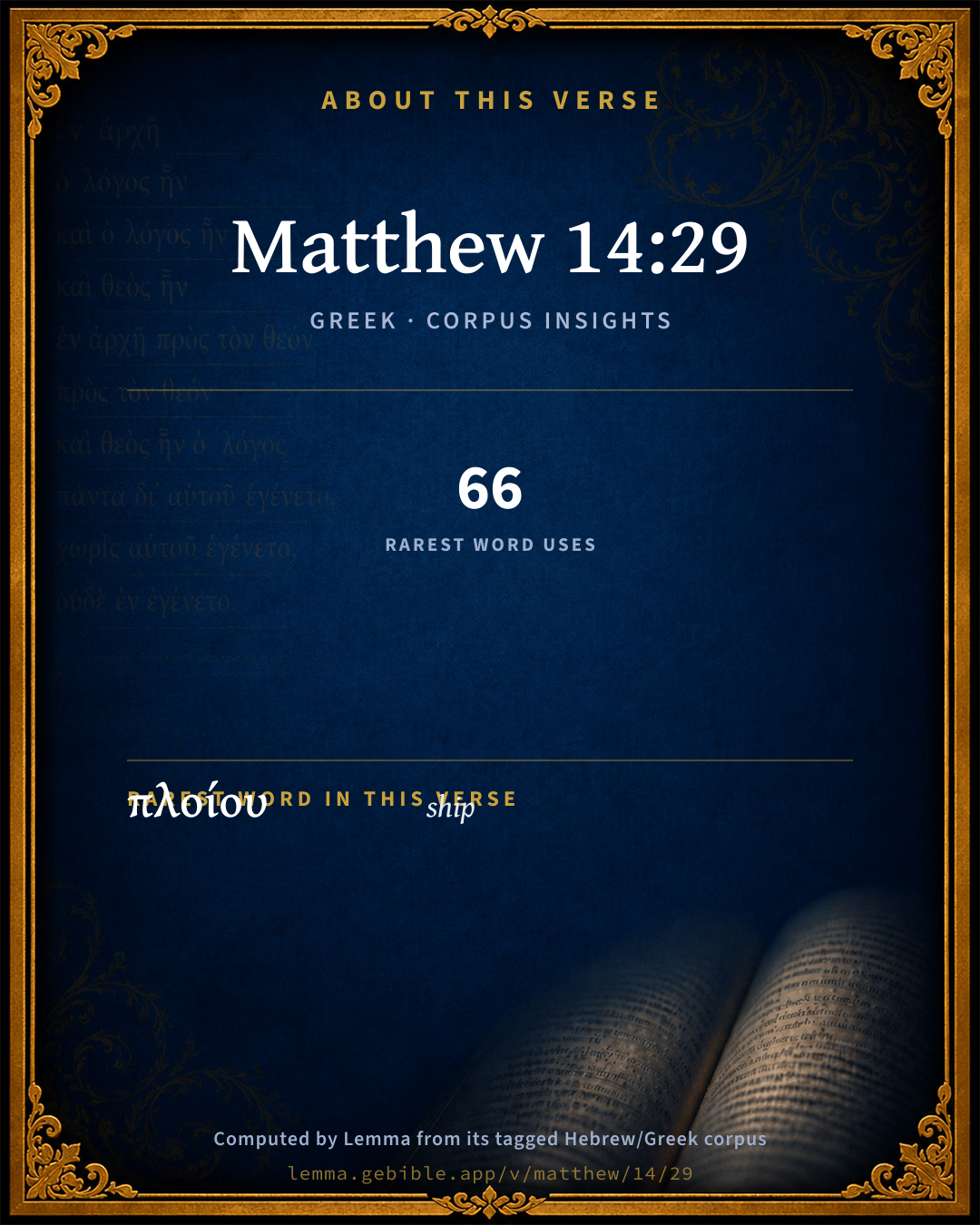
Matthew 14:29

Greek (Tischendorf 8th ed.) Matthew 14:29 appears in the Greek New Testament. The text above is from the Tischendorf 8th edition. Each word links to its Strong’s number and a concise gloss. Click any word for its full Thayer’s Greek Lexicon entry.
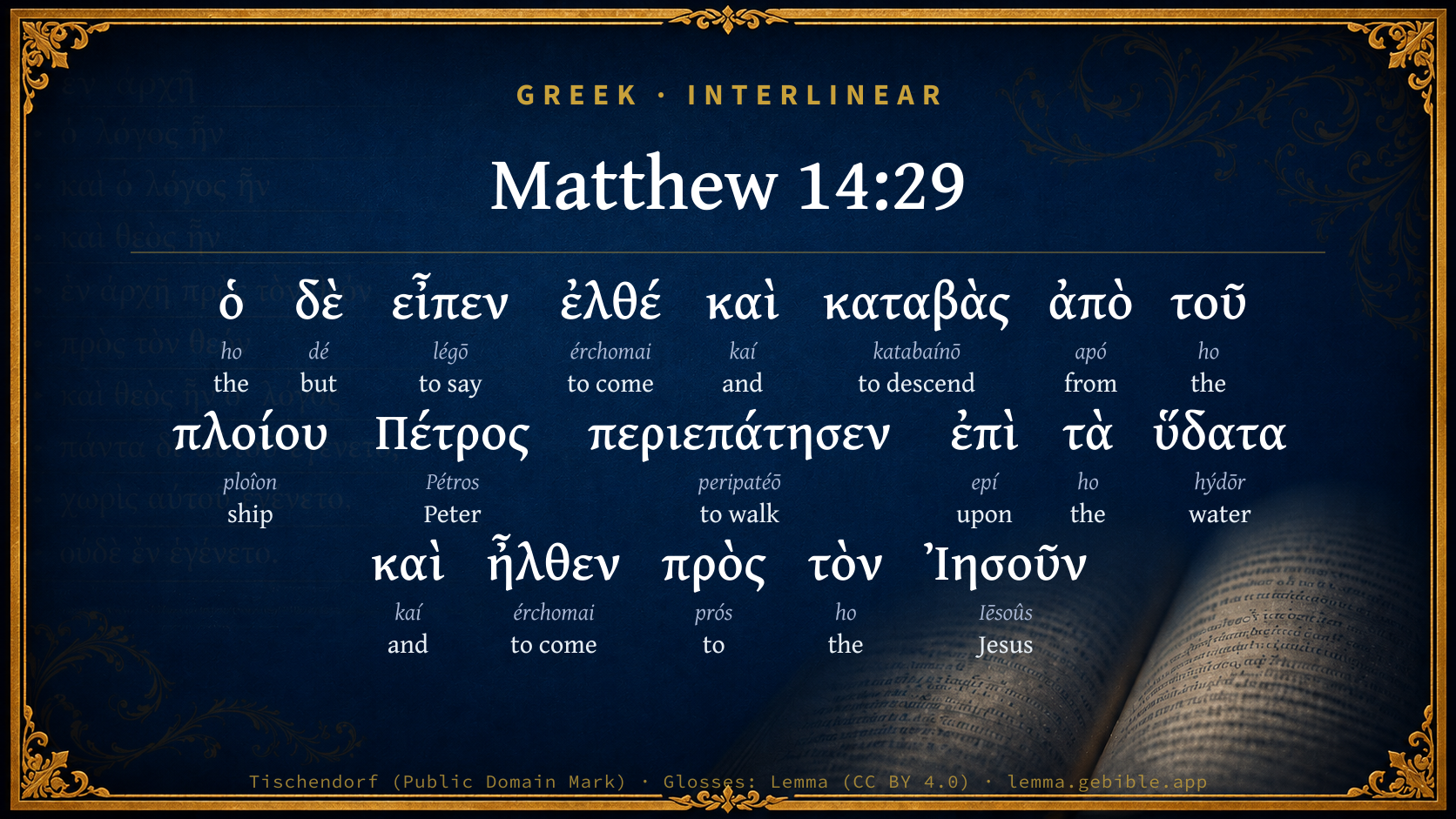
Download image
Cite this verse

Matthew 14:29 (World English Bible). Public Domain. Lemma interlinear Bible study tool, https://lemma.gebible.app/v/matthew/14/29.

Show BibTeX & RIS
BibTeX
RIS
English Translation
He said, "Come!" Peter stepped down from the boat, and walked on the waters to come to Jesus.
World English Bible · Public Domain
Download a study sheet

One document with this verse’s original text, its word-by-word gloss line, the meaning frame, cross-references with their text, attributed commentary, and full source and license credits — printable, and it pastes into notes with its structure intact.

This verse Autodidact and up

Study sheet (.html) Plain text (.txt)

A passage Seminary Student

Up to 50 verses in one chapter. A passage sheet keeps up to 6 commentary sources and 12 cross-references per verse, in the order this page ranks them, and says so on the sheet whenever that leaves anything out. Ask for a single verse and you get the Autodidact verse sheet above.

Everything on this page stays free to read, with no account — the sheet is a download of what is already on screen, not access to it.

Want to remove ads? Support Godless Engineer
Compare translations 3

The same verse in 3 English versions, stacked beneath the original-language interlinear above. Click any original word for its lexicon entry.

Each is an independent rendering of the whole verse — the interlinear is not word-aligned to these translations.

Highlighted words mark where these versions differ — a whole-verse word diff, not a word-by-word alignment.

  • World English Bible Public Domain
    He said, "Come!" Peter stepped down from the boat, and walked on the waters to come to Jesus.
  • King James Version Public Domain
    And he said, Come. And when Peter was come down out of the ship, he walked on the water, to go to Jesus.
  • unfoldingWord Literal Text CC BY-SA 4.0
    And he said, “Come.” And Peter, having gotten out from the boat, walked on the water to go to Jesus.

unfoldingWord Literal Text — © unfoldingWord, licensed CC BY-SA 4.0. Word-aligned USFM3 via Door43 (git.door43.org/unfoldingWord/en_ult).

Versions to compare (up to 4)

3 of 4 selected

Show all 19 translations

Every available English version of this verse, each an independent rendering of the whole verse.

  • World English Bible Public Domain
    He said, "Come!" Peter stepped down from the boat, and walked on the waters to come to Jesus.
  • Berean Standard Bible Public Domain
    “Come,” said Jesus. Then Peter got down out of the boat, walked on the water, and came toward Jesus.
  • Majority Standard Bible Public Domain
    “Come,” said Jesus. Then Peter got down out of the boat and walked on the water to go toward Jesus.
  • King James Version Public Domain
    And he said, Come. And when Peter was come down out of the ship, he walked on the water, to go to Jesus.
  • American Standard Version (1901) Public Domain
    And he said, Come. And Peter went down from the boat, and walked upon the waters to come to Jesus.
  • Revised Version (1885) Public Domain
    And he said, Come. And Peter went down from the boat, and walked upon the waters, to come to Jesus.
  • Geneva Bible (1599) Public Domain
    And he saide, Come. And when Peter was come downe out of the shippe, he walked on the water, to goe to Iesus.
  • Douay-Rheims (1899) Public Domain
    And he said: Come. And Peter going down out of the boat, walked upon the water to come to Jesus.
  • Young's Literal Translation Public Domain
    and he said, `Come;' and having gone down from the boat, Peter walked upon the waters to come unto Jesus,
  • Literal Standard Version CC BY-SA 4.0
    and He said, “Come”; and having gone down from the boat, Peter walked on the waters to come to Jesus,
  • Unlocked Literal Bible CC BY-SA 4.0
    Jesus said, “Come.” So Peter got out from the boat and walked on the water to go to Jesus.
  • unfoldingWord Literal Text CC BY-SA 4.0
    And he said, “Come.” And Peter, having gotten out from the boat, walked on the water to go to Jesus.
  • Darby Bible Public Domain
    And he said, Come. And Peter, having descended from the ship, walked upon the waters to go to Jesus.
  • World Messianic Bible Public Domain
    He said, “Come!” Peter stepped down from the boat and walked on the waters to come to Yeshua.
  • Webster's Bible Public Domain
    And he said, Come. And when Peter had come down out of the boat, he walked on the water, to go to Jesus.
  • Free Bible Version CC BY-SA 4.0
    “Come on then,” said Jesus. Peter got out of the boat and walked on the water towards Jesus.
  • Bible in Basic English Public Domain
    And he said, Come. And Peter got out of the boat, and walking on the water, went to Jesus.
  • Text-Critical English NT CC BY 4.0
    So he said, “Come.” Then Peter got down from the boat and walked on the water to go to Jesus.
  • Tyndale New Testament (1534) Public Domain
    And he sayde come. And when Peter was come doune out of the shippe he walked on the water to go to Iesus.

Literal Standard Version (2020), Covenant Press — licensed CC BY-SA 4.0. Text via the HelloAO Bible API (eBible.org). Unlocked Literal Bible (unfoldingWord) — licensed CC BY-SA 4.0. Text via the HelloAO Bible API (eBible.org). unfoldingWord Literal Text — © unfoldingWord, licensed CC BY-SA 4.0. Word-aligned USFM3 via Door43 (git.door43.org/unfoldingWord/en_ult). Free Bible Version, Dr. Jonathan Gallagher — licensed CC BY-SA 4.0. Text via the HelloAO Bible API (eBible.org).

Word by word

More ways to search: Search by grammar → Find every occurrence → Compare this word →

Practice this passage: Drill this verse → Learn its vocabulary →

πλοίου
ploîon
G4143
“ship”
Noun, Genitive, Singular, Neuter
Part of Speech
Noun
Case
Genitive
Number
Singular
Gender
Neuter
Full Thayer's Definition

Origin: from G4126

TDNT: None

1. a ship
  1. ὁ ho G3588 “the” Article, Nominative, Singular, Masculine
  2. δὲ dé G1161 “but” Conjunction
  3. εἶπεν légō G3004 “to say” Verb, Aorist, Active, Indicative, 3rd person, Singular
  4. ἐλθέ érchomai G2064 “to come” Verb, Aorist, Active, Imperative, 2nd person, Singular
  5. καὶ kaí G2532 “and” Conjunction
  6. καταβὰς katabaínō G2597 “to descend” Verb, Aorist, Active, Participle, Nominative, Singular, Masculine
  7. ἀπὸ apó G575 “from” Preposition
  8. τοῦ ho G3588 “the” Article, Genitive, Singular, Neuter
  9. Πέτρος Pétros G4074 “Peter” Noun, Nominative, Singular, Masculine
  10. περιεπάτησεν peripatéō G4043 “to walk” Verb, Aorist, Active, Indicative, 3rd person, Singular
  11. ἐπὶ epí G1909 “upon” Preposition
  12. τὰ ho G3588 “the” Article, Accusative, Plural, Neuter
  13. ὕδατα hýdōr G5204 “water” Noun, Accusative, Plural, Neuter
  14. καὶ kaí G2532 “and” Conjunction
  15. ἦλθεν érchomai G2064 “to come” Verb, Aorist, Active, Indicative, 3rd person, Singular
  16. πρὸς prós G4314 “to” Preposition
  17. τὸν ho G3588 “the” Article, Accusative, Singular, Masculine
  18. Ἰησοῦν Iēsoûs G2424 “Jesus” Noun, Accusative, Singular, Masculine

About this verse

These counts appear in no published source. They are computed here, from the morphology-tagged text and Lemma’s own curated glosses. What Lemma adds →

19
words
14
distinct lemmas
Gospels
section

Repetition

Words recur within this verse:

Cross-references

8

Topical passages linked to Matthew 14:29 in the Treasury of Scripture Knowledge — connected by theme and wording, ordered by reader-vote popularity; previews shown in the World English Bible.

  • Philippians 4:13 I can do all things through Christ, who strengthens me.
  • Mark 9:23 Jesus said to him, "If you can believe, all things are possible to him who believes."
  • Acts 3:16 By faith in his name has his name made this man strong, whom you see and know. Yes, the faith which is through him has given him this perfect soundness in the presence of you all.
  • Luke 17:6 The Lord said, "If you had faith like a grain of mustard seed, you would tell this sycamore tree, 'Be uprooted, and be planted in the sea,' and it would obey you.
  • Mark 11:22–23 Jesus answered them, "Have faith in God.
  • Matthew 21:21 Jesus answered them, "Most assuredly I tell you, if you have faith, and don't doubt, you will not only do what is done to the fig tree, but even if you told this mountain, 'Be taken up and cast into the sea,' it would be done.
  • Romans 4:19 Without being weakened in faith, he didn't consider his own body, already having been worn out, (he being about a hundred years old), and the deadness of Sarah's womb.
  • Matthew 17:20 He said to them, "Because of your unbelief. For most assuredly I tell you, if you have faith as a grain of mustard seed, you will tell this mountain, 'Move from here to there,' and it will move; and nothing will be impossible for you.

Cross-references courtesy of OpenBible.info (CC BY 4.0).

Commentary

Notes on Matthew 14:29 from classic Christian and Jewish commentators (each source and its license shown beneath its notes). The classic Christian expositions comment on the surrounding passage and are grouped to its opening verse, so a note may address several verses; the Jewish commentaries on the Tanakh (Rashi and others) are per-verse, so they appear only where the commentator wrote on this verse.

Lemma curates 59 commentaries, every one of them public domain or Creative Commons licensed, each selected and text-cleaned for this edition rather than reprinted as found. About our sources →

Bengel's Gnomon

Johann Albrecht Bengel

Mat 14:29. Ἐλθε, come) More is required of him who offers himself spontaneously to Christ; he is more greatly tempted, more mightily preserved.

Bengel's Gnomon of the New Testament — English translation (T&T Clark, Edinburgh, 1860) — public domain. Text from a community e-Sword module.

Jamieson, Fausset & Brown

Robert Jamieson, A. R. Fausset & David Brown

And he said, Come. And when Peter had come down out of the boat. he walked on the water, to go to Jesus--(Also see on Mar 6:50.)

Jamieson, Fausset & Brown — Commentary Critical and Explanatory on the Whole Bible (1871) — public domain (CC PDM 1.0). Text via the HelloAO Bible API.

Adam Clarke's Commentary

Verse 29. Peter - walked on the water] However impossible the thing commanded by Christ may appear, it is certain he will give power to accomplish it to those who receive his word by faith; but we must take care never to put Christ's power to the proof for the gratification of a vain curiosity; or even for the strengthening of our faith, when the ordinary means for doing that are within our reach.

Adam Clarke's Commentary on the Bible (1810–1826) — public domain. Text from a community e-Sword/MySword module.

The Cambridge Bible for Schools and Colleges

gen. ed. J. J. S. Perowne

29. And he said, Come] The boat was so near that the voice of Jesus could be heard even through the storm, though the wind was strong and the oarsmen labouring and perhaps calling out to one another. The hand of the Saviour was quite close to the sinking disciple.

The Cambridge Bible for Schools and Colleges (gen. ed. J. J. S. Perowne; Cambridge University Press, 1878–1918) — public domain. Text from a community e-Sword module.

John Gill's Exposition

But when he saw the wind boisterous,.... Or "strong", blowing hard against him, and raising up the waves, which beat with great violence upon him,

he was afraid; though Christ was so nigh him, and he had had such an instance of his power in bearing him up, causing him to walk upon the waters thus far; which shows, that his faith was imperfect:

and beginning to sink; through fear, and the violence of the wind and waves, just ready to be immersed, and go down to the bottom of the sea,

he cried; being in a great fright and much danger, and with great importunity and eagerness,

saying, Lord, save me: I am just going, I shall certainly perish else; still having so much faith in Christ, that he was able to save him in the last extremity.

John Gill's Exposition of the Whole Bible (1746–1763) — public domain (CC PDM 1.0). Text via the HelloAO Bible API.

Trapp's Complete Commentary

John Trapp

29 And he said, Come. And when Peter was come down out of the ship, he walked on the water, to go to Jesus.

Ver. 29. And he said, Come] Had the Pharisees asked a sign, they should have gone without, and have heard, Wicked and bastardly brood, as Mat 12:39. But a Peter shall have it, rather than he shall halt between two, as the word is, Mat 14:31. {a} Christ condescends to his infirmity, and bids him come. And the like was his dealing with that virtuous gentlewoman, Mistress Honywood; who, doubting much of her salvation, was often counselled by a worthy minister to take heed of inquiries further than God’s word, &c. Yet still did the temptation grow upon her, insomuch that having a Venice glass in her hand, and the same minister sitting by her; "You have often told me," said she to him, "that I must seek no further than God’s word. But I have been long without comfort, and can endure no longer; therefore if I must be saved let this glass be kept from breaking;" and so she threw it against the walls. The glass rebounds again and comes safe to the ground; which the minister having gotten into his hands, saith, "Oh, repent of this sin, bless God for his mercy, and never distrust him more of his promise; for now you have his voice from heaven in a miracle, telling you plainly of your estate." "This was curiosity," saith my author, "and might have brought despair; yet it was the Lord’s mercy to remit the fault and grant an extraordinary confirmation of her faith."

{a} δια τι εδιστασας. Sic dubito non inepte explanari possit, quasi sit a duo et ito. Beem.

John Trapp, A Commentary or Exposition upon All the Books of the Old and New Testament (1647–1656) — public domain. Text from a community e-Sword module.

Haydock's Catholic Bible Commentary

Let those who argue that the body of our Saviour was not a real but an aerial body, or phantom, because he walked upon the waters, explain to us how St. Peter, whom they will not deny to be a true man, walked on the waters. (St. Jerome)

George Leo Haydock (1774–1849), Haydock's Catholic Family Bible and Commentary, 1859 edition — public domain. Excludes Psalms (Douay-Rheims chapter numbering differs from Protestant) and Deuterocanonical books (Catholic canon only).

Matthew Poole's English Annotations

Peter, by saying if it be thou, showed that his faith was not so strong as it should have been, after he had heard his Master’s voice. By his saying to him,

bid me come unto thee on the water, he showeth a something stronger faith, and a resolution to obey his command; but his fear afterward, when the wind began to rise higher, and he began to sink, argued again the infirmity of his faith. Thus Peter is a pattern of the best believers, who though they may sometimes think that they could trust God in any state or condition, yet often mistake their own hearts, and begin to shrink in an hour of great extremity; which lets us see what need we have to pray, that God would not lead us by his providence into great temptations, much more to take heed that we do not throw ourselves into them. No man knows how he shall find his heart under a great temptation, until he hath tried it. It therefore gives us a caution, as against condemning others, so against boasting, and too much confidence as to ourselves, and lets us see how much need we have to keep our eye upon Christ and his strength in such an hour.

And immediately Jesus stretched forth his hand: God is never far off from his people when extreme troubles are hard at hand. Christ says Peter, but not without a cheek;

O thou of little faith, wherefore didst thou doubt? Doubting is directly contrary to faith, yet it will not conclude a soul to have no faith, only a little faith.

Matthew Poole's English Annotations on the Holy Bible (1683–1685) — public domain. Text from a community e-Sword/MySword module.

Whedon's Commentary on the Bible

Daniel D. Whedon

29. Come — Our Lord did not quite say, Come to me, but Come; and Peter did come, but not quite to Jesus. Jesus came to him. He walked on the water — So that Peter actually performed the miracle.

Daniel D. Whedon (gen. ed.), Commentary on the Old and New Testaments (1874–1909) — public domain. Text from a community e-Sword module.

The Pulpit Commentary

And he said, Come. Our Lord takes him at his word, and gives the command. It is not merely a permission. Observe that our Lord never blames him for having made the request. His venture of faith would have been altogether successful had his faith continued. And when Peter was come down out of the ship. The Revised Version has more simply, And Peter went down from the boat, and. He walked on the water. For the narrator was chiefly interested in his walking there (contrast ver. 28). To go to Jesus; rather, and came to Jesus (Westcott and Hort; cf. margin of Revised Version). The true text states what did, in fact, happen, notwithstanding Peter"s lack of faith (cf. ver. 31).

Vers. 29, 30. The lack of staying power.

"But when he saw the wind boisterous, he was afraid." It is the weakness of the impulsive man that he has no staying power, and is only good for the little while that the fit is on him. It is the weakness of impulsive, excitable nations, that while they are splendid at a dash, they have none of the persistency that holds on until the end is fully secured. St. Peter often spoke and acted before he thought. Behind him was impulse rather than resolve. So difficulties created at once a new and opposing impulse. He failed as quickly and as unreasonably as he acted. The men who succeed in life are the men who can hold on. St. Peter might have safely walked the water if he had held on the faith with which he started from the boat, and which had received the Master"s approval.

I ST. PETER ATTEMPTED AN IMPOSSIBILITY. There is nothing that men regard as so impossible as "walking on the sea." Men can walk on the narrowest ledges of the loftiest cliffs, or on the thinnest ropes, but not on the water. The Egyptians, in their hieroglyphics, were wont to represent an impossibility by painting the figure of a man with his feet walking upon the sea. St. Peter saw this impossibility overcome by his Master. A sudden thought seized him. He should like to do what his Master did. It was a child"s wish; but it showed love and trust. He spoke it out. The Master said "Come," and he tried to do the impossible. A nobler man than those who never had such thoughts, and never made such attempts.

II ST. PETER BEGAN TO SUCCEED WITH HIS IMPOSSIBILITY. A man can walk steadily along a very dangerous place if he looks up at the steadfast sky. He will be giddy if he ventures to look around or to look down. It is thus always in the spiritual spheres. St. Peters can always walk safely, even on the treacherous waters, so long as they look up and away to the steadfast Christ. They will fail and fall as soon as they look around, or down, or within. And the reason is that man is strong when he leans on another, but weak when he trusts to himself. The impulsive man leans for a minute and is strong; then impulse fails, and he is, like Samson, weak as other men.

III ST. PETER SOON FAILED WITH HIS IMPOSSIBILITY. If he could have kept his eye and mind fixed on Jesus he would have succeeded. But he thought of the wind; and the wind took the place of Jesus. Jesus quickened faith ; the wind quickened fear. Faith makes a man strong. Fear wholly unnerves. What St. Peter needed for success was "staying power of faith." Keeping on trusting. Keeping on "looking off unto Jesus;" "patient continuance in well doing, R.T.

The Pulpit Commentary (1880–1919), ed. H.D.M. Spence-Jones & Joseph S. Exell — public domain. Text from a community e-Sword module.

MacLaren's Expositions of Holy Scripture

Alexander MacLaren

Matthew

THE KING’S HIGHWAY

Mat 14:22 - Mat 14:36.

The haste and urgency with which the disciples were sent away, against their will, after the miracle of feeding the five thousand, is explained in John’s account. The crowd had been excited to a dangerous enthusiasm by a miracle so level to their tastes. A prophet who could feed them was something like a prophet. So they determine to make him a king. Our Lord, fearing the outburst, resolves to withdraw into the lonely hills, that the fickle blaze may die down. If the disciples had remained with Him, He could not have so easily stolen away, and they might have caught the popular fervour. To divide would distract the crowd, and make it easier for Him to disperse them, while many of them, as really happened, would be likely to set off by land for Capernaum, when they saw the boat had gone. The main teaching of this miracle, over and above its demonstration of the Messianic power of our Lord, is symbolical. All the miracles are parables, and this eminently so. Thus regarding it, we have-

I. The struggling toilers and the absent Christ.

They had a short row of some five or six miles in prospect, when they started in the early evening. An hour or so might have done it, but, for some unknown reason, they lingered. Perhaps instead of pulling across, they may have kept inshore, by the head of the lake, expecting Jesus to join them at some point. Thus, night finds them but a short way on their voyage. The paschal moon would be shining down on them, and perhaps in their eager talk about the miracle they had just seen, they did not make much speed. A sudden breeze sprang up, as is common at nightfall on mountain lakes; and soon a gale, against which they could make no headway, was blowing in their teeth. This lasted for eight or nine hours. Wet and weary, they tugged at the oars through the livelong night, the seas breaking over them, and the wind howling down the glens.

They had been caught in a similar storm once before, but then He had been on board, and it was daylight. Now it was dark, ‘and Jesus had not yet come to them,’ How they would look back at the dim outline of the hills, where they knew He was, and wonder why He had sent them out into the tempest alone! Mark tells us that He saw them distressed, hours before He came to them, and that makes His desertion the stranger. It is but His method of lovingly training them to do without His personal presence, and a symbol of what is to be the life of His people till the end. He is on the mountain in prayer, and He sees the labouring boat and the distressed rowers. The contrast is the same as is given in the last verses of Mark’s Gospel, where the serene composure of the Lord, sitting at the right hand of God, is sharply set over against the wandering, toiling lives of His servants, in their evangelistic mission. The commander-in-chief sits apart on the hill, directing the fight, and sending regiment after regiment to their deaths. Does that mean indifference? So it might seem but for the words which follow, ‘the Lord working with them.’ He shares in all the toil; and the lifting up of His holy hands sways the current of the fight, and inclines the balance. His love appoints effort and persistent struggle as the law of our lives. Nor are we to mourn or wonder; for the purpose of the appointment, so far as we are concerned, is to make character, and to give us ‘the wrestling thews that throw the world.’ Difficulties make men of us. Summer sailors, yachting in smooth water, have neither the joy of conflict nor the vigour which it gives. Better the darkness, when we cannot see our way, and the wind in our faces, if the good of things is to be estimated by their power to ‘strengthen us with strength in our soul!’

II. We have the approaching Christ.

Not till the last watch of the night does He come, when they have long struggled, and the boat is out in the very middle of the lake, and the storm is fiercest. We may learn from this the delays of His love. Because He loved Mary and Martha and Lazarus, He stayed still, in strange inaction, for two days, after their message. Because He loved Peter and the praying band, He let him lie in prison till the last hour of the last watch of the last night before his intended execution, and then delivered him with a leisureliness {making him put on article after article of dress} which tells of conscious omnipotence. Heaven’s clock goes at a different rate from our little timepieces. God’s day is a thousand years, and the longest tarrying is but ‘a little while.’ When He has come, we find that it is ‘right early,’ though before He came He seemed to us to delay. He comes across the waves. Their restless and yielding crests are smoothed and made solid by the touch of His foot. ‘He walketh on the sea as on a pavement’ {Septuagint version of Job 9:8}. It is a revelation of divine power. It is one of the very few miracles affecting Christ’s own person, and may perhaps be regarded as being, like the Transfiguration, a casual gleam of latent glory breaking through the body of His humiliation, and so, in some sense, prophetic. But it is also symbolic. He ever uses tumults and unrest as a means of advancing His purposes. The stormy sea is the recognised Old Testament emblem of antagonism to the divine rule; and just as He walked on the billows, so does He reach His end by the very opposition to it, ‘girding Himself’ with the wrath of men, and making it to praise Him. In this sense, too, His ‘paths are in the great waters.’ In another aspect, we have here the symbol of Christ’s using our difficulties and trials as the means of His loving approach to us. He comes, giving a deeper and more blessed sense of His presence by means of our sorrows, than in calm sunny weather. It is generally over a stormy sea that He comes to us, and golden treasures are thrown on our shores after a tempest.

III. We have the terror and the recognition.

The disciples were as yet little lifted above their fellows; they had no expectation of His coming, and thought just what any rude minds would have thought, that this mysterious Thing stalking towards them across the waters came from the unseen world, and probably that it was the herald of their drowning. Terror froze their blood, and brought out a shriek {as the word might be rendered} which was heard above the dash of waves and the raving wind. They had gallantly fought the tempest, but this unmanned them. We too often mistake Christ, when He comes to us. We do not recognise His working in the storm, nor His presence giving power to battle with it. We are so absorbed in the circumstances that we fail to see Him through them. Our tears weave a veil which hides Him, or the darkness obscures His face, and we see nothing but the threatening crests of the waves, curling high above our little boat. We mistake our best friend, and we are afraid of Him as we dimly see Him; and sometimes we think that the tokens of His presence are only phantasms of our own imagination.

They who were deceived by His appearance knew Him by His voice, as Mary did at the sepulchre. How blessed must have been the moment when that astounding certitude thrilled through their souls! That low voice is audible through all the tumult. He speaks to us by His word, and by the silent speech in our spirits, which makes us conscious that He is there. He does speak to us in the deepest of our sorrows, in the darkest of our nights; and when we hear of His voice, and with wonder and joy cry out, ‘It is the Lord,’ our sorrow is soothed, and the darkness is light about us.

The consciousness of His presence banishes all fear. ‘Be not afraid,’ follows ‘It is I.’ It is of no use to preach courage unless we preach Christ first. If we have not Him with us, we do well to fear: His presence is the only rational foundation for calm fearlessness. Only when the Lord of Hosts is with us, ought we not to fear, ‘though the waters roar . . . and be troubled.’ ‘Through the dear might of Him that walked the waves’ can we feeble creatures face all terrors, and feel no terror.

IV. We have the end of the storm and of the voyage.

The storm ceases as soon as Jesus is on board. John does not mention the cessation of the tempest, but tells us that they were immediately at the shore. It does not seem necessary to suppose another miracle, but only that the voyage ended very speedily. It is not always true that His presence is the end of dangers and difficulties, but the consciousness of His presence does hush the storm. The worst of trouble is gone when we know that He shares it; and though the long swell after the gale may last, it no longer threatens. Nor is it always true that His coming, and our consciousness that He has come, bring a speedy close to toils. We have to labour on, but in how different a mood these men would bend to their oars after they had Him on board! With Him beside us toil is sweet, burdens are lighter, and the road is shortened. Even with Him on board, life is a stormy voyage; but without Him, it ends in shipwreck. With Him, it may be long, but it will look all the shorter while it lasts, and when we land the rough weather will be remembered but as a transient squall. These wearied rowers, who had toiled all night, stepped on shore as the morning broke on the eastern bank. So we, if we have had Him for our shipmate, shall land on the eternal shore, and dry our wet garments in the sunshine, and all the stormy years that seemed so long shall be remembered but as a watch in the night.

Alexander MacLaren, Expositions of Holy Scripture (1904–1910) — public domain. Text from a community e-Sword module.

The People's New Testament

B. W. Johnson

29. And he said, Come. I suppose the Lord bade Peter to come in order to teach him a lesson.

B. W. Johnson's The People's New Testament with Notes (1889–1891) — public domain. Electronic text from the Christian Classics Ethereal Library (CCEL) ThML edition.

Cambridge Greek Testament for Schools and Colleges

29. ὁ δὲ εἶπεν, ἐλθέ. The boat was so near that the voice of Jesus could be heard even through the storm, though the wind was strong and the oarsmen labouring and perhaps calling out to one another. The hand of the Saviour was quite close to the sinking disciple.

Cambridge Greek Testament for Schools and Colleges (Cambridge University Press, 1896; 21 vols, various authors incl. Carr, Maclear, Plummer, Farrar, Lumby, Moule, M. R. James, Simcox) — public domain. Text from a community e-Sword module.

Vincent's Word Studies in the New Testament

Marvin R. Vincent

To go to [ελθειν προς] . But some of the best texts read kai hlqen prov, and went toward.

Marvin R. Vincent, Word Studies in the New Testament (1887–1900) — public domain. Text from a community e-Sword/MySword module.

Lesson kit

Teaching starters — assembled from the data on this page, not authored interpretation. Every prompt links to the verse data it draws on. Edit before teaching.

Matthew, in the Gospels, opens this verse with 19 words (14 distinct Greek lemmas). Its most distinctive word is ploîon (“ship”). A historical commentator’s framing appears above. Read the whole chapter for the surrounding context.

Discussion questions

  1. What does “ship” (ploîon) contribute to the verse as a whole?
  2. Philippians 4:13 shares this passage’s theme. How do the two illuminate each other?
  3. “to come” occurs 2× in this one verse. What is the effect of the repetition?
  4. These translations render this verse differently. What is at stake in choosing one wording over another?
  5. Reading how Bengel's Gnomon and Jamieson, Fausset & Brown read this verse, where do the two commentators agree and where do they part?

Things to notice

Reading settings

Reading text

Shown beneath each verse's original-language words.

Old Testament
Old Testament edition

Read the OT as the Masoretic Hebrew (MT) or the Greek Septuagint (LXX).

English shown for the Greek Septuagint (in the Hebrew ↔ Greek comparison).

Comparing translations? Open the Compare panel on any verse page to stack up to four side by side.