

Matthew 15:9
Greek (Tischendorf 8th ed.) Matthew 15:9 appears in the Greek New Testament. The text above is from the Tischendorf 8th edition. Each word links to its Strong’s number and a concise gloss. Click any word for its full Thayer’s Greek Lexicon entry.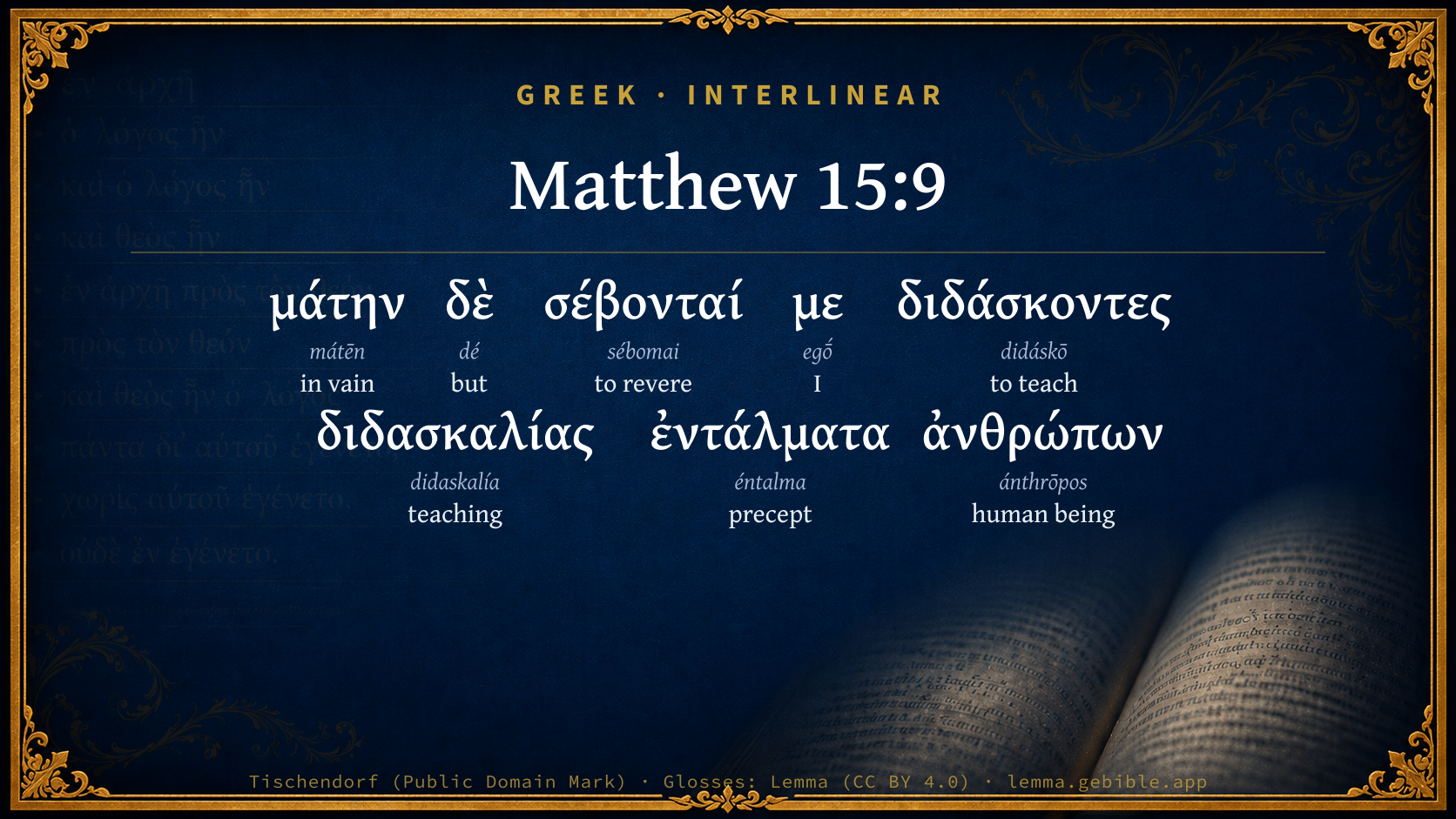
And in vain do they worship me, Teaching as doctrine rules made by men.'"
Download a study sheet
One document with this verse’s original text, its word-by-word gloss line, the meaning frame, cross-references with their text, attributed commentary, and full source and license credits — printable, and it pastes into notes with its structure intact.
This verse Autodidact and up
A passage Seminary Student
Up to 50 verses in one chapter. A passage sheet keeps up to 6 commentary sources and 12 cross-references per verse, in the order this page ranks them, and says so on the sheet whenever that leaves anything out. Ask for a single verse and you get the Autodidact verse sheet above.
Everything on this page stays free to read, with no account — the sheet is a download of what is already on screen, not access to it.
Compare translations 3
The same verse in 3 English versions, stacked beneath the original-language interlinear above. Click any original word for its lexicon entry.
Each is an independent rendering of the whole verse — the interlinear is not word-aligned to these translations.
Highlighted words mark where these versions differ — a whole-verse word diff, not a word-by-word alignment.
-
World English Bible Public Domain
And in vain do they worship me, Teaching as doctrine rules made by men.'"
-
King James Version Public Domain
But in vain they do worship me, teaching for doctrines the commandments of men.
-
unfoldingWord Literal Text CC BY-SA 4.0
But they worship me in vain, teaching as doctrines commandments of men.’”
unfoldingWord Literal Text — © unfoldingWord, licensed CC BY-SA 4.0. Word-aligned USFM3 via Door43 (git.door43.org/unfoldingWord/en_ult).
Show all 19 translations
Every available English version of this verse, each an independent rendering of the whole verse.
-
World English Bible Public Domain
And in vain do they worship me, Teaching as doctrine rules made by men.'"
-
Berean Standard Bible Public Domain
They worship Me in vain; they teach as doctrine the precepts of men.’”
-
Majority Standard Bible Public Domain
They worship Me in vain; they teach as doctrine the precepts of men.’”
-
King James Version Public Domain
But in vain they do worship me, teaching for doctrines the commandments of men.
-
American Standard Version (1901) Public Domain
But in vain do they worship me, Teaching `as their' doctrines the precepts of men.
-
Revised Version (1885) Public Domain
But in vain do they worship me, Teaching as their doctrines the precepts of men.
-
Geneva Bible (1599) Public Domain
But in vaine they worship me, teaching for doctrines, mens precepts.
-
Douay-Rheims (1899) Public Domain
And in vain do they worship me, teaching doctrines and commandments of men.
-
Young's Literal Translation Public Domain
and in vain do they worship Me, teaching teachings -- commands of men.'
-
Literal Standard Version CC BY-SA 4.0
and in vain they worship Me, teaching teachings—commands of men.”
-
Unlocked Literal Bible CC BY-SA 4.0
They worship me in vain, because they teach as their doctrines the commandments of people.'”
-
unfoldingWord Literal Text CC BY-SA 4.0
But they worship me in vain, teaching as doctrines commandments of men.’”
-
Darby Bible Public Domain
but in vain do they worship me, teaching [as] teachings commandments of men.
-
World Messianic Bible Public Domain
And they worship me in vain, teaching as doctrine rules made by men.’”
-
Webster's Bible Public Domain
But in vain they do worship me, teaching for doctrines the commandments of men.
-
Free Bible Version CC BY-SA 4.0
Their worship of me is pointless. What they teach are just man-made requirements.’”
-
Bible in Basic English Public Domain
But their worship is to no purpose, while they give as their teaching the rules of men.
-
Text-Critical English NT CC BY 4.0
They worship me in vain, teaching as doctrines the commandments of men.’ ”
-
Tyndale New Testament (1534) Public Domain
but in vayne they worshippe me teachinge doctrines whiche are nothing but mens precepts.
Literal Standard Version (2020), Covenant Press — licensed CC BY-SA 4.0. Text via the HelloAO Bible API (eBible.org). Unlocked Literal Bible (unfoldingWord) — licensed CC BY-SA 4.0. Text via the HelloAO Bible API (eBible.org). unfoldingWord Literal Text — © unfoldingWord, licensed CC BY-SA 4.0. Word-aligned USFM3 via Door43 (git.door43.org/unfoldingWord/en_ult). Free Bible Version, Dr. Jonathan Gallagher — licensed CC BY-SA 4.0. Text via the HelloAO Bible API (eBible.org).
Word by word
More ways to search: Search by grammar → Find every occurrence → Compare this word →
Practice this passage: Drill this verse → Learn its vocabulary →
- Appears 2× in the Greek New Testament
- First appears here
- Part of Speech
- Adverb
Full Thayer's Definition
- μάτην mátēn G3155 “in vain” Adverb
- δὲ dé G1161 “but” Conjunction
- σέβονταί sébomai G4576 “to revere” Verb, Present, Middle or Passive deponent, Indicative, 3rd person, Plural
- με egṓ G1473 “I” Personal pronoun, 1st person, Accusative, Singular
- διδάσκοντες didáskō G1321 “to teach” Verb, Present, Active, Participle, Nominative, Plural, Masculine
- διδασκαλίας didaskalía G1319 “teaching” Noun, Accusative, Plural, Feminine
- ἐντάλματα éntalma G1778 “precept” Noun, Accusative, Plural, Neuter
- ἀνθρώπων ánthrōpos G444 “human being” Noun, Genitive, Plural, Masculine
About this verse
These counts appear in no published source. They are computed here, from the morphology-tagged text and Lemma’s own curated glosses. What Lemma adds →
- 8
- words
- 8
- distinct lemmas
- Gospels
- section
Notable vocabulary
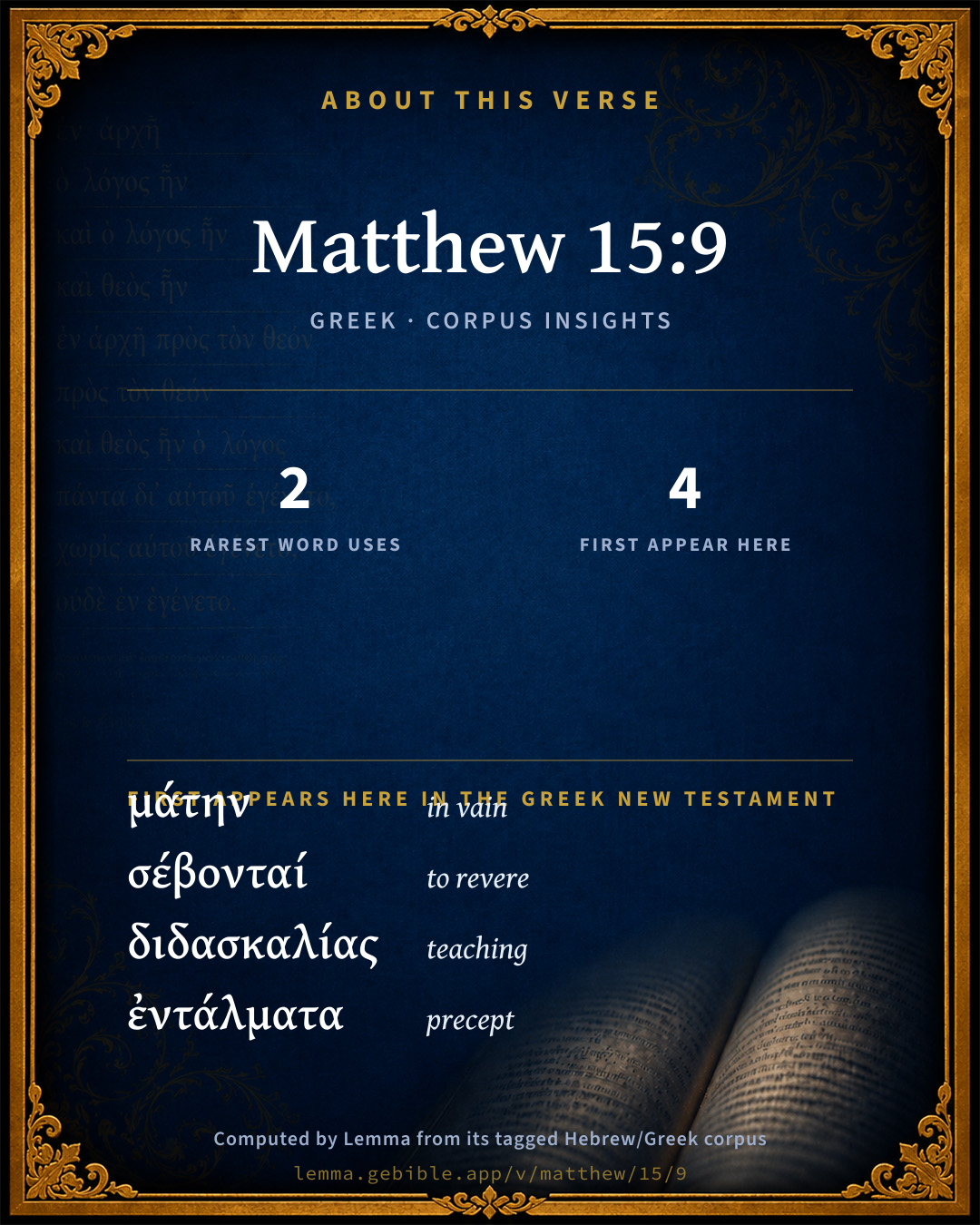
The rarest word here is μάτην in vain G3155 — appearing just 2 times in the whole Greek New Testament.
First appearance in Scripture
These words make their first canonical appearance in the Greek New Testament here:
Shared distinctive vocabulary
μάτην in vain G3155 occurs in 2 verses of the Greek New Testament. Also found in:
Cross-references
22Topical passages linked to Matthew 15:9 in the Treasury of Scripture Knowledge — connected by theme and wording, ordered by reader-vote popularity; previews shown in the World English Bible.
- Isaiah 29:13 The Lord said, Because this people draw near [to me], and with their mouth and with their lips to honor me, but have removed their heart far from me, and their fear of me is a commandment of men which has been taught [them];
- Mark 7:7 But in vain do they worship me, Teaching as doctrines the commandments of men.'
- 1 Timothy 1:4 neither to pay attention to myths and endless genealogies, which cause disputes, rather than God's stewardship, which is in faith--
- Titus 1:14 not paying attention to Jewish fables and commandments of men who turn away from the truth.
- Colossians 2:18–22 Let no one rob you of your prize by a voluntary humility and worshipping of the angels, dwelling in the things which he has not seen, vainly puffed up by his fleshly mind,
- 1 Timothy 4:6–7 If you instruct the brothers of these things, you will be a good servant of Christ Jesus, nourished in the words of the faith, and of the good doctrine which you have followed.
- Hebrews 13:9 Don't be carried away by various and strange teachings, for it is good that the heart be established by grace, not by food, through which those who were so occupied were not benefited.
- Isaiah 58:1–3 Cry aloud, don't spare, lift up your voice like a trumpet, and declare to my people their disobedience, and to the house of Jacob their sins.
- James 2:20 But do you want to know, vain man, that faith apart from works is dead?
- Deuteronomy 12:32 Whatever thing I command you, that shall you observe to do: you shall not add thereto, nor diminish from it.
- Exodus 20:7 "You shall not take the name of Yahweh your God in vain, for Yahweh will not hold him guiltless who takes his name in vain.
- 1 Samuel 25:21 Now David had said, Surely in vain have I kept all that this fellow has in the wilderness, so that nothing was missed of all that pertained to him: and he has returned me evil for good.
- Psalms 73:13 Surely in vain I have cleansed my heart, And washed my hands in innocence,
- 1 Timothy 4:1–3 But the Spirit says expressly that in later times some will fall away from the faith, paying attention to seducing spirits and doctrines of demons,
- Revelation 22:18 I testify to everyone who hears the words of the prophecy of this book, if anyone adds to them, may God add to him the plagues which are written in this book.
- Leviticus 26:16 I also will do this to you: I will appoint terror over you, even consumption and fever, that shall consume the eyes, and make the soul to pine away; and you will sow your seed in vain, for your enemies will eat it.
- Leviticus 26:20 and your strength will be spent in vain; for your land won't yield its increase, neither will the trees of the land yield their fruit.
- Psalms 39:6 "Surely every man walks like a shadow. Surely they busy themselves in vain. He heaps up, and doesn't know who shall gather.
- Proverbs 30:5–6 "Every word of God is flawless. He is a shield to those who take refuge in him.
- Ecclesiastes 5:2–7 Don't be rash with your mouth, and don't let your heart be hasty to utter anything before God; for God is in heaven, and you on earth. Therefore let your words be few.
- Isaiah 1:13–15 Bring no more vain offerings. Incense is an abomination to me; New moons, Sabbaths, and convocations: I can't bear with evil assemblies.
- Malachi 3:14 You have said, 'It is vain to serve God;' and 'What profit is it that we have kept his charge, and that we have walked mournfully before Yahweh of Hosts?
Cross-references courtesy of OpenBible.info (CC BY 4.0).
Lesson kit
Teaching starters — assembled from the data on this page, not authored interpretation. Every prompt links to the verse data it draws on. Edit before teaching.
Matthew, in the Gospels, opens this verse with 8 words (8 distinct Greek lemmas). Its most distinctive word is mátēn (“in vain”). A historical commentator’s framing appears above. Read the whole chapter for the surrounding context.
Discussion questions
- How does “in vain” (mátēn) shape what this verse is saying?
- 4 words make their first appearance in Scripture here. What does this debut establish?
- How does Mark 7:7, which shares the word «in vain», read alongside this verse?
- These translations render this verse differently. What is at stake in choosing one wording over another?
- Compare how Bengel's Gnomon and Adam Clarke's Commentary read this verse. Where do they agree or differ?
Things to notice
- 4 words make their first canonical appearance in Scripture here.
- These translations choose different wording for 6 words in this verse.
- 8 distinct Greek lemmas span 8 words in this verse.
Commentary
Notes on Matthew 15:9 from classic Christian and Jewish commentators (each source and its license shown beneath its notes). The classic Christian expositions comment on the surrounding passage and are grouped to its opening verse, so a note may address several verses; the Jewish commentaries on the Tanakh (Rashi and others) are per-verse, so they appear only where the commentator wrote on this verse.
Lemma curates 59 commentaries, every one of them public domain or Creative Commons licensed, each selected and text-cleaned for this edition rather than reprinted as found. About our sources →
Bengel's Gnomon
Johann Albrecht Bengel
Bengel's Gnomon of the New Testament — English translation (T&T Clark, Edinburgh, 1860) — public domain. Text from a community e-Sword module.
Adam Clarke's Commentary
Adam Clarke's Commentary on the Bible (1810–1826) — public domain. Text from a community e-Sword/MySword module.
Ellicott's Commentary for English Readers
A Bible Commentary for English Readers, edited by Charles John Ellicott (1878–1897) — public domain. Text from a community e-Sword module.
John Gill's Exposition
John Gill's Exposition of the Whole Bible (1746–1763) — public domain (CC PDM 1.0). Text via the HelloAO Bible API.
Trapp's Complete Commentary
John Trapp
John Trapp, A Commentary or Exposition upon All the Books of the Old and New Testament (1647–1656) — public domain. Text from a community e-Sword module.
Haydock's Catholic Bible Commentary
George Leo Haydock (1774–1849), Haydock's Catholic Family Bible and Commentary, 1859 edition — public domain. Excludes Psalms (Douay-Rheims chapter numbering differs from Protestant) and Deuterocanonical books (Catholic canon only).
Whedon's Commentary on the Bible
Daniel D. Whedon
Daniel D. Whedon (gen. ed.), Commentary on the Old and New Testaments (1874–1909) — public domain. Text from a community e-Sword module.
The Pulpit Commentary
The Pulpit Commentary (1880–1919), ed. H.D.M. Spence-Jones & Joseph S. Exell — public domain. Text from a community e-Sword module.
John Wesley's Explanatory Notes
John Wesley, Explanatory Notes Upon the Whole Bible (1754–1765) — public domain. Text via the GEBible commentary corpus.
The People's New Testament
B. W. Johnson
B. W. Johnson's The People's New Testament with Notes (1889–1891) — public domain. Electronic text from the Christian Classics Ethereal Library (CCEL) ThML edition.
Cambridge Greek Testament for Schools and Colleges
Cambridge Greek Testament for Schools and Colleges (Cambridge University Press, 1896; 21 vols, various authors incl. Carr, Maclear, Plummer, Farrar, Lumby, Moule, M. R. James, Simcox) — public domain. Text from a community e-Sword module.
Alford’s Greek Testament
Henry Alford
Henry Alford, The Greek Testament (1849–1861) — public domain. Text from a community e-Sword module.
International Critical Commentary
International Critical Commentary — older volumes (1896–1929), various authors — public domain. Text from a community e-Sword module.