Matthew 5:31

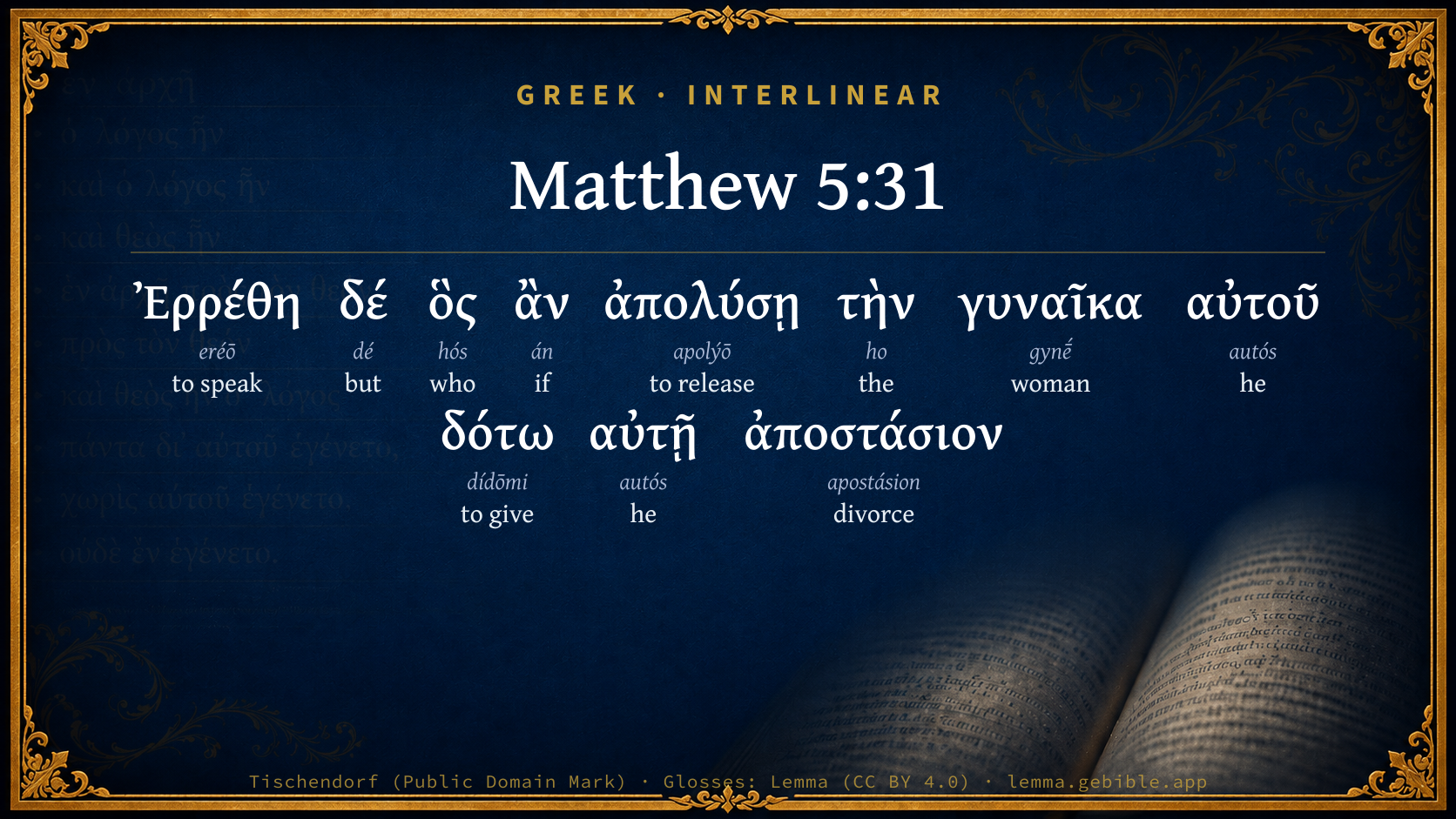
Greek (Tischendorf 8th ed.) Matthew 5:31 appears in the Greek New Testament. The text above is from the Tischendorf 8th edition. Each word links to its Strong’s number and a concise gloss. Click any word for its full Thayer’s Greek Lexicon entry.
Download image
Cite this verse

Matthew 5:31 (World English Bible). Public Domain. Lemma interlinear Bible study tool, https://lemma.gebible.app/v/matthew/5/31.

Show BibTeX & RIS
BibTeX
RIS
English Translation
"It was also said, 'Whoever shall put away his wife, let him give her a writing of divorce,'
World English Bible · Public Domain
Highlights
  • 1 first appearance in the Greek New Testament
Full analysis ↓
Download a study sheet

One document with this verse’s original text, its word-by-word gloss line, the meaning frame, cross-references with their text, attributed commentary, and full source and license credits — printable, and it pastes into notes with its structure intact.

This verse Autodidact and up

Study sheet (.html) Plain text (.txt)

A passage Seminary Student

Up to 50 verses in one chapter. A passage sheet keeps up to 6 commentary sources and 12 cross-references per verse, in the order this page ranks them, and says so on the sheet whenever that leaves anything out. Ask for a single verse and you get the Autodidact verse sheet above.

Everything on this page stays free to read, with no account — the sheet is a download of what is already on screen, not access to it.

Want to remove ads? Support Godless Engineer
Compare translations 3

The same verse in 3 English versions, stacked beneath the original-language interlinear above. Click any original word for its lexicon entry.

Each is an independent rendering of the whole verse — the interlinear is not word-aligned to these translations.

Highlighted words mark where these versions differ — a whole-verse word diff, not a word-by-word alignment.

  • World English Bible Public Domain
    "It was also said, 'Whoever shall put away his wife, let him give her a writing of divorce,'
  • King James Version Public Domain
    It hath been said, Whosoever shall put away his wife, let him give her a writing of divorcement:
  • unfoldingWord Literal Text CC BY-SA 4.0
    Now it has been said, ‘Whoever divorces his wife, let him give her a certificate of divorce.’

unfoldingWord Literal Text — © unfoldingWord, licensed CC BY-SA 4.0. Word-aligned USFM3 via Door43 (git.door43.org/unfoldingWord/en_ult).

Versions to compare (up to 4)

3 of 4 selected

Show all 19 translations

Every available English version of this verse, each an independent rendering of the whole verse.

  • World English Bible Public Domain
    "It was also said, 'Whoever shall put away his wife, let him give her a writing of divorce,'
  • Berean Standard Bible Public Domain
    It has also been said, ‘Whoever divorces his wife must give her a certificate of divorce.’
  • Majority Standard Bible Public Domain
    It has also been said, ‘Whoever divorces his wife must give her a certificate of divorce.’
  • King James Version Public Domain
    It hath been said, Whosoever shall put away his wife, let him give her a writing of divorcement:
  • American Standard Version (1901) Public Domain
    It was said also, Whosoever shall put away his wife, let him give her a writing of divorcement:
  • Revised Version (1885) Public Domain
    It was said also, Whosoever shall put away his wife, let him give her a writing of divorcement:
  • Geneva Bible (1599) Public Domain
    It hath bene sayd also, Whosoeuer shall put away his wife, let him giue her a bill of diuorcement.
  • Douay-Rheims (1899) Public Domain
    And it hath been said, Whoseoever shall put away his wife, let him give her a bill of divorce.
  • Young's Literal Translation Public Domain
    `And it was said, That whoever may put away his wife, let him give to her a writing of divorce;
  • Literal Standard Version CC BY-SA 4.0
    And it was said that, Whoever may put away his wife, let him give to her a writing of divorce;
  • Unlocked Literal Bible CC BY-SA 4.0
    It was also said, 'Whoever sends his wife away, let him give her a certificate of divorce.'
  • unfoldingWord Literal Text CC BY-SA 4.0
    Now it has been said, ‘Whoever divorces his wife, let him give her a certificate of divorce.’
  • Darby Bible Public Domain
    It has been said too, Whosoever shall put away his wife, let him give her a letter of divorce.
  • World Messianic Bible Public Domain
    “It was also said, ‘Whoever shall put away his wife, let him give her a writing of divorce,’
  • Webster's Bible Public Domain
    It hath been said, Whoever shall put away his wife, let him give her a writing of divorcement:
  • Free Bible Version CC BY-SA 4.0
    The law also said, ‘If a man divorces his wife, he should give her a certificate of divorce.’
  • Bible in Basic English Public Domain
    Again, it was said, Whoever puts away his wife has to give her a statement in writing for this purpose:
  • Text-Critical English NT CC BY 4.0
    “It was also said, ‘Whoever divorces his wife must give her a certificate of divorce.’
  • Tyndale New Testament (1534) Public Domain
    It ys sayd, whosoever put awaye his wyfe let hym geve her a testymonyall also of the devorcement.

Literal Standard Version (2020), Covenant Press — licensed CC BY-SA 4.0. Text via the HelloAO Bible API (eBible.org). Unlocked Literal Bible (unfoldingWord) — licensed CC BY-SA 4.0. Text via the HelloAO Bible API (eBible.org). unfoldingWord Literal Text — © unfoldingWord, licensed CC BY-SA 4.0. Word-aligned USFM3 via Door43 (git.door43.org/unfoldingWord/en_ult). Free Bible Version, Dr. Jonathan Gallagher — licensed CC BY-SA 4.0. Text via the HelloAO Bible API (eBible.org).

Word by word

More ways to search: Search by grammar → Find every occurrence → Compare this word →

Practice this passage: Drill this verse → Learn its vocabulary →

About this verse

These counts appear in no published source. They are computed here, from the morphology-tagged text and Lemma’s own curated glosses. What Lemma adds →

11
words
10
distinct lemmas
Gospels
section

Notable vocabulary

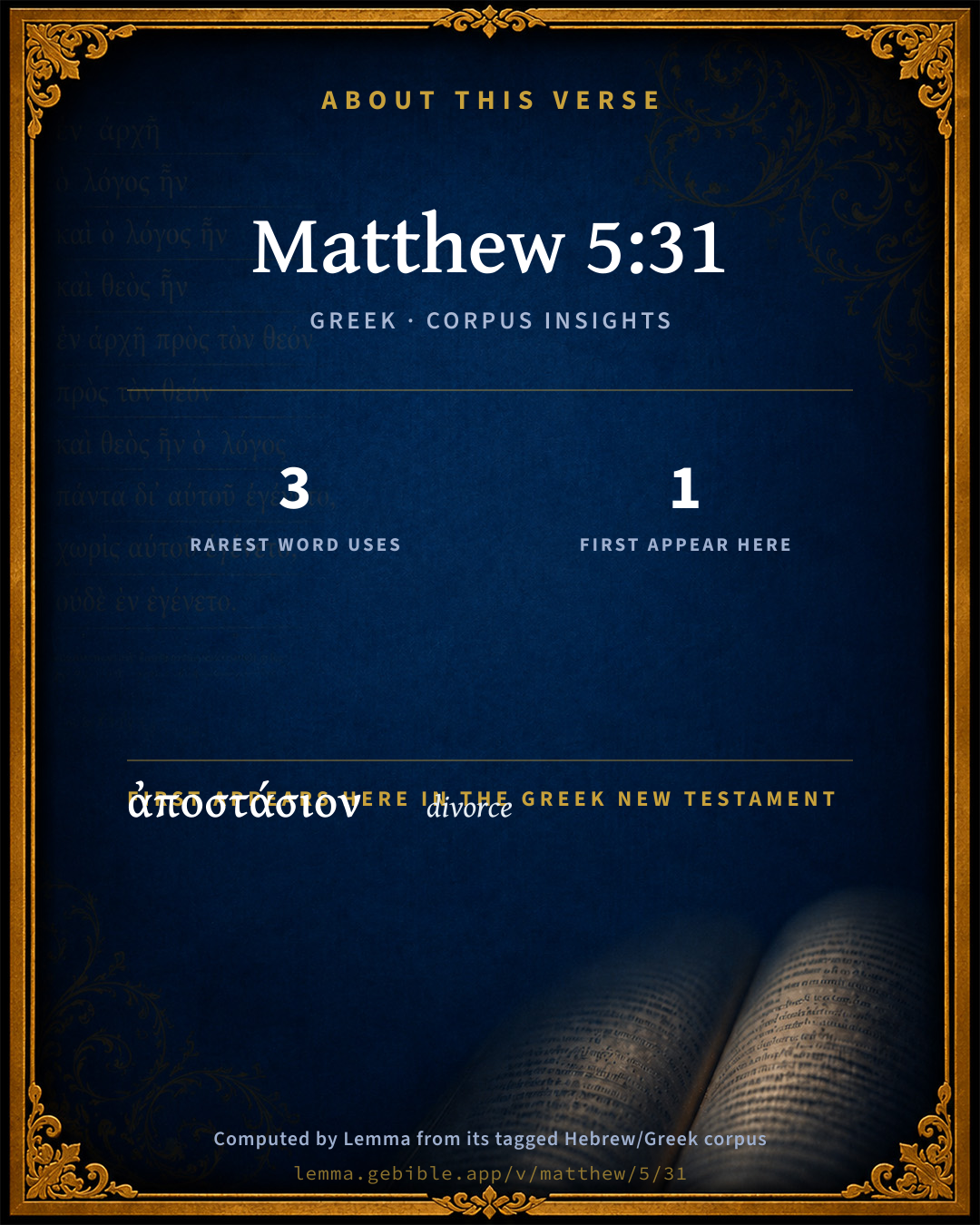
The rarest word here is ἀποστάσιον divorce G647 — appearing just 3 times in the whole Greek New Testament.

First appearance in Scripture

This word makes its first canonical appearance in the Greek New Testament here:

  • ἀποστάσιον divorce G647

Shared distinctive vocabulary

ἀποστάσιον divorce G647 occurs in 3 verses of the Greek New Testament. Also found in:

Repetition

A word recurs within this verse:

  • αὐτοῦ he G846 ×2

Cross-references

5

Topical passages linked to Matthew 5:31 in the Treasury of Scripture Knowledge — connected by theme and wording, ordered by reader-vote popularity; previews shown in the World English Bible.

  • Jeremiah 3:1 They say, If a man put away his wife, and she go from him, and become another man's, will he return to her again? Won't that land be greatly polluted? But you have played the prostitute with many lovers; yet return again to me, says Yahweh.
  • Deuteronomy 24:1–4 When a man takes a wife, and marries her, then it shall be, if she find no favor in his eyes, because he has found some unseemly thing in her, that he shall write her a bill of divorce, and give it in her hand, and send her out of his house.
  • Matthew 19:7 They asked him, "Why then did Moses command us to give her a bill of divorce, and divorce her?"
  • Matthew 19:3 Pharisees came to him, testing him, and saying, "Is it lawful for a man to divorce his wife for any reason?"
  • Mark 10:2–9 Pharisees came to him testing him, and asked him, "Is it lawful for a man to divorce his wife?"

Cross-references courtesy of OpenBible.info (CC BY 4.0).

Commentary

Notes on Matthew 5:31 from classic Christian and Jewish commentators (each source and its license shown beneath its notes). The classic Christian expositions comment on the surrounding passage and are grouped to its opening verse, so a note may address several verses; the Jewish commentaries on the Tanakh (Rashi and others) are per-verse, so they appear only where the commentator wrote on this verse.

Lemma curates 59 commentaries, every one of them public domain or Creative Commons licensed, each selected and text-cleaned for this edition rather than reprinted as found. About our sources →

Joseph Benson's Commentary

Mat 5:31-32. Let him give her a writing of divorcement — “The doctors of the school of Sammai affirmed, that, in the law concerning divorce, Deu 24:1, the words some uncleanness, were to be understood of adultery only; whereas, they of the school of Hillel interpreted them of any matter of dislike whatever. Hence the Pharisees asked Jesus, Mat 19:3, if it was lawful for a man to put away his wife for every cause? The opinion of Hillel was generally espoused by the Jews, as appears from both their practice and their writings. Thus, Mal 2:16, the clause which in our translation runs, The Lord says, He hateth putting away, that is, divorces on frivolous pretences, is, by the Chaldee paraphrast and the LXX., turned thus, (εαν μισησας εξαποστειλης,) if thou hatest thou shouldest put her away. Also, the son of Sirach says, Mat 25:26: If she go not as thou wouldest have her, cut her off from thy flesh. And Josephus, Ant. lib. 4. cap. 8, ‘He that would be disjoined from his wife, for any cause whatever, as many such causes there may be among men, let him give her a bill of divorce.’ Nay, one of their doctors, R. Akiba by name, delivered it as his opinion, ‘that a man may put his wife away, if he likes any other woman better.’” As, therefore, they had perverted the law of divorce that they might give full scope to their lusts, Jesus thought fit to reduce it to its primitive meaning, assuring them, “that he who divorces his wife for any of the causes allowed by the doctors, whoredom excepted, lays her under a strong temptation to commit adultery; unjust divorce being no divorce in the sight of God; and that since such marriages still subsisted, he who married the woman unjustly divorced, committed adultery also.” Saving for the cause of fornication, &c. — Fornication here, as elsewhere, is often used for adultery: in general it denotes the exercise of all the different species of unlawful lusts. Although in these words only one just cause of divorce is acknowledged, namely, adultery; “yet the apostle, 1Co 7:15, plainly allows another, viz., malicious and obstinate desertion in either of the parties; and that because it is wholly inconsistent with the purposes of marriage. We must therefore suppose, that our Lord here speaks of the causes of divorce commonly said to be comprehended under the term uncleanness, in the law; and declares, that none of them will justify a man’s divorcing his wife, except fornication.” Whosoever shall marry her that is divorced committeth adultery — Here we learn, “that if the cause of a divorce be just, the innocent party is freed from the bond of marriage, so as to be at liberty to marry again.” But if the divorce be made without a just cause, the marriage still subsists, and consequently both parties, the innocent as well as the guilty, thus divorced, commit adultery if they marry, as do the persons likewise whom they marry.” — Macknight.

Joseph Benson's Commentary on the Old and New Testaments (1811–1818) — public domain. Text from a community e-Sword module.

Tyndale Open Study Notes

Tyndale Open Resources

5:31-32 Jesus challenges the misapplication of the Old Testament provision for divorce (see Deut 24:1-4; cp. Matt 19:3-9): Following the rules does not make divorce acceptable. Jesus allows only one legitimate reason for divorce, sexual infidelity, and forbids casual divorce (see also 1 Cor 7:10-11).

5:31 A notice of divorce is a document stating the legality of a divorce. Evidence suggests that such a document permitted remarriage. “The essential formula in the notice of divorce is, ‘Lo, you are free to marry any man.’ . . . The essential formula in a writ of emancipation is, ‘Lo, you are a freedwoman: lo, you belong to yourself’” (Mishnah Gittin 9:3).

Tyndale Open Study Notes — © Tyndale Open Resources, licensed CC BY-SA 4.0. Text via the HelloAO Bible API.

Bengel's Gnomon

Johann Albrecht Bengel

Mat 5:31. Ὃς ἂν ἀπολύσῃ, whosoever shall put away) They held divorce to be an arbitrary matter.[211]—ἀποστάσιον, a divorce) i.e. a writing of divorcement. A metonymy which occurs in ch. Mat 19:7, and is also employed by the LXX.

[211] δότω does not indicate a command but a permission. [He may give.] They seemed to think Moses had nothing in view save the observance of certain formalities.—Vers. Germ.

Bengel's Gnomon of the New Testament — English translation (T&T Clark, Edinburgh, 1860) — public domain. Text from a community e-Sword module.

Meyer's Critical & Exegetical Commentary

Heinrich August Wilhelm Meyer

Mat_5:31 f.[410] In Deu_24:1 there is stated as a reason for the dismissal which is to be carried out, עֶרְוַת דָּבָר, something hateful, loathsome (see Ewald, Alterthum. p. 272; Keil, Archäol. II. p. 74 f.; Gesenius, Thes. II. p. 1068). This was explained by the strict Rabbi Sammai and his adherents as referring to adultery and other unchaste behaviour; but the gentle Rabbi Hillel and his school as referring to everything in general that displeased the husband (Josephus, Antt. iv. 8. 23; Vita, 76). Lightfoot, p. 273 ff.; Ewald, Jahrb. X. p. 56 ff., 81. Rabbi Abika went still further, who allowed dismissal if the husband found a more beautiful woman; see Wetstein. To these and other (see Othonis, Lex. Rabb. p. 504) ill-considered principlesfor Hillels doctrine had become the prevalent one

Christ opposes Himself, and draws out from the original and inmost nature of marriage (comp. Mat_19:4 ff.) a firm rule, preserving the sanctity of the idea, and admitting only that as a ground of separation by which the nature of marriage and its obligations is, as a matter of fact, directly and immediately destroyed.[411]

ἀπολύσῃ] not repudiare constituerit (Fritzsche after Grotius), but will have dismissed. In this is implied the oral declaration of dismissal, the accomplishment of which as a fact is to take place by means of a letter of divorce. The command to give the letter of divorce, moreover, the use of which was already in existence before the law, is only indirectly implied in Deu_24:1; comp. on Mat_19:7. The Greek expression for the dismissal of the woman is ἀποπέμπειν, Bekker, Anecd. p. 421; Bremi, ad Dem. adv. Onetor. iv. p. 92. On the wanton practice of the Greeks in this matter, see Hermann, Privatalterth. § 30.

ἀποστάσιον] departure, that is, by means of a βιβλίον ἀποστασίου, Deu_24:1; Mat_19:7; Mar_10:4; Jer_3:8. In Demosthenes, 790. 2, 940. 15, it is the desertion of his master, contrary to duty, by a manumitted slave; Hermann, l.c., § 57. 17.

The formula of the letter of divorce, see in Alphes. in Gittin, f. 600; in Lightfoot, p. 277. The object of the same was to prove that the marriage had been legally dissolved, and that it was competent to enter into a second marriage with another man (Ewald, l.c.). Observe, moreover, how the saying of the scribes, which has been quoted, is a mutilation of the legal precept, which had become traditional in the service of their lax principles, as if it, beside the arbitrary act of the man, were merely a question of the formality of the letter of divorce.

[410] The assertion that, if Jesus had delivered this declaration here, the discussion regarding divorce in ch. 19 could not have taken place (Köstlin, p. 47; Holtzmann, p. 176 f.), has no foundation, especially as in Mat_19:3, Mar_10:2, the discussion is called forth by the Pharisees; comp. Weiss. Olshausen and Bleek also find in ch. 19 the historical position for the declaration, which Hilgenfeld regards as a non-original appendix to what precedes; which is also substantially the judgment of Ritschl, who regards the metabatic δέ in ver. 31 as introducing an objection to vv. 29, 30.

[411] Comp. Harless, Ehescheidungsfrage, p. 17 ff.

Meyer — Critical and Exegetical Commentary on the New Testament — English translation by Peter Christie, edited by Frederick Crombie (T&T Clark, 1880) — public domain. Text from a community e-Sword module.

Expositor's Greek Testament

ed. W. Robertson Nicoll

Mat 5:31-32 . Third illustration , subordinate to the previous one, connected with the same general topic, sex relations, therefore introduced less formally with a simple ἐρρέθη δὲ . This instance is certainly directed against the scribes rather than Moses. The law (Deu 24:1 ) was meant to mitigate an existing usage, regarded as evil, in woman’s interest. The scribes busied themselves solely about getting the bill of separation into due legal form. They did nothing to restrain the unjust caprice of husbands; they rather opened a wider door to licence. The law contemplated as the ground of separation a strong loathing, probably of sexual origin. The Rabbis (the school of Shammai excepted) recognised whimsical dislikes, even a fancy for another fairer woman, as sufficient reasons. But they were zealous to have the bill in due form that the woman might be able to show she was free to marry again, and they probably flattered themselves they were defending the rights of women. Brave men! Jesus raised the previous question, and asserted a more radical right of woman not to be put away , except when she put herself away by unfaithfulness. He raised anew the prophetic cry (Mal 2:16 ), I hate putting away . It was an act of humanity of immense significance for civilisation, and of rare courage; for He was fighting single-handed against widely prevalent, long established opinion and custom. ἀπολύσῃ : the corresponding word in Greek authors is ἀποπέμπειν . ἀποστάσιον = βιβλίον ἀποστασίου in Deu 24 . The husband is to give her her dismissal, with a bill stating that she is no longer his wife. The singular form in ιον is to be noted. The tendency in later Greek was to substitute ιον for ια , the plural ending. Vide Lobeck, Phryn. , p. 517. παρ . λ . πορνείας : a most important exception which has given rise to much controversy that will probably last till the world’s end. The first question is: Did Christ really say this, or is it not rather an explanatory gloss due to the evangelist, or to the tradition he followed? De Wette, Weiss, Holtzmann (H. C.) take the latter view. It would certainly be in accordance with Christ’s manner of teaching, using strong, brief, unqualified assertions to drive home unfamiliar or unwelcome truths, if the word as He spoke it took the form given in Luk 16:18 : “Every one putting away his wife and marrying another committeth adultery”. This was the fitting word to be spoken by one who hated putting away, in a time when it was common and sanctioned by the authorities. A second question is: What does πορνεία mean? Schanz, a master, as becomes a Catholic, in this class of questions, enumerates five senses, but decides that it means adultery committed by a married woman. Some, including Döllinger ( Christenthum und Kirche: The First Age of Christianity and the Church , vol. ii., app. iii.), think it means fornication committed before marriage. The predominant opinion, both ancient and modern, is that adopted by Schanz. A third question is: Does Christ, assuming the words to have been spoken by Him, recognise adultery as a ground of absolute divorce, or only, as Catholics teach, of separation a toro et mensa ? Is it possible to be quite sure as to this point? One thing is certain. Christ did not come to be a new legislator making laws for social life. He came to set up a high ethical ideal, and leave that to work on men’s minds. The tendency of His teaching is to create deep aversion to rupture of married relations. That aversion might even go the length of shrinking from severance of the tie even in the case of one who had forfeited all claims. The last clause is bracketed by W. H [27] as of doubtful genuineness. It states unqualifiedly that to marry a dismissed wife is adultery. Meyer thinks that the qualification “unjustly dismissed,” i.e. , not for adultery, is understood. Weiss (Meyer) denies this.

[27] Westcott and Hort.

The Expositor's Greek Testament, edited by W. Robertson Nicoll (1897–1910) — public domain. Text from a community e-Sword module.

Jamieson, Fausset & Brown

Robert Jamieson, A. R. Fausset & David Brown

It hath been said--This shortened form was perhaps intentional, to mark a transition from the commandments of the Decalogue to a civil enactment on the subject of divorce, quoted from Deu 24:1. The law of divorce--according to its strictness or laxity--has so intimate a bearing upon purity in the married life, that nothing could be more natural than to pass from the seventh commandment to the loose views on that subject then current.

Whosoever shall put away his wife, let him give her a writing of divorcement--a legal check upon reckless and tyrannical separation. The one legitimate ground of divorce allowed by the enactment just quoted was "some uncleanness"--in other words, conjugal infidelity. But while one school of interpreters (that of Shammai) explained this quite correctly, as prohibiting divorce in every case save that of adultery, another school (that of HILLEL) stretched the expression so far as to include everything in the wife offensive or disagreeable to the husband--a view of the law too well fitted to minister to caprice and depraved inclination not to find extensive favor. And, indeed, to this day the Jews allow divorces on the most frivolous pretexts. It was to meet this that our Lord uttered what follows:

Jamieson, Fausset & Brown — Commentary Critical and Explanatory on the Whole Bible (1871) — public domain (CC PDM 1.0). Text via the HelloAO Bible API.

Adam Clarke's Commentary

Verse 31. Whosoever shall put away his wife] The Jewish doctors gave great license in the matter of divorce. Among them, a man might divorce his wife if she displeased him even in the dressing of his victuals!

Rabbi Akiba said, "If any man saw a woman handsomer than his own wife, he might put his wife away; because it is said in the law, If she find not favour in his eyes." De 24:1.

Josephus, the celebrated Jewish historian, in his Life, tells us, with the utmost coolness and indifference, "About this time I put away my wife, who had borne me three children, not being pleased with her manners."

These two cases are sufficient to show to what a scandalous and criminal excess this matter was carried among the Jews. However, it was allowed by the school of Shammai, that no man was to put away his wife unless for adultery. The school of Hillel gave much greater license.

A writing of divorcement] The following is the common form of such a writing. See Maimonides and Lightfoot.

"On the day of the week A. in the month B. in the year C. from the beginning of the world, according to the common computation in the province of D., I, N. the son of N. by whatever name I am called, of the city E. with entire consent of mind, and without any compulsion, have divorced, dismissed, and expelled thee-thee, I say, M. the daughter of M. by whatever name thou art called, of the city E. who wast heretofore my wife: but now I have dismissed thee-thee, I say, M. the daughter of M. by whatever name thou art called, of the city E. so as to be free, and at thine own disposal, to marry whomsoever thou pleasest, without hinderance from any one, from this day for ever. Thou art therefore free for any man. Let this be thy bill of divorce from me, a writing of separation and expulsion, according to the law of Moses and Israel.

REUBEN, son of Jacob, Witness.

ELIEZAR, son of Gilead, Witness."

God permitted this evil to prevent a greater; and, perhaps, to typify his repudiating the Jews, who were his first spouse.

Adam Clarke's Commentary on the Bible (1810–1826) — public domain. Text from a community e-Sword/MySword module.

Ellicott's Commentary for English Readers

(31) It hath been said.—The better MSS. give, “But it was said,” as though stating an implied objection to the previous teaching. Men might think that they could avoid the sin of adultery by taking the easy course of divorcing one wife before marrying another.

Whosoever shall put away . . .—The quotation is given as the popular Rabbinic explanation of Deu_24:1, which, as our Lord teaches in Mat_19:8, was given, on account of the hardness of men’s hearts, to prevent yet greater evils. The words of the precept were vague—“If she find no favour in his eyes, because he hath found some uncleanness in her,” and the two school of casuists took opposite views of its meaning. The stricter party of Shammai held that the “uncleanness” meant simply unchastity before or after marriage. The followers of Hillel held, on the other hand (as Milton among Christian teachers), that anything that made the company of the wife distasteful was a sufficient ground for repudiation. Even a moralist generally so pure and noble as the son of Sirach, took in this matter the laxer view—“If she go not as thou wouldest have her, cut her off from thy flesh, and give her a bill of divorce, and let her go” (Sir_25:26). It is noteworthy that our Lord, whose teaching, especially as regards the Sabbath question, might have been, for the most part, claimed by the school of Hillel, on this matter of divorce stamps the impress of His approval on the teaching of his rival.

A Bible Commentary for English Readers, edited by Charles John Ellicott (1878–1897) — public domain. Text from a community e-Sword module.

The Cambridge Bible for Schools and Colleges

gen. ed. J. J. S. Perowne

31. a writing of divorcement] See note on ch. Mat_1:19. The greatest abuses had arisen in regard to divorce, which was permitted on very trivial grounds. One Rabbinical saying was “If any man hate his wife, let him put her away.” Copies of these bills of divorce are still preserved. The formula may be seen in Lightfoot, Hor. Hebr. ad loc. The same facility of divorce prevails in Mohammedan countries.

The Cambridge Bible for Schools and Colleges (gen. ed. J. J. S. Perowne; Cambridge University Press, 1878–1918) — public domain. Text from a community e-Sword module.

John Gill's Exposition

It hath been said,.... It is not added here, as in the former instances, "by them of old time"; nor prefaced with these words, "ye have heard"; because the case of divorce was not any law of Moses, or of God by him; but only a permission, because of the hardness of the hearts of the Jews: and as to the controversy, about the causes of divorce, this was not debated by them of old time, but was a new thing, just started in the time of Christ; and was a controversy then agitating, between the schools of Hillell and Shammai: the one allowing it upon any frivolous cause; the other, only on account of adultery.

Whosoever shall put away his wife, dissolve the marriage bond, dismiss her from his bed, and send her from his house, see Deu 24:1 "let him give her a writing of divorcement", , "a bill of divorcement", or "a book of cutting off". For though a wife was obtained by several ways, there was but one way of dismissing her, as the Jews observe (f), and that was, by giving her a bill. The form of a writing of divorcement, as given by Maimonides (g), is as follows:

"On such a day of the week, in such a month, of such a year, either from the creation, or the epocha of contracts, according to the usual way of computation, which we observe in such a place; I such an one, the son of such an one, of such a place; or if I have any other name, or surname, or my parents, or my place, or the place of my parents; by my own will, without any force, I put away, dismiss, and divorce thee. Thee, I say, who art such an one, the daughter of such an one, of such a place; or if thou hast any other name, or surname, or thy parents, or thy place, or the place of thy parents; who wast my wife heretofore, but now I put thee away, dismiss and divorce thee; so that thou art in thine own hand, and hast power over thyself, to go, and marry any other man, whom thou pleasest; and let no man hinder thee in my name, from this day forward and for ever; and lo! thou art free to any man: and let this be unto thee, from me, a bill of divorce, an instrument of dismission, and a letter of forsaking, according to the law of Moses and Israel.''

"Such an one, the son of such an one, witness. Such an one, the son of such an one, witness.''

Would you choose to have one of these bills, filled up in proper form, take it in manner (h) following.

"On the fourth day of the week, on the eleventh day of the month Cisleu, in the year five thousand four hundred and fifty four, from the creation of the world; according to the computation which we follow here, in the city of Amsterdam, which is called Amstelredam; situated by the sea side, called Taya, and by the river Amstel; I Abraham, the son of Benjamin, surnamed Wolphius, the priest; and at this time dwelling in the city of Amsterdam, which is called Amstelredam, which is situated by the sea side, called Taya, and by the river Amstel; or if I have any other name, or surname, or my parents, or my place, or the place of my parents; by my own free will, without any compulsion, I put away, dismiss, and divorce thee, my wife Rebecca, the daughter of Jonas the Levite; who at this time abides in the city of Amsterdam, called Amstelredam, situated by the sea side, called Taya, and by the river Amstel; or if thou hast any other name, or surname, or thy parents, or thy place, or the place of thy parents, who wast heretofore my wife; but now I put thee away, dismiss, and divorce thee; so that thou art in thine own hands, and hast power over thyself, to go and marry any other man, whom thou pleasest: and let no man hinder thee in my name, from this day forward, and for ever; and lo! thou art free to any man. Let this be to thee, from me, a bill of divorce, an instrument of dismission, and a letter of forsaking, according to the law of Moses and Israel.''

"Sealtiel, the son of Paltiel, witness. Calonymus, the son of Gabriel, witness.''

This bill being written in twelve lines, neither more nor less, and being sealed by the husband, and signed by the witnesses, was delivered, either by him, or by a messenger, or deputy of his or hers, into her hand, lap, or bosom, in the presence of two persons; after which, she might, if she would, enrol it in the public records, and marry whom she pleased.

(f) Baal Hatturim in Deut. xxiv. 1. Maimon. Hilchot Ishot, c. 1. sect. 2, 3. (g) Hilchot Gerushin, c. 4. sect. 12. (h) In Surenhusii Misna, Vol. III. p. 324. Vid. Moses Kotsensis Mitzvot Tora pr. affirm. 50.

John Gill's Exposition of the Whole Bible (1746–1763) — public domain (CC PDM 1.0). Text via the HelloAO Bible API.

Trapp's Complete Commentary

John Trapp

31 It hath been said, Whosoever shall put away his wife, let him give her a writing of divorcement:

Ver. 31. It hath been said, Whosoever shall put away his wife, &c.] This Moses permitted, as a law maker, not as a prophet; as a civil magistrate, not as a man of God; merely for the hardness of the men’s hearts, and for the relief of the women, who else might have been misused and mischiefed by their unmannerly and unnatural husbands, Mal 2:13. Those hard hearted Jews caused their wives, when they should have been cheerful in God’s service, to cover the altar of the Lord with tears, with weeping, and with crying out, so that he regarded not the offering any more. A number of such Nabals there are today, that tyrannize over and trample upon their wives, as if they were not their fellows, but their footstools, not their companions and co-mates, but their slaves and vassals. "Husbands, love your wives, and be not bitter against them," Col 3:16. He saith not (as it might seem he should with respect to the former verse), Rule over them, and show your authority over those that are bound to submit unto you; but, love them, that their subjection may be free and ingenuous. Live not, as Lamech, like lions in your houses, quarrelsome, austere, discourteous, violent, with high words and hard blows, such are fitter to live in Bedlam than in a civil society. The apostle requires "that all bitterness be put away," all, and in all persons; how much more in married couples! The heathens, when they sacrificed at their marriage feasts, used to cast the gall of the beast sacrificed out of doors. την χολην εξελοντος ερριψαν. (Plutarch.) Vipera virus ob venerationem nuptiarum evomit; et tu duritiem animi, tu feritatem, tu crudelitatem ob unionis reverentiam non deponis? saith Basil. I confess it were better be married to a quartan ague than to a bad wife (so saith Simonides), for there be two good days for one bad with the one, not one with the other; febris hectica uxor mala, et non nisi morte avellenda. (Scalig.) But that should have been looked to beforehand. A hard adventure it is to yoke one’s self with any untamed heifer, that beareth not the yoke of Christ. And as grace, so good nature, a courteous disposition, is a thing to be especially looked at in a wife, which Eleazar, Abraham’s servant, understood, and therefore singled out as a token of a meet mate for his son. "Let her offer me drink, and my camels also," saith he, Gen 24:14. But what if it prove otherwise, and men by leaping unadvisedly into the marriage estate, have drawn much misery upon themselves? Quid si pro coniugio coniurgium contraxerint? Varro answereth, Uxoris vitium aut tollendum aut tolerandum est. A wife’s faults must be either cured or covered; mended, if we can; made the best of, if we cannot. If the first, she is made better; if the second, we. Qui tollit hanc sibi commodiorem praestat: qui tolerat, ipse se meliorem reddit. (Gellius.) Aurelii vox est, uxor admonenda persaepe, reprehendenda raro, verberanda nunquam.

" Coniugium humanae divina Academia vitae est."

And hence it cometh to pass, that,

" Quae modo pugnarant, iungant sua rostra columbae:

Quarum blanditias verbaque, murmur habet."

As on the other side, where this meekness of wisdom is not made use of by married folk, they are together in the house no otherwise than as two poisons in the stomach, as live eels in the pot, as two spaniels in a chain; their houses are more like kennels of hounds than families of Christians: or as so many fencing schools, wherein the two sexes seem to have met together for nothing but to play their prizes and to try masteries. Job was not more weary of his boils than they are of their bed fellows, cursing their wedding day as much as he did his birthday; and thirsting after a divorce as he did after death; which, because it cannot be had, their lives prove like the sojourning of Israel in Marah, where almost nothing could be heard but murmuring, mourning, conjuring, and complaining. Leo cassibus irretitus dixit, si praescivissem.

John Trapp, A Commentary or Exposition upon All the Books of the Old and New Testament (1647–1656) — public domain. Text from a community e-Sword module.

Albert Barnes' Notes on the Bible

It hath been said ... - That is, by Moses, Deu 24:1-2. The husband was directed, if he put his wife away, to give her a bill of divorce, that is a certificate of the fact she had been his wife, and that he had dissolved the marriage. There was considerable difference of opinion among the Jews for what causes the husband was permitted to do this. One of their famous schools maintained that it might be done for any cause, however trivial. The other maintained that adultery only could justify it. The truth was, however, that the husband exercised this right at pleasure; that he was judge in the case, and dismissed his wife when and for what cause he chose. And this seems to be agreeable to the law in Deuteronomy. Our Saviour in Mar 10:1-12, says that this was permitted on account of the hardness of their hearts, but that in the beginning it was not so. God made a single pair, and ordained marriage for life. But Moses found the people so much hardened; so long accustomed to the practice, and so rebellious, that, as a matter of civil appointment, he thought it best not to attempt any change. Our Saviour brought marriage back to its original intention, and declared that whosoever put away his wife henceforward, except for one offence, should be guilty of adultery. This is now the law of God. This was the original institution. This is the only law that is productive of peace and good morals, and that secures the respect due to a wife, and the good of children. Nor has any man or set of men - any legislature or any court, civil or ecclesiastical - a right to interfere, and declare that divorces may be granted for any other cause. They, therefore, whoever they may be, who are divorced for any cause except the single one of adultery, if they marry again, are, according to the Scriptures, living in adultery. No earthly laws can trample down the laws of God, or make that right which he has solemnly pronounced wrong.

Albert Barnes' Notes on the Bible (1834–1885) — public domain. Text from a community e-Sword/MySword module.

Matthew Poole's English Annotations

The law to which our Saviour refers here, or rather the indulgence and toleration, (for none was obliged to put away their wives in case of uncleanness), is that Deu 24:1, where we have it in these words: When a man hath taken a wife, and married her, and it come to pass that she find no favour in his eyes, because he hath found some uncleanness in her; then let him write her a bill of divorcement, and give it her in her hand, and send her out of his house. The Pharisees had extended this toleration which God gave husbands amongst the Jews to other cases, besides that of uncleanness or adultery; so as they put away their wives upon every slight occasion, interpreting those words, that she find no favour in his eyes, separately from the following words, because he hath found some uncleanness in her, and gave a liberty for men upon any dislike of their wives to put them away, provided that they first gave them a bill of divorcement; and that in these cases it was lawful for the parties, thus separated from each other, to marry to whom either of them pleased; and this is expressed in terms in their form of those writings of divorcement, in Josephus and other writers. This indeed is a case properly relating to the judicial law; but all the judicial laws are either appendices to the moral or to the ceremonial law. This particular indulgence was an appendix to the moral law, by the seventh commandment, to which our Saviour is now speaking, and giving the true sense of it. He here opposeth the Pharisees in two points.

1. Asserting that all divorces are unlawful except in case of adultery.

2. Asserting that whosoever married her that was put away committed adultery.

It hath been a great question, not so much amongst divines as amongst lawyers, whether it be not lawful in any case to put away a wife, unless for adultery? The canonists have found out many cases in which they affirm it lawful. And the Council of Trent (from whom we may learn the sense of the popish divines) anathematize those who deny the church a power of determining other causes of divorce. But their blasphemous curse falleth upon him, who is above them, God over all blessed for ever, who in this text hath determined that point. Nor indeed did Moses give a toleration in any other cases. There may indeed be a parting between man and wife upon other accounts, either wholly or in part: in case one of them will part from the other, which the apostle determines, 1Co 7:11,15; in which case the person departing is only guilty if he or she marry again. In case of an error, through ignorance or inadvertency, upon the marriage, that it appeareth that the persons married were such as by the law of nature and of God ought not to have married, &c. But if we take divorce for the voluntary act of the husband putting away of his wife, it is unlawful in any case but that of adultery, which dissolves the marriage knot and covenant. A second question is also here determined by our Saviour, viz. that it is unlawful for her, that is justly put away, to marry to any other, or for any other to marry her wittingly.

Matthew Poole's English Annotations on the Holy Bible (1683–1685) — public domain. Text from a community e-Sword/MySword module.

Whedon's Commentary on the Bible

Daniel D. Whedon

31. A writing of divorcement — The Mosaic law (Deu_24:1) was, that if “uncleanness” were found in a wife, the husband might “write a bill of divorcement, and put it into her hand, and send her out of his house.” On the meaning of the word “uncleanness,” the schools of the two Rabbies Shammai and Hillel differed. The former taught that the law allowed divorce for adultery alone; the latter interpreted it to mean any defect of person or character. Divorces thereby had become shamefully common, and the marriage tie of little force. As a consequence, all the laws of morality were loose, and all the best affections of our nature but slightly existed. The family is the true school of the purer virtues and noblest feelings. Where it exists in its full excellence, and its well managed government, the young character is rightly shaped, and men go forth into the world trained to maintain a well ordered society. Where this institution is in ruins, or but loosely maintained, childhood and youth are but poorly formed, and maturer years are lawless and unprincipled. Family disorganization is the forerunner of social disorganization, anarchy, and final despotism.

Daniel D. Whedon (gen. ed.), Commentary on the Old and New Testaments (1874–1909) — public domain. Text from a community e-Sword module.

The Pulpit Commentary

Vers. 31, 32. Divorce.

Here only. It hath been said (erreyh de). This is the only one of the six examples to which our Lord does not prefix "ye have heard," and inserts de . Hence Lightfoot ("Hor. Hebr.") writes, "This particle hath this emphasis in this place, that it whispers a silent objection, which is answered in the following verse," i.e. Christ had said even a sinful look is too much; the lawyers said, "But the Law allows divorce, and therefore a married man can after all obtain the woman he desires." But this is strained. The shorter expression is here sufficient, because of the close connexion of this subject with the preceding. Hence, Revised Version, better, it was said also. It is, by the by, curious that the translators of the Authorized Version should have altered the rendering of erreyh , which they had given rightly in vers. 21, 27, and should have preferred the perfect here and in vers. 33, 38, 43. Whosoever shall put away, etc. The substance of Deu_24:1, but leaving out all mention of cause for such putting away. This may be perhaps because our Lord is going to refer to this immediately, or because, in fact, the giving "a writing of divorcement" was now considered as alone of importance. Let him give her; Hebrew, into her hand; i.e. into her own possession. (cf. Isa_1:1 Jer_3:8) A writing of divorcement. See the translation of such a get in Lightfoot ("Hor. Hebr.").

The Pulpit Commentary (1880–1919), ed. H.D.M. Spence-Jones & Joseph S. Exell — public domain. Text from a community e-Sword module.

John Wesley's Explanatory Notes

Let him give her a writing of divorce - Which the scribes and Pharisees allowed men to do on any trifling occasion. Deut. xxiv, 1; Matt. xix, 7; Mark x, 2; Luke xvi, 18.

John Wesley, Explanatory Notes Upon the Whole Bible (1754–1765) — public domain. Text via the GEBible commentary corpus.

Kretzmann's Popular Commentary

Paul E. Kretzmann

A further illustration;

v. 31. It hath been said,. Whosoever shall put away his wife, let him give her a writing of divorcement.

v. 32. But I say unto you, That whosoever shall put away his wife, saving for the cause of fornication, causeth her to commit adultery; and whosoever shall marry her that is divorced, committeth adultery.

The form in which Jesus here speaks indicates that He disapproves of their literal interpretation of the permission granted by Moses, Deu 24:1. The Mosaic law was given in the interest of the woman, to give her at least some show of right. But the Jewish doctors, concerned only about the outward form and about getting the bill of separation into due legal shape, permitted a license which was soon carried to scandalous and criminal excesses. Pouncing upon the phrase: "She find no favor in his eyes," they permitted divorces when a man found a handsomer woman, when he was displeased with his wife’s cooking, when he did not find her manners agreeable. Only the bill or letter of separation must be made out, that formality was insisted upon. But such a deliberate breaking of the marriage-tie, though it be sanctioned by the civil courts, has no validity before God. The Lord recognizes only one reason for divorce, when there is a plain case of unfaithfulness, of adultery, of any unlawful intercourse of a married person with any other person but the lawful spouse. In this case a divorce may be secured, but is not commanded. "We neither command nor hinder such divorce, but leave it to the government to act... But to give advice to such as want to be Christians, it would be far better to admonish and urge both parties to stay together, and that the innocent spouse be reconciled to the guilty one (if this one were humble and willing to amend) and forgive in Christian love. " If any other reason is alleged and the divorce brought about, adultery is committed, both by the complainant, in severing the marriage-tie, and by the accused that permits the frivolous dissolution. In the same way he that marries a woman divorced from her lawful husband, to whom she still belongs before God, is an adulterer in the eyes of the Lord.

Paul E. Kretzmann, Popular Commentary of the Bible (1921–1924) — public domain. Text from a community e-Sword module.

Burkitt's Expository Notes on the New Testament

William Burkitt

Our blessed Saviour still proceeds in vindicating and clearing the seventh commandment from the corrupt glosses of the Pharisees. Almighty God had tolerated the Jews, in case of uncleanness, to put away their wives by a bill of divorce, Deu 24:1

Hereupon the Pharisees maintained it lawful to put away the wife upon every slight occasion. This abuse Christ corrects; and shows that divorce, except in case of adultery, is a certain breach of the seventh commandment.

Learn, 1. That so indissoluble is the marriage-covenant betwixt two persons, that nothing but adultery, which violates the bands of marriage, can dissolve or disannul it.

Learn, 2. When persons are unjustly put away, it is unlawful for them to marry to any other, or for others knowingly to marry to them.

William Burkitt's Expository Notes on the New Testament (1700–1703) — public domain. Text from a community e-Sword module.

The People's New Testament

B. W. Johnson

31, 32. Whosoever shall put away his wife. The divorce laws were very lax among the Jews. A man could put away his wife “for any cause” (Matt. 19:8). Moses directed a legal letter of divorcement (Deut. 24:1). Christ positively forbids divorce except for unchastity. Marriage is a divine institution, and the obligation is for life (Matt. 19:3–9; Rom. 7:1–3; 1 Cor. 7:10–17).

B. W. Johnson's The People's New Testament with Notes (1889–1891) — public domain. Electronic text from the Christian Classics Ethereal Library (CCEL) ThML edition.

unfoldingWord translationNotes

Door43 World Missions Community

Connecting Statement:

Jesus continues to teach about how he has come to fulfill the Old Testament law. Here he begins to speak about divorce.

It was also said

This can be stated in active form. AT: "God also said" or "Moses also said" (See: Active or Passive)

sends his wife away

This is a euphemism for divorce. (See: Euphemism)

let him give

"he must give"

But I say

Jesus agrees with God and his word, but he does not agree with the way the religious leaders have applied God's word. The "I" is emphatic. This indicates that what Jesus says is equally important to the original commands from God. Try to translate this phrase in a way that shows that emphasis. See how you translated this in Matthew 5:22.

makes her an adulteress

It is the man who divorces the woman improperly who "causes her to commit adultery." In many cultures it would be normal for her to remarry, but if the divorce is improper, such a remarriage is adultery.

her after she has been divorced

This can be stated in active form. AT: "her after her husband has divorced her" or "the divorced woman" (See: Active or Passive)

translationWords

divorce

sexual immorality

adultery

unfoldingWord translationNotes — © Distant Shores Media and the Door43 World Missions Community, licensed CC BY-SA 4.0. Source: git.door43.org/Door43/en_tn.

Cambridge Greek Testament for Schools and Colleges

31. ἀποστάσιον. See note on ch. Mat 1:19. The greatest abuses had arisen in regard to divorce, which was permitted on very trivial grounds. One Rabbinical saying was ‘If any man hate his wife, let him put her away.’ Copies of these bills of divorce are still preserved. The formula may be seen in Lightfoot, Hor. Hebr. ad loc. The same facility of divorce prevails in Mohammedan countries.

Cambridge Greek Testament for Schools and Colleges (Cambridge University Press, 1896; 21 vols, various authors incl. Carr, Maclear, Plummer, Farrar, Lumby, Moule, M. R. James, Simcox) — public domain. Text from a community e-Sword module.

International Critical Commentary

31. Special applications to divorce.

(L) And it was said that, Whosoever shall put away his wife, let him give to her a bill of divercement.] Cf. Deu 24:1, Deu 24:3 γράψει αὐτῆ βιβλίον ἀποστασίου. ἀποστάσιον occurs also in Isa 50:1, Jer 3:8 ἔδωκα αὐτῆ βιβλίον ἀποστασίοιυ.

International Critical Commentary — older volumes (1896–1929), various authors — public domain. Text from a community e-Sword module.

Lesson kit

Teaching starters — assembled from the data on this page, not authored interpretation. Every prompt links to the verse data it draws on. Edit before teaching.

Matthew, in the Gospels, opens this verse with 11 words (10 distinct Greek lemmas). Its most distinctive word is apostásion (“divorce”). A historical commentator’s framing appears above. Read the whole chapter for the surrounding context.

Discussion questions

  1. The word apostásion carries the sense “divorce.” How does it shape the verse?
  2. This is the first place “divorce” appears in Scripture (first appears here). What does its debut here establish?
  3. How does Matthew 19:7, which shares the word «divorce», read alongside this verse?
  4. What does the repetition of “he” (2× in this one verse) do in this verse?
  5. These translations render this verse differently; the difference is in the English rendering, not the original. What questions does that raise?
  6. Compare how Joseph Benson's Commentary and Tyndale Open Study Notes read this verse. Where do they agree or differ?

Things to notice

  • 1 word makes its first canonical appearance in Scripture here.
  • These translations choose different wording for 14 words in this verse.
  • “he” occurs 2× in this single verse.
  • 10 distinct Greek lemmas span 11 words in this verse.

Reading settings

Reading text

Shown beneath each verse's original-language words.

Old Testament
Old Testament edition

Read the OT as the Masoretic Hebrew (MT) or the Greek Septuagint (LXX).

English shown for the Greek Septuagint (in the Hebrew ↔ Greek comparison).

Comparing translations? Open the Compare panel on any verse page to stack up to four side by side.