
Matthew 3:14

Greek (Tischendorf 8th ed.) Matthew 3:14 appears in the Greek New Testament. The text above is from the Tischendorf 8th edition. Each word links to its Strong’s number and a concise gloss. Click any word for its full Thayer’s Greek Lexicon entry.
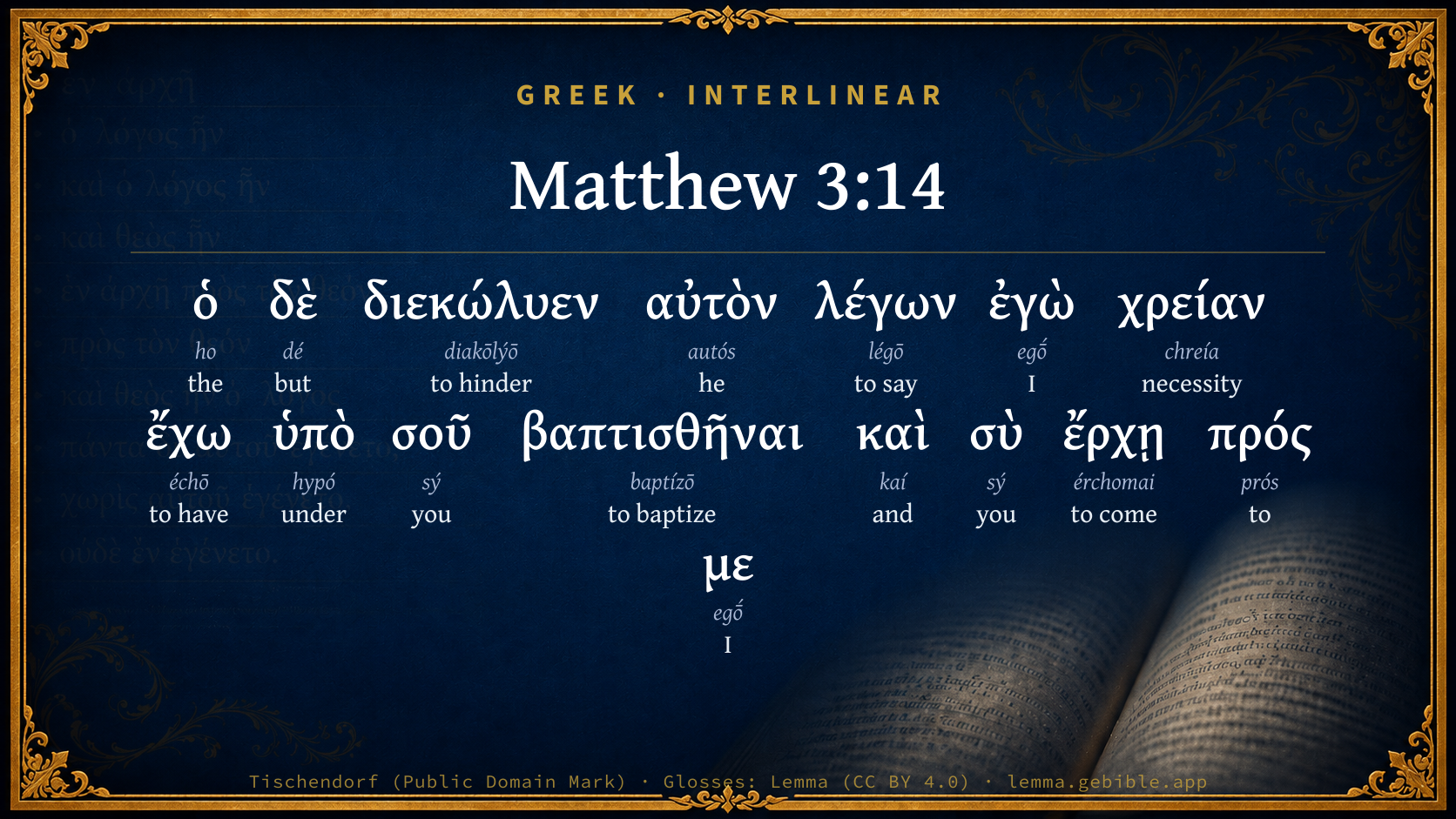
Download image
Cite this verse

Matthew 3:14 (World English Bible). Public Domain. Lemma interlinear Bible study tool, https://lemma.gebible.app/v/matthew/3/14.

Show BibTeX & RIS
BibTeX
RIS
English Translation
But John would have hindered him, saying, "I need to be baptized by you, and you come to me?"
World English Bible · Public Domain
Highlights
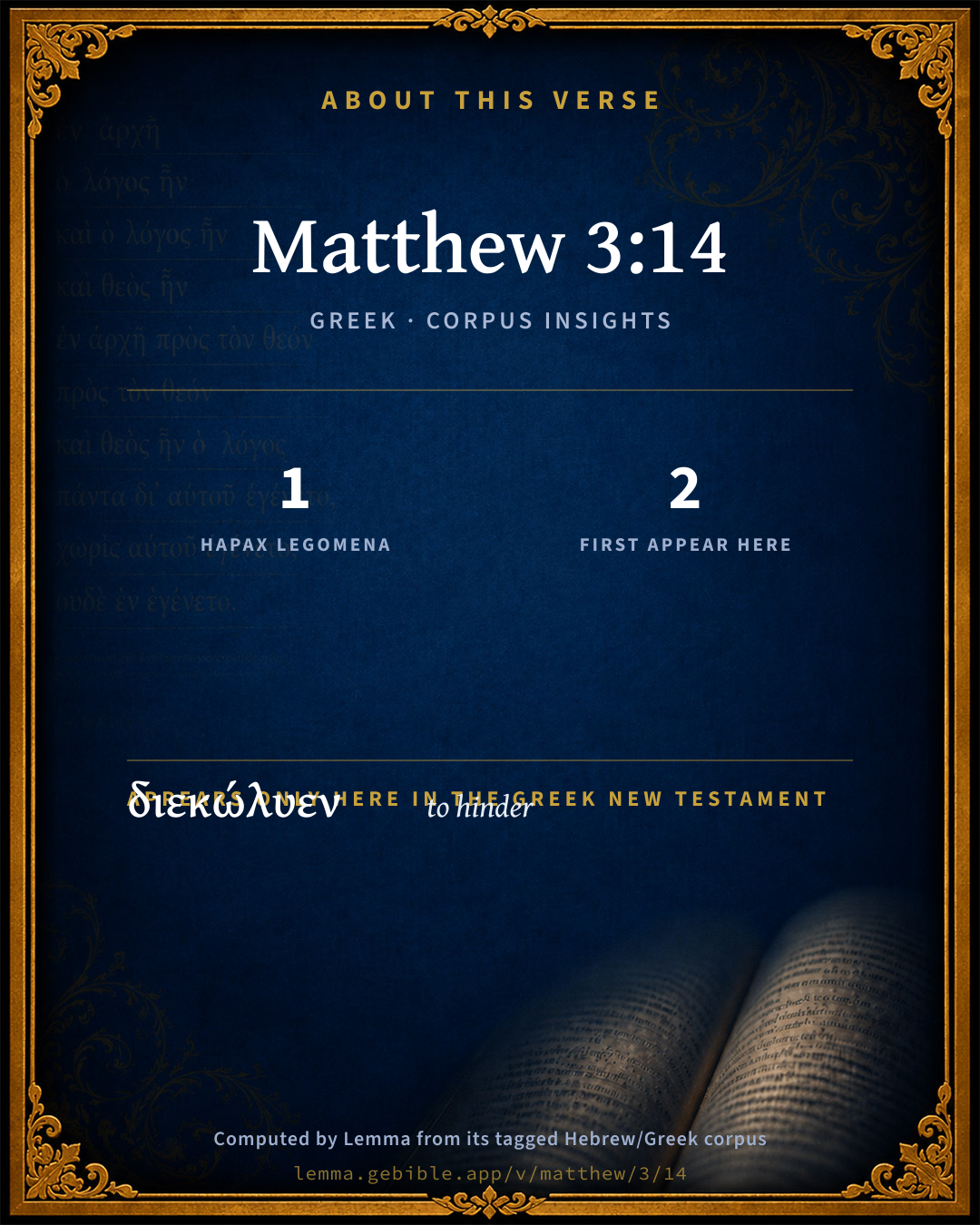
  • 1 hapax legomenon — only here in the Greek New Testament
  • 2 first appearances in the Greek New Testament
Full analysis ↓
Download a study sheet

One document with this verse’s original text, its word-by-word gloss line, the meaning frame, cross-references with their text, attributed commentary, and full source and license credits — printable, and it pastes into notes with its structure intact.

This verse Autodidact and up

Study sheet (.html) Plain text (.txt)

A passage Seminary Student

Up to 50 verses in one chapter. A passage sheet keeps up to 6 commentary sources and 12 cross-references per verse, in the order this page ranks them, and says so on the sheet whenever that leaves anything out. Ask for a single verse and you get the Autodidact verse sheet above.

Everything on this page stays free to read, with no account — the sheet is a download of what is already on screen, not access to it.

Want to remove ads? Support Godless Engineer
Compare translations 3

The same verse in 3 English versions, stacked beneath the original-language interlinear above. Click any original word for its lexicon entry.

Each is an independent rendering of the whole verse — the interlinear is not word-aligned to these translations.

Highlighted words mark where these versions differ — a whole-verse word diff, not a word-by-word alignment.

  • World English Bible Public Domain
    But John would have hindered him, saying, "I need to be baptized by you, and you come to me?"
  • King James Version Public Domain
    But John forbad him, saying, I have need to be baptized of thee, and comest thou to me?
  • unfoldingWord Literal Text CC BY-SA 4.0
    But John was hindering him, saying, “I have need to be baptized by you, and yet you come to me?”

unfoldingWord Literal Text — © unfoldingWord, licensed CC BY-SA 4.0. Word-aligned USFM3 via Door43 (git.door43.org/unfoldingWord/en_ult).

Versions to compare (up to 4)

3 of 4 selected

Show all 19 translations

Every available English version of this verse, each an independent rendering of the whole verse.

  • World English Bible Public Domain
    But John would have hindered him, saying, "I need to be baptized by you, and you come to me?"
  • Berean Standard Bible Public Domain
    But John tried to prevent Him, saying, “I need to be baptized by You, and do You come to me?”
  • Majority Standard Bible Public Domain
    But John tried to prevent Him, saying, “I need to be baptized by You, and do You come to me?”
  • King James Version Public Domain
    But John forbad him, saying, I have need to be baptized of thee, and comest thou to me?
  • American Standard Version (1901) Public Domain
    But John would have hindered him, saying, I have need to be baptized of thee, and comest thou to me?
  • Revised Version (1885) Public Domain
    But John would have hindered him, saying, I have need to be baptized of thee, and comest thou to me?
  • Geneva Bible (1599) Public Domain
    But Iohn earnestly put him backe, saying, I haue neede to be baptized of thee, and commest thou to me?
  • Douay-Rheims (1899) Public Domain
    But John stayed him, saying: I ought to be baptized by thee, and comest thou to me?
  • Young's Literal Translation Public Domain
    but John was forbidding him, saying, `I have need by thee to be baptized -- and thou dost come unto me!'
  • Literal Standard Version CC BY-SA 4.0
    but John was forbidding Him, saying, “I have need to be immersed by You—and You come to me?”
  • Unlocked Literal Bible CC BY-SA 4.0
    But John kept trying to stop him, saying, “I need to be baptized by you, and do you come to me?”
  • unfoldingWord Literal Text CC BY-SA 4.0
    But John was hindering him, saying, “I have need to be baptized by you, and yet you come to me?”
  • Darby Bible Public Domain
    but John urgently forbad him, saying, *I* have need to be baptised of thee; and comest *thou* to me?
  • World Messianic Bible Public Domain
    But Yochanan would have hindered him, saying, “I need to be immersed by you, and you come to me?”
  • Webster's Bible Public Domain
    But John forbad him, saying, I have need to be baptized by thee, and comest thou to me?
  • Free Bible Version CC BY-SA 4.0
    But John tried to change his mind. He told Jesus, “I need to be baptized by you, and you come to me to baptize you?”
  • Bible in Basic English Public Domain
    But John would have kept him back, saying, It is I who have need of baptism from you, and do you come to me?
  • Text-Critical English NT CC BY 4.0
    But John tried to prevent him, saying, “I need to be baptized by yoʋ, and yet yoʋ are coming to me?”
  • Tyndale New Testament (1534) Public Domain
    But Ihon forbade hym saynge: I ought to be baptysed of the: and comest thou to me?

Literal Standard Version (2020), Covenant Press — licensed CC BY-SA 4.0. Text via the HelloAO Bible API (eBible.org). Unlocked Literal Bible (unfoldingWord) — licensed CC BY-SA 4.0. Text via the HelloAO Bible API (eBible.org). unfoldingWord Literal Text — © unfoldingWord, licensed CC BY-SA 4.0. Word-aligned USFM3 via Door43 (git.door43.org/unfoldingWord/en_ult). Free Bible Version, Dr. Jonathan Gallagher — licensed CC BY-SA 4.0. Text via the HelloAO Bible API (eBible.org).

Word by word

More ways to search: Search by grammar → Find every occurrence → Compare this word →

Practice this passage: Drill this verse → Learn its vocabulary →

διεκώλυεν
diakōlýō
G1254
“to hinder”
Verb, Imperfect, Active, Indicative, 3rd person, Singular
Part of Speech
Verb
Tense
Imperfect
Voice
Active
Mood
Indicative
Person
3rd person
Number
Singular
Full Thayer's Definition

Origin: from G1223 and G2967

TDNT: None

1. to hinder, prevent
  1. ὁ ho G3588 “the” Article, Nominative, Singular, Masculine
  2. δὲ dé G1161 “but” Conjunction
  3. αὐτὸν autós G846 “he” Personal pronoun, Accusative, Singular, Masculine
  4. λέγων légō G3004 “to say” Verb, Present, Active, Participle, Nominative, Singular, Masculine
  5. ἐγὼ egṓ G1473 “I” Personal pronoun, 1st person, Nominative, Singular
  6. χρείαν chreía G5532 “necessity” Noun, Accusative, Singular, Feminine
  7. ἔχω échō G2192 “to have” Verb, Present, Active, Indicative, 1st person, Singular
  8. ὑπὸ hypó G5259 “under” Preposition
  9. σοῦ sý G4771 “you” Personal pronoun, 2nd person, Genitive, Singular
  10. βαπτισθῆναι baptízō G907 “to baptize” Verb, Aorist, Passive, Infinitive
  11. καὶ kaí G2532 “and” Conjunction
  12. σὺ sý G4771 “you” Personal pronoun, 2nd person, Nominative, Singular
  13. ἔρχῃ érchomai G2064 “to come” Verb, Present, Middle or Passive deponent, Indicative, 2nd person, Singular
  14. πρός prós G4314 “to” Preposition
  15. με egṓ G1473 “I” Personal pronoun, 1st person, Accusative, Singular

About this verse

These counts appear in no published source. They are computed here, from the morphology-tagged text and Lemma’s own curated glosses. What Lemma adds →

16
words
14
distinct lemmas
Gospels
section

Notable vocabulary

1 hapax legomenon — a word that appears only here in the entire Greek New Testament:

  • διεκώλυεν to hinder G1254

First appearance in Scripture

These words make their first canonical appearance in the Greek New Testament here:

  • διεκώλυεν to hinder G1254
  • χρείαν necessity G5532

Shared distinctive vocabulary

χρείαν necessity G5532 occurs in 47 verses of the Greek New Testament. Also found in:
Repetition

Words recur within this verse:

Cross-references

12

Topical passages linked to Matthew 3:14 in the Treasury of Scripture Knowledge — connected by theme and wording, ordered by reader-vote popularity; previews shown in the World English Bible.

  • John 3:3–7 Jesus answered him, "Most assuredly, I tell you, unless one is born anew, he can't see the Kingdom of God."
  • John 13:6–8 Then he came to Simon Peter. He said to him, "Lord, do you wash my feet?"
  • Acts 1:5–8 For John indeed baptized in water, but you will be baptized in the Holy Spirit not many days from now."
  • Luke 1:43 Why am I so favored, that the mother of my Lord should come to me?
  • John 1:16 From his fullness we all received grace upon grace.
  • Romans 3:23 for all have sinned, and fall short of the glory of God;
  • Romans 3:25 whom God set forth to be an atoning sacrifice, through faith in his blood, for a demonstration of his righteousness through the passing over of prior sins, in God's forbearance;
  • Galatians 3:22 But the Scriptures shut up all things under sin, that the promise by faith in Jesus Christ might be given to those who believe.
  • Galatians 3:27–29 For as many of you as were baptized into Christ have put on Christ.
  • Galatians 4:6 And because you are children, God sent out the Spirit of his Son into your hearts, crying, "Abba, Father!"
  • Ephesians 2:3–5 among whom we also all once lived in the lust of our flesh, doing the desires of the flesh and of the mind, and were by nature children of wrath, even as the rest.
  • Revelation 7:9–17 After these things I looked, and behold, a great multitude, which no man could number, out of every nation and of all tribes, peoples, and languages, standing before the throne and before the Lamb, dressed in white robes, with palm branches in their hands.

Cross-references courtesy of OpenBible.info (CC BY 4.0).

Commentary

Notes on Matthew 3:14 from classic Christian and Jewish commentators (each source and its license shown beneath its notes). The classic Christian expositions comment on the surrounding passage and are grouped to its opening verse, so a note may address several verses; the Jewish commentaries on the Tanakh (Rashi and others) are per-verse, so they appear only where the commentator wrote on this verse.

Lemma curates 59 commentaries, every one of them public domain or Creative Commons licensed, each selected and text-cleaned for this edition rather than reprinted as found. About our sources →

Joseph Benson's Commentary

Mat 3:14. But John forbade him — Out of modesty he would have declined the service, saying, I have need to be baptized of thee — To receive a larger measure of the gifts and graces of the Holy Spirit from thee, and comest thou to me — on such an occasion as this? It has been questioned, how John knew him to be the Christ, before the Spirit descended on him? But this question will be easily resolved, if it be considered that John was a prophet filled with the Holy Ghost from his mother’s womb. No doubt he knew by a secret intimation from that Spirit, that he, who then came to him, was the person on whom the Holy Ghost should descend, and on whom he should abide in so large a measure, or, rather, without measure, that he might impart him to others, such matters being frequently imparted to prophets by the inspiration of the Holy Ghost. Thus Simeon, having been told that he should not die until he had seen the Lord’s Christ, had an intimation given him in the temple that the child Jesus was that Christ, Luk 2:26-32; as had, also, Anna the prophetess. And Samuel, being told by God that on the morrow a man should come to him to be captain over his people Israel, 1Sa 9:15, when Saul appeared, he had another intimation given him respecting the person, the Lord saying, Mat 3:17, Behold the man of whom I spake to thee. Just so the Baptist, being to testify, when he baptized with water, that another should baptize them with the Holy Ghost, God tells him that of this he should see an evidence by the visible descent of the Holy Ghost upon Him who, from his fulness, was to impart this Spirit to all true believers; and when our Saviour came to be baptized, God tells him again, this was that very person.

Joseph Benson's Commentary on the Old and New Testaments (1811–1818) — public domain. Text from a community e-Sword module.

Tyndale Open Study Notes

Tyndale Open Resources

3:14 As John had already confessed (3:11-12), he was lesser than the Messiah, so he felt unfit to baptize him.

Tyndale Open Study Notes — © Tyndale Open Resources, licensed CC BY-SA 4.0. Text via the HelloAO Bible API.

Bengel's Gnomon

Johann Albrecht Bengel

Mat 3:14. Διεκώλυεν, forbade) John had not yet known that this was the Messiah. He had known, however, that the Messiah was close at hand, and that He would come to his baptism, and be indicated by a clear sign; see Joh 1:33. In the meanwhile, as soon as he sees Jesus, from that sympathy by which he had been moved in the womb, and from His most gracious aspect, he judges that this candidate for baptism must be the Messiah, and skilfully declares his conviction by a previous protest.[133] See Luther’s Kirchen Postille, on this passage, Fest. Epiph., Part II., ed. Spen., ff. 95, 96.—ἐγὼ, I) It is probable that John himself had not been baptized: see Luk 1:15, fin.—χρεὶαν, need) For it is elsewhere the part of the greater to baptize, of the less to be baptized, and to come on that account to one who baptizes.—ὑπὸ Σοῦ βαπτισθῆναι, to be baptized by Thee) sc. with Thy baptism of the Spirit and of fire. If either of us is to be baptized by the other, I am he.—Σὺ ἔρκῃ; comest Thou?) sc. seeking to be baptized.

[133] By this protest, precaution was becomingly taken, on the part of Providence, that the humiliation wherewith Christ condescended to undergo baptism, should not prove at all derogatory to His dignity.—Vers. Germ. Subsequently, by reason of the sign which, in accordance with the promise of God, was added after the baptism, John was so much the more confirmed and fitted for bearing testimony of Jesus being the Son of GOD.—Harm., p. 146.

Bengel's Gnomon of the New Testament — English translation (T&T Clark, Edinburgh, 1860) — public domain. Text from a community e-Sword module.

Meyer's Critical & Exegetical Commentary

Heinrich August Wilhelm Meyer

Mat_3:14. According to Joh_1:33, it was revealed to the Baptist that He upon whom he should see the Spirit descending was the Messiah. It was accordingly not until this moment that the recognition of Jesus as the Messiah entered his mind; and therefore, in the Gospel of John, he says of the time which preceded this moment: κἀγὼ οὐκ ᾔδειν αὐτόν. The passage before us is not in contradiction with this, for the recognition of the Messiahship of Jesus does not yet lie at its foundation, but the prophetic anticipation of the same, which on the approach of Jesus, as that solemn decision was about to begin through the revelation of the σημεῖον, seized the soul of the Baptist involuntarily and miraculously, and yet psychologically, in keeping with the spiritual rapport prepared by revelation. Comp. Luther: he scents the Spirit. Accordingly, we are not to assume in our passage either a recognition only of higher excellence (Hess, Paulus, Hofmann), or a contradiction with John (Strauss, de Wette, Keim), or, after Lücke, Holtzmann, and Scholten, that the oldest and shortest tradition of Matthew contained merely Mat_3:16-17, while Mat_3:14-15 were a later addition of the complete Matthew,[383] which Hilgenfeld seeks to support from the silence of Justin regarding the refusal of the Baptist, whilst Keim gives, indeed, the preference to the statement of Matthew over that of John, but still allows it to be very problematical.

διεκώλυεν] Stronger than the simple verb. The word (which does not occur elsewhere in the N. T. nor in the LXX., yet in Jdt_4:7; Jdt_12:7, and frequently in the classical writers) is selected, in keeping with the serious opposition of the astonished John. The imperfect is descriptive, and, indeed, so much so, that vere incipit actus, sed ob impedimenta caret eventu, Schaefer, ad Eur. Phoen. 81. Kühner, II. 1, p. 123. John actually repelled Jesus, and did not baptize Him at once, but only when the latter had made representations to the contrary effect.

ἐγὼ χρείαν, κ.τ.λ.] Grotius: Si alter nostrum omnino baptizandus sit, ego potius abs te, ut dignissimo, baptismum petere debui. Thus spoke John in the truest feeling of his own lowliness and sinfulness, in the presence of the long-longed for One, the first recognition of whom suddenly thrilled him.

καὶ σὺ ἔρχῃ πρός με;] A question indicative of the astonishment with which the Baptist, although he had received the divine declaration, Joh_1:33, was yet seized, through the impression made on him by the presence of the Lord. Moreover, this discourse necessarily excludes the idea that he too connected the baptism of Jesus with the profession of a confession of His sins. Yet the apocryphal Praedicatio Pauli, according to Cyprian, Opp. p. 142, Rigalt (Credner, Beitr. I. p. 360 ff.), had already made Jesus deliver a confession of sin; in the Evangelium sec. Hebraeos, on the other hand, quoted by Jerome, c. Pel. iii. 1, Jesus answers the request of His mother and His brethren to let Himself be baptized along with them: Quid peccavi, ut vadam et baptizer ab eo? nisi forte hoc ipsum quod dixi ignorantia est.

[383] According to Epiphanius, Haer. xxx. 13, the Gospel according to the Hebrews contained the conversation, although with embellishments, but placed it after the baptism. The want of originality of this narrative in itself (in answer to Schneckenburger, Hilgenfeld) already shows its apocryphal and extravagant character. The correctness of its position has found favour, indeed, with Bleek (p. 179 f., and in the Stud. u. Krit. 1833, p. 436), Usteri (in the same, 1829, p. 446), and Lücke, and Keim also, at the expense of our Gospel; but, after what has been said above, without any reason, as the want of agreement between Matthew and John is only apparent, and is not to be removed by changing the meaning of the simple and definite οὐκ ᾔδειν αὐτόν. See on Joh_1:31. The Wolfenbüttel Fragmentist (vom Zwecke Jesu, p. 133 ff.) has notoriously misused Joh_1:31 to assert that Jesus and John had long been acquainted with each other, and had come to an understanding to work to each others hands, but to conceal this from the people.

Meyer — Critical and Exegetical Commentary on the New Testament — English translation by Peter Christie, edited by Frederick Crombie (T&T Clark, 1880) — public domain. Text from a community e-Sword module.

Expositor's Greek Testament

ed. W. Robertson Nicoll

Mat 3:14-15 . John refuses . It is instructive to compare the three synoptical evangelists in their respective narratives of the baptism of Jesus. Mark (Mar 1:9 ) simply states the fact. Matthew reports perplexities created in the mind of John by the desire of Jesus to be baptised, and presumably in the minds of Christians for whom he wrote. Luke (Luk 3:21 ) passes lightly over the event in a participial clause, as if consoious that he was on delicate ground. The three narratives exhibit successive phases of opinion on the subject, a fact not without bearing on the dates and relations of the three Gospels. Matthew represents the intermediate phase. His account is intrinsically credible.

Mat 3:14 . διεκώλυεν : imperfect, pointing to a persistent (note the διὰ ) but unsuccessful attempt to prevent. His reason was a feeling that if either was to be baptised the relation ought to be inverted. To understand this feeling it is not necessary to import a fully developed Messianic theology into it, imputing to the Baptist all that we believe concerning Jesus as the Christ and the sinless one. It is enough to suppose that the visitor from Galilee had made a profound moral impression on him by His aspect and conversation, and awakened thoughts, hopes, incipient convictions as to who He might be. Nor ought we to take too seriously the Baptist’s statement: “I have need to be baptised of Thee”. Hitherto he had had no thought of being baptised himself. He was the baptiser, not one feeling need to be baptised; the censor of sinners, not the sympathetic fellow-sinner. And just here lies the contrast between John and Jesus, and between the Christ of John’s imagination and the Christ of reality. John was severe; Jesus was sympathetic. John was the baptiser of sinners; Jesus wished to be baptised, as if a sinner Himself, a brother of the sinful. In the light of this contrast we are to understand the baptism of Jesus. Many explanations of it have been given (for these, vide Meyer), mostly theological. One of the most feasible is that of Weiss (Matt.-Evan.), that in accordance with the symbolic significance of the rite as denoting death to an old life and rising to a new, Jesus came to be baptised in the sense of dying to the old natural relations to parents, neighbours, and earthly calling, and devoting Himself henceforth to His public Messianic vocation. The true solution is to be found in the ethical sphere, in the sympathetic spirit of Jesus which made Him maintain an attitude of solidarity with the sinful rather than assume the position of critic and judge. It was impossible for such an one, on the ground of being the Messiah, or even on the ground of sinlessness, to treat John’s baptism as a thing with which He had no concern. Love, not a sense of dignity or of moral faultlessness, must guide His action. Can we conceive sinlessness being so conscious of itself, and adopting as its policy aloofness from sinners? Christ’s baptism might create misunderstanding, just as His associating with publicans and sinners did. He was content to be misunderstood.

The Expositor's Greek Testament, edited by W. Robertson Nicoll (1897–1910) — public domain. Text from a community e-Sword module.

Jamieson, Fausset & Brown

Robert Jamieson, A. R. Fausset & David Brown

But John forbade him--rather, "was (in the act of) hindering him," or "attempting to hinder him."

saying, I have need to be baptized of thee, and comest thou to me?--(How John came to recognize Him, when he says he knew Him not, see Joh 1:31-34). The emphasis of this most remarkable speech lies all in the pronouns: "What! Shall the Master come for baptism to the servant--the sinless Saviour to a sinner?" That thus much is in the Baptist's words will be clearly seen if it be observed that he evidently regarded Jesus as Himself needing no purification but rather qualified to impart it to those who did. And do not all his other testimonies to Christ fully bear out this sense of the words? But it were a pity if, in the glory of this testimony to Christ, we should miss the beautiful spirit in which it was borne--"Lord, must I baptize Thee? Can I bring myself to do such a thing?"--reminding us of Peter's exclamation at the supper table, "Lord, dost Thou wash my feet?" while it has nothing of the false humility and presumption which dictated Peter's next speech. "Thou shall never wash my feet" (Joh 13:6, Joh 13:8).

Jamieson, Fausset & Brown — Commentary Critical and Explanatory on the Whole Bible (1871) — public domain (CC PDM 1.0). Text via the HelloAO Bible API.

Adam Clarke's Commentary

Verse 14. John forbad him] Earnestly and pressingly opposed him: this is the proper import of the words διεκωλευεν αυτον. I have observed that δια, in composition, most frequently, if not always, strengthens the signification in classic authors. - Wakefield.

Adam Clarke's Commentary on the Bible (1810–1826) — public domain. Text from a community e-Sword/MySword module.

Ellicott's Commentary for English Readers

(14) John forbad him.—Better, sought to hinder Him. Here again we have a question which we cannot fully answer. Did John thus forbid Him, as knowing Him to be the Christ? If so, how did that knowledge come? Had they known each other before, in youth or manhood? Or did a special inspiration reveal the character of Him who now drew near? The narrative of St. Matthew seems to imply such knowledge. On the other hand, the words of the Baptist in Joh_1:33 not only imply, but assert that he did not know Him till after the wonders of the Baptism. Probably, therefore, the sequence of facts was this: The Lord Jesus came to be baptised, as others did, though not, it would seem, with others. He confessed no sins. Look and tone, and words and silence alike spoke of a sinless and stainless life, such as even in approximate instances impresses us with something like awe in presence of the majesty of holiness. Recognising that holiness the Baptist spake as he did, “I have need to be baptised of Thee, to sit at Thy feet, learning lessons of purity and change of heart from Thee.”

A Bible Commentary for English Readers, edited by Charles John Ellicott (1878–1897) — public domain. Text from a community e-Sword module.

The Cambridge Bible for Schools and Colleges

gen. ed. J. J. S. Perowne

14. forbad him] Rather, was preventing, or, endeavoured to prevent.

The Cambridge Bible for Schools and Colleges (gen. ed. J. J. S. Perowne; Cambridge University Press, 1878–1918) — public domain. Text from a community e-Sword module.

John Gill's Exposition

But John forbad him, saying,.... It appears from hence, that John knew Christ before he baptized him, and before he saw the Spirit descending and abiding on him, Joh 1:33 wherefore that was not a signal, whereby he should first know him but whereby his knowledge of him should be confirmed; which knowledge of him he had, not through his kindred to him, or by any conversation he had with him before, but by immediate, divine revelation: upon which account he "forbad him"; refused to administer the ordinance to him; earnestly entreated that he would not insist upon it; desired to be excused being concerned herein: and this he did, partly lest the people should think Christ was not so great a person as he had represented him to be; yea, that he was one of the penitent sinners John had admitted to his baptism; and chiefly because of the majesty and dignity of Christ's person, who he knew stood in no need of such an outward ordinance; and because of his own unworthiness to administer it to him, as is evident from what follows,

I have need to be baptized of thee; not with water baptism, which Christ never administered, but with the baptism of the Spirit, which was his peculiar office. Hence we learn, that though John was so holy a man, was filled with the Holy Ghost from his mother's womb, had such large measures of grace, and lived such an exemplary life and conversation; yet was far from thinking, that he was perfect and righteous in himself, but stood in need of Christ, and of more grace from him. He seems surprised that Christ should come to him, and make such a motion to him; when it was his duty and privilege to come to him daily for fresh supplies of grace, and always to trust in him for life and salvation;

and comest thou to me? who am of the earth, earthly, when thou art the Lord from heaven; "to me", a poor sinful creature, when thou art the Holy One of God; "to me", who am thy servant, when thou art Lord of all; "to me", who always stand in need of thy grace, when thou art God all sufficient.

John Gill's Exposition of the Whole Bible (1746–1763) — public domain (CC PDM 1.0). Text via the HelloAO Bible API.

Trapp's Complete Commentary

John Trapp

14 But John forbad him, saying, I have need to be baptized of thee, and comest thou to me?

Ver. 14. But John forbade him] Flatly forbade him, and kept him out of the water with both hands earnestly; {a} not out of disobedience, but reverence, though faulty and erroneous. The very best have their blemishes. Omnibus malis Punicis inest granum putre, dixit Crates: and the fairest apple tree may have a fit of barrenness. But for involuntary infirmities, and those of daily incursion, there is a pardon of course, if sued out. And although Satan stood at the right hand of Joshua the high priest, because (as some will have it) his accusation was as true as vehement, and so Satan seemed to have the upper hand of him; yea, although he was so ill clothed, yet he stood before the angel. Christ did not abhor his presence, nor reject his service, Zec 3:2

I have need to be baptized of thee] There can be no flesh without filthiness, as a grave divine noteth upon this text (Dr Hall). Neither the supernatural conception nor austere life of John could exempt him from need of baptism.

And comest thou to me?] Amica συρραξες, a friendly falling out, but quickly made up. Most of our jarrings grow from mistakes. "Be swift to hear, slow to wrath;" easily satisfied. Not like glasses, which being once broken, cannot be pieced again.

" Quae modo pugnarant iungunt sua rostra columbae." Ovid.

{a} διεκωλυεν, obnixe prohibebat, ad vim praepositionis δια exprimendam.

John Trapp, A Commentary or Exposition upon All the Books of the Old and New Testament (1647–1656) — public domain. Text from a community e-Sword module.

Albert Barnes' Notes on the Bible

John forbade him - Refused him.

I have need - It is more suitable that I should be baptized with thy baptism, the Holy Spirit, than that thou shouldest be baptized in water by me. I am a sinner, and unworthy to administer this to the Messiah.

Albert Barnes' Notes on the Bible (1834–1885) — public domain. Text from a community e-Sword/MySword module.

Matthew Poole's English Annotations

He did not absolutely repel him, but modestly excused himself for a time, knowing that Christ was already baptized with a more excellent baptism than he could administer to him, for God gave him the Spirit not by measure, Joh 3:34.

Matthew Poole's English Annotations on the Holy Bible (1683–1685) — public domain. Text from a community e-Sword/MySword module.

Whedon's Commentary on the Bible

Daniel D. Whedon

14. John forbade him — This clearly implies that though John was unacquainted with his person, yet the spirit of discerning within recognized the divine in Christ. So confident is John of this, that though he knows him not, he addresses Jesus as his own superior. He only needs to behold the sign that God has appointed, and then he will proclaim him to the world openly. Before that token is given John does not dare to preach him to men. In this way it will be seen that there is no contradiction, as some have supposed, with Joh_1:31.

I have need to be baptized of thee — John has objections. But what objections! They are deep, gentle humility itself. The rough voice of the rebuker melts down to tenderness when he sees the great, gentle One coming. I am a sinner, thou art the sinless One; I am the sent messenger, thou art the coming Jehovah-Messiah. And comest thou to me for baptism? O baptize my body and soul with thy blessed spirit.

Daniel D. Whedon (gen. ed.), Commentary on the Old and New Testaments (1874–1909) — public domain. Text from a community e-Sword module.

The Pulpit Commentary

Vers. 14 and 15 are peculiar to St. Matthew. But John. In Joh_1:31, 33 the Baptist says that he knew him not till the descent of the Holy Spirit; i.e. knew him not in his full Messianic character. Here, either by an involuntary and miraculous impression, psychologically due to the previous revelation he had received (cf. Meyer); or, as is on the whole more probable, from his previous knowledge, direct or indirect, of Jesus, he recognizes his superior sanctity. John"s inmost thoughts must therefore have been somewhat as follows. "I have come to announce the advent of Messiah; hero is One who is much holier than I; it may be that he is Messiah, but I have no certainty till the sign promised has been vouchsafed." Forbade; would have hindered (Revised Version), for diekwluen , does not in itself imply speech. (For a similar imperfect of that which was not fully carried out, cf. Luk_1:59) It is noticeable, though doubtless merely as a coincidence, that the strong compound word diakwluw and baptizomai also occur together in RAPC Jdt 12:7. I have need to be baptized of thee. Many see here a reference to the baptism of the Spirit and fire, mentioned in ver. 11. But the following clause, "and dost thou come to me?" implies that the baptisms are identical, viz. baptism by water. The sentence is equivalent to "I John, who myself administer the baptism of repentance, need to profess repentance myself, and ought rather, therefore, to receive such a baptism at thy hands, who art so far holier than I" (cf. further Weiss, "Life," 1:320).

The Pulpit Commentary (1880–1919), ed. H.D.M. Spence-Jones & Joseph S. Exell — public domain. Text from a community e-Sword module.

Kretzmann's Popular Commentary

Paul E. Kretzmann

And yet Matthew writes:

v. 14. But John forbade Him, saying, I have need to be baptized of Thee, and comest Thou to me?

This passage is not out of harmony with Joh 1:31-33, where John says that he did not know Jesus. The apparent contradiction is in the translation only. In the original the word used signifies "to recognize beyond the possibility of a doubt, to be sure of the identity. " John had known of the existence of the Messiah, either from his mother or by direct revelation, but he did not know Him personally. When Jesus came, the majesty and dignity of His bearing caused John to surmise His identity, hence his hesitancy. But the actual identifying sign, which removed all doubts and made the recognition absolute, did not happen until after the baptism, as John relates in his gospel. In the meantime, John, impressed by the moral exaltation which emanated from the person of his visitor, sought, with some persistence, to dissuade and thus hinder Him from carrying out His intention. He cannot throw off the impression that this man is greater than he, and it behooves the smaller to receive Baptism at the hands of the greater. Well might John wonder as to the reason that actuates Christ in coming and seeking Baptism. "Why does He come and seek Baptism, as there is no sin and uncleanness in Him which Baptism would remove? That will be a blessed baptism. John here is getting a sinner who in His own person has no sin, and yet is the greatest sinner, that has and bears the sin of the whole world. For this reason He permits Himself to be baptized and confesses with this action that He is a sinner. However, not for Himself, but for us. For He here takes my place and thy place and stands in our stead who are sinners, and since all, especially the arrogant saints, do not want to be sinners, He must become a sinner for all; He assumes the form of our sinful flesh and complains, as many psalms testify, on the cross and in His passion, of the weight of the sins which He bears."

Paul E. Kretzmann, Popular Commentary of the Bible (1921–1924) — public domain. Text from a community e-Sword module.

Burkitt's Expository Notes on the New Testament

William Burkitt

Note here, 1. The modesty of John’s refusal: John forbade him, and refused to admit him. But why? 1. In regard of Christ, because he knew he needed it not: such was his majesty and greatness, that he was above it: and such was his purity and holiness, that he could not want it.

2. In respect of himself, he knew his own uncleanness: I have need to be baptized of thee, &c. He thought it unsuitable that a sinner should baptize and wash him that was no sinner.

3. With respect to the people; lest they seeing Christ baptized should apprehend him to be a sinner, and one that wanted the baptism of repentance as well as themselves.

Observe, 4. As the modesty of John’s refusal, so the reason he assigns for it: I have need to be baptized of thee; as if he had said, "Thou art purity, I am pollution; thou art spirit, I am flesh; humble apprehension has this holy man of himself.

Learn, That the more holy a person is, the more sensible he is of his unholiness; where there is most grace, there is the greatest sense of the want of grace.

William Burkitt's Expository Notes on the New Testament (1700–1703) — public domain. Text from a community e-Sword module.

The People's New Testament

B. W. Johnson

14. John forbade him. The objection that John made to the baptism of Christ implies some knowledge of him. Their mothers were cousins, but there is no evidence that Jesus and John had ever met. The Spirit had told John to proclaim the Redeemer and had given him a sign by which he should know him. When Jesus came before him, he perhaps knew, by the Spirit, his purity, and may have believed that he was the Messiah, but as yet he “knew him not” (see John 1:33). He could not be certain until he saw the divine sign. I have need to be baptized of thee. These words were uttered under the conviction, not certainty, that Jesus was the Christ.

B. W. Johnson's The People's New Testament with Notes (1889–1891) — public domain. Electronic text from the Christian Classics Ethereal Library (CCEL) ThML edition.

Cambridge Greek Testament for Schools and Colleges

14. διεκώλυεν, ‘was preventing,’ or, ‘endeavoured to prevent.’

Cambridge Greek Testament for Schools and Colleges (Cambridge University Press, 1896; 21 vols, various authors incl. Carr, Maclear, Plummer, Farrar, Lumby, Moule, M. R. James, Simcox) — public domain. Text from a community e-Sword module.

Alford’s Greek Testament

Henry Alford

14. διεκώλυεν] A much stronger word than κωλύω, implying the active and earnest preventing, with the gesture or hand, or voice, as here. The imperfect tense conveys, not that he endeavoured merely to hinder Him (see Hermann’s note on Soph. Ajax, 1105), but began to hinder Him, was hindering Him.

There is only an apparent inconsistency between the speech of John in this sense, and the assertion made by him in Joh 1:33, ‘I knew him not.’ Let us regard the matter in this light:—John begins his ministry by a commission from God, who also admonishes him, that He, whose Forerunner he was, would be in time revealed to him by a special sign. Jesus comes to be baptized by him. From the nature of his relationship to our Lord, he could not but know those events which had accompanied his birth, and his subsequent life of holy and unblameable purity and sanctity. My impression from the words of this verse certainly is, that he regarded Him as the Messiah. Still, his belief wanted that full and entire assurance which the occurrence of the predicted sign gave him, which the word ᾔδειν implies, and which would justify him in announcing Him to his disciples as the Lamb of God. See the ancient opinions in Maldonatus’s note.

Henry Alford, The Greek Testament (1849–1861) — public domain. Text from a community e-Sword module.

International Critical Commentary

14, 15. And John tried to forbid Him, saying, I have need to be baptized by Thee, and dost Thou come to me? And Jesus answering said to him, Suffer it now: for so it is fitting for us to fulfil all righteousness. Then he suffers Him.] These verses are not found in Mk., and appear to be an attempt to explain why the Messiah submitted to John’s baptism. πληρῶσαι πᾶσαν δικαιοσύνην apparently means “to leave nothing undone that had been revealed as the righteous will of God.” John’s baptism had the divine sanction, and the Messiah therefore must submit to it. In Mk.’s Gospel the baptism of Christ would seem to be recorded as the period when He received His Messianic authority. Then the Spirit came down into Him, and the divine voice declared Him to be the beloved Son. But when Mt. prefixed the narrative of the supernatural birth, the question was at once raised, How could one who was conceived of the Holy Spirit need to be baptized in order to receive Him? Mt. leaves the question unsolved, but attempts a partial solution by suggesting that the baptism was not necessary to the Messiahship of Christ. The Spirit, indeed, then came down upon Him, but He was not then constituted the Son of God. This He had been from His birth. The divine voice only ratified and publicly proclaimed an already existing Sonship. With this insertion and its attempt to explain why Christ was baptized, cf. the omission of Mk.’s statement that John’s baptism was εἰς ἄφεσιν ἁμαρτιῶν. A somewhat parallel account is quoted by Jerome, Contra Pelag. iii. 2 from the Gospel according to the Hebrews: “Ecce mater domini et fratres ejus dicebant ei: ‘Joannes baptista baptizat in remissionem peccatorum; eamus et baptizemur ab eo.’ Dixit autem eis ‘Quid peccavi ut vadam et baptizer ab eo? nisi forte hoc ipsum quod dixi ignorantia est.’ ” Here the point seized for explanation is the sinlessness of Christ. How could one who was sinless submit to a baptism “of repentance unto remission of sins,” Mar 1:4? The editor of the first Gospel has also felt the difficulty, and partially removed it, by omitting εἰς ἄφεσιν ἁμαρτιῶν. See on v. 2. But since he has prefixed to the account of the baptism the narrative of the supernatural birth and the words of the Baptist, “He shall baptize you with the Holy Spirit and with fire,” the question was raised in a new form, How could one who was begotten of the Holy Spirit (1:20) receive the Holy Spirit at baptism? And how could one who was Himself to baptize with the Holy Spirit come to John for baptism? I have marked the insertion vv. 14-15 as editorial, but of course the editor may be borrowing from a source known to him.—τότε] see on 2:7.—ἀφίησιν] For the historic present, cf. Introduction, p. lx.

(M)

International Critical Commentary — older volumes (1896–1929), various authors — public domain. Text from a community e-Sword module.

Vincent's Word Studies in the New Testament

Marvin R. Vincent

Forbad [διεκωλυεν] . The A. V., following Wyc. and Tynd., misses the meaning of the verb. As in so many instances, it overlooks the force of the imperfect tense, which expresses past action, either in progress or in process of conception, in the agent's mind. John did not forbid Jesus, but had it in mind to prevent him : was for hindering him. Hence Rev., properly, would have hindered him. Again, the preposition [δια] intensifies the verb, and represents strong feeling on John's part. He was moved to strenuous protest against Jesus ' baptism by him.

Marvin R. Vincent, Word Studies in the New Testament (1887–1900) — public domain. Text from a community e-Sword/MySword module.

Lesson kit

Teaching starters — assembled from the data on this page, not authored interpretation. Every prompt links to the verse data it draws on. Edit before teaching.

Matthew, in the Gospels, opens this verse with 16 words (14 distinct Greek lemmas). Its most distinctive word is diakōlýō (“to hinder”). A historical commentator’s framing appears above. Read the whole chapter for the surrounding context.

Discussion questions

  1. What does “to hinder” (diakōlýō) contribute to the verse as a whole?
  2. This verse holds 1 word here found nowhere else in the Greek New Testament. What might the rare word draw attention to?
  3. 2 words here appear for the first time in Scripture. What is being introduced at this debut?
  4. Matthew 6:8 shares the word «necessity» with this verse. How do the two illuminate each other?
  5. “I” occurs 2× in this one verse. What is the effect of the repetition?
  6. These translations render this verse differently. What is at stake in choosing one wording over another?
  7. Reading how Joseph Benson's Commentary and Tyndale Open Study Notes read this verse, where do the two commentators agree and where do they part?

Things to notice

  • 1 word in this verse appears nowhere else in the Greek New Testament.
  • 2 words make their first canonical appearance in Scripture here.
  • These translations choose different wording for 7 words in this verse.
  • “I” occurs 2× in this single verse.
  • 14 distinct Greek lemmas span 16 words in this verse.

Reading settings

Reading text

Shown beneath each verse's original-language words.

Old Testament
Old Testament edition

Read the OT as the Masoretic Hebrew (MT) or the Greek Septuagint (LXX).

English shown for the Greek Septuagint (in the Hebrew ↔ Greek comparison).

Comparing translations? Open the Compare panel on any verse page to stack up to four side by side.