
Matthew 1:8

Greek (Tischendorf 8th ed.) Matthew 1:8 appears in the Greek New Testament. The text above is from the Tischendorf 8th edition. Each word links to its Strong’s number and a concise gloss. Click any word for its full Thayer’s Greek Lexicon entry.
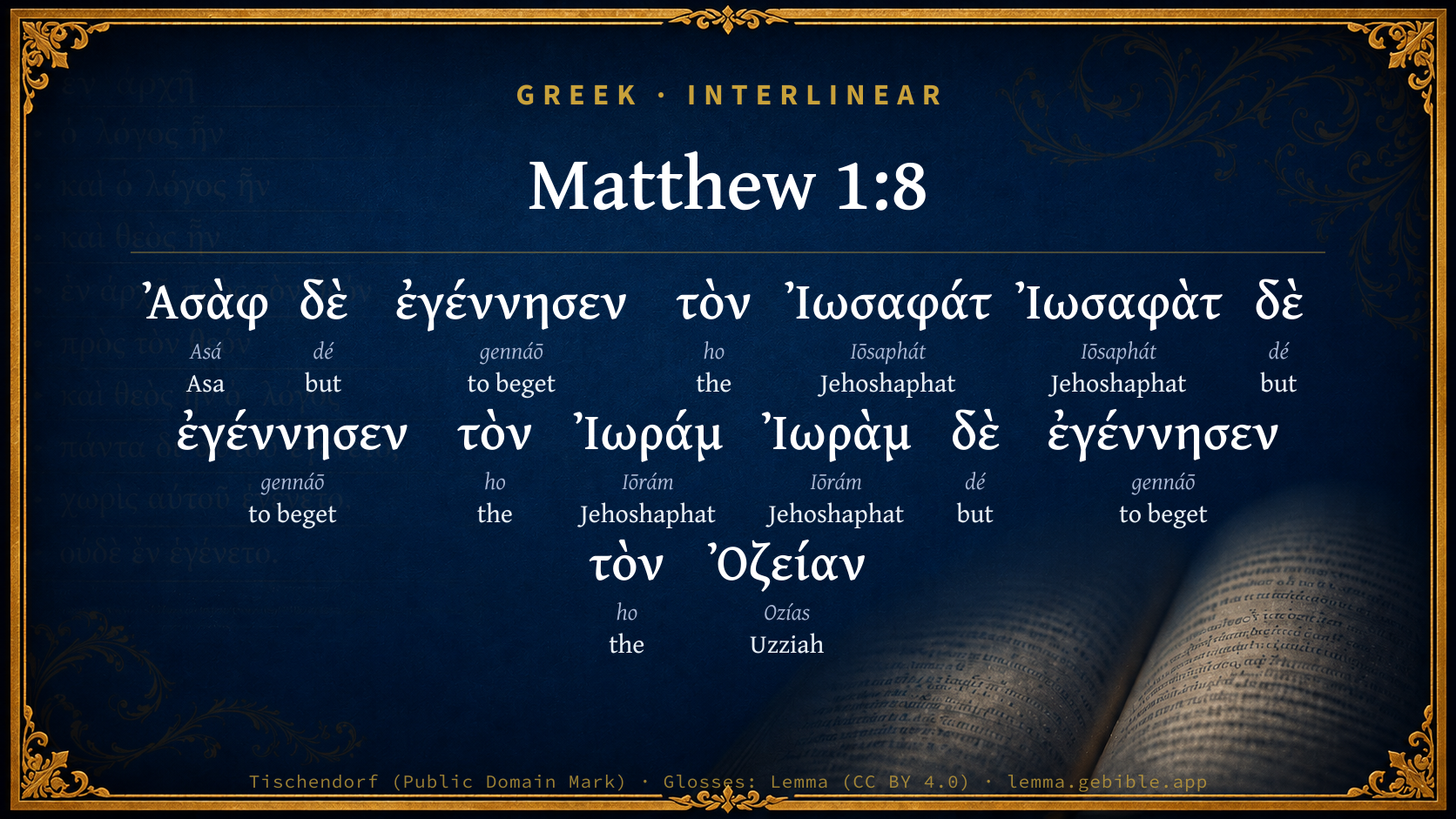
Download image
Cite this verse

Matthew 1:8 (World English Bible). Public Domain. Lemma interlinear Bible study tool, https://lemma.gebible.app/v/matthew/1/8.

Show BibTeX & RIS
BibTeX
RIS
English Translation
Asa became the father of Jehoshaphat. Jehoshaphat became the father of Joram. Joram became the father of Uzziah.
World English Bible · Public Domain
Highlights
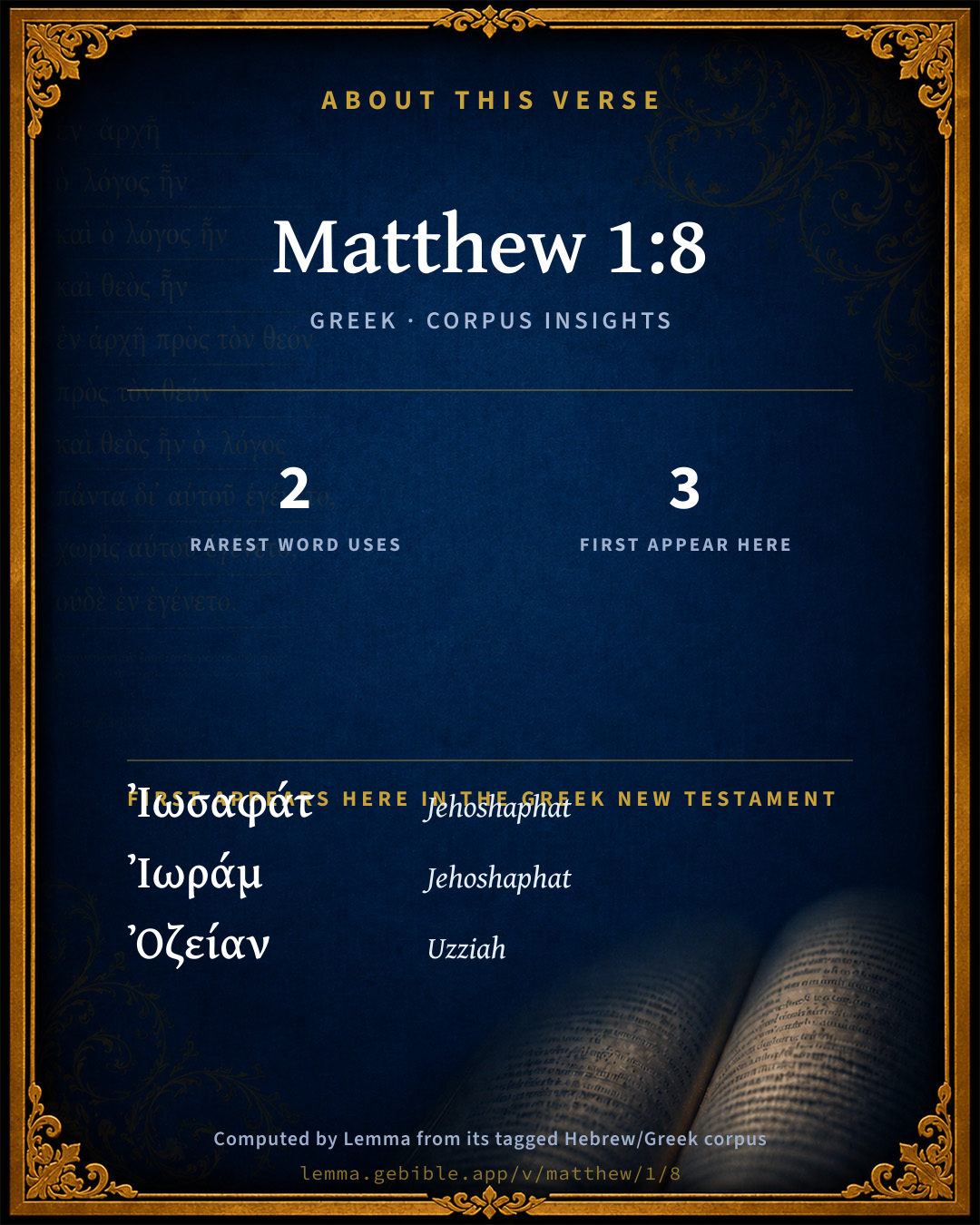
  • 3 first appearances in the Greek New Testament
Full analysis ↓
Download a study sheet

One document with this verse’s original text, its word-by-word gloss line, the meaning frame, cross-references with their text, attributed commentary, and full source and license credits — printable, and it pastes into notes with its structure intact.

This verse Autodidact and up

Study sheet (.html) Plain text (.txt)

A passage Seminary Student

Up to 50 verses in one chapter. A passage sheet keeps up to 6 commentary sources and 12 cross-references per verse, in the order this page ranks them, and says so on the sheet whenever that leaves anything out. Ask for a single verse and you get the Autodidact verse sheet above.

Everything on this page stays free to read, with no account — the sheet is a download of what is already on screen, not access to it.

Want to remove ads? Support Godless Engineer
Compare translations 3

The same verse in 3 English versions, stacked beneath the original-language interlinear above. Click any original word for its lexicon entry.

Each is an independent rendering of the whole verse — the interlinear is not word-aligned to these translations.

Highlighted words mark where these versions differ — a whole-verse word diff, not a word-by-word alignment.

  • World English Bible Public Domain
    Asa became the father of Jehoshaphat. Jehoshaphat became the father of Joram. Joram became the father of Uzziah.
  • King James Version Public Domain
    And Asa begat Josaphat; and Josaphat begat Joram; and Joram begat Ozias;
  • unfoldingWord Literal Text CC BY-SA 4.0
    and Asaph fathered Jehoshaphat, and Jehoshaphat fathered Joram, and Joram fathered Ozias,

unfoldingWord Literal Text — © unfoldingWord, licensed CC BY-SA 4.0. Word-aligned USFM3 via Door43 (git.door43.org/unfoldingWord/en_ult).

Versions to compare (up to 4)

3 of 4 selected

Show all 19 translations

Every available English version of this verse, each an independent rendering of the whole verse.

  • World English Bible Public Domain
    Asa became the father of Jehoshaphat. Jehoshaphat became the father of Joram. Joram became the father of Uzziah.
  • Berean Standard Bible Public Domain
    Asa was the father of Jehoshaphat, Jehoshaphat the father of Joram, and Joram the father of Uzziah.
  • Majority Standard Bible Public Domain
    Asa was the father of Jehoshaphat, Jehoshaphat the father of Joram, and Joram the father of Uzziah.
  • King James Version Public Domain
    And Asa begat Josaphat; and Josaphat begat Joram; and Joram begat Ozias;
  • American Standard Version (1901) Public Domain
    and Asa begat Jehoshaphat; and Jehoshaphat begat Joram; and Joram begat Uzziah;
  • Revised Version (1885) Public Domain
    and Asa begat Jehoshaphat; and Jehoshaphat begat Joram; and Joram begat Uzziah;
  • Geneva Bible (1599) Public Domain
    And Asa begate Iosaphat. And Iosaphat begate Ioram. And Ioram begate Hozias.
  • Douay-Rheims (1899) Public Domain
    And Asa begot Josaphat. And Josaphat begot Joram. And Joram begot Ozias.
  • Young's Literal Translation Public Domain
    and Asa begat Jehoshaphat, and Jehoshaphat begat Joram, and Joram begat Uzziah,
  • Literal Standard Version CC BY-SA 4.0
    and Asa begot Jehoshaphat, and Jehoshaphat begot Joram, and Joram begot Uzziah,
  • Unlocked Literal Bible CC BY-SA 4.0
    Asa was the father of Jehoshaphat, Jehoshaphat the father of Joram, and Joram an ancestor of Uzziah.
  • unfoldingWord Literal Text CC BY-SA 4.0
    and Asaph fathered Jehoshaphat, and Jehoshaphat fathered Joram, and Joram fathered Ozias,
  • Darby Bible Public Domain
    and Asa begat Josaphat, and Josaphat begat Joram, and Joram begat Ozias,
  • World Messianic Bible Public Domain
    Asa became the father of Jehoshaphat. Jehoshaphat became the father of Joram. Joram became the father of Uzziah.
  • Webster's Bible Public Domain
    And Asa begat Josaphat; and Josaphat begat Joram; and Joram begat Ozias;
  • Free Bible Version CC BY-SA 4.0
    and Asa the father of Jehoshaphat; and Jehoshaphat the father of Jehoram; and Jehoram the father of Uzziah;
  • Bible in Basic English Public Domain
    And the son of Asa was Jehoshaphat; and the son of Jehoshaphat was Joram; and the son of Joram was Uzziah;
  • Text-Critical English NT CC BY 4.0
    Asa was the father of Jehoshaphat, Jehoshaphat was the father of Joram, Joram was the father of Uzziah,
  • Tyndale New Testament (1534) Public Domain
    Asa begat Iosaphat: Iosaphat begat Ioram: Ioram begat Osias:

Literal Standard Version (2020), Covenant Press — licensed CC BY-SA 4.0. Text via the HelloAO Bible API (eBible.org). Unlocked Literal Bible (unfoldingWord) — licensed CC BY-SA 4.0. Text via the HelloAO Bible API (eBible.org). unfoldingWord Literal Text — © unfoldingWord, licensed CC BY-SA 4.0. Word-aligned USFM3 via Door43 (git.door43.org/unfoldingWord/en_ult). Free Bible Version, Dr. Jonathan Gallagher — licensed CC BY-SA 4.0. Text via the HelloAO Bible API (eBible.org).

Word by word

More ways to search: Search by grammar → Find every occurrence → Compare this word →

Practice this passage: Drill this verse → Learn its vocabulary →

Ἀσὰφ
Asá
G760
“Asa”
Noun, Proper, indeclinable
Part of Speech
Noun · Proper, indeclinable
Full Thayer's Definition

Origin: of hebrew origin H609

TDNT: None

Asa = "physician, or cure" 1. son of Abijah and king of Judah
  1. δὲ dé G1161 “but” Conjunction
  2. ἐγέννησεν gennáō G1080 “to beget” Verb, Aorist, Active, Indicative, 3rd person, Singular
  3. τὸν ho G3588 “the” Article, Accusative, Singular, Masculine
  4. Ἰωσαφάτ Iōsaphát G2498 “Jehoshaphat” Noun, Proper, indeclinable
  5. Ἰωσαφὰτ Iōsaphát G2498 “Jehoshaphat” Noun, Proper, indeclinable
  6. δὲ dé G1161 “but” Conjunction
  7. ἐγέννησεν gennáō G1080 “to beget” Verb, Aorist, Active, Indicative, 3rd person, Singular
  8. τὸν ho G3588 “the” Article, Accusative, Singular, Masculine
  9. Ἰωράμ Iōrám G2496 “Jehoshaphat” Noun, Proper, indeclinable
  10. Ἰωρὰμ Iōrám G2496 “Jehoshaphat” Noun, Proper, indeclinable
  11. δὲ dé G1161 “but” Conjunction
  12. ἐγέννησεν gennáō G1080 “to beget” Verb, Aorist, Active, Indicative, 3rd person, Singular
  13. τὸν ho G3588 “the” Article, Accusative, Singular, Masculine
  14. Ὀζείαν Ozías G3604 “Uzziah” Noun, Accusative, Singular, Masculine

About this verse

These counts appear in no published source. They are computed here, from the morphology-tagged text and Lemma’s own curated glosses. What Lemma adds →

15
words
7
distinct lemmas
Gospels
section

Notable vocabulary

The rarest word here is Ἀσὰφ Asa G760 — appearing just 2 times in the whole Greek New Testament.

First appearance in Scripture

These words make their first canonical appearance in the Greek New Testament here:

  • Ἰωσαφάτ Jehoshaphat G2498
  • Ἰωράμ Jehoshaphat G2496
  • Ὀζείαν Uzziah G3604

Shared distinctive vocabulary

Ἀσὰφ Asa G760 occurs in 2 verses of the Greek New Testament. Also found in:
Repetition

Words recur within this verse:

  • ἐγέννησεν to beget G1080 ×3
  • Ἰωσαφάτ Jehoshaphat G2498 ×2
  • Ἰωράμ Jehoshaphat G2496 ×2
  • δὲ but G1161 ×3
  • τὸν the G3588 ×3

Cross-references

10

Topical passages linked to Matthew 1:8 in the Treasury of Scripture Knowledge — connected by theme and wording, ordered by reader-vote popularity; previews shown in the World English Bible.

  • 1 Chronicles 3:11 Joram his son, Ahaziah his son, Joash his son,
  • 2 Chronicles 26:1–23 All the people of Judah took Uzziah, who was sixteen years old, and made him king in the room of his father Amaziah.
  • 1 Kings 15:24 Asa slept with his fathers, and was buried with his fathers in the city of David his father; and Jehoshaphat his son reigned in his place.
  • 1 Kings 22:2–50 It happened in the third year, that Jehoshaphat the king of Judah came down to the king of Israel.
  • 2 Kings 3:1 Now Jehoram the son of Ahab began to reign over Israel in Samaria in the eighteenth year of Jehoshaphat king of Judah, and reigned twelve years.
  • 2 Kings 8:16 In the fifth year of Joram the son of Ahab king of Israel, Jehoshaphat being then king of Judah, Jehoram the son of Jehoshaphat king of Judah began to reign.
  • 2 Kings 14:21 All the people of Judah took Azariah, who was sixteen years old, and made him king in the room of his father Amaziah.
  • 2 Kings 15:1–6 In the twenty-seventh year of Jeroboam king of Israel began Azariah son of Amaziah king of Judah to reign.
  • 2 Chronicles 17:1–19 Jehoshaphat his son reigned in his place, and strengthened himself against Israel.
  • 2 Chronicles 21:1 Jehoshaphat slept with his fathers, and was buried with his fathers in the city of David: and Jehoram his son reigned in his place.

Cross-references courtesy of OpenBible.info (CC BY 4.0).

Commentary

Notes on Matthew 1:8 from classic Christian and Jewish commentators (each source and its license shown beneath its notes). The classic Christian expositions comment on the surrounding passage and are grouped to its opening verse, so a note may address several verses; the Jewish commentaries on the Tanakh (Rashi and others) are per-verse, so they appear only where the commentator wrote on this verse.

Lemma curates 59 commentaries, every one of them public domain or Creative Commons licensed, each selected and text-cleaned for this edition rather than reprinted as found. About our sources →

Joseph Benson's Commentary

Mat 1:8. And Joram begat Ozias — By Ozias, Uzziah is intended, and it is certain from the history of the Kings and Chronicles that he was the son of Amaziah, 2Ch 26:1; Amaziah, of Joash, ch. Mat 24:27; Joash, of Ahaziah, ch. Mat 22:11; and Ahaziah, of Jehoram. But, according to the language of the Hebrews, the children of children are reputed the sons or daughters, not only of their immediate parents, but of their ancestors, and these ancestors are said to beget those who are removed some generations from them. Thus Isaiah says to Hezekiah, Of thy sons which thou shalt beget shall they take away, and they shall be eunuchs in the palace of the king of Babylon: which prediction was not fulfilled until the days of Jeconiah, long after the days of Hezekiah. But it will be asked, why these three in particular are left out of the catalogue? The best answer to this question seems to be, that the evangelist followed the Jewish tables in writing this list, and that he found them left out in these. But if he himself, though he found them in the tables, omitted their names, it must, as Dr. Doddridge observes, have been “by some peculiar divine direction, that the sin of Jehoram is thus animadverted upon, even to the fourth generation, his intermediate descendants being thus blotted out of the records of Christ’s family, and overlooked as if they had never been.”

Joseph Benson's Commentary on the Old and New Testaments (1811–1818) — public domain. Text from a community e-Sword module.

Tyndale Open Study Notes

Tyndale Open Resources

1:8 father of (or ancestor of): The term includes several generations here (2 Chr 21:1–26:1), as it does in the case of Josiah (Matt 1:11) and Shealtiel (1:12). The genealogy omits Ahaziah, Joash, and Amaziah (2 Kgs 8:24; 1 Chr 3:11; 2 Chr 22:1, 11; 24:27), perhaps because of their association with Ahab and Jezebel.

Tyndale Open Study Notes — © Tyndale Open Resources, licensed CC BY-SA 4.0. Text via the HelloAO Bible API.

Bengel's Gnomon

Johann Albrecht Bengel

Mat 1:8. Ἰωρὰμ δὲ ἐγέννησε τὸν Ὀζίαν, but Joram begat Josiah) Ahaziah (who is the same as the Joahaz of 2Ch 21:17; 2Ch 22:1), Joash, and Amaziah (mentioned in 1Ch 3:11-12), are here passed over: so that the word ἐγέννησε (begat) must be understood mediately[9] instead of immediately: as frequently happens with the word ΥἹΌς (son), as in the first verse of this chapter, where our Lord is called the Son of David, who was His remote ancestor. In like manner Joram is here said to have begotten Josiah, who was his great-grandson,—that is to say, he was his progenitor. Thus, by referring to 1Ch 6:7-9, we find, that six generations are left out in Ezr 7:3, between Azariah and Meraioth. St Matthew omitted the three kings in question, not because he was ignorant of their having existed (since the whole context proves his familiar acquaintance with his subject), but because they were well known to all: nor did he do so with any fraudulent intention, since, by increasing the number of generations, he would have confirmed the notion that the Messiah must have already appeared. Nor did he omit them on account of their impiety, for he has mentioned other impious men, as e.g. Jechonias, and him with especial consideration, and he has passed over several pious ones. But, as in describing roads and ways, it is necessary to be especially careful with regard to those points where they branch off in different directions, whereas a straight road may be found without any such direction, so does St Matthew in this genealogy point out with particular care those who have had brothers, and who, in contradistinction to them, have propagated the stem of the Messiah. He has indeed carried this so far that, having a reason[10] for not naming Jehoiakim, he has assigned his brothers to his only son; whilst he has passed over, without inconvenience, Joash, who was the only link[11] in his generation, together with his father and son. Furthermore, as in geography the distances of places from each other are, without any violence to truth, described sometimes by longer, sometimes by shorter stages,—so is it with the successive steps of generations in a pedigree; nor is the practice of Hebrew genealogists an exception to the general custom in this matter. The writers of the New Testament are accustomed also rather to imply than assert circumstances already well known on the authority of the Old Testament, and not liable to be mistaken, employing a brevity as congenial to the ardour of the Spirit, as desirable on other grounds.—See Gnomon on Act 7:16. Oziah was previously called Azariah, but by the omission of one Hebrew letter (ø, R) his name becomes Oziah.

[9] i.e., There being mediate or intervening persons.—ED

[10] See Jer 22:30.—(I. B.)

[11] In the original, “qui unica sui temporis scintilla fuerat.”—(I. B.)

“The only spark in his generation to prevent the line being extinguished.”—ED.

Bengel's Gnomon of the New Testament — English translation (T&T Clark, Edinburgh, 1860) — public domain. Text from a community e-Sword module.

Meyer's Critical & Exegetical Commentary

Heinrich August Wilhelm Meyer

Mat_1:8. Ἰορὰμ … Ὀζίαν] Three kings, Ahaziah, Joaz, and Amazia, are wanting between these (2Ki_8:24; 1Ch_3:11; 2Ch_22:1; 2Ch_22:11; 2Ch_24:27). The common opinion is that of Jerome, that the omission was made for the sake of obtaining an equal division of the names, in order not to go beyond the three Tesseradecades. Such omissions were nothing unusual: 1Ch_8:1; Gen_46:21. See Surenhusius, βιβλ. καταλλ. p. 97. Lightfoot, Hor. p. 181. On the same phenomenon in the Book of Enoch, see Ewald in the Kieler Monatschrift, 1852, p. 520 f. The evangelist accepted the genealogical list without alteration, just as he found it; and the cause of that omission cannot be pointed out, but probably was only, and that without special design, the similarity of those names, in which way the omission also which occurs in Mat_1:11 is to be explained. Ebrard and Riggenbach, erroneously introducing the point of view of theocratic illegality (comp. Lange), are of opinion that Matthew omitted the three kings for this reason, that Joram, on account of his marriage with the daughter of Jezebel, and of his conduct, had deserved that his posterity should be exterminated down to the fourth generation (so already some of the Fathers, Maldonatus, Spanheim, Lightfoot); that Matthew accordingly declared the descendants of the heathen Jezebel, down to the fourth generation, unworthy of succeeding to the theocratic throne. This breaks down at once before the simple ἐγέννησε. The omissions are generally not to be regarded as consciously made, otherwise they would conflict with Mat_1:17 (πᾶσαι), and would amount to a falsification.

Meyer — Critical and Exegetical Commentary on the New Testament — English translation by Peter Christie, edited by Frederick Crombie (T&T Clark, 1880) — public domain. Text from a community e-Sword module.

Adam Clarke's Commentary

Verse 8. Joram begat Ozias] This is the Uzziah, king of Judah, who was struck with the leprosy for his presumption in entering the temple to offer incense before the Lord. See 2Ch 26:16, c. Ozias was not the immediate son of Joram: there were three kings between them, Ahaziah, Joash, and Amaziah, which swell the fourteen generations to seventeen: but it is observed that omissions of this kind are not uncommon in the Jewish genealogies. In Ezr 7:3, Azariah is called the son of Meraioth, although it is evident, from 1Ch 6:7-9, that there were six descendants between them. This circumstance the evangelist was probably aware of but did not see it proper to attempt to correct what he found in the public accredited genealogical tables; as he knew it to be of no consequence to his argument, which was merely to show that Jesus Christ as surely descended, in an uninterrupted line from David, as David did from Abraham. And this he has done in the most satisfactory manner; nor did any person in those days pretend to detect any inaccuracy in his statement; though the account was published among those very people whose interest it was to expose the fallacy, in vindication of their own obstinate rejection of the Messiah, if any such fallacy could have been proved. But as they were silent, modern and comparatively modern unbelievers may for ever hold their peace. The objections raised on this head are worthy of no regard; yet the following statement deserves notice.

St. Matthew took up the genealogies just as he found them in the public Jewish records, which, though they were in the main correct, yet were deficient in many particulars. The Jews themselves give us sufficient proof of this. The Talmud, title Kiddushim, mentions ten classes of persons who returned from the Babylonish captivity:

I. כהני COHANEY, priests.

II. לוי LEVEY, Levites.

III. ישראל YISHRAEL, Israelites.

IV. חלולי CHULULEY, common persons, as to the priesthood; such whose fathers were priests, but their mothers were such as the priests should not marry.

V. גירי GIREY, proselytes.

VI. חרורי CHARUREY, freed-men, or servants who had been liberated by their masters.

VII. ממזירי MAMZIREY, spurious, such as were born in unlawful wedlock.

VIII. נתיני NETHINEY, Nethinim.

IX. שתוקי SHETUKEY, bastards, persons whose mothers, though well known, could not ascertain the fathers of their children, because of their connections with different men.

X. אסופי ASUPHEY, such as were gathered up out of the streets, whose fathers and mothers were utterly unknown.

Such was the heterogeneous mass brought up from Babylon to Jerusalem; and although we learn from the Jews, that great care was taken to separate the spurious from the true-born Israelites, and canons were made for that purpose, yet it so happened, that sometimes a spurious family had got into high authority, and therefore must not be meddled with. See several cases in Lightfoot. On this account, a faithful genealogist would insert in his roll such only as were indisputable. "It is therefore easy to guess," says Dr. Lightfoot, "whence Matthew took the last fourteen generations of this genealogy, and Luke the first forty names of his: namely, from the genealogical rolls, at that time well known, and laid up in the public κειμηλια, repositories, and in the private also. And it was necessary indeed, in so noble and sublime a subject, and a thing that would be so much inquired into by the Jewish people, as the lineage of the Messiah would be, that the evangelists should deliver a truth, not only that could not be gainsayed, but also might be proved and established from certain and undoubted rolls of ancestors." See Horae Talmudicae.

Adam Clarke's Commentary on the Bible (1810–1826) — public domain. Text from a community e-Sword/MySword module.

The Cambridge Bible for Schools and Colleges

gen. ed. J. J. S. Perowne

8. Joram begat Ozias (Uzziah)] The names of Ahaziah, Joash and Amaziah are here omitted; see note, Mat_1:17.

The Cambridge Bible for Schools and Colleges (gen. ed. J. J. S. Perowne; Cambridge University Press, 1878–1918) — public domain. Text from a community e-Sword module.

John Gill's Exposition

And Asa begat Josaphat,.... Called Jehoshaphat, Kg1 15:24 whom Asa begat of Azubah, the daughter of Shilhi, Kg1 22:42. He also was a very good prince.

And Josaphat begat Joram; called Jehoram, Kg1 22:50 to whom his father gave the kingdom, because he was the firstborn, Ch2 21:3.

And Joram begat Ozias; called Uzziah, Ch2 26:1 and Azariah, Kg2 15:1. He was not the immediate son of Joram; there were three kings between them, Ahaziah, Joash, and Amaziah, which are here omitted; either because of the curse denounced on Ahab's family, into which Joram married, whose idolatry was punished to the third or fourth generation; or because these were princes of no good character; or because their names were not in the Jewish registers. Nor does this omission at all affect the design of the Evangelist, which is to show that Jesus, the true Messiah, is of the house of David; nor ought the Jews to complain of it, as they do (a) since such omissions are to be met with in the Old Testament, particularly in Ezr 7:2 where six generations are omitted at once; and which is taken notice of by one of their own genealogical writers, whose words are these (b);

"we see in the genealogy of Ezra that he hath skipped over seven generations (perhaps it should be "six" and not "seven", since six are only omitted) from Ahitub to Ahitub.''

Nor is it any objection that Joram is said to beget Ozias, which he may be said to do in the like sense, as has been before observed of Hezekiah, Isa 39:7.

(a) R. Isaac Chizzuk Emunab, par. 2. p. 390. (b) Juchasin, fol. 10. 2.

John Gill's Exposition of the Whole Bible (1746–1763) — public domain (CC PDM 1.0). Text via the HelloAO Bible API.

Trapp's Complete Commentary

John Trapp

8 And Asa begat Josaphat; and Josaphat begat Joram; and Joram begat Ozias;

Ver. 8. And Asa begat Josaphat] A godly king, but late witted, and therefore paid for his learning twice at least in holy history. One thing in the narration of his acts is very remarkable. He placed forces in all the fenced cities; yet it is not said thereupon that the fear of the Lord fell on the neighbouring nations. But when he had established a preaching ministry in all the cities, then his enemies feared and made no war, 2Ch 17:10. Solidissima regiae politiae basis (saith Paradinus in Symbolis) est verum Dei cultum ubivis stabilire: alias qui potest aut Deus Reges beare, a quibus negligitur; aut populus fideliter colere, qui de obsequio suo non recte instituitur? The ordinances of God are the beauty and bulwark of a place and people.

And Josaphat begat Joram] That lived undesired and died unlamented. While he lived there was no use of him, and when he died, no miss of him: no more than of the paring of the nails or sweeping of the house (περιψηματα). He lived wickedly, and died wishedly, as it is said of King Edwin (Daniel’s Hist.).

And Joram begat Ozias] Here Ahaziah, Joash, and Amaziah are written in the earth, not once set down in the roll: perhaps it was because they were imped in the wicked family of Ahab. This Uzziah, though a king, yet he loved husbandry, 2Ch 26:10. Thrift is the fuel of magnificence. He was at length a leper, yet still remained a king. Infirmities may deform us, they cannot dethrone us. The English laws (saith Camden, Elizabeth) pronounce, that the crown once worn quite taketh away all defects whatsoever: sure it is that when God once crowns a man with his grace and favour, that man is out of harm’s way for ever.

John Trapp, A Commentary or Exposition upon All the Books of the Old and New Testament (1647–1656) — public domain. Text from a community e-Sword module.

Haydock's Catholic Bible Commentary

Joram begot Ozias, three generations are omitted, as we find 2 Paraliponenon xxii; for there, Joram begot Ochozias, and Ochozias begot Joas, and Joas begot Amazias, and Amazias begot Ozias. This omission is not material, the design of St. Matthew being only to shew the Jews that Jesus, their Messias, was of the family of David; and he is equally the son, or the descendent of David, though the said three generations be left out: for Ozias may be called the son of Joram, though Joram was his great-grandfather. (Witham) --- It is thought that St. Matthew omitted these three kings, Ochozias, Joas, and Amazias, to preserve the distribution of his genealogy into three parts, each of fourteen generations; and, perhaps, also on account of their impiety, or rather on account of the sentence pronounced against the house of Achab, from which they were descended by their mother Athalia. (3 Kings xxi. 21.) (Calmet)

George Leo Haydock (1774–1849), Haydock's Catholic Family Bible and Commentary, 1859 edition — public domain. Excludes Psalms (Douay-Rheims chapter numbering differs from Protestant) and Deuterocanonical books (Catholic canon only).

Matthew Poole's English Annotations

Jehoshaphat, here called

Josaphat, in the Greek, (they having no letter to express the Hebrew ה by), was the son of Asa, a good son of a good father, 2Ch 17:1,2; he reigned twenty-five years, 1Ki 22:42. Jehoram, here called

Joram, succeeded him in his kingdom: he slew his brethren; he walked in the ways of Ahab. 2Ch 21:4,6; he reigned but eight years, lived and died wickedly, and was buried infamously, 2Ch 21:19,20. But here ariseth another difficulty from what is said,

Joram begat Ozias. It is certain that he did not beget him immediately, for Uzziah was the fourth from Joram. Jehoram or Joram begat Ahaziah, he was his youngest son; he lived but one year as king, 2Ch 22:1,2; then Athaliah usurped the kingdom for six years, not counting her usurpation. Joash the son of Ahaziah reigned forty years, 2Ch 24:1. He dies, and Amaziah his son reigned in his stead, 2Ki 12:21. He was the father of Uzziah, 2Ch 26:1, called Azariah, 2Ki 14:21. So that when it is said, that Joram begat Ozias, we must only understand that Uzziah lineally descended from Joram: thus, Mat 1:1, Christ is called the Son of David, the son of Abraham. Thus the Jews said: We have Abraham to our father; and Elisabeth is said to be of the daughters of Aaron, Luk 1:5. But it is a greater question why the evangelist leaves out Ahaziah, Joash, and Amaziah, who were all three lawful princes, and rightly descended from the family of David. To pass by various conjectures, the best account I find given of it is this.

1. It is manifest the evangelist had a design to divide all the generations from Abraham to Christ into three periods. The first of which should contain the growing state of the Jewish commonwealth, till it came at the height, which was in David’s time. The second should contain its flourishing state; which was from David’s time till the first carrying into captivity. The third should contain its declining state, from the first carrying them into captivity to the coming of Christ.

2. He designed to reduce all the generations in each period to fourteen; this appeareth from Mat 1:17. Now although the first period contained exactly fourteen descents or generations, yet in the second there was manifestly seventeen, so as the evangelist was obliged to leave out three to bring them to the number of fourteen: now though it be a little too curious to inquire why the evangelist chose to leave out these three, Ahaziah, Joash, and Amaziah, rather than any other three, yet there is a probable good account of it given by learned men, who have waded into these speculations. Ahaziah was the son of Jehoram by Athaliah the daughter of Ahab, 2Ch 21:6; Joash her grandchild; Amaziah her great grandchild. Now God had cursed the house of Ahab, and threatened to root out all his house, 1Ki 21:21. This (as is supposed) made the evangelist, who was necessitated to leave out three to bring the generations to fourteen, rather to choose to leave out these princes, who were of Ahab’s half blood, than any others. If any say, Why then did he not leave out more? Besides that he was not obliged any other way, (than as he would keep to his number to leave out these), he knew God’s threatenings of children for the sins of parents usually terminate in the third and fourth generation.

Matthew Poole's English Annotations on the Holy Bible (1683–1685) — public domain. Text from a community e-Sword/MySword module.

The Pulpit Commentary

And Joram begat Ozias (Uzziah, Revised Version). Between Joram and Uzziah the pedigree omits three names Ahaziah immediately succeeded Joram, (2Ki_8:24) and was followed by his son Joash, (2Ki_12:1) and he by his son Amaziah. (2Ki_14:1) These were probably left out, that the number of generations might be reduced to fourteen. It is not likely that St. Matthew omitted them, but that they were absent from the form which he used. If we seek for a reason why these precise names are omitted, we may probably find it in the fact of their being descended from Jezebel; while the language of the second commandment would suggest that to the fourth generation the children" of that race would suffer for the sins of their parents. To the Jewish compiler of this genealogy no argument more forcible for the removal of these names could have been suggested. It will be seen that the word "begat" in these verses does not signify always the direct succession of son to father.

The Pulpit Commentary (1880–1919), ed. H.D.M. Spence-Jones & Joseph S. Exell — public domain. Text from a community e-Sword module.

John Wesley's Explanatory Notes

Jehoram begat Uzziah - Jehoahaz, Joash, and Amaziah coming between. So that he begat him mediately, as Christ is mediately the son of David and of Abraham. So the progeny of Hezekiah, after many generations, are called the sons that should issue from him, which he should beget, Isaiah xxxix, 7.

John Wesley, Explanatory Notes Upon the Whole Bible (1754–1765) — public domain. Text via the GEBible commentary corpus.

The People's New Testament

B. W. Johnson

8. Joram. Between Joram and Uzziah three names are intentionally omitted. They are found in 1 Chron. 3:11, 12. They were probably omitted to equalize the threefold division of generations from Abraham to Joseph. Such omissions of unimportant links are common in the Old Testament.

B. W. Johnson's The People's New Testament with Notes (1889–1891) — public domain. Electronic text from the Christian Classics Ethereal Library (CCEL) ThML edition.

Cambridge Greek Testament for Schools and Colleges

8. Ἰωρὰμ δὲ ἐγέννησεν τὸι Ὀζείαν (Uzziah). The names of Ahaziah, Joash and Amaziah are here omitted; see note, Mat 1:17.

Cambridge Greek Testament for Schools and Colleges (Cambridge University Press, 1896; 21 vols, various authors incl. Carr, Maclear, Plummer, Farrar, Lumby, Moule, M. R. James, Simcox) — public domain. Text from a community e-Sword module.

Alford’s Greek Testament

Henry Alford

8. Ἰωρὰμ … Ὀζείαν] Three kings, viz., Ahaziah, Joash, Amaziah (1Ch 3:11, 1Ch 3:12), are here omitted (supplied in , lat-a, in Luke). Some (Spanheim, Lightf., Ebrard, &c.) think that they were erased on account of their connexion, by means of Athaliah, with the accursed house of Ahab. Simeon is omitted by Moses in blessing the tribes (Deu_33): the descendants of Zebulun and Dan are passed over in 1 Chron., and none of the latter tribe are sealed in Rev_7. But more probably such erasion, even if justifiable by that reason, was not made on account of it, but for convenience, in order to square the numbers of the different portions of the genealogies, as here. Compare as illustrating such omissions, 1Ch 8:1 with Gen 46:21.

Henry Alford, The Greek Testament (1849–1861) — public domain. Text from a community e-Sword module.

International Critical Commentary

(E) 8, 9. And Joram begat Ozias; and Ozias begat Joatham; and Joatham begat Ahaz; and Ahaz begat Hezekias.] Cf. 1Ch 3:11, 1Ch 3:12. Joram begat Ozias. Commentators usually note that Mt. has here omitted three kings, Ahaziah, Joash, and Amaziah. But this is not the case. 1Ch 3:11 records that Ὀζειά was the son of Joram. That is to say, Mt. follows the LXX. of the Chronicles. Mt. continues: Ὀζείας δὲ ἐγέννησε τὸν Ἰωάθαμ. The Chronicler LXX. has Ἰωὰς υἱὸς αὐτοῦ, Ἀμασίας υἱὸς αὐτοῦ, Ἀζαριὰ υἱὸς αὐτοῦ, Ἰωαθὰν υἱὸς αὐτοῦ. That is to say, Mt. has omitted not Ahaziah = Ὀζείας, Joash, and Amaziah, but Joash, Amaziah, and Azariah = Uzziah. The reason must be sought in 1Ch 3:11 LXX. The son of Joram is there called Ὀζειά. Now for Ahaziah the LXX. generally has Ὀχοζείας, whilst Ὀζειά is generally the equivalent of Uzziah, e.g. 2Ch 26:3ff. Ὀζειά in 1Ch 3:11 is possibly a mistake. Mt. as he copied it seems naturally enough to have connected it with Uzziah, and so to have passed on to this king’s son, Jotham, thus omitting unconsciously the three intervening kings. Or the copy of the LXX. which he followed may have made the omission for the same reason.—Ὀζείας] The Septuagintal forms are Ὀζειά, B; Ὀζίας, A Luc.—Ἰωαθάμ] The LXX. A B has Ἰωαθάν, but Luc. Ἰωθάς.—Ἄχαζ] The LXX. A B has Ἄχας, but Luc. Ἄχαζ. Ἐζεκίας is the LXX. form.

8. Ἰωσαφάτ] LXX. Ἰωσαφάτ, Ἰωσαφάθ. In 1Ch 3:10 Ἰωσαφάτ, Josephus Ἰωσάφατος.—Ἰωράμ] So LXX. Josephus Ἰώραμος.—Ὀζείαν] S2 has “Ahazia; Ahazia begat Joash; Joash begat Amozia.” So Aphr.

International Critical Commentary — older volumes (1896–1929), various authors — public domain. Text from a community e-Sword module.

Lesson kit

Teaching starters — assembled from the data on this page, not authored interpretation. Every prompt links to the verse data it draws on. Edit before teaching.

Matthew, in the Gospels, opens this verse with 15 words (7 distinct Greek lemmas). Its most distinctive word is Asá (“Asa”). A historical commentator’s framing appears above. Read the whole chapter for the surrounding context.

Discussion questions

  1. What does “Asa” (Asá) contribute to the verse as a whole?
  2. 3 words make their first appearance in Scripture here. What does this debut establish?
  3. How does Matthew 1:7, which shares the word «Asa», read alongside this verse?
  4. What does the repetition of “to beget” (3× in this one verse) do in this verse?
  5. These translations render this verse differently. What is at stake in choosing one wording over another?
  6. Compare how Joseph Benson's Commentary and Tyndale Open Study Notes read this verse. Where do they agree or differ?

Things to notice

  • 3 words make their first canonical appearance in Scripture here.
  • These translations choose different wording for 10 words in this verse.
  • “to beget” occurs 3× in this single verse.
  • 7 distinct Greek lemmas span 15 words in this verse.

Reading settings

Reading text

Shown beneath each verse's original-language words.

Old Testament
Old Testament edition

Read the OT as the Masoretic Hebrew (MT) or the Greek Septuagint (LXX).

English shown for the Greek Septuagint (in the Hebrew ↔ Greek comparison).

Comparing translations? Open the Compare panel on any verse page to stack up to four side by side.