Matthew 14:25

Greek (Tischendorf 8th ed.) Matthew 14:25 appears in the Greek New Testament. The text above is from the Tischendorf 8th edition. Each word links to its Strong’s number and a concise gloss. Click any word for its full Thayer’s Greek Lexicon entry.
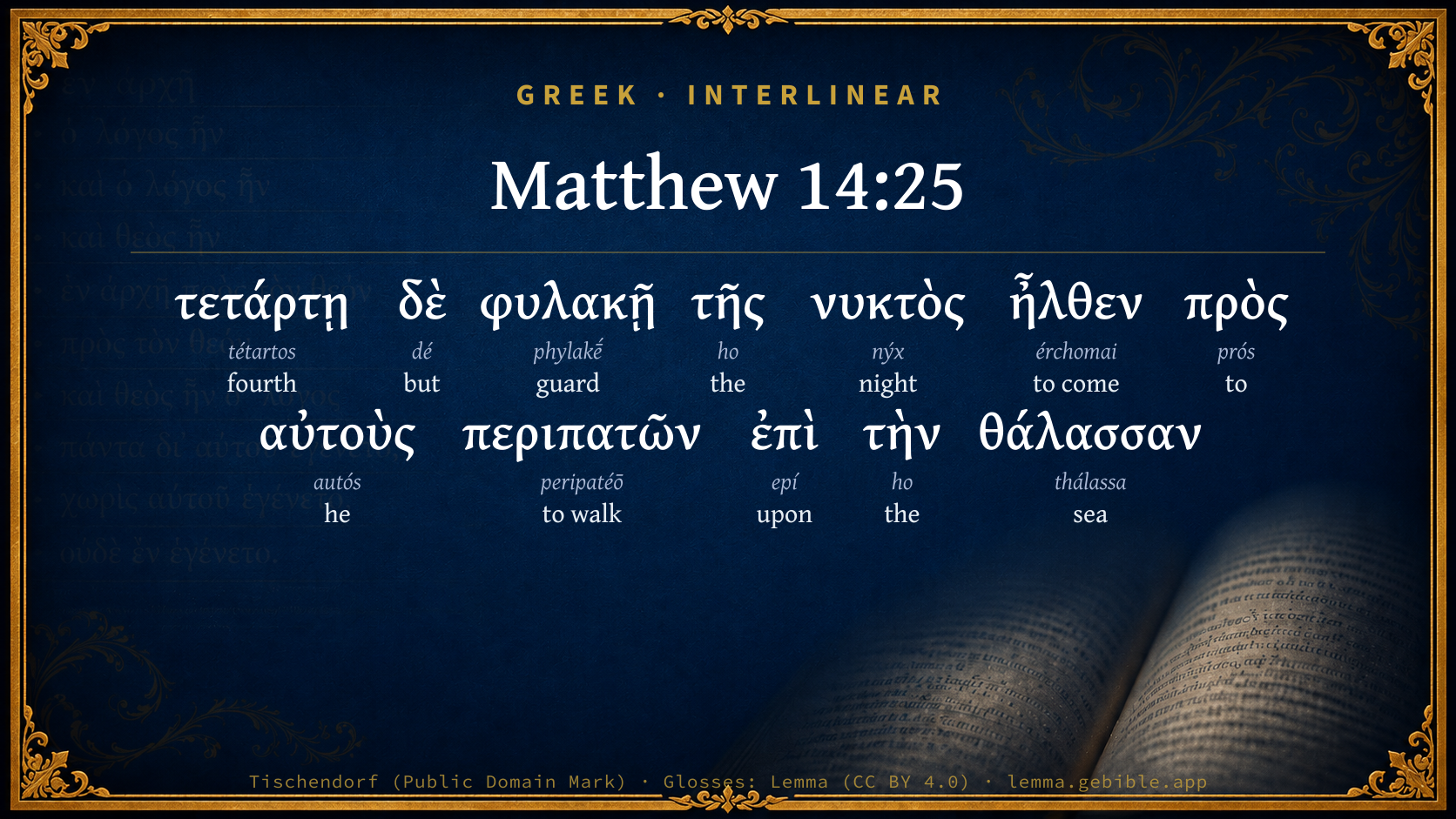
Download image
Cite this verse

Matthew 14:25 (World English Bible). Public Domain. Lemma interlinear Bible study tool, https://lemma.gebible.app/v/matthew/14/25.

Show BibTeX & RIS
BibTeX
RIS
English Translation
In the fourth watch of the night, Jesus came to them, walking on the sea.
World English Bible · Public Domain
Highlights
  • 1 first appearance in the Greek New Testament
Full analysis ↓
Download a study sheet

One document with this verse’s original text, its word-by-word gloss line, the meaning frame, cross-references with their text, attributed commentary, and full source and license credits — printable, and it pastes into notes with its structure intact.

This verse Autodidact and up

Study sheet (.html) Plain text (.txt)

A passage Seminary Student

Up to 50 verses in one chapter. A passage sheet keeps up to 6 commentary sources and 12 cross-references per verse, in the order this page ranks them, and says so on the sheet whenever that leaves anything out. Ask for a single verse and you get the Autodidact verse sheet above.

Everything on this page stays free to read, with no account — the sheet is a download of what is already on screen, not access to it.

Want to remove ads? Support Godless Engineer
Compare translations 3

The same verse in 3 English versions, stacked beneath the original-language interlinear above. Click any original word for its lexicon entry.

Each is an independent rendering of the whole verse — the interlinear is not word-aligned to these translations.

Highlighted words mark where these versions differ — a whole-verse word diff, not a word-by-word alignment.

  • World English Bible Public Domain
    In the fourth watch of the night, Jesus came to them, walking on the sea.
  • King James Version Public Domain
    And in the fourth watch of the night Jesus went unto them, walking on the sea.
  • unfoldingWord Literal Text CC BY-SA 4.0
    Now in the fourth watch of the night he came to them, walking on the sea.

unfoldingWord Literal Text — © unfoldingWord, licensed CC BY-SA 4.0. Word-aligned USFM3 via Door43 (git.door43.org/unfoldingWord/en_ult).

Versions to compare (up to 4)

3 of 4 selected

Show all 19 translations

Every available English version of this verse, each an independent rendering of the whole verse.

  • World English Bible Public Domain
    In the fourth watch of the night, Jesus came to them, walking on the sea.
  • Berean Standard Bible Public Domain
    During the fourth watch of the night, Jesus went out to them, walking on the sea.
  • Majority Standard Bible Public Domain
    During the fourth watch of the night, Jesus went out to them, walking on the sea.
  • King James Version Public Domain
    And in the fourth watch of the night Jesus went unto them, walking on the sea.
  • American Standard Version (1901) Public Domain
    And in the fourth watch of the night he came unto them, walking upon the sea.
  • Revised Version (1885) Public Domain
    And in the fourth watch of the night he came unto them, walking upon the sea.
  • Geneva Bible (1599) Public Domain
    And in the fourth watch of the night, Iesus went vnto them, walking on the sea.
  • Douay-Rheims (1899) Public Domain
    And in the fourth watch of the night, he came to them walking upon the sea.
  • Young's Literal Translation Public Domain
    And in the fourth watch of the night Jesus went away to them, walking upon the sea,
  • Literal Standard Version CC BY-SA 4.0
    And in the fourth watch of the night Jesus went away to them, walking on the sea,
  • Unlocked Literal Bible CC BY-SA 4.0
    In the fourth watch of the night Jesus approached them, walking on the sea.
  • unfoldingWord Literal Text CC BY-SA 4.0
    Now in the fourth watch of the night he came to them, walking on the sea.
  • Darby Bible Public Domain
    But in the fourth watch of the night he went off to them, walking on the sea.
  • World Messianic Bible Public Domain
    In the fourth watch of the night, Yeshua came to them, walking on the sea.
  • Webster's Bible Public Domain
    And in the fourth watch of the night Jesus went to them, walking on the sea.
  • Free Bible Version CC BY-SA 4.0
    About 3 a.m. Jesus caught up with them, walking on the sea.
  • Bible in Basic English Public Domain
    And in the fourth watch of the night he came to them, walking on the sea.
  • Text-Critical English NT CC BY 4.0
    And in the fourth watch of the night Jesus went to them, walking on the sea.
  • Tyndale New Testament (1534) Public Domain
    In the fourthe watche of the night Iesus came vnto them walkynge on the see.

Literal Standard Version (2020), Covenant Press — licensed CC BY-SA 4.0. Text via the HelloAO Bible API (eBible.org). Unlocked Literal Bible (unfoldingWord) — licensed CC BY-SA 4.0. Text via the HelloAO Bible API (eBible.org). unfoldingWord Literal Text — © unfoldingWord, licensed CC BY-SA 4.0. Word-aligned USFM3 via Door43 (git.door43.org/unfoldingWord/en_ult). Free Bible Version, Dr. Jonathan Gallagher — licensed CC BY-SA 4.0. Text via the HelloAO Bible API (eBible.org).

Word by word

More ways to search: Search by grammar → Find every occurrence → Compare this word →

Practice this passage: Drill this verse → Learn its vocabulary →

About this verse

These counts appear in no published source. They are computed here, from the morphology-tagged text and Lemma’s own curated glosses. What Lemma adds →

12
words
11
distinct lemmas
Gospels
section

Notable vocabulary

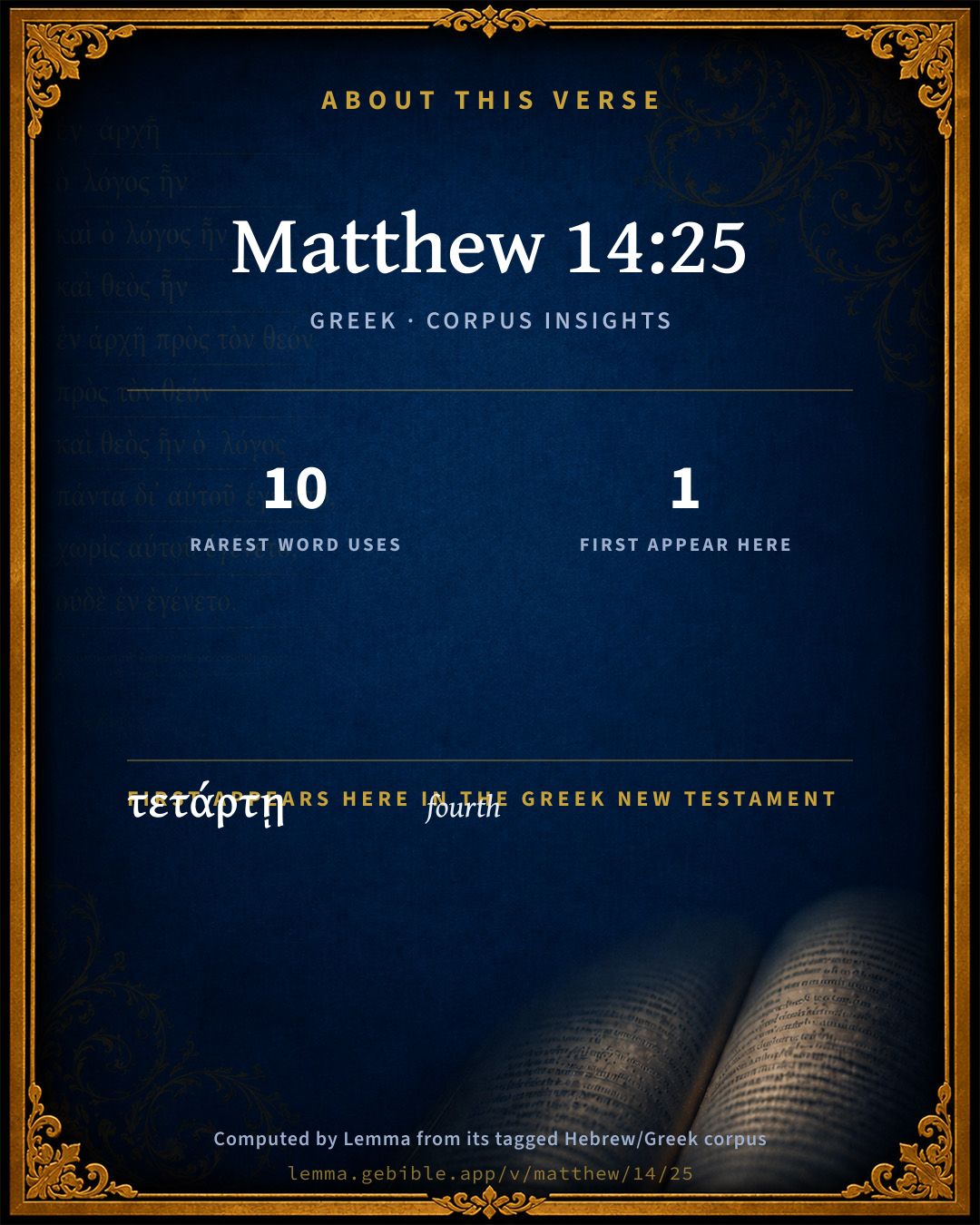
The rarest word here is τετάρτῃ fourth G5067 — appearing just 10 times in the whole Greek New Testament.

First appearance in Scripture

This word makes its first canonical appearance in the Greek New Testament here:

  • τετάρτῃ fourth G5067

Shared distinctive vocabulary

τετάρτῃ fourth G5067 occurs in 9 verses of the Greek New Testament. Also found in:

Repetition

A word recurs within this verse:

Cross-references

10

Topical passages linked to Matthew 14:25 in the Treasury of Scripture Knowledge — connected by theme and wording, ordered by reader-vote popularity; previews shown in the World English Bible.

  • Job 9:8 Who alone stretches out the heavens, Treads on the waves of the sea;
  • Mark 6:48 Seeing them distressed in rowing, for the wind was contrary to them, about the fourth watch of the night he came to them, walking on the sea, and he would have passed by them,
  • John 6:19 When therefore they had rowed about twenty-five or thirty stadia, they saw Jesus walking on the sea, and drawing near to the boat; and they were afraid.
  • Psalms 93:3–4 The floods have lifted up, Yahweh, The floods have lifted up their voice. The floods lift up their waves.
  • Matthew 24:43 But know this, that if the master of the house had known in what watch of the night the thief was coming, he would have watched, and would not have allowed his house to be broken into.
  • Psalms 104:3 He lays the beams of his chambers in the waters. He makes the clouds his chariot. He walks on the wings of the wind.
  • Luke 12:38 They will be blessed if he comes in the second or third watch, and finds them so.
  • Revelation 10:2 He had in his hand a little open book. He set his right foot on the sea, and his left on the land.
  • Revelation 10:5 The angel who I saw standing on the sea and on the land lifted up his right hand to the sky,
  • Revelation 10:8 The voice which I heard from heaven, again speaking with me, said, "Go, take the book which is open in the hand of the angel who stands on the sea and on the land."

Cross-references courtesy of OpenBible.info (CC BY 4.0).

Where the printed editions differ

1 variant

Places in this verse where the major printed Greek editions disagree on the wording in a way that affects the translation — a comparison of editions, not a manuscript-by-manuscript collation. The editions are the modern critical texts (Nestlé-Aland 28/27, SBL, Westcott-Hort, Tregelles, Tyndale House) and the traditional texts behind the KJV (the Textus Receptus and the Byzantine/Majority text). It is not a claim about which reading is original.

  1. Different wording
    ἦλθεν

    “he came”

    In NA28NA27TynSBLWHTreg Not in TRByz

    ἀπῆλθεν (apēlthen) 'he went away' occurs in traditional manuscripts (TR+Byz) instead of ἦλθεν (ēlthen) 'he came' in older manuscripts (NA28+NA27+Tyn+SBL+WH+Treg)

Textual data: Translators Amalgamated Greek New Testament (STEPBible TAGNT) · CC BY 4.0.

Commentary

Notes on Matthew 14:25 from classic Christian and Jewish commentators (each source and its license shown beneath its notes). The classic Christian expositions comment on the surrounding passage and are grouped to its opening verse, so a note may address several verses; the Jewish commentaries on the Tanakh (Rashi and others) are per-verse, so they appear only where the commentator wrote on this verse.

Lemma curates 59 commentaries, every one of them public domain or Creative Commons licensed, each selected and text-cleaned for this edition rather than reprinted as found. About our sources →

Joseph Benson's Commentary

Mat 14:25. And in the fourth watch of the night — The Jews, as well as the Romans, usually divided the night into four watches of three hours each. The first watch began at six, the second at nine, the third at twelve, the fourth at three. During these many tedious and distressing hours of storm and tempest, of darkness and danger, Jesus saw his disciples, though they saw not him: he beheld their perplexity and fear, while they were conflicting with the winds and waves, and observed how they toiled in rowing: Mar 6:48; yet he delayed all this time to go to their relief; seeing it proper so long to try their faith and patience. But in the fourth watch — When, it is probable, as the storm was not at all abated, they had begun to despair of deliverance; Jesus went unto them, walking on the water — agitated, stormy, and tumultuous as its billows were. Thus God often lengthens out the troubles of his people, and defers the time of their deliverance. But when things are come to an extremity, and they are ready to think he hath forgotten them, he unexpectedly appears for their relief and rescue; of a sudden the storm becomes a calm, and they are happily brought into a safe port. Thus, in the morning watch he appeared for Israel in the Red sea, troubled and dismayed their pursuing enemies, and delivered his people: and in all ages the extremity of his church has been his opportunity to visit and appear for her. He that keepeth Israel neither slumbers nor sleeps, but has constantly his eye upon them, and, when there is need, walks in darkness for their succour, support, and comfort. What a wonderful proof have we here of Christ’s sovereign power over the creatures, which are all under his feet, and at his command, forgetting their natures, and changing their most essential qualities at his word! “To walk on the sea was thought so impracticable, that the picture of two feet walking on the sea, was an Egyptian hieroglyphic for an impossible thing. And in the Scripture it is mentioned, as the prerogative of God, that he alone treadeth on the waves of the sea, Job 9:8.” — Doddridge.

Joseph Benson's Commentary on the Old and New Testaments (1811–1818) — public domain. Text from a community e-Sword module.

Tyndale Open Study Notes

Tyndale Open Resources

14:25 About three o’clock in the morning: Literally In the fourth watch of the night. This was approximately 3:00–6:00 am by Roman reckoning. • The fact that Jesus came . . . walking on the water demonstrates God’s sovereign reign over the stormy waters (see Job 9:8; Ps 77:19; Isa 43:16).

Tyndale Open Study Notes — © Tyndale Open Resources, licensed CC BY-SA 4.0. Text via the HelloAO Bible API.

Bengel's Gnomon

Johann Albrecht Bengel

Mat 14:25. Τετάρτη, fourth) and last. The Jews also divided the night into four watches. The disciples were subjected to great straits for some time, till He brought them help.—ἀπῆλθε, He departed) His prayers, though they had lasted a long while, being as it were broken off, He departed to help His disciples.—περιπατῶν, κ.τ.λ., walking) though the wind blew strong.

Bengel's Gnomon of the New Testament — English translation (T&T Clark, Edinburgh, 1860) — public domain. Text from a community e-Sword module.

Expositor's Greek Testament

ed. W. Robertson Nicoll

Mat 14:25 . τετάρτῃ φυλ . = 3 to 6, in the early morning, πρωῒ . ἐπὶ τ . θ .: the readings in this and the next verse vary between genitive and accusative. The sense is much the same. The evangelist means to represent Jesus as really walking on the sea, not on the land above the sea level (Paulus, Schenkel). Holtz. (H. C.), regarding it as a legend, refers to O. T. texts in which God walks on the sea.

The Expositor's Greek Testament, edited by W. Robertson Nicoll (1897–1910) — public domain. Text from a community e-Sword module.

Geneva Bible (1599)

Geneva Bible translators

By the fourth watch is meant the time near to day breaking: for in old time they divided the night into four watches, in which they scouted.

Geneva Bible (1599) marginal notes — public domain. Text via Bolls.life.

Adam Clarke's Commentary

Verse 25. The fourth watch] Anciently the Jews divided the night into three watches, consisting of four hours each. The first watch is mentioned, La 2:19: the second, Jdg 7:19; and the third, Ex 14:24; but a fourth watch is not mentioned in any part of the OLD Testament. This division the Romans had introduced in Judea, as also the custom of dividing the day into twelve hours: see Joh 11:9. The first watch began at six o'clock in the evening, and continued till nine; the second began at nine, and continued till twelve; the third began at twelve, and continued till three next morning; and the fourth began at three, and continued till six. It was therefore between the hours of three and six in the morning that Jesus made his appearance to his disciples.

Walking on the sea.] Thus suspending the laws of gravitation was a proper manifestation of unlimited power. Jesus did this by his own power; therefore Jesus showed forth his Godhead. In this one miracle we may discover three:-

1. Though at a distance from his disciples, he knew their distress.

2. He found them out on the lake, and probably in the midst of darkness.

3. He walked upon the water.

Job, speaking of those things whereby the omnipotence of God was demonstrated, says particularly, Job 9:8, He walketh upon the waves of the sea: intimating that this was impossible to any thing but Omnipotence.

Adam Clarke's Commentary on the Bible (1810–1826) — public domain. Text from a community e-Sword/MySword module.

Ellicott's Commentary for English Readers

(25) In the fourth watch of the night.—The Jews, since their conquest by Pompeius, had adopted the Roman division of the night into four watches, and this was accordingly between 3 A.M. and 6 A.M., in the dimness of the early dawn. St. John adds, as from a personal reminiscence, and as guarding against explanations that would minimise the miracle (such as that our Lord was seen on the shore, or was swimming to the boat), that they were about twenty-five or thirty furlongs from the point from which they had started—i.e., as the lake was five miles wide, nearly three-fourths of the way across.

Walking on the sea.—Here, again, we have to choose between the simple acceptance of the supernatural fact as another instance of His sovereignty, or rejecting it as a legend. On the former supposition. we may see in it something like an anticipation (not unconnected, it may be, with the intensity of that crisis in His life) of that spiritual body of which we see another manifestation in the Transfiguration, and which became normal after the Resurrection, reaching its completeness in the wonder of the Ascension. We speculate almost involuntarily on the nature, and, as it were, process of the miracle, asking whether the ordinary laws that govern motion were broken or suspended, or counteracted by higher laws. No such questions would seem to have suggested themselves to the disciples. They, as yet not free from the popular superstitions of their countrymen, thought that it was “a spirit” (better, a phantom, or spectre) taking the familiar form, it might be, to lure them to their destruction, or as a token that some sudden mischance had deprived them of that loved Presence, and, therefore, in their vague terror, they were troubled, and cried out for fear.

A Bible Commentary for English Readers, edited by Charles John Ellicott (1878–1897) — public domain. Text from a community e-Sword module.

The Cambridge Bible for Schools and Colleges

gen. ed. J. J. S. Perowne

25. in the fourth watch] i. e. early in the morning. Cp. “Et jam quarta canit venturam buccina lucem,” Propert. iv. 4. 63. At this time the Jews had adopted the Greek and Roman custom of four night watches. Formerly they divided the night into three watches, or rather according to Lightfoot (Hor. Heb.) the Romans and Jews alike recognised four watches, but with the Jews the fourth watch was regarded as morning, and was not included in the three watches of “deep night.” The four watches are named (Mar_13:35) 1 Even; 2 Midnight; 3 Cockcrowing; 4 Morning. St John states that they had rowed 25 or 30 furlongs.

Jesus went unto them] Mark adds “He would have passed by them.”

The Cambridge Bible for Schools and Colleges (gen. ed. J. J. S. Perowne; Cambridge University Press, 1878–1918) — public domain. Text from a community e-Sword module.

John Gill's Exposition

And when the disciples saw him walking on the sea,.... It being now morning, and perhaps might have moon light; and besides, there is always more light upon the water than land; they were able to discern something like a man, walking upon the surface of the sea, but had not light enough to distinguish what, or who it was; and, moreover, had no thought of Christ, or expectation of seeing him; and the appearance of a man walking upon the waters being so unusual, and astonishing,

they were troubled, saying it is a spirit: a nocturnal apparition, a demon in human form. The Jews, especially the sect of the Pharisees, had a notion, from whom the disciples might have their's, of spirits, apparitions, and demons, being to be seen in the night; hence that rule (u),

"it is forbidden a man to salute his friend in the night, for we are careful, lest , "it should be a demon".''

They say a great many things of one "Lilith", that has its name from "the night", a she demon, that used to appear in the night, with an human face, and carry off young children, and kill them. Some such frightful notions had possessed the minds of the disciples:

and they cried out for fear, as persons in the utmost consternation, in the greatest danger, and in want of help: the fear of spirits arises from the uncommonness of their appearance; from their superiority to men in power and strength; from the enmity there is between men and evil spirits; and from a general notion of their doing hurt and mischief: hence, demons are, by the Jews, called "hurtful", or "hurting", all their study being to do hurt to men; and the same word is here used in Munster's Hebrew Gospel: add to all this, that the fear of the disciples might be increased, through a vulgar notion among seafaring men, that such sights are ominous, and portend evil to sailors; and they might the more easily be induced to give credit to this, and fear, since they were already in such imminent danger.

(u) T. Bab. Megilla, fol. 3. 1. Sanhedrim, fol. 44. 1.

John Gill's Exposition of the Whole Bible (1746–1763) — public domain (CC PDM 1.0). Text via the HelloAO Bible API.

Trapp's Complete Commentary

John Trapp

25 And in the fourth watch of the night Jesus went unto them, walking on the sea.

Ver. 25. And in the fourth watch, &c.] Then, and not till then. His time is best, whatever we think of it: his help most sweet, because most seasonable: his hand commonly kept for a deadlift.

John Trapp, A Commentary or Exposition upon All the Books of the Old and New Testament (1647–1656) — public domain. Text from a community e-Sword module.

Albert Barnes' Notes on the Bible

And in the fourth watch of the night - The Jews anciently divided the night into three parts of four hours each, usually called watches. The first of these watches is mentioned in Lam 2:19, the middle watch in Jdg 7:19, and the morning watch in Exo 14:24. In the time of our Saviour they divided the night into four watches, the fourth having been introduced by the Romans. These watches consisted of three hours each. The first commenced at six and continued until nine; the second from nine to twelve; the third from twelve to three; and the fourth from three to six. The first was called evening; the second midnight; the third cock-crowing; the fourth morning, Mar 13:35. It is probable that the term watch was given to each of these divisions from the practice of placing sentinels around the camp in time of war, or in cities, to watch or guard the camp or city; and that they were at first relieved three times in the night, but under the Romans four times. It was in the last of these watches, or between three and six in the morning, that Jesus appeared to the disciples, so that he had spent most of the night alone on the mountain in prayer.

Walking on the sea - A manifest and wonderful miracle. It was a boisterous sea. It was in a dark night. The little boat was 4 or 5 miles from the shore, tossed by the billows.

Albert Barnes' Notes on the Bible (1834–1885) — public domain. Text from a community e-Sword/MySword module.

Haydock's Catholic Bible Commentary

And in the fourth watch of the night. The Jews, under the Romans, divided the night, or the time from sunset to sunrise, into four watches, each of them lasting for three hours. And the hours were longer or shorter, according as the nights were at different seasons of the year. At the equinox, the first watch was from six in the evening till nine; the second, from nine till twelve; the third, from twelve till three in the morning; and the fourth, from three till six, or till sunrise. (Witham) --- They had been tossed by the tempest almost the whole night. (St. Jerome)

George Leo Haydock (1774–1849), Haydock's Catholic Family Bible and Commentary, 1859 edition — public domain. Excludes Psalms (Douay-Rheims chapter numbering differs from Protestant) and Deuterocanonical books (Catholic canon only).

Whedon's Commentary on the Bible

Daniel D. Whedon

25. Fourth watch of the night — A watch is the regular period which a soldier or sentinel keeps guard by night before he is relieved by a successor. The ancient Jewish watches were three a night, the middle being at midnight. But just before Matthew wrote, the Jews had adopted the Roman custom of four watches of three hours each. These watches began at six, nine, twelve, and three, so that it was about three in the morning that our Lord made himself visible to his disciples. The disciples, starting from Butaiha toward Bethsaida, had toiled in rowing from eve until near morning, and had made but a little more than three miles from their starting place, having been driven southward, below the route to Capernaum, in the direction of the plain of Gennesaret. At three of the morning the dim form of Jesus walking upon the surface of the heaving billows is descried by the disciples in the ship. Stier eloquently says:

“What is that? they ask among themselves in terror; and the fear which now first breaks out in earnest, precisely when the helper comes, answers, It is an apparition, a phantasm; and when the terrifying word is spoken they cry out for fear. Is it a welcome from the Sheol, to which they fancy they are now near? This it cannot be, for the thing upon the sea assuredly looks like the Lord. It is more likely, therefore, to occur to them, that their excited imagination now morbidly deludes them with the figure of Him who has been so much in their thoughts — if, indeed, they have any definite idea at all of this phantasm. Man, in his present state, in the fear and perplexity of spirit which may so easily overtake him, sees apparitions; and takes even his Saviour, as he draws nigh in divine power, at first to be such. This, however, is always better than, in the opposite folly of boldness, to take a phantasm of his own thoughts as the Lord and Saviour.”

Daniel D. Whedon (gen. ed.), Commentary on the Old and New Testaments (1874–1909) — public domain. Text from a community e-Sword module.

The Pulpit Commentary

And in the fourth watch of the night. Therefore some nine hours after sunset (ver. 23, note). They had been battling for hours, and had only gone about three miles and a half. (Joh_6:19) Jesus went; came (Revised Version); hlye , not aphlye , with Received Text. Unto them, walking on the sea (epi thlyassan); contrast ver. 26 (epi thv yalasshv). Here there is more thought of motion (cf. ver. 29), but in the next verse the advance is almost forgotten, and the fact of Christ being on the water is all-important; "they saw him on the sea, walking."

The Pulpit Commentary (1880–1919), ed. H.D.M. Spence-Jones & Joseph S. Exell — public domain. Text from a community e-Sword module.

John Wesley's Explanatory Notes

The fourth watch - The Jews (as well as the Romans) usually divided the night into four watches, of three hours each. The first watch began at six, the second at nine, the third at twelve, the fourth at three in the morning. If it be thou - It is the same as, Since it is thou. The particle if frequently bears this meaning, both in ours and in all languages. So it means, John xiii, 14, 17. St. Peter was in no doubt, or he would not have quitted the ship.

John Wesley, Explanatory Notes Upon the Whole Bible (1754–1765) — public domain. Text via the GEBible commentary corpus.

Kretzmann's Popular Commentary

Paul E. Kretzmann

The miracle:

v. 25. And in the fourth watch of the night, Jesus went unto them, walking on the sea.

v. 26. And when the disciples saw Him walking on the sea, they were troubled, saying, It is a spirit; and they cried out for fear.

v. 27. But straightway Jesus spake unto them, saying, Be of good cheer; it is I; be not afraid.

Almost the entire night Jesus had spent in prayer, almost the entire night had His disciples struggled to reach the opposite shore. It was in the fourth and last watch of the night, between three and six in the morning, when the extreme darkness was dissolving into a gray dawn, that Jesus went out to them, walking along over the sea, on the water, as the evangelist says twice. The disciples, who were given to superstition, as were most of the Jews, were filled with the most extravagant fear, the dread of phantoms, ghosts, or spirits being very strong. They screamed for fear. But the calm voice of Jesus assures them. Thus the believers, as Luther says, in the midst of their tribulation, do not believe that God is God, but think He is a ghost come to frighten them and to destroy them, surrounded, as they are, by their troubles. But He will always prove to be the gracious and merciful Lord.

Paul E. Kretzmann, Popular Commentary of the Bible (1921–1924) — public domain. Text from a community e-Sword module.

Burkitt's Expository Notes on the New Testament

William Burkitt

Christ having seen the distress of his disciples on the shore, he hastens to them on the sea. It was not a stormy and tempestuous sea that could separate betwixt him and them: he that waded through a sea of blood, and through a sea of wrath, to save his people, will walk upon a sea of water to succour and relieve them.

But observe, the time when Christ came to help them, not till the fourth watch, a little before the morning. They had been many hours upon the waters, conflicting with the waves, with their fears and danger. God oft-times lengthens out the troubles of his children before he delivers them; but when they are come to an extremity, that is the season of his succours. As God suffers his church to be brought into extremities before he helps her, so he will help her in extremity. In the fourth watch Jesus came, &c.

William Burkitt's Expository Notes on the New Testament (1700–1703) — public domain. Text from a community e-Sword module.

The People's New Testament

B. W. Johnson

25. In the fourth watch. The Jews, who used to divide the night into three watches, latterly adopted the Roman division into four watches, as here; so that, at the rate of three hours to each, the fourth watch, reckoning from six P.M., would be three o'clock in the morning. Jesus went to them. The Lord saw their trouble from his mountain-top, and through the darkness of the night, for his heart was all with them; yet would he not go to their relief till his own time came.

B. W. Johnson's The People's New Testament with Notes (1889–1891) — public domain. Electronic text from the Christian Classics Ethereal Library (CCEL) ThML edition.

unfoldingWord translationNotes

Door43 World Missions Community

In the fourth watch of the night

The fourth watch is between 3 a.m. and sunrise. AT: "Just before dawn"

walking on the sea

"walking on top of the water"

they were terrified

"they were very afraid"

ghost

a spirit that has left the body of a person who has died

translationWords

watch (biblical time)

Jesus

disciple

terror

fear

unfoldingWord translationNotes — © Distant Shores Media and the Door43 World Missions Community, licensed CC BY-SA 4.0. Source: git.door43.org/Door43/en_tn.

Cambridge Greek Testament for Schools and Colleges

25, 26. The true reading ἐπὶ τὴν θάλ.… ἐπὶ τῆς θαλ. reverses the textus receptus. The change of case after ἐπί, and of the order of the participle, is suggestive: περιπ. ἐπὶ τὴν θάλ. ‘walking over the sea,’ ἐπὶ τῆς θαλ. περιπ. ‘upon the sea,’ (the wonder that first struck the disciples,) ‘walking,’ a secondary thought.

14, 22, 25. The subject Ἰησοῦς omitted, insertion due to lectionaries or marginal note.

25. τετάρτῃ δὲ φυλακῇ, i.e. early in the morning. Cp. ‘Et jam quarta canit venturam buccina lucem,’ Propert. IV. 4. 63. At this time the Jews had adopted the Greek and Roman custom of four night watches. Formerly they divided the night into three watches, or rather according to Lightfoot (Hor. Heb.) the Romans and Jews alike recognised four watches, but with the Jews the fourth watch was regarded as morning, and was not included in the three watches of ‘deep night.’ The four watches are named (Mar 13:35) 1 Even (ὀψέ), 2 Midnight (μεσονύκτιον), 3 Cockcrowing (ἀλεκτοροφωνίας), 4 Morning (πρωΐ). St John states that they had rowed 25 or 30 furlongs.

ἦλθεν πρὸς αὐτούς. Mark adds ‘He would have passed by them.’

ἐπὶ τὴν θάλασσαν. ἐπὶ with accus. of motion over a surface, cp. ἐπὶ οἴνοπα πόντον ὁρᾶν περᾶν πλεῖν (Homer). See critical notes, supra.

Cambridge Greek Testament for Schools and Colleges (Cambridge University Press, 1896; 21 vols, various authors incl. Carr, Maclear, Plummer, Farrar, Lumby, Moule, M. R. James, Simcox) — public domain. Text from a community e-Sword module.

Alford’s Greek Testament

Henry Alford

25.] The fourth watch according to the Roman calculation, which was by this time common among the Jews (who themselves divided the night into three parts or watches). This would be,—near the vernal equinox which this was,—between three and six in the morning.

ἀπῆλθεν πρὸς αὐτ.] a mixed construction for ἀπῆλθεν ἀπὸ τοῦ ὄρους καὶ ἦλθεν πρὸς αὐτ. The words περιπατ. ἐπὶ τὴν θάλ. (or τῆς θαλάσσης,—the gen. of the mere appearing on the spot, the accus. of motion,—over the sea. Webst. and Wilk. cite ἐπὶ πολλὰ ἀλήθην Od. ξ. 120,—ἐπʼ ἔννεα κεῖτο πέλεθρα Od. λ. 577) are common to the three Evangelists, and can have no other meaning here, than that the Lord walked bodily on the surface of the water. The passages commonly cited to shew that ἐπί with a gen. can mean ‘on the bank of,’ are not applicable here, being all after verbs of rest, not of motion. 4 Kings 2:7: Dan 8:2 Theod.: Joh 21:1. In ref. Job we read of the Almighty, ὁ τανύσας τὸν οὐρανὸν μόνος καὶ περιπατῶν ὡς ἐπʼ ἐδάφους ἐπὶ θαλάσσης. Mark adds καὶ ἤθελεν παρελθεῖν αὐτούς: John, καὶ ἐγγὺς τοῦ πλοίου γινόμενον. See notes on John.

Henry Alford, The Greek Testament (1849–1861) — public domain. Text from a community e-Sword module.

International Critical Commentary

25. And at the fourth watch of the night He came to them, walking over the sea.] Mk. has: “About the fourth watch of the night He cometh to them, walking on the sea (τῆς θαλάσσης), and wished to pass by them.” ἦλθεν for Mk.’s historic present ἔρχεται, as often. For the omission of Mk.’s last clause, see Introduction, p. xxxi. Mt. has ἐπὶ τὴν θάλασσαν for Mk.’s ἐπὶ τῆς θαλάσσης. Cf. 13:2 ἐπὶ τὸ́ αἰγιαλόν for Mk.’s ἐπὶ τῆς γῆς; 15:35 ἀναπεσεῖν ἐπὶ τὴν γῆν for Mk.’s ἐπὶ τῆς γῆς; and Introduction, p. xxix.

(M)

International Critical Commentary — older volumes (1896–1929), various authors — public domain. Text from a community e-Sword module.

Lesson kit

Teaching starters — assembled from the data on this page, not authored interpretation. Every prompt links to the verse data it draws on. Edit before teaching.

Matthew, in the Gospels, opens this verse with 12 words (11 distinct Greek lemmas). Its most distinctive word is tétartos (“fourth”). A historical commentator’s framing appears above. Read the whole chapter for the surrounding context.

Discussion questions

  1. What does “fourth” (tétartos) contribute to the verse as a whole?
  2. The word “fourth” first appears here in Scripture. What is being introduced at this debut?
  3. Mark 6:48 shares the word «fourth» with this verse. How do the two illuminate each other?
  4. “the” occurs 2× in this one verse. What is the effect of the repetition?
  5. The translations on this page render this verse differently — a whole-verse word diff, not a word-by-word alignment. What might account for the different wordings?
  6. Reading how Joseph Benson's Commentary and Tyndale Open Study Notes read this verse, where do the two commentators agree and where do they part?

Things to notice

  • 1 word makes its first canonical appearance in Scripture here.
  • These translations choose different wording for 4 words in this verse.
  • “the” occurs 2× in this single verse.
  • 11 distinct Greek lemmas span 12 words in this verse.

Reading settings

Reading text

Shown beneath each verse's original-language words.

Old Testament
Old Testament edition

Read the OT as the Masoretic Hebrew (MT) or the Greek Septuagint (LXX).

English shown for the Greek Septuagint (in the Hebrew ↔ Greek comparison).

Comparing translations? Open the Compare panel on any verse page to stack up to four side by side.