
Matthew 5:28

Greek (Tischendorf 8th ed.) Matthew 5:28 appears in the Greek New Testament. The text above is from the Tischendorf 8th edition. Each word links to its Strong’s number and a concise gloss. Click any word for its full Thayer’s Greek Lexicon entry.
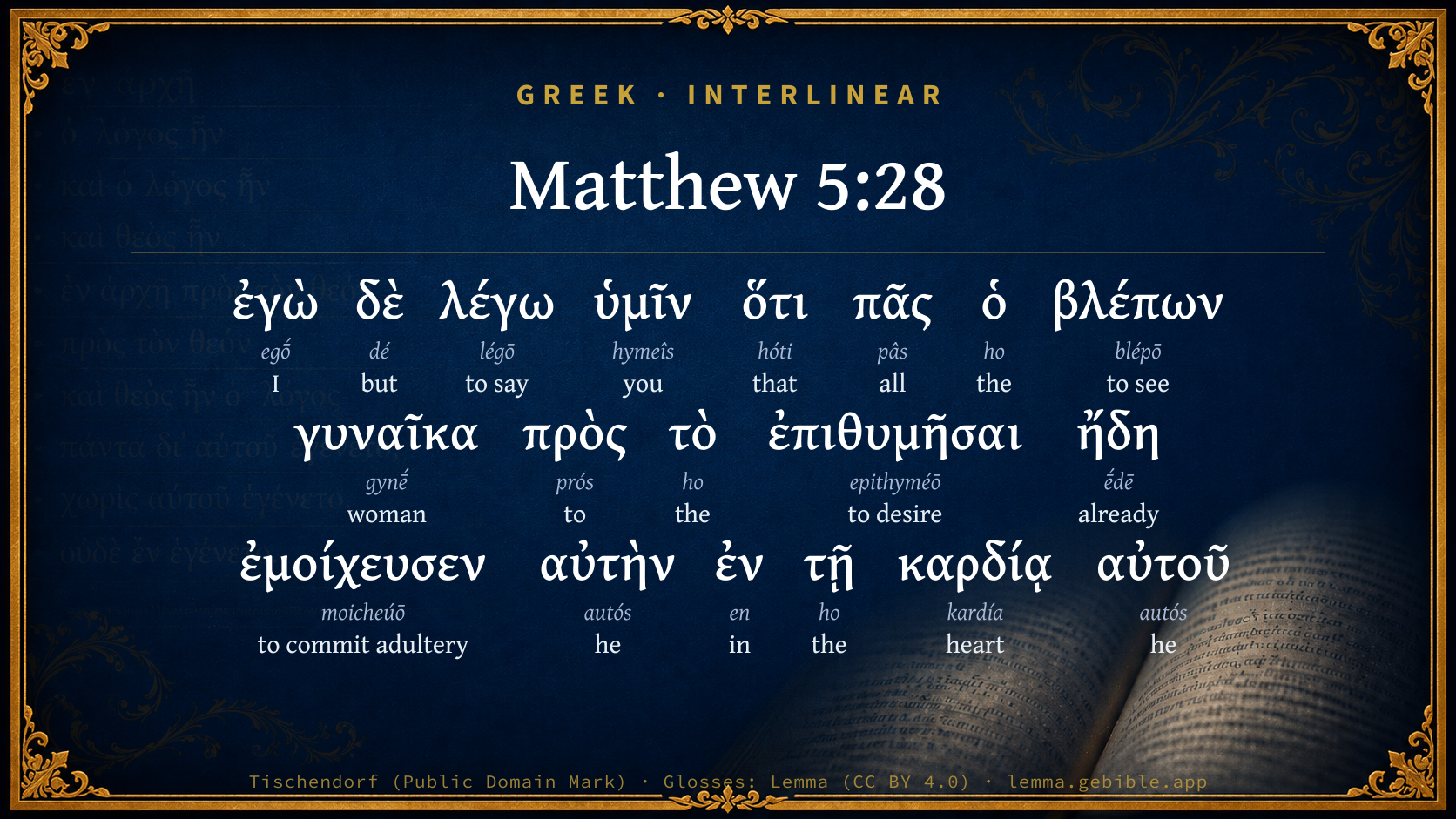
Download image
Cite this verse

Matthew 5:28 (World English Bible). Public Domain. Lemma interlinear Bible study tool, https://lemma.gebible.app/v/matthew/5/28.

Show BibTeX & RIS
BibTeX
RIS
English Translation
but I tell you that everyone who gazes at a woman to lust after her has committed adultery with her already in his heart.
World English Bible · Public Domain
Highlights
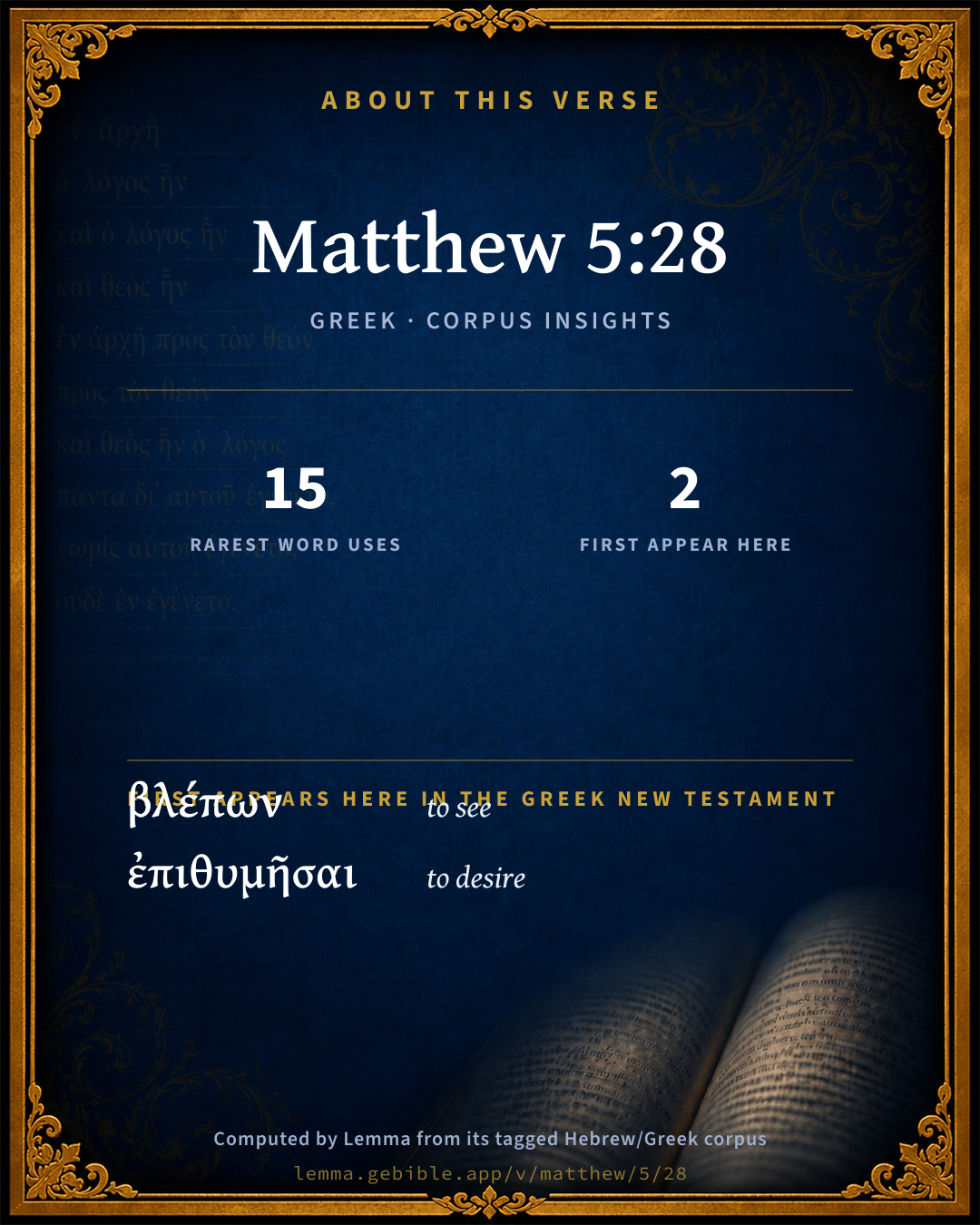
  • 2 first appearances in the Greek New Testament
Full analysis ↓
Download a study sheet

One document with this verse’s original text, its word-by-word gloss line, the meaning frame, cross-references with their text, attributed commentary, and full source and license credits — printable, and it pastes into notes with its structure intact.

This verse Autodidact and up

Study sheet (.html) Plain text (.txt)

A passage Seminary Student

Up to 50 verses in one chapter. A passage sheet keeps up to 6 commentary sources and 12 cross-references per verse, in the order this page ranks them, and says so on the sheet whenever that leaves anything out. Ask for a single verse and you get the Autodidact verse sheet above.

Everything on this page stays free to read, with no account — the sheet is a download of what is already on screen, not access to it.

Want to remove ads? Support Godless Engineer
Compare translations 3

The same verse in 3 English versions, stacked beneath the original-language interlinear above. Click any original word for its lexicon entry.

Each is an independent rendering of the whole verse — the interlinear is not word-aligned to these translations.

Highlighted words mark where these versions differ — a whole-verse word diff, not a word-by-word alignment.

  • World English Bible Public Domain
    but I tell you that everyone who gazes at a woman to lust after her has committed adultery with her already in his heart.
  • King James Version Public Domain
    But I say unto you, That whosoever looketh on a woman to lust after her hath committed adultery with her already in his heart.
  • unfoldingWord Literal Text CC BY-SA 4.0
    But I say to you that everyone looking at a woman to lust after her has already committed adultery with her in his heart.

unfoldingWord Literal Text — © unfoldingWord, licensed CC BY-SA 4.0. Word-aligned USFM3 via Door43 (git.door43.org/unfoldingWord/en_ult).

Versions to compare (up to 4)

3 of 4 selected

Show all 19 translations

Every available English version of this verse, each an independent rendering of the whole verse.

  • World English Bible Public Domain
    but I tell you that everyone who gazes at a woman to lust after her has committed adultery with her already in his heart.
  • Berean Standard Bible Public Domain
    But I tell you that anyone who looks at a woman to lust after her has already committed adultery with her in his heart.
  • Majority Standard Bible Public Domain
    But I tell you that anyone who looks at a woman to lust after her has already committed adultery with her in his heart.
  • King James Version Public Domain
    But I say unto you, That whosoever looketh on a woman to lust after her hath committed adultery with her already in his heart.
  • American Standard Version (1901) Public Domain
    but I say unto you, that every one that looketh on a woman to lust after her hath committed adultery with her already in his heart.
  • Revised Version (1885) Public Domain
    but I say unto you, that every one that looketh on a woman to lust after her hath committed adultery with her already in his heart.
  • Geneva Bible (1599) Public Domain
    But I say vnto you, that whosoeuer looketh on a woman to lust after her, hath committed adulterie with her already in his heart.
  • Douay-Rheims (1899) Public Domain
    But I say to you, that whosoever shall look on a woman to lust after her, hath already committed adultery with her in his heart.
  • Young's Literal Translation Public Domain
    but I -- I say to you, that every one who is looking on a woman to desire her, did already commit adultery with her in his heart.
  • Literal Standard Version CC BY-SA 4.0
    but I say to you that everyone who is looking on a woman to desire her, already committed adultery with her in his heart.
  • Unlocked Literal Bible CC BY-SA 4.0
    But I say to you that everyone who looks on a woman to lust after her has already committed adultery with her in his heart.
  • unfoldingWord Literal Text CC BY-SA 4.0
    But I say to you that everyone looking at a woman to lust after her has already committed adultery with her in his heart.
  • Darby Bible Public Domain
    But *I* say unto you, that every one who looks upon a woman to lust after her has already committed adultery with her in his heart.
  • World Messianic Bible Public Domain
    but I tell you that everyone who gazes at a woman to lust after her has committed adultery with her already in his heart.
  • Webster's Bible Public Domain
    But I say to you, That whoever looketh on a woman to lust after her, hath committed adultery with her already in his heart.
  • Free Bible Version CC BY-SA 4.0
    But I tell you that everyone who looks lustfully at a woman has already committed adultery with her in his mind.
  • Bible in Basic English Public Domain
    But I say to you that everyone whose eyes are turned on a woman with desire has had connection with her in his heart.
  • Text-Critical English NT CC BY 4.0
    But I say to you that anyone who looks at a woman to lust after her has already committed adultery with her in his heart.
  • Tyndale New Testament (1534) Public Domain
    But I say vnto you that whosoeuer looketh on a wyfe lustynge after her hathe committed advoutrie with hir alredy in his hert.

Literal Standard Version (2020), Covenant Press — licensed CC BY-SA 4.0. Text via the HelloAO Bible API (eBible.org). Unlocked Literal Bible (unfoldingWord) — licensed CC BY-SA 4.0. Text via the HelloAO Bible API (eBible.org). unfoldingWord Literal Text — © unfoldingWord, licensed CC BY-SA 4.0. Word-aligned USFM3 via Door43 (git.door43.org/unfoldingWord/en_ult). Free Bible Version, Dr. Jonathan Gallagher — licensed CC BY-SA 4.0. Text via the HelloAO Bible API (eBible.org).

Word by word

More ways to search: Search by grammar → Find every occurrence → Compare this word →

Practice this passage: Drill this verse → Learn its vocabulary →

ἐμοίχευσεν
moicheúō
G3431
“to commit adultery”
Verb, Aorist, Active, Indicative, 3rd person, Singular
Part of Speech
Verb
Tense
Aorist
Voice
Active
Mood
Indicative
Person
3rd person
Number
Singular
Full Thayer's Definition

Origin: from G3432

TDNT: 16:09,6

1. to commit adultery a. to be an adulterer b. to commit adultery with, have unlawful intercourse with another's wife c. of the wife: to suffer adultery, be debauched d. A Hebrew idiom, the word is used of those who at a woman's solicitation are drawn away to idolatry, i.e. to the eating of things sacrificed to idols
  1. ἐγὼ egṓ G1473 “I” Personal pronoun, 1st person, Nominative, Singular
  2. δὲ dé G1161 “but” Conjunction
  3. λέγω légō G3004 “to say” Verb, Present, Active, Indicative, 1st person, Singular
  4. ὑμῖν hymeîs G5210 “you” Personal pronoun, 2nd person, Dative, Plural
  5. ὅτι hóti G3754 “that” Conjunction
  6. πᾶς pâs G3956 “all” Adjective, Nominative, Singular, Masculine
  7. ὁ ho G3588 “the” Article, Nominative, Singular, Masculine
  8. βλέπων blépō G991 “to see” Verb, Present, Active, Participle, Nominative, Singular, Masculine
  9. γυναῖκα gynḗ G1135 “woman” Noun, Accusative, Singular, Feminine
  10. πρὸς prós G4314 “to” Preposition
  11. τὸ ho G3588 “the” Article, Accusative, Singular, Neuter
  12. ἐπιθυμῆσαι epithyméō G1937 “to desire” Verb, Aorist, Active, Infinitive
  13. ἤδη ḗdē G2235 “already” Adverb
  14. αὐτὴν autós G846 “he” Personal pronoun, Accusative, Singular, Feminine
  15. ἐν en G1722 “in” Preposition
  16. τῇ ho G3588 “the” Article, Dative, Singular, Feminine
  17. καρδίᾳ kardía G2588 “heart” Noun, Dative, Singular, Feminine
  18. αὐτοῦ autós G846 “he” Personal pronoun, Genitive, Singular, Masculine

About this verse

These counts appear in no published source. They are computed here, from the morphology-tagged text and Lemma’s own curated glosses. What Lemma adds →

19
words
16
distinct lemmas
Gospels
section

Notable vocabulary

The rarest word here is ἐμοίχευσεν to commit adultery G3431 — appearing just 15 times in the whole Greek New Testament.

First appearance in Scripture

These words make their first canonical appearance in the Greek New Testament here:

  • βλέπων to see G991
  • ἐπιθυμῆσαι to desire G1937

Shared distinctive vocabulary

ἐμοίχευσεν to commit adultery G3431 occurs in 12 verses of the Greek New Testament. Also found in:
Repetition

Words recur within this verse:

Cross-references

16

Topical passages linked to Matthew 5:28 in the Treasury of Scripture Knowledge — connected by theme and wording, ordered by reader-vote popularity; previews shown in the World English Bible.

  • 1 John 2:16 For all that is in the world, the lust of the flesh, the lust of the eyes, and the pride of life, isn't the Father's, but is the world's.
  • James 1:14–15 But each one is tempted, when he is drawn away by his own lust, and enticed.
  • Proverbs 6:25 Don't lust after her beauty in your heart, Neither let her captivate you with her eyelids.
  • Exodus 20:17 "You shall not covet your neighbor's house. You shall not covet your neighbor's wife, nor his man-servant, nor his maid-servant, nor his ox, nor his donkey, nor anything that is your neighbor's."
  • 2 Samuel 11:2 It happened at evening, that David arose from off his bed, and walked on the roof of the king's house: and from the roof he saw a woman bathing; and the woman was very beautiful to look on.
  • Job 31:1 "I made a covenant with my eyes, How then should I look lustfully at a young woman?
  • Genesis 34:2 Shechem the son of Hamor the Hivite, the prince of the land, saw her. He took her, lay with her, and humbled her.
  • Romans 7:7–8 What shall we say then? Is the law sin? May it never be! However, I wouldn't have known sin, except through the law. For I wouldn't have known coveting, unless the law had said, "You shall not covet."
  • 2 Peter 2:14 having eyes full of adultery, and who can't cease from sin; enticing unsettled souls; having a heart trained in greed; children of cursing;
  • Job 31:9 "If my heart has been enticed to a woman, And I have laid wait at my neighbor's door;
  • Romans 7:14 For we know that the law is spiritual, but I am fleshly, sold under sin.
  • Psalms 119:96 I have seen a limit to all perfection, But your commands are boundless.
  • Genesis 39:7–23 It happened after these things, that his master's wife cast her eyes on Joseph; and she said, "Lie with me."
  • Matthew 5:22 But I tell you, that everyone who is angry with his brother without a cause shall be in danger of the judgment; and whoever shall say to his brother, 'Raca!' shall be in danger of the council; and whoever shall say, 'You fool!' shall be in danger of the fire of Gehenna.
  • Matthew 5:39 But I tell you, don't resist him who is evil; but whoever strikes you on your right cheek, turn to him the other also.
  • Matthew 7:28–29 It happened, when Jesus had finished saying these things, that the multitudes were astonished at his teaching,

Cross-references courtesy of OpenBible.info (CC BY 4.0).

Commentary

Notes on Matthew 5:28 from classic Christian and Jewish commentators (each source and its license shown beneath its notes). The classic Christian expositions comment on the surrounding passage and are grouped to its opening verse, so a note may address several verses; the Jewish commentaries on the Tanakh (Rashi and others) are per-verse, so they appear only where the commentator wrote on this verse.

Lemma curates 59 commentaries, every one of them public domain or Creative Commons licensed, each selected and text-cleaned for this edition rather than reprinted as found. About our sources →

Jamieson, Fausset & Brown

Robert Jamieson, A. R. Fausset & David Brown

But I say unto you, That whosoever looketh on a woman to lust after her--with the intent to do so, as the same expression is used in Mat 6:1; or, with the full consent of his will, to feed thereby his unholy desires.

hath committed adultery with her already in his heart--We are not to suppose, from the word here used--"adultery"--that our Lord means to restrict the breach of this commandment to married persons, or to criminal intercourse with such. The expressions, "whosoever looketh," and "looketh upon a woman," seem clearly to extend the range of this commandment to all forms of impurity, and the counsels which follow--as they most certainly were intended for all, whether married or unmarried--seem to confirm this. As in dealing with the sixth commandment our Lord first expounds it, and then in the four following verses applies His exposition (Mat 5:21-25), so here He first expounds the seventh commandment, and then in the four following verses applies His exposition (Mat 5:28-32).

Jamieson, Fausset & Brown — Commentary Critical and Explanatory on the Whole Bible (1871) — public domain (CC PDM 1.0). Text via the HelloAO Bible API.

Bengel's Gnomon

Johann Albrecht Bengel

Mat 5:28. Ὁ βλέπων, that looketh) Refer to this expression the right eye mentioned in the next verse.—πρὸς, to) This particle determines the character of the looking.—ἤδη, already) by that very act.

Bengel's Gnomon of the New Testament — English translation (T&T Clark, Edinburgh, 1860) — public domain. Text from a community e-Sword module.

Expositor's Greek Testament

ed. W. Robertson Nicoll

Mat 5:28 . ὁ βλέπων : the looker is supposed to be a husband who by his look wrongs his own wife. γυναῖκα : married or unmarried. πρὸς τὸ ἐπιθυμῆσαι . he look is supposed to be not casual but persistent, the desire not involuntary or momentary, but cherished with longing. Augustine, a severe judge in such matters, defines the offence thus: “Qui hoc fine et hoc animo attenderit ut eam concupiscat; quod jam non est titillari delectatione carnis sed plene consentire libidini” (De ser. Domini). Chrysostom, the merciless scourge of the vices of Antioch, says: ὁ ἑαυτῷ τὴν ἐπιθυμίαν συλλέγων , ὁ μηδενὸς ἀναγκάζοντος τὸ θηρίον ἐπεισάγων ἠρεμοῦντι τῷ λογισμῷ . Hom. xvii. The Rabbis also condemned unchaste looks, but in how coarse a style compared with Jesus let this quotation given by Fritzsche show: “Intuens vel in minimum digitum feminae est ac si intueretur in locum pudendum”. In better taste are these sayings quoted by Wünsche (Beiträge): “The eye and the heart are the two brokers of sin”; “Passions lodge only in him who sees”. αὐτὴν (bracketed as doubtful by W. H [24] ): the accusative after ἐπιθ . is rare and late. We cannot but think of the personal relations to woman of One who understood so well the subtle sources of sexual sin. Shall we say that He was tempted in all points as we are, but desire was expelled by the mighty power of a pure love to which every woman was as a daughter, a sister, or a betrothed: a sacred object of tender respect?

[24] Westcott and Hort.

The Expositor's Greek Testament, edited by W. Robertson Nicoll (1897–1910) — public domain. Text from a community e-Sword module.

Adam Clarke's Commentary

Verse 28. Whosoever looketh on a woman to lust after her] επιθυμσαι αυτην, earnestly to covet her. The verb, επιθυμεω, is undoubtedly used here by our Lord, in the sense of coveting through the influence of impure desire. The word is used in precisely the same sense, on the same subject, by Herodotus, book the first, near the end. I will give the passage, but I dare not translate it. To the learned reader it will justify my translation, and the unlearned must take my word. Της ΕΠΙΘΥΜΗΣΕΙ γυναικος Μασσαγετης ανηρ, μισγεται αδεως, Raphelius, on this verse, says, επιθυμειν hoc loco, est turpi cupiditate mulieris potiundae flagrare. In all these eases, our blessed Lord points out the spirituality of the law; which was a matter to which the Jews paid very little attention. Indeed it is the property of a Pharisee to abstain only from the outward crime. Men are very often less inquisitive to know how far the will of God extends, that they may please him in performing it, than they are to know how far they may satisfy their lusts without destroying their bodies and souls, utterly, by an open violation of his law.

Hath committed adultery with her already in his heart.] It is the earnest wish or desire of the soul, which, in a variety of cases, constitutes the good or evil of an act. If a man earnestly wish to commit an evil, but cannot, because God puts time, place, and opportunity out of his power, he is fully chargeable with the iniquity of the act, by that God who searches and judges the heart. So, if a man earnestly wish to do some kindness, which it is out of his power to perform, the act is considered as his; because God, in this case, as in that above, takes the will for the deed. If voluntary and deliberate looks and desires make adulterers and adulteresses, how many persons are there whose whole life is one continued crime! whose eyes being full of adultery, they cannot cease from sin, 2Pe 2:14. Many would abhor to commit one external act before the eyes of men, in a temple of stone; and yet they are not afraid to commit a multitude of such acts in the temple of their hearts, and in the sight of God!

Adam Clarke's Commentary on the Bible (1810–1826) — public domain. Text from a community e-Sword/MySword module.

Ellicott's Commentary for English Readers

(28) To lust after her.—The intent is more strongly marked in the Greek than in the English. It is not the passing glance, not even the momentary impulse of desire, but the continued gaze by which the impulse is deliberately cherished till it becomes a passion. This noble and beautiful teaching, it has often been remarked, and by way of disparagement, is found elsewhere. Such disparagement is out of place. By the mercy of God the Light that “lighteth every man” has led men to recognise the truth thus asserted, and parallels to it may be found in the writings of Conlucius, Seneca, Epictetus, and even of the Jewish Rabbis themselves. The words of Juvenal closely express the general sentiment:—

“ Scelus intra se tacitus qui cogitat ullum,

Facti crimen habet.”

[“Who in his breast a guilty thought doth cherish,

He bears the guilt of action.”]

Our Lord’s words speak primarily of “adultery,” but are, of course, applicable to every form of sensual impurity.

A Bible Commentary for English Readers, edited by Charles John Ellicott (1878–1897) — public domain. Text from a community e-Sword module.

The Cambridge Bible for Schools and Colleges

gen. ed. J. J. S. Perowne

(β) Adultery, 27–32.

28. to lust after her i. e. “with a view to lust after her.”

in his heart] Contrast with the pure in heart, Mat_5:8.

The Cambridge Bible for Schools and Colleges (gen. ed. J. J. S. Perowne; Cambridge University Press, 1878–1918) — public domain. Text from a community e-Sword module.

John Gill's Exposition

But I say unto you, that whosoever looketh on a woman,.... Many and severe are the prohibitions of the Jews, concerning looking upon a woman, which they aggravate as a very great sin: they say (k), it is not lawful to look upon a beautiful woman, though unmarried; nor upon another man's wife, though deformed; nor upon a woman's coloured garments: they forbid (l) looking on a woman's little finger, and say (m), that he that tells money to a woman, out of his hand into her's, that he may look upon her, though he is possessed of the law and good works, even as Moses, he shall not escape the damnation of hell: they affirm (n), that he that looks upon a woman's heel, his children shall not be virtuous; and that a man may not go after a woman in the way, no, not after his wife: should he meet her on a bridge, he must take her to the side of him; and whoever goes through a river after a woman, shall have no part in the world to (o) come: nay, they forbid (p) a man looking on the beauty of his own wife. Now these things were said by them, chiefly to cover themselves, and because they would be thought to be very chaste; when they were, as Christ calls them, an "adulterous generation" in a literal sense: they usually did what our Lord observes, "strain at a gnat, and swallow a camel". We read in the Talmud (q), of , a "foolish saint" and it is asked, who is he? and it is answered, one that sees a woman drowning in a river, and says it is not lawful for me , "to look" upon her, and deliver her. It was not any looking upon a woman, that is forbid by Christ as criminal; but so to look, as "to lust after her"; for such an one

hath committed adultery with her already in his heart. But these men, who forbad external looking upon a woman, generally speaking, had no notion of heart sins; and which was the prevailing opinion of the Pharisees, in Christ's time.

"A good thought, they (r) allow, is reckoned as if done; as it is said, Mal 3:16. Upon which it is asked, what is the meaning of that, and "that thought" upon "his name?" Says R. Ase, if a man thinks to do a good work, and is hindered, and does it not, the Scripture reckons it to him, as if he did it; but an evil thought, the holy blessed God does not account of it as if done, as is said, Psa 66:18.''

Upon which words, a noted commentator (s) of their's has this remark:

"Though I regard iniquity in my heart to do it, even in thought, yea, against God himself, as if I had expressed it with my lips, he does not hear it; that is, , "he does not reckon it to me for sin"; because the holy blessed God does not account an evil thought for an action, to them that are in the faith of God, or of the true religion.''

For it seems, this is only true of the Israelites; it is just the reverse with the Gentiles, in whom God does not reckon of a good thought, as if it was done, but does of an evil one, as if it was in act (t). It must be owned, that this is not the sense of them all; for some of them have gone so far as to say (u), that

"the thoughts of sin are greater, or harder, than sin itself:''

by which they mean, that it is more difficult to subdue sinful lusts, than to refrain from the act of sin itself; and particularly, some of them say things which agree with, and come very near to what our Lord here says; as when they affirm (w), that

"everyone that looks upon a woman with intention, it is all one as if he lay with her.''

And that , "he that committeth adultery with his eyes, is called an adulterer" (x). Yea, they also observe (y), that a woman may commit adultery in her heart, as well as a man; but the Pharisees of Christ's time were of another mind.

(k) T. Bab. Avoda Zara, fol. 1, 2. (l) T. Bab. Beracot, fol. 24. 1. Sabbat. fol. 64. 2. (m) T. Bab. Beracot, fol. 61. 1. Eruvin, fol. 18. 2. (n) T. Bab. Nedarim, fol. 20. 1. T. Hieros. Challa, fol. 58. 3. Derech Eretz. c. 1. fol. 17. 3. (o) T. Bab. Beracot, fol. 61. 1. Eruvin, fol. 18. 2. (p) Zohar in Lev. fol. 34. 4. (q) T. Bab Sota, fol. 21. 2. (r) T. Bab. Kiddushin, fol. 40. 1. (s) R. David Kimchi, in Psal. lxvi. 18. (t) T. Hieros. Peah, fol. 16. 2. (u) T. Bab. Yoma, fol. 29. 1. (w) T. Hieros. Challa, fol. 58. 3. Massechet Calah, fol. 16. 4. Vid. Maimon. Issure Bia, c. 21. sect. 2. & Moses Kotsensis Mitzvot Tora precept. neg. 126. (x) Vajikra Rabba, sect. 23. fol. 265. 1. (y) Bemidbar Rabba, sect. 9. fol. 196. 1.

John Gill's Exposition of the Whole Bible (1746–1763) — public domain (CC PDM 1.0). Text via the HelloAO Bible API.

Trapp's Complete Commentary

John Trapp

28 But I say unto you, That whosoever looketh on a woman to lust after her hath committed adultery with her already in his heart.

Ver. 28. But I say unto you, that whosoever looketh on a woman to lust after her] Lusting is often the fruit of looking; as in Joseph’s mistress, who set her eyes upon Joseph; {a} and David, who saw Bathsheba bathing. Lust is quicksighted. How much better Job, who would not look, lest he should think upon a maid! and Nazianzen, who had learned (and he glories in it) to keep in his eyes front roving to wanton prospects! τους οφθαλμους σωφρονισαι. And the like is reported of that heavenly spark, the young Lord Harrington; whereas those that have eyes full of adultery cannot cease to sin, saith St Peter. {2Pe 2:14, μοιχαλιδος, full of the whore, as if she sat in the adulterer’s eye.} And facti crimina lumen habet, saith another. Samson’s eyes were the first offenders that betrayed him to lust, therefore are they first pulled out, and he led a blind captive to Gaza where before he had lustfully gazed on his Delilah. It is true, the blindness of his body opened the eyes of his mind. But how many thousands are there that die of the wound in the eye! Physicians reckon 200 diseases that belong to it; but none like this. For, by these loop-holes of lust and windows of wickedness, the devil windeth himself into the soul. Death entereth in by these windows, as the fathers apply that text in Jeremiah. The eye is the light of the body, saith our Saviour, and yet by our abuse, this most lightsome part of the body draweth many times the whole soul into utter darkness. Nothing, I dare say, so much enricheth hell as beautiful faces; while a man’s eye-beams, beating upon that beauty, reflect with anew heat upon himself. Ut vidi, ut perii! (Propert.) Looking and lusting differ (in Greek) but in one letter (εκ του οραν γινεται το εραν). When one seemed to pity a one-eyed man, he told him he had lost one of his enemies, a very thief, that would have stolen away his heart. Democritus (but in that no wise man) pulled out his eyes; and the Pharisee (little wiser) would shut his eyes when he walked abroad, to avoid the sight of women; insomuch that he often dashed his head against the walls, that the blood gushed out, and was therefore called Pharisoeus impingens, {b} How much better, and with greater commendation had these men taken our Saviour’s counsel in the following verses!

{a} Coniecit in eum oculos, Gen. xxxix. Non dicit Moses, vidit, aspexit: sed hic fuit aspectus impudicus. Pareus.

{b} Democritus oculos sibi eruit, quod mulieres sine concupiscentia adspicere non possit. Sed nihil aliud fecit quam quod fatuitatem suam urbi manifestam fecit. Tertullian in Apologet. Voluptatem vicisse voluptas est maxima, nec ulla maior est victoria, quam ea quae a cupiditatibus refertur. Cypr. de Bon. Pud.

John Trapp, A Commentary or Exposition upon All the Books of the Old and New Testament (1647–1656) — public domain. Text from a community e-Sword module.

Whedon's Commentary on the Bible

Daniel D. Whedon

28. Looketh… to lust — Where the will consents, and the volition permits the sensual feeling. Yet not every glance of admiration or desire, cast upon the beauty of one of the opposite sex, is here condemned. Such affections are planted in our nature for pure and beneficial purposes. Not even the recognition of the superior attractions of another man’s wife, or another woman’s husband, is transgression. Indeed, the sentiment of pleasure arising from beauty of persons around us, may be as pure as the pleasure of surveying pictures. A sweet voice is justly pleasant to the ear, a graceful manner to the taste, a fair form or face to the eye. But when from a sentiment it becomes a sensation, the danger commences. If the sensation be volitionally permitted, there is guilt. If nothing but opportunity were wanting to the guilty act, the adultery of the heart is fully committed. God, who sees the heart, holds the hidden man guilty.

Daniel D. Whedon (gen. ed.), Commentary on the Old and New Testaments (1874–1909) — public domain. Text from a community e-Sword module.

The Pulpit Commentary

But I say (ver. 22, note). The bare command forbidding an external action is insufficient. It must extend to the thought. Contrast Josephus ("Ant.," 12:9. 1), "The purposing to do a thing, without actually doing it, is not worthy of punishment." Generally, however, the sinfulness of wrong thoughts must have been acknowledged. (cf. Psa_51:10, and the tenth commandment; cf. late examples in Schottgen) Hammond ("Pr. Cat.," in Ford) says, "In the Law, the fastening of the eyes on an idol, considering the beauty of it, saith Maimonides, is forbidden, (Lev_19:4) and not only the worship of it". (vide Maimonides, "Hilk. Ab. Zar.," 2:2, by whom, however, the thought is, perhaps, rather condemned for what it leads to than per se; and similarly with Job_31:1 Pro_6:25) Whosoever; Revised Version, every one who (ver. 22, note). Looketh... to lust after (pro epiyumhsai). As pro with the infinitive, (e.G. Mat_6:1) primarily denotes purpose; this may be equivalent to "looketh in order that he may lust, looketh to stimulate his lust" (cf. Meyer, Trench); but, as Weiss points out, this surely belongs to the refinement, not to the beginning of sin. Hence Nosgen suggests looketh... lustfully". (cf. Jam_4:5) Probably this is one of those cases where, as Ellicott says on 1Co_9:18, pro with the infinitive has a shade of meaning that seems to lie between purpose and result, and even sometimes to approximate to the latter." At all events, it does not express, as eiv to would have expressed, the immediate purpose of the look (vide Ellicott, loc. cit. ); of. Mat_6:1. Her (authn , B, D, etc.); accusative with epiyumein , here only in the New Testament. Perhaps the pronoun should be omitted, with a.

Cherished evil feeling is sin before God.

It is not possible to deal, in a general audience, with the precise subject introduced in this text; but it is possible to treat it as illustrating the searching character of God"s Law, which goes in behind all acts of sin, and recognizes the states of mind and feeling out of which acts of sin would surely come if opportunity offered. "Man looketh on the outward appearance, but God looketh on the heart." And yet we have to make a very precise distinction. It is not the evil that comes into our heart which Christ declares to be sin; it is the evil that is cherished in our heart. In the cherishing lies the sin, because that cherishing is as truly the act of the will, the act of the personality, as any overt act of transgression could be.

I TEMPTATION IS NOT SIN. Illustrate by the threefold temptation of our Lord. To have those thoughts suggested to his mind was in no sense sin. We may say, he could not help their coming. They were presented from without. Bodily passion may present to us temptation; the presence of others may become force of temptation; circumstances may prove temptations; evil spirits may suggest temptations; but we must see clearly that temptation is outside our true selves. "Every man is tempted when he is drawn away of his own lust;" something he has, not something he is. An old divine quaintly says, "If Satan comes up to my door, I cannot help it; if he lifts the latch and walks in, I cannot help it. But if I offer him a chair, and begin with him a parley, I put myself altogether in the wrong.

II SIN DEPENDS ON MAN"S WAY OF DEALING WITH THE TEMPTATION. It bears no relations to a man"s will until the man exercises his will upon it. And that will may refuse a parley or may admit a parley. That will may reject the temptation or may cherish the temptation. Sin comes with the cherishing. The possibilities of man"s dealing with temptation are shown to us in the threefold triumph won by the Lord Jesus Christ over temptation when in the wilderness. R.T.

The Pulpit Commentary (1880–1919), ed. H.D.M. Spence-Jones & Joseph S. Exell — public domain. Text from a community e-Sword module.

Cambridge Greek Testament for Schools and Colleges

28. In αὐτῆς read for αὐτὴν we trace the probably unconscious emendation of a scholar.

28. πρὸς τὸ ἐπιθυμῆσαι, i.e. ‘with a view to lust after her.’

ἐν τῇ καρδίᾳ. Contrast with the pure in heart, Mat 5:8.

Cambridge Greek Testament for Schools and Colleges (Cambridge University Press, 1896; 21 vols, various authors incl. Carr, Maclear, Plummer, Farrar, Lumby, Moule, M. R. James, Simcox) — public domain. Text from a community e-Sword module.

Alford’s Greek Testament

Henry Alford

28. πᾶς ὁ βλέπων] The precise meaning should in this verse be kept in mind, as the neglect of it may lead into error. Our Lord is speaking of the sin of adultery, and therefore, however the saying may undoubtedly apply by implication to cases where this sin is out of the question—e.g. to the impure beholding of an unmarried woman with a view to fornication (it being borne in mind that spiritually, and before God, all fornication is adultery, inasmuch as the unmarried person is bound in loyalty and chastity to Him. See Stier below)—yet the direct assertion in this verse must be understood as applying to the cases where this sin is in question. And, again, the βλέπων πρὸς τὸ ἐπιθ. must not be interpreted of the casual evil thought which is checked by holy watchfulness, but the gazing with a view to feed that desire (for so πρὸς τό with an inf. must mean). And again, ἤδη ἐμ. αὐτ. ἐν τῇ κ. αὐτ., whatever it may undoubtedly imply respecting the guilt incurred in God’s sight, does not directly state any thing; but, plainly understood, affirms that the man who can do this—viz. ‘gaze with a view to feed unlawful desire’—has already in his heart passed the barrier of criminal intention; made up his mind, stifled his conscience; in thought, committed the deed. But perhaps there is justice in Stier’s remark, Reden Jesu, i. 129 (edn. 2), that our Lord speaks here after the O.T. usage, in which, both in the seventh commandment and elsewhere, adultery also includes fornication; for marriage is the becoming one flesh,—and therefore every such union, except that after the manner and in the state appointed by God, is a violation and contempt of that holy ordinance.

Henry Alford, The Greek Testament (1849–1861) — public domain. Text from a community e-Sword module.

Lesson kit

Teaching starters — assembled from the data on this page, not authored interpretation. Every prompt links to the verse data it draws on. Edit before teaching.

Matthew, in the Gospels, opens this verse with 19 words (16 distinct Greek lemmas). Its most distinctive word is moicheúō (“to commit adultery”). A historical commentator’s framing appears above. Read the whole chapter for the surrounding context.

Discussion questions

  1. The word moicheúō carries the sense “to commit adultery.” How does it shape the verse?
  2. 2 words make their first appearance in Scripture here. What does this debut establish?
  3. How does Matthew 5:27, which shares the word «to commit adultery», read alongside this verse?
  4. What does the repetition of “the” (3× in this one verse) do in this verse?
  5. These translations render this verse differently; the difference is in the English rendering, not the original. What questions does that raise?
  6. Compare how Jamieson, Fausset & Brown and Bengel's Gnomon read this verse. Where do they agree or differ?

Things to notice

  • 2 words make their first canonical appearance in Scripture here.
  • These translations choose different wording for 9 words in this verse.
  • “the” occurs 3× in this single verse.
  • 16 distinct Greek lemmas span 19 words in this verse.

Reading settings

Reading text

Shown beneath each verse's original-language words.

Old Testament
Old Testament edition

Read the OT as the Masoretic Hebrew (MT) or the Greek Septuagint (LXX).

English shown for the Greek Septuagint (in the Hebrew ↔ Greek comparison).

Comparing translations? Open the Compare panel on any verse page to stack up to four side by side.