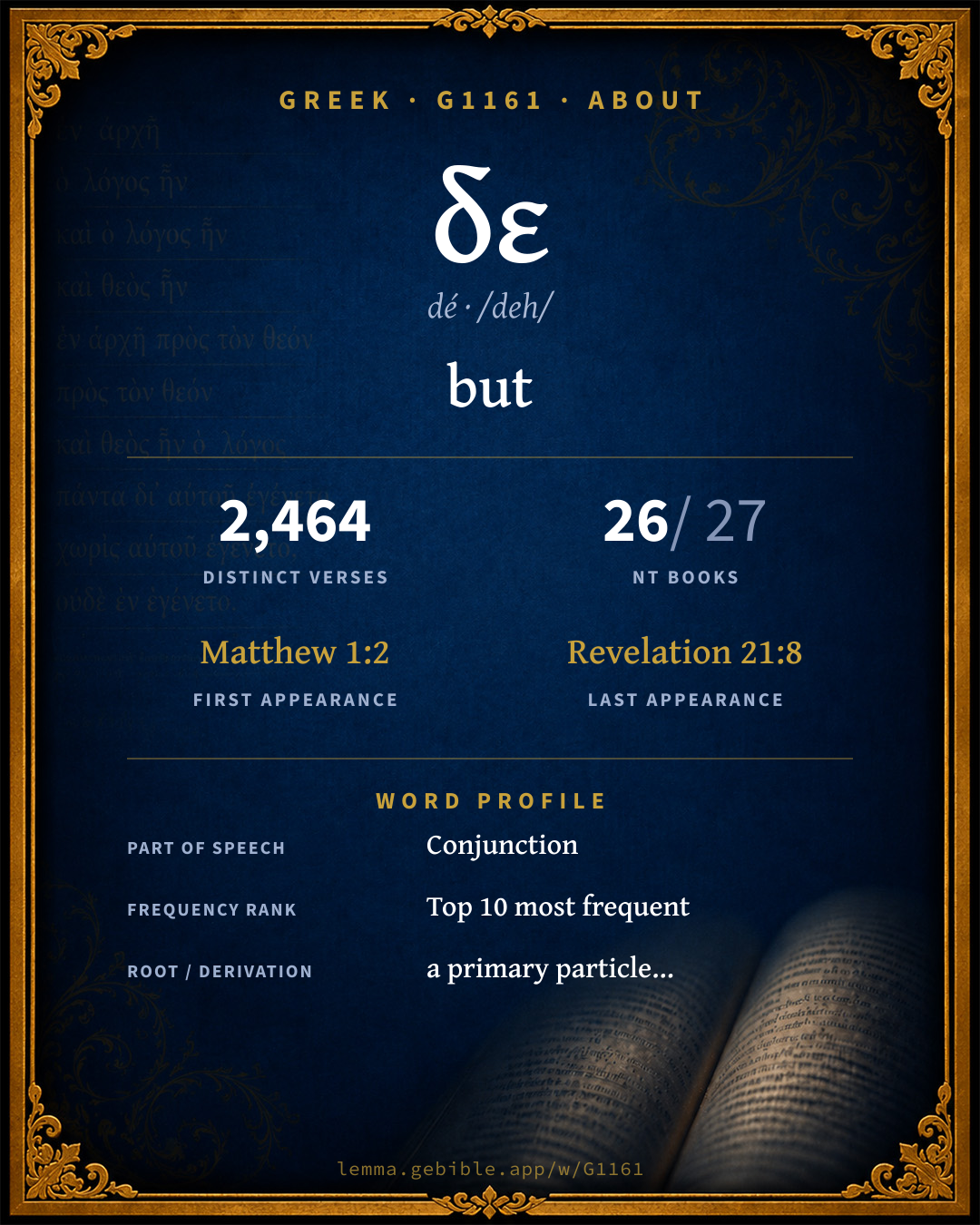
δέ
but
Full lexicon entry — Thayer's Greek Lexicon
From Thayer's Greek Lexicon
Where this word appears
Grammar key — what these labels mean
Part of speech
- Conjunction
- A joining word linking words or clauses.
Every verse where G1161 appears in the Book of Galatians — 53 distinct verses. Click any verse to open its interlinear word-by-word view. Verse text shown in the World English Bible for context — . Each verse’s Greek form is shown with its reference; the English is not keyword-highlighted, since the data carries no word-level English alignment. Use “Compare translations” on any verse to read it across multiple English versions. This concordance covers the Greek New Testament; Septuagint (Greek Old Testament) occurrences of this word are not indexed here.
Galatians
- Galatians 1:11 δὲ conj But I make known to you, brothers, concerning the Gospel which was preached by me, that it is not according to man.
- Galatians 1:15 δὲ conj But when it was the good pleasure of God, who separated me from my mother's womb, and called me through his grace,
- Galatians 1:19 δὲ conj But of the other apostles I saw no one, except James, the Lord's brother.
- Galatians 1:20 δὲ conj Now about the things which I write to you, behold, before God, I'm not lying.
- Galatians 1:22 δὲ conj I was still unknown by face to the assemblies of Judea which were in Christ,
- Galatians 1:23 δὲ conj but they only heard: "He who once persecuted us now preaches the faith that he once tried to destroy."
- Galatians 2:2 δὲ δὲ conj conj I went up by revelation, and I laid before them the Gospel which I preach among the Gentiles, but privately before those who were respected, for fear that I might be running, or had run, in vain.
- Galatians 2:4 δὲ conj This was because of the false brothers secretly brought in, who stole in to spy out our liberty which we have in Christ Jesus, that they might bring us into bondage;
- Galatians 2:6 δὲ conj But from those who were reputed to be important (whatever they were, it makes no difference to me; God doesn't show partiality to man)--they, I say, who were respected imparted nothing to me,
- Galatians 2:9 δὲ conj and when they perceived the grace that was given to me, James and Cephas and John, they who were reputed to be pillars, gave to me and Barnabas the right hand of fellowship, that we should go to the Gentiles, and they to the circumcision.
- Galatians 2:11 δὲ conj But when Peter came to Antioch, I resisted him to the face, because he stood condemned.
- Galatians 2:12 δὲ conj For before some people came from James, he ate with the Gentiles. But when they came, he drew back and separated himself, fearing those who were of the circumcision.
- Galatians 2:16 δὲ conj yet knowing that a man is not justified by the works of the law but through the faith of Jesus Christ, even we believed in Christ Jesus, that we might be justified by faith in Christ, and not by the works of the law, because no flesh will be justified by the works of the law.
- Galatians 2:17 δὲ conj But if, while we sought to be justified in Christ, we ourselves also were found sinners, is Christ a servant of sin? Certainly not!
- Galatians 2:20 δὲ δὲ δὲ conj conj conj I have been crucified with Christ, and it is no longer I that live, but Christ living in me. That life which I now live in the flesh, I live by faith in the Son of God, who loved me, and gave himself up for me.
- Galatians 3:8 δὲ conj The Scripture, foreseeing that God would justify the Gentiles by faith, preached the Gospel beforehand to Abraham, saying, "In you all the nations will be blessed."
- Galatians 3:11 δὲ conj Now that no man is justified by the law before God is evident, for, "The righteous will live by faith."
- Galatians 3:12 δὲ conj The law is not of faith, but, "The man who does them will live by them."
- Galatians 3:16 δὲ conj Now the promises were spoken to Abraham and to his seed. He doesn't say, "To seeds," as of many, but as of one, "To your seed," which is Christ.
- Galatians 3:17 δὲ conj Now I say this. A covenant confirmed beforehand by God in Christ, the law, which came four hundred thirty years after, does not annul, so as to make the promise of no effect.
- Galatians 3:18 δὲ conj For if the inheritance is of the law, it is no more of promise; but God has granted it to Abraham by promise.
- Galatians 3:20 δὲ δὲ conj conj Now a mediator is not between one, but God is one.
- Galatians 3:23 δὲ conj But before faith came, we were kept in custody under the law, shut up to the faith which should afterwards be revealed.
- Galatians 3:25 δὲ conj But now that faith has come, we are no longer under a tutor.
- Galatians 3:29 δὲ conj If you are Christ's, then you are Abraham's seed and heirs according to promise.
- Galatians 4:1 δέ conj But I say that so long as the heir is a child, he is no different from a bondservant, though he is lord of all;
- Galatians 4:4 δὲ conj But when the fullness of the time came, God sent out his Son, born to a woman, born under the law,
- Galatians 4:6 δέ conj And because you are children, God sent out the Spirit of his Son into your hearts, crying, "Abba, Father!"
- Galatians 4:7 δὲ conj So you are no longer a bondservant, but a son; and if a son, then an heir of God through Christ.
- Galatians 4:9 δὲ δὲ conj conj But now that you have come to know God, or rather to be known by God, why do you turn back again to the weak and miserable elements, to which you desire to be in bondage all over again?
- Galatians 4:13 δὲ conj but you know that because of weakness of the flesh I preached the Gospel to you the first time.
- Galatians 4:18 δὲ conj But it is always good to be zealous in a good cause, and not only when I am present with you.
- Galatians 4:20 δὲ conj but I could wish to be present with you now, and to change my tone, for I am perplexed about you.
- Galatians 4:23 δὲ conj However, the son by the handmaid was born according to the flesh, but the son by the free woman was born through promise.
- Galatians 4:25 δὲ conj For this Hagar is Mount Sinai in Arabia, and answers to the Jerusalem that exists now, for she is in bondage with her children.
- Galatians 4:26 δὲ conj But the Jerusalem that is above is free, which is the mother of us all.
- Galatians 4:28 δέ conj Now we, brothers, as Isaac was, are children of promise.
- Galatians 5:3 δὲ conj Yes, I testify again to every man who receives circumcision, that he is a debtor to do the whole law.
- Galatians 5:10 δὲ conj I have confidence toward you in the Lord that you will think no other way. But he who troubles you will bear his judgment, whoever he is.
- Galatians 5:11 δέ conj But I, brothers, if I still preach circumcision, why am I still persecuted? Then the stumbling-block of the cross has been removed.
- Galatians 5:15 δὲ conj But if you bite and devour one another, be careful that you don't consume one another.
- Galatians 5:16 δέ conj But I say, walk by the Spirit, and you won't fulfill the lust of the flesh.
- Galatians 5:17 δὲ conj For the flesh lusts against the Spirit, and the Spirit against the flesh; and these are contrary to one other, that you may not do the things that you desire.
- Galatians 5:18 δὲ conj But if you are led by the Spirit, you are not under the law.
- Galatians 5:19 δέ conj Now the works of the flesh are obvious, which are: adultery, sexual immorality, uncleanness, lustfulness,
- Galatians 5:22 δὲ conj But the fruit of the Spirit is love, joy, peace, patience, kindness, goodness, faithfulness,
- Galatians 5:24 δὲ conj Those who belong to Christ have crucified the flesh with its passions and lusts.
- Galatians 6:4 δὲ conj But let each man test his own work, and then he will take pride in himself and not in his neighbor.
- Galatians 6:6 δὲ conj But let him who is taught in the word share all good things with him who teaches.
- Galatians 6:8 δὲ conj For he who sows to his own flesh will from the flesh reap corruption. But he who sows to the Spirit will from the Spirit reap eternal life.
- Galatians 6:9 δὲ conj Let us not be weary in doing good, for we will reap in due season, if we don't give up.
- Galatians 6:10 δὲ conj So then, as we have opportunity, let's do what is good toward all men, and especially toward those who are of the household of the faith.
- Galatians 6:14 δὲ conj But far be it from me to boast, except in the cross of our Lord Jesus Christ, through which the world has been crucified to me, and I to the world.
About this entry
At a glance — auto-summarized from this page’s data, not written by a person. Every figure links to its source below. This summary describes the numbers; it doesn’t interpret them.
δε — transliterated dé — is a Greek conjunction carrying the sense “but.” Its earliest occurrence is Matthew 1:2. It appears 2,464 verses across 26 books of the Greek New Testament, among its most common vocabulary. It shares a root with δη. Each statement above links to its evidence; the full detail follows below.
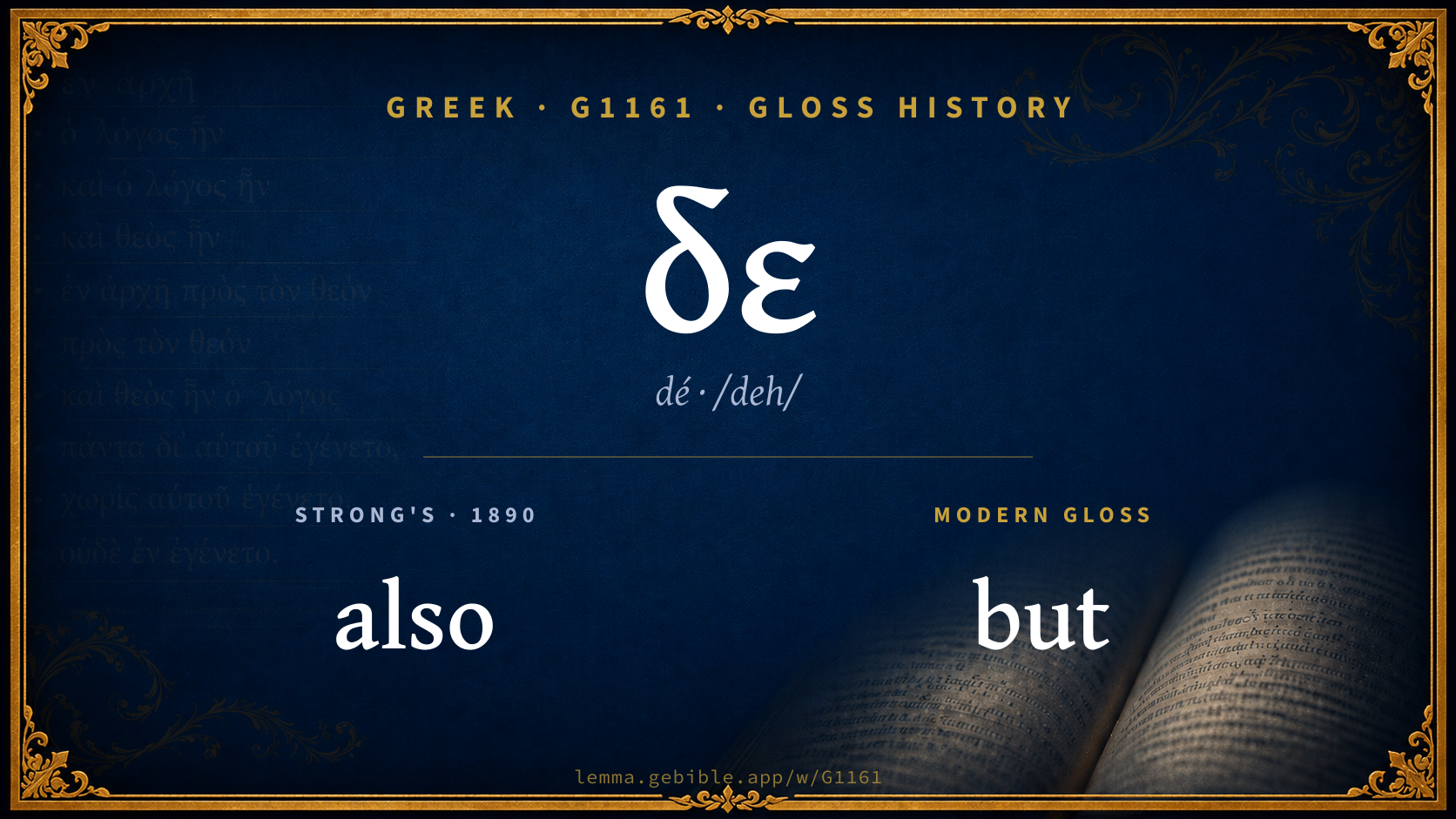
Gloss history
Strong's 1890 vs modern scholarship
About this word
Strong's G1161 catalogs a Greek word from the Greek New Testament.
These counts are not copied from any lexicon or concordance. They are computed here, from the morphology-tagged Greek New Testament. What Lemma adds →
- 2,464
- distinct verses
- The word appears in 2,464 distinct verses.
- 26 / 27
- NT books
- The word appears in 26 of 27 New Testament books.
- #4
- by frequency
- Top 10 most frequent Greek words (rank 4 of 5,347 Greek words by occurrence).
View all 2,464 occurrences in the concordance →
By section of the New Testament
By traditional corpus
Conventional, traditional groupings — biblical authorship is debated, so this is a traditional corpus grouping, not an authorship claim. Some books belong to more than one corpus (Luke is in both the Gospels and the Lukan corpus, and so on), so these shares overlap and need not total 100%. Each figure is a share of the word’s 2,464 distinct verses.
- Gospels 1,258 verses · 51%
- Lukan (Luke–Acts) 971 verses · 39%
- Pauline corpus 547 verses · 22%
- Johannine 211 verses · 9%
- General (Catholic) Epistles 93 verses · 4%
- Hebrews 68 verses · 3%
- Revelation 7 verses · 0%
How translations render this word
Counts come from each version’s own published word-to-Strong’s tagging or interlinear alignment — an approximate guide to how each version renders this word, not a word-level alignment the data otherwise carries. Because each total is that version’s own tagged count, the per-version totals vary from one another and need not match the appearance or distinct-verse counts above. These counts may also differ from a printed concordance because Lemma counts each distinctly tagged rendering and does not collapse phrase taggings into a single head-word total. This is a fixed set of word-tagged versions (KJV, ASV, BSB, ULT) and does not change with the reading translation you choose elsewhere. Each version’s license is shown beside its name below (and on Sources).
- King James Version: And 1,228×, But 929×, Now 166×
- American Standard Version: And 1,179×, But 999×, Now 171×
- Berean Standard Bible: But 784×, And 339×, Now 116×
- unfoldingWord Literal Text: But 1,407×, And 745×, Now 419×
King James Version Public Domain
Renders G1161 across 2,711 tagged occurrences — most commonly:
Plus other, less common renderings. Plus 42 renderings that appear only once — usually multi-word phrases or single function words the recovered tagging swept in, not distinct renderings. Not rendered by a distinct English word in 159 further occurrences.
American Standard Version Public Domain
Renders G1161 across 2,640 tagged occurrences — most commonly:
Plus other, less common renderings. Plus 75 renderings that appear only once — usually multi-word phrases or single function words the recovered tagging swept in, not distinct renderings. Not rendered by a distinct English word in 34 further occurrences.
Berean Standard Bible Public Domain
Renders G1161 across 1,643 tagged occurrences — most commonly:
Plus other, less common renderings. Plus 38 renderings that appear only once — usually multi-word phrases or single function words the recovered tagging swept in, not distinct renderings. Not rendered by a distinct English word in 1,112 further occurrences.
unfoldingWord Literal Text CC BY-SA 4.0
Renders G1161 across 2,802 tagged occurrences — most commonly:
Plus other, less common renderings. Plus 9 renderings that appear only once — usually multi-word phrases or single function words the recovered tagging swept in, not distinct renderings.
Senses in Thayer's
The 1 sense Thayer's distinguishes for this word, in lexicon order (not ranked by frequency or importance). The full entry — with sub-senses — is in the Lexicon Entry tab.
- but, moreover, and, etc.
Word origin
Origin: a primary particle (adversative or continuative)
A primary particle (adversative or continuative); but and etc. : - also and but moreover now [ often unexpressed in English ].
— Strong’s Exhaustive Concordance (1890), public domain.
Forms in the corpus
The 3 distinct written forms G1161 takes in the Greek New Testament, most frequent first — each parse links to that case’s occurrences in the concordance.
| Form | Parsing | Example | Uses |
|---|---|---|---|
| δὲ dè | Conjunction | Matthew 1:2 | 2,602 |
| δέ dé | Conjunction | Matthew 5:31 | 147 |
| δ’ d | Conjunction | Matthew 5:19 | 22 |
Same root — word family
Other Thayer's entries built from the same root as G1161, grouped by Strong’s listed origin. These share a root / origin per the lexicon — not necessarily a shared meaning. Each links to that word’s own entry.
Derived from this word
Compare all same-root words → They share a root, not necessarily a meaning.
Septuagint usage
The same Greek word δε appears 3,556 times in the Greek Old Testament (Septuagint), across 3,042 verses in 35 books.
- 3,556
- LXX occurrences
- Tagged occurrences of this Greek word in the Septuagint.
- 3,042
- verses
- Distinct Septuagint verses containing this word.
- 35 / 39
- OT books
- The word appears in 35 of the 39 Old Testament books.
Sample Septuagint occurrences
- Genesis 1:2 δέ
- Exodus 1:5 δέ
- Leviticus 1:9 δέ
- Numbers 1:47 δέ
- Deuteronomy 4:4 δέ
- Joshua 1:14 δέ
- Judges 1:11 δέ
- Ruth 1:14 δέ
- 1 Samuel 7:17 δέ
- 2 Samuel 3:30 δέ
- 1 Kings 1:17 δέ
- 2 Kings 3:15 δέ
Septuagint occurrences (same lexeme)
Every verse where the same Strong’s number (G1161) appears in the Greek Septuagint — showing the first 50 of 3,042. Verse text shown in the World English Bible for context; the Greek form is the matched word — the English is not keyword-highlighted.
- Genesis 1:2 δέ Now the earth was formless and empty. Darkness was on the surface of the deep. God's Spirit was hovering over the surface of the waters.
- Genesis 2:6 δέ but a mist went up from the earth, and watered the whole surface of the ground.
- Genesis 2:10 δέ A river went out of Eden to water the garden; and from there it was parted, and became four heads.
- Genesis 2:12 δέ and the gold of that land is good. There is aromatic resin and the onyx stone.
- Genesis 2:14 δέ The name of the third river is Hiddekel: this is the one which flows in front of Assyria. The fourth river is the Euphrates.
- Genesis 2:17 δέ but of the tree of the knowledge of good and evil, you shall not eat of it: for in the day that you eat of it you will surely die."
- Genesis 2:20 δέ The man gave names to all cattle, and to the birds of the sky, and to every animal of the field; but for man there was not found a helper suitable for him.
- Genesis 3:1 δέ Now the serpent was more subtle than any animal of the field which Yahweh God had made. He said to the woman, "Yes, has God said, 'You shall not eat of any tree of the garden?'"
- Genesis 3:3 δέ but of the fruit of the tree which is in the midst of the garden, God has said, 'You shall not eat of it, neither shall you touch it, lest you die.'"
- Genesis 3:17 δέ To Adam he said, "Because you have listened to your wife's voice, and have eaten of the tree, of which I commanded you, saying, 'You shall not eat of it,' cursed is the ground for your sake. In toil you will eat of it all the days of your life.
- Genesis 4:1 δέ The man knew Eve his wife. She conceived, and gave birth to Cain, and said, "I have gotten a man with Yahweh's help."
- Genesis 4:2 δέ Again she gave birth, to Cain's brother Abel. Abel was a keeper of sheep, but Cain was a tiller of the ground.
- Genesis 4:5 δέ but he didn't respect Cain and his offering. Cain was very angry, and the expression on his face fell.
- Genesis 4:7 δέ If you do well, will it not be lifted up? If you don't do well, sin crouches at the door. Its desire is for you, but you are to rule over it."
- Genesis 4:9 δέ Yahweh said to Cain, "Where is Abel, your brother?" He said, "I don't know. Am I my brother's keeper?"
- Genesis 4:16 δέ Cain went out from Yahweh's presence, and dwelt in the land of Nod, on the east of Eden.
- Genesis 4:18 δέ To Enoch was born Irad. Irad became the father of Mehujael. Mehujael became the father of Methushael. Methushael became the father of Lamech.
- Genesis 4:22 δέ Zillah also gave birth to Tubal Cain, the forger of every cutting instrument of brass and iron. Tubal Cain's sister was Naamah.
- Genesis 4:23 δέ Lamech said to his wives, "Adah and Zillah, Hear my voice, You wives of Lamech, listen to my speech, For I have slain a man for wounding me, A young man for bruising me.
- Genesis 4:24 δέ If Cain will be avenged seven times, Truly Lamech seventy-seven times."
- Genesis 4:25 δέ Adam knew his wife again. She gave birth to a son, and named him Seth. For, she said, "God has appointed me another child instead of Abel, for Cain killed him."
- Genesis 4:26 δέ There was also born a son to Seth, and he named him Enosh. Then men began to call on Yahweh's name.
- Genesis 5:3 δέ Adam lived one hundred thirty years, and became the father of a son in his own likeness, after his image, and named him Seth.
- Genesis 5:4 δέ The days of Adam after he became the father of Seth were eight hundred years, and he became the father of sons and daughters.
- Genesis 5:6 δέ Seth lived one hundred five years, and became the father of Enosh.
- Genesis 5:22 δέ Enoch walked with God after he became the father of Methuselah three hundred years, and became the father of sons and daughters.
- Genesis 6:2 δέ that God's sons saw that men's daughters were beautiful, and they took for themselves wives of all that they chose.
- Genesis 6:3 δέ Yahweh said, "My Spirit will not strive with man forever, because he also is flesh; yet will his days be one hundred twenty years."
- Genesis 6:4 δέ The Nephilim were in the earth in those days, and also after that, when God's sons came to men's daughters. They bore children to them: the same were the mighty men who were of old, men of renown.
- Genesis 6:5 δέ Yahweh saw that the wickedness of man was great in the earth, and that every imagination of the thoughts of his heart was only evil continually.
- Genesis 6:8 δέ But Noah found favor in Yahweh's eyes.
- Genesis 6:9 δέ This is the history of the generations of Noah. Noah was a righteous man, blameless among the people of his time. Noah walked with God.
- Genesis 6:10 δέ Noah became the father of three sons: Shem, Ham, and Japheth.
- Genesis 6:11 δέ The earth was corrupt before God, and the earth was filled with violence.
- Genesis 6:16 δέ You shall make a roof in the ark, and to a cubit shall you finish it upward. You shall set the door of the ark in the side of it. You shall make it with lower, second, and third levels.
- Genesis 6:17 δέ I, even, I do bring the flood of waters on this earth, to destroy all flesh having the breath of life from under the sky. Everything that is in the earth will die.
- Genesis 6:18 δέ But I will establish my covenant with you. You shall come into the ark, you, your sons, your wife, and your sons' wives with you.
- Genesis 6:21 δέ Take with you of all food that is eaten, and gather it to you; and it will be for food for you, and for them."
- Genesis 7:2 δέ You shall take seven pairs of every clean animal with you, the male and his female. Of the animals that are not clean, take two, the male and his female.
- Genesis 7:6 δέ Noah was six hundred years old when the flood of waters came on the earth.
- Genesis 7:7 δέ Noah went into the ark with his sons, his wife, and his sons' wives, because of the waters of the flood.
- Genesis 7:19 δέ The waters prevailed exceedingly on the earth. All the high mountains that were under the whole sky were covered.
- Genesis 8:5 δέ The waters receded continually until the tenth month. In the tenth month, on the first day of the month, the tops of the mountains were seen.
- Genesis 8:14 δέ In the second month, on the twenty-seventh day of the month, the earth was dry.
- Genesis 9:7 δέ Be fruitful, and multiply. Bring forth abundantly in the earth, and multiply in it."
- Genesis 9:18 δέ The sons of Noah who went forth from the ark were Shem, Ham, and Japheth. Ham is the father of Canaan.
- Genesis 9:24 δέ Noah awoke from his wine, and knew what his youngest son had done to him.
- Genesis 9:28 δέ Noah lived three hundred fifty years after the flood.
- Genesis 10:1 δέ Now this is the history of the generations of the sons of Noah and of Shem, Ham, and Japheth. Sons were born to them after the flood.
- Genesis 10:6 δέ The sons of Ham: Cush, Mizraim, Put, and Canaan.
These are occurrences of the same Greek lexeme (G1161) in the Septuagint — not a translation of any one Hebrew word. The store carries no word-level Hebrew↔Greek alignment, so no Hebrew original is asserted here. Counts come from the recovered LXX Strong's tagging — high-frequency vocabulary is well covered, while rare or late forms may be untagged — so they reflect tagged occurrences and may slightly undercount.