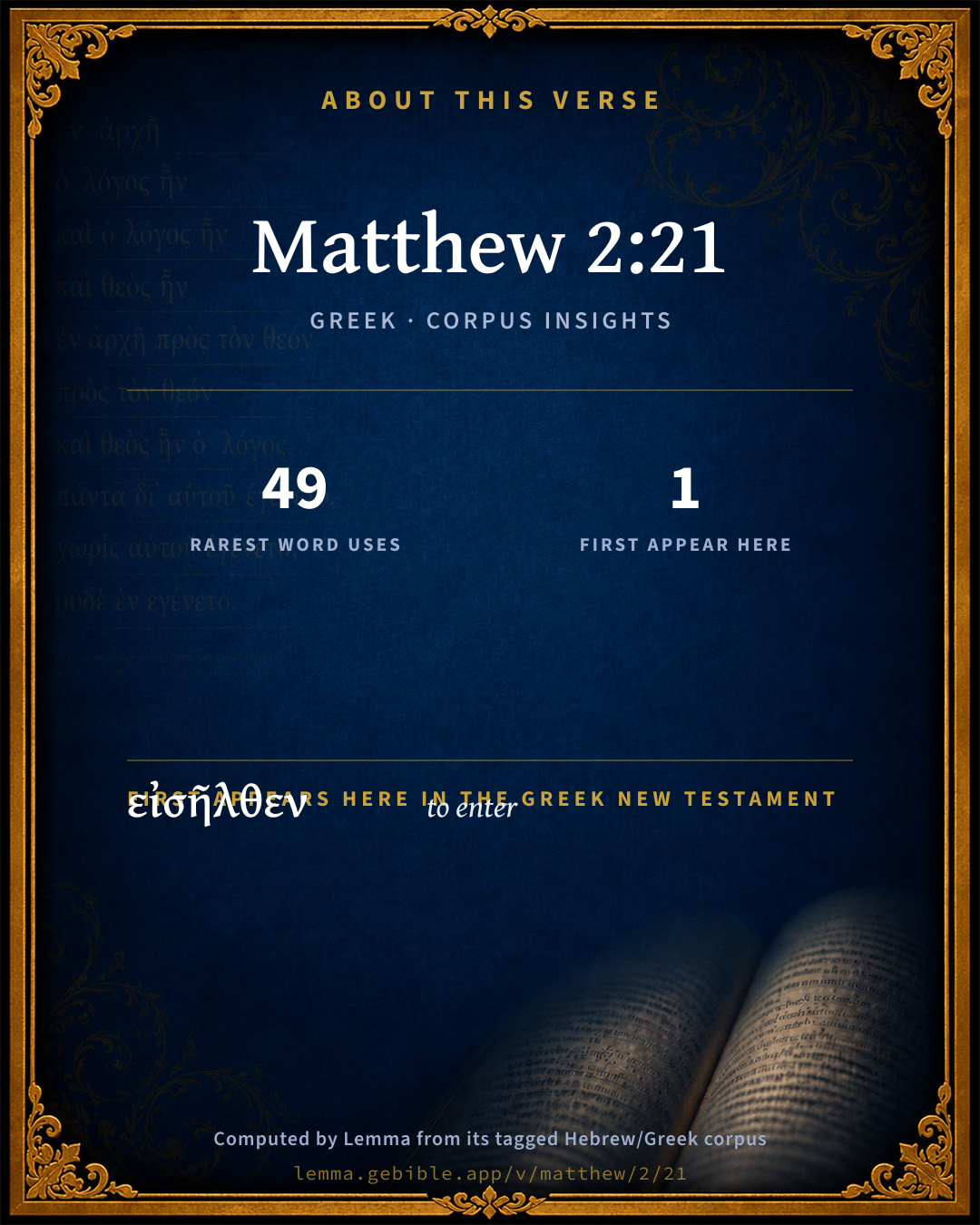
Matthew 2:21

Greek (Tischendorf 8th ed.) Matthew 2:21 appears in the Greek New Testament. The text above is from the Tischendorf 8th edition. Each word links to its Strong’s number and a concise gloss. Click any word for its full Thayer’s Greek Lexicon entry.
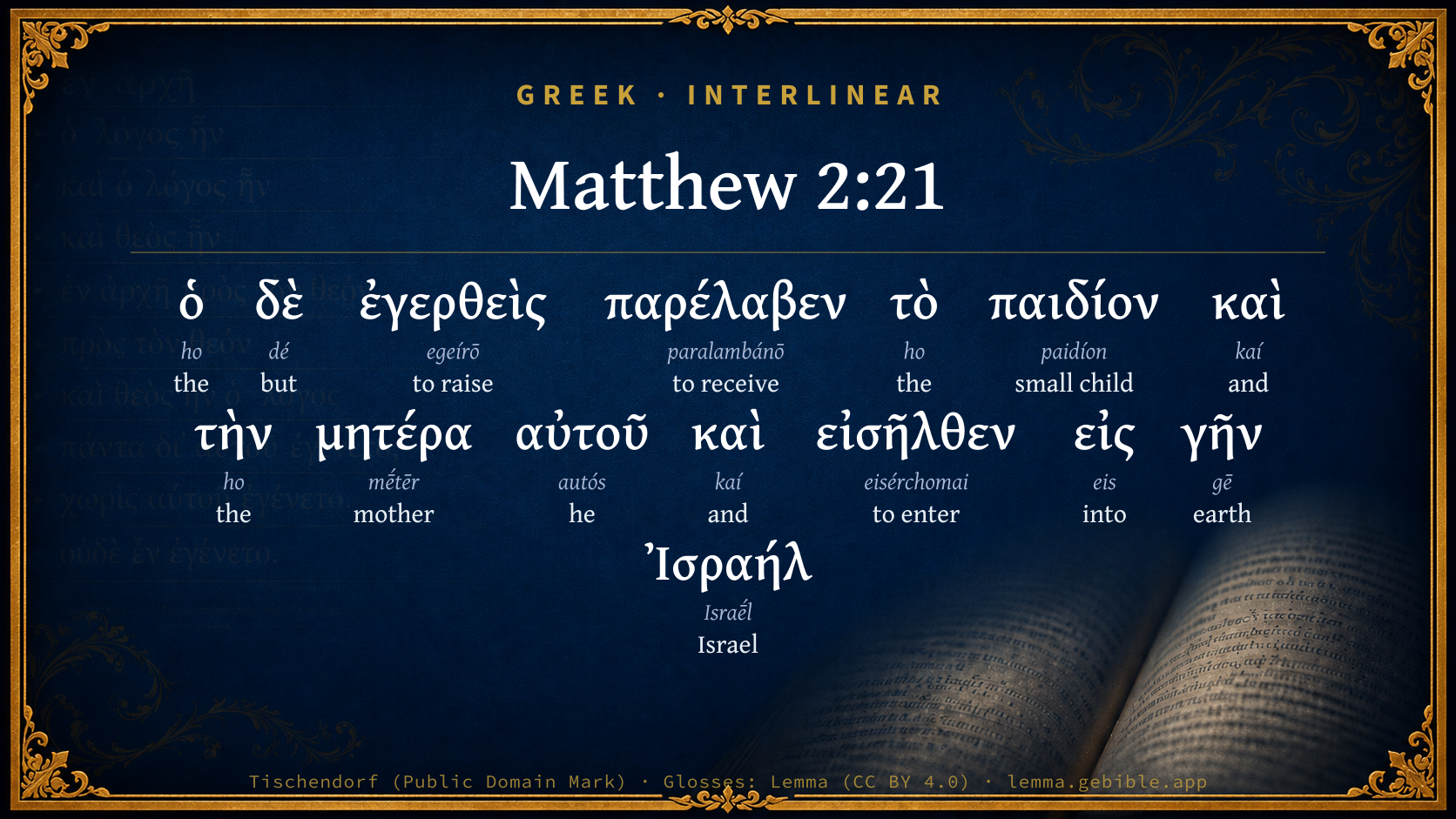
Download image
Cite this verse

Matthew 2:21 (World English Bible). Public Domain. Lemma interlinear Bible study tool, https://lemma.gebible.app/v/matthew/2/21.

Show BibTeX & RIS
BibTeX
RIS
English Translation
He arose and took the young child and his mother, and came into the land of Israel.
World English Bible · Public Domain
Highlights
  • 1 first appearance in the Greek New Testament
Full analysis ↓
Download a study sheet

One document with this verse’s original text, its word-by-word gloss line, the meaning frame, cross-references with their text, attributed commentary, and full source and license credits — printable, and it pastes into notes with its structure intact.

This verse Autodidact and up

Study sheet (.html) Plain text (.txt)

A passage Seminary Student

Up to 50 verses in one chapter. A passage sheet keeps up to 6 commentary sources and 12 cross-references per verse, in the order this page ranks them, and says so on the sheet whenever that leaves anything out. Ask for a single verse and you get the Autodidact verse sheet above.

Everything on this page stays free to read, with no account — the sheet is a download of what is already on screen, not access to it.

Want to remove ads? Support Godless Engineer
Compare translations 3

The same verse in 3 English versions, stacked beneath the original-language interlinear above. Click any original word for its lexicon entry.

Each is an independent rendering of the whole verse — the interlinear is not word-aligned to these translations.

Highlighted words mark where these versions differ — a whole-verse word diff, not a word-by-word alignment.

  • World English Bible Public Domain
    He arose and took the young child and his mother, and came into the land of Israel.
  • King James Version Public Domain
    And he arose, and took the young child and his mother, and came into the land of Israel.
  • unfoldingWord Literal Text CC BY-SA 4.0
    And he, having gotten up, took the young child and his mother, and entered into the land of Israel.

unfoldingWord Literal Text — © unfoldingWord, licensed CC BY-SA 4.0. Word-aligned USFM3 via Door43 (git.door43.org/unfoldingWord/en_ult).

Versions to compare (up to 4)

3 of 4 selected

Show all 19 translations

Every available English version of this verse, each an independent rendering of the whole verse.

  • World English Bible Public Domain
    He arose and took the young child and his mother, and came into the land of Israel.
  • Berean Standard Bible Public Domain
    So Joseph got up, took the Child and His mother, and went to the land of Israel.
  • Majority Standard Bible Public Domain
    So Joseph got up, took the Child and His mother, and went to the land of Israel.
  • King James Version Public Domain
    And he arose, and took the young child and his mother, and came into the land of Israel.
  • American Standard Version (1901) Public Domain
    And he arose and took the young child and his mother, and came into the land of Israel.
  • Revised Version (1885) Public Domain
    And he arose and took the young child and his mother, and came into the land of Israel.
  • Geneva Bible (1599) Public Domain
    Then he arose vp and tooke the babe and his mother, and came into the land of Israel.
  • Douay-Rheims (1899) Public Domain
    Who arose, and took the child and his mother, and came into the land of Israel.
  • Young's Literal Translation Public Domain
    And he, having risen, took the child and his mother, and came to the land of Israel,
  • Literal Standard Version CC BY-SA 4.0
    And he, having risen, took the Child and His mother, and came to the land of Israel,
  • Unlocked Literal Bible CC BY-SA 4.0
    Joseph rose, took the child and his mother, and came into the land of Israel.
  • unfoldingWord Literal Text CC BY-SA 4.0
    And he, having gotten up, took the young child and his mother, and entered into the land of Israel.
  • Darby Bible Public Domain
    And he arose and took to [him] the little child and its mother, and came into the land of Israel;
  • World Messianic Bible Public Domain
    He arose and took the young child and his mother, and came into Eretz-Israel.
  • Webster's Bible Public Domain
    And he arose, and took the young child and his mother, and came into the land of Israel.
  • Free Bible Version CC BY-SA 4.0
    So Joseph got up and took the boy and his mother, and returned to the land of Israel.
  • Bible in Basic English Public Domain
    And he got up, and took the young child and his mother, and came into the land of Israel.
  • Text-Critical English NT CC BY 4.0
    So Joseph rose, took the child and his mother, and went to the land of Israel.
  • Tyndale New Testament (1534) Public Domain
    Then he arose vp and toke the chylde and his mother and cam into the londe of Israhel.

Literal Standard Version (2020), Covenant Press — licensed CC BY-SA 4.0. Text via the HelloAO Bible API (eBible.org). Unlocked Literal Bible (unfoldingWord) — licensed CC BY-SA 4.0. Text via the HelloAO Bible API (eBible.org). unfoldingWord Literal Text — © unfoldingWord, licensed CC BY-SA 4.0. Word-aligned USFM3 via Door43 (git.door43.org/unfoldingWord/en_ult). Free Bible Version, Dr. Jonathan Gallagher — licensed CC BY-SA 4.0. Text via the HelloAO Bible API (eBible.org).

Word by word

More ways to search: Search by grammar → Find every occurrence → Compare this word →

Practice this passage: Drill this verse → Learn its vocabulary →

παρέλαβεν
paralambánō
G3880
“to receive”
Verb, Aorist, Active, Indicative, 3rd person, Singular
Part of Speech
Verb
Tense
Aorist
Voice
Active
Mood
Indicative
Person
3rd person
Number
Singular
Full Thayer's Definition

Origin: from G3844 and G2983

TDNT: 04:11,5

1. to take to, to take with one's self, to join to one's self a. an associate, a companion b. metaph. 1. to accept or acknowledge one to be such as he professes to be 2. not to reject, not to withhold obedience 2. to receive something transmitted a. an office to be discharged b. to receive with the mind 1. by oral transmission: of the authors from whom the tradition proceeds 2. by the narrating to others, by instruction of teachers (used of disciples)
  1. ὁ ho G3588 “the” Article, Nominative, Singular, Masculine
  2. δὲ dé G1161 “but” Conjunction
  3. ἐγερθεὶς egeírō G1453 “to raise” Verb, Aorist, Passive, Participle, Nominative, Singular, Masculine
  4. τὸ ho G3588 “the” Article, Accusative, Singular, Neuter
  5. παιδίον paidíon G3813 “small child” Noun, Accusative, Singular, Neuter
  6. καὶ kaí G2532 “and” Conjunction
  7. τὴν ho G3588 “the” Article, Accusative, Singular, Feminine
  8. μητέρα mḗtēr G3384 “mother” Noun, Accusative, Singular, Feminine
  9. αὐτοῦ autós G846 “he” Personal pronoun, Genitive, Singular, Masculine
  10. καὶ kaí G2532 “and” Conjunction
  11. εἰσῆλθεν eisérchomai G1525 “to enter” Verb, Aorist, Active, Indicative, 3rd person, Singular
  12. εἰς eis G1519 “into” Preposition
  13. γῆν gē G1093 “earth” Noun, Accusative, Singular, Feminine
  14. Ἰσραήλ Israḗl G2474 “Israel” Noun, Proper, indeclinable

About this verse

These counts appear in no published source. They are computed here, from the morphology-tagged text and Lemma’s own curated glosses. What Lemma adds →

15
words
12
distinct lemmas
Gospels
section

First appearance in Scripture

This word makes its first canonical appearance in the Greek New Testament here:

  • εἰσῆλθεν to enter G1525

Shared distinctive vocabulary

παρέλαβεν to receive G3880 occurs in 49 verses of the Greek New Testament. Also found in:

Repetition

Words recur within this verse:

Cross-references

2

Topical passages linked to Matthew 2:21 in the Treasury of Scripture Knowledge — connected by theme and wording, ordered by reader-vote popularity; previews shown in the World English Bible.

  • Genesis 6:22 Thus Noah did. According to all that God commanded him, so he did.
  • Hebrews 11:8 By faith, Abraham, when he was called, obeyed to go out to the place which he was to receive for an inheritance. He went out, not knowing where he went.

Cross-references courtesy of OpenBible.info (CC BY 4.0).

Commentary

Notes on Matthew 2:21 from classic Christian and Jewish commentators (each source and its license shown beneath its notes). The classic Christian expositions comment on the surrounding passage and are grouped to its opening verse, so a note may address several verses; the Jewish commentaries on the Tanakh (Rashi and others) are per-verse, so they appear only where the commentator wrote on this verse.

Lemma curates 59 commentaries, every one of them public domain or Creative Commons licensed, each selected and text-cleaned for this edition rather than reprinted as found. About our sources →

Joseph Benson's Commentary

Mat 2:21-22. And he arose — Joseph obeyed the angel, and, it appears, would gladly have gone to Judea, probably to Bethlehem, because from his own knowledge of the prophecies, as well as from the decision of the scribes, an account of which he might have received from the magi, he fancied his son’s education in Bethlehem was as necessary to his being acknowledged the Messiah, as his birth, which had been so providentially ordered to happen there. Nevertheless, when he heard that Archelaus did reign in Judea, he was afraid to go thither, knowing the jealous and cruel disposition of that prince. Archelaus was the sixth son of Herod, and the most cruel of all those that survived him. His father appointed him his successor, with regal authority, but Augustus gave him only the title of ethnarch, or ruler of the nation, annexing to his government Samaria and Idumæa. In the very beginning of his reign, he massacred 3,000 Jews at once in the temple, and was afterward, viz., in the tenth year of his government, banished by Augustus to Vienna in Gaul, on a complaint brought against him by the chief of the Jews, for his various cruelties. Joseph, therefore, might well be afraid to settle in a country that was under the government of such a cruel tyrant. Being warned of God in a dream, he turned aside into the parts of Galilee — which was under the government of Herod Antipas, (see note on Mat 2:2,) a prince of a milder character than Archelaus, and then on such hostile terms with him, that there was no danger of his giving up Joseph and Mary into his power. Add to this, that, being intent upon building the cities of Julias and Tiberias, he endeavoured, by promises and immunities, as well as by a mild government, to allure strangers to come and settle there. We may observe here, that although Joseph’s near relation to Jesus exposed him to many difficulties and dangers, such as he had been a stranger to till it commenced, yet it made him ample amends for that inconvenience, by placing him and his under the peculiar care of a watchful Providence, ever attentive to his safety, and that of his little family; and by procuring him the favour of so many extraordinary visitations and supernatural discoveries of the divine will. This is no less than the fourth message sent him from the court of heaven since he became the husband of Mary!

Joseph Benson's Commentary on the Old and New Testaments (1811–1818) — public domain. Text from a community e-Sword module.

Jamieson, Fausset & Brown

Robert Jamieson, A. R. Fausset & David Brown

And he arose, and took the young child and his mother, and came into the land of Israel--intending, as is plain from what follows, to return to Bethlehem of Judea, there, no doubt, to rear the Infant King, as at His own royal city, until the time should come when they would expect Him to occupy Jerusalem, "the city of the Great King."

Jamieson, Fausset & Brown — Commentary Critical and Explanatory on the Whole Bible (1871) — public domain (CC PDM 1.0). Text via the HelloAO Bible API.

John Gill's Exposition

And he arose and took the young child and his mother,.... He exactly conformed in every circumstance to the orders given him, with respect to the persons he took, the place he went to, and the expeditiousness of doing it; and is an example of ready and cheerful obedience to the commands of God, worthy of imitation. We may learn from hence, as well as from some other instances already met with, a reason among others, why, though Mary was a virgin, and even if she was to continue so, yet she must be espoused to Joseph as her husband; that she might have one to take care of her and her young child, and be a means, under God, of preserving, protecting, and providing for them.

And he arose and took the young child and his mother,.... He exactly conformed in every circumstance to the orders given him, with respect to the persons he took, the place he went to, and the expeditiousness of doing it; and is an example of ready and cheerful obedience to the commands of God, worthy of imitation. We may learn from hence, as well as from some other instances already met with, a reason among others, why, though Mary was a virgin, and even if she was to continue so, yet she must be espoused to Joseph as her husband; that she might have one to take care of her and her young child, and be a means, under God, of preserving, protecting, and providing for them.

Matthew 2:22

mat 2:22

mat 2:22

mat 2:22But when he heard that Archelaus,.... This Archelaus was a son of Herod the great by Malthace Samaritan, and was appointed by him for his successor a little before his death, and was upon it declared king by the populace, the soldiers, and those that were in power; all which is affirmed by Josephus (a), and confirms the account given by the Evangelist; with whose account agrees what the Jewish chronologer says (b), that

"Archelaus, the second king of the family of Herod, reigned after his father's death: and a little after he says, Caesar Augustus caused Archelaus to reign "in the room of Herod his father"'';

which is the very phrase used by Matthew. Now this man was like his father, a very cruel wicked man; and, as the above chronologer says (c), he ordered his troops, and slew at the feast of the passover, in the temple of the Lord, "nine thousand persons": though perhaps Josephus's account is truest, who says (d), that he sent in his whole army upon the people, who had raised a sedition, and slew, whilst they were sacrificing, about "three thousand"; and this happened at the beginning of his reign, and indeed before he had scarce mounted the throne. And now the news of this might have reached the ears of Joseph, and be the reason why he

was afraid to go thither, into Judea, where Archelaus reigned.

Notwithstanding being warned of God in a dream, who never failed to advise him when in difficulty and distress, he did not go back again to Egypt, but

turned aside into the parts of Galilee; where Herod Antipas, another of Herod's sons, was tetrarch or governor; who was a milder person, and not so cruel and tyrannical as Archelaus: besides, Galilee was an obscure place, where, Joseph might reasonably think, he should live with Mary and Jesus unobserved, and free from danger.

(a) Ib. c. 28. sect. 7. &c. 33. sect. 1. & l. 2. c. 1. sect. 1. (b) Ganz. Tzemach David, par. 1. fol 25. 1. (c) Ib. (d) De Bello Jud. l. 2. c. 1. sect. 5.

John Gill's Exposition of the Whole Bible (1746–1763) — public domain (CC PDM 1.0). Text via the HelloAO Bible API.

Trapp's Complete Commentary

John Trapp

21 And he arose, and took the young child and his mother, and came into the land of Israel.

Ver. 21. And he arose, &c., and came into the land of Israel] Glad they were got out of such a hell as Egypt, {Eze 20:7-8} where the Israelites having been for a time, brought back with them a golden calf; Jeroboam brought home two; and these good souls could not but get and gather guilt or grief. Hence David’s moans at Mesech, {Psa 120:5} Lot’s vexation at Sodom, Jeremiah’s wish for a cottage in the wilderness, far enough off from those adulterers and assemblies of treacherous men, those sacrificing Sodomites, {Jer 9:2} of whom it might be said, as Aaron of the people, that they were wholly set upon sin, Exo 32:22; 1Jn 5:19. But some of the saints forsake all (said Marsh the martyr) and commit themselves to painful exile, that, if it please God, Christ may come again out of Egypt. (Acts and Mon.)

John Trapp, A Commentary or Exposition upon All the Books of the Old and New Testament (1647–1656) — public domain. Text from a community e-Sword module.

Matthew Poole's English Annotations

The true King of the Jews being born, the singular providence of God so ordered it, that there was no more constituted governors of Judea under the title of kings, though they are said to reign, because the tetrarchs in their provinces exercised a regal power; for though Archelaus was by his father’s will declared his successor in the kingdom, yet the emperor and senate of Rome was to confirm him, who made Archelaus tetrarch of Judea, as appears by this verse; Antipas, another of his sons, called also by his father’s name, tetrarch of Galilee; Philip, another of his sons, tetrarch of Iturea; and Lysanias tetrarch of Abylene; and set a governor over Judea, which was Pontius Pilate; as appeareth by Luk 3:1. Of all the sons of Herod, Archelaus is said to be of the most fierce and bloody disposition, which made Joseph afraid to go thither. His brother Herod Antipas is reported of a much milder disposition, and more inactive temper. So Joseph, not without the direction of God, goeth into his own province, which was Galilee.

Matthew Poole's English Annotations on the Holy Bible (1683–1685) — public domain. Text from a community e-Sword/MySword module.

The Pulpit Commentary

And he arose, and took the young Child and his mother (so far verbally equivalent to ver. 14), and came into the land of Israel. Implicit and immediate obedience marking all he did.

The Pulpit Commentary (1880–1919), ed. H.D.M. Spence-Jones & Joseph S. Exell — public domain. Text from a community e-Sword module.

Kretzmann's Popular Commentary

Paul E. Kretzmann

Joseph lost no time in obeying the command:

v. 21. And he arose, and took the young Child and His mother, and came into the land of Israel.

But when he reached Judea, a new danger confronted him, causing his fears to be renewed:

v. 22.. But when he heard that Archelaus did reign in Judea in the room of his father Herod, he was afraid to go thither.

Herod, indeed, was dead, but Augustus had divided his kingdom among his three sons. Archelaus obtained Judea, Idumea, and Samaria, with the designation of ethnarch; Herod Antipas, Galilee and Perea; and Philip, Batanea, Trachonitis, and Auranitis, the latter two receiving the title tetrarch (ruler over a fourth part). Like his father, Archelaus was a suspicious and cruel tyrant. It is related of him that, at one of the Passovers, he caused three thousand people to be put to death in the Temple and city. No wonder that Joseph was filled with apprehension as to the safety of his charges. To settle in Judea was the most natural course to follow, and he probably had Jerusalem in mind. But once more God Himself, through the agency of an angel, solved the difficulty and indicated to him a place of security. And so he turned aside, made the journey up to Galilee, the northern part of Palestine, formerly divided into Upper and Lower Galilee, the former being Galilee proper. Mat 4:12; Joh 4:43, the latter occupying the ancient territory of Zebulon. It was to Lower Galilee that Joseph journeyed with the Child and His mother:

Paul E. Kretzmann, Popular Commentary of the Bible (1921–1924) — public domain. Text from a community e-Sword module.

Burkitt's Expository Notes on the New Testament

William Burkitt

Observe here, 1. The just fear that Joseph has upon his mind, that Herod’s son would be as bloody a tyrant as his flagitious father. No wonder that the children of cruel persecutors are suspected to tread in their bloody parents’ steps.

Observe, 2. How God’s warrant and direction doth quiet Joseph’s mind, resolve his doubts, and remove his fears, and make him readily comply with the command of God; Being warned of God he removes out of Egypt into Gallilee.

O how safe and satisfactory is it, in all our ways, to follow the call and comand of God! Joseph and Mary durst not move their feet, no not out of Egypt itself, till God gives them a warrant for their departure, and bids them go.

William Burkitt's Expository Notes on the New Testament (1700–1703) — public domain. Text from a community e-Sword module.

The People's New Testament

B. W. Johnson

21. And arose and took the young child. He obeyed as promptly as before, waiting obediently upon the Divine will. Came into the land of Israel. This included not only Judea, but Samaria, Galilee and the country beyond the Jordan. The part first reached by Joseph on his return would be Judea.

B. W. Johnson's The People's New Testament with Notes (1889–1891) — public domain. Electronic text from the Christian Classics Ethereal Library (CCEL) ThML edition.

International Critical Commentary

21. And he arose, and took the child and His mother, and came into the land of Israel.]

(P)

International Critical Commentary — older volumes (1896–1929), various authors — public domain. Text from a community e-Sword module.

Lesson kit

Teaching starters — assembled from the data on this page, not authored interpretation. Every prompt links to the verse data it draws on. Edit before teaching.

Matthew, in the Gospels, opens this verse with 15 words (12 distinct Greek lemmas). Its most distinctive word is paralambánō (“to receive”). A historical commentator’s framing appears above. Read the whole chapter for the surrounding context.

Discussion questions

  1. What does “to receive” (paralambánō) contribute to the verse as a whole?
  2. This is the first place “to enter” appears in Scripture (first appears here). What does its debut here establish?
  3. How does Matthew 1:20, which shares the word «to receive», read alongside this verse?
  4. What does the repetition of “the” (3× in this one verse) do in this verse?
  5. These translations render this verse differently; the difference is in the English rendering, not the original. What questions does that raise?
  6. Compare how Joseph Benson's Commentary and Jamieson, Fausset & Brown read this verse. Where do they agree or differ?

Things to notice

  • 1 word makes its first canonical appearance in Scripture here.
  • These translations choose different wording for 6 words in this verse.
  • “the” occurs 3× in this single verse.
  • 12 distinct Greek lemmas span 15 words in this verse.

Reading settings

Reading text

Shown beneath each verse's original-language words.

Old Testament
Old Testament edition

Read the OT as the Masoretic Hebrew (MT) or the Greek Septuagint (LXX).

English shown for the Greek Septuagint (in the Hebrew ↔ Greek comparison).

Comparing translations? Open the Compare panel on any verse page to stack up to four side by side.