
Genesis 9:28

Hebrew (Westminster Leningrad Codex) Genesis 9:28 appears in the Hebrew Old Testament. The text above is from the Westminster Leningrad Codex. Each word links to its Strong’s number, a concise gloss, and parsing drawn from the Open Scriptures Hebrew Bible morphology. Click any word for its full Brown-Driver-Briggs (BDB) entry.
Download image
Cite this verse

Genesis 9:28 (World English Bible). Public Domain. Lemma interlinear Bible study tool, https://lemma.gebible.app/v/genesis/9/28.

Show BibTeX & RIS
BibTeX
RIS
English Translation
Noah lived three hundred fifty years after the flood.
World English Bible · Public Domain
Download a study sheet

One document with this verse’s original text, its word-by-word gloss line, the meaning frame, cross-references with their text, attributed commentary, and full source and license credits — printable, and it pastes into notes with its structure intact.

This verse Autodidact and up

Study sheet (.html) Plain text (.txt)

A passage Seminary Student

Up to 50 verses in one chapter. A passage sheet keeps up to 6 commentary sources and 12 cross-references per verse, in the order this page ranks them, and says so on the sheet whenever that leaves anything out. Ask for a single verse and you get the Autodidact verse sheet above.

Everything on this page stays free to read, with no account — the sheet is a download of what is already on screen, not access to it.

Want to remove ads? Support Godless Engineer
Compare translations 3

The same verse in 3 English versions, stacked beneath the original-language interlinear above. Click any original word for its lexicon entry.

Each is an independent rendering of the whole verse — the interlinear is not word-aligned to these translations.

Highlighted words mark where these versions differ — a whole-verse word diff, not a word-by-word alignment.

  • World English Bible Public Domain
    Noah lived three hundred fifty years after the flood.
  • King James Version Public Domain
    And Noah lived after the flood three hundred and fifty years.
  • unfoldingWord Literal Text CC BY-SA 4.0
    And after the flood, Noah lived 350 years.

unfoldingWord Literal Text — © unfoldingWord, licensed CC BY-SA 4.0. Word-aligned USFM3 via Door43 (git.door43.org/unfoldingWord/en_ult).

Versions to compare (up to 4)

3 of 4 selected

Show all 18 translations

Every available English version of this verse, each an independent rendering of the whole verse.

  • World English Bible Public Domain
    Noah lived three hundred fifty years after the flood.
  • Berean Standard Bible Public Domain
    After the flood, Noah lived 350 years.
  • Majority Standard Bible Public Domain
    After the flood, Noah lived 350 years.
  • King James Version Public Domain
    And Noah lived after the flood three hundred and fifty years.
  • American Standard Version (1901) Public Domain
    And Noah lived after the flood three hundred and fifty years.
  • Revised Version (1885) Public Domain
    And Noah lived after the flood three hundred and fifty years.
  • Geneva Bible (1599) Public Domain
    And Noah liued after the flood three hundreth and fiftie yeeres.
  • Douay-Rheims (1899) Public Domain
    And Noe lived after the flood three hundred and fifty years:
  • Young's Literal Translation Public Domain
    And Noah liveth after the deluge three hundred and fifty years;
  • Literal Standard Version CC BY-SA 4.0
    And Noah lives after the flood three hundred and fifty years;
  • Unlocked Literal Bible CC BY-SA 4.0
    After the flood, Noah lived three hundred fifty years.
  • unfoldingWord Literal Text CC BY-SA 4.0
    And after the flood, Noah lived 350 years.
  • Darby Bible Public Domain
    And Noah lived after the flood three hundred and fifty years.
  • World Messianic Bible Public Domain
    Noah lived three hundred fifty years after the flood.
  • Webster's Bible Public Domain
    And Noah lived after the flood three hundred and fifty years.
  • Free Bible Version CC BY-SA 4.0
    Noah lived for another 350 years after the flood.
  • Bible in Basic English Public Domain
    And Noah went on living three hundred and fifty years after the great flow of waters;
  • JPS Tanakh (1917) Public Domain
    And Noah lived after the flood three hundred and fifty years.

Literal Standard Version (2020), Covenant Press — licensed CC BY-SA 4.0. Text via the HelloAO Bible API (eBible.org). Unlocked Literal Bible (unfoldingWord) — licensed CC BY-SA 4.0. Text via the HelloAO Bible API (eBible.org). unfoldingWord Literal Text — © unfoldingWord, licensed CC BY-SA 4.0. Word-aligned USFM3 via Door43 (git.door43.org/unfoldingWord/en_ult). Free Bible Version, Dr. Jonathan Gallagher — licensed CC BY-SA 4.0. Text via the HelloAO Bible API (eBible.org).

Word by word

More ways to search: Search by grammar → Find every occurrence → Compare this word →

Practice this passage: Drill this verse → Learn its vocabulary →

הַמַּבּ֑וּל
mabbûwl
H3999
“the · flood”
Particle, Definite Article + Noun, Common, Masculine, Singular, Absolute
Part of Speech
Particle + Noun
Type
Common
Gender
Masculine
Number
Singular
State
Absolute
Full BDB Definition

Origin: from H2986 in the sense of flowing

TWOT: 1142

flood, deluge. - Noah's flood that submerged the entire planet earth under water for about a year
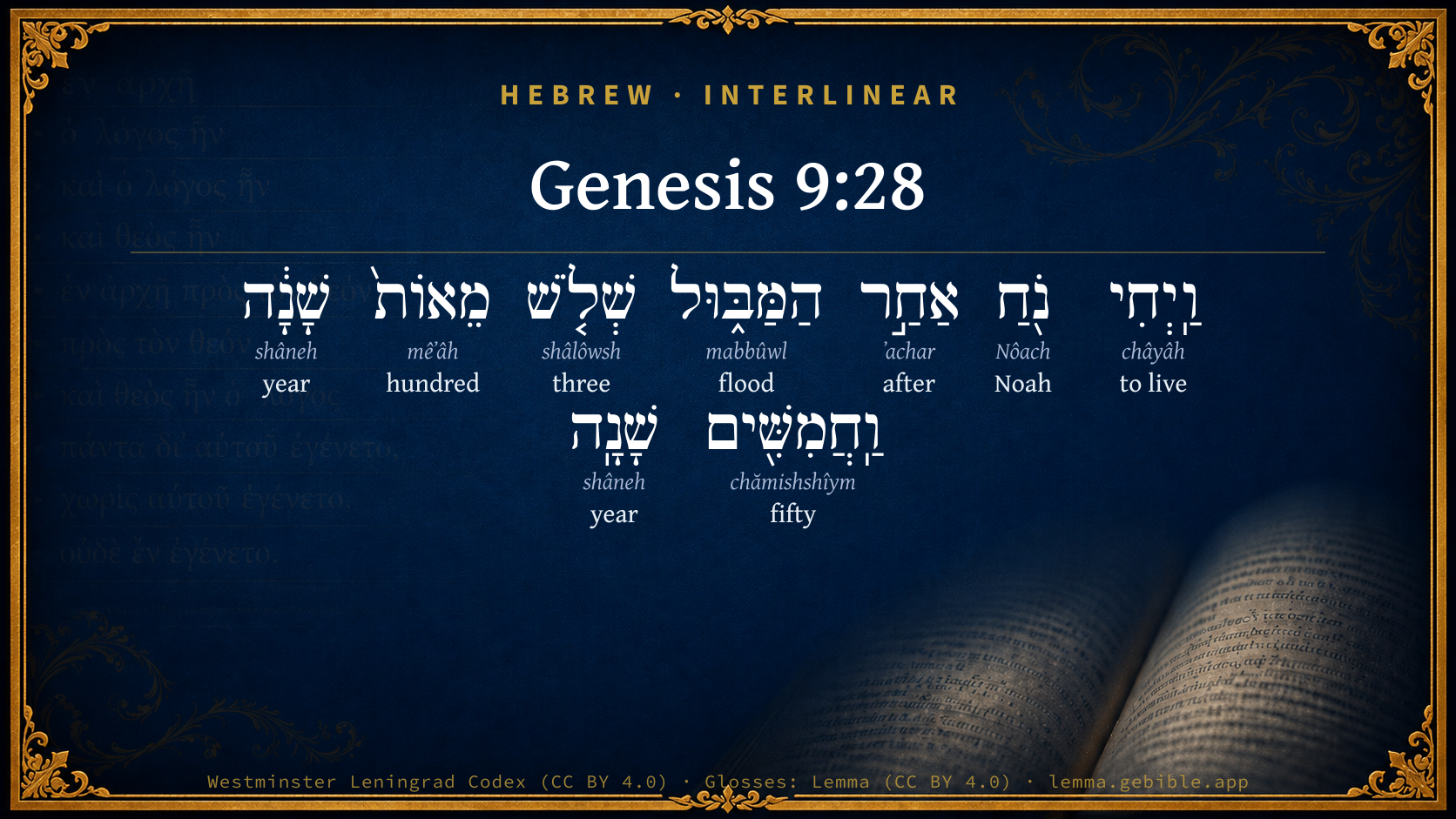
  1. וַֽיְחִי châyâh H2421 “and · to live” Conjunction + Verb, Qal, Sequential Imperfect, 3rd Person, Masculine, Singular
  2. נֹ֖חַ Nôach H5146 “Noah” Noun, Proper
  3. אַחַ֣ר ʼachar H310 “after” Preposition
  4. שְׁלֹ֤שׁ shâlôwsh H7969 “three” Adjective, Cardinal number, Feminine, Singular, Absolute
  5. מֵאוֹת֙ mêʼâh H3967 “hundred” Adjective, Cardinal number, Both, Plural, Absolute
  6. שָׁנָ֔ה shâneh H8141 “year” Noun, Common, Feminine, Singular, Absolute
  7. וַֽחֲמִשִּׁ֖ים chămishshîym H2572 “and · fifty” Conjunction + Adjective, Cardinal number, Both, Plural, Absolute
  8. שָׁנָֽה shâneh H8141 “year” Noun, Common, Feminine, Singular, Absolute

About this verse

These counts appear in no published source. They are computed here, from the morphology-tagged text and Lemma’s own curated glosses. What Lemma adds →

9
words
8
distinct lemmas
Pentateuch
section

Notable vocabulary

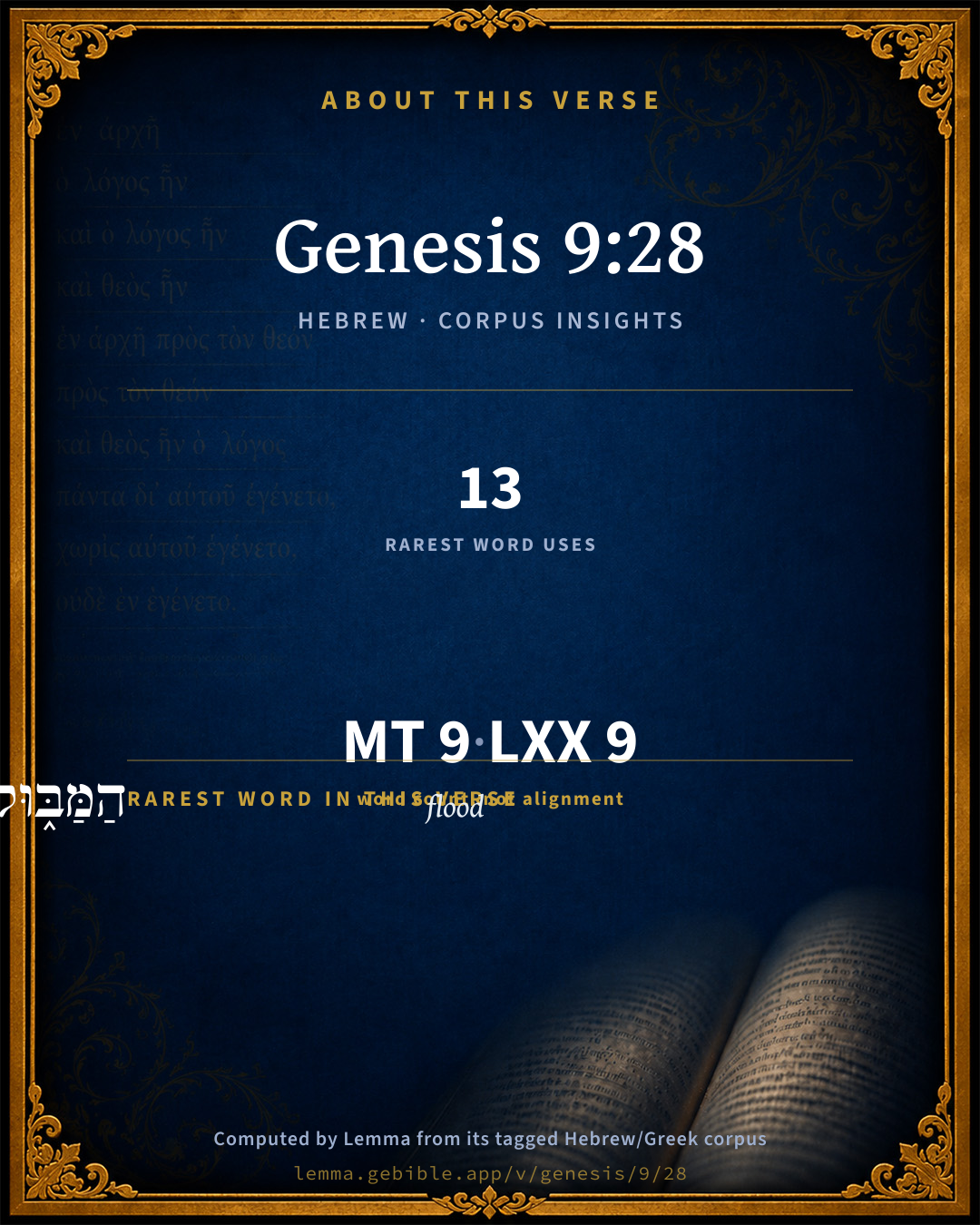
The rarest word here is הַמַּבּ֑וּל flood H3999 — appearing just 13 times in the whole Hebrew Bible.

Shared distinctive vocabulary

הַמַּבּ֑וּל flood H3999 occurs in 12 verses of the Hebrew Bible. Also found in:

Grammatical profile

  • 1 verb
  • 4 nouns
  • 3 adjectives
  • 1 preposition

Verb forms

  • וַֽיְחִי Qal · Sequential Imperfect

Repetition

A word recurs within this verse — often emphatic in Hebrew:

  • שָׁנָ֔ה year H8141 ×2

Hebrew & Septuagint length

In English translation the verse runs 9 words from the Hebrew and 11 from the Septuagint (LXX English) — closely comparable.

A rough comparison of the two English renderings, which tokenize alike — not a word-level alignment.

Word counts can differ between the Hebrew and the Greek without any difference in meaning — e.g. the Hebrew direct-object marker אֵת has no separate Greek word, and Greek often adds the article ὁ.

In the original languages it is 9 Hebrew tokens and 9 Greek tokens — but the two are counted differently (Hebrew bundles its prefixes and suffixes into one token; the Greek is in lemma form), so that isn’t a like-for-like length.

Hebrew and Greek witnesses Masoretic Hebrew ↔ Greek Septuagint

The same verse in the two great witnesses to the Old Testament, shown verse-for-verse.

These are two independent witnesses, not word-aligned to each other, and the Septuagint is shown in lemma (dictionary) form.

Hebrew Genesis 9:28 Masoretic · Westminster Leningrad Codex

וַֽיְחִי נֹ֖חַ אַחַ֣ר הַמַּבּ֑וּל שְׁלֹ֤שׁ מֵאוֹת֙ שָׁנָ֔ה וַֽחֲמִשִּׁ֖ים שָׁנָֽה

Noah lived three hundred fifty years after the flood.

World English Bible · Public Domain

Greek LXX Genesis 9:28 Septuagint · lemma form

ζάω δέ νωε μετά ὁ κατακλυσμός τριακόσιοι πεντήκοντα ἔτος

And Noe lived after the flood three hundred and fifty years.

LXX2012 (modern English Septuagint) · Public Domain

Hebrew: Westminster Leningrad Codex (CC BY 4.0). Greek: Septuagint (public domain); English from LXX2012 (modern English Septuagint) (Public Domain). How the Septuagint differs from the Hebrew →

Targum (Aramaic paraphrase)

2

The Targum is the ancient Jewish Aramaic paraphrase of the Hebrew Scriptures — an interpretive translation, not the Hebrew text itself. Onkelos (literal) and Pseudo-Jonathan (expansive) render the Torah, and Jonathan the Prophets. Coverage is partial: where no permissively-licensed English translation exists for a verse, only the Aramaic is shown. This is verse-level text, not a word-by-word alignment to the Hebrew.

  1. Targum Onkelos Torah (Genesis–Deuteronomy)
    וַחֲיָא נֹחַ בָּתַר טוֹפָנָא תְּלַת מְאָה וְחַמְשִׁין שְׁנִין

    And Noach lived after the deluge three hundred and fifty years.

    Targum Onkelos — Aramaic: “Onkelos Genesis” (public domain); “Onkelos Exodus” (public domain); “Onkelos Leviticus” (public domain); “Onkelos Numbers” (public domain); “Onkelos Deuteronomy” (public domain). English: “Sefaria Community Translation” (CC0 1.0 (public-domain dedication)); “J.W. Etheridge. The Targums of Onkelos and Jonathan Ben Uzziel on the Pentateuch. London: Longmans, Green, 1862” (public domain). Text via Sefaria.

  2. Targum Pseudo-Jonathan Torah (Genesis–Deuteronomy)
    וַחֲיָא נחַ בָּתַר טוּבְעָנָא תְּלַת מְאָה וְחַמְשִׁין שְׁנִין

    And Noach lived after the deluge three hundred and fifty years.

    Targum Pseudo-Jonathan — Aramaic: “Targum Jonathan on Genesis” (public domain); “Targum Jonathan on Exodus” (public domain); “Targum Jonathan on Leviticus” (public domain); “Targum Jonathan on Numbers” (public domain); “Targum Jonathan on Deuteronomy” (public domain). English: “The Targum of Jonathan ben Uzziel, trans. J. W. Etheridge, London, 1862” (public domain). Text via Sefaria.

Commentary

Notes on Genesis 9:28 from classic Christian and Jewish commentators (each source and its license shown beneath its notes). The classic Christian expositions comment on the surrounding passage and are grouped to its opening verse, so a note may address several verses; the Jewish commentaries on the Tanakh (Rashi and others) are per-verse, so they appear only where the commentator wrote on this verse.

Lemma curates 59 commentaries, every one of them public domain or Creative Commons licensed, each selected and text-cleaned for this edition rather than reprinted as found. About our sources →

Trapp's Complete Commentary

John Trapp

Gen 9:28 And Noah lived after the flood three hundred and fifty years.

Ver. 28, 29. And Noah lived after the flood, &c.] This man, if ever any that was born of a woman, had a long life, and full of misery. {Job 14:1} He saw the tenth generation after him before his death. But, oh, how oft was he occasioned to get under the juniper-tree with Elias, and desire to die! Before the flood, what a deal of wickedness and disorder beheld he in family, Church, and commonwealth; and all this punished by the deluge, to his unspeakable heart-break! Soon after he was mocked by his own son, and despised by almost all the rest of his posterity; whose unheard-of hardiness in building the tower of Babel, he was nolens volens , forced to see and suffer; and then shortly after, the confusion of tongues as their just punishment. What should I speak of their so many and so great cruelties, insolences, tyrannical usurpations, effusions of innocent blood, wars, stirs, strifes, superstitions, and abominable idolatries, under Nimrod, Jupiter, Belus, Semiramis, Zoroaster (the magic master), and other Emims and Zamzummims of the earth! Of all which, and a great deal more, this good old patriarch was, to his sorrow, not only an ear but an eye-witness. All which considered, it must needs be granted, that living so long, never any martyr, or other out of hell, suffered more misery than Noah did. {a} And the like may be said of Athanasius, of whom Master Hooker witnesseth, that for the space of forty-six years, from the time of his consecration to succeed Alexander Archbishop of Alexandria, till the last hour of his life in this world, his enemies never suffered him to enjoy the comfort of a peaceable day. Was not he to be reckoned a martyr, though he died in his bed? Cur verear Chrysostomum appellare Martyrem ? saith Erasmus. {b} And why may not any man say as much of Luther? &c.

{a} Vix mihi persuadeo virum ex homine miseriorem natum fuisse quam Noah . - Funccii Chron., fol. 17.

{b} Erasm. in Vita Chrysost.

John Trapp, A Commentary or Exposition upon All the Books of the Old and New Testament (1647–1656) — public domain. Text from a community e-Sword module.

The Biblical Illustrator

Joseph S. Exell

Gen_9:28-29

And all the days of Noah were nine hundred and fifty years: and he died

The years of Noah: their solemn lessons

Here is a brief record of a noble life.

There is little besides the simple numeration of years--merely a reference to the great event of Noahs history, and his falling at length under the common fate of all the race. This record, short as it is, teaches us some important lessons.

I. THE SLOW MOVEMENTS OF DIVINE JUSTICE. Before the flood the wickedness of man had grown so great that God threatened to cut short his appointed time upon the earth. His days were to be contracted to one hundred and twenty years--a terrible reduction of the energy of human life when man lived nearly one thousand years (Gen_6:3). But, from the instance of Noah, we find that this threat was not executed at once. Divine justice is stern and keen, but it is slow to punish.

II. THE ENERGY OF THE DIVINE BLESSING. God blessed man at the first, and endowed him with abundant measures of the spirit of life. Even when human iniquity required to be checked and punished by the curtailing of this sift, the energy of the old blessing suffered little abatement. God causes the power of that blessing still to linger among mankind. The hand of Divine goodness slackens but slowly in the bestowal of gifts to man. How often are the favours of Providence long continued to doomed nations and men! Underlying all Gods dealings with men there is the strong power of redemption, which is the life of every blessing. That power will yet overcome the worlds evil and subdue all things.

III. GODS PROVISION FOR THE EDUCATION OF THE RACE. When men depended entirely upon verbal instruction, and teachers were few, the long duration of human life contributed to the preservation and the extending of knowledge. But as the education of the world advanced, new sources of knowledge were opened and teachers multiplied, the necessity for long life in the instructors of mankind grew less. The provisions of God are wonderfully adjusted to human necessity.

IV. AN ENCOURAGEMENT TO PATIENT ENDURANCE. Here is one who bore the cross for the long space of nine hundred and fifty years. What a discipline in suffering as well as in doing the will of God! Time is the chief component among the forces that try patience, for patience is rather borne away by long trials than overwhelmed by the rolling wave. If tempted to murmur in affliction, or at our protracted contest with temptation and sin, let us think of those who have endured longer than we. (T. H. Leale.)

Noahs life and death

1. He lived accepted of God, promoted by Him, testifying against sin, preaching righteousness, giving laws from God to the generation wherein he was; and sometimes slipping into sin, and falling into bitter afflictions.

2. He died a death beseeming such a man; he died a saint, a believer, a glorious instrument in Christs Church, and so died in hope when by faith he had seen the promises. (G. Hughes, B. D.)

Review of the Chapter

I. GOD IS ALWAYS FAITHFUL to His promises, and mindful of those who trust in Him.

II. THE GOODNESS AND FAITHFULNESS OF GOD are further seen in His care for all His creatures, and in the steadfast order of nature. (Gen_8:1-22; Gen_9:9-10.)

III. NOAHS SIN is a most solemn warning. (1Co_10:12; Eph_5:18; 1Pe_5:8.) It is a sad finish to the history of so eminent a saint; an ominous beginning to the history of a new world. The first recorded sin after the Fall was a sin of violence; the first recorded sin after the flood was a sin of self-indulgence and sensuality. It is hard to say which of these two classes of sin has been, and is, the greatest curse to mankind. (The Congregational Pulpit.)

Lessons

1. Chronology is given by Gods Spirit. Special uses of it are in the Church.

2. Times and conditions of His Church God would have us know.

3. In the greatest desolations God hath raised some for His

Churchs good.

4. God extends the life of His saints as He bath use of them (Gen_9:28).

5. The longest life of saints wades through various conditions (Gen_9:29).

6. The longest living saint must die, yet like a saint, not fall as the wicked. (G. Hughes, B. D.)

.

The Biblical Illustrator, edited by Joseph S. Exell (c. 1880s–1900s) — public domain. Text from a community e-Sword module.

Joseph Benson's Commentary

Gen 9:28. Noah lived after the flood three hundred and fifty years — Which period, as the Jews observe, reaches to the fifty-eighth year of Abraham’s age. So that we need be under no difficulty in accounting for the transmission of the original revelation made to Adam, and of other branches of divine truth, from the beginning of the world to the time of Abraham. Noah received these from his parents, who had the account from Adam’s own mouth, and transmitted it to Abraham. And its communication and descent from him to the Jews, and from the Jews to us, is sufficiently known. Within this time also Noah saw the building of the tower of Babel, the horrid wickedness and idolatry of his children, and the bloody wars which even then began to arise between some of them.

Joseph Benson's Commentary on the Old and New Testaments (1811–1818) — public domain. Text from a community e-Sword module.

The Preacher's Complete Homiletical Commentary

Joseph S. Exell (gen. ed.)

MAIN HOMILETICS OF THE PARAGRAPH.—Gen_9:28-29

THE YEARS OF NOAH: THEIR SOLEMN LESSONS

Here is the brief record of a noble life. There is little besides the simple numeration of years—merely a reference to the great event of Noah’s history, and his falling at length under the common fate of all the race. This record, short as it is, teaches us some important lessons.

I. The slow movements of Divine justice. Before the flood the wickedness of man had grown so great that God threatened to cut short his appointed time upon the earth. His days were to be contracted to 120 years—a terrible reduction of the energy of human life when men lived nearly 1,000 years (Gen_6:3). But, from the instance of Noah, we find that this threat was not executed at once. Divine justice is stern and keen, but it is slow to punish.

II. The energy of the Divine blessing. God blessed man at the first, and endowed him with abundant measures of the spirit of life. Even when human iniquity required to be checked and punished by the curtailing of this gift, the energy of the old blessing suffered little abatement. God causes the power of that blessing still to linger among mankind. The hand of Divine goodness slackens but slowly in the bestowal of gifts to man. How often are the favours of Providence long continued to doomed nations and men! Underlying all God’s dealings with men there is the strong power of redemption, which is the life of every blessing. That power will yet overcome the world’s evil and subdue all things.

III. God’s provision for the education of the race. When men depended entirely upon verbal instruction, and teachers were few, the long duration of human life contributed to the preservation and the extending of knowledge. But as the education of the world advanced, new sources of knowledge were opened and teachers multiplied, the necessity for long life in the instructors of mankind grew less. The provisions of God are wonderfully adjusted to human necessity.

IV. An encouragement to patient endurance. Here is one who bore the cross for the long space of 950 years. What a discipline in suffering as well as in doing the will of God! Time is the chief component among the forces that try patience, for patience is rather borne away by long trials than overwhelmed by the rolling wave. If tempted to murmur in affliction, or at our protracted contest with temptation and sin, let us think of those who have endured longer than we.

SUGGESTIVE COMMENTS ON THE VERSES

Gen_9:28-29. He lived accepted of God, promoted by Him, testifying against sin, preaching righteousness, giving laws from God to the generation wherein he was; and sometimes slipping into sin, and falling into bitter afflictions. He died a death beseeming such a man; he died a saint, a believer, a glorious instrument in Christ’s Church, and so died in hope when by faith he had seen the promises.—(Hughes.)

ILLUSTRATIONS

BY

REV. WM. ADAMSON

Noah’s Death! Gen_9:28-29. The Jews have a myth of Noah, that on his deathbed he ordered his children to bring him wine sparkling in a beautiful cup. Holding it in his hand, he spoke to them of the vine. Let the vine be an emblem to you of your dignity, for it is full of weakness.

(1) Yet, as it creeps in the dust until the elm tree offers its aid, and then rises and gains strength by twining itself around the branches, so man is weak until he twines himself round the outstretched arm of God.

(2) Again, as the firm tree offers its supporting branches to the humble vine, in order that its hundred tendrils may wreathe themselves upwards nearer heaven, so God graciously offers His mighty arm for man’s soul to entwine his affections heavenward.

(3) Again, as the vine draws its nourishment of life from the earth, while on high it forms the coarser material into the leaf, and blossom, and refreshing grape, so should man. For as the vine needs light from above to pervade and invigorate, so man’s heart requires God’s light to stablish it. Then Noah gave them each the cup of wine; then drank thereof himself, and died.

“No further seek his merits to disclose,

Or draw his frailties from their dread abode;

There they abide in trembling hope repose,

The bosom of his Father and his God.”—Southey.

The Preacher's Complete Homiletical Commentary (gen. ed. Joseph S. Exell; Funk & Wagnalls, c. 1892) — public domain (pre-1929). A full-Bible homiletical/sermon-outline anthology covering 65 of 66 books (2 John is absent from the source module). Text from a community e-Sword module.

Matthew Henry's Commentary

Here see, 1. How God prolonged the life of Noah; he lived 950 years, twenty more than Adam and but nineteen less than Methuselah: this long life was a further reward of his signal piety, and a great blessing to the world, to which no doubt he continued a preacher of righteousness, with this advantage, that now all he preached to were his own children. 2. How God put a period to his life at last. Though he lived long, yet he died, having probably first seen many that descended from him dead before him. Noah lived to see two worlds, but, being an heir of the righteousness which is by faith, when he died he went to see a better than either.

Matthew Henry's Commentary on the Whole Bible (1708–1710) — public domain (CC PDM 1.0). Text via the HelloAO Bible API.

John Calvin's Commentaries

28. And Noah lived. Although Moses briefly states the age of the holy man, and does not record his annals and the memorable events of his life, yet those things which are certain, and which Scripture elsewhere commemorates, ought to recur to our minds. Within one hundred and fifty years, the offspring of his three sons became so numerous, that he had sufficient and even abundant proof of the efficacy of the Divine benediction Increase and multiply. He sees, not one city only, filled with his grandchildren, nor his seed expanded barely to three hundred families; but many nations springing from one of his sons who should inhabit extensive regions. This astonishing increase, since it was a visible representation of the divine favor towards him, would doubtless fill him with unbounded joy. For Abraham was nearly fifty years old when his ancestor Noah died. In the meantime, he was compelled to behold many things, which would afflict his holy breast with incredible grief. To omit other things; he saw in the family of Shem, the sanctuary of God, — into which the sons of Japheth were to be received, — destroyed, or, at least, dilapidated and rent. For whereas the father of Abraham himself, having deserted his proper station, had erected for himself a profane tabernacle; a very small portion indeed remained of those who worshipped God in the harmonious consent of a pure faith. With what tormenting pains this terrible confusion affected him cannot be sufficiently expressed in words. Hence we may know, that his eyes of faith must have been exceedingly penetrating, which did not fail to behold afar of, the grace of God, in preserving the Church, at that time overwhelmed by the wickedness of men.

John Calvin's Commentaries (1540-1563) — public domain. Text from the Calvin Translation Society English edition (1840s-50s) via the Christian Classics Ethereal Library (ccel.org). Calvin's coverage is partial (roughly two-thirds of the Bible); uncommented books and verses are honest gaps, never fabricated. The 19th-century editor's footnotes and remarks are omitted so the notes are faithfully Calvin's own voice.

John Gill's Exposition

And Noah lived after the flood three hundred and fifty years. So that he not only saw the old world, and the wickedness of that, and the destruction of it for it, but an increase of wickedness again, the building of the tower of Babel, the confusion of languages, the dispersion of his offspring, and the wars among them in the times of Nimrod, and others: however, it was a blessing to mankind that he lived so long after the flood in the new world, to transmit to posterity, by tradition, the affairs of the old world; and to give a particular account of the destruction of it, and to instruct them in the doctrines and duties of religion. By this it appears, that he lived within thirty two years of the birth of Abraham. The Jews conclude from hence, that he lived to the fifty eighth year of Abraham's life: it may be remarked, that it is not added here as usual to the account of the years of the patriarchs, "and he begat sons and daughters"; from whence it may be concluded, that he had no more children than the three before mentioned, as well as from the silence of the Scriptures elsewhere, and from the old age of himself and his wife, and especially from what is said; see Gill on Gen 9:19.

Genesis 9:29

John Gill's Exposition of the Whole Bible (1746–1763) — public domain (CC PDM 1.0). Text via the HelloAO Bible API.

Matthew Poole's English Annotations

Which reacheth to the fifty-eighth year of Abraham’s age, as the Jews note. And so we have a manifest account of the propagation of religion, from the beginning of the world to this day. Noah received it from his parents, who had the account of it from their first father Adam’s own mouth, and transmitted it to Abraham; and its descent from him to the Jews, and by the Jews to others, is sufficiently known. Within this time also Noah saw the building of Babel’s tower, the horrid wickedness and idolatry of his children, and the bloody wars which even then arose between some of them.

Matthew Poole's English Annotations on the Holy Bible (1683–1685) — public domain. Text from a community e-Sword/MySword module.

Whedon's Commentary on the Bible

Daniel D. Whedon

28. Noah lived after the flood — The narrative up to this verse may have been composed during the life of Noah, and in all probability the details of the deluge, the covenant, and these wondrous predictions, minute and graphic as they are, were written by Noah or by Shem, not in the present form, for the Hebrew did not then exist, but in a more primitive tongue, from which they were afterward translated by some one of their descendants, probably before the time of Moses.

Daniel D. Whedon (gen. ed.), Commentary on the Old and New Testaments (1874–1909) — public domain. Text from a community e-Sword module.

The Pulpit Commentary

Vers. 28, 29. And Noah lived after the flood three hundred and fifty years. Ie. to the fifty-eighth year of the life of Abram, and was thus in all probability a witness of the building of the tower of Babel, and of the consequent dispersion of mankind. And all the days of Noah were nine hundred and fifty years: and he died. Tuch, Bleek, and Colenso connect these verses with ver. 17, as the proper continuation of the Elohist"s work.

The Pulpit Commentary (1880–1919), ed. H.D.M. Spence-Jones & Joseph S. Exell — public domain. Text from a community e-Sword module.

unfoldingWord translationNotes

Door43 World Missions Community

translationWords

flood

Noah

unfoldingWord translationNotes — © Distant Shores Media and the Door43 World Missions Community, licensed CC BY-SA 4.0. Source: git.door43.org/Door43/en_tn.

Radak

Rabbi David Kimhi (Radak)

ויחי נח, the principal reason why the Torah lists the ages of these antediluvian people is only to enable us to count back to when human history started with the creation of Adam. All such basic historical data are provided both in the Torah and in the Books of the prophets.

Radak on the Tanakh — English translations: “Sefaria Community Translation” (CC0 1.0 (public-domain dedication)); “Eliyahu Munk, HaChut Hameshulash” (CC BY 4.0); “Rabbi Mike Feuer, Jerusalem Anthology” (CC BY 4.0); and “R. David Kimhi on the first book of Psalms, Translated by R.G. Finch, London, 1919” (public domain). Text via Sefaria.

Lesson kit

Teaching starters — assembled from the data on this page, not authored interpretation. Every prompt links to the verse data it draws on. Edit before teaching.

Genesis, in the Pentateuch, opens this verse with 9 words (8 distinct Hebrew lemmas). Its most distinctive word is mabbûwl (“flood”). A historical commentator’s framing appears above. Read the whole chapter for the surrounding context.

Discussion questions

  1. The word mabbûwl carries the sense “flood.” How does it shape the verse?
  2. How does Genesis 6:17, which shares the word «flood», read alongside this verse?
  3. What does the repetition of “year” (2× in this one verse) do in this verse?
  4. These translations render this verse differently; the difference is in the English rendering, not the original. What questions does that raise?
  5. «וַֽיְחִי» is a Qal Sequential Imperfect verb. How does that grammatical form shape the action described?
  6. Compare how Trapp's Complete Commentary and The Biblical Illustrator read this verse. Where do they agree or differ?

Things to notice

Reading settings

Reading text

Shown beneath each verse's original-language words.

Old Testament
Old Testament edition

Read the OT as the Masoretic Hebrew (MT) or the Greek Septuagint (LXX).

English shown for the Greek Septuagint (in the Hebrew ↔ Greek comparison).

Comparing translations? Open the Compare panel on any verse page to stack up to four side by side.