Matthew 6:33

Greek (Tischendorf 8th ed.) Matthew 6:33 appears in the Greek New Testament. The text above is from the Tischendorf 8th edition. Each word links to its Strong’s number and a concise gloss. Click any word for its full Thayer’s Greek Lexicon entry.
Download image
Cite this verse

Matthew 6:33 (World English Bible). Public Domain. Lemma interlinear Bible study tool, https://lemma.gebible.app/v/matthew/6/33.

Show BibTeX & RIS
BibTeX
RIS
English Translation
But seek first God's Kingdom, and his righteousness; and all these things will be given to you as well.
World English Bible · Public Domain
Download a study sheet

One document with this verse’s original text, its word-by-word gloss line, the meaning frame, cross-references with their text, attributed commentary, and full source and license credits — printable, and it pastes into notes with its structure intact.

This verse Autodidact and up

Study sheet (.html) Plain text (.txt)

A passage Seminary Student

Up to 50 verses in one chapter. A passage sheet keeps up to 6 commentary sources and 12 cross-references per verse, in the order this page ranks them, and says so on the sheet whenever that leaves anything out. Ask for a single verse and you get the Autodidact verse sheet above.

Everything on this page stays free to read, with no account — the sheet is a download of what is already on screen, not access to it.

Want to remove ads? Support Godless Engineer
Compare translations 3

The same verse in 3 English versions, stacked beneath the original-language interlinear above. Click any original word for its lexicon entry.

Each is an independent rendering of the whole verse — the interlinear is not word-aligned to these translations.

Highlighted words mark where these versions differ — a whole-verse word diff, not a word-by-word alignment.

  • World English Bible Public Domain
    But seek first God's Kingdom, and his righteousness; and all these things will be given to you as well.
  • King James Version Public Domain
    But seek ye first the kingdom of God, and his righteousness; and all these things shall be added unto you.
  • unfoldingWord Literal Text CC BY-SA 4.0
    But seek first the kingdom and his righteousness, and all these things will be added to you.

unfoldingWord Literal Text — © unfoldingWord, licensed CC BY-SA 4.0. Word-aligned USFM3 via Door43 (git.door43.org/unfoldingWord/en_ult).

Versions to compare (up to 4)

3 of 4 selected

Show all 19 translations

Every available English version of this verse, each an independent rendering of the whole verse.

  • World English Bible Public Domain
    But seek first God's Kingdom, and his righteousness; and all these things will be given to you as well.
  • Berean Standard Bible Public Domain
    But seek first the kingdom of God and His righteousness, and all these things will be added unto you.
  • Majority Standard Bible Public Domain
    But seek first the kingdom of God and His righteousness, and all these things will be added unto you.
  • King James Version Public Domain
    But seek ye first the kingdom of God, and his righteousness; and all these things shall be added unto you.
  • American Standard Version (1901) Public Domain
    But seek ye first his kingdom, and his righteousness; and all these things shall be added unto you.
  • Revised Version (1885) Public Domain
    But seek ye first his kingdom, and his righteousness; and all these things shall be added unto you.
  • Geneva Bible (1599) Public Domain
    But seeke ye first the kingdome of God, and his righteousnesse, and all these things shall be ministred vnto you.
  • Douay-Rheims (1899) Public Domain
    Seek ye therefore first the kingdom of God, and his justice, and all these things shall be added unto you.
  • Young's Literal Translation Public Domain
    but seek ye first the reign of God and His righteousness, and all these shall be added to you.
  • Literal Standard Version CC BY-SA 4.0
    but seek first the Kingdom of God and His righteousness, and all these will be added to you.
  • Unlocked Literal Bible CC BY-SA 4.0
    But seek first his kingdom and his righteousness and all these things will be given to you.
  • unfoldingWord Literal Text CC BY-SA 4.0
    But seek first the kingdom and his righteousness, and all these things will be added to you.
  • Darby Bible Public Domain
    But seek ye first the kingdom of God and his righteousness, and all these things shall be added unto you.
  • World Messianic Bible Public Domain
    But seek first God’s Kingdom and his righteousness; and all these things will be given to you as well.
  • Webster's Bible Public Domain
    But seek ye first the kingdom of God, and his righteousness, and all these things shall be added to you.
  • Free Bible Version CC BY-SA 4.0
    Seek his kingdom first, and his way of living right, and everything will be given to you.
  • Bible in Basic English Public Domain
    But let your first care be for his kingdom and his righteousness; and all these other things will be given to you in addition.
  • Text-Critical English NT CC BY 4.0
    But seek first the kingdom of God and his righteousness, and all these things will be added to you.
  • Tyndale New Testament (1534) Public Domain
    But rather seke ye fyrst the kyngdome of heuen and the rightwisnes therof and all these thynges shalbe ministred vnto you.

Literal Standard Version (2020), Covenant Press — licensed CC BY-SA 4.0. Text via the HelloAO Bible API (eBible.org). Unlocked Literal Bible (unfoldingWord) — licensed CC BY-SA 4.0. Text via the HelloAO Bible API (eBible.org). unfoldingWord Literal Text — © unfoldingWord, licensed CC BY-SA 4.0. Word-aligned USFM3 via Door43 (git.door43.org/unfoldingWord/en_ult). Free Bible Version, Dr. Jonathan Gallagher — licensed CC BY-SA 4.0. Text via the HelloAO Bible API (eBible.org).

Word by word

More ways to search: Search by grammar → Find every occurrence → Compare this word →

Practice this passage: Drill this verse → Learn its vocabulary →

προστεθήσεται
prostíthēmi
G4369
“to add”
Verb, Future, Passive, Indicative, 3rd person, Singular
Part of Speech
Verb
Tense
Future
Voice
Passive
Mood
Indicative
Person
3rd person
Number
Singular
Full Thayer's Definition

Origin: from G4314 and G5087

TDNT: 10:47,1

1. to put to 2. to add a. i.e. to join to, gather with any company, the number of one's followers or companions 1. he was gathered to his fathers i.e. died
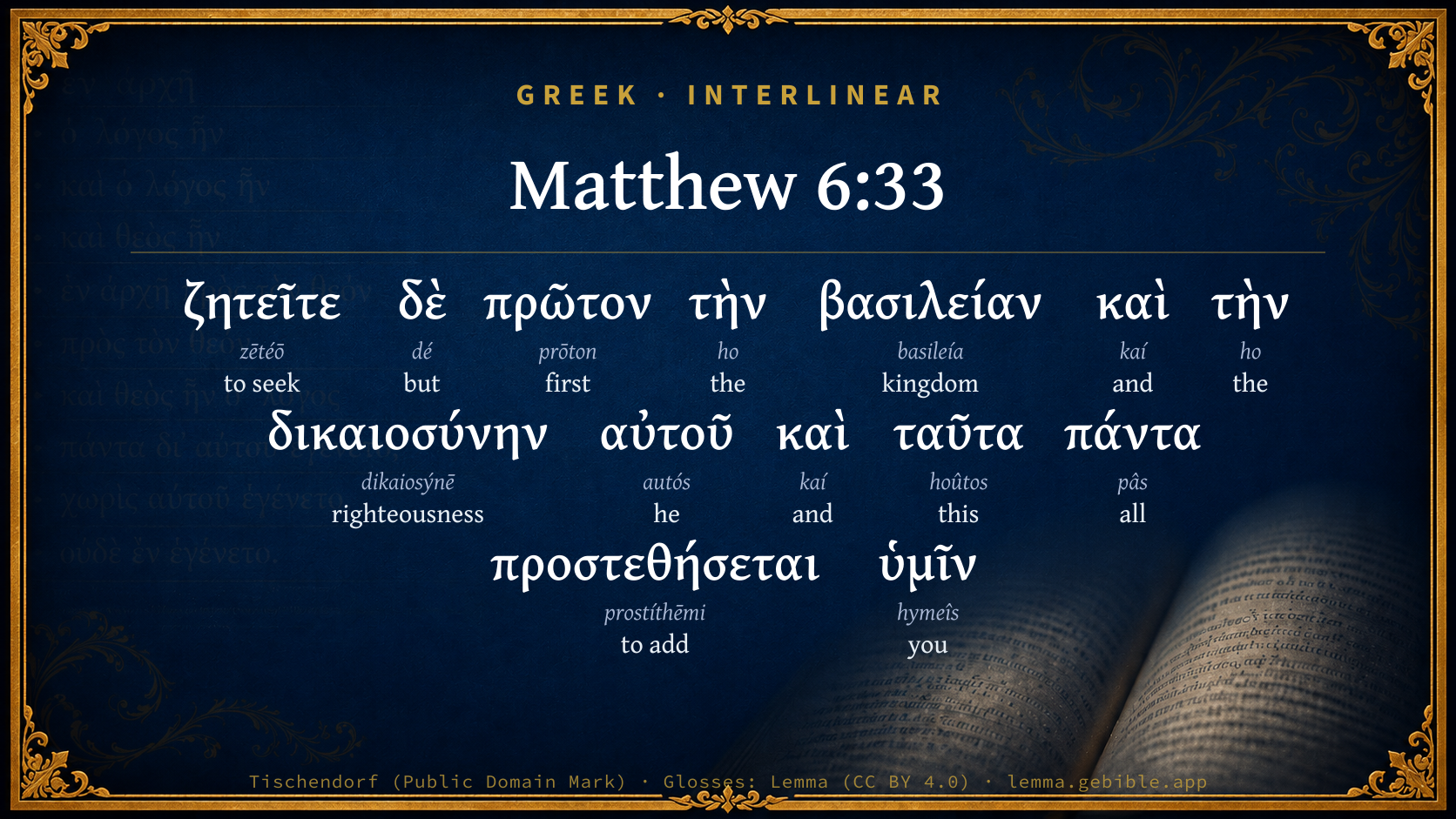
  1. ζητεῖτε zētéō G2212 “to seek” Verb, Present, Active, Imperative, 2nd person, Plural
  2. δὲ dé G1161 “but” Conjunction
  3. πρῶτον prōton G4412 “first” Adverb, Superlative
  4. τὴν ho G3588 “the” Article, Accusative, Singular, Feminine
  5. βασιλείαν basileía G932 “kingdom” Noun, Accusative, Singular, Feminine
  6. καὶ kaí G2532 “and” Conjunction
  7. τὴν ho G3588 “the” Article, Accusative, Singular, Feminine
  8. δικαιοσύνην dikaiosýnē G1343 “righteousness” Noun, Accusative, Singular, Feminine
  9. αὐτοῦ autós G846 “he” Personal pronoun, Genitive, Singular, Masculine
  10. καὶ kaí G2532 “and” Conjunction
  11. ταῦτα hoûtos G3778 “this” Demonstrative pronoun, Nominative, Plural, Neuter
  12. πάντα pâs G3956 “all” Adjective, Nominative, Plural, Neuter
  13. ὑμῖν hymeîs G5210 “you” Personal pronoun, 2nd person, Dative, Plural

About this verse

These counts appear in no published source. They are computed here, from the morphology-tagged text and Lemma’s own curated glosses. What Lemma adds →

14
words
12
distinct lemmas
Gospels
section

Notable vocabulary

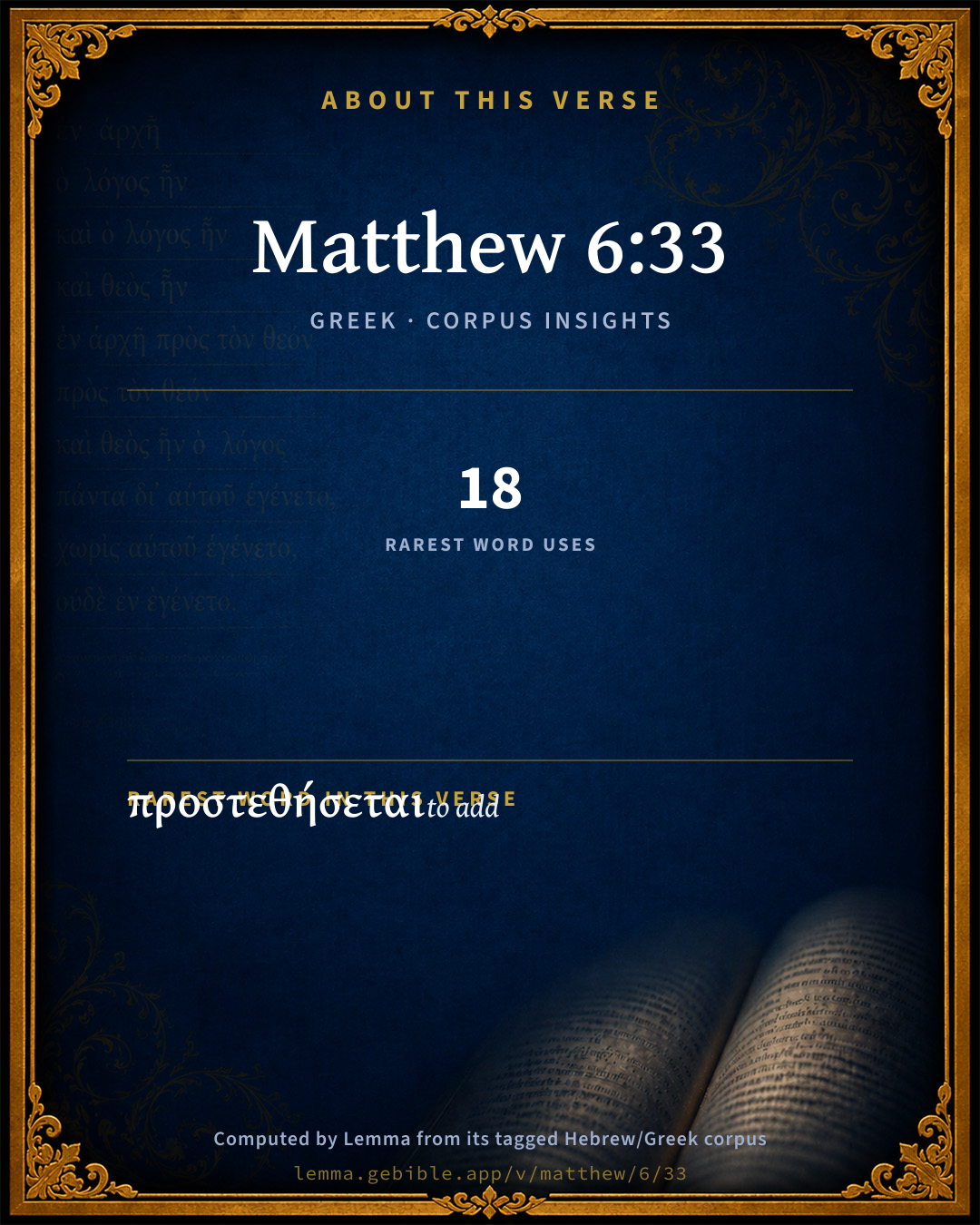
The rarest word here is προστεθήσεται to add G4369 — appearing just 18 times in the whole Greek New Testament.

Shared distinctive vocabulary

προστεθήσεται to add G4369 occurs in 18 verses of the Greek New Testament. Also found in:

Repetition

Words recur within this verse:

Cross-references

42

Topical passages linked to Matthew 6:33 in the Treasury of Scripture Knowledge — connected by theme and wording, ordered by reader-vote popularity; previews shown in the World English Bible.

  • Luke 12:31 But seek God's Kingdom, and all these things will be added to you.
  • Matthew 5:6 Blessed are those who hunger and thirst after righteousness, For they shall be filled.
  • John 6:27 Don't work for the food which perishes, but for the food which remains to eternal life, which the Son of Man will give to you. For God the Father has sealed him."
  • Psalms 34:9–10 Oh fear Yahweh, you his saints, For there is no lack with those who fear him.
  • Psalms 84:11–12 For Yahweh God is a sun and a shield. Yahweh will give grace and glory. He withholds no good thing from those who walk blamelessly.
  • Mark 10:29–30 Jesus said, "Most assuredly I tell you, there is no one who has left house, or brothers, or sisters, or father, or mother, or wife, or children, or land, for my sake, and for the Gospel's sake,
  • Romans 14:17 for the Kingdom of God is not eating and drinking, but righteousness, peace, and joy in the Holy Spirit.
  • Proverbs 3:9–10 Honor Yahweh with your substance, With the first fruits of all your increase:
  • Proverbs 2:1–9 My son, if you will receive my words, And store up my commandments within you;
  • Psalms 37:25 I have been young, and now am old, Yet I have not seen the righteous forsaken, Nor his children begging for bread.
  • Psalms 37:3 Trust in Yahweh, and do good. Dwell in the land, and enjoy safe pasture.
  • 2 Chronicles 31:20–21 Thus did Hezekiah throughout all Judah; and he worked that which was good and right and faithful before Yahweh his God.
  • Matthew 19:29 Everyone who has left houses, or brothers, or sisters, or father, or mother, or wife, or children, or lands, for my name's sake, will receive one hundred times, and will inherit eternal life.
  • Romans 8:31 What then shall we say about these things? If God is for us, who can be against us?
  • Psalms 37:18–19 Yahweh knows the days of the perfect. Their inheritance shall be forever.
  • Colossians 1:13–14 who delivered us out of the power of darkness, and translated us into the Kingdom of the Son of his love;
  • 1 Timothy 4:8 For bodily exercise has some value, but godliness has value for all things, having the promise of the life which is now, and of that which is to come.
  • Luke 18:29–30 He said to them, "Most assuredly I tell you, there is no one who has left house, or wife, or brothers, or parents, or children, for the Kingdom of God's sake,
  • 2 Corinthians 5:21 For him who knew no sin he made to be sin on our behalf; so that in him we might become the righteousness of God.
  • Romans 1:17 For in it is revealed God's righteousness from faith to faith. As it is written, "But the righteous shall live by faith."
  • 1 Kings 3:11–13 God said to him, Because you have asked this thing, and have not asked for yourself long life, neither have asked riches for yourself, nor have asked the life of your enemies, but have asked for yourself understanding to discern justice;
  • Philippians 3:9 and be found in him, not having a righteousness of my own, that which is of the law, but that which is through faith in Christ, the righteousness which is from God by faith;
  • Matthew 13:44–46 "Again, the Kingdom of Heaven is like a treasure hidden in the field, which a man found, and hid. In his joy, he goes and sells all that he has, and buys that field.
  • 1 Corinthians 1:30 But of him, you are in Christ Jesus, who was made to us wisdom from God, and righteousness and sanctification, and redemption:
  • Matthew 4:17 From that time, Jesus began to preach, and to say, "Repent! For the Kingdom of Heaven is at hand."
  • Matthew 3:2 "Repent, for the Kingdom of Heaven is at hand!"
  • Romans 10:3 For being ignorant of God's righteousness, and seeking to establish their own righteousness, they didn't subject themselves to the righteousness of God.
  • 1 Kings 17:13 Elijah said to her, Don't be afraid; go and do as you have said; but make me of it a little cake first, and bring it forth to me, and afterward make for you and for your son.
  • Acts 28:31 preaching the Kingdom of God, and teaching the things concerning the Lord Jesus Christ with all boldness, without hinderance.
  • 2 Peter 1:11 For thus will be richly supplied to you the entrance into the eternal Kingdom of our Lord and Savior, Jesus Christ.
  • 2 Chronicles 1:7–12 In that night did God appear to Solomon, and said to him, Ask what I shall give you.
  • 2 Thessalonians 1:5 This is an obvious sign of the righteous judgment of God, to the end that you may be counted worthy of the Kingdom of God, for which you also suffer.
  • Haggai 1:2–11 "This is what Yahweh of Hosts says: These people say, 'The time hasn't yet come, the time for Yahweh's house to be built.'"
  • Leviticus 25:20–21 If you said, "What shall we eat the seventh year? Behold, we shall not sow, nor gather in our increase;"
  • Romans 3:21–22 But now apart from the law, a righteousness of God has been revealed, being testified by the law and the prophets;
  • Jeremiah 23:6 In his days Judah shall be saved, and Israel shall dwell safely; and this is his name by which he shall be called: Yahweh our righteousness.
  • Isaiah 45:24 Only in Yahweh, it is said of me, is righteousness and strength; even to him shall men come; and all those who were incensed against him shall be disappointed.
  • Luke 1:6 They were both righteous before God, walking blamelessly in all the commandments and ordinances of the Lord.
  • 1 Corinthians 3:22 whether Paul, or Apollos, or Cephas, or the world, or life, or death, or things present, or things to come. All are yours,
  • 2 Peter 1:1 Simon Peter, a servant and apostle of Jesus Christ, to those who have obtained a like precious faith with us in the righteousness of our God and Savior, Jesus Christ:
  • Acts 20:25 Now, behold, I know that you all, among whom I went about preaching the Kingdom of God, will see my face no more.
  • Haggai 2:16–19 Through all that time, when one came to a heap of twenty measures, there were only ten. When one came to the wine vat to draw out fifty, there were only twenty.

Cross-references courtesy of OpenBible.info (CC BY 4.0).

Commentary

Notes on Matthew 6:33 from classic Christian and Jewish commentators (each source and its license shown beneath its notes). The classic Christian expositions comment on the surrounding passage and are grouped to its opening verse, so a note may address several verses; the Jewish commentaries on the Tanakh (Rashi and others) are per-verse, so they appear only where the commentator wrote on this verse.

Lemma curates 59 commentaries, every one of them public domain or Creative Commons licensed, each selected and text-cleaned for this edition rather than reprinted as found. About our sources →

The Biblical Illustrator

Joseph S. Exell

Mat_6:33

Seek ye first the kingdom of God.

The profitable pursuit

I. What we are to seek.

II. How we are to seek.

1. First in time.

2. First in attention.

3. What are your desires?

4. What are your exertions? These last two will reveal the object of your search.

III. Why we are thus to seek these blessings.

1. Though destitute, as we naturally are, of His kingdom and righteousness, if we seek them in the manner here required, we shall obtain them.

2. Besides gaining this kingdom and righteousness, all other things shall be added unto us.

Religion has a friendly influence over secular affairs; other things occupy too much of your time and attention.

1. This undue solicitude injures your spiritual welfare.

2. It is hurtful even to your temporal welfare. (W. Jay.)

Religion our chief concern

1. From the excellence of the objects which it proposes.

2. From the certainty of its rewards. (W. Fleming, D. D.)

The care of the body transferred to the soul

I. The conclusion to which the Saviour arrives.

1. The carefulness forbidden.

2. The grounds on which the prohibition is founded.

(1) It is heathenish.

(2) It is ungrateful.

(3) Fruitless and unnecessary.

(4) Unwise.

II. The duty commanded us.

1. The objects we are to pursue-The kingdom of God.

2. The precept given us respecting them-Seek first.

(1) Make religion our earliest and primary object of attention.

(2) Give it preference.

3. The promise annexed to the pursuit.

III. Three reflections.

1. What a friend to man is Christianity!

2. What an enemy to our peace is a worldly spirit:

3. What a reproof does this administer to multitudes of the hearers of the gospel! (J. E. Good.)

The first object in life

Suppose a man should be religious for the sake of temporal advantage. Whatever a mans motive, that is the first thing. Therefore this man is not seeking first the kingdom of God, but the temporal advantages to which his religion is subservient. Do not let a poor man be tempted to think that because he is not richer, either he is not a seeker, or God is not a faithful promiser. Occasions on which we may especially urge this text:-

1. Upon the young man just entering into life.

2. The man who is passing under some temptation to compromise a principle for the sake of some worldly interest-in friendship or business. Whatever be your engagements in life, remember that you have a prior one. And in whatever relation you stand to man, never forget that you have a higher one.

Keep your eye on the eternal.

1. Remember that there is a kingdom within, in which the spiritual is to reign over the carnal.

2. That there is a kingdom around you, which is Gods Church, which is your foremost duty to extend.

3. That there is a kingdom coming which shall put to shame all the riches of this present world. (J. Vaughan, M. A.)

The first concern

The word seek is contrasted with the same word used in the thirty-second verse: After these things do the Gentiles seek. With what activity, zeal, are these things attended to!

I. We need no argument to convince you that the things after which the gentiles seek occupy a great place in mens minds and necessarily so. Religious ordinances not merely for enjoyment, but to strengthen for the toil of life. But men postpone their salvation. This is against Gods ordinance, Seek first.

(1) In point of preference.

(2) In point of time.

(3) In point of anxiety.

II. The assurance connected with this command. This is a positive assurance; the fulfilment depends upon the faithfulness of God.

1. He argues from the less to the greater-Is not the life more than meat?

2. He takes us to Gods providential care over the lower creatures.

3. If men indulge in disquieting care, what benefit do they derive?

4. Disquieting care is as unnecessary as it is unprofitable. Your heavenly Father knoweth that ye have need of these things. A common objection is, How is it that so many good people are in want? Have they been seeking God first? (W. Cadman, M. A.)

Seeking first the kingdom of God

I. What is the kingdom of god?

1. To have the whole of ones heart in subjugation to God.

2. To extend the Church.

3. To pray for and help on the Second Advent.

II. What is his righteousness?

1. There was the righteousness in which man was first made.

2. There is a righteousness which is a part of the character of God.

3. There is a righteousness composed of all the perfections of the life of Christ.

Now this is the righteousness which every good man seeks.

1. That it will justify him before God.

2. Then something that will justify him before his own conscience.

3. The comfort of the thought that it is not to attainers, but to seekers.

4. There is one God in providence and in grace. (J. Vaughan, M. A.)

Mans first duty

I. His first duty.

1. In priority of time.

2. In excellence of value.

3. It implies diligence.

4. It implies consideration. How the unjust steward planned his conduct.

5. Seek a personal interest in the kingdom of God.

6. Seek the extension of the Redeemers kingdom.

7. Seek the glory of the kingdom.

II. His reward. Godliness hath promise of the life that now is, as well as of that which is to come. God is revealed as love; will He allow His servants to starve? He has given a positive pledge He spared not His own Son; shall He not with Him freely give us all things? (H. M. Villiers, M. A.)

I. The extent to which the precept of the text is neglected.

1. By the busy, anxious, laborious class of the community.

2. By the lovers of pleasure.

3. By the lovers of worldly honours and sordid applause.

4. By the professors of religion.

II. The duty of a stricter regard to the precept.

1. The kingdom of God is entitled to this deference.

2. If not sought first, will never be found at all.

3. In this search, all other essential throes will be granted. (J. W. Cunningham, M. A.)

I. What are we to understand by the kingdom of God? The reign of God, the ascendency of God. Self is the great usurper. The righteousness named is the Christian character in all the details of practical religion. To seek them, is to desire these above all other things.

II. All these things shall be added unto you. Temporal necessities. The kingdom of God, etc.

1. It will guard a man against those vain, ostentatious habits above his real income, which bring so many into difficulties, and eventually ruin.

2. It will preserve from those lax and slovenly habits of management which bring so many into ruin.

3. It will preserve from all dishonesty. (Hugh McNeile, M. A.)

Mans first duty, and Gods promise

Jacobs blessing has the preference over Esaus. It is well to obtain first the dew of heaven, then the fatness of the earth. Things are only of value as God blesses them; Gods gifts are better than His permissions. The promises of prosperity in the New Testament are small.

I. How far may our text be used as a motive to godliness? Suppose a family with whom everything goes wrong, their best pains useless. No religion in the family. If I could work a moral change, I feel that the only way of avoiding want. No matter what means used, so long as the man is brought to God. But we must not make secular good the motive; this would not be seeking first the kingdom.

II. What restrictions does our text impose upon human carefulness? It gives no sanction to those enthusiasts who would renounce all worldly provision. Anxiety they ought to dismiss, but not attention; lay aside distrust, but not industry. Not to seek only the kingdom, but first; this implies a second. The text gives no promise of superfluities. (H. Melvill, B. D.)

What t is meant by seeking the kingdom of God?

1. A fixed design and resolution to that end. Like the term and end of a mans journey, towards which the traveller is continually tending, and hath it always habitually in his intention, though he doth not always think of it every step that he takes.

2. Care and diligence as to the means. That we make religion our business, and exercise ourselves in the duties of it, both in public and private. With the same seriousness and application of mind as men do in their callings and professions.

3. Zeal and earnestness in the pursuit of it. The greatness of the design, and the excellency of what we seek after, will justify the highest degree of discreet zeal and fervour in the prosecution of 2:4. Patience and perseverance in our endeavours after the kingdom of God and His righteousness. Notwithstanding all the difficulties, discouragements, the opposition and persecution we may meet with, for righteousness sake. (John Tillotson, D. D.)

I. Constantly and sincerely make use of all means such as He hath prescribed whereby to obtain and practise true grace.

II. Consult and study the Word of God, wherein He hath revealed His will to you.

III. Make it daily your prayer to God, that He, for His Sons sake, will assist you with His grace and Holy Spirit in doing this. (William Beveridge, D. D.)

Providence leaves no excuse for indolence

Take the flowers of the field. They do not reap nor plant; and yet God clothes them with beauty. Very good; the flower has to develop. There is not a single flower in all the wilderness, nor in all gardens, whether of the Orient or here on our continent, that does not work for a living. It sprouts from the seed. It sends down its roots, and every one of these roots is a purveyor hunting underground here, there, and everywhere; developing, spreading out, sucking within and sucking without, dissolving the mineral, pumping here for the juices that are to run up, and searching for water yonder. The willow finds moisture, even though you should not be able to. In darkness the long vine reaches out to the light, seeks it, and at last finds it. Every plant that lives and comes to perfect plant-life is a worker, only on the plane to which he belongs with his limited development, and with his limited organization. It works for a living; and what does it find? What does the bird find? He finds that God so orders the affairs of this world that when ha works according to his nature he is provided for. The plant, when it works and develops itself according to the laws of its nature, finds that providence has provided for it. When a man works and develops according to his nature, he finds a providence that makes it possible for him to live and to thrive. (Beecher.)

Unfitness a great occasion of anxiety

Men are mistaking all the time what they are fit for. Shall a weak man go into the ring to wrestle? Shall a dell and heavy man go on the road to race? Shall an unskilled man undertake to carry on the most skilful shop? Men are all the time miscarrying and miscarrying; it is the collision between impotence and desire that is all the time putting them back; and they are worrying and fretting and anxious. (Beecher.)

1. Because nothing can happen to any without Gods general permission.

2. Because nothing shall happen to His people without Gods special direction.

3. Because in what does happen, the terms good and evil, as we are accustomed to employ them, are often misunderstood and misapplied.

4. Because sufficient will be afforded by every passing day to exercise oar powers and occupy our thoughts, without extending our views beyond. (T. Dale, M. A.)

Forecasting sorrow

1. It renders us insensible to present good.

2. It unfits for the activities of to-day. Anxiety depresses.

4. It gives a practical denial of the Christian creed.

5. It has a saddening influence upon others. (T. Jackson, B. A.)

Anxiety depresses

Men are worn out, enfeebled, aged more by corroding care than by hard labour. Look at a housemaid; if she be bright, cheerful, high-spirited, her toil is performed efficiently and speedily, to the satisfaction of herself and her mistress. How different if she is cheerless and gloomy! A merry heart goes all the day: a sad tires in a mile, observes our great dramatist; while the Chelsea philosopher says, Give us, oh, give us the cheerful man that sings at his work. He will do more in the same time; he will do it better; he will persevere longer. One is scarcely sensible to fatigue when marching to music. (T. Jackson, B. A.)

It renders insensible to present good

A young lady once expressed to Hogarth, the great satirist, a wish to learn to draw caricature. Alas! said he, it is not a faculty to be envied. Take my advice, and never draw caricature. By the long practice of it I have lost the enjoyment of beauty; I never see a face but distorted, and have never the satisfaction to behold the human face divine. So, by constantly looking at the dark side of their life, its distorted and unpleasant aspect-evils at hand and those looming in the distance-men lose the power to appreciate the blessings which are theirs, and make them an object of envy to their neighbours. (T. Jackson, B. A.)

I. Folly to be wholly taken up with the accessories, and neglect the principal.

II. Trouble not yourselves about futurity.

1. Do not anticipate your cares.

2. Do not add vexation to your life by forecasting and designing uncertainties.

3. Leave events to Gods infinite, all-wise disposal.

4. Look after your present duty.

5. Reserve all your strength about you, to bear you up against present difficulties and temptations.

III. Tomorrow is a new day.

1. Brings care of its own.

2. Brings new duties.

3. Fresh troubles.

4. Both its hands are full. Today has enough to do of its own; to-morrow brings its own harvest. (Adam Littleton, D. D.)

The evil here is

I. The evil of punishment.

1. Afflictions.

2. Troubles.

3. Incumbrances and turmoils of life. Every day finds us enough to do. Every year brings us enough to suffer.

II. The evils of sin.

1. Temptations and lapses.

2. Allurements.

3. Suggestions of Satan.

4. Enticements of the world.

As if the load of cares each day lays upon our shoulders were not heavy enough, we ourselves do fetch in more grist, and heap more bags still upon ourselves, by bringing future cares upon us. (T. Jackson, B. A.)

Taking no thought for the morrow

We must regard this injunction as Christ here regards it, as flowing from faith.

1. Faith may be intuitive. It springs at once from love. You have experienced hours when the Presence of a heavenly Friend seems most real; doubt was impossible. Such a faith is a defiance of lifes evils, dares all futurity. The faith of love soars above all the sorrows of time, and gazes on the glory of immortality.

2. Faith arises from reflection on the revelation of God. The belief springing from love does not always live; it is fitful. In nature we find a Fatherly care extending to the least of Gods creatures. Is it possible that faith in this Father can exist with anxious care for the morrow?

3. Faith rises from the conscious feebleness of man. The more we are conscious of our own ignorance and powerlessness, the more utterly can we leave the future in Gods hands. (E. L. Hull, B. A.)

The future does not belong to fear

The past belongs to gratitude and regret; the present to contentment and work; the future to hope and trust. (Beecher.)

Meeting sorrow

1. This meeting trouble half way is both a sin and an act of folly. God watches over us as individuals. We are doubting Gods love and care for us.

2. This habit of looking out for sorrows makes us forget our past and present blessings.

3. It is a sin to meet sorrow half way, because our present troubles are sufficient without seeking for others.

4. It is a sin because it is a want of faith in God.

5. It makes us melancholy, suspicious, and unfit for duty. (Wilmot Buxton.)

Anxiety produces an unhealthy habit of mind

A man once planted two rose trees, one on either side of his house. The trees were equally strong and healthy, but after a time the one grew and prospered, the other withered and died. Then the man discovered that the living rose tree was on the sunny side of the house. Brethren, we must have the sunshine of faith and hope on our lives, or we cannot live. I have read of a little child who was often observed playing by itself, and laughing and singing with delight. They asked the child what it was playing with, and the little one answered, I am playing with sunbeams. It would be better for some of us who are too apt to look on the dark side to imitate that happy child. If we allow ourselves to be always haunted by the shadow of fancied misfortune, we shall lose faith in prayer, since the black shadow will have eclipsed the face of God. (Wilmot Buxton.)

The future should not embitter the present

Will you shudder at winters snow whilst the flowers of summer are growing around you? (Wilmot Buxton.)

By fighting with fancied ills, we shall be too exhausted to struggle with real misfortunes

Your feet will become so tender from treading on imaginary thorns, that they will not endure the true thorny path, and there is such a path for all to tread. (Wilmot Buxton.)

Sorrows to be borne single

John Newton says: Sometimes I compare the troubles we have to undergo in the course of a year to a great bundle of fagots, far too large for us to lift. But God does not require us to carry the whole at once. He mercifully unties the bundle, and gives us first one stick, which we are to carry to-day, and then another, which we are to carry to-morrow, and so on. This we might easily manage if we would only take the burden appointed for us each day; but we choose to increase our trouble by carrying yesterdays stick over again to-day, and adding to-morrows burden to our load before we are required to bear it. Take therefore no thought for the morrow; for the morrow shall take thought for the things of itself.

Foreboding

I. Its nature. It is a painful, growing, contagious, discouraging habit.

II. The causes of this unhappy disposition. Constitutional. Bad health. Lack of faith in God.

III. The remedy for this evil habit or disposition of mind. If the result of physical causes must be treated accordingly. If the result of constitutional melancholy must be borne patiently, etc. If from defective faith can only be remedied by an increase of faith. (Dr. O. P. Fitzgerald.)

Live one day in the day

We may consider the year before us as a desk containing 365 letters addressed to us; one for every day, announcing its trials and prescribing its employments, with an order to open daily no letter but the letter for the day. Now, we may be strongly tempted to unseal, beforehand, some of the remainder. This, however, would serve only to embarrass us, while we should violate the rule which our Owner and Master has laid down for us. (Jay.)

The Biblical Illustrator, edited by Joseph S. Exell (c. 1880s–1900s) — public domain. Text from a community e-Sword module.

Joseph Benson's Commentary

Mat 6:33. But — You my disciples have more important business to employ your minds about, and have higher hopes to encourage you. Therefore seek ye first — That is, in the first place, and with the greatest earnestness and concern, as being the principal things, the kingdom of God — As described Rom 14:17, namely, that God, reigning in your heart, may fill it with the holiness above described, and the happiness consequent thereon; and, in order thereto, his righteousness — Not your own righteousness, which is of the law, but that which is through faith in Christ, the righteousness of God by faith. Compare Rom 10:3; Php 3:9. For it seems most natural to interpret the expression of that way of becoming righteous which the gospel proposes, and by which alone we can be put in possession of the kingdom of God on earth, or in heaven. And all these things shall be added unto you — For if you seek, as now directed, the kingdom of God, first and principally, all things pertaining to this life shall, in the course of the divine providence, be bestowed on you as far as they can contribute to your real welfare, and more you would not desire.

Joseph Benson's Commentary on the Old and New Testaments (1811–1818) — public domain. Text from a community e-Sword module.

Tyndale Open Study Notes

Tyndale Open Resources

6:33 Here Jesus gives the positive alternative to worrying. Single-minded commitment to God and seeking his reign through Christ (see 6:19-24) must be the primary concern of Jesus’ disciples.

Tyndale Open Study Notes — © Tyndale Open Resources, licensed CC BY-SA 4.0. Text via the HelloAO Bible API.

Bengel's Gnomon

Johann Albrecht Bengel

Mat 6:33. Ζητεῖτε, seek ye) the kingdom which is nigh at hand, and not difficult of acquisition.—πρῶτον, first) He who seeks that first, will soon seek that only.—βασιλείαν, kingdom.—δικαιοσύνην, righteousness) Heavenly meat and drink are opposed to earthly, and thus also raiment; and, therefore, St Luke in his twelfth chapter leaves raiment to be understood at Mat 6:29, and righteousness at Mat 6:31, although righteousness also filleth; see ch. Mat 5:6.[296]—ΑὐΤΟῦ, his) sc. righteousness.—See the note on Rom 1:17.—ταῦτα, these things) An instance of Litotes.[297]—ΠΡΟΣΤΕΘΉΣΕΤΑΙ, shall be added unto) These things are a προσθήκη or appendage of the life and body (see Mat 6:25); and still more so of the kingdom (see Luk 12:32).

[296] Sc. “Blessed are they that hunger and thirst after RIGHTEOUSNESS, for they shall be FILLED.” See also Gnomon in loc.—(I. B.)

[297] The word used in the original is ταπείνωσις, concerning which John Albert Burk says, in his Explanation of the Technical Terms employed in the Gnomon—

“LITOTES, Μειωσις, Ταπεινωσις, EXTENUATIO, quæ singulæ in Gnomone passim allegantur, vix ac ne vix quidem differunt.”

For explanation and examples, see Appendix.—(I. B.)

Bengel's Gnomon of the New Testament — English translation (T&T Clark, Edinburgh, 1860) — public domain. Text from a community e-Sword module.

Meyer's Critical & Exegetical Commentary

Heinrich August Wilhelm Meyer

Mat_6:33. Ζητεῖτε δέ] now states what they ought to do, instead of indulging that care forbidden in Mat_6:31.

πρῶτον] in the first place, before you strive after anything else; your first striving. In that case a second is, of course, unnecessary, because their food, their drink, and their raiment προστεθήσεται. But in the πρῶτον the subordinate striving after something is not even darkly sanctioned (de Wette); on the contrary, and notwithstanding the πρῶτον, this striving is excluded as much by Mat_6:32 as by καὶ … προστεθ. Accordingly, that first striving is the only one.

The simple ζητεῖτε is distinguished from ἐπιζητ. not in respect of degree, but only in such a way that the latter points out the direction of the striving. Hence ἐπιζητεῖν ἐπί τινα, 2Sa_3:8. Comp. note on Rom_11:7; Php_4:7.

τὴν βασιλ. καὶ τὴν δικαιοσύνην αὐτοῦ] (see the critical remarks) where the αὐτοῦ belonging to both substantives refers, according to Mat_6:32, to God, and is meant to convey the idea that what is to form the object and aim of our striving is the Messianic kingdom, the becoming partakers in it, the being admitted into it, and the moral righteousness which God imparts to the believer to assist him to attain the kingdom.

ταῦτα πάντα] See Mat_6:31-32. The distinction between ταῦτα πάντα and πάντα ταῦτα lies merely in this, that in the former it is the demonstrative idea on which the emphasis is placed, whereas in the latter it is the idea of universality that is so. See Winer, p. 510 [E. T. 686]. Comp. Lobeck, ad Aj. 1023; Saupp, ad Hipparch. VI. 5.

προστεθήσεται] will be added, namely, to the moral result of your striving. Comp. the saying of Christ handed down by Clement, Origen, and Eusebius: αἰτεῖτε τὰ μεγάλα, καὶ τὰ μικρὰ ὑμῖν προστεθήσεται· καὶ αἰτεῖτε τὰ ἐπουράνια, καὶ τὰ ἐπίγεια προστεθήσεται ὑμῖν (Fabricius, Cod. Apocr. i. p. 329), which differs from our passage in the generality of its terms, and in having αἰτεῖτε.

Meyer — Critical and Exegetical Commentary on the New Testament — English translation by Peter Christie, edited by Frederick Crombie (T&T Clark, 1880) — public domain. Text from a community e-Sword module.

Jamieson, Fausset & Brown

Robert Jamieson, A. R. Fausset & David Brown

But seek ye first the kingdom of God, and his righteousness; and all these things shall be added unto you--This is the great summing up. Strictly speaking, it has to do only with the subject of the present section--the right state of the heart with reference to heavenly trod earthly things; but being couched in the form of a brief general directory, it is so comprehensive in its grasp as to embrace the whole subject of this discourse. And, as if to make this the more evident, the two keynotes of this great sermon seem purposely struck in it--"the KINGDOM" and "the RIGHTEOUSNESS" Of the kingdom--as the grand objects, in the supreme pursuit of which all things needful for the present life will be added to us. The precise sense of every word in this golden verse should be carefully weighed. "The kingdom of God" is the primary subject of the Sermon on the Mount--that kingdom which the God of heaven is erecting in this fallen world, within which are all the spiritually recovered and inwardly subject portion of the family of Adam, under Messiah as its Divine Head and King. "The righteousness thereof" is the character of all such, so amply described and variously illustrated in the foregoing portions of this discourse. The "seeking" of these is the making them the object of supreme choice and pursuit; and the seeking of them "first" is the seeking of them before and above all else. The "all these things" which shall in that case be added to us are just the "all these things" which the last words of Mat 6:32 assured us "our heavenly Father knoweth that we have need of"; that is, all we require for the present life. And when our Lord says they shall be "added," it is implied, as a matter of course, that the seekers of the kingdom and its righteousness shall have these as their proper and primary portion: the rest being their gracious reward for not seeking them. (See an illustration of the principle of this in Ch2 1:11-12). What follows is but a reduction of this great general direction into a practical and ready form for daily use.

Jamieson, Fausset & Brown — Commentary Critical and Explanatory on the Whole Bible (1871) — public domain (CC PDM 1.0). Text via the HelloAO Bible API.

Adam Clarke's Commentary

Verse 33. But seek ye first the kingdom of God] See Clarke on Mt 3:7.

His righteousness] That holiness of heart and purity of life which God requires of those who profess to be subjects of that spiritual kingdom mentioned above. See Clarke on Mt 5:20.

The seventh reason against these worldly cares and fears is-because the business of our salvation ought to engross us entirely: hither all our desires, cares, and inquiries ought to tend. Grace is the way to glory - holiness the way to happiness. If men be not righteous, there is no heaven to be had: if they be, they shall have heaven and earth too; for godliness has the promise of both lives. 1Ti 6:3.

All these things shall be added unto you.] The very blunt note of old Mr. Trapp, on this passage, is worthy of serious attention. All things shall be added. "They shall be cast in as an overplus, or as small advantages to the main bargain; as paper and pack-thread are given where we buy spice and fruit, or an inch of measure to an ell of cloth." This was a very common saying among the Jews: "Seek that, to which other things are necessarily connected." "A king said to his particular friend, 'Ask what thou wilt, and I will give it unto thee.' He thought within himself, 'If I ask to be made a general I shall readily obtain it. I will ask something to which all these things shall be added:' he therefore said, 'Give me thy daughter to wife.' This he did knowing that all the dignities of the kingdom should be added unto this gift." See in Schoettgen.

To this verse, probably, belong the following words, quoted often by Clement, Origen, and Eusebius, as the words of Christ: αιτειτε τα μεγαλα, και τα μικρα υμιν προστεθησεται· και αιτειτε τα επουρανια, και τα επιγεια προστεθησεται υμιν. "Ask great things, and little things shall be added unto you; ask heavenly things, and earthly things shall be added unto you."

Adam Clarke's Commentary on the Bible (1810–1826) — public domain. Text from a community e-Sword/MySword module.

Ellicott's Commentary for English Readers

(33) Seek ye first the kingdom of God.—The context shows that the words point to the “seeking” of prayer, rather than of act, though the latter meaning is, of course, not excluded. What is thus to be sought is “the kingdom of God” (the change from the less personal “kingdom of heaven” is significant), the higher spiritual life in its completeness, for ourselves and for others; and with it we are to seek “His righteousness,” that which, being perfect beyond the righteousness of the scribes and Pharisees, must be His gift to us, and therefore to be sought in prayer. One who seeks for this may well be content to leave all else in his Father’s hands. Even without his asking “they shall be added unto him” in such measure as is best for him. Among the few traditional sayings ascribed to our Lord of which we can think as probably an authentic report of His teaching, is one to the same effect quoted by Origen and Clement of Alexandria,” Ask great things, and little things shall be added to you: ask heavenly things, and earthly things shall be added to you.”

A Bible Commentary for English Readers, edited by Charles John Ellicott (1878–1897) — public domain. Text from a community e-Sword module.

John Gill's Exposition

Take therefore no thought for the morrow,.... Reference is had to Pro 27:1. "Boast not of thyself tomorrow": a man cannot promise or assure himself, that he shall have a morrow, and therefore it is great weakness and folly to be anxiously thoughtful about it. This is expressed in the Talmud (s), nearer the sense of Christ's words, after this manner:

, "do not distress thyself with tomorrow's affliction, for thou knowest not what a day may bring forth"; perhaps tomorrow may not be, and thou wilt be found distressing thyself, for the time which is nothing to thee.''

And should it come, it is unnecessary to be thoughtful of it in a distressing manner before hand;

for the morrow shall take thought for the things of itself. The morrow is here introduced by a "prosopopeia", as if it was a person sufficiently thoughtful and careful for the necessaries of it: every day brings along with it fresh care and thought, being attended with fresh wants and troubles; and therefore, it is very unadvisable, to bring the cares and troubles of two days upon one; as he does, who is anxiously concerned today, for the things of tomorrow;

sufficient unto the day is the evil thereof. This proverb is thus expressed in the Talmud (t), , "sufficient for distress", or "vexation, is the present time"; which the gloss explains thus,

"sufficient for the vexation it is, that men should grieve for it, at the time that it comes upon them.''

It is very wrong to anticipate trouble, or meet it before hand; if it was for no other reason but this, that every day's trouble is enough, and should not be needlessly added to, by an over concern what shall be done for tomorrow; or how shall the necessities of it be answered, or the trials of it be endured.

(s) T. Bab. Sanhedrim, fol. 100. 2. (t) T. Bab. Beracot, fol. 9. 2.

Next: Matthew Chapter 7

John Gill's Exposition of the Whole Bible (1746–1763) — public domain (CC PDM 1.0). Text via the HelloAO Bible API.

Trapp's Complete Commentary

John Trapp

33 But seek ye first the kingdom of God, and his righteousness; and all these things shall be added unto you.

Ver. 33. But seek ye first the kingdom of God and his righteousness] That as the end, this as the means; for grace is the way to glory, holiness to happiness. If men be not righteous there is no heaven to be had; as if they be, they shall have heaven and earth too: for godliness hath the promise of both lives; and godly men, in Scripture (Abraham, Job, David, others), were richer than any: and so men might be now if they would be as godly. The good God had furnished Constantine the Great with so many outward blessings, as scarcely any man dare ever have desired, saith St Austin. {a} He sought God’s kingdom first, and therefore other things sought him: and so they would do us, did we but run the same method. Riches and honours, delights and pleasures, life and length of days, seed and posterity, are all entailed upon piety, Pro 3:16-17 Deu 28:1-14 Psa 112:2-3. The wicked in the fulness of his sufficiency is in straits, Job 20:22, when the godly in the fulness of their straits are in all-sufficiency. Oh, who would not then turn spiritual purchaser, and with all his gettings get godliness? "Seek ye first the kingdom of God," saith divinity (first, before anything else; and first, more than any other thing). Seek ye first the good things of the mind, saith philosophy, {b} Caetera aut aderunt, aut certe non oberunt. But our senseless over valuing of earthly things and under valuing of heavenly is that which maketh us so carkingly careful in the one, and so recklessly affected in the other. The lean kine eat up the fat, and it is nothing seen by them. The strength of the ground is so spent in nourishing weeds, tares, or grain of little worth, that the good wheat is pulled down, choked, or starved. Earthly mindedness sucketh the sap of grace from the heart, as the ivy doth from the oak, and maketh it unfruitful. Correct therefore this ill-humour, this choke-weed: cast away this clog, this thick clay, that makes us like that deceased woman in the Gospel, that being held of a spirit eighteen years, could not look up to heaven, Luk 13:11. And learn to covet spiritual things, labour for the meat that perisheth not. Lay hold upon eternal life, whatever you let go. Temporal things are, nec vera, nec vestra, mutable and momentary, mixed and infected with care in getting, fear in keeping, grief in losing. Besides, they are insufficient and unsatisfactory, and many times prove instruments of vice, and hindrances from heaven {c} Spiritual things, on the other side, are solid and substantial, serving to a life that is supernatural and supernal. They are also certain and durable, Nec prodi, nec perdi, nec eripi, nec surripi possunt. They are sound and sincere, a continual feast, without cessation or the least intermission, {d} they serve to, and satisfy the soul; as being the gain of earth and heaven, and of him that filleth both. Seek ye therefore first, &c. Our Saviour, in his prayer, gives us but one petition for temporals, five for spirituals, to teach us this lesson. Scipio went first to the capitol, and then to the senate, &c. Aristotle saith, first take care of divine things: that is the best policy. πρωτον περι θειων επιμελε. (Polit. vii. 8.)

And all these things shall be added unto you] They shall be cast in as a bonus, or as those small advantages to the main bargain; as pepper and pack thread is given where we buy spice and fruit; as a handful is cast into the sack of grain, or an inch of measure to an ell of cloth. These follow God’s kingdom, as the blackguard do the court, or as all the revenue and retinue doth some great lady that one hath wedded. The night of Popery shall shame such as think much of the time that is spent with and for God; for in their superstitious zeal they were wont to say, Mass and meat hinders no man’s thrift. It would be a great stay of mind, if the king should say to us for ourselves, the same that David did to Mephibosheth, "Fear not, for I will surely show thee kindness," and "thou shalt surely eat bread at my table continually," 2Sa 9:7. Or if he should say to us for our children, as David did to Barzillai the Gileadite concerning Chimham: "Chimham shall go over with me, and I will do to him that which shall seem good unto thee: and whatsoever thou shalt require of me, that will I do for thee," 2Sa 19:38; hath not God said as much here as all this, and shall we not trust and serve him, cleave to him, and rest on him without fear or distraction?

{a} Bonus Deus Constant. mag. tantis terrenis implevit muneribus, quanta optare nullus auderet. Aug. Civ. Dei, 5. 25.

{b} Quaerite primum bona amimi. Cicero.

{c} Lucrum in arca facit damnum in conscientia. Aug.

{d} Ανηρ αγαθος πασαν ημεραν εορτην ηγειται. Diog. ap. Plut.

John Trapp, A Commentary or Exposition upon All the Books of the Old and New Testament (1647–1656) — public domain. Text from a community e-Sword module.

Haydock's Catholic Bible Commentary

[5] Your Father knoweth; he does not say God knoweth, but your Father, to teach us to apply to him with greater confidence. (St. John Chrysostom) --- He that delivers himself entirely into the hands of God, may rest secure both in prosperity and adversity, knowing that he is governed by a tender Father. (St. Thomas Aquinas)

===============================

[BIBLIOGRAPHY]

Et justitiam ejus, Greek: dikaiosunen autou, non Greek: autes, Dei, not Regni.

====================

George Leo Haydock (1774–1849), Haydock's Catholic Family Bible and Commentary, 1859 edition — public domain. Excludes Psalms (Douay-Rheims chapter numbering differs from Protestant) and Deuterocanonical books (Catholic canon only).

Matthew Poole's English Annotations

The kingdom of God, and his righteousness, in this verse, are terms comprehensive of whatsoever appertaineth to the honour and glory of God, either as means, or as the end. Let your principal care and study be how to get to heaven, and how to promote the kingdom of God in the world; to bring your hearts into subjection to the will of God, that the kingdom of God may be within you, and how to bring others to the obedience of faith and of the will of God. And for the things of this life, it shall fare with you as it did with Solomon, 1Ki 3:12, who asked not riches and honour, but had them. You shall have for your necessities, Psa 37:4; Mar 10:30; 1Ti 4:8.

Matthew Poole's English Annotations on the Holy Bible (1683–1685) — public domain. Text from a community e-Sword/MySword module.

Whedon's Commentary on the Bible

Daniel D. Whedon

33. Seek — The word is here emphatic, opposed to the seek of Mat_6:32. After these things the Gentiles seek, first and supremely; just as you should seek, first and supremely, the kingdom of God. No one can read the history of heathen nations, especially the great nations of antiquity, in the right spirit, without perceiving their sad condition arising from their loss of the proper knowledge of the Fatherhood of God. Losing all thought of his care, they cared supremely for themselves. They had nobody else to take care of them. Sordid, unscrupulous, and cruel selfishness was the result. No substitute for God was found in idolatry; for their idols, being the personification of their own passions, produced truly nothing but a self-worship, and so aggravated the evil. Against this whole system of Gentilism our Lord here raises the standard. Sons of men, you have a Father in heaven; relax this intense self-care; trust yourselves to him; know him as holy, and seek his righteousness; and so accepting his dominion, doubt not that all earthly goods shall be subordinately added unto you.

First the kingdom… added — We have here a summary of the whole requirement — God supreme and earth subordinate; his kingdom first, and all proper earthly good as an appendix. He who does this will be religious first, industrious and prudent next, and will place faith in his heart, instead of care, finally.

Kingdom of God — That is, the dominion or supremacy of God. With your trust in God, obey the laws of God. He is holy; be ye, therefore, holy. And, as I am his messenger, speaking in his name, come ye out under my guidance from the kingdom of Gentilism into the kingdom of God.

All these things — All the things of Mammon that you need. Even in all true worldly good, God will be better than Mammon.

Shall be added unto you — So that, under all these prohibitions of anxious distrust, the blessed Jesus presupposes that there shall exist in our hearts a rightful, trusting care, and a provident thought for the true and temperate enjoyment of earthly good which shall be added, through our proper performance of duty, by our heavenly Father unto us. The interpretation which we have here given arises from the text, and completely repudiates and refutes the skeptical charge that our Lord teaches either a high impracticable morality, a monastic unworldliness, or a filthy, mendicant, idle life, like that of the friars of popery.

Daniel D. Whedon (gen. ed.), Commentary on the Old and New Testaments (1874–1909) — public domain. Text from a community e-Sword module.

The Pulpit Commentary

Parallel passage: Luk_12:31, which is shorter. But; i.e. in contrast to such seeking as he has just spoken of. Our Lord at length gives a distinct promise that if God"s cause is made the first aim, all the necessaries of life shall be provided. Seek ye first. The difference between zhtein here and epizhtein in ver. 32 seems to be only that the latter points out more clearly the direction of the search. First. If the search for earthly things be put into a secondary place, it may be allowable. The kingdom of God, and his righteousness; his kingdom and his righteousness (Revised Version). "Of God" must almost certainly be omitted with a (B); of. Westcott and Hort, "App." The first phrase represents rather the external, the second the internal aim. Seek ye the spread and accomplishment of God"s kingdom; seek ye personal conformity to his standard of righteousness. Both thoughts are of fundamental importance for this "sermon", (kingdom, of Mat_5:3, Mat_5:10, Mat_5:19, 20 6:10; righteousness, especially Mat_5:17-20) which treats essentially of the way in which the subjects of the Divine kingdom should regard the Divine righteousness and conform to it. And all these things shall be added unto you; of. the apocryphal saying of our Lord, repeated by Origen (Clem. Alex.), "Jesus said to his disciples, Ask great things, and the small shall be added to you; and ask heavenly things, and the earthly shall be added to you". (Westcott, "Introd.," App. C; Resch, "Agrapha," p. 230, etc.; of. also 1Ki_3:11-14 Mar_10:29, 30 1Ti_4:8)

The first object of human pursuit.

"Seek ye first the kingdom of God, and his righteousness." In a former homily on this chapter it is shown that the kingdom of God is the dom, or rule, of God"s will. There is a traditional sentence given by Origen, and by Clement of Alexandria, which our Lord might have uttered, for it is very like this authentic passage: "Ask great things, and little things shall be added to you; ask heavenly things, and earthly things shall be added to you." Man is made for God. "What is the chief end of man? To glorify God, and enjoy him for ever." "Whom have I in heaven but thee? and there is none upon earth that I desire beside thee." In this text our Lord says, "There is one great end and purpose of your being, and that you must voluntarily make your one, first, chief end." There may be intermediate ends and objects which rightly call for your attention, but there is one which must never be forgotten. You were made for God; to love him, to serve him, to praise him, to live in fellowship with him, to do and to bear his holy will. The true order of our human pursuits should be first, God; second, others; third, self. Or, to put it in another way first, righteousness; second, duty; third, pleasure. Or some point and freshness may be gained by making a distinction between the kingdom and the righteousness.

I GOD"S KINGDOM IS THE REIGN OF HIS WILL. And that concerns conduct. God"s will covers and concerns all our doings and relations.

II GOD"S RIGHTEOUSNESS IS HIMSELF. And that is character; concerns character; stands as model for the moulding of character. Then man"s two supreme ends which are really erie which he must always and everywhere put in the first places, are:

1. God"s character to be like him.

2. God"s will to serve him. It will be a joyful surprise to any man to find how all life goes into place, and everything gets provided for, when he seeks first the kingdom and righteousness. R.T.

The Pulpit Commentary (1880–1919), ed. H.D.M. Spence-Jones & Joseph S. Exell — public domain. Text from a community e-Sword module.

John Wesley's Explanatory Notes

Seek the kingdom of God and his righteousness - Singly aim at this, that God, reigning in your heart, may fill it with the righteousness above described. And indeed whosoever seeks this first, will soon come to seek this only.

John Wesley, Explanatory Notes Upon the Whole Bible (1754–1765) — public domain. Text via the GEBible commentary corpus.

Scofield Reference Notes

C. I. Scofield

kingdom of God

The kingdom of God is to be distinguished from the kingdom of heaven (See Scofield "Mat 3:2"), in five respects:

(1) The kingdom of God is universal, including all moral intelligences willingly subject to the will of God, whether angels, the Church, or saints of past or future dispensations Luk 13:28; Luk 13:29; Heb 12:22; Heb 12:23 while the kingdom of heaven is Messianic, mediatorial, and Davidic, and has for its object the establishment of the kingdom of God in the earth (See Scofield "Mat 3:2") 1Co 15:24; 1Co 15:25.

(2) The kingdom of God is entered only by the new birth Joh 3:3; Joh 3:5-7 the kingdom of heaven, during this age, is the sphere of a profession which may be real or false. (See Scofield "Mat 13:3") Mat 25:1; Mat 25:11; Mat 25:12

(3) Since the kingdom of heaven is the earthly sphere of the universal kingdom of God, the two have almost all things in common. For this reason many parables and other teachings are spoken of the kingdom of heaven in Matthew, and of the kingdom of God in Mark and Luke. It is the omissions which are significant. The parables of the wheat and tares, and of the net Mat 13:24-30; Mat 13:36-43; Mat 13:47-50 are not spoken of the kingdom of God. In that kingdom there are neither tares nor bad fish. But the parable of the leaven Mat 13:33 is spoken of the kingdom of God also, for, alas, even the true doctrines of the kingdom are leavened with the errors of which the Pharisees, Sadducees, and the Herodians were the representatives. (See Scofield "Mat 13:33").

(4) The kingdom of God "comes not with outward show" Luk 17:20 but is chiefly that which is inward and spiritual Rom 14:17 while the kingdom of heaven is organic, and is to be manifested in glory on the earth. (See "Kingdom (O.T.)," Zec 12:8, note; (N.T.),; Luk 1:31-33; 1Co 15:24, note; Mat 17:2, note.) (See Scofield "Zec 12:8"), Luk 1:31-33 See Scofield "1Co 15:24" See Scofield "Mat 17:2"

(5) The kingdom of heaven merges into the kingdom of God when Christ, having put all enemies under his feet, "shall have delivered up the kingdom to God, even the Father" 1Co 15:24-28 (See Scofield "Mat 3:2")

The Scofield Reference Bible (1917 edition), notes by C. I. Scofield — public domain. Text from a community e-Sword module.

Kretzmann's Popular Commentary

Paul E. Kretzmann

The care which God demands:

v. 33. But seek ye first the kingdom of God and His righteousness, and all these things shall be added unto you.

To seek, earnestly to covet, to put the whole heart to the gaining of, the kingdom of God, is a most necessary care for the disciples of Christ, for the children of God. For this kingdom is not meat and drink, but righteousness, and peace and joy in the Holy Ghost, Rom 14:17. To possess this righteousness, which is well-pleasing to God, to be filled with the fruits of this righteousness, to become rich in truly good works, that is a goal worthy of the Christian’s ambition. Such a constant seeking after purity of heart and holiness of life will incidentally stifle all care and worry of this life. And the little things of this earthly body and life will then come as a matter of course, the main object of the quest having been secured. They will be cast into our laps as an overplus, as an addition to the great bargain which our seeking has gained. Therefore, once more:

Paul E. Kretzmann, Popular Commentary of the Bible (1921–1924) — public domain. Text from a community e-Sword module.

Burkitt's Expository Notes on the New Testament

William Burkitt

That is, let your first and chief care be to promote the kingdom of grace in this world, and to secure the kingdom of glory in the next; and in order unto both, seek after an universal holiness and righteousness, both of heart and life, and then fear not the want of these outward comforts, they shall be added in measure, though not to satiate; for health, though not for surfeit.

Observe, 1. That Christians must here on earth set themselves to seek heaven or the kingdom of God.

2. That God’s kingdom cannot be sought without God;s righteousness: holiness is the only way to happiness.

3. That heaven, or the kingdom of God, must be sought in the first place, with our chief care and principal endeavour.

4. That heaven being once secured by us, all earthly things will be superadded by God, as he sees needful and convenient for us.

William Burkitt's Expository Notes on the New Testament (1700–1703) — public domain. Text from a community e-Sword module.

The People's New Testament

B. W. Johnson

33. Seek ye first the kingdom of God. The promise is made that if we seek it first, and its righteousness, all earthly wants will be supplied. The condition demands, 1. That we seek the kingdom first in point of time. Some propose to secure a competence, and after they have gained it, they will serve God. 2. We must make it first in importance. Everything else must give way before its demands. 3. It must be first in our affections, have our whole hearts. We must “love the Lord our God with the whole heart” (Matt. 22:37). His righteousness. The righteousness that God bestows upon those who are in the Kingdom, Christ's righteousness, the forgiveness of sins in his name.

B. W. Johnson's The People's New Testament with Notes (1889–1891) — public domain. Electronic text from the Christian Classics Ethereal Library (CCEL) ThML edition.

Cambridge Greek Testament for Schools and Colleges

33. τὴν δικ. αὐτοῦ, i.e. τὴν δικ. Θεοῦ (Rom 1:17), the leading thought in that epistle. It is the aim (ζητεῖτε) of the Christian life. Note how Christians are taught at least to aim at (ζητεῖν) righteousness, when the heathen earnestly aim at (ἐπιζητεῖν) lower objects.

ταῦτα πάντα προστεθήσεται ὑμῖν. One of the traditional sayings of Christ is closely parallel to this: αἰτεῖτε τὰ μεγάλα καὶ τὰ μικρὰ ὑμῖν προστεθήσεται, καὶ αἰτεῖτε τὰ ἐπουράνια καὶ τὰ ἐπίγεια προστεθήσεται ὑμῖν. Orig. de Orat. 2.

For a corresponding sentiment in Greek philosophy cp. Plato, Apol. Socr. p. 30, ἐξ ἀρετῆς χρήματα καὶ τἄλλα ἀγαθὰ τοῖς ἀνθρώποις ἅπαντα καὶ ἰδίᾳ καὶ δημοσίᾳ. The whole passage is worth reading in this connection. Such passages bear witness that what the best heathen recognised as their best thoughts were in fact the nearest to Christianity. The same Spirit led Gentile as well as Jew.

Cambridge Greek Testament for Schools and Colleges (Cambridge University Press, 1896; 21 vols, various authors incl. Carr, Maclear, Plummer, Farrar, Lumby, Moule, M. R. James, Simcox) — public domain. Text from a community e-Sword module.

Alford’s Greek Testament

Henry Alford

33. ζητεῖτε πρῶτον] Not with any reference to seeking all these things after our religious duties, e.g. beginning with prayer days of avarice and worldly anxiety, but make your great object, as we say, your first care.

δικαιοσύνην] Not here the forensic righteousness of justification, but the spiritual purity inculcated in this discourse. τήν δικ. αὐτοῦ answers to ἡ τελειότης αὐτοῦ, spoken of in ch. 5:48, and is another reference to the being as our Heavenly Father is. In the Christian life which has been since unfolded, the righteousness of justification is a necessary condition of likeness to God; but it is not the δικ. αὐτ. here meant. ταῦτα πάντα, these things, all of them—the emphasis being on the genus—all such things: πάντα ταῦτα, all these things—‘the whole of the things mentioned’—the emphasis being on πάντα,—the fact that all without exception are included. See Winer, § 18. 4.

προστεθ.] There is a traditional saying of our Lord, αἰτεῖτε τὰ μεγάλα, καὶ τὰ μικρὰ ὑμῖν προστεθήσεται· καὶ αἰτεῖτε τὰ ἐπουράνια, καὶ τὰ ἐπίγεια προστεθήσεται ὑμῖν. Fabric. Cod. Apocr. i. 329. (Meyer.)

Henry Alford, The Greek Testament (1849–1861) — public domain. Text from a community e-Sword module.

International Critical Commentary

33. But seek first His kingdom and righteousness; and all these things shall be added to you.] Lk. has: “But seek His kingdom, and these things shall be added to you.

(L)

33. τἠν βασιλείαν] Add τοῦ θεοῦ, E al S2 latt. k has τοῦ θεοθ for αὐτοῦ after δικαιοσύνην. B transposes βασιλείαν and δικαιοσύνην. The explanatory τοῦ θεοῦ is quite needless after ὁ πατὴρ ὑμῶν of the previous verse. The transposition of B, which is hardly likely to be genuine, is perhaps due to observance of the fact that δικαιοσύνη is said to be a requisite for admission into the kingdom, 5:20, and should therefore come first.

International Critical Commentary — older volumes (1896–1929), various authors — public domain. Text from a community e-Sword module.

Lesson kit

Teaching starters — assembled from the data on this page, not authored interpretation. Every prompt links to the verse data it draws on. Edit before teaching.

Matthew, in the Gospels, opens this verse with 14 words (12 distinct Greek lemmas). Its most distinctive word is prostíthēmi (“to add”). A historical commentator’s framing appears above. Read the whole chapter for the surrounding context.

Discussion questions

  1. What does “to add” (prostíthēmi) contribute to the verse as a whole?
  2. Matthew 6:27 shares the word «to add» with this verse. How do the two illuminate each other?
  3. “the” occurs 2× in this one verse. What is the effect of the repetition?
  4. The translations on this page render this verse differently — a whole-verse word diff, not a word-by-word alignment. What might account for the different wordings?
  5. Reading how The Biblical Illustrator and Joseph Benson's Commentary read this verse, where do the two commentators agree and where do they part?

Things to notice

Reading settings

Reading text

Shown beneath each verse's original-language words.

Old Testament
Old Testament edition

Read the OT as the Masoretic Hebrew (MT) or the Greek Septuagint (LXX).

English shown for the Greek Septuagint (in the Hebrew ↔ Greek comparison).

Comparing translations? Open the Compare panel on any verse page to stack up to four side by side.