Matthew 15:3

Greek (Tischendorf 8th ed.) Matthew 15:3 appears in the Greek New Testament. The text above is from the Tischendorf 8th edition. Each word links to its Strong’s number and a concise gloss. Click any word for its full Thayer’s Greek Lexicon entry.
Download image
Cite this verse

Matthew 15:3 (World English Bible). Public Domain. Lemma interlinear Bible study tool, https://lemma.gebible.app/v/matthew/15/3.

Show BibTeX & RIS
BibTeX
RIS
English Translation
He answered them, "Why do you also disobey the commandment of God because of your tradition?
World English Bible · Public Domain
Download a study sheet

One document with this verse’s original text, its word-by-word gloss line, the meaning frame, cross-references with their text, attributed commentary, and full source and license credits — printable, and it pastes into notes with its structure intact.

This verse Autodidact and up

Study sheet (.html) Plain text (.txt)

A passage Seminary Student

Up to 50 verses in one chapter. A passage sheet keeps up to 6 commentary sources and 12 cross-references per verse, in the order this page ranks them, and says so on the sheet whenever that leaves anything out. Ask for a single verse and you get the Autodidact verse sheet above.

Everything on this page stays free to read, with no account — the sheet is a download of what is already on screen, not access to it.

Want to remove ads? Support Godless Engineer
Compare translations 3

The same verse in 3 English versions, stacked beneath the original-language interlinear above. Click any original word for its lexicon entry.

Each is an independent rendering of the whole verse — the interlinear is not word-aligned to these translations.

Highlighted words mark where these versions differ — a whole-verse word diff, not a word-by-word alignment.

  • World English Bible Public Domain
    He answered them, "Why do you also disobey the commandment of God because of your tradition?
  • King James Version Public Domain
    But he answered and said unto them, Why do ye also transgress the commandment of God by your tradition?
  • unfoldingWord Literal Text CC BY-SA 4.0
    But he, answering, said to them, “Why do you also transgress the commandment of God because of your tradition?

unfoldingWord Literal Text — © unfoldingWord, licensed CC BY-SA 4.0. Word-aligned USFM3 via Door43 (git.door43.org/unfoldingWord/en_ult).

Versions to compare (up to 4)

3 of 4 selected

Show all 19 translations

Every available English version of this verse, each an independent rendering of the whole verse.

  • World English Bible Public Domain
    He answered them, "Why do you also disobey the commandment of God because of your tradition?
  • Berean Standard Bible Public Domain
    Jesus replied, “And why do you break the command of God for the sake of your tradition?
  • Majority Standard Bible Public Domain
    Jesus replied, “And why do you break the command of God for the sake of your tradition?
  • King James Version Public Domain
    But he answered and said unto them, Why do ye also transgress the commandment of God by your tradition?
  • American Standard Version (1901) Public Domain
    And he answered and said unto them, Why do ye also transgress the commandment of God because of your tradition?
  • Revised Version (1885) Public Domain
    And he answered and said unto them, Why do ye also transgress the commandment of God because of your tradition?
  • Geneva Bible (1599) Public Domain
    But he answered and said vnto them, Why doe yee also transgresse the commandement of God by your tradition?
  • Douay-Rheims (1899) Public Domain
    But he answering, said to them: Why do you also transgress the commandment of God for your tradition For God said:
  • Young's Literal Translation Public Domain
    And he answering said to them, `Wherefore also do ye transgress the command of God because of your tradition?
  • Literal Standard Version CC BY-SA 4.0
    And He answering said to them, “Why also do you transgress the command of God because of your tradition?
  • Unlocked Literal Bible CC BY-SA 4.0
    He answered and said to them, “Then why do you violate the commandment of God for the sake of your traditions?
  • unfoldingWord Literal Text CC BY-SA 4.0
    But he, answering, said to them, “Why do you also transgress the commandment of God because of your tradition?
  • Darby Bible Public Domain
    But he answering said to them, Why do *ye* also transgress the commandment of God on account of your traditional teaching?
  • World Messianic Bible Public Domain
    He answered them, “Why do you also disobey the commandment of God because of your tradition?
  • Webster's Bible Public Domain
    But he answered and said to them, Why do ye also transgress the commandment of God by your tradition?
  • Free Bible Version CC BY-SA 4.0
    “Why do you break God's commandment because of your tradition?” Jesus replied.
  • Bible in Basic English Public Domain
    And in answer he said to them, Why do you, yourselves, go against the word of God on account of the teaching which has been handed down to you?
  • Text-Critical English NT CC BY 4.0
    He answered them, “And why do you break the commandment of God for the sake of your tradition?
  • Tyndale New Testament (1534) Public Domain
    He answered and sayde vnto them: why do ye also transgresse the commaundment of God thorowe youre tradicions?

Literal Standard Version (2020), Covenant Press — licensed CC BY-SA 4.0. Text via the HelloAO Bible API (eBible.org). Unlocked Literal Bible (unfoldingWord) — licensed CC BY-SA 4.0. Text via the HelloAO Bible API (eBible.org). unfoldingWord Literal Text — © unfoldingWord, licensed CC BY-SA 4.0. Word-aligned USFM3 via Door43 (git.door43.org/unfoldingWord/en_ult). Free Bible Version, Dr. Jonathan Gallagher — licensed CC BY-SA 4.0. Text via the HelloAO Bible API (eBible.org).

Word by word

More ways to search: Search by grammar → Find every occurrence → Compare this word →

Practice this passage: Drill this verse → Learn its vocabulary →

παραβαίνετε
parabaínō
G3845
“to neglect”
Verb, Present, Active, Indicative, 2nd person, Plural
Part of Speech
Verb
Tense
Present
Voice
Active
Mood
Indicative
Person
2nd person
Number
Plural
Full Thayer's Definition

Origin: from G3844 and the base of G939

TDNT: 17:16,8

1. to go by the side of 2. to go past or pass over without touching a thing 3. to overstep, neglect, violate, transgress 4. so to go past as to turn aside from a. to depart, leave, be turned from 5. one who abandons his trust
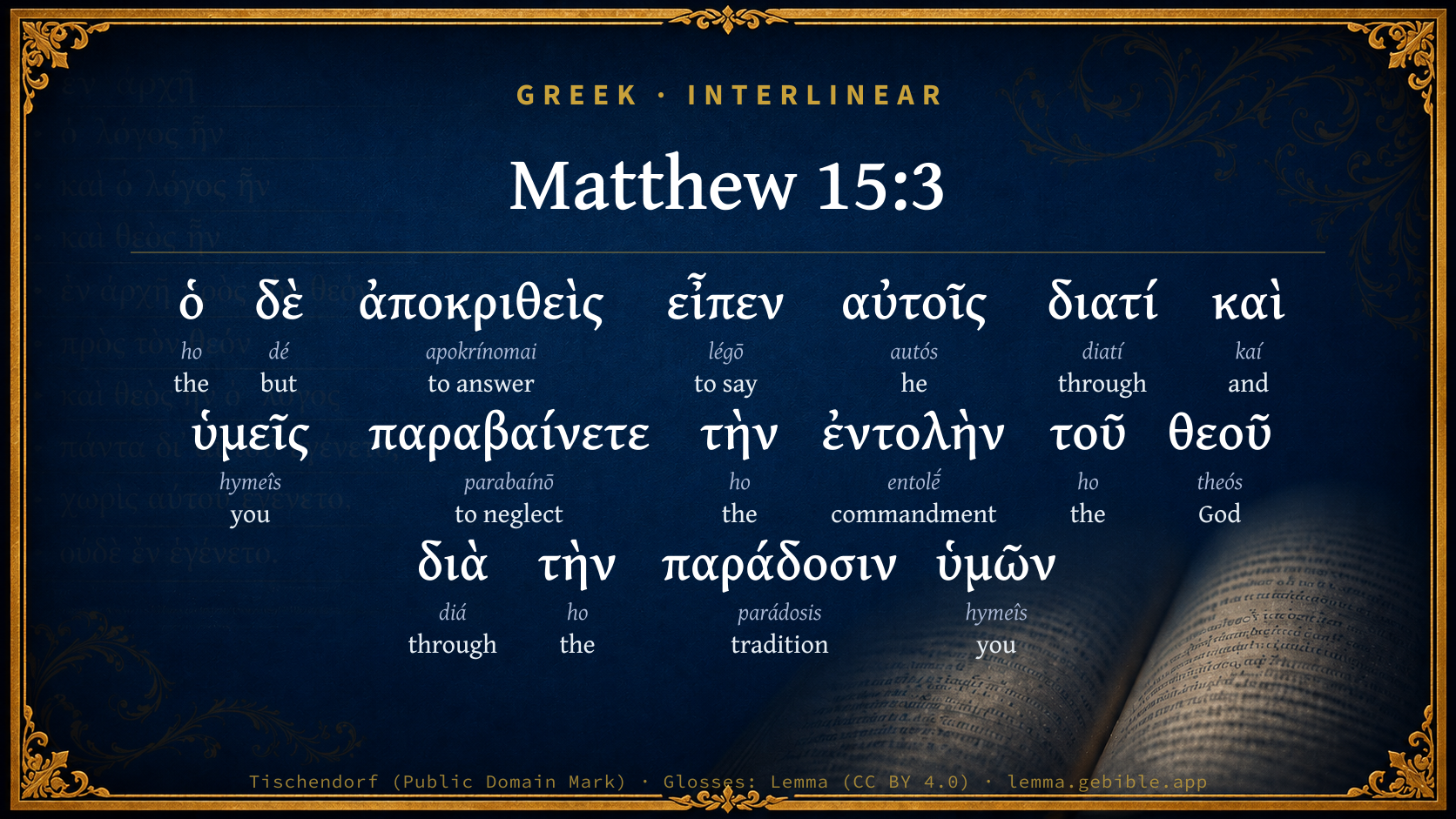
  1. ὁ ho G3588 “the” Article, Nominative, Singular, Masculine
  2. δὲ dé G1161 “but” Conjunction
  3. ἀποκριθεὶς apokrínomai G611 “to answer” Verb, Aorist, Passive deponent, Participle, Nominative, Singular, Masculine
  4. εἶπεν légō G3004 “to say” Verb, Aorist, Active, Indicative, 3rd person, Singular
  5. αὐτοῖς autós G846 “he” Personal pronoun, Dative, Plural, Masculine
  6. διατί diatí G1302 “through” Particle, Interrogative
  7. καὶ kaí G2532 “and” Conjunction
  8. ὑμεῖς hymeîs G5210 “you” Personal pronoun, 2nd person, Nominative, Plural
  9. τὴν ho G3588 “the” Article, Accusative, Singular, Feminine
  10. ἐντολὴν entolḗ G1785 “commandment” Noun, Accusative, Singular, Feminine
  11. τοῦ ho G3588 “the” Article, Genitive, Singular, Masculine
  12. θεοῦ theós G2316 “God” Noun, Genitive, Singular, Masculine
  13. διὰ diá G1223 “through” Preposition
  14. τὴν ho G3588 “the” Article, Accusative, Singular, Feminine
  15. παράδοσιν parádosis G3862 “tradition” Noun, Accusative, Singular, Feminine
  16. ὑμῶν hymeîs G5210 “you” Personal pronoun, 2nd person, Genitive, Plural

About this verse

These counts appear in no published source. They are computed here, from the morphology-tagged text and Lemma’s own curated glosses. What Lemma adds →

17
words
13
distinct lemmas
Gospels
section

Notable vocabulary

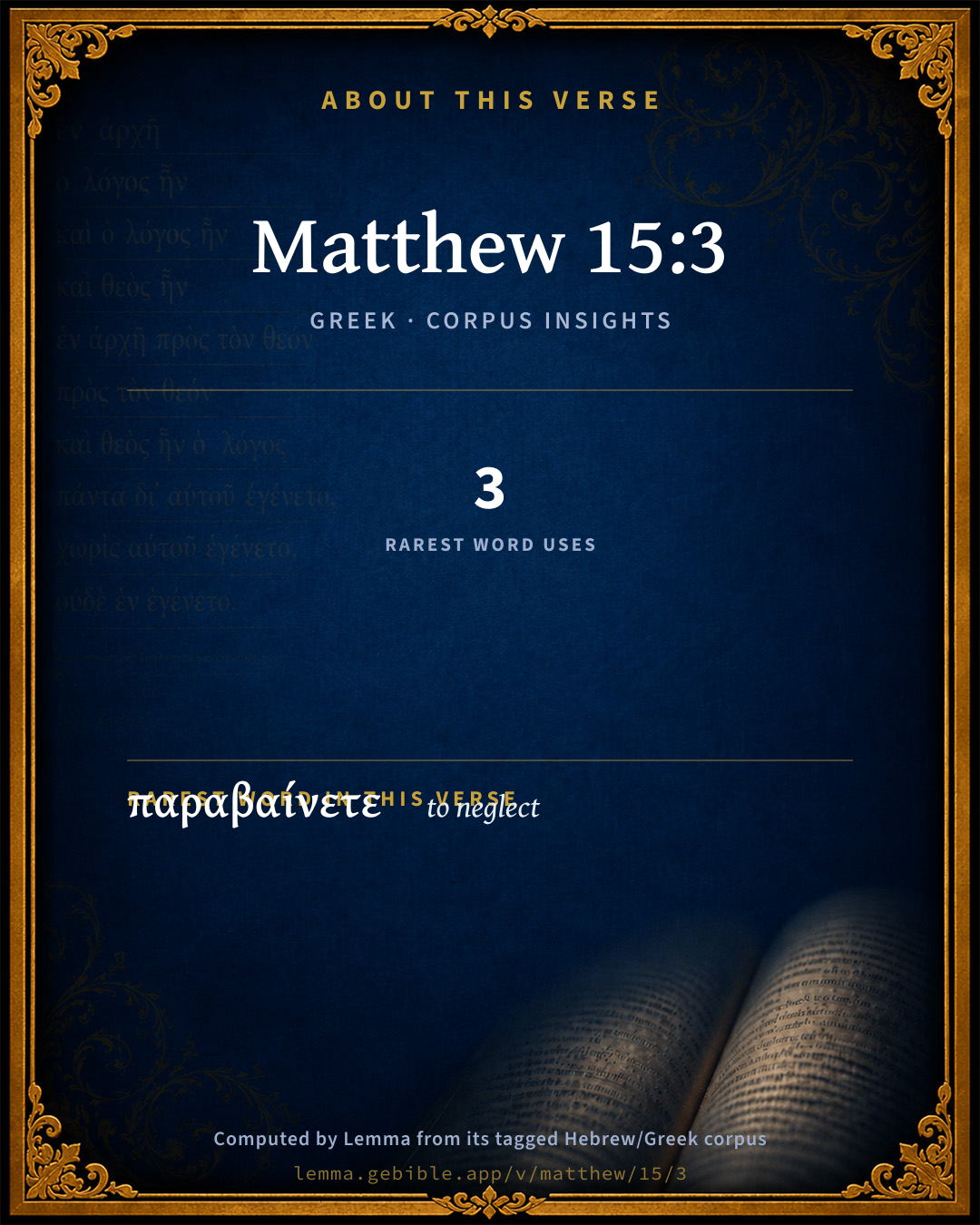
The rarest word here is παραβαίνετε to neglect G3845 — appearing just 3 times in the whole Greek New Testament.

Shared distinctive vocabulary

παραβαίνετε to neglect G3845 occurs in 3 verses of the Greek New Testament. Also found in:

Repetition

Words recur within this verse:

Cross-references

6

Topical passages linked to Matthew 15:3 in the Treasury of Scripture Knowledge — connected by theme and wording, ordered by reader-vote popularity; previews shown in the World English Bible.

  • Colossians 2:23 Which things indeed appear like wisdom in self-imposed worship, and humility, and severity to the body; but aren't of any value against the indulgence of the flesh.
  • Titus 1:14 not paying attention to Jewish fables and commandments of men who turn away from the truth.
  • Mark 7:6–8 He answered them, "Well did Isaiah prophesy of you hypocrites, as it is written, 'This people honors me with their lips, But their heart is far from me.
  • Colossians 2:8 Be careful that you don't let anyone rob you through his philosophy and vain deceit, after the tradition of men, after the elements of the world, and not after Christ.
  • Matthew 7:3–5 Why do you see the speck that is in your brother's eye, but don't consider the beam that is in your own eye?
  • Mark 7:13 making void the word of God by your tradition, which you have handed down. You do many things like this."

Cross-references courtesy of OpenBible.info (CC BY 4.0).

Commentary

Notes on Matthew 15:3 from classic Christian and Jewish commentators (each source and its license shown beneath its notes). The classic Christian expositions comment on the surrounding passage and are grouped to its opening verse, so a note may address several verses; the Jewish commentaries on the Tanakh (Rashi and others) are per-verse, so they appear only where the commentator wrote on this verse.

Lemma curates 59 commentaries, every one of them public domain or Creative Commons licensed, each selected and text-cleaned for this edition rather than reprinted as found. About our sources →

Bengel's Gnomon

Johann Albrecht Bengel

Mat 15:3. Διατί, why) He replies by a question similar in form to that which they had proposed in Mat 15:2.[678]—καὶ ὑμεῖς, ye also) Whether My disciples transgress or not, you are the greatest transgressors.—διὰ, κ.τ.λ., on account of, etc.) Traditions, even where you could least expect it, detract from the commandments of God.[679]—ὑμῶν, your) They had said, of the ancients; Jesus is no respecter of persons.

[678] The truth is never at a loss for questions, which it may put in opposition to the questions of hypocrites.—V. g.

[679] And what an amount of injury, from time to time, has been the result of the accumulation of such traditions, however much particular ones may be not without their show of plausibility, can hardly be stated.—V. g.

Bengel's Gnomon of the New Testament — English translation (T&T Clark, Edinburgh, 1860) — public domain. Text from a community e-Sword module.

Meyer's Critical & Exegetical Commentary

Heinrich August Wilhelm Meyer

Mat_15:3. Καί] also, implies a comparison between the ὑμεῖς and οἱ μαθηταί σου; that is to say, the παραβαίνειν is acknowledged to be true of both parties, the only difference being in the matters in which the transgression is exemplified. Klotz, ad Devar. p. 636.

διὰ τ. παράδ. ὑμ.] which you observe. Notice how the one question is met with another in the same style, thereby rendering the reductio ad absurdum only the more telling. Luther appropriately remarks that He places one wedge against the other, and therewith drives the first back.

Meyer — Critical and Exegetical Commentary on the New Testament — English translation by Peter Christie, edited by Frederick Crombie (T&T Clark, 1880) — public domain. Text from a community e-Sword module.

Expositor's Greek Testament

ed. W. Robertson Nicoll

Mat 15:3-6 . Christ’s reply ; consists of a counter charge and a prophetic citation (Mat 15:7-9 ) in the inverse order to that of Mk.

Mat 15:3 . καὶ ὑμεῖς : the retort, if justifiable, the best defence possible of neglect charged = “we transgress the tradition because we want to keep the commands of God: choice lies between these; you make the wrong choice”. Grave issue raised; no compromise possible here. διὰ τ . π . ὑμῶν : not rules made by the parties addressed (Weiss-Meyer), but the tradition which ye idolise, your precious paradosis .

The Expositor's Greek Testament, edited by W. Robertson Nicoll (1897–1910) — public domain. Text from a community e-Sword module.

Geneva Bible (1599)

Geneva Bible translators

Their wicked boldness, in corrupting the commandments of God, and that upon the pretence of godliness, and usurping authority to make laws, is here reproved.

Geneva Bible (1599) marginal notes — public domain. Text via Bolls.life.

Jamieson, Fausset & Brown

Robert Jamieson, A. R. Fausset & David Brown

But he answered and said unto them, Why do ye also transgress the commandment of God by your tradition?--The charge is retorted with startling power: "The tradition they transgress is but man's, and is itself the occasion of heavy transgression, undermining the authority of God's law."

Jamieson, Fausset & Brown — Commentary Critical and Explanatory on the Whole Bible (1871) — public domain (CC PDM 1.0). Text via the HelloAO Bible API.

Adam Clarke's Commentary

Verse 3. Why do ye - transgress the commandment] Ye accuse my disciples of transgressing the traditions of the elders - I accuse you of transgressing the commands of God, and that too in favour of your own tradition; thus preferring the inventions of men to the positive precepts of God. Pretenders to zeal often prefer superstitious usages to the Divine law, and human inventions to the positive duties of Christianity.

Adam Clarke's Commentary on the Bible (1810–1826) — public domain. Text from a community e-Sword/MySword module.

Ellicott's Commentary for English Readers

(3) By your tradition.—Better, for the sake of your tradition. Our Lord’s answer, it will be noted, is an indirect one, an argumentum ad hominem. He shows that their traditional casuistry was in direct opposition to the “commandment” of God, and the natural inference from that antagonism was that in itself, apart from the commandment, it had no binding authority as a rule of life.

A Bible Commentary for English Readers, edited by Charles John Ellicott (1878–1897) — public domain. Text from a community e-Sword module.

John Gill's Exposition

But he answered and said unto them,.... Taking no notice of the tradition about eating bread without washing the hands, whether it was right or wrong; it being at most but an human tradition, of no moment and importance, whether it was broke or kept; he makes a very just recrimination, by putting another question to them,

why do you also transgress the commandment of God by your tradition? suggesting, that, if his disciples were guilty, they were not so guilty as they themselves were; that his disciples, at most, were but guilty of the breach of an human precept, whereas they were guilty of the breach of a divine command; and that it was strange, that men who were so scrupulous of breaking, and bore so hard on such as did transgress the traditions of the elders, could allow themselves to transgress the commandments of God; yea, to do this by, and while they were observing their own traditions: and which observation carries a full acquittance of the disciples from blame; for, if by keeping the traditions of the elders, they broke the commands of God, it was a very good reason why they should not observe them.

John Gill's Exposition of the Whole Bible (1746–1763) — public domain (CC PDM 1.0). Text via the HelloAO Bible API.

Trapp's Complete Commentary

John Trapp

3 But he answered and said unto them, Why do ye also transgress the commandment of God by your tradition?

Ver. 3. He answered and said unto them] He shapes them an answer by way of recrimination (αντδγκλημα); which is a singular means of conviction to the adversary, but hard to be done by us without some mixture of bitterness, such as was that in David to Michal, 2Sa 6:21.

Transgress the commandment of God by your tradition] God’s commands should be kept as the apple of the eye, Pro 7:2. They are broken by omissions, commissions, and failings in the manner; like as a man may miss the mark by shooting short, or beyond, or wide. These Pharisees, as those Athenians of old (whereas they had most excellent laws, but most lawless natures), chose rather to live by their lusts than by their laws. {a} They had many traditions and unwritten verities, pretended to be invented and prescribed them by their elders, that by the observation thereof they might be the better enabled to keep God’s commandments. These traditions they styled Mashlamnathoth, completions or perfections; because thereby they conceited that the written law was made more complete and perfect. And say not the Papists as much of their traditions? Buxtorf. Tiber.

{a} Athenienses cum haberent aequissima iura, sed iniquisima ingenia, moribus suis quam legibus, uti malunt. Valer. Max.

John Trapp, A Commentary or Exposition upon All the Books of the Old and New Testament (1647–1656) — public domain. Text from a community e-Sword module.

Haydock's Catholic Bible Commentary

Why do you also. The Jews understanding the saying of the prophets, "wash yourselves and be clean," in a carnal manner, they made a precept of not eating without first washing their hands. (Ven. Bede) --- The traditions here alluded to, and which they call the oral law, were respected equally with the written law, by all the Jews, except the sect of Caraites; they were collected in seventy-two books, and composed the cabbala, and were kept by Gemaliel and other heads of the sanhedrim, till the destruction of Jerusalem. About 120 years after this, Rabbi Judas composed a book of them, called Mishna, or second law; afterwards two supplements and explanations were given, viz. the Talmud of Jerusalem, and the Talmud of Babylon. By these the Jews are still governed in ecclesiastical matters.

George Leo Haydock (1774–1849), Haydock's Catholic Family Bible and Commentary, 1859 edition — public domain. Excludes Psalms (Douay-Rheims chapter numbering differs from Protestant) and Deuterocanonical books (Catholic canon only).

Matthew Poole's English Annotations

Mark hath the same, Mar 7:9, though a little out of the order in which Matthew hath it: Full well ye reject the commandment of God, that ye may keep your own tradition. Our Saviour could have answered them, had he pleased, more strictly to their questions, but he must then either have incurred danger or odium; he therefore chooseth to answer them by another question, which struck at the root of the matter. Admit, saith he, my disciples culpable in not observing traditions, which indeed you call the traditions of the elders, but are your own, devised by you, or some like you, merely to uphold your power and authority, and to keep people in a needless subjection to you: I am sure you are far more guilty, in making traditions contrary to the law of God, or rejecting God’s law to keep your traditions. And indeed this is the common guilt of those who are great zealots for traditions and rites, not commanded in the word of God. The Jewish Rabbi Jose saith, He sinneth as much who eateth with unwashen hands, as he that lieth with an harlot. The papists make it a greater sin for a priest to marry than to keep a concubine, and commit fornication; they make it a lesser transgression than to eat meat on a Friday.

Matthew Poole's English Annotations on the Holy Bible (1683–1685) — public domain. Text from a community e-Sword/MySword module.

Whedon's Commentary on the Bible

Daniel D. Whedon

3. He answered and said — Jesus knows that a challenge is intended, but he does not shun to meet it. They come armed with the traditions of the elders; he meets them with the law of Jehovah. It is man’s authority opposed by the authority of God. Commandment of God — When God speaks, let man keep silence.

Daniel D. Whedon (gen. ed.), Commentary on the Old and New Testaments (1874–1909) — public domain. Text from a community e-Sword module.

The Pulpit Commentary

He answered. Christ does not formally defend his disciples, nor condemn the Pharisees for their ceremonial ablutions, but he turns to a matter of more importance, even a plain breach or evasion of a plain commandment. Ye also. If my disciples transgress a tradition of the ancients, ye too transgress, and that the commandment of God an error of far graver character. His non-observance of these minutiae showed their unimportance, and called attention to the inward purity which they typified, and which could be maintained without these external ceremonies. At the same time, Jesus does not condemn such symbolical acts, even as he himself washed the disciples" feet before the last Supper. The evil in rabbinical teachings was that it superseded the spiritual view, and placed outward cleansing on a higher level than inward holiness. By (dia with accusative); on account of, in order to maintain. Your tradition. Tradition which is emphatically yours and not God"s, a human gloss, not a revealed command. Jesus does not accept the assertion that these traditions are derived from the ancients; he gives them a more modern origin.

The Pulpit Commentary (1880–1919), ed. H.D.M. Spence-Jones & Joseph S. Exell — public domain. Text from a community e-Sword module.

John Wesley's Explanatory Notes

They wash not their hands when they eat bread - Food in general is termed bread in Hebrew; so that to eat bread is the same as to make a meal.

John Wesley, Explanatory Notes Upon the Whole Bible (1754–1765) — public domain. Text via the GEBible commentary corpus.

Kretzmann's Popular Commentary

Paul E. Kretzmann

Christ’s reply:

v. 3. But He answered and said unto them, Why do ye also transgress the commandment of God by your tradition?

v. 4. For God commanded, saying, Honor thy father and mother; and He that curseth father and mother, let him die the death.

v. 5. But ye say, Whosoever shall say to his father or his mother, It is a gift, by whatsoever thou mightest be profited by me; and honor not his father or his mother, he shall be free.

v. 6. Thus have ye made the commandment of God of none effect by your tradition.

The retort immediately places the issue in the proper light. Christ becomes the accuser, and the Pharisees and scribes the guilty. He says, in effect: Let your miserable charge stand, for the present; I cheerfully admit that the tradition of men is transgressed in our circle. But here is a far more serious matter. The choice is between the actual commands of God and the precepts of your teachers; your choice is the wrong one. The contrast is emphatic and clear-cut: The commandment of God—your tradition. God’s Law, to which Jesus refers, was clear and unmistakable, Exo 21:17: Lev 20:9; Deu 27:10. Your demand is a mere saying of men. And it is to be condemned absolutely, since it results in setting aside the Law of God. The Pharisees permitted children in the home to say the word corban , Mar 7:11, whereby they were supposed to absolve themselves from filial duties. The words literally read: He that says to his father or to his mother. Let it be a sacrifice what thou desirest of me as a help or benefit. This, according to tradition, excused children from helping their parents with money, goods, earnings, or any other material assistance. It implied that the children wanted to give such money or gift to God as a sacrifice, though very often even that was omitted. Christ’s argument is: Even the honest pleading of previous obligation to God will not excuse a child for neglecting its duty to its parents, much less the ordinary careless, heartless, and profane manner in which this pretext was grasped. Thus were the Jewish teachers guilty before God, even according to the Old Testament, Pro 28:24. Thus were children dispensed from even the true works of love in this manner. "For the contention with the Pharisees really consisted in this, whether it be better to give presents to the parents or sacrifices to the priests. They said it was better to sacrifice. Thus they taught that the honor due to the parents was a mere ceremony, namely, to bow the head, to rise before them, and in outward behavior be respectful toward them.... Corban , that means a gift or sacrifice to God. As though a child would say: I should gladly give it to thee, but what shall I do? Even now it is not mine any more, but is given to God. Thus the name of God must be the cover for all shameful blasphemy and wickedness; as though God had taken from the father what the latter should receive from the son. " The Pharisees and scribes surely had invalidated, and were in the constant habit of setting aside, the commandment of God for their miserable tradition.

Paul E. Kretzmann, Popular Commentary of the Bible (1921–1924) — public domain. Text from a community e-Sword module.

Burkitt's Expository Notes on the New Testament

William Burkitt

Observe here, 1. The heavy charge which our Saviour brings in against the Pharisees; namely, for violating an express command of God, and preferring their own traditions before it: you make void the commandments of God by your traditions.

Observe, 2. The command which our Saviour instances in, as violated by them; it is the fifth commandment, which requires children to relieve their parents in necessity. Now, though the Pharisees did not deny this in plain terms, yet they made an exception from it, which if children had a mind, rendered it void and useless. For the Pharisees taught, that in case any would give a gift to the temple, which gift they called corban, and of which they themselves had a great share; that then children were discharged from making further provision for their poor, or impotent parents; and might say unto them after this manner, that which thou askest for thy supply, is given to God, and therefore I cannot relieve thee. So that covetous and graceless children looked upon it as the most frugal way, once for all to fine to the temple, rather than pay the constant rent of daily relief to their poor parents.

Learn, that no duty, gift, or offering to God, is accepted, where the duty of charity is neglected. It is more acceptable to God to refresh the hearts of his saints, who are the living temples of the Holy Ghost, than to adorn material temples with gold and silver.

William Burkitt's Expository Notes on the New Testament (1700–1703) — public domain. Text from a community e-Sword module.

The People's New Testament

B. W. Johnson

3. Why do ye also transgress? The Lord does not deny their charge, but strikes at the evil by showing that their human traditions led them to break God's written law.

B. W. Johnson's The People's New Testament with Notes (1889–1891) — public domain. Electronic text from the Christian Classics Ethereal Library (CCEL) ThML edition.

Cambridge Greek Testament for Schools and Colleges

3. διὰ τὴν παράδοσιν. ‘For the sake of your tradition;’ i.e. in order that ye may establish it: ἵνα τὴν παράδοσιν ὑμῶν τηρήσητε, Mar 7:9.

Cambridge Greek Testament for Schools and Colleges (Cambridge University Press, 1896; 21 vols, various authors incl. Carr, Maclear, Plummer, Farrar, Lumby, Moule, M. R. James, Simcox) — public domain. Text from a community e-Sword module.

Alford’s Greek Testament

Henry Alford

3. καὶ ὑμ.] The καί implies that there was a παράβασις also on their part—acknowledging that on the part of the disciples.

τὴν ἐντ. τ. θ.] A remarkable testimony from our Lord to the divine origin of the Mosaic law: not merely of the Decalogue, as such, for the second command quoted is not in the Decalogue, and it is to be observed that where the text has ὁ θεὸς ἐνετείλατο, Mark (7:10) has Μωυσῆς εἶπεν.

Henry Alford, The Greek Testament (1849–1861) — public domain. Text from a community e-Sword module.

International Critical Commentary

3. And He answered and said to them.] Mk. has simply: “And He said to them.” In what follows Mt. has altered the sequence of the verses in Mk. in such a way that he makes a double antithesis: “Why do Thy disciples transgress?” v. 2; “Why do ye transgress?” v. 3; “God said,” v. 4; “But you say,” v. 5; and makes the speech work up towards the rhetorical climax: “Ye hypocrites,” etc.

Why do ye also transgress the commandment of God because of your tradition?] Mk. has: “Well do you annul the commandment of God that you may keep your tradition.” Mt. turns the ironical statement into a question to form an antithesis with v. 2, assimilating ἀθετεῖτε to παραβαίνετε to make the antithesis more pointed.

(M)

International Critical Commentary — older volumes (1896–1929), various authors — public domain. Text from a community e-Sword module.

Vincent's Word Studies in the New Testament

Marvin R. Vincent

Also [και] . The significance of this little word must not be overlooked. Christ admits that the disciples had transgressed a human injunction, but adds, "Ye also transgress, and in a much greater way." " Whether the disciples transgress or not, you are the greatest transgressors "(Bengel). The one question is met with the other in the same style. Luther says," He places one wedge against the other, and therewith drives the first back. "

Marvin R. Vincent, Word Studies in the New Testament (1887–1900) — public domain. Text from a community e-Sword/MySword module.

Lesson kit

Teaching starters — assembled from the data on this page, not authored interpretation. Every prompt links to the verse data it draws on. Edit before teaching.

Matthew, in the Gospels, opens this verse with 17 words (13 distinct Greek lemmas). Its most distinctive word is parabaínō (“to neglect”). A historical commentator’s framing appears above. Read the whole chapter for the surrounding context.

Discussion questions

  1. The word parabaínō carries the sense “to neglect.” How does it shape the verse?
  2. How does Matthew 15:2, which shares the word «to neglect», read alongside this verse?
  3. What does the repetition of “the” (4× in this one verse) do in this verse?
  4. The translations on this page render this verse differently — a whole-verse word diff, not a word-by-word alignment. What might account for the different wordings?
  5. Compare how Bengel's Gnomon and Meyer's Critical & Exegetical Commentary read this verse. Where do they agree or differ?

Things to notice

Reading settings

Reading text

Shown beneath each verse's original-language words.

Old Testament
Old Testament edition

Read the OT as the Masoretic Hebrew (MT) or the Greek Septuagint (LXX).

English shown for the Greek Septuagint (in the Hebrew ↔ Greek comparison).

Comparing translations? Open the Compare panel on any verse page to stack up to four side by side.