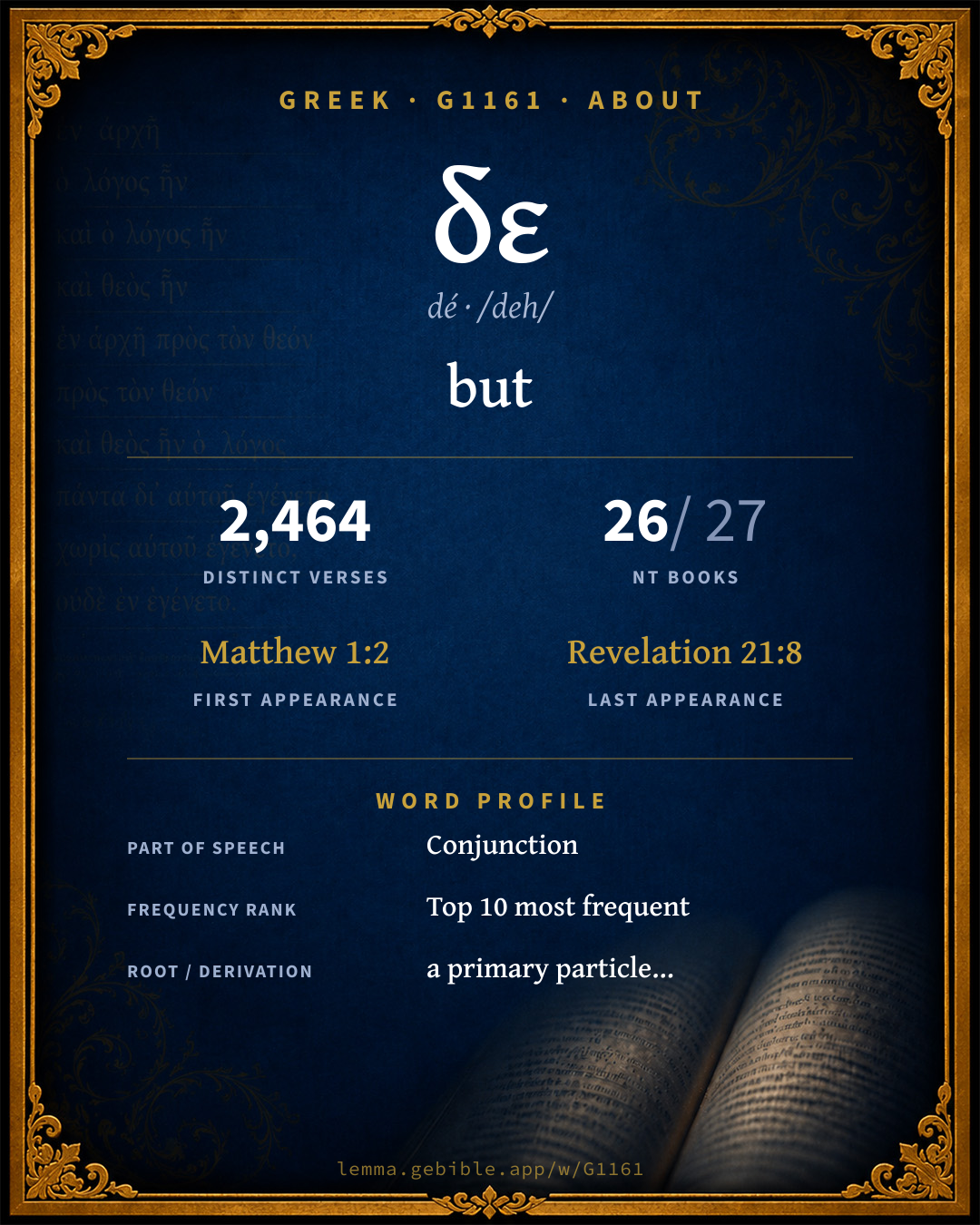
δέ
but
Full lexicon entry — Thayer's Greek Lexicon
From Thayer's Greek Lexicon
Where this word appears
Grammar key — what these labels mean
Part of speech
- Conjunction
- A joining word linking words or clauses.
Every verse where G1161 appears in the Book of 2 Corinthians — 68 distinct verses. Click any verse to open its interlinear word-by-word view. Verse text shown in the World English Bible for context — . Each verse’s Greek form is shown with its reference; the English is not keyword-highlighted, since the data carries no word-level English alignment. Use “Compare translations” on any verse to read it across multiple English versions. This concordance covers the Greek New Testament; Septuagint (Greek Old Testament) occurrences of this word are not indexed here.
2 Corinthians
- 2 Corinthians 1:6 δὲ conj But if we are afflicted, it is for your comfort and salvation. If we are comforted, it is for your comfort, which produces in you the patient enduring of the same sufferings which we also suffer.
- 2 Corinthians 1:12 δὲ conj For our boasting is this: the testimony of our conscience, that in holiness and sincerity of God, not in fleshly wisdom but in the grace of God we behaved ourselves in the world, and more abundantly toward you.
- 2 Corinthians 1:13 δὲ conj For we write no other things to you, than what you read or even acknowledge, and I hope you will acknowledge to the end;
- 2 Corinthians 1:18 δὲ conj But as God is faithful, our word toward you was not "Yes and no."
- 2 Corinthians 1:21 δὲ conj Now he who establishes us with you in Christ, and anointed us, is God;
- 2 Corinthians 1:23 δὲ conj But I call God for a witness to my soul, that I didn't come to Corinth to spare you.
- 2 Corinthians 2:1 δὲ conj But I determined this for myself, that I would not come to you again in sorrow.
- 2 Corinthians 2:5 δέ conj But if any has caused sorrow, he has caused sorrow, not to me, but in part (that I not press too heavily) to you all.
- 2 Corinthians 2:10 δέ conj Now I also forgive whomever you forgive anything. For if indeed I have forgiven anything, I have forgiven that one for your sakes in the presence of Christ,
- 2 Corinthians 2:12 δὲ conj Now when I came to Troas for the Gospel of Christ, and when a door was opened to me in the Lord,
- 2 Corinthians 2:14 δὲ conj Now thanks be to God, who always leads us in triumph in Christ, and reveals through us the sweet aroma of his knowledge in every place.
- 2 Corinthians 2:16 δὲ conj to the one a stench from death to death; to the other a sweet aroma from life to life. Who is sufficient for these things?
- 2 Corinthians 3:4 δὲ conj Such confidence we have through Christ toward God;
- 2 Corinthians 3:6 δὲ conj who also made us sufficient as servants of a new covenant; not of the letter, but of the Spirit. For the letter kills, but the Spirit gives life.
- 2 Corinthians 3:7 δὲ conj But if the service of death, written engraved on stones, came with glory, so that the children of Israel could not look steadfastly on the face of Moses for the glory of his face; which was passing away:
- 2 Corinthians 3:16 δὲ conj But whenever one turns to the Lord, the veil is taken away.
- 2 Corinthians 3:17 δὲ δὲ conj conj Now the Lord is the Spirit and where the Spirit of the Lord is, there is liberty.
- 2 Corinthians 3:18 δὲ conj But we all, with unveiled face beholding as in a mirror the glory of the Lord, are transformed into the same image from glory to glory, even as from the Lord, the Spirit.
- 2 Corinthians 4:3 δὲ conj Even if our Gospel is veiled, it is veiled in those who perish;
- 2 Corinthians 4:5 δὲ conj For we don't preach ourselves, but Christ Jesus as Lord, and ourselves as your servants for Jesus' sake;
- 2 Corinthians 4:7 δὲ conj But we have this treasure in clay vessels, that the exceeding greatness of the power may be of God, and not from ourselves.
- 2 Corinthians 4:12 δὲ conj So then death works in us, but life in you.
- 2 Corinthians 4:13 δὲ conj But having the same spirit of faith, according to that which is written, "I believed, and therefore I spoke." We also believe, and therefore also we speak;
- 2 Corinthians 4:18 δὲ conj while we don't look at the things which are seen, but at the things which are not seen. For the things which are seen are temporal, but the things which are not seen are eternal.
- 2 Corinthians 5:5 δὲ conj Now he who made us for this very thing is God, who also gave to us the down payment of the Spirit.
- 2 Corinthians 5:8 δὲ conj We are of good courage, I say, and are willing rather to be absent from the body, and to be at home with the Lord.
- 2 Corinthians 5:11 δὲ δὲ conj conj Knowing therefore the fear of the Lord, we persuade men, but we are revealed to God; and I hope that we are revealed also in your consciences.
- 2 Corinthians 5:18 δὲ conj But all things are of God, who reconciled us to himself through Jesus Christ, and gave to us the ministry of reconciliation;
- 2 Corinthians 6:1 δὲ conj Working together, we entreat also that you not receive the grace of God in vain,
- 2 Corinthians 6:10 δὲ δὲ conj conj as sorrowful, yet always rejoicing; as poor, yet making many rich; as having nothing, and yet possessing all things.
- 2 Corinthians 6:12 δὲ conj You are not restricted by us, but you are restricted by your own affections.
- 2 Corinthians 6:13 δὲ conj Now in return, I speak as to my children, you also be open wide.
- 2 Corinthians 6:15 δὲ conj What agreement has Christ with Belial? Or what portion has a believer with an unbeliever?
- 2 Corinthians 6:16 δὲ conj What agreement has a temple of God with idols? For you are a temple of the living God. Even as God said, "I will dwell in them, and walk in them; and I will be their God, and they will be my people."
- 2 Corinthians 7:7 δὲ conj and not by his coming only, but also by the comfort with which he was comforted in you, while he told us of your longing, your mourning, and your zeal for me; so that I rejoiced still more.
- 2 Corinthians 7:10 δὲ conj For godly sorrow works repentance to salvation, which brings no regret. But the sorrow of the world works death.
- 2 Corinthians 7:13 δὲ conj Therefore we have been comforted. In our comfort we rejoiced the more exceedingly for the joy of Titus, because his spirit has been refreshed by you all.
- 2 Corinthians 8:1 δὲ conj Moreover, brothers, we make known to you the grace of God which has been given in the assemblies of Macedonia;
- 2 Corinthians 8:11 δὲ conj But now complete the doing also, that as there was the readiness to be willing, so there may be the completion also out of your ability.
- 2 Corinthians 8:16 δὲ conj But thanks be to God, who puts the same earnest care for you into the heart of Titus.
- 2 Corinthians 8:17 δὲ conj For he indeed accepted our exhortation, but being himself very earnest, he went out to you of his own accord.
- 2 Corinthians 8:18 δὲ conj We have sent together with him the brother whose praise in the Gospel is known through all the assemblies.
- 2 Corinthians 8:19 δὲ conj Not only so, but who was also appointed by the assemblies to travel with us in this grace, which is served by us to the glory of the Lord himself, and to show our readiness.
- 2 Corinthians 8:22 δὲ δὲ conj conj We have sent with them our brother, whom we have many times proved earnest in many things, but now much more earnest, by reason of the great confidence which he has in you.
- 2 Corinthians 9:3 δὲ conj But I have sent the brothers that our boasting on your behalf may not be in vain in this respect, that, just as I said, you may be prepared,
- 2 Corinthians 9:6 δέ conj Remember this: he who sows sparingly will also reap sparingly. He who sows bountifully will also reap bountifully.
- 2 Corinthians 9:8 δὲ conj And God is able to make all grace abound to you, that you, always having all sufficiency in everything, may abound to every good work.
- 2 Corinthians 9:10 δὲ conj Now may he who supplies seed to the sower and bread for food, supply and multiply your seed for sowing, and increase the fruits of your righteousness;
- 2 Corinthians 10:1 δὲ δὲ conj conj Now I Paul, myself, entreat you by the humility and gentleness of Christ; I who in your presence am lowly among you, but being absent am of good courage toward you.
- 2 Corinthians 10:2 δὲ conj Yes, I beg you that I may not, when present, show courage with the confidence with which I intend to be bold against some, who consider us to be walking according to the flesh.
- 2 Corinthians 10:10 δὲ conj For, "His letters," they say, "are weighty and strong, but his bodily presence is weak, and his speech is despised."
- 2 Corinthians 10:13 δὲ conj But we will not boast beyond proper limits, but within the boundaries with which God appointed to us, which reach even to you.
- 2 Corinthians 10:15 δὲ conj not boasting beyond proper limits in other men's labors, but having hope that as your faith grows, we will be abundantly enlarged by you in our sphere of influence,
- 2 Corinthians 10:17 δὲ conj But "he who boasts, let him boast in the Lord."
- 2 Corinthians 11:3 δὲ conj But I am afraid that somehow, as the serpent deceived Eve in his craftiness, so your minds might be corrupted from the simplicity that is in Christ.
- 2 Corinthians 11:6 δὲ conj But though I am unskilled in speech, yet I am not unskilled in knowledge. No, in every way we have been revealed to you in all things.
- 2 Corinthians 11:12 δὲ conj But what I do, that I will do, that I may cut off occasion from them that desire an occasion, that in which they boast, they may be found even as we.
- 2 Corinthians 11:16 δὲ conj I say again, let no one think me foolish. But if so, yet receive me as foolish, that I also may boast a little.
- 2 Corinthians 11:21 δ’ conj I speak by way of disparagement, as though we had been weak. Yet however any is bold (I speak in foolishness), I am bold also.
- 2 Corinthians 12:1 δὲ conj It is doubtless not profitable for me to boast. For I will come to visions and revelations of the Lord.
- 2 Corinthians 12:5 δὲ conj On behalf of such a one I will boast, but on my own behalf I will not boast, except in my weaknesses.
- 2 Corinthians 12:6 δέ conj For if I would desire to boast, I will not be foolish; for I will speak the truth. But I forbear, so that no man may account of me above that which he sees in me, or hears from me.
- 2 Corinthians 12:15 δὲ conj I will most gladly spend and be spent for your souls. If I love you more abundantly, am I loved the less?
- 2 Corinthians 12:16 δέ conj But be it so, I did not myself burden you. But, being crafty, I caught you with deception.
- 2 Corinthians 12:19 δὲ conj Again, do you think that we are excusing ourselves to you? In the sight of God we speak in Christ. But all things, beloved, are for your edifying.
- 2 Corinthians 13:6 δὲ conj But I hope that you will know that we aren't disqualified.
- 2 Corinthians 13:7 δὲ δὲ conj conj Now I pray to God that you do no evil; not that we may appear approved, but that you may do that which is honorable, though we are as reprobate.
- 2 Corinthians 13:9 δὲ conj For we rejoice when we are weak and you are strong. And this we also pray for, even your perfecting.
About this entry
At a glance — auto-summarized from this page’s data, not written by a person. Every figure links to its source below. This summary describes the numbers; it doesn’t interpret them.
δε — transliterated dé — is a Greek conjunction carrying the sense “but.” Its earliest occurrence is Matthew 1:2. It appears 2,464 verses across 26 books of the Greek New Testament, among its most common vocabulary. It shares a root with δη. Each statement above links to its evidence; the full detail follows below.
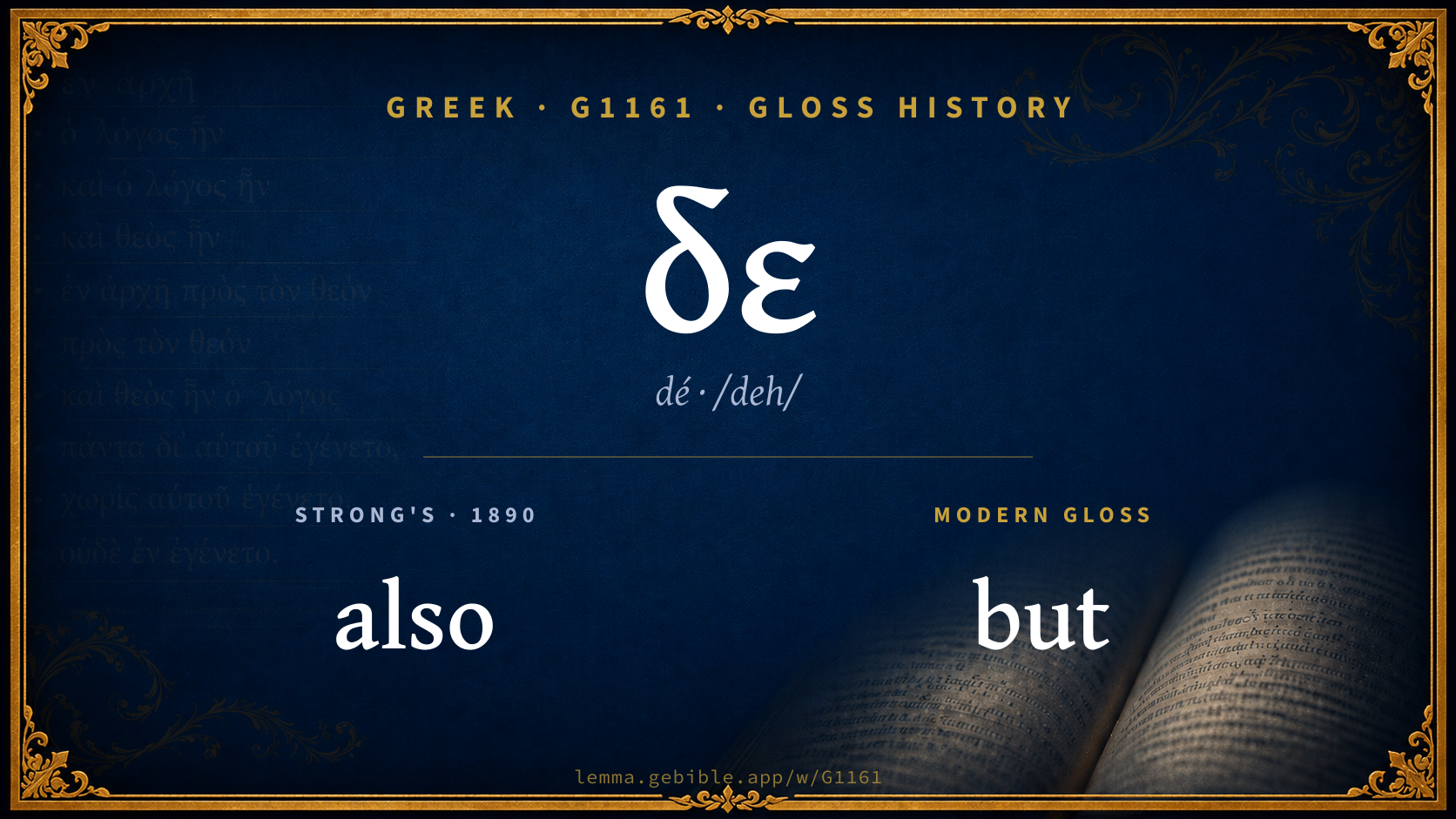
Gloss history
Strong's 1890 vs modern scholarship
About this word
Strong's G1161 catalogs a Greek word from the Greek New Testament.
These counts are not copied from any lexicon or concordance. They are computed here, from the morphology-tagged Greek New Testament. What Lemma adds →
- 2,464
- distinct verses
- The word appears in 2,464 distinct verses.
- 26 / 27
- NT books
- The word appears in 26 of 27 New Testament books.
- #4
- by frequency
- Top 10 most frequent Greek words (rank 4 of 5,347 Greek words by occurrence).
View all 2,464 occurrences in the concordance →
By section of the New Testament
By traditional corpus
Conventional, traditional groupings — biblical authorship is debated, so this is a traditional corpus grouping, not an authorship claim. Some books belong to more than one corpus (Luke is in both the Gospels and the Lukan corpus, and so on), so these shares overlap and need not total 100%. Each figure is a share of the word’s 2,464 distinct verses.
- Gospels 1,258 verses · 51%
- Lukan (Luke–Acts) 971 verses · 39%
- Pauline corpus 547 verses · 22%
- Johannine 211 verses · 9%
- General (Catholic) Epistles 93 verses · 4%
- Hebrews 68 verses · 3%
- Revelation 7 verses · 0%
How translations render this word
Counts come from each version’s own published word-to-Strong’s tagging or interlinear alignment — an approximate guide to how each version renders this word, not a word-level alignment the data otherwise carries. Because each total is that version’s own tagged count, the per-version totals vary from one another and need not match the appearance or distinct-verse counts above. These counts may also differ from a printed concordance because Lemma counts each distinctly tagged rendering and does not collapse phrase taggings into a single head-word total. This is a fixed set of word-tagged versions (KJV, ASV, BSB, ULT) and does not change with the reading translation you choose elsewhere. Each version’s license is shown beside its name below (and on Sources).
- King James Version: And 1,228×, But 929×, Now 166×
- American Standard Version: And 1,179×, But 999×, Now 171×
- Berean Standard Bible: But 784×, And 339×, Now 116×
- unfoldingWord Literal Text: But 1,407×, And 745×, Now 419×
King James Version Public Domain
Renders G1161 across 2,711 tagged occurrences — most commonly:
Plus other, less common renderings. Plus 42 renderings that appear only once — usually multi-word phrases or single function words the recovered tagging swept in, not distinct renderings. Not rendered by a distinct English word in 159 further occurrences.
American Standard Version Public Domain
Renders G1161 across 2,640 tagged occurrences — most commonly:
Plus other, less common renderings. Plus 75 renderings that appear only once — usually multi-word phrases or single function words the recovered tagging swept in, not distinct renderings. Not rendered by a distinct English word in 34 further occurrences.
Berean Standard Bible Public Domain
Renders G1161 across 1,643 tagged occurrences — most commonly:
Plus other, less common renderings. Plus 38 renderings that appear only once — usually multi-word phrases or single function words the recovered tagging swept in, not distinct renderings. Not rendered by a distinct English word in 1,112 further occurrences.
unfoldingWord Literal Text CC BY-SA 4.0
Renders G1161 across 2,802 tagged occurrences — most commonly:
Plus other, less common renderings. Plus 9 renderings that appear only once — usually multi-word phrases or single function words the recovered tagging swept in, not distinct renderings.
Senses in Thayer's
The 1 sense Thayer's distinguishes for this word, in lexicon order (not ranked by frequency or importance). The full entry — with sub-senses — is in the Lexicon Entry tab.
- but, moreover, and, etc.
Word origin
Origin: a primary particle (adversative or continuative)
A primary particle (adversative or continuative); but and etc. : - also and but moreover now [ often unexpressed in English ].
— Strong’s Exhaustive Concordance (1890), public domain.
Forms in the corpus
The 3 distinct written forms G1161 takes in the Greek New Testament, most frequent first — each parse links to that case’s occurrences in the concordance.
| Form | Parsing | Example | Uses |
|---|---|---|---|
| δὲ dè | Conjunction | Matthew 1:2 | 2,602 |
| δέ dé | Conjunction | Matthew 5:31 | 147 |
| δ’ d | Conjunction | Matthew 5:19 | 22 |
Same root — word family
Other Thayer's entries built from the same root as G1161, grouped by Strong’s listed origin. These share a root / origin per the lexicon — not necessarily a shared meaning. Each links to that word’s own entry.
Derived from this word
Compare all same-root words → They share a root, not necessarily a meaning.
Septuagint usage
The same Greek word δε appears 3,556 times in the Greek Old Testament (Septuagint), across 3,042 verses in 35 books.
- 3,556
- LXX occurrences
- Tagged occurrences of this Greek word in the Septuagint.
- 3,042
- verses
- Distinct Septuagint verses containing this word.
- 35 / 39
- OT books
- The word appears in 35 of the 39 Old Testament books.
Sample Septuagint occurrences
- Genesis 1:2 δέ
- Exodus 1:5 δέ
- Leviticus 1:9 δέ
- Numbers 1:47 δέ
- Deuteronomy 4:4 δέ
- Joshua 1:14 δέ
- Judges 1:11 δέ
- Ruth 1:14 δέ
- 1 Samuel 7:17 δέ
- 2 Samuel 3:30 δέ
- 1 Kings 1:17 δέ
- 2 Kings 3:15 δέ
Septuagint occurrences (same lexeme)
Every verse where the same Strong’s number (G1161) appears in the Greek Septuagint — showing the first 50 of 3,042. Verse text shown in the World English Bible for context; the Greek form is the matched word — the English is not keyword-highlighted.
- Genesis 1:2 δέ Now the earth was formless and empty. Darkness was on the surface of the deep. God's Spirit was hovering over the surface of the waters.
- Genesis 2:6 δέ but a mist went up from the earth, and watered the whole surface of the ground.
- Genesis 2:10 δέ A river went out of Eden to water the garden; and from there it was parted, and became four heads.
- Genesis 2:12 δέ and the gold of that land is good. There is aromatic resin and the onyx stone.
- Genesis 2:14 δέ The name of the third river is Hiddekel: this is the one which flows in front of Assyria. The fourth river is the Euphrates.
- Genesis 2:17 δέ but of the tree of the knowledge of good and evil, you shall not eat of it: for in the day that you eat of it you will surely die."
- Genesis 2:20 δέ The man gave names to all cattle, and to the birds of the sky, and to every animal of the field; but for man there was not found a helper suitable for him.
- Genesis 3:1 δέ Now the serpent was more subtle than any animal of the field which Yahweh God had made. He said to the woman, "Yes, has God said, 'You shall not eat of any tree of the garden?'"
- Genesis 3:3 δέ but of the fruit of the tree which is in the midst of the garden, God has said, 'You shall not eat of it, neither shall you touch it, lest you die.'"
- Genesis 3:17 δέ To Adam he said, "Because you have listened to your wife's voice, and have eaten of the tree, of which I commanded you, saying, 'You shall not eat of it,' cursed is the ground for your sake. In toil you will eat of it all the days of your life.
- Genesis 4:1 δέ The man knew Eve his wife. She conceived, and gave birth to Cain, and said, "I have gotten a man with Yahweh's help."
- Genesis 4:2 δέ Again she gave birth, to Cain's brother Abel. Abel was a keeper of sheep, but Cain was a tiller of the ground.
- Genesis 4:5 δέ but he didn't respect Cain and his offering. Cain was very angry, and the expression on his face fell.
- Genesis 4:7 δέ If you do well, will it not be lifted up? If you don't do well, sin crouches at the door. Its desire is for you, but you are to rule over it."
- Genesis 4:9 δέ Yahweh said to Cain, "Where is Abel, your brother?" He said, "I don't know. Am I my brother's keeper?"
- Genesis 4:16 δέ Cain went out from Yahweh's presence, and dwelt in the land of Nod, on the east of Eden.
- Genesis 4:18 δέ To Enoch was born Irad. Irad became the father of Mehujael. Mehujael became the father of Methushael. Methushael became the father of Lamech.
- Genesis 4:22 δέ Zillah also gave birth to Tubal Cain, the forger of every cutting instrument of brass and iron. Tubal Cain's sister was Naamah.
- Genesis 4:23 δέ Lamech said to his wives, "Adah and Zillah, Hear my voice, You wives of Lamech, listen to my speech, For I have slain a man for wounding me, A young man for bruising me.
- Genesis 4:24 δέ If Cain will be avenged seven times, Truly Lamech seventy-seven times."
- Genesis 4:25 δέ Adam knew his wife again. She gave birth to a son, and named him Seth. For, she said, "God has appointed me another child instead of Abel, for Cain killed him."
- Genesis 4:26 δέ There was also born a son to Seth, and he named him Enosh. Then men began to call on Yahweh's name.
- Genesis 5:3 δέ Adam lived one hundred thirty years, and became the father of a son in his own likeness, after his image, and named him Seth.
- Genesis 5:4 δέ The days of Adam after he became the father of Seth were eight hundred years, and he became the father of sons and daughters.
- Genesis 5:6 δέ Seth lived one hundred five years, and became the father of Enosh.
- Genesis 5:22 δέ Enoch walked with God after he became the father of Methuselah three hundred years, and became the father of sons and daughters.
- Genesis 6:2 δέ that God's sons saw that men's daughters were beautiful, and they took for themselves wives of all that they chose.
- Genesis 6:3 δέ Yahweh said, "My Spirit will not strive with man forever, because he also is flesh; yet will his days be one hundred twenty years."
- Genesis 6:4 δέ The Nephilim were in the earth in those days, and also after that, when God's sons came to men's daughters. They bore children to them: the same were the mighty men who were of old, men of renown.
- Genesis 6:5 δέ Yahweh saw that the wickedness of man was great in the earth, and that every imagination of the thoughts of his heart was only evil continually.
- Genesis 6:8 δέ But Noah found favor in Yahweh's eyes.
- Genesis 6:9 δέ This is the history of the generations of Noah. Noah was a righteous man, blameless among the people of his time. Noah walked with God.
- Genesis 6:10 δέ Noah became the father of three sons: Shem, Ham, and Japheth.
- Genesis 6:11 δέ The earth was corrupt before God, and the earth was filled with violence.
- Genesis 6:16 δέ You shall make a roof in the ark, and to a cubit shall you finish it upward. You shall set the door of the ark in the side of it. You shall make it with lower, second, and third levels.
- Genesis 6:17 δέ I, even, I do bring the flood of waters on this earth, to destroy all flesh having the breath of life from under the sky. Everything that is in the earth will die.
- Genesis 6:18 δέ But I will establish my covenant with you. You shall come into the ark, you, your sons, your wife, and your sons' wives with you.
- Genesis 6:21 δέ Take with you of all food that is eaten, and gather it to you; and it will be for food for you, and for them."
- Genesis 7:2 δέ You shall take seven pairs of every clean animal with you, the male and his female. Of the animals that are not clean, take two, the male and his female.
- Genesis 7:6 δέ Noah was six hundred years old when the flood of waters came on the earth.
- Genesis 7:7 δέ Noah went into the ark with his sons, his wife, and his sons' wives, because of the waters of the flood.
- Genesis 7:19 δέ The waters prevailed exceedingly on the earth. All the high mountains that were under the whole sky were covered.
- Genesis 8:5 δέ The waters receded continually until the tenth month. In the tenth month, on the first day of the month, the tops of the mountains were seen.
- Genesis 8:14 δέ In the second month, on the twenty-seventh day of the month, the earth was dry.
- Genesis 9:7 δέ Be fruitful, and multiply. Bring forth abundantly in the earth, and multiply in it."
- Genesis 9:18 δέ The sons of Noah who went forth from the ark were Shem, Ham, and Japheth. Ham is the father of Canaan.
- Genesis 9:24 δέ Noah awoke from his wine, and knew what his youngest son had done to him.
- Genesis 9:28 δέ Noah lived three hundred fifty years after the flood.
- Genesis 10:1 δέ Now this is the history of the generations of the sons of Noah and of Shem, Ham, and Japheth. Sons were born to them after the flood.
- Genesis 10:6 δέ The sons of Ham: Cush, Mizraim, Put, and Canaan.
These are occurrences of the same Greek lexeme (G1161) in the Septuagint — not a translation of any one Hebrew word. The store carries no word-level Hebrew↔Greek alignment, so no Hebrew original is asserted here. Counts come from the recovered LXX Strong's tagging — high-frequency vocabulary is well covered, while rare or late forms may be untagged — so they reflect tagged occurrences and may slightly undercount.