Matthew 1:11

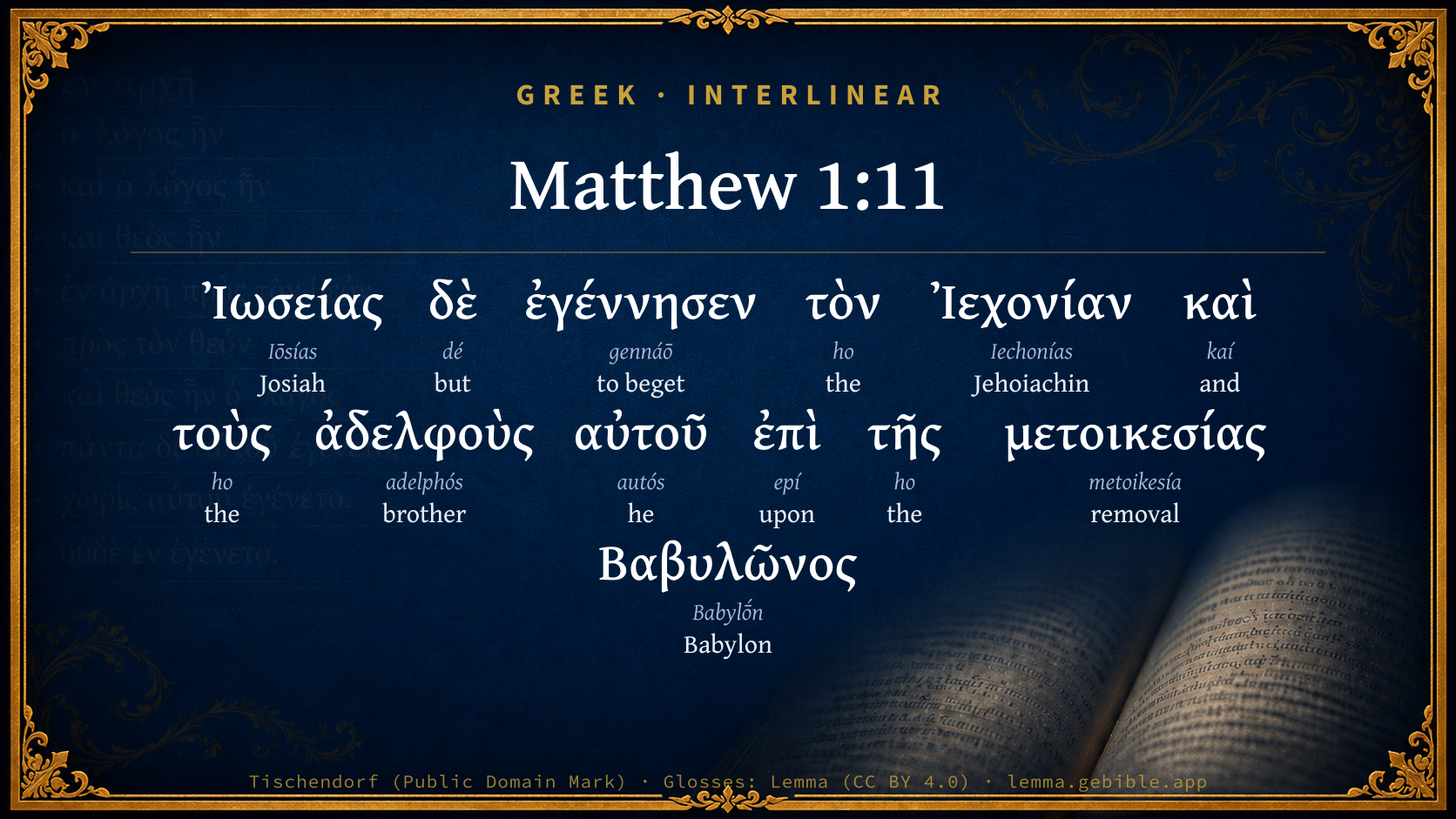
Greek (Tischendorf 8th ed.) Matthew 1:11 appears in the Greek New Testament. The text above is from the Tischendorf 8th edition. Each word links to its Strong’s number and a concise gloss. Click any word for its full Thayer’s Greek Lexicon entry.
Download image
Cite this verse

Matthew 1:11 (World English Bible). Public Domain. Lemma interlinear Bible study tool, https://lemma.gebible.app/v/matthew/1/11.

Show BibTeX & RIS
BibTeX
RIS
English Translation
Josiah became the father of Jechoniah and his brothers, at the time of the exile to Babylon.
World English Bible · Public Domain
Highlights
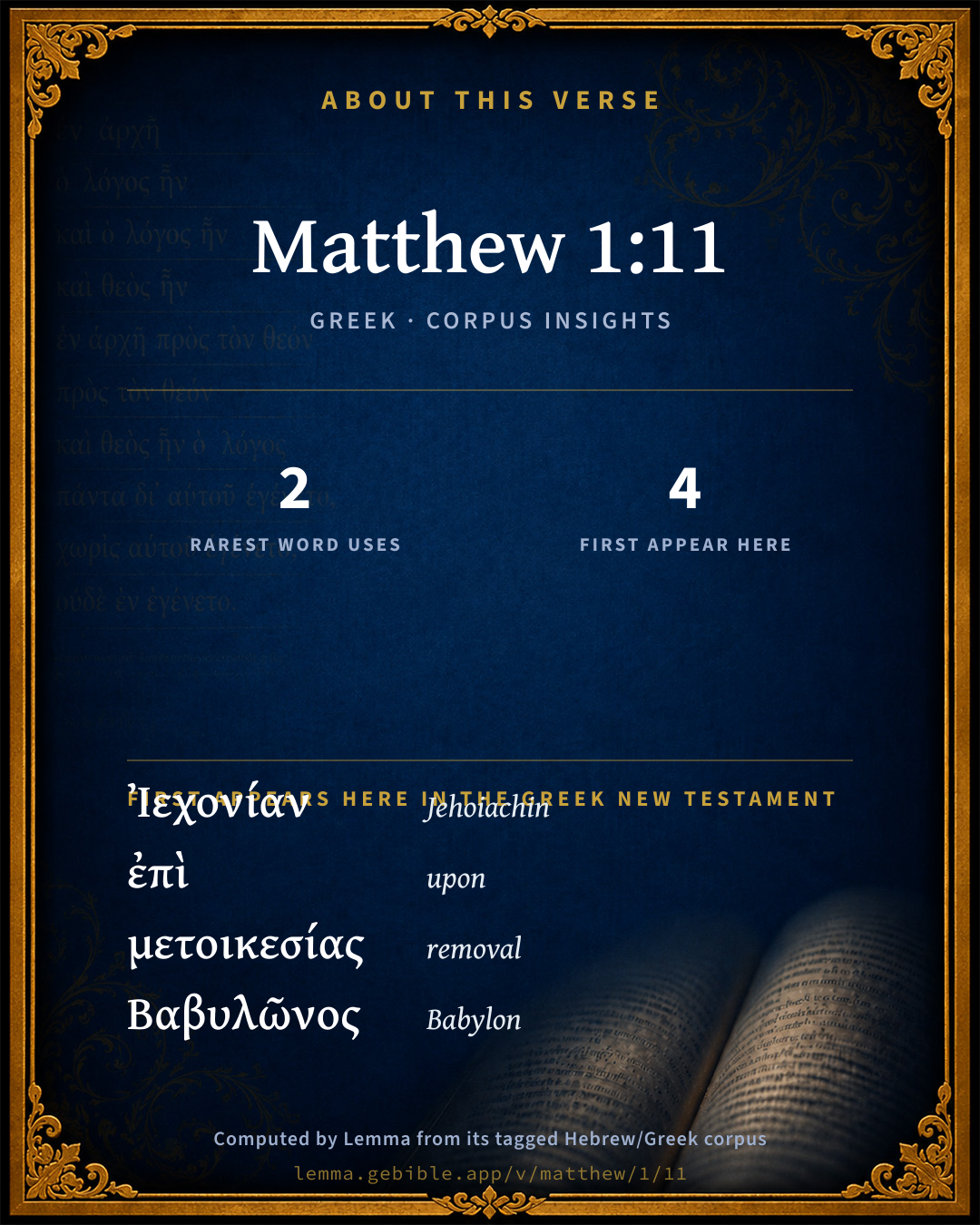
  • 4 first appearances in the Greek New Testament
Full analysis ↓
Download a study sheet

One document with this verse’s original text, its word-by-word gloss line, the meaning frame, cross-references with their text, attributed commentary, and full source and license credits — printable, and it pastes into notes with its structure intact.

This verse Autodidact and up

Study sheet (.html) Plain text (.txt)

A passage Seminary Student

Up to 50 verses in one chapter. A passage sheet keeps up to 6 commentary sources and 12 cross-references per verse, in the order this page ranks them, and says so on the sheet whenever that leaves anything out. Ask for a single verse and you get the Autodidact verse sheet above.

Everything on this page stays free to read, with no account — the sheet is a download of what is already on screen, not access to it.

Want to remove ads? Support Godless Engineer
Compare translations 3

The same verse in 3 English versions, stacked beneath the original-language interlinear above. Click any original word for its lexicon entry.

Each is an independent rendering of the whole verse — the interlinear is not word-aligned to these translations.

Highlighted words mark where these versions differ — a whole-verse word diff, not a word-by-word alignment.

  • World English Bible Public Domain
    Josiah became the father of Jechoniah and his brothers, at the time of the exile to Babylon.
  • King James Version Public Domain
    And Josias begat Jechonias and his brethren, about the time they were carried away to Babylon:
  • unfoldingWord Literal Text CC BY-SA 4.0
    and Josiah fathered Jechoniah and his brothers at the Babylonian deportation,

unfoldingWord Literal Text — © unfoldingWord, licensed CC BY-SA 4.0. Word-aligned USFM3 via Door43 (git.door43.org/unfoldingWord/en_ult).

Versions to compare (up to 4)

3 of 4 selected

Show all 19 translations

Every available English version of this verse, each an independent rendering of the whole verse.

  • World English Bible Public Domain
    Josiah became the father of Jechoniah and his brothers, at the time of the exile to Babylon.
  • Berean Standard Bible Public Domain
    and Josiah the father of Jeconiah and his brothers at the time of the exile to Babylon.
  • Majority Standard Bible Public Domain
    and Josiah the father of Jeconiah and his brothers at the time of the exile to Babylon.
  • King James Version Public Domain
    And Josias begat Jechonias and his brethren, about the time they were carried away to Babylon:
  • American Standard Version (1901) Public Domain
    and Josiah begat Jechoniah and his brethren, at the time of the carrying away to Babylon.
  • Revised Version (1885) Public Domain
    and Josiah begat Jechoniah and his brethren, at the time of the carrying away to Babylon.
  • Geneva Bible (1599) Public Domain
    And Iosias begate Iakim. And Iakim begate Iechonias and his brethren about the time they were caried away to Babylon.
  • Douay-Rheims (1899) Public Domain
    And Josias begot Jechonias and his brethren in the transmigration of Babylon.
  • Young's Literal Translation Public Domain
    and Josiah begat Jeconiah and his brethren, at the Babylonian removal.
  • Literal Standard Version CC BY-SA 4.0
    and Josiah begot Jeconiah and his brothers, at the Babylonian removal.
  • Unlocked Literal Bible CC BY-SA 4.0
    Josiah was an ancestor of Jechoniah and his brothers at the time of the deportation to Babylon.
  • unfoldingWord Literal Text CC BY-SA 4.0
    and Josiah fathered Jechoniah and his brothers at the Babylonian deportation,
  • Darby Bible Public Domain
    and Josias begat Jechonias and his brethren, at the time of the carrying away of Babylon.
  • World Messianic Bible Public Domain
    Josiah became the father of Jechoniah and his brothers at the time of the exile to Babylon.
  • Webster's Bible Public Domain
    And Josias begat Jechonias and his brethren, about the time they were carried away to Babylon:
  • Free Bible Version CC BY-SA 4.0
    and Josiah the father of Jehoiachin and his brothers, at the time of the exile to Babylon.
  • Bible in Basic English Public Domain
    And the sons of Josiah were Jechoniah and his brothers, at the time of the taking away to Babylon.
  • Text-Critical English NT CC BY 4.0
    and Josiah was the father of Jechoniah and his brothers, at the time of the Babylonian resettlement.
  • Tyndale New Testament (1534) Public Domain
    Iosias begat Iechonias and his brethren aboute the tyme they were caryed awaye to Babylon.

Literal Standard Version (2020), Covenant Press — licensed CC BY-SA 4.0. Text via the HelloAO Bible API (eBible.org). Unlocked Literal Bible (unfoldingWord) — licensed CC BY-SA 4.0. Text via the HelloAO Bible API (eBible.org). unfoldingWord Literal Text — © unfoldingWord, licensed CC BY-SA 4.0. Word-aligned USFM3 via Door43 (git.door43.org/unfoldingWord/en_ult). Free Bible Version, Dr. Jonathan Gallagher — licensed CC BY-SA 4.0. Text via the HelloAO Bible API (eBible.org).

Word by word

More ways to search: Search by grammar → Find every occurrence → Compare this word →

Practice this passage: Drill this verse → Learn its vocabulary →

Ἰωσείας
Iōsías
G2502
“Josiah”
Noun, Nominative, Singular, Masculine
Part of Speech
Noun
Case
Nominative
Number
Singular
Gender
Masculine
Full Thayer's Definition

Origin: of hebrew origin H2977

TDNT: None

Josiah = "whom Jehovah heals" 1. king of Judah, who restored among the Jews the worship of the true God, and after a reign of thirty one years was slain in battle about 611 BC
  1. δὲ dé G1161 “but” Conjunction
  2. ἐγέννησεν gennáō G1080 “to beget” Verb, Aorist, Active, Indicative, 3rd person, Singular
  3. τὸν ho G3588 “the” Article, Accusative, Singular, Masculine
  4. Ἰεχονίαν Iechonías G2423 “Jehoiachin” Noun, Accusative, Singular, Masculine
  5. καὶ kaí G2532 “and” Conjunction
  6. τοὺς ho G3588 “the” Article, Accusative, Plural, Masculine
  7. ἀδελφοὺς adelphós G80 “brother” Noun, Accusative, Plural, Masculine
  8. αὐτοῦ autós G846 “he” Personal pronoun, Genitive, Singular, Masculine
  9. ἐπὶ epí G1909 “upon” Preposition
  10. τῆς ho G3588 “the” Article, Genitive, Singular, Feminine
  11. μετοικεσίας metoikesía G3350 “removal” Noun, Genitive, Singular, Feminine
  12. Βαβυλῶνος Babylṓn G897 “Babylon” Noun, Genitive, Singular, Feminine

About this verse

These counts appear in no published source. They are computed here, from the morphology-tagged text and Lemma’s own curated glosses. What Lemma adds →

13
words
11
distinct lemmas
Gospels
section

Notable vocabulary

The rarest word here is Ἰωσείας Josiah G2502 — appearing just 2 times in the whole Greek New Testament.

First appearance in Scripture

These words make their first canonical appearance in the Greek New Testament here:

  • Ἰεχονίαν Jehoiachin G2423
  • ἐπὶ upon G1909
  • μετοικεσίας removal G3350
  • Βαβυλῶνος Babylon G897

Shared distinctive vocabulary

Ἰωσείας Josiah G2502 occurs in 2 verses of the Greek New Testament. Also found in:

Repetition

A word recurs within this verse:

Cross-references

12

Topical passages linked to Matthew 1:11 in the Treasury of Scripture Knowledge — connected by theme and wording, ordered by reader-vote popularity; previews shown in the World English Bible.

  • Jeremiah 27:20 which Nebuchadnezzar king of Babylon didn't take, when he carried away captive Jeconiah the son of Jehoiakim, king of Judah, from Jerusalem to Babylon, and all the nobles of Judah and Jerusalem;
  • Jeremiah 52:11–15 He put out the eyes of Zedekiah; and the king of Babylon bound him in fetters, and carried him to Babylon, and put him in prison until the day of his death.
  • Jeremiah 52:28–30 This is the people whom Nebuchadrezzar carried away captive: in the seventh year three thousand twenty-three Jews;
  • Daniel 1:2 The Lord gave Jehoiakim king of Judah into his hand, with part of the vessels of the house of God; and he carried them into the land of Shinar to the house of his god: and he brought the vessels into the treasure-house of his god.
  • 2 Kings 23:31–24:20 Jehoahaz was twenty-three years old when he began to reign; and he reigned three months in Jerusalem: and his mother's name was Hamutal the daughter of Jeremiah of Libnah.
  • 2 Kings 25:11 The residue of the people who were left in the city, and those who fell away, who fell to the king of Babylon, and the residue of the multitude, did Nebuzaradan the captain of the guard carry away captive.
  • 1 Chronicles 3:15–17 The sons of Josiah: the firstborn Johanan, the second Jehoiakim, the third Zedekiah, the fourth Shallum.
  • 2 Chronicles 36:1–8 Then the people of the land took Jehoahaz the son of Josiah, and made him king in his father's place in Jerusalem.
  • 2 Chronicles 36:10 At the return of the year king Nebuchadnezzar sent, and brought him to Babylon, with the goodly vessels of the house of Yahweh, and made Zedekiah his brother king over Judah and Jerusalem.
  • 2 Chronicles 36:20 Those who had escaped from the sword carried he away to Babylon; and they were servants to him and his sons until the reign of the kingdom of Persia:
  • Jeremiah 2:10–28 For pass over to the isles of Kittim, and see; and send to Kedar, and consider diligently; and see if there has been such a thing.
  • Jeremiah 39:9 Then Nebuzaradan the captain of the guard carried away captive into Babylon the residue of the people who remained in the city, the deserters also who fell away to him, and the residue of the people who remained.

Cross-references courtesy of OpenBible.info (CC BY 4.0).

Commentary

Notes on Matthew 1:11 from classic Christian and Jewish commentators (each source and its license shown beneath its notes). The classic Christian expositions comment on the surrounding passage and are grouped to its opening verse, so a note may address several verses; the Jewish commentaries on the Tanakh (Rashi and others) are per-verse, so they appear only where the commentator wrote on this verse.

Lemma curates 59 commentaries, every one of them public domain or Creative Commons licensed, each selected and text-cleaned for this edition rather than reprinted as found. About our sources →

Adam Clarke's Commentary

Verse 11. Josias begat Jechonias, c.] There are three considerable difficulties in this verse.

1. Josias was not the father of Jechonias he was only the grandfather of that prince: 1Ch 3:14-16.

2. Jechonias had no brethren; at least, none are on record.

3. Josias died 20 years before the Babylonish captivity took place, and therefore Jechonias and his brethren could not have been begotten about the time they were carried away to Babylon.

To this way be added a fourth difficulty, viz. there are only thirteen in this 2nd class of generations; or forty-one, instead of forty-two, in the whole. But all these difficulties disappear, by adopting a reading found in many MSS. Ιωσιας δε εγεννησε τον Ιωακειμ· Ιωακειμ δε εγεννησε τον Ιεχονιαν. And Josias begat JEHOIAKIM, or Joakim, and JOAKIM begat Jechonias. For this reading, see the authorities in Griesbach. Josiah was the immediate father of Jehoiakim (called also Eliakeim and Joakim) and his brethren, who were Johanan, Zedekiah, and Shallum: see 1Ch 3:15. Joakim was the father of Joachin or Jechonias, about the time of the first Babylonish captivity: for we may reckon three Babylonish captivities. The first happened in the fourth year of Joakim, son of Josiah, about A. M. 3398. In this year, Nebuchadnezzar, having taken Jerusalem, led a great number of captives to Babylon. The second captivity happened under Jechoniah, son of Joakim; who, having reigned three months, was taken prisoner in 3405, and was carried to Babylon, with a great number of the Jewish nobility. The third captivity took place under Zedekiah, A. M. 3416. And thus, says Calmet, Mt 1:11 should be read: Josias begat Joakim and his brethren: and Joakim begat Jechonias about the time of the first Babylonish captivity; and Jechonias begat Salathiel, after they were brought to Babylon. Thus, with the necessary addition of Joakim, the three classes, each containing fourteen generations, are complete. And to make this the more evident, I shall set down each of these three generations in a separate column, with the additional Joakim, that the reader may have them all at one view.

1 Abraham

1 Solomon

1 Jechonias

2 Isaac

2 Rehoboam

2 Salathiel

3 Jacob

3 Abia

3 Zorobabel

4 Judah

4 Asa

4 Abiud

5 Pharez

5 Josaphat

5 Eliakim

6 Esrom

6 Joram

6 Azor

7 Aram

7 Ozias

7 Sadoc

8 Aminadab

8 Joatham

8 Achim

9 Naason

9 Achaz

9 Eliud

10 Salmon

10 Ezekias

10 Eleazar

11 Booz

11 Manasses

11 Matthan

12 Obed

12 Amon

12 Jacob

13 Jesse

13 Josias

13 Joseph

14 David

14 Joachim

14 JESUS

In all forty-two generations.

Adam Clarke's Commentary on the Bible (1810–1826) — public domain. Text from a community e-Sword/MySword module.

Joseph Benson's Commentary

Mat 1:11. Josias begat Jechonias — According to the Bodleian and other MSS., (of which notice is taken in the margin of our Bibles,) we must read Josiah begat Jehoiakim, and Jehoiakim begat Jechoniah. And this indeed seems absolutely necessary to keep up the number of fourteen generations; unless we suppose, with Dr. Whitby, that the Jechoniah here is a different person from that Jechoniah mentioned in the next verse, which seems a very unreasonable supposition, since it is certain that throughout this whole table each person is mentioned twice, first as the son of the preceding, and then as the father of the following. And his brethren — Jehoahaz and Zedekiah, who were both kings of Judah, the former the predecessor to Jehoiakim, and the latter the successor of his son Jehoiachin. Of the history of these persons see the notes on 2Ki 23:30-31; and 2Ki 24:1-20; and 2Ki 25:1-7. About the time they were carried away to Babylon — There were two transportations to Babylon of the tribes which composed the kingdom of Judah. The first happened in the eighth year of the reign of Jehoiachin the son of Jehoiakim. For Jehoiachin delivered up the city to Nebuchadnezzar, and, by treaty, agreed to go with the Chaldeans to Babylon, at which time the princes and the mighty men, even 10,000 captives, with all the craftsmen and smiths, were carried away to Babylon. 2Ki 24:12-16. The second transportation happened in the 11th year of the reign of Zedekiah, when the city was taken by storm, and all the people made prisoners of war and carried off. The seventy years of the captivity were dated from the first transportation, here properly called μετοικεσια, a removal or migration: and it is of this that the evangelist speaks in this genealogy: the other is more properly termed αιχμαλωσια, a being taken and carried away captive.

Joseph Benson's Commentary on the Old and New Testaments (1811–1818) — public domain. Text from a community e-Sword module.

Tyndale Open Study Notes

Tyndale Open Resources

1:11 father: Josiah was the grandfather of Jehoiachin.

Tyndale Open Study Notes — © Tyndale Open Resources, licensed CC BY-SA 4.0. Text via the HelloAO Bible API.

Bengel's Gnomon

Johann Albrecht Bengel

Mat 1:11. Ἰωσίας δὲ ἐγέννησε τὸν Ἰεχονίαν, But Josiah begat Jechoniah) Many transcribers both in ancient and in modern times, and those principally Greeks, have inserted Jehoiachim here, because, firstly, the Old Testament had that name in this situation, and secondly, the number of fourteen generations, from David to the Babylonian captivity, given by St Matthew, seemed to require the insertion. Jehoiachim, however, must not be inserted: for history would not suffer Jehoiachim to be put without his brothers, and brothers to be thus given to Jechoniah, who had none. Some have sought for Jehoiachim in St Matthew’s first mention of Jechoniah; Jerome[12] has done so especially, when answering Porphyry’s[13] objections to this verse on the ground of the hiatus. No transformation, however, will produce Jechoniah (in the LXX. ἸΕΧΟΝΊΑς) from the Hebrew יהויקים, the ἸΩΑΚΕῖΜ (Joakim) of the LXX., so as to make them one and the same name: nor have we any more reason for supposing that Jehoiachim and Jechoniah are intended by the repetition of the former, than that two separate individuals are intended by the repetition of Isaac’s name; and so on with the other names in the genealogy. The same Jechoniah is twice introduced under his own name: he was descended from Josiah through Jehoiachim, whose name is omitted. St Matthew calls Jechoniah’s uncles his brothers (cf. Gen 13:8), and that with great felicity; for Zedekiah came to the throne after the commencement of the captivity, to the exclusion of the sons of Jechoniah, whom he succeeded, and who, though his nephew, was born eight years before him. The brothers, therefore, of Jehoiachim, of whom Zedekiah was chief, who is expressly called the brother in 2Ch 36:10, and 2Ki 24:17, instead of the uncle of Jechoniah, are appropriately mentioned after Jechoniah as his brothers.[14]—ἘΠῚ ΤῊς ΜΕΤΟΙΚΕΣΊΑς, about the time of the migration[15]) The preposition ἘΠῚ, which is contrasted with ΜΕΤᾺ (after) in the twelfth verse, is also employed sometimes to denote the immediate sequence of that, during or about the time of which something else takes place.—See Gnomon on Mar 2:26. The Hebrew præfix á has the same force in Gen 10:25. The birth of Jechoniah was followed immediately by the removal to Babylon,—which is called by the LXX. both ἈΠΟΙΚΕΣΊΑ (the emigration), and μετοικεσία (the migration, immigration, or sojourning); the former with reference to Palestine, the latter with reference to Babylon.—Βαβυλῶνος, of Babylon) i.e. to, or into Babylon. In like manner ὁδὸς Αἰγύπτου, in Jer 2:18, signifies the way into Egypt.

[12] One of the most celebrated Fathers of the Christian Church, born of Christian parents at Stridon, on the borders of Pannonia and Dalmatia, in the year 331. Educated at Rome under the best masters. After travelling through France, Italy, and the East, he adopted the monastic life in Syria in his 31st year. He died A.D. 422.—(I. B.)

[13] A Platonic philosopher, born at Tyre, A.D. 223. Studied under Longinus and Plotinus. He was a man of great talent and learning, and one of the most able opponents of Christianity. He died in the reign of Diocletian.—(I. B.)

[14] Irenœus, 218, writes, “Ante hunc Joachim (Joseph enim Joachim et Jechoniæ filius ostenditur, quemadmodum et Matthæus generationem ejus exponit).” So M Cod. Reg. Paris of 9th century, and U Cod. Venetus of same date, in opposition to the ancient authorities, insert Ἰωαχείμ.—ED.

[15] sc. to Babylon.—(I. B.)

Bengel's Gnomon of the New Testament — English translation (T&T Clark, Edinburgh, 1860) — public domain. Text from a community e-Sword module.

Meyer's Critical & Exegetical Commentary

Heinrich August Wilhelm Meyer

Mat_1:11. The son of Josiah was Joakim, and his son was Jechoniah. Here, consequently, a link is wanting, and accordingly several uncials, curss., and a few versions[353] contain the supplement: ἸΩΣΊΑς ΔῈ ἘΓΈΝΝΗΣΕ ΤῸΝ ἸΩΑΚΕΊΜ· ἸΩΑΚΕῚΜ ΔῈ ἘΓΈΝΝΗΣΕ ΤῸΝ ἸΕΧΟΝΊΑΝ (1Ch_3:15-16). The omission is not, with Ebrard, to be explained from the circumstance that under Joakim the land passed under the sway of a foreign power (2Ki_24:4), and that consequently the theocratic regal right became extinct (against this arbitrary view, see on Mat_1:8); but merely from a confusion between the two similar names, which, at the same time, contributed to the omission of one of them. This clearly appears from the circumstance that, indeed, several brothers of Joakim are mentioned (three, see 1Ch_3:15), but not of Jechoniah. Zedekiah is, indeed, designated in 2Ch_36:10 as the brother of the latter (and in 1Ch_3:16 as his son), but was his uncle (2Ki_24:17; Jer_37:1). That our genealogy, however, followed the (erroneous, see Bertheau, p. 430) statement in 2Ch_36:10, is not to be assumed on account of the plural τοὺς ἀδελφούς, which rather points to 1Ch_3:15 and the interchange with Joiakim. It is quite in an arbitrary manner, finally, that Kuinoel has assigned to the words ΚΑῚ … ΑὐΤΟῦ their place only after ΣΑΛΑΘΊΗΛ, and Fritzsche has even entirely deleted them as spurious.

ἘΠῚ Τῆς ΜΕΤΟΙΚ. ΒΑΒΥΛῶΝΟς] during (not about the time, Luther and others) the migration. See Bernhardy, p. 246; Kühner, II. p. 430. The statement, however, is inexact, as Jechoniah was carried away along with others (2Ki_24:15). The genitive Βαβυλ. is used in the sense of ΕἸς ΒΑΒΥΛῶΝΑ. Comp. Eurip. Iph. T. 1073: γῆς πατρῷας νόστος. Mat_10:5 : ὉΔῸς ἘΘΝῶΝ; Mat_4:15, al. Winer, p. 176 [E. T. p. 234].

[353] Amongst the editions this interpolation has been received into the text by Colinaeus, H. Stephens, and Er. Schmidt, also by Beza (1James , 2 d); by Castalio in his translation. It has been defended by Rinck, Lucub. crit. p. 245 f.; Ewald assumes that ver. 11 originally ran: Ἰωσίας δὲ ἐγένν. τ. Ἰωακὶμ καὶ τοῦς ἀδελφοὺς αὐτοῦ· Ἰωακὶμ δὲ ἐγένν. τὸν Ἰεχονίαν ἐπὶ τῆς μετοικ. Βαβ. The present form of the text may be an old error of the copyists, occasioned by the similarity of the two names.

Meyer — Critical and Exegetical Commentary on the New Testament — English translation by Peter Christie, edited by Frederick Crombie (T&T Clark, 1880) — public domain. Text from a community e-Sword module.

Expositor's Greek Testament

ed. W. Robertson Nicoll

Mat 1:11 . Ἰωσίας ἐγεν . τὸν Ἰεχονίαν . There is an omission here also: Eliakim, son of Josiah and father of Jeconiah. It was noted and made a ground of reproach to Christians by Porphyry. Maldonatus, pressed by the difficulty, proposed to substitute for Jeconiah, Jehoiakim, the second of four sons ascribed to Josiah in the genealogist’s source (1Ch 3:14 ), whereby the expression τοὺς ἀδελφοὺς αὐτοῦ would retain its natural sense. But, while the two names are perhaps similar enough to be mistaken for each other, it is against the hypothesis as a solution of the difficulty that Jehoiakim did not share in the captivity (2Ki 24:6 ), while the words of Mat 1:11 seem to imply that the descendant of Josiah referred to was associated with his brethren in exile. The words ἐπὶ τῆς μετοικεσίας Βαβυλῶνος probably supply the key to the solution. Josiah brings us to the brink of the period of exile. With his name that doleful time comes into the mind of the genealogist. Who is to represent it in the line of succession? Not Jehoiakim, for though the deportation began in his reign he was not himself a captive. It must be Jeconiah (Jehoiakin), his son at the second remove, who was among the captives (2Ki 24:15 ). His “brethren” are his uncles, sons of Josiah, his grandfather; brethren in blood, and brethren also as representatives of a calamitous time ( vide Weiss-Meyer). There is a pathos in this second allusion to brotherhood. “Judah and his brethren,” partakers in the promise (also in the sojourn in Egypt); “Jeconiah and his brethren,” the generation of the promise eclipsed. Royalty in the dust, but not without hope. The omission of Eliakim (or Jehoiakim) serves the subordinate purpose of keeping the second division of the genealogy within the number fourteen. Μετοικεσίας : literally change of abode , deportation, “carrying away,” late Greek for μετοικία or μετοίκησις . Βαβυλῶνος : genitive, expressing the terminus ad quem ( vide Winer, § 30, 2 a, and cf. Mat 4:15 , ὁδὸν θαλάσσης , Mat 10:5 , ὁδὸν ἐθνῶν ). ἐπὶ τ . μ ., “at the time of, during,” the time being of some length; the process of deportation went on for years. Cf. Mar 2:26 , ἐπὶ Ἀβιάθαρ , under the high priesthood of Abiathar, and Mar 12:26 for a similar use of ἐπὶ in reference to place: ἐπὶ τοῦ βάτου at the place where the story of the bush occurs. Μετὰ τ . μ . in Mat 1:12 means after not during , as some have supposed, misled by taking μετοικεσία as denoting the state of exile. Vide on this Fritzsche.

The Expositor's Greek Testament, edited by W. Robertson Nicoll (1897–1910) — public domain. Text from a community e-Sword module.

Geneva Bible (1599)

Geneva Bible translators

That is, the captivity fell in the days of Jakim and Jeconiah: for Jeconiah was born before their carrying away into captivity.

Geneva Bible (1599) marginal notes — public domain. Text via Bolls.life.

Jamieson, Fausset & Brown

Robert Jamieson, A. R. Fausset & David Brown

And Josias begat Jechonias and his brethren--Jeconiah was Josiah's grandson, being the son of Jehoiakim, Josiah's second son (Ch1 3:15); but Jehoiakim might well be sunk in such a catalogue, being a mere puppet in the hands of the king of Egypt (Ch2 36:4). The "brethren" of Jechonias here evidently mean his uncles--the chief of whom, Mattaniah or Zedekiah, who came to the throne (Kg2 24:17), is, in Ch2 36:10, as well as here, called "his brother."

about the time they were carried away to Babylon--literally, "of their migration," for the Jews avoided the word "captivity" as too bitter a recollection, and our Evangelist studiously respects the national feeling.

Jamieson, Fausset & Brown — Commentary Critical and Explanatory on the Whole Bible (1871) — public domain (CC PDM 1.0). Text via the HelloAO Bible API.

Ellicott's Commentary for English Readers

(11) Jechonias and his brethren.—Here again there is a missing link in the name of Eliakim, or Jehoiakim, the son of Josiah (2Ki_23:34). Jeconiah was therefore the grandson of Josiah. The alternative reading mentioned in the margin rests on very slight authority, and was obviously the insertion of some later scribe, to meet the difficulty. The word “brethren” was probably meant to include Mattaniah or Zedekiah, the last king of Judah, who was the son of Josiah, and therefore uncle to Jechoniah.

A Bible Commentary for English Readers, edited by Charles John Ellicott (1878–1897) — public domain. Text from a community e-Sword module.

The Cambridge Bible for Schools and Colleges

gen. ed. J. J. S. Perowne

11. Josias begat Jechonias (Jehoiakim)] but in the next v. Jechonias = Jehoiachin. Read, as in the margin, “Josias begat Jakim (Jehoiakim), and Jakim begat Jechonias (Jehoiachin).

Jechonias and his brethren] Jehoiachin had no brethren, but Jehoiakim had three: a further proof that Jechonias in this verse=Jehoiakim.

The Cambridge Bible for Schools and Colleges (gen. ed. J. J. S. Perowne; Cambridge University Press, 1878–1918) — public domain. Text from a community e-Sword module.

John Gill's Exposition

And Josias begat Jechonias,.... This Jechonias is the same with Jehoiakim, the son of Josias, called so by Pharaohnecho, when he made him king, whose name before was Eliakim, Kg2 23:34 begat of Zebudah, the daughter of Pedaiah of Rumah, Kg2 23:36.

and his brethren. These were Johanan, Zedekiah, and Shallum. Two of them were kings, one reigned before him, viz. Shallum, who is called Jehoahaz, Kg2 23:30 compared with Jer 22:11, the other, viz. Zedekiah, called before Mattaniah, reigned after his son Jehoiakim: these being both kings, is the reason why his brethren are mentioned; as well as to distinguish him from Jechonias in the next verse; who does not appear to have had any brethren: these were

about the time they were carried away to Babylon, which is not to be connected with the word "begat": for Josiah did not beget Jeconiah and his brethren at that time, for he had been dead some years before; nor with Jechonias, for he never was carried away into Babylon, but died in Judea, and slept with his fathers, Kg2 24:6 but with the phrase "his brethren": and may be rendered thus, supposing understood, "which were at", or "about the carrying away to Babylon", or the Babylonish captivity.

John Gill's Exposition of the Whole Bible (1746–1763) — public domain (CC PDM 1.0). Text via the HelloAO Bible API.

Trapp's Complete Commentary

John Trapp

11 And Josias begat Jechonias and his brethren, about the time they were carried away to Babylon:

Ver. 11. And Josias begat Jechonias] Rob. Stephanus restoreth and rectifieth the text thus: "Josias begat Jakin and his brethren, and Jakin begat Jechonias." For otherwise the middle fourteen (whereby St Matthew reckoneth) would want a man. Jehoahaz, younger brother to Jakin, had, after his father’s death, stepped into the throne, but was soon ejected. Usurpation prospers not. Abimelech’s head had stolen the crown, and by a blow on his head he is slain at Shechem. What got most of the Caesars by their hasty advancement, nisi ut citius interficerentur? as one hath it. Notandum, saith the chronologer, quod nullus Pontificum, egregii aliquid a tempore Bonifitcii tertii pro sedis Romanae tyrannide constituens, diu supervixerit. Quod et huic Bonifacio accidit. It is remarkable that no pope of any note for activity in his office was long of life.

John Trapp, A Commentary or Exposition upon All the Books of the Old and New Testament (1647–1656) — public domain. Text from a community e-Sword module.

Haydock's Catholic Bible Commentary

Josias begot[2] Jechonias, &c. The genealogy of Christ, as it appears by the 17th verse, is divided by the evangelist into thrice fourteen generations, and so it is to contain 42 persons. The first class of fourteen begins with Abraham, and ends with David. The second class begins with Solomon, and ends with Jechonias. The third class is supposed to begin with Salathiel, and to end, says St. Jerome, with our Saviour Christ. But thus we shall only find in the third class thirteen generations, and in all only forty-one, instead of forty-two. Not to mention in these short notes other interpretations, the conjecture of St. Epiphanius seems to most probable, that we are to understand two Jechonias’s, the father and the son, who had the same name. So that the true reading should be, Josias begot Jechonias and his brethren, and Jechonias begot Jechonias, and Jechonias begot Salathiel. Thus Jechonias named in the 12th verse is not the same, but the son of him that was named in the 11th verse; and from Jechonias the son, begins the third class, and so Christ himself will be the last or 14th person in that last series or class. There are several difficulties about reconciling this genealogy in St. Matthew with that in St. Luke, chap. iii. But without insisting on all the particulars in these short notes, I hope it may suffice to take notice, that no one can reasonably doubt that both the evangelists copied out the genealogical tables, as they were then extant, and carefully preserved by the Jews, and especially by those families that were of the tribe of Juda, and of the family of David, of which the Messias was to be born. For if the evangelists had neither falsified, or made any mistake as to these genealogies, the Jews undoubtedly would have objected this against their gospels, which they never did. (Witham) --- The difficulties here are: 1. Why does St. Matthew give the genealogy of Joseph and not of Mary? 2. How is it inferred that Jesus is descended from David and Solomon, because Joseph is the son of David? 3. How can Joseph have two men for his father, Jacob of the race of Solomon, and Heli of the race of Nathan? To the 1st it is generally answered, that it was not customary with the Jews to draw out the genealogies of women; to the 2nd, that Jesus being the son of Joseph, either by adoption, or simply as the son of Mary his wife, he entered by that circumstance into all the rights of the family of Joseph; moreover, Mary was of the same tribe and family of Joseph, and thus the heir of the branch of Solomon marrying with the heiress of the branch of Nathan, the rights of the two families united in Joseph and Mary, were transmitted through them to Jesus, their son and heir; to the 3rd, that Jacob was the father of Joseph according to nature, and Heli his father according to law; or that Joseph was the son of the latter by adoption, and of the former by nature. (Haydock) --- In the transmigration, [3] transportation to Babylon; i.e. about the time the Jews were carried away captives to Babylon. For Josias died before their transportation. See 4 Kings xxiv. (Witham) --- Some think we are to read: Josias begot Joakim and his brethren; and Joakim begot Joachim, or Jechonias. Jechonias was son to Joakim, and grandson to Josias. The brothers of Jechonias are not known, but those of Joakim are known. (1 Paralipomenon iii. 15, 16.) Besides this reading give the number 14. (Haydock) --- St. Jerome says that Jechonias, the son of Josias, is a different person from Jechonias who begot Salathiel, for the latter was son of the former; see Paralipomenon iii. where it is said that Zorobabel was son of Phadaia; but Phadaia is the same as Salatheil. (Estius) --- Mat. Polus affirms that every one the least conversant in Jewish story, must know that several genealogies which appear to contradict each other, do not in reality. (Synop. Crit. ver. 4, p. 12.)

===============================

[BIBLIOGRAPHY]

See St. Epiphanius hær. vi. pag. 21. Edit. Petav. Greek: epeide tines &c.

In transmigratione, Greek: epi tes metoikesias, i.e. circa tempus transmigrationis.

George Leo Haydock (1774–1849), Haydock's Catholic Family Bible and Commentary, 1859 edition — public domain. Excludes Psalms (Douay-Rheims chapter numbering differs from Protestant) and Deuterocanonical books (Catholic canon only).

Matthew Poole's English Annotations

In this Jechonias 1Ch 3:15,16 (whoever he was) determined the evangelist’s second period of fourteen generations. But there is much dispute, both about the Jechonias who is here mentioned, and the sons of Josiah as they are reckoned up 1Ch 3:15, where it is said: The sons of Josiah were, the firstborn Johanan, the second Jehoiakim, the third Zedekiah, the fourth Shallum. It is plain that Jehoahaz succeeded Josiah his father, 2Ki 23:31; 2Ch 36:1. It is certain that amongst the Jews it was very ordinary for persons to have two names; thus king Uzziah in the Book of Kings is called Azariah, 2Ki 14:21. Most if not all of Josiah’s sons had two names: it is plain that Jehoahaz his eldest son is the same who in 1Ch 3:15 is called Johanan; but he reigned but three months, probably set up by the people, and put down by Pharaoh-necho, in a battle against whom Josiah was slain; he pursuing his victory put him down and set up Eliakim his next brother, calling him Jehoiakim, as he is called 1Ch 3:15. He reigned eleven years, 2Ch 36:5. The king of Babylon puts him down, and setteth up Jehoiachin his son, who is also called Jeconiah, and Coniah. He reigned but three months and ten days, 2Ch 36:9; and the king of Babylon fetcheth him away, and sets up his uncle Zedekiah, called also Mattaniah. He reigned eleven years, as appeareth by 2Ch 36:11; then the whole body of the Jews were carried away captive into Babylon. 2Ki 24:14-16; 2Ki 25:11; 2Ch 36:10,20; Jer 27:20; 39:9; 52:11,15,28-30; Da 1:2 We do not read, either in the Book of Kings or Chronicles, that Shallum (Josiah’s fourth son) ever reigned, yet it should seem that he did, by Jer 22:11. Some think that he was set up instead of Jehoahaz, when he was carried away. But the Scripture saith nothing of it, nor is it very probable that the conqueror should skip over the second and third son, and set up the fourth. But it is not my present concern to inquire after Shallum, but only after Jechonias mentioned in this verse, and the other Jechonias mentioned in Mat 1:12, as the head of those generations which make up the last period. As to this Jechonias, the most probable opinion is, that it was Jehoiakim, who was also called Jeconiah, and that the Jechonias mentioned Mat 1:12 was Jehoiachin, the son of Jehoiakim. In this I find some of the best interpreters acquiescing, nor indeed is there any great difficulty in allowing Jehoiakim the father, as well as Jehoiachin the son, to be called Jeconiah (so near are the names akin, and the signification of both the same); but then the question is, how Josiah could be said to beget Jehoiakim about the time of the carrying into the captivity of Babylon; for it appeareth by 2Ch 36:5, that Jehoiakim was twenty-five years old when he began to reign, and he reigned eleven years; and in his time was the first carrying into Babylon; so that there must be thirty-seven years betwixt the begetting of Jehoiakim and the first transportation into Babylon. The margin of our Bibles tells us of another reading, Josias begat Jakim, ( Jakim and Jehoiakim are the same), and Jakim begat Jechonias (that is, Jehoiachin). Beza thinks this the truest reading, taken out of an old copy of R. Stephens, magnified by Stapulensis and Bucer. But he thinks it should be thus, Josias begat Jakim and his brethren, ( for we know that Josiah had four sons), and Jakim begat Jechonias (that is, Jehoiachin) about the time of the carrying into the captivity o Babylon. For Jehoiachin or Jeconiah was not nine years old when himself was carried away, and his father was carried away before. About the carrying away into Babylon: the Greek preposition επι doth not signify any determinate certain time, but doth include sometimes many and distinct times, as it must do here; for Josiah began to reign at eight years old, and reigned thirty-one years, so that he died at thirty-nine years of age, 2Ch 34:1. Jehoahaz (or Johanan) his eldest son succeeded him at twenty-three years old, so he must be born when Josiah was sixteen years of age; Jehoiakim began to reign at twenty-five years of age; Zedekiah at one and twenty; as appeareth from 2Ch 36:2,5,11. So that Zedekiah must be but about nine years old when his father died, which was not twelve years before, Jehoiakim was carried into Babylon, as appeareth by the history, 2Ch 36:1-23. Thus the persons in this period (which was the flourishing time of the kingdom of Judah) are fourteen: Solomon, Rehoboam, Abia, Asa, Jehoshaphat, Joram, Uzziah, Jotham, Ahaz, Hezekiah, Manasseh, Amon, Josiah, Jehoiakim; only here is no mention made of Jehoahaz’s reign, who was Josiah’s eldest son, who, it may be, is not mentioned by the evangelist, either because Jehoiakim (here called Jechonias) was a second son of the same father, or in regard of his short reign (for it was but three months and odd days); or, it may be, because in all probability he was tumultuously set up by the people, and not fixed in his throne before he was turned out by the conqueror Pharaoh-necho; nor do we read of any sons he left; to be sure he left none who could succeed him in the throne, for Jehoiakim was set up, and his son Jehoiachin succeeded him, as the history telleth us.

Matthew Poole's English Annotations on the Holy Bible (1683–1685) — public domain. Text from a community e-Sword/MySword module.

The Pulpit Commentary

Josias (Josiah, Revised Version) begat Jechonias (Jechoniah, Revised Version). Here we come upon another omission. Josiah was the father of Jehoiakim, and he the father of Jechoniah (called also Jehoiachin); see 2Ki_23:34 2Ki_24:6. The omission is supplied in some few manuscripts; but it may be only the case of a marginal note in a previous copy having found its way into the text. There is, however, something to be said in favour of its acceptance. The similarity between the names Jehoiakim and Jehoiachin is very great, especially in some of the Greek forms, so that they might easily be confused, and thus a verse be omitted in some very early text. Then Jehoiachin (Jechonias) apparently had no brethren, (but see 1Ch_3:16) whereas Jehoiakim, the son of Josiah, had two or three. (1Ch_3:15) To make the whole pedigree agree with the Old Testament records some addition in this form would appear necessary; Josiah begat Jehoiakim and his brethren, and Jehoiakim begat Jechoniah about the time, etc. But manuscript evidence for this is extremely slight (vide Westcott and Hort, "App.," i,). Yet the supposition that the name of Jehoiakim has been omitted removes what has seemed to many another difficulty. As the list now stands, to make up the fourteen in the third as well as in the second section of the genealogy it is necessary to count Jehoiachin a king whose reign lasted only three mouths (2Ki_24:8) twice over. He closes the second fourteen and begins the third. There is nothing like this found at the other division. To substitute Jehoiakim after Josiah would avoid this repetition of the name of such a very insignificant person, especially as the reign of Jehoiakim lasted eleven years. (2Ki_23:36) And to mention Jehoiakim as the father of Jehoiachin "at the time of the carrying away to Babylon" would be very appropriate, whereas to say Josiah begat his children at that date is not so strictly correct. It seems, then, probable that we have here some clerical error, which may have existed already in the list which St. Matthew used. About the time. The preposition in the Greek means rather, at the time." The Authorized Version, however, gives the sense, for the birth of Jehoiachin must have been some years before the commencement of the Babylonish conquest, which may be said to have begun with Nebuchadnezzar"s invasion of the land in Jehoiakim"s days. (2Ki_24:1)

The Pulpit Commentary (1880–1919), ed. H.D.M. Spence-Jones & Joseph S. Exell — public domain. Text from a community e-Sword module.

John Wesley's Explanatory Notes

Josiah begat Jeconiah -- mediately, Jehoiakim coming between. And his brethren - That is, his uncles. The Jews term all kinsmen brethren. About the time they were carried away -- which was a little after the birth of Jeconiah.

John Wesley, Explanatory Notes Upon the Whole Bible (1754–1765) — public domain. Text via the GEBible commentary corpus.

The People's New Testament

B. W. Johnson

11. The carrying away to Babylon. The great seventy years' captivity in Babylon, following the destruction of Jerusalem by Nebuchadnezzar.

B. W. Johnson's The People's New Testament with Notes (1889–1891) — public domain. Electronic text from the Christian Classics Ethereal Library (CCEL) ThML edition.

Cambridge Greek Testament for Schools and Colleges

11. Ἰωσείας δὲ ἐγέννησεν τὸν Ἰεχονίαν (Jehoiakim); but in the next v. Jechonias = Jehoiachin. A step is thus wanting in the genealogy, which is supplied by a very early though probably not genuine reading: Ἰωσείας δὲ ἐγέννησεν τὸν Ἰωακείμ· Ἰωακεὶμ δὲ ἐγέννησεν τὸν Ἰεχονίαν (Jehoiachin). The insertion would make fifteen steps in this portion of the genealogy and would not remove the difficulty unless τοὺς ἀδελφοὺς were placed after Ἰωακείμ.

Ἰεχονίαν καὶ τοὺς ἀδελφοὺς αὐτοῦ. No brethren of Jehoiachin are mentioned, but Jehoiakim had three (1Ch 3:15): a further indication that Ἰεχονίας in this verse = Jehoiakim.

ἐπὶ τῆς μετοικεσίας Βαβυλῶνος. ‘At the time of the migration or transportation to Babylon’ (606 B.C.). For ἐπὶ in this sense cp. ἐπὶ Κλαυδίου, Act 11:28; ἐπὶ ἀρχιερέως Ἄννα, Luk 3:2. This use of the preposition comes from the conception that one event rests on, but not wholly on, a person or other events. μετοικεσία, the LXX. word for the Babylonish exile, for which the classical μετοικία is also used. For the genitive Βαβυλῶνος see Winer, p. 234. Cp. French ‘chemin de Paris,’ road to Paris.

Cambridge Greek Testament for Schools and Colleges (Cambridge University Press, 1896; 21 vols, various authors incl. Carr, Maclear, Plummer, Farrar, Lumby, Moule, M. R. James, Simcox) — public domain. Text from a community e-Sword module.

Alford’s Greek Testament

Henry Alford

11. Ἰωσείας … Ἰεχον.] Eliakim, son of Josiah and father of Jechonias, is omitted; which was objected to the Christians by Porphyry. The reading which inserts Joacim (i.e. Eliakim) rests on hardly any foundation, and would make fifteen generations in the second tesseradecade. The solution of the difficulty by supposing the name to apply to both Eliakim and his son, and to mean the former in ver. 11 and the latter in ver. 12, is unsupported by example, and contrary to the usage of the genealogy. When we notice that the ἀδελφοί of Jechonias are his uncles, and find this way of speaking sanctioned by 2Ch 36:10, where Zedekiah, one of these, is called his brother, we are led to seek our solution in some recognized manner of speaking of these kings, by which Eliakim and his son were not accounted two distinct generations. If we compare 1Ch 3:16 with 2Ki 24:17, we can hardly fail to see that there is some confusion in the records of Josiah’s family. In the latter passage, where we have “his father’s brother,” the LXX render τὸν υἱὸν αὐτοῦ. Lord A. Hervey, in his careful work on the genealogies of our Lord, has suggested a reason for the difficulty: viz. that the text may originally have stood thus: Ἰωσείας δέ ἐγέννησεν τὸν Ἰωακεὶμ καὶ τοὺς ἀδελφοὺς αὐτοῦ, Ἰωακεὶμ δὲ ἐγέννησεν τὸν Ἰωαχεὶμ ἐπὶ τῆς μετοικεσίας Βαβυλῶνος, μετὰ δὲ τὴν μετ. Β. Ἰωαχεὶμ ἐγέννησεν τὸν Σαλαθιήλ, κ.τ.λ., and a copyist may have omitted the Ἰωακ. δ. ἐγ. τὸν Ἰωαχ. as an accidental repetition. This view may perhaps be imagined to derive some support from the digest: but it seems to me that the objection to it is, the present occurrence of Ἰεχονίαν and -ας in all our copies. This Lord A. Hervey does not satisfactorily account for in saying “the form Ἰεχονίας was doubtless substituted in St. Matthew’s Gospel much later, to bring it into accordance with 1Ch_3.”

ἐπὶ τῆς μετ.] at the time of the migration to Babylon (on this usage of ἐπί with a gen., derived from its meaning of local juxta-, or superimposition, see Bernhardy, Syntax, p. 246):—and μετὰ τὴν μετ., after the migration. For the construction, μετ. Βαβ., see reff.

Henry Alford, The Greek Testament (1849–1861) — public domain. Text from a community e-Sword module.

International Critical Commentary

(E) 11. And Josiah begat Jechoniah and his brethren, at the time of the captivity into Babylon.] καὶ τοὺς ἀδελφοὺς αὐτοῦ is inserted because in 1Ch 3:15, the names of the brethren of Jehoiakim are recorded just as the same words occur in v. 2, because the brethren of Judah are registered in 1Ch 2:1.

The verse as it stands gives rise to great difficulties, because Jehoiakim has been omitted. But the text must be corrupt. As it stands there are only thirteen names in the third division, beginning with Salathiel. And this is impossible in view of v. 17. If we suppose that Ἰεχονίαν in v. 11 is a corruption for Ἰωακείμ, everything is plain.1 The καὶ τούς ἀδελφούς is then due to 1Ch 3:15 where the names of Jehoiakim’s brethren are given.—ἐπὶ τῆς μετοικεσίας] μετοικεσία, a rare word. It occurs ten times in the LXX., besides only Anth. P. 7. 731. The mention of the Captivity closes the second division of the genealogy. In the generation of Jechoniah the family lost the royal power to which it had risen in the person of David.

11. Ἰωσείας] א B Dluc; LXX. has Ἰωσείας, Ἰωσίας; Josephus Ἰωσίας.—τὸν Ἰεχονίαν] We must read here τὸν Ἰωακεὶμ καὶ τοὺς ἀδελφοὐς αὐτοῦ]. Ἰωακεὶμ δὲ ὲγέννησε τὸν Ἰεχονίαν ἐπὶ τῆς μετοικεσίας Βαβνλῶνος. So substantially: M U al S4 S5 with asterisk.

International Critical Commentary — older volumes (1896–1929), various authors — public domain. Text from a community e-Sword module.

Lesson kit

Teaching starters — assembled from the data on this page, not authored interpretation. Every prompt links to the verse data it draws on. Edit before teaching.

Matthew, in the Gospels, opens this verse with 13 words (11 distinct Greek lemmas). Its most distinctive word is Iōsías (“Josiah”). A historical commentator’s framing appears above. Read the whole chapter for the surrounding context.

Discussion questions

  1. How does “Josiah” (Iōsías) shape what this verse is saying?
  2. 4 words make their first appearance in Scripture here. What does this debut establish?
  3. How does Matthew 1:10, which shares the word «Josiah», read alongside this verse?
  4. What does the repetition of “the” (3× in this one verse) do in this verse?
  5. These translations render this verse differently. What is at stake in choosing one wording over another?
  6. Compare how Adam Clarke's Commentary and Joseph Benson's Commentary read this verse. Where do they agree or differ?

Things to notice

  • 4 words make their first canonical appearance in Scripture here.
  • These translations choose different wording for 18 words in this verse.
  • “the” occurs 3× in this single verse.
  • 11 distinct Greek lemmas span 13 words in this verse.

Reading settings

Reading text

Shown beneath each verse's original-language words.

Old Testament
Old Testament edition

Read the OT as the Masoretic Hebrew (MT) or the Greek Septuagint (LXX).

English shown for the Greek Septuagint (in the Hebrew ↔ Greek comparison).

Comparing translations? Open the Compare panel on any verse page to stack up to four side by side.