Matthew 9:25

Greek (Tischendorf 8th ed.) Matthew 9:25 appears in the Greek New Testament. The text above is from the Tischendorf 8th edition. Each word links to its Strong’s number and a concise gloss. Click any word for its full Thayer’s Greek Lexicon entry.
Download image
Cite this verse

Matthew 9:25 (World English Bible). Public Domain. Lemma interlinear Bible study tool, https://lemma.gebible.app/v/matthew/9/25.

Show BibTeX & RIS
BibTeX
RIS
English Translation
But when the crowd was put out, he entered in, took her by the hand, and the girl arose.
World English Bible · Public Domain
Highlights
  • 1 first appearance in the Greek New Testament
Full analysis ↓
Download a study sheet

One document with this verse’s original text, its word-by-word gloss line, the meaning frame, cross-references with their text, attributed commentary, and full source and license credits — printable, and it pastes into notes with its structure intact.

This verse Autodidact and up

Study sheet (.html) Plain text (.txt)

A passage Seminary Student

Up to 50 verses in one chapter. A passage sheet keeps up to 6 commentary sources and 12 cross-references per verse, in the order this page ranks them, and says so on the sheet whenever that leaves anything out. Ask for a single verse and you get the Autodidact verse sheet above.

Everything on this page stays free to read, with no account — the sheet is a download of what is already on screen, not access to it.

Want to remove ads? Support Godless Engineer
Compare translations 3

The same verse in 3 English versions, stacked beneath the original-language interlinear above. Click any original word for its lexicon entry.

Each is an independent rendering of the whole verse — the interlinear is not word-aligned to these translations.

Highlighted words mark where these versions differ — a whole-verse word diff, not a word-by-word alignment.

  • World English Bible Public Domain
    But when the crowd was put out, he entered in, took her by the hand, and the girl arose.
  • King James Version Public Domain
    But when the people were put forth, he went in, and took her by the hand, and the maid arose.
  • unfoldingWord Literal Text CC BY-SA 4.0
    But when the crowd had been put outside, having entered, he took her hand, and the girl was raised up.

unfoldingWord Literal Text — © unfoldingWord, licensed CC BY-SA 4.0. Word-aligned USFM3 via Door43 (git.door43.org/unfoldingWord/en_ult).

Versions to compare (up to 4)

3 of 4 selected

Show all 19 translations

Every available English version of this verse, each an independent rendering of the whole verse.

  • World English Bible Public Domain
    But when the crowd was put out, he entered in, took her by the hand, and the girl arose.
  • Berean Standard Bible Public Domain
    After the crowd had been put outside, Jesus went in and took the girl by the hand, and she got up.
  • Majority Standard Bible Public Domain
    After the crowd had been put outside, Jesus went in and took the girl by the hand, and she got up.
  • King James Version Public Domain
    But when the people were put forth, he went in, and took her by the hand, and the maid arose.
  • American Standard Version (1901) Public Domain
    But when the crowd was put forth, he entered in, and took her by the hand; and the damsel arose.
  • Revised Version (1885) Public Domain
    But when the crowd was put forth, he entered in, and took her by the hand; and the damsel arose.
  • Geneva Bible (1599) Public Domain
    And when the multitude were put foorth, hee went in and tooke her by the hande, and the maide arose.
  • Douay-Rheims (1899) Public Domain
    And when the multitude was put forth, he went in, and took her by the hand. And the maid arose.
  • Young's Literal Translation Public Domain
    but, when the multitude was put forth, having gone in, he took hold of her hand, and the damsel arose,
  • Literal Standard Version CC BY-SA 4.0
    but when the multitude was put forth, having gone in, He took hold of her hand, and the girl arose,
  • Unlocked Literal Bible CC BY-SA 4.0
    When the crowd had been put outside, he entered the room and took her by the hand, and the girl got up.
  • unfoldingWord Literal Text CC BY-SA 4.0
    But when the crowd had been put outside, having entered, he took her hand, and the girl was raised up.
  • Darby Bible Public Domain
    But when the crowd had been put out, he went in and took her hand; and the damsel rose up.
  • World Messianic Bible Public Domain
    But when the crowd was sent out, he entered in, took her by the hand, and the girl arose.
  • Webster's Bible Public Domain
    But when the people were put forth, he went in, and took her by the hand, and the maid arose.
  • Free Bible Version CC BY-SA 4.0
    But once the crowd had been sent out, he went in and took the girl by the hand, and she got up.
  • Bible in Basic English Public Domain
    But when the people were sent out, he went in and took her by the hand; and the girl got up.
  • Text-Critical English NT CC BY 4.0
    But when the crowd had been put outside, he went in and took hold of the girl's hand, and she arose.
  • Tyndale New Testament (1534) Public Domain
    Assone as the people were put forthe he went in and toke her by the hond and the mayde arose.

Literal Standard Version (2020), Covenant Press — licensed CC BY-SA 4.0. Text via the HelloAO Bible API (eBible.org). Unlocked Literal Bible (unfoldingWord) — licensed CC BY-SA 4.0. Text via the HelloAO Bible API (eBible.org). unfoldingWord Literal Text — © unfoldingWord, licensed CC BY-SA 4.0. Word-aligned USFM3 via Door43 (git.door43.org/unfoldingWord/en_ult). Free Bible Version, Dr. Jonathan Gallagher — licensed CC BY-SA 4.0. Text via the HelloAO Bible API (eBible.org).

Word by word

More ways to search: Search by grammar → Find every occurrence → Compare this word →

Practice this passage: Drill this verse → Learn its vocabulary →

κοράσιον
korásion
G2877
“girl”
Noun, Nominative, Singular, Neuter
Part of Speech
Noun
Case
Nominative
Number
Singular
Gender
Neuter
Full Thayer's Definition

Origin: from a presumed derivative of kore (a maiden)

TDNT: None

1. a girl, damsel, maiden
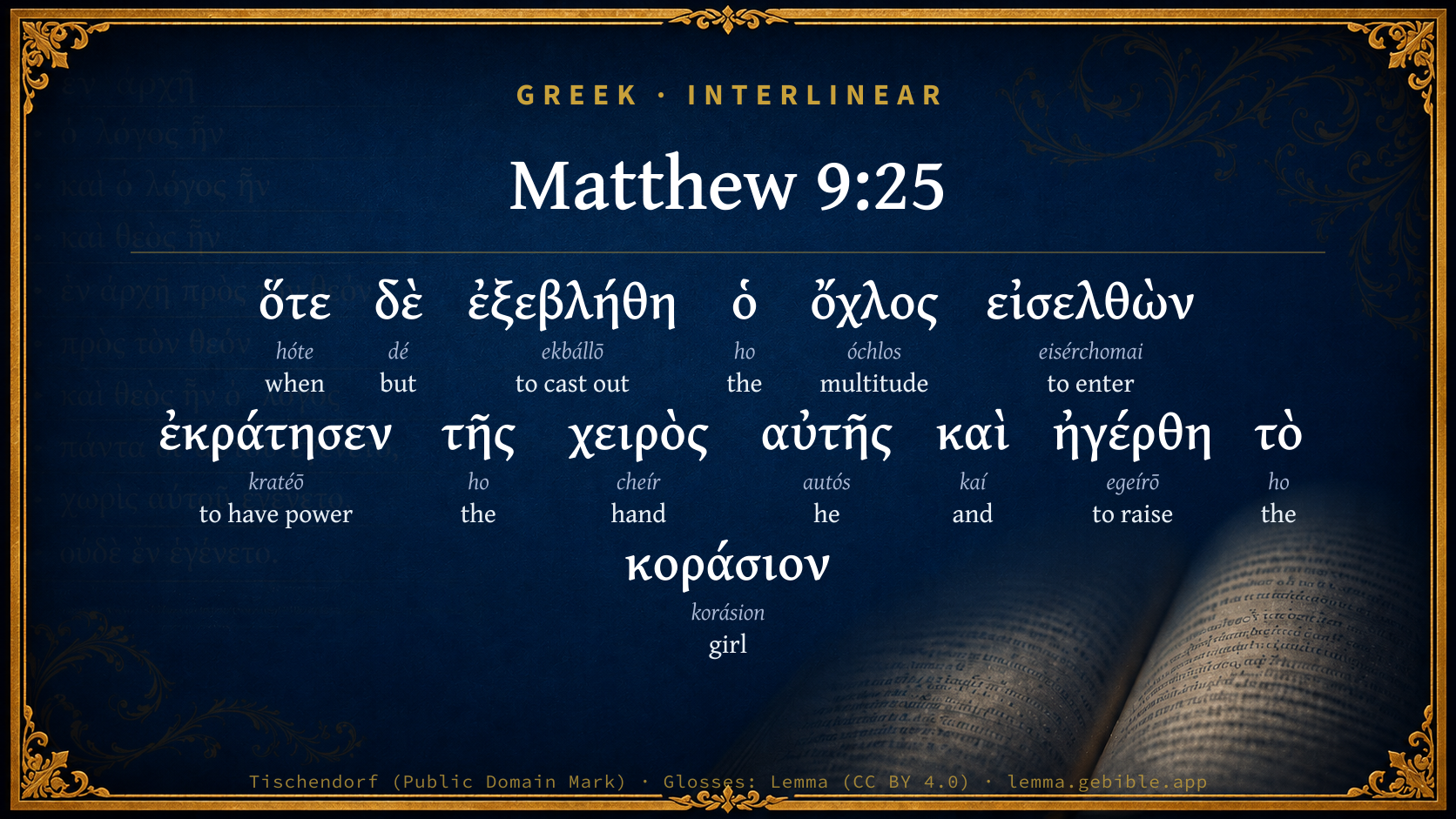
  1. ὅτε hóte G3753 “when” Adverb
  2. δὲ dé G1161 “but” Conjunction
  3. ἐξεβλήθη ekbállō G1544 “to cast out” Verb, Aorist, Passive, Indicative, 3rd person, Singular
  4. ὁ ho G3588 “the” Article, Nominative, Singular, Masculine
  5. ὄχλος óchlos G3793 “multitude” Noun, Nominative, Singular, Masculine
  6. εἰσελθὼν eisérchomai G1525 “to enter” Verb, Aorist, Active, Participle, Nominative, Singular, Masculine
  7. ἐκράτησεν kratéō G2902 “to have power” Verb, Aorist, Active, Indicative, 3rd person, Singular
  8. τῆς ho G3588 “the” Article, Genitive, Singular, Feminine
  9. χειρὸς cheír G5495 “hand” Noun, Genitive, Singular, Feminine
  10. αὐτῆς autós G846 “he” Personal pronoun, Genitive, Singular, Feminine
  11. καὶ kaí G2532 “and” Conjunction
  12. ἠγέρθη egeírō G1453 “to raise” Verb, Aorist, Passive, Indicative, 3rd person, Singular
  13. τὸ ho G3588 “the” Article, Nominative, Singular, Neuter

About this verse

These counts appear in no published source. They are computed here, from the morphology-tagged text and Lemma’s own curated glosses. What Lemma adds →

14
words
12
distinct lemmas
Gospels
section

Notable vocabulary

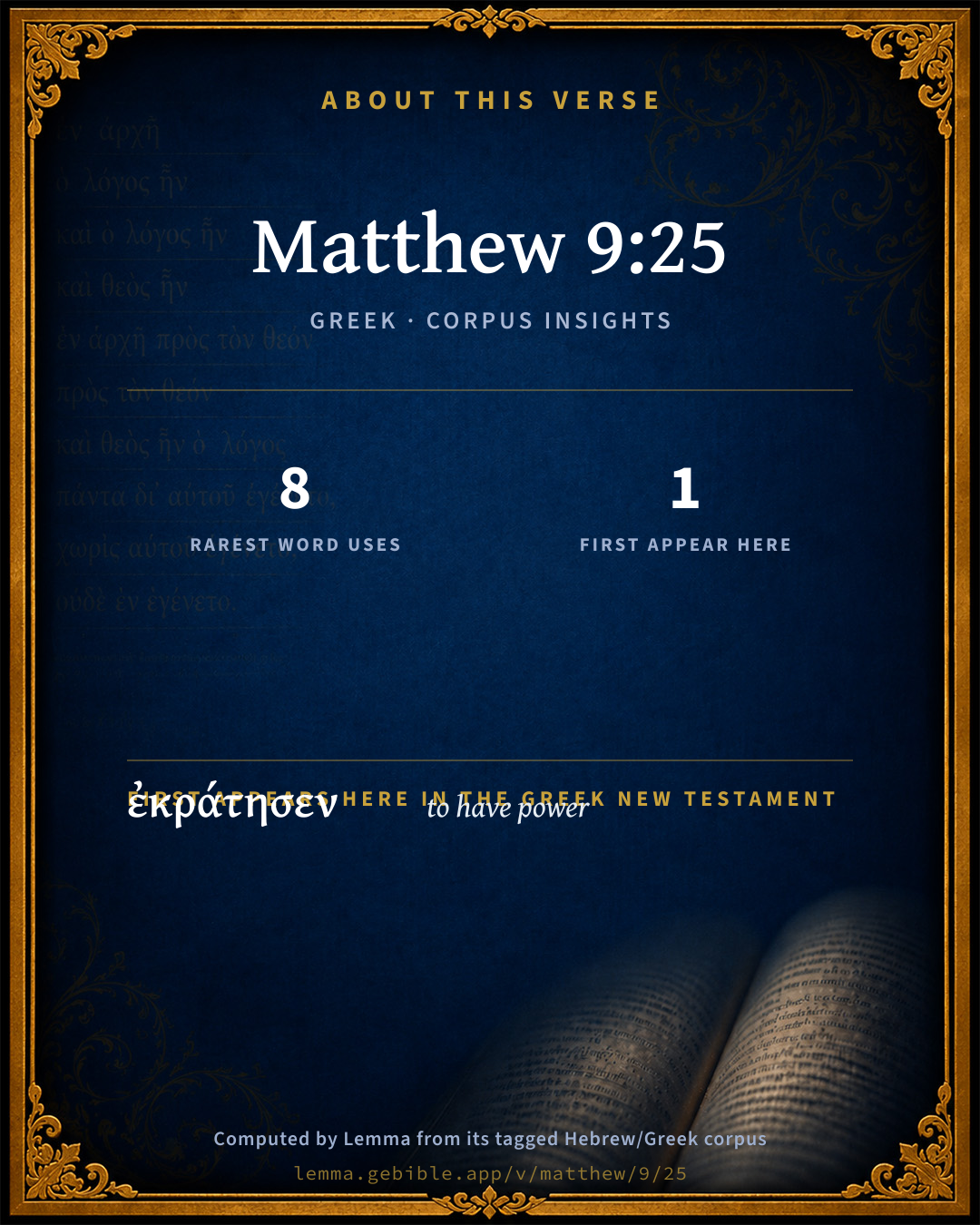
The rarest word here is κοράσιον girl G2877 — appearing just 8 times in the whole Greek New Testament.

First appearance in Scripture

This word makes its first canonical appearance in the Greek New Testament here:

  • ἐκράτησεν to have power G2902

Shared distinctive vocabulary

κοράσιον girl G2877 occurs in 7 verses of the Greek New Testament. Also found in:

Repetition

A word recurs within this verse:

Cross-references

7

Topical passages linked to Matthew 9:25 in the Treasury of Scripture Knowledge — connected by theme and wording, ordered by reader-vote popularity; previews shown in the World English Bible.

  • Mark 9:27 But Jesus took him by the hand, and raised him up; and he arose.
  • Mark 1:31 He came and took her by the hand, and raised her up. The fever left her, and she served them.
  • Mark 5:41 Taking the child by the hand, he said to her, "Talitha cumi;" which means, being interpreted, "Girl, I tell you, get up."
  • Luke 8:54 But he put them all outside, and taking her by the hand, he called, saying, "Child, arise!"
  • 2 Kings 4:32–36 When Elisha was come into the house, behold, the child was dead, and laid on his bed.
  • Mark 8:23 He took hold of the blind man by the hand, and brought him out of the village. When he had spit on his eyes, and laid his hands on him, he asked him if he saw anything.
  • Acts 9:40–41 Peter put them all out, and kneeled down and prayed. Turning to the body, he said, "Tabitha, get up!" She opened her eyes, and when she saw Peter, she sat up.

Cross-references courtesy of OpenBible.info (CC BY 4.0).

Commentary

Notes on Matthew 9:25 from classic Christian and Jewish commentators (each source and its license shown beneath its notes). The classic Christian expositions comment on the surrounding passage and are grouped to its opening verse, so a note may address several verses; the Jewish commentaries on the Tanakh (Rashi and others) are per-verse, so they appear only where the commentator wrote on this verse.

Lemma curates 59 commentaries, every one of them public domain or Creative Commons licensed, each selected and text-cleaned for this edition rather than reprinted as found. About our sources →

Joseph Benson's Commentary

Mat 9:25-26. When the people were put forth — Namely, the mourners, who, having expressed the dispositions mentioned above, were not worthy to behold the miracle; he went in — Namely, into the chamber where the corpse was lying, accompanied by none but the three disciples above mentioned, and the father and mother of the damsel, they being of all persons the most proper witnesses of the miracle, which in reality suffered nothing by the absence of the rest. For, as they were all sensible that the child was dead, they could not but be certain of the miracle when they saw her alive again, though they might not know to whom the honour of her resurrection was due. And took her by the hand — As if he had been going to awake her out of sleep: and, with a gentle voice, but such as the persons in the chamber could easily hear, he said, Talitha cumi, which is, Damsel, arise. See Mark. And the maid arose — In an instant she revived and sat up, just like a person who, being called, awakes out of a soft sleep. Luke says, Her spirit came again; an expression which implies that she was really dead, and that the soul exists separately after the body dies; a truth very necessary to be asserted in those days, when it was denied by many. Withal, her flesh, her colour, and her strength returning in the twinkling of an eye, she was not in the weak, languishing condition of one who, being worn out with a disease, had given up the ghost; for she arose and walked, Mar 5:42, being of the age of twelve years. She was not even in the languishing condition of those who come to life after having fainted away, but was in a state of confirmed good health: for it appears she was hungry, and therefore Jesus commanded to give her meat, Luk 8:55. And her parents, seeing her flesh, and colour, and strength, and appetite returned thus suddenly with her life, were unmeasurably astonished at the miracle, Luk 8:56, as well they might. He charged them, however, that they should tell no man what was done, an injunction which could not mean that her parents were to keep the miracle a secret, which was impossible to be done; for as the whole family, their friends, and all the people collected together to mourn, were witnesses of her death, so her restoration to life could not be hid from them, nor from any that had communication with them. But he meant, that they should not officiously blaze it abroad, nor even indulge the inclination which they might feel to speak of a matter so astonishing. The reason was, the miracle spake sufficiently for itself. Accordingly Matthew here tells us, The fame of it went abroad into all that land — Words which imply not only that the report of it was spread throughout that country, and that it was much spoken of, which, all circumstances considered, it could not fail to be, but that the truth of it was inquired into by many, and that upon inquiry the reality of the miracle was universally acknowledged; and, as this is the proper meaning of the observation concerning this or any other of our Lord’s miracles, (namely, that the fame of them went abroad,) so the evangelists, by thus openly and frequently appealing to the notoriety of the facts, have given us all the assurance possible of the reality of the miracles which they have recorded. See Macknight. It may not be improper to observe here that Christ raised three dead persons to life: this child, the widow’s son, and Lazarus; one newly departed, another on the bier, the third smelling in the grave: to show us that no degree of death is so desperate as to be past his help.

Joseph Benson's Commentary on the Old and New Testaments (1811–1818) — public domain. Text from a community e-Sword module.

Bengel's Gnomon

Johann Albrecht Bengel

Mat 9:25. Ἠγέρθη, she was raised) Jesus raised the dead from the bed, from the bier, from the grave; in this instance, in Luk 7:14; in Joh 11:44. It would be inquisitive to speculate concerning the state of the souls which had been separated for a short time.

Bengel's Gnomon of the New Testament — English translation (T&T Clark, Edinburgh, 1860) — public domain. Text from a community e-Sword module.

Adam Clarke's Commentary

Verse 25. He - took her by the hand, and the maid arose.] The fountain of life thus communicating its vital energy to the dead body. Where death has already taken place, no power but that of the great God can restore to life; in such a case, vain is the help of man. So the soul that is dead in trespasses and sins-that is, sentenced to death because of transgression - and is thus dead in law, can only be restored to spiritual life by the mighty power of the Lord Jesus; because HE alone has made the atonement, and HE alone can pardon transgression. If the spiritually dead person be utterly unconcerned about the state and fate of his soul, let a converted relative either bring him to Christ by leading him to hear the unadulterated Gospel of the kingdom; or bring Christ to him by fervent, faithful, and persevering prayer.

Adam Clarke's Commentary on the Bible (1810–1826) — public domain. Text from a community e-Sword/MySword module.

John Gill's Exposition

And the fame hereof went abroad into all that land. For though he strictly charged the parents, as the other evangelists say, that they should tell no man what was done, he not affecting the applause of men; yet it was not possible the thing should be entirely concealed; since there was such a number of people, not only relations, but neighbours, who full well knew, and were assured she had been dead: when these saw her alive, walk about, eat and drink, and converse with them, they must be persuaded of the miracle, and relate it wherever they came; so that the fame of it could not but be spread all over the country in which Capernaum was.

And the fame hereof went abroad into all that land. For though he strictly charged the parents, as the other evangelists say, that they should tell no man what was done, he not affecting the applause of men; yet it was not possible the thing should be entirely concealed; since there was such a number of people, not only relations, but neighbours, who full well knew, and were assured she had been dead: when these saw her alive, walk about, eat and drink, and converse with them, they must be persuaded of the miracle, and relate it wherever they came; so that the fame of it could not but be spread all over the country in which Capernaum was.

Matthew 9:27

mat 9:27

mat 9:27

mat 9:27And when Jesus departed thence,.... From the house of Jairus, to another in the same city;

two blind men followed him: very closely, by the direction of others, having heard of the miracle just now performed by him; and from thence concluded he was able to restore them to their sight;

crying and saying, with great faith and fervour, with much importunity, and frequently repeating the following words,

thou son of David, have mercy on us. Whence it appears, that they firmly believed, and were fully persuaded, that he was the true Messiah; for "the son of David" was a known character of the Messiah among the Jews: nothing was more common than to call him by this title, without any other additional epithet; see Gill on Mat 1:1, and since it had been prophesied of the Messiah, that he should "open the eyes of the blind", Isa 35:5 they might be greatly encouraged to hope and believe they should obtain mercy from him in this respect.

John Gill's Exposition of the Whole Bible (1746–1763) — public domain (CC PDM 1.0). Text via the HelloAO Bible API.

Trapp's Complete Commentary

John Trapp

25 But when the people were put forth, he went in, and took her by the hand, and the maid arose.

Ver. 25. He took her by the hand] As it were to awaken her out of a deep sleep. He could have raised her without either coming down or laying his hands upon her. But as Jairus desired him, so he did for him. Who now shall dare to despise the day of small things? Zec 4:10.

John Trapp, A Commentary or Exposition upon All the Books of the Old and New Testament (1647–1656) — public domain. Text from a community e-Sword module.

Haydock's Catholic Bible Commentary

He took her by the hand, and as in his hands is the key both of life and death, (Apocalypse i. 18,) so he commanded the soul to return and the girl to arise. (Haydock) --- and when the crowd, &c. That is, if after a sinful and worldly life we wish to rise again, and be cleansed from the miserable condition of moral sin, denoted by the girl who was dead, we must cast out of our minds the great multitude of worldly concerns; for whilst these have possession, the mind is unable to recollect itself and apply seriously to consideration. (St. Gregory)

George Leo Haydock (1774–1849), Haydock's Catholic Family Bible and Commentary, 1859 edition — public domain. Excludes Psalms (Douay-Rheims chapter numbering differs from Protestant) and Deuterocanonical books (Catholic canon only).

Matthew Poole's English Annotations

Mark saith, Mar 5:41-43, And he took the damsel by the hand and said unto her, Talitha cumi; which is, being interpreted, Damsel, I say unto thee, arise. And straightway the damsel arose, and walked; for she was of the age of twelve years. And they were astonished with a great astonishment. And he charged them straitly that no man should know it; and commanded that something should be given her to eat. Luke saith, Luk 8:54-56, And he put them all out, and took her by the hand, and called, saying, Maid, arise. And her spirit came again, and she arose straightway: and he commanded to give her meat. And her parents were astonished: but he charged them that they should tell no man what was done. It was the power and virtue that went out of Christ which wrought the miracles: he performeth them under a variety of circumstances; sometimes he used only his word, (as in the case of Lazarus), sometimes he touched the persons, laying his hand upon them; here he takes the maid by the hand, and also saith, Daughter, or maid, arise. They were words of power and authority, she presently arose. Luke saith her spirit returned again. Luke by this lets us know, that the soul is not the crasis, or some accident to the body, but a distinct subsistence of itself. For the curious question of some, where the soul of this maiden was, as also the soul of Lazarus, of whom we read in Joh 11:1-57, and others restored to life, when dead, were in the time while they were separated from their bodies; it is a matter of no great concern to us to know where: this we know, that God designed their return to their bodies again, they were not therefore fixed in their eternal mansions. Our Saviour hath taught us, that souls departed are under the conduct of angels to their stations. Lazarus’s soul was carried by angels into Abraham’s bosom. What can be opposed if we say, that it is probable the souls of these persons were under the guard of angels, about or near the dead bodies, waiting the pleasure of God with reference to them, until the Lord again commanded the restoring of them to their bodies?

He commanded to give her meat, to confirm the truth of the miracle. Concerning our Lord’s command that they should not publish what he had done, we spake before in the case of the leper. Our Lord’s time was not yet come, and he was not willing his enemies should take too public a notice of him. But Matthew saith,

The fame thereof went abroad into all that land, that is, Galilee, at some distance from Jerusalem, which was the great seat of his enemies, where probably our Saviour did least desire any public notice should as yet be taken of him.

Matthew Poole's English Annotations on the Holy Bible (1683–1685) — public domain. Text from a community e-Sword/MySword module.

The Pulpit Commentary

But when the people (crowd, Revised Version; cf. ver. 23) were put forth, he went in. Till they were cast out he would not enter. They with their hired sorrow would disturb the reverential feelings essential to the performance of such a miracle. And took her by the hand, and the maid (ver. 24, note) arose. Matthew omits all mention of Christ"s words to her, but his hgeryh is, perhaps, a reminiscence of the command egeire .

Restoration with a word.

"Took her by the band, and the maid arose." This is the first instance of our Lord"s dealing with death, which represents the extreme effect of sin. "Sin, when it is finished, bringeth forth death;" "The wages of sin is death." If our Lord had not delivered from the power of physical death, it would have been open to his enemies to say that the supreme evil of humanity he had failed to reach, That reproach cannot be made, for our Lord recovered one who had only just died; one who was being carried out for burial; and one who had lain in the grave four days. And he himself burst asunder the bands of death, when they had been fastened upon him. But the point which is more especially presented to view, in this incident, is the glorious manner in which our Lord dealt with death. There is a revelation of his glory and claim in the calmness of his mastery over the supreme human foe.

I HE RESTORED THE DEAD WITHOUT MAKING EVEN A SHOW OF AGENCIES. Here is a striking fact, which has not been duly noticed. In opening blind eyes Jesus used agencies he made clay and anointed the eyes but in neither of the cases of restoring the dead did he use any agencies. This comes to be more striking when we contrast the cases in which the great prophets, Elijah and Elisha, dealt with the dead. Elijah stretched himself upon the dead child three times. Elisha went "up" to the chamber "and lay upon the child, and put his mouth upon his mouth, and his eyes upon his eyes, and his hands upon his hands, and stretched himself upon him." The contrast is even seen in the matter of prayer. Elijah cried unto the Lord; and his prayer is given. Elisha prayed unto the Lord. But in two of the cases our Lord did not associate even prayer with the putting forth of his power to recover the dead.

II HE RESTORED TEE DEAD BY THE POWER OF A SIMPLE COMMAND. In this case our Lord"s actual words are given, "Talitha cumi." At Nain, he simply said, "Young man, I say unto thee, arise." At Bethany the words of power were, "Lazarus, come forth." What is clear is that Elijah and Elisha acted as servants; Jesus acted as Master. He claimed, and he exerted, power and authority over death. It had to take the place of one of his servants, respond to his commands, and do his bidding.

What, then, must he be who can thus deal with the one power which man has, by the experience of long ages, learned to regard as irresistible? R.T.

The Pulpit Commentary (1880–1919), ed. H.D.M. Spence-Jones & Joseph S. Exell — public domain. Text from a community e-Sword module.

John Wesley's Explanatory Notes

The maid arose - Christ raised three dead persons to life; this child, the widow's son, and Lazarus: one newly departed, another on the bier, the third smelling in the grave: to show us that no degree of death is so desperate as to be past his help.

John Wesley, Explanatory Notes Upon the Whole Bible (1754–1765) — public domain. Text via the GEBible commentary corpus.

The People's New Testament

B. W. Johnson

25. When the people were put forth. Luke (8:51). says that Peter, James and John, and the father and mother of the maiden were permitted to remain He took her by the hand. As we learn from one of the parallel accounts, he said to her, Talitha cumi. This is Aramaic, the language generally spoken by the common people in Palestine at the time of Christ. The words mean: “Rise, my child.” They were immediately obeyed. She arose, and walked.

B. W. Johnson's The People's New Testament with Notes (1889–1891) — public domain. Electronic text from the Christian Classics Ethereal Library (CCEL) ThML edition.

unfoldingWord translationNotes

Door43 World Missions Community

Connecting Statement:

This completes the account of Jesus bringing the daughter of the Jewish official back to life.

General Information:

Verse 26 is a summary statement that describes the result of Jesus raising this girl from the dead.

When the crowd had been put outside

This can be stated in active form. AT: "After Jesus had sent the crowd outside" or "After the family had sent the people outside" (See: Active or Passive)

got up

"got out of bed." This is the same meaning as in Matthew 8:15.

The news about this spread into all that region

"The people of that whole region heard about it" or "The people who saw that the girl was alive started telling everyone in the whole area about it"

unfoldingWord translationNotes — © Distant Shores Media and the Door43 World Missions Community, licensed CC BY-SA 4.0. Source: git.door43.org/Door43/en_tn.

Cambridge Greek Testament for Schools and Colleges

25. ἐξεβλήθη ὁ ὄχλος. The crowd which paid no regard to the repeated bidding (ἔλεγεν, Mat 9:24, imperf.) of Jesus was now thrust forth.

Cambridge Greek Testament for Schools and Colleges (Cambridge University Press, 1896; 21 vols, various authors incl. Carr, Maclear, Plummer, Farrar, Lumby, Moule, M. R. James, Simcox) — public domain. Text from a community e-Sword module.

Alford’s Greek Testament

Henry Alford

25.] ἐκρ. τῆς χ. αὐ. is common to the three Evangelists. From Luke we learn that our Lord said ἡ παῖς, ἔγειρε: from Mark we have the words He actually uttered, ταλιθὰ κοῦμ: from both we learn that our Lord only took with him Peter, James, and John, and the father and mother of the maiden,—that she was twelve years old,—and that our Lord commanded that something should be given her to eat. She was an only daughter, Luk 8:42.

Henry Alford, The Greek Testament (1849–1861) — public domain. Text from a community e-Sword module.

International Critical Commentary

(M) 25. And when the multitude was put out, He entered in, and took her hand, and the girl arose.] The editor here summarises Mk 40-43.—ἐξεβλήθη, ἠγέρθη] Mk. has ἐκβαλών, ἀνέστη. For Mt.’s preference for passives, see Introduction, p. xxiii.

International Critical Commentary — older volumes (1896–1929), various authors — public domain. Text from a community e-Sword module.

Lesson kit

Teaching starters — assembled from the data on this page, not authored interpretation. Every prompt links to the verse data it draws on. Edit before teaching.

Matthew, in the Gospels, opens this verse with 14 words (12 distinct Greek lemmas). Its most distinctive word is korásion (“girl”). A historical commentator’s framing appears above. Read the whole chapter for the surrounding context.

Discussion questions

  1. How does “girl” (korásion) shape what this verse is saying?
  2. The word “to have power” first appears here in Scripture. What is being introduced at this debut?
  3. Matthew 9:24 shares the word «girl» with this verse. How do the two illuminate each other?
  4. “the” occurs 3× in this one verse. What is the effect of the repetition?
  5. The translations on this page render this verse differently — a whole-verse word diff, not a word-by-word alignment. What might account for the different wordings?
  6. Reading how Joseph Benson's Commentary and Bengel's Gnomon read this verse, where do the two commentators agree and where do they part?

Things to notice

  • 1 word makes its first canonical appearance in Scripture here.
  • These translations choose different wording for 15 words in this verse.
  • “the” occurs 3× in this single verse.
  • 12 distinct Greek lemmas span 14 words in this verse.

Reading settings

Reading text

Shown beneath each verse's original-language words.

Old Testament
Old Testament edition

Read the OT as the Masoretic Hebrew (MT) or the Greek Septuagint (LXX).

English shown for the Greek Septuagint (in the Hebrew ↔ Greek comparison).

Comparing translations? Open the Compare panel on any verse page to stack up to four side by side.