
Matthew 9:6

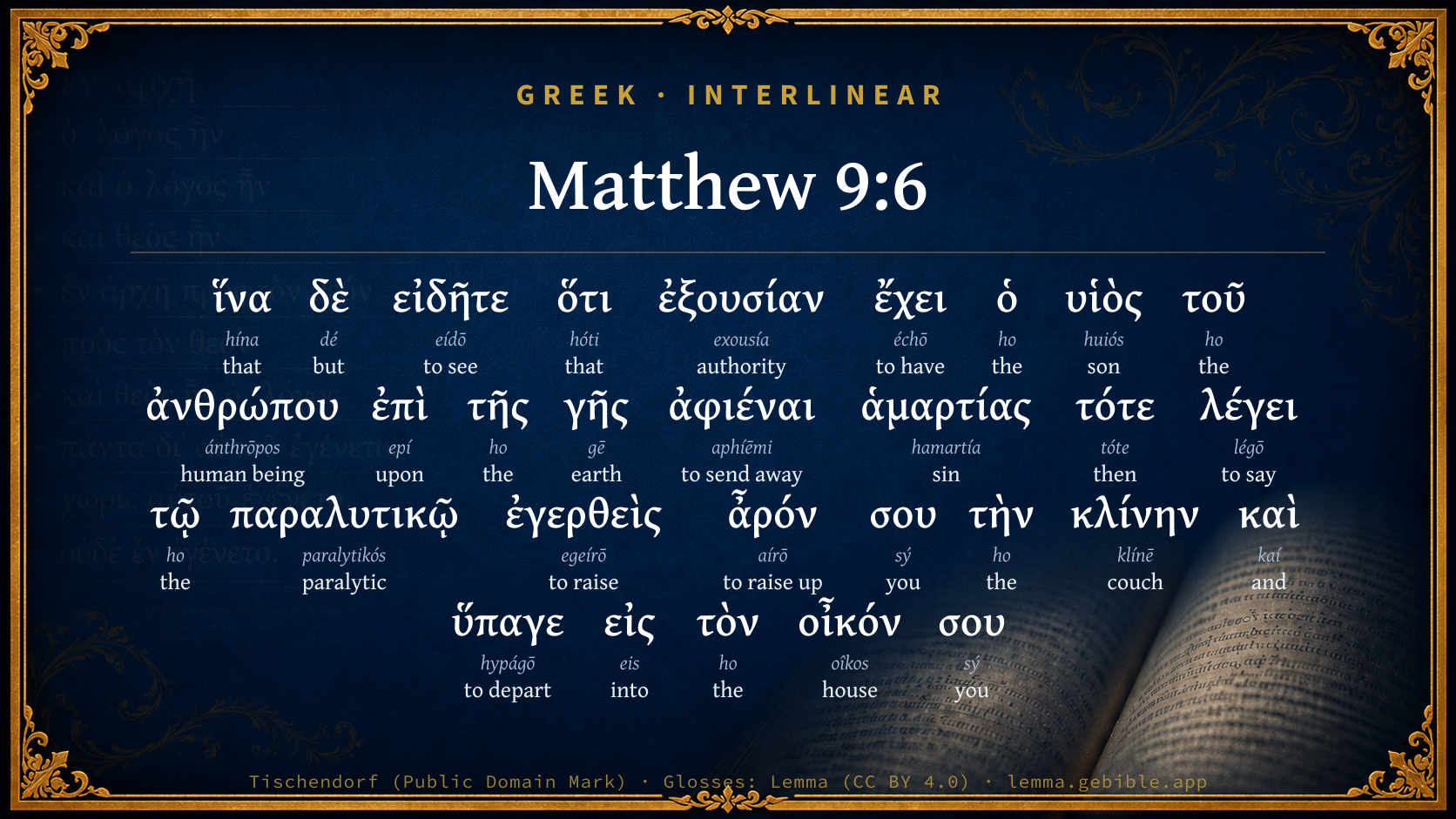
Greek (Tischendorf 8th ed.) Matthew 9:6 appears in the Greek New Testament. The text above is from the Tischendorf 8th edition. Each word links to its Strong’s number and a concise gloss. Click any word for its full Thayer’s Greek Lexicon entry.
Download image
Cite this verse

Matthew 9:6 (World English Bible). Public Domain. Lemma interlinear Bible study tool, https://lemma.gebible.app/v/matthew/9/6.

Show BibTeX & RIS
BibTeX
RIS
English Translation
But that you may know that the Son of Man has authority on earth to forgive sins..." (then he said to the paralytic), "Get up, and take up your mat, and go up to your house."
World English Bible · Public Domain
Highlights
  • 1 first appearance in the Greek New Testament
Full analysis ↓
Download a study sheet

One document with this verse’s original text, its word-by-word gloss line, the meaning frame, cross-references with their text, attributed commentary, and full source and license credits — printable, and it pastes into notes with its structure intact.

This verse Autodidact and up

Study sheet (.html) Plain text (.txt)

A passage Seminary Student

Up to 50 verses in one chapter. A passage sheet keeps up to 6 commentary sources and 12 cross-references per verse, in the order this page ranks them, and says so on the sheet whenever that leaves anything out. Ask for a single verse and you get the Autodidact verse sheet above.

Everything on this page stays free to read, with no account — the sheet is a download of what is already on screen, not access to it.

Want to remove ads? Support Godless Engineer
Compare translations 3

The same verse in 3 English versions, stacked beneath the original-language interlinear above. Click any original word for its lexicon entry.

Each is an independent rendering of the whole verse — the interlinear is not word-aligned to these translations.

Highlighted words mark where these versions differ — a whole-verse word diff, not a word-by-word alignment.

  • World English Bible Public Domain
    But that you may know that the Son of Man has authority on earth to forgive sins..." (then he said to the paralytic), "Get up, and take up your mat, and go up to your house."
  • King James Version Public Domain
    But that ye may know that the Son of man hath power on earth to forgive sins, (then saith he to the sick of the palsy,) Arise, take up thy bed, and go unto thine house.
  • unfoldingWord Literal Text CC BY-SA 4.0
    But in order that you might know that the Son of Man has authority on the earth to forgive sins,”—he then says to the paralytic—“Getting up, pick up your mat, and go to your house.”

unfoldingWord Literal Text — © unfoldingWord, licensed CC BY-SA 4.0. Word-aligned USFM3 via Door43 (git.door43.org/unfoldingWord/en_ult).

Versions to compare (up to 4)

3 of 4 selected

Show all 19 translations

Every available English version of this verse, each an independent rendering of the whole verse.

  • World English Bible Public Domain
    But that you may know that the Son of Man has authority on earth to forgive sins..." (then he said to the paralytic), "Get up, and take up your mat, and go up to your house."
  • Berean Standard Bible Public Domain
    But so that you may know that the Son of Man has authority on earth to forgive sins...” Then He said to the paralytic, “Get up, pick up your mat, and go home.”
  • Majority Standard Bible Public Domain
    But so that you may know that the Son of Man has authority on earth to forgive sins...” Then He said to the paralytic, “Get up, pick up your mat, and go home.”
  • King James Version Public Domain
    But that ye may know that the Son of man hath power on earth to forgive sins, (then saith he to the sick of the palsy,) Arise, take up thy bed, and go unto thine house.
  • American Standard Version (1901) Public Domain
    But that ye may know that the Son of man hath authority on earth to forgive sins (then saith he to the sick of the palsy), Arise, and take up thy bed, and go up unto thy house.
  • Revised Version (1885) Public Domain
    But that ye may know that the Son of man hath power on earth to forgive sins (then saith he to the sick of the palsy), Arise, and take up thy bed, and go unto thy house.
  • Geneva Bible (1599) Public Domain
    And that ye may knowe that the Sonne of man hath authoritie in earth to forgiue sinnes, (then saide he vnto the sicke of the palsie,) Arise, take vp thy bed, and goe to thine house.
  • Douay-Rheims (1899) Public Domain
    But that you may know that the Son of man hath power on earth to forgive sins, (then said he to the man sick of palsy,) Arise, take up thy bed, and go into thy house.
  • Young's Literal Translation Public Domain
    `But, that ye may know that the Son of Man hath power upon the earth to forgive sins -- (then saith he to the paralytic) -- having risen, take up thy couch, and go to thy house.'
  • Literal Standard Version CC BY-SA 4.0
    But that you may know that the Son of Man has power on the earth to forgive sins—(then He says to the paralytic)—Having risen, take up your bed, and go to your house.”
  • Unlocked Literal Bible CC BY-SA 4.0
    But that you may know that the Son of Man has authority on earth to forgive sins,... “ he said to the paralytic, “Get up, pick up your mat, and go to your house.”
  • unfoldingWord Literal Text CC BY-SA 4.0
    But in order that you might know that the Son of Man has authority on the earth to forgive sins,”—he then says to the paralytic—“Getting up, pick up your mat, and go to your house.”
  • Darby Bible Public Domain
    But that ye may know that the Son of man has power on earth to forgive sins, (then he says to the paralytic,) Rise up, take up thy bed and go to thy house.
  • World Messianic Bible Public Domain
    But that you may know that the Son of Man has authority on earth to forgive sins—” (then he said to the paralytic), “Get up, and take up your mat, and go to your house.”
  • Webster's Bible Public Domain
    But that ye may know that the Son of man hath power on earth to forgive sins, (then saith he to the sick with the palsy,) Arise, take up thy bed, and go to thy house.
  • Free Bible Version CC BY-SA 4.0
    But to convince you that the Son of man does have the authority to forgive sins…” he said to the paralyzed man, “Get up, pick up your mat, and go home!”
  • Bible in Basic English Public Domain
    But so that you may see that on earth the Son of man has authority for the forgiveness of sins, (then said he to the man who was ill,) Get up, and take up your bed, and go to your house.
  • Text-Critical English NT CC BY 4.0
    But so that you may know that the Son of Man has authority on earth to forgive sins” —then he said to the paralytic— “Rise, pick up yoʋr bed, and go to yoʋr house.”
  • Tyndale New Testament (1534) Public Domain
    That ye maye knowe that the sonne of man hath power to forgeve sinnes in erth then sayd he vnto the sicke of the palsye: arise take vp thy beed and go home to thine housse.

Literal Standard Version (2020), Covenant Press — licensed CC BY-SA 4.0. Text via the HelloAO Bible API (eBible.org). Unlocked Literal Bible (unfoldingWord) — licensed CC BY-SA 4.0. Text via the HelloAO Bible API (eBible.org). unfoldingWord Literal Text — © unfoldingWord, licensed CC BY-SA 4.0. Word-aligned USFM3 via Door43 (git.door43.org/unfoldingWord/en_ult). Free Bible Version, Dr. Jonathan Gallagher — licensed CC BY-SA 4.0. Text via the HelloAO Bible API (eBible.org).

Word by word

More ways to search: Search by grammar → Find every occurrence → Compare this word →

Practice this passage: Drill this verse → Learn its vocabulary →

κλίνην
klínē
G2825
“couch”
Noun, Accusative, Singular, Feminine
Part of Speech
Noun
Case
Accusative
Number
Singular
Gender
Feminine
Full Thayer's Definition

Origin: from G2827

TDNT: None

1. a small bed, a couch 2. a couch to recline on at meals 3. a couch on which a sick man is carried
  1. ἵνα hína G2443 “that” Conjunction
  2. δὲ dé G1161 “but” Conjunction
  3. εἰδῆτε eídō G1492 “to see” Verb, Perfect, Active, Subjunctive, 2nd person, Plural
  4. ὅτι hóti G3754 “that” Conjunction
  5. ἐξουσίαν exousía G1849 “authority” Noun, Accusative, Singular, Feminine
  6. ἔχει échō G2192 “to have” Verb, Present, Active, Indicative, 3rd person, Singular
  7. ὁ ho G3588 “the” Article, Nominative, Singular, Masculine
  8. υἱὸς huiós G5207 “son” Noun, Nominative, Singular, Masculine
  9. τοῦ ho G3588 “the” Article, Genitive, Singular, Masculine
  10. ἀνθρώπου ánthrōpos G444 “human being” Noun, Genitive, Singular, Masculine
  11. ἐπὶ epí G1909 “upon” Preposition
  12. τῆς ho G3588 “the” Article, Genitive, Singular, Feminine
  13. γῆς gē G1093 “earth” Noun, Genitive, Singular, Feminine
  14. ἀφιέναι aphíēmi G863 “to send away” Verb, Present, Active, Infinitive
  15. ἁμαρτίας hamartía G266 “sin” Noun, Accusative, Plural, Feminine
  16. τότε tóte G5119 “then” Adverb
  17. λέγει légō G3004 “to say” Verb, Present, Active, Indicative, 3rd person, Singular
  18. τῷ ho G3588 “the” Article, Dative, Singular, Masculine
  19. παραλυτικῷ paralytikós G3885 “paralytic” Adjective, Dative, Singular, Masculine
  20. ἐγερθεὶς egeírō G1453 “to raise” Verb, Aorist, Passive, Participle, Nominative, Singular, Masculine
  21. ἆρόν aírō G142 “to raise up” Verb, Aorist, Active, Imperative, 2nd person, Singular
  22. σου sý G4771 “you” Personal pronoun, 2nd person, Genitive, Singular
  23. τὴν ho G3588 “the” Article, Accusative, Singular, Feminine
  24. καὶ kaí G2532 “and” Conjunction
  25. ὕπαγε hypágō G5217 “to depart” Verb, Present, Active, Imperative, 2nd person, Singular
  26. εἰς eis G1519 “into” Preposition
  27. τὸν ho G3588 “the” Article, Accusative, Singular, Masculine
  28. οἶκόν oîkos G3624 “house” Noun, Accusative, Singular, Masculine
  29. σου sý G4771 “you” Personal pronoun, 2nd person, Genitive, Singular

About this verse

These counts appear in no published source. They are computed here, from the morphology-tagged text and Lemma’s own curated glosses. What Lemma adds →

30
words
24
distinct lemmas
Gospels
section

Notable vocabulary

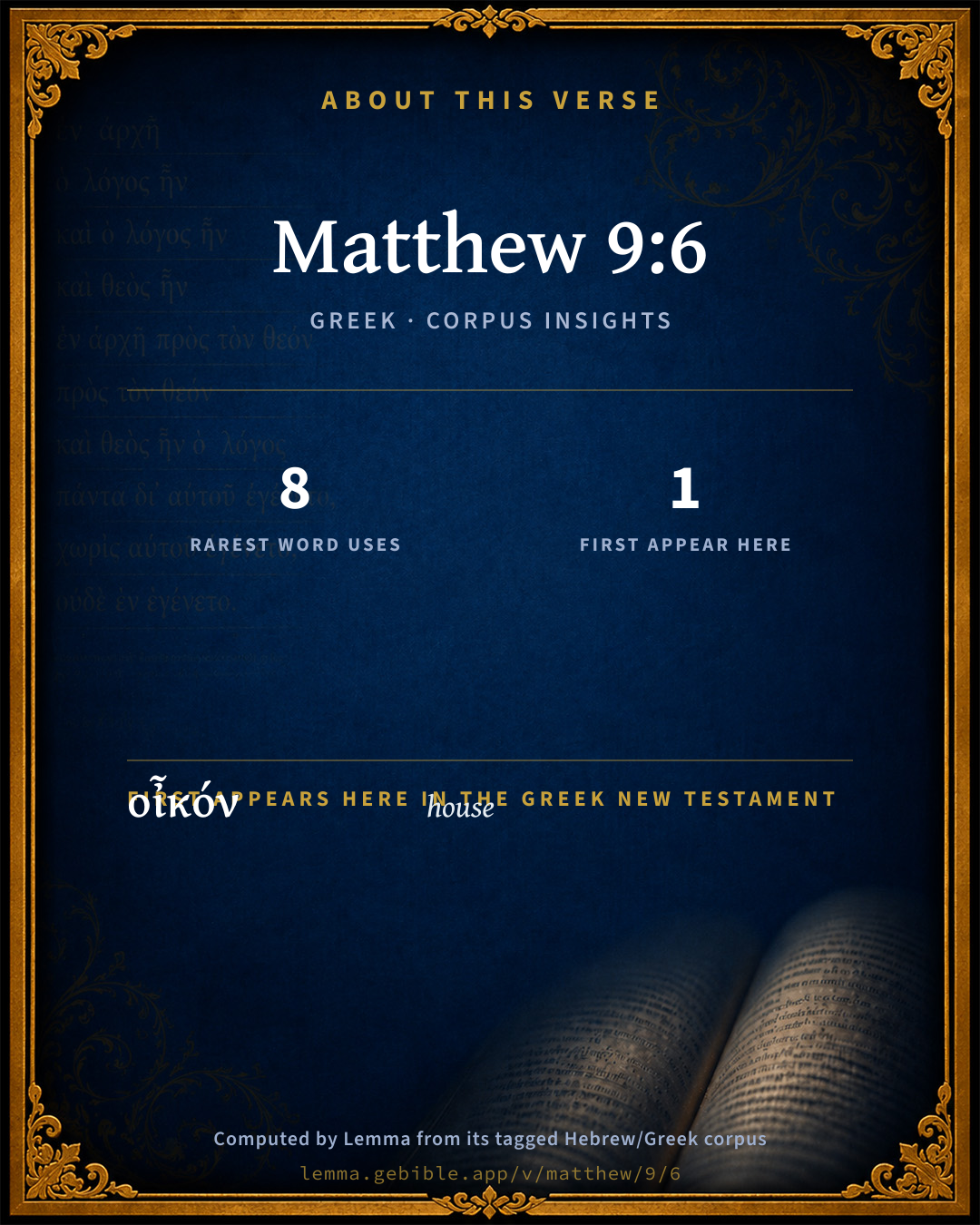
The rarest word here is κλίνην couch G2825 — appearing just 8 times in the whole Greek New Testament.

First appearance in Scripture

This word makes its first canonical appearance in the Greek New Testament here:

  • οἶκόν house G3624

Shared distinctive vocabulary

κλίνην couch G2825 occurs in 8 verses of the Greek New Testament. Also found in:
Repetition

Words recur within this verse:

Cross-references

19

Topical passages linked to Matthew 9:6 in the Treasury of Scripture Knowledge — connected by theme and wording, ordered by reader-vote popularity; previews shown in the World English Bible.

  • Isaiah 43:25 I, even I, am he who blots out your transgressions for my own sake; and I will not remember your sins.
  • Matthew 9:5 For which is easier, to say, 'Your sins are forgiven;' or to say, 'Get up, and walk?'
  • John 5:21–23 For as the Father raises the dead and gives them life, even so the Son also gives life to whom he desires.
  • John 20:21–23 Jesus therefore said to them again, "Peace be to you. As the Father has sent me, even so I send you."
  • 2 Corinthians 2:10 Now I also forgive whomever you forgive anything. For if indeed I have forgiven anything, I have forgiven that one for your sakes in the presence of Christ,
  • Micah 7:18 Who is a God like you, who pardons iniquity, And passes over the disobedience of the remnant of his heritage? He doesn't retain his anger forever, Because he delights in loving kindness.
  • Matthew 8:20 Jesus said to him, "The foxes have holes, and the birds of the sky have nests, but the Son of Man has nowhere to lay his head."
  • Mark 2:7 "Why does this man speak blasphemies like that? Who can forgive sins but God alone?"
  • Mark 2:10 But that you may know that the Son of Man has authority on earth to forgive sins"--he said to the paralytic--
  • Luke 5:21 The scribes and the Pharisees began to reason, saying, "Who is this that speaks blasphemies? Who can forgive sins, but God alone?"
  • Luke 13:11–13 Behold, there was a woman who had a spirit of infirmity eighteen years, and she was bent over, and could in no way straighten herself up.
  • John 10:28 I give eternal life to them. They will never perish, and no one will snatch them out of my hand.
  • John 17:2 even as you gave him authority over all flesh, he will give eternal life to all whom you have given him.
  • Acts 5:31 God exalted him with his right hand to be a Prince and a Savior, to give repentance to Israel, and remission of sins.
  • Acts 7:59–60 They stoned Stephen as he called out, saying, "Lord Jesus, receive my Spirit!"
  • Acts 9:34 Peter said to him, "Aeneas, Jesus Christ heals you. Get up and make your bed!" Immediately he arose.
  • 2 Corinthians 5:20 We are therefore ambassadors on behalf of Christ, as though God were entreating by us. We beg you on behalf of Christ, be reconciled to God.
  • Ephesians 4:32 And be kind to one another, tenderhearted, forgiving each other, just as God also in Christ forgave you.
  • Colossians 3:13 bearing with one another, and forgiving each other, if any man has a complaint against any; even as Christ forgave you, so you also do.

Cross-references courtesy of OpenBible.info (CC BY 4.0).

Commentary

Notes on Matthew 9:6 from classic Christian and Jewish commentators (each source and its license shown beneath its notes). The classic Christian expositions comment on the surrounding passage and are grouped to its opening verse, so a note may address several verses; the Jewish commentaries on the Tanakh (Rashi and others) are per-verse, so they appear only where the commentator wrote on this verse.

Lemma curates 59 commentaries, every one of them public domain or Creative Commons licensed, each selected and text-cleaned for this edition rather than reprinted as found. About our sources →

The Biblical Illustrator

Joseph S. Exell

Mat_9:6

But that ye may know that the Son of Man.

Forgiveness

This narrative is remarkable,

1. Because it is evident that while our Lord forgave the sick mans sins for his own sake, He healed his disease for the sake of those who stood by.

2. Because our Lord claims the power of forgiving sins, not because He is the Son of God, but because He is the Son of Man.

3. It is one of the very rare instances in which a miracle seems to have been performed for the purpose of convincing unbelief. What is this forgiveness? It must be the same thing as human forgiveness. Forgive us our trespasses, as we forgive them that trespass against us. It therefore cannot mean the remission of punishment. Forgiveness is reconciliation; the offence is no longer allowed to stand between the parties. When God forgives He receives us back to His favour. It is free, full, and outruns our repentance. But He does not destroy the consequences of sin; the punishment remains. But it entirely changes the character of the punishment. What we regarded as the blow of an angry Ruler, becomes the chastisement of a kind Father. Our Lord claims the power of forgiving sins, not because He is the Son of God, but because He is the Son of Man. Why does our Lord thus describe Himself? We are accustomed to think that the pardon of sin is a power possessed by God alone. When Christ calls Himself the Son of Man, He is displaying before our eyes a pattern of what we ought to be, and of powers we ought to possess. Were we perfect beings, the power of forgiving sins would be ours. The ministry of reconciliation is committed to man. The forgiveness of sins is the reconciliation of the sinner to God; people of great personal holiness have the power of reconciling sinners to God. This may fall short of the power to forgive; but it is because the holiest man falls short of the measure of Christ. We may now see why our Lord accepted the challenge of unbelief. He cured the man to show the bystanders that they ought to have like power. It was man, not God, who had made the way of forgiveness hard. Love raised the life that self-righteous scorn had trampled down. (J. P. Wright, M. A.)

The forgiveness of sins

Christ here addressed the soul of the man first; sometimes His first attention was given to the body. From the indiscriminate order of Christs procedure in this matter, we like to see how body and soul are equally dear to God. The power which is given to Christ upon earth to forgive sins.

1. There is a beautiful justice in the fact that He who purchased the pardon, at such an untold price of suffering, should be the one to whom it is permitted to have the joy of giving it.

2. At the moment when our blessed Lord said these words the apostles were all standing by; and He did His own work, in His own solitude, to His own glory.

3. In these words on earth I read the blessed promise that so long as this earth shall last, more and more wicked though it may grow, He will never leave this earth while it is an earth, but will be always here to do His forgiving work. (J. Vaughan, M. A.)

The forgiveness of sins

I. As the great want of man.

II. As the peculiar achievement of christ.

III. As the primary offer of the gospel. (J. A. Seiss, D. D.)

1. The force of the name Son of Man, implying

(1) Divine origin.

(2) Representative of manhood. Not the Son of the Jew, or carpenter.

(3) Brotherhood.

(4) Manlike sympathy.

2. His grand prerogative-power on earth to forgive sins.:Forgiveness is His own right by virtue of His

(1) Sacrifice;

(2) Intercession (Act_5:31).

3. The great blessing-forgiveness. The soul might have been healed and the body untouched; but the paralysis, both moral and physical, was removed.

(1) Forgiveness is obtainable on earth.

(2) Many realized it now. (J. Harris.)

The Son of Man

There have been two men in the world, says St. Paul: the fallen Adam, with his infantile and undeveloped perfections; and the Christ, with His full and complete humanity. All other men are fragments; He is the Entire and perfect Chrysolite. Aristotle is but the rubbish of an Adam, and Adam is but the dim outline sketch of a Jesus. And between the two there have been none. The one Man as God meant Him, the type of man, the perfect humanity, the realized ideal, the home of all the powers of manhood. (Dr. Maclaren.)

Eastern beds

The Oriental frequently spreads a mat upon the ground and sleeps in the open air. In the morning he rolls up his mat, and carries it away. (A. Cart, M. A.)

Forgiveness personal

The Rev. H. Wilkins, Cheltenham, in Good Cause for Good Cheer, writes: It is no general statement, but a personal assurance of the forgiveness of sins. Looking with His own keen glance of love into the sick mans eyes, He says: Thy sins be forgiven thee. The general truth of the pardon of sins is not enough for us, we want a personal forgiveness. One day when Martin Luther was almost overwhelmed with despair in his cell at Erfurth, an old monk tried to comfort him by repeating the article of the Apostles Creed, I believe in the forgiveness of sins. Luther often repeated the same words. Ah! said the good old monk, it is not enough to believe in the forgiveness of Davids sins or Peters sins; this the devils believe. Gods command is to believe that our own sins are forgiven. This was the assurance that Jesus gave here. He knew this mans life-history; He knew, probably, that there was a close connection between his suffering and his sin; but whatever his sins were, they were frankly forgiven.

The Biblical Illustrator, edited by Joseph S. Exell (c. 1880s–1900s) — public domain. Text from a community e-Sword module.

Tyndale Open Study Notes

Tyndale Open Resources

9:6 So I will prove: Jesus performed the miracle to reveal his authority and identity as God’s Messiah (see 11:2-6; 12:28).

Tyndale Open Study Notes — © Tyndale Open Resources, licensed CC BY-SA 4.0. Text via the HelloAO Bible API.

Bengel's Gnomon

Johann Albrecht Bengel

Mat 9:6. Εἰδῆτε, ye may know) This word also breathes authority.[396]—ἐπὶ τῆς γῆς, on earth) This is exclusively the place where sins are committed and remitted. Earth was the scene of Christ’s works from the beginning.[397] See Pro 8:31; cf. the two clauses in Psa 16:3; see[398] Jer 9:24; Joh 17:4; Luk 2:14. I have, says He, all authority in heaven, much more on earth; see ch. Mat 16:19, Mat 28:18.[399] This speech savours of a heavenly origin.—ἐξουσίαν, authority) The argument from power to authority holds good in this passage.—λέγει, He saith) A similar change of person between the protasis and apodosis occurs in Num 5:20-21, and Jer 5:14.

[396] Bengel just below translates ἐξουσίαν (rendered in E. V. power) by “authority,” and refers to it by anticipation.—(I. B.)

[397] Nay more, it is the wrestling arena between sin and grace.—V. g.

[398] E. B. inserts here “Gen 6:5,” which has been adopted by the later editions.—(I. B.)

[399] We also in our turn may now say: Seeing that He had that power, when sojourning on the earth, why should He not also have the same, now that He has been raised from the dead and taken up into heaven? Act 5:31.—V. g.

Bengel's Gnomon of the New Testament — English translation (T&T Clark, Edinburgh, 1860) — public domain. Text from a community e-Sword module.

Meyer's Critical & Exegetical Commentary

Heinrich August Wilhelm Meyer

Mat_9:6-7. Ἐξουσίαν ἔχει] placed near the beginning of the sentence so as to be emphatic: that the Son of man is empowered upon earth (not merely to announce, but) to communicate the forgiveness of sins. ἐπὶ τῆς γῆς does not belong to ἀφ. ἁμ. (Grotius),in which case its position would convey an awkward emphasis, and the order of the words would naturally be ἀφ. ἁμ. ἐπὶ τ. γῆς (as Marcion read them),but it is joined to ἐξουσίαν ἔχει in the consciousness of the ἐξουσία brought with Him from heaven. Coelestem ortum hic sermo sapit, Bengel.

τότε λέγει τῷ παραλυτ.] is neither to be taken parenthetically, nor is τόδε to be understood (Fritzsche), in order to justify the parenthesis; but Matthews style is such that no formal apodosis comes after ἁμαρτίας, but rather the call to the paralytic ἐγερθείς, etc. Matthew reports this change in regard to the parties addressed with scrupulous fidelity; and so, after concluding what Jesus says to the scribes with the anacoluthon ἵνα δὲ εἰδῆτε … ἁμαρτίας, he proceeds to add, in the narrative form, then He says to the paralytic. This is a circumstantial simplicity of style which is not to be met with in polished Greek writers, who would have omitted the τότε λέγει τῷ παραλ. altogether as a mere encumbrance. See passages from Demosthenes in Kypke, I. p. 48 f.

καὶ ἐγερθεὶς, κ.τ.λ.] therefore an immediate and complete cure, which does not favour the far-fetched notion that the declaration of Jesus penetrated the nervous system of the paralytic as with an electric current (Schenkel).

Meyer — Critical and Exegetical Commentary on the New Testament — English translation by Peter Christie, edited by Frederick Crombie (T&T Clark, 1880) — public domain. Text from a community e-Sword module.

Expositor's Greek Testament

ed. W. Robertson Nicoll

Mat 9:6 . ἵνα δὲ εἰδῆτε : transition to the other aspect, that of ἐξουσία , the point raised by the scribes when they looked a charge of blasphemy. ὁ υἱὸς τοῦ ἀν ., ἐπὶ τῆς γῆς : these two phrases point at supposed disabilities for forgiving. “Forgiveness takes place in heaven, and is the exclusive prerogative of God,” was the thesis of the scribes. “It may be exercised even on earth, and by the Son of Man,” is the counter thesis of Christ. Therefore “Son of Man” must be a title not of dignity but of humiliation. Here = one whom ye think lightly of; even He can forgive. τότε λέγει . Jesus stops short in His speech to the scribes and turns to the sick man, saying: ἔγειρε , etc., also in Mat 9:6 , intransitive. The reading ἔγειραι in T.R., Mat 9:6 , is a correction of style, the use of the active intransitively being condemned by grammarians. Hence this various reading always occurs. ( vide Suidas, s.v., and Buttmann, Gramm. , p. 56.) τὴν κλίνην , a light piece of furniture, easily portable. ὕπαγε : all three actions, arising, lifting, walking , conclusive evidence of restored power.

The Expositor's Greek Testament, edited by W. Robertson Nicoll (1897–1910) — public domain. Text from a community e-Sword module.

Adam Clarke's Commentary

Verse 6. But that ye may know, c.] External miracles are the proofs of internal ones. Three miracles are wrought in this case. (I mean, by miracle, something produced or known that no power is capable of but that which is omnipotent, and no knowledge adequate to but that which is omniscient.) The miracles are these:

1st. The remission of the poor man's sins.

2d. The discernment of the secret thoughts of the scribes.

3d. The restoring of the paralytic, in an instant, to perfect soundness.

Thus one miracle becomes the proof and establishment of another. Never was a clearer proof of omnipotent energy and mercy brought under the senses of man. Here is an absolutely perfect miracle wrought and here are absolute incontestable proofs that the miracle was wrought; and the conclusion is the fullest demonstration of the Divinity of the ever-blessed Jesus.

Arise, take up thy bed] Being enabled to obey this command was the public proof that the man was made whole. Such a circumstance should not pass without improvement. A man gives proof of his conversion from sin to God who imitates this paralytic person. He who does not rise and stand upright, but either continues grovelling on the earth, or falls back as soon as he is got up, is not yet cured of his spiritual palsy. When we see a penitent enabled to rejoice in hope of God's glory, and to walk in the way of his commandments, he affords us all the proof which we can reasonably require, that his conversion is real: the proof sufficient to satisfy himself is the witness of the Holy Spirit in his own heart; but this is a matter of which those who are without cannot judge: they must form their opinion from his conduct, and judge of the tree by its fruits.

Adam Clarke's Commentary on the Bible (1810–1826) — public domain. Text from a community e-Sword/MySword module.

Ellicott's Commentary for English Readers

(6) That ye may know that the Son of man hath power.—Better, authority, as in Joh_5:27. The two passages are so closely parallel that we can hardly be wrong in thinking that the words now spoken were meant to recall those which some, at least, of those who listened had heard before. This view, at any rate, brings out the fulness of their meaning. As they stand here, they seem to include both the two hypotheses mentioned in the Note on Mat_9:3. The Father had given Him authority to “forgive sins” and to “execute judgment” because He was the Son of Man, the representative of mankind, and as such was exercising a delegated power. But then, that discourse in John 5 showed that He also spoke of Himself as the Son of God as well as the Son of Man (Joh_5:25), and as such claimed an honour equal to that which was rightly paid to the Father (Joh_5:23). Ultimately, therefore, our Lord’s answer rests on the higher, and not the lower, of the two grounds on which the objectors might have been met.

Arise, take up thy bed.—As St. Mark gives the words we have the very syllables that had been spoken to the “impotent man” at Bethesda (Joh_5:8), and in any case words identical in meaning; and the natural inference is that our Lord meant to recall what the scribes from Jerusalem had then seen and heard.

A Bible Commentary for English Readers, edited by Charles John Ellicott (1878–1897) — public domain. Text from a community e-Sword module.

The Cambridge Bible for Schools and Colleges

gen. ed. J. J. S. Perowne

6. take up thy bed] The Oriental frequently spreads a mat upon the ground and sleeps in the open air, in the morning he rolls up his mat and carries it away.

The Cambridge Bible for Schools and Colleges (gen. ed. J. J. S. Perowne; Cambridge University Press, 1878–1918) — public domain. Text from a community e-Sword module.

John Gill's Exposition

But that ye may know that the son of man,.... That they might have a visible proof, an ocular demonstration, that though he was the son of man, truly and really man, yet not a mere man; but also as truly and properly God, God and man in one person, and so

hath power on earth to forgive sins: not only ability as God, but even authority to do it as mediator, even whilst he was on earth, in a state of humiliation, in fashion as a man, in the form of a servant, conversing with sinful mortals.

Then saith he to the sick of the palsy; turning himself from the Scribes, unto him, and without putting up any prayer to God, but by a mere word of command, says to him,

arise, take up thy bed, and go unto thine house: he ordered him to "arise" from his bed, on which he was carried by four men, and "take up his bed", and carry it himself; which would be not only an evidence that the disease had left him, but that he was in full strength, and perfect health; and to "go" to his own "house", not only that the multitude might see that he could walk home himself, whom they had seen brought by others; but that those in the house, who had been eyewitnesses of his great disorder and weakness, might be also of his cure.

John Gill's Exposition of the Whole Bible (1746–1763) — public domain (CC PDM 1.0). Text via the HelloAO Bible API.

Trapp's Complete Commentary

John Trapp

6 But that ye may know that the Son of man hath power on earth to forgive sins, (then saith he to the sick of the palsy,) Arise, take up thy bed, and go unto thine house.

Ver. 6. That the Son of man hath power, &c.] And therefore is more than a man. The Rhemists tell us of one man that could remove mountains. But none but the man Christ Jesus could ever remit sins. He only it is that blots out the cloud, and the thick cloud too, enormities as well as infirmities, Isa 44:22, for this is a true axiom, Peccata non minuunt iustificationem, though sins be different, justification is not. Take heed ye add not words to God’s covenant.

John Trapp, A Commentary or Exposition upon All the Books of the Old and New Testament (1647–1656) — public domain. Text from a community e-Sword module.

Albert Barnes' Notes on the Bible

But that ye may know ... - That you may have full proof on that point; that you may see that I have power to forgive sin, I will perform an act which all must perceive and admit to require the power of God.

Arise, take up thy bed, and go unto thine own house - The fact that the paralytic man could do this would prove that a miracle was performed. He was healed by a word; it was done instantaneously; it was done in the most public manner. The fact that a man, just before perfectly helpless, could now take up and carry his own bed or couch, proved that a divine “power” had been exerted; and that fact proved that he who had performed the miracle must also have the “power” and the “authority” to forgive sin. It is proper to add, in illustrating this, that in the East a “bed” is often nothing more than a bolster and a blanket spread on the floor. “The bed provided for me,” says Professor Hackett (“Illustrations of Scripture,” p. 112) “consisted merely of a bolster and a blanket spread on the floor. The latter could be drawn partially over the body if any one wished, though the expectation seemed to be that we should sleep in our ordinary dress, without any additional covering. Such a bed is obviously a portable one; it is easy to take it up, fold it together, and carry it from place to place, as convenience may require.”

Albert Barnes' Notes on the Bible (1834–1885) — public domain. Text from a community e-Sword/MySword module.

Haydock's Catholic Bible Commentary

But that you may know. This may be understood differently, either as spoken by Christ to the Jews present, or by the evangelist to the people to whom he wrote his gospel. (St. Thomas Aquinas) --- Thus Christ proves that he had the power of remitting sins; as a falsity cannot be confirmed by a miracle, since in this case God would bear testimony to a falsity. (Menochius) --- Take thy bed, &c. This doubtless was commanded him, to convince the whole world that this was no phantom, and to add still greater credibility to the fact, and he rose, &c. --- He who was pleased to become man, is truly the Son of God; and, in this quality, he possesses all power. This he proves by the double exercise of his power over both soul and body. (Haydock) --- Surge, tolle, and vade, Christ added these words for the greater evidence of the cure. (Maldonatus)

George Leo Haydock (1774–1849), Haydock's Catholic Family Bible and Commentary, 1859 edition — public domain. Excludes Psalms (Douay-Rheims chapter numbering differs from Protestant) and Deuterocanonical books (Catholic canon only).

Whedon's Commentary on the Bible

Daniel D. Whedon

6. Power on earth — The counterpart of power in heaven. It could be no superior scientific skill, it could be no mere earthly magnetic power, it could be no accidental coincidence of events.

Take up thy bed — A light mattress. Other men brought him on the bed; he can now carry himself away, bed and all.

Daniel D. Whedon (gen. ed.), Commentary on the Old and New Testaments (1874–1909) — public domain. Text from a community e-Sword module.

The Pulpit Commentary

But that ye may know. From his authority in the physical world they may have direct knowledge (eidhte) of his authority in the spiritual world. Observe that the claim is even in the so-called "Triple Tradition." That the Son of man hath power (better, authority, with Revised Version margin, and the American Committee) on earth to forgive sins (oti exousian ecei o uiopou epi thv ghv afienai amartiav). Observe

(1) that our Lord does not say "I," but "the Son of man";

(2) that the emphatic words in the sentence are "hath authority," and "on earth." It would therefore appear as though our Lord wished to call the attention of those present to a phrase which they already knew, but did not rightly understand. He seems to point them to Dan_7:13, and reminding them that even there "one like unto a son of man" (cf. supra, Mat_8:20, note) receives authority (h exousia autou exousia aiwniov , ver. 14), tells them that this authority includes forgiving sins, and that this may be exercised not only in the future and in "the clouds of heaven," but now (ecei) and "on earth." Further, if, as seems likely,. the phrase was understood to symbolize the nation, he desired them to see in himself the great means whereby the nation should rise to its ideal. If, as is possible, though hardly probable, this saying of our Lord"s is chronologically earlier than Mat_8:20, and therefore the earliest occasion on which he used the phrase, the almost direct reference to Dan_7:13 makes it the more interesting. (Then saith he to the sick of the palsy). The thought of the sentence is continued, but as he now turns directly to the sick man, its form is altered. Arise, take up. The Revised Version, retaining the wrong reading, egeryeiv , inserts "and." Thy bed (ver. 9, note), and go unto thine house. Thus avoiding publicity.

The Pulpit Commentary (1880–1919), ed. H.D.M. Spence-Jones & Joseph S. Exell — public domain. Text from a community e-Sword module.

John Wesley's Explanatory Notes

On earth - Even in my state of humiliation.

John Wesley, Explanatory Notes Upon the Whole Bible (1754–1765) — public domain. Text via the GEBible commentary corpus.

Scofield Reference Notes

C. I. Scofield

Son of man

(See Scofield "Mat 8:20").

sins Sin. (See Scofield "Rom 3:23").

The Scofield Reference Bible (1917 edition), notes by C. I. Scofield — public domain. Text from a community e-Sword module.

Kretzmann's Popular Commentary

Paul E. Kretzmann

The argument in deed:

v. 6. But that ye may know that the Son of Man hath power on earth to forgive sins, (then saith He to the sick of the palsy,) Arise, take up thy bed, and go unto thine house.

v. 7. And he arose and departed to his house.

Far from admitting a pretension on His part which would amount to a blasphemy, He, the Son of Man, deliberately assumes a divine prerogative also in healing the body. The greater includes the smaller: the right and the authority to pardon sins implies the power and the ability to heal mere bodily ailments. If He had been guilty of blasphemy, He could not have had the authority to cure the sick man by a peremptory command. He, the true human being, is nevertheless not a mere man, but can command the sickness and restore the sick to complete health by a word of His almighty power. The man that had been chained to his cot in utter helplessness could now shoulder this same cot and walk out in the fullness of perfect vitality.

Paul E. Kretzmann, Popular Commentary of the Bible (1921–1924) — public domain. Text from a community e-Sword module.

The People's New Testament

B. W. Johnson

6. But that ye may know. By doing that which is capable of being put to the proof, I will vindicate my right and power to do that which in its very nature is incapable of being put to the proof of the senses. The Son of man cannot simply mean a man, or a mere man, since the powers in question do not to men as such. The true sense is determined by Daniel 7:13, where the phrase is confessedly applied to the Messiah, as a partaker of our nature. Hath power on earth to forgive sins. “Authority” is a better rendering than “power,” and it is so given by the American Revision Committee. He had “authority” from the Father who had sent him, and who had committed judgment to his hands on earth. Sins are against God, and therefore only God can forgive them; for in the nature of things only he can forgive against whom the offense has been committed, but Jesus was “God manifest in the flesh.” I can forgive sins committed against myself, but not those committed against my neighbor, much less those against God. Christ's argument here affords a fair test of all priestly claims to absolve from sin. If the priest has power to remit the eternal punishment of sin, he should be able, certainly, to remit the physical and temporal punishment of sin. This Christ did; this the priest does not, and cannot do.

B. W. Johnson's The People's New Testament with Notes (1889–1891) — public domain. Electronic text from the Christian Classics Ethereal Library (CCEL) ThML edition.

Cambridge Greek Testament for Schools and Colleges

6. ἆρόν σου τὴν κλίνην. The Oriental frequently spreads a mat upon the ground and sleeps in the open air, in the morning he rolls up his mat and carries it away.

Cambridge Greek Testament for Schools and Colleges (Cambridge University Press, 1896; 21 vols, various authors incl. Carr, Maclear, Plummer, Farrar, Lumby, Moule, M. R. James, Simcox) — public domain. Text from a community e-Sword module.

Alford’s Greek Testament

Henry Alford

6. ὁ υἱ. τ. ἀνθ.] The Messiah: an expression regarded by the Jews as equivalent to ὁ χριστὸς ὁ υἱὸς τοῦ θεοῦ, ch. 26:63. See also Joh 5:27. “The Alexandrian Fathers, in their conflict with the Nestorians, made use of this passage in proof of the entire transference which there was of all the properties of Christ’s divine nature to His human; so that whatever one had, was so far common, that it might also be predicated of the other. It is quite true that had not the two natures been indissolubly knit together in a single Person, no such language could have been used; yet I should rather suppose that ‘Son of Man’ being the standing title whereby the Lord was well pleased to designate Himself, bringing out by it that He was at once one with humanity, and the crown of humanity, He does not so use it that the title is every where to be pressed, but at times simply as equivalent to Messiah.” Trench, p. 208.

ἐπὶ τῆς γῆς] Distinguished from ἐν τῷ οὐρανῷ, as in ch. 16:19; 18:18. Bengel finely remarks, “Cœlestem ortum hic sermo sapit.” The Son of Man, as God manifest in man’s flesh, has on man’s earth that power, which in its fountain and essence belongs to God in heaven. And this not by delegation, but “because He (being God) is the Son of Man.” Joh 5:27.

τότε λέγει] See a similar interchange of the persons in construction, Gen 3:22, Gen 3:23.

τότε λέγει τῷ π. is not parenthetic, nor is ἵνα δὲ εἰδῆτε κ.τ.λ. an elliptic sentence; but the speech and narrative are intermixed. A simple construction would require either ἵνα δὲ εἰδῆτε.… ὧδε λέγω τῷ παρ …, or ἵνα δὲ εἰδῶσιν … τότε λέγει … We have, in the text, the first member of the former construction joined with the second of the latter.

Henry Alford, The Greek Testament (1849–1861) — public domain. Text from a community e-Sword module.

International Critical Commentary

(M) 6. But that you may know that the Son of Man upon earth hath authority to forgive sins, then He saith to the paralytic, Arise, take up thy bed, and go to thy house.] Mk. has: “But that ye may know that the Son of Man hath authority upon earth to forgive sins, He saith to the paralytic, Take up thy pallet, and go to thy house.” For the parenthetical clause breaking the construction as suggesting dependence of one Gospel upon another, cf. Hor. Syn. p. 42, and Mar 1:16 = Mat 4:18, Mar 5:28 = Mat 9:21, Mar 14:2 = Mat 26:5, Mar 15:10 = Mat 27:18. The construction of ἐπὶ τῆς γῆς is ambiguous. In Mk. it occurs as here before, ἀφιέναι ἁμαρτίας (so א C D al latt S3, but B Φ place it afterward). The ambiguity is therefore due to Mk. The somewhat emphatic position of ἐπὶ τῆς γῆς seems intended to give implicit expression to the underlying contrast in heaven. In heaven, God alone can forgive sins, but on earth the Son of Man has authority (delegated to Him by God) to do so. For “Son of Man,” see Introduction, p. lxxi. It is, of course, possible that in the Aramaic phrase originally used here by Christ, “Son of Man” meant (in this passage, not necessarily elsewhere) “man”—“That you may know that men share with God His divine prerogative of forgiving sins.” But if Mk. had thus mistranslated the original Aramaic1 by ὁ υἱὸς τοῦ ἀυθρώπου instead of οἱ ἄνθρωποι, it is hardly possible that Mt. would not have corrected him. He therefore probably understood the phrase in Mk v. 10 as referring to Christ. The Son of Man has received from God the power of exercising a function otherwise restricted to God alone. Cf. Dalm. Words, 261.

κλίνη for Mk.’s κράβαττος, as in v. 2. For τότε in Mt., see on 2:7.—σου τὴν κλίνην] See on v. 5.

International Critical Commentary — older volumes (1896–1929), various authors — public domain. Text from a community e-Sword module.

Lesson kit

Teaching starters — assembled from the data on this page, not authored interpretation. Every prompt links to the verse data it draws on. Edit before teaching.

Matthew, in the Gospels, opens this verse with 30 words (24 distinct Greek lemmas). Its most distinctive word is klínē (“couch”). A historical commentator’s framing appears above. Read the whole chapter for the surrounding context.

Discussion questions

  1. The word klínē carries the sense “couch.” How does it shape the verse?
  2. This is the first place “house” appears in Scripture (first appears here). What does its debut here establish?
  3. How does Matthew 9:2, which shares the word «couch», read alongside this verse?
  4. What does the repetition of “the” (6× in this one verse) do in this verse?
  5. These translations render this verse differently. What is at stake in choosing one wording over another?
  6. Compare how The Biblical Illustrator and Tyndale Open Study Notes read this verse. Where do they agree or differ?

Things to notice

  • 1 word makes its first canonical appearance in Scripture here.
  • These translations choose different wording for 21 words in this verse.
  • “the” occurs 6× in this single verse.
  • 24 distinct Greek lemmas span 30 words in this verse.

Reading settings

Reading text

Shown beneath each verse's original-language words.

Old Testament
Old Testament edition

Read the OT as the Masoretic Hebrew (MT) or the Greek Septuagint (LXX).

English shown for the Greek Septuagint (in the Hebrew ↔ Greek comparison).

Comparing translations? Open the Compare panel on any verse page to stack up to four side by side.