
Matthew 13:7

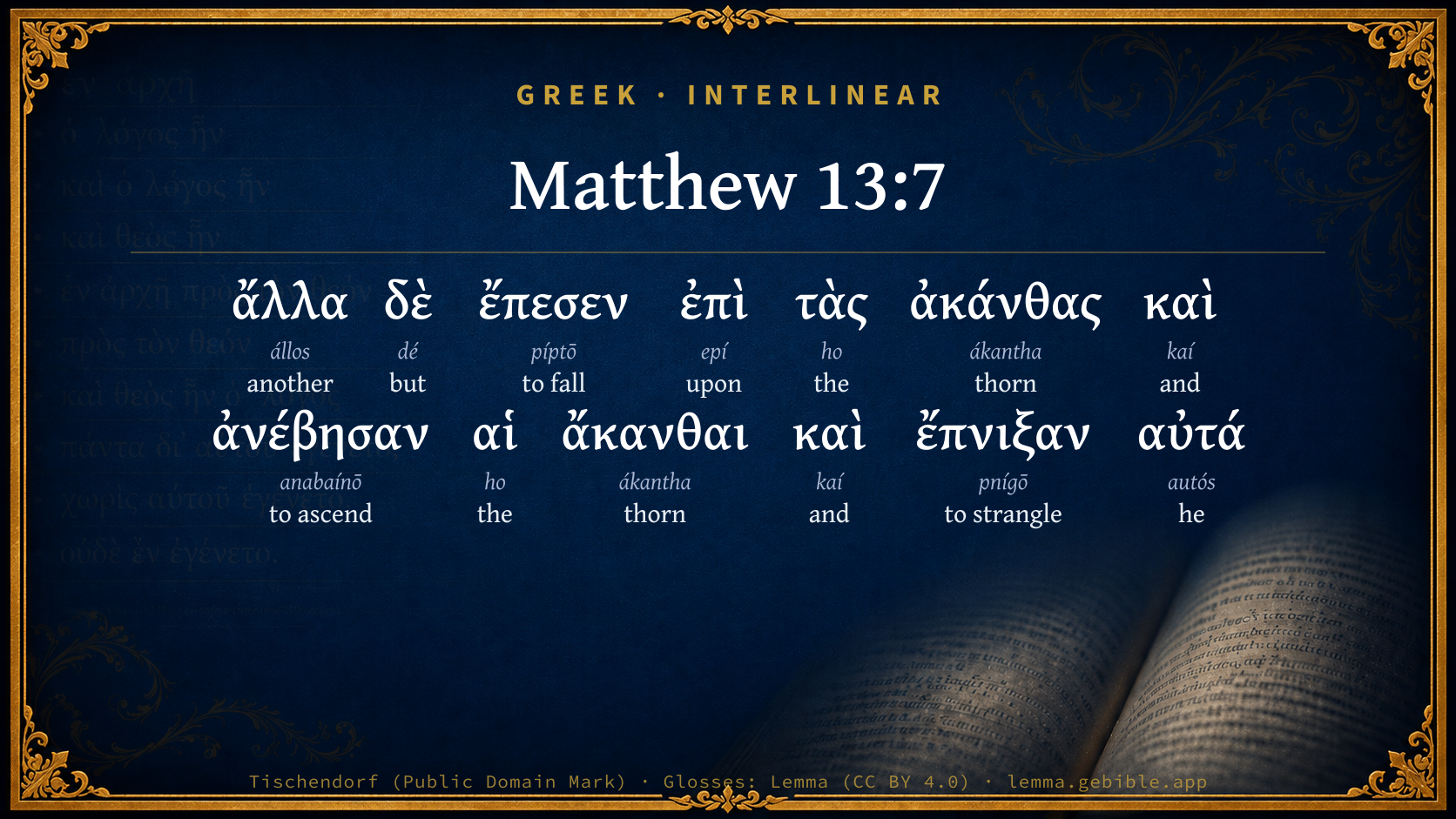
Greek (Tischendorf 8th ed.) Matthew 13:7 appears in the Greek New Testament. The text above is from the Tischendorf 8th edition. Each word links to its Strong’s number and a concise gloss. Click any word for its full Thayer’s Greek Lexicon entry.
Download image
Cite this verse

Matthew 13:7 (World English Bible). Public Domain. Lemma interlinear Bible study tool, https://lemma.gebible.app/v/matthew/13/7.

Show BibTeX & RIS
BibTeX
RIS
English Translation
Others fell among thorns. The thorns grew up and choked them:
World English Bible · Public Domain
Highlights
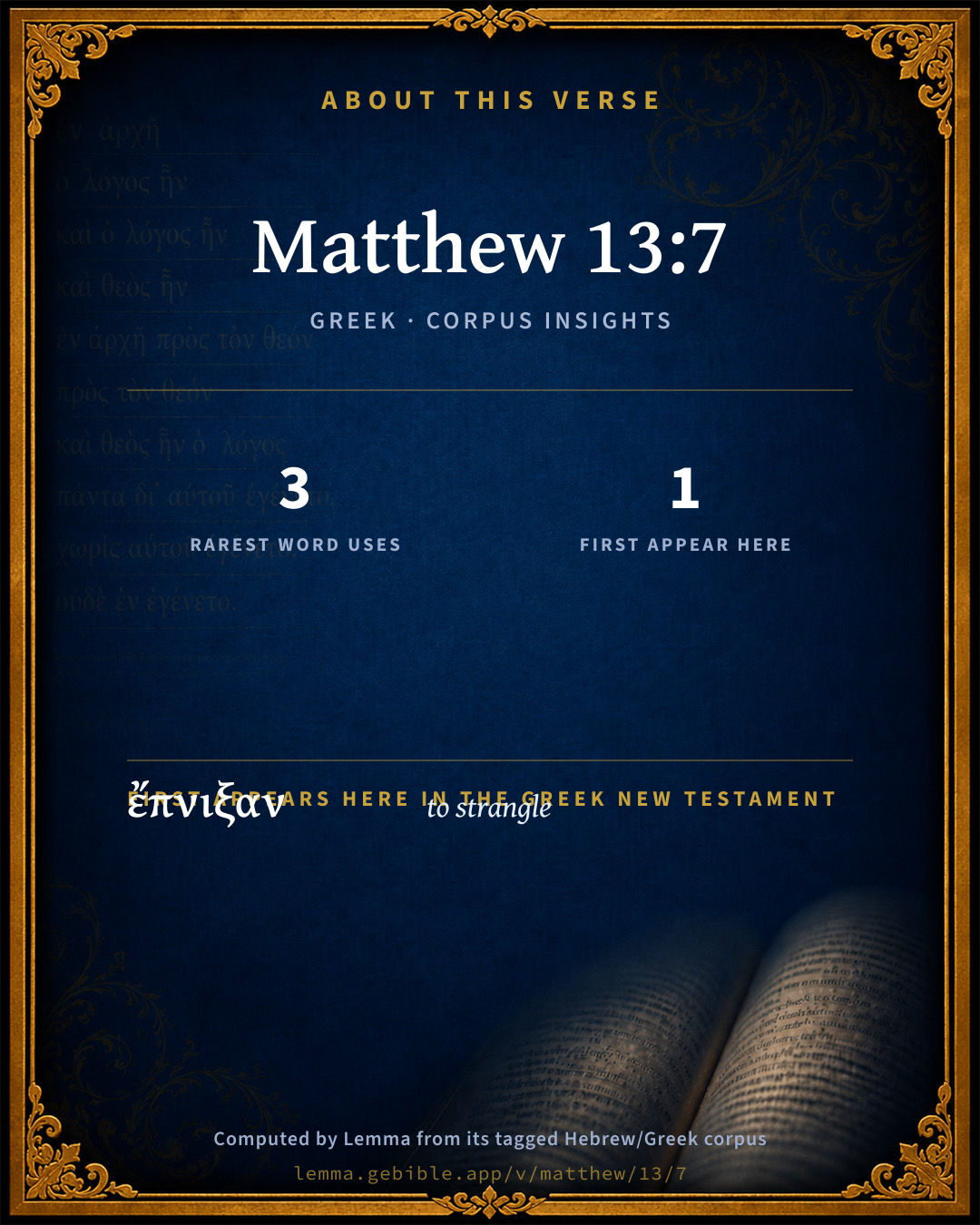
  • 1 first appearance in the Greek New Testament
Full analysis ↓
Download a study sheet

One document with this verse’s original text, its word-by-word gloss line, the meaning frame, cross-references with their text, attributed commentary, and full source and license credits — printable, and it pastes into notes with its structure intact.

This verse Autodidact and up

Study sheet (.html) Plain text (.txt)

A passage Seminary Student

Up to 50 verses in one chapter. A passage sheet keeps up to 6 commentary sources and 12 cross-references per verse, in the order this page ranks them, and says so on the sheet whenever that leaves anything out. Ask for a single verse and you get the Autodidact verse sheet above.

Everything on this page stays free to read, with no account — the sheet is a download of what is already on screen, not access to it.

Want to remove ads? Support Godless Engineer
Compare translations 3

The same verse in 3 English versions, stacked beneath the original-language interlinear above. Click any original word for its lexicon entry.

Each is an independent rendering of the whole verse — the interlinear is not word-aligned to these translations.

Highlighted words mark where these versions differ — a whole-verse word diff, not a word-by-word alignment.

  • World English Bible Public Domain
    Others fell among thorns. The thorns grew up and choked them:
  • King James Version Public Domain
    And some fell among thorns; and the thorns sprung up, and choked them:
  • unfoldingWord Literal Text CC BY-SA 4.0
    But others fell among the thorns, and the thorns grew up and choked them.

unfoldingWord Literal Text — © unfoldingWord, licensed CC BY-SA 4.0. Word-aligned USFM3 via Door43 (git.door43.org/unfoldingWord/en_ult).

Versions to compare (up to 4)

3 of 4 selected

Show all 19 translations

Every available English version of this verse, each an independent rendering of the whole verse.

  • World English Bible Public Domain
    Others fell among thorns. The thorns grew up and choked them:
  • Berean Standard Bible Public Domain
    Other seed fell among thorns, which grew up and choked the seedlings.
  • Majority Standard Bible Public Domain
    Other seed fell among thorns, which grew up and choked the seedlings.
  • King James Version Public Domain
    And some fell among thorns; and the thorns sprung up, and choked them:
  • American Standard Version (1901) Public Domain
    And others fell upon the thorns; and the thorns grew up and choked them:
  • Revised Version (1885) Public Domain
    And others fell upon the thorns; and the thorns grew up, and choked them:
  • Geneva Bible (1599) Public Domain
    And some fell among thornes, and the thornes sprong vp, and choked them.
  • Douay-Rheims (1899) Public Domain
    And others fell among thorns: and the thorns grew up and choked them.
  • Young's Literal Translation Public Domain
    and others fell upon the thorns, and the thorns did come up and choke them,
  • Literal Standard Version CC BY-SA 4.0
    and others fell on the thorns, and the thorns came up and choked them,
  • Unlocked Literal Bible CC BY-SA 4.0
    Other seeds fell among the thorn plants. The thorn plants grew up and choked them.
  • unfoldingWord Literal Text CC BY-SA 4.0
    But others fell among the thorns, and the thorns grew up and choked them.
  • Darby Bible Public Domain
    and others fell upon the thorns, and the thorns grew up and choked them;
  • World Messianic Bible Public Domain
    Others fell among thorns. The thorns grew up and choked them.
  • Webster's Bible Public Domain
    And some fell among thorns; and the thorns sprung up, and choked them:
  • Free Bible Version CC BY-SA 4.0
    Other seeds fell among thorns that grew up and choked them.
  • Bible in Basic English Public Domain
    And some seeds went among thorns, and the thorns came up and they had no room for growth:
  • Text-Critical English NT CC BY 4.0
    Other seeds fell among the thorns, and the thorns grew up and choked them.
  • Tyndale New Testament (1534) Public Domain
    Some fell amonge thornes and the thornes sproge vp and chooked it.

Literal Standard Version (2020), Covenant Press — licensed CC BY-SA 4.0. Text via the HelloAO Bible API (eBible.org). Unlocked Literal Bible (unfoldingWord) — licensed CC BY-SA 4.0. Text via the HelloAO Bible API (eBible.org). unfoldingWord Literal Text — © unfoldingWord, licensed CC BY-SA 4.0. Word-aligned USFM3 via Door43 (git.door43.org/unfoldingWord/en_ult). Free Bible Version, Dr. Jonathan Gallagher — licensed CC BY-SA 4.0. Text via the HelloAO Bible API (eBible.org).

Word by word

More ways to search: Search by grammar → Find every occurrence → Compare this word →

Practice this passage: Drill this verse → Learn its vocabulary →

ἔπνιξαν
pnígō
G4155
“to strangle”
Verb, Aorist, Active, Indicative, 3rd person, Plural
Part of Speech
Verb
Tense
Aorist
Voice
Active
Mood
Indicative
Person
3rd person
Number
Plural
Full Thayer's Definition

Origin: strengthened from G4154

TDNT: 13:35,9

1. to choke, strangle a. of thorns crowding out the seed in the field and hindering its growth 2. to wring one's neck, throttle
  1. ἄλλα állos G243 “another” Adjective, Nominative, Plural, Neuter
  2. δὲ dé G1161 “but” Conjunction
  3. ἔπεσεν píptō G4098 “to fall” Verb, Aorist, Active, Indicative, 3rd person, Singular
  4. ἐπὶ epí G1909 “upon” Preposition
  5. τὰς ho G3588 “the” Article, Accusative, Plural, Feminine
  6. ἀκάνθας ákantha G173 “thorn” Noun, Accusative, Plural, Feminine
  7. καὶ kaí G2532 “and” Conjunction
  8. ἀνέβησαν anabaínō G305 “to ascend” Verb, Aorist, Active, Indicative, 3rd person, Plural
  9. αἱ ho G3588 “the” Article, Nominative, Plural, Feminine
  10. ἄκανθαι ákantha G173 “thorn” Noun, Nominative, Plural, Feminine
  11. καὶ kaí G2532 “and” Conjunction
  12. αὐτά autós G846 “he” Personal pronoun, Accusative, Plural, Neuter

About this verse

These counts appear in no published source. They are computed here, from the morphology-tagged text and Lemma’s own curated glosses. What Lemma adds →

13
words
10
distinct lemmas
Gospels
section

Notable vocabulary

The rarest word here is ἔπνιξαν to strangle G4155 — appearing just 3 times in the whole Greek New Testament.

First appearance in Scripture

This word makes its first canonical appearance in the Greek New Testament here:

  • ἔπνιξαν to strangle G4155

Shared distinctive vocabulary

ἔπνιξαν to strangle G4155 occurs in 3 verses of the Greek New Testament. Also found in:
Repetition

Words recur within this verse:

  • ἀκάνθας thorn G173 ×2
  • τὰς the G3588 ×2
  • καὶ and G2532 ×2

Cross-references

4

Topical passages linked to Matthew 13:7 in the Treasury of Scripture Knowledge — connected by theme and wording, ordered by reader-vote popularity; previews shown in the World English Bible.

  • Mark 4:18–19 Others are those who are sown among the thorns. These are those who have heard the word,
  • Jeremiah 4:3–4 For thus says Yahweh to the men of Judah and to Jerusalem, Break up your fallow ground, and don't sow among thorns.
  • Genesis 3:18 Thorns also and thistles will it bring forth to you; and you will eat the herb of the field.
  • Matthew 13:22 What was sown among the thorns, this is he who hears the word, but the cares of this age and the deceitfulness of riches choke the word, and he becomes unfruitful.

Cross-references courtesy of OpenBible.info (CC BY 4.0).

Commentary

Notes on Matthew 13:7 from classic Christian and Jewish commentators (each source and its license shown beneath its notes). The classic Christian expositions comment on the surrounding passage and are grouped to its opening verse, so a note may address several verses; the Jewish commentaries on the Tanakh (Rashi and others) are per-verse, so they appear only where the commentator wrote on this verse.

Lemma curates 59 commentaries, every one of them public domain or Creative Commons licensed, each selected and text-cleaned for this edition rather than reprinted as found. About our sources →

The Biblical Illustrator

Joseph S. Exell

Mat_13:7; Mat_13:22

And some fell among thorns.

1. Thorns and thistles occupying the field suck in the sap which should go to nourish the good seed. The capability of the ground is limited.

2. Thorns and thistles favoured as indigenous plants by the suitability of soil and climate outgrow the grain. The thorns are at home, the wheat is an exotic.

3. Anxieties about work, clothes, etc., become the thorn plants, harmless in appearance at first, which in the end may choke the seed of grace in your heart.

4. Worldly cares nursed by indulgence into a dangerous strength are further like thorns growing in a corn field, in that they interpose a veil between the ace of Jesus and the opening, trustful look of a longing soul. The seed must be exposed to the sun.

5. As long as weeds live they grow. They must be cast out of the field.

6. The thorn is a prickly thing; it tears the husbandmans flesh, as well as destroys the fruit of his field. (W. Arnot.)

The deceitfulness of riches

Greek mythology tells of one who, being offererd a valuable reward if successful in a race, resolved to outstrip all competitors. But, alas I she did not, and why? Because enemies ever and anon flung pieces of gold just before her. The temptation was too strong; as often as she saw the glittering coins she stopped to pick them up, and so lost the prize. A picture that of some who start on the spiritual course; they forfeit the recompense because they stop to pick up gold. The deceitfulness of riches choke the word, and it becometh unfruitful.

The deceitfulness of riches

1. Riches are deceitful in the insidious growth which they promote of the desire for wealth, quite independent of what it is worth in its positive power.

2. In the transition from a normal desire for wealth to the fervour of avarice, there is great danger of deception among men.

3. Wealth is deceitful in taking the place of legitimate enjoyments in life.

4. The relative growth of the selfish over the generous.

5. In the gradual development of self-esteem and self-sufficiency.

6. In an entire perversion which takes place in the minds of men.

7. Wealth deceives men by promises. (H. W. Beecher.)

Worldliness

In gold there is a halter: in silver there is bird-lime; in the farm there is a bond; in the love of the world there is a chain. While we search for gold we are strangled; while for silver we stick fast; while we seize upon the farm, we are taken prisoners. (Ambrose.)

The soul has a limited capacity for growth

There is nutriment enough in the ground for thorns, and enough for wheat; but not enough, in any ground, for both wheat and thorns. The agriculturist thins his nursery-ground, and the farmer weeds his field, and the gardener removes the superfluous grapes, for that very reason: in order that the dissipated sap may be concentrated in a few plants vigorously. So in the same way, the heart has a certain power of loving. But love, dissipated on many objects, concentrates itself on none. God or the world-not both. No man can serve two masters. If any man love the world, the love of the ]Father is not in him. He that has learned many accomplishments or sciences, generally knows none thoroughly. Multifariousness of knowledge is commonly opposed to depth-variety of affections is generally not found with intensity. (F. W. Robertson.)

The word choked

A merchant of-, engaged in a lucrative trade, was convinced by the Spirit of God that he was an heir of hell, but might, by repentance and faith in Jesus Christ, become an heir of heaven. The god of this world tempted him with much earthly gain; and God, in the Person of the Holy Ghost, offered him durable riches and righteousness. He was fully convinced, as he said, that the riches of earth and the riches of heaven were set before him, and that he could not obtain both, but might take his choice. He glanced at heavens durable riches, and then settled his covetous gaze on earths glittering tinsel. He paused, feeling his choice was for eternity; but, at length, strangely, madly cried, Give me my portion here. His prayer was answered-his fiches were multiplied; but, said he, I know that to gain the world, I have lost my soul.

Deceitfulness of riches

Some years ago, when preaching at Bristol, amongst other notes I received to pray for individuals, one was this: A person earnestly desires the prayers of the congregation, who is prospering in trade. Ah, said I to myself, here is a man who knows something of his own heart, and who has read the Scriptures to some purpose. (W. Jay.)

Riches like thorns

Riches are like thorns: they may be touched, but not rested upon. Canst thou set thy heart upon a thorn without piercing thyself through with many sorrows? (Venning.)

The Biblical Illustrator, edited by Joseph S. Exell (c. 1880s–1900s) — public domain. Text from a community e-Sword module.

Bengel's Gnomon

Johann Albrecht Bengel

Mat 13:7. Ἀνέβησαν αἱ ἄκανθαι, the thorns sprang up) beyond the crop itself. They had not before then grown so high. Those who have heard the Word, yet do not grow in good, turn their strength to increase in evil.

Bengel's Gnomon of the New Testament — English translation (T&T Clark, Edinburgh, 1860) — public domain. Text from a community e-Sword module.

Expositor's Greek Testament

ed. W. Robertson Nicoll

Mat 13:7 . ἐπὶ τὰς ἀκάνθας . Fritzsche prefers the reading ἐις because the seed fell not on thorns already sprung up, but on ground full of thorn seeds or roots. But the latter idea, which is the true one, can be expressed also by ἐπὶ . ἀνέβησαν : the thorns sprang up as well as the corn, and growing more vigorously gained the upper hand. ἔπνιξαν . Euthy. Zig. finds this idea in ἀνέβησαν , for which he gives as synonym ὑπερίσχυσαν .

The Expositor's Greek Testament, edited by W. Robertson Nicoll (1897–1910) — public domain. Text from a community e-Sword module.

Adam Clarke's Commentary

Verse 7. Among thorns] Where the earth was ploughed up, but the brambles and weeds had not been cleared away.

Adam Clarke's Commentary on the Bible (1810–1826) — public domain. Text from a community e-Sword/MySword module.

Ellicott's Commentary for English Readers

(7) Among thorns.—Literally, the thorns, so familiar to the husbandman. These were not visible at the time of sowing. The ground had been so far cleared, but the roots were left below the surface, and their growth and that of the grain went on simultaneously, and ended in the survival, not of the fittest, but of the strongest. The ears shot up, and did not die suddenly, as in the preceding case, but were slowly strangled till they died away.

A Bible Commentary for English Readers, edited by Charles John Ellicott (1878–1897) — public domain. Text from a community e-Sword module.

The Cambridge Bible for Schools and Colleges

gen. ed. J. J. S. Perowne

7. thorns sprung up] The scholar will remember that Vergil mentions among the “plagues” of the wheat,

“Ut mala culmos

Esset robigo segnisque horreret in

arvis Carduus.”

Georg. i:150–153.

The Cambridge Bible for Schools and Colleges (gen. ed. J. J. S. Perowne; Cambridge University Press, 1878–1918) — public domain. Text from a community e-Sword module.

John Gill's Exposition

And some fell among thorns,.... On a spot of ground which was full of the roots of thorns, and briars, which was not cleared of them as it should be. We often read (e) of , "a field cleared of thorns"; but such was not this piece of ground, it was overrun with them, not on the surface of the earth, but within it: for it follows,

and the thorns sprung up: naturally, being neither sown nor planted; either before the seed, or, at least, as soon; and however grew faster, and higher,

and choked them; so that they came to nothing; hence the advice, "sow not among thorns", Jer 4:3 and a lost kindness, or what is bestowed in vain, is expressed in this proverbial manner (f), , "thy beneficence is taken away, and cast among thorns": these point out such hearers who seemed to be contrite, to have the low ground of their hearts broken up, their consciences tender, and to have a true sense of sin, as well as to be outwardly reformed; and yet inwardly were full of the thorns of sinful lusts, particularly of the cares of the world, the deceitfulness of riches, the lusts of other things, and the pleasures of this life, which rendered the word useless and unfruitful; see Mat 13:22 all which are comparable to thorns; it is hardly possible to be in the midst of, and meddle with these, without being scratched by them; they pierce, afflict, and wound, even where they have not their greatest power and influence; and where they do prevail, and get the ascendant, as they are fruitless themselves, they make others so too; they choke the word, and make that, and all ordinances, and opportunities, useless, and unserviceable. Thorns are a part of the earth's curse for the sin of man; and such persons in whom thorny cares and lusts prevail, as they are like unto the earth which beareth thorns, so, as that, they are rejected, and nigh to cursing, whose end is to be burned in everlasting flames of divine wrath and fury, Heb 6:8.

(e) Misn. Sheviith, c. 4. sect. 2. T. Hieros. Sheviith, fol. 34. 3. & 35. 1. T. Bab. Bechorot, fol. 34. 2. (f) T. Bab. Sabbat, fol. 63. 2. Bava Kama, fol. 83. 1. Cetubot, fol. 53. 2. & Betza, fol. 29. 2.

John Gill's Exposition of the Whole Bible (1746–1763) — public domain (CC PDM 1.0). Text via the HelloAO Bible API.

Trapp's Complete Commentary

John Trapp

7 And some fell among thorns; and the thorns sprung up, and choked them:

Ver. 7. {See Trapp on "Mat 13:5"}

John Trapp, A Commentary or Exposition upon All the Books of the Old and New Testament (1647–1656) — public domain. Text from a community e-Sword module.

Whedon's Commentary on the Bible

Daniel D. Whedon

7. Some fell among thorns — Briers and brambles in hot countries have a quick and plentiful overgrowth. They crowd and choke every other form of vegetation.

“Every one who has been in Palestine must have been struck with the number of thorny shrubs and plants that abound there. The traveller finds them in his path, go where he may. Many of them are small, but some grow as high as a man’s head. The Rabbinical writers say that there are no less than twenty-two words in the Hebrew Bible denoting thorny and prickly plants. The prevalence of such shrubs, say agriculturists, shows a luxuriant soil. If proper care be not taken they soon get the upper hand, and spread in every direction. ‘I went by the field of the slothful; and lo, it was all grown over with thorns, and nettles had covered the face thereof.’ Pro_24:30-31.” — Prof. Hackett.

Daniel D. Whedon (gen. ed.), Commentary on the Old and New Testaments (1874–1909) — public domain. Text from a community e-Sword module.

The Pulpit Commentary

And some fell among thorns; upon the thorns (Revised Version); which were sure to be close by. (cf. Jer_4:3) And the thorns sprang up (grew up, Revised Version, anebhsan ), and choked them. Whether brambles or merely spinous weeds (on their abundance, see Tristram, "Nat. Hist. of Bible," p. 423, edit. 1889) are here referred to is not certain. Even the former might be comparatively low in sowing time, and only as they "grew up" cause serious injury to the wheat.

The Pulpit Commentary (1880–1919), ed. H.D.M. Spence-Jones & Joseph S. Exell — public domain. Text from a community e-Sword module.

The People's New Testament

B. W. Johnson

7. And some fell among thorns. More literally, into the thorns. The traveler, to-day, finds Palestine literally a land of thorns, of thistles, brambles, and thorny bushes. Thorns grew up … choked them. Or, as Wycliffe renders it, The thorns sprang up and strangled it. The thorns suffocated the growing plant.

B. W. Johnson's The People's New Testament with Notes (1889–1891) — public domain. Electronic text from the Christian Classics Ethereal Library (CCEL) ThML edition.

unfoldingWord translationNotes

Door43 World Missions Community

Connecting Statement:

Jesus finishes telling a parable about a person who sows seeds.

fell among the thorn plants

"fell where plants with thorns grew"

choked them

"choked the new sprouts." Use your word for the way weeds prevent other plants from growing well.

produced a crop

"grew more seeds" or "gave fruit"

some one hundred times as much, some sixty, and some thirty

The words "seeds," "produced," and "crop" are understood from the previous phrase. These can be expressed clearly. AT: "some seeds produced one hundred times as much crop, some seeds produced sixty times as much crop, and some seeds produced thirty times as much crop" (See: Ellipsis)

one hundred ... sixty ... thirty

"100 ... 60 ... 30" (See: Numbers)

He who has ears

This is a way of referring to everyone there who was hearing what Jesus was saying. See how you translated this in Matthew 11:15. AT: "Whoever can hear me" (See: Idiom)

listen

Here "listen" represents paying attention. See how you translated this in Matthew 11:15. AT: "pay attention to what I am saying" (See: Metonymy)

translationWords

seed

thorn

unfoldingWord translationNotes — © Distant Shores Media and the Door43 World Missions Community, licensed CC BY-SA 4.0. Source: git.door43.org/Door43/en_tn.

Cambridge Greek Testament for Schools and Colleges

7. αἱ ἄκανθαι. Virgil mentions among the ‘plagues’ of the wheat,

‘Ut mala culmos

Esset robigo segnisque horreret in arvis

Carduus.’

Georg. I. 150–153.

7. σαγήνη. A drag-net or seine (the English word comes from the Greek through sagena of the Vulgate). One end of the seine is held on the shore, the other is hauled off by a boat and then returned to the land. In this way a large number of fishes of all kinds is enclosed. Seine-fishing is still practised on the coasts of Devonshire and Cornwall.

The teaching of this parable partly coincides with that of the parable of the Tares (Mat 13:24-30). In both are exhibited the mixture of good and evil in the visible Church, and the final separation of them. But here the thought is specially directed to the ingathering of the Church. The ministers of Christ will of necessity draw converts of diverse character, good and evil, and actuated by different motives. From the parable of the tares we learn not to reject any from within the Church, in the hope of expelling the element of evil. It is a parable of the settled Church. This is a missionary parable. It teaches that as a matter of history or of fact, no barrier or external test will serve to exclude the unworthy convert.

Cambridge Greek Testament for Schools and Colleges (Cambridge University Press, 1896; 21 vols, various authors incl. Carr, Maclear, Plummer, Farrar, Lumby, Moule, M. R. James, Simcox) — public domain. Text from a community e-Sword module.

Alford’s Greek Testament

Henry Alford

7.] ἐπὶ τ. ἀκ. = εἰς τὰς ἀκ. Mark; = ἐν μέσῳ τῶν ἀκ. Luke. In places where were the roots of thorns, beds of thistles, or such like.

ἀνέβησαν.… καί = συμφυεῖσαι Luke; ἀπέπν. = συνέπν, Mark, who adds καὶ καρπὸν οὐκ ἔδωκεν.

Henry Alford, The Greek Testament (1849–1861) — public domain. Text from a community e-Sword module.

International Critical Commentary

(M) 7. And others fell upon the thorns, and the thorns grew up and choked them.] Mk. has: “And other (sing.) fell into the thorns; and the thorns grew up and choked it, and it gave no fruit.”—ἄλλα δέ for Mk.’s καὶ ἄλλο, as Often.—ἀπέπνιξαν] Mk. has συνέπνιξαν. In Mt. א D have the simple verb, which occurs also in 18:28, Mar 5:13. ἀπέπνιξαν may be an assimilation to Lk.

International Critical Commentary — older volumes (1896–1929), various authors — public domain. Text from a community e-Sword module.

Vincent's Word Studies in the New Testament

Marvin R. Vincent

Sprang up. The seed, therefore, fell, not among standing thorns, but among those beneath the surface, ready to spring up.

Trench (" Parables ") cites a striking parallel from Ovid, describing the obstacles to the growth of the grain :

"Now the too ardent sun, now furious showers, With baleful stars and bitter winds combine The crop to ravage; while the greedy fowl Snatch the strown seeds; and grass with stubborn roots, And thorn and darnel plague the ripening grain."

Metamorposes, 5, 486.

Marvin R. Vincent, Word Studies in the New Testament (1887–1900) — public domain. Text from a community e-Sword/MySword module.

Lesson kit

Teaching starters — assembled from the data on this page, not authored interpretation. Every prompt links to the verse data it draws on. Edit before teaching.

Matthew, in the Gospels, opens this verse with 13 words (10 distinct Greek lemmas). Its most distinctive word is pnígō (“to strangle”). A historical commentator’s framing appears above. Read the whole chapter for the surrounding context.

Discussion questions

  1. What does “to strangle” (pnígō) contribute to the verse as a whole?
  2. This is the first place “to strangle” appears in Scripture (first appears here). What does its debut here establish?
  3. How does Matthew 18:28, which shares the word «to strangle», read alongside this verse?
  4. What does the repetition of “thorn” (2× in this one verse) do in this verse?
  5. These translations render this verse differently. What is at stake in choosing one wording over another?
  6. Compare how The Biblical Illustrator and Bengel's Gnomon read this verse. Where do they agree or differ?

Things to notice

  • 1 word makes its first canonical appearance in Scripture here.
  • These translations choose different wording for 4 words in this verse.
  • “thorn” occurs 2× in this single verse.
  • 10 distinct Greek lemmas span 13 words in this verse.

Reading settings

Reading text

Shown beneath each verse's original-language words.

Old Testament
Old Testament edition

Read the OT as the Masoretic Hebrew (MT) or the Greek Septuagint (LXX).

English shown for the Greek Septuagint (in the Hebrew ↔ Greek comparison).

Comparing translations? Open the Compare panel on any verse page to stack up to four side by side.