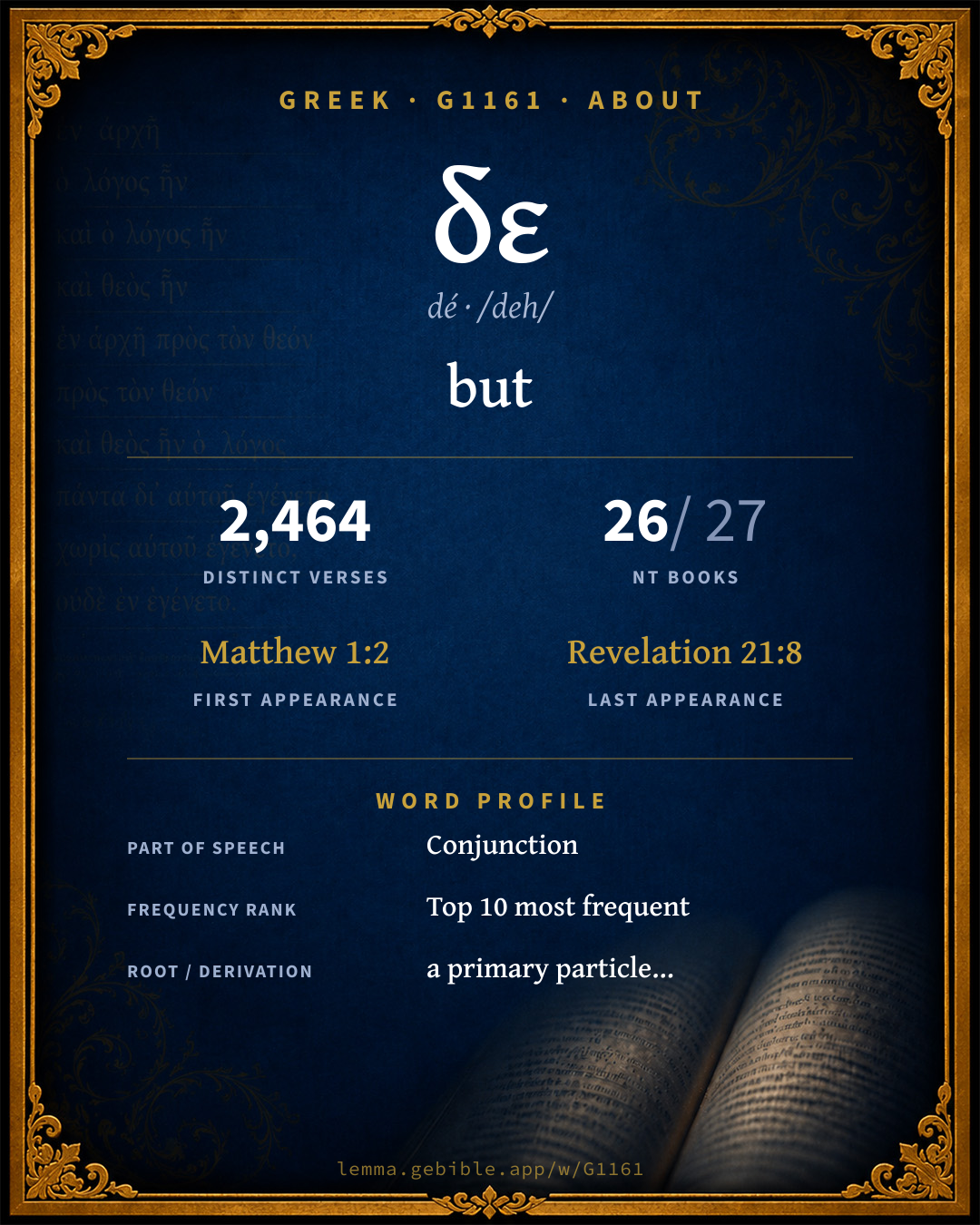
δέ
but
Full lexicon entry — Thayer's Greek Lexicon
From Thayer's Greek Lexicon
Where this word appears
Grammar key — what these labels mean
Part of speech
- Conjunction
- A joining word linking words or clauses.
Every verse where G1161 appears in the Book of Hebrews — 68 distinct verses. Click any verse to open its interlinear word-by-word view. Verse text shown in the World English Bible for context — . Each verse’s Greek form is shown with its reference; the English is not keyword-highlighted, since the data carries no word-level English alignment. Use “Compare translations” on any verse to read it across multiple English versions. This concordance covers the Greek New Testament; Septuagint (Greek Old Testament) occurrences of this word are not indexed here.
Hebrews
- Hebrews 1:6 δὲ conj Again, when he brings in the firstborn into the world he says, "Let all the angels of God worship him."
- Hebrews 1:8 δὲ conj but of the Son he says, "Your throne, O God, is forever and ever; The scepter of uprightness is the scepter of your Kingdom.
- Hebrews 1:11 δὲ conj They will perish, but you continue. They all will grow old like a garment does.
- Hebrews 1:12 δὲ conj As a mantle you will roll them up, And they will be changed; But you are the same. Your years will not fail."
- Hebrews 1:13 δὲ conj But of which of the angels has he said at any time, "Sit at my right hand, Until I make your enemies the footstool of your feet?"
- Hebrews 2:6 δέ conj But one has somewhere testified, saying, "What is man, that you think of him? Or the son of man, that you care for him?
- Hebrews 2:8 δὲ conj You have put all things in subjection under his feet." For in that he subjected all things to him, he left nothing that is not subject to him. But now we don't see all things subjected to him, yet.
- Hebrews 2:9 δὲ conj But we see him who has been made a little lower than the angels, Jesus, because of the suffering of death crowned with glory and honor, that by the grace of God he should taste of death for everyone.
- Hebrews 3:4 δὲ conj For every house is built by someone; but he who built all things is God.
- Hebrews 3:6 δὲ conj but Christ is faithful as a Son over his house; whose house we are, if we hold fast our confidence and the glorying of our hope firm to the end.
- Hebrews 3:10 δὲ conj Therefore I was displeased with that generation, And said, 'They always err in their heart, But they didn't know my ways;'
- Hebrews 3:17 δὲ conj With whom was he displeased forty years? Wasn't it with those who sinned, whose bodies fell in the wilderness?
- Hebrews 3:18 δὲ conj To whom did he swear that they wouldn't enter into his rest, but to those who were disobedient?
- Hebrews 4:13 δὲ conj There is no creature that is hidden from his sight, but all things are naked and laid open before the eyes of him with whom we have to do.
- Hebrews 4:15 δὲ conj For we don't have a high priest who can't be touched with the feeling of our infirmities, but one who has been in all points tempted like we are, yet without sin.
- Hebrews 5:14 δέ conj But solid food is for those who are full grown, who by reason of use have their senses exercised to discern good and evil.
- Hebrews 6:8 δὲ conj but if it bears thorns and thistles, it is rejected and near being cursed, whose end is to be burned.
- Hebrews 6:9 δὲ conj But, beloved, we are persuaded of better things for you, and things that accompany salvation, even though we speak like this.
- Hebrews 6:11 δὲ conj We desire that each one of you may show the same diligence to the fullness of hope even to the end,
- Hebrews 6:12 δὲ conj that you won't be sluggish, but imitators of those who through faith and patience inherited the promises.
- Hebrews 7:2 δὲ conj to whom also Abraham divided a tenth part of all (being first, by interpretation, king of righteousness, and then also king of Salem, which is king of peace;
- Hebrews 7:3 δὲ conj without father, without mother, without genealogy, having neither beginning of days nor end of life, but made like the Son of God), remains a priest continually.
- Hebrews 7:4 δὲ conj Now consider how great this man was, to whom even Abraham, the patriarch, gave a tenth out of the best spoils.
- Hebrews 7:6 δὲ conj but he whose genealogy is not counted from them has taken tithes of Abraham, and has blessed him who has the promises.
- Hebrews 7:7 δὲ conj But without any dispute the less is blessed by the better.
- Hebrews 7:8 δὲ conj Here people who die receive tithes, but there one receives tithes of whom it is testified that he lives.
- Hebrews 7:19 δὲ conj (for the law made nothing perfect), and a bringing in thereupon of a better hope, through which we draw near to God.
- Hebrews 7:21 δὲ conj (for they indeed have been made priests without an oath), but he with an oath by him that says of him, "The Lord swore and will not change his mind, 'You are a priest forever, According to the order of Melchizedek'".
- Hebrews 7:24 δὲ conj But he, because he lives forever, has his priesthood unchangeable.
- Hebrews 7:28 δὲ conj For the law appoints men as high priests who have weakness, but the word of the oath which came after the law appoints a Son forever who has been perfected.
- Hebrews 8:1 δὲ conj Now in the things which we are saying, the main point is this. We have such a high priest, who sat down on the right hand of the throne of the Majesty in the heavens,
- Hebrews 8:6 δὲ conj But now he has obtained a more excellent ministry, by so much as he is also the mediator of a better covenant, which has been enacted on better promises.
- Hebrews 8:13 δὲ conj In that he says, "A new covenant," he has made the first old. But that which is becoming old and grows aged is near to vanishing away.
- Hebrews 9:3 δὲ conj After the second veil was the tabernacle which is called the Holy of Holies,
- Hebrews 9:5 δὲ conj and above it cherubim of glory overshadowing the mercy seat, of which things we can't now speak in detail.
- Hebrews 9:6 δὲ conj Now these things having been thus prepared, the priests go in continually into the first tabernacle, accomplishing the services,
- Hebrews 9:7 δὲ conj but into the second the high priest alone, once in the year, not without blood, which he offers for himself, and for the errors of the people.
- Hebrews 9:11 δὲ conj But Christ having come as a high priest of the coming good things, through the greater and more perfect tabernacle, not made with hands, that is to say, not of this creation,
- Hebrews 9:12 δὲ conj nor yet through the blood of goats and calves, but through his own blood, entered in once for all into the Holy Place, having obtained eternal redemption.
- Hebrews 9:21 δὲ conj Moreover he sprinkled the tabernacle and all the vessels of the ministry in like manner with the blood.
- Hebrews 9:23 δὲ conj It was necessary therefore that the copies of the things in the heavens should be cleansed with these; but the heavenly things themselves with better sacrifices than these.
- Hebrews 9:26 δὲ conj or else he must have suffered often since the foundation of the world. But now once at the end of the ages, he has been revealed to put away sin by the sacrifice of himself.
- Hebrews 9:27 δὲ conj Inasmuch as it is appointed for men to die once, and after this, judgment,
- Hebrews 10:5 δὲ conj Therefore when he comes into the world, he says, "Sacrifice and offering you didn't desire, But a body did you prepare for me;
- Hebrews 10:12 δὲ conj but he, when he had offered one sacrifice for sins for ever, sat down on the right hand of God;
- Hebrews 10:15 δὲ conj The Holy Spirit also testifies to us, for after saying,
- Hebrews 10:18 δὲ conj Now where remission of these is, there is no more offering for sin.
- Hebrews 10:27 δέ conj but a certain fearful expectation of judgment, and a fierceness of fire which will devour the adversaries.
- Hebrews 10:32 δὲ conj But remember the former days, in which, after you were enlightened, you endured a great struggle with sufferings;
- Hebrews 10:33 δὲ conj partly, being exposed to both reproaches and oppressions; and partly, becoming partakers with those who were treated so.
- Hebrews 10:38 δὲ conj But the righteous will live by faith. If he shrinks back, my soul has no pleasure in him."
- Hebrews 10:39 δὲ conj But we are not of those who shrink back to destruction, but of those who have faith to the saving of the soul.
- Hebrews 11:1 δὲ conj Now faith is assurance of things hoped for, proof of things not seen.
- Hebrews 11:6 δὲ conj Without faith it is impossible to be well pleasing to him, for he who comes to God must believe that he exists, and that he is a rewarder of those who seek him.
- Hebrews 11:16 δὲ conj But now they desire a better country, that is, a heavenly one. Therefore God is not ashamed of them, to be called their God, for he has prepared a city for them.
- Hebrews 11:35 δὲ conj Women received their dead by resurrection. Others were tortured, not accepting their deliverance, that they might obtain a better resurrection.
- Hebrews 11:36 δὲ δὲ conj conj Others were tried by mocking and scourging, yes, moreover by bonds and imprisonment.
- Hebrews 12:6 δὲ conj For whom the Lord loves, he chastens, And scourges every son whom he receives."
- Hebrews 12:8 δὲ conj But if you are without discipline, of which all have been made partakers, then are you illegitimate, and not children.
- Hebrews 12:10 δὲ conj For they indeed, for a few days, punished us as seemed good to them; but he for our profit, that we may be partakers of his holiness.
- Hebrews 12:11 δὲ conj All chastening seems for the present to be not joyous but grievous; yet afterward it yields the peaceful fruit of righteousness to those who have been exercised thereby.
- Hebrews 12:13 δὲ conj and make straight paths for your feet, so that which is lame may not be dislocated, but rather be healed.
- Hebrews 12:26 δὲ conj whose voice shook the earth, then, but now he has promised, saying, "Yet once more I will shake not only the earth, but also the heavens."
- Hebrews 12:27 δέ conj This phrase, "Yet once more," signifies the removing of those things that are shaken, as of things that have been made, that those things which are not shaken may remain.
- Hebrews 13:16 δὲ conj But don't forget to be doing good and sharing, for with such sacrifices God is well pleased.
- Hebrews 13:19 δὲ conj I strongly urge you to do this, that I may be restored to you sooner.
- Hebrews 13:20 δὲ conj Now may the God of peace, who brought again from the dead the great shepherd of the sheep with the blood of an eternal covenant, our Lord Jesus,
- Hebrews 13:22 δὲ conj But I exhort you, brothers, endure the word of exhortation, for I have written to you in few words.
About this entry
At a glance — auto-summarized from this page’s data, not written by a person. Every figure links to its source below. This summary describes the numbers; it doesn’t interpret them.
δε — transliterated dé — is a Greek conjunction carrying the sense “but.” Its earliest occurrence is Matthew 1:2. It appears 2,464 verses across 26 books of the Greek New Testament, among its most common vocabulary. It shares a root with δη. Each statement above links to its evidence; the full detail follows below.
Gloss history
Strong's 1890 vs modern scholarship
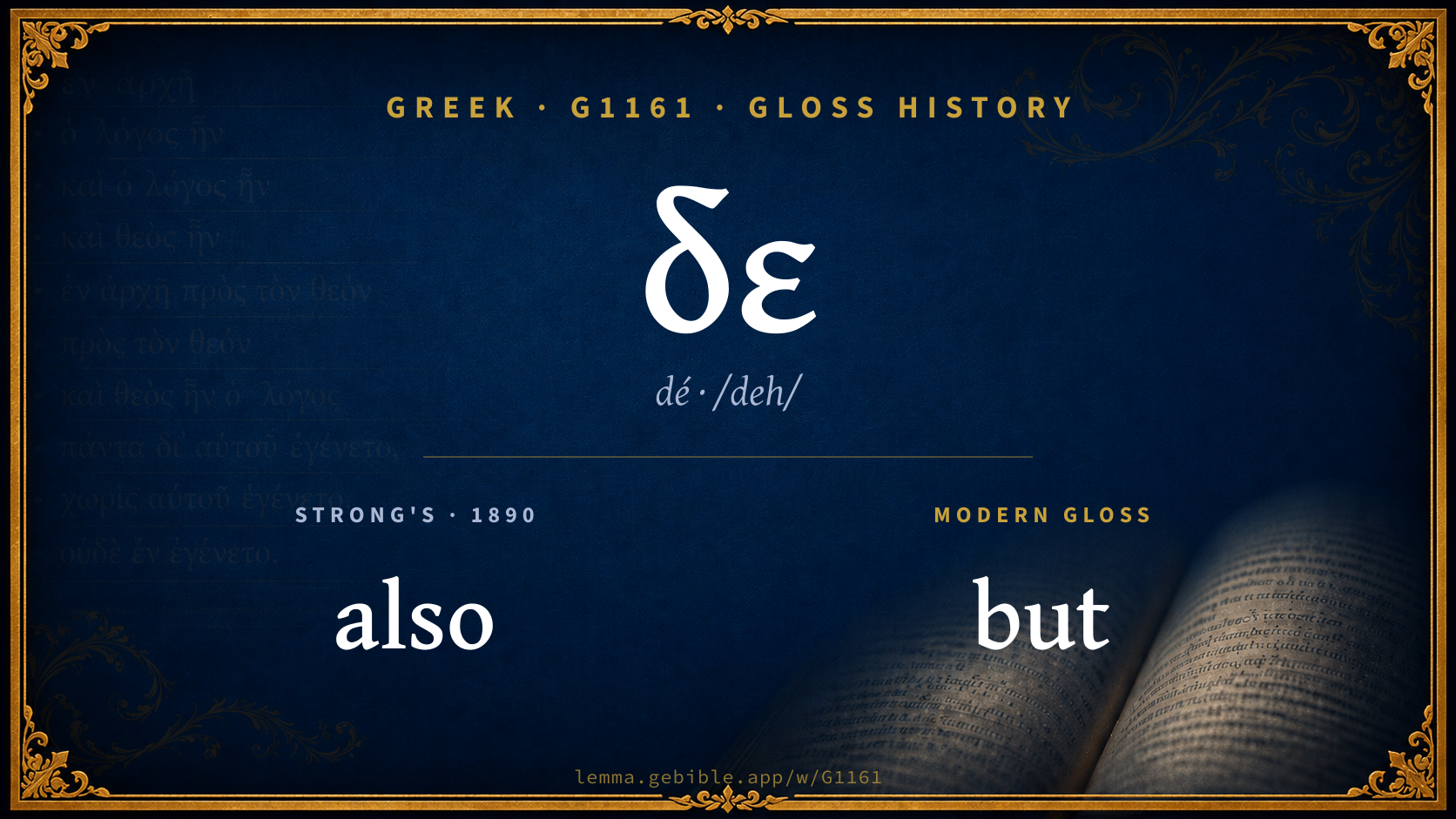
About this word
Strong's G1161 catalogs a Greek word from the Greek New Testament.
These counts are not copied from any lexicon or concordance. They are computed here, from the morphology-tagged Greek New Testament. What Lemma adds →
- 2,464
- distinct verses
- The word appears in 2,464 distinct verses.
- 26 / 27
- NT books
- The word appears in 26 of 27 New Testament books.
- #4
- by frequency
- Top 10 most frequent Greek words (rank 4 of 5,347 Greek words by occurrence).
View all 2,464 occurrences in the concordance →
By section of the New Testament
By traditional corpus
Conventional, traditional groupings — biblical authorship is debated, so this is a traditional corpus grouping, not an authorship claim. Some books belong to more than one corpus (Luke is in both the Gospels and the Lukan corpus, and so on), so these shares overlap and need not total 100%. Each figure is a share of the word’s 2,464 distinct verses.
- Gospels 1,258 verses · 51%
- Lukan (Luke–Acts) 971 verses · 39%
- Pauline corpus 547 verses · 22%
- Johannine 211 verses · 9%
- General (Catholic) Epistles 93 verses · 4%
- Hebrews 68 verses · 3%
- Revelation 7 verses · 0%
How translations render this word
Counts come from each version’s own published word-to-Strong’s tagging or interlinear alignment — an approximate guide to how each version renders this word, not a word-level alignment the data otherwise carries. Because each total is that version’s own tagged count, the per-version totals vary from one another and need not match the appearance or distinct-verse counts above. These counts may also differ from a printed concordance because Lemma counts each distinctly tagged rendering and does not collapse phrase taggings into a single head-word total. This is a fixed set of word-tagged versions (KJV, ASV, BSB, ULT) and does not change with the reading translation you choose elsewhere. Each version’s license is shown beside its name below (and on Sources).
- King James Version: And 1,228×, But 929×, Now 166×
- American Standard Version: And 1,179×, But 999×, Now 171×
- Berean Standard Bible: But 784×, And 339×, Now 116×
- unfoldingWord Literal Text: But 1,407×, And 745×, Now 419×
King James Version Public Domain
Renders G1161 across 2,711 tagged occurrences — most commonly:
Plus other, less common renderings. Plus 42 renderings that appear only once — usually multi-word phrases or single function words the recovered tagging swept in, not distinct renderings. Not rendered by a distinct English word in 159 further occurrences.
American Standard Version Public Domain
Renders G1161 across 2,640 tagged occurrences — most commonly:
Plus other, less common renderings. Plus 75 renderings that appear only once — usually multi-word phrases or single function words the recovered tagging swept in, not distinct renderings. Not rendered by a distinct English word in 34 further occurrences.
Berean Standard Bible Public Domain
Renders G1161 across 1,643 tagged occurrences — most commonly:
Plus other, less common renderings. Plus 38 renderings that appear only once — usually multi-word phrases or single function words the recovered tagging swept in, not distinct renderings. Not rendered by a distinct English word in 1,112 further occurrences.
unfoldingWord Literal Text CC BY-SA 4.0
Renders G1161 across 2,802 tagged occurrences — most commonly:
Plus other, less common renderings. Plus 9 renderings that appear only once — usually multi-word phrases or single function words the recovered tagging swept in, not distinct renderings.
Senses in Thayer's
The 1 sense Thayer's distinguishes for this word, in lexicon order (not ranked by frequency or importance). The full entry — with sub-senses — is in the Lexicon Entry tab.
- but, moreover, and, etc.
Word origin
Origin: a primary particle (adversative or continuative)
A primary particle (adversative or continuative); but and etc. : - also and but moreover now [ often unexpressed in English ].
— Strong’s Exhaustive Concordance (1890), public domain.
Forms in the corpus
The 3 distinct written forms G1161 takes in the Greek New Testament, most frequent first — each parse links to that case’s occurrences in the concordance.
| Form | Parsing | Example | Uses |
|---|---|---|---|
| δὲ dè | Conjunction | Matthew 1:2 | 2,602 |
| δέ dé | Conjunction | Matthew 5:31 | 147 |
| δ’ d | Conjunction | Matthew 5:19 | 22 |
Same root — word family
Other Thayer's entries built from the same root as G1161, grouped by Strong’s listed origin. These share a root / origin per the lexicon — not necessarily a shared meaning. Each links to that word’s own entry.
Derived from this word
Compare all same-root words → They share a root, not necessarily a meaning.
Septuagint usage
The same Greek word δε appears 3,556 times in the Greek Old Testament (Septuagint), across 3,042 verses in 35 books.
- 3,556
- LXX occurrences
- Tagged occurrences of this Greek word in the Septuagint.
- 3,042
- verses
- Distinct Septuagint verses containing this word.
- 35 / 39
- OT books
- The word appears in 35 of the 39 Old Testament books.
Sample Septuagint occurrences
- Genesis 1:2 δέ
- Exodus 1:5 δέ
- Leviticus 1:9 δέ
- Numbers 1:47 δέ
- Deuteronomy 4:4 δέ
- Joshua 1:14 δέ
- Judges 1:11 δέ
- Ruth 1:14 δέ
- 1 Samuel 7:17 δέ
- 2 Samuel 3:30 δέ
- 1 Kings 1:17 δέ
- 2 Kings 3:15 δέ
Septuagint occurrences (same lexeme)
Every verse where the same Strong’s number (G1161) appears in the Greek Septuagint — showing the first 50 of 3,042. Verse text shown in the World English Bible for context; the Greek form is the matched word — the English is not keyword-highlighted.
- Genesis 1:2 δέ Now the earth was formless and empty. Darkness was on the surface of the deep. God's Spirit was hovering over the surface of the waters.
- Genesis 2:6 δέ but a mist went up from the earth, and watered the whole surface of the ground.
- Genesis 2:10 δέ A river went out of Eden to water the garden; and from there it was parted, and became four heads.
- Genesis 2:12 δέ and the gold of that land is good. There is aromatic resin and the onyx stone.
- Genesis 2:14 δέ The name of the third river is Hiddekel: this is the one which flows in front of Assyria. The fourth river is the Euphrates.
- Genesis 2:17 δέ but of the tree of the knowledge of good and evil, you shall not eat of it: for in the day that you eat of it you will surely die."
- Genesis 2:20 δέ The man gave names to all cattle, and to the birds of the sky, and to every animal of the field; but for man there was not found a helper suitable for him.
- Genesis 3:1 δέ Now the serpent was more subtle than any animal of the field which Yahweh God had made. He said to the woman, "Yes, has God said, 'You shall not eat of any tree of the garden?'"
- Genesis 3:3 δέ but of the fruit of the tree which is in the midst of the garden, God has said, 'You shall not eat of it, neither shall you touch it, lest you die.'"
- Genesis 3:17 δέ To Adam he said, "Because you have listened to your wife's voice, and have eaten of the tree, of which I commanded you, saying, 'You shall not eat of it,' cursed is the ground for your sake. In toil you will eat of it all the days of your life.
- Genesis 4:1 δέ The man knew Eve his wife. She conceived, and gave birth to Cain, and said, "I have gotten a man with Yahweh's help."
- Genesis 4:2 δέ Again she gave birth, to Cain's brother Abel. Abel was a keeper of sheep, but Cain was a tiller of the ground.
- Genesis 4:5 δέ but he didn't respect Cain and his offering. Cain was very angry, and the expression on his face fell.
- Genesis 4:7 δέ If you do well, will it not be lifted up? If you don't do well, sin crouches at the door. Its desire is for you, but you are to rule over it."
- Genesis 4:9 δέ Yahweh said to Cain, "Where is Abel, your brother?" He said, "I don't know. Am I my brother's keeper?"
- Genesis 4:16 δέ Cain went out from Yahweh's presence, and dwelt in the land of Nod, on the east of Eden.
- Genesis 4:18 δέ To Enoch was born Irad. Irad became the father of Mehujael. Mehujael became the father of Methushael. Methushael became the father of Lamech.
- Genesis 4:22 δέ Zillah also gave birth to Tubal Cain, the forger of every cutting instrument of brass and iron. Tubal Cain's sister was Naamah.
- Genesis 4:23 δέ Lamech said to his wives, "Adah and Zillah, Hear my voice, You wives of Lamech, listen to my speech, For I have slain a man for wounding me, A young man for bruising me.
- Genesis 4:24 δέ If Cain will be avenged seven times, Truly Lamech seventy-seven times."
- Genesis 4:25 δέ Adam knew his wife again. She gave birth to a son, and named him Seth. For, she said, "God has appointed me another child instead of Abel, for Cain killed him."
- Genesis 4:26 δέ There was also born a son to Seth, and he named him Enosh. Then men began to call on Yahweh's name.
- Genesis 5:3 δέ Adam lived one hundred thirty years, and became the father of a son in his own likeness, after his image, and named him Seth.
- Genesis 5:4 δέ The days of Adam after he became the father of Seth were eight hundred years, and he became the father of sons and daughters.
- Genesis 5:6 δέ Seth lived one hundred five years, and became the father of Enosh.
- Genesis 5:22 δέ Enoch walked with God after he became the father of Methuselah three hundred years, and became the father of sons and daughters.
- Genesis 6:2 δέ that God's sons saw that men's daughters were beautiful, and they took for themselves wives of all that they chose.
- Genesis 6:3 δέ Yahweh said, "My Spirit will not strive with man forever, because he also is flesh; yet will his days be one hundred twenty years."
- Genesis 6:4 δέ The Nephilim were in the earth in those days, and also after that, when God's sons came to men's daughters. They bore children to them: the same were the mighty men who were of old, men of renown.
- Genesis 6:5 δέ Yahweh saw that the wickedness of man was great in the earth, and that every imagination of the thoughts of his heart was only evil continually.
- Genesis 6:8 δέ But Noah found favor in Yahweh's eyes.
- Genesis 6:9 δέ This is the history of the generations of Noah. Noah was a righteous man, blameless among the people of his time. Noah walked with God.
- Genesis 6:10 δέ Noah became the father of three sons: Shem, Ham, and Japheth.
- Genesis 6:11 δέ The earth was corrupt before God, and the earth was filled with violence.
- Genesis 6:16 δέ You shall make a roof in the ark, and to a cubit shall you finish it upward. You shall set the door of the ark in the side of it. You shall make it with lower, second, and third levels.
- Genesis 6:17 δέ I, even, I do bring the flood of waters on this earth, to destroy all flesh having the breath of life from under the sky. Everything that is in the earth will die.
- Genesis 6:18 δέ But I will establish my covenant with you. You shall come into the ark, you, your sons, your wife, and your sons' wives with you.
- Genesis 6:21 δέ Take with you of all food that is eaten, and gather it to you; and it will be for food for you, and for them."
- Genesis 7:2 δέ You shall take seven pairs of every clean animal with you, the male and his female. Of the animals that are not clean, take two, the male and his female.
- Genesis 7:6 δέ Noah was six hundred years old when the flood of waters came on the earth.
- Genesis 7:7 δέ Noah went into the ark with his sons, his wife, and his sons' wives, because of the waters of the flood.
- Genesis 7:19 δέ The waters prevailed exceedingly on the earth. All the high mountains that were under the whole sky were covered.
- Genesis 8:5 δέ The waters receded continually until the tenth month. In the tenth month, on the first day of the month, the tops of the mountains were seen.
- Genesis 8:14 δέ In the second month, on the twenty-seventh day of the month, the earth was dry.
- Genesis 9:7 δέ Be fruitful, and multiply. Bring forth abundantly in the earth, and multiply in it."
- Genesis 9:18 δέ The sons of Noah who went forth from the ark were Shem, Ham, and Japheth. Ham is the father of Canaan.
- Genesis 9:24 δέ Noah awoke from his wine, and knew what his youngest son had done to him.
- Genesis 9:28 δέ Noah lived three hundred fifty years after the flood.
- Genesis 10:1 δέ Now this is the history of the generations of the sons of Noah and of Shem, Ham, and Japheth. Sons were born to them after the flood.
- Genesis 10:6 δέ The sons of Ham: Cush, Mizraim, Put, and Canaan.
These are occurrences of the same Greek lexeme (G1161) in the Septuagint — not a translation of any one Hebrew word. The store carries no word-level Hebrew↔Greek alignment, so no Hebrew original is asserted here. Counts come from the recovered LXX Strong's tagging — high-frequency vocabulary is well covered, while rare or late forms may be untagged — so they reflect tagged occurrences and may slightly undercount.