
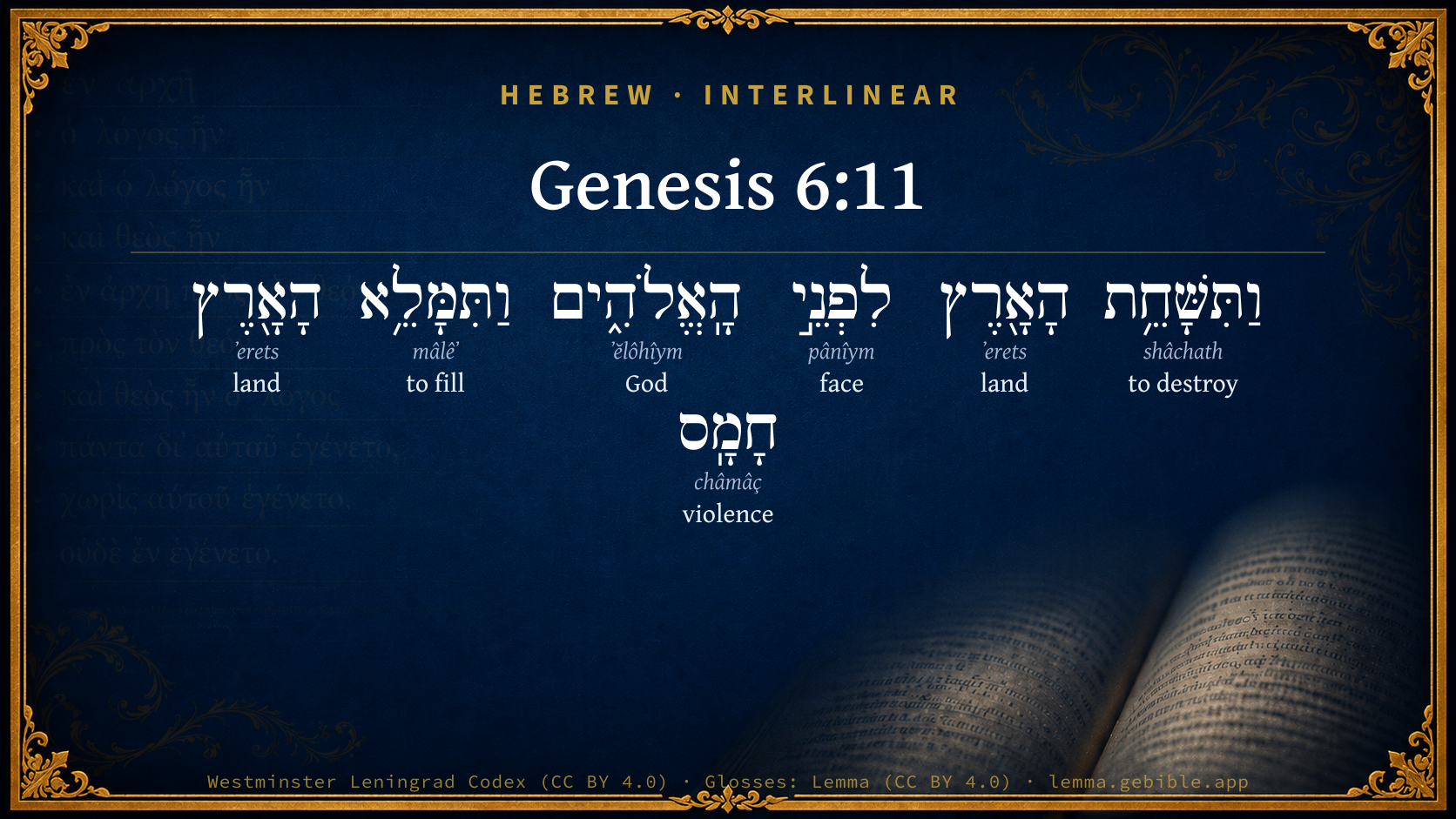
Genesis 6:11

Hebrew (Westminster Leningrad Codex) Genesis 6:11 appears in the Hebrew Old Testament. The text above is from the Westminster Leningrad Codex. Each word links to its Strong’s number, a concise gloss, and parsing drawn from the Open Scriptures Hebrew Bible morphology. Click any word for its full Brown-Driver-Briggs (BDB) entry.
Download image
Cite this verse

Genesis 6:11 (World English Bible). Public Domain. Lemma interlinear Bible study tool, https://lemma.gebible.app/v/genesis/6/11.

Show BibTeX & RIS
BibTeX
RIS
English Translation
The earth was corrupt before God, and the earth was filled with violence.
World English Bible · Public Domain
Highlights
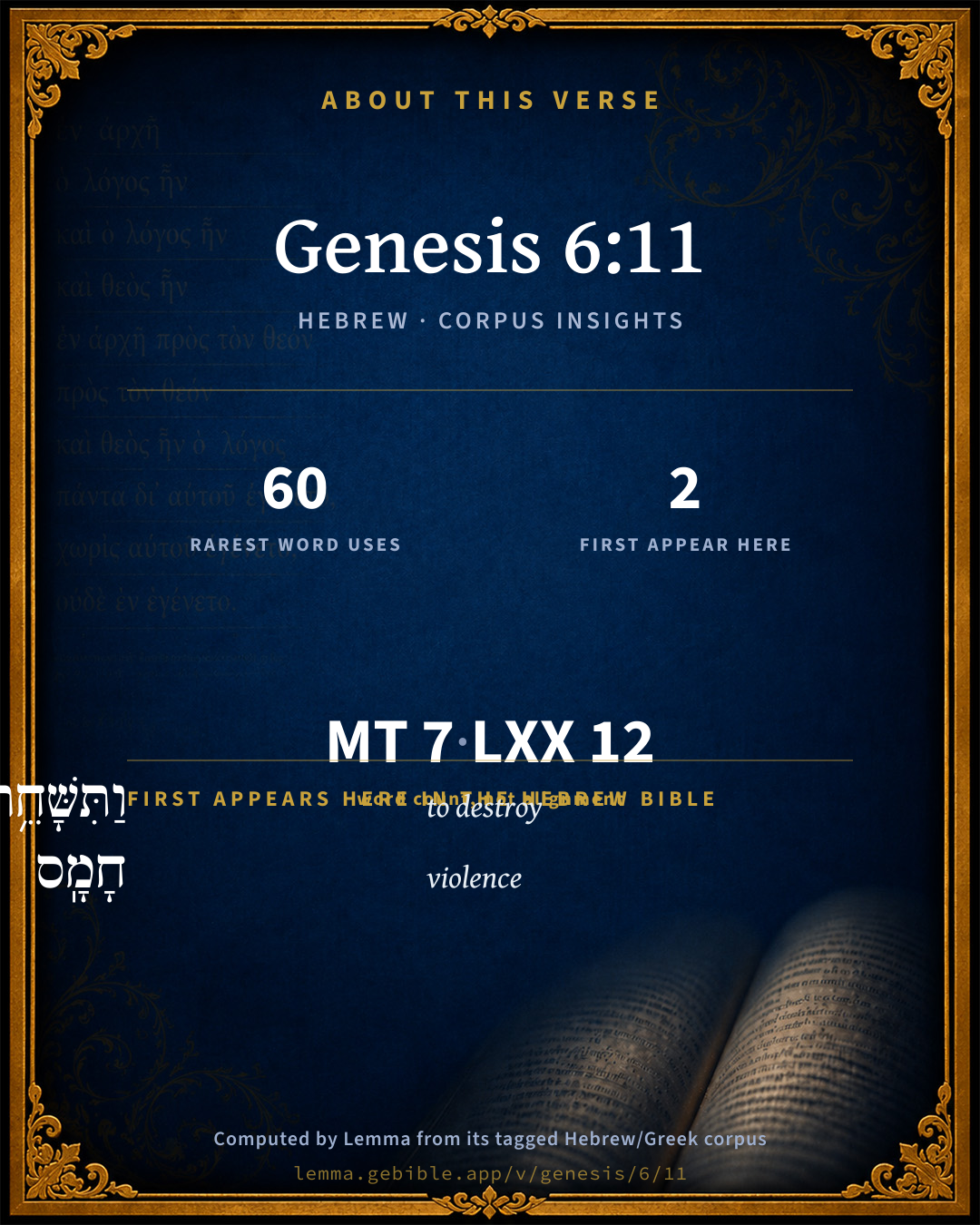
  • 2 first appearances in the Hebrew Bible
Full analysis ↓
Download a study sheet

One document with this verse’s original text, its word-by-word gloss line, the meaning frame, cross-references with their text, attributed commentary, and full source and license credits — printable, and it pastes into notes with its structure intact.

This verse Autodidact and up

Study sheet (.html) Plain text (.txt)

A passage Seminary Student

Up to 50 verses in one chapter. A passage sheet keeps up to 6 commentary sources and 12 cross-references per verse, in the order this page ranks them, and says so on the sheet whenever that leaves anything out. Ask for a single verse and you get the Autodidact verse sheet above.

Everything on this page stays free to read, with no account — the sheet is a download of what is already on screen, not access to it.

Want to remove ads? Support Godless Engineer
Compare translations 3

The same verse in 3 English versions, stacked beneath the original-language interlinear above. Click any original word for its lexicon entry.

Each is an independent rendering of the whole verse — the interlinear is not word-aligned to these translations.

Highlighted words mark where these versions differ — a whole-verse word diff, not a word-by-word alignment.

  • World English Bible Public Domain
    The earth was corrupt before God, and the earth was filled with violence.
  • King James Version Public Domain
    The earth also was corrupt before God, and the earth was filled with violence.
  • unfoldingWord Literal Text CC BY-SA 4.0
    Now the earth was corrupt before God, and the earth was filled violence.

unfoldingWord Literal Text — © unfoldingWord, licensed CC BY-SA 4.0. Word-aligned USFM3 via Door43 (git.door43.org/unfoldingWord/en_ult).

Versions to compare (up to 4)

3 of 4 selected

Show all 18 translations

Every available English version of this verse, each an independent rendering of the whole verse.

  • World English Bible Public Domain
    The earth was corrupt before God, and the earth was filled with violence.
  • Berean Standard Bible Public Domain
    Now the earth was corrupt in the sight of God, and full of violence.
  • Majority Standard Bible Public Domain
    Now the earth was corrupt in the sight of God, and full of violence.
  • King James Version Public Domain
    The earth also was corrupt before God, and the earth was filled with violence.
  • American Standard Version (1901) Public Domain
    And the earth was corrupt before God, and the earth was filled with violence.
  • Revised Version (1885) Public Domain
    And the earth was corrupt before God, and the earth was filled with violence.
  • Geneva Bible (1599) Public Domain
    The earth also was corrupt before God: for the earth was filled with crueltie.
  • Douay-Rheims (1899) Public Domain
    And the earth was corrupted before God, and was filled with iniquity.
  • Young's Literal Translation Public Domain
    And the earth is corrupt before God, and the earth is filled `with' violence.
  • Literal Standard Version CC BY-SA 4.0
    And the earth is corrupt before God, and the earth is filled [with] violence.
  • Unlocked Literal Bible CC BY-SA 4.0
    The earth was corrupt before God, and it was filled with violence.
  • unfoldingWord Literal Text CC BY-SA 4.0
    Now the earth was corrupt before God, and the earth was filled violence.
  • Darby Bible Public Domain
    And the earth was corrupt before God, and the earth was full of violence.
  • World Messianic Bible Public Domain
    The earth was corrupt before God, and the earth was filled with violence.
  • Webster's Bible Public Domain
    The earth also was corrupt before God; and the earth was filled with violence.
  • Free Bible Version CC BY-SA 4.0
    God saw how corrupt the whole world had become, full of violent and lawless people.
  • Bible in Basic English Public Domain
    And the earth was evil in God's eyes and full of violent ways.
  • JPS Tanakh (1917) Public Domain
    And the earth was corrupt before God, and the earth was filled with violence.

Literal Standard Version (2020), Covenant Press — licensed CC BY-SA 4.0. Text via the HelloAO Bible API (eBible.org). Unlocked Literal Bible (unfoldingWord) — licensed CC BY-SA 4.0. Text via the HelloAO Bible API (eBible.org). unfoldingWord Literal Text — © unfoldingWord, licensed CC BY-SA 4.0. Word-aligned USFM3 via Door43 (git.door43.org/unfoldingWord/en_ult). Free Bible Version, Dr. Jonathan Gallagher — licensed CC BY-SA 4.0. Text via the HelloAO Bible API (eBible.org).

Word by word

More ways to search: Search by grammar → Find every occurrence → Compare this word →

Practice this passage: Drill this verse → Learn its vocabulary →

About this verse

These counts appear in no published source. They are computed here, from the morphology-tagged text and Lemma’s own curated glosses. What Lemma adds →

7
words
6
distinct lemmas
Pentateuch
section

First appearance in Scripture

These words make their first canonical appearance in the Hebrew Bible here:

  • וַתִּשָּׁחֵ֥ת to destroy H7843
  • חָמָֽס violence H2555

Shared distinctive vocabulary

חָמָֽס violence H2555 occurs in 59 verses of the Hebrew Bible. Also found in:

Grammatical profile

  • 2 verbs
  • 5 nouns

Verb forms

  • וַתִּשָּׁחֵ֥ת Niphal · Sequential Imperfect
  • וַתִּמָּלֵ֥א Niphal · Sequential Imperfect

Repetition

A word recurs within this verse — often emphatic in Hebrew:

  • הָאָ֖רֶץ land H776 ×2

Hebrew & Septuagint length

In English translation the verse runs 13 words from the Hebrew and 14 from the Septuagint (LXX English) — closely comparable.

A rough comparison of the two English renderings, which tokenize alike — not a word-level alignment.

Word counts can differ between the Hebrew and the Greek without any difference in meaning — e.g. the Hebrew direct-object marker אֵת has no separate Greek word, and Greek often adds the article ὁ.

In the original languages it is 7 Hebrew tokens and 12 Greek tokens — but the two are counted differently (Hebrew bundles its prefixes and suffixes into one token; the Greek is in lemma form), so that isn’t a like-for-like length.

Cross-references

18

Topical passages linked to Genesis 6:11 in the Treasury of Scripture Knowledge — connected by theme and wording, ordered by reader-vote popularity; previews shown in the World English Bible.

  • Ezekiel 8:17 Then he said to me, Have you seen [this], son of man? Is it a light thing to the house of Judah that they commit the abominations which they commit here? for they have filled the land with violence, and have turned again to provoke me to anger: and, behold, they put the branch to their nose.
  • Hosea 4:1–2 Hear the word of Yahweh, you children of Israel; For Yahweh has a charge against the inhabitants of the land: "Indeed there is no truth, Nor goodness, Nor knowledge of God in the land.
  • Habakkuk 2:8 Because you have plundered many nations, all the remnant of the peoples will plunder you, because of men's blood, and for the violence done to the land, to the city and to all who dwell in it.
  • Romans 2:13 For it isn't the hearers of the law who are righteous before God, but the doers of the law will be justified
  • Romans 3:19 Now we know that whatever things the law says, it speaks to those who are under the law, that every mouth may be closed, and all the world may be brought under the judgment of God.
  • Isaiah 60:18 Violence shall no more be heard in your land, desolation nor destruction within your borders; but you shall call your walls Salvation, and your gates Praise.
  • Ezekiel 28:16 By the abundance of your traffic they filled the midst of you with violence, and you have sinned: therefore I have cast you as profane out of the mountain of God; and I have destroyed you, covering cherub, from the midst of the stones of fire.
  • Psalms 11:5 Yahweh examines the righteous, But the wicked and him who loves violence his soul hates.
  • Psalms 55:9 Confuse them, Lord, and confound their language, For I have seen violence and strife in the city.
  • Psalms 140:11 An evil speaker won't be established in the earth. Evil will hunt the violent man to overthrow him.
  • Jeremiah 6:7 As a well casts forth its waters, so she casts forth her wickedness: violence and destruction is heard in her; before me continually is sickness and wounds.
  • Habakkuk 1:2 Yahweh, how long will I cry, and you will not hear? I cry out to you "Violence!" and will you not save?
  • Luke 1:6 They were both righteous before God, walking blamelessly in all the commandments and ordinances of the Lord.
  • Genesis 10:9 He was a mighty hunter before Yahweh. Therefore it is said, "Like Nimrod, a mighty hunter before Yahweh."
  • Genesis 13:13 Now the men of Sodom were exceedingly wicked and sinners against Yahweh.
  • Habakkuk 2:17 For the violence done to Lebanon will overwhelm you, and the destruction of the animals, which made them afraid; because of men's blood, and for the violence done to the land, to every city and to those who dwell in them.
  • Genesis 7:1 Yahweh said to Noah, "Come with all of your household into the ark, for I have seen your righteousness before me in this generation.
  • 2 Chronicles 34:27 because your heart was tender, and you did humble yourself before God, when you heard his words against this place, and against the inhabitants of it, and have humbled yourself before me, and have torn your clothes, and wept before me; I also have heard you, says Yahweh.

Cross-references courtesy of OpenBible.info (CC BY 4.0).

Hebrew and Greek witnesses Masoretic Hebrew ↔ Greek Septuagint

The same verse in the two great witnesses to the Old Testament, shown verse-for-verse.

These are two independent witnesses, not word-aligned to each other, and the Septuagint is shown in lemma (dictionary) form.

Hebrew Genesis 6:11 Masoretic · Westminster Leningrad Codex

וַתִּשָּׁחֵ֥ת הָאָ֖רֶץ לִפְנֵ֣י הָֽאֱלֹהִ֑ים וַתִּמָּלֵ֥א הָאָ֖רֶץ חָמָֽס

The earth was corrupt before God, and the earth was filled with violence.

World English Bible · Public Domain

Greek LXX Genesis 6:11 Septuagint · lemma form

φθείρω δέ ὁ γῆ ἐναντίον ὁ θεός καί πίμπλημι ὁ γῆ ἀδικία

But the earth was corrupted before God, and the earth was filled with iniquity.

LXX2012 (modern English Septuagint) · Public Domain

On this verse, The Cambridge Bible for Schools and Colleges discusses the Septuagint’s reading. Read the note in Commentary ↓

Hebrew: Westminster Leningrad Codex (CC BY 4.0). Greek: Septuagint (public domain); English from LXX2012 (modern English Septuagint) (Public Domain). How the Septuagint differs from the Hebrew →

Targum (Aramaic paraphrase)

2

The Targum is the ancient Jewish Aramaic paraphrase of the Hebrew Scriptures — an interpretive translation, not the Hebrew text itself. Onkelos (literal) and Pseudo-Jonathan (expansive) render the Torah, and Jonathan the Prophets. Coverage is partial: where no permissively-licensed English translation exists for a verse, only the Aramaic is shown. This is verse-level text, not a word-by-word alignment to the Hebrew.

  1. Targum Onkelos Torah (Genesis–Deuteronomy)
    וְאִתְחַבָּלַת אַרְעָא קֳדָם יְיָ וְאִתְמְלִיאַת אַרְעָא חֲטּוֹפִין

    And the earth was corrupted before the Lord, and the earth was filled with violences.

    Targum Onkelos — Aramaic: “Onkelos Genesis” (public domain); “Onkelos Exodus” (public domain); “Onkelos Leviticus” (public domain); “Onkelos Numbers” (public domain); “Onkelos Deuteronomy” (public domain). English: “Sefaria Community Translation” (CC0 1.0 (public-domain dedication)); “J.W. Etheridge. The Targums of Onkelos and Jonathan Ben Uzziel on the Pentateuch. London: Longmans, Green, 1862” (public domain). Text via Sefaria.

  2. Targum Pseudo-Jonathan Torah (Genesis–Deuteronomy)
    וְאִתְחַבָּלַת אַרְעָא בְּגִין דַיְירָהָא דְסָטוּ מִן אָרְחָן דְתַקְנָן קֳדָם יְיָ וְאִיתְמְלִיאַת אַרְעָא חֲטוּפִין

    And the earth was corrupted through the inhabitants thereof, who had declined from the ways of righteousness before the Lord; and the earth was filled with rapine.

    Targum Pseudo-Jonathan — Aramaic: “Targum Jonathan on Genesis” (public domain); “Targum Jonathan on Exodus” (public domain); “Targum Jonathan on Leviticus” (public domain); “Targum Jonathan on Numbers” (public domain); “Targum Jonathan on Deuteronomy” (public domain). English: “The Targum of Jonathan ben Uzziel, trans. J. W. Etheridge, London, 1862” (public domain). Text via Sefaria.

Commentary

Notes on Genesis 6:11 from classic Christian and Jewish commentators (each source and its license shown beneath its notes). The classic Christian expositions comment on the surrounding passage and are grouped to its opening verse, so a note may address several verses; the Jewish commentaries on the Tanakh (Rashi and others) are per-verse, so they appear only where the commentator wrote on this verse.

Lemma curates 59 commentaries, every one of them public domain or Creative Commons licensed, each selected and text-cleaned for this edition rather than reprinted as found. About our sources →

Matthew Henry's Commentary

The wickedness of that generation is here again spoken of, either as a foil to Noah's piety - he was just and perfect, when all the earth was corrupt; or as a further justification of God's resolution to destroy the world, which he was now about to communicate to his servant Noah. 1. All kinds of sin was found among them, for it is said (Gen 6:11) that the earth was, (1.) Corrupt before God, that is, in the matters of God's worship; either they had other gods before him, or they worshipped him by images, or they were corrupt and wicked in despite and contempt of God, daring him and defying him to his face. (2.) The earth was also filled with violence and injustice towards men. There was no order nor regular government; no man was safe in the possession of that which he had the most clear and incontestable right to, no, not the most innocent life; there was nothing but murders, rapes, and rapine. Note, Wickedness, as it is the shame of human nature, so it is the ruin of human society. Take away conscience and the fear of God, and men become beasts and devils to one another, like the fishes of the sea, where the greater devour the less. Sin fills the earth with violence, and so turns the world into a wilderness, into a cock-pit. 2. The proof and evidence of it were undeniable; for God looked upon the earth, and was himself an eye-witness of the corruption that was in it, of which before, Gen 6:5. The righteous Judge in all his judgments proceeds upon the infallible certainty of his own omniscience, Psa 33:13. 3. That which most aggravated the matter was the universal spreading of the contagion: All flesh had corrupted his way. It was not some particular nations or cities that were thus wicked but the whole world of mankind were so; there was none that did good, no, not one besides Noah. Note, When wickedness has become general and universal ruin is not far off; while there is a remnant of praying people in a nation, to empty the measure as it fills, judgments may be kept off a great while; but when all hands are at work to pull down the fences by sin, and none stand in the gap to make up the breach, what can be expected but an inundation of wrath?

Matthew Henry's Commentary on the Whole Bible (1708–1710) — public domain (CC PDM 1.0). Text via the HelloAO Bible API.

John Gill's Exposition

And God said unto Noah,.... This is a proof that he found favour in his eyes, since he spake to him, and told him what he had observed, and what he was determined to do, and gave him directions to make an ark for the security of himself and family, when he should destroy the world:

the end of all flesh is come before me; that is, it was determined to put an end to the lives of all men, and of all cattle, and fowl and creeping things on the earth; all which are included in the phrase, "all flesh", even every living substance on the earth:

for the earth is filled with violence through them; that is, through men, for they are principally intended in the preceding clause, though not only; and it was through them, and not through other creatures, that the earth was filled with violence, in the sense in which it is explained in See Gill on Gen 6:11,

and behold, I will destroy them with the earth; meaning, that he would destroy all men, together with the cattle and creeping things of the earth, the trees, and herbs, and plants in it, yea, that itself, for that is said to perish by the flood, Pe2 3:6. Some render it, "out of the earth" (b); that is, would destroy them from it, that they should be no more on it.

(b) "e terra", Cartwright; some in Vatablus; so Ar. vers. Aben Ezra, Jarchi, Ben Gersom & Ben Melech.

John Gill's Exposition of the Whole Bible (1746–1763) — public domain (CC PDM 1.0). Text via the HelloAO Bible API.

Trapp's Complete Commentary

John Trapp

Gen 6:11 The earth also was corrupt before God, and the earth was filled with violence.

Ver. 11. The earth also was corrupt before God.] Or, rotten, putrid, and stank again. Sin is an offence to all God’s senses; yea, to his very soul, as he complains in Isa 1:1-16. Oh that it were so to ours! then would we not hide it under our tongues, as a child doth sugar, and harbour it in our hearts; yea, let it eat of our meat, and drink of our cup, and lie in our bosoms, as the poor man’s lamb did in Nathan’s parable. {2Sa 12:3} Lust was but a stranger to David, as the prophet there intimates {2Sa 12:4} At other times, and when himself, "I hate vain thoughts," saith he, {Psa 119:113} yea, "every false way," {Psa 119:104} as the vomit of a dog, as the devil’s excrements, as the putrefaction of a dead soul, dead in trespasses; dead and rotten, as here, stinking (τεταρταιος), worse before God, than Lazarus was or could be, after he had lain four days in the grave. {Joh 11:39}

John Trapp, A Commentary or Exposition upon All the Books of the Old and New Testament (1647–1656) — public domain. Text from a community e-Sword module.

The Biblical Illustrator

Joseph S. Exell

Gen_6:11-13

The earth also was corrupt

Corruption and violence, twin evils

If succeeding generations inquire, wherefore hath the Lord done thus unto the work of His hands?

What meaneth the heat of this great anger? Be it known that it was not for a small matter: The earth was corrupt before God, and the earth was filled with violence. Here are two words used to express the wickedness of the world, corruption and violence, both which are repeated, and dwelt upon in Gen_6:12-13. The former refers, I conceive, to their having debased and depraved the true religion. This was the natural consequence of the junction between the sons of God and the daughters of men. Whenever the Church is become one with the world, the corruption of true religion has invariably followed: for if wicked men have a religion, it must needs be such as to accord with their inclinations. Hence arose all the heresies of the early ages of Christianity; hence the grand Romish apostasy; and in short every corruption of the true religion in past or present times. The latter of these terms is expressive of their conduct towards one another. The fear of God, and the regard of man are closely connected; and where the one is given up, the other will soon follow. Indeed, it appears to be the decree of the eternal God, that when men have cast off His fear, they shall not continue long in amity one with another. And He has only to let the laws of nature take their course in order to effect it; for when men depart from God, the principle of union is lost, and self-love governs everything: and being LOVERS OF THEIR OWN SELVES, they will be covetous, boasters, proud, blasphemers, disobedient to parents, unthankful, unholy, without natural affection, truce breakers, false accusers, incontinent, fierce, despisers of those that are good, traitors, heady, high-minded, lovers of pleasure more than lovers of God. Such a flood of wickedness is at any time sufficient to deluge a world with misery. If these things did not then break forth in national wars as they do with us, it was merely because the world was not as yet divided into nations; the springs of domestic and social life were poisoned, the tender ties of blood and affinity violated, and quarrels, intrigues, oppressions, robberies, and murders pervaded the abodes of man. (A. Fuller.)

Lessons

1. Apostasy from God and pollution of worship, is the corruption of men.

2. Such corruption in Gods face is high provocation.

3. Violent injury to man accompanieth apostasy from God.

4. Fulness of such iniquity makes a world ripe for judgment (Gen_6:11).

5. God must see and mark iniquity done in His face.

6. God layeth open all corruption of men, which He seeth.

7. Man is a self-corrupter; he pollutes his own way.

8. The habitation of sinners aggravates their corruption (Gen_6:12).

9. God revealeth His wrath before He strikes. (G. Hughes, B. D.)

Corruption of man

Salter used to say: In regard to our corruptions we may learn something from the difference of glasses. You behold yourselves in your common looking glasses, and see yourselves so fine that you admire your persons and dress. But when you view yourself in a microscope, how much may you behold in that fine skin to be ashamed of; what disfigurement to the eye! and instead of smoothness, irregularity, uncomeliness, and even impurity. So, if you will look upon yourself through the glass of faith, that glass would show you much of the corruption of your sinful nature still cleaving to you, your tempers crooked, your graces misshapen and deformed, and so much corruption cleaving to every action of your lives that would make you sin sick that you have known God so long, and are like Him so little.

The earth must be destroyed

The earth was corrupted, and full of violence, and all flesh had depraved its way upon the earth; therefore the end of all flesh was resolved, together with the earth. The earth is, in the Bible, not considered as a mere passive object; it is the habitation of man; it beholds his deeds of virtue and of baseness; it is, therefore, like the eternal heavens, invoked as a witness in solemn exhortations; it cries up to heaven if it is soiled with blood; it vomits out the wicked inhabitants. But the earth has also furnished the matter from which man was framed; there is, therefore, a certain mutual relation between both; if man is corrupted, the earth shares his degradation; if the one is exterminated, the other participates in the ruin; Sodom and Gomorrah were destroyed together with their impious inhabitants; the Israelites were threatened, that when they should be led away as captives for their iniquity, their once blooming land would be converted into a dreary desert of thorns and thistles; whilst, at the return of the pious and penitent into their land, even the inhospitable wilderness would be changed into beautiful gardens and proud cedar forests; and just as the first parents were, after their fall, doomed to exhaust their strength on a curse-laden soil; thus the generation of Noah was annihilated, together with the earth which had seen and suffered their iniquity. The Persian faith teaches that, in whatever country the sacredness of matrimony is violated, that country perishes, together with its inhabitants. The nearer man is to the state of nature, the more mysterious and inseparable appears to him his connection with the earth and its silently working powers; the earth is the great mother of all men, who produces, nourishes, and may destroy them; and the heathen nations have based upon these conceptions many of their most beautiful myths, too universally known to require a detailed allusion. But the animals must perish, because they had also beheld the iniquity of man; every witness of the degradation was to be removed; the history of man should commence a new epoch. If crimes were committed through the instrumentality of animals, the latter were also killed: an ox which had caused the death of a man, was destroyed; if a Hebrew town adopted idolatrous worship, its inhabitants were destroyed with their cattle; whilst piety and faith were attended by prosperity among the beasts; the avarice of Achan was punished by death, and the destruction of his family and his property; when the Amalekites were to be extirpated, the animals were included in the fatal decree; and when the Ninevites did penance by fasting and humiliation, the beasts shared the same acts of external grief. The horror against bloodshed was so intense, that every reminiscence of it was to be eradicated; some Indian tribes pursue with their united force the wild beast which has killed a man, and the family of the murdered is an abomination and a disgrace till they have killed that or another beast of the same species; and other ancient nations went a step still farther, and doomed even inanimate objects (as an axe) with which a crime had been perpetrated to ignominious treatment, if the author of the misdeed could not be discovered (see notes on Exo_21:28-32); and if, among the Hindoos, a man is killed by an accidental fall from a tree, all his relations assemble, cut it down, and reduce it to chips, which they scatter to the winds. (M. M. Kalisch, Ph. D.)

The Biblical Illustrator, edited by Joseph S. Exell (c. 1880s–1900s) — public domain. Text from a community e-Sword module.

Joseph Benson's Commentary

Gen 6:11. The earth — Put for its inhabitants; was corrupt before God — In matters of God’s worship; either having other gods before him, or worshipping him by images; or before the face of God, whose eye was upon it, and in despite and contempt of his presence and justice. They sinned openly and impudently, without shame, and boldly and resolutely, without any fear of God. The earth also was filled with violence and injustice toward men; there was no order, nor regular government; no man was safe in the possession of that which he had the most clear right to; there was nothing but murders, rapes, and rapines.

Joseph Benson's Commentary on the Old and New Testaments (1811–1818) — public domain. Text from a community e-Sword module.

Tyndale Open Study Notes

Tyndale Open Resources

6:11-13 See 6:5-7. • violence (Hebrew khamas): Murder had especially corrupted the line of Cain (4:8, 23-24).

Tyndale Open Study Notes — © Tyndale Open Resources, licensed CC BY-SA 4.0. Text via the HelloAO Bible API.

Geneva Bible (1599)

Geneva Bible translators

Meaning, that all were given to the contempt of God, and oppression of their neighbors.

Geneva Bible (1599) marginal notes — public domain. Text via Bolls.life.

Jamieson, Fausset & Brown

Robert Jamieson, A. R. Fausset & David Brown

the earth was filled with violence--In the absence of any well-regulated government it is easy to imagine what evils would arise. Men did what was right in their own eyes, and, having no fear of God, destruction and misery were in their ways.

Jamieson, Fausset & Brown — Commentary Critical and Explanatory on the Whole Bible (1871) — public domain (CC PDM 1.0). Text via the HelloAO Bible API.

Adam Clarke's Commentary

Verse 11. The earth also was corrupt] See Clarke on Ge 6:5.

Adam Clarke's Commentary on the Bible (1810–1826) — public domain. Text from a community e-Sword/MySword module.

John Calvin's Commentaries

11. The earth also was corrupt before God. In the former clause of this verse Moses describes that impious contempt of God, which had left no longer any religion in the world; but the light of equity being extinct, all men had plunged into sin. In the second clause he declares, that the love of oppression, that frauds, injuries, rapines, and all kinds of injustice, prevailed. And these are the fruits of impiety, that men, when they have revolted from God, — forgetful of mutual equity among themselves, — are carried forward to insane ferocity, to rapines, and to oppressions of all sorts. God again declares that he had seen this; in order that he may commend his longsuffering to us. The earth is here put for its inhabitants; and the explanation immediately follows, ‘that all flesh had corrupted its way.’ Yet the word flesh is not here understood as before, in a bad sense; but is meant for men, without any mark of censure: as in other places of Scripture,

‘All flesh shall see the glory of the Lord,’ (Isaiah 40:5.)

‘Let all flesh be silent before the Lord,’ (Zechariah 2:13.)

John Calvin's Commentaries (1540-1563) — public domain. Text from the Calvin Translation Society English edition (1840s-50s) via the Christian Classics Ethereal Library (ccel.org). Calvin's coverage is partial (roughly two-thirds of the Bible); uncommented books and verses are honest gaps, never fabricated. The 19th-century editor's footnotes and remarks are omitted so the notes are faithfully Calvin's own voice.

Ellicott's Commentary for English Readers

(11) The earth.—This is the larger word, and it occurs no less than six times in these three verses, thus indicating a more widespread calamity than if adâmâh only had been used, as in Gen_6:7. But the earth that “was corrupt before God” was not the whole material globe, but that part which man, notably the gibborim of Gen_6:4, had “filled with violence.” Whithersoever man’s violence had spread, there his home and all his works, his builded cities, his tilled land, his cattle and stores, must be entirely swept away. An absolutely new beginning was to be made by Noah, such as Adam had to undertake when he was expelled from Paradise. The reason of this necessity is next given.

A Bible Commentary for English Readers, edited by Charles John Ellicott (1878–1897) — public domain. Text from a community e-Sword module.

The Cambridge Bible for Schools and Colleges

gen. ed. J. J. S. Perowne

11. corrupt] The full strength of the word would rather be given by “corrupted.” LXX ἐφθάρη, Lat. corrupta est, “was marred, ruined.” “Before God,” i.e. according to the standard of His judgement. “God” is here ha-Elohim, i.e. the God, the Elohim, absolutely.

violence] The particular form of wickedness represented by this word, here and in Gen_6:13, is doubtless meant to be impious insolence and active disregard of all law of right and wrong. LXX ἀδικίας and Lat. iniquitate miss the specific thought of “violence.”

The Cambridge Bible for Schools and Colleges (gen. ed. J. J. S. Perowne; Cambridge University Press, 1878–1918) — public domain. Text from a community e-Sword module.

Matthew Poole's English Annotations

The earth is here put for its inhabitants, as 1Ki 10:24; Eze 14:13.

Before God, or, before the face of God; q.d. in despite and contempt of God, and of his presence and justice. Compare Gen 10:9, and Gen 13:13; q. d. They sinned openly and impudently without shame, boldly and resolutely without any fear of God.

In the latter part of the verse,

the earth is put for the place, or the inhabited parts of it. So the same word is twice used in a differing sense in one and the same verse. See the like Mat 8:22.

Violence, or, injustice, fraud, rapine, oppression; for all these this word signifies. Some conceive that these two branches note the universal corruption of mankind, in reference to all their duties.

1. Towards God and his worship, which they corrupted by horrible superstition, and by idolatry, which is called corruption, Exo 32:7; Deu 32:5; Jdg 2:19.

2. Towards men, in the duties of righteousness.

Matthew Poole's English Annotations on the Holy Bible (1683–1685) — public domain. Text from a community e-Sword/MySword module.

Whedon's Commentary on the Bible

Daniel D. Whedon

11-13. The earth also was corrupt — This verb, in the same form, is used in Exo_8:24, to describe the land of Egypt corrupted by the swarms of flies, the black, blood-sucking multitudes that made the land uninhabitable. It is also used in Jer_13:7, of a girdle rotted in the ground, which symbolized to the prophet the awful sin of idolatrous Israel. Earth, or rather the land, is used by metonomy for the inhabitants of the land, as in the last clause of Gen_6:13. The expression is repeated and thus explained in the following verse.

Before God — In the three successive verses this sinful corruption and violence is described in words of increasing vigour and vividness, as going on before the very eyes of God.

Violence — A chaos of sinful destructive passion raged through the inhabited world.

God looked upon the earth, and, behold — A sublime and solemn anthropomorphism. The universal destruction of the sinful race rises before God’s eye as a vivid fearful vision, and he describes what he sees to the solitary righteous man who “walked with him” in confidential communion.

Through them — Hebrews, from before their face. Violence heralded their steps wherever they trod.

I will destroy them — Hebrews I am destroying them, even (the inhabitants of) the earth. The determination to destroy having been formed, the event is spoken of as already in process of execution.

Daniel D. Whedon (gen. ed.), Commentary on the Old and New Testaments (1874–1909) — public domain. Text from a community e-Sword module.

The Pulpit Commentary

The earth

(1) its inhabitants, as in ver. 11 (cf. Gen_11:1) mankind being denominated earth because wholly earthly (Chrysostom);

(2) the land, which had become defiled through their wickedness (vers. 12, 13; cf. Psa_107:34) also (literally, and the earth) was corrupt in a moral sense, the causes and forms of which corruption have already been detailed in the preceding paragraph. The term is elsewhere applied to idolatry, or the sin of perverting and depraving the worship of God (Exo_32:7; Deu_32:5; Jud_1:2:19; 2Ch_27:2) but the special sins of the antediluvians were rather licentiousness and lawlessnessbefore Godi.e. openly, publicly, flagrantly, and presumptuously (cf.; Gen_10:9) noting the intensity of their wickedness, or intimating the fact that God had seen their corruption, and so commending the Divine long-suffering (Calvin), and the earth was filled with violence. "The outward exhibition of inward carnality" (Murphy); "injurious and cruel dealing, the violating of duties towards men, "rapines or robberies (Chaldee) (Ainsworth). (Cf. Gen_49:5; Joe_3:19; Oba_1:10.

The Pulpit Commentary (1880–1919), ed. H.D.M. Spence-Jones & Joseph S. Exell — public domain. Text from a community e-Sword module.

John Wesley's Explanatory Notes

The earth also was corrupt before God - That is, in the matters of God's worship; either they had other gods before him, or worshipped him by images: or, they were corrupt and wicked in despite of God. The earth was also filled with violence, and injustice towards men; there was no order nor regular government, no man was safe in the possession of that which he had the most clear right to, there was nothing but murders, rapes and rapines.

John Wesley, Explanatory Notes Upon the Whole Bible (1754–1765) — public domain. Text via the GEBible commentary corpus.

unfoldingWord translationNotes

Door43 World Missions Community

The earth

Possible meanings are 1) the people who lived on the earth or 2) "The earth itself." (See: Metonymy)

was corrupt

The people doing what is evil is spoken of as if they were food that has become rotten. AT: "was rotten" or "was completely evil" (See: Metaphor)

before God

Possible meanings are 1) "in God's sight" or 2) "in the presence of Yahweh" as in Genesis 4:16.

and it was filled with violence

The writer speaks of violence as if it were something that could be put into a container and of the earth as a container. AT: "and there were very many violent people on the earth" or "because it was full of people who did evil things to each other" (See: Metaphor)

behold

The word "behold" here alerts us to pay attention to the surprising information that follows.

all flesh

Possible meanings for what "all flesh" represents are 1) all human beings or 2) all physical beings, including humans and animal. (See: Synecdoche)

had corrupted their way

How a person behaves is spoken of as if it were a way or road. AT: "had stopped living the way God wanted" or "had behaved in an evil way" (See: Metaphor)

translationWords

corrupt

God

flesh

unfoldingWord translationNotes — © Distant Shores Media and the Door43 World Missions Community, licensed CC BY-SA 4.0. Source: git.door43.org/Door43/en_tn.

Rashi

Rabbi Shlomo Yitzchaki (Rashi)

ותשחת [THE EARTH] WAS CORRUPT — It means lewdness and idolatry, as (Deuteronomy 4:16) פן תשחיתון “lest ye deal corruptly” (the following words show that this refers to idolatry) and as ‘כי השחית כל בשר וגו “for all flesh had corrupted etc.” (in next verse of this chapter where Rashi states that this has reference to lewdness) (Sanhedrin 57a).

ותמלא הארץ חמס AND THE EARTH WAS FILLED WITH VIOLENCE — means robbery.

Rashi on the Tanakh — English translations: “The Judaica Press complete Tanach with Rashi, translated by A. J. Rosenberg” (CC BY 4.0); “Pentateuch with Rashi's commentary by M. Rosenbaum and A.M. Silbermann, 1929-1934” (public domain); “The Metsudah Tanach series, Lakewood, N.J” (CC BY 4.0); and “The Book of Joshua, Metsudah Publications, 1997” (CC BY 4.0). Text via Sefaria.

Radak

Rabbi David Kimhi (Radak)

ותשחת הארץ, the people on earth had become corrupted; we have a similar formulation in Exodus 1,2 where the Torah writes of the Israelites ותמלא הארץ, and the meaning cannot be that the whole earth was filled with Israelites. There are many examples of similar stylistic formulations used in the Torah.

לפני האלוקים, this expression is meant to inform us that G’d does indeed watch over the actions of His creatures in the “lower” regions of His universe not only in a general way, but sometimes even over the deeds of individuals; now He saw that the human species had become thoroughly corrupted. This is the meaning of the word ותמלא in our verse.

Radak on the Tanakh — English translations: “Sefaria Community Translation” (CC0 1.0 (public-domain dedication)); “Eliyahu Munk, HaChut Hameshulash” (CC BY 4.0); “Rabbi Mike Feuer, Jerusalem Anthology” (CC BY 4.0); and “R. David Kimhi on the first book of Psalms, Translated by R.G. Finch, London, 1919” (public domain). Text via Sefaria.

Ibn Ezra

Rabbi Abraham ibn Ezra

Before Elokim. That is, in public. Alternatively, it means that performed their corrupt deeds in private so that only Hashem knew of them.

Ibn Ezra on the Tanakh — English translations: “Sefaria Community Translation” (CC0 1.0 (public-domain dedication)); “Yalkut, Sifsei Chachomim Chumash, Metsudah Publications, 2009” (CC BY 4.0); and “Commentary of Ibn Ezra on Isaiah - trans. by M. Friedlander, 1873” (public domain). Text via Sefaria.

Lesson kit

Teaching starters — assembled from the data on this page, not authored interpretation. Every prompt links to the verse data it draws on. Edit before teaching.

Genesis, in the Pentateuch, opens this verse with 7 words (6 distinct Hebrew lemmas). Its most distinctive word is châmâç (“violence”). A historical commentator’s framing appears above. Read the whole chapter for the surrounding context.

Discussion questions

  1. What does “violence” (châmâç) contribute to the verse as a whole?
  2. 2 words here appear for the first time in Scripture. What is being introduced at this debut?
  3. Genesis 6:13 shares the word «violence» with this verse. How do the two illuminate each other?
  4. “land” occurs 2× in this one verse. What is the effect of the repetition?
  5. These translations render this verse differently; the difference is in the English rendering, not the original. What questions does that raise?
  6. The verb «וַתִּשָּׁחֵ֥ת» is Niphal Sequential Imperfect. How does its form color the action?
  7. Reading how Matthew Henry's Commentary and John Gill's Exposition read this verse, where do the two commentators agree and where do they part?

Things to notice

Reading settings

Reading text

Shown beneath each verse's original-language words.

Old Testament
Old Testament edition

Read the OT as the Masoretic Hebrew (MT) or the Greek Septuagint (LXX).

English shown for the Greek Septuagint (in the Hebrew ↔ Greek comparison).

Comparing translations? Open the Compare panel on any verse page to stack up to four side by side.