
Matthew 2:14

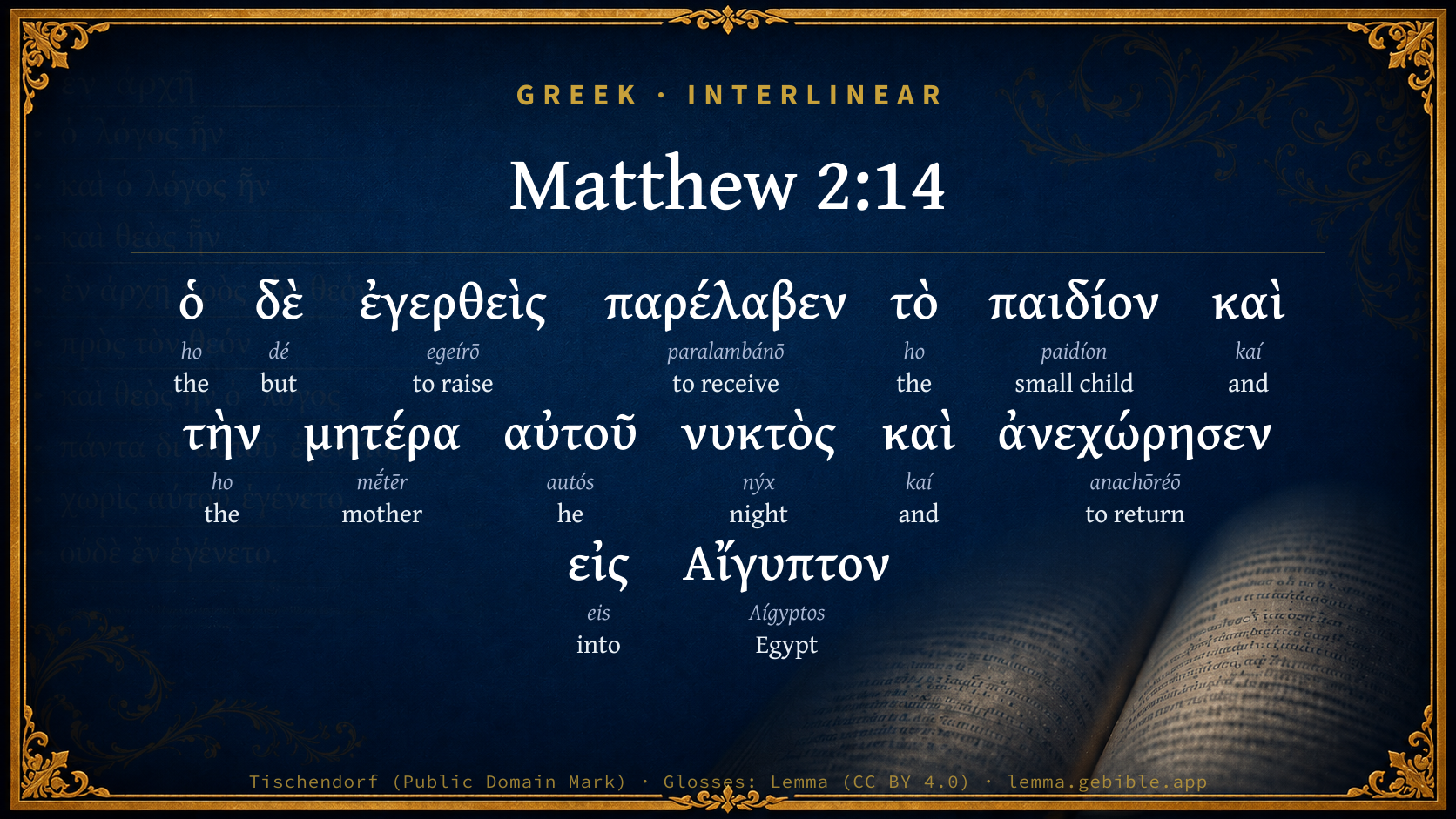
Greek (Tischendorf 8th ed.) Matthew 2:14 appears in the Greek New Testament. The text above is from the Tischendorf 8th edition. Each word links to its Strong’s number and a concise gloss. Click any word for its full Thayer’s Greek Lexicon entry.
Download image
Cite this verse

Matthew 2:14 (World English Bible). Public Domain. Lemma interlinear Bible study tool, https://lemma.gebible.app/v/matthew/2/14.

Show BibTeX & RIS
BibTeX
RIS
English Translation
He arose and took the young child and his mother by night, and departed into Egypt,
World English Bible · Public Domain
Highlights
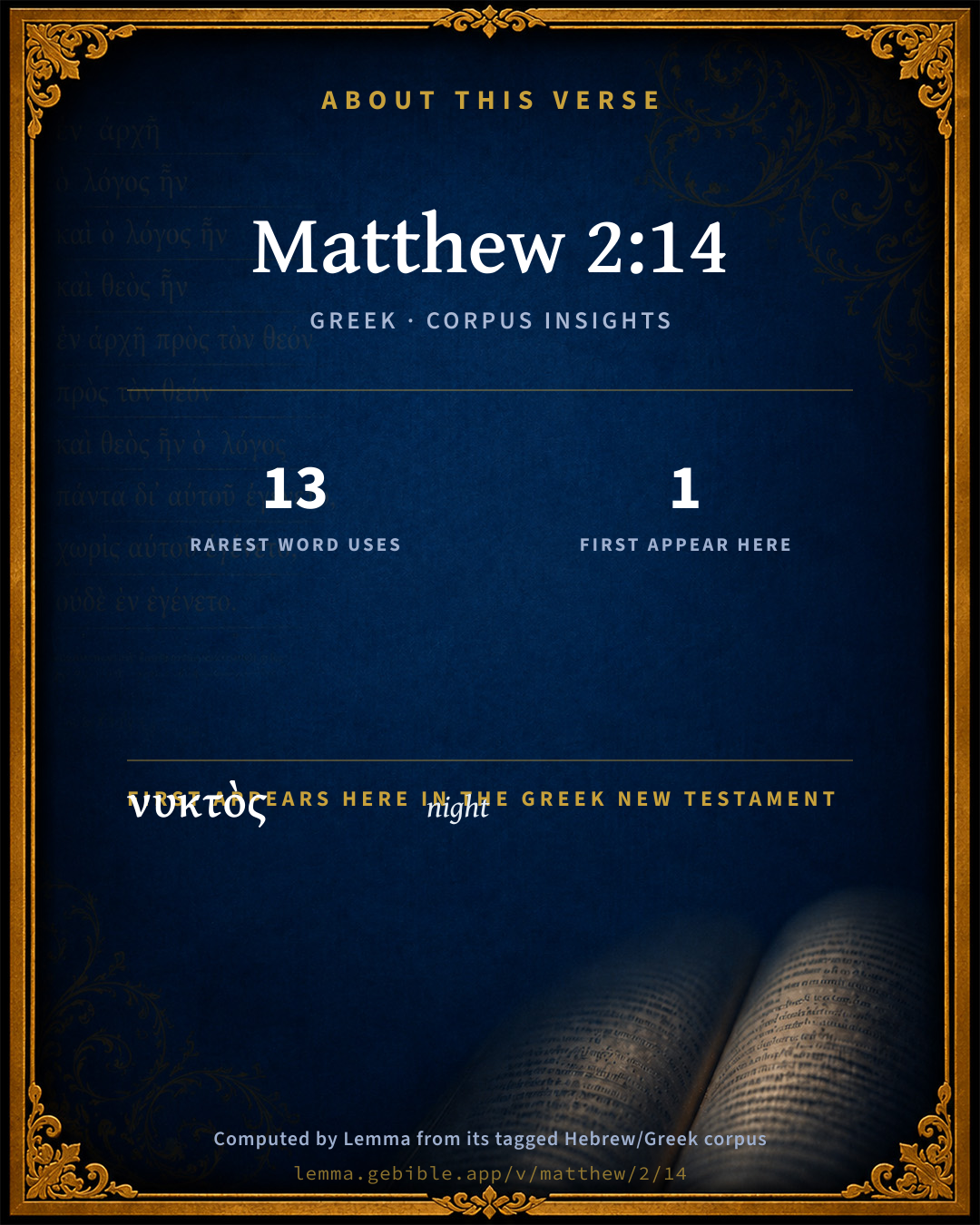
  • 1 first appearance in the Greek New Testament
Full analysis ↓
Download a study sheet

One document with this verse’s original text, its word-by-word gloss line, the meaning frame, cross-references with their text, attributed commentary, and full source and license credits — printable, and it pastes into notes with its structure intact.

This verse Autodidact and up

Study sheet (.html) Plain text (.txt)

A passage Seminary Student

Up to 50 verses in one chapter. A passage sheet keeps up to 6 commentary sources and 12 cross-references per verse, in the order this page ranks them, and says so on the sheet whenever that leaves anything out. Ask for a single verse and you get the Autodidact verse sheet above.

Everything on this page stays free to read, with no account — the sheet is a download of what is already on screen, not access to it.

Want to remove ads? Support Godless Engineer
Compare translations 3

The same verse in 3 English versions, stacked beneath the original-language interlinear above. Click any original word for its lexicon entry.

Each is an independent rendering of the whole verse — the interlinear is not word-aligned to these translations.

Highlighted words mark where these versions differ — a whole-verse word diff, not a word-by-word alignment.

  • World English Bible Public Domain
    He arose and took the young child and his mother by night, and departed into Egypt,
  • King James Version Public Domain
    When he arose, he took the young child and his mother by night, and departed into Egypt:
  • unfoldingWord Literal Text CC BY-SA 4.0
    And having gotten up, he took the young child and his mother at night and departed for Egypt,

unfoldingWord Literal Text — © unfoldingWord, licensed CC BY-SA 4.0. Word-aligned USFM3 via Door43 (git.door43.org/unfoldingWord/en_ult).

Versions to compare (up to 4)

3 of 4 selected

Show all 19 translations

Every available English version of this verse, each an independent rendering of the whole verse.

  • World English Bible Public Domain
    He arose and took the young child and his mother by night, and departed into Egypt,
  • Berean Standard Bible Public Domain
    So he got up, took the Child and His mother by night, and withdrew to Egypt,
  • Majority Standard Bible Public Domain
    So he got up, took the Child and His mother by night, and withdrew to Egypt,
  • King James Version Public Domain
    When he arose, he took the young child and his mother by night, and departed into Egypt:
  • American Standard Version (1901) Public Domain
    And he arose and took the young child and his mother by night, and departed into Egypt;
  • Revised Version (1885) Public Domain
    And he arose and took the young child and his mother by night, and departed into Egypt;
  • Geneva Bible (1599) Public Domain
    So he arose and tooke the babe and his mother by night, and departed into Egypt,
  • Douay-Rheims (1899) Public Domain
    Who arose, and took the child and his mother by night, and retired into Egypt: and he was there until the death of Herod:
  • Young's Literal Translation Public Domain
    And he, having risen, took the child and his mother by night, and withdrew to Egypt,
  • Literal Standard Version CC BY-SA 4.0
    And he, having risen, took the Child and His mother by night, and withdrew to Egypt,
  • Unlocked Literal Bible CC BY-SA 4.0
    That night Joseph rose and took the young child and his mother and departed into Egypt.
  • unfoldingWord Literal Text CC BY-SA 4.0
    And having gotten up, he took the young child and his mother at night and departed for Egypt,
  • Darby Bible Public Domain
    And, having arisen, he took to [him] the little child and his mother by night, and departed into Egypt.
  • World Messianic Bible Public Domain
    He arose and took the young child and his mother by night and departed into Egypt,
  • Webster's Bible Public Domain
    When he arose, he took the young child and his mother by night, and departed into Egypt:
  • Free Bible Version CC BY-SA 4.0
    So Joseph got up and took the boy and his mother, and left during the night for Egypt.
  • Bible in Basic English Public Domain
    So he took the young child and his mother by night, and went into Egypt;
  • Text-Critical English NT CC BY 4.0
    So Joseph rose, took the child and his mother by night, and departed for Egypt,
  • Tyndale New Testament (1534) Public Domain
    The he arose and toke the chylde and his mother by night and departed into Egypte

Literal Standard Version (2020), Covenant Press — licensed CC BY-SA 4.0. Text via the HelloAO Bible API (eBible.org). Unlocked Literal Bible (unfoldingWord) — licensed CC BY-SA 4.0. Text via the HelloAO Bible API (eBible.org). unfoldingWord Literal Text — © unfoldingWord, licensed CC BY-SA 4.0. Word-aligned USFM3 via Door43 (git.door43.org/unfoldingWord/en_ult). Free Bible Version, Dr. Jonathan Gallagher — licensed CC BY-SA 4.0. Text via the HelloAO Bible API (eBible.org).

Word by word

More ways to search: Search by grammar → Find every occurrence → Compare this word →

Practice this passage: Drill this verse → Learn its vocabulary →

ἀνεχώρησεν
anachōréō
G402
“to return”
Verb, Aorist, Active, Indicative, 3rd person, Singular
Part of Speech
Verb
Tense
Aorist
Voice
Active
Mood
Indicative
Person
3rd person
Number
Singular
Full Thayer's Definition

Origin: from G303 and G5562

TDNT: None

1. to go back, return 2. to withdraw a. so as to leave a room b. of those who through fear seek some other place, or shun sight
  1. ὁ ho G3588 “the” Article, Nominative, Singular, Masculine
  2. δὲ dé G1161 “but” Conjunction
  3. ἐγερθεὶς egeírō G1453 “to raise” Verb, Aorist, Passive, Participle, Nominative, Singular, Masculine
  4. παρέλαβεν paralambánō G3880 “to receive” Verb, Aorist, Active, Indicative, 3rd person, Singular
  5. τὸ ho G3588 “the” Article, Accusative, Singular, Neuter
  6. παιδίον paidíon G3813 “small child” Noun, Accusative, Singular, Neuter
  7. καὶ kaí G2532 “and” Conjunction
  8. τὴν ho G3588 “the” Article, Accusative, Singular, Feminine
  9. μητέρα mḗtēr G3384 “mother” Noun, Accusative, Singular, Feminine
  10. αὐτοῦ autós G846 “he” Personal pronoun, Genitive, Singular, Masculine
  11. νυκτὸς nýx G3571 “night” Noun, Genitive, Singular, Feminine
  12. καὶ kaí G2532 “and” Conjunction
  13. εἰς eis G1519 “into” Preposition
  14. Αἴγυπτον Aígyptos G125 “Egypt” Noun, Accusative, Singular, Feminine

About this verse

These counts appear in no published source. They are computed here, from the morphology-tagged text and Lemma’s own curated glosses. What Lemma adds →

15
words
12
distinct lemmas
Gospels
section

Notable vocabulary

The rarest word here is ἀνεχώρησεν to return G402 — appearing just 13 times in the whole Greek New Testament.

First appearance in Scripture

This word makes its first canonical appearance in the Greek New Testament here:

  • νυκτὸς night G3571

Shared distinctive vocabulary

ἀνεχώρησεν to return G402 occurs in 13 verses of the Greek New Testament. Also found in:
Repetition

Words recur within this verse:

Cross-references

3

Topical passages linked to Matthew 2:14 in the Treasury of Scripture Knowledge — connected by theme and wording, ordered by reader-vote popularity; previews shown in the World English Bible.

  • Matthew 2:20–21 "Arise and take the young child and his mother, and go into the land of Israel, for those who sought the young child's life are dead."
  • Acts 26:21 For this reason the Jews seized me in the temple, and tried to kill me.
  • Matthew 1:24 Joseph arose from his sleep, and did as the angel of the Lord commanded him, and took his wife to himself;

Cross-references courtesy of OpenBible.info (CC BY 4.0).

Commentary

Notes on Matthew 2:14 from classic Christian and Jewish commentators (each source and its license shown beneath its notes). The classic Christian expositions comment on the surrounding passage and are grouped to its opening verse, so a note may address several verses; the Jewish commentaries on the Tanakh (Rashi and others) are per-verse, so they appear only where the commentator wrote on this verse.

Lemma curates 59 commentaries, every one of them public domain or Creative Commons licensed, each selected and text-cleaned for this edition rather than reprinted as found. About our sources →

The Biblical Illustrator

Joseph S. Exell

Mat_2:14

Departed into Egypt.

I. The natural seed of Israel, as called out of Egypt.

II. The divine seed, the man Christ Jesus.

III. The chosen seed that shall be brought out of Egypt. (C. H. Spurgeon.)

The Biblical Illustrator, edited by Joseph S. Exell (c. 1880s–1900s) — public domain. Text from a community e-Sword module.

Joseph Benson's Commentary

Mat 2:14-15. When he arose — Viz., from his bed, he took the young child, &c. — He immediately obeyed the heavenly vision, and departed into Egypt — With as hasty a flight as their circumstances would allow. And was there until the death of Herod — Which happened a few months after. That it might be fulfilled — That is, fulfilled again, which was spoken by the prophet — Viz., Hosea, on another occasion, Out of Egypt have I called my son — These words of Hosea, without doubt, were primarily spoken of God’s bringing Israel out of Egypt under the conduct of Moses, the prophet referring to God’s message to Pharaoh, recorded Exo 4:22-23, Israel is my son, even my firstborn; let my son go that he may serve me. Now this deliverance of the Israelites, God’s adopted son, was a type of his bringing Christ his real son from thence, and the meaning here is, that the words were now, as it were, fulfilled anew, and more eminently than before, Christ being in a far higher sense the son of God than Israel, of whom the words were originally spoken. For as a prophetical prediction is then fulfilled when what was foretold has come to pass, so a type is fulfilled when that is accomplished in the antitype, which was done in the type before. If the reader will consult the note on Hos 11:1, he will find this passage fully, and, it is hoped, satisfactorily explained and vindicated; and the consistency of the evangelist’s words with those of the prophet clearly shown. It may not, however, be improper to add here to what is there advanced, that the lot of the Messiah in Egypt was now afflictive, like that of his ancestors formerly in the same country. And the same love of God which induced him to deliver Israel out of Egyptian bondage, was the cause also why he would not leave Christ in Egypt, but bring him back to his own people, whom he was about to enlighten with his heavenly doctrine, and redeem by his sufferings and death. Nor would it be absurd to carry the allegory still further, and to compare Herod to Pharaoh. For, as by the just judgment of God, both the firstborn of Pharaoh, the enemy of the Jews, was slain, and a little after Pharaoh himself perished; so Herod, not long after he had formed the wicked but vain design of putting Christ to death, in a fit of diabolical rage killed his firstborn son, and afterward himself perished, suffering the greatest tortures. — Wetstein.

Joseph Benson's Commentary on the Old and New Testaments (1811–1818) — public domain. Text from a community e-Sword module.

Bengel's Gnomon

Johann Albrecht Bengel

Mat 2:14. Νυκτὸς, by night) The benefit of night is great in times of persecution.

Bengel's Gnomon of the New Testament — English translation (T&T Clark, Edinburgh, 1860) — public domain. Text from a community e-Sword module.

Expositor's Greek Testament

ed. W. Robertson Nicoll

Mat 2:14 . ὁ δὲ ἐγερθεὶς : Joseph promptly executes the command, νυκτός , before the day, indicating alarm as well as obedience. The words of the command in Mat 2:13 are repeated by the evangelist in Mat 2:14 to emphasise the obedient spirit of Joseph.

The Expositor's Greek Testament, edited by W. Robertson Nicoll (1897–1910) — public domain. Text from a community e-Sword module.

Jamieson, Fausset & Brown

Robert Jamieson, A. R. Fausset & David Brown

When he arose, he took the young child and his mother by night, and departed into Egypt--doubtless the same night.

Jamieson, Fausset & Brown — Commentary Critical and Explanatory on the Whole Bible (1871) — public domain (CC PDM 1.0). Text via the HelloAO Bible API.

Ellicott's Commentary for English Readers

(14) He took the young child and his mother.—The form adopted here, as in the preceding verse, is significantly reverential. In a narrative of common life the natural expression would have been “his wife and the young child.”

And departed into Egypt.—The brevity with which this is told is, to a certain extent, an argument for the non-mythical character of the narrative of which it forms a part. The legends of the Apocryphal Gospels, embodied in many forms of poetry and art, show how easily, in later times, the fabulous element crystallised round the Gospel nucleus of fact. The idols of Egypt bowed or fell down before the divine child; a well sprung up under the palm-tree that gave the traveller shelter. They were attacked by robbers, and owed their preservation to the pity of Dismas, one of the band, who was afterwards the penitent thief of the crucifixion. How far the journey extended we cannot tell. It would have been enough for Joseph’s object to pass the so-called River of Egypt, which separated that country from the region under Herod’s sovereignty.

A Bible Commentary for English Readers, edited by Charles John Ellicott (1878–1897) — public domain. Text from a community e-Sword module.

John Gill's Exposition

When he arose, he took the young child and his mother,.... That is, as soon as he awoke out of sleep, and rose from his bed, he did as he was commanded, he prepared for his journey; and very opportunely had the wise men presented their gifts; the gold they brought served to defray the expense of this journey, and which no doubt was so ordered by divine providence for this purpose. Joseph was very punctual and expeditious in obeying the command of God; he took the young child and his mother,

by night, the very selfsame night in which he had this notice; and which season was the most fitting to depart in for secrecy, and most commodious and agreeable to travel in, in those hot countries: hence it appears very manifest, that the coming of the wise men, and the departure of Joseph with Mary and Jesus into Egypt, could not be within a fortnight after the birth of Christ, nor any time before Mary's Purification; since such a journey must have been very improper and unsuitable, at any time within that period; but rather Jesus must be about two years of age, whether something under, or over, it matters not, when Joseph with him

departed into Egypt: what part of Egypt he went into is not certain. The Jews say that Jesus went to Alexandria in Egypt, and which is probable enough; since this was a place greatly resorted to at this time by Jews, and where provision was made for their sustenance; though they greatly mistake the person with whom he went; for they say (f) that R. Joshua ben Perachiah, whom they pretend was his master, went to Alexandria in Egypt, and Jesus with him. However, this is an acknowledgment of the truth of this part of Christ's history, that he was in Egypt; as also when they blasphemously and maliciously say (g), did not Ben Stada, by whom they mean Jesus, bring enchantments or magic, , "out of Egypt", in a cutting in the flesh? To which wicked accusation Arnobius seems to refer (h), when he says,

"perhaps we may meet with many other of these reproachful and childish sayings; as that he was a magician, that he performed all these things by secret arts, and that he stole strange sciences, and the names of mighty angels, out of the temples of the Egyptians.''

(f) T. Bab. Sanhedrim, fol. 107. 2. Cabala R. Abraham. Juchasin, fol. 16. 2. (g) T. Hieros. Sabbat. fol. 13. 1. Bab. Sabbat. fol. 104. 2. (h) Adv. Gentes, l. 1. p. 36.

John Gill's Exposition of the Whole Bible (1746–1763) — public domain (CC PDM 1.0). Text via the HelloAO Bible API.

Trapp's Complete Commentary

John Trapp

14 When he arose, he took the young child and his mother by night, and departed into Egypt:

Ver. 14. When he arose he took the young child, &e.] Whither God leads, we must cheerfully follow, though he seem to lead us, as he did Israel in the wilderness, in and out, backwards and forwards, as if he were treading in a maze; although we were to go with him into those places (Hor. I 32):

" Pigris ubi nulla campis

Arbor aestiva recreatur aura:

Quod latus mundi nebulae malusque

Iupiter urget."

And departed into Egypt] A country, for its fruitfulness and abundance, anciently called, Publicum orbis horreum, the world’s great granary or barn: Horreum, unde hauriatur. (Plin. Mela.) And to this day, so far as the river waters, they do but throw in the seed, and have four rich harvests in less than four months, saith a recent traveller. {a} To here flees the Son of God, as to a sanctuary of safety. And some say, that at his coming there all the idols fell to the ground. Sure it is, that when the love of Christ once cometh into the heart, all the idol desires of the world and flesh fall to nothing, Hos 14:8.

{a} Blount’s Yoyage into the Levant.

John Trapp, A Commentary or Exposition upon All the Books of the Old and New Testament (1647–1656) — public domain. Text from a community e-Sword module.

Albert Barnes' Notes on the Bible

When he arose - Having arisen; that is, he arose immediately after awaking from his dream, and prepared at once to obey the command,

By night - Thus he showed his prompt obedience to the command, and at the same time so concealed his departure as to render himself and Mary and the child safe from pursuit.

Albert Barnes' Notes on the Bible (1834–1885) — public domain. Text from a community e-Sword/MySword module.

Haydock's Catholic Bible Commentary

It is very probable that Joseph, with Jesus and his Mother, remained in some part of Egypt, where the Jews were settled, as at Alexandria. That many Jews dwelt in Egypt, particularly from the time of the prophet Jeremias, is evident from Josephus, and also from the first chapter of the second book of Machabees. Mention is also made of them in Acts ii. and Act. iv. under the name of Alexandrines.

George Leo Haydock (1774–1849), Haydock's Catholic Family Bible and Commentary, 1859 edition — public domain. Excludes Psalms (Douay-Rheims chapter numbering differs from Protestant) and Deuterocanonical books (Catholic canon only).

Matthew Poole's English Annotations

True faith, or assent to a Divine revelation, always produces obedience to the precept of it. Thus it did in the wise men, thus in Joseph. Thus every where in holy writ. By which we may learn, that they indeed believe not the Scriptures to be the word of God, who take no care to live up to the rule of life prescribed in them. Joseph not only obeyed, but readily and presently obeyed:

When he arose, he took the young Child and his mother. The poverty of our Saviour’s parents is not obscurely gathered from this hasty motion of Joseph. His motion was not delayed for the packing up of goods, gathering in of debts, &c. if he lost any thing by his haste, yet he carried with him the promise and special care of God for him and his. Yet he moveth prudentially, and therefore he begins his journey

by night, when least notice could be taken of his motion. We are not to put God upon working miracles for our preservation, though we have never so many sure promises, when it may be obtained in the use of means. They are God’s security given to creatures, whom he hath endued with reason, and expressed that we should use it, while we yet trust in his word. We are not told into what part of Egypt Joseph went, nor how long he stayed there: some say six or seven years; others, but three or four months. The text saith he

was there until the death of Herod. Some say that was before the paschal solemnity that year. But these things are great uncertainties. It is certain he stayed there till Herod died, but when that certainly was we know not, nor is it material for us to be curious in inquiring.

That it might be fulfilled which was spoken of the Lord by the prophet, Out of Egypt have I called my Son. That it might be fulfilled is a phrase we often meet with in the New Testament, to declare the harmony of Scripture, and the faithfulness of God in fulfilling the prophecies or promises of the Old Testament. Spanhemius tells us: "The Scripture is said to be fulfilled properly or improperly." Properly two ways, either literally or mystically. Improperly, secondarily, when some such like thing happeneth as was before foretold or spoken of, or an example is brought parallel to some former example. Literally the Scripture is said to be fulfilled;

1. When a thing before prophesied of, or promised, cometh to pass. Thus the prophecy, Isa 7:14, was literally fulfilled Mat 1:23; so Mic 5:2 was literally fulfilled Mat 2:6, by Christ’s being born in Bethlehem; so Zec 9:9 was literally fulfilled Mat 21:5. Or else;

2. When the type is fulfilled in the antitype. Thus we read of many scriptures of the Old Testament fulfilled in Christ, several things about the paschal lamb, the brazen serpent, Solomon, David, Jonah, &c. Improperly the Scripture is said to be fulfilled, when any thing is reported as done, which bear a proportion to something before recorded in holy writ, as spoken or done: thus Christ applies the same thing to the hypocrites which lived in his time, Mat 15:7,8, which Isaiah spoke of those who lived in his time, Isa 29:13 so Mat 13:14; Isa 6:9; this divines call a fulfilling per accommodationem, aut transumptionem.

The question is, whether this scripture, which is Hos 11:1, was fulfilled in Christ’s being carried into Egypt, properly or improperly. There is a great variety of opinions; those possibly judge best who think that the Israelites going into and coming out of Egypt, was a type of Christ’s going into Egypt, being preserved there, and coming out again. Matthew saith the scripture was fulfilled, whether properly or improperly is not much material for us to know. I have only added thus much to shorten my discourse hereafter where we shall meet with this phrase.

Matthew Poole's English Annotations on the Holy Bible (1683–1685) — public domain. Text from a community e-Sword/MySword module.

Whedon's Commentary on the Bible

Daniel D. Whedon

14. By night — That no informant may be able to indicate whither he has gone. Departed into Egypt — Colonies of Jews had for a long time existed and flourished in Egypt. A rival temple had there been built, and there the Greek translation of the Hebrew Scriptures, called the Septuagint, was made. It was, by the ordinary caravan road, but a few days’ journey; the gifts of the Magi would furnish ample provision for the expenses, and doubtless there were relatives or friends in Egypt willing to receive them.

The flight to Egypt had three purposes: 1. The security of the child from his enemies. 2. To show the divine care and valuation of the holy child. 3.

To make his childhood’s sufferings an antitype to the history of chosen Israel. As Israel went down into Egypt and tarried there under compulsion of Pharaoh until his restoration to Canaan, so Jesus went down into Egypt and tarried under compulsion of Herod until restored to the Holy Land. Twice, then, out of Egypt did God call his son; namely, his collective son, Israel, and his individual son, Christ.

Daniel D. Whedon (gen. ed.), Commentary on the Old and New Testaments (1874–1909) — public domain. Text from a community e-Sword module.

The Pulpit Commentary

When he arose, he took; Revised Version, and he arose and took. The egeryeiv here, as in ver. 13, precludes delay. The young Child and his mother by night, and departed into Egypt. As St. Paul in after years was able to connect himself with fellow-craftsmen, and thus maintain himself, (Act_18:3) so might Joseph reasonably expect to be able to do in Egypt, and the more so since the connexion there between those who worked at the same trade seems to have been even closer than elsewhere, for in tile great synagogue at Alexandria they sat together, "so that if a stranger came he could join himself to his fellow-craftsmen and, through their means, obtain his livelihood" (Talm. Jeremiah, "Suecah," 5:1, p. 55, d). Jewish reference to our Lord"s stay in Egypt are to be found in the blasphemous tables of his having brought thence his knowledge of magic (cf. Laible, in "Nathanael," 1890, p. 79).

The Pulpit Commentary (1880–1919), ed. H.D.M. Spence-Jones & Joseph S. Exell — public domain. Text from a community e-Sword module.

Kretzmann's Popular Commentary

Paul E. Kretzmann

Joseph again was obedient to the angel’s word:

v. 14. When he arose, he took the young Child and His mother by night, and departed into Egypt:

v. 15. and was there until the death of Herod; that it might be fulfilled which was spoken of the Lord by the prophet, saying, Out of Egypt have I called My Son.

Matthew relates the carrying out of the command in the very words in which the angel had spoken them in order to show the obedient spirit of Joseph. That very night he quietly made his escape with those entrusted to his care. He made Egypt his home until after the death of Herod, which, by the nearest historical calculation, occurred in the same year. He died of a peculiar, loathsome disease, which caused his flesh to decay upon his bones, rendering him an abhorrent carcass before his soul finally left the body. It may be remarked, in passing, that all accounts of Christ’s stay in Egypt, as found in apocryphal sources, are entirely fanciful and gross pieces of superstition. But it is of interest to find even here a fulfillment of Old Testament prophecy, Hos 11:1. Though the deliverance of Israel out of the serfdom of Egypt is there referred to, the Holy Ghost here gives us another true explanation, showing that the prophecy relates to the infant Jesus, in His sheltered sojourn in, and safe return from, the country where His ancestors had been held in bondage. Note the reference to the divine inspiration of the prophecy!

Paul E. Kretzmann, Popular Commentary of the Bible (1921–1924) — public domain. Text from a community e-Sword module.

The People's New Testament

B. W. Johnson

14. When he arose, he took the young child. The message came while he was sleeping; as soon as he arose from his bed he took the Child and his mother and departed at once. There was prompt obedience, as there should always be, to the divine commands.

B. W. Johnson's The People's New Testament with Notes (1889–1891) — public domain. Electronic text from the Christian Classics Ethereal Library (CCEL) ThML edition.

Cambridge Greek Testament for Schools and Colleges

14. ἀναχωρεῖν (1) ‘to retire’ from danger as here, and chs. Mat 4:12, Mat 12:16, and elsewhere; (2) in the later Classics ‘to retire from business or public life;’ (3) in Ecclesiastical writers ‘to retire from the world,’ ‘become a hermit, or anchoret’ (ἀναχωρητής).

This word, which occurs much more frequently in this Gospel than elsewhere in N.T. seems to connect itself with two points in the traditional life of St Matthew 1. His stay in Egypt—the cradle of the anchoret life. 2. His asceticism, to which the notion of ‘retirement’ is closely related.

Cambridge Greek Testament for Schools and Colleges (Cambridge University Press, 1896; 21 vols, various authors incl. Carr, Maclear, Plummer, Farrar, Lumby, Moule, M. R. James, Simcox) — public domain. Text from a community e-Sword module.

International Critical Commentary

14. And he arose, and took the child and His mother by night, and departed into Egypt.]

(P O)

International Critical Commentary — older volumes (1896–1929), various authors — public domain. Text from a community e-Sword module.

Lesson kit

Teaching starters — assembled from the data on this page, not authored interpretation. Every prompt links to the verse data it draws on. Edit before teaching.

Matthew, in the Gospels, opens this verse with 15 words (12 distinct Greek lemmas). Its most distinctive word is anachōréō (“to return”). A historical commentator’s framing appears above. Read the whole chapter for the surrounding context.

Discussion questions

  1. The word anachōréō carries the sense “to return.” How does it shape the verse?
  2. This is the first place “night” appears in Scripture (first appears here). What does its debut here establish?
  3. How does Matthew 2:12, which shares the word «to return», read alongside this verse?
  4. What does the repetition of “the” (3× in this one verse) do in this verse?
  5. The translations on this page render this verse differently — a whole-verse word diff, not a word-by-word alignment. What might account for the different wordings?
  6. Compare how The Biblical Illustrator and Joseph Benson's Commentary read this verse. Where do they agree or differ?

Things to notice

  • 1 word makes its first canonical appearance in Scripture here.
  • These translations choose different wording for 6 words in this verse.
  • “the” occurs 3× in this single verse.
  • 12 distinct Greek lemmas span 15 words in this verse.

Reading settings

Reading text

Shown beneath each verse's original-language words.

Old Testament
Old Testament edition

Read the OT as the Masoretic Hebrew (MT) or the Greek Septuagint (LXX).

English shown for the Greek Septuagint (in the Hebrew ↔ Greek comparison).

Comparing translations? Open the Compare panel on any verse page to stack up to four side by side.