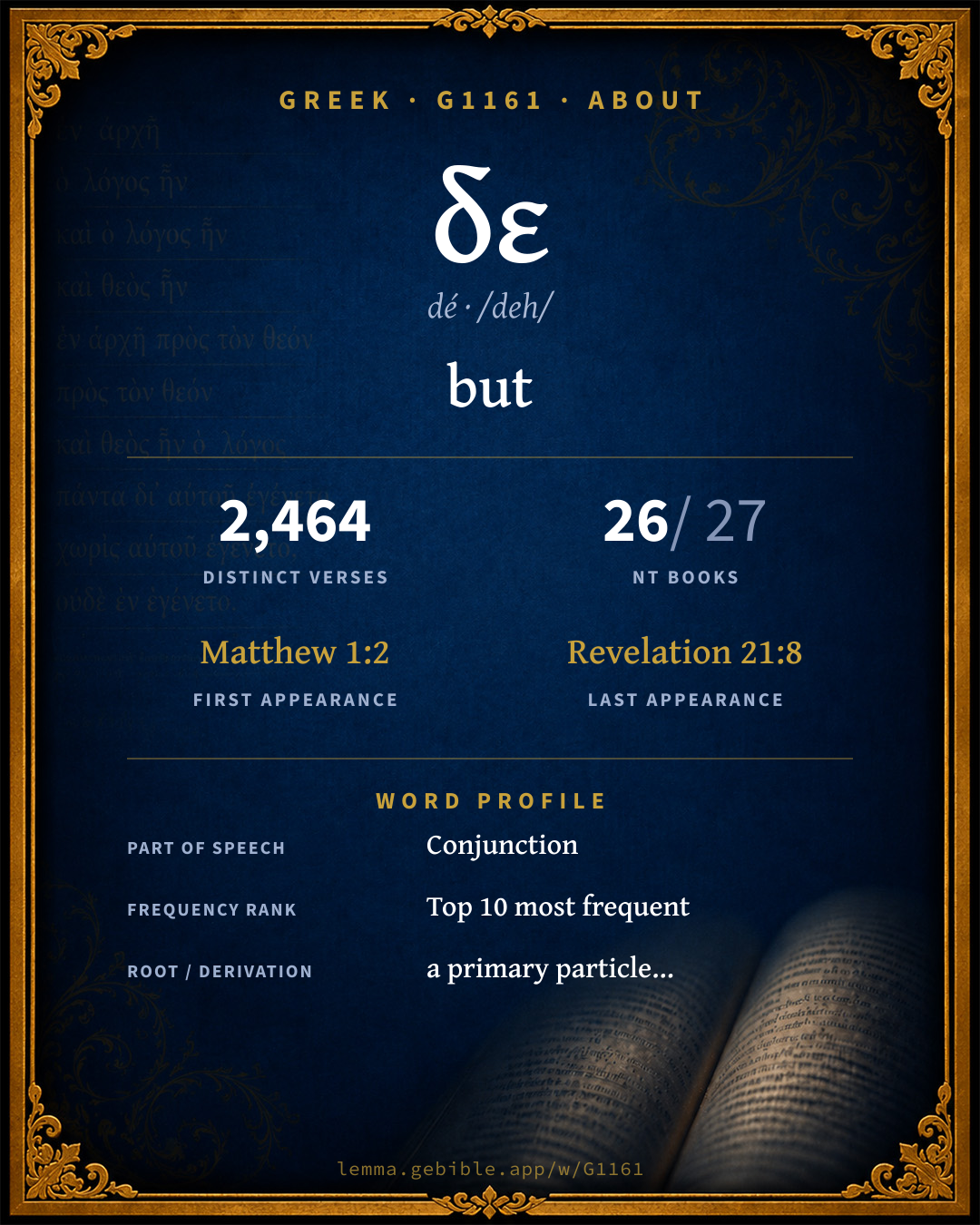
δέ
but
Full lexicon entry — Thayer's Greek Lexicon
From Thayer's Greek Lexicon
Where this word appears
Grammar key — what these labels mean
Part of speech
- Conjunction
- A joining word linking words or clauses.
Every verse where G1161 appears in the Book of 1 Corinthians — 165 distinct verses. Click any verse to open its interlinear word-by-word view. Verse text shown in the World English Bible for context — . Each verse’s Greek form is shown with its reference; the English is not keyword-highlighted, since the data carries no word-level English alignment. Use “Compare translations” on any verse to read it across multiple English versions. This concordance covers the Greek New Testament; Septuagint (Greek Old Testament) occurrences of this word are not indexed here.
1 Corinthians
- 1 Corinthians 1:10 δὲ δὲ conj conj Now I beg you, brothers, through the name of our Lord, Jesus Christ, that you all speak the same thing and that there be no divisions among you, but that you be perfected together in the same mind and in the same judgment.
- 1 Corinthians 1:12 δὲ δὲ δὲ δὲ conj conj conj conj Now I mean this, that each one of you says, "I follow Paul," "I follow Apollos," "I follow Cephas," and, "I follow Christ."
- 1 Corinthians 1:16 δὲ conj (I also baptized the household of Stephanas; besides them, I don't know whether I baptized any other.)
- 1 Corinthians 1:18 δὲ conj For the word of the cross is foolishness to those who are dying, but to us who are saved it is the power of God.
- 1 Corinthians 1:23 δὲ δὲ conj conj but we preach Christ crucified; a stumbling block to Jews, and foolishness to Greeks,
- 1 Corinthians 1:24 δὲ conj but to those who are called, both Jews and Greeks, Christ is the power of God and the wisdom of God.
- 1 Corinthians 1:30 δὲ conj But of him, you are in Christ Jesus, who was made to us wisdom from God, and righteousness and sanctification, and redemption:
- 1 Corinthians 2:6 δὲ δὲ conj conj We speak wisdom, however, among those who are full grown; yet a wisdom not of this world, nor of the rulers of this world, who are coming to nothing.
- 1 Corinthians 2:10 δὲ conj But to us, God revealed them through the Spirit. For the Spirit searches all things, yes, the deep things of God.
- 1 Corinthians 2:12 δὲ conj But we received, not the spirit of the world, but the Spirit which is from God, that we might know the things that were freely given to us by God.
- 1 Corinthians 2:14 δὲ conj Now the natural man doesn't receive the things of God's Spirit, for they are foolishness to him, and he can't know them, because they are spiritually discerned.
- 1 Corinthians 2:15 δὲ δὲ conj conj But he who is spiritual discerns all things, and he himself is judged by no one.
- 1 Corinthians 2:16 δὲ conj "For who has known the mind of the Lord, that he should instruct him?" But we have Christ's mind.
- 1 Corinthians 3:4 δέ conj For when one says, "I follow Paul," and another, "I follow Apollos," aren't you fleshly?
- 1 Corinthians 3:5 δέ conj Who then is Apollos, and who is Paul, but servants through whom you believed; and each as the Lord gave to him?
- 1 Corinthians 3:8 δὲ δὲ conj conj Now he who plants and he who waters are the same, but each will receive his own reward according to his own labor.
- 1 Corinthians 3:10 δὲ δὲ conj conj According to the grace of God which was given to me, as a wise master builder I laid a foundation, and another builds on it. But let each man be careful how he builds on it.
- 1 Corinthians 3:12 δέ conj But if anyone builds on the foundation with gold, silver, costly stones, wood, hay, or stubble;
- 1 Corinthians 3:15 δὲ δὲ conj conj If any man's work is burned, he will suffer loss, but he himself will be saved, but as through fire.
- 1 Corinthians 3:23 δὲ δὲ conj conj and you are Christ's, and Christ is God's.
- 1 Corinthians 4:3 δὲ conj But with me it is a very small thing that I should be judged by you, or by man's judgment. Yes, I don't judge my own self.
- 1 Corinthians 4:4 δὲ conj For I know nothing against myself. Yet I am not justified by this, but he who judges me is the Lord.
- 1 Corinthians 4:6 δέ conj Now these things, brothers, I have in a figure transferred to myself and Apollos for your sakes, that in us you might learn not to think beyond the things which are written, that none of you be puffed up against one another.
- 1 Corinthians 4:7 δὲ δὲ conj conj For who makes you different? And what do you have that you didn't receive? But if you did receive it, why do you boast as if you had not received it?
- 1 Corinthians 4:10 δὲ δὲ δὲ conj conj conj We are fools for Christ's sake, but you are wise in Christ. We are weak, but you are strong. You have honor, but we have dishonor.
- 1 Corinthians 4:18 δέ conj Now some are puffed up, as though I were not coming to you.
- 1 Corinthians 4:19 δὲ conj But I will come to you shortly, if the Lord is willing. And I will know, not the word of those who are puffed up, but the power.
- 1 Corinthians 5:3 δὲ conj For I most assuredly, as being absent in body but present in spirit, have already, as though I were present, judged him who has done this thing.
- 1 Corinthians 5:11 δὲ conj But as it is, I wrote to you not to associate with anyone who is called a brother who is a sexual sinner, or covetous, or an idolater, or a slanderer, or a drunkard, or an extortioner. Don't even eat with such a person.
- 1 Corinthians 5:13 δὲ conj But those who are outside, God judges. "Put away the wicked man from among yourselves."
- 1 Corinthians 6:13 δὲ δὲ conj conj "Foods for the belly, and the belly for foods," but God will bring to nothing both it and them. But the body is not for sexual immorality, but for the Lord; and the Lord for the body.
- 1 Corinthians 6:14 δὲ conj Now God raised up the Lord, and will also raise us up by his power.
- 1 Corinthians 6:17 δὲ conj But he who is joined to the Lord is one spirit.
- 1 Corinthians 6:18 δὲ conj Flee sexual immorality! "Every sin that a man does is outside the body," but he who commits sexual immorality sins against his own body.
- 1 Corinthians 7:1 δὲ conj Now concerning the things about which you wrote to me: it is good for a man not to touch a woman.
- 1 Corinthians 7:2 δὲ conj But, because of sexual immoralities, let each man have his own wife, and let each woman have her own husband.
- 1 Corinthians 7:3 δὲ conj Let the husband render to his wife the affection owed her, and likewise also the wife to her husband.
- 1 Corinthians 7:4 δὲ conj The wife doesn't have authority over her own body, but the husband. Likewise also the husband doesn't have authority over his own body, but the wife.
- 1 Corinthians 7:6 δὲ conj But this I say by way of concession, not of commandment.
- 1 Corinthians 7:7 δὲ δὲ conj conj Yet I wish that all men were like me. However each man has his own gift from God, one of this kind, and another of that kind.
- 1 Corinthians 7:8 δὲ conj But I say to the unmarried and to widows, it is good for them if they remain even as I am.
- 1 Corinthians 7:9 δὲ conj But if they don't have self-control, let them marry. For it's better to marry than to burn.
- 1 Corinthians 7:10 δὲ conj But to the married I command--not I, but the Lord--that the wife not leave her husband
- 1 Corinthians 7:11 δὲ conj (but if she departs, let her remain unmarried, or else be reconciled to her husband), and that the husband not leave his wife.
- 1 Corinthians 7:12 δὲ conj But to the rest I--not the Lord--say, if any brother has an unbelieving wife, and she is content to live with him, let him not leave her.
- 1 Corinthians 7:14 δὲ conj For the unbelieving husband is sanctified in the wife, and the unbelieving wife is sanctified in the husband. Otherwise your children would be unclean, but now are they holy.
- 1 Corinthians 7:15 δὲ δὲ conj conj Yet if the unbeliever departs, let there be separation. The brother or the sister is not under bondage in such cases, but God has called us in peace.
- 1 Corinthians 7:25 δὲ δὲ conj conj Now concerning virgins, I have no commandment from the Lord, but I give my judgment as one who has obtained mercy from the Lord to be trustworthy.
- 1 Corinthians 7:28 δὲ δὲ δὲ conj conj conj But if you marry, you have not sinned. If a virgin marries, she has not sinned. Yet such will have oppression in the flesh, and I want to spare you.
- 1 Corinthians 7:29 δέ conj But I say this, brothers: the time is short, that from now on, both those who have wives may be as though they had none;
- 1 Corinthians 7:32 δὲ conj But I desire to have you to be free from cares. He who is unmarried is concerned for the things of the Lord, how he may please the Lord;
- 1 Corinthians 7:33 δὲ conj but he who is married is concerned about the things of the world, how he may please his wife.
- 1 Corinthians 7:34 δὲ conj There is also a difference between a wife and a virgin. The unmarried woman cares about the things of the Lord, that she may be holy both in body and in spirit. But she who is married cares about the things of the world--how she may please her husband.
- 1 Corinthians 7:35 δὲ conj This I say for your own profit; not that I may ensnare you, but for that which is appropriate, and that you may attend to the Lord without distraction.
- 1 Corinthians 7:36 δέ conj But if any man thinks that he is behaving inappropriately toward his virgin, if she is past the flower of her age, and if need so requires, let him do what he desires. He doesn't sin. Let them marry.
- 1 Corinthians 7:37 δὲ δὲ conj conj But he who stands steadfast in his heart, having no necessity, but has power over his own heart, to keep his own virgin, does well.
- 1 Corinthians 7:39 δὲ conj A wife is bound by law for as long as her husband lives; but if the husband is dead, she is free to be married to whoever she desires, only in the Lord.
- 1 Corinthians 7:40 δέ δὲ conj conj But she is happier if she stays as she is, in my judgment, and I think that I also have God's Spirit.
- 1 Corinthians 8:1 δὲ δὲ conj conj Now concerning things sacrificed to idols: We know that we all have knowledge. Knowledge puffs up, but love builds up.
- 1 Corinthians 8:3 δέ conj But if anyone loves God, the same is known by him.
- 1 Corinthians 8:7 δὲ conj However, that knowledge isn't in all men. But some, with consciousness of the idol until now, eat as of a thing sacrificed to an idol, and their conscience, being weak, is defiled.
- 1 Corinthians 8:8 δὲ conj But food will not commend us to God. For neither, if we don't eat, are we the worse; nor, if we eat, are we the better.
- 1 Corinthians 8:9 δὲ conj But be careful that by no means does this liberty of yours become a stumbling block to the weak.
- 1 Corinthians 8:12 δὲ conj Thus, sinning against the brothers, and wounding their conscience when it is weak, you sin against Christ.
- 1 Corinthians 9:15 δὲ δὲ conj conj But I have used none of these things, and I don't write these things that it may be done so in my case; for I would rather die, than that anyone should make my boasting void.
- 1 Corinthians 9:17 δὲ conj For if I do this of my own will, I have a reward. But if not of my own will, I have a stewardship entrusted to me.
- 1 Corinthians 9:23 δὲ conj Now I do this for the Gospel's sake, that I may be a joint partaker of it.
- 1 Corinthians 9:24 δὲ conj Don't you know that those who run in a race all run, but one receives the prize? Run like that, that you may win.
- 1 Corinthians 9:25 δὲ δὲ conj conj Every man who strives in the games exercises self-control in all things. Now they do it to receive a corruptible crown, but we an incorruptible.
- 1 Corinthians 10:4 δὲ conj and all drank the same spiritual drink. For they drank of a spiritual rock that followed them, and the rock was Christ.
- 1 Corinthians 10:6 δὲ conj Now these things were our examples, to the intent we should not lust after evil things, as they also lusted.
- 1 Corinthians 10:11 δὲ δὲ conj conj Now all these things happened to them by way of example, and they were written for our admonition, on whom the ends of the ages have come.
- 1 Corinthians 10:13 δὲ conj No temptation has taken you except what is common to man. God is faithful, who will not allow you to be tempted above what you are able, but will with the temptation also make the way of escape, that you may be able to endure it.
- 1 Corinthians 10:20 δὲ conj But I say that the things which the Gentiles sacrifice, they sacrifice to demons, and not to God, and I don't desire that you would have communion with demons.
- 1 Corinthians 10:28 δέ conj But if anyone says to you, "This was offered to idols," don't eat it for the sake of the one who told you, and for the sake of conscience. For "the earth is the Lord's, and all its fullness."
- 1 Corinthians 10:29 δὲ conj Conscience, I say, not your own, but the other's conscience. For why is my liberty judged by another conscience?
- 1 Corinthians 11:2 δὲ conj Now I praise you, brothers, that you remember me in all things, and hold firm the traditions, even as I delivered them to you.
- 1 Corinthians 11:3 δὲ δὲ δὲ conj conj conj But I would have you know that the head of every man is Christ, and the head of the woman is the man, and the head of Christ is God.
- 1 Corinthians 11:5 δὲ conj But every woman praying or prophesying with her head unveiled dishonors her head. For it is one and the same thing as if she were shaved.
- 1 Corinthians 11:6 δὲ conj For if a woman is not covered, let her also be shorn. But if it is shameful for a woman to be shorn or shaved, let her be covered.
- 1 Corinthians 11:7 δὲ conj For a man indeed ought not to have his head covered, because he is the image and glory of God, but the woman is the glory of the man.
- 1 Corinthians 11:12 δὲ conj For as woman came from man, so a man also comes through a woman; but all things are from God.
- 1 Corinthians 11:15 δὲ conj But if a woman has long hair, it is a glory to her, for her hair is given to her for a covering.
- 1 Corinthians 11:16 δέ conj But if any man seems to be contentious, we have no such custom, neither do God's assemblies.
- 1 Corinthians 11:17 δὲ conj But in giving you this command, I don't praise you, that you come together not for the better but for the worse.
- 1 Corinthians 11:21 δὲ conj For in your eating each one takes his own supper before others. One is hungry, and another is drunken.
- 1 Corinthians 11:28 δὲ conj But let a man examine himself, and so let him eat of the bread, and drink of the cup.
- 1 Corinthians 11:31 δὲ conj For if we discerned ourselves, we wouldn't be judged.
- 1 Corinthians 11:32 δὲ conj But when we are judged, we are punished by the Lord, that we may not be condemned with the world.
- 1 Corinthians 11:34 δὲ conj But if anyone is hungry, let him eat at home, lest your coming together be for judgment. The rest I will set in order whenever I come.
- 1 Corinthians 12:1 δὲ conj Now concerning spiritual things, brothers, I don't want you to be ignorant.
- 1 Corinthians 12:4 δὲ δὲ conj conj Now there are various kinds of gifts, but the same Spirit.
- 1 Corinthians 12:6 δὲ conj There are various kinds of workings, but the same God, who works all things in all.
- 1 Corinthians 12:7 δὲ conj But to each one is given the manifestation of the Spirit for the profit of all.
- 1 Corinthians 12:8 δὲ conj For to one is given through the Spirit the word of wisdom, and to another the word of knowledge, according to the same Spirit;
- 1 Corinthians 12:9 δὲ conj to another faith, by the same Spirit; and to another gifts of healings, by the same Spirit;
- 1 Corinthians 12:10 δὲ δὲ δὲ δὲ conj conj conj conj and to another workings of miracles; and to another prophecy; and to another discerning of spirits; to another different kinds of languages; and to another the interpretation of languages.
- 1 Corinthians 12:11 δὲ conj But the one and the same Spirit works all of these, distributing to each one separately as he desires.
- 1 Corinthians 12:12 δὲ conj For as the body is one, and has many members, and all the members of the body, being many, are one body; so also is Christ.
- 1 Corinthians 12:18 δὲ conj But now God has set the members, each one of them, in the body, just as he desired.
- 1 Corinthians 12:19 δὲ conj If they were all one member, where would the body be?
- 1 Corinthians 12:20 δὲ δὲ conj conj But now they are many members, but one body.
- 1 Corinthians 12:21 δὲ conj The eye can't tell the hand, "I have no need for you," or again the head to the feet, "I have no need for you."
- 1 Corinthians 12:24 δὲ conj whereas our presentable parts have no such need. But God composed the body together, giving more abundant honor to the inferior part,
- 1 Corinthians 12:27 δέ conj Now you are the body of Christ, and members individually.
- 1 Corinthians 12:31 δὲ conj But earnestly desire the best gifts. Moreover, I show a most excellent way to you.
- 1 Corinthians 13:1 δὲ conj If I speak with the languages of men and of angels, but don't have love, I have become sounding brass, or a clanging cymbal.
- 1 Corinthians 13:2 δὲ conj If I have the gift of prophecy, and know all mysteries and all knowledge; and if I have all faith, so as to remove mountains, but don't have love, I am nothing.
- 1 Corinthians 13:3 δὲ conj If I dole out all my goods to feed the poor, and if I give my body to be burned, but don't have love, it profits me nothing.
- 1 Corinthians 13:6 δὲ conj doesn't rejoice in unrighteousness, but rejoices with the truth;
- 1 Corinthians 13:8 δὲ conj Love never fails. But where there are prophecies, they will be done away with. Where there are various languages, they will cease. Where there is knowledge, it will be done away with.
- 1 Corinthians 13:10 δὲ conj but when that which is complete has come, then that which is partial will be done away with.
- 1 Corinthians 13:12 δὲ δὲ conj conj For now we see in a mirror, dimly, but then face to face. Now I know in part, but then I will know fully, even as I was also fully known.
- 1 Corinthians 13:13 δὲ δὲ conj conj But now faith, hope, and love remain--these three. The greatest of these is love.
- 1 Corinthians 14:1 δὲ δὲ conj conj Follow after love, and earnestly desire spiritual gifts, but especially that you may prophesy.
- 1 Corinthians 14:2 δὲ conj For he who speaks in another language speaks not to men, but to God; for no one understands; but in the Spirit he speaks mysteries.
- 1 Corinthians 14:3 δὲ conj But he who prophesies speaks to men for their edification, exhortation, and consolation.
- 1 Corinthians 14:4 δὲ conj He who speaks in another language edifies himself, but he who prophesies edifies the assembly.
- 1 Corinthians 14:5 δὲ δὲ δὲ conj conj conj Now I desire to have you all speak with other languages, but rather that you would prophesy. For he is greater who prophesies than he who speaks with other languages, unless he interprets, that the assembly may be built up.
- 1 Corinthians 14:6 δέ conj But now, brothers, if I come to you speaking with other languages, what would I profit you, unless I speak to you either by way of revelation, or of knowledge, or of prophesying, or of teaching?
- 1 Corinthians 14:14 δὲ conj For if I pray in another language, my spirit prays, but my understanding is unfruitful.
- 1 Corinthians 14:15 δὲ δὲ conj conj What is it then? I will pray with the spirit, and I will pray with the understanding also. I will sing with the spirit, and I will sing with the understanding also.
- 1 Corinthians 14:20 δὲ conj Brothers, don't be children in thoughts, yet in malice be babies, but in thoughts be mature.
- 1 Corinthians 14:22 δὲ conj Therefore other languages are for a sign, not to those who believe, but to the unbelieving; but prophesying is for a sign, not to the unbelieving, but to those who believe.
- 1 Corinthians 14:23 δὲ conj If therefore the whole assembly is assembled together and all speak with other languages, and unlearned or unbelieving people come in, won't they say that you are crazy?
- 1 Corinthians 14:24 δὲ δέ conj conj But if all prophesy, and someone unbelieving or unlearned comes in, he is reproved by all, and he is judged by all.
- 1 Corinthians 14:28 δὲ δὲ conj conj But if there is no interpreter, let him keep silent in the assembly, and let him speak to himself, and to God.
- 1 Corinthians 14:29 δὲ conj Let the prophets speak, two or three, and let the others discern.
- 1 Corinthians 14:30 δὲ conj But if a revelation is made to another sitting by, let the first keep silent.
- 1 Corinthians 14:35 δέ conj If they desire to learn anything, let them ask their own husbands at home, for it is shameful for a woman to chatter in the assembly.
- 1 Corinthians 14:38 δέ conj But if anyone is ignorant, let him be ignorant.
- 1 Corinthians 14:40 δὲ conj Let all things be done decently and in order.
- 1 Corinthians 15:1 δὲ conj Now I declare to you, brothers, the Gospel which I preached to you, which also you received, in which you also stand,
- 1 Corinthians 15:6 δὲ conj Then he appeared to over five hundred brothers at once, most of whom remain until now, but some have also fallen asleep.
- 1 Corinthians 15:8 δὲ conj and last of all, as to the child born at the wrong time, he appeared to me also.
- 1 Corinthians 15:10 δὲ δὲ conj conj But by the grace of God I am what I am. His grace which was bestowed on me was not futile, but I worked more than all of them; yet not I, but the grace of God which was with me.
- 1 Corinthians 15:12 δὲ conj Now if Christ is preached, that he has been raised from the dead, how do some among you say that there is no resurrection of the dead?
- 1 Corinthians 15:13 δὲ conj But if there is no resurrection of the dead, neither has Christ been raised.
- 1 Corinthians 15:14 δὲ conj If Christ has not been raised, then our preaching is in vain, and your faith also is in vain.
- 1 Corinthians 15:15 δὲ conj Yes, we are found false witnesses of God, because we testified about God that he raised up Christ, whom he didn't raise up, if it is so that the dead are not raised.
- 1 Corinthians 15:17 δὲ conj If Christ has not been raised, your faith is vain; you are still in your sins.
- 1 Corinthians 15:20 δὲ conj But now Christ has been raised from the dead. He became the first fruits of those who are asleep.
- 1 Corinthians 15:23 δὲ conj But each in his own order: Christ the first fruits, then those who are Christ's, at his coming.
- 1 Corinthians 15:27 δὲ conj For, "He put all things in subjection under his feet." But when he says, "All things are put in subjection," it is evident that he is excepted who subjected all things to him.
- 1 Corinthians 15:28 δὲ conj When all things have been subjected to him, then the Son will also himself be subjected to him who subjected all things to him, that God may be all in all.
- 1 Corinthians 15:35 δὲ conj But someone will say, "How are the dead raised?" and, "With what kind of body do they come?"
- 1 Corinthians 15:38 δὲ conj But God gives it a body even as it pleased him, and to each seed a body of its own.
- 1 Corinthians 15:39 δὲ δὲ δὲ conj conj conj All flesh is not the same flesh, but there is one flesh of men, another flesh of animals, another of fish, and another of birds.
- 1 Corinthians 15:40 δὲ conj There are also celestial bodies, and terrestrial bodies; but the glory of the celestial differs from that of the terrestrial.
- 1 Corinthians 15:50 δέ conj Now I say this, brothers, that flesh and blood can't inherit the Kingdom of God; neither does corruption inherit incorruption.
- 1 Corinthians 15:51 δὲ conj Behold, I tell you a mystery. We will not all sleep, but we will all be changed,
- 1 Corinthians 15:54 δὲ conj But when this corruptible will have put on incorruption, and this mortal will have put on immortality, then what is written will happen: "Death is swallowed up in victory."
- 1 Corinthians 15:56 δὲ δὲ conj conj The sting of death is sin, and the power of sin is the law.
- 1 Corinthians 15:57 δὲ conj But thanks be to God, who gives us the victory through our Lord Jesus Christ.
- 1 Corinthians 16:1 δὲ conj Now concerning the collection for the saints, as I commanded the assemblies of Galatia, you do likewise.
- 1 Corinthians 16:3 δὲ conj When I arrive, I will send whoever you approve with letters to carry your gracious gift to Jerusalem.
- 1 Corinthians 16:4 δὲ conj If it is appropriate for me to go also, they will go with me.
- 1 Corinthians 16:5 δὲ conj But I will come to you when I have passed through Macedonia, for I am passing through Macedonia.
- 1 Corinthians 16:6 δὲ conj But with you it may be that I will stay, or even winter, that you may send me on my journey wherever I go.
- 1 Corinthians 16:8 δὲ conj But I will stay at Ephesus until Pentecost,
- 1 Corinthians 16:10 δὲ conj Now if Timothy comes, see that he is with you without fear, for he does the work of the Lord, as I also do.
- 1 Corinthians 16:11 δὲ conj Therefore let no one despise him. But set him forward on his journey in peace, that he may come to me; for I expect him with the brothers.
- 1 Corinthians 16:12 δὲ δὲ conj conj Now concerning Apollos, the brother, I strongly urged him to come to you with the brothers; and it was not at all his desire to come now; but he will come when he has an opportunity.
- 1 Corinthians 16:15 δὲ conj Now I beg you, brothers (you know the house of Stephanas, that it is the first fruits of Achaia, and that they have set themselves to minister to the saints),
- 1 Corinthians 16:17 δὲ conj I rejoice at the coming of Stephanas, Fortunatus, and Achaicus; for that which was lacking on your part, they supplied.
About this entry
At a glance — auto-summarized from this page’s data, not written by a person. Every figure links to its source below. This summary describes the numbers; it doesn’t interpret them.
δε — transliterated dé — is a Greek conjunction carrying the sense “but.” Its earliest occurrence is Matthew 1:2. It appears 2,464 verses across 26 books of the Greek New Testament, among its most common vocabulary. It shares a root with δη. Each statement above links to its evidence; the full detail follows below.
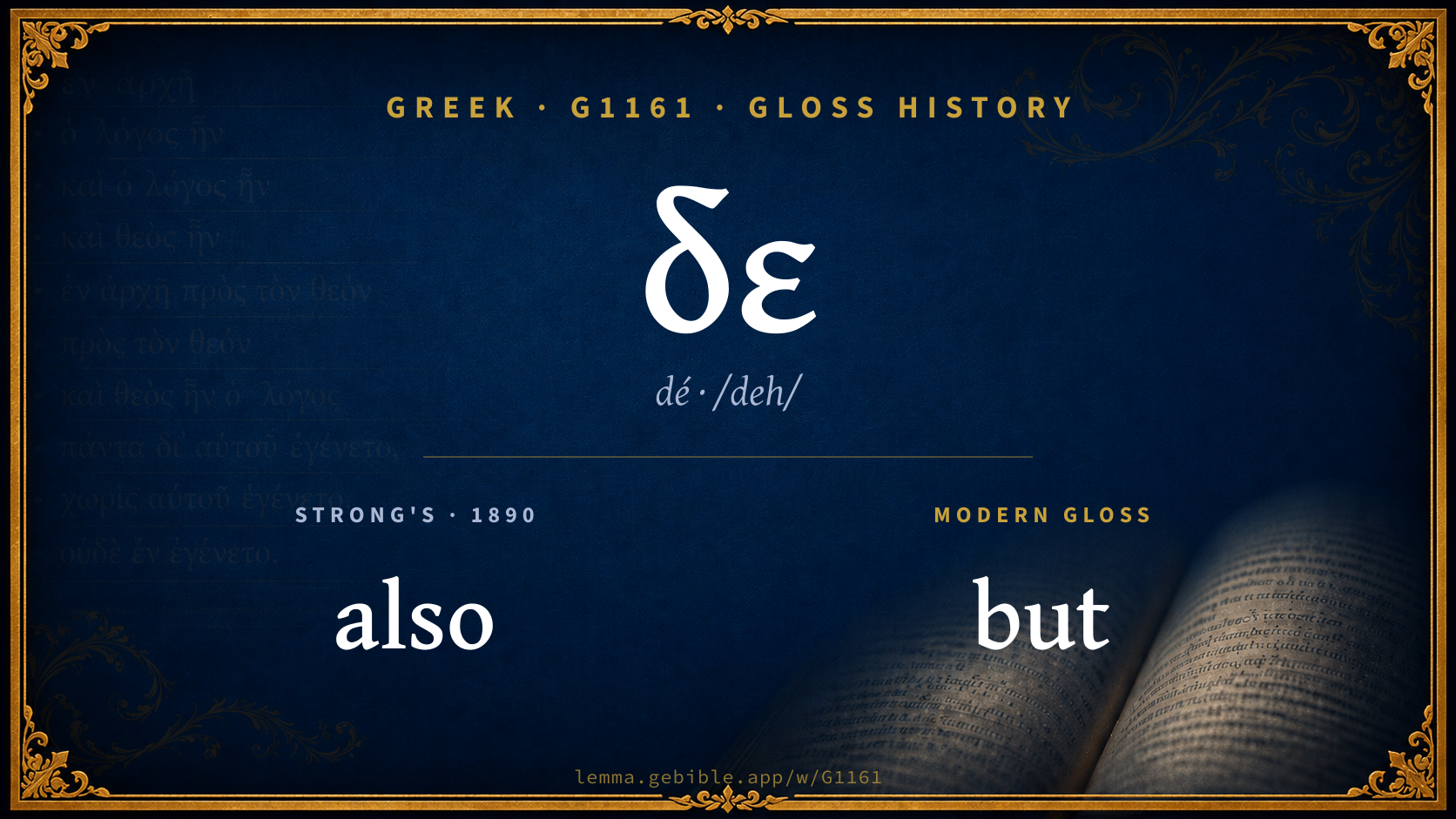
Gloss history
Strong's 1890 vs modern scholarship
About this word
Strong's G1161 catalogs a Greek word from the Greek New Testament.
These counts are not copied from any lexicon or concordance. They are computed here, from the morphology-tagged Greek New Testament. What Lemma adds →
- 2,464
- distinct verses
- The word appears in 2,464 distinct verses.
- 26 / 27
- NT books
- The word appears in 26 of 27 New Testament books.
- #4
- by frequency
- Top 10 most frequent Greek words (rank 4 of 5,347 Greek words by occurrence).
View all 2,464 occurrences in the concordance →
By section of the New Testament
By traditional corpus
Conventional, traditional groupings — biblical authorship is debated, so this is a traditional corpus grouping, not an authorship claim. Some books belong to more than one corpus (Luke is in both the Gospels and the Lukan corpus, and so on), so these shares overlap and need not total 100%. Each figure is a share of the word’s 2,464 distinct verses.
- Gospels 1,258 verses · 51%
- Lukan (Luke–Acts) 971 verses · 39%
- Pauline corpus 547 verses · 22%
- Johannine 211 verses · 9%
- General (Catholic) Epistles 93 verses · 4%
- Hebrews 68 verses · 3%
- Revelation 7 verses · 0%
How translations render this word
Counts come from each version’s own published word-to-Strong’s tagging or interlinear alignment — an approximate guide to how each version renders this word, not a word-level alignment the data otherwise carries. Because each total is that version’s own tagged count, the per-version totals vary from one another and need not match the appearance or distinct-verse counts above. These counts may also differ from a printed concordance because Lemma counts each distinctly tagged rendering and does not collapse phrase taggings into a single head-word total. This is a fixed set of word-tagged versions (KJV, ASV, BSB, ULT) and does not change with the reading translation you choose elsewhere. Each version’s license is shown beside its name below (and on Sources).
- King James Version: And 1,228×, But 929×, Now 166×
- American Standard Version: And 1,179×, But 999×, Now 171×
- Berean Standard Bible: But 784×, And 339×, Now 116×
- unfoldingWord Literal Text: But 1,407×, And 745×, Now 419×
King James Version Public Domain
Renders G1161 across 2,711 tagged occurrences — most commonly:
Plus other, less common renderings. Plus 42 renderings that appear only once — usually multi-word phrases or single function words the recovered tagging swept in, not distinct renderings. Not rendered by a distinct English word in 159 further occurrences.
American Standard Version Public Domain
Renders G1161 across 2,640 tagged occurrences — most commonly:
Plus other, less common renderings. Plus 75 renderings that appear only once — usually multi-word phrases or single function words the recovered tagging swept in, not distinct renderings. Not rendered by a distinct English word in 34 further occurrences.
Berean Standard Bible Public Domain
Renders G1161 across 1,643 tagged occurrences — most commonly:
Plus other, less common renderings. Plus 38 renderings that appear only once — usually multi-word phrases or single function words the recovered tagging swept in, not distinct renderings. Not rendered by a distinct English word in 1,112 further occurrences.
unfoldingWord Literal Text CC BY-SA 4.0
Renders G1161 across 2,802 tagged occurrences — most commonly:
Plus other, less common renderings. Plus 9 renderings that appear only once — usually multi-word phrases or single function words the recovered tagging swept in, not distinct renderings.
Senses in Thayer's
The 1 sense Thayer's distinguishes for this word, in lexicon order (not ranked by frequency or importance). The full entry — with sub-senses — is in the Lexicon Entry tab.
- but, moreover, and, etc.
Word origin
Origin: a primary particle (adversative or continuative)
A primary particle (adversative or continuative); but and etc. : - also and but moreover now [ often unexpressed in English ].
— Strong’s Exhaustive Concordance (1890), public domain.
Forms in the corpus
The 3 distinct written forms G1161 takes in the Greek New Testament, most frequent first — each parse links to that case’s occurrences in the concordance.
| Form | Parsing | Example | Uses |
|---|---|---|---|
| δὲ dè | Conjunction | Matthew 1:2 | 2,602 |
| δέ dé | Conjunction | Matthew 5:31 | 147 |
| δ’ d | Conjunction | Matthew 5:19 | 22 |
Same root — word family
Other Thayer's entries built from the same root as G1161, grouped by Strong’s listed origin. These share a root / origin per the lexicon — not necessarily a shared meaning. Each links to that word’s own entry.
Derived from this word
Compare all same-root words → They share a root, not necessarily a meaning.
Septuagint usage
The same Greek word δε appears 3,556 times in the Greek Old Testament (Septuagint), across 3,042 verses in 35 books.
- 3,556
- LXX occurrences
- Tagged occurrences of this Greek word in the Septuagint.
- 3,042
- verses
- Distinct Septuagint verses containing this word.
- 35 / 39
- OT books
- The word appears in 35 of the 39 Old Testament books.
Sample Septuagint occurrences
- Genesis 1:2 δέ
- Exodus 1:5 δέ
- Leviticus 1:9 δέ
- Numbers 1:47 δέ
- Deuteronomy 4:4 δέ
- Joshua 1:14 δέ
- Judges 1:11 δέ
- Ruth 1:14 δέ
- 1 Samuel 7:17 δέ
- 2 Samuel 3:30 δέ
- 1 Kings 1:17 δέ
- 2 Kings 3:15 δέ
Septuagint occurrences (same lexeme)
Every verse where the same Strong’s number (G1161) appears in the Greek Septuagint — showing the first 50 of 3,042. Verse text shown in the World English Bible for context; the Greek form is the matched word — the English is not keyword-highlighted.
- Genesis 1:2 δέ Now the earth was formless and empty. Darkness was on the surface of the deep. God's Spirit was hovering over the surface of the waters.
- Genesis 2:6 δέ but a mist went up from the earth, and watered the whole surface of the ground.
- Genesis 2:10 δέ A river went out of Eden to water the garden; and from there it was parted, and became four heads.
- Genesis 2:12 δέ and the gold of that land is good. There is aromatic resin and the onyx stone.
- Genesis 2:14 δέ The name of the third river is Hiddekel: this is the one which flows in front of Assyria. The fourth river is the Euphrates.
- Genesis 2:17 δέ but of the tree of the knowledge of good and evil, you shall not eat of it: for in the day that you eat of it you will surely die."
- Genesis 2:20 δέ The man gave names to all cattle, and to the birds of the sky, and to every animal of the field; but for man there was not found a helper suitable for him.
- Genesis 3:1 δέ Now the serpent was more subtle than any animal of the field which Yahweh God had made. He said to the woman, "Yes, has God said, 'You shall not eat of any tree of the garden?'"
- Genesis 3:3 δέ but of the fruit of the tree which is in the midst of the garden, God has said, 'You shall not eat of it, neither shall you touch it, lest you die.'"
- Genesis 3:17 δέ To Adam he said, "Because you have listened to your wife's voice, and have eaten of the tree, of which I commanded you, saying, 'You shall not eat of it,' cursed is the ground for your sake. In toil you will eat of it all the days of your life.
- Genesis 4:1 δέ The man knew Eve his wife. She conceived, and gave birth to Cain, and said, "I have gotten a man with Yahweh's help."
- Genesis 4:2 δέ Again she gave birth, to Cain's brother Abel. Abel was a keeper of sheep, but Cain was a tiller of the ground.
- Genesis 4:5 δέ but he didn't respect Cain and his offering. Cain was very angry, and the expression on his face fell.
- Genesis 4:7 δέ If you do well, will it not be lifted up? If you don't do well, sin crouches at the door. Its desire is for you, but you are to rule over it."
- Genesis 4:9 δέ Yahweh said to Cain, "Where is Abel, your brother?" He said, "I don't know. Am I my brother's keeper?"
- Genesis 4:16 δέ Cain went out from Yahweh's presence, and dwelt in the land of Nod, on the east of Eden.
- Genesis 4:18 δέ To Enoch was born Irad. Irad became the father of Mehujael. Mehujael became the father of Methushael. Methushael became the father of Lamech.
- Genesis 4:22 δέ Zillah also gave birth to Tubal Cain, the forger of every cutting instrument of brass and iron. Tubal Cain's sister was Naamah.
- Genesis 4:23 δέ Lamech said to his wives, "Adah and Zillah, Hear my voice, You wives of Lamech, listen to my speech, For I have slain a man for wounding me, A young man for bruising me.
- Genesis 4:24 δέ If Cain will be avenged seven times, Truly Lamech seventy-seven times."
- Genesis 4:25 δέ Adam knew his wife again. She gave birth to a son, and named him Seth. For, she said, "God has appointed me another child instead of Abel, for Cain killed him."
- Genesis 4:26 δέ There was also born a son to Seth, and he named him Enosh. Then men began to call on Yahweh's name.
- Genesis 5:3 δέ Adam lived one hundred thirty years, and became the father of a son in his own likeness, after his image, and named him Seth.
- Genesis 5:4 δέ The days of Adam after he became the father of Seth were eight hundred years, and he became the father of sons and daughters.
- Genesis 5:6 δέ Seth lived one hundred five years, and became the father of Enosh.
- Genesis 5:22 δέ Enoch walked with God after he became the father of Methuselah three hundred years, and became the father of sons and daughters.
- Genesis 6:2 δέ that God's sons saw that men's daughters were beautiful, and they took for themselves wives of all that they chose.
- Genesis 6:3 δέ Yahweh said, "My Spirit will not strive with man forever, because he also is flesh; yet will his days be one hundred twenty years."
- Genesis 6:4 δέ The Nephilim were in the earth in those days, and also after that, when God's sons came to men's daughters. They bore children to them: the same were the mighty men who were of old, men of renown.
- Genesis 6:5 δέ Yahweh saw that the wickedness of man was great in the earth, and that every imagination of the thoughts of his heart was only evil continually.
- Genesis 6:8 δέ But Noah found favor in Yahweh's eyes.
- Genesis 6:9 δέ This is the history of the generations of Noah. Noah was a righteous man, blameless among the people of his time. Noah walked with God.
- Genesis 6:10 δέ Noah became the father of three sons: Shem, Ham, and Japheth.
- Genesis 6:11 δέ The earth was corrupt before God, and the earth was filled with violence.
- Genesis 6:16 δέ You shall make a roof in the ark, and to a cubit shall you finish it upward. You shall set the door of the ark in the side of it. You shall make it with lower, second, and third levels.
- Genesis 6:17 δέ I, even, I do bring the flood of waters on this earth, to destroy all flesh having the breath of life from under the sky. Everything that is in the earth will die.
- Genesis 6:18 δέ But I will establish my covenant with you. You shall come into the ark, you, your sons, your wife, and your sons' wives with you.
- Genesis 6:21 δέ Take with you of all food that is eaten, and gather it to you; and it will be for food for you, and for them."
- Genesis 7:2 δέ You shall take seven pairs of every clean animal with you, the male and his female. Of the animals that are not clean, take two, the male and his female.
- Genesis 7:6 δέ Noah was six hundred years old when the flood of waters came on the earth.
- Genesis 7:7 δέ Noah went into the ark with his sons, his wife, and his sons' wives, because of the waters of the flood.
- Genesis 7:19 δέ The waters prevailed exceedingly on the earth. All the high mountains that were under the whole sky were covered.
- Genesis 8:5 δέ The waters receded continually until the tenth month. In the tenth month, on the first day of the month, the tops of the mountains were seen.
- Genesis 8:14 δέ In the second month, on the twenty-seventh day of the month, the earth was dry.
- Genesis 9:7 δέ Be fruitful, and multiply. Bring forth abundantly in the earth, and multiply in it."
- Genesis 9:18 δέ The sons of Noah who went forth from the ark were Shem, Ham, and Japheth. Ham is the father of Canaan.
- Genesis 9:24 δέ Noah awoke from his wine, and knew what his youngest son had done to him.
- Genesis 9:28 δέ Noah lived three hundred fifty years after the flood.
- Genesis 10:1 δέ Now this is the history of the generations of the sons of Noah and of Shem, Ham, and Japheth. Sons were born to them after the flood.
- Genesis 10:6 δέ The sons of Ham: Cush, Mizraim, Put, and Canaan.
These are occurrences of the same Greek lexeme (G1161) in the Septuagint — not a translation of any one Hebrew word. The store carries no word-level Hebrew↔Greek alignment, so no Hebrew original is asserted here. Counts come from the recovered LXX Strong's tagging — high-frequency vocabulary is well covered, while rare or late forms may be untagged — so they reflect tagged occurrences and may slightly undercount.