Matthew 14:8

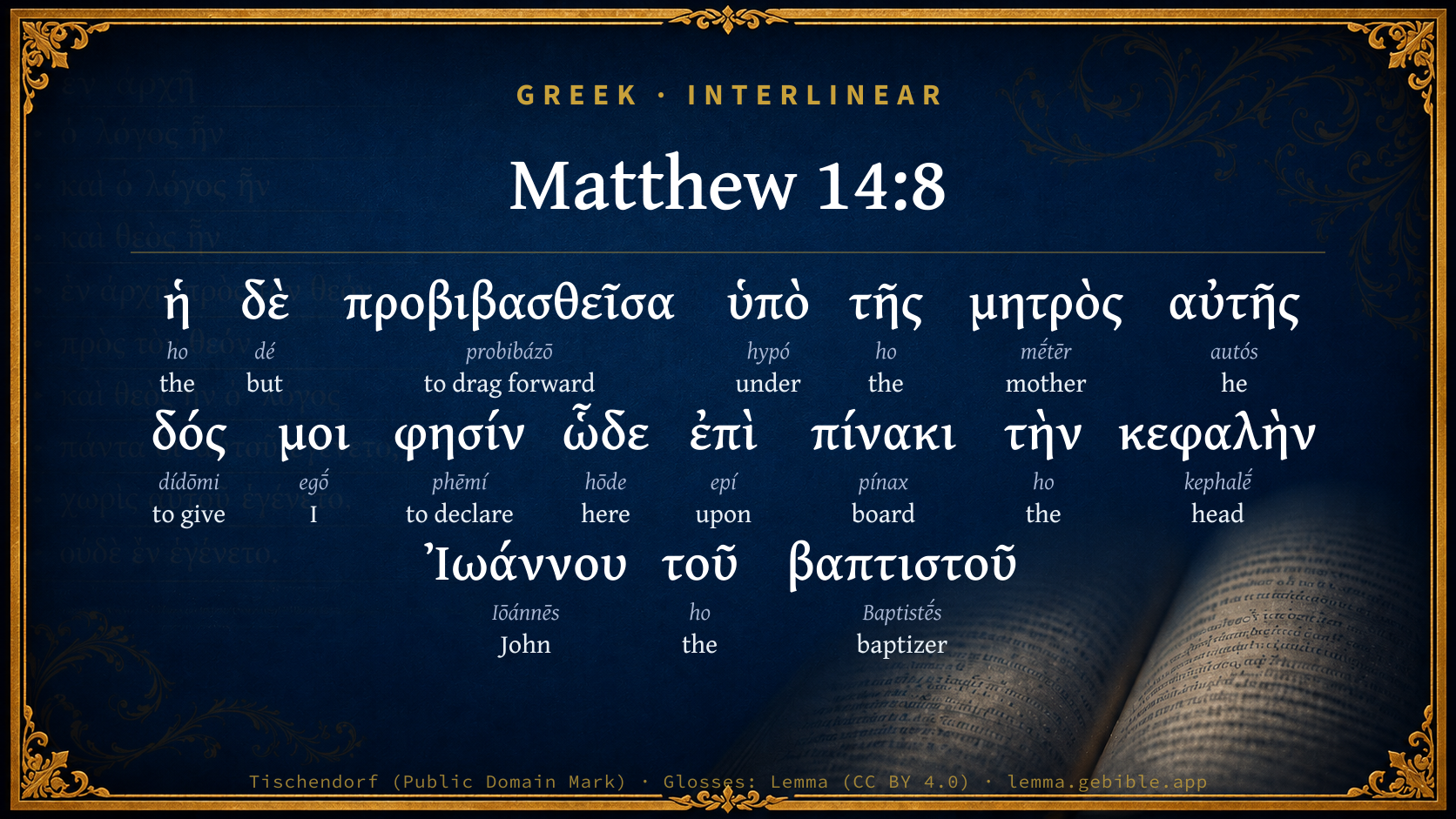
Greek (Tischendorf 8th ed.) Matthew 14:8 appears in the Greek New Testament. The text above is from the Tischendorf 8th edition. Each word links to its Strong’s number and a concise gloss. Click any word for its full Thayer’s Greek Lexicon entry.
Download image
Cite this verse

Matthew 14:8 (World English Bible). Public Domain. Lemma interlinear Bible study tool, https://lemma.gebible.app/v/matthew/14/8.

Show BibTeX & RIS
BibTeX
RIS
English Translation
She, being prompted by her mother, said, "Give me here on a platter the head of John the Baptizer."
World English Bible · Public Domain
Highlights
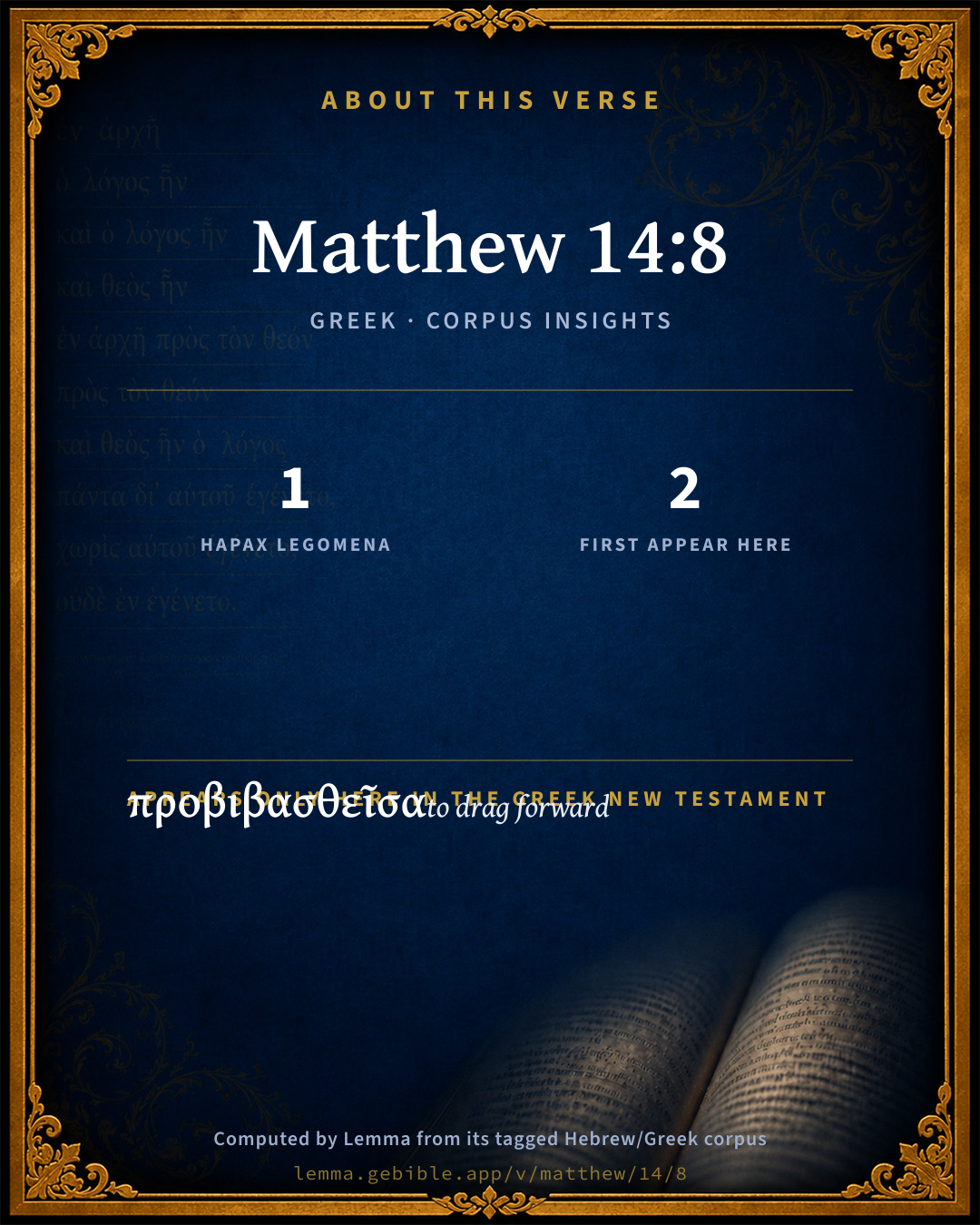
  • 1 hapax legomenon — only here in the Greek New Testament
  • 2 first appearances in the Greek New Testament
Full analysis ↓
Download a study sheet

One document with this verse’s original text, its word-by-word gloss line, the meaning frame, cross-references with their text, attributed commentary, and full source and license credits — printable, and it pastes into notes with its structure intact.

This verse Autodidact and up

Study sheet (.html) Plain text (.txt)

A passage Seminary Student

Up to 50 verses in one chapter. A passage sheet keeps up to 6 commentary sources and 12 cross-references per verse, in the order this page ranks them, and says so on the sheet whenever that leaves anything out. Ask for a single verse and you get the Autodidact verse sheet above.

Everything on this page stays free to read, with no account — the sheet is a download of what is already on screen, not access to it.

Want to remove ads? Support Godless Engineer
Compare translations 3

The same verse in 3 English versions, stacked beneath the original-language interlinear above. Click any original word for its lexicon entry.

Each is an independent rendering of the whole verse — the interlinear is not word-aligned to these translations.

Highlighted words mark where these versions differ — a whole-verse word diff, not a word-by-word alignment.

  • World English Bible Public Domain
    She, being prompted by her mother, said, "Give me here on a platter the head of John the Baptizer."
  • King James Version Public Domain
    And she, being before instructed of her mother, said, Give me here John Baptist's head in a charger.
  • unfoldingWord Literal Text CC BY-SA 4.0
    Now she, having been urged beforehand by her mother, said, “Give me here, on a platter, the head of John the Baptist.”

unfoldingWord Literal Text — © unfoldingWord, licensed CC BY-SA 4.0. Word-aligned USFM3 via Door43 (git.door43.org/unfoldingWord/en_ult).

Versions to compare (up to 4)

3 of 4 selected

Show all 19 translations

Every available English version of this verse, each an independent rendering of the whole verse.

  • World English Bible Public Domain
    She, being prompted by her mother, said, "Give me here on a platter the head of John the Baptizer."
  • Berean Standard Bible Public Domain
    Prompted by her mother, she said, “Give me here on a platter the head of John the Baptist.”
  • Majority Standard Bible Public Domain
    Prompted by her mother, she said, “Give me here on a platter the head of John the Baptist.”
  • King James Version Public Domain
    And she, being before instructed of her mother, said, Give me here John Baptist's head in a charger.
  • American Standard Version (1901) Public Domain
    And she, being put forward by her mother, saith, Give me here on a platter the head of John the Baptist.
  • Revised Version (1885) Public Domain
    And she, being put forward by her mother, saith, Give me here in a charger the head of John the Baptist.
  • Geneva Bible (1599) Public Domain
    And shee being before instructed of her mother, sayde, Giue mee here Iohn Baptists head in a platter.
  • Douay-Rheims (1899) Public Domain
    But she being instructed before by her mother, said: Give me here in a dish the head of John the Baptist.
  • Young's Literal Translation Public Domain
    And she having been instigated by her mother -- `Give me (says she) here upon a plate the head of John the Baptist;
  • Literal Standard Version CC BY-SA 4.0
    And she, having been instigated by her mother, says, “Give me here on a plate the head of John the Immerser”;
  • Unlocked Literal Bible CC BY-SA 4.0
    After being instructed by her mother, she said, “Give me here, on a platter, the head of John the Baptist.”
  • unfoldingWord Literal Text CC BY-SA 4.0
    Now she, having been urged beforehand by her mother, said, “Give me here, on a platter, the head of John the Baptist.”
  • Darby Bible Public Domain
    But she, being set on by her mother, says, Give me here upon a dish the head of John the baptist.
  • World Messianic Bible Public Domain
    She, being prompted by her mother, said, “Give me here on a platter the head of Yochanan the Immerser.”
  • Webster's Bible Public Domain
    And she, being before instructed by her mother, said, Give me here the head of John the Baptist in a dish.
  • Free Bible Version CC BY-SA 4.0
    Prompted by her mother, she said, “Give me here on a plate the head of John the Baptist.”
  • Bible in Basic English Public Domain
    And she, at her mother's suggestion, said, Give me here on a plate the head of John the Baptist.
  • Text-Critical English NT CC BY 4.0
    Prompted by her mother, she said, “Give me here on a platter the head of John the Baptist.”
  • Tyndale New Testament (1534) Public Domain
    And she beinge informed of her mother before sayde: geve me here Ihon baptistes heed in a platter.

Literal Standard Version (2020), Covenant Press — licensed CC BY-SA 4.0. Text via the HelloAO Bible API (eBible.org). Unlocked Literal Bible (unfoldingWord) — licensed CC BY-SA 4.0. Text via the HelloAO Bible API (eBible.org). unfoldingWord Literal Text — © unfoldingWord, licensed CC BY-SA 4.0. Word-aligned USFM3 via Door43 (git.door43.org/unfoldingWord/en_ult). Free Bible Version, Dr. Jonathan Gallagher — licensed CC BY-SA 4.0. Text via the HelloAO Bible API (eBible.org).

Word by word

More ways to search: Search by grammar → Find every occurrence → Compare this word →

Practice this passage: Drill this verse → Learn its vocabulary →

προβιβασθεῖσα
probibázō
G4264
“to drag forward”
Verb, Aorist, Passive, Participle, Nominative, Singular, Feminine
Part of Speech
Verb
Tense
Aorist
Voice
Passive
Mood
Participle
Case
Nominative
Number
Singular
Gender
Feminine
Full Thayer's Definition

Origin: from G4253 and a reduplicated form of G971

TDNT: None

1. to cause to go forward, to lean forward, to bring forward, drag forward 2. metaph. to incite, instigate, urge, forward, set on a. to induce by persuasion
  1. ἡ ho G3588 “the” Article, Nominative, Singular, Feminine
  2. δὲ dé G1161 “but” Conjunction
  3. ὑπὸ hypó G5259 “under” Preposition
  4. τῆς ho G3588 “the” Article, Genitive, Singular, Feminine
  5. μητρὸς mḗtēr G3384 “mother” Noun, Genitive, Singular, Feminine
  6. αὐτῆς autós G846 “he” Personal pronoun, Genitive, Singular, Feminine
  7. δός dídōmi G1325 “to give” Verb, Aorist, Active, Imperative, 2nd person, Singular
  8. μοι egṓ G1473 “I” Personal pronoun, 1st person, Dative, Singular
  9. φησίν phēmí G5346 “to declare” Verb, Present, Active, Indicative, 3rd person, Singular
  10. ὧδε hōde G5602 “here” Adverb
  11. ἐπὶ epí G1909 “upon” Preposition
  12. πίνακι pínax G4094 “board” Noun, Dative, Singular, Masculine
  13. τὴν ho G3588 “the” Article, Accusative, Singular, Feminine
  14. κεφαλὴν kephalḗ G2776 “head” Noun, Accusative, Singular, Feminine
  15. Ἰωάννου Iōánnēs G2491 “John” Noun, Genitive, Singular, Masculine
  16. τοῦ ho G3588 “the” Article, Genitive, Singular, Masculine
  17. βαπτιστοῦ Baptistḗs G910 “baptizer” Noun, Genitive, Singular, Masculine

About this verse

These counts appear in no published source. They are computed here, from the morphology-tagged text and Lemma’s own curated glosses. What Lemma adds →

18
words
15
distinct lemmas
Gospels
section

Notable vocabulary

1 hapax legomenon — a word that appears only here in the entire Greek New Testament:

  • προβιβασθεῖσα to drag forward G4264

First appearance in Scripture

These words make their first canonical appearance in the Greek New Testament here:

  • προβιβασθεῖσα to drag forward G4264
  • πίνακι board G4094

Shared distinctive vocabulary

πίνακι board G4094 occurs in 5 verses of the Greek New Testament. Also found in:

Repetition

A word recurs within this verse:

Cross-references

12

Topical passages linked to Matthew 14:8 in the Treasury of Scripture Knowledge — connected by theme and wording, ordered by reader-vote popularity; previews shown in the World English Bible.

  • Proverbs 29:10 The bloodthirsty hate a man of integrity; And they seek the life of the upright.
  • Mark 6:24 She went out, and said to her mother, "What shall I ask?" She said, "The head of John the Baptizer."
  • 1 Kings 18:4 for it was so, when Jezebel cut off the prophets of Yahweh, that Obadiah took one hundred prophets, and hid them by fifty in a cave, and fed them with bread and water.)
  • 1 Kings 18:13 Wasn't it told my lord what I did when Jezebel killed the prophets of Yahweh, how I hid one hundred men of Yahweh's prophets by fifty in a cave, and fed them with bread and water?
  • 1 Kings 19:2 Then Jezebel send a messenger to Elijah, saying, So let the gods do to me, and more also, if I don't make your life as the life of one of them by tomorrow about this time.
  • 2 Kings 11:1 Now when Athaliah the mother of Ahaziah saw that her son was dead, she arose and destroyed all the seed royal.
  • 2 Chronicles 22:2–3 Forty-two years old was Ahaziah when he began to reign; and he reigned one year in Jerusalem: and his mother's name was Athaliah the daughter of Omri.
  • Proverbs 1:16 For their feet run to evil. They hurry to shed blood.
  • Numbers 7:13 and his offering was: one silver platter, the weight of which was one hundred thirty shekels, one silver bowl of seventy shekels, after the shekel of the sanctuary; both of them full of fine flour mixed with oil for a meal offering;
  • Numbers 7:19 He offered for his offering: one silver platter, the weight of which was one hundred thirty shekels, one silver bowl of seventy shekels, after the shekel of the sanctuary; both of them full of fine flour mixed with oil for a meal offering;
  • Numbers 7:84–85 This was the dedication of the altar, on the day when it was anointed, by the princes of Israel: twelve silver platters, twelve silver bowls, twelve golden ladles;
  • Ezra 1:9 This is the number of them: thirty platters of gold, one thousand platters of silver, twenty-nine knives,

Cross-references courtesy of OpenBible.info (CC BY 4.0).

Commentary

Notes on Matthew 14:8 from classic Christian and Jewish commentators (each source and its license shown beneath its notes). The classic Christian expositions comment on the surrounding passage and are grouped to its opening verse, so a note may address several verses; the Jewish commentaries on the Tanakh (Rashi and others) are per-verse, so they appear only where the commentator wrote on this verse.

Lemma curates 59 commentaries, every one of them public domain or Creative Commons licensed, each selected and text-cleaned for this edition rather than reprinted as found. About our sources →

Joseph Benson's Commentary

Mat 14:8. And she, being before instructed of her mother — Namely, before she made her request: for, after the king had made her this promise, she immediately went forth and said to her mother, What shall I ask? And her mother, having now obtained the wished-for opportunity of executing her revenge, eagerly replied, Ask the head of John the Baptist; representing, no doubt, to her daughter, that he had attempted to expel and ruin them both; and that, considering the opinion which the king still entertained of him, he might some time or other, though in irons, regain Herod’s favour and accomplish his design; for which reason, the opportunity of taking his life was not to be neglected, if she regarded her own safety. These, or such like arguments, wrought up the young lady to such a pitch, that she not only consented to do as she was bidden, but became hearty in the cause: for, Mar 6:25, she came in straightway with haste, Greek, ευθεως μετα σπουδης, immediately with eagerness; and while all the guests sat mute, expecting what mighty thing would be asked, she demanded the holy Baptist’s head, as of greater value to her than the half of the kingdom. Give me here — Fearing if the king had time to consider, he would not do it; John Baptist’s head in a charger — Επι πινακι, a large dish, or bowl. And the king was sorry — Knowing that John was a good man; yet, for the oath’s sake, &c. So he murdered an innocent man for mere tenderness of conscience! Such was the tenderness of the consciences of those Jewish rulers, who, while they were using their utmost efforts to take away, by a most unjust and cruel process, the life of Christ, yet scrupled going into the judgment-hall of Pilate, lest they should be defiled! But Herod was influenced also by a regard for those who sat with him at meat. Doubtless he was unwilling to appear either rash, or fickle, or false before them, as they were probably the first persons of his kingdom for rank and character. Thus out of a misplaced regard to his oath and his guests, this king committed a most unjust and cruel action, which will ever reflect the greatest dishonour upon his memory.

Joseph Benson's Commentary on the Old and New Testaments (1811–1818) — public domain. Text from a community e-Sword module.

Tyndale Open Study Notes

Tyndale Open Resources

14:8 The practice of bringing a head . . . on a tray was not unknown in the ancient world (see Josephus, Antiquities 13.4.8; 14.15.13; 18.5.1; 20.5.1).

Tyndale Open Study Notes — © Tyndale Open Resources, licensed CC BY-SA 4.0. Text via the HelloAO Bible API.

Bengel's Gnomon

Johann Albrecht Bengel

Mat 14:8. Προβιβασθεῖσα, being before instructed) i.e. before she asked.—ὧδε, here) Before the king could repent.—πίνακι, in a charger) which perhaps she held in her hand. The ungodly know how to propose the most horrible things with elegance of language and sweetness of sound.

Bengel's Gnomon of the New Testament — English translation (T&T Clark, Edinburgh, 1860) — public domain. Text from a community e-Sword module.

Expositor's Greek Testament

ed. W. Robertson Nicoll

Mat 14:8 . προβιβασθεῖσα : not “before instructed,” as in A. V [87] , but “brought to this point”; urged on. It should require a good deal of “educating” to bring a young girl to make such a grim request. But she had learnt her lesson well, and asked the Baptist’s head, as if she had been asking a favourite dish ( ὡς περί τινος ἐδέσματος διαλεγομένη , Chrys., Hom. xlviii.). Kypke cites two instances of the rare use of the word in the sense of instruction. ὧδε here and now, on the spot, ἐξαυτῆς in Mk. That was an essential part of the request. No time must be left for repentance. If not done at once under the influence of wine and the momentary gratification given by the voluptuous dance, it might never be done at all. This implies that the Baptist was at hand, therefore that the feast was at Machaerus, where there was a palace as well as a fortress.

[87] Authorised Version.

The Expositor's Greek Testament, edited by W. Robertson Nicoll (1897–1910) — public domain. Text from a community e-Sword module.

Adam Clarke's Commentary

Verse 8. Give me here John Baptist's head in a charger.] The word charger formerly signified a large dish, bowl, or drinking cup: the Saxon has [Anglo-Saxon], a dish, Tindal, a platter; any thing is better than charger, which never conveyed much meaning, and now conveys none. The evangelist says she was instructed before, by her mother, to ask the Baptist's head! What a most infernal mother, to give such instructions to her child! and what a promising daughter to receive them! What a present for a young lady!-the bloody head of the murdered forerunner of Jesus! and what a gratification for an adulterous wife, and incestuous mother! The disturber of her illicit pleasures, and the troubler of her brother-husband's conscience, is no more! Short, however, was their glorying! See Clarke on Mt 14:3.

Adam Clarke's Commentary on the Bible (1810–1826) — public domain. Text from a community e-Sword/MySword module.

Ellicott's Commentary for English Readers

(8) Being before instructed of her mother.—Better, being prompted, or instigated. The word does not imply that the girl had been instructed before she danced what to ask for, and St. Mark distinctly states (Mar_6:24) that she went out from the banquet-hall to ask her mother what use she was to make of the tetrarch’s promise. The mother’s absence shows that the supper was one for men only, and that it was among them, flushed as they were with wine, that the daughter had appeared in reckless disregard of all maiden modesty.

A Bible Commentary for English Readers, edited by Charles John Ellicott (1878–1897) — public domain. Text from a community e-Sword module.

The Cambridge Bible for Schools and Colleges

gen. ed. J. J. S. Perowne

8. instructed] Rather, impelled, instigated.

a charger] The original word = “a flat wooden trencher” on which meat was served. This appears to have been the meaning of the old English word “charger,” which is connected with cargo and with French charger, and signified originally that on which a load is placed, hence a dish.

The Cambridge Bible for Schools and Colleges (gen. ed. J. J. S. Perowne; Cambridge University Press, 1878–1918) — public domain. Text from a community e-Sword module.

John Gill's Exposition

And she being before instructed of her mother,.... What request to make; for as Mark says, "she went forth" to her mother immediately, as soon as she had received the king's promise, and took advice of her, what she should ask; who bid her ask for the head of John the Baptist; and accordingly she went in, "straightway with haste unto the king", as the same evangelist observes, to take him at his word, and whilst he was in the mood; being urged and hastened on by her mother, who was eager to satisfy her revenge on John; and said,

give me here John Baptist's head in a charger: she desires his head, and this to be brought to her in a large dish, that her mother might be sure of his death; and have an opportunity of insulting that mouth and tongue, that had spoke against her incestuous marriage: and she desires to have it given "here", in that very place, at that very time, where, and while the company was together, who were witnesses of the king's promise and oath; and this she did, lest when the festival was over, and he was out of his cups, he should repent of his folly and rashness. The mother and daughter seem to be much alike, both for lasciviousness, revenge, and cruelty: and if what the historian says (w) be true, that this same person Salome, the daughter of Herodias, as she walked over a river which was frozen in the winter season, the ice broke, and she fell in, and the pieces of ice cut off her head; the "lex talionis", the law of retaliation, was righteously executed on her.

(w) Nicephorus, Hist. l. 1. c. 20.

John Gill's Exposition of the Whole Bible (1746–1763) — public domain (CC PDM 1.0). Text via the HelloAO Bible API.

Trapp's Complete Commentary

John Trapp

8 And she, being before instructed of her mother, said, Give me here John Baptist’s head in a charger.

Ver. 8. And she being before instructed, &c.] Partus sequitur ventrem, the birth follows the belly. Here was like mother like daughter, neither good bird nor good egg, as they say. Κακου κορακος κακον ωον. The mother and daughter both had an aching tooth at the Baptist, and sought an opportunity to be meet with him (ενειχεν αυτω, Mar 6:19): which now having gotten, they pursued to the utmost. The damosel came with haste to the king, saith St Mark, Mar 6:25, when once she had her lesson, as fearing, belike, she should come too late. Such another hussy as this was dame Alice Pierce, a concubine to our Edward III. For when as at a parliament in the fiftieth year of that king’s reign, it was petitioned that the Duke of Lancaster, the Lord Latimer, chamberlain, and this dame Alice might be removed from court, and the petition was vehemently urged by their speaker, Sir Peter la Mare; this knight afterwards at the suit of that impudent woman (working upon the king’s impotencies) was committed to perpetual imprisonment at Nottingham. And another such history we have of one Diana Valentina, mistress to Henry II, King of France, whom she had so subdued, that he gave her all the confiscations of goods made in the kingdom for cause of heresy. Whereupon many were burned in France for religion, as they said, but indeed to maintain the pride and satisfy the covetousness of that lewd woman. This was in the year 1554. And in the year 1559, Ann du Bourge, a counsellor of state, was burnt also for crime of heresy; not so much by the inclination of the judges as by the resolution of the queen, provoked against him: because, forsooth, the Lutherans gave out that the king had been slain, as he was running at tilt, by a wound in the eye, by the providence of God, for a punishment of his words used against Du Bourge, that he would see him burnt.

John Trapp, A Commentary or Exposition upon All the Books of the Old and New Testament (1647–1656) — public domain. Text from a community e-Sword module.

Matthew Poole's English Annotations

Mark, Mar 6:24,25, reports it more largely: And she went forth, and said unto her mother, What shall I ask? And she said, The head of John the Baptist. And she came in straightway with haste to the king, and asked, saying, I will that thou give me by and by in a charger the head of John the Baptist. The meaning is plain, so as the words need no interpreter: they let us see;

1. The power of the lust of malice and desire of revenge; surely Herodias might have prompted her to have asked something which might have done her more good than the blood of a holy and innocent man. The guilty soul is never at rest. John Baptist was a prisoner; she should not need have feared the influence of John’s word to have caused a divorce, but she cannot be at rest while John is alive.

2. The great evil of wicked parents, and the contrary blessing of parents fearing God: the former, by commanding or persuading their children to sin, are great instruments towards their children’s damnation; the other, by their admonitions, precepts and instructions, great instruments of their salvation and eternal happiness.

3. We may observe the genius of flattering courtiers, not one of them interposes to save the Baptist’s life.

Matthew Poole's English Annotations on the Holy Bible (1683–1685) — public domain. Text from a community e-Sword/MySword module.

Whedon's Commentary on the Bible

Daniel D. Whedon

8. A charger — The Greek word signifies a flat board, used for any purpose, as for a writing-table or tablet. In Luk_11:39, it is translated a platter; that is, a large dish, in which meat or other food is carved or served up. The old English word charger is connected with the whole family of words implying the idea of something carrying or carried. As the simplest root in the English language may be specified the syllable car, then we have cart, carriage, chariot, cargo, charge, carry, carrier, and charger. Hence the platter was called a charger, because it was charged with a burden to carry.

Daniel D. Whedon (gen. ed.), Commentary on the Old and New Testaments (1874–1909) — public domain. Text from a community e-Sword module.

The Pulpit Commentary

And she, being before instructed; being put forward (Revised Version); probibasyeisa . (Act_19:33, Received Text; Deu_6:7) The word implies that the girl herself would not have thought of it, and perhaps that she had at first some little reluctance. But if so, it was soon over, for she came back "in haste" (Mark). Of her mother. St. Mark explains that she left the room to ask her mother. Said, Give me. This is the gift I want. Here. And evidently at once. The word excludes the possibility of the feast being in Tiberias, if John was slain at Machaerus, as the passage in Josephus states. (cf. Mat_3:1, note) There is no very great difficulty in supposing the chief men of Galilee, etc. (Mark), to have gone as far as Machaerus to pay their respects to Herod and to partake of the feast, but whether the statement in Josephus is accurate, and how, if it be so, it is to be reconciled with the preceding statement that Machaerus belonged to Aretas, are questions not easily answered (see Schurer, I 2:26). John Baptist"s head in a charger; in a charger the head of John the Baptist (Revised Version). She defines here still more closely (wde epi pinaki), and then states her request. On the form of her demand for John"s death, Chrysostom says that she wished to see his tongue lying there silent, for she did not merely long to be freed from his reproaches, but to insult and jeer him (epibhnai kai epitwyasai keimena). Charger. A wooden trencher.

The Pulpit Commentary (1880–1919), ed. H.D.M. Spence-Jones & Joseph S. Exell — public domain. Text from a community e-Sword module.

John Wesley's Explanatory Notes

Being before instructed by her mother - Both as to the matter and manner of her petition: She said, Give me here - Fearing if he had time to consider, he would not do it: John the Baptist's head in a charger - A large dish or bowl.

John Wesley, Explanatory Notes Upon the Whole Bible (1754–1765) — public domain. Text via the GEBible commentary corpus.

The People's New Testament

B. W. Johnson

8. Give me John the Baptist's head in a charger. Mark tells us that she went to consult her mother before she made her request. That vile woman was prepared with an answer. Indeed, she had manipulated the whole affair so as to secure Herod's consent to the murder of John. In a charger. An old English word for a large dish, so called from the load it sustained.

B. W. Johnson's The People's New Testament with Notes (1889–1891) — public domain. Electronic text from the Christian Classics Ethereal Library (CCEL) ThML edition.

unfoldingWord translationNotes

Door43 World Missions Community

After being instructed by her mother

This can be stated in active form. AT: "After her mother instructed her" (See: Active or Passive)

instructed

"coached" or "told"

she said

"the daughter of Herodias said to Herod"

platter

a very large plate

The king was very upset by her request

This can be stated in active form. AT: "Her request made the king very upset" (See: Active or Passive)

The king

"King Herod"

he ordered that it should be done

This can be stated in active form. AT: "he ordered his men to do what she said" (See: Active or Passive)

translationWords

John (the Baptist)

king

oath

unfoldingWord translationNotes — © Distant Shores Media and the Door43 World Missions Community, licensed CC BY-SA 4.0. Source: git.door43.org/Door43/en_tn.

Cambridge Greek Testament for Schools and Colleges

8. προβιβασθεῖσα. ‘Impelled,’ ‘instigated;’ cp. Xen. Mem. 1. 5. 1, ἐπισκεψώμεθα εἴ τι προυβίβαζε λέγων εἰς αὐτὴν τοιάδε.

πίναξ = ‘a flat wooden trencher’ on which meat was served, δαιτρὸς δὲ κρειών πίνακας παρέθηκεν ἀείρας, Hom. Od. I. 141. This appears to have been the meaning of the old English word ‘charger’ (A.V.), which is connected with cargo and with French charger, and signified originally that on which a load is placed, hence a dish.

Cambridge Greek Testament for Schools and Colleges (Cambridge University Press, 1896; 21 vols, various authors incl. Carr, Maclear, Plummer, Farrar, Lumby, Moule, M. R. James, Simcox) — public domain. Text from a community e-Sword module.

International Critical Commentary

8. And she, being put forward by her mother, Give me, she says, here upon a dish the head of John the Baptist.] Mt. summarises Mk 24-25. In abbreviating, he shortens the narrative so far as to make it almost unintelligible. The reader must suppose that Herodias and Herod were living together, which Mk. has stated in v. 17 ὅτι αὐτὴν ἐγάμησεν, from the fact that the daughter of Herodias danced before Herod. He has also to infer that this took place at a public festivity from τοὺς συνανακειμένους of the next verse.

(M)

International Critical Commentary — older volumes (1896–1929), various authors — public domain. Text from a community e-Sword module.

Vincent's Word Studies in the New Testament

Marvin R. Vincent

Being before instructed [προβιβασθεισα] . Wyc., monestid, with warned in explanation. Both wrong. Rev., rightly, being put forward. Compare Act 19:33, where the right meaning is, they pushed Alexander forward out of the crowd; and not as A. V., drew out. The correct rendering slightly relieves Salome of the charge of wanton cruelty, and throws it wholly upon Herodias.

Here [ωδε] . She demanded it on the spot, before Herod should have had time to reflect and relent; the more so, as she knew his respect for John (compare was sorry, ver. 9). The circumstances seem to point to Machaerus itself as the scene of the banquet; so that the deed could be quickly done, and the head of the Baptist delivered while the feast was still in progress.

In a charger [επι πινακι] . The Revisers cannot be defended in their retention of this thoroughly obsolete word. A charge is originally a burden; and a charger something loaded. Hence, a dish. Wyc., dish. Tynd., platter.

Marvin R. Vincent, Word Studies in the New Testament (1887–1900) — public domain. Text from a community e-Sword/MySword module.

Lesson kit

Teaching starters — assembled from the data on this page, not authored interpretation. Every prompt links to the verse data it draws on. Edit before teaching.

Matthew, in the Gospels, opens this verse with 18 words (15 distinct Greek lemmas). Its most distinctive word is probibázō (“to drag forward”). A historical commentator’s framing appears above. Read the whole chapter for the surrounding context.

Discussion questions

  1. The word probibázō carries the sense “to drag forward.” How does it shape the verse?
  2. 1 word here appears nowhere else in the Greek New Testament. Why might the author reach for such rare wording?
  3. 2 words make their first appearance in Scripture here. What does this debut establish?
  4. How does Matthew 14:11, which shares the word «board», read alongside this verse?
  5. What does the repetition of “the” (4× in this one verse) do in this verse?
  6. The translations on this page render this verse differently — a whole-verse word diff, not a word-by-word alignment. What might account for the different wordings?
  7. Compare how Joseph Benson's Commentary and Tyndale Open Study Notes read this verse. Where do they agree or differ?

Things to notice

  • 1 word in this verse appears nowhere else in the Greek New Testament.
  • 2 words make their first canonical appearance in Scripture here.
  • These translations choose different wording for 14 words in this verse.
  • “the” occurs 4× in this single verse.
  • 15 distinct Greek lemmas span 18 words in this verse.

Reading settings

Reading text

Shown beneath each verse's original-language words.

Old Testament
Old Testament edition

Read the OT as the Masoretic Hebrew (MT) or the Greek Septuagint (LXX).

English shown for the Greek Septuagint (in the Hebrew ↔ Greek comparison).

Comparing translations? Open the Compare panel on any verse page to stack up to four side by side.