
Matthew 13:30

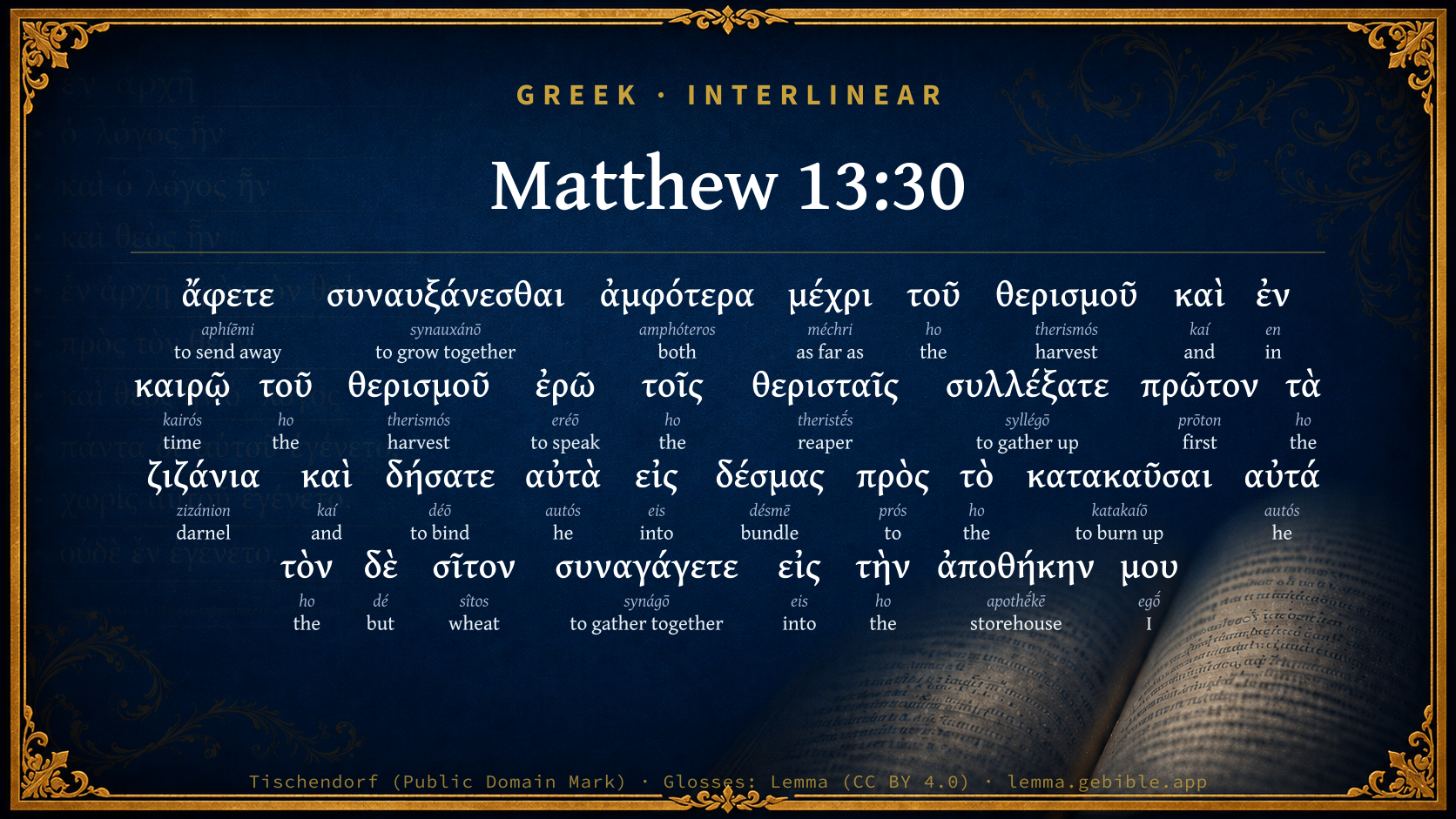
Greek (Tischendorf 8th ed.) Matthew 13:30 appears in the Greek New Testament. The text above is from the Tischendorf 8th edition. Each word links to its Strong’s number and a concise gloss. Click any word for its full Thayer’s Greek Lexicon entry.
Download image
Cite this verse

Matthew 13:30 (World English Bible). Public Domain. Lemma interlinear Bible study tool, https://lemma.gebible.app/v/matthew/13/30.

Show BibTeX & RIS
BibTeX
RIS
English Translation
Let both grow together until the harvest, and in the harvest time I will tell the reapers, "First, gather up the darnel, and bind them in bundles to burn them; but gather the wheat into my barn."'"
World English Bible · Public Domain
Highlights
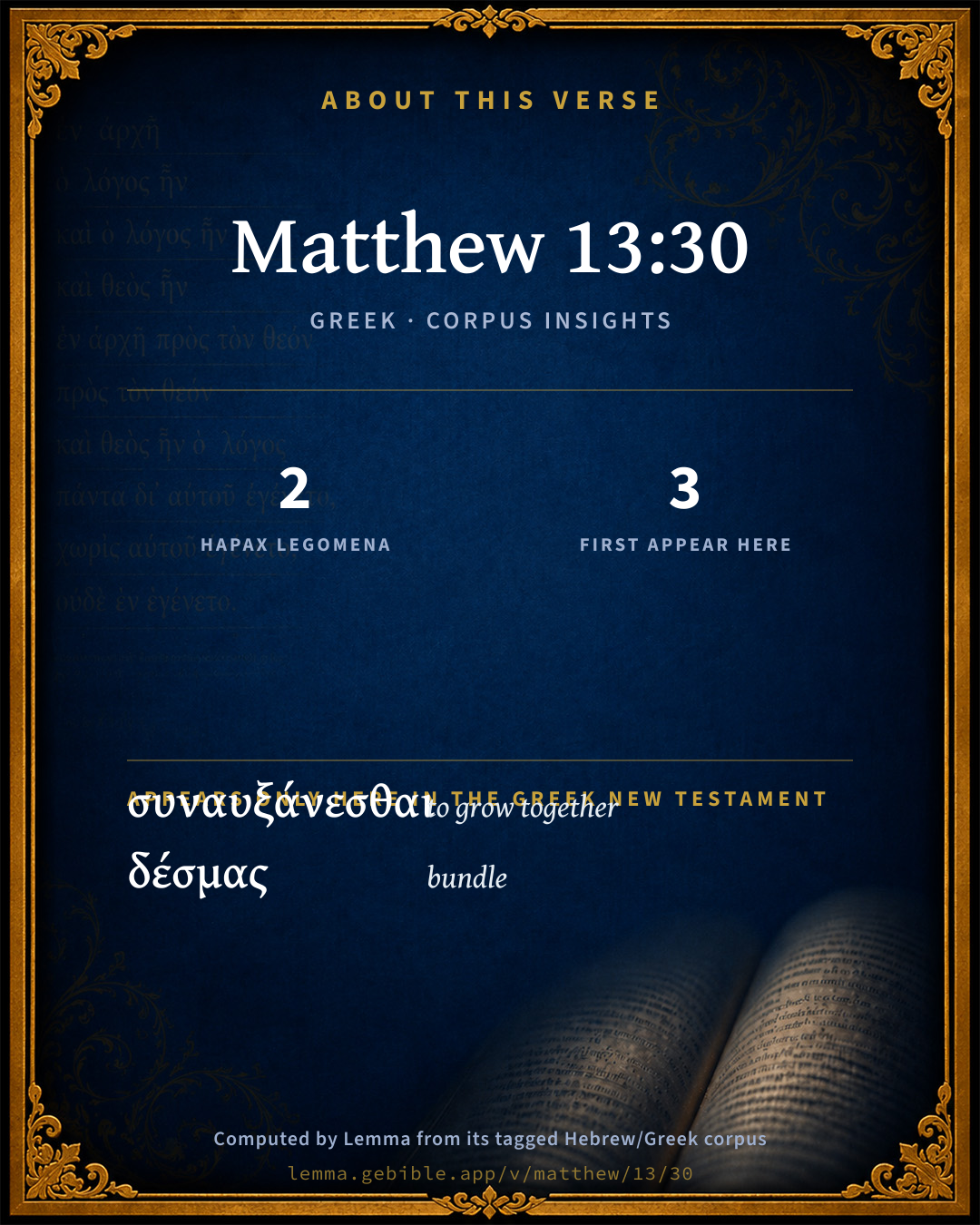
  • 2 hapax legomena — only here in the Greek New Testament
  • 3 first appearances in the Greek New Testament
Full analysis ↓
Download a study sheet

One document with this verse’s original text, its word-by-word gloss line, the meaning frame, cross-references with their text, attributed commentary, and full source and license credits — printable, and it pastes into notes with its structure intact.

This verse Autodidact and up

Study sheet (.html) Plain text (.txt)

A passage Seminary Student

Up to 50 verses in one chapter. A passage sheet keeps up to 6 commentary sources and 12 cross-references per verse, in the order this page ranks them, and says so on the sheet whenever that leaves anything out. Ask for a single verse and you get the Autodidact verse sheet above.

Everything on this page stays free to read, with no account — the sheet is a download of what is already on screen, not access to it.

Want to remove ads? Support Godless Engineer
Compare translations 3

The same verse in 3 English versions, stacked beneath the original-language interlinear above. Click any original word for its lexicon entry.

Each is an independent rendering of the whole verse — the interlinear is not word-aligned to these translations.

Highlighted words mark where these versions differ — a whole-verse word diff, not a word-by-word alignment.

  • World English Bible Public Domain
    Let both grow together until the harvest, and in the harvest time I will tell the reapers, "First, gather up the darnel, and bind them in bundles to burn them; but gather the wheat into my barn."'"
  • King James Version Public Domain
    Let both grow together until the harvest: and in the time of harvest I will say to the reapers, Gather ye together first the tares, and bind them in bundles to burn them: but gather the wheat into my barn.
  • unfoldingWord Literal Text CC BY-SA 4.0
    Permit both to grow together until the harvest, and at the time of the harvest I will say to the reapers, “First gather the darnel and tie them in bundles to burn them up but gather the wheat into my barn.”’”

unfoldingWord Literal Text — © unfoldingWord, licensed CC BY-SA 4.0. Word-aligned USFM3 via Door43 (git.door43.org/unfoldingWord/en_ult).

Versions to compare (up to 4)

3 of 4 selected

Show all 19 translations

Every available English version of this verse, each an independent rendering of the whole verse.

  • World English Bible Public Domain
    Let both grow together until the harvest, and in the harvest time I will tell the reapers, "First, gather up the darnel, and bind them in bundles to burn them; but gather the wheat into my barn."'"
  • Berean Standard Bible Public Domain
    Let both grow together until the harvest. At that time I will tell the harvesters: First collect the weeds and tie them in bundles to be burned; then gather the wheat into my barn.’”
  • Majority Standard Bible Public Domain
    Let both grow together until the harvest. At that time I will tell the harvesters: First collect the weeds and tie them in bundles to be burned; then gather the wheat into my barn.’”
  • King James Version Public Domain
    Let both grow together until the harvest: and in the time of harvest I will say to the reapers, Gather ye together first the tares, and bind them in bundles to burn them: but gather the wheat into my barn.
  • American Standard Version (1901) Public Domain
    Let both grow together until the harvest: and in the time of the harvest I will say to the reapers, Gather up first the tares, and bind them in bundles to burn them; but gather the wheat into my barn.
  • Revised Version (1885) Public Domain
    Let both grow together until the harvest: and in the time of the harvest I will say to the reapers, Gather up first the tares, and bind them in bundles to burn them: but gather the wheat into my barn.
  • Geneva Bible (1599) Public Domain
    Let both growe together vntill the haruest, and in time of haruest I will say to the reapers, Gather yee first the tares, and binde them in sheaues to burne them: but gather the wheate into my barne.
  • Douay-Rheims (1899) Public Domain
    Suffer both to grow until the harvest, and in the time of the harvest I will say to the reapers: Gather up first the cockle, and bind it into bundles to burn, but the wheat gather ye into my barn.
  • Young's Literal Translation Public Domain
    suffer both to grow together till the harvest, and in the time of the harvest I will say to the reapers, Gather up first the darnel, and bind it in bundles, to burn it, and the wheat gather up into my storehouse.'
  • Literal Standard Version CC BY-SA 4.0
    permit both to grow together until the harvest, and in the time of the harvest I will say to the reapers, Gather up first the darnel, and bind it in bundles, to burn it, and the wheat gather up into my storehouse.”
  • Unlocked Literal Bible CC BY-SA 4.0
    Let both grow together until the harvest. At the time of the harvest I will say to the reapers, “First pull out the weeds and tie them in bundles to burn them, but gather the wheat into my barn.”'”
  • unfoldingWord Literal Text CC BY-SA 4.0
    Permit both to grow together until the harvest, and at the time of the harvest I will say to the reapers, “First gather the darnel and tie them in bundles to burn them up but gather the wheat into my barn.”’”
  • Darby Bible Public Domain
    Suffer both to grow together unto the harvest, and in time of the harvest I will say to the harvestmen, Gather first the darnel, and bind it into bundles to burn it; but the wheat bring together into my granary.
  • World Messianic Bible Public Domain
    Let both grow together until the harvest, and in the harvest time I will tell the reapers, “First, gather up the darnel weeds, and bind them in bundles to burn them; but gather the wheat into my barn.”’”
  • Webster's Bible Public Domain
    Let both grow together until the harvest: and in the time of harvest I will say to the reapers, Gather ye first the tares, and bind them in bundles to burn them: but gather the wheat into my barn.
  • Free Bible Version CC BY-SA 4.0
    Let them both grow until harvest, and then at harvest-time I'll tell the reapers to first gather the weeds, tie them up into bundles and burn them, and then gather the wheat and store it in my barn.’”
  • Bible in Basic English Public Domain
    Let them come up together till the getting in of the grain; and then I will say to the workers, Take up first the evil plants, and put them together for burning: but put the grain into my store-house.
  • Text-Critical English NT CC BY 4.0
    Let them both grow together until the harvest, and at the time of the harvest I will say to the reapers, “Gather the tares first and bind them into bundles to burn them up, but gather the wheat into my barn.” ’ ”
  • Tyndale New Testament (1534) Public Domain
    let bothe growe to gether tyll harvest come and in tyme of harvest I wyll saye to the repers gather ye fyrst the tares and bind the in sheves to be bret: but gather the wheete into my barne.

Literal Standard Version (2020), Covenant Press — licensed CC BY-SA 4.0. Text via the HelloAO Bible API (eBible.org). Unlocked Literal Bible (unfoldingWord) — licensed CC BY-SA 4.0. Text via the HelloAO Bible API (eBible.org). unfoldingWord Literal Text — © unfoldingWord, licensed CC BY-SA 4.0. Word-aligned USFM3 via Door43 (git.door43.org/unfoldingWord/en_ult). Free Bible Version, Dr. Jonathan Gallagher — licensed CC BY-SA 4.0. Text via the HelloAO Bible API (eBible.org).

Word by word

More ways to search: Search by grammar → Find every occurrence → Compare this word →

Practice this passage: Drill this verse → Learn its vocabulary →

συναυξάνεσθαι
synauxánō
G4885
“to grow together”
Verb, Present, Passive, Infinitive
Part of Speech
Verb
Tense
Present
Voice
Passive
Mood
Infinitive
Full Thayer's Definition

Origin: from G4862 and G837

TDNT: None

1. to cause to grow together 2. to grow together
  1. ἄφετε aphíēmi G863 “to send away” Verb, Aorist, Active, Imperative, 2nd person, Plural
  2. ἀμφότερα amphóteros G297 “both” Adjective, Accusative, Plural, Neuter
  3. μέχρι méchri G3360 “as far as” Adverb
  4. τοῦ ho G3588 “the” Article, Genitive, Singular, Masculine
  5. θερισμοῦ therismós G2326 “harvest” Noun, Genitive, Singular, Masculine
  6. καὶ kaí G2532 “and” Conjunction
  7. ἐν en G1722 “in” Preposition
  8. καιρῷ kairós G2540 “time” Noun, Dative, Singular, Masculine
  9. τοῦ ho G3588 “the” Article, Genitive, Singular, Masculine
  10. θερισμοῦ therismós G2326 “harvest” Noun, Genitive, Singular, Masculine
  11. ἐρῶ eréō G2046 “to speak” Verb, Future, Active, Indicative, 1st person, Singular
  12. τοῖς ho G3588 “the” Article, Dative, Plural, Masculine
  13. θερισταῖς theristḗs G2327 “reaper” Noun, Dative, Plural, Masculine
  14. συλλέξατε syllégō G4816 “to gather up” Verb, Aorist, Active, Imperative, 2nd person, Plural
  15. πρῶτον prōton G4412 “first” Adverb, Superlative
  16. τὰ ho G3588 “the” Article, Accusative, Plural, Neuter
  17. ζιζάνια zizánion G2215 “darnel” Noun, Accusative, Plural, Neuter
  18. καὶ kaí G2532 “and” Conjunction
  19. δήσατε déō G1210 “to bind” Verb, Aorist, Active, Imperative, 2nd person, Plural
  20. αὐτὰ autós G846 “he” Personal pronoun, Accusative, Plural, Neuter
  21. εἰς eis G1519 “into” Preposition
  22. δέσμας désmē G1197 “bundle” Noun, Accusative, Plural, Feminine
  23. πρὸς prós G4314 “to” Preposition
  24. τὸ ho G3588 “the” Article, Accusative, Singular, Neuter
  25. κατακαῦσαι katakaíō G2618 “to burn up” Verb, Aorist, Active, Infinitive
  26. αὐτά autós G846 “he” Personal pronoun, Accusative, Plural, Neuter
  27. τὸν ho G3588 “the” Article, Accusative, Singular, Masculine
  28. δὲ dé G1161 “but” Conjunction
  29. σῖτον sîtos G4621 “wheat” Noun, Accusative, Singular, Masculine
  30. συναγάγετε synágō G4863 “to gather together” Verb, Aorist, Active, Imperative, 2nd person, Plural
  31. εἰς eis G1519 “into” Preposition
  32. τὴν ho G3588 “the” Article, Accusative, Singular, Feminine
  33. ἀποθήκην apothḗkē G596 “storehouse” Noun, Accusative, Singular, Feminine
  34. μου egṓ G1473 “I” Personal pronoun, 1st person, Genitive, Singular

About this verse

These counts appear in no published source. They are computed here, from the morphology-tagged text and Lemma’s own curated glosses. What Lemma adds →

35
words
25
distinct lemmas
Gospels
section

Notable vocabulary

2 hapax legomena — words that appear only here in the entire Greek New Testament:

  • συναυξάνεσθαι to grow together G4885
  • δέσμας bundle G1197

First appearance in Scripture

These words make their first canonical appearance in the Greek New Testament here:

  • συναυξάνεσθαι to grow together G4885
  • θερισταῖς reaper G2327
  • δέσμας bundle G1197

Shared distinctive vocabulary

θερισταῖς reaper G2327 occurs in 2 verses of the Greek New Testament. Also found in:
Repetition

Words recur within this verse:

  • θερισμοῦ harvest G2326 ×2
  • εἰς into G1519 ×2
  • τοῦ the G3588 ×7
  • καὶ and G2532 ×2
  • αὐτὰ he G846 ×2

Cross-references

14

Topical passages linked to Matthew 13:30 in the Treasury of Scripture Knowledge — connected by theme and wording, ordered by reader-vote popularity; previews shown in the World English Bible.

  • Matthew 3:12 His winnowing fork is in his hand, and he will thoroughly cleanse his threshing floor. He will gather his wheat into the barn, but the chaff he will burn up with unquenchable fire."
  • 1 Timothy 5:24 Some men's sins are evident, preceding them to judgment, and some also follow later.
  • 1 Corinthians 4:5 Therefore judge nothing before the time, until the Lord comes, who will both bring to light the hidden things of darkness, and reveal the counsels of the hearts. Then each man will get his praise from God.
  • Malachi 3:18–4:1 Then you shall return and discern between the righteous and the wicked, between him who serves God and him who doesn't serve him.
  • John 15:6 If a man doesn't remain in me, he is thrown out as a branch, and is withered; and they gather them, throw them into the fire, and they are burned.
  • Matthew 13:39–43 The enemy who sowed them is the devil. The harvest is the end of the age, and the reapers are angels.
  • Matthew 25:32 Before him all the nations will be gathered, and he will separate them one from another, as a shepherd separates the sheep from the goats.
  • Matthew 25:41 Then he will say also to those on the left hand, 'Depart from me, you cursed, into the eternal fire which is prepared for the devil and his angels;
  • Luke 3:17 whose fan is in his hand, and he will thoroughly cleanse his threshing floor, and will gather the wheat into his barn; but he will burn up the chaff with unquenchable fire."
  • Matthew 25:6–13 But at midnight there was a cry, 'Behold! The bridegroom is coming! Come out to meet him!'
  • 1 Samuel 25:29 Though men be risen up to pursue you, and to seek your soul, yet the soul of my lord shall be bound in the bundle of life with Yahweh your God; and the souls of your enemies, them shall he sling out, as from the hollow of a sling.
  • Ezekiel 15:4–7 Behold, it is cast into the fire for fuel; the fire has devoured both the ends of it, and the midst of it is burned: is it profitable for any work?
  • Matthew 22:10–14 Those servants went out into the highways, and gathered together as many as they found, both bad and good. The wedding was filled with guests.
  • Isaiah 27:10–11 For the fortified city is solitary, a habitation deserted and forsaken, like the wilderness: there shall the calf feed, and there shall he lie down, and consume the branches of it.

Cross-references courtesy of OpenBible.info (CC BY 4.0).

Commentary

Notes on Matthew 13:30 from classic Christian and Jewish commentators (each source and its license shown beneath its notes). The classic Christian expositions comment on the surrounding passage and are grouped to its opening verse, so a note may address several verses; the Jewish commentaries on the Tanakh (Rashi and others) are per-verse, so they appear only where the commentator wrote on this verse.

Lemma curates 59 commentaries, every one of them public domain or Creative Commons licensed, each selected and text-cleaned for this edition rather than reprinted as found. About our sources →

Bengel's Gnomon

Johann Albrecht Bengel

Mat 13:30. Συναυξάνεσθαι, grow together) Growth in good and evil takes place simultaneously, sometimes in the case of individuals, and generally in that of men taken collectively; and the further that ages proceed, the more conspicuous do they both become.—ἐν τῷ καιρῷ, κ.τ.λ., in the time) Then it will at length be the right time to do so.—πρῶτον, first) that the godly may behold the punishment of the ungodly; the ungodly not see the glory of the godly. Thus in ch. 25, though the Judge addresses the righteous first, yet afterwards in the last verse the ungodly are banished into eternal fire before [the godly are admitted into heaven].—δέσμας, bundles) As from σταθμός; (a standing place, station, etc.) comes στάθμη (a carpenter’s rule, etc.), and from λῦμα (physical or moral filth, etc.) comes λύμη (outrage, etc.), so from δεσμὸς (a band or bond) are derived δέσμα (a bond), and δέσμη (a bundle); see Eustathius. They will have no choice: those of like kind will be joined together.—κατακαῦσαι, to burn utterly) They will be burned, and that utterly.—δὲ, but) Then the separation will have been effected.—συναγάγετε, collect) and bring.

Bengel's Gnomon of the New Testament — English translation (T&T Clark, Edinburgh, 1860) — public domain. Text from a community e-Sword module.

Meyer's Critical & Exegetical Commentary

Heinrich August Wilhelm Meyer

Mat_13:30. Ἐν καιρῷ] without the article, Winer, p. 118 [E. T. 147 ff.].

δήσατε αὐτὰ δεσμ.] (see critical remarks): bind them into bundles. For this construction of δής. with two accusatives, considering the resemblance between it and the root of δεσμ., comp. Kühner, II. 1, p. 274.

The explanation of the parable, which latter is different from that given in Mar_4:26 ff. (in answer to Holtzmann, Weiss), is furnished by Jesus Himself in Mat_13:37 ff. It is to this effect. The visible church, up till the day of judgment, is to comprise within its pale those who are not members of the invisible church, and who shall have no part in the kingdom that is to be established. The separation is not a thing with which man is competent to deal, but must be left in the hands of the Judge. The matter is to be understood, however, in a broad and general way, so that it cannot be said at all to affect the right of individual excommunication and restoration. In regard to individuals, there remains the possibility (to which, however, the parable makes no reference whatever): ut qui hodie sunt zizania, eras sint frumentum, Augustine.

Meyer — Critical and Exegetical Commentary on the New Testament — English translation by Peter Christie, edited by Frederick Crombie (T&T Clark, 1880) — public domain. Text from a community e-Sword module.

Expositor's Greek Testament

ed. W. Robertson Nicoll

Mat 13:30 . Συλλέξατε πρῶτον : before or after cutting down the crop? Not said which; order of procedure immaterial, for now the wheat is ripe . δήσατε εἰς δέσμας ; the εἰς , omitted in some MSS., is not necessary before a noun of same meaning with the verb. Fritzsche thinks the expression without preposition more elegant. Meyer also omits, with appeal to Kühner on verbs with double accusatives. This parable embodies the great principle of bad men being tolerated for the sake of the good. It relegates to the end the judgment which the contemporaries of Jesus, including the Baptist, expected at the beginning of the Messianic kingdom (Weiss-Meyer).

The Expositor's Greek Testament, edited by W. Robertson Nicoll (1897–1910) — public domain. Text from a community e-Sword module.

Jamieson, Fausset & Brown

Robert Jamieson, A. R. Fausset & David Brown

Let both grow together--that is, in the visible Church.

until the harvest--till the one have ripened for full salvation, the other for destruction. (See on Mat 13:39).

and in the time of harvest I will say to the reapers--(See on Mat 13:39).

Gather ye together first the tares, and bind them in bundles to burn them--"in the fire" (Mat 13:40).

but gather the wheat into my barn--Christ, as the Judge, will separate the two classes (as in Mat 25:32). It will be observed that the tares are burned before the wheat is housed; in the exposition of the parable (Mat 13:41, Mat 13:43) the same order is observed: and the same in Mat 25:46 --as if, in some literal sense, "with thine eyes shalt thou behold and see the reward of the wicked" (Psa 91:8).

Third and Fourth Parables or Second Pair:

THE MUSTARD SEED and THE LEAVEN (Mat 13:31-33).

The subject of both these parables, as of the first pair, is the same, but under a slight diversity of aspect, namely--

THE GROWTH OF THE KINGDOM FROM THE SMALLEST BEGINNINGS TO ULTIMATE UNIVERSALITY.

The Mustard Seed (Mat 13:31-32).

Jamieson, Fausset & Brown — Commentary Critical and Explanatory on the Whole Bible (1871) — public domain (CC PDM 1.0). Text via the HelloAO Bible API.

Adam Clarke's Commentary

Verse 30. Let both grow together] Though every minister of God should separate from the Church of Christ every incorrigible sinner, yet he should proceed no farther: the man is not to be persecuted in his body or goods, because he is not sound in the faith - GOD tolerates him; so should men. False doctrines are against God - he alone is the judge and punisher of them-man has no right to interfere in this matter. They who burnt Vanini for atheism usurped the seat of judgment, and thus proved themselves to be not less a diabolical seed than the person they thus, without God's leave, hurried into eternity. MARY, Queen of England, of execrable memory, and the inquisitorial tormentors she employed, were all of this diabolical sowing. See more on this parable at Mt 13:37, &c.

Adam Clarke's Commentary on the Bible (1810–1826) — public domain. Text from a community e-Sword/MySword module.

John Gill's Exposition

Which indeed is the least of all seeds,.... So mustard with the Jews (u), is called , "a kind of seeds"; and being very small, hence "as a grain of mustard", is often used, proverbially (w), for the least thing, as it is by Christ,

Mat 17:20. Not but there are seeds lesser than this; but the meaning is, that this is one of the least of all seeds; or was the least of seeds, which were commonly known in Judea; or the very least which grew to the size this sometimes did, and as here related. Now this is designed to express the small beginnings of the Gospel dispensation, of the ministry of the word, of the grace of God in the hearts of his people, and of the small number of them at first. The Gospel, and the ministry of it were like a grain of mustard seed, little, mean, and contemptible; the author of it, Christ, was so to the Jews, in his birth, parentage, education, and outward appearance; the subject of it a crucified Christ, and salvation by him; and the doctrines out of the reach, and contrary to carnal reason; the preachers of it, were persons of very mean and low life, few in number, weak, illiterate, and despicable, and the whole world against them; the circumstances which attended the Gospel were very discouraging; it was charged with novelty, represented as contrary to common sense, and the reason of mankind, and as opening a door to licentiousness; and was followed with violent opposition and persecution, wherever it went. The grace of God, which under the ministry of the word is implanted in the hearts of the Lord's people, is at first very small, like a grain of mustard seed; it is a day of small things; faith in Christ is very weak and low, spiritual strength small, comfort little, experience of the love of God not large, light and knowledge in the doctrines of grace but very obscure and glimmering: the church of God, which sprung up under the ministry of the word, and through the work of grace, upon the hearts of particular persons, was like the small grain of mustard seed; the persons of which it consisted were but few in number in Christ's time, and at his ascension into heaven, and when the Gospel was first preached among the Gentiles; and those persons which laid the foundation, and were at the beginning of the Gospel church state, made a very contemptible figure, by reason of their outward poverty, and mean circumstances in the world; and on account of the severe persecutions which every where attended them; and also through the errors and heresies introduced by evil men, that crept in among them,

But when it is grown, it is the greatest among herbs, and becometh a tree. Luke says, "a great tree", Luk 13:19 for to such a size did the mustard tree grow in the land of Judea, of which take the following instances (x),

"At Shichin there was a mustard stalk, which had three branches, and one of them was cut down, and they covered a potter's booth with it; and found in it , "three kabs of mustard seed" (elsewhere (y) it is said, nine kabs). Says R. Simeon ben Chelphetha, I have one stalk of mustard seed in my field, and I go up to it, .

"as one goes up to the top of a fig tree".

And though the mustard tree grew to this height and size, it was reckoned among herbs, as here by Christ; for they say (z),

"they do not put mustard in a field of fruits, but in a field of herbs.

All which serve to illustrate and confirm the account here given by Christ, and alluded to; and which expresses the very large growth and increase of the Gospel, and the ministry of it; of the grace of God in the heart, and of the church of Christ, and his interest in the world: of the Gospel, and the ministry of it, as to its large spread in the world; which at first was confined to the Jews, but was afterwards published to the Gentiles, and carried through the whole world; and, in ages since, has made a considerable progress, particularly at the Reformation; and will make a much greater one, towards the end of time: and of the grace of God in the heart, which gradually increases to a full assurance of understanding of hope, and of faith, and to the measure of the stature of the fulness of Christ: and of the church of Christ, and his interest in the world; both as to the large numbers it did consist of in the times of the apostles, and since, and will more especially hereafter; for the church will fill the earth, and the kingdoms of the world will become the church, and all nations of the earth will flock unto it; the people of the Jews in general will be converted, and the fulness of the Gentiles will be brought in: as also with respect to the figure it will make through the great personages, the kings and princes of the earth, that will be in it; the great power and authority the saints will then have; the peace and prosperity that will be enjoyed by them; the spirituality, holiness, righteousness, love, and unity, there will be among them; as also the presence of God and of the Lamb, they will be favoured with; all which glory and happiness will be brought about by a plentiful effusion of the Spirit, and by the glorious appearance of Christ,

So that the birds of the air come and lodge in the branches thereof: by "the birds of the air", some think angels are meant, compared to "birds" for their harmlessness and innocence; for their readiness and swiftness to do the will of God; and for their warbling notes and tuneful songs of praise; and who may be called birds "of the air", or heaven, because of their habitation: now these delight to be in the church, to be under the shadow of the Gospel ministry, and to look into the mysteries of it. Though rather, the saints and people of God are intended, who, in Scripture, are sometimes compared to particular birds; as to the eagle, the dove, and sparrow; and to birds in general, because timorous, weak, and defenceless, are exposed to danger, and wonderfully delivered, and are very subject to wander and go astray; and because of their chirpings, and singing songs of praise to their God and Redeemer; and to birds of the air or heaven, because they are heaven born souls, are partakers of the heavenly calling, and are pressing for, and soaring aloft towards the high calling of God in Christ: now the Gospel ministry, and the Gospel church state, are very useful to these; they "come" thereunto willingly, and cheerfully, deliberately, and with dependence on the grace and strength of Christ; humbly, under a sense of their own unworthiness, and yet with joy and thankfulness; heartily, and with their faces thitherwards, and they also "lodge" therein. This is what they desire, and their hearts are set upon; here they determine to be, and it is their happiness to be here; the shadow of Gospel ordinances is very delightful, very refreshing, and very fruitful to them, and under which saints dwell with great safety; and what a coming of these birds will there be hither, and a tabernacling of them herein, at the latter day! which are greatly designed in this part of the parable,

(u) Misn. Kilaim, c. 3. sect. 2. (w) T. Bab. Beracot, fol. 31. 1. Megilla, fol. 23. 2. Nidda, fol. 66. 1. (x) T. Hieros. Peah, fol. 20. 2. (y) T. Bab, Cetubot, fol. 111. 2. (z) Misn. Kilaim, c. 2. sect. 8.

John Gill's Exposition of the Whole Bible (1746–1763) — public domain (CC PDM 1.0). Text via the HelloAO Bible API.

Trapp's Complete Commentary

John Trapp

30 Let both grow together until the harvest: and in the time of harvest I will say to the reapers, Gather ye together first the tares, and bind them in bundles to burn them: but gather the wheat into my barn.

Ver. 30. Bind them in bundles, &c.] This shall be the angels’ office at the last day, to bundle up swearers with swearers, drunkards with drunkards, &c., that they may suffer together, as they have sinned together, and pledge one another in that cup of fire and brimstone that shall then be poured down their throats, Psa 11:6. As in the meantime, brimstone is here scattered upon their habitation, Job 18:15, every moment ready to take fire, if God but lighten upon it with the arrows of his indignation, Psa 18:14.

John Trapp, A Commentary or Exposition upon All the Books of the Old and New Testament (1647–1656) — public domain. Text from a community e-Sword module.

Whedon's Commentary on the Bible

Daniel D. Whedon

30. Let both grow together until the harvest — Let the probationary state remain until the judgment day. Then shall the final separation of the good and the evil take place. The evil shall be sent to hell, and the righteous to heaven. Gather ye… first the tares… gather the wheat — Upon the same gathering both tares and wheat are sent each to their own place. We remark here:

1. We have here a very clear contradiction of the millenarian theory that there are two resurrections, one of the righteous, another of the wicked, a thousand years apart.

2. We have also a very express condemnation of the doctrine that God will first destroy the wicked, and allow the saints to reign on earth a thousand years before the final judgment. The wicked and the righteous will both continue undestroyed during the time of probation. This belongs to the very nature of the probation.

3. Nor does this parable contradict the doctrine that men will be generally converted for ages before the judgment. It is destruction, not conversion, that the parable intends to deny. Men will be permitted to be wicked even in the millennium. They will be of the same depraved nature as now. Only the main mass will be saints by conversion and sanctification.

4. Let us from this parable understand the divine government, and never wonder at the sparing or even the prosperity of the wicked.

This is the season of probation, but the day of judgment will show a different state of things. Verily there is a just God over all.

Daniel D. Whedon (gen. ed.), Commentary on the Old and New Testaments (1874–1909) — public domain. Text from a community e-Sword module.

The Pulpit Commentary

To the reapers. Not all my servants, but they to whom such work belongs (cf. Goebel); i.e. the angels (ver. 39). Gather ye together; gather up (Revised Version), because the same word (sullegein ) is employed as in ver. 28. This command belongs to the time after the field is reaped. First the tares. The tares are to be separated and gathered together before the wheat is garnered. And hind them in bundles to burn them: but gather (sunagete). This word regards rather the destination, sullegein the operation. The wheat into my barn. (Mat_3:12, notes)

Evil and good only together for a time.

In every parable we should expect to find three things.

1. General hints in relation to the kingdom, common to many parables.

2. Special points of description necessary to the completion of the picture, but not to be unduly pressed to yield a meaning.

3. A particular aspect of truth, for the sake of which the parable is specially given.

I THE SALIENT POINTS OF THIS PARABLE.

1. Our inability to form perfect judgment of individuals now.

2. The duty of accepting profession now, and leaving perfect judgment for God"s future.

3. The distinction between good and evil is vital; there is really no possible confusion between them.

4. The distinction between good and bad persons will one day be clearly seen.

5. The temptation to use outward physical force to accomplish the objects of the Church must be steadfastly resisted.

II THE ONE POINT CALLING FOR PARTICULAR ATTENTION. It is the fact of life that evil and good do now grow together. Illustrate weeds and flowers; poison and food; fierce and gentle animals; good and bad men in every association. This is true of Christian worship, and even of the Church. Illustrate Epistle to Corinthians, which deals with a wicked man in the Church. Our Lord assumes the fact when he says, "By their fruits ye shall know them." It would be an incomprehensible fact if this were our only life. We can a little understand it, if we see God"s purpose to morally test every man. Everything in life is arranged for testing purposes. Disposition is tried at home. Character is tried in business. Principles are tried in society. Evil has everywhere the chance of mastering good if it can. Suppose evil people were now put all by themselves; there would be no hope of their deliverance from evil. Suppose the good people were put all by themselves; they would get conceited past bearing. As it is

(1) evil finds itself revealed as evil;

(2) evil gains space for repentance;

(3) evil has opportunity and incentive to repentance.

Evil put in close association with goodness

(1) tests goodness itself; makes it no easy thing to be good;

(2) finds spheres for goodness to work in; and so, by working, goodness is nourished.

Heaven is not to be thought of as the place for becoming good, but for being good. This life is the time for the training of man"s character. We need have no fear concerning the issues of Divine training. As certainly as no tares will be spared from the burning, so certainly no true wheat will ever be lost. R.T.

The Pulpit Commentary (1880–1919), ed. H.D.M. Spence-Jones & Joseph S. Exell — public domain. Text from a community e-Sword module.

Scofield Reference Notes

C. I. Scofield

1 Gather

The gathering of the tares into bundles for burning does not imply immediate judgment. At the end of this age (Mat 13:40) the tares are set apart for burning, but first the wheat is gathered into the barn.; Joh 14:3; 1Th 4:14-17.

The Scofield Reference Bible (1917 edition), notes by C. I. Scofield — public domain. Text from a community e-Sword module.

The People's New Testament

B. W. Johnson

30. Let both grow together until the harvest. The time of separation will come at last. The righteous shall not always be vexed by the presence and deeds of evil doers. Harvest time will come, and that is the time of separation. The tares, ripened and manifest, can easily be sifted out from the wheat. For the application of the parable see note on verses 36–43 below.

B. W. Johnson's The People's New Testament with Notes (1889–1891) — public domain. Electronic text from the Christian Classics Ethereal Library (CCEL) ThML edition.

International Critical Commentary

(L) 30. Let both grow together until the harvest; and in the time of the harvest I will say to the reapers, Gather first the tares, and bind them into bundles to burn them; but the wheat gather into my granary.]

αὐτὰ εἰς δέσμας L X Δ S1 S2 a b c g1 2 ff2 q omit εἰς. D e f h k omit αὐτά. Epiph. quoted by Tisch. gives δέσμας δέσμας; cf. συμπόσια συμπόσια, Mar 6:39; and see Moulton, p. 97.

International Critical Commentary — older volumes (1896–1929), various authors — public domain. Text from a community e-Sword module.

Lesson kit

Teaching starters — assembled from the data on this page, not authored interpretation. Every prompt links to the verse data it draws on. Edit before teaching.

Matthew, in the Gospels, opens this verse with 35 words (25 distinct Greek lemmas). Its most distinctive word is synauxánō (“to grow together”). A historical commentator’s framing appears above. Read the whole chapter for the surrounding context.

Discussion questions

  1. The word synauxánō carries the sense “to grow together.” How does it shape the verse?
  2. 2 words here appear nowhere else in the Greek New Testament. Why might the author reach for such rare wording?
  3. 3 words make their first appearance in Scripture here. What does this debut establish?
  4. How does Matthew 13:39, which shares the word «reaper», read alongside this verse?
  5. What does the repetition of “harvest” (2× in this one verse) do in this verse?
  6. These translations render this verse differently. What is at stake in choosing one wording over another?
  7. Compare how Bengel's Gnomon and Meyer's Critical & Exegetical Commentary read this verse. Where do they agree or differ?

Things to notice

  • 2 words in this verse appear nowhere else in the Greek New Testament.
  • 3 words make their first canonical appearance in Scripture here.
  • These translations choose different wording for 9 words in this verse.
  • “harvest” occurs 2× in this single verse.
  • 25 distinct Greek lemmas span 35 words in this verse.

Reading settings

Reading text

Shown beneath each verse's original-language words.

Old Testament
Old Testament edition

Read the OT as the Masoretic Hebrew (MT) or the Greek Septuagint (LXX).

English shown for the Greek Septuagint (in the Hebrew ↔ Greek comparison).

Comparing translations? Open the Compare panel on any verse page to stack up to four side by side.