2 Kings 3:15

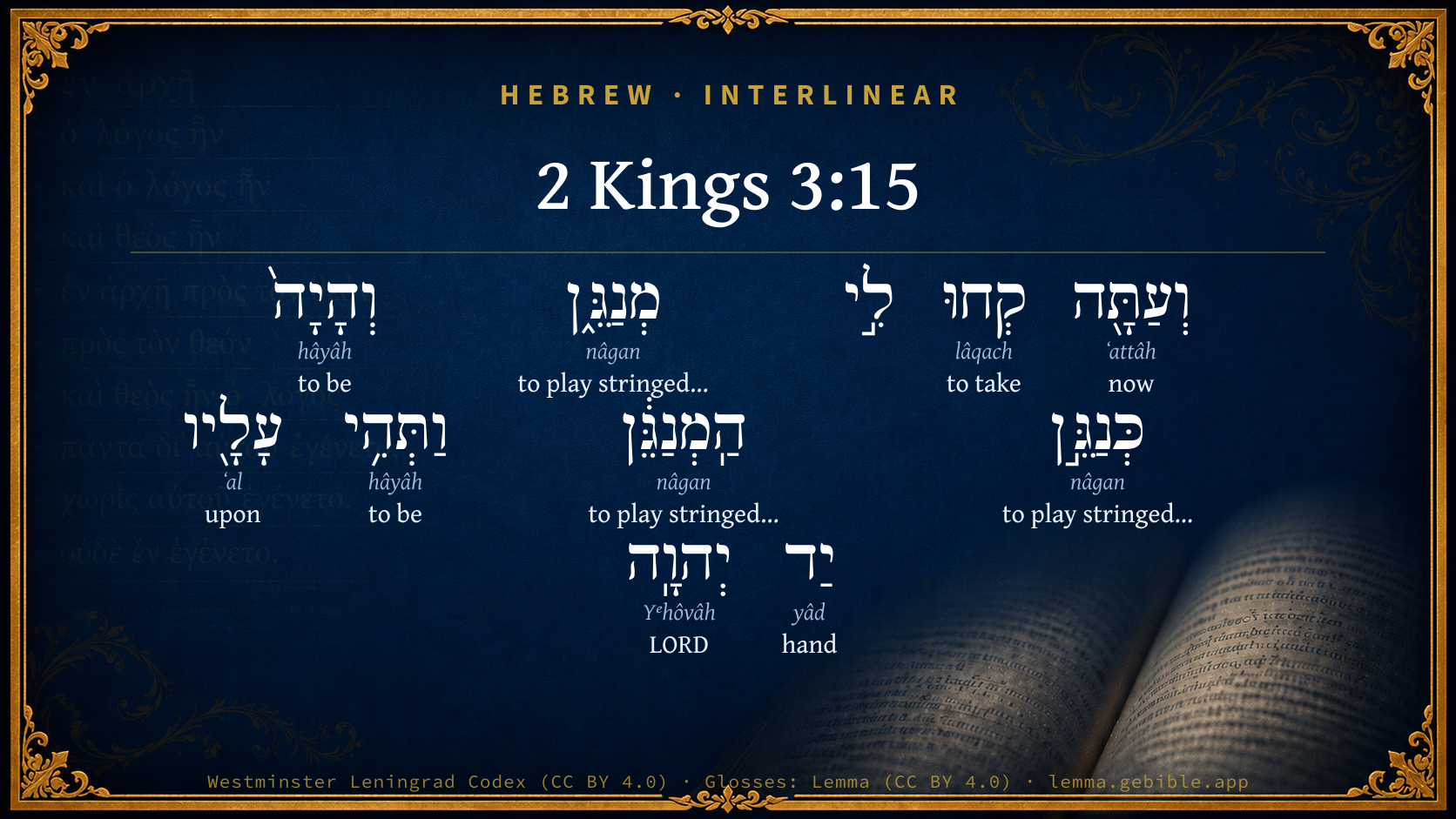
Hebrew (Westminster Leningrad Codex) 2 Kings 3:15 appears in the Hebrew Old Testament. The text above is from the Westminster Leningrad Codex. Each word links to its Strong’s number, a concise gloss, and parsing drawn from the Open Scriptures Hebrew Bible morphology. Click any word for its full Brown-Driver-Briggs (BDB) entry.
Download image
Cite this verse

2 Kings 3:15 (World English Bible). Public Domain. Lemma interlinear Bible study tool, https://lemma.gebible.app/v/2-kings/3/15.

Show BibTeX & RIS
BibTeX
RIS
English Translation
But now bring me a minstrel. It happened, when the minstrel played, that the hand of Yahweh came on him.
World English Bible · Public Domain
Download a study sheet

One document with this verse’s original text, its word-by-word gloss line, the meaning frame, cross-references with their text, attributed commentary, and full source and license credits — printable, and it pastes into notes with its structure intact.

This verse Autodidact and up

Study sheet (.html) Plain text (.txt)

A passage Seminary Student

Up to 50 verses in one chapter. A passage sheet keeps up to 6 commentary sources and 12 cross-references per verse, in the order this page ranks them, and says so on the sheet whenever that leaves anything out. Ask for a single verse and you get the Autodidact verse sheet above.

Everything on this page stays free to read, with no account — the sheet is a download of what is already on screen, not access to it.

Want to remove ads? Support Godless Engineer
Compare translations 3

The same verse in 3 English versions, stacked beneath the original-language interlinear above. Click any original word for its lexicon entry.

Each is an independent rendering of the whole verse — the interlinear is not word-aligned to these translations.

Highlighted words mark where these versions differ — a whole-verse word diff, not a word-by-word alignment.

  • World English Bible Public Domain
    But now bring me a minstrel. It happened, when the minstrel played, that the hand of Yahweh came on him.
  • King James Version Public Domain
    But now bring me a minstrel. And it came to pass, when the minstrel played, that the hand of the LORD came upon him.
  • unfoldingWord Literal Text CC BY-SA 4.0
    But now, bring to me a harpist.” And it happened when the harpist harped that the hand of Yahweh was upon him.

unfoldingWord Literal Text — © unfoldingWord, licensed CC BY-SA 4.0. Word-aligned USFM3 via Door43 (git.door43.org/unfoldingWord/en_ult).

Versions to compare (up to 4)

3 of 4 selected

Show all 18 translations

Every available English version of this verse, each an independent rendering of the whole verse.

  • World English Bible Public Domain
    But now bring me a minstrel. It happened, when the minstrel played, that the hand of Yahweh came on him.
  • Berean Standard Bible Public Domain
    But now, bring me a harpist.” And while the harpist played, the hand of the LORD came upon Elisha
  • Majority Standard Bible Public Domain
    But now, bring me a harpist.” And while the harpist played, the hand of the LORD came upon Elisha
  • King James Version Public Domain
    But now bring me a minstrel. And it came to pass, when the minstrel played, that the hand of the LORD came upon him.
  • American Standard Version (1901) Public Domain
    But now bring me a minstrel. And it came to pass, when the minstrel played, that the hand of Jehovah came upon him.
  • Revised Version (1885) Public Domain
    But now bring me a minstrel. And it came to pass, when the minstrel played, that the hand of the LORD came upon him.
  • Geneva Bible (1599) Public Domain
    But nowe bring me a minstrel. And when the minstrel played, the hand of the Lord came vpon him.
  • Douay-Rheims (1899) Public Domain
    But now bring me hither a minstrel. And when the minstrel played, the hand of the Lord came upon him, and he said:
  • Young's Literal Translation Public Domain
    and now, bring to me a minstrel; and it hath been, at the playing of the minstrel, that the hand of Jehovah is on him,
  • Literal Standard Version CC BY-SA 4.0
    and now, bring a musician to me”; and it has been, at the playing of the musician, that the hand of YHWH is on him,
  • Unlocked Literal Bible CC BY-SA 4.0
    But now bring me a musician.” Then it came to pass when the harpist played, the hand of Yahweh came upon Elisha.
  • unfoldingWord Literal Text CC BY-SA 4.0
    But now, bring to me a harpist.” And it happened when the harpist harped that the hand of Yahweh was upon him.
  • Darby Bible Public Domain
    And now fetch me a minstrel. And it came to pass when the minstrel played, that the hand of Jehovah was upon him.
  • World Messianic Bible Public Domain
    But now bring me a musician.” When the musician played, the LORD’s hand came on him.
  • Webster's Bible Public Domain
    But now bring me a minstrel. And it came to pass, when the minstrel played, that the hand of the LORD came upon him.
  • Free Bible Version CC BY-SA 4.0
    Now bring me a musician.” While the musician played, the Lord's power came upon Elisha,
  • Bible in Basic English Public Domain
    But now, get me a player of music, and it will come about that while the man is playing, the hand of the Lord will come on me and I will give you the word of the Lord: and they got a player of music, and while the man was playing, the hand of the Lord was on him.
  • JPS Tanakh (1917) Public Domain
    But now bring me a minstrel.' And it came to pass, when the minstrel played, that the hand of the LORD came upon him.

Literal Standard Version (2020), Covenant Press — licensed CC BY-SA 4.0. Text via the HelloAO Bible API (eBible.org). Unlocked Literal Bible (unfoldingWord) — licensed CC BY-SA 4.0. Text via the HelloAO Bible API (eBible.org). unfoldingWord Literal Text — © unfoldingWord, licensed CC BY-SA 4.0. Word-aligned USFM3 via Door43 (git.door43.org/unfoldingWord/en_ult). Free Bible Version, Dr. Jonathan Gallagher — licensed CC BY-SA 4.0. Text via the HelloAO Bible API (eBible.org).

Word by word

More ways to search: Search by grammar → Find every occurrence → Compare this word →

Practice this passage: Drill this verse → Learn its vocabulary →

מְנַגֵּ֑ן
nâgan
H5059
“playing stringed instrument”
Verb, Piel, Participle Active, Masculine, Singular, Absolute
Part of Speech
Verb
Stem
Piel
Form
Participle Active
Gender
Masculine
Number
Singular
State
Absolute
Full BDB Definition

Origin: a primitive root

TWOT: 1292 . 1

to play or strike strings, play a stringed instrument - (Qal) - player (participle) - (Piel) - to play - player, minstrel (participle)
  1. וְעַתָּ֖ה ʻattâh H6258 “and · now” Conjunction + Adverb
  2. קְחוּ lâqach H3947 “take” Verb, Qal, Imperative, 2nd Person, Masculine, Plural
  3. וְהָיָה֙ hâyâh H1961 “and · to be” Conjunction + Verb, Qal, Sequential Perfect, 3rd Person, Masculine, Singular
  4. כְּנַגֵּ֣ן nâgan H5059 “like/as · to play stringed instrument” Preposition + Verb, Piel, Infinitive Construct
  5. הַֽמְנַגֵּ֔ן nâgan H5059 “the · playing stringed instrument” Particle, Definite Article + Verb, Piel, Participle Active, Masculine, Singular, Absolute
  6. וַתְּהִ֥י hâyâh H1961 “and · to be” Conjunction + Verb, Qal, Sequential Imperfect, 3rd Person, Feminine, Singular
  7. עָלָ֖יו ʻal H5921 “upon · him” Preposition + Suffix, Personal, 3rd Person, Masculine, Singular
  8. יַד yâd H3027 “hand of” Noun, Common, Both, Singular, Construct
  9. יְהוָֽה Yᵉhôvâh H3068 “LORD” Noun, Proper

About this verse

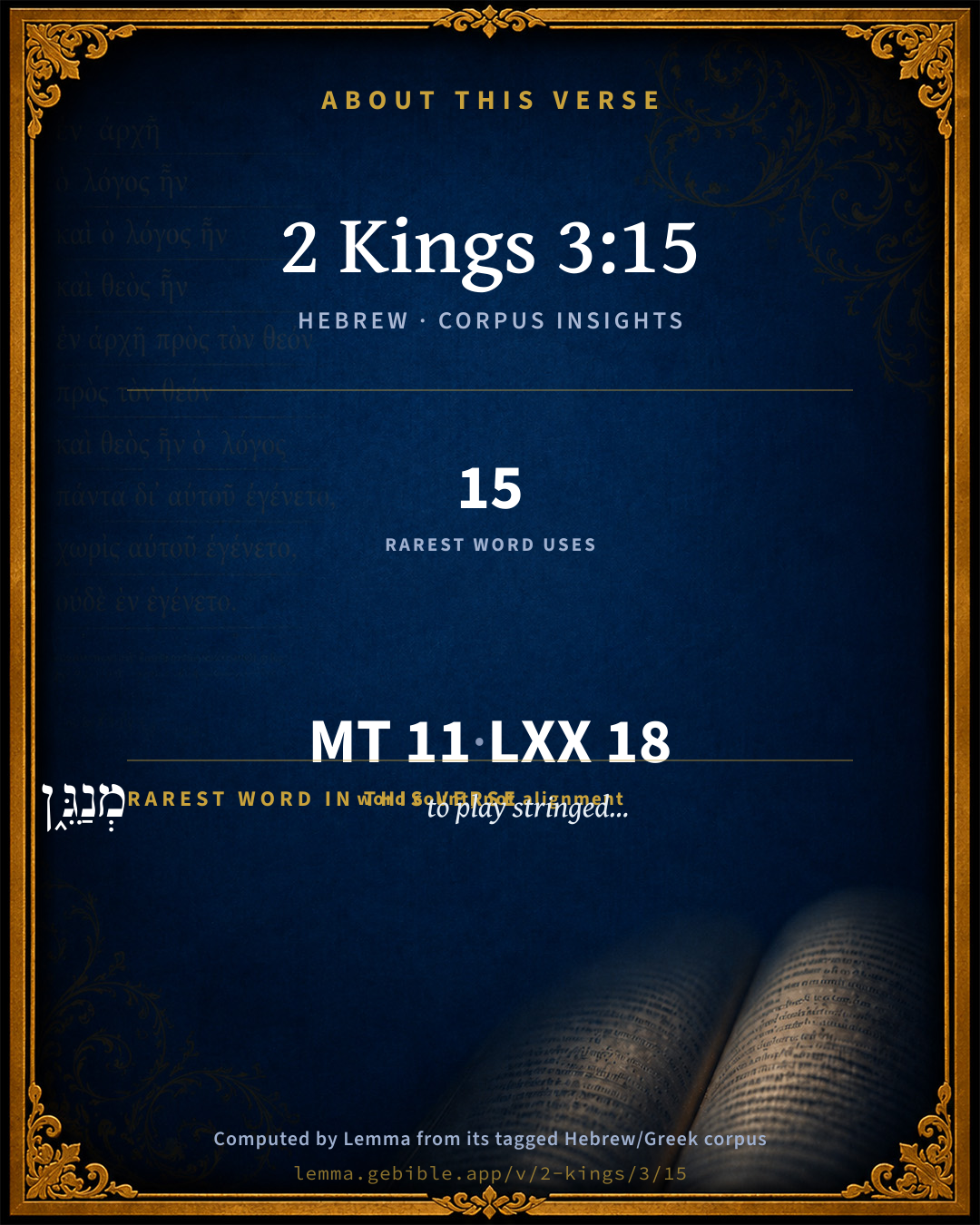
These counts appear in no published source. They are computed here, from the morphology-tagged text and Lemma’s own curated glosses. What Lemma adds →

11
words
7
distinct lemmas
Historical
section

Notable vocabulary

The rarest word here is מְנַגֵּ֑ן to play stringed instrument H5059 — appearing just 15 times in the whole Hebrew Bible.

Shared distinctive vocabulary

מְנַגֵּ֑ן to play stringed instrument H5059 occurs in 12 verses of the Hebrew Bible. Also found in:

Grammatical profile

  • 6 verbs
  • 2 nouns
  • 2 prepositions
  • 1 adverb

Verb forms

  • קְחוּ Qal · Imperative
  • מְנַגֵּ֑ן Piel · Participle Active
  • וְהָיָה֙ Qal · Sequential Perfect
  • כְּנַגֵּ֣ן Piel · Infinitive Construct
  • הַֽמְנַגֵּ֔ן Piel · Participle Active
  • וַתְּהִ֥י Qal · Sequential Imperfect

Repetition

Words recur within this verse — often emphatic in Hebrew:

  • מְנַגֵּ֑ן to play stringed instrument H5059 ×3
  • וְהָיָה֙ to be H1961 ×2

Hebrew & Septuagint length

In English translation the verse runs 20 words from the Hebrew and 24 from the Septuagint (LXX English) — closely comparable.

A rough comparison of the two English renderings, which tokenize alike — not a word-level alignment.

Word counts can differ between the Hebrew and the Greek without any difference in meaning — e.g. the Hebrew direct-object marker אֵת has no separate Greek word, and Greek often adds the article ὁ.

In the original languages it is 11 Hebrew tokens and 18 Greek tokens — but the two are counted differently (Hebrew bundles its prefixes and suffixes into one token; the Greek is in lemma form), so that isn’t a like-for-like length.

Cross-references

11

Topical passages linked to 2 Kings 3:15 in the Treasury of Scripture Knowledge — connected by theme and wording, ordered by reader-vote popularity; previews shown in the World English Bible.

  • 1 Samuel 16:23 It happened, when the [evil] spirit from God was on Saul, that David took the harp, and played with his hand: so Saul was refreshed, and was well, and the evil spirit departed from him.
  • Ephesians 5:18–19 Don't be drunken with wine, in which is dissipation, but be filled with the Spirit,
  • 1 Samuel 10:5 After that you shall come to the hill of God, where is the garrison of the Philistines: and it shall happen, when you are come there to the city, that you shall meet a band of prophets coming down from the high place with a psaltery, and a tambourine, and a pipe, and a harp, before them; and they will be prophesying:
  • Ezekiel 1:3 the word of Yahweh came expressly to Ezekiel the priest, the son of Buzi, in the land of the Chaldeans by the river Chebar; and the hand of Yahweh was there on him.
  • 1 Kings 18:46 and the hand of Yahweh was on Elijah; and he girded up his loins, and ran before Ahab to the entrance of Jezreel.
  • Ezekiel 8:1 It happened in the sixth year, in the sixth [month], in the fifth [day] of the month, as I sat in my house, and the elders of Judah sat before me, that the hand of the Lord Yahweh fell there on me.
  • 1 Samuel 18:10 It happened on the next day, that an evil spirit from God came mightily on Saul, and he prophesied in the midst of the house: and David played with his hand, as he did day by day. Saul had his spear in his hand;
  • 1 Chronicles 25:1–3 Moreover, David and the captains of the host set apart for the service certain of the sons of Asaph, and of Heman, and of Jeduthun, who should prophesy with harps, with psalteries, and with cymbals: and the number of those who did the work according to their service was:
  • Ezekiel 3:14 So the Spirit lifted me up, and took me away; and I went in bitterness, in the heat of my spirit; and the hand of Yahweh was strong on me.
  • Ezekiel 3:22 The hand of Yahweh was there on me; and he said to me, Arise, go forth into the plain, and I will there talk with you.
  • Acts 11:21 The hand of the Lord was with them, and a great number believed and turned to the Lord.

Cross-references courtesy of OpenBible.info (CC BY 4.0).

Hebrew and Greek witnesses Masoretic Hebrew ↔ Greek Septuagint

The same verse in the two great witnesses to the Old Testament, shown verse-for-verse.

These are two independent witnesses, not word-aligned to each other, and the Septuagint is shown in lemma (dictionary) form.

Hebrew 2 Kings 3:15 Masoretic · Westminster Leningrad Codex

וְעַתָּ֖ה קְחוּ לִ֣י מְנַגֵּ֑ן וְהָיָה֙ כְּנַגֵּ֣ן הַֽמְנַגֵּ֔ן וַתְּהִ֥י עָלָ֖יו יַד יְהוָֽה

But now bring me a minstrel. It happened, when the minstrel played, that the hand of Yahweh came on him.

World English Bible · Public Domain

Greek LXX 2 Kings 3:15 Septuagint · lemma form

καί νυνί δέ λαμβάνω ἐγώ ψάλλω καί γίγνομαι ὡς ψάλλω ὁ ψάλλω καί γίγνομαι ἐπί αὐτός χείρ κύριος

And now fetch me a harper. And it came to pass, as the harper harped, that the hand of the Lord came upon him.

LXX2012 (modern English Septuagint) · Public Domain

Hebrew: Westminster Leningrad Codex (CC BY 4.0). Greek: Septuagint (public domain); English from LXX2012 (modern English Septuagint) (Public Domain). How the Septuagint differs from the Hebrew →

Targum (Aramaic paraphrase)

1

The Targum is the ancient Jewish Aramaic paraphrase of the Hebrew Scriptures — an interpretive translation, not the Hebrew text itself. Onkelos (literal) and Pseudo-Jonathan (expansive) render the Torah, and Jonathan the Prophets. Coverage is partial: where no permissively-licensed English translation exists for a verse, only the Aramaic is shown. This is verse-level text, not a word-by-word alignment to the Hebrew.

  1. Targum Jonathan Prophets (Joshua–Malachi)
    וּכְעַן אַיְתוֹ לִי גַבְרָא דְיָדַע לְנַגָנָא בְּכִנוֹרָא וַהֲוָה כַּד נַגֵן דִמְנַגֵן וּשַׁרְיָא עֲלוֹהִי רוּחַ נְבוּאָה מִן קֳדָם יְיָ:

    (no public-domain English translation for this verse)

    Targum Jonathan — Aramaic: “Mikraot Gedolot” (public domain). English: “Sefaria Community Translation” (CC0 1.0 (public-domain dedication)); “London "Chaldee Paraphrase," 1871” (public domain). Text via Sefaria.

Commentary

Notes on 2 Kings 3:15 from classic Christian and Jewish commentators (each source and its license shown beneath its notes). The classic Christian expositions comment on the surrounding passage and are grouped to its opening verse, so a note may address several verses; the Jewish commentaries on the Tanakh (Rashi and others) are per-verse, so they appear only where the commentator wrote on this verse.

Lemma curates 59 commentaries, every one of them public domain or Creative Commons licensed, each selected and text-cleaned for this edition rather than reprinted as found. About our sources →

Trapp's Complete Commentary

John Trapp

2Ki 3:15 But now bring me a minstrel. And it came to pass, when the minstrel played, that the hand of the LORD came upon him.

Ver. 15. But now bring me a minstrel,] Heb., One that striketh with his hand upon a musical instrument. A Levite, likely, he meant, that played and sung some psalm of David. Such a one the prophet here calleth for, to dispel his grief, say some Hebrew doctors, for the loss of Elijah; from whose translation, till the then present occasion, the spirit of prophecy, say the same authors, rested not upon him. To compose his spirits, say some, much moved with indignation at Jehoram; for which purpose also the Pythagoreans, every night when they went to bed, played on an instrument. {a} And Plato in his laws attributeth the same virtue to music. But besides this, the prophet’s mind might hereby be raised up to an expectation of God communicating himself. The way to be filled with the Spirit is to edify ourselves by psalms, and hymns, and spiritual songs. Hence we sing before sermon, &c.

{a} Quintilian, lib. ix. cap. 4.

John Trapp, A Commentary or Exposition upon All the Books of the Old and New Testament (1647–1656) — public domain. Text from a community e-Sword module.

Joseph Benson's Commentary

2Ki 3:15. Now bring me a minstrel — One that can sing and play well upon an instrument of music. This he requires, that his mind, which had been disturbed at the sight of idolatrous Jehoram, might be composed, and that he might be excited to more fervent prayer, and thereby be prepared to receive the prophetic inspiration. See on 1Sa 10:5; 1Sa 16:16. Those that desire communion with God, must keep their spirits quiet and serene. All hurry of spirits, and all turbulent passions, make us unfit for divine visitations. The hand of the Lord came upon him — The spirit of prophecy, so called, to note that it was no natural or acquired virtue inherent in him, but a singular gift of God, given to whom and when he pleased.

Joseph Benson's Commentary on the Old and New Testaments (1811–1818) — public domain. Text from a community e-Sword module.

Tyndale Open Study Notes

Tyndale Open Resources

3:15 bring me someone who can play the harp: Music stimulated the prophetic spirit (cp. Ps 49:4).

Tyndale Open Study Notes — © Tyndale Open Resources, licensed CC BY-SA 4.0. Text via the HelloAO Bible API.

Geneva Bible (1599)

Geneva Bible translators

He sang songs to God’s glory, and so stirred up the Prophet’s heart to prophesy.

Geneva Bible (1599) marginal notes — public domain. Text via Bolls.life.

Jamieson, Fausset & Brown

Robert Jamieson, A. R. Fausset & David Brown

bring me a minstrel--The effect of music in soothing the mind is much regarded in the East; and it appears that the ancient prophets, before entering their work, commonly resorted to it, as a preparative, by praise and prayer, to their receiving the prophetic afflatus.

the hand of the Lord--a phrase significantly implying that the gift of prophecy was not a natural or inherent gift, but conferred by the power and grace of God.

Jamieson, Fausset & Brown — Commentary Critical and Explanatory on the Whole Bible (1871) — public domain (CC PDM 1.0). Text via the HelloAO Bible API.

Adam Clarke's Commentary

Verse 15. Bring me a minstrel.] A person who played on the harp. The rabbins, and many Christians, suppose that Elisha's mind was considerably irritated and grieved by the bad behaviour of the young men at Beth-el, and their tragical end, and by the presence of the idolatrous king of Israel; and therefore called for Divine psalmody, that it might calm his spirits, and render him more susceptible of the prophetic influence. To be able to discern the voice of God, and the operation of his hand, it is necessary that the mind be calm, and the passions all in harmony, under the direction of reason; that reason may be under the influence of the Divine Spirit.

The hand of the Lord came upon him.] The playing of the harper had the desired effect; his mind was calmed, and the power of God descended upon him. This effect of music was generally acknowledged in every civilized nation. Cicero, in his Tusculan Questions, lib. iv., says, that "the Pythagoreans were accustomed to calm their minds, and soothe their passions, by singing and playing upon the harp." Pythagoraei mentes suas a cogitationum intentione cantu fidibusque ad tranquillitatem traducebant. I have spoken elsewhere of the heathen priests who endeavoured to imitate the true prophets, and were as actually filled with the devil as the others were with the true God. The former were thrown into violent agitations and contortions by the influence of the demons which possessed them, while the latter were in a state of the utmost serenity and composure.

Adam Clarke's Commentary on the Bible (1810–1826) — public domain. Text from a community e-Sword/MySword module.

Ellicott's Commentary for English Readers

(15) Bring me a minstrel.—Mĕnaggçn—i.e., a harper, player on a stringed instrument (nĕgînâh). Elisha called for music as a natural means of calming his perturbed spirit (2Ki_3:13-14). Composure and serenity of soul were essential, if the prophet was to hear the voice of God within. Cicero tells us that the Pythagoreans were wont to tranquillise their minds after the strain of thought with’ harp music and singing (Tusc. Iv. 2). (Comp. 1Sa_10:5; 1Ch_25:1, Note.) The incident is a striking mark of the historical truth of the narrative.

And it came to pass.—Perfect with weak waw: a later idiom. (Comp. 1Sa_17:48.)

The hand of the Lord came upon him.—Targum and some MSS., “the Spirit of the Lord;” but comp. 1Ki_18:46.

A Bible Commentary for English Readers, edited by Charles John Ellicott (1878–1897) — public domain. Text from a community e-Sword module.

The Cambridge Bible for Schools and Colleges

gen. ed. J. J. S. Perowne

15. But now bring me a minstrel] Of the power of music over the mind we have examples in the history of Saul (1Sa_16:23) and also of the use of music by the companies of prophets (1Sa_10:5). But neither of these instances illustrates the case of Elisha as here described. It was not employed to calm his own angry spirit, and he was alone, whereas the prophetic band in 1Sa_10:5 were marching in a body, and chanting some religious hymns or service. From the result described here, viz. that the hand (that is, the influence and spirit) of the Lord came upon him, we may conclude that this was what Elisha wished for, and we may suppose that while the music went on his thoughts took shape, and found vent in prayer, till at length he was prompted inwardly what to say. A striking instance of the power of music.

the hand of the Lord] The phrase is most frequently employed in the Pentateuch and the historical books to signify God’s power exerted in punishment. Cf. Exo_9:3, ‘The hand of the Lord is upon thy cattle’. See also Deu_2:15; Jos_22:31; Jdg_2:15. But it is also used of the divine power which strengthened and supported Elijah, 1Ki_18:46, and several times in Ezekiel of the spirit by which the prophet was possessed (cf. Eze_1:3; Eze_3:14; Eze_3:22; Eze_8:1; Eze_33:22; Eze_37:1). The passage Eze_33:22 may be best quoted in illustration of the case of Elisha: ‘The hand of the Lord was upon me in the evening … and had opened my mouth … and my mouth was opened and I was no more dumb.’ As to Ezekiel, so here to Elisha there was given what he should speak. Josephus says ‘he became inspired’.

The Cambridge Bible for Schools and Colleges (gen. ed. J. J. S. Perowne; Cambridge University Press, 1878–1918) — public domain. Text from a community e-Sword module.

John Gill's Exposition

And this is but a light thing in the sight of the Lord,.... To give them such a plenty of water in such an extraordinary manner: he would do for them what was greater, not only save them from falling into the hand of Moab, which they feared,

but he wilt deliver the Moabites into your hands; which was more than was asked for, or expected.

John Gill's Exposition of the Whole Bible (1746–1763) — public domain (CC PDM 1.0). Text via the HelloAO Bible API.

Albert Barnes' Notes on the Bible

Music seems to have been a regular accompaniment of prophecy in the “schools of the prophets” (marginal reference), and an occasional accompaniment of it elsewhere Exo 15:20.

Albert Barnes' Notes on the Bible (1834–1885) — public domain. Text from a community e-Sword/MySword module.

Haydock's Catholic Bible Commentary

Minstrel. The priests and Levites, who officiated in the temple, accompanied the army. Eliseus wants no profane music, (Calmet) but, by this request, shews his respect for the true religion, (Haydock) and by sounding forth the divine praises, in some of David’s psalms, wishes to obtain of God the favour which was desired. (Theodoret) (Menochius) --- He had felt some emotion at the sight of Joram, and was sensible that God required a calm. (Calmet) --- He dwells not in a violent wind, &c., 3 Kings xix 11. (Haydock) --- The surprising effects of ancient music to calm the passions are well attested, 1 Kings xvi. 17. By this means St. Francis was raised to the contemplation of heavenly things; and St. Augustine says of himself: "How I wept when I heard thy hymns and canticles, being greatly moved at the delightful harmony of thy church:" suavesonantis Ecclesiæ tuæ vocibus commotus acriter. (Conf. ix. 6. de C. xiv. 24.) --- Upon him, so that he experienced that enthusiasm which shewed that he was actuated by the divine spirit, to speak with all the authority requisite. The pagans strove to imitate the true prophets, but the difference was very evident; no less than the spirit with which they were filled; the former were agitated in a furious manner; the latter were composed and majestic. (Calmet)

George Leo Haydock (1774–1849), Haydock's Catholic Family Bible and Commentary, 1859 edition — public domain. Excludes Psalms (Douay-Rheims chapter numbering differs from Protestant) and Deuterocanonical books (Catholic canon only).

Matthew Poole's English Annotations

A minstrel; one that can sing and play upon a musical instrument. This he requires, that his mind, which had been disturbed and inflamed with holy anger at the sight of wicked Jehoram, might be composed, and cheered, and united within itself, and that he might be excited to the more fervent prayer to God, and joyfully praising him; whereby he was prepared to receive the prophetical inspiration. For although prophecy be the gift of God, yet men might do something either to hinder or further the reception of it; for which cause Paul bids Christians study to get the gift of prophecy, 1Co 14:1. And for this very end the colleges of the prophets were erected, wherein the sons of the prophets did use divers means to procure this gift, which also they did sometimes receive, as we see 2Ki 2:3,5; and, amongst other means, they used instruments of music to exhilarate their spirits, &c., 1Sa 10:5. Of the great power of music upon the affections, See Poole "1Sa 16:16".

The hand of the Lord, i.e. the Spirit of prophecy; so called, to note that it was not from Elisha’s temper of body or mind; that it was no natural nor acquired virtue inherent in him; but a singular gift of God, given to whom and when he pleased. This phrase is used also Eze 1:3; 3:14,22; 8:1.

Matthew Poole's English Annotations on the Holy Bible (1683–1685) — public domain. Text from a community e-Sword/MySword module.

Whedon's Commentary on the Bible

Daniel D. Whedon

15. Bring me a minstrel — The power of music to quell the passions, to tranquillize the mind, and to bring the soul into a devotional frame, is no strange fact. See note on 1Sa_16:16. The prophets of the schools carried with them instruments of music to aid them in their prophesying, (1Sa_10:5;) and here Elisha, whose spirit was ruffled by the presence of the idolatrous Jehoram, calls to his aid the sound of music, that its soft tones may bring his soul into harmony with the inner world of spiritual vision.

The hand of the Lord came upon him — The expression often occurs in Ezekiel to denote the imparting of Divine energy, which qualified the prophet for his holy work.

Daniel D. Whedon (gen. ed.), Commentary on the Old and New Testaments (1874–1909) — public domain. Text from a community e-Sword module.

The Pulpit Commentary

But now bring me a minstrel. A player on the harp seems to be intended. Music was cultivated in the schools of the prophets (1Sa_10:5; 1Ch_25:1-3) and was employed to soothe and quiet the soul, to help it to forget things earthly and external, and bring it into that ecstatic condition in which it was most open to the reception of Divine influences. As David"s harping refreshed Saul, and tranquillized his spirit, (1Sa_16:23) so the playing of any skilled minstrel had a soothing effect on those possessing the prophetic gift generally, and enabled them to shut out the outer world, and concentrate their whole attention on the inward voice which communicated to them the Divine messages. And it came to pass, when the minstrel played, that the hand of the Lord came upon him. By "the hand of the Lord" is meant the power of the Spirit of God, the Divine effluence, whatever it was, which acquainted the prophets with the Divine will, and enabled them to utter it.

The Pulpit Commentary (1880–1919), ed. H.D.M. Spence-Jones & Joseph S. Exell — public domain. Text from a community e-Sword module.

John Wesley's Explanatory Notes

Minstrel - One that can sing and play upon a musical instrument. This he requires, that his mind which had been disturbed at the sight of wicked Jehoram, might be composed, and that he might be excited to more fervent prayer whereby he was prepared to receive the prophetic inspiration. Those that desire communion with God must keep their spirits quiet and serene. All hurry of spirit, and all turbulent passions, make us unfit for divine visitations. The hand, &c. - The spirit of prophecy, so called, to note that it was no natural nor acquired virtue inherent in him; but a singular gift of God, given to whom and when he pleased.

John Wesley, Explanatory Notes Upon the Whole Bible (1754–1765) — public domain. Text via the GEBible commentary corpus.

unfoldingWord translationNotes

Door43 World Missions Community

Then it came to pass

"And it happened that"

harpist

someone who plays the harp

the hand of Yahweh came upon Elisha

Here Yahweh's "hand" refers to his "power." AT: "the power of Yahweh came upon Elisha" (See: Metonymy)

trenches

A trench is a long ditch that workers dig in the ground to collect water.

this river valley will be filled with water

This can be stated in active form. AT: "I will fill this river valley with water" (See: Active or Passive)

you will drink

This refers to drinking the water that Yahweh provides. AT: "you will drink the water" (See: Assumed Knowledge and Implicit Information)

translationWords

harp

hand

Yahweh

Elisha

livestock

unfoldingWord translationNotes — © Distant Shores Media and the Door43 World Missions Community, licensed CC BY-SA 4.0. Source: git.door43.org/Door43/en_tn.

Rashi

Rabbi Shlomo Yitzchaki (Rashi)

Bring me a musician. Because of his anger, the Divine Presence departed from him.. See Maseches Pesachim 117a.

Rashi on the Tanakh — English translations: “The Judaica Press complete Tanach with Rashi, translated by A. J. Rosenberg” (CC BY 4.0); “Pentateuch with Rashi's commentary by M. Rosenbaum and A.M. Silbermann, 1929-1934” (public domain); “The Metsudah Tanach series, Lakewood, N.J” (CC BY 4.0); and “The Book of Joshua, Metsudah Publications, 1997” (CC BY 4.0). Text via Sefaria.

Lesson kit

Teaching starters — assembled from the data on this page, not authored interpretation. Every prompt links to the verse data it draws on. Edit before teaching.

2 Kings, in the Historical, opens this verse with 11 words (7 distinct Hebrew lemmas). Its most distinctive word is nâgan (“to play stringed instrument”). A historical commentator’s framing appears above. Read the whole chapter for the surrounding context.

Discussion questions

  1. How does “to play stringed instrument” (nâgan) shape what this verse is saying?
  2. How does 1 Samuel 16:16, which shares the word «to play stringed instrument», read alongside this verse?
  3. What does the repetition of “to play stringed instrument” (3× in this one verse) do in this verse?
  4. These translations render this verse differently. What is at stake in choosing one wording over another?
  5. «קְחוּ» is a Qal Imperative verb. How does that grammatical form shape the action described?
  6. Compare how Trapp's Complete Commentary and Joseph Benson's Commentary read this verse. Where do they agree or differ?

Things to notice

Reading settings

Reading text

Shown beneath each verse's original-language words.

Old Testament
Old Testament edition

Read the OT as the Masoretic Hebrew (MT) or the Greek Septuagint (LXX).

English shown for the Greek Septuagint (in the Hebrew ↔ Greek comparison).

Comparing translations? Open the Compare panel on any verse page to stack up to four side by side.