
Revelation 21:8

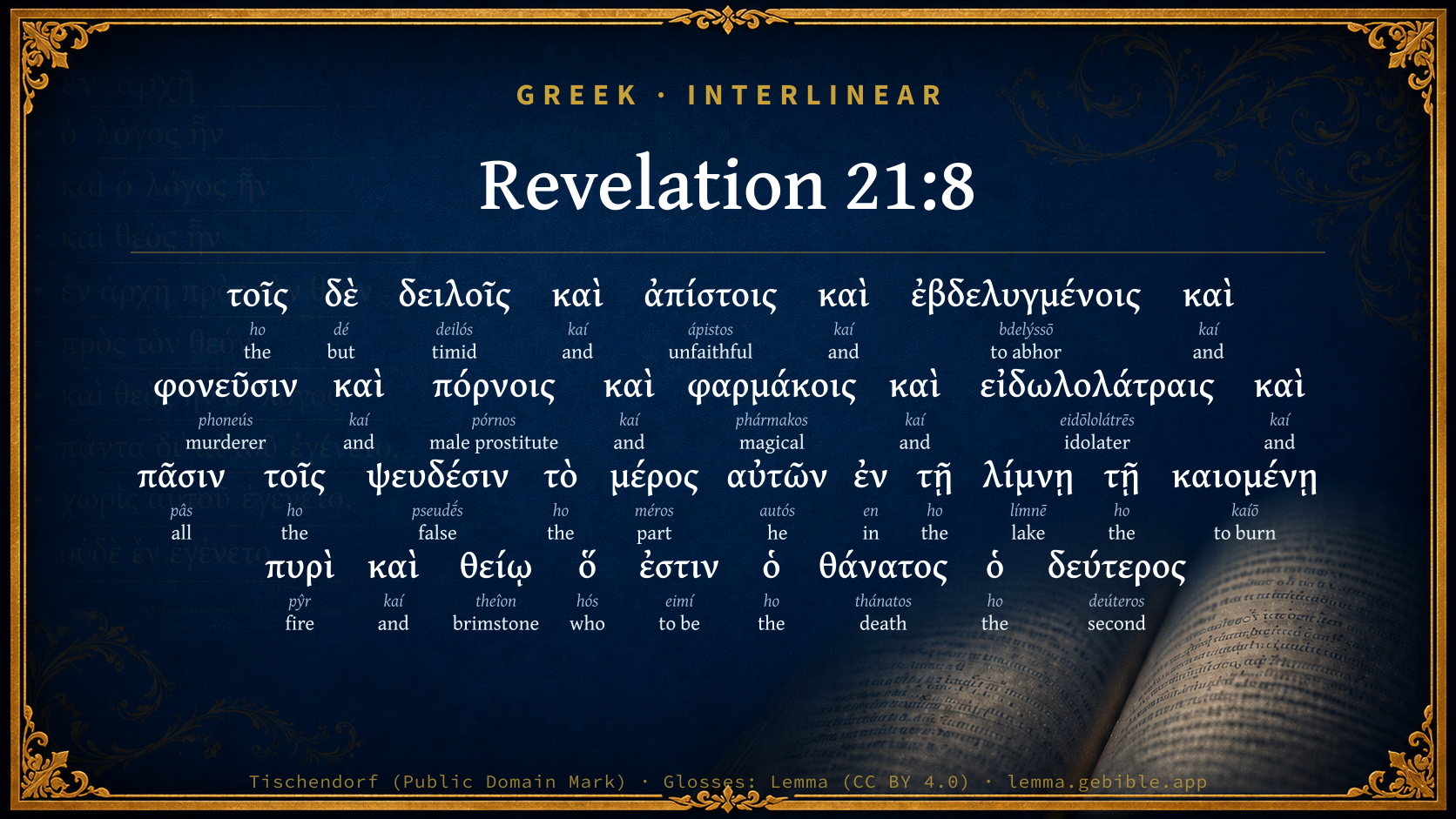
Greek (Tischendorf 8th ed.) Revelation 21:8 appears in the Greek New Testament. The text above is from the Tischendorf 8th edition. Each word links to its Strong’s number and a concise gloss. Click any word for its full Thayer’s Greek Lexicon entry.
Download image
Cite this verse

Revelation 21:8 (World English Bible). Public Domain. Lemma interlinear Bible study tool, https://lemma.gebible.app/v/revelation/21/8.

Show BibTeX & RIS
BibTeX
RIS
English Translation
But for the cowardly, unbelieving, sinners, abominable, murderers, sexually immoral, sorcerers, idolaters, and all liars, their part is in the lake that burns with fire and sulfur, which is the second death."
World English Bible · Public Domain
Highlights
  • 1 first appearance in the Greek New Testament
Full analysis ↓
Download a study sheet

One document with this verse’s original text, its word-by-word gloss line, the meaning frame, cross-references with their text, attributed commentary, and full source and license credits — printable, and it pastes into notes with its structure intact.

This verse Autodidact and up

Study sheet (.html) Plain text (.txt)

A passage Seminary Student

Up to 50 verses in one chapter. A passage sheet keeps up to 6 commentary sources and 12 cross-references per verse, in the order this page ranks them, and says so on the sheet whenever that leaves anything out. Ask for a single verse and you get the Autodidact verse sheet above.

Everything on this page stays free to read, with no account — the sheet is a download of what is already on screen, not access to it.

Want to remove ads? Support Godless Engineer
Compare translations 3

The same verse in 3 English versions, stacked beneath the original-language interlinear above. Click any original word for its lexicon entry.

Each is an independent rendering of the whole verse — the interlinear is not word-aligned to these translations.

Highlighted words mark where these versions differ — a whole-verse word diff, not a word-by-word alignment.

  • World English Bible Public Domain
    But for the cowardly, unbelieving, sinners, abominable, murderers, sexually immoral, sorcerers, idolaters, and all liars, their part is in the lake that burns with fire and sulfur, which is the second death."
  • King James Version Public Domain
    But the fearful, and unbelieving, and the abominable, and murderers, and whoremongers, and sorcerers, and idolaters, and all liars, shall have their part in the lake which burneth with fire and brimstone: which is the second death.
  • unfoldingWord Literal Text CC BY-SA 4.0
    But for the cowardly and the unbelieving and the abhorred and murderers and fornicators and sorcerers and idolaters and all liars, their place in the lake burning with fire and sulfur, which is the second death.”

unfoldingWord Literal Text — © unfoldingWord, licensed CC BY-SA 4.0. Word-aligned USFM3 via Door43 (git.door43.org/unfoldingWord/en_ult).

Versions to compare (up to 4)

3 of 4 selected

Show all 19 translations

Every available English version of this verse, each an independent rendering of the whole verse.

  • World English Bible Public Domain
    But for the cowardly, unbelieving, sinners, abominable, murderers, sexually immoral, sorcerers, idolaters, and all liars, their part is in the lake that burns with fire and sulfur, which is the second death."
  • Berean Standard Bible Public Domain
    But to the cowardly and unbelieving and abominable and murderers and sexually immoral and sorcerers and idolaters and all liars, their place will be in the lake that burns with fire and sulfur. This is the second death.”
  • Majority Standard Bible Public Domain
    But to the cowardly and unbelieving and sinful and abominable and murderers and sexually immoral and sorcerers and idolaters and all liars, their place will be in the lake that burns with fire and sulfur. This is the second death.”
  • King James Version Public Domain
    But the fearful, and unbelieving, and the abominable, and murderers, and whoremongers, and sorcerers, and idolaters, and all liars, shall have their part in the lake which burneth with fire and brimstone: which is the second death.
  • American Standard Version (1901) Public Domain
    But for the fearful, and unbelieving, and abominable, and murderers, and fornicators, and sorcerers, and idolaters, and all liars, their part `shall be' in the lake that burneth with fire and brimstone; which is the second death.
  • Revised Version (1885) Public Domain
    But for the fearful, and unbelieving, and abominable, and murderers, and fornicators, and sorcerers, and idolaters, and all liars, their part shall be in the lake that burneth with fire and brimstone; which is the second death.
  • Geneva Bible (1599) Public Domain
    But the fearful and vnbeleeuing, and the abominable and murtherers, and whoremogers, and sorcerers, and idolaters, and all liars shall haue their part in the lake, which burneth with fire and brimstone, which is the second death.
  • Douay-Rheims (1899) Public Domain
    But the fearful, and unbelieving, and the abominable, and murderers, and whoremongers, and sorcerers, and idolaters, and all liars, they shall have their portion in the pool burning with fire and brimstone, which is the second death.
  • Young's Literal Translation Public Domain
    and to fearful, and unstedfast, and abominable, and murderers, and whoremongers, and sorcerers, and idolaters, and all the liars, their part `is' in the lake that is burning with fire and brimstone, which is a second death.'
  • Literal Standard Version CC BY-SA 4.0
    But to fearful, and unsteadfast, and abominable, and murderers, and whoremongers, and sorcerers, and idolaters, and all the liars, their part [is] in the lake that is burning with fire and brimstone, which is the second death.”
  • Unlocked Literal Bible CC BY-SA 4.0
    But as for the cowards, the faithless, the detestable, the murderers, the sexually immoral, sorcerers, idolaters, and all liars, their place will be in the fiery lake of burning sulfur. That is the second death.”
  • unfoldingWord Literal Text CC BY-SA 4.0
    But for the cowardly and the unbelieving and the abhorred and murderers and fornicators and sorcerers and idolaters and all liars, their place in the lake burning with fire and sulfur, which is the second death.”
  • Darby Bible Public Domain
    But to the fearful and unbelieving, [and sinners], and those who make themselves abominable, and murderers, and fornicators, and sorcerers, and idolaters, and all liars, their part [is] in the lake which burns with fire and brimstone; which is the second death.
  • World Messianic Bible Public Domain
    But for the cowardly, unbelieving, sinners, abominable, murderers, sexually immoral, sorcerers, idolaters, and all liars, their part is in the lake that burns with fire and sulfur, which is the second death.”
  • Webster's Bible Public Domain
    But the fearful, and unbelieving, and the abominable, and murderers, and lewd men, and sorcerers, and idolaters, and all liars, shall have their part in the lake which burneth with fire and brimstone: which is the second death.
  • Free Bible Version CC BY-SA 4.0
    But anyone who is a coward, who doesn't trust me, who does disgusting things, who is a murderer, who is sexually immoral, who practices witchcraft, who worships idols, who tells lies—their chosen place is in the lake that burns with fire and sulfur. This is the second death.”
  • Bible in Basic English Public Domain
    But those who are full of fear and without faith, the unclean and takers of life, those who do the sins of the flesh, and those who make use of evil powers or who give worship to images, and all those who are false, will have their part in the sea of ever-burning fire which is the second death.
  • Text-Critical English NT CC BY 4.0
    But as for the cowardly, the faithless, the sinful, the detestable, the murderers, the fornicators, the sorcerers, the idolaters, and all liars, their portion is in the lake that burns with fire and sulfur, which is the second death.”
  • Tyndale New Testament (1534) Public Domain
    But the fearefull and vnbelevynge and the abhominable and murdrers and whormongers and sorcerers and ydolaters and all lyars shall have their parte in the lake which burnyth with fyre and brymstone which is the seconde deth.

Literal Standard Version (2020), Covenant Press — licensed CC BY-SA 4.0. Text via the HelloAO Bible API (eBible.org). Unlocked Literal Bible (unfoldingWord) — licensed CC BY-SA 4.0. Text via the HelloAO Bible API (eBible.org). unfoldingWord Literal Text — © unfoldingWord, licensed CC BY-SA 4.0. Word-aligned USFM3 via Door43 (git.door43.org/unfoldingWord/en_ult). Free Bible Version, Dr. Jonathan Gallagher — licensed CC BY-SA 4.0. Text via the HelloAO Bible API (eBible.org).

Word by word

More ways to search: Search by grammar → Find every occurrence → Compare this word →

Practice this passage: Drill this verse → Learn its vocabulary →

ἐβδελυγμένοις
bdelýssō
G948
“to abhor”
Verb, Perfect, Passive, Participle, Dative, Plural, Masculine
Part of Speech
Verb
Tense
Perfect
Voice
Passive
Mood
Participle
Case
Dative
Number
Plural
Gender
Masculine
Full Thayer's Definition

Origin: from a (presumed) derivative of bdeo (to stink)

TDNT: 1:598,*

1. to render foul, to cause to be abhorred 2. abominable 3. to turn one's self away from on account of the stench 4. metaph. to abhor, detest
  1. τοῖς ho G3588 “the” Article, Dative, Plural, Masculine
  2. δὲ dé G1161 “but” Conjunction
  3. δειλοῖς deilós G1169 “timid” Adjective, Dative, Plural, Masculine
  4. καὶ kaí G2532 “and” Conjunction
  5. ἀπίστοις ápistos G571 “unfaithful” Adjective, Dative, Plural, Masculine
  6. καὶ kaí G2532 “and” Conjunction
  7. καὶ kaí G2532 “and” Conjunction
  8. φονεῦσιν phoneús G5406 “murderer” Noun, Dative, Plural, Masculine
  9. καὶ kaí G2532 “and” Conjunction
  10. πόρνοις pórnos G4205 “male prostitute” Noun, Dative, Plural, Masculine
  11. καὶ kaí G2532 “and” Conjunction
  12. φαρμάκοις phármakos G5333 “magical” Noun, Dative, Plural, Masculine
  13. καὶ kaí G2532 “and” Conjunction
  14. εἰδωλολάτραις eidōlolátrēs G1496 “idolater” Noun, Dative, Plural, Masculine
  15. καὶ kaí G2532 “and” Conjunction
  16. πᾶσιν pâs G3956 “all” Adjective, Dative, Plural, Masculine
  17. τοῖς ho G3588 “the” Article, Dative, Plural, Masculine
  18. ψευδέσιν pseudḗs G5571 “false” Adjective, Dative, Plural, Masculine
  19. τὸ ho G3588 “the” Article, Nominative, Singular, Neuter
  20. μέρος méros G3313 “part” Noun, Nominative, Singular, Neuter
  21. αὐτῶν autós G846 “he” Personal pronoun, Genitive, Plural, Masculine
  22. ἐν en G1722 “in” Preposition
  23. τῇ ho G3588 “the” Article, Dative, Singular, Feminine
  24. λίμνῃ límnē G3041 “lake” Noun, Dative, Singular, Feminine
  25. τῇ ho G3588 “the” Article, Dative, Singular, Feminine
  26. καιομένῃ kaíō G2545 “to burn” Verb, Present, Passive, Participle, Dative, Singular, Feminine
  27. πυρὶ pŷr G4442 “fire” Noun, Dative, Singular, Neuter
  28. καὶ kaí G2532 “and” Conjunction
  29. θείῳ theîon G2303 “brimstone” Noun, Dative, Singular, Neuter
  30. ὅ hós G3739 “who” Relative pronoun, Nominative, Singular, Neuter
  31. ἐστιν eimí G1510 “to be” Verb, Present, Active, Indicative, 3rd person, Singular
  32. ὁ ho G3588 “the” Article, Nominative, Singular, Masculine
  33. θάνατος thánatos G2288 “death” Noun, Nominative, Singular, Masculine
  34. ὁ ho G3588 “the” Article, Nominative, Singular, Masculine
  35. δεύτερος deúteros G1208 “second” Adjective, Nominative, Singular, Masculine

About this verse

These counts appear in no published source. They are computed here, from the morphology-tagged text and Lemma’s own curated glosses. What Lemma adds →

36
words
23
distinct lemmas
Revelation
section

Notable vocabulary

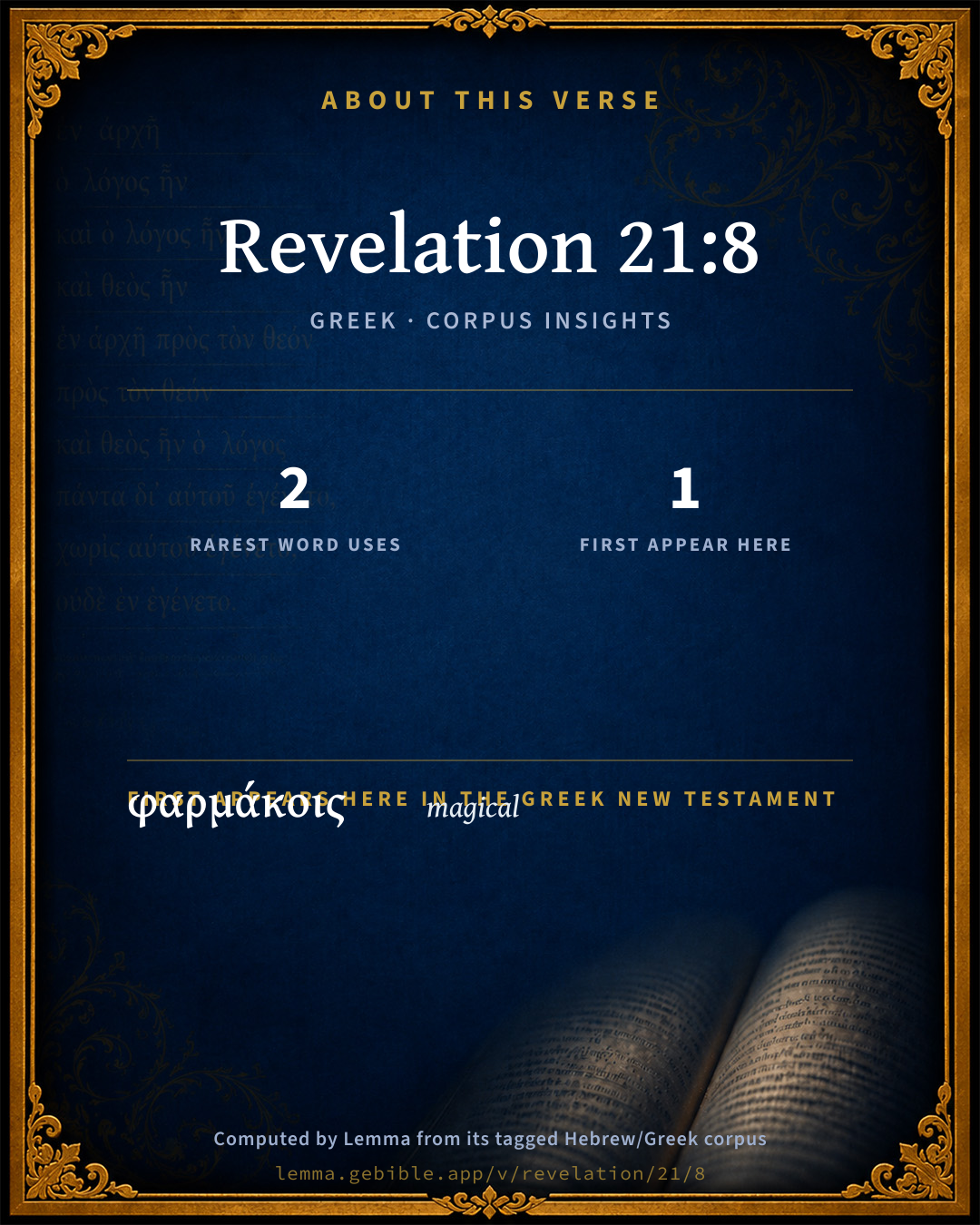
The rarest word here is ἐβδελυγμένοις to abhor G948 — appearing just 2 times in the whole Greek New Testament.

First appearance in Scripture

This word makes its first canonical appearance in the Greek New Testament here:

  • φαρμάκοις magical G5333

Shared distinctive vocabulary

ἐβδελυγμένοις to abhor G948 occurs in 2 verses of the Greek New Testament. Also found in:
Repetition

Words recur within this verse:

Cross-references

33

Topical passages linked to Revelation 21:8 in the Treasury of Scripture Knowledge — connected by theme and wording, ordered by reader-vote popularity; previews shown in the World English Bible.

  • 1 Corinthians 6:9–10 Or don't you know that the unrighteous will not inherit the Kingdom of God? Don't be deceived. Neither the sexually immoral, nor idolaters, nor adulterers, nor male prostitutes, nor homosexuals,
  • Revelation 2:11 He who has an ear, let him hear what the Spirit says to the assemblies. He who overcomes won't be harmed by the second death.
  • Ephesians 5:5–6 Know this for sure, that no sexually immoral person, nor unclean person, nor covetous man, who is an idolater, has any inheritance in the Kingdom of Christ and God.
  • Revelation 22:15 Outside are the dogs, the sorcerers, the sexually immoral, the murderers, the idolaters, and everyone who loves and practices falsehood.
  • Revelation 20:14–15 Death and Hades were thrown into the lake of fire. This is the second death, the lake of fire.
  • Galatians 5:19–21 Now the works of the flesh are obvious, which are: adultery, sexual immorality, uncleanness, lustfulness,
  • Proverbs 19:9 A false witness shall not be unpunished. He who utters lies shall perish.
  • John 12:42–43 Nevertheless even of the rulers many believed in him, but because of the Pharisees they didn't confess it, so that they wouldn't be put out of the synagogue,
  • 1 John 3:15 Whoever hates his brother is a murderer, and you know that no murderer has eternal life remaining in him.
  • 1 Corinthians 10:20–21 But I say that the things which the Gentiles sacrifice, they sacrifice to demons, and not to God, and I don't desire that you would have communion with demons.
  • Malachi 3:5 I will come near to you to judgment; and I will be a swift witness against the sorcerers, and against the adulterers, and against the perjurers, and against those who oppress the hireling in his wages, the widow, and the fatherless, and who deprive the foreigner of justice, and don't fear me," says Yahweh of Hosts.
  • Matthew 10:28 Don't be afraid of those who kill the body, but are not able to kill the soul. Rather, fear him who is able to destroy both soul and body in Gehenna.
  • 1 Timothy 1:9–10 as knowing this, that law is not made for a righteous man, but for the lawless and insubordinate, for the ungodly and sinners, for the unholy and profane, for murderers of fathers and murderers of mothers, for manslayers,
  • Hebrews 13:4 Let marriage be held in honor among all, and let the bed be undefiled: but God will judge the sexually immoral and adulterers.
  • Matthew 8:26 He said to them, "Why are you fearful, oh you of little faith?" Then he got up, rebuked the wind and the sea, and there was a great calm.
  • 1 Timothy 4:2 through the hypocrisy of men who speak lies, branded in their own conscience as with a hot iron;
  • Revelation 19:20 The beast was taken, and with him the false prophet who worked the signs in his sight, with which he deceived those who had received the mark of the beast and those who worshiped his image. These two were thrown alive into the lake of fire that burns with sulfur.
  • Proverbs 19:5 A false witness shall not be unpunished. He who pours out lies shall not go free.
  • John 8:44 You are of your Father, the devil, and you want to do the desires of your father. He was a murderer from the beginning, and doesn't stand in the truth, because there is no truth in him. When he speaks a lie, he speaks on his own; for he is a liar, and the father of it.
  • Revelation 9:21 They didn't repent of their murders, nor of their sorceries, nor of their sexual immorality, nor of their thefts.
  • Luke 12:4–9 "I tell you, my friends, don't be afraid of those who kill the body, and after that have no more that they can do.
  • Deuteronomy 20:8 The officers shall speak further to the people, and they shall say, What man is there who is fearful and faint-hearted? let him go and return to his house, lest his brother's heart melt as his heart.
  • Isaiah 9:15 The elder and the honorable man, he is the head; and the prophet who teaches lies, he is the tail.
  • 1 Peter 3:14–15 But even if you should suffer for righteousness' sake, you are blessed. "Don't fear what they fear, neither be troubled."
  • 1 John 2:22 Who is the liar but he who denies that Jesus is the Christ? This is the Antichrist, he who denies the Father and the Son.
  • Judges 7:3 Now therefore proclaim in the ears of the people, saying, Whoever is fearful and trembling, let him return and depart from Mount Gilead. There returned of the people twenty-two thousand; and there remained ten thousand.
  • Isaiah 51:12 I, even I, am he who comforts you: who are you, that you are afraid of man who shall die, and of the son of man who shall be made as grass;
  • Isaiah 57:11 Of whom have you been afraid and in fear, that you lie, and have not remembered me, nor laid it to your heart? Haven't I held my peace even of long time, and you don't fear me?
  • 1 John 5:10 He who believes in the Son of God has the testimony in himself. He who doesn't believe God has made him a liar, because he has not believed in the testimony that God has given concerning his Son.
  • 2 Thessalonians 2:9 even he whose coming is according to the working of Satan with all power and signs and lying wonders,
  • 1 John 5:4–5 For whatever is born of God overcomes the world. This is the victory that has overcome the world: your faith.
  • Revelation 2:2 "I know your works, and your toil and perseverance, and that you can't tolerate evil men, and have tested those who call themselves apostles, and they are not, and found them false.
  • Hebrews 12:24 to Jesus, the mediator of a new covenant, and to the blood of sprinkling that speaks better than that of Abel.

Cross-references courtesy of OpenBible.info (CC BY 4.0).

Where the printed editions differ

1 variant

Places in this verse where the major printed Greek editions disagree on the wording in a way that affects the translation — a comparison of editions, not a manuscript-by-manuscript collation. The editions are the modern critical texts (Nestlé-Aland 28/27, SBL, Westcott-Hort, Tregelles, Tyndale House) and the traditional texts behind the KJV (the Textus Receptus and the Byzantine/Majority text). It is not a claim about which reading is original.

  1. Extra text
    καὶ ἁμαρτωλοῖς

    “and to sinners”

    In Byz Not in NA28NA27TynSBLWHTregTR

    καὶ ἁμαρτωλοῖς (kai hamartōlois) 'and to sinners' is only in a few manuscripts (Byz)

Textual data: Translators Amalgamated Greek New Testament (STEPBible TAGNT) · CC BY 4.0.

Commentary

Notes on Revelation 21:8 from classic Christian and Jewish commentators (each source and its license shown beneath its notes). The classic Christian expositions comment on the surrounding passage and are grouped to its opening verse, so a note may address several verses; the Jewish commentaries on the Tanakh (Rashi and others) are per-verse, so they appear only where the commentator wrote on this verse.

Lemma curates 59 commentaries, every one of them public domain or Creative Commons licensed, each selected and text-cleaned for this edition rather than reprinted as found. About our sources →

Tyndale Open Study Notes

Tyndale Open Resources

21:8 This vice list summarizes sins described throughout Revelation. These sins characterize people who have not experienced adoption by God; their fate is the fiery lake (see Rom 1:29-32; Gal 5:19-21; 2 Tim 3:2-5; cp. Exod 20:13-17; see also study note on Rev 20:10). • all liars: John apparently viewed deception as the root of sin; elsewhere he describes Satan as the “father of lies” (John 8:44; 1 Jn 2:4; see Rev 14:5; 21:27; 22:15; cp. Matt 12:34).

Tyndale Open Study Notes — © Tyndale Open Resources, licensed CC BY-SA 4.0. Text via the HelloAO Bible API.

Bengel's Gnomon

Johann Albrecht Bengel

Rev 21:8.[227]Τοῖς[228]) The Dative expresses the Hebrew ì: that is, as far as relates to the fearful, etc. So the word αὐτῶν, their, shortly afterwards, coheres with this.—[229] φαρμακοῖς, sorcerers) φάρμακον is a word of middle signification; but it is often used, together with its derivatives, to signify injurious medicine, witchcraft, which often sets itself off as salutary to men and beasts, but it is most pestilential, whether taken by itself, or even when joined with an express compact or secret intercourse with devils. Hence it is joined with idolatry, Gal 5:20.

[227] 6, 7. διψῶντι—ὁ νικῶν, that thirsteth—he that overcometh) A twofold class of men; a twofold kind of gifts.—V. g.

[228] Supported by AB. But Rec. Text, without authority, omits τοῖς.—E.

[229] δὲ, but) There is the same antithesis, ver. 27, ch. Rev 22:15.—V. g.

—τῆς ζωῆς, of life) No death now remains, ver. 8.—V. g.

Bengel's Gnomon of the New Testament — English translation (T&T Clark, Edinburgh, 1860) — public domain. Text from a community e-Sword module.

Expositor's Greek Testament

ed. W. Robertson Nicoll

The reverse side of the picture ( cf. Rev 20:12-15 and below on Rev 21:27 ): a black list of those who have not conquered. δειλοῖς = “cowards” or apostates, who deny Christ in the persecution and worship Caesar (Introd. § 6) through fear of suffering; “ δειλία does not of course itself allow that it is timorous, but would shelter its timidity under the more honourable title of εὐλάβεια ” (Trench, Synonyms , § x.). It embraces further all those who draw back under the general strain of ridicule and social pressure (Heb 6:4-8 ; 2Ti 4:16 , etc.), like Bunyan’s Pliable , but unlike his Mr. Fearing ( cf. 1MMal 3:16 ). ἀπίστοις not = incredulous (so e.g. , Dittenberger’s Sylloge , 802 32 , 3 cent. B.C.) but, as in Luk 12:46 ( cf. Sir. ii. 12 f.), = “faithless,” untrustworthy, those who are not πιστός (Rev 1:5 , Rev 2:10 ; Rev 2:13 , 2Ti 2:13 ). All δειλοί are ἄπιστοι ( cf. Introd. § 6), but not all ἄπιστοι are δειλοί . There are more reasons for disloyalty to Christ than cowardice, and some of these are hinted at in the following words, which suggest that ἄπιστοι includes the further idea of immorality (as in Tit 1:15-16 , where it is grouped with βδελυκτοί ). Lack of faith is denounced also in Apoc. Bar. liv. 21, 4 Ezr 9:7 , etc. ἐβδελυγμένοις for βδελυκτοῖς (as εὐλογημένος for εὐλογητός , etc., cf. Field on Gal 2:11 ; Simcox, Lang. N.T. 128, 129), “detestable” because “defiled and fouled” by the impurities of the pagan cults (Rev 17:4 , Rev 18:3 , etc.; cf. Hos 9:10 ; Slav. En. x. 4) including unnatural vice. Murder (and fornication, Jas 2:11 ) in the popular religions of the ancient world caused ritual impurity and disqualified for access to God, unless atoned for. φαρμακοῖς = “poisoners” or “sorcerers” (Rev 22:15 ), cf. Dan 2:27 LXX, and above on Rev 9:21 , where (as here and in Gal 5:21 ) witchcraft or magic is bracketed with idolatry. Idolaters, in Apoc. Pet. 18, have a special place πλείστου πυρὸς γέμων . ψευδέσιν = “liars,” primarily recreant Christians who deny their faith and Lord, or worship false gods (Rom 1:25 ); but also untruthful Christians who cheat (Act 5:3 ) and lie to one another (Col 3:9 , cf. Rev 14:5 ); further perhaps to be taken in its general ethical sense (Slav. En. xlii. 13; cf. Did. Rev 5:2 ) = Oriental duplicity. τοῖς δὲ : as in LXX, the subject of the principal clause is thrown forward into the dative (Viteau, ii. 41, 42). The special standpoint of the Apoc. renders the terms of exclusion rather narrower than elsewhere ( cf. Volz, 313). Thus there is no allusion to sins of omission, especially as regards justice and kindness between man and man (as Slav. En. x., xlii. 8 9, Mat 25:41 f. the former apocalypse finely excluding from heaven all guilty of “evil thoughts” and magic, all harsh or callous men, and finally all idolaters). The parallels with the rest of the Apocalypse, as well as the general style, indicate that Rev 21:1-8 comes from the pen of the prophet himself; there is no evidence sufficient to support the conjecture that Rev 21:5-8 is a Christian editor’s gloss in a Jewish original (Vischer, von Soden, S. Davidson, Rauch = Rev 21:6-8 , Spitta). The catalogue of vices, not unparalleled in ethnic literature ( cf. Dieterich, pp. 163 f., 174 f., Heinrici on 2Co 6:4 f.), diverges from those of Rev 9:20-21 and Rev 22:15 . The second agrees with Sap. 14:22 28 in making idolatry the fontal vice, and with Did. v in putting theft after πορνεία ( cf. Heb 13:4-5 , Eph 5:5 , etc.). Paul, again, invariably starts with the blighting touch of πορνεία or ἀκαθαρσία ( cf. Seeberg’s Catechismus d. Urc. 9 29, and von Dobschütz, pp. 406 f.) as in Rev 22:15 . No special significance attaches to the lists of the Apocalypse beyond the obviously appropriate selection of idolatry (Rev 9:20 ) as the outstanding vice of paganism, with cowardice (Rev 21:8 ) as the foil to victorious confession (Rev 21:7 , Rev 2:13 ; Rev 2:17 , Rev 15:2 ); note the division of Rev 22:15 into the repulsive or filthy (first three) and the wicked (second three), corresponding to Rev 22:11 . The κύνες of Rev 22:15 roughly answer to the “abominable” of Rev 21:8 . Rev 21:1-8 are a summary of what follows: Rev 21:1-2 = Rev 21:9-21 , Rev 21:3-4 = Rev 21:22 to Rev 22:5 , Rev 21:5-8 = Rev 22:16-21 .

Rev 21:9 to Rev 22:5 : the new Jerusalem (resuming the thought of Rev 21:2 , cf. Rev 19:7 ), corresponding to the new universe (Rev 21:1 ). The fall of Jerusalem accentuated the tendency to rise from the expectation of a new or renovated city on earth to the hope of a heavenly, transcendent city ( cf. Apoc. Bar. iv. 2 6, etc.), though the passionate desire for a restoration of city and temple in the messianic age was still strong ( cf. R. J. 226 f., Volz, 334 f.). John introduces the definitely Christian identification of the heavenly Jerusalem with the bride of the messiah, and combines the various features of a renovated, a heavenly, and a pre-existent city features which occasionally reflect the mythological background of such earlier ideas in Judaism. The whole conception, if not the passage itself, is satirised by Lucian ( Vera Hist . ii.) in his account of the golden city with its emerald wall, its river, and the absence of night, to say nothing of vines δωδεκαφόροι καὶ κατὰ μῆνα ἕκαστον καρποφοροῦσιν . Rev 21:11-21 describe the exterior, Rev 21:22-27 the interior.

The Expositor's Greek Testament, edited by W. Robertson Nicoll (1897–1910) — public domain. Text from a community e-Sword module.

Geneva Bible (1599)

Geneva Bible translators

Their lot, and inheritance as it were.

Geneva Bible (1599) marginal notes — public domain. Text via Bolls.life.

Jamieson, Fausset & Brown

Robert Jamieson, A. R. Fausset & David Brown

the fearful--Greek, "the cowardly," who do not quit themselves like men so as to "overcome" in the good fight; who have the spirit of slavish "fear," not love, towards God; and who through fear of man are not bold for God, or "draw back." Compare Rev 21:27; Rev 22:15.

unbelieving--Greek, "faithless."

abominable--who have drank of the harlot's "cup of abominations."

sorcerers--one of the characteristics of Antichrist's time.

all liars--Greek, "all the liars": or else "all who are liars"; compare Ti1 4:1-2, where similarly lying and dealings with spirits and demons, are joined together as features of "the latter times."

second death-- Rev 20:14 : "everlasting destruction," Th2 1:9; Mar 9:44, Mar 9:46, Mar 9:48, "Where THEIR worm dieth not, and the fire is not quenched."

Jamieson, Fausset & Brown — Commentary Critical and Explanatory on the Whole Bible (1871) — public domain (CC PDM 1.0). Text via the HelloAO Bible API.

Adam Clarke's Commentary

Verse 8. But the fearful] δειλοις Those who, for fear of losing life or their property, either refused to receive the Christian religion, though convinced of its truth and importance; or, having received it, in times of persecution fell away, not being willing to risk their lives.

And unbelieving] Those who resist against full evidence. And sinners, καιαμαρτωλοις, is added here by about thirty excellent MSS., and is found in the Syrian, Arabic, some of the Slavonic, and in Andreas and Arethas. On this evidence Griesbach has admitted it into the text.

The abominable] εβδελυγμενοις Those who are polluted with unnatural lust.

And murderers] φονευσι Those who take away the life of man for any cause but the murder of another, and those who hate a brother in their heart.

And whoremongers] πορνοις Adulterers, fornicators, whores, prostitutes, and rakes of every description.

Sorcerers] φαρμακοις Persons who, by drugs, philtres, fumigations, c., pretend to produce supernatural effects, chiefly by spiritual agency.

Idolaters] ειδωλολατραις Those who offer any kind of worship or religious reverence to any thing but God. All image worshippers are idolaters in every sense of the word.

And all liars] και πασι τοις ψευδεσι Every one who speaks contrary to the truth when he knows the truth, and even he who speaks the truth with the intention to deceive i.e., to persuade a person that a thing is different from what it really is, by telling only a part of the truth, or suppressing some circumstance which would have led the hearer to a different end to the true conclusion. All these shall have their portion, το μερος, their share, what belongs to them, their right, in the lake which burneth with fire and brimstone. This is the second death, from which there is no recovery.

Adam Clarke's Commentary on the Bible (1810–1826) — public domain. Text from a community e-Sword/MySword module.

Ellicott's Commentary for English Readers

(8) But the fearful, and unbelieving, and the abominable . . .—Better, But for the cowardly and unfaithful (or, unbelieving) and defiled with abominations, and murderers, and fornicators, and sorcerers, and idolaters, and for all the false, their part (is) in the lake that burneth with fire and brimstone; which thing is the second death. The list here given points to those classes of character which cannot find a place in the Holy City. Nothing that defileth shall enter in. The less glaring faults stand first, the cowardly and unbelieving. There is a high and holy fear in which the Christian passes the time of his sojourn here (1Pe_1:17); but there is a base and selfish fear, a fear of man, which brings a snare; those who have faith enter boldly the strife, following the Lamb whithersoever He goeth, and conquering by faith. The cowardly sink into companionship with the faithless and unbelieving, with the workers of iniquity. The abominations spoken of here have reference to those mentioned in Rev_17:4. The characters, it has been thought, form four pairs. Fear and unbelief go hand in hand (Deu_20:1-8; Mat_8:26); the workers of abomination and the murderers, the fornicators and the sorcerers are united as those who sin in secret; the idolaters and the false, as those who change God’s truth into a lie. (Comp. Eph_5:5; Col_3:5; Php_3:19.) These who are thus shut out from the heavenly city stand in contrast to those who are admitted; yet among those admitted arc such who have sinned through fear, faithlessness, and fleshliness. Sin indeed excludes from the city, but it is sin loved sin unrepented of, which alone can close the gate of the city whose gates lie open day and night.

A Bible Commentary for English Readers, edited by Charles John Ellicott (1878–1897) — public domain. Text from a community e-Sword module.

The Cambridge Bible for Schools and Colleges

gen. ed. J. J. S. Perowne

8. But the fearful] The cowards would express the sense more accurately, at least in modern English. Those condemned are those who are afraid to do their duty, not those who do it, though timidly and in spite of the fears of nature: still less those who do it “with fear and trembling” in St Paul’s sense.

unbelieving] It is, as usual, questionable whether this word or “unfaithful” expresses the sense most accurately. He who believes God’s Word is “faithful” to God: the character here condemned is the exact opposite.

abominable] Lit. abominated; probably alluding to crimes yet fouler than those named.

sorcerers] Not the same word as that applied to Simon and Bar-jesus in the Acts, but cognate with that used above, Rev_9:21, and rendered “witchcrafts” in Gal_5:20. The natural meaning of the word would rather be “poisoners;” and in fact in St John’s days the two generally went together, and no line could be drawn between them. It is therefore no wonder that both the Apostles speak of it as a real crime connected with murder and other “works of the flesh,” as well as with idolatry. For of course professed sorcery involved devil-worship, the basest idolatry of all, even if the devil had no more direct communication with the sorcerers than he has with all liars and impostors.

liars] The word is a little more general, all the false.

shall have] Lit. But to the fearful, &c. their portion [shall be] in the lake &c.

The Cambridge Bible for Schools and Colleges (gen. ed. J. J. S. Perowne; Cambridge University Press, 1878–1918) — public domain. Text from a community e-Sword module.

John Gill's Exposition

But the fearful,.... Not the timorous sheep and lambs of Christ, the dear children of God, who are sometimes of a fearful heart, on account of sin, temptation, and unbelief; but such who are of cowardly spirits, and are not valiant for the truth, but who, through fear of men, either make no profession of Christ and his Gospel, or having made it, drop it, lest they should be exposed to tribulation and persecution; these are they that are afraid of the beast, and live in servile bondage to him.

And unbelieving; meaning not merely atheists, who do not believe there is a God, or deists only, that do not believe in Christ; but such who profess his name, and are called by it, and yet do not truly believe in him, nor embrace his Gospel and the truths of it, but believe a lie; these are condemned already, and on them the wrath of God abides, and they will be damned at last; though it may have a regard to such also who are infidels as to the second coming of Christ to judgment, and who are scoffers and mockers at it:

and the abominable: every sinful man is so in the sight of God; but here it denotes such who are the worst of sinners, given up to sinning; who are abominable, and to every good work reprobate; who are addicted to the worst of crimes, as were the Sodomites and others; the Ethiopic version renders it, "who pollute themselves" with unnatural lusts. The Syriac and Arabic versions express it by two words, "sinners and polluted", filthy sinners; the character well agrees with Babylon, the mother of harlots and abominations of the earth, and to all that adhere to her, and join with her in her abominable idolatries.

And murderers; of the saints, and prophets, and martyrs of Jesus, with whose blood Babylon, or the whore of Rome, has made herself drunk, and in whom it will be found.

And whoremongers; all unclean persons, that indulge themselves in impure lusts, in fornication, adultery, and all lewdness; as the clergy of the church of Rome, who being forbidden to marry, and being under a vow of celibacy, and making great pretensions to chastity and singular holiness, give up themselves to all lasciviousness, to work all uncleanness with greediness.

And sorcerers; conjurers, dealers with familiar spirits, necromancers, and such as use the magic art, as many of the popes did to get into the chair, and poisoners of kings and princes; whoredoms and witchcrafts go together sometimes, as they did in Jezebel, an emblem of the Romish antichrist.

And idolaters; that worship devils, idols of gold, silver, brass, stone, and wood, representing God, and Christ, and the virgin Mary, and saints departed, Rev 9:20.

And all liars; in common, and particularly such who speak lies in hypocrisy, as the followers of the man of sin, and who are given up to believe a lie, that they might be damned; all lies being of the devil, and abominable to God. All and each of these

shall have their part in the lake which burneth with fire and brimstone. The Jews (a) speak of several distinct places in hell, for several sorts of sinners, as particularly for sabbath breakers, adulterers, and liars; and say of the wicked, that when he is condemned he shall take "his part" in hell (b); See Gill on Rev 19:20.

which is the second death; See Gill on Rev 2:11.

(a) Raya Mehimna in Zohar in Lev. fol. 7. 2. (b) T. Bab. Chagiga, fol. 15. 1.

John Gill's Exposition of the Whole Bible (1746–1763) — public domain (CC PDM 1.0). Text via the HelloAO Bible API.

Trapp's Complete Commentary

John Trapp

8 But the fearful, and unbelieving, and the abominable, and murderers, and whoremongers, and sorcerers, and idolaters, and all liars, shall have their part in the lake which burneth with fire and brimstone: which is the second death.

Ver. 8. But the fearful] Cowardly recreants, white livered milk sops, that pull in their horns for every pile of grass that toucheth them, that are afraid of every new step, saying as Caesar at Rubicon, "Yet we may go back;" that follow Christ afar off, as Peter; that tremble after him, as the people did after Saul, 1Sa 13:7, and the next news is, "They were scattered from him," 1Sa 13:11. These lead the ring dance of this rout of reprobates; and are so hated of Christ, that he will not employ them so far as to break a pitcher, or to bear a torch, Jdg 7:3-7.

And unbelieving] Therefore fearful, because unbelieving, for faith fears no fray bugs; {a} but why do ye fear, ye little faiths? saith our Saviour.

{a} An object of fear; a bogy, spectre. ŒD

John Trapp, A Commentary or Exposition upon All the Books of the Old and New Testament (1647–1656) — public domain. Text from a community e-Sword module.

Albert Barnes' Notes on the Bible

But the fearful - Having stated, in general terms, who they were who would be admitted into that blessed world, he now states explicitly who would not. The “fearful” denote those who had not firmness boldly to maintain their professed principles, or who were afraid to avow themselves as the friends of God in a wicked world. They stand in contrast with those who “overcome,” Rev 21:7.

And unbelieving - Those who have not true faith; avowed infidels; infidels at heart; and all who have not the sincere faith of the gospel. See the notes on Mar 16:16.

And the abominable - The verb from which this word is derived means to excite disgust; to feel disgust at; to abominate or abhor; and hence the participle - “the abominable” - refers to all who are detestable, to wit, on account of their sins; all whose conduct is offensive to God. Thus it would include those who live in open sin; who practice detestable vices; whose conduct is suited to excite disgust and abhorrence. These must all, of course, be excluded from a pure and holy world; and this description, alas! would embrace a lamentably large portion of the world as it has hitherto been. See the notes on Rom 1:26 ff.

And murderers - See the Rom 1:29 note; Gal 5:21 note.

And whoremongers - See the notes on Gal 5:19.

And sorcerers - See the word used here - φαρμακεῦσι pharmakeusi - explained in the notes on Gal 5:19, under the word “witchcraft.”

And idolaters - 1Co 6:9; Gal 5:19.

And all liars - All who are false in their statements, their promises, their contracts. The word would embrace all who are false toward God Act 5:1-3, and false toward human beings. See Rom 1:31.

Shall have their part in the lake which burneth, ... - notes on Rev 20:14. That is, they will be excluded from heaven, and punished for ever. See the 1Co 6:9-10 notes; Gal 5:19-21 notes.

Albert Barnes' Notes on the Bible (1834–1885) — public domain. Text from a community e-Sword/MySword module.

Matthew Poole's English Annotations

All those who are without the church invisible, whether protime persons, (such are murderers, whoremongers, sorcerers, liars), or idolaters, or unbelievers and hypocrites, shall all be cast to hell.

The fearful, who, through fear of losing their reputation, estates, honours, or lives, deny me, or shall not dare to own me.

And unbelieving; such as will not agree to the proposition of my gospel; or will not come to me that they might have life.

The abominable; sodomites, and such as live in beastly lusts.

Murderers; such as, without any warrant from God, take away men’s lives wilfully,

Whoremongers; such as defile their neighbours’ wives.

Sorcerers; such as exercise witchcraft, consult the devil, and trade with familiar spirits.

Idolaters; whether they commit the idolatry of Ahab, giving Divine adoration to the creatures, as the term of their worship; or the idolatry of Jeroboam, worshipping the true God by images.

And all liars; and all such as are liars with their tongues, speaking what they know to be false; or liars in practice, that is, hypocrites, seeming to be what they are not.

Shall have their part in the lake which burneth with fire and brimstone: which is the second death: all these, and all such like, shall be eternally damned.

Matthew Poole's English Annotations on the Holy Bible (1683–1685) — public domain. Text from a community e-Sword/MySword module.

Whedon's Commentary on the Bible

Daniel D. Whedon

8. The fearful—The moral coward who overcometh not, because he shrinks from fight. Thousands are lost for want of exercising moral courage against the persecutions and contempt of the world.

Unbelieving—Who deny the reality of the battle and reward, and so never overcome.

Abominable—Guilty of unnameable vices.

Sorcerers— Seducers, who win to crime by guilty fascinations.

Daniel D. Whedon (gen. ed.), Commentary on the Old and New Testaments (1874–1909) — public domain. Text from a community e-Sword module.

The Pulpit Commentary

But the fearful, and unbelieving, and the abominable, and murderers, and whoremongers, and sorcerers, and idolaters, and all liars, shall have their part in the lake which burneth with fire and brimstone: which is the second death; but for the fearful, etc. The construction is changed in the middle of the verse. The fearful are those who, through cowardice, have not overcome (cf. ver. 7). Abominable; those defiled with abominations. (cf. Rev_17:4) And murderers, and fornicators. (cf. Rev_14:4 Rev_17:1, Rev_17:2) And sorcerers; (cf. Rev_9:21 Rev_18:23) those who deceived the heathen. And idolaters; the heathen who were deceived by them. All liars; all who are false in any way. Their part is in the lake, etc.. (see on Rev_20:10) These took no part in the first, spiritual, resurrection; (Rev_20:6) they now, therefore, inherit "the second death."

The Pulpit Commentary (1880–1919), ed. H.D.M. Spence-Jones & Joseph S. Exell — public domain. Text from a community e-Sword module.

John Wesley's Explanatory Notes

But the fearful and unbelieving - Who, through want of courage and faith, do not overcome. And abominable - That is, sodomites. And whoremongers, and sorcerers, and idolaters - These three sins generally went together; their part is in the lake.

John Wesley, Explanatory Notes Upon the Whole Bible (1754–1765) — public domain. Text via the GEBible commentary corpus.

Scofield Reference Notes

C. I. Scofield

second death

Second death, Summary: "The second death" and the "lake of fire" are identical terms Rev 20:14 and are used of the eternal state of the wicked. It is "second" relative to the preceding physical death of the wicked in unbelief and rejection of God; their eternal state is one of eternal "death" (i.e. separation from God) in sins Joh 8:21; Joh 8:24. That the second death is not annihilation is shown by a comparison of; Rev 19:20; Rev 20:10. After one thousand years in the lake of fire the Beast and False Prophet are still there, undestroyed. The words "forever and forever" ("to the ages of the ages") are used in Heb 1:8 for the duration of the throne of God, eternal in the sense of unending.

The Scofield Reference Bible (1917 edition), notes by C. I. Scofield — public domain. Text from a community e-Sword module.

Burkitt's Expository Notes on the New Testament

William Burkitt

After a description given of the celestial happiness of the righteous at the day of judgment, here follows the eternally miserable condition of the wicked; and eight several sorts of sinners are here summed up, who shall be excluded out of heaven, and cast into hell, namely,

the fearful, such as dare not own Christ, or for fear of suffering, have disowned him, or apostatized and revolted from him;

unbelievers, such especially as have sat under the dispensation of the gospel, but have rejected our Lord Jesus Christ, and have refused to come unto him that they might have life;

the abominable, such as live in the practice of sins against nature, sodomy, and such uncleanness as renders them abominable in the sight of God and man, Rom 1:26;

murders, such as destroy either the soul, body, or good name, of their neighbours, especially persecutors; the whore and her followers, who are drunk with the blood of the saints;

whoremongers of all sorts, both spiritual and corporal, particularly such as are guilty of uncleanness in a conjugal state;

sorcerers, such as exercise witchcraft, consult with the devil, and trade with familiar spirits;

idolators of all sorts and kinds, such as worship false gods, or the true God after a false manner; covetous persons, who make the world their god; and sensual persons, who make their belly their god; lastly,

all liars, those which lie with the lip, and talk falsely; those that lie in their lives, as all hypocrites do, whose practice gives their profession the lie; those who are the inventors of the doctrine of lies, which is no better than the doctrine of devils;

these, all these, shall have their part in the lake that burneth with fire and brimstone, that is, in exquisite torments, and everlasting.

From the whole note, 1. How the timorous and fearful stand in the front of all those vile sinners, whose ways lead down to the chambers of death and hell.

Behold here! God’s martial law executed upon cowards and renegadoes, whose fear makes them revolt from Christ in time of danger. Think of this, all you timorous and faint-hearted professors! who cannot bear the thought of lying in a nasty dungeon for owning Christ, how will you endure to lie in a lake of fire and brimstone for disowning of him! Is not the little finger of an angry God heavier than the loins of all the tyrants and persecutors in the world?

Note, 2. That although eight sorts of sinners only are here reckoned up, yet all others who live and die impenitently in any known sin, besides these, of what kind soever, are certainly included, and their damnation implied also, as well as these: for whoever lives in the habitual practice of any known sin, without converting from from it unto God, is certainly in a state of damnation.

Note lastly, That the sins here mentioned must not be understood copulatively, but disjunctively; we must not suppose that such as are guilty of all the before-mentioned sins, are the persons threatened with hell-fire; but such as are with allowance guilty of any one of these, or of any other besides these, and continuing impenitently in them.

William Burkitt's Expository Notes on the New Testament (1700–1703) — public domain. Text from a community e-Sword module.

The People's New Testament

B. W. Johnson

8. But the fearful and unbelieving. Those wedded to sin have no place in the glorious home prepared for the saints. “The fearful, and unbelieving, and the abominable, and murderers, and whoremongers, and sorcerers, and idolaters, and all liars,” have undergone the second death, the death that has no resurrection, and can never enter or disturb the holy peace of the glorious city.

B. W. Johnson's The People's New Testament with Notes (1889–1891) — public domain. Electronic text from the Christian Classics Ethereal Library (CCEL) ThML edition.

Cambridge Greek Testament for Schools and Colleges

8. δειλοῖς. Primas[819] dubiis.

[819] Primasius, edited by Haussleiter.

ἀπίστοις. B2 adds καὶ ἁμαρτώλοις.

καὶ ἐβδ. 1 omits καἰ.

ψευδέσιν. A has ψεύσταις.

ὁ θάν. ὁ δεύτ. P has only θάνατος.

8. τοῖς δέ δειλοῖς. “The cowards” would express the sense more accurately, at least in modern English, than “the fearful” of A. V[857] Those condemned are those who are afraid to do their duty, not those who do it, though timidly and in spite of the fears of nature: still less those who do it “with fear and trembling” in St Paul’s sense.

[857] Authorised Version.

ἀπίστοις. It is, as usual, questionable whether “unbelieving” (A. V[858]) or “unfaithful” expresses the sense most accurately. He who believes God’s Word is “faithful” to God: the character here condemned is the exact opposite.

[858] Authorised Version.

ἐβδελυγμένοις may mean “polluted with idols” or “abominations,” see note on Rev 21:27; perhaps more probably alludes to crimes yet fouler than those named.

πόρνοις. The versions give this word a sense not attested in ordinary Greek, where when masculine it equals κύνες Rev 22:15. Cf. ἄλλαγμα κυνὸς Deu 23:18.

φαρμακοῖς. In LXX. φαρμακός always means a dealer in witchcraft φάρμακον witchcraft (poison is always θυμὸς in LXX. except in Psa 111:3 where, as in the New Testament parallels Rom 3:13, St Jas 3:8, it is ἰὸς), consequently A. V[859] is right in translating “sorcerers” here and “sorceries” Rev 9:21 and “witchcraft” Gal 5:20; venefici and veneficia in the Vg[860] are no argument to the contrary for the same persons dealt in both witchcraft and poison and the names apply to both. φαρμακός in ordinary Greek, with the possible exception of a passage in Hipponax, means vile persons such as were in early times pampered for a season at public expense and then sacrificed for the public good.

[859] Authorised Version.

[860] Vulgate.

ψευδέσιν. It is uncertain whether this word was chosen deliberately as more general than ψεύσταις.

Rev 21:9 to Rev 22:5. THE VISION OF THE NEW JERUSALEM

Cambridge Greek Testament for Schools and Colleges (Cambridge University Press, 1896; 21 vols, various authors incl. Carr, Maclear, Plummer, Farrar, Lumby, Moule, M. R. James, Simcox) — public domain. Text from a community e-Sword module.

Vincent's Word Studies in the New Testament

Marvin R. Vincent

The fearful [δειλοις] . The dative case. Hence, as Rev., for the fearful. Only here, Mt 8:26, and Mr 4:40.

Abominable [εβδελυγμενοις] . See on abomination, Mt 24:15. Properly, defiled with abominations.

Whoremongers [πορνοις] . Much better, as Rev., fornicators.

Sorcerers. See on sorceries, ch. 9 21.

Shall have their part [το μερος αυτων] . Lit., the whole passage reads : to the fearful, etc., their part. shall be is supplied.

Marvin R. Vincent, Word Studies in the New Testament (1887–1900) — public domain. Text from a community e-Sword/MySword module.

Lesson kit

Teaching starters — assembled from the data on this page, not authored interpretation. Every prompt links to the verse data it draws on. Edit before teaching.

Revelation, in the Revelation, opens this verse with 36 words (23 distinct Greek lemmas). Its most distinctive word is bdelýssō (“to abhor”). A historical commentator’s framing appears above. Read the whole chapter for the surrounding context.

Discussion questions

  1. How does “to abhor” (bdelýssō) shape what this verse is saying?
  2. The word “magical” first appears here in Scripture. What is being introduced at this debut?
  3. Romans 2:22 shares the word «to abhor» with this verse. How do the two illuminate each other?
  4. “and” occurs 8× in this one verse. What is the effect of the repetition?
  5. These translations render this verse differently; the difference is in the English rendering, not the original. What questions does that raise?
  6. Reading how Tyndale Open Study Notes and Bengel's Gnomon read this verse, where do the two commentators agree and where do they part?

Things to notice

  • 1 word makes its first canonical appearance in Scripture here.
  • These translations choose different wording for 18 words in this verse.
  • “and” occurs 8× in this single verse.
  • 23 distinct Greek lemmas span 36 words in this verse.

Reading settings

Reading text

Shown beneath each verse's original-language words.

Old Testament
Old Testament edition

Read the OT as the Masoretic Hebrew (MT) or the Greek Septuagint (LXX).

English shown for the Greek Septuagint (in the Hebrew ↔ Greek comparison).

Comparing translations? Open the Compare panel on any verse page to stack up to four side by side.