
Matthew 1:13

Greek (Tischendorf 8th ed.) Matthew 1:13 appears in the Greek New Testament. The text above is from the Tischendorf 8th edition. Each word links to its Strong’s number and a concise gloss. Click any word for its full Thayer’s Greek Lexicon entry.
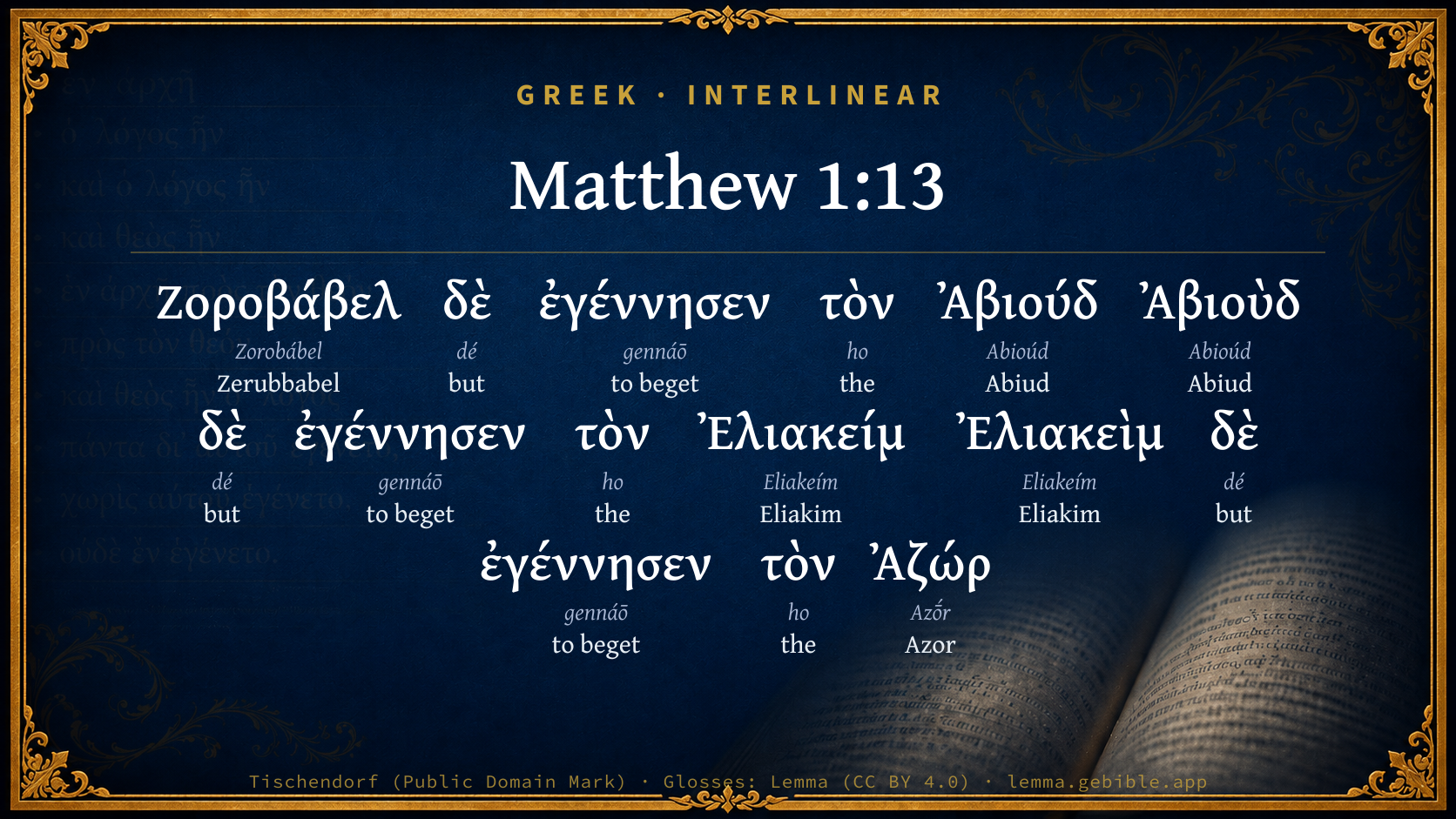
Download image
Cite this verse

Matthew 1:13 (World English Bible). Public Domain. Lemma interlinear Bible study tool, https://lemma.gebible.app/v/matthew/1/13.

Show BibTeX & RIS
BibTeX
RIS
English Translation
Zerubbabel became the father of Abiud. Abiud became the father of Eliakim. Eliakim became the father of Azor.
World English Bible · Public Domain
Highlights
  • 3 first appearances in the Greek New Testament
Full analysis ↓
Download a study sheet

One document with this verse’s original text, its word-by-word gloss line, the meaning frame, cross-references with their text, attributed commentary, and full source and license credits — printable, and it pastes into notes with its structure intact.

This verse Autodidact and up

Study sheet (.html) Plain text (.txt)

A passage Seminary Student

Up to 50 verses in one chapter. A passage sheet keeps up to 6 commentary sources and 12 cross-references per verse, in the order this page ranks them, and says so on the sheet whenever that leaves anything out. Ask for a single verse and you get the Autodidact verse sheet above.

Everything on this page stays free to read, with no account — the sheet is a download of what is already on screen, not access to it.

Want to remove ads? Support Godless Engineer
Compare translations 3

The same verse in 3 English versions, stacked beneath the original-language interlinear above. Click any original word for its lexicon entry.

Each is an independent rendering of the whole verse — the interlinear is not word-aligned to these translations.

Highlighted words mark where these versions differ — a whole-verse word diff, not a word-by-word alignment.

  • World English Bible Public Domain
    Zerubbabel became the father of Abiud. Abiud became the father of Eliakim. Eliakim became the father of Azor.
  • King James Version Public Domain
    And Zorobabel begat Abiud; and Abiud begat Eliakim; and Eliakim begat Azor;
  • unfoldingWord Literal Text CC BY-SA 4.0
    and Zerubbabel fathered Abiud, and Abiud fathered Eliakim, and Eliakim fathered Azor,

unfoldingWord Literal Text — © unfoldingWord, licensed CC BY-SA 4.0. Word-aligned USFM3 via Door43 (git.door43.org/unfoldingWord/en_ult).

Versions to compare (up to 4)

3 of 4 selected

Show all 19 translations

Every available English version of this verse, each an independent rendering of the whole verse.

  • World English Bible Public Domain
    Zerubbabel became the father of Abiud. Abiud became the father of Eliakim. Eliakim became the father of Azor.
  • Berean Standard Bible Public Domain
    Zerubbabel the father of Abiud, Abiud the father of Eliakim, and Eliakim the father of Azor.
  • Majority Standard Bible Public Domain
    Zerubbabel the father of Abiud, Abiud the father of Eliakim, and Eliakim the father of Azor.
  • King James Version Public Domain
    And Zorobabel begat Abiud; and Abiud begat Eliakim; and Eliakim begat Azor;
  • American Standard Version (1901) Public Domain
    and Zerubbabel begat Abiud; and Abiud begat Eliakim; and Eliakim begat Azor;
  • Revised Version (1885) Public Domain
    and Zerubbabel begat Abiud; and Abiud begat Eliakim; and Eliakim begat Azor;
  • Geneva Bible (1599) Public Domain
    And Zorobabel begate Abiud. And Abiud begate Eliacim. And Eliacim begate Azor.
  • Douay-Rheims (1899) Public Domain
    And Zorobabel begot Abiud. And Abiud begot Eliacim. And Eliacim begot Azor.
  • Young's Literal Translation Public Domain
    and Zerubbabel begat Abiud, and Abiud begat Eliakim, and Eliakim begat Azor,
  • Literal Standard Version CC BY-SA 4.0
    and Zerubbabel begot Abiud, and Abiud begot Eliakim, and Eliakim begot Azor,
  • Unlocked Literal Bible CC BY-SA 4.0
    Zerubbabel was the father of Abiud, Abiud the father of Eliakim, and Eliakim the father of Azor.
  • unfoldingWord Literal Text CC BY-SA 4.0
    and Zerubbabel fathered Abiud, and Abiud fathered Eliakim, and Eliakim fathered Azor,
  • Darby Bible Public Domain
    and Zorobabel begat Abiud, and Abiud begat Eliakim, and Eliakim begat Azor,
  • World Messianic Bible Public Domain
    Zerubbabel became the father of Abiud. Abiud became the father of Eliakim. Eliakim became the father of Azor.
  • Webster's Bible Public Domain
    And Zorobabel begat Abiud; and Abiud begat Eliakim; and Eliakim begat Azor;
  • Free Bible Version CC BY-SA 4.0
    and Zerubbabel the father of Abiud; and Abiud the father of Eliakim; and Eliakim the father of Azor;
  • Bible in Basic English Public Domain
    And Zerubbabel had Abiud; and Abiud had Eliakim; and Eliakim had Azor;
  • Text-Critical English NT CC BY 4.0
    Zerubbabel was the father of Abiud, Abiud was the father of Eliakim, Eliakim was the father of Azor,
  • Tyndale New Testament (1534) Public Domain
    zorobabel begat Abiud: Abiud begat Eliachim: Eliachim begat Azor:

Literal Standard Version (2020), Covenant Press — licensed CC BY-SA 4.0. Text via the HelloAO Bible API (eBible.org). Unlocked Literal Bible (unfoldingWord) — licensed CC BY-SA 4.0. Text via the HelloAO Bible API (eBible.org). unfoldingWord Literal Text — © unfoldingWord, licensed CC BY-SA 4.0. Word-aligned USFM3 via Door43 (git.door43.org/unfoldingWord/en_ult). Free Bible Version, Dr. Jonathan Gallagher — licensed CC BY-SA 4.0. Text via the HelloAO Bible API (eBible.org).

Word by word

More ways to search: Search by grammar → Find every occurrence → Compare this word →

Practice this passage: Drill this verse → Learn its vocabulary →

Ἀβιούδ
Abioúd
G10
“Abiud”
Noun, Proper, indeclinable
Part of Speech
Noun · Proper, indeclinable
Full Thayer's Definition

Origin: of hebrew origin H31

TDNT: None

Abiud = "my father is majesty" 1. the son of Bela and grandson of Benjamin ( 1 Ch. 8:3 )
  1. Ζοροβάβελ Zorobábel G2216 “Zerubbabel” Noun, Proper, indeclinable
  2. δὲ dé G1161 “but” Conjunction
  3. ἐγέννησεν gennáō G1080 “to beget” Verb, Aorist, Active, Indicative, 3rd person, Singular
  4. τὸν ho G3588 “the” Article, Accusative, Singular, Masculine
  5. Ἀβιοὺδ Abioúd G10 “Abiud” Noun, Proper, indeclinable
  6. δὲ dé G1161 “but” Conjunction
  7. ἐγέννησεν gennáō G1080 “to beget” Verb, Aorist, Active, Indicative, 3rd person, Singular
  8. τὸν ho G3588 “the” Article, Accusative, Singular, Masculine
  9. Ἐλιακείμ Eliakeím G1662 “Eliakim” Noun, Proper, indeclinable
  10. Ἐλιακεὶμ Eliakeím G1662 “Eliakim” Noun, Proper, indeclinable
  11. δὲ dé G1161 “but” Conjunction
  12. ἐγέννησεν gennáō G1080 “to beget” Verb, Aorist, Active, Indicative, 3rd person, Singular
  13. τὸν ho G3588 “the” Article, Accusative, Singular, Masculine
  14. Ἀζώρ Azṓr G107 “Azor” Noun, Proper, indeclinable

About this verse

These counts appear in no published source. They are computed here, from the morphology-tagged text and Lemma’s own curated glosses. What Lemma adds →

15
words
7
distinct lemmas
Gospels
section

Notable vocabulary

The rarest word here is Ἀβιούδ Abiud G10 — appearing just 2 times in the whole Greek New Testament.

First appearance in Scripture

These words make their first canonical appearance in the Greek New Testament here:
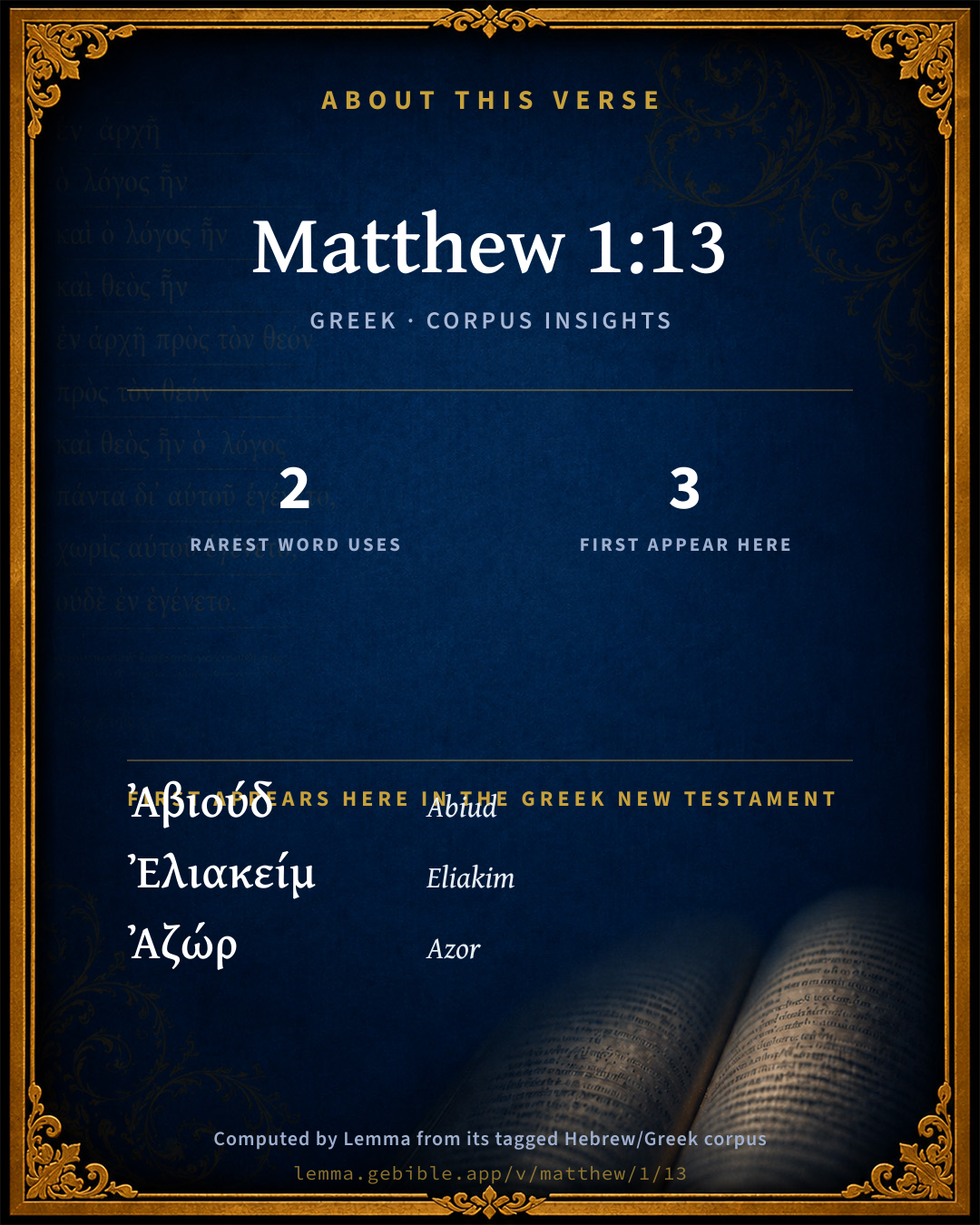
  • Ἀβιούδ Abiud G10
  • Ἐλιακείμ Eliakim G1662
  • Ἀζώρ Azor G107

Repetition

Words recur within this verse:

  • ἐγέννησεν to beget G1080 ×3
  • Ἀβιούδ Abiud G10 ×2
  • Ἐλιακείμ Eliakim G1662 ×2
  • δὲ but G1161 ×3
  • τὸν the G3588 ×3

Commentary

Notes on Matthew 1:13 from classic Christian and Jewish commentators (each source and its license shown beneath its notes). The classic Christian expositions comment on the surrounding passage and are grouped to its opening verse, so a note may address several verses; the Jewish commentaries on the Tanakh (Rashi and others) are per-verse, so they appear only where the commentator wrote on this verse.

Lemma curates 59 commentaries, every one of them public domain or Creative Commons licensed, each selected and text-cleaned for this edition rather than reprinted as found. About our sources →

Bengel's Gnomon

Johann Albrecht Bengel

Mat 1:13. Ἐγέννησε τὸν Ἀβιοὺδ, begat Abiud) This is the same as Hodaiah,[17] who was in like manner descended from Zorobabel, through several intervening ancestors (see 1Ch 3:19; 1Ch 3:24), as Hiller explains in his Syntagmata, pp. 361, sqq., where he shows, that the Jews acknowledged the genealogy in the said passage of Chronicles to be that of the Messiah: nor, indeed, was it necessary that any other genealogy should have been carried further down there than that of the Messiah. There can, therefore, be no doubt but that the passage in question was particularly well known to the Jews; and there was, consequently, the less need that St Matthew should repeat it in extenso. In this generation, then, concludes the scripture of the Old Testament. The remainder of the genealogy was supplied by St Matthew from trustworthy documents of a later date, and, no doubt, of a public character.

[17] Or Hodajah, as in Bengel.

Bengel's Gnomon of the New Testament — English translation (T&T Clark, Edinburgh, 1860) — public domain. Text from a community e-Sword module.

Meyer's Critical & Exegetical Commentary

Heinrich August Wilhelm Meyer

Mat_1:13. None of the members of the genealogy after Zerubbabel, whose son Abiud is not named in 1Ch_3:19 f. along with the others, occurs in the O. T. The family of David had already fallen into a humble position. But even after the exile, the preservation and, relatively, the restoration of the genealogies remained a subject of national, especially priestly, concern; comp. Joseph, c. Apion. This concern could not but be only all the more lively and active in reference to the house of David, with which the expectation of the Messiah was always connected.

Meyer — Critical and Exegetical Commentary on the New Testament — English translation by Peter Christie, edited by Frederick Crombie (T&T Clark, 1880) — public domain. Text from a community e-Sword module.

Jamieson, Fausset & Brown

Robert Jamieson, A. R. Fausset & David Brown

And Zorobabel begat Abiud, &c.--None of these names are found in the Old Testament; but they were doubtless taken from the public or family registers, which the Jews carefully kept, and their accuracy was never challenged.

Jamieson, Fausset & Brown — Commentary Critical and Explanatory on the Whole Bible (1871) — public domain (CC PDM 1.0). Text via the HelloAO Bible API.

The Cambridge Bible for Schools and Colleges

gen. ed. J. J. S. Perowne

13. Zorobabel begat Abiud] Here a step is omitted, Abiud—the Hodaiah of 1Ch_3:24—being the grandson of Zerubbabel. Rhesa, who is named as Zerubbabel’s son (Luk_3:27), is a title: the text in Luke should run, “which was the son of Rhesa Zorobabel.” The Juda of Luke is the same as Abiud.

The Cambridge Bible for Schools and Colleges (gen. ed. J. J. S. Perowne; Cambridge University Press, 1878–1918) — public domain. Text from a community e-Sword module.

John Gill's Exposition

And Zorobabel begat Abiud,.... The children of Zorobabel are said in Ch1 3:19, to be Meshullam, and Hananiah, and Shelomith their sister, but no mention is made of Abiud: he seems to be the same with Meshullam the eldest son, who might have two names; nor is this unlikely, since it was usual, especially about the time of the Babylonish captivity, for men to have more names than one, as may be observed in Daniel and others, Dan 1:7 where they went by one, and in Judea by another.

And Abiud begat Eliakim, &c. From hence to the 16th verse the genealogy is carried down to Joseph, the husband of Mary; which account must be taken from the genealogical tables of the Jews, to which recourse might be had, and with which it agrees; or otherwise the Jews would have cavilled at it; but I do not find any objections made by them to it. That there were genealogical books or tables kept by the Jews is certain, from the following instances (i);

"Simeon ben Azzai says, I found in Jerusalem, , "a volume of genealogies", and there was written in it, &c.''

Again (k), says R. Levi,

"they found a "volume of genealogies" in Jerusalem, and there was written in it that Hillell came from David; Ben Jarzaph from Asaph; Ben Tzitzith Hacceseth from Abner; Ben Cobesin from Ahab; Ben Calba Shebuah from Caleb; R. Jannai from Eli; R. Chayah Rabba from the children of Shephatiah, the son of Abital; R. Jose be Rabbi Chelphetha from the children of Jonadab, the son of Rechab; and R. Nehemiah from Nehemiah the Tirshathite.''

Once more (l), says R. Chana bar Chanma, when the holy blessed God causes his

"Shechinah to dwell, he does not cause it to dwell but upon families, "which are genealogized" in Israel.''

Now if Matthew's account had not been true, it might easily have been refuted by these records. The author of the old (m) Nizzachon takes notice of the close of this genealogy, but finds no fault with it; only that it is carried down to Joseph, and not to Mary; which may be accounted for by a rule of their own (n), "the mother's family is not called a family", whereas the father's is. It is very remarkable that the Jewish Targum (o) traces the descent of the Messiah from the family of David in the line of Zorobabel, as Matthew does; and reckons the same number of generations, wanting one, from Zorobabel to the Messiah, as the Evangelist does, from Zorobabel to Jesus; according to Matthew, the genealogy stands thus, Zorobabel, Abiud, Eliakim, Azor, Sadoc, Achim, Eliud, Eleazar, Matthan, Jacob, Joseph, Jesus; and according to the Targum the order is this,

"Zorobabel, Hananiah, Jesaiah, Rephaiah, Arnon, Obadiah, Shecaniah, Shemnigh, Neariah, Elioenai, Anani; this is the king Messiah, who is to be revealed.''

The difference of names may be accounted for by their having two names, as before observed. This is a full proof, that, according to the Jews own account, and expectation, the Messiah must be come many years and ages ago.

(i) T. Bab. Yebamot, fol. 49. 2. (k) T. Hieros. Taanith, fol. 68. 1. B. Rabba, sect. 98. fol. 85. 3. (l) T. Bab. Kiddushin, fol. 70. 9. (m) P. 186. (n) T. Bab. Yebamot, fol. 54. 2. Bava Bathra, fol. 109. 2. & 110. 2. Bereshit Rabba, fol. 6. 1. Jucbasin, fol. 55. 2. (o) In 1 Chron. iii. 24. Vid. Beckii Not. in ib. p. 56, 57.

John Gill's Exposition of the Whole Bible (1746–1763) — public domain (CC PDM 1.0). Text via the HelloAO Bible API.

Trapp's Complete Commentary

John Trapp

13 And Zorobabel begat Abiud; and Abiud begat Eliakim; and Eliakim begat Azor;

Ver. 13. And Zorobabel begat Abiud] St Luke saith, Rhesa: hence the diversity of number and names. Matthew descends by the posterity of Abiud; Luke, of Rhesa, down to Joseph.

And Abiud begat Eliakim, and Eliakim begat Azor, &c.] These lived in those calamitous times of the people of God after the Captivity, and were not kings and captains, as being held under by other nations; but law givers they were, as Jacob prophesied, and principal men among that people, "till Shiloh came," Gen 49:10.

John Trapp, A Commentary or Exposition upon All the Books of the Old and New Testament (1647–1656) — public domain. Text from a community e-Sword module.

Matthew Poole's English Annotations

Here are divers objections made to this last part of the genealogy, and in a great measure caused from the difference between Matthew and Luke; but I shall not attempt any reconciliation of those differences till I come to Luk 3:23-38. There is no Abiud reckoned amongst the sons of Zorobabel, 1Ch 3:19,20; and for the others named, we have no certain account of them in any part of the holy writ. From the time of Jehoiakim were above five hundred years to the birth of Christ, of which seventy were spent in the captivity of Babylon. Zorobabel was alive at the end of the captivity, Ezr 5:2, and, as it appears, the ruler of the Jews, though not under the title and style of king. For Eliakim, Azor, Sadoc, Achim, Eliud, Eleazar, Matthan, and Jacob, though we have no mention of them in any canonical books of holy writ but only this, yet Matthew’s credit in the church of God ought to out weigh any other writings, pretending any thing contrary to what he saith; we are therefore obliged to believe they all lineally descended from David, but, living in a private state and condition, and holy writ not extending its history beyond Zorobabel’s time, (the time when the Jews came out of Babylon), it is no wonder that we have no better means than we have from holy writ to know their lineal descent from the royal family. That Matthew in what he wrote was guided by the unerring Spirit, and that he had rolls of pedigrees which we want, we have reason to believe. This is enough for us Christians, who own the books of the New as well as the Old Testament to be wrote by persons Divinely inspired; so, as to them, we have nothing to do but to reconcile Matthew and Luke, both whom we own to have had the same infallible inspiration and direction. If Jews or pagans argue from any other topic than this, it is enough to tell them, that the Jews kept exact genealogies, and more especially as to the descents in the tribes of Judah and Levi, that they might never be at loss as to the Messiah, whom they expected as the Son of David, nor yet as to the true high priest. Though these records and rolls of genealogy be now lost, yet we have no reason to believe they were so in Matthew’s time; of which genealogies (as to this part) doubtless what Matthew saith was but a copy, directed by that Holy Spirit by which he was inspired.

Matthew Poole's English Annotations on the Holy Bible (1683–1685) — public domain. Text from a community e-Sword/MySword module.

The Pulpit Commentary

And Zorobabel (Zerubbabel, Revised Version) begat Abiad. Here the two lines of pedigree in St. Matthew and St. Luke seem tc separate, and not to converge again till we come to Matthan (or Matthat), the grandfather of Joseph, which name is common to both. The Bishop of Bath and Wells has shown some reason for supposing that Rhesa, mentioned in St. Luke as Zerubbabel"s son, is merely a title signifying "a chief," and also for identifying Hananiah, who is called a son of Zerubbabel, (1Ch_3:19) with Joanna, who follows Rhesa in St. Luke, (Luk_3:27) and there being some relation between the Juda of St. Luke and the Abiud (i.e. father of Juda) given as Zerubbabel"s son in St. Matthew. Except in these few particulars, the two lines show no connexion of names, and it seems likely that the family of David had fallen into low estate for several generations before the birth of Christ.

The Pulpit Commentary (1880–1919), ed. H.D.M. Spence-Jones & Joseph S. Exell — public domain. Text from a community e-Sword module.

Cambridge Greek Testament for Schools and Colleges

13. Ζοροβάβελ δὲ ἐγέννησεν τὸν Ἀβιούδ. Here a step is omitted, Abiud—the Hodaiah of 1Ch 3:24—being the grandson of Zerubbabel. Rhesa, who is named as Zerubbabel’s son (Luk 3:27), is conjectured to be a title (Rhesa or Rosh = a Prince): in that case the text in Luke should run, ‘which was the son of Rhesa Zorobabel.’ The Juda of Luke is the same as Abiud.

Cambridge Greek Testament for Schools and Colleges (Cambridge University Press, 1896; 21 vols, various authors incl. Carr, Maclear, Plummer, Farrar, Lumby, Moule, M. R. James, Simcox) — public domain. Text from a community e-Sword module.

Alford’s Greek Testament

Henry Alford

13. Ζοροβ.… Ἀβιούδ] Abiud is not mentioned as a son of the Zerubbabel in 1Ch_3.

Lord A. Hervey, p. 122 ff., has made it probable that Abiud is identical with the Hodaiah of 1Ch 3:24, and the Juda of Luk 3:26. Dr. Mill (p. 178, note) mentions this conjecture, but does not adopt it. The objection, that thus the first generation after Zerubbabel would be omitted, need not have much weight, after the omission of three generations in the last tesseradecade. I cannot but recommend to the student the perusal of Lord A. Hervey’s work. Whether or not we may be inclined to adopt his conjectures on so intricate and uncertain a subject as the reconciling of the genealogies, too much praise cannot be given to the spirit of combined Christian reverence and enlightened critical courage in which it is treated throughout.

On the comparison of this genealogy with that given in Luke, see notes, Luk 3:23-38.

Henry Alford, The Greek Testament (1849–1861) — public domain. Text from a community e-Sword module.

International Critical Commentary

(E) 13, 14. And Eliakim begat Azor; and Azor begat Sadok; and Sadok begat Acheim; and Acheim begat Eliud.]

International Critical Commentary — older volumes (1896–1929), various authors — public domain. Text from a community e-Sword module.

Lesson kit

Teaching starters — assembled from the data on this page, not authored interpretation. Every prompt links to the verse data it draws on. Edit before teaching.

Matthew, in the Gospels, opens this verse with 15 words (7 distinct Greek lemmas). Its most distinctive word is Abioúd (“Abiud”). A historical commentator’s framing appears above. Read the whole chapter for the surrounding context.

Discussion questions

  1. The word Abioúd carries the sense “Abiud.” How does it shape the verse?
  2. 3 words make their first appearance in Scripture here. What does this debut establish?
  3. What does the repetition of “to beget” (3× in this one verse) do in this verse?
  4. The translations on this page render this verse differently — a whole-verse word diff, not a word-by-word alignment. What might account for the different wordings?
  5. Compare how Bengel's Gnomon and Meyer's Critical & Exegetical Commentary read this verse. Where do they agree or differ?

Things to notice

  • 3 words make their first canonical appearance in Scripture here.
  • These translations choose different wording for 6 words in this verse.
  • “to beget” occurs 3× in this single verse.
  • 7 distinct Greek lemmas span 15 words in this verse.

Reading settings

Reading text

Shown beneath each verse's original-language words.

Old Testament
Old Testament edition

Read the OT as the Masoretic Hebrew (MT) or the Greek Septuagint (LXX).

English shown for the Greek Septuagint (in the Hebrew ↔ Greek comparison).

Comparing translations? Open the Compare panel on any verse page to stack up to four side by side.