
Matthew 8:22

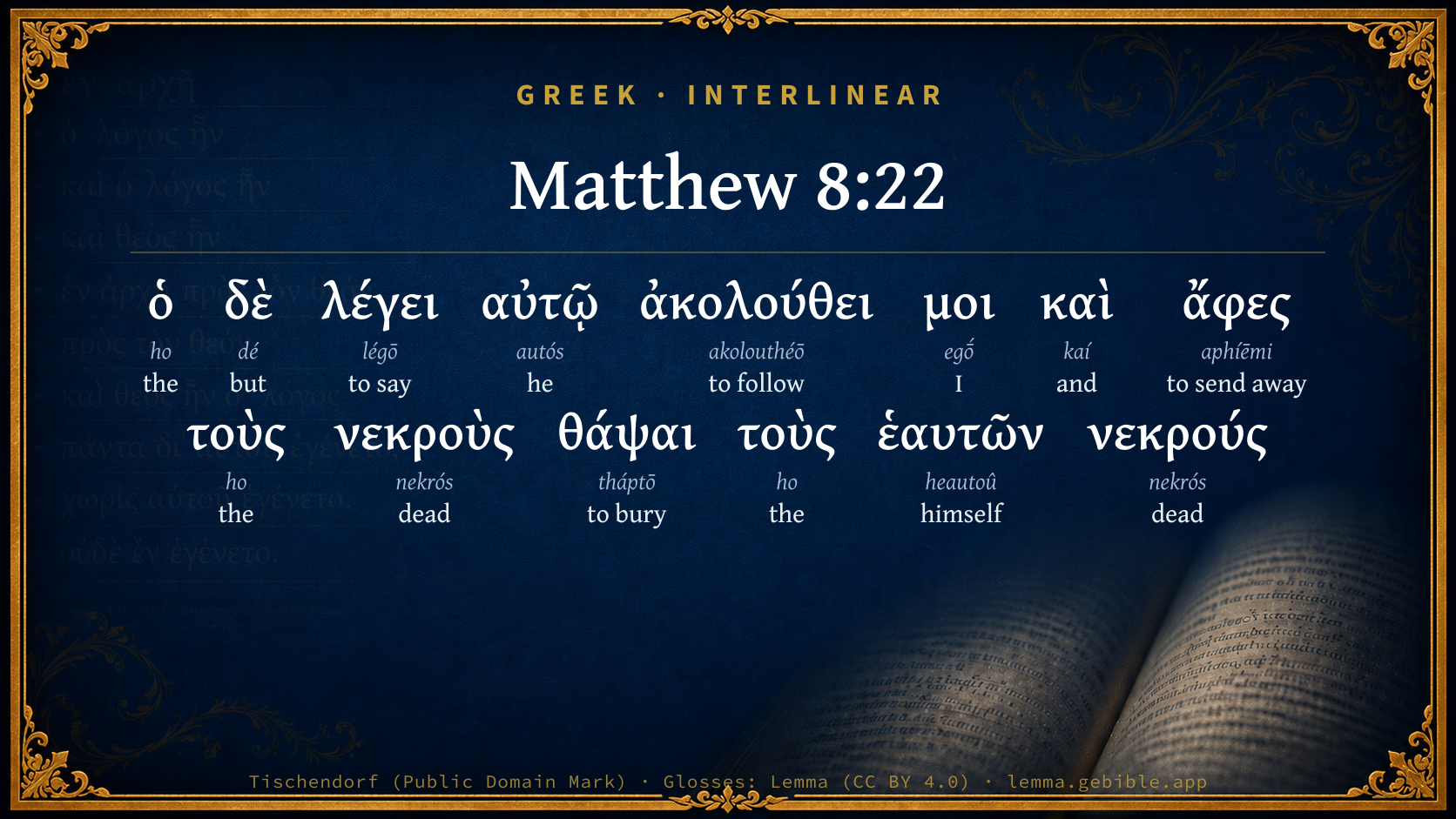
Greek (Tischendorf 8th ed.) Matthew 8:22 appears in the Greek New Testament. The text above is from the Tischendorf 8th edition. Each word links to its Strong’s number and a concise gloss. Click any word for its full Thayer’s Greek Lexicon entry.
Download image
Cite this verse

Matthew 8:22 (World English Bible). Public Domain. Lemma interlinear Bible study tool, https://lemma.gebible.app/v/matthew/8/22.

Show BibTeX & RIS
BibTeX
RIS
English Translation
But Jesus said to him, "Follow me, and leave the dead to bury their own dead."
World English Bible · Public Domain
Highlights
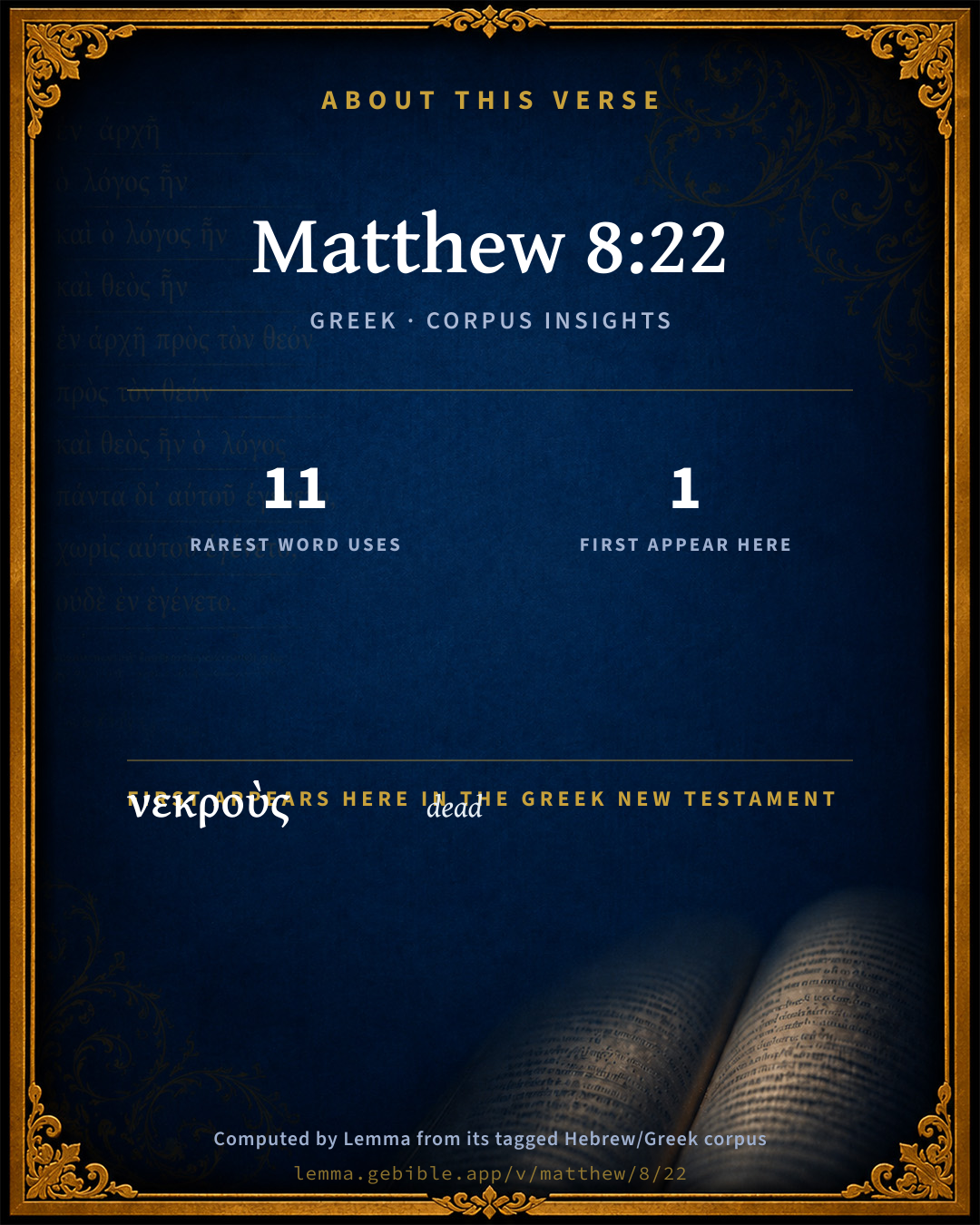
  • 1 first appearance in the Greek New Testament
Full analysis ↓
Download a study sheet

One document with this verse’s original text, its word-by-word gloss line, the meaning frame, cross-references with their text, attributed commentary, and full source and license credits — printable, and it pastes into notes with its structure intact.

This verse Autodidact and up

Study sheet (.html) Plain text (.txt)

A passage Seminary Student

Up to 50 verses in one chapter. A passage sheet keeps up to 6 commentary sources and 12 cross-references per verse, in the order this page ranks them, and says so on the sheet whenever that leaves anything out. Ask for a single verse and you get the Autodidact verse sheet above.

Everything on this page stays free to read, with no account — the sheet is a download of what is already on screen, not access to it.

Want to remove ads? Support Godless Engineer
Compare translations 3

The same verse in 3 English versions, stacked beneath the original-language interlinear above. Click any original word for its lexicon entry.

Each is an independent rendering of the whole verse — the interlinear is not word-aligned to these translations.

Highlighted words mark where these versions differ — a whole-verse word diff, not a word-by-word alignment.

  • World English Bible Public Domain
    But Jesus said to him, "Follow me, and leave the dead to bury their own dead."
  • King James Version Public Domain
    But Jesus said unto him, Follow me; and let the dead bury their dead.
  • unfoldingWord Literal Text CC BY-SA 4.0
    But Jesus says to him, “Follow me, and let the dead bury their own dead.”

unfoldingWord Literal Text — © unfoldingWord, licensed CC BY-SA 4.0. Word-aligned USFM3 via Door43 (git.door43.org/unfoldingWord/en_ult).

Versions to compare (up to 4)

3 of 4 selected

Show all 19 translations

Every available English version of this verse, each an independent rendering of the whole verse.

  • World English Bible Public Domain
    But Jesus said to him, "Follow me, and leave the dead to bury their own dead."
  • Berean Standard Bible Public Domain
    But Jesus told him, “Follow Me, and let the dead bury their own dead.”
  • Majority Standard Bible Public Domain
    But Jesus told him, “Follow Me, and let the dead bury their own dead.”
  • King James Version Public Domain
    But Jesus said unto him, Follow me; and let the dead bury their dead.
  • American Standard Version (1901) Public Domain
    But Jesus saith unto him, Follow me; and leave the dead to bury their own dead.
  • Revised Version (1885) Public Domain
    But Jesus saith unto him, Follow me; and leave the dead to bury their own dead.
  • Geneva Bible (1599) Public Domain
    But Iesus said vnto him, Followe me, and let the dead burie their dead.
  • Douay-Rheims (1899) Public Domain
    But Jesus said to him: Follow me, and let the dead bury their dead.
  • Young's Literal Translation Public Domain
    and Jesus said to him, `Follow me, and suffer the dead to bury their own dead.'
  • Literal Standard Version CC BY-SA 4.0
    and Jesus said to him, “Follow Me, and permit the dead to bury their own dead.”
  • Unlocked Literal Bible CC BY-SA 4.0
    But Jesus said to him, “Follow me, and leave the dead to bury their own dead.”
  • unfoldingWord Literal Text CC BY-SA 4.0
    But Jesus says to him, “Follow me, and let the dead bury their own dead.”
  • Darby Bible Public Domain
    But Jesus said to him, Follow me, and leave the dead to bury their own dead.
  • World Messianic Bible Public Domain
    But Yeshua said to him, “Follow me, and leave the dead to bury their own dead.”
  • Webster's Bible Public Domain
    But Jesus said to him, Follow me; and let the dead bury their dead.
  • Free Bible Version CC BY-SA 4.0
    “Follow me! Leave the dead to bury their own dead,” Jesus replied.
  • Bible in Basic English Public Domain
    But Jesus said to him, Come after me; and let the dead take care of their dead.
  • Text-Critical English NT CC BY 4.0
    But Jesus said to him, “Follow me, and let the dead bury their own dead.”
  • Tyndale New Testament (1534) Public Domain
    But Iesus sayd vnto him: folowe me and let the deed burie their deed.

Literal Standard Version (2020), Covenant Press — licensed CC BY-SA 4.0. Text via the HelloAO Bible API (eBible.org). Unlocked Literal Bible (unfoldingWord) — licensed CC BY-SA 4.0. Text via the HelloAO Bible API (eBible.org). unfoldingWord Literal Text — © unfoldingWord, licensed CC BY-SA 4.0. Word-aligned USFM3 via Door43 (git.door43.org/unfoldingWord/en_ult). Free Bible Version, Dr. Jonathan Gallagher — licensed CC BY-SA 4.0. Text via the HelloAO Bible API (eBible.org).

Word by word

More ways to search: Search by grammar → Find every occurrence → Compare this word →

Practice this passage: Drill this verse → Learn its vocabulary →

θάψαι
tháptō
G2290
“to bury”
Verb, Aorist, Active, Infinitive
Part of Speech
Verb
Tense
Aorist
Voice
Active
Mood
Infinitive
Full Thayer's Definition

Origin: a root

TDNT: None

1. to bury, inter
  1. ὁ ho G3588 “the” Article, Nominative, Singular, Masculine
  2. δὲ dé G1161 “but” Conjunction
  3. λέγει légō G3004 “to say” Verb, Present, Active, Indicative, 3rd person, Singular
  4. αὐτῷ autós G846 “he” Personal pronoun, Dative, Singular, Masculine
  5. ἀκολούθει akolouthéō G190 “to follow” Verb, Present, Active, Imperative, 2nd person, Singular
  6. μοι egṓ G1473 “I” Personal pronoun, 1st person, Dative, Singular
  7. καὶ kaí G2532 “and” Conjunction
  8. ἄφες aphíēmi G863 “to send away” Verb, Aorist, Active, Imperative, 2nd person, Singular
  9. τοὺς ho G3588 “the” Article, Accusative, Plural, Masculine
  10. νεκροὺς nekrós G3498 “dead” Adjective, Accusative, Plural, Masculine
  11. τοὺς ho G3588 “the” Article, Accusative, Plural, Masculine
  12. ἑαυτῶν heautoû G1438 “himself” Reflexive pronoun, 3rd person, Genitive, Plural, Masculine
  13. νεκρούς nekrós G3498 “dead” Adjective, Accusative, Plural, Masculine

About this verse

These counts appear in no published source. They are computed here, from the morphology-tagged text and Lemma’s own curated glosses. What Lemma adds →

14
words
11
distinct lemmas
Gospels
section

Notable vocabulary

The rarest word here is θάψαι to bury G2290 — appearing just 11 times in the whole Greek New Testament.

First appearance in Scripture

This word makes its first canonical appearance in the Greek New Testament here:

  • νεκροὺς dead G3498

Shared distinctive vocabulary

θάψαι to bury G2290 occurs in 11 verses of the Greek New Testament. Also found in:
Repetition

Words recur within this verse:

  • νεκροὺς dead G3498 ×2
  • ὁ the G3588 ×3

Cross-references

8

Topical passages linked to Matthew 8:22 in the Treasury of Scripture Knowledge — connected by theme and wording, ordered by reader-vote popularity; previews shown in the World English Bible.

  • Luke 15:32 But it was appropriate to celebrate and be glad, for this, your brother, was dead, and is alive again. He was lost, and is found.'"
  • Colossians 2:13 You were dead through your trespasses and the uncircumcision of your flesh. He made you alive together with him, having forgiven us all our trespasses,
  • Ephesians 5:14 Therefore he says, "Awake, you who sleep, and arise from the dead, and Christ will shine on you."
  • Ephesians 2:5 even when we were dead through our trespasses, made us alive together with Christ (by grace you have been saved),
  • Ephesians 2:1 You were made alive when you were dead in transgressions and sins,
  • John 1:43 On the next day, he was determined to go out into Galilee, and he found Philip. Jesus said to him, "Follow me."
  • 1 Timothy 5:6 But she who gives herself to pleasure is dead while she lives.
  • Matthew 4:18–22 Walking by the sea of Galilee, he saw two brothers: Simon, who is called Peter, and Andrew, his brother, casting a net into the sea; for they were fishermen.

Cross-references courtesy of OpenBible.info (CC BY 4.0).

Commentary

Notes on Matthew 8:22 from classic Christian and Jewish commentators (each source and its license shown beneath its notes). The classic Christian expositions comment on the surrounding passage and are grouped to its opening verse, so a note may address several verses; the Jewish commentaries on the Tanakh (Rashi and others) are per-verse, so they appear only where the commentator wrote on this verse.

Lemma curates 59 commentaries, every one of them public domain or Creative Commons licensed, each selected and text-cleaned for this edition rather than reprinted as found. About our sources →

Tyndale Open Study Notes

Tyndale Open Resources

8:22 Let the spiritually dead bury their own dead: Jesus’ opponents would have misconstrued this instruction as blatant disregard for the fifth commandment to honor one’s parents (Exod 20:12), but in essence it is a restatement of the first commandment (Exod 20:1-3). It was warranted by Jesus’ messianic authority and the impact of the Kingdom upon normal human life, including family ties and commitments (see Matt 10:34-39; 12:46-50; 19:29; Zech 13:3; Luke 14:26-27).

Tyndale Open Study Notes — © Tyndale Open Resources, licensed CC BY-SA 4.0. Text via the HelloAO Bible API.

Bengel's Gnomon

Johann Albrecht Bengel

Mat 8:22. Τοὺς νεκροὺς, the dead) An expression urgently commanding the man to follow Him, and therefore embracing many things. Both the dead who are to be buried, and the dead who are to bury them, must come under consideration. The dead who are to be buried, are without doubt those literally dead, whether the father of this disciple was already then dead or old, and near to death, and with only this one son. Cf. Tob 14:12. The dead who bury, or those to whom the burial of the dead should be left, are partly those who are also about to die, mortals bound to the law of death (cf. Rom 8:10), as distinguished from the hope of a better life—that hope, however, being not altogether taken away. The appellation is to be limited by the context: as in Luk 20:34, they, who nevertheless are capable of being saved, are called the children of this world; so they are called dead, who are more fit for burying than for announcing the kingdom of God. As in ch. Mat 9:24, the girl is called not dead, who soon shall live (cf. Joh 11:4), so they are called dead, who soon shall die.[379] In the time of pestilence, the dead are buried by those who soon themselves die. Nor is the case very different with successive generations of mortals in the course of ages. Partly, they are already dead; and with regard to them the expression is hypothetical, with this meaning—Do thou follow Me, and leave the burial of the dead to the dead themselves; i.e. Let the dead, as far as you are concerned, remain unburied. A similar mode of expression occurs in Exo 21:14, Let the murderer be taken from the altar: i.e. let him be slain, even if he has fled to the altar. The appellation, therefore, of the dead who bury, is abrupt, and suitable to a command which could brook no delay—a command which had sacred grounds, and flowed from the divine perception of the Saviour. We ought to surrender ourselves wholly and immediately.—τοὺς ἑαυτῶν, their own) sc. relatives. See Gen 23:4. It was the duty of this disciple to deny his father.[380]

[379] The dead are in their lasting home, and the mourners are not far off from the same, but continue wandering all around it, until they themselves also enter it.—See Ecc 12:5.—V. g.

[380] The winds and the sea, on this occasion, sooner obeyed the will of Christ than did men.—Harm. 269, 270.

Bengel's Gnomon of the New Testament — English translation (T&T Clark, Edinburgh, 1860) — public domain. Text from a community e-Sword module.

Meyer's Critical & Exegetical Commentary

Heinrich August Wilhelm Meyer

Mat_8:22. Τοὺς νεκροὺς … νεκρούς] The first νεκρ. (not the second likewise, as Weisse improperly holds) denotes the spiritually dead (comp. on Mat_4:16, on Joh_5:21; Joh_5:25, and on Luk_15:24), who are without the spiritual life that comes through Christ. Origen in Cramers Catena: ψυχὴ ἐν κακίᾳ οὖσα νεκρά ἐστιν. The second literally; the dead belonging to their own circles. Fritzsche (comp. Kaeuffer, de not. ζωῆς αἰων. p. 34) interprets literally in both cases: let the dead bury themselves among one another, as a paradox by way of refusing the request. What a meaningless view of Jesus thoughtful way of putting it! The seeming harshness of Jesus reply (in answer to Weisse, Bruno Bauer) must be judged of by considering the necessity which he saw of decided and immediate separation, as compared with the danger of the contrary (Chrysostom); comp. Mat_10:37. Moreover, it is to be inferred from ἀκολούθει μοι. Comp. with Luk_9:60, that this μαθητής proceeded at once to follow the Lord, while that γραμματεύς of Mat_8:19 probably went away like the rich young man mentioned in Mat_19:22.

Meyer — Critical and Exegetical Commentary on the New Testament — English translation by Peter Christie, edited by Frederick Crombie (T&T Clark, 1880) — public domain. Text from a community e-Sword module.

Expositor's Greek Testament

ed. W. Robertson Nicoll

Mat 8:22 . Ἀκολούθει μοι : the reply is a stern refusal, and the reason apparently hard and unfeeling ἄφες τοὺς νεκροὺς … νεκρούς : word for word the same in Luke (Luk 9:60 ), an unforgettable, mystic, hard saying. The dead must be taken in two senses = let the spiritually dead, not yet alive to the claims of the kingdom, bury the naturally dead. Fritzsche objects, and finds in the saying the paradox: “let the dead bury each other the best way they can,” which, as Weiss says, is not a paradox, but nonsense. Another eccentric idea of some commentators is that the first νεκροὺς refers to the vespillones , the corpse-bearers who carried out the bodies of the poor at night, in Hebrew phrase, the men of the dead. Take it as we will, it seems a hard, heartless saying, difficult to reconcile with Christ’s denunciation of the Corban casuistry, by which humanity and filial piety were sacrificed on the altar of religion (Mat 15:3-6 ). But, doubtless, Jesus knew to whom He was speaking. The saying can be understood and justified; but it can also very easily be misunderstood and abused, and woe to the man who does so. From these two examples we see that Jesus had a startling way of speaking to disciples, which would create reflection and also give rise to remark. The disciple-logia are original, severe, fitted to impress, sift and confirm.

The Expositor's Greek Testament, edited by W. Robertson Nicoll (1897–1910) — public domain. Text from a community e-Sword module.

Adam Clarke's Commentary

Verse 22. Let the dead bury their dead.] It was usual for the Jews to consider a man as dead who had departed from the precepts of the law; and, on this ground, every transgressor was reputed a dead man. Our Lord's saying, being in common use, had nothing difficult in it to a Jew. Natural death is the separation of the body and soul; spiritual death, the separation of God and the soul: men who live in sin are dead to God. Leave the spiritually dead to bury their natural dead. All the common offices of life may be performed by any person; to preach the glad tidings of the kingdom of God is granted but to a few, and to these only by an especial call; these should immediately abandon worldly concerns and employments, and give themselves wholly up to the work of the ministry.

Adam Clarke's Commentary on the Bible (1810–1826) — public domain. Text from a community e-Sword/MySword module.

Ellicott's Commentary for English Readers

(22) Let the dead bury their dead.—The point of the half-epigrammatic, half-proverbial saying, lies in the contrast between the two meanings of the word “dead.” “Let those who have no spiritual life linger in the circle of outward routine duties, and sacrifice the highest spiritual possibilities of their nature to their fulfilment. Those who are really living will do the work to which their Master calls them, and leave the lower conventional duties to be done or left undone as the events of their life shall order.” Something there was, we may be sure, in the inward state of the disciple which called for the sternness of the rebuke. He had been called to a living work: he was resting in a dead one.

A Bible Commentary for English Readers, edited by Charles John Ellicott (1878–1897) — public domain. Text from a community e-Sword module.

The Cambridge Bible for Schools and Colleges

gen. ed. J. J. S. Perowne

22. let the dead bury their dead] Or, their own dead. The exact force of this is not quite clear. The word “dead” is used first in a figurative, secondly, in a literal sense. In a figurative sense by the “dead” are intended those who are outside the kingdom, who are dead to the true life. Perhaps a brother or brothers of the disciple had rejected Christ, “let them bury their father.” Another way of understanding the proverb is: Let those who are dead in Christ, dead to the world, bury their dead—their affections and lusts, all that connects them with that dead past. St Luke, after “let the dead bury their dead,” adds, “but go thou and preach the kingdom of God.” Perhaps no incident marks more decisively the height of self-abandonment required by Jesus of His followers. In this instance the disciple is called upon to renounce for Christ’s sake the last and most sacred of filial duties. The unswerving devotion to Christ is illustrated in the parallel passage (Luk_9:62) by “the man who puts his hand to the plough.”

The Cambridge Bible for Schools and Colleges (gen. ed. J. J. S. Perowne; Cambridge University Press, 1878–1918) — public domain. Text from a community e-Sword module.

John Gill's Exposition

And when he was entered into a ship,.... Which was got ready by his disciples, or hired by them for his use, according to the directions he had given,

his disciples followed him into the ship, and they only; for as for the men hereafter mentioned, they were the men that belonged to the ship, and had the management of it: the multitude were dismissed, and in order to be clear of them, Christ took this method; and being desirous also of trying the faith of his disciples, he ordered it so, that they should be alone with him.

John Gill's Exposition of the Whole Bible (1746–1763) — public domain (CC PDM 1.0). Text via the HelloAO Bible API.

Trapp's Complete Commentary

John Trapp

22 But Jesus said unto him, Follow me; and let the dead bury their dead.

Ver. 22. Follow me] Let go things less necessary, and mind the main. Thy task is long, thy time is short; opportunities are headlong, and must be quickly caught, as the echo catcheth the voice. There is no use of after wit.

" Praecipitat tempus, mors atra impendet agenti."

(Sil. Italic.)

Let the dead bury their dead] The dead in sin, their dead in nature. Ungodly men are no better than breathing ghosts, walking sepulchres of themselves. Their bodies are but living coffins to carry a dead soul up and down in. The saints only are heirs of life, 1Pe 3:7, and all others are dead, stark dead in sins and trespasses, as the wanton widow, 1Ti 5:6; as Terence saith the same: Sane hercle homo voluptati obsequens fuit dum vixit. And of such dead corpses (as once in Egypt, Exo 12:30) there is no house wherein there is not one, nay, many.

John Trapp, A Commentary or Exposition upon All the Books of the Old and New Testament (1647–1656) — public domain. Text from a community e-Sword module.

Albert Barnes' Notes on the Bible

Let the dead bury their dead - The word “dead” is used in this passage in two different senses. It is apparently a paradox, but is suited to convey the idea very distinctly to the mind. The Jews used the word “dead” often to express indifference toward a thing; or, rather, to show that that thing has no “influence” over us. Thus, to be dead to the world; to be dead to the law Rom 7:4; to be dead to sin Rom 6:11, means that the world, law, and sin have not influence or control over us; that we are free from them, and act “as though they were not.” A body in the grave is unaffected by the pomp and vanity, by the gaiety and revelry, by the ambition and splendor that may be near the tomb. So people of the world are dead to religion. They see not its beauty, hear not its voice, are not won by its loveliness. This is the class of people to which the Saviour refers here. Let people, says he, who are uninterested in my work, and who are “dead in sin” Eph 2:1, take care of the dead. Your duty is now to follow me.

There may have been several reasons for this apparently harsh direction. One may have been to “test” the character and attachment of the man. If he had proper love for Christ, he would be willing to leave his friends, even in the most tender and trying circumstances. This is required, Mat 10:27; Luk 14:26. A second reason may have been, that if he returned “at that time,” his friends might ridicule or oppose him, or present plausible arguments, “in the afflictions of the family,” why he should not return to Christ. The thing to which he was called was moreover of more importance than any earthly consideration; and, for that time, Christ chose to require of the man a very extraordinary sacrifice, to show his sincere attachment to him. Or it may have been that the Saviour saw that the effect of visiting his home at that time might have been to drive away all his serious impressions, and that he would return to him no more.

His impressions may not have been deep enough, and his purpose to follow the Saviour may not have been strong enough to bear the trial to which he would be subjected. Strange as it may seem, there are few scenes better suited to drive away serious impressions than those connected with a funeral. We should have supposed it would be otherwise: but facts show it to be so, and demonstrate that if this was one of the reasons which influenced the Saviour, he had a thorough knowledge of human nature. The arrangements for the funeral, the preparation of mourning apparel, and the depth of sorrow in such cases, divert the mind from its sins and its personal need of a Saviour; and hence few persons are awakened or converted as the result of death in a family. The case here was a “strong” one - it was as strong as can well be conceived; and the Saviour meant to teach by this that nothing is to be allowed to divert the mind from religion nothing to be an excuse for not following him. Not even the death of a father, and the sorrows of an afflicted family, are to be suffered to lead a man to defer religion, or to put off the purpose to be a Christian. That is a fixed duty - a duty not to be deferred or neglected, whether in sickness or health, at home or abroad whether surrounded by living and happy kindred, or whether a father, a mother, a child, or a sister lies in our house dead.

It is the “regular” duty of children to obey their parents, and to show them kindness in affliction, and to evince proper care and respect for them when dead. Nor did our Saviour show himself insensible to these duties. He taught here, however, as he always taught, that a regard to friends, and ease, and comfort, should be “subordinate to the gospel;” and that we should always be ready to sacrifice these when duty to God requires it.

Albert Barnes' Notes on the Bible (1834–1885) — public domain. Text from a community e-Sword/MySword module.

Haydock's Catholic Bible Commentary

Let the dead bury their dead. The first words, let the dead, cannot mean those that were dead by a corporal death; and therefore must needs be understood of those who were spiritually dead in sin. (Witham) --- Two similar answers are mentioned in Luke ix. 57, 60. Jesus Christ may have given the same answers on two different occasions. (Bible de Vence) --- God will not suffer us to go and bury a deceased parent, when he calls us to other employments. (St. John Chrysostom)

George Leo Haydock (1774–1849), Haydock's Catholic Family Bible and Commentary, 1859 edition — public domain. Excludes Psalms (Douay-Rheims chapter numbering differs from Protestant) and Deuterocanonical books (Catholic canon only).

Whedon's Commentary on the Bible

Daniel D. Whedon

22. Follow me — Infinite interests must take precedence of the finite.

Dead bury their dead — The maxim is pointed with a play upon the double sense of the word dead. Let the spiritually dead bury the corporeally dead. Let a secular world perform its duties to its secular members. Our duties must be applied to a life eternal. Luke adds, (Luk_9:60,) “But go thou and preach the kingdom of God.”

Did the three instances of settling the matter of following our Lord occur on the same day? Perhaps so. They may have transpired in view of our Lord’s passing over the lake into the wild Gadarene country.

Or, the first one having occurred at that time, the Evangelists may introduce the other instances by association of similarity, as alike illustrating the mode of our Lord’s choice of apostles. It was not because our Lord could not have selected men of rank and influence for the sacred office, but for deeper reasons, that he called the humble laborious laymen.

Daniel D. Whedon (gen. ed.), Commentary on the Old and New Testaments (1874–1909) — public domain. Text from a community e-Sword module.

The Pulpit Commentary

But Jesus said unto him, Follow me, and let; Revised Version, leave. Yet the thought of leaving seems here merged in that of permitting. (cf. Mat_23:14 Mar_5:37 10:14) The dead (Revised Version, to) bury their (Revised Version, own) dead (touv). The paradox was self-interpreting. Let the spiritually dead have to do with death; dead men belong in a special sense to them. Observe that there was no danger of his father remaining unburied. Christ means that there are times when his service admits of no postponement, however sacred the conflicting duty. His followers must on such occasions be very Nazarites (Num_6:7) or high priests. (Lev_21:11) St. Luke adds, "But go thou, and publish abroad the kingdom of God," and adds a third similar case.

The Pulpit Commentary (1880–1919), ed. H.D.M. Spence-Jones & Joseph S. Exell — public domain. Text from a community e-Sword module.

John Wesley's Explanatory Notes

But Jesus said - When God calls, leave the business of the world to them who are dead to God.

John Wesley, Explanatory Notes Upon the Whole Bible (1754–1765) — public domain. Text via the GEBible commentary corpus.

The People's New Testament

B. W. Johnson

22. Follow me. The highest of all duties, now discharged by becoming his disciple, obeying him and making his life our example. Let the dead bury their dead. Those spiritually dead will attend to the last rites of them who have died naturally.

B. W. Johnson's The People's New Testament with Notes (1889–1891) — public domain. Electronic text from the Christian Classics Ethereal Library (CCEL) ThML edition.

Cambridge Greek Testament for Schools and Colleges

22. θάψαι τοὺς ἑαυτῶν νεκρούς. The exact force of this is not quite clear. The word ‘dead’ is used first in a figurative, secondly, in a literal sense, as in Joh 11:25-26. In a figurative sense by the ‘dead’ are intended those who are outside the kingdom, who are dead to the true life. Perhaps a brother or brothers of the disciple had rejected Christ, ‘let them bury their father.’

St Luke, after ‘let the dead bury their dead,’ adds, ‘but go thou and preach the kingdom of God.’

Perhaps no incident marks more decisively the height of self-abandonment required by Jesus of His followers. In this instance the disciple is called upon to renounce for Christ’s sake the last and most sacred of filial duties. The unswerving devotion to Christ is illustrated in the parallel passage (Luk 9:62) by ‘the man who puts his hand to the plough.’

Cambridge Greek Testament for Schools and Colleges (Cambridge University Press, 1896; 21 vols, various authors incl. Carr, Maclear, Plummer, Farrar, Lumby, Moule, M. R. James, Simcox) — public domain. Text from a community e-Sword module.

Alford’s Greek Testament

Henry Alford

22. νεκρούς] First time, as Rev 3:1, spiritually,—second, literally dead. The two meanings are similarly used in one saying by our Lord in Joh 11:25, Joh 11:26. See Heb 6:1; Heb 9:14. ἐκώλυσεν αὐτόν, οὐ κωλύων τὸ τιμᾷν τοὺς γονεῖς, ἀλλὰ διδάσκων ὅτι χρὴ τὸν ἐφιέμενον τῶν οὐρανίων μὴ ὑποστρέφειν εἰς τὰ γήϊνα, μηδʼ ἀπολιμπάνειν μὲν τὰ ζωηρά, παλινδρομεῖν δὲ εἰς τὰ νεκρωτικά, μηδὲ θεοῦ προτιμᾷν γονεῖς. ἐγίνωσκε γὰρ ὅτι θάψουσι τοῦτον ἄλλοι, καὶ οὐκ εικὸς τοῦτον ἀπολειφθῆναι τῶν ἀναγκαιοτέρων. οἶμαι δὲ ὅτι καὶ ἄπιστος ἦν ὁ τελευτήσας. Euthym.

Henry Alford, The Greek Testament (1849–1861) — public domain. Text from a community e-Sword module.

International Critical Commentary

22. And Jesus saith to him, Follow Me, and let the dead bury their own dead.] It is generally suggested that τοὺς νεκρούς means the spiritually dead, i.e. those who had not felt the call to follow Christ, and were dead so far as He was concerned. They could perform the duties of burial. The questioner had received the call, and that was the more urgent duty. In this case, the burial of the dead parent would come under the rule that sometimes the call to follow Christ might necessitate the abandonment of human relations; cf. 19:29. But it is possible that “let the dead bury their dead” was a proverbial saying, meaning, “Cut yourself adrift from the past when matters of present interest call for your whole attention.”

(M)

International Critical Commentary — older volumes (1896–1929), various authors — public domain. Text from a community e-Sword module.

Lesson kit

Teaching starters — assembled from the data on this page, not authored interpretation. Every prompt links to the verse data it draws on. Edit before teaching.

Matthew, in the Gospels, opens this verse with 14 words (11 distinct Greek lemmas). Its most distinctive word is tháptō (“to bury”). A historical commentator’s framing appears above. Read the whole chapter for the surrounding context.

Discussion questions

  1. How does “to bury” (tháptō) shape what this verse is saying?
  2. The word “dead” first appears here in Scripture. What is being introduced at this debut?
  3. Matthew 8:21 shares the word «to bury» with this verse. How do the two illuminate each other?
  4. “dead” occurs 2× in this one verse. What is the effect of the repetition?
  5. These translations render this verse differently. What is at stake in choosing one wording over another?
  6. Reading how Tyndale Open Study Notes and Bengel's Gnomon read this verse, where do the two commentators agree and where do they part?

Things to notice

  • 1 word makes its first canonical appearance in Scripture here.
  • These translations choose different wording for 5 words in this verse.
  • “dead” occurs 2× in this single verse.
  • 11 distinct Greek lemmas span 14 words in this verse.

Reading settings

Reading text

Shown beneath each verse's original-language words.

Old Testament
Old Testament edition

Read the OT as the Masoretic Hebrew (MT) or the Greek Septuagint (LXX).

English shown for the Greek Septuagint (in the Hebrew ↔ Greek comparison).

Comparing translations? Open the Compare panel on any verse page to stack up to four side by side.