
Matthew 3:12

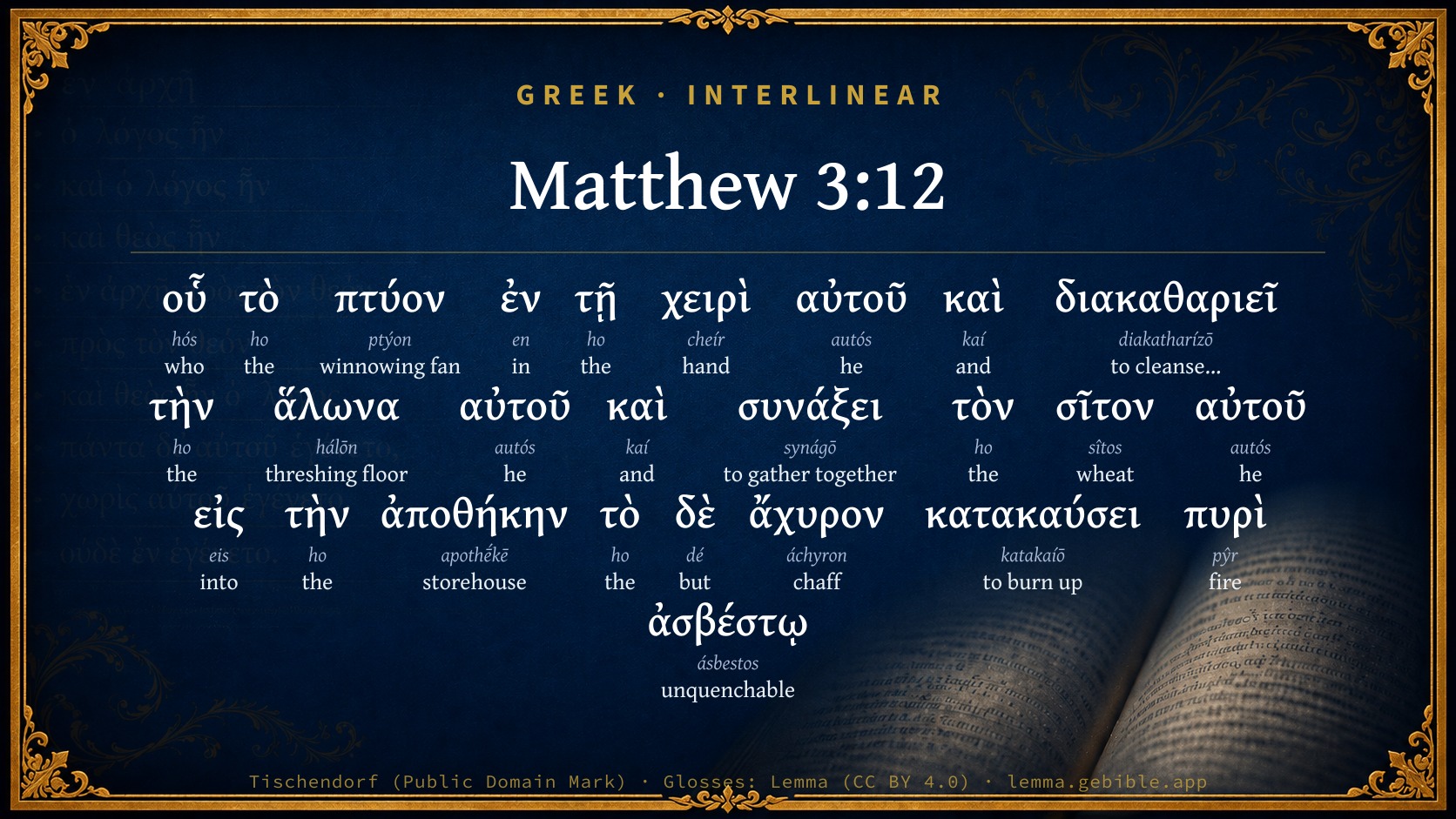
Greek (Tischendorf 8th ed.) Matthew 3:12 appears in the Greek New Testament. The text above is from the Tischendorf 8th edition. Each word links to its Strong’s number and a concise gloss. Click any word for its full Thayer’s Greek Lexicon entry.
Download image
Cite this verse

Matthew 3:12 (World English Bible). Public Domain. Lemma interlinear Bible study tool, https://lemma.gebible.app/v/matthew/3/12.

Show BibTeX & RIS
BibTeX
RIS
English Translation
His winnowing fork is in his hand, and he will thoroughly cleanse his threshing floor. He will gather his wheat into the barn, but the chaff he will burn up with unquenchable fire."
World English Bible · Public Domain
Highlights
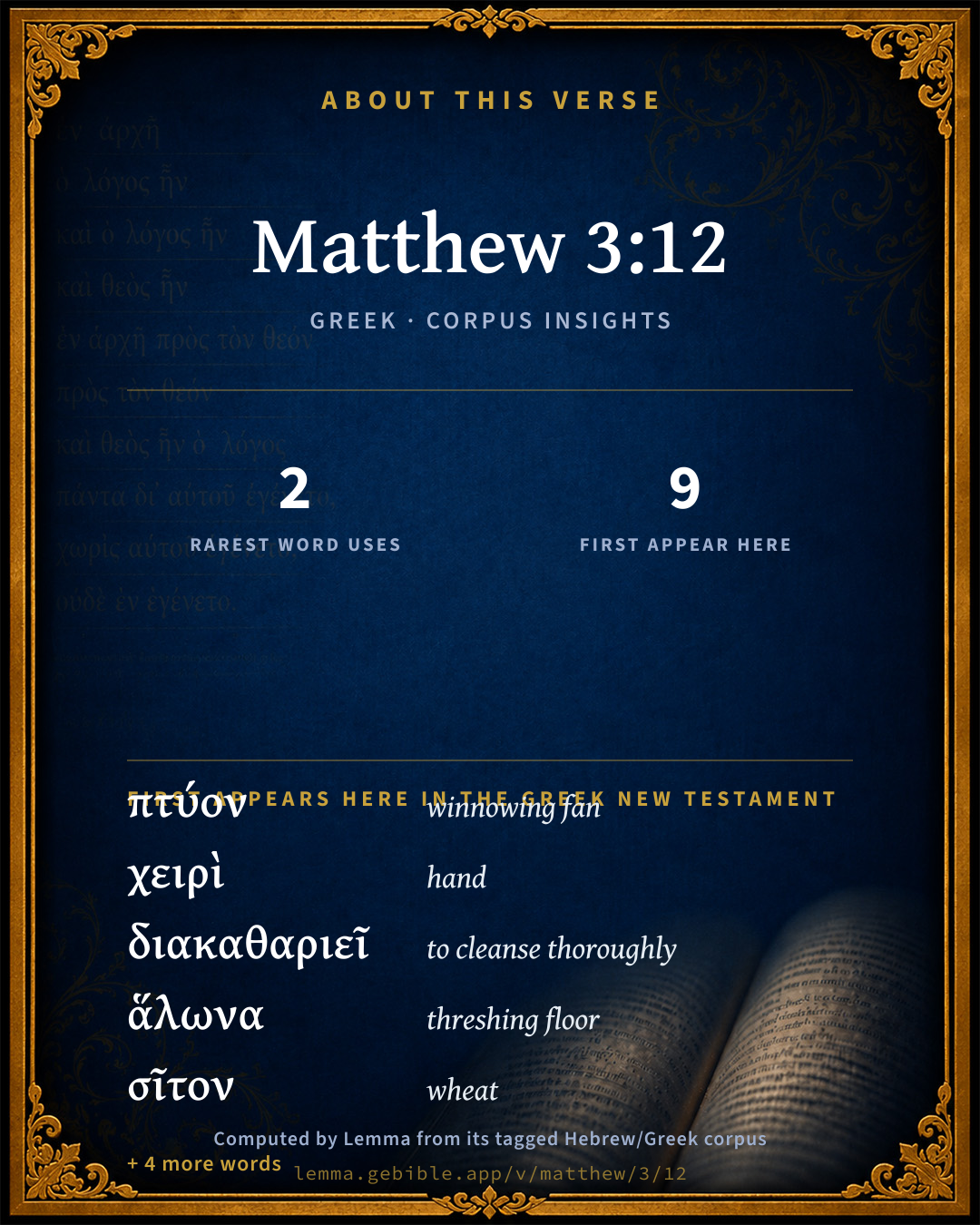
  • 9 first appearances in the Greek New Testament
Full analysis ↓
Download a study sheet

One document with this verse’s original text, its word-by-word gloss line, the meaning frame, cross-references with their text, attributed commentary, and full source and license credits — printable, and it pastes into notes with its structure intact.

This verse Autodidact and up

Study sheet (.html) Plain text (.txt)

A passage Seminary Student

Up to 50 verses in one chapter. A passage sheet keeps up to 6 commentary sources and 12 cross-references per verse, in the order this page ranks them, and says so on the sheet whenever that leaves anything out. Ask for a single verse and you get the Autodidact verse sheet above.

Everything on this page stays free to read, with no account — the sheet is a download of what is already on screen, not access to it.

Want to remove ads? Support Godless Engineer
Compare translations 3

The same verse in 3 English versions, stacked beneath the original-language interlinear above. Click any original word for its lexicon entry.

Each is an independent rendering of the whole verse — the interlinear is not word-aligned to these translations.

Highlighted words mark where these versions differ — a whole-verse word diff, not a word-by-word alignment.

  • World English Bible Public Domain
    His winnowing fork is in his hand, and he will thoroughly cleanse his threshing floor. He will gather his wheat into the barn, but the chaff he will burn up with unquenchable fire."
  • King James Version Public Domain
    Whose fan is in his hand, and he will throughly purge his floor, and gather his wheat into the garner; but he will burn up the chaff with unquenchable fire.
  • unfoldingWord Literal Text CC BY-SA 4.0
    whose winnowing fork in his hand, and he will thoroughly clear off his threshing floor and gather his wheat into the storehouse. But he will burn up the chaff with unquenchable fire.”

unfoldingWord Literal Text — © unfoldingWord, licensed CC BY-SA 4.0. Word-aligned USFM3 via Door43 (git.door43.org/unfoldingWord/en_ult).

Versions to compare (up to 4)

3 of 4 selected

Show all 19 translations

Every available English version of this verse, each an independent rendering of the whole verse.

  • World English Bible Public Domain
    His winnowing fork is in his hand, and he will thoroughly cleanse his threshing floor. He will gather his wheat into the barn, but the chaff he will burn up with unquenchable fire."
  • Berean Standard Bible Public Domain
    His winnowing fork is in His hand to clear His threshing floor and to gather His wheat into the barn; but He will burn up the chaff with unquenchable fire.”
  • Majority Standard Bible Public Domain
    His winnowing fork is in His hand, and He will clear His threshing floor and gather His wheat into the barn; but He will burn up the chaff with unquenchable fire.”
  • King James Version Public Domain
    Whose fan is in his hand, and he will throughly purge his floor, and gather his wheat into the garner; but he will burn up the chaff with unquenchable fire.
  • American Standard Version (1901) Public Domain
    whose fan is in his hand, and he will thoroughly cleanse his threshing-floor; and he will gather his wheat into the garner, but the chaff he will burn up with unquenchable fire.
  • Revised Version (1885) Public Domain
    whose fan is in his hand, and he will throughly cleanse his threshing-floor; and he will gather his wheat into the garner, but the chaff he will burn up with unquenchable fire.
  • Geneva Bible (1599) Public Domain
    Which hath his fanne in his hand, and wil make cleane his floore, and gather his wheate into his garner, but will burne vp the chaffe with vnquenchable fire.
  • Douay-Rheims (1899) Public Domain
    Whose fan is in his hand, and he will thoroughly cleanse his floor and gather his wheat into the barn; but the chaff he will burn with unquenchable fire.
  • Young's Literal Translation Public Domain
    whose fan `is' in his hand, and he will thoroughly cleanse his floor, and will gather his wheat to the storehouse, but the chaff he will burn with fire unquenchable.'
  • Literal Standard Version CC BY-SA 4.0
    whose fan [is] in His hand, and He will thoroughly cleanse His floor, and will gather His wheat into the storehouse, but He will burn the chaff with unquenchable fire.”
  • Unlocked Literal Bible CC BY-SA 4.0
    His winnowing fork is in his hand to thoroughly clear off his threshing floor and to gather his wheat into the storehouse. But he will burn up the chaff with fire that can never be put out.”
  • unfoldingWord Literal Text CC BY-SA 4.0
    whose winnowing fork in his hand, and he will thoroughly clear off his threshing floor and gather his wheat into the storehouse. But he will burn up the chaff with unquenchable fire.”
  • Darby Bible Public Domain
    whose winnowing fan [is] in his hand, and he shall thoroughly purge his threshing-floor, and shall gather his wheat into the garner, but the chaff he will burn with fire unquenchable.
  • World Messianic Bible Public Domain
    His winnowing fork is in his hand, and he will thoroughly cleanse his threshing floor. He will gather his wheat into the barn, but the chaff he will burn up with unquenchable fire.”
  • Webster's Bible Public Domain
    Whose fan is in his hand, and he will thoroughly cleanse his floor, and gather his wheat into the granary; but he will burn the chaff with unquenchable fire.
  • Free Bible Version CC BY-SA 4.0
    He has his winnowing tool ready in his hand. He will clean up the threshing floor and gather the wheat into the storehouse, but he will burn the chaff with fire that can't be put out.”
  • Bible in Basic English Public Domain
    In whose hand is the instrument with which he will make clean his grain; he will put the good grain in his store, but the waste will be burned up in the fire which will never be put out.
  • Text-Critical English NT CC BY 4.0
    His winnowing fork is in his hand, and he will thoroughly clean out his threshing floor and gather his wheat into the barn, but the chaff he will burn up with unquenchable fire.”
  • Tyndale New Testament (1534) Public Domain
    which hath also his fan in his hond and will pourge his floure and gadre the wheet into his garner and will burne the chaffe with vnquecheable fyre.

Literal Standard Version (2020), Covenant Press — licensed CC BY-SA 4.0. Text via the HelloAO Bible API (eBible.org). Unlocked Literal Bible (unfoldingWord) — licensed CC BY-SA 4.0. Text via the HelloAO Bible API (eBible.org). unfoldingWord Literal Text — © unfoldingWord, licensed CC BY-SA 4.0. Word-aligned USFM3 via Door43 (git.door43.org/unfoldingWord/en_ult). Free Bible Version, Dr. Jonathan Gallagher — licensed CC BY-SA 4.0. Text via the HelloAO Bible API (eBible.org).

Word by word

More ways to search: Search by grammar → Find every occurrence → Compare this word →

Practice this passage: Drill this verse → Learn its vocabulary →

πτύον
ptýon
G4425
“winnowing fan”
Noun, Nominative, Singular, Neuter
Part of Speech
Noun
Case
Nominative
Number
Singular
Gender
Neuter
Full Thayer's Definition

Origin: from G4429

TDNT: None

1. a winnowing shovel
  1. οὗ hós G3739 “who” Relative pronoun, Genitive, Singular, Masculine
  2. τὸ ho G3588 “the” Article, Nominative, Singular, Neuter
  3. ἐν en G1722 “in” Preposition
  4. τῇ ho G3588 “the” Article, Dative, Singular, Feminine
  5. χειρὶ cheír G5495 “hand” Noun, Dative, Singular, Feminine
  6. αὐτοῦ autós G846 “he” Personal pronoun, Genitive, Singular, Masculine
  7. καὶ kaí G2532 “and” Conjunction
  8. διακαθαριεῖ diakatharízō G1245 “to cleanse thoroughly” Verb, Future, Active, Indicative, 3rd person, Singular, Attic form
  9. τὴν ho G3588 “the” Article, Accusative, Singular, Feminine
  10. ἅλωνα hálōn G257 “threshing floor” Noun, Accusative, Singular, Feminine
  11. αὐτοῦ autós G846 “he” Personal pronoun, Genitive, Singular, Masculine
  12. καὶ kaí G2532 “and” Conjunction
  13. συνάξει synágō G4863 “to gather together” Verb, Future, Active, Indicative, 3rd person, Singular
  14. τὸν ho G3588 “the” Article, Accusative, Singular, Masculine
  15. σῖτον sîtos G4621 “wheat” Noun, Accusative, Singular, Masculine
  16. αὐτοῦ autós G846 “he” Personal pronoun, Genitive, Singular, Masculine
  17. εἰς eis G1519 “into” Preposition
  18. τὴν ho G3588 “the” Article, Accusative, Singular, Feminine
  19. ἀποθήκην apothḗkē G596 “storehouse” Noun, Accusative, Singular, Feminine
  20. τὸ ho G3588 “the” Article, Accusative, Singular, Neuter
  21. δὲ dé G1161 “but” Conjunction
  22. ἄχυρον áchyron G892 “chaff” Noun, Accusative, Singular, Neuter
  23. κατακαύσει katakaíō G2618 “to burn up” Verb, Future, Active, Indicative, 3rd person, Singular
  24. πυρὶ pŷr G4442 “fire” Noun, Dative, Singular, Neuter
  25. ἀσβέστῳ ásbestos G762 “unquenchable” Adjective, Dative, Singular, Neuter

About this verse

These counts appear in no published source. They are computed here, from the morphology-tagged text and Lemma’s own curated glosses. What Lemma adds →

26
words
18
distinct lemmas
Gospels
section

Notable vocabulary

The rarest word here is πτύον winnowing fan G4425 — appearing just 2 times in the whole Greek New Testament.

First appearance in Scripture

These words make their first canonical appearance in the Greek New Testament here (9 in total — showing 8):

  • πτύον winnowing fan G4425
  • χειρὶ hand G5495
  • διακαθαριεῖ to cleanse thoroughly G1245
  • ἅλωνα threshing floor G257
  • σῖτον wheat G4621
  • ἀποθήκην storehouse G596
  • ἄχυρον chaff G892
  • κατακαύσει to burn up G2618

Shared distinctive vocabulary

πτύον winnowing fan G4425 occurs in 2 verses of the Greek New Testament. Also found in:
Repetition

Words recur within this verse:

Cross-references

26

Topical passages linked to Matthew 3:12 in the Treasury of Scripture Knowledge — connected by theme and wording, ordered by reader-vote popularity; previews shown in the World English Bible.

  • Malachi 4:1 "For, behold, the day comes, it burns as a furnace; and all the proud, and all who work wickedness, will be stubble; and the day that comes will burn them up," says Yahweh of Hosts, "that it shall leave them neither root nor branch.
  • Matthew 13:30 Let both grow together until the harvest, and in the harvest time I will tell the reapers, "First, gather up the darnel, and bind them in bundles to burn them; but gather the wheat into my barn."'"
  • Luke 3:17 whose fan is in his hand, and he will thoroughly cleanse his threshing floor, and will gather the wheat into his barn; but he will burn up the chaff with unquenchable fire."
  • Isaiah 41:16 You shall winnow them, and the wind shall carry them away, and the whirlwind shall scatter them; and you shall rejoice in Yahweh, you shall glory in the Holy One of Israel.
  • Jeremiah 51:2 I will send to Babylon strangers, who shall winnow her; and they shall empty her land: for in the day of trouble they shall be against her round about.
  • Psalms 1:4 The wicked are not so, But are like the chaff which the wind drives away.
  • Matthew 13:41 The Son of Man will send out his angels, and they will gather out of his Kingdom all things that cause stumbling, and those who do iniquity,
  • Jeremiah 7:20 Therefore thus says the Lord Yahweh: Behold, my anger and my wrath shall be poured out on this place, on man, and on animal, and on the trees of the field, and on the fruit of the ground; and it shall burn, and shall not be quenched.
  • Malachi 3:2–3 "But who can endure the day of his coming? And who will stand when he appears? For he is like a refiner's fire, and like launderer's soap;
  • John 15:2 Every branch in me that doesn't bear fruit, he takes away. Every branch that bears fruit, he prunes, that it may bear more fruit.
  • Psalms 35:5 Let them be as chaff before the wind, Yahweh's angel driving them on.
  • Jeremiah 15:7 I have winnowed them with a fan in the gates of the land; I have bereaved [them] of children, I have destroyed my people; they didn't return from their ways.
  • Mark 9:43–48 If your hand causes you to stumble, cut it off. It is better for you to enter into life maimed, rather than having your two hands to go into Gehenna, into the unquenchable fire,
  • Job 21:18 That they are as stubble before the wind, As chaff that the storm carries away?
  • Isaiah 1:31 The strong will be like tinder, And his work like a spark. They will both burn together, And no one will quench them."
  • Isaiah 5:24 Therefore as the tongue of fire devours the stubble, And as the dry grass sinks down in the flame, So their root shall be as rottenness, And their blossom shall go up as dust; Because they have rejected the law of Yahweh of Hosts, And despised the word of the Holy One of Israel.
  • Isaiah 17:13 The nations shall rush like the rushing of many waters: but he shall rebuke them, and they shall flee far off, and shall be chased as the chaff of the mountains before the wind, and like the whirling dust before the storm.
  • Isaiah 30:24 the oxen likewise and the young donkeys that till the ground shall eat savory provender, which has been winnowed with the shovel and with the fork.
  • Isaiah 66:24 They shall go forth, and look on the dead bodies of the men who have transgressed against me: for their worm shall not die, neither shall their fire be quenched; and they shall be an abhorring to all flesh.
  • Jeremiah 17:27 But if you will not listen to me to make the Sabbath day holy, and not to bear a burden and enter in at the gates of Jerusalem on the Sabbath day; then will I kindle a fire in the gates of it, and it shall devour the palaces of Jerusalem, and it shall not be quenched.
  • Ezekiel 20:47–48 and tell the forest of the South, Hear the word of Yahweh: Thus says the Lord Yahweh, Behold, I will kindle a fire in you, and it shall devour every green tree in you, and every dry tree: the flaming flame shall not be quenched, and all faces from the south to the north shall be burnt thereby.
  • Matthew 13:43 Then the righteous will shine forth like the sun in the Kingdom of their Father. He who has ears to hear, let him hear.
  • Matthew 13:49–50 So will it be in the end of the world. The angels will come forth, and separate the wicked from among the righteous,
  • Jeremiah 4:11 At that time shall it be said to this people and to Jerusalem, A hot wind from the bare heights in the wilderness toward the daughter of my people, not to winnow, nor to cleanse;
  • Hosea 13:3 Therefore they will be like the morning cloud, And like the dew that passes away early, Like the chaff that is driven with the whirlwind out of the threshing floor, And like the smoke out of the chimney.
  • Amos 9:9 "For, behold, I will command, and I will sift the house of Israel among all the nations, as grain is sifted in a sieve, yet not the least kernel will fall on the earth.

Cross-references courtesy of OpenBible.info (CC BY 4.0).

Commentary

Notes on Matthew 3:12 from classic Christian and Jewish commentators (each source and its license shown beneath its notes). The classic Christian expositions comment on the surrounding passage and are grouped to its opening verse, so a note may address several verses; the Jewish commentaries on the Tanakh (Rashi and others) are per-verse, so they appear only where the commentator wrote on this verse.

Lemma curates 59 commentaries, every one of them public domain or Creative Commons licensed, each selected and text-cleaned for this edition rather than reprinted as found. About our sources →

The Biblical Illustrator

Joseph S. Exell

Mat_3:12

Whose fan.

Christ a sifter

Humanity yields its twofold crop, its wheat and chaff, and keeps its terrible capacity of mixing chaff and wheat together, making them look alike.

A sifter needed

Something, then, is watered to lift the cover, to unveil the reality, to expose the things that we do and the persons that we are. Whether we want Him or not, He comes whose fan is in His hand.

A sifter needed for the sake of the truth

Realize, too, that the sifting work must be done not only for the truths sake and for Gods sake, but for the sake of the foolish people themselves-for the welfare of the world. Otherwise the world, cheated by the delusion, would go from bad to worse, and be deluded to destruction.

Life foreshadows a sifting process

Christ prepares the way for His own great reckoning to come, by setting foreshadows of His sifting work around us where we are. Life itself moves on with the fan in its hand. So into this medley where you live there springs suddenly some new-comer. It is a providence of God. A contagious disease escapes quarantine and breaks out in the town. There is a wreck on a reef off the shore. On a Western river great waterfloods sweep away scores of houses and lives. A hundred human bodies are crushed and burned in a mass in some building. You are not hurt; but as the report strikes man after man in the neighbourhood, if you could look underneath the masks which some people from pride or policy keep over their real selves, would you not see always two sorts of men revealed? In one there is apathy, and in another there is sympathy. Here are the two sorts of men disclosed. Before, you could not have told which was which; all looked alike; but in the threshing-floor of God the winnowing has begun.

Adversity a stifting process

One family that you know, overtaken by misfortune, is paralysed or embittered, and goes down. Another, struck by the same blow, summons its interior strength, is sweet-tempered, hopeful, and courageous, and as it descends in style rises in spiritual stature. The season why prosperity seems to enlarge some persons and belittle others is not so much that it actually alters their dimensions as that it publishes what their dimensions are. It is a shaking of the fan.

Public questions sift

Now and then a sharp question of right or wrong is thrust in upon a whole community in palpable shape-a question of public justice or oppression, of fair dealing between capital and labour, of chastity in literature or decency in art, of commercial honour, temperance in drinking, political integrity. Everybody must take sides, openly in act or virtually in secret choice or feeling. This new truth has the fan in its hand. It sifts your gay society, getting souls in position for their judgment. At certain historical epochs great characters arrive. They utter one of these great truths, and stand out or fight for it. They are not judges of men, but sifters of men. Every one of them has a fan in the hand.

Character cannot permanently be concealed

There is no privacy for character in the universe. The righteousness of God has arranged it that we shall live surrounded by a system of detectives and exposures, and all the uniforms and costumes and cosmetics and masks and escapes of that public stage, society, will not baffle them. This life is the beginning, though not the end, of judgment.

Truth a dividing power

It is inwrought benignantly into the silent and steady operation of the truth. Truth itself is a dividing power.

Discrimination a law of nature

To me it establishes faith, and makes the awful doctrine of retribution reasonable, to see the law wrought into the whole fabric of Nature around us and the very constitution of man. Even in the orchards and gardens there is a visible economy of discrimination, of rejection, of judgment. Bad fruit drops off and is cast away by the same hand that gathers and garners the good. Sow chaff and grain together if you choose; the chaff rots, while the vital seeds sprout and grow and yield some thirty, some sixty, some an hundred. Why not so when we come up to the immortal wheat? (Bishop Huntingdon.)

1. Christ is the universal Judge; His fan is in His hand. He possesses authority, discrimination, and impartiality,-the three grand qualifications for this office. (M. Henry.)

Wheat-chaff.

I. In the Christian Church there is a mixture of nominal and real Christians. Parable of the Tares. Of the Wedding Garment. Judas. Ananias and Sapphira. The false are the careless or indifferent. The self-righteous or sentimental; the hollow-hearted or hypocritical. The true are penitents, believers, new creatures.

II. The Head of the Church knows the true character of all its members. Seven churches of Asia. I know thy works. Intimate and exact knowledge of His own people.

III. The Head of the Church will separate the precious from the vile. By His doctrine-providential dealings-Satanic temptations-fire of persecution.

IV. The final doom of all the mem-bets of the Church will correspond to their character. The wheat to the garner, The chaff to the fire.

1. Examine yourselves.

2. Prepare for judgment. (Anon.)

I. The Two great classes into which the world is divided. Two only. In the eyes of men many. Either believers or unbelievers. No third class.

II. When these two classes will be separated. Not yet. When Christ comes!

III. The portion of Christs people.

IV. The portion of those who are not Christs. (J. C. Ryle.)

The wheat and the chaff

By the wheat is evidently intended those whose characters are useful; by the chaff those who are worthless. Wheat is valuable because it answers the purpose of the cultivator, which is to produce food for himself and others; so those persons are useful who answer the ends for which God has placed them here. God has placed us here to glorify Him:-

1. By our exercising suitable dispositions towards Him;

2. By cultivating every virtue;

3. By our doing good to others.

From this description of the wheat we may easily infer the character of those who resemble the chaff.

1. If those are the wheat who exercise suitable dispositions towards God, those are the chaff who are without such dispositions.

2. If those are the wheat who are seeking the perfection of their nature, then those are the chaff who neglect to seek it.

3. If those are the wheat who labour for the temporal and spiritual welfare of their fellow-creatures, those are the chaff who live chiefly to please themselves.

4. If those are the wheat who glorify God by believing in Christ, then those are the chaff who remain in unbelief.

5. To which of these two classes do we belong? (B. W. Noel, M. A.)

Good and evil are really different in kind, absolutely and intrinsically, essentially and in the nature of things:

I. By the free choice of will, and the practice consequent upon such a choice, real virtue or vice can be acquired.

II. Every man is as to his moral character what his own behaviour and practice make him. By as certain and determinate a distinction as wheat and chaff are, of their real and proper natures, different from each other.

III. God in all His commandments really desires to bring men by the habitual practice of virtue to a state by which they can become capable of His eternal happiness in the enjoyment of His unchangeable favour. Therefore the good must be separated from the evil surely and thoroughly, if we would win salvation. (Samuel Clarke, D. D.)

Similarity between real Christians and hypocritical

And let me remind you how like the chaff is to the wheat, how like the mere professor is to the saint. Of what colour is the chaff? Precisely the same as that of the wheat. And what is its form? Exactly that of the wheat. And where is it found? Not blowing about the highway, but in close contact with the wheat. It is upon us that this sifting trial is to pass; and it matters not how perfect may be our resemblance to the saints, if there be a resemblance and nothing more. (P. B. Power.)

Sect distinctions obliterated in destiny

I have seen a field here, and a field there, stand thick with corn-a hedge or two has separated them. At the proper season the reapers entered; soon the earth was disburdened, and the grain was conveyed to its destined resting-place, where, blended together in the barn or the stack, it could not be known that a hedge had ever separated this corn from that. Thus it is with the Church. Here it grows, as it were, in different fields, and even, maybe, by different hedges. By and by, when the harvest is come, all Gods wheat shall be gathered into the garner, without one single mark to distinguish that once they differed in outward circumstantials of form and order. (Toplady.)

The Biblical Illustrator, edited by Joseph S. Exell (c. 1880s–1900s) — public domain. Text from a community e-Sword module.

Joseph Benson's Commentary

Mat 3:12. Whose fan is in his hand — That is, the doctrine of the gospel, which is of such a nature as effectually discovers what is the real disposition of the hearts of men, and perfectly distinguishes between the hypocritical and the sincere. Perhaps, also, the Baptist might refer to the persecutions and tribulations which should attend the preaching of the gospel. Dr. Campbell renders the original expression, το πτυον, winnowing shovel, mentioned Isa 30:24, “an implement of husbandry, very ancient, simple, and properly manual: whereas the fan, (or van, as it is sometimes called,) is more complex, and, being contrived for raising an artificial wind, by the help of sails, can hardly be considered as proper for being carried about in the hand.” “In the eastern countries,” says Dr. Shaw, “after the grain is trodden out, they winnow it by throwing it up against the wind with a shovel.” “To understand the Baptist’s meaning aright, we should observe, that in this verse he describes the authority of Christ’s ministry, as in Mat 3:16 he had described its efficacy. As if he had said, The Messiah is infinitely mightier than I, not only as he will bestow on you the miraculous gifts of the Spirit, but as he has power to reward those who obey him with eternal life, and to punish such with everlasting destruction, as reject him.” — Macknight. He will thoroughly purge his floor — His Church, at present covered with a mixture of wheat and chaff. As if he had said, Though, for the present, the good and bad, the fruitful and unfruitful, are joined together in the visible Church, yet in due time he will sever them, Mal 3:2-3; and rid his Church of all hypocrites and ungodly persons. And gather his wheat — The, truly pious, into his garner — Will lay them up in heaven as his peculiar treasure. But the chaff — Those who have only a show of religion, without the power, and produce not the fruits of righteousness, he will burn with unquenchable fire — He will treat them as men do the refuse of the floor. He will destroy them as worthless and unprofitable trash. There is, in these words, an evident allusion to the custom of burning the chaff after winnowing, that it might not, by the wind’s changing, be blown back again, and so be mingled with the wheat. And though this may in part refer to the calamities to come upon the Jewish nation for rejecting Christ, yet, it seems chiefly to intend the final destruction of all sinners in hell, which alone is properly opposed to the gathering the wheat into the garner. See Mat 13:40-42. And certainly this burning of the chaff with unquenchable fire, is absolutely inconsistent with all views of the restoration of the wicked, nor can it, by any easy or just interpretation, be reconciled with their annihilation, which, it is certain, no punishment of mind or body can, of itself, effect.

Joseph Benson's Commentary on the Old and New Testaments (1811–1818) — public domain. Text from a community e-Sword module.

Tyndale Open Study Notes

Tyndale Open Resources

3:12 Farmers would use a winnowing fork to toss harvested grain into the air, allowing the useless husks (chaff) to blow away. The Messiah’s ministry divides all humanity into two groups: (1) the wheat, that is, those who respond, forming the new people of God; and (2) the chaff, the unrepentant (see 3:8).

Tyndale Open Study Notes — © Tyndale Open Resources, licensed CC BY-SA 4.0. Text via the HelloAO Bible API.

Bengel's Gnomon

Johann Albrecht Bengel

Mat 3:12. οὖ, whose) This, and Αὐτοῦ, His, being placed emphatically thrice, shows the power of Christ. οὗ—αὐτοῦ is a Hebraism.—τὸ πτύον, the fan) i.e. the Gospel.—ἐν τῇ χειρὶ Αὐτοῦ, in His hand) even now. The whole of John’s harangue, and therefore the commencement of the Gospel, agrees entirely with the last clause of Old Testament prophecy, in Mal. 3:19–24, where the connection of things from Moses to the conclusion of ancient prophecy, and thence to Christ’s forerunner and Christ Himself, and the day of His universal judgment, is exquisitely and solemnly declared.—Αὐτοῦ, His) Neither His forerunner, nor any of His apostles, had this fan in the same manner as the Lord Jesus Himself. The consolation of His ministers in then weakness is, “The Lord will do it.” Their wrath, though void of strength, is not vain.—τὴν ἅλωνα Αὐτοῦ, His threshing-floor) The wayfarers are in the threshing-floor, the conquerors in the garner.[129]—Αὐτοῦ, His) See Heb 3:6.—καὶ συνάξει τὸν σῖτον Αὐτοῦ εἰς τὴν ἀποθήκην, and will gather His wheat into the garner) Αὐτου, His, must either be omitted or construed with ἀποθήκην, garner;[130] cf. Mat 13:30, τὸν δὲ σῖτον συναγάγετε εἰς τὴν ἀποθήκην Μου, but gather the wheat into My garner. The Same is Lord of the wheat as of the garner: the Same of the garner as of the threshing-floor. See Luk 3:17.—ἄχυρον, chaff) The chaff is held of no[131] account.[132]—πυρὶ, with fire) Every one must be either baptized with fire here, or burned with fire hereafter: there is no other alternative.—ἀσβέστῳ, unquenchable) See therefore that your sins be first blotted out. In Job 20:26, the LXX. have πῦρ ἄκαυστοι, incombustible fire [i.e. fire that cannot be burnt out] shall consume the ungodly: or, rather, from the Cod. Alex., ἄσβεστον, unquenchable, unextinguishable (which word would otherwise not be found in the LXX.), so as to render אֵשׁ לא̇ נֻפָּח, fire which can never be extinguished.

[129] One cannot well express in English the contrast implied in the very rhythm of Bengel’s Latin, “In area sunt viatores, in horreo victores.”—ED.

[130] “Which Luther has rightly done.”—Not. Crit.

[131] Cf. Gnomon on chap. Mat 13:49.—(I. B.)

[132] Although at times it is not unlike the wheat.—Vers. Germ.

Bengel's Gnomon of the New Testament — English translation (T&T Clark, Edinburgh, 1860) — public domain. Text from a community e-Sword module.

Meyer's Critical & Exegetical Commentary

Heinrich August Wilhelm Meyer

Mat_3:12. And fire, I say; for what a separation will it make!

οὗ] assigns a reason, like our: He whose [German, Er, dessen]. See Ellendt, Lex. Soph. II. p. 371; Kühner, II. p. 939. It is not, however, as Grotius, Bengel, Storr, Kuinoel think, pleonastic, but the literal translation is to be closely adhered to: whose fan is in his hand; that is, he who has his (to him peculiar, comp. Mat_3:4) fan in his hand ready for use. Comp LXX. Isa_9:5. According to Fritzsche, ἐν τῇ χειρὶ αὐτοῦ is epexegetical: cujus erit ventilabrum, sc. in manu ejus. But such epexegetical remarks, which fall under the point of view of Appositio partitiva, stand, as they actually occur, in the same case with the general word, which they define more minutely (οὗ τὸ πτύον, τῆς χειρὸς αὐτοῦ). See Eph_3:5, and remarks in loc.

ἅλωνα] ἅλως (Xen. Oec. xviii. 6; Dem. 1040. 23), in Greek writers commonly after the Attic declension, is the same as נֹּרֶן, a circular firmly-trodden place upon the field itself, where the grain is either trodden out by oxen, or thrashed out by thrashing machines drawn by oxen. Keil, Arch. II. p. 114; Robinson, III. p. 370. Similarly in Greek writers; see Hermann, Privatalterth. xv. 6, xxiv. 3. The floor is cleansed in this way, that the seed grains and the pounded straw and similar refuse are not allowed to lie upon it indiscriminately mingled together, in the state in which the threshing has left this unclean condition of the floor, but the grain and refuse are separated from each other in order to be brought to the place destined for them. In the figure, the floor, which belongs to the Messiah, is not the church (Fathers and many others), nor mankind (de Wette), nor the Jewish nation (B. Crusius), but, because the place of the Messiahs activity must be intended (Ewald), and that, according to the national determination of the idea of the Baptist, the holy land, as the proper sphere of the work of the Messiah, not the world in general (Bleek), as would have to be assumed according to the Christian fulfilment of the idea. In accordance with this view, we must neither, with Zeger, Fischer, Kuinoel, de Wette, explain τ. ἅλωνα, according to the alleged Hebrew usage (Job_39:12; Rth_3:2), as the grain upon the floor; nor, with Fritzsche, regard the cleansing as effected, removendo inde frumentum, which is an act that does not follow until the floor has been cleansed. The διακαθαρίζειν, to purify thoroughly, which is not preserved anywhere except in Luk_2:17, designates the cleansing from one end to the other; in classical writers διακαθαίρειν, Plat. Pol. iii. pp. 399 E, 411 D; Alciphr. iii. 26.

ἀποθήκην] place for storing up, magazine. The grain stores (σιτόβολιον, Polyb. iii. 100. 4; θησαυροὶ σίτου, Strabo, xii. p. 862; σιτοδόκη, Pollux) were chiefly dry subterranean vaults. Jahn, Archäol. I. 1, p. 376.

ἄχυρον] not merely chaff in the narrower sense of the word (מֹץ), but all those portions of the stalk and ear which contain no grain, which are torn in pieces by the threshing, and remain over (חֶּכֶן), Herod. iv. 72; Xen. Oec. xvii. 1, 6. f.; Gen_24:25; Exo_5:7. These were used as fuel. Mishna tract, Schabbath ii. 1; Parah. iv. 3. Paulsen, vom Ackerbau der Morgenl. p. 150.

The sense, apart from figurative language, is: The Messiah will receive into His kingdom those who are found worthy (comp. Mat_13:30); but upon the unworthy He will inflict in full the everlasting punishments of Gehenna. Comp. Mal. 3:19.

ἀσβέστῳ] which is not quenched (Hom. Il. xvii. 89; Pind. Isthm. iii. 72; Dion. Hal. Antt. i. 76, corresponding to the thing portrayed; comp. Isa_66:24). Not, therefore: which is not extinguished till all is consumed (Paulus, Bleek).

REMARK.

Joh_1:26 is not to be regarded as parallel with Mat_3:12, for, according to John, the Baptist speaks after the baptism of Jesus, and to the members of the Sanhedrim. And doubtless he had often given expression to his testimony regarding Christ, who was the point which the prophet had in view in his preaching of repentance and baptism.

That he is not yet definitely designated in Matthew as Elijah (Luk_1:17; Mat_11:10; Mat_11:14), is rightly regarded as an evidence of the truth of the gospel narrative, which has not anticipated the subsequently developed representation of John. To relegate, however, the announcement of the Messiah from the preaching of the Baptist into the realm of legend (Strauss) is a mockery of the entire evangelical testimony, and places it below the narrative of Josephus, which was squared according to the ideas of political prudence (Antt. xviii. 5. 2).

Meyer — Critical and Exegetical Commentary on the New Testament — English translation by Peter Christie, edited by Frederick Crombie (T&T Clark, 1880) — public domain. Text from a community e-Sword module.

Expositor's Greek Testament

ed. W. Robertson Nicoll

Mat 3:12 . This ver. follows up Mat 3:11 , and explains the judicial action emblemed by wind and fire. οὗ τὸ πτύον ἐ . τ . χ . αὐτοῦ . The construction is variously understood. Grotius takes it as a Hebraism for ἐν οὗ χειρὶ τὸ πτύον . Fritzsche takes ἐν τ . χειρὶ αὐτοῦ as epexegetical, and renders: “whose will be the fan, viz. , in His hand”. Meyer and Weiss take οὗ as assigning a reason: “He ( αὐτὸς of Mat 3:11 ) whose fan is in hand and who is therefore able to perform the part assigned to Him”. Then follows an explanation of the modus operandi . διακαθαριεῖ from διακαθαρίζω , late for classic διακαθαίρω . The idea is: He with His fan will throw up the wheat, mixed with the chaff, that the wind may blow the chaff away; He will then collect the straw, ἄχυρον (in Greek writers usually plural τὰ ἄχυρα , vide Grimm), and burn it with fire, and collect the wheat lying on the threshing floor and store it in His granary. So shall He thoroughly ( δια intensifying) cleanse His floor. And the sweeping wind and the consuming fire are the emblems and measure of His power; stronger than mine, as the tempest and the devastating flames are mightier than the stream which I use as my element. ἅλων , a place in a field made firm by a roller, or on a rocky hill top exposed to the breeze. ἀποθήκη means generally any kind of store, and specially a grain store, often underground. Bleek takes the epithet ἀσβέστῳ applied to the fire as signifying: inextinguishable till all the refuse be consumed. It is usually understood absolutely.

The Expositor's Greek Testament, edited by W. Robertson Nicoll (1897–1910) — public domain. Text from a community e-Sword module.

Geneva Bible (1599)

Geneva Bible translators

Will cleanse it thoroughly, and make a full riddance.

The triumphs of the wicked shall end in everlasting torment.

Geneva Bible (1599) marginal notes — public domain. Text via Bolls.life.

Jamieson, Fausset & Brown

Robert Jamieson, A. R. Fausset & David Brown

Whose fan--winnowing fan.

is in his hand--ready for use. This is no other than the preaching of the Gospel, even now beginning, the effect of which would be to separate the solid from the spiritually worthless, as wheat, by the winnowing fan, from the chaff. (Compare the similar representation in Mal 3:1-3).

and he will throughly purge his floor--threshing-floor; that is, the visible Church.

and gather his wheat--His true-hearted saints; so called for their solid worth (compare Amo 9:9; Luk 22:31).

into the garner--"the kingdom of their Father," as this "garner" or "barn" is beautifully explained by our Lord in the parable of the wheat and the tares (Mat 13:30, Mat 13:43).

but he will burn up the chaff--empty, worthless professors of religion, void of all solid religious principle and character (see Psa 1:4).

with unquenchable fire--Singular is the strength of this apparent contradiction of figures:--to be burnt up, but with a fire that is unquenchable; the one expressing the utter destruction of all that constitutes one's true life, the other the continued consciousness of existence in that awful condition.

Luke adds the following important particulars (Luk 3:18-20) :

Luk 3:18 :

And many other things in his exhortation preached he unto the people--showing that we have here but an abstract of his teaching. Besides what we read in Joh 1:29, Joh 1:33-34; Joh 3:27-36, the incidental allusion to his having taught his disciples to pray (Luk 11:1) --of which not a word is said elsewhere--shows how varied his teaching was.

Luk 3:19 :

But Herod the tetrarch, being reproved by him for Herodias his brother Philip's wife, and for all the evils which Herod had done--In this last clause we have an important fact, here only mentioned, showing how thoroughgoing was the fidelity of the Baptist to his royal hearer, and how strong must have been the workings of conscience in that slave of passion when, notwithstanding such plainness, he "did many things, and heard John gladly" (Mar 6:20).

Luk 3:20 :

Added yet this above all, that he shut up John in prison--This imprisonment of John, however, did not take place for some time after this; and it is here recorded merely because the Evangelist did not intend to recur to his history till he had occasion to relate the message which he sent to Christ from his prison at Machærus (Luk 7:18, &c.).

Jamieson, Fausset & Brown — Commentary Critical and Explanatory on the Whole Bible (1871) — public domain (CC PDM 1.0). Text via the HelloAO Bible API.

Adam Clarke's Commentary

Verse 12. Whose fan is in his hand] The Romans are here termed God's fan, as, in Mt 3:10, they were called his axe, and, in Mt 22:7, they are termed his troops or armies.

The winnowing fan of the Hindoos is square, made of split bamboo; and the corn is winnowed by waving the fan backwards with both hands-"Whose fan is in his hand."

His floor] Does not this mean the land of Judea, which had been long, as it were, the threshing-floor of the Lord? God says, he will now, by the winnowing fan (viz. the Romans) throughly cleanse this floor - the wheat, those who believe in the Lord Jesus, he will gather into his garner, either take to heaven from the evil to come, or put in a place of safety, as he did the Christians, by sending them to Pella, in Coelosyria, previously to the destruction of Jerusalem. But he will burn up the chaff - the disobedient and rebellions Jews, who would not come unto Christ, that they might have life.

Unquenchable fire.] That cannot be extinguished by man.

Adam Clarke's Commentary on the Bible (1810–1826) — public domain. Text from a community e-Sword/MySword module.

Ellicott's Commentary for English Readers

(12) Whose fan is in his hand.—The scene brought before us is that of the large hardened surface which was the “threshing-floor” of the East, the sheaves of corn thrown over it, the oxen treading on them, the large winnowing fan driving on them the full force of the strong current of air, leaving the wheat in the middle, while the chaff is driven to the outskirts of the field to be afterwards swept up and burnt. The metaphor was a sufficiently familiar one. (Comp. Job_21:18; Psa_1:4; Psa_35:5; Isa_17:13; Isa_29:5; Hos_13:3.) The new features here are (1) that the “coming One,” the expected Christ, is to be the agent in the process; (2) that the Old Testament imagery rests in the “scattering” of the chaff, and this passes on to the “burning”; (3) that the fire is said to be “unquenched,” or perhaps “unquenchable.” The interpretation of the parable lies on the surface. The chaff are the ungodly and evildoers. The unquenched fire is the wrath of God against evil, which is, in its very nature, eternal, and can only cease with the cessation or transformation of the evil. The word translated “chaff” includes, it may be noted, straw as well, all but the actual grain.

It seems right briefly to direct the reader’s thoughts here to what is recorded of the Baptist’s ministry in the other Gospels; the questions of the priests and Levites (Joh_1:19-25); the counsels given to publicans, soldiers, and others (Luk_3:10-14); the presence, among the crowd, of Galileans, some of whom were afterwards Apostles (Joh_1:35-42). A curious legendary addition, found in the Apocryphal Gospel according to the Hebrews, is worth noting, as preparing the way for what follows: “Behold, the mother of the Lord and his brethren said unto Him, ‘John the Baptist baptiseth for the remission of sins; let us go that we may be baptised by him.’ But He said unto them, ‘In what have I sinned that I should go and be baptised by him? unless, perhaps, even that which I have thus spoken be a sin of ignorance.’ “This was obviously an attempt to explain the difficulty of the Sinless One seeking a baptism of repentance. It was, of course, probable enough that the household of Nazareth, cherishing, as they did, hopes of the kingdom of heaven, should be drawn with other Galileans to the Baptist’s preaching.

A Bible Commentary for English Readers, edited by Charles John Ellicott (1878–1897) — public domain. Text from a community e-Sword module.

The Cambridge Bible for Schools and Colleges

gen. ed. J. J. S. Perowne

12. fan] An instrument by which the corn after being threshed is thrown up against the wind to clear it of chaff.

floor] Here put for the contents of the threshing-floor, the mingled grain and chaff.

St Matthew represents the picturesque side of John’s preaching, these verses are full of imagery. How many similes are compressed into his teaching! The vipers, the stones, the trees, the slave, the threshing-floor, are all used to illustrate his discourse. St Luke throws into prominence the great teacher’s keen discrimination of character. St John has recorded a fragment of the Baptist’s deeper teaching as to the nature and mission of the Son of God.

The Cambridge Bible for Schools and Colleges (gen. ed. J. J. S. Perowne; Cambridge University Press, 1878–1918) — public domain. Text from a community e-Sword module.

John Gill's Exposition

Whose fan is in his hand,.... The Jews had their hand fans, and which were like a man's hand; their names were ; which, as Maimonides says (n), were three sorts of instruments used in the floor, in form of a man's hand; with which they cleansed the wheat and barley from the straw; and their names differ according to their form: some have many teeth, and with them they cleanse the wheat at the end of the work; and there are others that have few teeth, no more than three, and with these they purge the wheat at first, from the thick straw. By the "fan", here is meant, either the Gospel which Christ was just ready to publish; by which he would effectually call his chosen people among the Jews, and so distinguish and separate them from others, as well as purify and cleanse them, or rather the awful judgment of God, which Christ was ready to execute, and in a short time would execute on the unbelieving and impenitent Jews: hence it is said to be "in his hand"; being put there by his Father, who "hath committed all judgment to the Son". That this is the meaning of the "Baptist", seems evident, since "fanning" is always, when figuratively taken, used for judgments, Isa 41:16. By "his floor", is meant the land of Israel, where he was born, brought up, and lived; of which the Lord says, "O my threshing, and the corn of my floor!" Isa 21:10. This, he says, "he will thoroughly purge" of all his refuse and chaff, that is, by fanning: so fanning and cleansing, or purging, are joined together, Jer 4:11 so is used for purging by fanning, in the Misnic writings (o). By "his wheat", are meant his elect among the Jews, the chosen of God and precious; so called because of their excellency, purity, usefulness, solidity, and constancy: these he "will gather into his garner"; meaning either some place of protection, where he would direct his people to for safety from that wrath, ruin, and destruction; which should fall upon the Jewish nation; or else the kingdom of heaven, into which he would bring them, by taking them out of the world from the evil to come. By "the chaff", are meant wicked and ungodly persons, such as are destitute of the grace of God, whether professors, or profane; being empty, barren, and unfruitful; and so good for nothing but the fire, which therefore "he will burn with unquenchable fire", of divine wrath and vengeance: an allusion to a custom among the Jews, who, when they purified the increase of their unclean fields, gathered it together in an "area" or floor, in the midst of them, and then sifted it with sieves; one sort with two sieves, another with three, that they might thoroughly purge it, and burnt the chaff and stalks (p); see Isa 5:24.

(n) In Misn. Celim. c. 13. sect. 7. Vid. Jarchi & Bartenora in ib. & in Misn. Tibbul. Yom. c. 4. sect. 6. (o) Misn. Sabbat. c. 7. sect. 2. & Gittin, c. 5. sect. 9. (p) Misn. Oholot. c. 18. sect. 2.

John Gill's Exposition of the Whole Bible (1746–1763) — public domain (CC PDM 1.0). Text via the HelloAO Bible API.

Trapp's Complete Commentary

John Trapp

12 Whose fan is in his hand, and he will throughly purge his floor, and gather his wheat into the garner; but he will burn up the chaff with unquenchable fire.

Ver. 12. Whose fan is in his hand] Though the devil and wicked men mightily strive to wring it out of his hand; for what, say they, need this shedding and this shoaling? this distinguishing and differencing of men into saints and sinners? Are not all the Lord’s people holy? Num 16:3. Is there any man lives and sinneth not? but yet there is as wide a difference between sinner and sinner as is between the bosom of Abraham and the belly of hell, Luk 16:26; Luk 1:1-80. The godly man projects not sin as the wicked doth; but is preoccupied by it, against his general purpose, προληφθη, Gal 6:1; Gal 2:1-21. He arts not the sin that he acts: he sins not sinningly; ου ποιει αμαρτιαν, 1Jn 3:9. He is not transformed into sin’s image, as the wicked are, Mic 1:5. His scum rests not in him; he works that out by repentance that he committed with reluctance, Eze 24:11; Eze 3:1-27. He is the better for it afterwards. His very sin (when bewailed and disclaimed) maketh him more heedful of his ways, more thankful for a Saviour, more merciful to others, more desireful after the state of perfection, &c. Whence grew that paradox of Mr. John Fox, "That his graces did him most hurt, and his sins most good." {a} Whereas wicked men grow worse and worse, deceiving and being deceived, till at length by long trading in sin, being hardened by the deceitfulness thereof, they are utterly deprived of all (even passive) power of recovering themselves out of the devil’s snare, 2Ti 2:23; 2Ti 3:13; Heb 3:13; which is a conformity to the devil’s condition. This their covering therefore is too short. Christ’s fan is in his hand to take out the precious from the vile, Jer 15:19; and the ministers of Christ must separate (as the priests of old did) the clean from the unclean, drive the chaff one way and the wheat another: "for what is the chaff to the wheat, saith the Lord?" Jer 23:28. See this enjoined them, Isa 3:10-11. Zuinglius, as in his public lectures be would very sharply rebuke sin, so ever and anon he would come in with this proviso, Probe vir, haec nihil ad te: this is nothing to thee, thou godly man. (Scultet. Annul.) He knew that he could not beat the dogs, but the children would be ready to cry, whom therefore he comforted.

And he will throughly purge his floor] That is, his Church, called God’s threshingfloor, Isa 21:10, because usually threshed by God with the flail of affliction. That is one way whereby the Lord Christ doth purge his people, and separate between the son that he loves and the sin that he hates. This he doth also by his word and Spirit: "sanctifying them by his truth, his word is truth," Joh 17:17; "And such were some of you, but ye are washed, but ye are justified, but ye are sanctified in the name of our Lord Jesus Christ, and by the Spirit of our God," 1Co 6:11. Thus Christ purgeth his floor, here initially and in part, hereafter thoroughly and in all perfection. In all which we may observe (saith a divine) this difference between Christ and the tempter. Christ hath his fan in his hand, and he fanneth us; the devil hath a sieve in his hand, and he sifteth us. {b} Now a fan casteth out the worst and keepeth in the best: a sieve keepeth in the worst, and casteth out the best. Right so Christ (and his trials) purgeth chaff and corruption out of us, and nourisheth and increaseth his graces in us. Contrariwise, the devil, whatever evil is in us, he confirmeth it; what faith or other good thing soever, he weakeneth it. But Christ hath prayed for his (though never so hard laid at) that their faith fail not, and giveth them in time of fanning, to fall low at his feet, as wheat, when the wicked, as light chaff, are ready to fly in his face, as murmuring at their hard measure, with those miscreants in the wilderness.

And gather his wheat into the garner] Mali in area nobiscum esse possunt, in horreo non possunt. (Augustine.) The wicked may be with us in the floor, they shall not in the garner: for there shall in no wise enter into the City of the Lamb anything that defileth, or that worketh abomination, Rev 21:27, βδελυγμα. Heaven spewed out the angels in the first act of their apostasy; and albeit the devil could screw himself into Paradise, yet no unclean person shall ever enter into the kingdom of heaven. Without shall be dogs and evildoers, Rev 21:8; no dirty dog doth trample on that golden pavement, no dross is with that gold, no chaff with that wheat; but the spirits of "just men made perfect," amidst a general assembly of angels, and that glorious amphitheatre, Heb 12:22. In the mean while, Dei frumentum ego sum (may every good soul say, with Ignatius), I am God’s wheat: and although the wheat be as yet but in the ear, or but in the blade, yet when the fruit is ripe, he will put in the sickle (because the harvest is come), and gather his wheat into his barn, into his garner. It doth the husbandman good at heart to see his grain come forward, though the harvest be not yet, Mar 4:28-29. Spes alit agricolas, sed adhuc mea messis in herba est.

But will burn up the chaff with unquenchable fire] In reference to the custom of those countries, which was to cast their chaff into the fire. But this, alas, is another manner of fire than that. A metaphorical fire doubtless, and differs from material fire: 1. In respect of the violence, for it is unspeakable. 2. Of the durance, for it is unquenchable. 3. Of illumination, for though it burn violently to their vexation, yet it shines not to their comfort. 4. Of operation, for it consumes not what it burneth; they ever fry, but never die; vivere nolunt, mori nesciunt; they "seek death, but find it not," as those Rev 9:6. A just hand of God upon them; that they that once might have had life and would not, now would have death and cannot.

{a} παραδοξον αλλ ου παραλαγον. Capell on Temptations.

{b} Luk 22:31. σιυιασαι, Concussionem notat vehementissimam, quae manibus et genibus fit, nunc in altum efferendo, nunc ab uno latere ad alterum agitando.

John Trapp, A Commentary or Exposition upon All the Books of the Old and New Testament (1647–1656) — public domain. Text from a community e-Sword module.

Albert Barnes' Notes on the Bible

His fan - The word used here and rendered “fan” means a winnowing shovel instead. It was used for throwing the grain, after it was threshed, into the air, so that the chaff might be driven away by the wind. This mode of separating the grain from the chaff is still practiced in the East. It is not probable that the fan, as the term is now used, was known to the Orientals as an instrument for cleaning grain. See the notes at Isa 30:24.

His floor - The threshing-floor was an open space, or area, in the field, usually on an elevated part of the land, Gen 50:10. It had no covering or walls. It was a space of ground 30 or 40 paces in diameter, and made smooth by rolling it or treading it hard. A high place was selected for the purpose of keeping it dry, and for the convenience of winnowing the grain by the wind. The grain was usually trodden out by oxen. Sometimes it was beaten with flails, as with us; and sometimes with a sharp threshing instrument, made to roll over the grain and to cut the straw at the same time. See the notes at Isa 41:15.

Shall purge - Shall cleanse or purify. Shall remove the chaff, etc.

The garner - The granary, or place to deposit the wheat.

Unquenchable fire - Fire that shall not be extinguished, that will utterly consume it. By the floor, here, is represented the Jewish people. By the wheat, the righteous, or the people of God. By the chaff, the wicked. They are often represented as being driven away like chaff before the wind, Job 21:18; Psa 1:4; Isa 17:13; Hos 13:13. They are also represented as chaff which the fire consumes, Isa 5:24. This image is often used to express judgments, Isa 41:15; “Thou shall thresh the mountains and beat them small, and shalt make the hills as chaff.” By the unquenchable fire is meant the eternal suffering of the wicked in hell, 2Th 1:8-9; Mar 9:48; Mat 25:41.

Albert Barnes' Notes on the Bible (1834–1885) — public domain. Text from a community e-Sword/MySword module.

Haydock's Catholic Bible Commentary

Address yourselves then to Him, and prevent, by a prompt and sincere conversion, that dreadful judgment which the just and severe Judge, whom I now announce to you, will most undoubtedly pass upon sinners, when he shall remove the chaff from the good grain, i.e. the bad from the good, calling the latter with him to his heavenly kingdom, and sending the former to burn in unquenchable fire. (Haydock)

George Leo Haydock (1774–1849), Haydock's Catholic Family Bible and Commentary, 1859 edition — public domain. Excludes Psalms (Douay-Rheims chapter numbering differs from Protestant) and Deuterocanonical books (Catholic canon only).

Matthew Poole's English Annotations

Judea is at present God’s floor, the only church he hath upon the earth; but there is chaff upon this floor, as well as wheat. Now he is come who will make a separation between the chaff and the wheat; who by his preaching the gospel will distinguish between Israel and those that are of Israel, Rom 9:6; between those who, living in the true expectation of the Messias, shall receive him now he is come, and those who, by their not owning and receiving him, shall declare that they never had any true expectation of him: shall separate them into distinct heaps, raising up a gospel church, and shall at the last day make yet a stricter discrimination, and

thoroughly purge his floor, taking true believers into heaven, and burning unbelievers

with unquenchable fire, casting them into torments like unquenchable fire.

Matthew Poole's English Annotations on the Holy Bible (1683–1685) — public domain. Text from a community e-Sword/MySword module.

Whedon's Commentary on the Bible

Daniel D. Whedon

12. Whose fan — John here proceeds to describe the terribly discriminating and adjudging process which the coming king Messiah was about to perform. Similar images are contained in Mal_3:1-6, upon which and upon Malachi iv, we have repeatedly said John’s speech was founded as a prediction of his day. Fan — Or winnowing shovel. Wheat was winnowed from the chaff by dropping it from an uplifted shovel, so that the chaff might be taken off by the wind. Purge — Cleanse from the chaff. Floor — The area of flattened and hardened ground in the field where the winnowing was done. Garner — Granary or grain depository. The garners or granaries of the East are often excavations in the earth in which the grain is buried; frequently for the sake of concealment, either from an enemy or from an oppressive government. Sometimes, the owner being slain or driven away, the subterranean treasure is found accidentally by the plow, or other means. Unquenchable fire — A reference is here made to the practice of burning the chaff under process of winnowing. Lest the flying particles of chaff should be driven back into the wheat, a fire is made to burn, in whose blaze the chaff is forthwith consumed. The wheat is the righteous, the chaff is the wicked, and Christ is the winnower; the granary is heaven, the unquenchable fire is hell.

This epithet unquenchable is decisive against Restorationism and against Destructionism.

Restorationism teaches that the wicked will be delivered from hell; but this supposes the word unquenchable to be an empty terror devoid of meaning. For to what amounts it that the fire is unquenchable if the sinner may be snatched from it at any moment? what cares he for the phantasm of a hell forever empty though forever burning? Moreover, what sense in supposing a hell forever preserved flaming, yet forever void. But, in fact, hell is the penal condition of the condemned sinner, and the fire the penal essence itself; hell has no existence save as a penalty for guilt. Terminate the penalty and the fire has gone out.

Destructionism is the doctrine that the sinner ceases, by the penalty, to exist. So that God still keeps an empty hell eternally burning! In other words, this term unquenchable is unmeaning, and so essentially false.

Daniel D. Whedon (gen. ed.), Commentary on the Old and New Testaments (1874–1909) — public domain. Text from a community e-Sword module.

The Pulpit Commentary

Whose fan. The pronged winnowing-fork (see Pal. Expl. Fund Statem; Ap. 1891) which throws up the grain against the wind. The Coming One is to put an end to the present mixture of chaff and corn. He will thoroughly purge the threshing-floor of this world, gathering the good into one safe place, and destroying the evil. The figure of winnowing comes not unseldom in the Old Testament, (e.g. Jer_15:7 Jer_51:2) but generally with the sole idea of destruction of the ungodly, not with that of separating so as to also preserve the godly. (yet cf. Psa_139:3, margin; Amo_9:9) Is in his hand. The figure is stronger than that in ver. 10, where the instrument was only lying ready to be taken up. But that was an instrument of destruction alone. And he will throughly purge; cleanse (Revised Version); permundo (Vulgate); diakayariei , the preposition is intensive, not local. His. Observe the threefold autou , referring to hand, flour, corn personal agency, sphere, ownership. In the Vatican and some other manuscripts it is found also after "garner;" but this is, perhaps, introduced from the parallel in Luke. Floor; threshing-floor (Revised Version). Not the barn that English-men think of, but an open and level space. (for the figure, cf. especially Mic_4:12) Here the threshing-floor is equivalent to the scene of the Lord"s operations, i.e. the world, or rather the universe (cf. Epbraem (?Tartan) in Resch, "Agrapha," p. 295). The present mixture of good and evil shall be brought to an End. and gather together, from different parts of the threshing-floor, or from intimate association with the chaff, into one heap. All true believers shall finally be brought to perfect unity. (cf. Mat_13:30) His wheat. The term is adopted by Ignatius ("Ram.," "I am the wheat of God, and I am ground by the teeth of wild beasts, that I may be found pure bread of Christ." Into the garner. The final home of the saints, hidden away and safe from all marauders. Garners in the East are generally subterranean vaults or eaves. (but cf. Luk_12:18) But will burn up. Utterly consuming it, (contrast Exo_3:2) as the tares (Mat_13:30, Mat_13:40) and the books of magic. (Act_19:19) The chaff. For, as Jeremiah says (Jer_23:28) when comparing a mere dream with a message from the Lord," What is the chaff to the wheat?" The Targum even interprets Jeremiah"s words of the wicked and the righteous. The chaff in Jeremiah includes the straw, for in the East everything except the actual grain is generally burnt, and is sometimes used for heating fireplaces (Mishna, "Sabb.," 3:1; "Parah," 4:3). With unquenchable fire. "Unquenchable" shows that John is here thinking not of the figure of chaff but of the persons figured by it. But what does the word mean? In itself it might mean that the fire cannot be overcome by the greatness or the nature of the mass that it has to consume; i.e. , to drop the figure, by either the number or the character at" the wicked. But from its usage it seems rather to be equivalent to not being overcome by the lapse of time. It is used, e.g. , of the perpetual fire of Vesta, of the fire of the Magi, of the fire upon the Jewish altar (vide references in Thayer). The whole expression in itself says nothing about the everlasting duration of the punishment; i.e. it does not decide for "everlasting punishment" or for "annihilation," but seems rather to exclude the possibility of amelioration under it. (cf. Isa_1:31)

Christ" s unquenchable fire.

It is not possible to think that John could have referred to what we call "hell-fire the punishment-fires of the next life. And we need have no definite opinions concerning the nature of that fire in order to understand John"s figure here. Speaking of Messiah"s actual present work in souls, he calls it a "baptism of fire," and he further remarks on its severity and continuity. His baptism of water was but of a temporary and symbolical character. Christ"s baptism of fire would be permanent and spiritually real a fire that would go on burning until all the world"s evil was burned up. As illustration, note that "every year all effete substances that have served their purpose in the old form are burnt up in the autumn fire of nature, and only what has promise of life and usefulness passes scatheless through the ordeal. This flaming besom of nature"s fire sweeps from sight in the most obscure nooks, as well as in the most open places, the impurities of death and decay, in order to prepare the stage for fresh life and new growth.

I THE SEVERITY OF CHRIST"S WORK. Apparently John"s seems to be more arresting and severe; but really it does not prove to be so. There is all the difference between "washing off" and burning out." The very forces themselves, "water," "fire," suggest the distinction. Repentance seems severe; the after-time resolute dealing with sin and rooting it out is much more severe. Christian keeping on is much more stern than Christian beginning. Illustrate by the Book of Revelation. The living Christ is actually present in his Churches, and at work, making them altogether white; and all the forces, famine, war, commotions, disease, etc., are the fires in which he is burning away the dross, and making the silver shine perfectly white. He were no true friend of sinners if he withheld necessary severity.

II THE CONTINUITY OF CHRIST"S WORK. What is presented to thought is, that nothing will check or stop the Divine fire-cleansing. That it will stop when its work is done is assumed. The fire will keep on consuming as long as there is anything to consume, but no one conceives evil to be eternal. Christ will burn on until his burning work is needed no more. R.T.

The Pulpit Commentary (1880–1919), ed. H.D.M. Spence-Jones & Joseph S. Exell — public domain. Text from a community e-Sword module.

John Wesley's Explanatory Notes

Whose fan - That is, the word of the Gospel. His floor - That is, his Church, which is now covered with a mixture of wheat and chaff. He will gather the wheat into the garner - Will lay up those who are truly good in heaven.

John Wesley, Explanatory Notes Upon the Whole Bible (1754–1765) — public domain. Text via the GEBible commentary corpus.

Kretzmann's Popular Commentary

Paul E. Kretzmann

This thought is carried out still further:

v. 12. Whose fan is in His hand, and He will thoroughly purge His floor, and gather His wheat into the garner; but He will burn up the chaff with unquenchable fire.

The picture is that of a threshing-floor in the Orient, a flat, open space paved with stones. The husbandman has driven his oxen across the floor to tread out the grain from the hulls, or his workmen have beaten it out with flails. Now comes the purging of the floor to separate the stalks and the hulls from the grain, and the winnowing of the loose matter with a fan to blow away the lighter chaff and leave the heavier kernels. God’s great threshing-floor is the earth. The test by which He decides the fate of every person in the world, by which He separates the wheat from the chaff, is the relation toward Jesus and His salvation. Those that are found secure in His redemption through faith are gathered safely into the garner of heaven. But those that are found too light, either on account of their reliance upon their own self-righteousness or because they esteem a mere external church-membership a sufficient guarantee of the joys of heaven, will find themselves subjected to the violent, inextinguishable fire, not only of the judgment, Mal 4:1, but of hell. Mat 25:41.

Paul E. Kretzmann, Popular Commentary of the Bible (1921–1924) — public domain. Text from a community e-Sword module.

Burkitt's Expository Notes on the New Testament

William Burkitt

In these words the baptists compare Christ, the promised Messiah, to an husbandman, the Jewish church to a barnfloor. The office of the husbandman is to thresh, fan, and winnow his corn, separating it from the chaff: preserving the one and consuming the other .

Learn hence, 1. That the church is Christ’s floor.

2. That this floor Christ will purge and that thoroughly.

3. That the word of Christ is the fan in his hand, by and with which he will thoroughly purge his floor.

The church is compared to a floor, upon the account of that mixture which is in the church; in a floor there is straw as well as grain, chaff as well as corn, tares as well as wheat, cockle and darnel as well as good seed.

Thus in the church there is and will be a mixture of good and bad, saints and sinners, hypocrites and sincere Christians. But this floor Christ will purge; purge it, but not break it up: purge out its corruptions, but not destroy its essence and its existence:

And the fan with which he will purge his floor is his word, accompanied with the wind of discipline. The fan detects and discovers the chaff, and the wind dissipates and scatters it; and by the help of both the floor is purged. His fan is in his hand, &c.

William Burkitt's Expository Notes on the New Testament (1700–1703) — public domain. Text from a community e-Sword module.

The People's New Testament

B. W. Johnson

12. Fan is in his hand. Rather the winnowing shovel, by which the wheat and chaff were tossed together into the air, so that the wind would blow the chaff away. In Palestine grain was threshed on an outdoor threshing floor, either by hand or the treading of cattle, and winnowed by casting it up to the wind. Gather his wheat into the garner. Granary, or grain depository. Unquenchable fire. A reference is here made to the practice of burning the chaff under process of winnowing. The wheat is the righteous, the chaff is the wicked, and Christ is the winnower; the granary is heaven, the unquenchable fire is hell.

B. W. Johnson's The People's New Testament with Notes (1889–1891) — public domain. Electronic text from the Christian Classics Ethereal Library (CCEL) ThML edition.

Cambridge Greek Testament for Schools and Colleges

12. πτύον, also called λικμός or λίκνον, Lat. vannus, was the instrument by which the corn after being threshed was thrown up against the wind to clear it of chaff. Cp. Il. XIII. 588–90.

ὡς δʼ ὃτʼ ἀπὸ πλατέος πτυόφιν μεγάλην κατʼ ἀλωὴν

θρώσκωσιν κύαμοι μελανόχροες ἢ ἐρέβινθοι

πνοιῇ ὑπὸ λιγυρῇ καὶ λικμητῆρος ἐρωῇ.

αὐτοῦ … αὐτοῦ … αὐτοῦ. The thrice repeated αὐτοῦ marks forcibly what are Christ’s—the hand, the floor, and the corn are His, but the chaff is not His. Cp. a similar prominence given to the sense of possession, Luk 12:18-19.

ἅλωνα. (From a root signifying ‘whirl,’ &c.) ‘A threshing-floor,’ a broad flat place, usually on a rocky hill-top exposed to the breeze, or in a wind-swept valley. ἅλωνα is here put for the contents of the threshing-floor, the mingled grain and chaff. Observe how the thought of the πνεῦμα ἅγιον and the πῦρ rises again in this verse, a different use being made of the metaphor. It is the divine wind—the Spirit of God that clears the grain (‘Thou shalt fan them and the wind shall carry them away.’ Isa 41:16); and the divine fire that burns the chaff.

The separation by Christ’s winnowing fan is sometimes a separation between individuals, sometimes a separation between the good and evil in the heart of a man or in a society or nation.

ἄχυρον. Cp. Aristoph. Ach. 471, 472.

ἀλλʼ ἐσμὲν αὐτοὶ νῦν γε περιεπτισμένοι

τοὺς γὰρ μετοίκους ἄχυρα τῶν ἀστῶν λέγω.

The ‘metics’ are the worthless ‘residuum’ of the citizens.

St Matthew represents the picturesque side of John’s preaching. These verses are full of imagery, the vipers, the stones, the trees, the slave, the threshing-floor, are all used to illustrate his discourse. St Luke throws into prominence the great teacher’s keen discrimination of character. St John has recorded a fragment of the Baptist’s deeper teaching as to the nature and mission of the Son of God.

Cambridge Greek Testament for Schools and Colleges (Cambridge University Press, 1896; 21 vols, various authors incl. Carr, Maclear, Plummer, Farrar, Lumby, Moule, M. R. James, Simcox) — public domain. Text from a community e-Sword module.

Alford’s Greek Testament

Henry Alford

12. οὗ τὸ πτύον] οὗ … αὐτοῦ, a very common redundancy. See reff. οὗ is not ‘whose,’ which is implied in τό: it belongs (against Meyer) to χειρί, not to πτύον, and the sense is just as if it had stood, οὗ ἐν τῇ χειρὶ αὐτοῦ τὸ πτύον. In the Rabbinical work Midrash Tehillim, on Psa_2, is found: ‘Advenit trituratio, stramen projiciunt in iguem, paleam in ventum, sed triticum conservant in area: sic nationes mundi erunt sicut conflagratio furni: ast Israel conservabitur solus.’ (Quoted by Lightfoot on Joh 3:17.)

τὴν ἅλωνα] The contents of the barn-floor. (De Wette, &c.) Thus in ref. Job, εἰσοίσει δέ σου (σοι , not ) τὸν ἅλωνα. Or perhaps owing to διακαθ. (shall cleanse from one end to the other) the floor itself, which was an open hard-trodden space in the middle of the field. See “The Land and the Book,” p. 538 ff., where there is an illustration. “Very little use is now made of the fan, but I have seen it employed to purge the floor of the refuse dust, which the owner throws away as useless.” p. 540.

ἄχυρον] Not only the chaff, but also the straw: see reff.: ‘all that is not wheat.’

Henry Alford, The Greek Testament (1849–1861) — public domain. Text from a community e-Sword module.

International Critical Commentary

12. Whose fan is in His hand, and He will purge His threshing floor, and will gather His wheat into the granaryi; but the chaff He will burn with fire unquenchable.] So Lk. with infinitives for the future tenses. These words furnish a commentary on καὶ πυρί of the last verse. The Messiah will separate between the repentant and the unrepentant. The former He will baptize with the Holy Spirit, and gather them like wheat into a granary (i.e. into His kingdom). The latter He will exclude from His kingdom, and commit them to fire to be burned like chaff. For the work of the Messiah in destroying sinners, cf. Enoch 69:27 “He caused the sinners and those who have led the world astray to pass away and be destroyed from off the face of the earth”; 62:2 “And the word of His mouth slew all the sinners, and all the unrighteous were destroyed before His face.” The unrighteous descend, 63:10 “into the flame of the pain of Sheol.”

International Critical Commentary — older volumes (1896–1929), various authors — public domain. Text from a community e-Sword module.

Vincent's Word Studies in the New Testament

Marvin R. Vincent

Fan, floor (Wyc. has corn - floor). The picture is of a farmer at his threshing - floor, the area of hard - beaten earth on which the sheaves are spread and the grain trodden out by animals. His fan, that is his winnowing - shovel or fork, is in his hand, and with it he throws up the mingled wheat and chaff against the wind in order to separate the grain. 3

Throughly cleanse [διακαθαριει] . Throughly (retained by Rev.) obsolete form of thoroughly, is the force of the preposition dia (through). In that preposition lies the picture of the farmer beginning at one side of the floor, and working through to the other, cleansing as he goes.

The whole metaphor represents the Messiah as separating the evil from the good, according to the tests of his kingdom and Gospel, receiving the worthy into his kingdom and consigning the unworthy to destruction (compare Mt 13:30; 39 - 43; 48 - 50).

Marvin R. Vincent, Word Studies in the New Testament (1887–1900) — public domain. Text from a community e-Sword/MySword module.

Lesson kit

Teaching starters — assembled from the data on this page, not authored interpretation. Every prompt links to the verse data it draws on. Edit before teaching.

Matthew, in the Gospels, opens this verse with 26 words (18 distinct Greek lemmas). Its most distinctive word is ptýon (“winnowing fan”). A historical commentator’s framing appears above. Read the whole chapter for the surrounding context.

Discussion questions

  1. How does “winnowing fan” (ptýon) shape what this verse is saying?
  2. 9 words here appear for the first time in Scripture. What is being introduced at this debut?
  3. Luke 3:17 shares the word «winnowing fan» with this verse. How do the two illuminate each other?
  4. “the” occurs 6× in this one verse. What is the effect of the repetition?
  5. The translations on this page render this verse differently — a whole-verse word diff, not a word-by-word alignment. What might account for the different wordings?
  6. Reading how The Biblical Illustrator and Joseph Benson's Commentary read this verse, where do the two commentators agree and where do they part?

Things to notice

  • 9 words make their first canonical appearance in Scripture here.
  • These translations choose different wording for 14 words in this verse.
  • “the” occurs 6× in this single verse.
  • 18 distinct Greek lemmas span 26 words in this verse.

Reading settings

Reading text

Shown beneath each verse's original-language words.

Old Testament
Old Testament edition

Read the OT as the Masoretic Hebrew (MT) or the Greek Septuagint (LXX).

English shown for the Greek Septuagint (in the Hebrew ↔ Greek comparison).

Comparing translations? Open the Compare panel on any verse page to stack up to four side by side.