
Matthew 14:6

Greek (Tischendorf 8th ed.) Matthew 14:6 appears in the Greek New Testament. The text above is from the Tischendorf 8th edition. Each word links to its Strong’s number and a concise gloss. Click any word for its full Thayer’s Greek Lexicon entry.
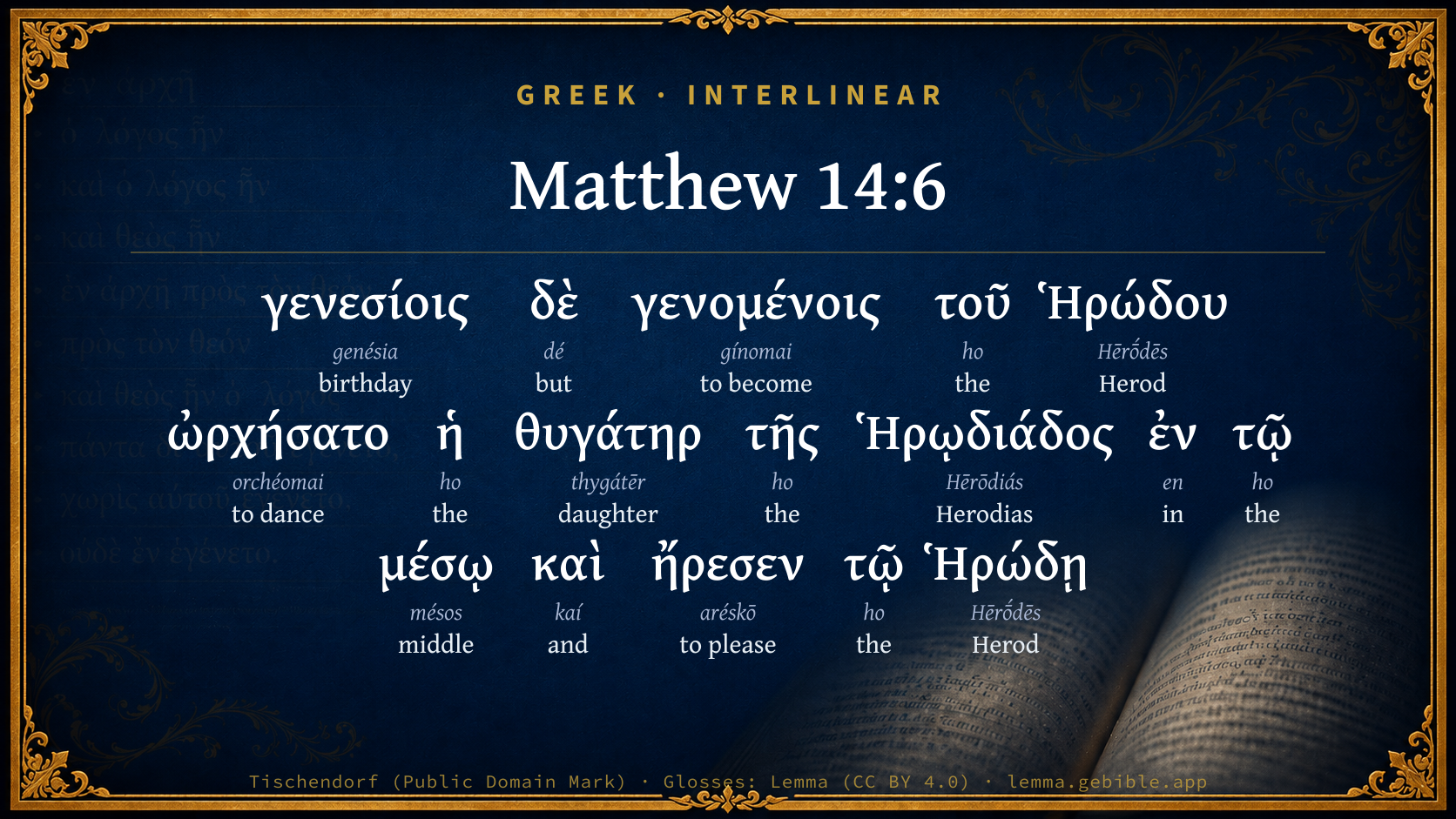
Download image
Cite this verse

Matthew 14:6 (World English Bible). Public Domain. Lemma interlinear Bible study tool, https://lemma.gebible.app/v/matthew/14/6.

Show BibTeX & RIS
BibTeX
RIS
English Translation
But when Herod's birthday came, the daughter of Herodias danced among them and pleased Herod.
World English Bible · Public Domain
Highlights
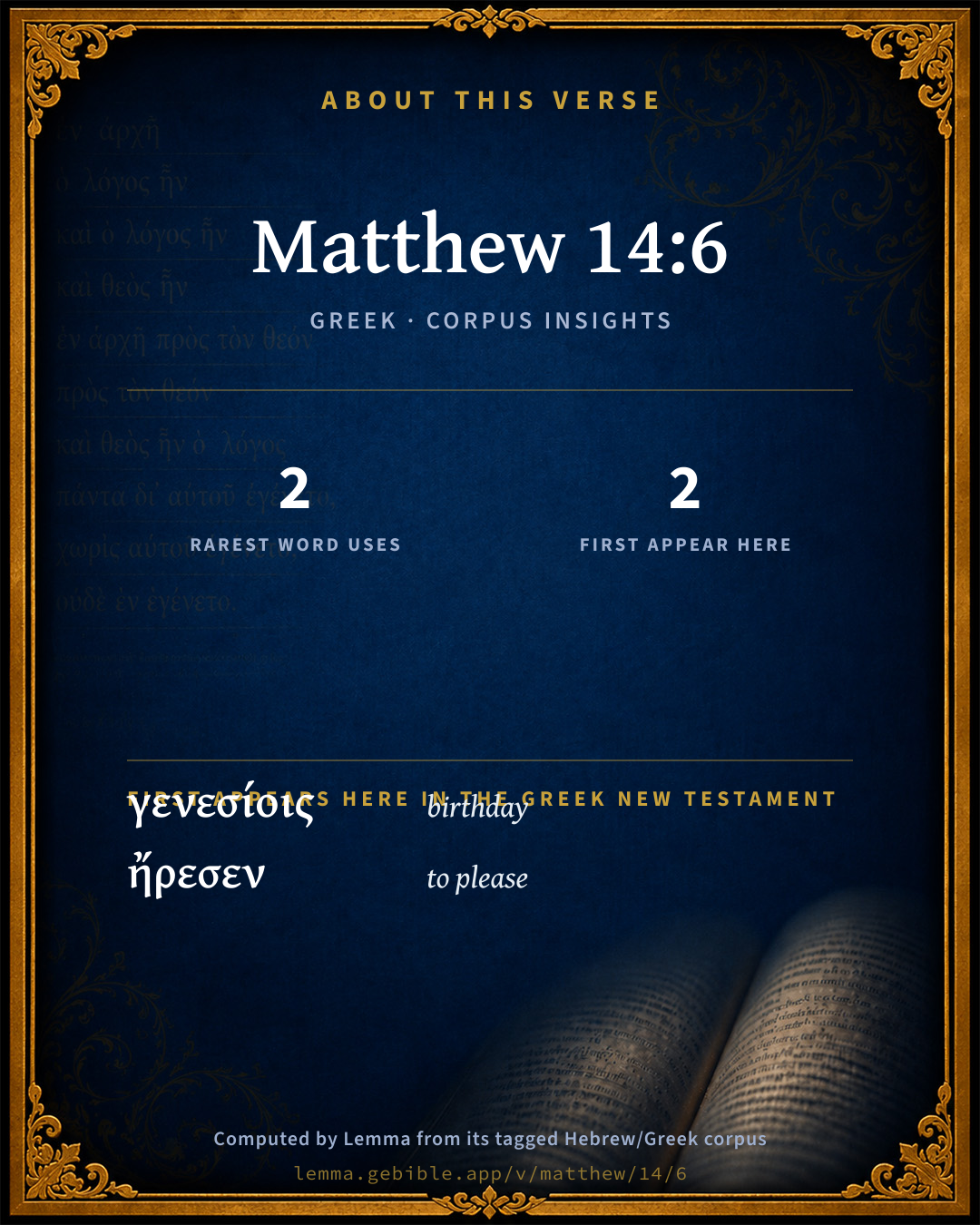
  • 2 first appearances in the Greek New Testament
Full analysis ↓
Download a study sheet

One document with this verse’s original text, its word-by-word gloss line, the meaning frame, cross-references with their text, attributed commentary, and full source and license credits — printable, and it pastes into notes with its structure intact.

This verse Autodidact and up

Study sheet (.html) Plain text (.txt)

A passage Seminary Student

Up to 50 verses in one chapter. A passage sheet keeps up to 6 commentary sources and 12 cross-references per verse, in the order this page ranks them, and says so on the sheet whenever that leaves anything out. Ask for a single verse and you get the Autodidact verse sheet above.

Everything on this page stays free to read, with no account — the sheet is a download of what is already on screen, not access to it.

Want to remove ads? Support Godless Engineer
Compare translations 3

The same verse in 3 English versions, stacked beneath the original-language interlinear above. Click any original word for its lexicon entry.

Each is an independent rendering of the whole verse — the interlinear is not word-aligned to these translations.

Highlighted words mark where these versions differ — a whole-verse word diff, not a word-by-word alignment.

  • World English Bible Public Domain
    But when Herod's birthday came, the daughter of Herodias danced among them and pleased Herod.
  • King James Version Public Domain
    But when Herod's birthday was kept, the daughter of Herodias danced before them, and pleased Herod.
  • unfoldingWord Literal Text CC BY-SA 4.0
    But the birthday of Herod having come, the daughter of Herodias danced in the midst and pleased Herod,

unfoldingWord Literal Text — © unfoldingWord, licensed CC BY-SA 4.0. Word-aligned USFM3 via Door43 (git.door43.org/unfoldingWord/en_ult).

Versions to compare (up to 4)

3 of 4 selected

Show all 19 translations

Every available English version of this verse, each an independent rendering of the whole verse.

  • World English Bible Public Domain
    But when Herod's birthday came, the daughter of Herodias danced among them and pleased Herod.
  • Berean Standard Bible Public Domain
    On Herod’s birthday, however, the daughter of Herodias danced before them and pleased Herod
  • Majority Standard Bible Public Domain
    When Herod’s birthday was being celebrated, however, the daughter of Herodias danced before them and pleased Herod
  • King James Version Public Domain
    But when Herod's birthday was kept, the daughter of Herodias danced before them, and pleased Herod.
  • American Standard Version (1901) Public Domain
    But when Herod's birthday came, the daughter of Herodias danced in the midst, and pleased Herod.
  • Revised Version (1885) Public Domain
    But when Herod’s birthday came, the daughter of Herodias danced in the midst, and pleased Herod.
  • Geneva Bible (1599) Public Domain
    But when Herods birth day was kept, the daughter of Herodias daunced before them, and pleased Herod.
  • Douay-Rheims (1899) Public Domain
    But on Herod's birthday, the daughter of Herodias danced before them: and pleased Herod.
  • Young's Literal Translation Public Domain
    But the birthday of Herod being kept, the daughter of Herodias danced in the midst, and did please Herod,
  • Literal Standard Version CC BY-SA 4.0
    But the birthday of Herod being kept, the daughter of Herodias danced in the midst, and pleased Herod,
  • Unlocked Literal Bible CC BY-SA 4.0
    But when Herod's birthday came, the daughter of Herodias danced in the midst and pleased Herod.
  • unfoldingWord Literal Text CC BY-SA 4.0
    But the birthday of Herod having come, the daughter of Herodias danced in the midst and pleased Herod,
  • Darby Bible Public Domain
    But when Herod's birthday was celebrated, the daughter of Herodias danced before them, and pleased Herod;
  • World Messianic Bible Public Domain
    But when Herod’s birthday came, the daughter of Herodias danced among them and pleased Herod.
  • Webster's Bible Public Domain
    But when Herod's birth-day was kept, the daughter of Herodias danced before them, and pleased Herod.
  • Free Bible Version CC BY-SA 4.0
    However, on Herod's birthday the daughter of Herodias danced for the party, and Herod was delighted with her.
  • Bible in Basic English Public Domain
    But when Herod's birthday came, the daughter of Herodias was dancing before them, and Herod was pleased with her.
  • Text-Critical English NT CC BY 4.0
    But when Herod's birthday was celebrated, the daughter of Herodias danced before the guests and pleased Herod.
  • Tyndale New Testament (1534) Public Domain
    But when Herodes birth daye was come the doughter of Herodias daunsed before them and pleased Herod.

Literal Standard Version (2020), Covenant Press — licensed CC BY-SA 4.0. Text via the HelloAO Bible API (eBible.org). Unlocked Literal Bible (unfoldingWord) — licensed CC BY-SA 4.0. Text via the HelloAO Bible API (eBible.org). unfoldingWord Literal Text — © unfoldingWord, licensed CC BY-SA 4.0. Word-aligned USFM3 via Door43 (git.door43.org/unfoldingWord/en_ult). Free Bible Version, Dr. Jonathan Gallagher — licensed CC BY-SA 4.0. Text via the HelloAO Bible API (eBible.org).

Word by word

More ways to search: Search by grammar → Find every occurrence → Compare this word →

Practice this passage: Drill this verse → Learn its vocabulary →

γενεσίοις
genésia
G1077
“birthday”
Noun, Dative, Plural, Neuter
Part of Speech
Noun
Case
Dative
Number
Plural
Gender
Neuter
Full Thayer's Definition

Origin: from a derivative of G1078

TDNT: None

1. a birthday celebration, a birthday feast a. the earlier Greeks used this word of funeral commemorations, a festival commemorative of a deceased friend
  1. δὲ dé G1161 “but” Conjunction
  2. γενομένοις gínomai G1096 “to become” Verb, Aorist, Middle deponent, Participle, Dative, Plural, Neuter
  3. τοῦ ho G3588 “the” Article, Genitive, Singular, Masculine
  4. Ἡρώδου Hērṓdēs G2264 “Herod” Noun, Genitive, Singular, Masculine
  5. ὠρχήσατο orchéomai G3738 “to dance” Verb, Aorist, Middle deponent, Indicative, 3rd person, Singular
  6. ἡ ho G3588 “the” Article, Nominative, Singular, Feminine
  7. θυγάτηρ thygátēr G2364 “daughter” Noun, Nominative, Singular, Feminine
  8. τῆς ho G3588 “the” Article, Genitive, Singular, Feminine
  9. Ἡρῳδιάδος Hērōdiás G2266 “Herodias” Noun, Genitive, Singular, Feminine
  10. ἐν en G1722 “in” Preposition
  11. τῷ ho G3588 “the” Article, Dative, Singular, Neuter
  12. μέσῳ mésos G3319 “middle” Adjective, Dative, Singular, Neuter
  13. καὶ kaí G2532 “and” Conjunction
  14. ἤρεσεν aréskō G700 “to please” Verb, Aorist, Active, Indicative, 3rd person, Singular
  15. τῷ ho G3588 “the” Article, Dative, Singular, Masculine
  16. Ἡρώδῃ Hērṓdēs G2264 “Herod” Noun, Dative, Singular, Masculine

About this verse

These counts appear in no published source. They are computed here, from the morphology-tagged text and Lemma’s own curated glosses. What Lemma adds →

17
words
12
distinct lemmas
Gospels
section

Notable vocabulary

The rarest word here is γενεσίοις birthday G1077 — appearing just 2 times in the whole Greek New Testament.

First appearance in Scripture

These words make their first canonical appearance in the Greek New Testament here:

  • γενεσίοις birthday G1077
  • ἤρεσεν to please G700

Shared distinctive vocabulary

γενεσίοις birthday G1077 occurs in 2 verses of the Greek New Testament. Also found in:
Repetition

Words recur within this verse:

  • Ἡρώδου Herod G2264 ×2
  • τοῦ the G3588 ×5

Cross-references

10

Topical passages linked to Matthew 14:6 in the Treasury of Scripture Knowledge — connected by theme and wording, ordered by reader-vote popularity; previews shown in the World English Bible.

  • Mark 6:21–23 Then a convenient day came, that Herod on his birthday made a supper for his nobles, the high officers, and the chief men of Galilee.
  • Genesis 40:20 It happened the third day, which was Pharaoh's birthday, that he made a feast for all his servants, and he lifted up the head of the chief cupbearer and the head of the chief baker among his servants.
  • Hosea 1:5–6 It will happen in that day that I will break the bow of Israel in the valley of Jezreel."
  • Esther 1:2–12 that in those days, when the king Ahasuerus sat on the throne of his kingdom, which was in Shushan the palace,
  • Matthew 22:24 saying, "Teacher, Moses said, 'If a man dies, having no children, his brother shall marry his wife, and raise up seed for his brother.'
  • Mark 6:17 For Herod himself had sent out and arrested John, and bound him in prison for the sake of Herodias, his brother Philip's wife, for he had married her.
  • Esther 2:18 Then the king made a great feast to all his princes and his servants, even Esther's feast; and he made a release to the provinces, and gave gifts, according to the bounty of the king.
  • Daniel 5:1–4 Belshazzar the king made a great feast to a thousand of his lords, and drank wine before the thousand.
  • Mark 6:19 Herodias set herself against him, and desired to kill him, but she couldn't,
  • Luke 3:19 but Herod the tetrarch, being reproved by him for Herodias, his brother's wife, and for all the evil things which Herod had done,

Cross-references courtesy of OpenBible.info (CC BY 4.0).

Commentary

Notes on Matthew 14:6 from classic Christian and Jewish commentators (each source and its license shown beneath its notes). The classic Christian expositions comment on the surrounding passage and are grouped to its opening verse, so a note may address several verses; the Jewish commentaries on the Tanakh (Rashi and others) are per-verse, so they appear only where the commentator wrote on this verse.

Lemma curates 59 commentaries, every one of them public domain or Creative Commons licensed, each selected and text-cleaned for this edition rather than reprinted as found. About our sources →

Tyndale Open Study Notes

Tyndale Open Resources

14:6 Herodias’s daughter was probably Salome, a daughter from Herodias’s previous marriage to Philip. Sexually provocative dances such as this were a regular occurrence for depraved royalty.

Tyndale Open Study Notes — © Tyndale Open Resources, licensed CC BY-SA 4.0. Text via the HelloAO Bible API.

Bengel's Gnomon

Johann Albrecht Bengel

Mat 14:6. Γενεσίῳν) Either the day on which he was born, as the LXX. use the word in Gen 40:20, or that on which he began to reign. Remarkable days of high festival are accompanied with great danger of falling into sin.[665]—ὠρχήσατο, she danced) A light matter; the handle of a most weighty matter.—θυγάτηρ, daughter) Salome by name.—ἐν τῶ μέσῳ, in the midst) in the sight of all during the banquet.

[665] Of this kind are, for instance, dedication-festivals, market-days, etc.; for, when these are celebrated according to custom, often weariness and lamentations succeed to vain rejoicings. And yet the world does not allow itself to be advised to better things.—V. g.

Bengel's Gnomon of the New Testament — English translation (T&T Clark, Edinburgh, 1860) — public domain. Text from a community e-Sword module.

Meyer's Critical & Exegetical Commentary

Heinrich August Wilhelm Meyer

Mat_14:6 ff. Γενέσια, Birthday celebration. Lobeck, ad Phryn. p. 103 f.; Suicer, Thes. I. p. 746; Loesner, Obss. p. 40. Others (Heinsius, Grotius, Is. Vossius, Paulus) interpret: a festival by way of commemorating Herods accession, because the latter is often compared to a birth, Psa_2:7; 1Sa_13:1. An unwarranted departure from ordinary usage. Wieseler likewise takes the word as referring to the accession, but improperly appeals, partly to the fact of its being used to denote a celebration in memory of the dead (Herod. iv. 26), comp. Lex. rhet. p. 231, a figurative sense which only tells in favour of our interpretation, and partly to the Rabbinical גנוסיא של מלכם (Avoda Sara i. 3), where, however, the royal birthdays are likewise meant. No instance is to be found in the Greek classics (for the Latin natalis, see Plin. Paneg. 82).

For the dative of time, see Winer, p. 205 [E. T. 276].

ἡ θυγάτηρ τῆς Ἡρωδ.] and of Philip. She was called Salome, and married her uncle, Philip the tetrarch. See Josephus, Antt. xviii. 5. 4. Her dancing was, doubtless, of a mimetic and wanton character. Hor. Od. iii. 6. 21. Wetstein on this passage. Moreover, this circumstance of the girl dancing is in keeping with the view that fixes the date of this scene as early as the year 29; while it is entirely at variance with Keims supposition, that it occurred in the year 3435, by which time Salome had been long married, and, for aught we know, may already have been left a widow; for which reason Keim considers himself all the more justified in ascribing a legendary character to the narrative, though without interfering in any way with the historical nucleus of the story, which he believes has not been affected by the plastic influence of legend; while Volkmar again declares the whole to be a fabrication.

ἐν τῷ μέσῳ] In the centre of the banqueting hall. The subject of ἤρεσε is still ἡ θυγάτ.

ὅθεν] as in Act_26:19, frequently in the Epistle to the Hebrews, and common in classical writers.

προβιβασθεῖσα] urged, induced, prevailed upon, not: instructed (neither is it to be so rendered in Exo_35:34). See Plat. Prot. p. 328 B; Xen. Mem. i. 5. 1; Polyb. iii. 59. 2, xxiv. 3. 7; Bremi, ad Aeschin. Ctesiph. 28; Kühner, ad Xen. Mem. i. 2. 17.

ὧδε] therefore without any delay.

ἐπὶ πίνακι] upon a plate.

Meyer — Critical and Exegetical Commentary on the New Testament — English translation by Peter Christie, edited by Frederick Crombie (T&T Clark, 1880) — public domain. Text from a community e-Sword module.

Expositor's Greek Testament

ed. W. Robertson Nicoll

Mat 14:6 . γενεσίοις γενομένοις : one expects the genitive absolute as in T.R., which just on that account is to be suspected. The dative of time. But cf. Mar 6:21 , where we have γενομένης and γενεσίοις occurring together, and vide Weiss, Mk.-Evang., p. 221, on the literary connection between the two texts. Most commentators take γενεσίοις as referring to Herod’s birthday. Some, e.g. , Grotius, think of the anniversary of the accession to the throne = birthday of his reign . In classic Greek it means a feast in honour of the dead on their birthday, γενέθλια being the word for a birthday feast, vide Lobeck, Phryn., 103. Loesner, Observ. ad N. T. e. Phil. Alex., cites instances from Philo of the use of both words in the sense of a birthday feast. ἡ θυγάτηρ τ . Ἡρῳδ .: Salome by name. ἐν τῷ μέσῳ , implies a festive assembly, as fully described in Mk.

The Expositor's Greek Testament, edited by W. Robertson Nicoll (1897–1910) — public domain. Text from a community e-Sword module.

Geneva Bible (1599)

Geneva Bible translators

There were three Herods: the first of them was Antipater’s son, who is also called Ascalonius, in whose reign Christ was born, and he it was that caused the children to be slain. The second was called Antipas, Magnus his son, whose mother’s name was Malthace or Martaca, and this was called Tetrarch, by reason of enlarging his dominion, when Archelaus was banished to Vienna in France. The third was Agrippa, Magnus his nephew by Aristobulus, and he it was that slew James.

Geneva Bible (1599) marginal notes — public domain. Text via Bolls.life.

Adam Clarke's Commentary

Verse 6. Herod's birth-day] Either the day in which he was born, or the day on which he began to reign; for both were termed birth-days. See 1Sa 13:1, and Ho 7:5. The kings of Persia were accustomed to reject no petition that was preferred to them during the entertainment. See Herodotus in Calliope, and Es 5:3.

The daughter - danced] This was Salome, mentioned before. Danced: by a literal rendering of the saltavit of the Vulgate, in my old MS. of the English Bible, the whole of this business seems to be treated with sovereign contempt: for thus says the translator, Shee leped in the myddle.

Adam Clarke's Commentary on the Bible (1810–1826) — public domain. Text from a community e-Sword/MySword module.

Ellicott's Commentary for English Readers

(6) Herod’s birthday.—Some critics have looked on the feast as one commemorating Herod’s accession—his birth-day as a ruler; but there seems no reason for not accepting the word in its simple natural sense. Such feasts were common enough in the imperial life at Rome, and that of Herod’s birthday had become proverbial even there (Persius, Sat. v., i. 180).

The daughter of Herodias danced before them.—Dances in filmy garments that but half concealed the form, commonly of an impure or voluptuous nature, were common enough both at Eastern and Roman banquets, the guests being simply spectators. But the dancers were for the most part women who made it their calling, like the nautch-girls of India; and it was a new thing, at which every decent Jew would shudder, for the daughter of a kingly house to come-thus into a shameless publicity and expose herself to the gaze of the banqueters, including as they did the chief captains and chiliarchs of the Roman legions, as well as Herod’s own courtiers and the chief men of the province (Mar_6:21). But Herodias, it would seem, knew the tetrarch’s weak point as well as Madame du Barry knew that of Louis XV. of France, and sought to bend him to her will, even though it were by the sacrifice of her daughter’s modesty. She danced before them—literally, in the midst of them—as they reclined on their couches indolently gazing. Her name is given by Josephus (Ant. xviii. 5, § 4) as Salome.

A Bible Commentary for English Readers, edited by Charles John Ellicott (1878–1897) — public domain. Text from a community e-Sword module.

The Cambridge Bible for Schools and Colleges

gen. ed. J. J. S. Perowne

6. the daughter of Herodias] Salome; she was afterwards married to her uncle Herod-Philip, the tetrarch, and on his death to Aristobulus, grandson of Herod the Great.

danced before them] Some sort of pantomimic dance is meant. Horace notes as one of the signs of national decay that even highborn maidens learnt the voluptuous dances of the East. Herod would recall similar scenes at Rome. See note Mat_14:1.

The Cambridge Bible for Schools and Colleges (gen. ed. J. J. S. Perowne; Cambridge University Press, 1878–1918) — public domain. Text from a community e-Sword module.

John Gill's Exposition

But when Herod's birthday was kept,.... The birthdays of princes, both of their coming into the world, and accession to the throne of government, were kept by the Gentiles; as by the Egyptians, Gen 40:20 and by the (n) Persians, and Romans (o), and other nations, but not by the Jews; who reckon these among the feasts of idolaters.

"These (say they (p)) are the feasts of idolaters; the "Calends", and the "Saturnalia", the time kept in memory of subduing a kingdom (or when a king takes possession of it, the day of his accession), , "and the birthday of kings" (when they are made and crowned, the day of coronation), and the day of birth, and the day of death.''

And it is a question, whether this day, that was kept, was the day of Herod's natural birth, or of his civil government, being his accession, or coronation day: and it might also be a question, whether it was the then present Herod's birthday, or whether it was not his father Herod's, was it not that Mark says, Mar 6:21 it was his birthday; since it is the latter the poet (q) refers to, as kept by Jews, when he says, "At cum Herodis venere dies"; and the old Scholiast upon him observes, that

"Herod reigned over the Jews in Syria, in the times of Augustus; therefore the Herodians kept Herod's birthday, as also the sabbath, on which day they set up candles in the windows lighted, and encircled with violets.''

This they did, believing him to be the Messiah: and it is further to be observed, that the word here used, is said (r) to be proper to the dead, and not to the living; and that he that uses it of the living, speaks very inaccurately: but however, it was a festival, and a time of great mirth and jollity; and a proper opportunity offered to Herodias, to execute her malicious designs against John the Baptist; for at this time,

the daughter of Herodias danced before them: in the original text it is, "in the midst", in the middle of the hall; or in the midst of the company, the lords, high captains, and chief estates of Galilee, for whom Herod made a supper, Mar 6:21 and the Syriac renders it , "before the guests". Music and dancing were usual at such entertainments, they were the common appendages of a feast (s): the daughter of Herodias, who danced before the company for their diversion, whether alone, or with others, was very probably Salome (t), whom she had by her former husband; and therefore is called, not the daughter of Herod, but of Herodias:

and pleased Herod; and as Mark adds, "and them that sat with him"; so that the pleasure he had did not arise merely from the respect and honour shown to him and his birthday, by her appearing with so much cheerfulness on this occasion before him; who had taken her father's wife from him, and defiled her mother; but from the airs, gestures, and motions of the lady in dancing; which were so extremely fine and regular, that she gave wonderful satisfaction and delight to Herod, and the whole company.

(n) Herodot. l. 1. c. 133. & 9. c. 109. (o) Plin. Ep. 1. 10. ep. 61. (p) Misn. Avoda Zara, c. 1. sect. 3. (q) Persius, Satyr. 5. prope finem. (r) Ammonius, &c. in lit. (s) Alex. ab Alex. Genial. Dier. l. 2. c. 25. (t) Joseph. Antiqu. l. 18. c. 6.

John Gill's Exposition of the Whole Bible (1746–1763) — public domain (CC PDM 1.0). Text via the HelloAO Bible API.

Trapp's Complete Commentary

John Trapp

6 But when Herod’s birthday was kept, the daughter of Herodias danced before them, and pleased Herod.

Ver. 6. But when Herod’s birthday was kept] All this was a mere plot, as St Mark also intimateth, in those words of his, Mat 6:21; "And when a convenient day was come." This birthday then was the day appointed long before by Herod and his harlot for the acting of this tragedy. {a} A great feast must be prepared, the states invited, the damosel must dance, the king swear, the Baptist thereupon be beheaded, that the Queen may be gratified. And this tragedy was new acted at Paris, A.D. 1572, when the French massacre was committed under pretence of a wedding royal. Cardinal Lorrain gave a great sum of money to him that brought the first news thereof to Rome, and the pope caused it to be painted in his palace.

The daughter of Herodlas danced] Tripudiabat tripped on the toe in a most immodest manner, as they used to do in their bacchanals, as the word signifieth. {b} This old fornicator seemed to be taken and tickled with the sight, that like a madman he swears to give her her request, to the half of the kingdom, which yet was more than he could do, the kingdom being not his, but the Emperor of Rome’s, to dispose of. So as Robert, Duke of Normandy, passed through Falaise, he beheld among a company of young maids dancing, one Arlet, a tanner’s daughter, whose nimbleness in her dance so enamoured the Duke, that he took her for his concubine, and on her begat our William the Conqueror. Such and no better commonly are the effects of mixed dancings, which made Chrysostom say, Ubi est saltatio, ibi eat diabolus, Where dancing is, there the devil is. And another ancient calleth dancing a circle, whose centre is the devil, blowing up the fire of concupiscence in the hearts both of the actors and spectators. Augustine saith, Omnis motus et saltus petulantice est saltus in profundum cloacae, Every caper in the dance is a leap into a deep outhouse. No sober man doth dance, saith Cicero.

And pleased Herod] Who was now well heated with wine as an oven, Pro 23:31; Pro 23:33, for then his eyes were apt to behold strange women, and his heart to utter perverse things. Gula Veneris vestibulum: Et Venus in vinis ignis ut igne furit. The throat of Venus into the court, and Venus is the firey wine as wild by fire. But what a monstrous thing it is to behold green apples on a tree in winter, to find youthful lusts in old decrepit goats!

{a} Res tota ex composito gesta est. Par.

{b} ωρχησατο, απο των υρχων, a vinearum ordinibus. from a type of wine.

John Trapp, A Commentary or Exposition upon All the Books of the Old and New Testament (1647–1656) — public domain. Text from a community e-Sword module.

Albert Barnes' Notes on the Bible

See also Mar 6:21-29. But when Herod’s birthday was come Kings were accustomed to observe the day of their birth with much pomp, and commonly, also, by giving a feast to their principal nobility. See Gen 40:20. Mark adds that this birthday was kept by making a supper to his “lords, high captains, and chief estates in Galilee;” that is to the chief men in office. “High captains” means, in the original, commanders of thousands, or of a division of 1,000 people.

The daughter of Herodias - That is, “Salome,” her daughter by her former husband. This was a violation of all the rules of modesty and propriety. One great principle of all eastern nations is to keep their females from public view. For this purpose they are confined in a particular part of the house, called the harem. See the notes at Mat 9:1-8. If they appear in public, it is always with a veil, so closely drawn that their faces cannot be seen. No modest woman would have appeared in this manner before the court, and it is probable, therefore, that she partook of the dissolute principles of her mother. It is also probable that the dance was one well known in Greece - the lascivious and wanton dance of the Ionics.

Mat 14:7

He promised with an oath - This a foolish and wicked oath.

To please a wanton girl, the monarch called the eternal God to witness his willingness to give her half his kingdom, Mar 6:23. It seems, also, that he was willing to shed the holiest blood it contained. An oath like this it was not lawful to make, and it should have been broken. See Mat 14:9.

Mat 14:8

Being before instructed of her mother - Not before she danced, but afterward, and before she made the request of Herod.

See Mar 6:24. The only appearance of what was right in the whole transaction was her honoring her mother by consulting her, but in this she only intended to accomplish the purposes of wickedness more effectively.

In a charger - The original word means a large platter on which food is placed. We should have supposed that she would have been struck with abhorrence at such a direction from her mother; but she seems to have been gratified. John, by his faithfulness, had offended the whole family, and here was ample opportunity for an adulterous mother and her dissolute child to gratify their resentment. It was customary for princes to require the heads of persons ordered for execution to be brought to them. For this there were two reasons:

To gratify their resentment - to feast their eyes on the proof that their enemy was dead; and, To ascertain the fact that the sentence had been executed.

There is a similar instance in Roman history of a woman requiring the head of an enemy to be brought to her. Agrippina, the mother of Nero, who was afterward emperor, sent an officer to put to death Lollia Paulina, who had been her rival for the imperial dignity. When Lollia’s head was brought to her, not knowing it at first, she examined it with her own hands until she perceived some particular feature by which the lady was distinguished.

Mat 14:9

And the king was sorry - There might have been several reasons for this.

1. Herod had a high respect for John, and feared him. He knew that he was a holy man, and had “observed him,” Mar 6:20. In the margin (Mark) this is “kept him,” or “saved him.” In fact he had interposed and saved John from being put to death by Herodias, who had had a quarrel with John, and would have killed him but for Herod, Mar 6:19. Herod, though a bad man, had a respect and veneration for John as a holy and just man, as wicked people often will have.

2. John was in high repute among the people, and Herod might have been afraid that his murder might excite commotion.

3. Herod, though a wicked man, does not appear to have been insensible to some of the common principles of human nature. Here was a great and most manifest crime proposed - no less than the murder of an acknowledged prophet of the Lord. It was deliberate. It was to gratify the malice of a wicked woman. It was the price of a few moments’ entertainment. His conscience, though in feeble and dying accents, checked him. He would have preferred a request not so manifestly wicked, and that would not have involved him in so much difficulty.

For the oath’s sake - Herod felt that he was bound by this oath; but he was not. The oath should not have been taken: but, being taken, he could not be bound by it. No oath could justify a man in committing murder. The true principle is, that Herod was bound by a prior obligation - by the law of God - not to commit murder; and no act of his, be it an oath or anything else, could free him from that obligation.

And them which sat with him at meat - This was the strongest reason why Herod murdered John. He had not firmness enough to obey the law of God and to follow the dictates of conscience against the opinions of wicked people. He was afraid of the charge of cowardice and want of spirit; afraid of ridicule and the contempt of the wicked. This is the principle of the laws of honor; this the foundation of dwelling. It is not so much for his own sake that one man murders another in a duel, for the offence is often a mere trifle - it is a word, or look, that never would injure him. It is because the “men of honor,” as they call themselves, his companions, would consider him a coward and would laugh at him. Those companions may be unprincipled contemners of the laws of God and man; and yet the duellist, against his own conscience, against the laws of God, against the good opinion of the virtuous part of the world, and against the laws of his country, seeks by deadly aim to murder another merely to gratify his dissolute companions. And this is the law of honor! This is the secret of duelling! This the source of that remorse that settles in awful blackness, and that thunders damnation around the duellist in his dying hours! It should be added, this is the course of all youthful guilt. Young men are led along by others. They have not firmness enough to follow the teachings of a father and of the law of God. They are afraid of being called mean and cowardly by the wicked; and they often sink low in vice and crime, never to rise again.

At meat - That is, at supper. The word “meat,” at the time the Bible was translated, meant provisions of all kinds. It is now restricted to flesh, and does not convey a full idea of the original.

Mat 14:11

And his head was brought in a charger ... - For the sake of these wicked people, the bloody offering - the head of the slaughtered prophet was brought and given as the reward to the daughter and mother.

What an offering to a woman! Josephus says of Herodias that “she was a woman full of ambition and envy, having a mighty influence on Herod, and able to persuade him to things he was not at all inclined to.” This is one of the many proofs that we have that the evangelists drew characters according to truth.

Mat 14:12

And his disciples ... - The head was with Herodias.

The body, with pious care, they buried.

And went and told Jesus - This was done, probably, for the following reasons:

It was an important event, and one particularly connected with the work of Jesus. John was his forerunner, and it was important that he should be made acquainted with his death. It is not unreasonable to suppose that in their affliction they came to him for consolation; nor is it improper in our affliction to follow their example, and go and tell Jesus. Their master had been slain by a cruel king. Jesus was engaged in the same cause, and they probably supposed that he was in danger. They therefore came to warn him of it, and he Mat 14:13 sought a place of safety.

Albert Barnes' Notes on the Bible (1834–1885) — public domain. Text from a community e-Sword/MySword module.

Matthew Poole's English Annotations

Mark relates this more fully, but the sense is the same, Mat 6:21-23, And when a convenient day was come, that Herod on his birthday made a supper to his lords, high captains, and chief estates of Galilee; and when the daughter of the said Herodias came in, and danced, and pleased Herod and them that sat with him, the king said unto the damsel, Ask of me whatsoever thou wilt, and I will give it thee. And he sware unto her, Whatsoever thou shalt ask of me, I will give it thee, unto the half of my kingdom. Those who have got over the point of lawfulness in an action, have nothing to consult but convenience: therefore saith Mark, when a convenient day was come, when probably Herod should be over merry with wine, or should be busy with his company, and not so much at leisure to consider what he did. It so happened that the daughter of this Herodias danced before Herod upon his birthday. The keeping of birthdays was usual amongst the eastern kings; Pharaoh kept his birthday, Gen 40:20. Some by it understand the day of the prince’s coronation, or entrance upon his government, which some think is meant in Hos 7:5, by the day of our king, (when) the princes made him sick with bottles of wine. The Jews reckoned them both amongst the pagan festivals, but they had derived both this and many other usages from them. Dancing was much used amongst them at their festivals, It seemeth this daughter of Herodias pleased Herod more than ordinary; he sweareth that he would give her what she would ask, to the half of his kingdom. That phrase, by Est 5:3, seemeth to have been ordinary with princes when they made liberal promises.

Matthew Poole's English Annotations on the Holy Bible (1683–1685) — public domain. Text from a community e-Sword/MySword module.

Whedon's Commentary on the Bible

Daniel D. Whedon

6. Herod’s birthday was kept — According to Mark this was done with great magnificence; for “he made a great feast for his lords, high captains, and the chief persons of Galilee.” The nobility of Galilee must have come some distance for the occasion. For it is plain, from the rapidity with which John was executed, that this celebration took place at or near the fortress of Macherus, where John was imprisoned, in southern Perea, near the confines of Arabia. It is highly probable that Herod was at this time engaged in war with Aretas, king of Arabia, for reasons fully narrated in our note upon Mat_14:1. This is confirmed from the fact that the executioner of John is by Mark called by the Latin term spiculator, which implies a military officer. The adulterous Herodias, the guilty cause of the war, like another Helen, is present to cheer her champion and amuse his festal hours. Danced — Female dancers in the East are a customary part of great entertainments. On this occasion the dancer was of high birth, being no other than the princess Salome, daughter of Herodias.

Daniel D. Whedon (gen. ed.), Commentary on the Old and New Testaments (1874–1909) — public domain. Text from a community e-Sword module.

The Pulpit Commentary

But when Herod"s birthday was kept; came (Revised Version); genesioiv de genomenoiv tou Hrwdou , dative of time (Winer, with the addition of a participle. Birthday. So "Pharaoh"s birthday". (Gen_40:20, hmera genesewv) Thayer"s Grimm refers to "Alciphr. Epp. 3, 18, and 55; Dio Cass., 47, 18, etc.," for genesia being used in the same sense. The Talmudic aysynyg (see Levy, s.v.) apparently represents the same word, and (preceded by has the same meaning (cf. Schurer, I 2:27). Possibly Jews found genesia an easier word to pronounce than the more classical geneslia . The daughter of Herodias; i.e. Salome, daughter of Herod Philip and Herodias; she afterwards married her half uncle, Philip the tetrarch (ver. 3, note). She could not now be less than seventeen or eighteen years old (cf. Gutschmid, in Schurer, I 2:28), so, in the East, could only just be still called a korasion (ver. 11). Mark"s text (like the Greek of Codex Bezae here) speaks of her as though she herself was called Herodias, and was the daughter of Antipas and Herodias; but the issue of this union could not then have been more than two years old (Schurer, loc. cit. ). Besides, the trait mentioned by Mark, (Mar_6:25) that she came back with haste to the king, asking for the head of the Baptist, implies that she was more than a child. Rendel Harris ("Texts and Studies," II 1. p. 68) suggests that the confusion is due to an early Latinization of the Greek from an ambiguous ejus. Danced. Probably with the same kind of voluptuous dance as that of the Egyptian almd described by Warburton ("Crescent and Cross," chap. 14.). But that a member of the royal family should so dance before a company must have been almost unheard of. Before them; in the midst (Revised Version). Matthew only. Such a dance with men sitting round would be specially abhorrent to the Jewish mind. And pleased Herod. And of course, as St. Mark adds, "them that sat with him" (cf. ver. 9).

The Pulpit Commentary (1880–1919), ed. H.D.M. Spence-Jones & Joseph S. Exell — public domain. Text from a community e-Sword module.

John Wesley's Explanatory Notes

The daughter of Herodias - Afterward infamous for a life suitable to this beginning.

John Wesley, Explanatory Notes Upon the Whole Bible (1754–1765) — public domain. Text via the GEBible commentary corpus.

Kretzmann's Popular Commentary

Paul E. Kretzmann

The birthday feast:

v. 6. But when Herod’s birthday was kept, the daughter of Herodias danced before them, and pleased Herod.

v. 7. Whereupon he promised with an oath to give her whatsoever she would ask.

v. 8. And she, being before instructed of her mother, said, Give me here John Baptist’s head in a charger.

There was a great birthday celebration, with much luxury and costly show, the highest military and civil authorities and the most prominent citizens of the country having been invited. There was much eating and drinking, and various forms of entertainment, after the Oriental custom. The feast was nearing its close, most of the guests were probably in a state of half-intoxication, the excitement of revelry had risen to the greatest height, when a feature not on the program was introduced by the cunning Herodias with the aim of carrying out her design. Her daughter Salome suddenly appeared in the midst of the festive assembly. Leaping into the middle of the hall, she performed a dance, a lascivious performance calculated to incite the passions. Herod and his guests broke out into wild rounds of applause. And, carried away by the sensual appeal of the dance, Herod made ready to reward the princess handsomely, backing up his first offer with an oath to give her whatever she might ask. Then was the scheme revealed; for the girl had been instructed, or rather induced, instigated, impelled, brought up to that point by her mother’s precepts, and so made her appalling request. Here, in the very place of her recent indecent exhibition, she demanded, on a large serving-platter, the head of John the Baptist. Thus the vindictive persecution of Herodias reached its climax. "Thus the hypocrites in our days also do; they murder the innocent, pretending, meanwhile, that it must be done because the people refuse to remain with the Christian Church. Very well: Persecute thou the Word of God, blaspheme His holy name and kill the innocent, and adorn thyself afterwards and say, I have done this for the sake of God’s Word and name. Wilt thou know what thou art? Thou art a child of Herod; he is thy father."

Paul E. Kretzmann, Popular Commentary of the Bible (1921–1924) — public domain. Text from a community e-Sword module.

Burkitt's Expository Notes on the New Testament

William Burkitt

Several observables are here to be taken notice of.

1. The time of this execrable murder: it was upon eastern kings to celebrate their birth-days: Pharaoh’s birth-day was kept, Gen 40:20. Herod’s here; both with blood; yet these personal stains do not make the practice unlawful. When we solemnize our birth-day with thankfulness to our Creator and Preserver, for life and being, for protection and preservation to that moment, and commend ourselves to the care of his good providence for the remainder of our days, this is an act of piety and religion. But Herod’s birth-day was kept with revelling and feasting, with music and dancing: not that dancing which is itself, is a set, regular, harmonious motion of the body, can be unlawful, and more than walking or running: circumstances may make it sinful.

But from this, although disorderly banquet on Herod’s birth-day, we learn, that great men’s feasts and frolics are too often, a season of much sin.

Observe, 2. The instigator and promoter of the Holy Baptist’s death, Herodias and her daughter: that good man falls a sacrifice to the fury and malice, to the pride and scorn, of a lustful woman, for being a rub in the way of her licentious adultery. Resolute sinners, who are mad upon their lusts, run furiously upon their gainsayers, though they be the prophets of God themselves, and resolve to bear down all opposition they meet with in the gratification of their unlawful desires.

Observe, 3. With what reluctance Herod consented to this villainy: The king was sorry: wicked men oft-times sin with a troubled and disturbed conscience: they have a mighty struggle with themselves before they commit their sins: but at last their lusts get the mastery over their consciences. So did Herod’s here; for:

4. Not withstanding his sorrow. He commands the fact: He sent and beheaded John in the sorrow. And a three-fold cord tied him to this performance.

1. The conscience of his oath. See his hypocrisy: he made conscience of a rash oath, who made no scruple of real murder.

2. Respect to his reputation, Them that sat with him heard his promise, and will be witness of his levity, if he do not perform. Insisting upon punctilio of honour has hazarded the loss of millions of souls.

3. A loathness to discontent Herodias and her daughter. O vain and foolish hypocrite, who dreaded the displeasure of a wanton mistress, before the offending of God and conscience!

Observe, 5. These wicked women not only require the Baptist to be beheaded, but that his head be brought in a charger to them. What a dish is here to be served up at a prince’s table on his birth-day! A dead man’s head swimming in blood! How prodigiously insatiably is cruelty and revenge! Herodias did not think herself safe till John was dead; she could not think him dead till his head was off; she could not believe his head was off till she had it in her hand.

Revenge never thinks it has made sure enough. O how cruel is a wicked heart, that could take pleasure in a spectacle of so much horror! How was that holy head tossed by impure and filthy hands! That true and faithful tongue, those pure eyes, those mortified cheeks are now insultingly handled by an incestuous harlot, and made a scorn to the drunken eyes of Herod’s guest.

From the whole, learn, 1. That neither the holiest of prophets, nor the best of men, are more secure from violence, than from natural death. He that was sanctified in the womb, conceived and born with so much miracle, lived with so much reverence and observation, is now at midnight obscurely murdered in a close prison.

Learn, 2. That it is as true a martyrdom to suffer for duty, as for faith: he dies as tryly a martyr that dies for doing his duty, as he that dies for professing the faith, and bearing witness to the truth.

William Burkitt's Expository Notes on the New Testament (1700–1703) — public domain. Text from a community e-Sword module.

The People's New Testament

B. W. Johnson

6. When Herod's birthday was kept. In imitation of the Roman emperors, the Herodian princes kept their birthdays with feasting and revelry and magnificent banquets. We learn from Mark that he made a supper, or banquet feast. The daughter of Herodias. Her name, according to Josephus, was Salome, a daughter by Philip, Herod's brother. She was afterwards married to her uncle Philip, the tetrarch of Iturea (Luke 3:1). Danced. It was not customary for the ladies of high rank to dance beyond the limit of the harem. The Oriental dance of a libertine character. But her wicked mother induced her own daughter thus to degrade herself in order to accomplish her revengeful purpose.

B. W. Johnson's The People's New Testament with Notes (1889–1891) — public domain. Electronic text from the Christian Classics Ethereal Library (CCEL) ThML edition.

unfoldingWord translationNotes

Door43 World Missions Community

in the midst

You can make explicit the implicit information. AT: "in the midst of the guests attending the birthday celebration" (See: Assumed Knowledge and Implicit Information)

translationWords

Herod Antipas

Herodias

promise

oath

unfoldingWord translationNotes — © Distant Shores Media and the Door43 World Missions Community, licensed CC BY-SA 4.0. Source: git.door43.org/Door43/en_tn.

Cambridge Greek Testament for Schools and Colleges

6. γενεσίοις γενομένοις, for γενεσίων γενομένων. The dative has decisive authority. The gen. abs. a grammatical note, which has come into the text as the easier reading.

6. γενεσίοις γενομένοις. Dative of time, ‘marking precisely time when’ (Clyde); cp. τοῖς σάββασιν, ch. Mat 12:2, Winer, p. 274. Plural, as usual in names of festivals, ἐγκαίνια, ἄζυμα, Παναθήναια, Saturnalia. Here τὰ γενέσια retains what must have been its original sense, ‘a birthday festival;’ but in classical Greek it meant a memorial feast in honour of the dead, celebrated on the anniversary of birth, and so distinguished from τὰ νεκύσια, the feast observed on the anniversary of death. See Rawlinson’s note on Herod. IV. 26. The classical word for a birthday feast was τὰ γενέθλια, this in turn came through the process of Christian thought to mean a festival commemorative of a martyr’s death—his birth into the new life—ἐπιτελεῖν τὴν τοῦ μαρτυρίου αὐτοῦ ἡμέραν γενέθλιον, Martyr. Polyc. 18, p. 1044 A. See Sophocles’ Lexicon on γενέθλιος and γενέσιος and Lob. Phryn. 104.

ὠρχήσατο. Some sort of pantomimic dance is meant. Horace notes as one of the signs of national decay that even highborn maidens learnt the voluptuous dances of the East, Hor. Od. III. 6. 21. Herod would recall similar scenes at Rome. See note Mat 14:1.

ἡ θυγάτηρ τῆς Ἡρωδιάδος. Salome; she was afterwards married to her uncle Herod-Philip, the tetrarch, and on his death to Aristobulus, grandson of Herod the Great.

Cambridge Greek Testament for Schools and Colleges (Cambridge University Press, 1896; 21 vols, various authors incl. Carr, Maclear, Plummer, Farrar, Lumby, Moule, M. R. James, Simcox) — public domain. Text from a community e-Sword module.

Alford’s Greek Testament

Henry Alford

6. γενεσίοις] the birthday. This name was given in classical Greek to an anniversary celebration of the memory of the dead. So Herod., iv. 26, having described such a celebration among the Issedones, adds, παῖς δὲ πατρὶ τοῦτο ποιέει κατάπερ οἱ Ἕλληνες τὰ γενέσια. Phrynichus, , and Ammonius lay it down that γενέσια is not to be used for γενέθλια, a birthday. But the adj. was certainly so used in later Greek: e.g. ἄγοντες τ. γενέσιον ἡμέραν τ. παιδίου, Jos. Antt. xii. 4. 7 (in Dio Cassius xlvii. 18, lvi. 46, lxvii. 2, usually cited, the γενέσια, though bearing this meaning, are in each case in honour of a dead person). See Suicer, Thes. under γενέθλια, and Lobeck’s note, Phryn. p. 103. Heins., Grot., ., hold that the word here means the feast of Herod’s accession: but they give no proof that it ever had such a meaning. Among the seasons kept by the Gentiles, enumerated in the Rabbinical work Avoda Sara, we have גנוסיא של מלכים: see Lightfoot in loc. [On the dative “compare the examples quoted by Jelf, § 699.” Moulton’s Winer, p. 276, note 1.]

A great feast was given to the nobility of Galilee, Mar 6:21. The damsel’s name was Salome (Jos. Antt. xviii. 5. 4), daughter of Herodias by her former husband Philip. She afterwards married her uncle Philip, tetrarch of Ituræa and Trachonitis: and he dying childless, she became the wife of her cousin Aristobulus, son of Herod king of Chalcis, by whom he had three sons, Herod, Agrippa, and Aristobulus. The dance was probably a pantomimic dance.

Henry Alford, The Greek Testament (1849–1861) — public domain. Text from a community e-Sword module.

International Critical Commentary

6. And on the birthday of Herod, the daughter of Herodias danced in the midst, and pleased Herod.] Mt. summarises Mk vv. 21 and 22.—γενεσίοις δὲ γενομένοις] For the dative, cf. Blass, p. 120, n. 3. The dative seems to be due to a fusion of Mk.’s τοῖς γενεσίοις with his preceding γενομένης ἡμέρας. γενέσια is used in the later Greek as equivalent to γενέθλια, a birthday; cf. Fayûm Towns, 11420, 1158, 11930.

(M)

International Critical Commentary — older volumes (1896–1929), various authors — public domain. Text from a community e-Sword module.

Vincent's Word Studies in the New Testament

Marvin R. Vincent

Birthday [γενεσιοις] . Though some explain it as the anniversary of Herod 's accession. The custom of celebrating birthdays by festivities was not approved by the strict Jews; but it is claimed that the Herodian princes adopted the custom. The Roman satirist, Persius, alludes to a festival known as "Herod 's Day," and pictures a banquet on that occasion.

"But when Come Herod 's day, and on the steaming panes The ranged lamps, festooned with violets, pour The unctuous cloud, while the broad tunny - tail Sprawled o'er the red dish swims, and snowy jars Swell with the wine." Sat. 5 180 - 183.

Before [εν τω μεσω] . Rev., in the midst. Wyc., leaped in the middle.

Marvin R. Vincent, Word Studies in the New Testament (1887–1900) — public domain. Text from a community e-Sword/MySword module.

Lesson kit

Teaching starters — assembled from the data on this page, not authored interpretation. Every prompt links to the verse data it draws on. Edit before teaching.

Matthew, in the Gospels, opens this verse with 17 words (12 distinct Greek lemmas). Its most distinctive word is genésia (“birthday”). A historical commentator’s framing appears above. Read the whole chapter for the surrounding context.

Discussion questions

  1. What does “birthday” (genésia) contribute to the verse as a whole?
  2. 2 words make their first appearance in Scripture here. What does this debut establish?
  3. How does Mark 6:21, which shares the word «birthday», read alongside this verse?
  4. What does the repetition of “Herod” (2× in this one verse) do in this verse?
  5. These translations render this verse differently. What is at stake in choosing one wording over another?
  6. Compare how Tyndale Open Study Notes and Bengel's Gnomon read this verse. Where do they agree or differ?

Things to notice

  • 2 words make their first canonical appearance in Scripture here.
  • These translations choose different wording for 9 words in this verse.
  • “Herod” occurs 2× in this single verse.
  • 12 distinct Greek lemmas span 17 words in this verse.

Reading settings

Reading text

Shown beneath each verse's original-language words.

Old Testament
Old Testament edition

Read the OT as the Masoretic Hebrew (MT) or the Greek Septuagint (LXX).

English shown for the Greek Septuagint (in the Hebrew ↔ Greek comparison).

Comparing translations? Open the Compare panel on any verse page to stack up to four side by side.