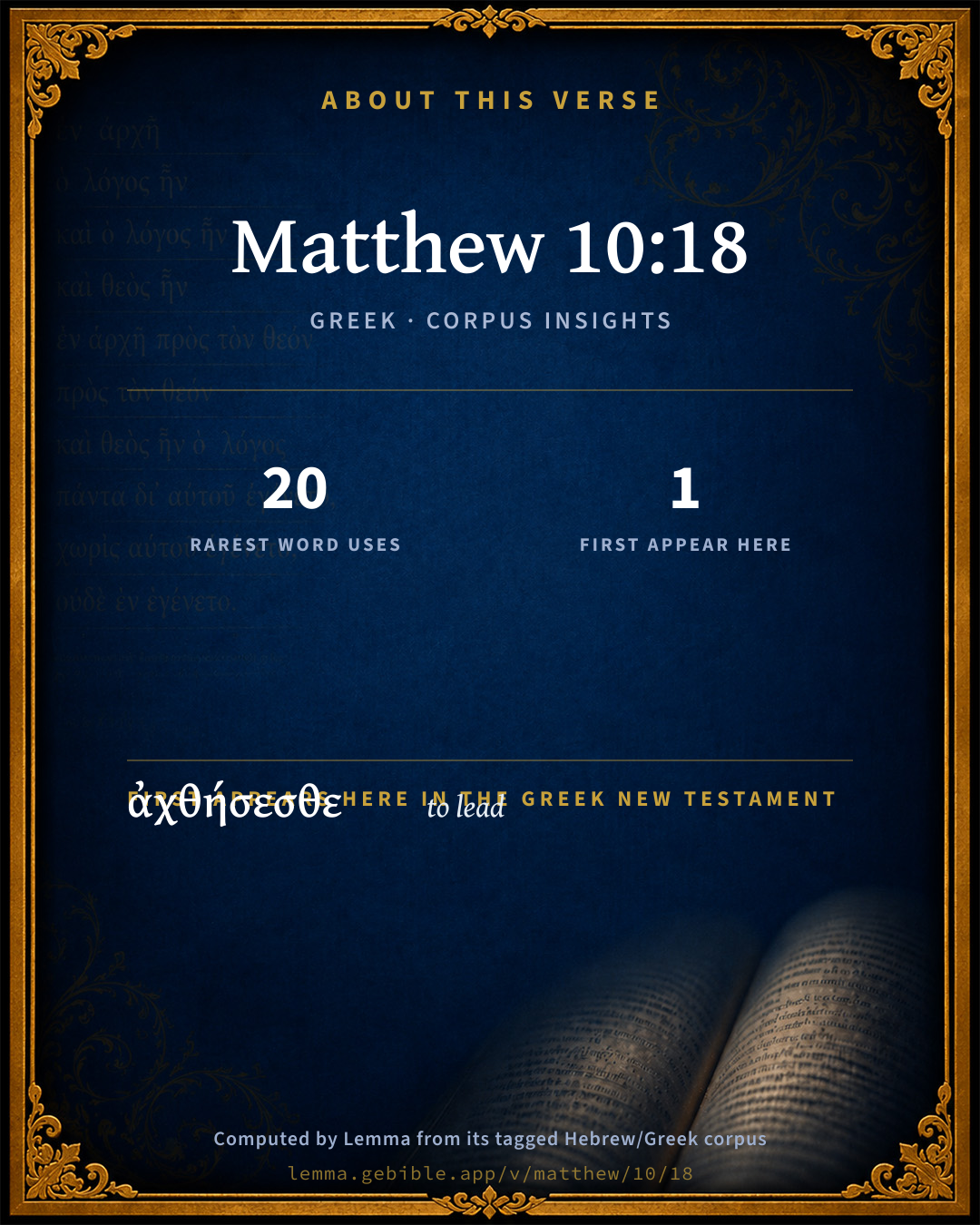
Matthew 10:18

Greek (Tischendorf 8th ed.) Matthew 10:18 appears in the Greek New Testament. The text above is from the Tischendorf 8th edition. Each word links to its Strong’s number and a concise gloss. Click any word for its full Thayer’s Greek Lexicon entry.

Download image
Cite this verse

Matthew 10:18 (World English Bible). Public Domain. Lemma interlinear Bible study tool, https://lemma.gebible.app/v/matthew/10/18.

Show BibTeX & RIS
BibTeX
RIS
English Translation
Yes, and you will be brought before governors and kings for my sake, for a testimony to them and to the Gentiles.
World English Bible · Public Domain
Highlights
  • 1 first appearance in the Greek New Testament
Full analysis ↓
Download a study sheet

One document with this verse’s original text, its word-by-word gloss line, the meaning frame, cross-references with their text, attributed commentary, and full source and license credits — printable, and it pastes into notes with its structure intact.

This verse Autodidact and up

Study sheet (.html) Plain text (.txt)

A passage Seminary Student

Up to 50 verses in one chapter. A passage sheet keeps up to 6 commentary sources and 12 cross-references per verse, in the order this page ranks them, and says so on the sheet whenever that leaves anything out. Ask for a single verse and you get the Autodidact verse sheet above.

Everything on this page stays free to read, with no account — the sheet is a download of what is already on screen, not access to it.

Want to remove ads? Support Godless Engineer
Compare translations 3

The same verse in 3 English versions, stacked beneath the original-language interlinear above. Click any original word for its lexicon entry.

Each is an independent rendering of the whole verse — the interlinear is not word-aligned to these translations.

Highlighted words mark where these versions differ — a whole-verse word diff, not a word-by-word alignment.

  • World English Bible Public Domain
    Yes, and you will be brought before governors and kings for my sake, for a testimony to them and to the Gentiles.
  • King James Version Public Domain
    And ye shall be brought before governors and kings for my sake, for a testimony against them and the Gentiles.
  • unfoldingWord Literal Text CC BY-SA 4.0
    and you will be brought also before governors and kings for my sake, for a testimony to them and to the Gentiles.

unfoldingWord Literal Text — © unfoldingWord, licensed CC BY-SA 4.0. Word-aligned USFM3 via Door43 (git.door43.org/unfoldingWord/en_ult).

Versions to compare (up to 4)

3 of 4 selected

Show all 19 translations

Every available English version of this verse, each an independent rendering of the whole verse.

  • World English Bible Public Domain
    Yes, and you will be brought before governors and kings for my sake, for a testimony to them and to the Gentiles.
  • Berean Standard Bible Public Domain
    On My account, you will be brought before governors and kings as witnesses to them and to the Gentiles.
  • Majority Standard Bible Public Domain
    On My account you will be brought before governors and kings as witnesses to them and to the Gentiles.
  • King James Version Public Domain
    And ye shall be brought before governors and kings for my sake, for a testimony against them and the Gentiles.
  • American Standard Version (1901) Public Domain
    yea and before governors and kings shall ye be brought for my sake, for a testimony to them and to the Gentiles.
  • Revised Version (1885) Public Domain
    yea and before governors and kings shall ye be brought for my sake, for a testimony to them and to the Gentiles.
  • Geneva Bible (1599) Public Domain
    And ye shall be brought to the gouernours and Kings for my sake, in witnes to them, and to the Gentiles.
  • Douay-Rheims (1899) Public Domain
    And you shall be brought before governors, and before kings for my sake, for a testimony to them and to the Gentiles:
  • Young's Literal Translation Public Domain
    and before governors and kings ye shall be brought for my sake, for a testimony to them and to the nations.
  • Literal Standard Version CC BY-SA 4.0
    and before governors and kings you will be brought for My sake, for a testimony to them and to the nations.
  • Unlocked Literal Bible CC BY-SA 4.0
    Then you will be brought before governors and kings for my sake, as a testimony to them and to the Gentiles.
  • unfoldingWord Literal Text CC BY-SA 4.0
    and you will be brought also before governors and kings for my sake, for a testimony to them and to the Gentiles.
  • Darby Bible Public Domain
    and ye shall be brought before rulers and kings for my sake, for a testimony to them and to the nations.
  • World Messianic Bible Public Domain
    Yes, and you will be brought before governors and kings for my sake, for a testimony to them and to the nations.
  • Webster's Bible Public Domain
    And ye will be brought before governors and kings for my sake, for a testimony against them and the Gentiles.
  • Free Bible Version CC BY-SA 4.0
    You will be dragged before governors and kings because of me, to witness to them and to the foreigners.
  • Bible in Basic English Public Domain
    And you will come before rulers and kings because of me, for a witness to them and to the Gentiles.
  • Text-Critical English NT CC BY 4.0
    For my sake you will even be brought before governors and kings as witnesses to them and to the Gentiles.
  • Tyndale New Testament (1534) Public Domain
    And ye shall be brought to the heed rulers and kynges for my sake in witnes to them and to the gentyls.

Literal Standard Version (2020), Covenant Press — licensed CC BY-SA 4.0. Text via the HelloAO Bible API (eBible.org). Unlocked Literal Bible (unfoldingWord) — licensed CC BY-SA 4.0. Text via the HelloAO Bible API (eBible.org). unfoldingWord Literal Text — © unfoldingWord, licensed CC BY-SA 4.0. Word-aligned USFM3 via Door43 (git.door43.org/unfoldingWord/en_ult). Free Bible Version, Dr. Jonathan Gallagher — licensed CC BY-SA 4.0. Text via the HelloAO Bible API (eBible.org).

Word by word

More ways to search: Search by grammar → Find every occurrence → Compare this word →

Practice this passage: Drill this verse → Learn its vocabulary →

ἡγεμόνας
hēgemṓn
G2232
“ruler”
Noun, Accusative, Plural, Masculine
Part of Speech
Noun
Case
Accusative
Number
Plural
Gender
Masculine
Full Thayer's Definition

Origin: from G2233

TDNT: None

1. a leader of any kind, a guide, ruler, prefect, president, chief, general, commander, sovereign a. a "legatus Caesaris", an officer administering a province in the name and with the authority of the Roman emperor 1. the governor of a province b. a procurator, an officer who was attached to a proconsul or a proprietor and had charge of the imperial revenues 1. in causes relating to these revenues he administered justice. In the smaller provinces also, which were so to speak appendages of the greater, he discharged the functions of governor of the province; and such was the relation of the procurator of Judaea to the governor of Syria. c. first, leading, chief d. of a principal town as the capital of the region
  1. καὶ kaí G2532 “and” Conjunction
  2. ἐπὶ epí G1909 “upon” Preposition
  3. δὲ dé G1161 “but” Conjunction
  4. καὶ kaí G2532 “and” Conjunction
  5. βασιλεῖς basileús G935 “king” Noun, Accusative, Plural, Masculine
  6. ἀχθήσεσθε ágō G71 “to lead” Verb, Future, Passive, Indicative, 2nd person, Plural
  7. ἕνεκεν héneka G1752 “for” Preposition
  8. ἐμοῦ egṓ G1473 “I” Personal pronoun, 1st person, Genitive, Singular
  9. εἰς eis G1519 “into” Preposition
  10. μαρτύριον martýrion G3142 “testimony” Noun, Accusative, Singular, Neuter
  11. αὐτοῖς autós G846 “he” Personal pronoun, Dative, Plural, Masculine
  12. καὶ kaí G2532 “and” Conjunction
  13. τοῖς ho G3588 “the” Article, Dative, Plural, Neuter
  14. ἔθνεσιν éthnos G1484 “nation” Noun, Dative, Plural, Neuter

About this verse

These counts appear in no published source. They are computed here, from the morphology-tagged text and Lemma’s own curated glosses. What Lemma adds →

15
words
13
distinct lemmas
Gospels
section

Notable vocabulary

The rarest word here is ἡγεμόνας ruler G2232 — appearing just 20 times in the whole Greek New Testament.

First appearance in Scripture

This word makes its first canonical appearance in the Greek New Testament here:

  • ἀχθήσεσθε to lead G71

Shared distinctive vocabulary

ἡγεμόνας ruler G2232 occurs in 19 verses of the Greek New Testament. Also found in:

Repetition

A word recurs within this verse:

Cross-references

12

Topical passages linked to Matthew 10:18 in the Treasury of Scripture Knowledge — connected by theme and wording, ordered by reader-vote popularity; previews shown in the World English Bible.

  • Psalms 2:1–6 Why do the nations rage, And the peoples plot a vain thing?
  • Matthew 8:4 Jesus said to him, "See that you tell nobody, but go, show yourself to the priest, and offer the gift that Moses commanded, as a testimony to them."
  • Mark 13:9 But watch yourselves, for they will deliver you up to councils. You will be beaten in synagogues. You will stand before rulers and kings for my sake, for a testimony to them.
  • Acts 5:25–27 One came and told them, "Behold, the men whom you put in prison are in the temple, standing and teaching the people."
  • Acts 24:1–26 After five days, the high priest, Ananias, came down with certain elders and an orator, one Tertullus. They informed the governor against Paul.
  • Acts 12:1–4 Now about that time, Herod the king stretched out his hands to oppress some of the assembly.
  • Acts 23:33–34 When they came to Caesarea and delivered the letter to the governor, they also presented Paul to him.
  • 2 Timothy 1:8 Therefore don't be ashamed of the testimony of our Lord, nor of me his prisoner; but endure hardship for the Gospel according to the power of God,
  • 2 Timothy 4:16–17 At my first defense, no one came to help me, but all left me. May it not be held against them.
  • Revelation 1:9 I John, your brother and partner with you in oppression, Kingdom, and perseverance in Christ Jesus, was on the isle that is called Patmos because of God's Word and the testimony of Jesus Christ.
  • Revelation 6:9 When he opened the fifth seal, I saw underneath the altar the souls of those who had been killed for the Word of God, and for the testimony of the Lamb which they had.
  • Revelation 11:7 When they have finished their testimony, the beast that comes up out of the abyss will make war with them, and overcome them, and kill them.

Cross-references courtesy of OpenBible.info (CC BY 4.0).

Commentary

Notes on Matthew 10:18 from classic Christian and Jewish commentators (each source and its license shown beneath its notes). The classic Christian expositions comment on the surrounding passage and are grouped to its opening verse, so a note may address several verses; the Jewish commentaries on the Tanakh (Rashi and others) are per-verse, so they appear only where the commentator wrote on this verse.

Lemma curates 59 commentaries, every one of them public domain or Creative Commons licensed, each selected and text-cleaned for this edition rather than reprinted as found. About our sources →

Bengel's Gnomon

Johann Albrecht Bengel

Mat 10:18. Δὲ, but) The particle is here used epitatically,[467] to denote a further step in the subject announced.—ἈΧΘΉΣΕΣΘΕ, ye shall be brought) The apostles did not come ultroneously to the rulers, they were brought.—αὐτοῖς, against them) sc. the Jews, in contradistinction to the Gentiles mentioned immediately afterwards,—καὶ τοῖς ἔθνεσιν, and the Gentiles) This chapter therefore already contemplates matters more remote, and refers to the apostolate after our Lord’s ascension.

[467] See Append, on Epitasis. An emphatic addition to an enunciation already made.—ED.

Bengel's Gnomon of the New Testament — English translation (T&T Clark, Edinburgh, 1860) — public domain. Text from a community e-Sword module.

Meyer's Critical & Exegetical Commentary

Heinrich August Wilhelm Meyer

Mat_10:18. Καὶ … δέ] and … but (always separated except in the epic poets), is of the nature of a climax, introducing still another circumstance, whereupon δέ follows this new and emphasized thought. Hartung, Partikell. I. p. 181 f.; Klotz, ad Devar. p. 645; Baeumlein, Partik. p. 148 f.

ἡγεμόνας] comprises the three kinds of provincial chief magistrates, propraetors, proconsuls, and procurators. Fischer, de vit. Lex. N. T. p. 432 ff.

εἰς μαρτύριον … ἔθνεσιν] as a testimony to them and to the Gentiles, i.e. those wrongs and that violent treatment have this as their object, that (through your confession and demeanour) a testimony regarding me may be given to the Jews and the Gentiles. Comp. Mat_8:4, Mat_24:14. Let it be observed: (1) that it is arbitrary to refer εἰς μαρτύριον, as is usually done, merely to the last point, καὶ ἐπὶ ἡγεμόνας, etc., seeing that everything, in fact, from παραδώσουσι onwards, belongs to one category and has one common aim; (2) that αὐτοῖς, therefore, cannot point to the ἡγεμόνας and βασιλεῖς, to whom it is commonly referred (Baumgarten-Crusius, Bleek), though not in keeping with the distinction expressed by καὶ τοῖς ἔθνεσιν, for the truth is, the procurators and kings were Gentiles also; but that, as is at once suggested to the reader by this adding on of καὶ τοῖς ἔθνεσιν, it rather refers to the Jews (Maldonatus, Bengel, Lange, Hilgenfeld, Schegg, following Theophylact), who (αὐτῶν, Mat_10:17) are the active subjects of παραδώσουσι, μαστιγώσουσιν, and partly also of ἀχθήσεσθε; (3) that, according to the context, τοῖς ἔθνεσιν, to the Gentiles, refers to the ἡγεμόνας and βασιλεῖς, and their Gentile environment; (4) and lastly, that the further reference of μαρτύριον is to be gathered from ἕνεκεν ἐμοῦ: a testimony of me, regarding my person and work. The dative case, however, is that of reference as regards the μαρτύριον; to define more specifically would be an unwarrantable liberty. This is applicable to the view adopted since Chrysostom: εἰς ἔλεγχον αὐτῶν (Theophylact, Euth. Zigabenus, Erasmus, Beza, Maldonatus, Kuinoel), although this is included in that general reference.

Meyer — Critical and Exegetical Commentary on the New Testament — English translation by Peter Christie, edited by Frederick Crombie (T&T Clark, 1880) — public domain. Text from a community e-Sword module.

Expositor's Greek Testament

ed. W. Robertson Nicoll

Mat 10:18 . ἡγεμόνας , provincial governors, including the three degrees: Propraetors, Proconsuls, and Procurators. From the point of view of the evangelist, who conceives the whole discourse as connected with the Galiean mission confined to Jews, the reference can only be to Roman governors in Palestine . But in Christ’s mind they doubtless had a larger scope, and pointed to judicial tribulations in the larger, Gentile world. εἰς μαρτύριον . The compensation for the incriminated will be that, when they stand on their defence, they will have an opportunity of witnessing for the Master ( ἔνεκεν ἐμοῦ ) and the Cause. Observe the combination καὶ δὲ in first clause of this verse, καὶ before ἐπὶ ἡγεμόνας , δὲ after it. It introduces a further particular under a double point of view, with καὶ so far as similar, with δὲ so far as different (Bäumlein, Schulgram. , § 675, also Gr. Partikeln , 188, 9). A more formidable experience.

The Expositor's Greek Testament, edited by W. Robertson Nicoll (1897–1910) — public domain. Text from a community e-Sword module.

Jamieson, Fausset & Brown

Robert Jamieson, A. R. Fausset & David Brown

And ye shall be brought before governors--provincial rulers.

and kings--the highest tribunals.

for my sake, for a testimony against them--rather, "to them," in order to bear testimony to the truth and its glorious effects.

and the Gentiles--"to the Gentiles"; a hint that their message would not long be confined to the lost sheep of the house of Israel. The Acts of the Apostles are the best commentary on these warnings.

Jamieson, Fausset & Brown — Commentary Critical and Explanatory on the Whole Bible (1871) — public domain (CC PDM 1.0). Text via the HelloAO Bible API.

Adam Clarke's Commentary

Verse 18. Ye shall be brought before governors, &c.] "This affords a striking proof of the prescience of Christ. Who could have thought, at that time, that these despised and illiterate men could excite so much attention, and be called upon to apologize for the profession of their faith before the tribunals of the most illustrious personages of the earth ?" Wakefield.

By governors and kings we may understand, the Roman proconsuls, governors of provinces, and the kings who were tributary to the Roman government, and the emperors themselves, before whom many of the primitive Christians were brought.

For a testimony against them and the Gentiles.] That is, to render testimony, both to Jews and Gentiles, of the truth and power of my Gospel.

Adam Clarke's Commentary on the Bible (1810–1826) — public domain. Text from a community e-Sword/MySword module.

Ellicott's Commentary for English Readers

(18) Ye shall be brought before governors and kings.—The words are significant as looking forward (if we assume the unity of the discourse) to that future work among the Gentiles upon which the Twelve were told that they were not as yet to enter. “Rulers” stands always in the New Testament for the governors (proconsuls, procurators, and others) of the Roman Empire. “Kings” at least includes, even if it does not primarily indicate, the emperors themselves.

Against them.—Rather, unto them. The word is simply the dative of the person to whom we address our testimony, not involving necessarily any hostile or even reproving purpose.

A Bible Commentary for English Readers, edited by Charles John Ellicott (1878–1897) — public domain. Text from a community e-Sword module.

The Cambridge Bible for Schools and Colleges

gen. ed. J. J. S. Perowne

18. governors] Such as Felix and Festus at Cæsarea, the Prætors or Duumviri at Philippi (Act_16:20), the Politarchs at Thessalonica (Act_17:6).

kings] As Herod Agrippa or the Roman Emperor.

The Cambridge Bible for Schools and Colleges (gen. ed. J. J. S. Perowne; Cambridge University Press, 1878–1918) — public domain. Text from a community e-Sword module.

John Gill's Exposition

But when they deliver you up,.... The apostles hearing that they should be delivered up to councils, and brought before governors and kings, might be under some concern how they should behave, and what they should be able to say in vindication of themselves and truth, before such great persons; they not being used to converse with men in such high stations: they were illiterate men, and of no elocution; men of mean birth, low life, most of them poor fishermen; and might fear, on these accounts, that the Gospel would suffer for want of able persons to defend it before the great ones of the earth. Now, in order to remove these their fears and objections, and to strengthen and comfort their minds, our Lord bids them, when this would be their ease, that the Jews would deliver them to the Roman magistrates, to

take no thought how, or what ye shall speak; not to be anxiously concerned, neither as to the matter, or manner of what they should say in their defence: they should have no occasion, as orators do, to take pains, and rack their thoughts, to prepare a studied, elaborate oration, dressed with all the flowers of rhetoric, filled with the most moving and powerful arguments, and clothed with diction of the strictest propriety and elegance; for they should want neither words, nor things; they should have arguments put into their mouths, and helped to proper language to express them in:

for it shall be given you in the same hour, what ye shall speak; immediate assistance should be afforded them either by his father, or himself; or rather, the blessed Spirit, who would suggest unto them, at once, things, the most proper to be said, and help them to deliver them in the most proper manner: and these are the most convincing arguments, and that the best elocution, which the Spirit of God helps men to; these vastly exceed all the art of men, and strength of nature. This was greatly verified in Peter and John, two poor fishermen, when before the council, and in Stephen the protomartyr.

John Gill's Exposition of the Whole Bible (1746–1763) — public domain (CC PDM 1.0). Text via the HelloAO Bible API.

Trapp's Complete Commentary

John Trapp

18 And ye shall be brought before governors and kings for my sake, for a testimony against them and the Gentiles.

Ver. 18. And ye shall be brought before governors] Yea, they offered themselves to them, crying Christiani sumus, We are Christians, and so tiring them thereby, that one of them {a} in a great chafe cried out, O miseri, si libet perire, num vobis rupes aut restes desunt? Can ye find no other way to despatch yourselves, but that I must be troubled with you?

And before kings, for my sake] As Paul before Agrippa, and afterwards Nero; Luther before Charles V; Lambert before Henry VIII.

{a} Artius Antoninus, apud Tertul.

John Trapp, A Commentary or Exposition upon All the Books of the Old and New Testament (1647–1656) — public domain. Text from a community e-Sword module.

Albert Barnes' Notes on the Bible

And ye shall be brought ... - This prediction was completely and abundantly fulfilled, Act 5:26; Act 12:1-4; Act 23:33; Act 26:1, Act 26:28, Act 26:30. Peter is said to have been brought before Nero, and John before Domitian, Roman emperors; and others before Parthian, Scythian, and Indian kings. They were to stand there to bear a testimony against them; or, as it might be rendered, to them. That is, they were to be “witnesses to them” of the great facts and doctrines of the Christian religion; and if they rejected Christianity, they would be witnesses “against” them in the day of judgment. The fulfillment of this prophecy is a signal evidence that Christ possessed a knowledge of the future. Few things were more improbable when this was uttered than that the fishermen of Galilee would stand before the illustrious and mighty monarchs of the East and the West.

Albert Barnes' Notes on the Bible (1834–1885) — public domain. Text from a community e-Sword/MySword module.

Haydock's Catholic Bible Commentary

For a testimony to them, &c. That is, that by suffering with fortitude and constancy, you may bear testimony of me, as men must know, that it is not any vain thing for which they see you are prepared to die. Or the sense may be, that this may be for you a testimony against them in the day of judgment, and may render them inexcusable, since they will be unable to say that they have not heard the gospel. (Menochius)

George Leo Haydock (1774–1849), Haydock's Catholic Family Bible and Commentary, 1859 edition — public domain. Excludes Psalms (Douay-Rheims chapter numbering differs from Protestant) and Deuterocanonical books (Catholic canon only).

Whedon's Commentary on the Bible

Daniel D. Whedon

18. Brought before governors — Procurators and proconsuls. Such were Pilate, Felix, and Festus. And kings — Such were Herod, Agrippa, and the Roman emperor. For a testimony against them — A memento in the great day of judgment, that the Gospel had been preached unto them, and had been rejected by them. And the Gentiles — For our Lord is now contemplating a field of trial far beyond the boundaries of Palestine, to which he had limited their present trial mission. From the humble encounters which they were to undergo before the magistrates and mobs in the towns of Palestine; our Lord mounts to their arraignments before the great ones of the earth and their expanded missions into the various Gentile nations. Here is a quiet yet signal prophecy of the spread of the Gospel in distant lands, and an intimation of the persecutions which marked the progress of Christianity for several centuries.

Daniel D. Whedon (gen. ed.), Commentary on the Old and New Testaments (1874–1909) — public domain. Text from a community e-Sword module.

The Pulpit Commentary

And; yea and (Revised Version); kai ... de . Ye shall be brought. Transposed in the Revised Version with the following words, because the stress of Christ"s saying lies, not on his followers being brought to trial, but on the high position of their judges. This marks both the extreme importance that their enemies will attach to them, and the lengths to which these will go. Before governors; i.e. , probably, representatives of others in supreme power. Such were Felix and Festus, the praetors at Philippi (hardly the politarchs at Thessalonica, for this was a free city), and Gallio at Corinth. But perhaps hgemwn is here used in the narrower sense of procurator, in which case of the above names only the first two ought to be mentioned, for Gallio was a proconsul (anyupatov). And kings. The supreme authorities themselves. So especially Nero, (2Ti_4:16) and even Herod Agrippa II, (Act_25:13, sqq.) for he was autocratic in his kingdom, save that he owed allegiance to the power that gave it to him. For my sake. (Mat_5:11, note) St. Peter ("for the Lord"s sake... king... governors," 1Pe_2:13, 1Pe_2:14) possibly refers to this utterance, but by using the singular, "king," recalls more definitely the one political organization with which his readers would be brought into contact in Asia Minor, the Roman emperor and his representatives. For a testimony against (to, Revised Version) them and (to, Revised Version) the Gentiles. Them. Not the Jews (Bengel, Meyer, and perhaps also the Revised Version), but the governors and kings. For (a) the parallel passage, Mar_13:9, omits "the Gentiles;" (b) the parallel passage, Mat_24:14 (vide supra), runs, "This gospel of the kingdom shall be preached in the whole world possibly, too, the word employed, oikoumenh , has special reference to the Roman empire for a testimony unto all the Gentiles." Both passages show that the Lord is not here thinking of the Jews, but only of the Gentiles and rulers from among them. Against; to. A witness to these Gentile rulers of what the gospel really does for men, and of their consequent responsibility; cf. Mat_8:4, note; also the parallel passage, Luk_21:13. Eusebius, referring to out" Lord"s words, gives a striking illustration in his "Mart. Pal.," 6.

The Pulpit Commentary (1880–1919), ed. H.D.M. Spence-Jones & Joseph S. Exell — public domain. Text from a community e-Sword module.

The People's New Testament

B. W. Johnson

18. Ye shall be brought before governors. Before the civil tribunals, like criminals. And kings. This was literally fulfilled in the case of James, the brother of John (Acts 12:2), and Paul (Acts 26:1).

B. W. Johnson's The People's New Testament with Notes (1889–1891) — public domain. Electronic text from the Christian Classics Ethereal Library (CCEL) ThML edition.

Cambridge Greek Testament for Schools and Colleges

18. ἡγεμόνας. Such as Felix and Festus at Cæsarea, the Praetors or Duumviri at Philippi (Act 16:20), the Politarchs at Thessalonica (Act 17:6).

βασιλεῖς. As Herod Agrippa or the Roman Emperor.

Cambridge Greek Testament for Schools and Colleges (Cambridge University Press, 1896; 21 vols, various authors incl. Carr, Maclear, Plummer, Farrar, Lumby, Moule, M. R. James, Simcox) — public domain. Text from a community e-Sword module.

Alford’s Greek Testament

Henry Alford

18.] καὶ.… δέ implies, yea and moreover; assuming what has just been said and passing on to something more. The words are always separated, except in the Epic poets. See Viger, ed. Herm. p. 545 (note), 844: Hartung, Partikellehre, i. 181 f.: Klotz ad Devar. p. 645.

ἡγεμόνας—Proconsuls, Proprætors, Procurators, as (Pontius Pilate,) Felix, Festus, Gallio, Sergius Paulus.

βασιλεῖς, as (Herod,) Agrippa. The former verse was of Jewish persecution; this, of Gentile: the concluding words shew that the scope of both, in the divine purposes, as regarded the Apostles, was the same, viz. εἰς μαρτ. αὐτ. κ. τ. ἔθν. The μαρτ. is in both senses—a testimony to, and against them (see ch. 8:4, note), and refers to both bets of persecutors: αὐτοῖς, to them, i.e. the Jews (not the ἡγ. καὶ βασ. for they are in most cases Gentiles themselves), καὶ τοῖς ἔθν. It was a testimony in the best sense to Sergius Paulus, Act 13:7, but against Felix, Act 24:25; and this double power ever belongs to the word of God as preached—it is a δίστομος ῥομφαία (Rev 1:16; Rev 2:12).

Henry Alford, The Greek Testament (1849–1861) — public domain. Text from a community e-Sword module.

International Critical Commentary

(M) 18. And before rulers and kings shall ye be led for My sake, for a testimony to them and to the Gentiles.] Mk. has: “And before rulers and kings shall ye stand (fast) for My sake, for a testimony to them.”—ἀχθήσεσθε] for Mk.’s σταθήσεσθε is suggested by ἄγωσιν of Mk v. 11.—καὶ τοῖς ἔθνεσιν] for Mk.’s harsh καὶ εἰς πάντα τὰ ἔθνη, which in Mk. belongs to the following verse. The editor could not take over the next few words, πρῶτον δεῖ κηρυχθῆναι τὸ εὐαγγέλιον, since they are obviously unsuited to this charge to the Twelve. He should therefore have stopped at μαρτύριον αὐτοῖς. See on 24:14.

International Critical Commentary — older volumes (1896–1929), various authors — public domain. Text from a community e-Sword module.

Lesson kit

Teaching starters — assembled from the data on this page, not authored interpretation. Every prompt links to the verse data it draws on. Edit before teaching.

Matthew, in the Gospels, opens this verse with 15 words (13 distinct Greek lemmas). Its most distinctive word is hēgemṓn (“ruler”). A historical commentator’s framing appears above. Read the whole chapter for the surrounding context.

Discussion questions

  1. What does “ruler” (hēgemṓn) contribute to the verse as a whole?
  2. The word “to lead” first appears here in Scripture. What is being introduced at this debut?
  3. Matthew 2:6 shares the word «ruler» with this verse. How do the two illuminate each other?
  4. “and” occurs 3× in this one verse. What is the effect of the repetition?
  5. The translations on this page render this verse differently — a whole-verse word diff, not a word-by-word alignment. What might account for the different wordings?
  6. Reading how Bengel's Gnomon and Meyer's Critical & Exegetical Commentary read this verse, where do the two commentators agree and where do they part?

Things to notice

  • 1 word makes its first canonical appearance in Scripture here.
  • These translations choose different wording for 6 words in this verse.
  • “and” occurs 3× in this single verse.
  • 13 distinct Greek lemmas span 15 words in this verse.

Reading settings

Reading text

Shown beneath each verse's original-language words.

Old Testament
Old Testament edition

Read the OT as the Masoretic Hebrew (MT) or the Greek Septuagint (LXX).

English shown for the Greek Septuagint (in the Hebrew ↔ Greek comparison).

Comparing translations? Open the Compare panel on any verse page to stack up to four side by side.