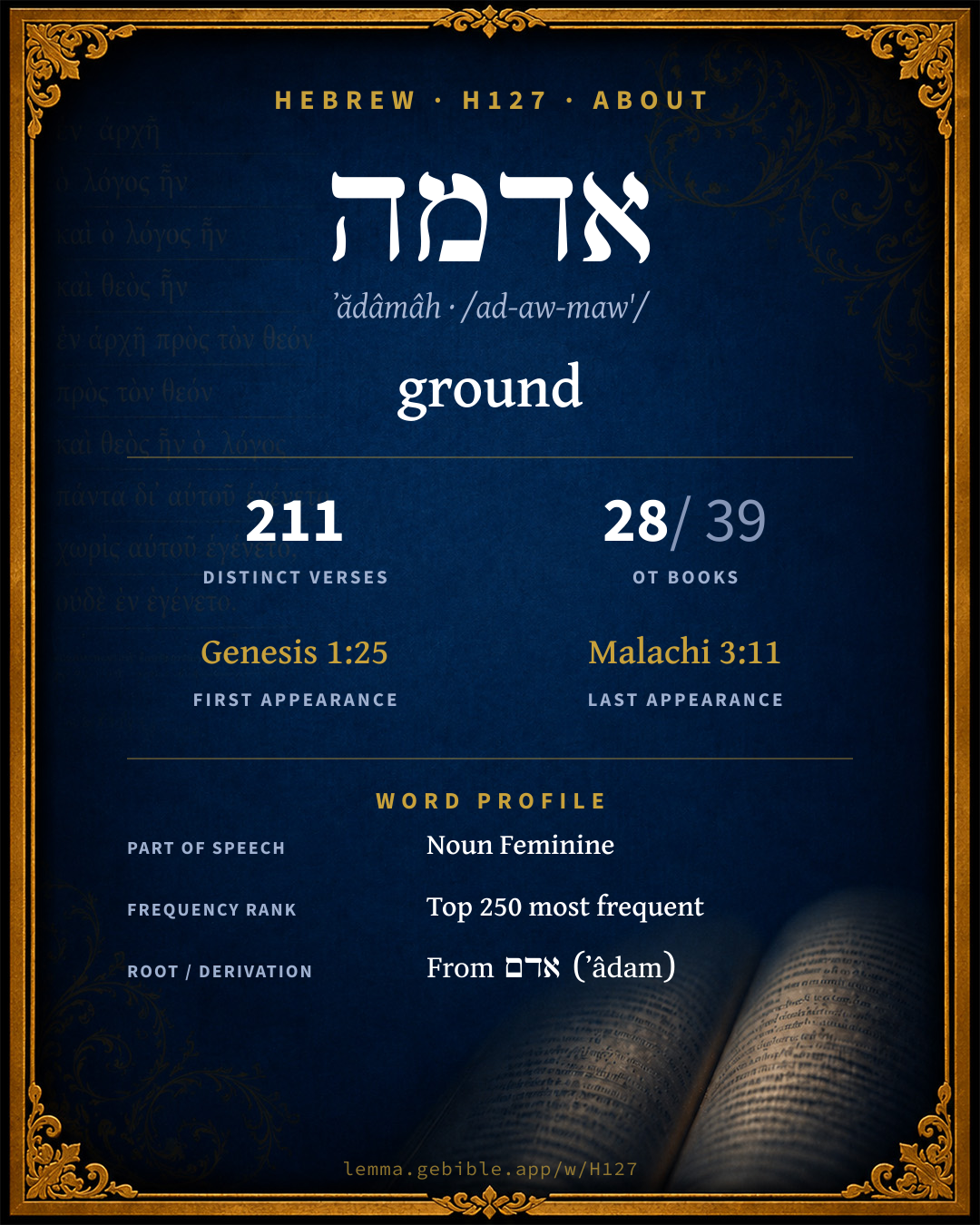
אֲדָמָה
ground
‘ground’ is one of 8 main senses fuller range ↓
Full lexicon entry — Brown-Driver-Briggs (BDB)
From Brown-Driver-Briggs (BDB)
Where this word appears
See every Absolute-state word in the Hebrew Bible →
Grammar key — what these labels mean
Part of speech
- Noun
- A naming word — a person, place, thing, or idea.
Noun type
- Common
- A common noun — a general class of person, place, or thing (“king,” “city,” “water”), not a specific name.
State
- Absolute
- The independent form of a noun, not bound to a following word.
- Construct
- A noun bound to a following noun in a possessive / “of” relationship (the construct chain).
Gender
- Feminine
- Grammatically feminine.
Number
- Singular
- One.
- Plural
- More than one (in Hebrew, generally three or more).
Grammatical forms
- Noun, Common, Feminine, Singular, Absolute 137 times (61%)
- Noun, Common, Feminine, Singular, Construct 87 times (39%)
- Noun, Common, Feminine, Plural, Absolute 1 time (0%)
Parsed forms decoded from the imported morphology (morphhb / Westminster Leningrad Codex — WLC text public domain, morphhb tagging CC BY 4.0), counted across 225 parsed occurrences — not distinct verses.
Page 1 of 2 — showing verses 1–200 of 211 distinct verses where H127 appears, across 28 books. Click any verse to open its interlinear word-by-word view. Verse text shown in the World English Bible for context — . Each verse’s Hebrew form is shown with its reference; the English is not keyword-highlighted, since the data carries no word-level English alignment. Use “Compare translations” on any verse to read it across multiple English versions. This concordance covers the Hebrew Bible; Septuagint (Greek Old Testament) occurrences are not indexed here.
Genesis 37 verses
- Genesis 1:25 הָֽ/אֲדָמָ֖ה ptcl def.art + n c fs God made the animals of the earth after their kind, and the cattle after their kind, and everything that creeps on the ground after its kind. God saw that it was good.
- Genesis 2:5 הָֽ/אֲדָמָֽה ptcl def.art + n c fs No plant of the field was yet in the earth, and no herb of the field had yet sprung up; for Yahweh God had not caused it to rain on the earth. There was not a man to till the ground,
- Genesis 2:6 הָֽ/אֲדָמָֽה ptcl def.art + n c fs but a mist went up from the earth, and watered the whole surface of the ground.
- Genesis 2:7 הָ֣/אֲדָמָ֔ה ptcl def.art + n c fs Yahweh God formed man from the dust of the ground, and breathed into his nostrils the breath of life; and man became a living soul.
- Genesis 2:9 הָ֣/אֲדָמָ֔ה ptcl def.art + n c fs Out of the ground Yahweh God made every tree to grow that is pleasant to the sight, and good for food; the tree of life also in the midst of the garden, and the tree of the knowledge of good and evil.
- Genesis 2:19 הָֽ/אֲדָמָ֗ה ptcl def.art + n c fs Out of the ground Yahweh God formed every animal of the field, and every bird of the sky, and brought them to the man to see what he would call them. Whatever the man called every living creature, that was its name.
- Genesis 3:17 הָֽ/אֲדָמָה֙ ptcl def.art + n c fs To Adam he said, "Because you have listened to your wife's voice, and have eaten of the tree, of which I commanded you, saying, 'You shall not eat of it,' cursed is the ground for your sake. In toil you will eat of it all the days of your life.
- Genesis 3:19 הָ֣/אֲדָמָ֔ה ptcl def.art + n c fs By the sweat of your face will you eat bread until you return to the ground, for out of it you were taken. For you are dust, and to dust you shall return."
- Genesis 3:23 הָ֣/אֲדָמָ֔ה ptcl def.art + n c fs Therefore Yahweh God sent him forth from the garden of Eden, to till the ground from whence he was taken.
- Genesis 4:2 אֲדָמָֽה n c fs Again she gave birth, to Cain's brother Abel. Abel was a keeper of sheep, but Cain was a tiller of the ground.
- Genesis 4:3 הָֽ/אֲדָמָ֛ה ptcl def.art + n c fs As time passed, it happened that Cain brought an offering to Yahweh from the fruit of the ground.
- Genesis 4:10 הָֽ/אֲדָמָֽה ptcl def.art + n c fs Yahweh said, "What have you done? The voice of your brother's blood cries to me from the ground.
- Genesis 4:11 הָֽ/אֲדָמָה֙ ptcl def.art + n c fs Now you are cursed because of the ground, which has opened its mouth to receive your brother's blood from your hand.
- Genesis 4:12 הָ֣/אֲדָמָ֔ה ptcl def.art + n c fs From now on, when you till the ground, it won't yield its strength to you. You shall be a fugitive and a wanderer in the earth."
- Genesis 4:14 הָֽ/אֲדָמָ֔ה ptcl def.art + n c fs Behold, you have driven me out this day from the surface of the ground. I will be hidden from your face, and I will be a fugitive and a wanderer in the earth. It will happen that whoever finds me will kill me."
- Genesis 5:29 הָ֣/אֲדָמָ֔ה ptcl def.art + n c fs and he named him Noah, saying, "This same will comfort us in our work and in the toil of our hands, because of the ground which Yahweh has cursed."
- Genesis 6:1 הָֽ/אֲדָמָ֑ה ptcl def.art + n c fs It happened, when men began to multiply on the surface of the ground, and daughters were born to them,
- Genesis 6:7 הָֽ/אֲדָמָ֔ה ptcl def.art + n c fs Yahweh said, "I will destroy man whom I have created from the surface of the ground; man, along with animals, creeping things, and birds of the sky; for I am sorry that I have made them."
- Genesis 6:20 הָֽ/אֲדָמָ֖ה ptcl def.art + n c fs Of the birds after their kind, of the cattle after their kind, of every creeping thing of the ground after its kind, two of every sort shall come to you, to keep them alive.
- Genesis 7:4 הָֽ/אֲדָמָֽה ptcl def.art + n c fs In seven days, I will cause it to rain on the earth for forty days and forty nights. Every living thing that I have made, I will destroy from the surface of the ground."
- Genesis 7:8 הָֽ/אֲדָמָֽה ptcl def.art + n c fs Clean animals, animals that are not clean, birds, and everything that creeps on the ground
- Genesis 7:23 הָֽ/אֲדָמָ֗ה ptcl def.art + n c fs Every living thing was destroyed that was on the surface of the ground, including man, cattle, creeping things, and birds of the sky. They were destroyed from the earth. Only Noah was left, and those who were with him in the ark.
- Genesis 8:8 הָֽ/אֲדָמָֽה ptcl def.art + n c fs He sent forth a dove from him, to see if the waters were abated from off the surface of the ground,
- Genesis 8:13 הָֽ/אֲדָמָֽה ptcl def.art + n c fs It happened in the six hundred first year, in the first month, the first day of the month, the waters were dried up from off the earth. Noah removed the covering of the ark, and looked. He saw that the surface of the ground was dried.
- Genesis 8:21 הָֽ/אֲדָמָה֙ ptcl def.art + n c fs Yahweh smelled the sweet savor. Yahweh said in his heart, "I will not again curse the ground any more for man's sake, because the imagination of man's heart is evil from his youth; neither will I ever again strike everything living, as I have done.
- Genesis 9:2 הָֽ/אֲדָמָ֛ה ptcl def.art + n c fs The fear of you and the dread of you will be on every animal of the earth, and on every bird of the sky. Everything that the ground teems with, and all the fish of the sea are delivered into your hand.
- Genesis 9:20 הָֽ/אֲדָמָ֑ה ptcl def.art + n c fs Noah began to be a farmer, and planted a vineyard.
- Genesis 12:3 הָ/אֲדָמָֽה ptcl def.art + n c fs I will bless those who bless you, and I will curse him who curses you. In you will all of the families of the earth be blessed."
- Genesis 19:25 הָ/אֲדָמָֽה ptcl def.art + n c fs He overthrew those cities, all the plain, all the inhabitants of the cities, and that which grew on the ground.
- Genesis 28:14 הָ/אֲדָמָ֖ה ptcl def.art + n c fs Your seed will be as the dust of the earth, and you will spread abroad to the west, and to the east, and to the north, and to the south. In you and in your seed will all the families of the earth be blessed.
- Genesis 28:15 הָ/אֲדָמָ֖ה ptcl def.art + n c fs Behold, I am with you, and will keep you, wherever you go, and will bring you again into this land. For I will not leave you, until I have done that which I have spoken of to you."
- Genesis 47:18 וְ/אַדְמָתֵֽ/נוּ conj + n c fs cs + sfx pers 1cp When that year was ended, they came to him the second year, and said to him, "We will not hide from my lord how our money is all spent, and the herds of cattle are my lord's. There is nothing left in the sight of my lord, but our bodies, and our lands.
- Genesis 47:19 אַדְמָתֵ֔/נוּ אַדְמָתֵ֖/נוּ וְ/אַדְמָתֵ֨/נוּ֙ וְ/הָ/אֲדָמָ֖ה n c fs cs + sfx pers 1cp n c fs cs + sfx pers 1cp conj + n c fs cs + sfx pers 1cp conj + ptcl def.art + n c fs Why should we die before your eyes, both we and our land? Buy us and our land for bread, and we and our land will be servants to Pharaoh. Give us seed, that we may live, and not die, and that the land won't be desolate."
- Genesis 47:20 אַדְמַ֤ת n c fs cs So Joseph bought all the land of Egypt for Pharaoh, for the Egyptians sold every man his field, because the famine was severe on them, and the land became Pharaoh's.
- Genesis 47:22 אַדְמַ֥ת אַדְמָתָֽ/ם n c fs cs n c fs cs + sfx pers 3mp Only he didn't buy the land of the priests, for the priests had a portion from Pharaoh, and ate their portion which Pharaoh gave them. That is why they didn't sell their land.
- Genesis 47:23 אַדְמַתְ/כֶ֖ם הָ/אֲדָמָֽה n c fs cs + sfx pers 2mp ptcl def.art + n c fs Then Joseph said to the people, "Behold, I have bought you and your land today for Pharaoh. Behold, here is seed for you, and you shall sow the land.
- Genesis 47:26 אַדְמַ֥ת אַדְמַ֤ת n c fs cs n c fs cs Joseph made it a statute concerning the land of Egypt to this day, that Pharaoh should have the fifth. Only the land of the priests alone didn't become Pharaoh's.
Exodus 9 verses
- Exodus 3:5 אַדְמַת n c fs cs He said, "Don't come close. Take off your sandals from off your feet, for the place you are standing on is holy ground."
- Exodus 8:21 הָ/אֲדָמָ֖ה ptcl def.art + n c fs Else, if you will not let my people go, behold, I will send swarms of flies on you, and on your servants, and on your people, and into your houses: and the houses of the Egyptians shall be full of swarms of flies, and also the ground whereon they are.
- Exodus 10:6 הָ֣/אֲדָמָ֔ה ptcl def.art + n c fs Your houses shall be filled, and the houses of all your servants, and the houses of all the Egyptians; as neither your fathers nor your fathers' fathers have seen, since the day that they were on the earth to this day.'" He turned, and went out from Pharaoh.
- Exodus 20:12 הָ/אֲדָמָ֔ה ptcl def.art + n c fs "Honor your father and your mother, that your days may be long in the land which Yahweh your God gives you.
- Exodus 20:24 אֲדָמָה֮ n c fs You shall make an altar of earth for me, and shall sacrifice on it your burnt offerings and your peace-offerings, your sheep and your oxen. In every place where I record my name I will come to you and I will bless you.
- Exodus 23:19 אַדְמָ֣תְ/ךָ֔ n c fs cs + sfx pers 2ms The first of the first fruits of your ground you shall bring into the house of Yahweh your God. "You shall not boil a kid in its mother's milk.
- Exodus 32:12 הָֽ/אֲדָמָ֑ה ptcl def.art + n c fs Why should the Egyptians speak, saying, 'He brought them forth for evil, to kill them in the mountains, and to consume them from the surface of the earth?' Turn from your fierce wrath, and repent of this evil against your people.
- Exodus 33:16 הָ/אֲדָמָֽה ptcl def.art + n c fs For how would people know that I have found favor in your sight, I and your people? Isn't it in that you go with us, so that we are separated, I and your people, from all the people who are on the surface of the earth?"
- Exodus 34:26 אַדְמָ֣תְ/ךָ֔ n c fs cs + sfx pers 2ms You shall bring the first of the first fruits of your ground to the house of Yahweh your God. You shall not boil a young goat in its mother's milk."
Leviticus 2 verses
- Leviticus 20:24 אַדְמָתָ/ם֒ n c fs cs + sfx pers 3mp But I have said to you, "You shall inherit their land, and I will give it to you to possess it, a land flowing with milk and honey." I am Yahweh your God, who has separated you from the peoples.
- Leviticus 20:25 הָֽ/אֲדָמָ֔ה ptcl def.art + n c fs "'You shall therefore make a distinction between the clean animal and the unclean, and between the unclean fowl and the clean: and you shall not make yourselves abominable by animal, or by bird, or by anything with which the ground teems, which I have separated from you as unclean for you.
Numbers 5 verses
- Numbers 11:12 הָֽ/אֲדָמָ֔ה ptcl def.art + n c fs Have I conceived all this people? have I brought them forth, that you should tell me, Carry them in your bosom, as a nursing-father carries the sucking child, to the land which you swore to their fathers?
- Numbers 12:3 הָ/אֲדָמָֽה ptcl def.art + n c fs Now the man Moses was very humble, above all the men who were on the surface of the earth.
- Numbers 16:30 הָ/אֲדָמָ֤ה ptcl def.art + n c fs But if Yahweh make a new thing, and the ground open its mouth, and swallow them up, with all that appertain to them, and they go down alive into Sheol; then you shall understand that these men have despised Yahweh.
- Numbers 16:31 הָ/אֲדָמָ֖ה ptcl def.art + n c fs It happened, as he made an end of speaking all these words, that the ground split apart that was under them;
- Numbers 32:11 הָ/אֲדָמָ֔ה ptcl def.art + n c fs Surely none of the men who came up out of Egypt, from twenty years old and upward, shall see the land which I swore to Abraham, to Isaac, and to Jacob; because they have not wholly followed me:
Deuteronomy 35 verses
- Deuteronomy 4:10 הָ֣/אֲדָמָ֔ה ptcl def.art + n c fs the day that you stood before Yahweh your God in Horeb, when Yahweh said to me, Assemble me the people, and I will make them hear my words, that they may learn to fear me all the days that they live on the earth, and that they may teach their children.
- Deuteronomy 4:18 בָּ/אֲדָמָ֑ה prep det + n c fs the likeness of anything that creeps on the ground, the likeness of any fish that is in the water under the earth;
- Deuteronomy 4:40 הַ֣/אֲדָמָ֔ה ptcl def.art + n c fs You shall keep his statutes, and his commandments, which I command you this day, that it may go well with you, and with your children after you, and that you may prolong your days in the land, which Yahweh your God gives you, forever.
- Deuteronomy 5:16 הָֽ/אֲדָמָ֔ה ptcl def.art + n c fs "Honor your father and your mother, as Yahweh your God commanded you; that your days may be long, and that it may go well with you, in the land which Yahweh your God gives you.
- Deuteronomy 6:15 הָ/אֲדָמָֽה ptcl def.art + n c fs for Yahweh your God in the midst of you is a jealous God; lest the anger of Yahweh your God be kindled against you, and he destroy you from off the face of the earth.
- Deuteronomy 7:6 הָ/אֲדָמָֽה ptcl def.art + n c fs For you are a holy people to Yahweh your God: Yahweh your God has chosen you to be a people for his own possession, above all peoples who are on the face of the earth.
- Deuteronomy 7:13 אַ֠דְמָתֶ/ךָ הָֽ/אֲדָמָ֔ה n c fs cs + sfx pers 2ms ptcl def.art + n c fs and he will love you, and bless you, and multiply you; he will also bless the fruit of your body and the fruit of your ground, your grain and your new wine and your oil, the increase of your cattle and the young of your flock, in the land which he swore to your fathers to give you.
- Deuteronomy 11:9 הָ֣/אֲדָמָ֔ה ptcl def.art + n c fs and that you may prolong your days in the land, which Yahweh swore to your fathers to give to them and to their seed, a land flowing with milk and honey.
- Deuteronomy 11:17 וְ/הָ֣/אֲדָמָ֔ה conj + ptcl def.art + n c fs and the anger of Yahweh be kindled against you, and he shut up the sky, so that there shall be no rain, and the land shall not yield its fruit; and you perish quickly from off the good land which Yahweh gives you.
- Deuteronomy 11:21 הָֽ/אֲדָמָ֔ה ptcl def.art + n c fs that your days may be multiplied, and the days of your children, in the land which Yahweh swore to your fathers to give them, as the days of the heavens above the earth.
- Deuteronomy 12:1 הָ/אֲדָמָֽה ptcl def.art + n c fs These are the statutes and the ordinances which you shall observe to do in the land which Yahweh, the God of your fathers, has given you to possess it, all the days that you live on the earth.
- Deuteronomy 12:19 אַדְמָתֶֽ/ךָ n c fs cs + sfx pers 2ms Take heed to yourself that you don't forsake the Levite as long as you live in your land.
- Deuteronomy 14:2 הָ/אֲדָמָֽה ptcl def.art + n c fs For you are a holy people to Yahweh your God, and Yahweh has chosen you to be a people for his own possession, above all peoples who are on the face of the earth.
- Deuteronomy 21:1 בָּ/אֲדָמָה֙ prep det + n c fs If one be found slain in the land which Yahweh your God gives you to possess it, lying in the field, and it isn't known who has struck him;
- Deuteronomy 21:23 אַדְמָ֣תְ/ךָ֔ n c fs cs + sfx pers 2ms his body shall not remain all night on the tree, but you shall surely bury him the same day; for he who is hanged is accursed of God; that you don't defile your land which Yahweh your God gives you for an inheritance.
- Deuteronomy 25:15 הָֽ/אֲדָמָ֔ה ptcl def.art + n c fs A perfect and just weight shall you have; a perfect and just measure shall you have: that your days may be long in the land which Yahweh your God gives you.
- Deuteronomy 26:2 הָ/אֲדָמָ֗ה ptcl def.art + n c fs that you shall take of the first of all the fruit of the ground, which you shall bring in from your land that Yahweh your God gives you; and you shall put it in a basket, and shall go to the place which Yahweh your God shall choose, to cause his name to dwell there.
- Deuteronomy 26:10 הָ/אֲדָמָ֔ה ptcl def.art + n c fs Now, behold, I have brought the first of the fruit of the ground, which you, Yahweh, have given me. You shall set it down before Yahweh your God, and worship before Yahweh your God:
- Deuteronomy 26:15 הָ/אֲדָמָ֔ה ptcl def.art + n c fs Look down from your holy habitation, from heaven, and bless your people Israel, and the ground which you have given us, as you swore to our fathers, a land flowing with milk and honey.
- Deuteronomy 28:4 אַדְמָתְ/ךָ֖ n c fs cs + sfx pers 2ms Blessed shall be the fruit of your body, and the fruit of your ground, and the fruit of your animals, the increase of your cattle, and the young of your flock.
- Deuteronomy 28:11 אַדְמָתֶ֑/ךָ הָ/אֲדָמָ֔ה n c fs cs + sfx pers 2ms ptcl def.art + n c fs Yahweh will make you plenteous for good, in the fruit of your body, and in the fruit of your cattle, and in the fruit of your ground, in the land which Yahweh swore to your fathers to give you.
- Deuteronomy 28:18 אַדְמָתֶ֑/ךָ n c fs cs + sfx pers 2ms Cursed shall be the fruit of your body, and the fruit of your ground, the increase of your cattle, and the young of your flock.
- Deuteronomy 28:21 הָֽ/אֲדָמָ֔ה ptcl def.art + n c fs Yahweh will make the pestilence cleave to you, until he have consumed you from off the land, where you go in to possess it.
- Deuteronomy 28:33 אַדְמָֽתְ/ךָ֙ n c fs cs + sfx pers 2ms The fruit of your ground, and all your labors, shall a nation which you don't know eat up; and you shall be only oppressed and crushed always;
- Deuteronomy 28:42 אַדְמָתֶ֑/ךָ n c fs cs + sfx pers 2ms All your trees and the fruit of your ground shall the locust possess.
- Deuteronomy 28:51 אַדְמָתְ/ךָ֮ n c fs cs + sfx pers 2ms and shall eat the fruit of your cattle, and the fruit of your ground, until you are destroyed; that also shall not leave you grain, new wine, or oil, the increase of your cattle, or the young of your flock, until they have caused you to perish.
- Deuteronomy 28:63 הָֽ/אֲדָמָ֔ה ptcl def.art + n c fs It shall happen that as Yahweh rejoiced over you to do you good, and to multiply you, so Yahweh will rejoice over you to cause you to perish, and to destroy you; and you shall be plucked from off the land where you go in to possess it.
- Deuteronomy 29:28 אַדְמָתָ֔/ם n c fs cs + sfx pers 3mp and Yahweh rooted them out of their land in anger, and in wrath, and in great indignation, and cast them into another land, as at this day.
- Deuteronomy 30:9 אַדְמָתְ/ךָ֖ n c fs cs + sfx pers 2ms Yahweh your God will make you plenteous in all the work of your hand, in the fruit of your body, and in the fruit of your cattle, and in the fruit of your ground, for good: for Yahweh will again rejoice over you for good, as he rejoiced over your fathers;
- Deuteronomy 30:18 הָ֣/אֲדָמָ֔ה ptcl def.art + n c fs I denounce to you this day, that you shall surely perish; you shall not prolong your days in the land, where you pass over the Jordan to go in to possess it.
- Deuteronomy 30:20 הָ/אֲדָמָ֗ה ptcl def.art + n c fs to love Yahweh your God, to obey his voice, and to cleave to him; for he is your life, and the length of your days; that you may dwell in the land which Yahweh swore to your fathers, to Abraham, to Isaac, and to Jacob, to give them.
- Deuteronomy 31:13 הָ֣/אֲדָמָ֔ה ptcl def.art + n c fs and that their children, who have not known, may hear, and learn to fear Yahweh your God, as long as you live in the land where you go over the Jordan to possess it.
- Deuteronomy 31:20 הָ/אֲדָמָ֣ה ptcl def.art + n c fs For when I shall have brought them into the land which I swore to their fathers, flowing with milk and honey, and they shall have eaten and filled themselves, and grown fat; then will they turn to other gods, and serve them, and despise me, and break my covenant.
- Deuteronomy 32:43 אַדְמָת֖/וֹ n c fs cs + sfx pers 3ms Rejoice, you nations, [with] his people: For he will avenge the blood of his servants, Will render vengeance to his adversaries, Will make expiation for his land, for his people.
- Deuteronomy 32:47 הָ֣/אֲדָמָ֔ה ptcl def.art + n c fs For it is no vain thing for you; because it is your life, and through this thing you shall prolong your days in the land, where you go over the Jordan to possess it.
Joshua 2 verses
- Joshua 23:13 הָ/אֲדָמָ֤ה ptcl def.art + n c fs know for a certainty that Yahweh your God will no more drive these nations from out of your sight; but they shall be a snare and a trap to you, and a scourge in your sides, and thorns in your eyes, until you perish from off this good land which Yahweh your God has given you.
- Joshua 23:15 הָ/אֲדָמָ֤ה ptcl def.art + n c fs It shall happen, that as all the good things are come on you of which Yahweh your God spoke to you, so will Yahweh bring on you all the evil things, until he have destroyed you from off this good land which Yahweh your God has given you.
1 Samuel 3 verses
- 1 Samuel 4:12 וַ/אֲדָמָ֖ה conj + n c fs There ran a man of Benjamin out of the army, and came to Shiloh the same day, with his clothes torn, and with earth on his head.
- 1 Samuel 20:15 הָ/אֲדָמָֽה ptcl def.art + n c fs but also you shall not cut off your kindness from my house forever; no, not when Yahweh has cut off the enemies of David everyone from the surface of the earth.
- 1 Samuel 20:31 הָ/אֲדָמָ֔ה ptcl def.art + n c fs For as long as the son of Jesse lives on the earth, you shall not be established, nor your kingdom. Therefore now send and bring him to me, for he shall surely die.
2 Samuel 5 verses
- 2 Samuel 1:2 וַ/אֲדָמָ֖ה conj + n c fs it happened on the third day, that behold, a man came out of the camp from Saul, with his clothes torn, and earth on his head: and so it was, when he came to David, that he fell to the earth, and did obeisance.
- 2 Samuel 9:10 הָ/אֲדָמָ֡ה ptcl def.art + n c fs You shall till the land for him, you, and your sons, and your servants; and you shall bring in [the fruits], that your master's son may have bread to eat: but Mephibosheth your master's son shall eat bread always at my table." Now Ziba had fifteen sons and twenty servants.
- 2 Samuel 14:7 הָ/אֲדָמָֽה ptcl def.art + n c fs Behold, the whole family is risen against your handmaid, and they say, Deliver him who struck his brother, that we may kill him for the life of his brother whom he killed, and so destroy the heir also. Thus will they quench my coal which is left, and will leave to my husband neither name nor remainder on the surface of the earth.
- 2 Samuel 15:32 וַ/אֲדָמָ֖ה conj + n c fs It happened that when David had come to the top [of the ascent], where God was worshiped, behold, Hushai the Archite came to meet him with his coat torn, and earth on his head.
- 2 Samuel 17:12 הָ/אֲדָמָ֑ה ptcl def.art + n c fs So shall we come on him in some place where he shall be found, and we will light on him as the dew falls on the ground; and of him and of all the men who are with him we will not leave so much as one.
1 Kings 8 verses
- 1 Kings 7:46 הָ/אֲדָמָ֑ה ptcl def.art + n c fs In the plain of the Jordan did the king cast them, in the clay ground between Succoth and Zarethan.
- 1 Kings 8:34 הָ֣/אֲדָמָ֔ה ptcl def.art + n c fs then hear you in heaven, and forgive the sin of your people Israel, and bring them again to the land which you gave to their fathers.
- 1 Kings 8:40 הָ/אֲדָמָ֑ה ptcl def.art + n c fs that they may fear you all the days that they live in the land which you gave to our fathers.
- 1 Kings 9:7 הָ/אֲדָמָה֙ ptcl def.art + n c fs then will I cut off Israel out of the land which I have given them; and this house, which I have made holy for my name, will I cast out of my sight; and Israel shall be a proverb and a byword among all peoples.
- 1 Kings 13:34 הָ/אֲדָמָֽה ptcl def.art + n c fs This thing became sin to the house of Jeroboam, even to cut it off, and to destroy it from off the surface of the earth.
- 1 Kings 14:15 הָ/אֲדָמָ֨ה ptcl def.art + n c fs For Yahweh will strike Israel, as a reed is shaken in the water; and he will root up Israel out of this good land which he gave to their fathers, and will scatter them beyond the River, because they have made their Asherim, provoking Yahweh to anger.
- 1 Kings 17:14 הָ/אֲדָמָֽה ptcl def.art + n c fs For thus says Yahweh, the God of Israel, The jar of meal shall not empty, neither shall the jar of oil fail, until the day that Yahweh sends rain on the earth.
- 1 Kings 18:1 הָ/אֲדָמָֽה ptcl def.art + n c fs It happened after many days, that the word of Yahweh came to Elijah, in the third year, saying, Go, show yourself to Ahab; and I will send rain on the earth.
2 Kings 4 verses
- 2 Kings 5:17 אֲדָמָ֑ה n c fs Naaman said, If not, yet, please let there be given to your servant two mules' burden of earth; for your servant will henceforth offer neither burnt offering nor sacrifice to other gods, but to Yahweh.
- 2 Kings 17:23 אַדְמָת/וֹ֙ n c fs cs + sfx pers 3ms until Yahweh removed Israel out of his sight, as he spoke by all his servants the prophets. So Israel was carried away out of their own land to Assyria to this day.
- 2 Kings 21:8 הָ֣/אֲדָמָ֔ה ptcl def.art + n c fs neither will I cause the feet of Israel to wander any more out of the land which I gave their fathers, if only they will observe to do according to all that I have commanded them, and according to all the law that my servant Moses commanded them.
- 2 Kings 25:21 אַדְמָתֽ/וֹ n c fs cs + sfx pers 3ms The king of Babylon struck them, and put them to death at Riblah in the land of Hamath. So Judah was carried away captive out of his land.
1 Chronicles 1 verse
2 Chronicles 6 verses
- 2 Chronicles 4:17 הָ/אֲדָמָ֑ה ptcl def.art + n c fs In the plain of the Jordan did the king cast them, in the clay ground between Succoth and Zeredah.
- 2 Chronicles 6:25 הָ֣/אֲדָמָ֔ה ptcl def.art + n c fs then hear from heaven, and forgive the sin of your people Israel, and bring them again to the land which you gave to them and to their fathers.
- 2 Chronicles 6:31 הָ/אֲדָמָ֑ה ptcl def.art + n c fs that they may fear you, to walk in your ways, so long as they live in the land which you gave to our fathers.
- 2 Chronicles 7:20 אַדְמָתִ/י֙ n c fs cs + sfx pers 1cs then will I pluck them up by the roots out of my land which I have given them; and this house, which I have made holy for my name, will I cast out of my sight, and I will make it a proverb and a byword among all peoples.
- 2 Chronicles 26:10 אֲדָמָ֖ה n c fs He built towers in the wilderness, and hewed out many cisterns, for he had much cattle; in the lowland also, and in the plain: [and he had] farmers and vineyard keepers in the mountains and in the fruitful fields; for he loved farming.
- 2 Chronicles 33:8 הָֽ/אֲדָמָ֔ה ptcl def.art + n c fs neither will I any more remove the foot of Israel from off the land which I have appointed for your fathers, if only they will observe to do all that I have commanded them, even all the law and the statutes and the ordinances [given] by Moses.
Nehemiah 4 verses
- Nehemiah 9:1 וַ/אֲדָמָ֖ה conj + n c fs Now in the twenty-fourth day of this month the children of Israel were assembled with fasting, and with sackcloth, and earth on them.
- Nehemiah 9:25 וַ/אֲדָמָ֣ה conj + n c fs They took fortified cities, and a fat land, and possessed houses full of all good things, cisterns hewn out, vineyards, and olive groves, and fruit trees in abundance: so they ate, and were filled, and became fat, and delighted themselves in your great goodness.
- Nehemiah 10:35 אַדְמָתֵ֗/נוּ n c fs cs + sfx pers 1cp and to bring the first fruits of our ground, and the first fruits of all fruit of all manner of trees, year by year, to the house of Yahweh;
- Nehemiah 10:37 אַדְמָתֵ֖/נוּ n c fs cs + sfx pers 1cp and that we should bring the first fruits of our dough, and our heave-offerings, and the fruit of all manner of trees, the new wine and the oil, to the priests, to the chambers of the house of our God; and the tithes of our ground to the Levites; for they, the Levites, take the tithes in all the cities of our tillage.
Job 2 verses
Psalms 6 verses
- Psalms 49:11 אֲדָמֽוֹת n c fp Their inward thought is that their houses will endure forever, And their dwelling places to all generations. They name their lands after themselves.
- Psalms 83:10 לָ/אֲדָמָֽה prep det + n c fs Who perished at Endor, Who became as dung for the earth.
- Psalms 104:30 אֲדָמָֽה n c fs You send forth your Spirit: they are created. You renew the face of the ground.
- Psalms 105:35 אַדְמָתָֽ/ם n c fs cs + sfx pers 3mp Ate up every plant in their land; And ate up the fruit of their ground.
- Psalms 137:4 אַדְמַ֥ת n c fs cs How can we sing Yahweh's song in a foreign land?
- Psalms 146:4 לְ/אַדְמָת֑/וֹ prep + n c fs cs + sfx pers 3ms His spirit departs, and he returns to the earth. In that very day, his thoughts perish.
Proverbs 2 verses
- Proverbs 12:11 אַ֭דְמָת/וֹ n c fs cs + sfx pers 3ms He who tills his land shall have plenty of bread, But he who chases fantasies is void of understanding.
- Proverbs 28:19 אַ֭דְמָת/וֹ n c fs cs + sfx pers 3ms One who works his land will have an abundance of food; But one who chases fantasies will have his fill of poverty.
Isaiah 14 verses
- Isaiah 1:7 אַדְמַתְ/כֶ֗ם n c fs cs + sfx pers 2mp Your country is desolate. Your cities are burned with fire. Strangers devour your land in your presence, And it is desolate, As overthrown by strangers.
- Isaiah 6:11 וְ/הָ/אֲדָמָ֖ה conj + ptcl def.art + n c fs Then I said, "Lord, how long?" He answered, "Until cities are waste without inhabitant, And houses without man, And the land becomes utterly waste,
- Isaiah 7:16 הָ/אֲדָמָה֙ ptcl def.art + n c fs For before the child knows to refuse the evil, and choose the good, the land whose two kings you abhor shall be forsaken.
- Isaiah 14:1 אַדְמָתָ֑/ם n c fs cs + sfx pers 3mp For Yahweh will have compassion on Jacob, and will yet choose Israel, and set them in their own land: and the foreigner shall join himself with them, and they shall cleave to the house of Jacob.
- Isaiah 14:2 אַדְמַ֣ת n c fs cs The peoples shall take them, and bring them to their place; and the house of Israel shall possess them in the land of Yahweh for servants and for handmaids: and they shall take them captive whose captives they were; and they shall rule over their oppressors.
- Isaiah 15:9 אֲדָמָֽה n c fs For the waters of Dimon are full of blood; for I will bring yet more on Dimon, a lion on them of Moab that escape, and on the remnant of the land.
- Isaiah 19:17 אַדְמַ֨ת n c fs cs The land of Judah shall become a terror to Egypt; everyone to whom mention is made of it shall be afraid, because of the purpose of Yahweh of Hosts, which he purposes against it.
- Isaiah 23:17 הָ/אֲדָמָֽה ptcl def.art + n c fs It shall happen after the end of seventy years, that Yahweh will visit Tyre, and she shall return to her hire, and shall play the prostitute with all the kingdoms of the world on the surface of the earth.
- Isaiah 24:21 הָ/אֲדָמָ֖ה הָ/אֲדָמָֽה ptcl def.art + n c fs ptcl def.art + n c fs It shall happen in that day, that Yahweh will punish the host of the high ones on high, and the kings of the earth on the earth.
- Isaiah 28:24 אַדְמָתֽ/וֹ n c fs cs + sfx pers 3ms Does he who plows to sow plow continually? does he [continually] open and harrow his ground?
- Isaiah 30:23 הָ/אֲדָמָ֗ה הָֽ/אֲדָמָ֔ה ptcl def.art + n c fs ptcl def.art + n c fs He will give the rain for your seed, with which you shall sow the ground; and bread of the increase of the ground, and it shall be fat and plenteous. In that day shall your cattle feed in large pastures;
- Isaiah 30:24 הָֽ/אֲדָמָ֔ה ptcl def.art + n c fs the oxen likewise and the young donkeys that till the ground shall eat savory provender, which has been winnowed with the shovel and with the fork.
- Isaiah 32:13 אַדְמַ֣ת n c fs cs On the land of my people shall come up thorns and briers; yes, on all the houses of joy in the joyous city.
- Isaiah 45:9 אֲדָמָ֑ה n c fs Woe to him who strives with his Maker--a potsherd among the potsherds of the earth! Shall the clay ask him who fashions it, "What are you making?" or your work, "He has no hands?"
Jeremiah 18 verses
- Jeremiah 7:20 הָֽ/אֲדָמָ֑ה ptcl def.art + n c fs Therefore thus says the Lord Yahweh: Behold, my anger and my wrath shall be poured out on this place, on man, and on animal, and on the trees of the field, and on the fruit of the ground; and it shall burn, and shall not be quenched.
- Jeremiah 8:2 הָ/אֲדָמָ֖ה ptcl def.art + n c fs and they shall spread them before the sun, and the moon, and all the host of the sky, which they have loved, and which they have served, and after which they have walked, and which they have sought, and which they have worshiped: they shall not be gathered, nor be buried, they shall be for dung on the surface of the earth.
- Jeremiah 12:14 אַדְמָתָ֔/ם n c fs cs + sfx pers 3mp Thus says Yahweh against all my evil neighbors, who touch the inheritance which I have caused my people Israel to inherit: behold, I will pluck them up from off their land, and will pluck up the house of Judah from among them.
- Jeremiah 14:4 הָ/אֲדָמָה֙ ptcl def.art + n c fs Because of the ground which is cracked, because no rain has been in the land, the plowmen are disappointed, they cover their heads.
- Jeremiah 16:4 הָ/אֲדָמָ֖ה ptcl def.art + n c fs They shall die grievous deaths: they shall not be lamented, neither shall they be buried; they shall be as dung on the surface of the ground; and they shall be consumed by the sword, and by famine; and their dead bodies shall be food for the birds of the sky, and for the animals of the earth.
- Jeremiah 16:15 אַדְמָתָ֔/ם n c fs cs + sfx pers 3mp but, As Yahweh lives, who brought up the children of Israel from the land of the north, and from all the countries where he had driven them. I will bring them again into their land that I gave to their fathers.
- Jeremiah 23:8 אַדְמָתָֽ/ם n c fs cs + sfx pers 3mp but, As Yahweh lives, who brought up and who led the seed of the house of Israel out of the north country, and from all the countries where I had driven them. They shall dwell in their own land.
- Jeremiah 24:10 הָ/אֲדָמָ֔ה ptcl def.art + n c fs I will send the sword, the famine, and the pestilence, among them, until they be consumed from off the land that I gave to them and to their fathers.
- Jeremiah 25:5 הָ֣/אֲדָמָ֔ה ptcl def.art + n c fs saying, Return you now everyone from his evil way, and from the evil of your doings, and dwell in the land that Yahweh has given to you and to your fathers, from of old and even forevermore;
- Jeremiah 25:26 הָ/אֲדָמָ֑ה ptcl def.art + n c fs and all the kings of the north, far and near, one with another; and all the kingdoms of the world, which are on the surface of the earth: and the king of Sheshach shall drink after them.
- Jeremiah 25:33 הָ/אֲדָמָ֖ה ptcl def.art + n c fs The slain of Yahweh shall be at that day from one end of the earth even to the other end of the earth: they shall not be lamented, neither gathered, nor buried; they shall be dung on the surface of the ground.
- Jeremiah 27:10 אַדְמַתְ/כֶ֔ם n c fs cs + sfx pers 2mp for they prophesy a lie to you, to remove you far from your land, and that I should drive you out, and you should perish.
- Jeremiah 27:11 אַדְמָת/וֹ֙ n c fs cs + sfx pers 3ms But the nation that shall bring their neck under the yoke of the king of Babylon, and serve him, that [nation] will I let remain in their own land, says Yahweh; and they shall till it, and dwell therein.
- Jeremiah 28:16 הָ/אֲדָמָ֑ה ptcl def.art + n c fs Therefore thus says Yahweh, Behold, I will send you away from off the surface of the earth: this year you shall die, because you have spoken rebellion against Yahweh.
- Jeremiah 35:7 הָ/אֲדָמָ֔ה ptcl def.art + n c fs neither shall you build house, nor sow seed, nor plant vineyard, nor have any; but all your days you shall dwell in tents; that you may live many days in the land in which you sojourn.
- Jeremiah 35:15 הָ֣/אֲדָמָ֔ה ptcl def.art + n c fs I have sent also to you all my servants the prophets, rising up early and sending them, saying, Return you now every man from his evil way, and amend your doings, and don't go after other gods to serve them, and you shall dwell in the land which I have given to you and to your fathers: but you have not inclined your ear, nor listened to me.
- Jeremiah 42:12 אַדְמַתְ/כֶֽם n c fs cs + sfx pers 2mp I will grant you mercy, that he may have mercy on you, and cause you to return to your own land.
- Jeremiah 52:27 אַדְמָתֽ/וֹ n c fs cs + sfx pers 3ms The king of Babylon struck them, and put them to death at Riblah in the land of Hamath. So Judah was carried away captive out of his land.
Ezekiel 27 verses
- Ezekiel 7:2 לְ/אַדְמַ֥ת prep + n c fs cs You, son of man, thus says the Lord Yahweh to the land of Israel, An end: the end is come on the four corners of the land.
- Ezekiel 11:17 אַדְמַ֥ת n c fs cs Therefore say, Thus says the Lord Yahweh: I will gather you from the peoples, and assemble you out of the countries where you have been scattered, and I will give you the land of Israel.
- Ezekiel 12:19 אַדְמַ֣ת n c fs cs and tell the people of the land, Thus says the Lord Yahweh concerning the inhabitants of Jerusalem, and the land of Israel: They shall eat their bread with fearfulness, and drink their water in dismay, that her land may be desolate, [and despoiled] of all that is therein, because of the violence of all those who dwell therein.
- Ezekiel 12:22 אַדְמַ֥ת n c fs cs Son of man, what is this proverb that you have in the land of Israel, saying, The days are prolonged, and every vision fails?
- Ezekiel 13:9 אַדְמַ֥ת n c fs cs My hand shall be against the prophets who see false visions, and who divine lies: they shall not be in the council of my people, neither shall they be written in the writing of the house of Israel, neither shall they enter into the land of Israel; and you shall know that I am the Lord Yahweh.
- Ezekiel 18:2 אַדְמַ֥ת n c fs cs What do you mean, that you use this proverb concerning the land of Israel, saying, The fathers have eaten sour grapes, and the children's teeth are set on edge?
- Ezekiel 20:38 אַדְמַ֥ת n c fs cs and I will purge out from among you the rebels, and those who disobey against me; I will bring them forth out of the land where they sojourn, but they shall not enter into the land of Israel: and you shall know that I am Yahweh.
- Ezekiel 20:42 אַדְמַ֣ת n c fs cs You shall know that I am Yahweh, when I shall bring you into the land of Israel, into the country which I swore to give to your fathers.
- Ezekiel 21:2 אַדְמַ֥ת n c fs cs Son of man, set your face toward Jerusalem, and drop [your word] toward the sanctuaries, and prophesy against the land of Israel;
- Ezekiel 21:3 לְ/אַדְמַ֣ת prep + n c fs cs and tell the land of Israel, Thus says Yahweh: Behold, I am against you, and will draw forth my sword out of its sheath, and will cut off from you the righteous and the wicked.
- Ezekiel 25:3 אַדְמַ֤ת n c fs cs and tell the children of Ammon, Hear the word of the Lord Yahweh: Thus says the Lord Yahweh, Because you said, Aha, against my sanctuary, when it was profaned; and against the land of Israel, when it was made desolate; and against the house of Judah, when they went into captivity:
- Ezekiel 25:6 אַדְמַ֖ת n c fs cs For thus says the Lord Yahweh: Because you have clapped your hands, and stamped with the feet, and rejoiced with all the despite of your soul against the land of Israel;
- Ezekiel 28:25 אַדְמָתָ֔/ם n c fs cs + sfx pers 3mp Thus says the Lord Yahweh: When I shall have gathered the house of Israel from the peoples among whom they are scattered, and shall be sanctified in them in the sight of the nations, then shall they dwell in their own land which I gave to my servant Jacob.
- Ezekiel 33:24 אַדְמַ֤ת n c fs cs Son of man, they who inhabit those waste places in the land of Israel speak, saying, Abraham was one, and he inherited the land: but we are many; the land is given us for inheritance.
- Ezekiel 34:13 אַדְמָתָ֑/ם n c fs cs + sfx pers 3mp I will bring them out from the peoples, and gather them from the countries, and will bring them into their own land; and I will feed them on the mountains of Israel, by the watercourses, and in all the inhabited places of the country.
- Ezekiel 34:27 אַדְמָתָ֖/ם n c fs cs + sfx pers 3mp The tree of the field shall yield its fruit, and the earth shall yield its increase, and they shall be secure in their land; and they shall know that I am Yahweh, when I have broken the bars of their yoke, and have delivered them out of the hand of those who made slaves of them.
- Ezekiel 36:6 אַדְמַ֣ת n c fs cs Therefore prophesy concerning the land of Israel, and tell the mountains and to the hills, to the watercourses and to the valleys, Thus says the Lord Yahweh: Behold, I have spoken in my jealousy and in my wrath, because you have borne the shame of the nations:
- Ezekiel 36:17 אַדְמָתָ֔/ם n c fs cs + sfx pers 3mp Son of man, when the house of Israel lived in their own land, they defiled it by their way and by their doings: their way before me was as the uncleanness of a woman in her impurity.
- Ezekiel 36:24 אַדְמַתְ/כֶֽם n c fs cs + sfx pers 2mp For I will take you from among the nations, and gather you out of all the countries, and will bring you into your own land.
- Ezekiel 37:12 אַדְמַ֥ת n c fs cs Therefore prophesy, and tell them, Thus says the Lord Yahweh: Behold, I will open your graves, and cause you to come up out of your graves, my people; and I will bring you into the land of Israel.
- Ezekiel 37:14 אַדְמַתְ/כֶ֑ם n c fs cs + sfx pers 2mp I will put my Spirit in you, and you shall live, and I will place you in your own land: and you shall know that I, Yahweh, have spoken it and performed it, says Yahweh.
- Ezekiel 37:21 אַדְמָתָֽ/ם n c fs cs + sfx pers 3mp Say to them, Thus says the Lord Yahweh: Behold, I will take the children of Israel from among the nations, where they are gone, and will gather them on every side, and bring them into their own land:
- Ezekiel 38:18 אַדְמַ֣ת n c fs cs It shall happen in that day, when Gog shall come against the land of Israel, says the Lord Yahweh, that my wrath shall come up into my nostrils.
- Ezekiel 38:19 אַדְמַ֥ת n c fs cs For in my jealousy and in the fire of my wrath have I spoken, Surely in that day there shall be a great shaking in the land of Israel;
- Ezekiel 38:20 הָֽ/אֲדָמָ֔ה הָ/אֲדָמָ֑ה ptcl def.art + n c fs ptcl def.art + n c fs so that the fish of the sea, and the birds of the sky, and the animals of the field, and all creeping things who creep on the earth, and all the men who are on the surface of the earth, shall shake at my presence, and the mountains shall be thrown down, and the steep places shall fall, and every wall shall fall to the ground.
- Ezekiel 39:26 אַדְמָתָ֛/ם n c fs cs + sfx pers 3mp They shall bear their shame, and all their trespasses by which they have trespassed against me, when they shall dwell securely in their land, and none shall make them afraid;
- Ezekiel 39:28 אַדְמָתָ֑/ם n c fs cs + sfx pers 3mp They shall know that I am Yahweh their God, in that I caused them to go into captivity among the nations, and have gathered them to their own land; and I will leave none of them any more there;
Daniel 3 verses
- Daniel 11:9 אַדְמָתֽ/וֹ n c fs cs + sfx pers 3ms He shall come into the realm of the king of the south, but he shall return into his own land.
- Daniel 11:39 וַ/אֲדָמָ֖ה conj + n c fs He shall deal with the strongest fortresses by the help of a foreign god: whoever acknowledges [him] he will increase with glory; and he shall cause them to rule over many, and shall divide the land for a price.
- Daniel 12:2 אַדְמַת n c fs cs Many of those who sleep in the dust of the earth shall awake, some to everlasting life, and some to shame and everlasting contempt.
Hosea 1 verse
Joel 2 verses
Amos 7 verses
- Amos 3:2 הָ/אֲדָמָ֑ה ptcl def.art + n c fs "You only have I chosen of all the families of the earth. Therefore I will punish you for all of your sins."
- Amos 3:5 הָ֣/אֲדָמָ֔ה ptcl def.art + n c fs Can a bird fall in a trap on the earth, Where no snare is set for him? Does a snare spring up from the ground, When there is nothing to catch?
- Amos 5:2 אַדְמָתָ֖/הּ n c fs cs + sfx pers 3fs "The virgin of Israel has fallen; She shall rise no more. She is cast down on her land; There is no one to raise her up."
- Amos 7:11 אַדְמָתֽ/וֹ n c fs cs + sfx pers 3ms For Amos says, 'Jeroboam will die by the sword, and Israel shall surely be led away captive out of his land.'"
About this entry
At a glance — auto-summarized from this page’s data, not written by a person. Every figure links to its source below. This summary describes the numbers; it doesn’t interpret them.
At its core, אדמה (ʼădâmâh) means “ground.” Its English rendering has broadened — “land” classically, “ground” (unfoldingWord Literal Text) in modern versions; see the renderings breakdown. Spanning 211 verses in 28 books, it ranks among the common words of the Hebrew Bible. It first appears in Genesis 1:25. Not a single-sense word: explore its full sense range. Each statement above links to its evidence; the full detail follows below.
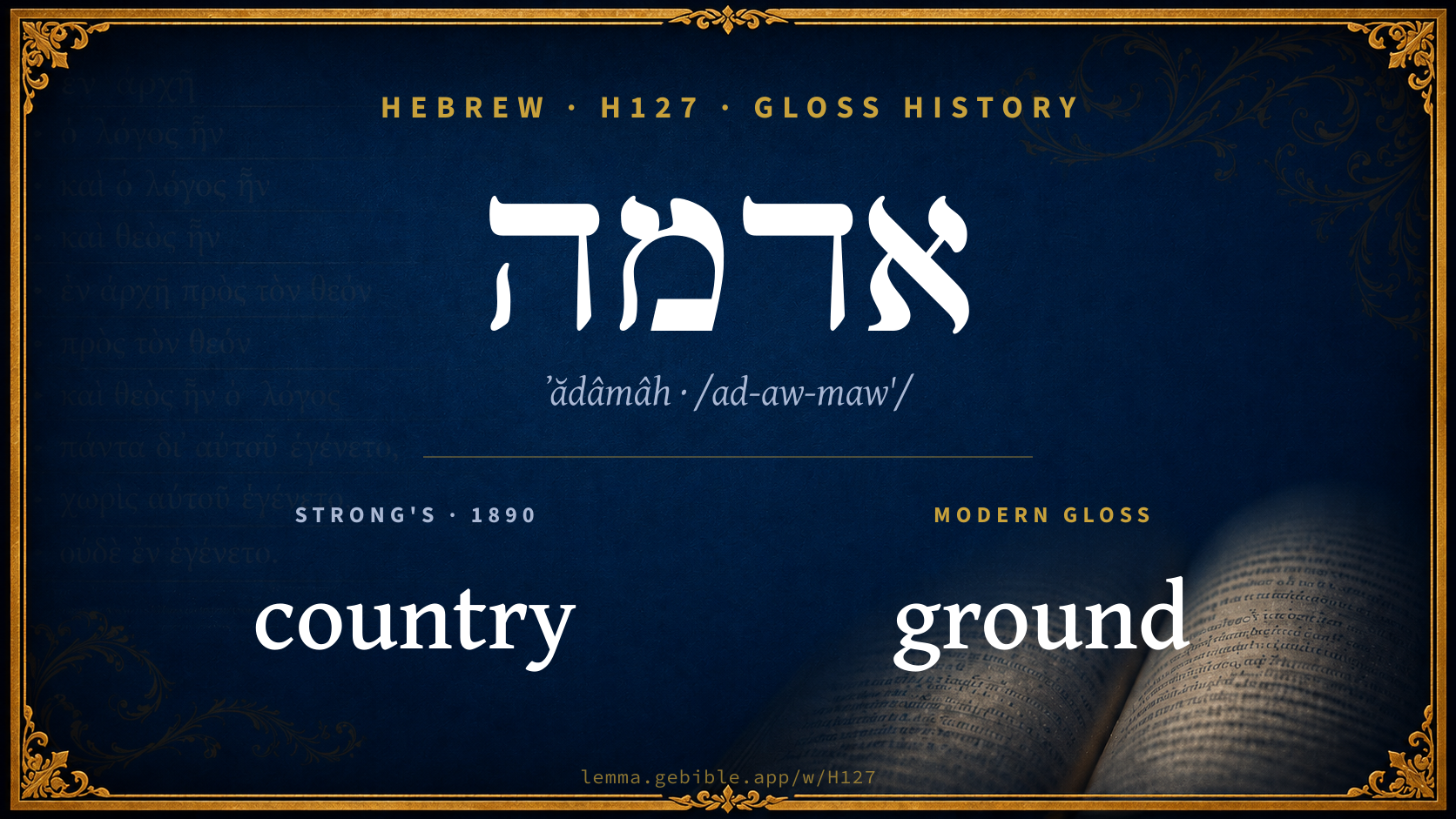
Gloss history
Strong's 1890 vs modern scholarship
About this word
Strong's H127 catalogs a Hebrew word from the Hebrew Old Testament.
These counts are not copied from any lexicon or concordance. They are computed here, from the morphology-tagged Hebrew Old Testament. What Lemma adds →
- 211
- distinct verses
- The word appears in 211 distinct verses.
- 28 / 39
- OT books
- The word appears in 28 of 39 Old Testament books.
- #210
- by frequency
- Top 250 most frequent Hebrew words (rank 210 of 8,640 Hebrew words by occurrence).
View all 211 occurrences in the concordance →
Most concentrated in
- Genesis 37 verses 18%
- Deuteronomy 35 verses 17%
- Ezekiel 27 verses 13%
By section of the Old Testament
By traditional corpus
Conventional, traditional groupings — biblical authorship is debated, so this is a traditional corpus grouping, not an authorship claim. Each share is this word’s portion of its verses in that division of the Hebrew canon. Each figure is a share of the word’s 211 distinct verses.
- Prophets (Nevi'im) 99 verses · 47%
- Torah (Pentateuch) 88 verses · 42%
- Writings (Ketuvim) 24 verses · 11%
How translations render this word
Counts come from each version’s own published word-to-Strong’s tagging or interlinear alignment — an approximate guide to how each version renders this word, not a word-level alignment the data otherwise carries. Because each total is that version’s own tagged count, the per-version totals vary from one another and need not match the appearance or distinct-verse counts above. These counts may also differ from a printed concordance because Lemma counts each distinctly tagged rendering and does not collapse phrase taggings into a single head-word total. This is a fixed set of word-tagged versions (KJV, ASV, BSB, ULT) and does not change with the reading translation you choose elsewhere. Each version’s license is shown beside its name below (and on Sources).
- King James Version: Land 88×, Earth 52×, Ground 41×
- American Standard Version: Land 68×, Ground 58×, Earth 32×
- Berean Standard Bible: Land 106×, Ground 38×, Earth 34×
- unfoldingWord Literal Text: Ground 91×, Land 90×, Earth 18×
King James Version Public Domain
Renders H127 across 222 tagged occurrences — most commonly:
Plus 19 renderings that appear only once — usually multi-word phrases or single function words the recovered tagging swept in, not distinct renderings. Not rendered by a distinct English word in 3 further occurrences.
American Standard Version Public Domain
Renders H127 across 221 tagged occurrences — most commonly:
Plus 38 renderings that appear only once — usually multi-word phrases or single function words the recovered tagging swept in, not distinct renderings.
Berean Standard Bible Public Domain
Renders H127 across 220 tagged occurrences — most commonly:
Plus 10 renderings that appear only once — usually multi-word phrases or single function words the recovered tagging swept in, not distinct renderings. Not rendered by a distinct English word in 5 further occurrences.
unfoldingWord Literal Text CC BY-SA 4.0
Renders H127 across 230 tagged occurrences — most commonly:
Plus 5 renderings that appear only once — usually multi-word phrases or single function words the recovered tagging swept in, not distinct renderings.
7 senses and sub-senses in the full BDB
What do BDB’s symbols mean?
BDB uses these scholarly abbreviations:
| Symbol | Meaning |
|---|---|
| 𝔊 | the Septuagint (the ancient Greek translation, LXX) |
| 𝔙 | the Vulgate (the Latin translation) |
| 𝔖 | the Syriac version (the Peshitta) |
| 𝔗 | the Targum (the Aramaic translation) |
| ψ | the Psalms |
| √ | root (the underlying root or stem) |
| ‖ | parallel passage (a synonymous or contrasted parallel) |
| † | the dagger: every passage where the word occurs is cited |
The 7 senses and sub-senses the full Brown-Driver-Briggs lexicon distinguishes for this word, in lexicon order (not ranked by frequency), with BDB’s own verbatim wording and sub-sense lettering. Shown in Hebrew script with BDB’s own scholarly abbreviations. The condensed entry is in the Lexicon Entry tab. See also the Forms in the corpus table below.
- 1. ground (as tilled, yielding sustenance) Gn 2:5, 9; 3:17, 23; 4:2, 3, 12; 5:29; 8:21; 19:25; 47:23 Ex 34:26 (all J); Ex 23:19 (E) Dt 7:13; 11:17; 26:2, 10, 15; 28:4, 11, 18, 33, 42, 51; 30:9; 2 S 9:10 Is 1:7; 28:24; 30:23(×2), 24 Je 7:20; 14:4; 25:33 Hg 1:11 Mal 3:11 ψ 83:11; 105:35 Pr 12:11 28:19 1 Ch 27:26 Ne 10:36, 38 cf. fig. Jb 5:6 (‖ עפר); personif. 31:38 Jo 1:10; also אִישׁ הָא׳ Gn 9:20 (J) tiller, husbandman; meton. אֹהֵב א׳ 2 Ch 26:10 i.e. lover of husbandry (or do these point to earlier meaning tillage? cf. DlPr 105) אִישׁ עֹבֵד א׳ Zc 13:5. e.g. Genesis 2:5
- 2. piece of ground, landed property Gn 47:18, 19(×3), 20, 22(×2), 23, 26 (all J) ψ 49:12 (pl.) e.g. Genesis 47:18
- 3. earth as material substance; of wh. man is made Gn 2:7 (עָפָר מִן־הָא׳); so animals v 19 (מִן־הָא׳); altar Ex 20:24; earthen vessels חַרְשֵׂי א׳ Is 45:9, on head, sign of woe 1 S 4:12 2 S 1:2; 15:32; of contrition Ne 9:1 (cf. אֵפֶר, עָפָר); מַעֲבֵה הָא׳ 1 K 7:46 cf. 2 Ch 4:17 (firmness of earth, firm earth, clay-ground, for casting-moulds; or clay-moulds (Be)? or is this n.pr.? Klo proposes בַּמְּעָרָה הָאֲדֻמָּה in the red cave); mule-loads of 2 K 5:17; in it lie the dead מִיְּשֵׁנֵי אַדְמַת־עָפָר Dn 12:2 cf. Gn 3:19, 23 ψ 146:4. e.g. Genesis 2:7
- 4. ground as earth’s visible surface; רֶמֶס הָא׳ Gn 1:25; 6:20 (both P) Ho 2:20 cf. Gn 7:8; 9:2 (J?) Lv 20:25 (P) Dt 4:18 Ez 38:20; also Gn 4:10 (J) Is 24:21 Am 3:5 Zp 1:2, 3; as wet with dew 2 S 17:12; rain 1 K 17:14; 18:1; cf. personif. פָּֽצְתָה הָא׳ אֶת־פִּיהָ Nu 16:30 (P) (‖ ארץ v 32), vid. v 31 Gn 4:11; of partic. place, spot א׳ קֹדֶשׁ Ex 3:5 especially as abode of man Ex 10:6 Dt 4:10, 40; 12:1 1 S 20:31 2 S 14:7; oft.פְּנֵי הָא׳ Gn 2:6; 4:14; 6:1, 7; 7:4, 23; 8:8, 13 Ex 32:12; 33:16 Nu 12:3 Dt 6:15; 7:6 (all J, D) 1 S 20:15 + 9 textual e.g. Genesis 1:25
- 5. land, territory, country (= ארץ Gn 47:19 (J) Lv 20:24 (J?—‖ ארץ) cstr. bef. n.pr. א׳ מִצְרַיִם Gn 47:20, 26; א׳ יְהוּדָה Is 19:17; א׳ יִשְׂרָאֵל Ez 11:17 + 16 textual Ez; espe. of land as promised or given by י׳ to his people = Canaan Gn 28:15 Ex 20:12 Nu 11:12; 32:11 (all J?) Dt 5:16 + 16 textual Dt, Jos; 1 K 8:34, 40 +, Je 16:15; 24:10; 25:5; 35:15 Ez 28:25 2 Ch 6:25, 31; 7:20; 33:8; cf. also Dt 12:19; 21:23; 29:27 2 K 17:23 Is 6:11; 7:16; 14:1 +, Ez 34:13, 27 +, Ne 9:25 (א׳ שְׁמֵנָה),—in all c. 41 textual + Jo 2:21 (personif.); א׳ הַקֹּדֶשׁ Zc 2:16 (cf. sub 4 supr. hence also as Yahweh’s land Dt 32:43 Is 14:2 Zc 9:16 2 Ch 7:20. e.g. Genesis 47:19
- 6. whole earth, inhabited earth (seld.; cf. also פְּנֵי הָא׳ sub 4 supr.) Gn 12:3; 28:14 (both J cf. אֶרֶץ 18:18; 22:18; 26:4) Dt 14:2 Am 3:2 Is 24:21. e.g. Genesis 12:3
- 7. n.pr.loc. city in Naphtali (as built cf. אָדָם 4? = ed-Dâme?) W. of L. Gennes. Jos 19:36 v. Di. e.g. Joshua 19:36
Senses from the full Brown-Driver-Briggs lexicon (Brown, Driver, Briggs; Oxford 1906 — public domain), digitized via Sefaria, supplemented by the OpenScriptures HebrewLexicon (CC BY 4.0). Full attribution on Sources.
Word origin
n.f. ground, land (as tilled, Ger. bebaut? DlPr 105, but Fleisch. (MerxArchiv I, 236 f) comp. Ar. أَدَمَة skin, as smoothly covering & close-fitting; √דם cf. Ar. دَمَّ smear (spread over surface); cf. also NöZMG 1886, 737)—א׳ Gn 1:25 +; cstr. אַדְמַת Gn 47:20 +; sf. אַדְמָתִי Jb 31:38 + 2 textual etc.; pl. אֲדָמוֹת ψ 49:12—
— Brown-Driver-Briggs (Oxford 1906, public domain), digitized via Sefaria, supplemented by the OpenScriptures HebrewLexicon (CC BY 4.0). See Sources.
Derived from אדם (ʼâdam) (H119) — to be red.
Jastrow Dictionary
A second Hebrew/Aramaic lexicon for comparison, covering Aramaic and post-biblical (Talmudic, Targumic, Midrashic) usage that the biblical-Hebrew BDB does not. Matched by lemma rather than by Strong’s number, so a lemma may carry more than one Jastrow headword (shown separately below), and the entries cover usage well beyond the Bible.
אֲדָמָה
- , cmp. foreg.; thick and moist) [earth], clay. Gen. R. s. 14 the potter takes sand (עפר) which is male (masc. gender) and clay (אדמה) which is female (fem. gender).—Sabb. VIII, 5 א׳ כחותם וכ׳ as much clay as is required for a seal on bag-knots. [For the meaning of the phonetic equivalents of our w. in other Semit. tongues, v. Ges. H. Dict. s. v.]
A Dictionary of the Targumim, the Talmud Babli and Yerushalmi, and the Midrashic Literature (Marcus Jastrow; London, Luzac, 1903) — Public Domain. Digitized via Sefaria. Digitized via Sefaria. Full attribution on Sources.
Forms in the corpus
The 81 distinct written forms H127 takes in the Hebrew Bible, most frequent first — each parse links to that state’s occurrences in the concordance. Hebrew forms include their vowel points and cantillation, so a single lemma takes many written forms.
The 60 most common forms are shown; 21 rarer forms follow in the full concordance.
Same root — word family
Other BDB entries built from the same root as H127, grouped by Strong’s listed origin. These share a root / origin per the lexicon — not necessarily a shared meaning. Each links to that word’s own entry.
Derives from
Shares the same root
- אדם ʼâdâm H120 man
- אדם ʼâdôm H122 red
- אדם ʼôdem H124 ruby
- אדמדם ʼădamdâm H125 reddish
- אדמני ʼadmônîy H132 red
Proper names from this root
People and places named from this root — a name, not an additional meaning of the word.
Compare all same-root words → Showing 4 of 10 — not the complete family. 3 of the same-root words are proper names (people or places). They share a root, not necessarily a meaning.
Septuagint verse parallels
This word appears in 203 verses that also exist in the Greek Old Testament (Septuagint), out of the 211 Hebrew verses it occurs in. You can read those verses in Greek by switching the Old Testament edition to the Septuagint.
Read these verses in the Septuagint
- Genesis 1:25
- Exodus 3:5
- Leviticus 20:24
- Numbers 11:12
- Deuteronomy 4:10
- Joshua 23:13
- 1 Samuel 4:12
- 2 Samuel 1:2
- 1 Kings 7:46
- 2 Kings 5:17
- 1 Chronicles 27:26
- 2 Chronicles 4:17
This is a verse-level parallel only — the same verses exist in both the Hebrew and Greek Old Testaments. No word-level Hebrew↔Greek correspondence is claimed: the data carries no such alignment, so no Greek word is shown as this Hebrew word’s translation. Coverage is not total — the Septuagint omits the deuterocanon and renumbers the Psalms, so some Hebrew verses have no direct Greek parallel.