
Nehemiah 10:37

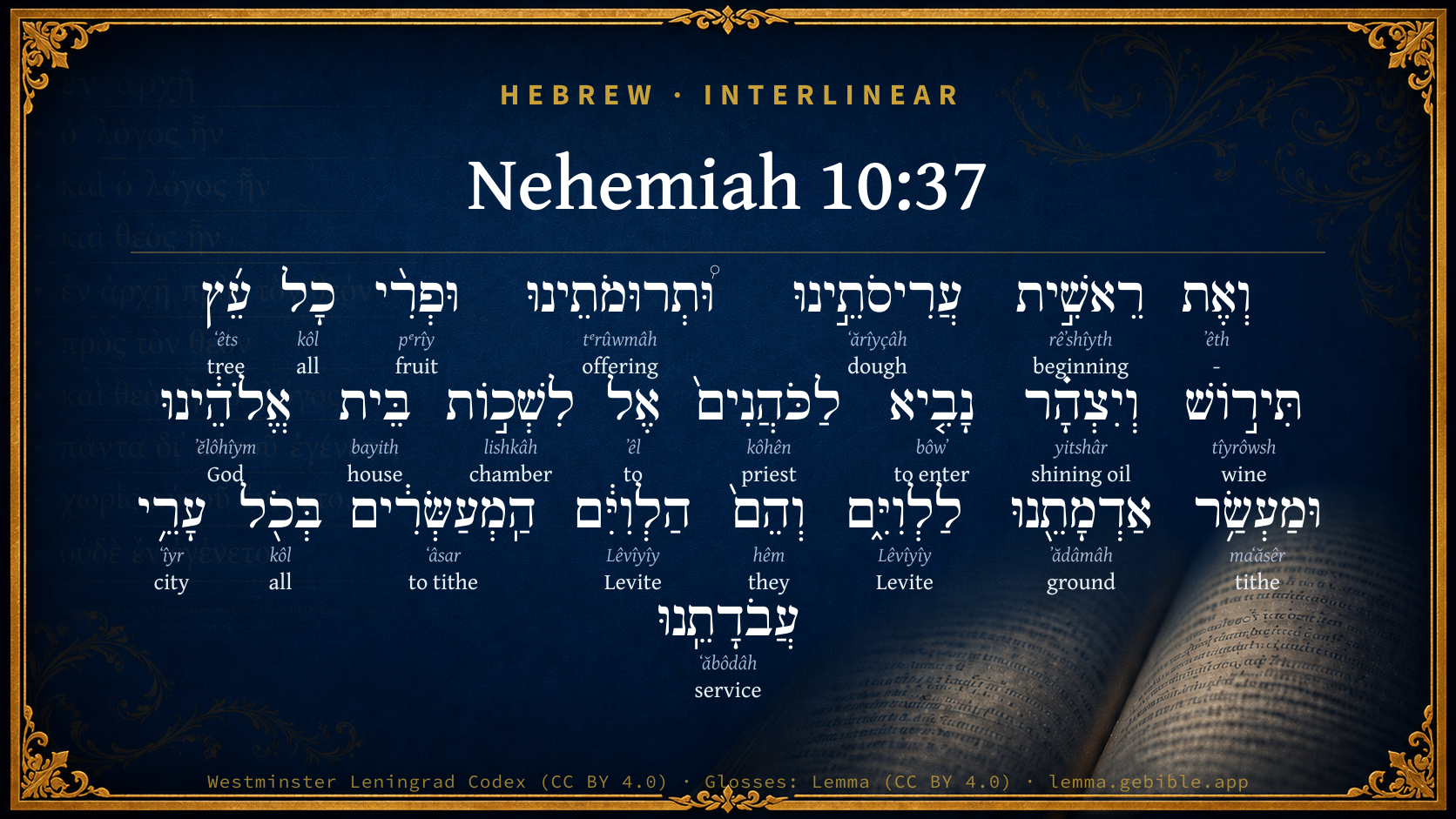
Hebrew (Westminster Leningrad Codex) Nehemiah 10:37 appears in the Hebrew Old Testament. The text above is from the Westminster Leningrad Codex. Each word links to its Strong’s number, a concise gloss, and parsing drawn from the Open Scriptures Hebrew Bible morphology. Click any word for its full Brown-Driver-Briggs (BDB) entry.
Download image
Cite this verse

Nehemiah 10:37 (World English Bible). Public Domain. Lemma interlinear Bible study tool, https://lemma.gebible.app/v/nehemiah/10/37.

Show BibTeX & RIS
BibTeX
RIS
English Translation
and that we should bring the first fruits of our dough, and our heave-offerings, and the fruit of all manner of trees, the new wine and the oil, to the priests, to the chambers of the house of our God; and the tithes of our ground to the Levites; for they, the Levites, take the tithes in all the cities of our tillage.
World English Bible · Public Domain
Download a study sheet

One document with this verse’s original text, its word-by-word gloss line, the meaning frame, cross-references with their text, attributed commentary, and full source and license credits — printable, and it pastes into notes with its structure intact.

This verse Autodidact and up

Study sheet (.html) Plain text (.txt)

A passage Seminary Student

Up to 50 verses in one chapter. A passage sheet keeps up to 6 commentary sources and 12 cross-references per verse, in the order this page ranks them, and says so on the sheet whenever that leaves anything out. Ask for a single verse and you get the Autodidact verse sheet above.

Everything on this page stays free to read, with no account — the sheet is a download of what is already on screen, not access to it.

Want to remove ads? Support Godless Engineer
Compare translations 3

The same verse in 3 English versions, stacked beneath the original-language interlinear above. Click any original word for its lexicon entry.

Each is an independent rendering of the whole verse — the interlinear is not word-aligned to these translations.

Highlighted words mark where these versions differ — a whole-verse word diff, not a word-by-word alignment.

  • World English Bible Public Domain
    and that we should bring the first fruits of our dough, and our heave-offerings, and the fruit of all manner of trees, the new wine and the oil, to the priests, to the chambers of the house of our God; and the tithes of our ground to the Levites; for they, the Levites, take the tithes in all the cities of our tillage.
  • King James Version Public Domain
    And that we should bring the firstfruits of our dough, and our offerings, and the fruit of all manner of trees, of wine and of oil, unto the priests, to the chambers of the house of our God; and the tithes of our ground unto the Levites, that the same Levites might have the tithes in all the cities of our tillage.
  • unfoldingWord Literal Text CC BY-SA 4.0
    And we will bring: the first of our dough and our offerings, and the fruit of every tree, wine, and oil, for the priests, to the chambers of the house of our God; and a tithe of our soil for the Levites. And they, the Levites, will be the ones receiving tithes in all the cities of our labor.

unfoldingWord Literal Text — © unfoldingWord, licensed CC BY-SA 4.0. Word-aligned USFM3 via Door43 (git.door43.org/unfoldingWord/en_ult).

Versions to compare (up to 4)

3 of 4 selected

Show all 18 translations

Every available English version of this verse, each an independent rendering of the whole verse.

  • World English Bible Public Domain
    and that we should bring the first fruits of our dough, and our heave-offerings, and the fruit of all manner of trees, the new wine and the oil, to the priests, to the chambers of the house of our God; and the tithes of our ground to the Levites; for they, the Levites, take the tithes in all the cities of our tillage.
  • Berean Standard Bible Public Domain
    Moreover, we will bring to the priests at the storerooms of the house of our God the firstfruits of our dough, of our grain offerings, of the fruit of all our trees, and of our new wine and oil. A tenth of our produce belongs to the Levites, so that they shall receive tithes in all the towns where we labor.
  • Majority Standard Bible Public Domain
    Moreover, we will bring to the priests at the storerooms of the house of our God the firstfruits of our dough, of our grain offerings, of the fruit of all our trees, and of our new wine and oil. A tenth of our produce belongs to the Levites, so that they shall receive tithes in all the towns where we labor.
  • King James Version Public Domain
    And that we should bring the firstfruits of our dough, and our offerings, and the fruit of all manner of trees, of wine and of oil, unto the priests, to the chambers of the house of our God; and the tithes of our ground unto the Levites, that the same Levites might have the tithes in all the cities of our tillage.
  • American Standard Version (1901) Public Domain
    and that we should bring the first-fruits of our dough, and our heave-offerings, and the fruit of all manner of trees, the new wine and the oil, unto the priests, to the chambers of the house of our God; and the tithes of our ground unto the Levites; for they, the Levites, take the tithes in all the cities of our tillage.
  • Revised Version (1885) Public Domain
    and that we should bring the firstfruits of our dough, and our heave offerings, and the fruit of all manner of trees, the wine and the oil, unto the priests, to the chambers of the house of our God; and the tithes of our ground unto the Levites; for they, the Levites, take the tithes in all the cities of our tillage.
  • Geneva Bible (1599) Public Domain
    And that we should bring the first fruite of our dough, and our offrings, and the fruite of euery tree, of wine and of oyle, vnto the Priests, to the chambers of the house of our God: and the tithes of our lande vnto the Leuites, that the Leuites might haue the tithes in all the cities of our trauaile.
  • Douay-Rheims (1899) Public Domain
    And that we would bring the firstfruits of our meats, and of our libations, and the fruit of every tree, of the vintage also and of oil to the priests, to the storehouse of our God, and the tithes of our ground to the Levites. The Levites also shall receive the tithes of our works out of all the cities.
  • Young's Literal Translation Public Domain
    And the beginning of our dough, and our heave-offerings, and the fruit of every tree, of new wine, and of oil, we bring in to the priests, unto the chambers of the house of our God, and the tithe of our ground to the Levites; and they -- the Levites -- have the tithes in all the cities of our tillage;
  • Literal Standard Version CC BY-SA 4.0
    And the beginning of our dough, and our raised-offerings, and the fruit of every tree, of new wine, and of oil, we bring to the priests, into the chambers of the house of our God, and the tithe of our ground to the Levites; and they—the Levites—have the tithes in all the cities of our tillage;
  • Unlocked Literal Bible CC BY-SA 4.0
    We will bring the first of our dough and our grain offerings, and the fruit of every tree, and the new wine and the oil we will bring to the priests, to the storerooms of the house of our God. We will bring to the Levites the tithes from our soil because the Levites collect the tithes in all the towns where we work.
  • unfoldingWord Literal Text CC BY-SA 4.0
    And we will bring: the first of our dough and our offerings, and the fruit of every tree, wine, and oil, for the priests, to the chambers of the house of our God; and a tithe of our soil for the Levites. And they, the Levites, will be the ones receiving tithes in all the cities of our labor.
  • Darby Bible Public Domain
    and that we should bring the first-fruits of our coarse meal and our heave-offerings, and the fruit of all manner of trees, new wine and oil, to the priests, into the chambers of the house of our God, and the tithes of our ground to the Levites, that they, the Levites, should take the tithes in all the cities of our tillage.
  • World Messianic Bible Public Domain
    and that we should bring the first fruits of our dough, our wave offerings, the fruit of all kinds of trees, and the new wine and the oil, to the priests, to the rooms of the house of our God; and the tithes of our ground to the Levites; for they, the Levites, take the tithes in all our farming villages.
  • Webster's Bible Public Domain
    And that we should bring the first-fruits of our dough, and our offerings, and the fruit of all manner of trees, of wine and of oil, to the priests, to the chambers of the house of our God; and the tithes of our ground to the Levites, that the same Levites might have the tithes in all the cities of our tillage.
  • Free Bible Version CC BY-SA 4.0
    We will bring to the storerooms of the Temple of our God, to the priests, the first part of our coarse-ground flour, of our grain offerings, of the fruit of all our trees, and of our new wine and olive oil. We will also bring a tithe of our produce to the Levites, for the Levites are the ones who collect the tithes in all the farming towns.
  • Bible in Basic English Public Domain
    And that we would take the first of our rough meal, and our lifted offerings, and the fruit of every sort of tree, and wine and oil, to the priests, to the rooms of the house of our God; and the tenth of the produce of our land to the Levites; for they, the Levites, take a tenth in all the towns of our ploughed land.
  • JPS Tanakh (1917) Public Domain
    (10-38) and that we should bring the first of our dough, and our heave-offerings, and the fruit of all manner of trees, the wine and the oil, unto the priests, to the chambers of the house of our God; and the tithes of our land unto the Levites; for they, the Levites, take the tithes in all the cities of our tillage.

Literal Standard Version (2020), Covenant Press — licensed CC BY-SA 4.0. Text via the HelloAO Bible API (eBible.org). Unlocked Literal Bible (unfoldingWord) — licensed CC BY-SA 4.0. Text via the HelloAO Bible API (eBible.org). unfoldingWord Literal Text — © unfoldingWord, licensed CC BY-SA 4.0. Word-aligned USFM3 via Door43 (git.door43.org/unfoldingWord/en_ult). Free Bible Version, Dr. Jonathan Gallagher — licensed CC BY-SA 4.0. Text via the HelloAO Bible API (eBible.org).

Word by word

More ways to search: Search by grammar → Find every occurrence → Compare this word →

Practice this passage: Drill this verse → Learn its vocabulary →

עֲרִיסֹתֵ֣ינוּ
ʻărîyçâh
H6182
“dough · our”
Noun, Common, Feminine, Plural, Construct + Suffix, Personal, 1st Person, Common, Plural
Part of Speech
Noun
Type
Common
Gender
Feminine
Number
Plural
State
Construct
Full BDB Definition

Origin: from an unused root meaning to comminute

TWOT: 1699a

dough, meal, coarse meal, kneading trough - meaning dubious
  1. וְאֶת ʼêth H853 “and · -” Conjunction + Particle, Direct Object
  2. רֵאשִׁ֣ית rêʼshîyth H7225 “beginning of” Noun, Common, Feminine, Singular, Construct
  3. וּ֠תְרוּמֹתֵינוּ tᵉrûwmâh H8641 “and · offerings · our” Conjunction + Noun, Common, Feminine, Plural, Construct + Suffix, Personal, 1st Person, Common, Plural
  4. וּפְרִ֨י pᵉrîy H6529 “and · fruit of” Conjunction + Noun, Common, Masculine, Singular, Construct
  5. כָל kôl H3605 “all of” Noun, Common, Masculine, Singular, Construct
  6. עֵ֜ץ ʻêts H6086 “tree” Noun, Common, Masculine, Singular, Absolute
  7. תִּיר֣וֹשׁ tîyrôwsh H8492 “wine” Noun, Common, Masculine, Singular, Absolute
  8. וְיִצְהָ֗ר yitshâr H3323 “and · shining oil” Conjunction + Noun, Common, Masculine, Singular, Absolute
  9. נָבִ֤יא bôwʼ H935 “to enter” Verb, Hiphil, Imperfect, 1st Person, Common, Plural
  10. לַכֹּהֲנִים֙ kôhên H3548 “to/for the · priests” Preposition, Determined + Noun, Common, Masculine, Plural, Absolute
  11. אֶל ʼêl H413 “to” Preposition
  12. לִשְׁכ֣וֹת lishkâh H3957 “chambers of” Noun, Common, Feminine, Plural, Construct
  13. בֵּית bayith H1004 “house of” Noun, Common, Masculine, Singular, Construct
  14. אֱלֹהֵ֔ינוּ ʼĕlôhîym H430 “God(s) · our” Noun, Common, Masculine, Plural, Construct + Suffix, Personal, 1st Person, Common, Plural
  15. וּמַעְשַׂ֥ר maʻăsêr H4643 “and · tithe of” Conjunction + Noun, Common, Masculine, Singular, Construct
  16. אַדְמָתֵ֖נוּ ʼădâmâh H127 “ground · our” Noun, Common, Feminine, Singular, Construct + Suffix, Personal, 1st Person, Common, Plural
  17. לַלְוִיִּ֑ם Lêvîyîy H3881 “to/for the · Levites” Preposition, Determined + Noun, Gentilic, Masculine, Plural, Absolute
  18. וְהֵם֙ hêm H1992 “and · they” Conjunction + Pronoun, Personal, 3rd Person, Masculine, Plural
  19. הַלְוִיִּ֔ם Lêvîyîy H3881 “the · Levites” Particle, Definite Article + Noun, Gentilic, Masculine, Plural, Absolute
  20. הַֽמְעַשְּׂרִ֔ים ʻâsar H6237 “the · tithing” Particle, Definite Article + Verb, Piel, Participle Active, Masculine, Plural, Absolute
  21. בְּכֹ֖ל kôl H3605 “in/at · all of” Preposition + Noun, Common, Masculine, Singular, Construct
  22. עָרֵ֥י ʻîyr H5892 “cities of” Noun, Common, Feminine, Plural, Construct
  23. עֲבֹדָתֵֽנוּ ʻăbôdâh H5656 “service · our” Noun, Common, Feminine, Singular, Construct + Suffix, Personal, 1st Person, Common, Plural

About this verse

These counts appear in no published source. They are computed here, from the morphology-tagged text and Lemma’s own curated glosses. What Lemma adds →

24
words
22
distinct lemmas
Historical
section

Notable vocabulary

The rarest word here is עֲרִיסֹתֵ֣ינוּ dough H6182 — appearing just 4 times in the whole Hebrew Bible.

Shared distinctive vocabulary

עֲרִיסֹתֵ֣ינוּ dough H6182 occurs in 4 verses of the Hebrew Bible. Also found in:

Grammatical profile

  • 2 verbs
  • 19 nouns
  • 1 pronoun
  • 1 preposition
  • 1 particle

Verb forms

  • נָבִ֤יא Hiphil · Imperfect
  • הַֽמְעַשְּׂרִ֔ים Piel · Participle Active

Repetition

Words recur within this verse — often emphatic in Hebrew:

  • כָל all H3605 ×2
  • לַלְוִיִּ֑ם Levite H3881 ×2

Cross-references

15

Topical passages linked to Nehemiah 10:37 in the Treasury of Scripture Knowledge — connected by theme and wording, ordered by reader-vote popularity; previews shown in the World English Bible.

  • Leviticus 23:17 You shall bring out of your habitations two wave-loaves of two tenth parts of an ephah: they shall be of fine flour, they shall be baked with yeast, for first fruits to Yahweh.
  • Numbers 18:21 To the children of Levi, behold, I have given all the tithe in Israel for an inheritance, in return for their service which they serve, even the service of the tent of meeting.
  • Deuteronomy 18:4 The first fruits of your grain, of your new wine, and of your oil, and the first of the fleece of your sheep, shall you give him.
  • Deuteronomy 26:2 that you shall take of the first of all the fruit of the ground, which you shall bring in from your land that Yahweh your God gives you; and you shall put it in a basket, and shall go to the place which Yahweh your God shall choose, to cause his name to dwell there.
  • Nehemiah 13:5 had prepared for him a great chamber, where before they laid the meal-offerings, the frankincense, and the vessels, and the tithes of the grain, the new wine, and the oil, which were given by commandment to the Levites, and the singers, and the porters; and the heave-offerings for the priests.
  • Nehemiah 13:9 Then I commanded, and they cleansed the chambers: and there brought I again the vessels of the house of God, with the meal-offerings and the frankincense.
  • Leviticus 27:30–33 "'All the tithe of the land, whether of the seed of the land or of the fruit of the trees, is Yahweh's. It is holy to Yahweh.
  • Numbers 15:19–21 then it shall be that when you eat of the bread of the land, you shall offer up a heave-offering to Yahweh.
  • Numbers 18:12–13 All the best of the oil, and all the best of the vintage, and of the grain, the first fruits of them which they give to Yahweh, to you have I given them.
  • 1 Kings 6:5–10 Against the wall of the house he built stories round about, against the walls of the house round about, both of the temple and of the oracle; and he made side-chambers round about.
  • 2 Chronicles 31:6 The children of Israel and Judah, who lived in the cities of Judah, they also brought in the tithe of oxen and sheep, and the tithe of dedicated things which were consecrated to Yahweh their God, and laid them by heaps.
  • 2 Chronicles 31:11–12 Then Hezekiah commanded to prepare chambers in the house of Yahweh; and they prepared them.
  • Malachi 3:8 Will a man rob God? Yet you rob me! But you say, 'How have we robbed you?' In tithes and offerings.
  • Malachi 3:10 Bring the whole tithe into the store-house, that there may be food in my house, and test me now in this," says Yahweh of hosts, "if I will not open you the windows of heaven, and pour you out a blessing, that there shall not be room enough for.
  • Numbers 18:24–32 For the tithe of the children of Israel, which they offer as a heave-offering to Yahweh, I have given to the Levites for an inheritance: therefore I have said to them, Among the children of Israel they shall have no inheritance.

Cross-references courtesy of OpenBible.info (CC BY 4.0).

Hebrew and Greek witnesses Masoretic Hebrew ↔ Greek Septuagint

The same verse in the two great witnesses to the Old Testament, shown verse-for-verse.

These are two independent witnesses, not word-aligned to each other, and the Septuagint is shown in lemma (dictionary) form.

Hebrew Nehemiah 10:37 Masoretic · Westminster Leningrad Codex

וְאֶת רֵאשִׁ֣ית עֲרִיסֹתֵ֣ינוּ וּ֠תְרוּמֹתֵינוּ וּפְרִ֨י כָל עֵ֜ץ תִּיר֣וֹשׁ וְיִצְהָ֗ר נָבִ֤יא לַכֹּהֲנִים֙ אֶל לִשְׁכ֣וֹת בֵּית אֱלֹהֵ֔ינוּ וּמַעְשַׂ֥ר אַדְמָתֵ֖נוּ לַלְוִיִּ֑ם וְהֵם֙ הַלְוִיִּ֔ם הַֽמְעַשְּׂרִ֔ים בְּכֹ֖ל עָרֵ֥י עֲבֹדָתֵֽנוּ

and that we should bring the first fruits of our dough, and our heave-offerings, and the fruit of all manner of trees, the new wine and the oil, to the priests, to the chambers of the house of our God; and the tithes of our ground to the Levites; for they, the Levites, take the tithes in all the cities of our tillage.

World English Bible · Public Domain

Greek LXX Structure differs

The Septuagint has no separate book of Nehemiah. Its Greek text is the second half of Esdras B (2 Esdras), chapters 11–23; Ezra is the first half (1–10).

A verse-for-verse comparison isn’t shown here because the chapters and verses don’t line up. Switch to the LXX edition with the MT / LXX toggle above to read the Greek directly.

On this verse, The Cambridge Bible for Schools and Colleges discusses the Septuagint’s reading. Read the note in Commentary ↓

Hebrew: Westminster Leningrad Codex (CC BY 4.0). Greek: Septuagint (public domain); English from a public-domain English Septuagint. How the Septuagint differs from the Hebrew →

Commentary

Notes on Nehemiah 10:37 from classic Christian and Jewish commentators (each source and its license shown beneath its notes). The classic Christian expositions comment on the surrounding passage and are grouped to its opening verse, so a note may address several verses; the Jewish commentaries on the Tanakh (Rashi and others) are per-verse, so they appear only where the commentator wrote on this verse.

Lemma curates 59 commentaries, every one of them public domain or Creative Commons licensed, each selected and text-cleaned for this edition rather than reprinted as found. About our sources →

The Cambridge Bible for Schools and Colleges

gen. ed. J. J. S. Perowne

37. and that we should bring] The change of construction (cf. the infinitive ‘to bring’ in Neh_10:35-36) somewhat favours the suggestion that this and the next two verses are a later insertion, introduced for the purpose of recording in detail the Jewish practice of paying firstfruits and tithes.

the firstfruits of our dough] R.V. marg. ‘Or, coarse meal.’ See Num_15:21, ‘Of the first of your dough (marg. Or, coarse meal) ye shall offer up a cake for an heave offering.’ The firstfruits or ‘the first’ (rêshith) is equivalent to ‘the best.’ Cf. Lev_23:17.

and our offerings] R.V. and our heave offerings. Before this expression we have also to understand ‘the firstfruits of.’ The priests did not receive the whole ‘heave offerings’ (terumoth), but ‘the firstfruits’ or ‘first’ of them. This is also the teaching of Eze_44:30, ‘And the first of all the firstfruits of everything, and every oblation (marg. Or, heave offering) of everything, of all your oblations, shall be for the priests.’ The portion thus assigned to the priests was called ‘the heave offering for the priests’ (Neh_13:5). The word rendered ‘heave offering’ was used in a general sense to denote ‘a gift’ (Pro_29:4), but was applied in a special sense to gifts or offerings for a sacred purpose, e.g. contributions to the tabernacle, Exo_25:2 sq., or the portions of sacrifices set apart for the priests, Lev_7:32. In 2Sa_1:21, ‘fields of offerings’ are fields from whose rich pasture the firstlings of the flock would be taken.

and the fruit of all manner of trees] See on Neh_10:35. We should understand these words to depend upon ‘the firstfruits of.’ The structure of the verse is certainly in favour of this interpretation. ‘The first-fruits,’ devoted to the priests, are distinguished from the ‘tithes’ which are given to the Levites.

wine] R.V. marg. ‘Or, the vintage.’ ‘The wine and the oil,’ not in apposition to ‘the fruit of all manner of trees,’ but separately mentioned on account of their peculiar value. Cf. Num_18:12.

to the chambers of the house of our God] See on Neh_10:39, Neh_12:44, Neh_13:4; LXX. εἰς τὸ γαζοφυλάκιον οἴκου τοῦ θεοῦ.

the tithes of our ground] According to Lev_27:30. On the omission of reference to tithe of ‘herd and flock’ mentioned in Lev_27:32, see note at end of chapter. Passages in the O.T. dealing with tithe are Gen_14:20; Gen_28:22; Lev_27:30-33; Num_18:21-32; Deu_14:22-29; Deu_26:12-15; Amo_4:4; Mal_3:8-10; 2Ch_31:5-6, and Neh_10:37-39; Neh_12:44; Neh_13:5.

that the same Levites might have the tithes] R.V. for they, the Levites, take the tithes. LXX. δεκατοῦντες. Vulg. ‘accipient decimas.’ The word in the Hebrew which generally denotes ‘to pay tithe of something,’ is here used in a special sense of collecting tithe, in which it is found in the later Hebrew of the Mishnah. It occurs here in the sense of ἀποδεκατόω in Heb_7:5 ‘to take tithes of the people.’

in all the cities of our tillage] LXX. ἐν πάσαις πόλεσιν δουλείας ἡμῶν. Vulg. ‘ex omnibus civitatibus operum nostrorum.’ Cf. 1Ch_27:26, ‘over them that did the work of the field for tillage of the ground.’ The translation of ‘abodah’ by ‘tillage’ gives the only probable sense. The alternative, ‘cities of our service’ would be meaningless. The words are important as determining the agricultural character of the area from which this tithe was collected. It is implied, though not stated, that the tithe thus collected by the Levites was of ‘the fruits of the field’ (cf. Deu_14:22-29; Deu_26:12-15) and did not include the tithe of ‘the herd or the flock.’ See note on Neh_10:39. The word ‘Abodah’ was in later times technically used for ‘worship.’ Cf. the saying of Simon the Just in the Pirqe Aboth, ‘On three things the world is stayed; on the Thorah, and on the Worship (Abodah), and on the bestowal of kindnesses’ (Sayings of the Jewish Fathers, Taylor, p. 26).

The Cambridge Bible for Schools and Colleges (gen. ed. J. J. S. Perowne; Cambridge University Press, 1878–1918) — public domain. Text from a community e-Sword module.

Trapp's Complete Commentary

John Trapp

Neh 10:37 And [that] we should bring the firstfruits of our dough, and our offerings, and the fruit of all manner of trees, of wine and of oil, unto the priests, to the chambers of the house of our God; and the tithes of our ground unto the Levites, that the same Levites might have the tithes in all the cities of our tillage.

Ver. 37. And that we should bring the firstfruits of our dough] As oft as they baked they gave cake unto the priests, where they dwelled throughout the tribes; for they were dispersed all abroad the land for instruction of the people, and exhortation to obedience to the law of God. See Num 15:20-21.

And the tithes of our ground unto the Levites] All the tithes were paid to the Levites, not to the priests; and out of them the Levites paid a tenth to the priests.

In all the cities of our tillage] No places were tithe free.

John Trapp, A Commentary or Exposition upon All the Books of the Old and New Testament (1647–1656) — public domain. Text from a community e-Sword module.

The Biblical Illustrator

Joseph S. Exell

Neh_10:37

And the tithes.

Tithes

Without inquiring into the reason for which the number ten has been so frequently preferred as a number of selection in the ones of tribute offerings, both sacred and secular, voluntary and compulsory, we may remark that numerous instances of its use are found both in profane and also in Biblical history, prior to, or independently of, the appointment of the Levitical tithes under the law. In Biblical history the two prominent instances are--

1. Abram presenting the tenth of his property, according to the Syrian and Arabic versions of Heb_7:1-28., but as the passages themselves appear to show, of the spoils of his victory, to Melchisedek (Gen_14:20; Heb_7:2-6).

2. Jacob, after his vision at Luz, devoting a tenth of all his property to God in case he should return home in safety (Gen_28:22). These instances bear witness to the antiquity of tithes, in some shape or other, previous to the Mosaic tithe system. But numerous instances are to he found of the practice of heathen nations, Greeks, Ronians, Carthaginians, Arabians, of applying tenths derived from property in general, from spoil, from confiscated goods, or from commercial profits, to sacred, and quasi-sacred, and also to fiscal purposes, viz., as consecrated to a deity, presented as a reward to a successful general, set apart as a tribute to a sovereign, or as a permanent source of revenue. (Smiths Bible Dictionary.)

Giving as a means of character culture

God carries on His cause in the world by the aid of His people. He is constantly calling on us to give, now to this cause and now to that. Why so? Surely He to whom the silver and gold belong has no need of us to help forward His work. He could, if He would, do it much more efficiently without us. But He is striving to educate us into resemblance to Christ and meetness for heaven. If a father could place his child where he would be habitually giving, giving, in the expression of a benevolent sympathy and helpfulness, he would be putting him under the most efficient of all means for the development in him of a truly Christian, or Christlike, spirit. He would be conferring on him one of the richest possible blessings. This is the blessing which our heavenly Father is trying to bestow upon us, in surrounding us as He does with those who need our sympathy and help. If we gratefully recognise our Fathers wise and loving design, and, so far as we can, give our help with a truly Christian spirit, our contributions will do more good to us who give than to those who receive them. Every such expression of Christian love will leave an impress on our character which we shall carry with us for ever. It will develop into augmented power and more absolute supremacy within us that Christlike spirit without which we can never walk the golden streets. We need, then, to cultivate the habit of giving as much as the habit of praying.

The Biblical Illustrator, edited by Joseph S. Exell (c. 1880s–1900s) — public domain. Text from a community e-Sword module.

Joseph Benson's Commentary

Neh 10:37-38. That the Levites might have the tithes in all the cities of our tillage — That is, the tithes of all the fruits of the ground belonging to our several cities. And the priest, the son of Aaron, shall be with the Levites — As the people gave the tithe of their land to the Levites, so the Levites gave a tithe of their tithes to the priests. And it is here ordered, that when the people brought them to the Levites, one of the priests should be present to inspect them, and to see that they tithed the tithes, that is, set apart the tenth of the tithes they had received for the priests, which were brought to the chambers of the house of God, wherein they were deposited for their use.

Joseph Benson's Commentary on the Old and New Testaments (1811–1818) — public domain. Text from a community e-Sword module.

Tyndale Open Study Notes

Tyndale Open Resources

10:37-39 The Levites collected the tithes in all . . . rural towns and sent a tenth of that collection to the Temple in Jerusalem (see Num 18:25-32).

Tyndale Open Study Notes — © Tyndale Open Resources, licensed CC BY-SA 4.0. Text via the HelloAO Bible API.

Geneva Bible (1599)

Geneva Bible translators

Wheresoever we labored, or travailed, there the tithes were due unto the Lord both by the Law, and according to the oath and covenant that we made.

Geneva Bible (1599) marginal notes — public domain. Text via Bolls.life.

Ellicott's Commentary for English Readers

(37) To the chambers of the house of our God.—To the store-chambers, minutely described as they were of old in 1 Kings 6, Hezekiah appears to have added formerly a treasure-house for the tithes, referred to in the next verse (2Ch_31:11).

In all the cities of our tillage.—Agricultural towns, so called here with reference to the fruits of the earth, which were deposited first in certain selected places.

A Bible Commentary for English Readers, edited by Charles John Ellicott (1878–1897) — public domain. Text from a community e-Sword module.

John Gill's Exposition

And the priest the son of Aaron shall be with the Levites, when the Levites take tithes,.... There was always to be a priest with the Levites at such times, to take notice what quantity they received, that they might not be under any temptation, or lie under any suspicion of defrauding the priests of their due, who were to have a part in the tithes, as follows:

and the Levites shall bring up the tithe of the tithes unto the house of our God, to the chambers, into the treasure house: which were in the court of the priests for that purpose; for out of the tithes of the Levites there was another tithe or tenth part taken, and given to the priests, see Num 18:26.

John Gill's Exposition of the Whole Bible (1746–1763) — public domain (CC PDM 1.0). Text via the HelloAO Bible API.

Haydock's Catholic Bible Commentary

Meats. Hebrew, "paste," Numbers xv. 20., (Calmet) and xxiii. 17. --- Ground, or the produce. (Menochius)

George Leo Haydock (1774–1849), Haydock's Catholic Family Bible and Commentary, 1859 edition — public domain. Excludes Psalms (Douay-Rheims chapter numbering differs from Protestant) and Deuterocanonical books (Catholic canon only).

Matthew Poole's English Annotations

i.e. The tithes of all the fruits of the ground belonging to our several cities.

Matthew Poole's English Annotations on the Holy Bible (1683–1685) — public domain. Text from a community e-Sword/MySword module.

Whedon's Commentary on the Bible

Daniel D. Whedon

37. The firstfruits of our dough — The “wave loaves” described in Lev_23:17.

The tithes — For these were holy to Jehovah.

Lev_27:30.

Daniel D. Whedon (gen. ed.), Commentary on the Old and New Testaments (1874–1909) — public domain. Text from a community e-Sword module.

The Pulpit Commentary

The first-fruits of our dough. See Num_15:18-21. And our offerings. Literally, "our heave offerings". (Num_15:20 Lev_23:11, Lev_23:17) To the chambers of the house. The store-chambers attached to the temple-building. (see Neh_13:4, Neh_13:5) The tithes of our ground. As with the law of first-fruits, so with that of tithes (which was more burthensome), there had grown up a practice of neglecting it on the part of many, if not of all. The natural result would be the non-attendance of Levites at Jerusalem, and so a falling-off in the solemnity and grandeur of the temple-worship. (comp. Neh_13:10) It was now covenanted afresh on the part of the people that they would resume the legal practice, at any rate to the extent of paying what has been called "the first tithe," or that due to the Levites for their sustentation. In all the cities of our tillage. The Levitical tithe was not taken to Jerusalem. but stored up in some neighbouring, generally Levitical, city.

The Pulpit Commentary (1880–1919), ed. H.D.M. Spence-Jones & Joseph S. Exell — public domain. Text from a community e-Sword module.

unfoldingWord translationNotes

Door43 World Missions Community

General Information:

In these verses, the people continue describing the content of the oath they were making in Nehemiah verse 29.

We will bring ... We will bring

The pronoun "we" here includes Nehemiah and the Israelites except for the priests and the Levites, and also does not include the reader of this book (See: Exclusive and Inclusive "We")

our dough

Possible meanings are that this refers to 1) dough made from coarse flour, 2) coarse flour, or 3) ground grain.

the new wine and the oil

The words "first of" are understood from the begininng of the sentnces. They can be repeated. AT: "the first of the new wine and of the oil" or "the best of the new wine and of the oil" (See: Ellipsis)

the storerooms of the house of our God

"the places where things are stored in the temple"

the tithes from our soil

Here "our soil" refers to everything that is grown in the ground. AT: "the tithes of what we grow in the ground" (See: Synecdoche)

they receive the tithes

This can be stated in active form. AT: "the people give them the tithes" (See: Active or Passive)

a tenth

This means one part out of ten equal parts. (See: Fractions)

the storerooms of the treasury

"the storerooms in the temple"

translationWords

grain offering

fruit

wine

oil

priest

house of God

Levi

tenth

descend

Aaron

receive

unfoldingWord translationNotes — © Distant Shores Media and the Door43 World Missions Community, licensed CC BY-SA 4.0. Source: git.door43.org/Door43/en_tn.

Lesson kit

Teaching starters — assembled from the data on this page, not authored interpretation. Every prompt links to the verse data it draws on. Edit before teaching.

Nehemiah, in the Historical, opens this verse with 24 words (22 distinct Hebrew lemmas). Its most distinctive word is ʻărîyçâh (“dough”). A historical commentator’s framing appears above. Read the whole chapter for the surrounding context.

Discussion questions

  1. The word ʻărîyçâh carries the sense “dough.” How does it shape the verse?
  2. Numbers 15:20 shares the word «dough» with this verse. How do the two illuminate each other?
  3. “all” occurs 2× in this one verse. What is the effect of the repetition?
  4. The translations on this page render this verse differently — a whole-verse word diff, not a word-by-word alignment. What might account for the different wordings?
  5. The verb «נָבִ֤יא» is Hiphil Imperfect. How does its form color the action?
  6. Reading how The Cambridge Bible for Schools and Colleges and Trapp's Complete Commentary read this verse, where do the two commentators agree and where do they part?

Things to notice

Reading settings

Reading text

Shown beneath each verse's original-language words.

Old Testament
Old Testament edition

Read the OT as the Masoretic Hebrew (MT) or the Greek Septuagint (LXX).

English shown for the Greek Septuagint (in the Hebrew ↔ Greek comparison).

Comparing translations? Open the Compare panel on any verse page to stack up to four side by side.