
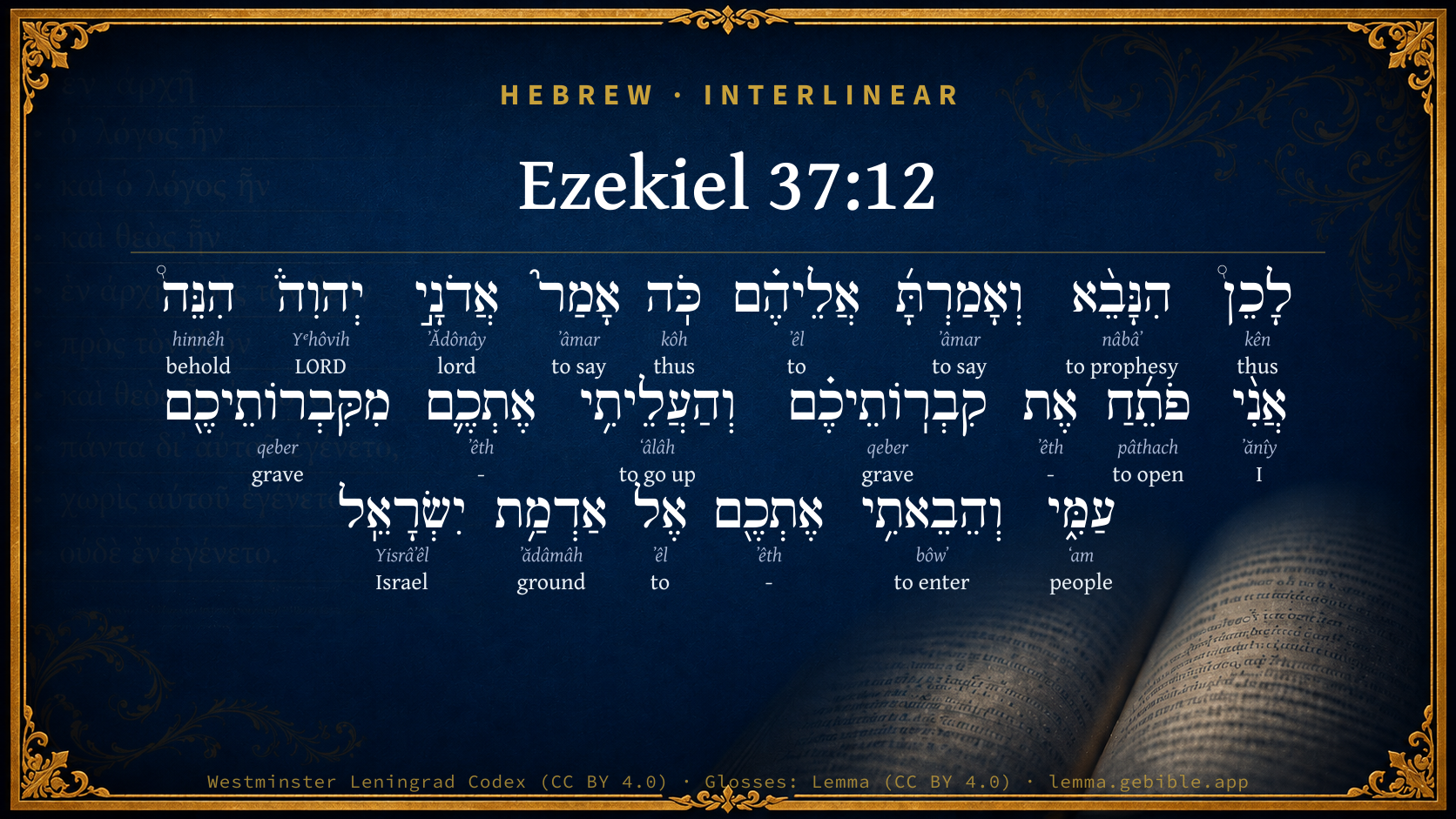
Ezekiel 37:12

Hebrew (Westminster Leningrad Codex) Ezekiel 37:12 appears in the Hebrew Old Testament. The text above is from the Westminster Leningrad Codex. Each word links to its Strong’s number, a concise gloss, and parsing drawn from the Open Scriptures Hebrew Bible morphology. Click any word for its full Brown-Driver-Briggs (BDB) entry.
Download image
Cite this verse

Ezekiel 37:12 (World English Bible). Public Domain. Lemma interlinear Bible study tool, https://lemma.gebible.app/v/ezekiel/37/12.

Show BibTeX & RIS
BibTeX
RIS
English Translation
Therefore prophesy, and tell them, Thus says the Lord Yahweh: Behold, I will open your graves, and cause you to come up out of your graves, my people; and I will bring you into the land of Israel.
World English Bible · Public Domain
Download a study sheet

One document with this verse’s original text, its word-by-word gloss line, the meaning frame, cross-references with their text, attributed commentary, and full source and license credits — printable, and it pastes into notes with its structure intact.

This verse Autodidact and up

Study sheet (.html) Plain text (.txt)

A passage Seminary Student

Up to 50 verses in one chapter. A passage sheet keeps up to 6 commentary sources and 12 cross-references per verse, in the order this page ranks them, and says so on the sheet whenever that leaves anything out. Ask for a single verse and you get the Autodidact verse sheet above.

Everything on this page stays free to read, with no account — the sheet is a download of what is already on screen, not access to it.

Want to remove ads? Support Godless Engineer
Compare translations 3

The same verse in 3 English versions, stacked beneath the original-language interlinear above. Click any original word for its lexicon entry.

Each is an independent rendering of the whole verse — the interlinear is not word-aligned to these translations.

Highlighted words mark where these versions differ — a whole-verse word diff, not a word-by-word alignment.

  • World English Bible Public Domain
    Therefore prophesy, and tell them, Thus says the Lord Yahweh: Behold, I will open your graves, and cause you to come up out of your graves, my people; and I will bring you into the land of Israel.
  • King James Version Public Domain
    Therefore prophesy and say unto them, Thus saith the Lord GOD; Behold, O my people, I will open your graves, and cause you to come up out of your graves, and bring you into the land of Israel.
  • unfoldingWord Literal Text CC BY-SA 4.0
    Therefore prophesy and say to them, ‘The Lord Yahweh says this: Behold! I will open your graves and lift you out from them, my people. I will bring you back to the land of Israel.

unfoldingWord Literal Text — © unfoldingWord, licensed CC BY-SA 4.0. Word-aligned USFM3 via Door43 (git.door43.org/unfoldingWord/en_ult).

Versions to compare (up to 4)

3 of 4 selected

Show all 18 translations

Every available English version of this verse, each an independent rendering of the whole verse.

  • World English Bible Public Domain
    Therefore prophesy, and tell them, Thus says the Lord Yahweh: Behold, I will open your graves, and cause you to come up out of your graves, my people; and I will bring you into the land of Israel.
  • Berean Standard Bible Public Domain
    Therefore prophesy and tell them that this is what the Lord GOD says: ‘O My people, I will open your graves and bring you up from them, and I will bring you back to the land of Israel.
  • Majority Standard Bible Public Domain
    Therefore prophesy and tell them that this is what the Lord GOD says: ‘O My people, I will open your graves and bring you up from them, and I will bring you back to the land of Israel.
  • King James Version Public Domain
    Therefore prophesy and say unto them, Thus saith the Lord GOD; Behold, O my people, I will open your graves, and cause you to come up out of your graves, and bring you into the land of Israel.
  • American Standard Version (1901) Public Domain
    Therefore prophesy, and say unto them, Thus saith the Lord Jehovah: Behold, I will open your graves, and cause you to come up out of your graves, O my people; and I will bring you into the land of Israel.
  • Revised Version (1885) Public Domain
    Therefore prophesy, and say unto them, Thus saith the Lord GOD: Behold, I will open your graves, and cause you to come up out of your graves, O my people; and I will bring you into the land of Israel.
  • Geneva Bible (1599) Public Domain
    Therefore prophecie, and say vnto them, Thus saith the Lord God, Beholde, my people, I will open your graues, and cause you to come vp out of your sepulchres, and bring you into the lande of Israel,
  • Douay-Rheims (1899) Public Domain
    Therefore prophesy, and say to them: Thus saith the Lord God: Behold I will open your graves, and will bring you out of your sepulchres, O my people: and will bring you into the land of Israel.
  • Young's Literal Translation Public Domain
    Therefore, prophesy, and thou hast said unto them, thus said the Lord Jehovah: Lo, I am opening your graves, And have brought you up out of your graves, O My people, And brought you in unto the land of Israel.
  • Literal Standard Version CC BY-SA 4.0
    Therefore, prophesy, and you have said to them, Thus said Lord YHWH: Behold, I am opening your graves, || And have brought you up out of your graves, O My people, || And brought you into the land of Israel.
  • Unlocked Literal Bible CC BY-SA 4.0
    Therefore prophesy and say to them, 'The Lord Yahweh says this: Behold! I will open your graves and lift you out from them, my people. I will bring you back to the land of Israel.
  • unfoldingWord Literal Text CC BY-SA 4.0
    Therefore prophesy and say to them, ‘The Lord Yahweh says this: Behold! I will open your graves and lift you out from them, my people. I will bring you back to the land of Israel.
  • Darby Bible Public Domain
    Therefore prophesy and say unto them, Thus saith the Lord Jehovah: Behold, I will open your graves, and cause you to come up out of your graves, O my people, and bring you into the land of Israel.
  • World Messianic Bible Public Domain
    Therefore prophesy, and tell them, ‘The Lord GOD says: “Behold, I will open your graves, and cause you to come up out of your graves, my people; and I will bring you into Eretz-Israel.
  • Webster's Bible Public Domain
    Therefore prophesy and say to them, Thus saith the Lord GOD; Behold, O my people, I will open your graves, and cause you to come out of your graves, and bring you into the land of Israel.
  • Free Bible Version CC BY-SA 4.0
    So prophesy and tell them that this is what the Lord God says: My people, I'm going to open your graves and lift you out of them, and I will take you back to the country of Israel.
  • Bible in Basic English Public Domain
    For this cause be a prophet to them, and say, This is what the Lord has said: See, I am opening the resting-places of your dead, and I will make you come up out of your resting-places, O my people; and I will take you into the land of Israel.
  • JPS Tanakh (1917) Public Domain
    Therefore prophesy, and say unto them: Thus saith the Lord GOD: Behold, I will open your graves, and cause you to come up out of your graves, O My people; and I will bring you into the land of Israel.

Literal Standard Version (2020), Covenant Press — licensed CC BY-SA 4.0. Text via the HelloAO Bible API (eBible.org). Unlocked Literal Bible (unfoldingWord) — licensed CC BY-SA 4.0. Text via the HelloAO Bible API (eBible.org). unfoldingWord Literal Text — © unfoldingWord, licensed CC BY-SA 4.0. Word-aligned USFM3 via Door43 (git.door43.org/unfoldingWord/en_ult). Free Bible Version, Dr. Jonathan Gallagher — licensed CC BY-SA 4.0. Text via the HelloAO Bible API (eBible.org).

Word by word

More ways to search: Search by grammar → Find every occurrence → Compare this word →

Practice this passage: Drill this verse → Learn its vocabulary →

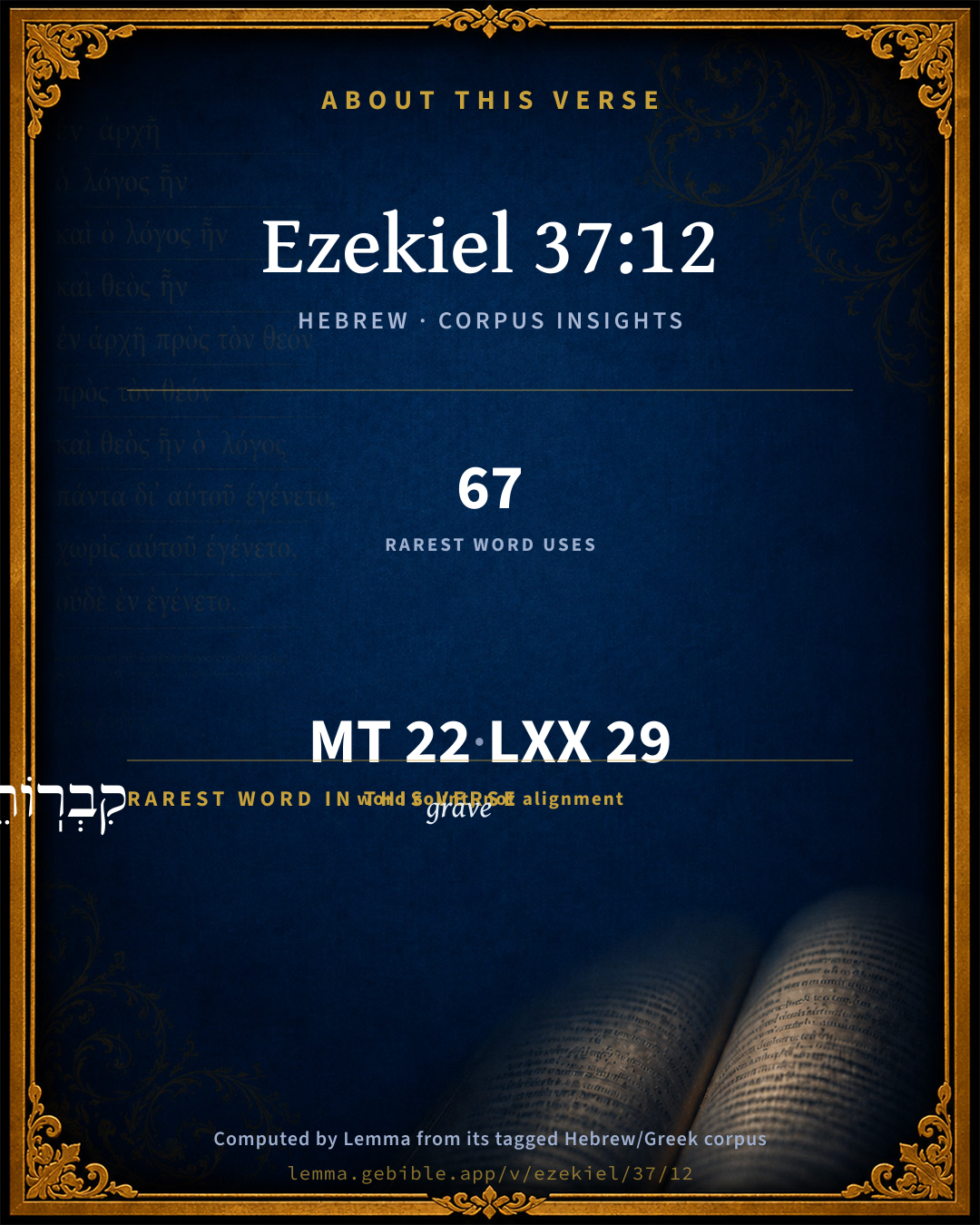
קִבְרֽוֹתֵיכֶ֗ם
qeber
H6913
“graves · your”
Noun, Common, Masculine, Plural, Construct + Suffix, Personal, 2nd Person, Masculine, Plural
Part of Speech
Noun
Type
Common
Gender
Masculine
Number
Plural
State
Construct
Full BDB Definition

Origin: from H6912

TWOT: 1984a

grave, sepulchre, tomb
  1. לָכֵן֩ kên H3651 “to/for · thus” Preposition + Adverb
  2. הִנָּבֵ֨א nâbâʼ H5012 “prophesy” Verb, Niphal, Imperative, 2nd Person, Masculine, Singular
  3. וְאָמַרְתָּ֜ ʼâmar H559 “and · to say” Conjunction + Verb, Qal, Sequential Perfect, 2nd Person, Masculine, Singular
  4. אֲלֵיהֶ֗ם ʼêl H413 “to · them” Preposition + Suffix, Personal, 3rd Person, Masculine, Plural
  5. כֹּֽה kôh H3541 “thus” Adverb
  6. אָמַר֮ ʼâmar H559 “to say” Verb, Qal, Perfect, 3rd Person, Masculine, Singular
  7. אֲדֹנָ֣י ʼĂdônây H136 “Lord · my” Noun, Common, Masculine, Plural, Construct + Suffix, Personal, 1st Person, Common, Singular
  8. יְהוִה֒ Yᵉhôvih H3069 “LORD” Noun, Proper
  9. הִנֵּה֩ hinnêh H2009 “behold” Particle, Demonstrative
  10. אֲנִ֨י ʼănîy H589 “I” Pronoun, Personal, 1st Person, Common, Singular
  11. פֹתֵ֜חַ pâthach H6605 “opening” Verb, Qal, Participle Active, Masculine, Singular, Absolute
  12. אֶת ʼêth H853 “-” Particle, Direct Object
  13. וְהַעֲלֵיתִ֥י ʻâlâh H5927 “and · to go up” Conjunction + Verb, Hiphil, Sequential Perfect, 1st Person, Common, Singular
  14. אֶתְכֶ֛ם ʼêth H853 “- · you” Particle, Direct Object + Suffix, Personal, 2nd Person, Masculine, Plural
  15. מִקִּבְרוֹתֵיכֶ֖ם qeber H6913 “from · graves · your” Preposition + Noun, Common, Masculine, Plural, Construct + Suffix, Personal, 2nd Person, Masculine, Plural
  16. עַמִּ֑י ʻam H5971 “people · my” Noun, Common, Masculine, Singular, Construct + Suffix, Personal, 1st Person, Common, Singular
  17. וְהֵבֵאתִ֥י bôwʼ H935 “and · to enter” Conjunction + Verb, Hiphil, Sequential Perfect, 1st Person, Common, Singular
  18. אֶתְכֶ֖ם ʼêth H853 “- · you” Particle, Direct Object + Suffix, Personal, 2nd Person, Masculine, Plural
  19. אֶל ʼêl H413 “to” Preposition
  20. אַדְמַ֥ת ʼădâmâh H127 “ground of” Noun, Common, Feminine, Singular, Construct
  21. יִשְׂרָאֵֽל Yisrâʼêl H3478 “Israel” Noun, Proper

About this verse

These counts appear in no published source. They are computed here, from the morphology-tagged text and Lemma’s own curated glosses. What Lemma adds →

22
words
17
distinct lemmas
Prophets
section

Grammatical profile

  • 6 verbs
  • 7 nouns
  • 1 pronoun
  • 2 prepositions
  • 2 adverbs
  • 4 particles

Verb forms

  • הִנָּבֵ֨א Niphal · Imperative
  • וְאָמַרְתָּ֜ Qal · Sequential Perfect
  • אָמַר֮ Qal · Perfect
  • פֹתֵ֜חַ Qal · Participle Active
  • וְהַעֲלֵיתִ֥י Hiphil · Sequential Perfect
  • וְהֵבֵאתִ֥י Hiphil · Sequential Perfect

Repetition

Words recur within this verse — often emphatic in Hebrew:

  • וְאָמַרְתָּ֜ to say H559 ×2
  • קִבְרֽוֹתֵיכֶ֗ם grave H6913 ×2
  • אֲלֵיהֶ֗ם to H413 ×2

Hebrew & Septuagint length

In English translation the verse runs 38 words from the Hebrew and 32 from the Septuagint (LXX English) — closely comparable.

A rough comparison of the two English renderings, which tokenize alike — not a word-level alignment.

Word counts can differ between the Hebrew and the Greek without any difference in meaning — e.g. the Hebrew direct-object marker אֵת has no separate Greek word, and Greek often adds the article ὁ.

In the original languages it is 22 Hebrew tokens and 29 Greek tokens — but the two are counted differently (Hebrew bundles its prefixes and suffixes into one token; the Greek is in lemma form), so that isn’t a like-for-like length.

Cross-references

15

Topical passages linked to Ezekiel 37:12 in the Treasury of Scripture Knowledge — connected by theme and wording, ordered by reader-vote popularity; previews shown in the World English Bible.

  • Isaiah 26:19 Your dead shall live; my dead bodies shall arise. Awake and sing, you who dwell in the dust; for your dew is [as] the dew of herbs, and the earth shall cast forth the dead.
  • Hosea 13:14 I will ransom them from the power of Sheol. I will redeem them from death! Death, where are your plagues? Sheol, where is your destruction? Compassion will be hidden from my eyes.
  • 1 Thessalonians 4:16 For the Lord himself will descend from heaven with a shout, with the voice of the archangel, and with God's trumpet. The dead in Christ will rise first,
  • Isaiah 66:14 You shall see [it], and your heart shall rejoice, and your bones shall flourish like the tender grass: and the hand of Yahweh shall be known toward his servants; and he will have indignation against his enemies.
  • Amos 9:14–15 I will bring back the captivity of my people Israel, And they will rebuild the ruined cities, and inhabit them; and they will plant vineyards, and drink wine from them. They shall also make gardens, And eat the fruit of them.
  • Revelation 20:13 The sea gave up the dead who were in it. Death and Hades gave up the dead who were in them. They were judged, each one according to his works.
  • Ezekiel 36:24 For I will take you from among the nations, and gather you out of all the countries, and will bring you into your own land.
  • Ezekiel 37:25 They shall dwell in the land that I have given to Jacob my servant, in which your fathers lived; and they shall dwell therein, they, and their children, and their children's children, forever: and David my servant shall be their prince for ever.
  • Hosea 6:2 After two days will he revive us. On the third day he will raise us up, And we will live before him.
  • Deuteronomy 32:39 See now that I, even I, am he, There is no god with me: I kill, and I make alive; I wound, and I heal; There is none who can deliver out of my hand.
  • Job 35:14–15 How much less when you say you don't see him. The cause is before him, and you wait for him!
  • Ezekiel 28:25 Thus says the Lord Yahweh: When I shall have gathered the house of Israel from the peoples among whom they are scattered, and shall be sanctified in them in the sight of the nations, then shall they dwell in their own land which I gave to my servant Jacob.
  • Ezekiel 37:21 Say to them, Thus says the Lord Yahweh: Behold, I will take the children of Israel from among the nations, where they are gone, and will gather them on every side, and bring them into their own land:
  • Ezra 1:1–2 Now in the first year of Cyrus king of Persia, that the word of Yahweh by the mouth of Jeremiah might be accomplished, Yahweh stirred up the spirit of Cyrus king of Persia, so that he made a proclamation throughout all his kingdom, and [put it] also in writing, saying,
  • 1 Samuel 2:6 Yahweh kills, and makes alive: He brings down to Sheol, and brings up.

Cross-references courtesy of OpenBible.info (CC BY 4.0).

Hebrew and Greek witnesses Masoretic Hebrew ↔ Greek Septuagint

The same verse in the two great witnesses to the Old Testament, shown verse-for-verse.

These are two independent witnesses, not word-aligned to each other, and the Septuagint is shown in lemma (dictionary) form.

Hebrew Ezekiel 37:12 Masoretic · Westminster Leningrad Codex

לָכֵן֩ הִנָּבֵ֨א וְאָמַרְתָּ֜ אֲלֵיהֶ֗ם כֹּֽה אָמַר֮ אֲדֹנָ֣י יְהוִה֒ הִנֵּה֩ אֲנִ֨י פֹתֵ֜חַ אֶת קִבְרֽוֹתֵיכֶ֗ם וְהַעֲלֵיתִ֥י אֶתְכֶ֛ם מִקִּבְרוֹתֵיכֶ֖ם עַמִּ֑י וְהֵבֵאתִ֥י אֶתְכֶ֖ם אֶל אַדְמַ֥ת יִשְׂרָאֵֽל

Therefore prophesy, and tell them, Thus says the Lord Yahweh: Behold, I will open your graves, and cause you to come up out of your graves, my people; and I will bring you into the land of Israel.

World English Bible · Public Domain

Greek LXX Ezekiel 37:12 Septuagint · lemma form

διά οὗτος προφητεύω καί εἶπον ὅδε λέγω κύριος ἰδού ἐγώ ἀναοἴγω σύ ὁ μνῆμα καί ἀναἄγω σύ ἐκ ὁ μνῆμα σύ καί εἰςἄγω σύ εἰς ὁ γῆ ὁ ἰσραήλ

Therefore prophesy and say, Thus says the Lord; Behold, I will open your tombs, and will bring you up out of your tombs, and will bring you into the land of Israel.

LXX2012 (modern English Septuagint) · Public Domain

Hebrew: Westminster Leningrad Codex (CC BY 4.0). Greek: Septuagint (public domain); English from LXX2012 (modern English Septuagint) (Public Domain). How the Septuagint differs from the Hebrew →

Targum (Aramaic paraphrase)

1

The Targum is the ancient Jewish Aramaic paraphrase of the Hebrew Scriptures — an interpretive translation, not the Hebrew text itself. Onkelos (literal) and Pseudo-Jonathan (expansive) render the Torah, and Jonathan the Prophets. Coverage is partial: where no permissively-licensed English translation exists for a verse, only the Aramaic is shown. This is verse-level text, not a word-by-word alignment to the Hebrew.

  1. Targum Jonathan Prophets (Joshua–Malachi)
    בְּכֵן אִתְנַבֵּי וְתֵימַר לְהוֹן כִּדְנַן אֲמַר יְיָ אֱלֹהִים הָא אֲנָא פְּתָחֵית יַת קִבְרֵיכוֹן וְאֶסַק יַתְכוֹן מִקִבְרֵיכוֹן עַמִי וְאָעֵיל יַתְכוֹן לְאַרְעָא דְיִשְׂרָאֵל:

    (no public-domain English translation for this verse)

    Targum Jonathan — Aramaic: “Mikraot Gedolot” (public domain). English: “Sefaria Community Translation” (CC0 1.0 (public-domain dedication)); “London "Chaldee Paraphrase," 1871” (public domain). Text via Sefaria.

Commentary

Notes on Ezekiel 37:12 from classic Christian and Jewish commentators (each source and its license shown beneath its notes). The classic Christian expositions comment on the surrounding passage and are grouped to its opening verse, so a note may address several verses; the Jewish commentaries on the Tanakh (Rashi and others) are per-verse, so they appear only where the commentator wrote on this verse.

Lemma curates 59 commentaries, every one of them public domain or Creative Commons licensed, each selected and text-cleaned for this edition rather than reprinted as found. About our sources →

Trapp's Complete Commentary

John Trapp

Eze 37:12 Therefore prophesy and say unto them, Thus saith the Lord GOD; Behold, O my people, I will open your graves, and cause you to come up out of your graves, and bring you into the land of Israel.

Ver. 12. Behold, O my people.] God owneth them still, though they had little deserved it. "Shall men’s unbelief make the faith of God without effect?" {Rom 3:3} Tumulos desperationis aperit; he openeth the graves of desperation, and lets in a marvellous light. So the Lord did for his poor Church by this blessed Reformation begun by Luther, whose book, De Captivitate Babylonica, did abundance of good. As for that wrought here in England, a foreigner {a} saith of it, that it is such as the ages past had despaired about, the present worthily admireth, and future ages shall stand amazed at. O beatos qui Deum ducem e spirituali Babylonia eos educentem secuti sunt!

{a} Scultet., Annal. Dec. 2, ep. ded.

John Trapp, A Commentary or Exposition upon All the Books of the Old and New Testament (1647–1656) — public domain. Text from a community e-Sword module.

Jamieson, Fausset & Brown

Robert Jamieson, A. R. Fausset & David Brown

my people--in antithesis to "for our parts" (Eze 37:11). The hope that is utterly gone, if looking at themselves, is sure for them in God, because He regards them as His people. Their covenant relation to God ensures His not letting death permanently reign over them. Christ makes the same principle the ground on which the literal resurrection rests. God had said, "I am the God of Abraham," &c.; God, by taking the patriarchs as His, undertook to do for them all that Omnipotence can perform: He, being the ever living God, is necessarily the God of, not dead, but living persons, that is, of those whose bodies His covenant love binds Him to raise again. He can--and because He can--He will--He must [FAIRBAIRN]. He calls them "My people" when receiving them into favor; but "thy people," in addressing His servant, as if He would put them away from Him (Eze 13:17; Eze 33:2; Exo 32:7).

out of your graves--out of your politically dead state, primarily in Babylon, finally hereafter in all lands (compare Eze 6:8; Hos 13:14). The Jews regarded the lands of their captivity and dispersion as their "graves"; their restoration was to be as "life from the dead" (Rom 11:15). Before, the bones were in the open plain (Eze 37:1-2); now, in the graves, that is, some of the Jews were in the graves of actual captivity, others at large but dispersed. Both alike were nationally dead.

Jamieson, Fausset & Brown — Commentary Critical and Explanatory on the Whole Bible (1871) — public domain (CC PDM 1.0). Text via the HelloAO Bible API.

Adam Clarke's Commentary

Verse 12. I will open your graves] Here is a pointed allusion to the general resurrection; a doctrine properly credited and understood by the Jews, and to which our Lord refers, Joh 5:25; Joh 5:28-29: "The hour is coming when they that are in their graves shall hear his voice, and come forth."

And cause you to come up out of your graves] I am determined that ye shall be restored; so that were ye even in your graves, as mankind at the general resurrection, yet my all-powerful voice shall call you forth.

Adam Clarke's Commentary on the Bible (1810–1826) — public domain. Text from a community e-Sword/MySword module.

Ellicott's Commentary for English Readers

(12) Open your graves.—In Eze_37:2 it is said that the bones were “in the open valley,” literally, upon the face of the valley. This was a necessity of the vision, in order that they might be seen; now the people, whom the bones represented, are spoken of as in graves, since this was the normal and proper place for the dead.

A Bible Commentary for English Readers, edited by Charles John Ellicott (1878–1897) — public domain. Text from a community e-Sword module.

The Cambridge Bible for Schools and Colleges

gen. ed. J. J. S. Perowne

12. The figure is varied here, the people are regarded as dead and buried and their revival is an opening of their graves. The phrase “bring you into the land of Israel” shews, however, that the language is still used figuratively of the resuscitation of the dead nation and not literally of the resurrection of deceased individuals.

The Cambridge Bible for Schools and Colleges (gen. ed. J. J. S. Perowne; Cambridge University Press, 1878–1918) — public domain. Text from a community e-Sword module.

John Gill's Exposition

Therefore prophesy, and say unto them,.... For their comfort, in order to revive their hope, and encourage their faith, in these distressed circumstances:

thus saith the Lord, behold, O my people: they were his people still, and he had a covenant interest in them, and they in him, though in such a low estate; and which was the ground of his care of them, and concern for them, and or doing all the good things to them after mentioned; all proceeded from his covenant, and the grace of it, and their relation to him:

I will open your graves, and cause you to come out of your graves; the cities and prisons in Chaldea and other places; where they were confined and held captives, and out of which they could no more deliver themselves than a dead man of himself can rise up out of his grave: this is both an emblem of the resurrection of the dead at the last day (z), when they shall come forth out of their graves at the voice of Christ, some to the resurrection of life, and others to the resurrection of damnation; and of dead sinners, raised out of the graves of sin by the power and efficacy of the grace of God; see Joh 5:25,

and bring you into the land of Israel; to dwelt in it, and abide there, and be no more dispossessed of it; as they will not, any more, when once settled in it, upon their conversion in the latter day.

(z) To which it is applied in T. Bab. Sabbat, fol. 152. 2, & Taanith, fol. 2. 2.

John Gill's Exposition of the Whole Bible (1746–1763) — public domain (CC PDM 1.0). Text via the HelloAO Bible API.

Matthew Poole's English Annotations

Prophesy; tell them their mistake, and revive their hope by a new promise and declaration of my purposes of mercy towards them.

Say unto them; these poor desponding, dejected Israelites.

Behold; consider what my prophet assures you he hath seen, dry bones miraculously revived, and standing up in power as a mighty host, so shall you.

I will open your graves; though your captivity be as death, your persons and confinements close as the grave, yet I will open those graves. I will lift you out, lend you a hand to bring you out with life and strength. And I will be your guide, that you may know the way; be your support, that you may be able to go; and your guard and defence against dangers of the way, that you may certainly come into your own land.

Matthew Poole's English Annotations on the Holy Bible (1683–1685) — public domain. Text from a community e-Sword/MySword module.

The Pulpit Commentary

Vers. 12-14. I will open your graves. That this is not exact interpretation of the foregoing symbol may be argued from the fact that in the vision no mention is made of graves; yet the discrepancy to which it is supposed to point is more apparent than real. If the prophet was to see the bones, it was requisite that these should be above ground rather than beneath. On the other hand, when one speaks of a grave, it is not needful to always think of an underground tomb. To all intents and purposes a person is in his grave when, life being extinct, his body has returned to the dust. So, the opening of graves promised in Scripture is not so much, or always, the cleaving asunder of material sepulchers, as the bringing back to life of those whose bodies have returned to the dust. Hence the opening of Israel"s graves could only signify the reawakening of the politically and religiously dead people to national and spiritual life. This was the first step in the restoration of the future held up before the minds of the despairing people. The second, indicated by the clause, and allah put my Spirit in you, pointed, as in Eze_36:26, Eze_36:27, to their future endowment with higher moral and spiritual life than they had previously possessed, and not merely, as in vers. 5, 6, to their political and national resuscitation (Smend). The last step, the re-establishment of the reconstructed nation in Palestine, was guaranteed by the word, I will place you in your own land. The circumstance that this is twice repeated (vers. 12, 14) shows that whatever view be entertained of the ultimate occupation of Canaan by Israel, this was the goal towards which the vision looked. That it received partial, limited, and temporary fulfillment of a literal kind in the restoration under Zerubbabel and Ezra, is undeniable; that it will ever obtain historical realization of a permanent sort is doubtful; that it will eventually find its highest significance when God"s spiritual Israel, the Church of Christ, takes possession of the heavenly Canaan, is one of the clearest and surest announcements of Scripture.

NOTE. On the above nine verses (6-14) Plumptre writes, "We can scarcely fail to find, in our Lord"s words in Joh 5, something like an echo of Ezekiel"s teaching. There also, though the truth of the general resurrection is declared more clearly, the primary thought is that of a spiritual resurrection. Further, we may note that the complement of Ezekiel"s message is found in the language of Dan_12:2. Taking the two together, we find both reproduced in the teaching of Joh 5." (manuscript notes).

The Pulpit Commentary (1880–1919), ed. H.D.M. Spence-Jones & Joseph S. Exell — public domain. Text from a community e-Sword module.

John Wesley's Explanatory Notes

I will open - Though your captivity be as death, your persons close as the grave, yet I will open those graves.

John Wesley, Explanatory Notes Upon the Whole Bible (1754–1765) — public domain. Text via the GEBible commentary corpus.

Rashi

Rabbi Shlomo Yitzchaki (Rashi)

Therefore, prophesy that I am destined to resurrect you a second time.

Rashi on the Tanakh — English translations: “The Judaica Press complete Tanach with Rashi, translated by A. J. Rosenberg” (CC BY 4.0); “Pentateuch with Rashi's commentary by M. Rosenbaum and A.M. Silbermann, 1929-1934” (public domain); “The Metsudah Tanach series, Lakewood, N.J” (CC BY 4.0); and “The Book of Joshua, Metsudah Publications, 1997” (CC BY 4.0). Text via Sefaria.

Lesson kit

Teaching starters — assembled from the data on this page, not authored interpretation. Every prompt links to the verse data it draws on. Edit before teaching.

Ezekiel, in the Prophets, opens this verse with 22 words (17 distinct Hebrew lemmas). Its most distinctive word is qeber (“grave”). A historical commentator’s framing appears above. Read the whole chapter for the surrounding context.

Discussion questions

  1. The word qeber carries the sense “grave.” How does it shape the verse?
  2. Isaiah 26:19 shares this passage’s theme. How do the two illuminate each other?
  3. “to say” occurs 2× in this one verse. What is the effect of the repetition?
  4. These translations render this verse differently. What is at stake in choosing one wording over another?
  5. The verb «הִנָּבֵ֨א» is Niphal Imperative. How does its form color the action?
  6. Reading how Trapp's Complete Commentary and Jamieson, Fausset & Brown read this verse, where do the two commentators agree and where do they part?

Things to notice

Reading settings

Reading text

Shown beneath each verse's original-language words.

Old Testament
Old Testament edition

Read the OT as the Masoretic Hebrew (MT) or the Greek Septuagint (LXX).

English shown for the Greek Septuagint (in the Hebrew ↔ Greek comparison).

Comparing translations? Open the Compare panel on any verse page to stack up to four side by side.