
Deuteronomy 21:23

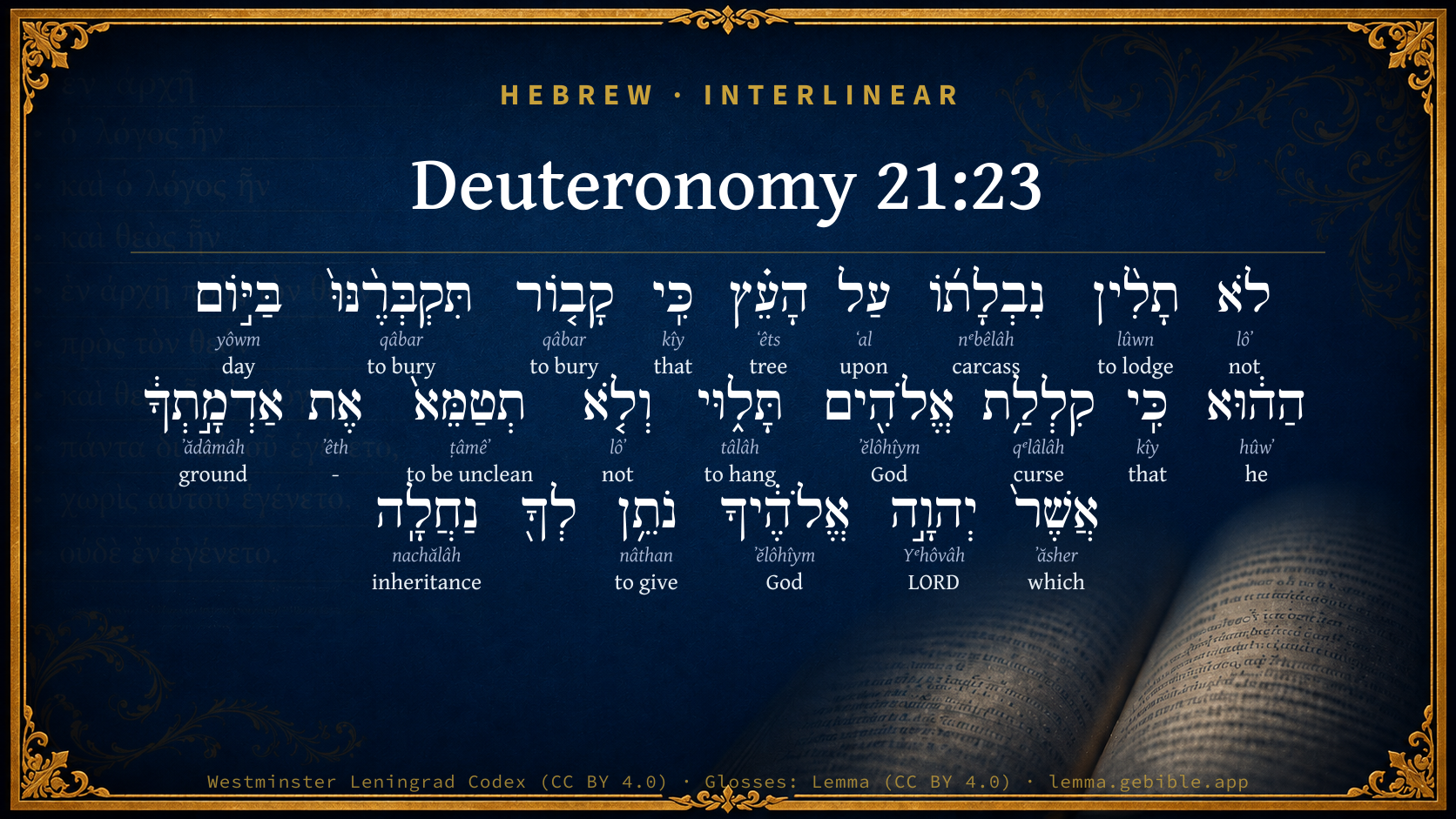
Hebrew (Westminster Leningrad Codex) Deuteronomy 21:23 appears in the Hebrew Old Testament. The text above is from the Westminster Leningrad Codex. Each word links to its Strong’s number, a concise gloss, and parsing drawn from the Open Scriptures Hebrew Bible morphology. Click any word for its full Brown-Driver-Briggs (BDB) entry.
Download image
Cite this verse

Deuteronomy 21:23 (World English Bible). Public Domain. Lemma interlinear Bible study tool, https://lemma.gebible.app/v/deuteronomy/21/23.

Show BibTeX & RIS
BibTeX
RIS
English Translation
his body shall not remain all night on the tree, but you shall surely bury him the same day; for he who is hanged is accursed of God; that you don't defile your land which Yahweh your God gives you for an inheritance.
World English Bible · Public Domain
Download a study sheet

One document with this verse’s original text, its word-by-word gloss line, the meaning frame, cross-references with their text, attributed commentary, and full source and license credits — printable, and it pastes into notes with its structure intact.

This verse Autodidact and up

Study sheet (.html) Plain text (.txt)

A passage Seminary Student

Up to 50 verses in one chapter. A passage sheet keeps up to 6 commentary sources and 12 cross-references per verse, in the order this page ranks them, and says so on the sheet whenever that leaves anything out. Ask for a single verse and you get the Autodidact verse sheet above.

Everything on this page stays free to read, with no account — the sheet is a download of what is already on screen, not access to it.

Want to remove ads? Support Godless Engineer
Compare translations 3

The same verse in 3 English versions, stacked beneath the original-language interlinear above. Click any original word for its lexicon entry.

Each is an independent rendering of the whole verse — the interlinear is not word-aligned to these translations.

Highlighted words mark where these versions differ — a whole-verse word diff, not a word-by-word alignment.

  • World English Bible Public Domain
    his body shall not remain all night on the tree, but you shall surely bury him the same day; for he who is hanged is accursed of God; that you don't defile your land which Yahweh your God gives you for an inheritance.
  • King James Version Public Domain
    His body shall not remain all night upon the tree, but thou shalt in any wise bury him that day; (for he that is hanged is accursed of God;) that thy land be not defiled, which the LORD thy God giveth thee for an inheritance.
  • unfoldingWord Literal Text CC BY-SA 4.0
    his corpse shall not remain on the tree. Instead, you shall surely bury him that day; for cursed of God a hanged man. And you shall not defile your land that Yahweh your God is giving to you an inheritance.

unfoldingWord Literal Text — © unfoldingWord, licensed CC BY-SA 4.0. Word-aligned USFM3 via Door43 (git.door43.org/unfoldingWord/en_ult).

Versions to compare (up to 4)

3 of 4 selected

Show all 18 translations

Every available English version of this verse, each an independent rendering of the whole verse.

  • World English Bible Public Domain
    his body shall not remain all night on the tree, but you shall surely bury him the same day; for he who is hanged is accursed of God; that you don't defile your land which Yahweh your God gives you for an inheritance.
  • Berean Standard Bible Public Domain
    you must not leave the body on the tree overnight, but you must be sure to bury him that day, because anyone who is hung on a tree is under God’s curse. You must not defile the land that the LORD your God is giving you as an inheritance.
  • Majority Standard Bible Public Domain
    you must not leave the body on the tree overnight, but you must be sure to bury him that day, because anyone who is hung on a tree is under God’s curse. You must not defile the land that the LORD your God is giving you as an inheritance.
  • King James Version Public Domain
    His body shall not remain all night upon the tree, but thou shalt in any wise bury him that day; (for he that is hanged is accursed of God;) that thy land be not defiled, which the LORD thy God giveth thee for an inheritance.
  • American Standard Version (1901) Public Domain
    his body shall not remain all night upon the tree, but thou shalt surely bury him the same day; for he that is hanged is accursed of God; that thou defile not thy land which Jehovah thy God giveth thee for an inheritance.
  • Revised Version (1885) Public Domain
    his body shall not remain all night upon the tree, but thou shalt surely bury him the same day; for he that is hanged is accursed of God; that thou defile not thy land which the LORD thy God giveth thee for an inheritance.
  • Geneva Bible (1599) Public Domain
    His body shall not remaine all night vpon the tree, but thou shalt bury him the same day: for the curse of God is on him that is hanged. Defile not therfore thy land which the Lord thy God giueth thee to inherite.
  • Douay-Rheims (1899) Public Domain
    His body shall not remain upon the tree, but shall be buried the same day: for he is accursed of God that hangeth on a tree: and thou shalt not defile thy land, which the Lord thy God shall give thee in possession.
  • Young's Literal Translation Public Domain
    his corpse doth not remain on the tree, for thou dost certainly bury him in that day -- for a thing lightly esteemed of God `is' the hanged one -- and thou dost not defile thy ground which Jehovah thy God is giving to thee -- an inheritance.
  • Literal Standard Version CC BY-SA 4.0
    his corpse does not remain on the tree, for you certainly bury him in the day—for he who is hanged [becomes] a curse of God—and you do not defile your ground which your God YHWH is giving to you [for] an inheritance.”
  • Unlocked Literal Bible CC BY-SA 4.0
    then his body must not remain all night on the tree. Instead, you must surely bury him the same day; for whoever is hanged is cursed by God. Obey this commandment so that you do not defile the land that Yahweh your God is giving you as an inheritance.
  • unfoldingWord Literal Text CC BY-SA 4.0
    his corpse shall not remain on the tree. Instead, you shall surely bury him that day; for cursed of God a hanged man. And you shall not defile your land that Yahweh your God is giving to you an inheritance.
  • Darby Bible Public Domain
    his body shall not remain all night upon the tree, but thou shalt in any wise bury him that day (for he that is hanged is a curse of God); and thou shalt not defile thy land, which Jehovah thy God giveth thee for an inheritance.
  • World Messianic Bible Public Domain
    his body shall not remain all night on the tree, but you shall surely bury him the same day; for he who is hanged is accursed of God. Don’t defile your land which the LORD your God gives you for an inheritance.
  • Webster's Bible Public Domain
    His body shall not remain all night upon the tree, but thou shalt in any wise bury him that day; (for he that is hanged is accursed of God;) that thy land may not be defiled, which the LORD thy God giveth thee for an inheritance.
  • Free Bible Version CC BY-SA 4.0
    don't leave the body hanging there overnight. Make sure you bury the body the same day, because anyone who is hung is under God's curse. Don't defile the country that the Lord your God is giving you to own.
  • Bible in Basic English Public Domain
    Do not let his body be on the tree all night, but put it to rest in the earth the same day; for the man who undergoes hanging is cursed by God; so do not make unclean the land which the Lord your God is giving you for your heritage.
  • JPS Tanakh (1917) Public Domain
    his body shall not remain all night upon the tree, but thou shalt surely bury him the same day; for he that is hanged is a reproach unto God; that thou defile not thy land which the LORD thy God giveth thee for an inheritance.

Literal Standard Version (2020), Covenant Press — licensed CC BY-SA 4.0. Text via the HelloAO Bible API (eBible.org). Unlocked Literal Bible (unfoldingWord) — licensed CC BY-SA 4.0. Text via the HelloAO Bible API (eBible.org). unfoldingWord Literal Text — © unfoldingWord, licensed CC BY-SA 4.0. Word-aligned USFM3 via Door43 (git.door43.org/unfoldingWord/en_ult). Free Bible Version, Dr. Jonathan Gallagher — licensed CC BY-SA 4.0. Text via the HelloAO Bible API (eBible.org).

Word by word

More ways to search: Search by grammar → Find every occurrence → Compare this word →

Practice this passage: Drill this verse → Learn its vocabulary →

תָּל֑וּי
tâlâh
H8518
“hung”
Verb, Qal, Participle Passive, Masculine, Singular, Absolute
Part of Speech
Verb
Stem
Qal
Form
Participle Passive
Gender
Masculine
Number
Singular
State
Absolute
Full BDB Definition

Origin: a primitive root

TWOT: 2512

to hang - (Qal) - to hang - to hang up (any object) - to put to death by hanging - (Niphal) to be hanged - (Piel) to hang, hang up (for display)
  1. לֹא lôʼ H3808 “not” Particle, Negative
  2. תָלִ֨ין lûwn H3885 “to lodge” Verb, Qal, Imperfect, 3rd Person, Feminine, Singular
  3. נִבְלָת֜וֹ nᵉbêlâh H5038 “carcass · his” Noun, Common, Feminine, Singular, Construct + Suffix, Personal, 3rd Person, Masculine, Singular
  4. עַל ʻal H5921 “upon” Preposition
  5. הָעֵ֗ץ ʻêts H6086 “the · tree” Particle, Definite Article + Noun, Common, Masculine, Singular, Absolute
  6. כִּֽי kîy H3588 “that” Conjunction
  7. קָב֤וֹר qâbar H6912 “to bury” Verb, Qal, Infinitive Absolute
  8. תִּקְבְּרֶ֨נּוּ֙ qâbar H6912 “to bury · him” Verb, Qal, Imperfect, 2nd Person, Masculine, Singular + Suffix, Personal, 3rd Person, Masculine, Singular
  9. בַּיּ֣וֹם yôwm H3117 “in/at the · day” Preposition, Determined + Noun, Common, Masculine, Singular, Absolute
  10. הַה֔וּא hûwʼ H1931 “the · he” Particle, Definite Article + Pronoun, Personal, 3rd Person, Masculine, Singular
  11. כִּֽי kîy H3588 “that” Conjunction
  12. קִלְלַ֥ת qᵉlâlâh H7045 “curse of” Noun, Common, Feminine, Singular, Construct
  13. אֱלֹהִ֖ים ʼĕlôhîym H430 “God(s)” Noun, Common, Masculine, Plural, Absolute
  14. וְלֹ֤א lôʼ H3808 “and · not” Conjunction + Particle, Negative
  15. תְטַמֵּא֙ ṭâmêʼ H2930 “to be unclean” Verb, Piel, Imperfect, 2nd Person, Masculine, Singular
  16. אֶת ʼêth H853 “-” Particle, Direct Object
  17. אַדְמָ֣תְךָ֔ ʼădâmâh H127 “ground · your” Noun, Common, Feminine, Singular, Construct + Suffix, Personal, 2nd Person, Masculine, Singular
  18. אֲשֶׁר֙ ʼăsher H834 “which” Particle, Relative
  19. יְהוָ֣ה Yᵉhôvâh H3068 “LORD” Noun, Proper
  20. אֱלֹהֶ֔יךָ ʼĕlôhîym H430 “God(s) · your” Noun, Common, Masculine, Plural, Construct + Suffix, Personal, 2nd Person, Masculine, Singular
  21. נֹתֵ֥ן nâthan H5414 “giving” Verb, Qal, Participle Active, Masculine, Singular, Absolute
  22. נַחֲלָֽה nachălâh H5159 “inheritance” Noun, Common, Feminine, Singular, Absolute

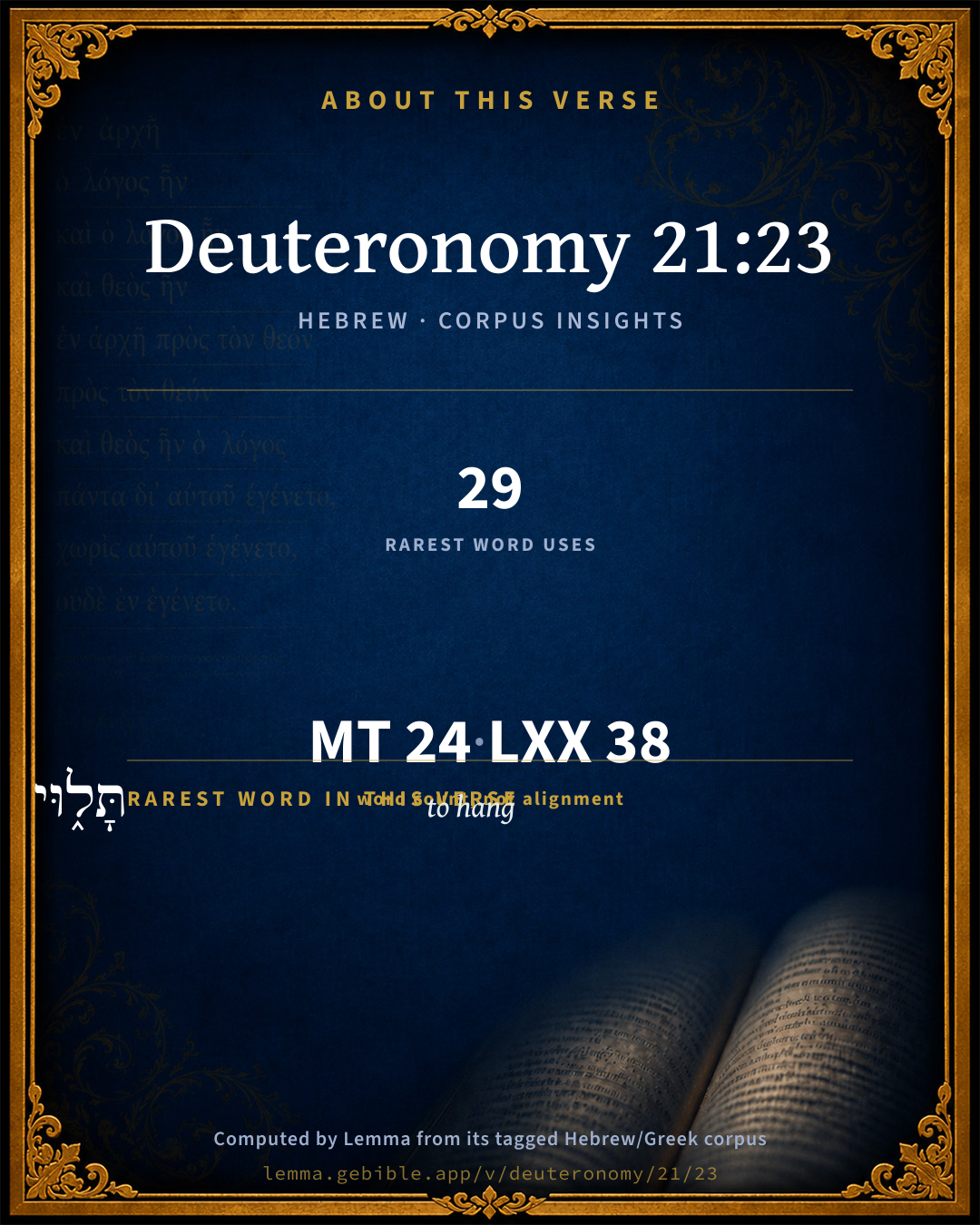
About this verse

These counts appear in no published source. They are computed here, from the morphology-tagged text and Lemma’s own curated glosses. What Lemma adds →

24
words
19
distinct lemmas
Pentateuch
section

Shared distinctive vocabulary

תָּל֑וּי to hang H8518 occurs in 27 verses of the Hebrew Bible. Also found in:

Grammatical profile

  • 6 verbs
  • 9 nouns
  • 1 pronoun
  • 2 prepositions
  • 2 conjunctions
  • 4 particles

Verb forms

  • תָלִ֨ין Qal · Imperfect
  • קָב֤וֹר Qal · Infinitive Absolute
  • תִּקְבְּרֶ֨נּוּ֙ Qal · Imperfect
  • תָּל֑וּי Qal · Participle Passive
  • תְטַמֵּא֙ Piel · Imperfect
  • נֹתֵ֥ן Qal · Participle Active

Repetition

Words recur within this verse — often emphatic in Hebrew:

  • קָב֤וֹר to bury H6912 ×2
  • אֱלֹהִ֖ים God H430 ×2
  • לֹא not H3808 ×2
  • כִּֽי that H3588 ×2

Hebrew & Septuagint length

In English translation the verse runs 43 words from the Hebrew and 53 from the Septuagint (LXX English) — closely comparable.

A rough comparison of the two English renderings, which tokenize alike — not a word-level alignment.

Word counts can differ between the Hebrew and the Greek without any difference in meaning — e.g. the Hebrew direct-object marker אֵת has no separate Greek word, and Greek often adds the article ὁ.

In the original languages it is 24 Hebrew tokens and 38 Greek tokens — but the two are counted differently (Hebrew bundles its prefixes and suffixes into one token; the Greek is in lemma form), so that isn’t a like-for-like length.

Cross-references

11

Topical passages linked to Deuteronomy 21:23 in the Treasury of Scripture Knowledge — connected by theme and wording, ordered by reader-vote popularity; previews shown in the World English Bible.

  • Galatians 3:13 Christ redeemed us from the curse of the law, having become a curse for us. For it is written, "Cursed is everyone who hangs on a tree,"
  • John 19:31 Therefore the Jews, because it was the Preparation Day, so that the bodies wouldn't remain on the cross on the Sabbath (for that Sabbath was a special one), asked of Pilate that their legs might be broken, and that they might be taken away.
  • Leviticus 18:25 The land was defiled: therefore I punished its iniquity, and the land vomitted out her inhabitants.
  • 2 Corinthians 5:21 For him who knew no sin he made to be sin on our behalf; so that in him we might become the righteousness of God.
  • Numbers 25:4 Yahweh said to Moses, Take all the chiefs of the people, and hang them up to Yahweh before the sun, that the fierce anger of Yahweh may turn away from Israel.
  • Numbers 35:33–34 So you shall not pollute the land in which you are: for blood, it pollutes the land; and no expiation can be made for the land for the blood that is shed therein, but by the blood of him who shed it.
  • Joshua 8:29 The king of Ai he hanged on a tree until the evening: and at the going down of the sun Joshua commanded, and they took his body down from the tree, and cast it at the entrance of the gate of the city, and raised thereon a great heap of stones, to this day.
  • Joshua 10:26–27 Afterward Joshua struck them, and put them to death, and hanged them on five trees: and they were hanging on the trees until the evening.
  • Romans 9:3 For I could wish that I myself were accursed from Christ for my brothers' sake, my relatives according to the flesh,
  • Joshua 7:12 Therefore the children of Israel can't stand before their enemies; they turn their backs before their enemies, because they are become accursed: I will not be with you any more, except you destroy the devoted thing from among you.
  • 1 Corinthians 16:22 If any man doesn't love the Lord Jesus Christ, let him be accursed. Come, Lord!

Cross-references courtesy of OpenBible.info (CC BY 4.0).

Hebrew and Greek witnesses Masoretic Hebrew ↔ Greek Septuagint

The same verse in the two great witnesses to the Old Testament, shown verse-for-verse.

These are two independent witnesses, not word-aligned to each other, and the Septuagint is shown in lemma (dictionary) form.

Hebrew Deuteronomy 21:23 Masoretic · Westminster Leningrad Codex

לֹא תָלִ֨ין נִבְלָת֜וֹ עַל הָעֵ֗ץ כִּֽי קָב֤וֹר תִּקְבְּרֶ֨נּוּ֙ בַּיּ֣וֹם הַה֔וּא כִּֽי קִלְלַ֥ת אֱלֹהִ֖ים תָּל֑וּי וְלֹ֤א תְטַמֵּא֙ אֶת אַדְמָ֣תְךָ֔ אֲשֶׁר֙ יְהוָ֣ה אֱלֹהֶ֔יךָ נֹתֵ֥ן לְךָ֖ נַחֲלָֽה

his body shall not remain all night on the tree, but you shall surely bury him the same day; for he who is hanged is accursed of God; that you don't defile your land which Yahweh your God gives you for an inheritance.

World English Bible · Public Domain

Greek LXX Deuteronomy 21:23 Septuagint · lemma form

οὐ ἐπικοιμάω ὁ σῶμα αὐτός ἐπί ὁ ξύλον ἀλλά ταφή θάπτω αὐτός ἐν ὁ ἡμέρα ἐκεῖνος ὅτι καταἀράομαι ὑπό θεός πᾶς κρεμάζω ἐπί ξύλον καί οὐ μιαίνω ὁ γῆ ὅς κύριος ὁ θεός σύ δίδωμι σύ ἐν κλῆρος

his body shall not remain all night upon the tree, but you⌃ shall by all means bury it in that day; for every one that is hanged on a tree is cursed of God; and you⌃ shall by no means defile the land which the Lord your God gives you for an inheritance.

LXX2012 (modern English Septuagint) · Public Domain

On this verse, The Cambridge Bible for Schools and Colleges discusses the Septuagint’s reading. Read the note in Commentary ↓

Hebrew: Westminster Leningrad Codex (CC BY 4.0). Greek: Septuagint (public domain); English from LXX2012 (modern English Septuagint) (Public Domain). How the Septuagint differs from the Hebrew →

Targum (Aramaic paraphrase)

2

The Targum is the ancient Jewish Aramaic paraphrase of the Hebrew Scriptures — an interpretive translation, not the Hebrew text itself. Onkelos (literal) and Pseudo-Jonathan (expansive) render the Torah, and Jonathan the Prophets. Coverage is partial: where no permissively-licensed English translation exists for a verse, only the Aramaic is shown. This is verse-level text, not a word-by-word alignment to the Hebrew.

  1. Targum Onkelos Torah (Genesis–Deuteronomy)
    לָא תְבִית נְבִלְתֵּהּ עַל צְלִיבָא אֲרֵי מִקְבַּר תִּקְבְּרִנֵהּ בְּיוֹמָא הַהוּא אֲרֵי עַל דְחָב קֳדָם יְיָ אִצְטְלַב וְלָא תְסָאֵב יָת אַרְעָךְ דִי יְיָ אֱלָהָךְ יָהֵב לָךְ אַחֲסָנָא

    (no public-domain English translation for this verse)

    Targum Onkelos — Aramaic: “Onkelos Genesis” (public domain); “Onkelos Exodus” (public domain); “Onkelos Leviticus” (public domain); “Onkelos Numbers” (public domain); “Onkelos Deuteronomy” (public domain). English: “Sefaria Community Translation” (CC0 1.0 (public-domain dedication)); “J.W. Etheridge. The Targums of Onkelos and Jonathan Ben Uzziel on the Pentateuch. London: Longmans, Green, 1862” (public domain). Text via Sefaria.

  2. Targum Pseudo-Jonathan Torah (Genesis–Deuteronomy)
    לָא תָבִית נִבְלַת גּוּשְׁמֵיהּ עַל קֵיסָא אֲרוּם מִקְבַּר תִּקְבְּרוּנֵיהּ בְּיוֹמָא הַהוּא אֲרוּם קִילוּתָא קֳדָם אֱלָהָא לְמִצְלוֹב גְּבַר אֱלָהֵן חוֹבוֹי גָרְמוּ לֵיהּ וּמִן בִּגְלַל דִּבְדִיוּקְנָא דַיְיָ אִתְעֲבֵד תְּקַבְּרוּנֵיהּ עִם מִטְמוֹעַ שִׁמְשָׁא דְּלָא יְקִילִין בִּרְיָיתָא בֵּיהּ וְלָא תְטוּפוּן בִּנְבֵילְתְּהוֹן דְּחַיָּיבָא יַת אַרְעֲכוֹן דַּיְיָ אֱלָהָכוֹן יָהִיב לְכוֹן אַחֲסָנָא

    his dead body shall not remain upon the beam, but he shall be certainly buried on the same day; for it is execrable before God to hang a man, but that his guilt gave occasion for it; and because he was made in the image of God, you shall bury him at the going down of the sun, lest wild beasts abuse him, and lest you overspread your land, which the Lord your God giveth you to possess, with the dead bodies of criminals.

    Targum Pseudo-Jonathan — Aramaic: “Targum Jonathan on Genesis” (public domain); “Targum Jonathan on Exodus” (public domain); “Targum Jonathan on Leviticus” (public domain); “Targum Jonathan on Numbers” (public domain); “Targum Jonathan on Deuteronomy” (public domain). English: “The Targum of Jonathan ben Uzziel, trans. J. W. Etheridge, London, 1862” (public domain). Text via Sefaria.

Commentary

Notes on Deuteronomy 21:23 from classic Christian and Jewish commentators (each source and its license shown beneath its notes). The classic Christian expositions comment on the surrounding passage and are grouped to its opening verse, so a note may address several verses; the Jewish commentaries on the Tanakh (Rashi and others) are per-verse, so they appear only where the commentator wrote on this verse.

Lemma curates 59 commentaries, every one of them public domain or Creative Commons licensed, each selected and text-cleaned for this edition rather than reprinted as found. About our sources →

Trapp's Complete Commentary

John Trapp

Deu 21:23 His body shall not remain all night upon the tree, but thou shalt in any wise bury him that day; (for he that is hanged [is] accursed of God;) that thy land be not defiled, which the LORD thy God giveth thee [for] an inheritance.

Ver. 23. For he that is hanged.] {See Trapp on "Gal 3:13"}

John Trapp, A Commentary or Exposition upon All the Books of the Old and New Testament (1647–1656) — public domain. Text from a community e-Sword module.

Joseph Benson's Commentary

Deu 21:23. He is accursed of God — He is in a singular manner cursed and punished by God’s appointment with a most shameful kind of punishment, as this was held among the Jews and all nations; and therefore this punishment may suffice for him, and there shall not be added to it that of lying unburied. And this curse is here appropriated to those that are hanged, to signify beforehand that Christ should undergo this execrable punishment, and be made a curse for us, (Gal 3:13,) which, though it was future in respect to men, yet was present unto God. Defiled — Either by inhumanity toward the dead, or by suffering the monument of the man’s wickedness, and of God’s curse, to remain public a longer time than God would have it; whereas, it ought to be put out of sight, and buried in oblivion.

Joseph Benson's Commentary on the Old and New Testaments (1811–1818) — public domain. Text from a community e-Sword module.

Tyndale Open Study Notes

Tyndale Open Resources

21:23 for anyone who is hung: The Greek version reads for everyone who is hung on a tree. Cp. Gal 3:13, which explains how this proverb applies to Jesus. • cursed in the sight of God: Unrepentant sinners do fall under God’s judgment. However, the idea of this proverb is probably that whoever saw a person in this condition would naturally conclude that God had cursed that person, when in fact the person could have been misjudged or even lynched.

Tyndale Open Study Notes — © Tyndale Open Resources, licensed CC BY-SA 4.0. Text via the HelloAO Bible API.

Geneva Bible (1599)

Geneva Bible translators

For God’s Law by his death is satisfied, and nature abhorreth cruelty.

Geneva Bible (1599) marginal notes — public domain. Text via Bolls.life.

Adam Clarke's Commentary

Verse 23. His body shall not remain all night upon the tree] Its exposure for the space of one day was judged sufficient. The law which required this answered all the ends of public justice, exposed the shame and infamy of the conduct, but did not put to torture the feelings of humanity by requiring a perpetual exhibition of a human being, a slow prey to the most loathsome process of putrefaction. Did ever the spiking of the heads of state criminals prevent high treason? or the gibbeting of a thief or a murderer, prevent either murder or robbery? These questions may be safely answered in the negative; and the remains of the ancient barbarism which requires these disgusting and abominable exhibitions, and which are deplored by every feeling heart, should be banished with all possible speed. In the case given in the text, God considers the land as defiled while the body of the executed criminal lay exposed, hence it was enjoined, Thou shalt in any wise bury him that day.

For he that is hanged is accursed of God] That is, he has forfeited his life to the law; for it is written, Cursed is every one who continueth not in all things that are written in the book of the law to do them; and on his body, in the execution of the sentence of the law, the curse was considered as alighting; hence the necessity of removing the accursed thing out of sight. How excellent are all these laws! How wondrously well calculated to repress crimes by showing the enormity of sin! It is worthy of remark that in the infliction of punishment prescribed by the Mosaic law, we ever find that Mercy walks hand in hand with Judgment.

Adam Clarke's Commentary on the Bible (1810–1826) — public domain. Text from a community e-Sword/MySword module.

The Cambridge Bible for Schools and Colleges

gen. ed. J. J. S. Perowne

23. for the thing hanged is accursed of God] lit. a curse of God. This was the meaning of such exposure of the corpse after execution. God’s wrath was heaped upon it; or it became doubly unclean and therefore terribly charged with infection to its surroundings. The LXX version of these words: κεκαταραμένος ὑπὸ θεοῦ πᾶς κρεμάμενος ἐπὶ ξύλου is quoted by Paul with a difference—ἐπικατάρατος πᾶς ὁ κρεμάμενος ἐπὶ ξύλου—in support of his statement that Christ was made a curse for us.

that thou defile not] In D only here and Deu_24:4, but the idea, differently expressed, is frequent.

giveth thee for an inheritance] Deu_15:4. see on Deu_4:21.

The Cambridge Bible for Schools and Colleges (gen. ed. J. J. S. Perowne; Cambridge University Press, 1878–1918) — public domain. Text from a community e-Sword module.

John Gill's Exposition

His body shall not remain all night upon the tree,.... Which is to be understood of any and everyone that was hanged, and not of the rebellious son only; of whom Josephus (l) says, that he was to be stoned by the multitude without the city, and having remained a whole day for a spectacle unto all, was to be buried at night; and indeed such a person was not to remain hanging on the tree any part of the night, but to be taken down at sun setting; so the Targum of Jonathan,"ye shall bury him at sun setting;''so says Maimonides (m), they hang a man near the setting of the sun and loose him immediately, and if he continues they transgress a negative precept, "his body shall not remain", &c. yea, according to him and to the Misnah (n), and which agrees with the practice of the Jews to this day, not only those that were put to death by the sanhedrim, but whoever suffered his dead to remain unburied a night transgressed a negative command, unless he kept him for his honour, to get for him a coffin and shroud:

but thou shalt in any wise bury him in that day: by all means, if possible; malefactors were not buried in the sepulchre of their fathers, but there were two burying places provided by the sanhedrim, one for those that were stoned and burnt, and another for those that were killed with the sword and strangled (o); and even the instruments of their death were to be buried also, as Maimonides (p) relates, the tree on which he is hanged is buried with him, that there may be no remembrance of the evil, and they say, this is the tree on which such an one was hanged; and so the stone with which he is stoned, and the sword with which he is killed, and the napkin with which he is strangled, all are buried in the place where he is put to death, but not in the grave itself:

for he that is hanged is accursed of God: plainly appears to be so, having committed some foul sin which has brought the curse of God upon him, and which being hanged on a tree was a plain proof and declaration of; and therefore having hereby suffered the rigour of the law, the curse of it, his body was ordered to be taken down; for the words are not a reason of his being hanged, but a reason why being hanged, and so openly accursed, he should not remain hanging, but be taken down and buried: the meaning is not, as Onkelos gives it, that"because he sinned before the Lord he is hanged,''and particularly was guilty of blasphemy; which is given as the reason of his being hanged, and as the sense of this passage; on the mention of which it is said (q),"it is as if he should say, wherefore is he hanged? because he cursed God, and the name of God was found profaned:''but though this, or any other capital crime, may be allowed to be the reason of the man's being hanged, and so apparently accursed; yet this is not the reason of his being loosed from thence, but his having bore the curse and satisfied the law: and hence this is applied to Christ by the apostle, in Gal 3:13 showing, that his hanging on the tree was an indication and proof of his being made sin and a curse for his people, or that he bore the curse of the law for their sins, and that the taking of him down from the tree, and burying him, signified the removing the curse from him and his people for whom he suffered; or that thereby he redeemed them from the curse of the law, as the apostle expresses it:

that thy land be not defiled, which the Lord thy God giveth thee for an inheritance: which is another reason for taking down the body from the tree and burying it, lest the land of Canaan, which the Lord had given them for an inheritance, and which was typical of the undefiled inheritance, Pe1 1:4 should be polluted, both in a natural sense, through the putrefaction and corruption, and the disagreeable smell of a dead body, and in a ceremonial sense, as every carcass was defiling, if a person but entered where it was; and therefore a dead body was not to be left hanging openly in the air, and rotting there.

(l) Antiqu. l. 4. c. 8. sect. 24. (m) Hilchot Sanhedrin, c. 15. sect. 7. (n) Sanhedrin, c. 6. sect. 5. (o) Sanhedrin, c. 6. sect. 5. (p) Ut supra, (Hilchot Sanhedrin, c. 15.) sect. 9. (q) Misn. Sanhedrin, c. 6. sect. 4.

Next: Deuteronomy Chapter 22

John Gill's Exposition of the Whole Bible (1746–1763) — public domain (CC PDM 1.0). Text via the HelloAO Bible API.

Albert Barnes' Notes on the Bible

He that is hanged is accursed of God - i. e. “Bury him that is hanged out of the way before evening: his hanging body defiles the land; for God’s curse rests on it.” The curse of God is probably regarded as lying on the malefactor because, from the fact of his being hanged, be must have been guilty of a especially atrocious breach of God’s covenant. Such an offender could not remain on the face of the earth without defiling it (compare Lev 18:25, Lev 18:28; Num 35:34). Therefore after the penalty of his crime had been inflicted, and he had hung for a time as a public example, the holy land was to be at once and entirely delivered from his presence. See Gal 3:13 for Paul’s quotation of this text and his application of it.

Albert Barnes' Notes on the Bible (1834–1885) — public domain. Text from a community e-Sword/MySword module.

Haydock's Catholic Bible Commentary

Of God. Chaldean, "he has been fixed on the gibbet for sinning against God." Symmachus and Arabic, "he has blasphemed the Lord." Syriac, "the man who has blasphemed shall be hung." Only people accused of great crimes such as blasphemy and idolatry, were condemned to this reproachful death, and prayers were not said for them in the synagogue, as they were for other persons, during the 11 months following their decease. (Calmet) --- They are not to be remembered before God. Their dead bodies are to be buried before sun-set, that the country may not be defiled. The punishment itself is extremely infamous, and the name of God is often used by the Jews, to express something in the highest degree, as the cedars of God, &c. (Haydock) --- Some understand this passage, as if the body were not to be left on the gibbet, because man, being created to the likeness of God, he will not allow the body to be insulted. Homer (Iliad xxiv.) says that Achilles offered an insult to the earth, when he dragged the dead body of Hector round the walls of Troy. Others think, that the criminal having been treated with due severity, as accursed of God, his corpse must not be deprived of decent burial. Res sacra miser. The Jews refused this privilege to none but suicides, (Josephus, Jewish Wars iii. 25,) while the Egyptians and Phœnicians suffered the bodies to rot upon the gibbet, whose inhumanity God here reproves. St. Paul reads this verse in a different manner both from the Hebrew and Septuagint, leaving out of God, and substituting, with the Septuagint, the words every one, and on a tree. Christ has redeemed us from the curse of the law, being made a curse for us: for it is written, Cursed is every one that hangeth on a tree, Galatians iii. 13. St. Jerome remarks, that on this, as well as on other occasions, he adheres to the sense, without following the express words of Scripture. He also observes, with Tertullian, that only those are declared accursed by the law, who are hung for their crimes; and as Jesus Christ suffered not for any fault of his own, but being willing to appear in the character of one accursed, he has procured for us all blessings. (Calmet) --- In a mystical sense, that man is accursed who is obstinate in sin, hanging as it were on the tree, which was the occasion of our first parents’ transgression. (Worthington) --- St. Jerome seems to think that the Jews have inserted of God, to intimate that Christ was accursed of him. (Haydock)

George Leo Haydock (1774–1849), Haydock's Catholic Family Bible and Commentary, 1859 edition — public domain. Excludes Psalms (Douay-Rheims chapter numbering differs from Protestant) and Deuterocanonical books (Catholic canon only).

Matthew Poole's English Annotations

Is accursed of God, i.e. he is in a singular manner cursed and punished by God’s appointment with a most shameful kind of punishment, as this was held among the Jews and all nations; and therefore this punishment may suffice for him, and there shall not be added to it that of lying unburied, which was another great calamity, Jer 16:4. And this curse is here appropriated to those that are hanged, partly because this punishment was inflicted only upon the most notorious and public offenders, and such as brought the curse of God upon the community, as Num 25:4; 2Sa 21:6; and principally to foresignify that Christ should undergo this execrable punishment, and be made a curse for us, Gal 3:13, which though it was yet to come in respect to men, yet was present unto God, and in his eye at this time. And so this is delivered with respect unto Christ, as many other passages of Scripture manifestly are.

Be not defiled, to wit, morally; either by inhumanity towards the dead; or rather by suffering the monument or memorial of the man’s great wickedness, and of God’s curse, to remain public and visible a longer time than God would have it, whereas it should be put out of sight, and buried in oblivion.

Matthew Poole's English Annotations on the Holy Bible (1683–1685) — public domain. Text from a community e-Sword/MySword module.

Whedon's Commentary on the Bible

Daniel D. Whedon

23. His body shall not remain all night upon the tree — The exposed dead body defiled the land. Comp. Jos_8:29; Jos_10:26.

For he that is hanged is accursed of God — The translation given in the version is the one most generally accepted. The Jewish commentators have rendered it: “He that is hanged is a curse to God — that is, an insult or mockery.” We prefer the former. The whole passage would be equivalent to this: “Let not the body hang on the tree after sunset, for the hanging body of a malefactor defiles the land, since the curse of God rests upon it.” For the application of the passage, “He that is hanged is accursed of God,” to Jesus Christ, see Gal_3:13.

Daniel D. Whedon (gen. ed.), Commentary on the Old and New Testaments (1874–1909) — public domain. Text from a community e-Sword module.

John Wesley's Explanatory Notes

He is accursed of God - He is in a singular manner cursed and punished by God's appointment with a most shameful kind of punishment, as this was held among the Jews and all nations; and therefore this punishment may suffice for him, and there shall not be added to it that of lying unburied. And this curse is here appropriated to those that are hanged, to so signify that Christ should undergo this execrable punishment, and be made a curse for us, Gal. iii, 13, which though it was to come in respect to men, yet was present unto God. Defiled - Either by inhumanity towards the dead: or by suffering the monument of the man's wickedness, and of God's curse, to remain publick a longer time than God would have it, whereas it should be put out of sight, and buried in oblivion.

John Wesley, Explanatory Notes Upon the Whole Bible (1754–1765) — public domain. Text via the GEBible commentary corpus.

Rashi

Rabbi Shlomo Yitzchaki (Rashi)

כי קללת אלהים תלוי FOR HE THAT IS HANGED IS A קללת אלהים — i.e., a degradation of the Divine King, for man is made in His image and the Israelites are His children. A parable! It may be compared to the case of two twin brothers who very closely resembled each other: one became king and the other was arrested for robbery and was hanged. Whoever saw him on the gallows thought that the king was hanged (Sanhedrin 46b). — Wherever the term קללה occurs in Scripture it has the meaning of bonding in light esteem and despising, as e.g., (1 Kings 2:8) “[Shimei the son of Gera, a Benjamite of Bahurim] who cursed me with a severe curse (קללני קללה נמרצת)” (cf. II Samuel 16:5—8).

Rashi on the Tanakh — English translations: “The Judaica Press complete Tanach with Rashi, translated by A. J. Rosenberg” (CC BY 4.0); “Pentateuch with Rashi's commentary by M. Rosenbaum and A.M. Silbermann, 1929-1934” (public domain); “The Metsudah Tanach series, Lakewood, N.J” (CC BY 4.0); and “The Book of Joshua, Metsudah Publications, 1997” (CC BY 4.0). Text via Sefaria.

Ramban (Nachmanides)

Rabbi Moshe ben Nachman (Ramban / Nachmanides)

AND THOU DEFILE NOT THY LAND. In the opinion of our Rabbis this is not merely a reason, meaning [that a corpse may not be left hanging] “in order that you defile not your Land,” for, if so, it would be permissible [to leave the dead overnight] outside the Land. Instead, this is a second negative commandment. Now, whoever leaves overnight the corpse of a criminal hanging, or of any dead body in the Land transgresses two negative commandments [his body shall not remain all night upon the tree, and thou defile not the Land] and a positive commandment [but thou shalt surely bury him the same day]. Outside the Land [whenever someone allows any corpse to remain overnight] he violates the positive commandment [mentioned] and the negative commandment [his body shall not remain all night] which is derived from the law of the hanging corpse, as I have explained. It is by reason of this negative commandment that Joshua buried the Canaanite kings during the day of their execution, although, in their hanging, there would not have been the curse which our Rabbis mentioned with regards to the blasphemer and idol-worshipper. Rather, it was on account of the uncleanness of the Land [which their hanging would have caused] or because he was apprehensive of the desecration of G-d on the basis of the parable of the two brothers, as I have mentioned.

Ramban (Nachmanides) on the Tanakh — English translation: “Commentary on the Torah by Ramban (Nachmanides). Translated and annotated by Charles B. Chavel. New York, Shilo Pub. House, 1971-1976” (CC BY 4.0). Text via Sefaria.

Lesson kit

Teaching starters — assembled from the data on this page, not authored interpretation. Every prompt links to the verse data it draws on. Edit before teaching.

Deuteronomy, in the Pentateuch, opens this verse with 24 words (19 distinct Hebrew lemmas). Its most distinctive word is tâlâh (“to hang”). A historical commentator’s framing appears above. Read the whole chapter for the surrounding context.

Discussion questions

  1. The word tâlâh carries the sense “to hang.” How does it shape the verse?
  2. How does Genesis 40:19, which shares the word «to hang», read alongside this verse?
  3. What does the repetition of “to bury” (2× in this one verse) do in this verse?
  4. These translations render this verse differently; the difference is in the English rendering, not the original. What questions does that raise?
  5. «תָלִ֨ין» is a Qal Imperfect verb. How does that grammatical form shape the action described?
  6. Compare how Trapp's Complete Commentary and Joseph Benson's Commentary read this verse. Where do they agree or differ?

Things to notice

Reading settings

Reading text

Shown beneath each verse's original-language words.

Old Testament
Old Testament edition

Read the OT as the Masoretic Hebrew (MT) or the Greek Septuagint (LXX).

English shown for the Greek Septuagint (in the Hebrew ↔ Greek comparison).

Comparing translations? Open the Compare panel on any verse page to stack up to four side by side.