
2 Kings 17:23

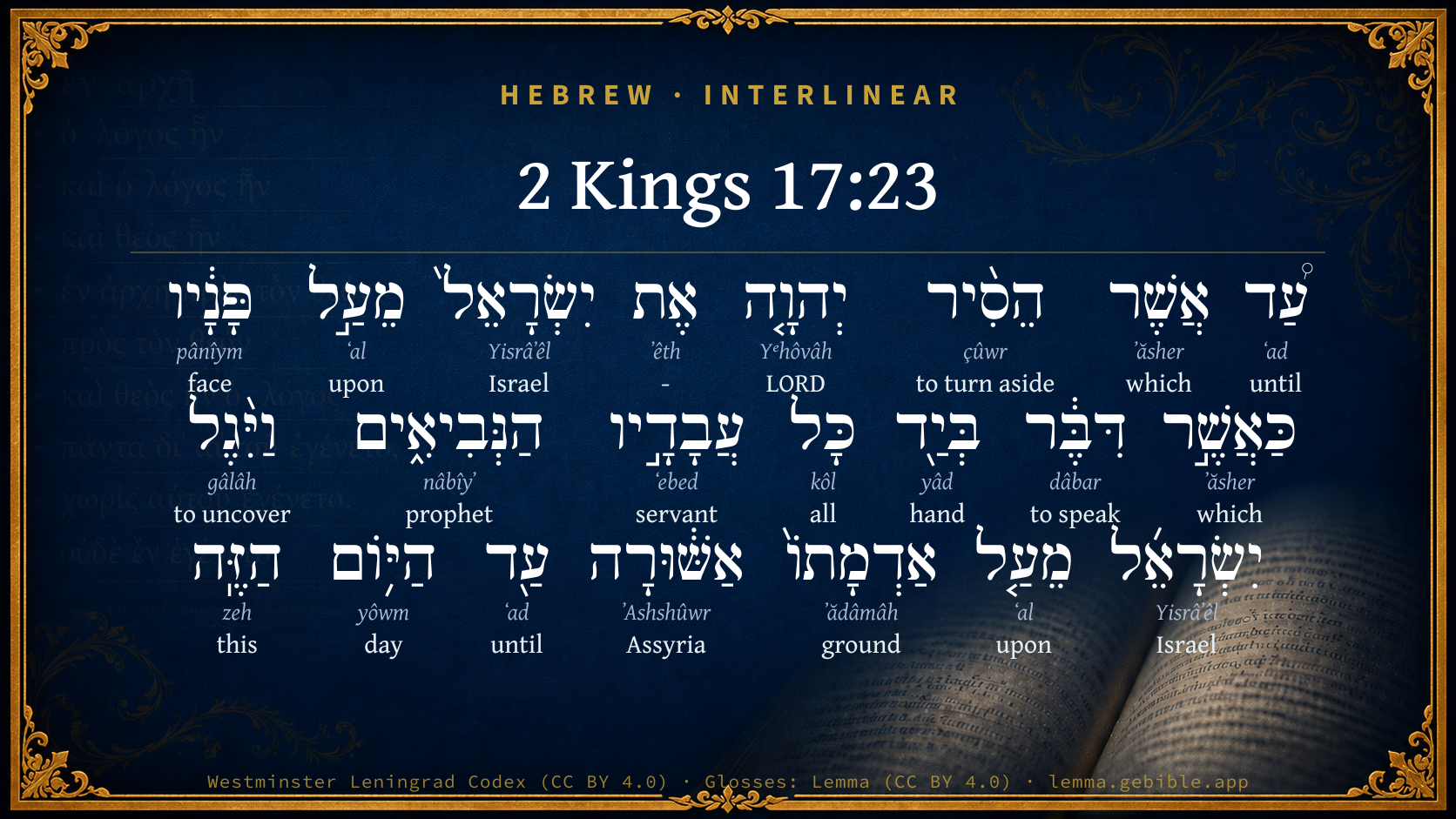
Hebrew (Westminster Leningrad Codex) 2 Kings 17:23 appears in the Hebrew Old Testament. The text above is from the Westminster Leningrad Codex. Each word links to its Strong’s number, a concise gloss, and parsing drawn from the Open Scriptures Hebrew Bible morphology. Click any word for its full Brown-Driver-Briggs (BDB) entry.
Download image
Cite this verse

2 Kings 17:23 (World English Bible). Public Domain. Lemma interlinear Bible study tool, https://lemma.gebible.app/v/2-kings/17/23.

Show BibTeX & RIS
BibTeX
RIS
English Translation
until Yahweh removed Israel out of his sight, as he spoke by all his servants the prophets. So Israel was carried away out of their own land to Assyria to this day.
World English Bible · Public Domain
Download a study sheet

One document with this verse’s original text, its word-by-word gloss line, the meaning frame, cross-references with their text, attributed commentary, and full source and license credits — printable, and it pastes into notes with its structure intact.

This verse Autodidact and up

Study sheet (.html) Plain text (.txt)

A passage Seminary Student

Up to 50 verses in one chapter. A passage sheet keeps up to 6 commentary sources and 12 cross-references per verse, in the order this page ranks them, and says so on the sheet whenever that leaves anything out. Ask for a single verse and you get the Autodidact verse sheet above.

Everything on this page stays free to read, with no account — the sheet is a download of what is already on screen, not access to it.

Want to remove ads? Support Godless Engineer
Compare translations 3

The same verse in 3 English versions, stacked beneath the original-language interlinear above. Click any original word for its lexicon entry.

Each is an independent rendering of the whole verse — the interlinear is not word-aligned to these translations.

Highlighted words mark where these versions differ — a whole-verse word diff, not a word-by-word alignment.

  • World English Bible Public Domain
    until Yahweh removed Israel out of his sight, as he spoke by all his servants the prophets. So Israel was carried away out of their own land to Assyria to this day.
  • King James Version Public Domain
    Until the LORD removed Israel out of his sight, as he had said by all his servants the prophets. So was Israel carried away out of their own land to Assyria unto this day.
  • unfoldingWord Literal Text CC BY-SA 4.0
    until Yahweh removed Israel away from his face, according to what he had spoken by the hand of all of his servants the prophets. And Israel went into exile away from its land to Assyria, to this day.

unfoldingWord Literal Text — © unfoldingWord, licensed CC BY-SA 4.0. Word-aligned USFM3 via Door43 (git.door43.org/unfoldingWord/en_ult).

Versions to compare (up to 4)

3 of 4 selected

Show all 18 translations

Every available English version of this verse, each an independent rendering of the whole verse.

  • World English Bible Public Domain
    until Yahweh removed Israel out of his sight, as he spoke by all his servants the prophets. So Israel was carried away out of their own land to Assyria to this day.
  • Berean Standard Bible Public Domain
    Finally, the LORD removed Israel from His presence, as He had declared through all His servants the prophets. So Israel was exiled from their homeland into Assyria, where they are to this day.
  • Majority Standard Bible Public Domain
    Finally, the LORD removed Israel from His presence, as He had declared through all His servants the prophets. So Israel was exiled from their homeland into Assyria, where they are to this day.
  • King James Version Public Domain
    Until the LORD removed Israel out of his sight, as he had said by all his servants the prophets. So was Israel carried away out of their own land to Assyria unto this day.
  • American Standard Version (1901) Public Domain
    until Jehovah removed Israel out of his sight, as he spake by all his servants the prophets. So Israel was carried away out of their own land to Assyria unto this day.
  • Revised Version (1885) Public Domain
    until the LORD removed Israel out of his sight, as he spake by the hand of all his servants the prophets. So Israel was carried away out of their own land to Assyria, unto this day.
  • Geneva Bible (1599) Public Domain
    Vntill the Lord put Israel away out of his sight, as he had said by all his seruants the Prophets, and caryed Israel away out of their land to Asshur vnto this day.
  • Douay-Rheims (1899) Public Domain
    Till the Lord removed Israel from his face, as he had spoken in the hand of all his servants the prophets: and Israel was carried away out of their land to Assyria, unto this day.
  • Young's Literal Translation Public Domain
    till that Jehovah hath turned Israel aside from His presence, as He spake by the hand of all His servants the prophets, and Israel is removed from off its land to Asshur, unto this day.
  • Literal Standard Version CC BY-SA 4.0
    until YHWH has turned Israel aside from His presence, as He spoke by the hand of all His servants the prophets, and Israel is removed from off its land to Asshur, to this day.
  • Unlocked Literal Bible CC BY-SA 4.0
    so Yahweh removed Israel from his sight, as he had said through all his servants the prophets that he would. So Israel was carried away out of their own land to Assyria, and it is this way to this present day.
  • unfoldingWord Literal Text CC BY-SA 4.0
    until Yahweh removed Israel away from his face, according to what he had spoken by the hand of all of his servants the prophets. And Israel went into exile away from its land to Assyria, to this day.
  • Darby Bible Public Domain
    until Jehovah had removed Israel out of his sight, as he had said through all his servants the prophets; and Israel was carried away out of their own land to Assyria, unto this day.
  • World Messianic Bible Public Domain
    until the LORD removed Israel out of his sight, as he said by all his servants the prophets. So Israel was carried away out of their own land to Assyria to this day.
  • Webster's Bible Public Domain
    Until the LORD removed Israel out of his sight, as he had said by all his servants the prophets. So was Israel carried away out of their own land to Assyria to this day.
  • Free Bible Version CC BY-SA 4.0
    so the Lord eventually expelled them from his presence, just as he had said he would through all his servants, the prophets. So the Israelites were deported from their land and taken to Assyria, where they are to this day.
  • Bible in Basic English Public Domain
    Till the Lord put Israel away from before his face, as he had said by all his servants the prophets. So Israel was taken away from their land to Assyria, to this day.
  • JPS Tanakh (1917) Public Domain
    until the LORD removed Israel out of His sight, as He spoke by the hand of all His servants the prophets. So Israel was carried away out of their own land to Assyria, unto this day.

Literal Standard Version (2020), Covenant Press — licensed CC BY-SA 4.0. Text via the HelloAO Bible API (eBible.org). Unlocked Literal Bible (unfoldingWord) — licensed CC BY-SA 4.0. Text via the HelloAO Bible API (eBible.org). unfoldingWord Literal Text — © unfoldingWord, licensed CC BY-SA 4.0. Word-aligned USFM3 via Door43 (git.door43.org/unfoldingWord/en_ult). Free Bible Version, Dr. Jonathan Gallagher — licensed CC BY-SA 4.0. Text via the HelloAO Bible API (eBible.org).

Word by word

More ways to search: Search by grammar → Find every occurrence → Compare this word →

Practice this passage: Drill this verse → Learn its vocabulary →

אַשּׁ֔וּרָה
ʼAshshûwr
H804
“Assyria · toward”
Noun, Proper + Suffix, Demonstrative
Part of Speech
Noun
Type
Proper
Full BDB Definition

Origin: apparently from H833 (in the sense of successful)

TWOT: 176

Asshur or Assyria = "a step" - the second son of Shem, eponymous ancestor of the Assyrians (noun proper masculine) - the people of Assyria (noun proper masculine) - the nation, Assyria (noun proper locative) - the land, Assyria or Asshur (noun proper locative)
  1. עַ֠ד ʻad H5704 “until” Preposition
  2. אֲשֶׁר ʼăsher H834 “which” Particle, Relative
  3. הֵסִ֨יר çûwr H5493 “to turn aside” Verb, Hiphil, Perfect, 3rd Person, Masculine, Singular
  4. יְהוָ֤ה Yᵉhôvâh H3068 “LORD” Noun, Proper
  5. אֶת ʼêth H853 “-” Particle, Direct Object
  6. יִשְׂרָאֵל֙ Yisrâʼêl H3478 “Israel” Noun, Proper
  7. מֵעַ֣ל ʻal H5921 “from · upon” Preposition + Preposition
  8. פָּנָ֔יו pânîym H6440 “face(s) · his” Noun, Common, Both, Plural, Construct + Suffix, Personal, 3rd Person, Masculine, Singular
  9. כַּאֲשֶׁ֣ר ʼăsher H834 “like/as · which” Preposition + Particle, Relative
  10. דִּבֶּ֔ר dâbar H1696 “to speak” Verb, Piel, Perfect, 3rd Person, Masculine, Singular
  11. בְּיַ֖ד yâd H3027 “in/at · hand of” Preposition + Noun, Common, Both, Singular, Construct
  12. כָּל kôl H3605 “all of” Noun, Common, Masculine, Singular, Construct
  13. עֲבָדָ֣יו ʻebed H5650 “servants · his” Noun, Common, Masculine, Plural, Construct + Suffix, Personal, 3rd Person, Masculine, Singular
  14. הַנְּבִיאִ֑ים nâbîyʼ H5030 “the · prophets” Particle, Definite Article + Noun, Common, Masculine, Plural, Absolute
  15. וַיִּ֨גֶל gâlâh H1540 “and · to uncover” Conjunction + Verb, Qal, Sequential Imperfect, 3rd Person, Masculine, Singular
  16. יִשְׂרָאֵ֜ל Yisrâʼêl H3478 “Israel” Noun, Proper
  17. מֵעַ֤ל ʻal H5921 “from · upon” Preposition + Preposition
  18. אַדְמָתוֹ֙ ʼădâmâh H127 “ground · his” Noun, Common, Feminine, Singular, Construct + Suffix, Personal, 3rd Person, Masculine, Singular
  19. עַ֖ד ʻad H5704 “until” Preposition
  20. הַיּ֥וֹם yôwm H3117 “the · day” Particle, Definite Article + Noun, Common, Masculine, Singular, Absolute
  21. הַזֶּֽה zeh H2088 “the · this” Particle, Definite Article + Pronoun, Demonstrative, Masculine, Singular

About this verse

These counts appear in no published source. They are computed here, from the morphology-tagged text and Lemma’s own curated glosses. What Lemma adds →

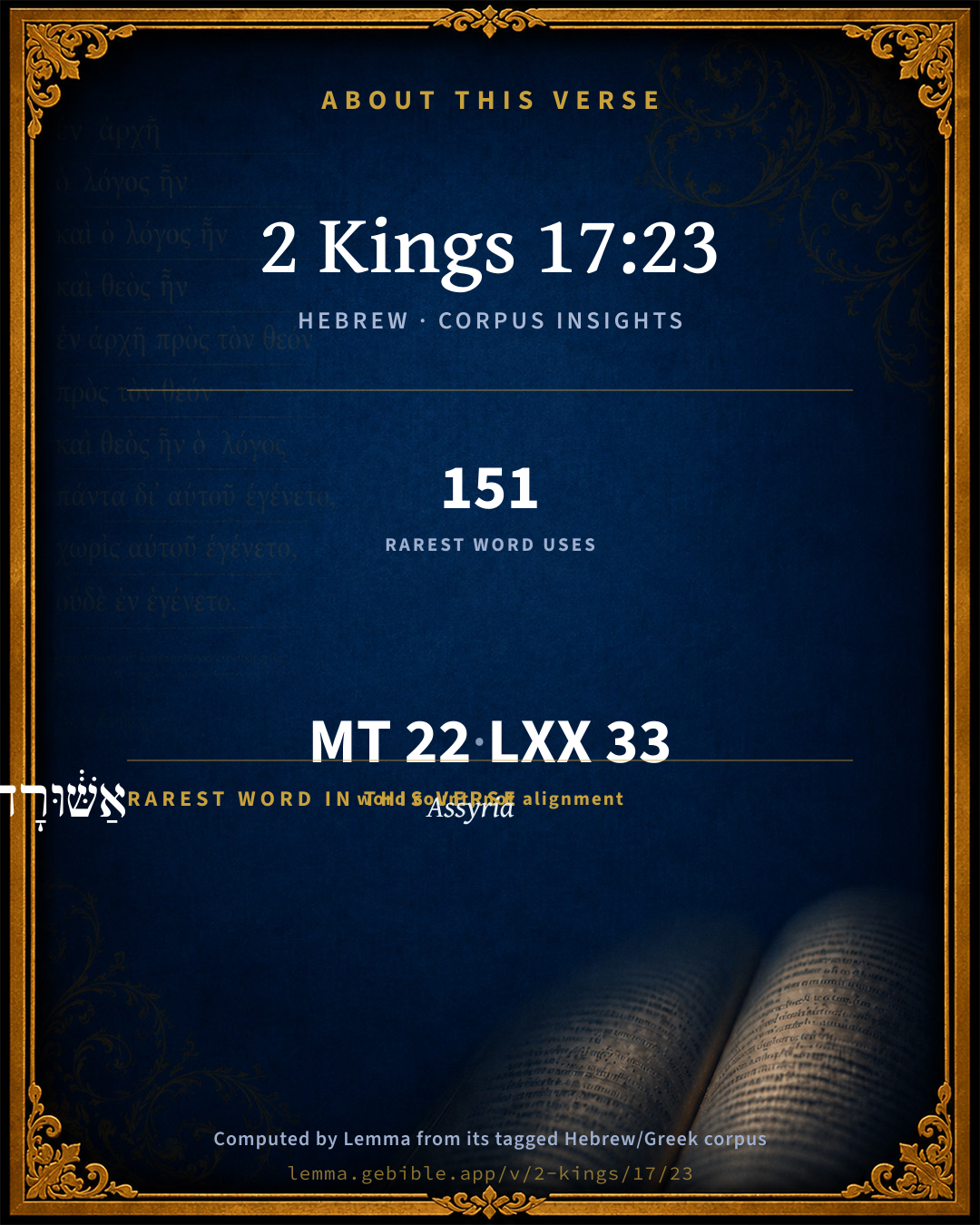
22
words
18
distinct lemmas
Historical
section

Grammatical profile

  • 3 verbs
  • 11 nouns
  • 1 pronoun
  • 4 prepositions
  • 3 particles

Verb forms

  • הֵסִ֨יר Hiphil · Perfect
  • דִּבֶּ֔ר Piel · Perfect
  • וַיִּ֨גֶל Qal · Sequential Imperfect

Repetition

Words recur within this verse — often emphatic in Hebrew:

  • עַ֠ד until H5704 ×2
  • יִשְׂרָאֵל֙ Israel H3478 ×2
  • מֵעַ֣ל upon H5921 ×2
  • אֲשֶׁר which H834 ×2

Hebrew & Septuagint length

In English translation the verse runs 32 words from the Hebrew and 32 from the Septuagint (LXX English) — the same length.

A rough comparison of the two English renderings, which tokenize alike — not a word-level alignment.

Word counts can differ between the Hebrew and the Greek without any difference in meaning — e.g. the Hebrew direct-object marker אֵת has no separate Greek word, and Greek often adds the article ὁ.

In the original languages it is 22 Hebrew tokens and 33 Greek tokens — but the two are counted differently (Hebrew bundles its prefixes and suffixes into one token; the Greek is in lemma form), so that isn’t a like-for-like length.

Cross-references

10

Topical passages linked to 2 Kings 17:23 in the Treasury of Scripture Knowledge — connected by theme and wording, ordered by reader-vote popularity; previews shown in the World English Bible.

  • 2 Kings 17:6 In the ninth year of Hoshea the king of Assyria took Samaria, and carried Israel away to Assyria, and placed them in Halah, and on the Habor, the river of Gozan, and in the cities of the Medes.
  • 2 Kings 17:13 Yet Yahweh testified to Israel, and to Judah, by every prophet, and every seer, saying, Turn you from your evil ways, and keep my commandments and my statutes, according to all the law which I commanded your fathers, and which I sent to you by my servants the prophets.
  • 1 Kings 14:16 He will give Israel up because of the sins of Jeroboam, which he has sinned, and with which he has made Israel to sin.
  • 2 Kings 17:20 Yahweh rejected all the seed of Israel, and afflicted them, and delivered them into the hand of spoilers, until he had cast them out of his sight.
  • 2 Kings 18:11–12 The king of Assyria carried Israel away to Assyria, and put them in Halah, and on the Habor, the river of Gozan, and in the cities of the Medes,
  • Hosea 1:4–9 Yahweh said to him, "Call his name Jezreel; for yet a little while, and I will avenge the blood of Jezreel on the house of Jehu, and will cause the kingdom of the house of Israel to cease.
  • Amos 5:27 Therefore will I cause you to go into captivity beyond Damascus," says Yahweh, whose name is the God of hosts.
  • 1 Kings 13:2 He cried against the altar by the word of Yahweh, and said, altar, altar, thus says Yahweh: Behold, a son shall be born to the house of David, Josiah by name; and on you shall he sacrifice the priests of the high places who burn incense on you, and men's bones shall they burn on you.
  • 2 Kings 17:18 Therefore Yahweh was very angry with Israel, and removed them out of his sight: there was none left but the tribe of Judah only.
  • Micah 1:6 Therefore I will make Samaria like a rubble heap of the field, Like places for planting vineyards; And I will pour down its stones into the valley, And I will uncover its foundations.

Cross-references courtesy of OpenBible.info (CC BY 4.0).

Hebrew and Greek witnesses Masoretic Hebrew ↔ Greek Septuagint

The same verse in the two great witnesses to the Old Testament, shown verse-for-verse.

These are two independent witnesses, not word-aligned to each other, and the Septuagint is shown in lemma (dictionary) form.

Hebrew 2 Kings 17:23 Masoretic · Westminster Leningrad Codex

עַ֠ד אֲשֶׁר הֵסִ֨יר יְהוָ֤ה אֶת יִשְׂרָאֵל֙ מֵעַ֣ל פָּנָ֔יו כַּאֲשֶׁ֣ר דִּבֶּ֔ר בְּיַ֖ד כָּל עֲבָדָ֣יו הַנְּבִיאִ֑ים וַיִּ֨גֶל יִשְׂרָאֵ֜ל מֵעַ֤ל אַדְמָתוֹ֙ אַשּׁ֔וּרָה עַ֖ד הַיּ֥וֹם הַזֶּֽה

until Yahweh removed Israel out of his sight, as he spoke by all his servants the prophets. So Israel was carried away out of their own land to Assyria to this day.

World English Bible · Public Domain

Greek LXX 2 Kings 17:23 Septuagint · lemma form

ἕως ὅς μεταἵστημι κύριος ὁ ἰσραήλ ἀπό πρόσωπον αὐτός καθώς λαλέω κύριος ἐν χείρ πᾶς ὁ δοῦλος αὐτός ὁ προφήτης καί ἀποοἰκίζω ἰσραήλ ἐπάνωθεν ὁ γῆ αὐτός εἰς ἀσσύριος ἕως ὁ ἡμέρα οὗτος

until the Lord removed Israel from his presence, as the Lord spoke by all his servants the prophets; and Israel was removed from off their land to the Assyrians until this day.

LXX2012 (modern English Septuagint) · Public Domain

Hebrew: Westminster Leningrad Codex (CC BY 4.0). Greek: Septuagint (public domain); English from LXX2012 (modern English Septuagint) (Public Domain). How the Septuagint differs from the Hebrew →

Targum (Aramaic paraphrase)

1

The Targum is the ancient Jewish Aramaic paraphrase of the Hebrew Scriptures — an interpretive translation, not the Hebrew text itself. Onkelos (literal) and Pseudo-Jonathan (expansive) render the Torah, and Jonathan the Prophets. Coverage is partial: where no permissively-licensed English translation exists for a verse, only the Aramaic is shown. This is verse-level text, not a word-by-word alignment to the Hebrew.

  1. Targum Jonathan Prophets (Joshua–Malachi)
    עַד דְאַגְלֵי יְיָ יַת יִשְׂרָאֵל מֵאַרְעָא בֵּית שְׁכִנְתֵּיהּ כְּמָא דְמַלֵל בְּיַד כָּל עַבְדוֹהִי נְבִיַיָא וּגְלוֹ יִשְׂרָאֵל מֵעַל אַרְעֲהוֹן לְאַתּוּר עַד יוֹמָא הָדֵין:

    (no public-domain English translation for this verse)

    Targum Jonathan — Aramaic: “Mikraot Gedolot” (public domain). English: “Sefaria Community Translation” (CC0 1.0 (public-domain dedication)); “London "Chaldee Paraphrase," 1871” (public domain). Text via Sefaria.

Commentary

Notes on 2 Kings 17:23 from classic Christian and Jewish commentators (each source and its license shown beneath its notes). The classic Christian expositions comment on the surrounding passage and are grouped to its opening verse, so a note may address several verses; the Jewish commentaries on the Tanakh (Rashi and others) are per-verse, so they appear only where the commentator wrote on this verse.

Lemma curates 59 commentaries, every one of them public domain or Creative Commons licensed, each selected and text-cleaned for this edition rather than reprinted as found. About our sources →

Trapp's Complete Commentary

John Trapp

2Ki 17:23 Until the LORD removed Israel out of his sight, as he had said by all his servants the prophets. So was Israel carried away out of their own land to Assyria unto this day.

Ver. 23. Until the Lord removed.] See on 2Ki 17:18.

Unto this day.] Wrath is come upon them to the utmost, if not to the very end, as the Greek hath it. {1Th 2:16}

John Trapp, A Commentary or Exposition upon All the Books of the Old and New Testament (1647–1656) — public domain. Text from a community e-Sword module.

Geneva Bible (1599)

Geneva Bible translators

Hebrew, by the hand of.

Geneva Bible (1599) marginal notes — public domain. Text via Bolls.life.

Ellicott's Commentary for English Readers

(23) By all his servants the prophets.—Comp. Hos_1:6; Hos_9:16; Amo_3:11-12; Amo_5:27; Isa_28:1-4.

So was Israel carried away.—That the land was not entirely depopulated appears from such passages as 2Ch_30:1; 2Ch_34:9. But henceforth “the distinctive character of the nation was lost; such Hebrews as remained in their old land became mixed with their heathen neighbours. When Josiah destroyed the ancient high places of the northern kingdom he slew their priests, whereas the priests of Judæan sanctuaries were provided for at Jerusalem. It is plain from this that he regarded the worship of the northern sanctuaries as purely heathenish (comp. 2Ki_23:20 with 2Ki_17:5), and it was only in much later times that the mixed population of Samaria became possessed of the Pentateuch, and set up a worship on Mount Gerizim, in imitation of the ritual of the second Temple. We have no reason to think that the captive Ephraimites were more able to retain their distinctive character than their brethren who remained in Palestine. The problem of the lost tribes, which has so much attraction for some speculators, is a purely fanciful one. The people whom Hosea and Amos describe were not fitted to maintain themselves apart from the heathen among whom they dwelt. Scattered among strange nations, they accepted the service of strange gods (Deu_28:64), and, losing their distinctive religion, lost also their distinctive existence.” (Robertson Smith.)

A Bible Commentary for English Readers, edited by Charles John Ellicott (1878–1897) — public domain. Text from a community e-Sword module.

The Cambridge Bible for Schools and Colleges

gen. ed. J. J. S. Perowne

23. as he had said by all his servants the prophets] R.V. as he spake by the hand of all his servants the prophets. These were probably more numerous, in connexion with the northern kingdom than with the kingdom of Judah, and conspicuous among them were the great figures of Elijah and Elisha. The other prophets of Israel were Ahijah the Shilonite of the land of Ephraim (1Ki_14:4), an anonymous prophet in Beth-el (1Ki_13:11), Micaiah the son of Imlah in Samaria (1Ki_22:10). Elijah was a Gileadite (1Ki_17:1), and Abel-meholah, Elisha’s birthplace, was in the tribe of Issachar (1Ki_19:16), Jonah was born at Gath-hepher in Galilee in the tribe of Zebulon (2Ki_14:25), Nahum the Elkoshite was of Israel (Nah_1:1), and probably Hosea also. The prophecy of Amos is concerning Israel, but he was born at Tekoah in Judah.

to Assyria unto this day] See above on 2Ki_2:22. The R.V. begins this last clause ‘So Israel was’ &c.

The Cambridge Bible for Schools and Colleges (gen. ed. J. J. S. Perowne; Cambridge University Press, 1878–1918) — public domain. Text from a community e-Sword module.

John Gill's Exposition

Until the Lord removed Israel out of his sight,.... Suffered them to be carried captive into the land of Assyria:

as he had said by all his servants the prophets; by Hosea, Amos, Micah, and others; see their prophecies, and also Kg1 13:32,

so was Israel carried away out of their own land to Assyria, unto this day; the time of the writing this book; nor have they returned unto our days, nearly 2,800 years later.

John Gill's Exposition of the Whole Bible (1746–1763) — public domain (CC PDM 1.0). Text via the HelloAO Bible API.

Albert Barnes' Notes on the Bible

As he had said by all his servants the prophets - The writer refers not only to the extant prophecies of Moses (Lev 26:33; Deu 4:26-27; Deu 28:36, etc.), Ahijah the Shilohite (marginal reference), Hosea Hos 9:3, Hos 9:17, and Amos Amo 7:17, but also to the entire series of warnings and predictions which prophet after prophet in a long unbroken succession had addressed to the disobedient Israelites 2Ki 17:13 on their apostasy, and so leaving them wholly “without excuse” (see the 2Ki 17:13 note).

Unto this day - The words, taken in combination with the rest of the chapter, distinctly show that the Israelites had not returned to their land by the time of the composition of the Books of Kings. They show nothing as to their ultimate fate. But, on the whole, it would seem probable:

(1) that the ten tribes never formed a community in their exile, but were scattered from the first; and

(2) that their descendants either blended with the pagan and were absorbed, or returned to Palestine with Zerubbabel and Ezra, or became inseparable united with the dispersed Jews in Mesopotamia and the adjacent countries.

No discovery, therefore, of the ten tribes is to be expected, nor can works written to prove their identity with any existing race or body of persons be regarded as anything more than ingenious exercitations.

Albert Barnes' Notes on the Bible (1834–1885) — public domain. Text from a community e-Sword/MySword module.

Haydock's Catholic Bible Commentary

Day. If Esdras was the author of this book, as it is very probable, this observation would tend to show how much more favourably the Jews were treated than the kingdom of Israel, which was still, for the most part, in captivity. (Calmet)

George Leo Haydock (1774–1849), Haydock's Catholic Family Bible and Commentary, 1859 edition — public domain. Excludes Psalms (Douay-Rheims chapter numbering differs from Protestant) and Deuterocanonical books (Catholic canon only).

Matthew Poole's English Annotations

The Lord removed Israel out of his sight: they continued to the last obstinate and incorrigible under all the instructions and corrections which God sent to them; and therefore were most justly given up by God into this dreadful captivity; which all this foregoing discourse was designed to prove.

Matthew Poole's English Annotations on the Holy Bible (1683–1685) — public domain. Text from a community e-Sword/MySword module.

Whedon's Commentary on the Bible

Daniel D. Whedon

23. To Assyria unto this day — Thus the Assyrian captivity lasted until our historian’s day, and how much longer is not said. The subsequent history of “the ten tribes” has been the subject of endless speculation and inquiry. In the time of Josephus there seems to have been a notion prevailing that the ten tribes abode together in a body of innumerable multitude beyond the Euphrates. Antiquities, 2Ki_11:5; 2Ki_11:2. Also Esdras has a vision of the ten tribes separating themselves from the heathen, and migrating to a distant land never before inhabited by men. English Apocrypha, 2Es_13:40-47. Perhaps this vision of Esdras was the starting-point of all the speculations about the “Lost Tribes,” for they have been “lost” and “found” in nearly every part of Asia, Europe, and North America. But vague traditional tales and ingenious speculations are of little weight to counterbalance the abundant testimony of Scripture on the subject, which may be stated as follows: —

1.) A considerable portion of the Israelitish population never went into the Assyrian exile. The first deportations were by Pul and Tiglath-pileser, (2Ki_15:19; 2Ki_15:29; 1Ch_5:26,) and in all probability were composed of fewer captives than Shalmaneser (or Sargon, see note on 2Ki_17:6) carried away after the capture of Samaria and the fall of the northern kingdom. Sargon’s inscription, which would not be likely to make too low an estimate, mentions twenty-seven thousand two hundred and eighty captives, (see note on 2Ki_17:6,) but the northern kingdom must surely have had a population far exceeding these numbers. Multitudes were, of course, slain in the siege of Samaria, and in previous wars; but supposing them to have been ten times the number of the captives, (two hundred and seventy-two thousand eight hundred — a liberal estimate,) what became of all the rest of Israel, which in David’s time numbered eight hundred thousand warriors, which, of course, implies a population of many millions. 2Sa_24:9. Doubtless the captives, like those from Jerusalem, (2Ki_24:14-15; 2Ki_25:12,) were composed chiefly of “the princes and mighty men of valour, and craftsmen, and smiths, and the king’s mother, and wives, and officers, and the mighty of the land” — the flower and strength of the nation, while “the poor of the land, vinedressers and husbandmen,” (numerically, perhaps, the majority of the population,) were left in the land, or else fled to other parts. Only “the cities of Samaria” (2Ki_17:24) seem to have been depopulated, so that in other and remoter districts of the kingdom a large majority of the population seem to have been left to care for the land. Thus the kingdom of the ten tribes ceased to exist; but numerically the mass of the people were left in their ancient homes. Certain it is that they were not all carried into exile.

2.) The captives were not allowed to settle in one district. 2Ki_17:6, compared with 1Ch_5:26, may perhaps indicate that a majority of the exiles, both under Tiglath-pileser and Sargon, were placed in Halah and along the Habor, but others (and how large a proportion does not appear) were scattered abroad in various cities of Media. This fact of their being scattered throughout various parts of the vast Assyrian empire argues against the notion of their continuing their tribe distinctions, and especially of their perpetuating the ten tribes as an organized community.

3.) There is reason to believe that after the fall of Samaria the old enmity between Judah and Israel began to cease. In the reign of Hezekiah arrangements were made to proclaim “throughout all Israel, from Beer-sheba even to Dan, that they should come to keep the passover unto the Lord God of Israel at Jerusalem;” and letters were sent “to Ephraim and Manasseh,” accompanied by an exhortation for them “to turn again unto the Lord God of Abraham, Isaac, and Israel.” Many scorned the invitation, but “divers of Asher and Manasseh and of Zebulun humbled themselves and came to Jerusalem,” so that there appeared at the passover “many of Ephraim and Manasseh, Issachar and Zebulun.” And on that proud occasion “all the congregation of Judah, with the priests and the Levites, and all the congregation that came out of Israel, and the strangers that came out of the land of Israel, and that dwelt in Judah, rejoiced,” for it was the first occasion of the kind “since the time of Solomon the son of David.” and it betokened a reunion of the divided kingdom. See 2 Chronicles 30. At the close of the passover it is also said that “all Israel that were present went out,” and utterly destroyed all the signs of idolatry “out of all Judah and Benjamin, in Ephraim also and Manasseh.” 2Ch_31:1. The like thing was done by Josiah, (2Ki_23:19; 2Ch_34:7; 2Ch_35:18,) who also collected money for repairing the temple “of the hand of Manasseh and Ephraim, and of all the remnant of Israel, and of all Judah and Benjamin.” 2Ch_34:9. Such a coming together in their now oppressed land would rapidly efface from Judah and Israel their ancient bitterness and jealousy. The better portion of all the people would see and obey the manifest will of Jehovah, and the rest, having no bond of union, would gradually, like all foolish factions, die and fade away.

4.) The prophets with one voice represent both Judah and Israel as returning together from their exile. More than a century after the fall of Samaria, Judah also was led into exile, and Jeremiah, who flourished at that time, began at once to comfort them with prophecies of a restoration. He says, “The house of Judah shall walk with the house of Israel, and they shall come together out of the land of the north to the land that I have given for an inheritance unto your fathers.” Jer_3:18; comp. Jer_30:3, Jer_33:7. “The children of Israel shall come, they and the children of Judah together, going and weeping: they shall go, and seek the Lord their God.” Jer_50:4. So we may believe that the chastisement of the exile not only cleansed all Israel from idolatry, but also utterly crushed out the old tribal feuds and jealousies. Ezekiel also prophesies: “Thus saith the Lord God, Behold, I will take the children of Israel from among the heathen whither they be gone, and will gather them on every side, and bring them into their own land: and I will make them one nation in the land upon the mountains of Israel; and one king shall be king to them all: and they shall be no more two nations, neither shall they be divided into two kingdoms any more at all.” Eze_37:21-22; compare also 2Ki_17:16-20. Other similar prophecies may be found in these same prophets, and also in Isa_11:11-13; Isa_14:1; Hos_1:11; Mic_2:12. Some of these prophecies are doubtless Messianic; but all have more or less to show that in their exile Judah and Israel became united in all their higher sympathies and hopes, and were thus prepared, whenever opportunity offered, to return together to the land of their fathers.

5.) Finally, all we know of the subsequent history of Israel tends to confirm these prophecies, and to show that in the lands of their exile, and elsewhere, Judah and Israel became largely intermingled. Three successive deportations of Jews seem to have been carried away by Nebuchadnezzar, (2Ki_24:11-16; 2Ki_25:11; Jer_52:30,) and yet it is probable that all these captives were not, numerically, a majority of the population of Judah. The vast multitude of the poorer classes were left in the land, (2Ki_24:14; 2Ki_25:12,) and some fled to other countries. We have no record of all the localities in which these captives were placed, but as the Babylonian empire under Nebuchadnezzar comprised a large portion of the ancient Assyrian, it is very likely that many of the Jewish exiles were settled in cities and districts already occupied by descendants of those Israelites from the cities of Samaria who had been carried off by the Assyrian kings more than a century before. Ezekiel, a prophet of the Jewish exiles, is made “a watchman unto the house of Israel.” 2Ki_3:17. When Cyrus issued his proclamation for the Jews to return and rebuild the temple, he had dominion over all the lands into which either Jews or Israelites had been exiled, but he seems to know of no such distinction as “Judah and Israel.” He proclaims, “Who is there among you of all his people,” (Ezr_1:3 :) and subsequently Artaxerxes decrees “that all they of the people of Israel, and of his priests and Levites, in my realm, which are minded of their own freewill to go up to Jerusalem,” may return from exile; and Keil well asks, “Who could maintain, with any show of reason, that no one belonging to the ten tribes availed himself of this permission?” In Ezr_2:64-65, the whole number of those who first returned from the captivity is said to have been forty-two thousand three hundred and sixty, “besides their servants and their maids, of whom there were seven thousand three hundred and thirty-seven;” but the previous list of families, which seems to be “of the fathers of Judah and Benjamin, and the priests, and the Levites,” (2Ki_1:5,) amounts to only twenty-nine thousand eight hundred and eighteen. Hence it has been plausibly inferred that the gross number, forty-two thousand three hundred and sixty, includes many representatives of the ten tribes. Then in the offerings that were made by the returned exiles at the feast of dedication, “twelve he goats” were offered “for a sin offering for all Israel, according to the number of the tribes of Israel.” Ezr_6:17. Compare, also, 2 Kings 8:35. “There is no doubt,” says Keil, “that the majority of those who returned with Zerubbabel and Ezra belonged to the tribes of Judah, Benjamin, and Levi; which may be explained very simply from the fact, that as they had been a much shorter time in exile, they had retained a much stronger longing for the home given by the Lord to their fathers than the tribes that were carried away one hundred and eighty years before.” Hence, too, it is, that since the captivity, the common name for all Israelites, wherever scattered abroad, is Jews. We must also remember that, with the fall of Samaria, Jehovah “caused to cease the kingdom of the house of Israel,” (Hos_1:4;) it had no longer an existence, but was largely absorbed by Judah; and therefore it is not to be wondered at that no express mention is made of descendants of the ten tribes returning along with Judah from exile.

But there were vast multitudes of Judah and Israel that never accepted the offer to return to the fatherland. They chose to remain in their new homes; and subsequently, under Ahasuerus, the Jews are spoken of as “scattered abroad and dispersed among the people in all the provinces” of the Persian empire. Est_3:8. On the day of Pentecost there were at Jerusalem devout Jews “out of every nation under heaven,” who had been born among, and spoke as their vernacular the languages of, the “Parthians, and Medes, and Elamites, and the dwellers in Mesopotamia, and in Judea, and Cappadocia, in Pontus, and Asia, Phrygia, and Pamphylia, in Egypt, and in the parts of Libya about Cyrene, and strangers of Rome.” Act_2:5-10. Josephus also speaks of the great numbers of Jews who in his time dwelt in Babylon, Mesopotamia, and beyond the Euphrates. Antiquities, 2Ki_15:2; 2Ki_15:2, 2Ki_3:1; 2Ki_18:9; 2Ki_18:1. Paul speaks of “our twelve tribes,” (Act_26:7,) and James addresses his epistle “to the twelve tribes scattered abroad;” (Jas_1:1;) from all which we infer that after the Babylonish exile the old division of “Judah and Israel” became lost, all the scattered tribes became intermixed, no one region held any one tribe or any definite number of tribes, the name of Jews was applied to them all, the ten tribes as a distinct nation had long ceased to exist, and the whole body of Israelites throughout the world became amalgamated into one people, recognising themselves as the descendants and representatives of the twelve ancient tribes.

Daniel D. Whedon (gen. ed.), Commentary on the Old and New Testaments (1874–1909) — public domain. Text from a community e-Sword module.

The Pulpit Commentary

Until the Lord removed Israel out of his sight (see the comment on ver. 18) as he had said by all his servants the prophets. The destruction of the kingdom of Israel had been distinctly prophesied by Ahijah the Shilonite, (1Ki_14:15, 1Ki_14:16) Hosea, (Hos_1:4; Hos_9:3, Hos_9:17) and. (Amo_7:17) General warnings and denunciations had been given by Moses (Lev_26:33; Deu_4:26, 27 28:36, etc.) by Isaiah, (Isa_7:8 Isa_28:1-4) and probably by the entire series of prophets enumerated in the comment on ver. 13. So was Israel carried away out of their own land to Assyria unto this day; i.e. up to the time that the Second Book of Kings was written, about B.C. 580-560, the Israelites remained within the limits of the country to which they were carried by the conqueror. Not long after this time, about B.C. 538, a considerable number returned with Zerubbabel to Palestine, and others with Ezra (see Ezr_2:70 Ezr_3:1 Ezr_6:16, 17 7:13 8:35 1Ch_9:2, 1Ch_9:3; Zec_8:13) What became of the rest has been a fertile subject of speculation. Probably the more religions united with the Jewish communities, which were gradually formed in almost all the cities of the East; while the irreligious laid aside their peculiar customs, and became blended indistinguishably with the heathen. "There is no ground for expecting to find the "ten tribes" anywhere at the present day.

The Pulpit Commentary (1880–1919), ed. H.D.M. Spence-Jones & Joseph S. Exell — public domain. Text from a community e-Sword module.

Rashi

Rabbi Shlomo Yitzchaki (Rashi)

And Yisroel went into exile. This is voweled with a “chirik,” which is an expression of “went in exile.” It is not an expression of “was exiled.”

Rashi on the Tanakh — English translations: “The Judaica Press complete Tanach with Rashi, translated by A. J. Rosenberg” (CC BY 4.0); “Pentateuch with Rashi's commentary by M. Rosenbaum and A.M. Silbermann, 1929-1934” (public domain); “The Metsudah Tanach series, Lakewood, N.J” (CC BY 4.0); and “The Book of Joshua, Metsudah Publications, 1997” (CC BY 4.0). Text via Sefaria.

Lesson kit

Teaching starters — assembled from the data on this page, not authored interpretation. Every prompt links to the verse data it draws on. Edit before teaching.

2 Kings, in the Historical, opens this verse with 22 words (18 distinct Hebrew lemmas). Its most distinctive word is ʼAshshûwr (“Assyria”). A historical commentator’s framing appears above. Read the whole chapter for the surrounding context.

Discussion questions

  1. What does “Assyria” (ʼAshshûwr) contribute to the verse as a whole?
  2. How does 2 Kings 17:6, which shares this passage’s theme, read alongside this verse?
  3. What does the repetition of “until” (2× in this one verse) do in this verse?
  4. The translations on this page render this verse differently — a whole-verse word diff, not a word-by-word alignment. What might account for the different wordings?
  5. «הֵסִ֨יר» is a Hiphil Perfect verb. How does that grammatical form shape the action described?
  6. Compare how Trapp's Complete Commentary and Geneva Bible (1599) read this verse. Where do they agree or differ?

Things to notice

Reading settings

Reading text

Shown beneath each verse's original-language words.

Old Testament
Old Testament edition

Read the OT as the Masoretic Hebrew (MT) or the Greek Septuagint (LXX).

English shown for the Greek Septuagint (in the Hebrew ↔ Greek comparison).

Comparing translations? Open the Compare panel on any verse page to stack up to four side by side.