
Ezekiel 20:42

Hebrew (Westminster Leningrad Codex) Ezekiel 20:42 appears in the Hebrew Old Testament. The text above is from the Westminster Leningrad Codex. Each word links to its Strong’s number, a concise gloss, and parsing drawn from the Open Scriptures Hebrew Bible morphology. Click any word for its full Brown-Driver-Briggs (BDB) entry.
Download image
Cite this verse

Ezekiel 20:42 (World English Bible). Public Domain. Lemma interlinear Bible study tool, https://lemma.gebible.app/v/ezekiel/20/42.

Show BibTeX & RIS
BibTeX
RIS
English Translation
You shall know that I am Yahweh, when I shall bring you into the land of Israel, into the country which I swore to give to your fathers.
World English Bible · Public Domain
Download a study sheet

One document with this verse’s original text, its word-by-word gloss line, the meaning frame, cross-references with their text, attributed commentary, and full source and license credits — printable, and it pastes into notes with its structure intact.

This verse Autodidact and up

Study sheet (.html) Plain text (.txt)

A passage Seminary Student

Up to 50 verses in one chapter. A passage sheet keeps up to 6 commentary sources and 12 cross-references per verse, in the order this page ranks them, and says so on the sheet whenever that leaves anything out. Ask for a single verse and you get the Autodidact verse sheet above.

Everything on this page stays free to read, with no account — the sheet is a download of what is already on screen, not access to it.

Want to remove ads? Support Godless Engineer
Compare translations 3

The same verse in 3 English versions, stacked beneath the original-language interlinear above. Click any original word for its lexicon entry.

Each is an independent rendering of the whole verse — the interlinear is not word-aligned to these translations.

Highlighted words mark where these versions differ — a whole-verse word diff, not a word-by-word alignment.

  • World English Bible Public Domain
    You shall know that I am Yahweh, when I shall bring you into the land of Israel, into the country which I swore to give to your fathers.
  • King James Version Public Domain
    And ye shall know that I am the LORD, when I shall bring you into the land of Israel, into the country for the which I lifted up mine hand to give it to your fathers.
  • unfoldingWord Literal Text CC BY-SA 4.0
    Then, when I bring you to the land of Israel, to the land that I have lifted up my hand to swear to give to your fathers, you will know that I am Yahweh.

unfoldingWord Literal Text — © unfoldingWord, licensed CC BY-SA 4.0. Word-aligned USFM3 via Door43 (git.door43.org/unfoldingWord/en_ult).

Versions to compare (up to 4)

3 of 4 selected

Show all 18 translations

Every available English version of this verse, each an independent rendering of the whole verse.

  • World English Bible Public Domain
    You shall know that I am Yahweh, when I shall bring you into the land of Israel, into the country which I swore to give to your fathers.
  • Berean Standard Bible Public Domain
    Then you will know that I am the LORD, when I bring you into the land of Israel, the land that I swore to give your fathers.
  • Majority Standard Bible Public Domain
    Then you will know that I am the LORD, when I bring you into the land of Israel, the land that I swore to give your fathers.
  • King James Version Public Domain
    And ye shall know that I am the LORD, when I shall bring you into the land of Israel, into the country for the which I lifted up mine hand to give it to your fathers.
  • American Standard Version (1901) Public Domain
    And ye shall know that I am Jehovah, when I shall bring you into the land of Israel, into the country which I sware to give unto your fathers.
  • Revised Version (1885) Public Domain
    And ye shall know that I am the LORD, when I shall bring you into the land of Israel, into the country which I lifted up mine hand to give unto your fathers.
  • Geneva Bible (1599) Public Domain
    And ye shall knowe, that I am the Lord, when I shall bring you into the land of Israel, into the land, for the which I lifted vp mine hande to giue it to your fathers.
  • Douay-Rheims (1899) Public Domain
    And you shall know that I am the Lord, when I shall have brought you into the land of Israel, into the land for which I lifted up my hand to give it to your fathers.
  • Young's Literal Translation Public Domain
    And ye have known that I `am' Jehovah, In My bringing you to the ground of Israel, Unto the land that I did lift up My hand To give it to your fathers,
  • Literal Standard Version CC BY-SA 4.0
    And you have known that I [am] YHWH, || In My bringing you to the ground of Israel, || To the land that I lifted up My hand || To give it to your fathers,
  • Unlocked Literal Bible CC BY-SA 4.0
    Then, when I bring you to the land of Israel, to the land that I have lifted up my hand to swear to give to your fathers, you will know that I am Yahweh.
  • unfoldingWord Literal Text CC BY-SA 4.0
    Then, when I bring you to the land of Israel, to the land that I have lifted up my hand to swear to give to your fathers, you will know that I am Yahweh.
  • Darby Bible Public Domain
    And ye shall know that I [am] Jehovah, when I have brought you into the land of Israel, into the country which I lifted up my hand to give to your fathers.
  • World Messianic Bible Public Domain
    You will know that I am the LORD when I bring you into Eretz-Israel, into the country which I swore to give to your fathers.
  • Webster's Bible Public Domain
    And ye shall know that I am the LORD, when I shall bring you into the land of Israel, into the country for which I lifted up my hand to give it to your fathers.
  • Free Bible Version CC BY-SA 4.0
    Then you will acknowledge that I am the Lord when I bring you back to the country of Israel, the land that I promised to give your forefathers.
  • Bible in Basic English Public Domain
    And you will be certain that I am the Lord, when I take you into the land of Israel, into the country which I made an oath to give to your fathers.
  • JPS Tanakh (1917) Public Domain
    And ye shall know that I am the LORD, when I shall bring you into the land of Israel, into the country which I lifted up My hand to give unto your fathers.

Literal Standard Version (2020), Covenant Press — licensed CC BY-SA 4.0. Text via the HelloAO Bible API (eBible.org). Unlocked Literal Bible (unfoldingWord) — licensed CC BY-SA 4.0. Text via the HelloAO Bible API (eBible.org). unfoldingWord Literal Text — © unfoldingWord, licensed CC BY-SA 4.0. Word-aligned USFM3 via Door43 (git.door43.org/unfoldingWord/en_ult). Free Bible Version, Dr. Jonathan Gallagher — licensed CC BY-SA 4.0. Text via the HelloAO Bible API (eBible.org).

Word by word

More ways to search: Search by grammar → Find every occurrence → Compare this word →

Practice this passage: Drill this verse → Learn its vocabulary →

אַדְמַ֣ת
ʼădâmâh
H127
“ground of”
Noun, Common, Feminine, Singular, Construct
Part of Speech
Noun
Type
Common
Gender
Feminine
Number
Singular
State
Construct
Full BDB Definition

Origin: from H119

TWOT: 25b

ground, land - ground (as general, tilled, yielding sustenance) - piece of ground, a specific plot of land - earth substance (for building or constructing) - ground as earth's visible surface - land, territory, country - whole inhabited earth - city in Naphtali
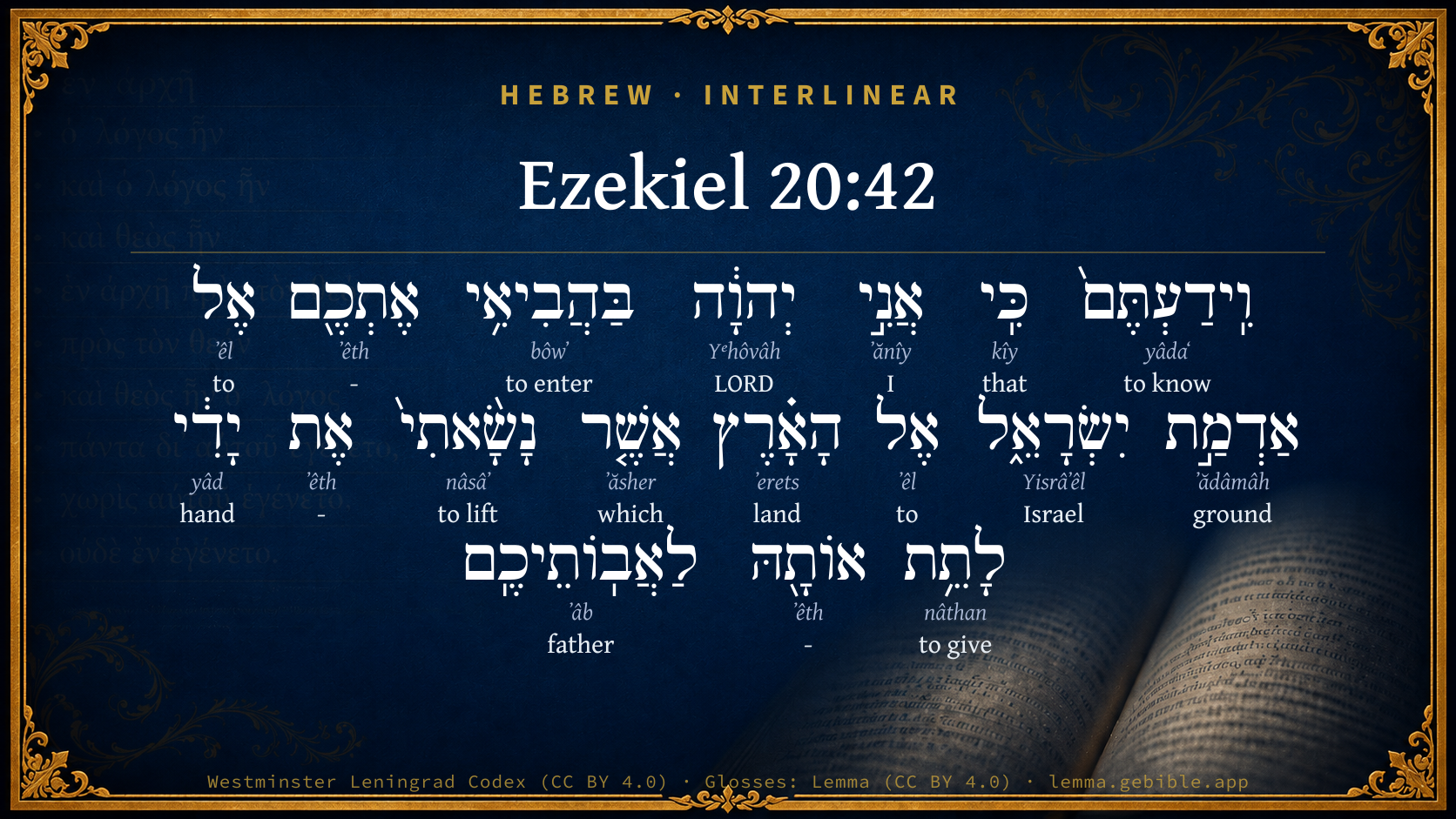
  1. וִֽידַעְתֶּם֙ yâdaʻ H3045 “and · to know” Conjunction + Verb, Qal, Sequential Perfect, 2nd Person, Masculine, Plural
  2. כִּֽי kîy H3588 “that” Conjunction
  3. אֲנִ֣י ʼănîy H589 “I” Pronoun, Personal, 1st Person, Common, Singular
  4. יְהוָ֔ה Yᵉhôvâh H3068 “LORD” Noun, Proper
  5. בַּהֲבִיאִ֥י bôwʼ H935 “in/at · to enter · me” Preposition + Verb, Hiphil, Infinitive Construct + Suffix, Personal, 1st Person, Common, Singular
  6. אֶתְכֶ֖ם ʼêth H853 “- · you” Particle, Direct Object + Suffix, Personal, 2nd Person, Masculine, Plural
  7. אֶל ʼêl H413 “to” Preposition
  8. יִשְׂרָאֵ֑ל Yisrâʼêl H3478 “Israel” Noun, Proper
  9. אֶל ʼêl H413 “to” Preposition
  10. הָאָ֗רֶץ ʼerets H776 “the · land” Particle, Definite Article + Noun, Common, Both, Singular, Absolute
  11. אֲשֶׁ֤ר ʼăsher H834 “which” Particle, Relative
  12. נָשָׂ֨אתִי֙ nâsâʼ H5375 “to lift” Verb, Qal, Perfect, 1st Person, Common, Singular
  13. אֶת ʼêth H853 “-” Particle, Direct Object
  14. יָדִ֔י yâd H3027 “hand · my” Noun, Common, Both, Singular, Construct + Suffix, Personal, 1st Person, Common, Singular
  15. לָתֵ֥ת nâthan H5414 “to give” Preposition + Verb, Qal, Infinitive Construct
  16. אוֹתָ֖הּ ʼêth H853 “- · her” Particle, Direct Object + Suffix, Personal, 3rd Person, Feminine, Singular
  17. לַאֲבֽוֹתֵיכֶֽם ʼâb H1 “to/for · fathers · your” Preposition + Noun, Common, Masculine, Plural, Construct + Suffix, Personal, 2nd Person, Masculine, Plural

About this verse

These counts appear in no published source. They are computed here, from the morphology-tagged text and Lemma’s own curated glosses. What Lemma adds →

18
words
15
distinct lemmas
Prophets
section

Grammatical profile

  • 4 verbs
  • 6 nouns
  • 1 pronoun
  • 2 prepositions
  • 1 conjunction
  • 4 particles

Verb forms

  • וִֽידַעְתֶּם֙ Qal · Sequential Perfect
  • בַּהֲבִיאִ֥י Hiphil · Infinitive Construct
  • נָשָׂ֨אתִי֙ Qal · Perfect
  • לָתֵ֥ת Qal · Infinitive Construct

Repetition

A word recurs within this verse — often emphatic in Hebrew:

  • אֶל to H413 ×2

Hebrew & Septuagint length

In English translation the verse runs 28 words from the Hebrew and 35 from the Septuagint (LXX English) — closely comparable.

A rough comparison of the two English renderings, which tokenize alike — not a word-level alignment.

Word counts can differ between the Hebrew and the Greek without any difference in meaning — e.g. the Hebrew direct-object marker אֵת has no separate Greek word, and Greek often adds the article ὁ.

In the original languages it is 18 Hebrew tokens and 30 Greek tokens — but the two are counted differently (Hebrew bundles its prefixes and suffixes into one token; the Greek is in lemma form), so that isn’t a like-for-like length.

Cross-references

14

Topical passages linked to Ezekiel 20:42 in the Treasury of Scripture Knowledge — connected by theme and wording, ordered by reader-vote popularity; previews shown in the World English Bible.

  • Ezekiel 34:13 I will bring them out from the peoples, and gather them from the countries, and will bring them into their own land; and I will feed them on the mountains of Israel, by the watercourses, and in all the inhabited places of the country.
  • Ezekiel 38:23 I will magnify myself, and sanctify myself, and I will make myself known in the eyes of many nations; and they shall know that I am Yahweh.
  • Ezekiel 36:23–24 I will sanctify my great name, which has been profaned among the nations, which you have profaned in the midst of them; and the nations shall know that I am Yahweh, says the Lord Yahweh, when I shall be sanctified in you before their eyes.
  • Jeremiah 24:7 I will give them a heart to know me, that I am Yahweh: and they shall be my people, and I will be their God; for they shall return to me with their whole heart.
  • Jeremiah 31:34 and they shall teach no more every man his neighbor, and every man his brother, saying, Know Yahweh; for they shall all know me, from the least of them to the greatest of them, says Yahweh: for I will forgive their iniquity, and their sin will I remember no more.
  • Ezekiel 11:17–20 Therefore say, Thus says the Lord Yahweh: I will gather you from the peoples, and assemble you out of the countries where you have been scattered, and I will give you the land of Israel.
  • Ezekiel 20:38 and I will purge out from among you the rebels, and those who disobey against me; I will bring them forth out of the land where they sojourn, but they shall not enter into the land of Israel: and you shall know that I am Yahweh.
  • Ezekiel 20:44 You shall know that I am Yahweh, when I have dealt with you for my name's sake, not according to your evil ways, nor according to your corrupt doings, you house of Israel, says the Lord Yahweh.
  • Ezekiel 24:24 Thus shall Ezekiel be to you a sign; according to all that he has done shall you do: when this comes, then shall you know that I am the Lord Yahweh.
  • Ezekiel 26:13 I will cause the noise of your songs to cease; and the sound of your harps shall be no more heard.
  • Ezekiel 37:21 Say to them, Thus says the Lord Yahweh: Behold, I will take the children of Israel from among the nations, where they are gone, and will gather them on every side, and bring them into their own land:
  • Ezekiel 37:25 They shall dwell in the land that I have given to Jacob my servant, in which your fathers lived; and they shall dwell therein, they, and their children, and their children's children, forever: and David my servant shall be their prince for ever.
  • John 17:3 This is eternal life, that they should know you, the only true God, and him whom you sent, Jesus Christ.
  • 1 John 5:20 We know that the Son of God has come, and has given us an understanding, that we know him who is true, and we are in him who is true, in his Son Jesus Christ. This is the true God, and eternal life.

Cross-references courtesy of OpenBible.info (CC BY 4.0).

Hebrew and Greek witnesses Masoretic Hebrew ↔ Greek Septuagint

The same verse in the two great witnesses to the Old Testament, shown verse-for-verse.

These are two independent witnesses, not word-aligned to each other, and the Septuagint is shown in lemma (dictionary) form.

Hebrew Ezekiel 20:42 Masoretic · Westminster Leningrad Codex

וִֽידַעְתֶּם֙ כִּֽי אֲנִ֣י יְהוָ֔ה בַּהֲבִיאִ֥י אֶתְכֶ֖ם אֶל אַדְמַ֣ת יִשְׂרָאֵ֑ל אֶל הָאָ֗רֶץ אֲשֶׁ֤ר נָשָׂ֨אתִי֙ אֶת יָדִ֔י לָתֵ֥ת אוֹתָ֖הּ לַאֲבֽוֹתֵיכֶֽם

You shall know that I am Yahweh, when I shall bring you into the land of Israel, into the country which I swore to give to your fathers.

World English Bible · Public Domain

Greek LXX Ezekiel 20:42 Septuagint · lemma form

καί ἐπιγιγνώσκω διότι ἐγώ κύριος ἐν ὁ εἰςἄγω ἐγώ σύ εἰς ὁ γῆ ὁ ἰσραήλ εἰς ὁ γῆ εἰς ὅς αἴρω ὁ χείρ ἐγώ ὁ δίδωμι αὐτός ὁ πατήρ σύ

And you⌃ shall know that I am the Lord, when I have brought you into the land of Israel, into the land concerning which I lifted up my hand to give it to your fathers.

LXX2012 (modern English Septuagint) · Public Domain

Hebrew: Westminster Leningrad Codex (CC BY 4.0). Greek: Septuagint (public domain); English from LXX2012 (modern English Septuagint) (Public Domain). How the Septuagint differs from the Hebrew →

Targum (Aramaic paraphrase)

1

The Targum is the ancient Jewish Aramaic paraphrase of the Hebrew Scriptures — an interpretive translation, not the Hebrew text itself. Onkelos (literal) and Pseudo-Jonathan (expansive) render the Torah, and Jonathan the Prophets. Coverage is partial: where no permissively-licensed English translation exists for a verse, only the Aramaic is shown. This is verse-level text, not a word-by-word alignment to the Hebrew.

  1. Targum Jonathan Prophets (Joshua–Malachi)
    וְתֵידְעוּן אֲרֵי אֲנָא יְיָ כַּד אָעֵיל יַתְכוֹן לְאַרְעָא דְיִשְׂרָאֵל דִי קַיֵמִית בְּמֵימְרִי לְמִתַּן יָתָהּ לַאֲבָהָתְכוֹן:

    (no public-domain English translation for this verse)

    Targum Jonathan — Aramaic: “Mikraot Gedolot” (public domain). English: “Sefaria Community Translation” (CC0 1.0 (public-domain dedication)); “London "Chaldee Paraphrase," 1871” (public domain). Text via Sefaria.

Commentary

Notes on Ezekiel 20:42 from classic Christian and Jewish commentators (each source and its license shown beneath its notes). The classic Christian expositions comment on the surrounding passage and are grouped to its opening verse, so a note may address several verses; the Jewish commentaries on the Tanakh (Rashi and others) are per-verse, so they appear only where the commentator wrote on this verse.

Lemma curates 59 commentaries, every one of them public domain or Creative Commons licensed, each selected and text-cleaned for this edition rather than reprinted as found. About our sources →

Trapp's Complete Commentary

John Trapp

Eze 20:42 And ye shall know that I [am] the LORD, when I shall bring you into the land of Israel, into the country [for] the which I lifted up mine hand to give it to your fathers.

Ver. 42. Into the land of Israel.] A pledge of a better place.

John Trapp, A Commentary or Exposition upon All the Books of the Old and New Testament (1647–1656) — public domain. Text from a community e-Sword module.

Adam Clarke's Commentary

Verse 42. And ye shall know] Shall acknowledge that I am Jehovah.

Adam Clarke's Commentary on the Bible (1810–1826) — public domain. Text from a community e-Sword/MySword module.

John Calvin's Commentaries

For the sake of frightening them, he threatened that he would be conspicuous to the reprobate, saying, you shall know that I am Jehovah, — meaning, that he would be their judge: hence he was known to the reprobate by proofs of his anger or wrath. But now another kind of knowledge is denoted, namely, that which brings a sweet taste of paternal love: you shall know, says he, that I am, Jehovah your God, when I shall have brought you in again. He here shows his full and complete benefit towards the faithful, which we saw before was withheld from the reprobate. For they were brought back, because, without exception, all were permitted to return to their country; for then the yoke of an imperious tyranny was broken when they were freed from the dominion of the Chaldees, and the king of the Medes had permitted them to build the temple, and to dwell in the land of Canaan. All were set at liberty, as I have said; but that was the only favor conferred upon the wicked, since they all perished in the desert of the Gentiles: but God’s elect were led by the hand to the land of Israel, and there they really possessed the promised inheritance, since they dwelt there as sons and lawful heirs. The hypocrites returned, as I have said, but they never possessed the land by right of inheritance, for they wandered hither and thither in the desert, and although they resided at home, were always wandering exiles. We see, then, that a singular privilege is intended when it is said, I will be known by you, when I shall have brought you back from the nations and the lands through which you were dispersed, into the land concerning which I swore that I would give it to your fathers. Here a mark is inscribed, that the faithful may know that this promise was not common to all: for the dwelling in the land of Canaan of itself was not a matter of much consequence, but here a value is expressed, that they should arrive at that land as God’s heirs, and succeed their sacred fathers, to whom the inheritance was promised. As God swore that he would give the land to Abraham, Isaac, and Jacob, this ought not to be restricted to them personally, as we very well know; and yet they were its true heirs and lords, as their sepulchers bear witness. They suffered vexation by constantly changing their settlements, and were never at rest in one residence. During life they were strangers, but their sepulcher was a proof of true and lawful dominion: and in this way they transmitted the hope of the promised inheritance to their posterity. Now, therefore, we see with what intention the Prophet here says that the land was promised to their fathers, that its value might raise the minds of the faithful to consider the magnitude of the benefit. It follows —

John Calvin's Commentaries (1540-1563) — public domain. Text from the Calvin Translation Society English edition (1840s-50s) via the Christian Classics Ethereal Library (ccel.org). Calvin's coverage is partial (roughly two-thirds of the Bible); uncommented books and verses are honest gaps, never fabricated. The 19th-century editor's footnotes and remarks are omitted so the notes are faithfully Calvin's own voice.

John Gill's Exposition

And there ye shall remember your ways, and all your doings, wherein ye have been defiled,.... Their rejection of the Messiah; their continued disbelief of him; their obstinacy, hardness, and impenitence; their adherence to the traditions of the elders, to the making void the word of God; together with the most flagrant immoralities that ever any people were guilty of, and which are of a very defiling nature, and made them abominable in the sight of God; these now the Spirit of God convincing them of, they will remember with shame and confusion, and mourn over them in an evangelical way; and the more so, when they shall find themselves reinstated in their own land, enjoying all civil and religious privileges and liberties under Christ their King, whom they will now know, own, and serve; see Zac 12:10,

and ye shall loath yourselves in your own sight for all your evils that ye have committed; against God and Christ; against the law of the one, and the Gospel of the other. Sin is a loathsome thing to God; and it is so to his people When they are thoroughly convinced of it, and they loath themselves for it; and never more so than when they have the greatest instances and clearest discoveries of the love and grace of God in Christ to them; then they blush, are ashamed of themselves and their sins, and are confounded when they perceive the Lord is pacified towards them, and their sins are forgiven for Christ's sake: sin never appears more odious and loathsome than when viewed in the glass of pardoning love; see Ezr 9:6.

John Gill's Exposition of the Whole Bible (1746–1763) — public domain (CC PDM 1.0). Text via the HelloAO Bible API.

Matthew Poole's English Annotations

Ye shall know more fully by experience that he is your God, who is the great, good, wise, and faithful God, who performs his word; you shall know, and love, fear, obey, and worship him alone, and according to his will. Of the rest of the verse, see Eze 20:5,23,28, where these passages are spoken to.

Matthew Poole's English Annotations on the Holy Bible (1683–1685) — public domain. Text from a community e-Sword/MySword module.

unfoldingWord translationNotes

Door43 World Missions Community

General Information:

Yahweh continues giving Ezekiel his message to the house of Israel.

I have lifted up my hand to swear

Here "lifted up my hand" is a symbolic action that shows he will truly do what he has sworn to do. AT: "I have solemnly sworn" (See: Symbolic Action)

you will call to mind

This idiom means to remember. AT: "you will remember" (See: Idiom)

you defiled yourselves

A person who is not acceptable for God's purposes is spoken of as if the person were defiled. (See: Metaphor)

you will despise yourselves in your own eyes

Here the eyes represent seeing, and seeing represents thoughts or judgment. AT: "you will hate yourselves" (See: Metaphor)

because of my name's sake

Here the word "name" represents Yahweh's reputation. AT: "because of my reputation" (See: Metonymy)

translationWords

ancestor

evil

works

clean

name

corrupt

Lord Yahweh

unfoldingWord translationNotes — © Distant Shores Media and the Door43 World Missions Community, licensed CC BY-SA 4.0. Source: git.door43.org/Door43/en_tn.

Lesson kit

Teaching starters — assembled from the data on this page, not authored interpretation. Every prompt links to the verse data it draws on. Edit before teaching.

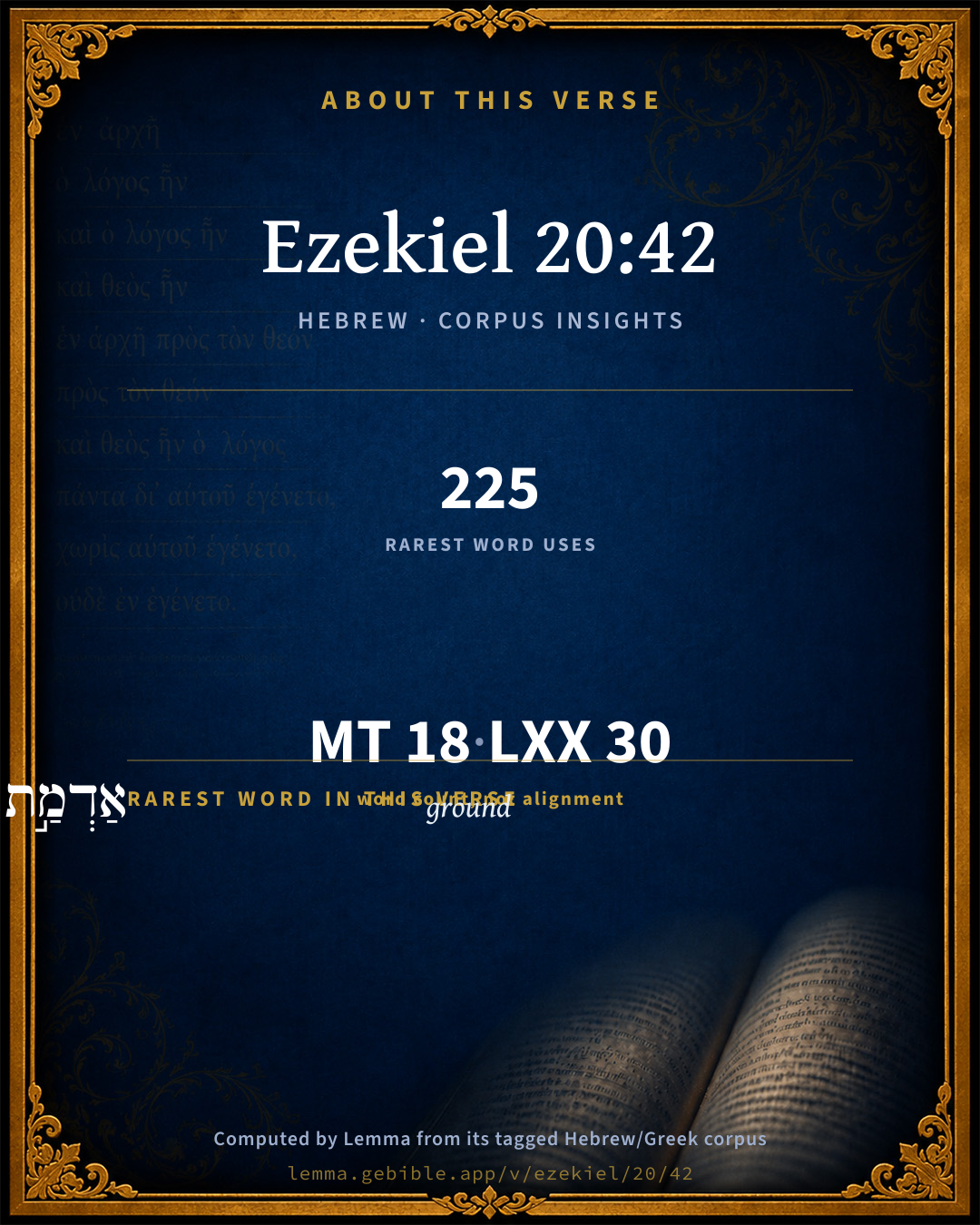
Ezekiel, in the Prophets, opens this verse with 18 words (15 distinct Hebrew lemmas). Its most distinctive word is ʼădâmâh (“ground”). A historical commentator’s framing appears above. Read the whole chapter for the surrounding context.

Discussion questions

  1. What does “ground” (ʼădâmâh) contribute to the verse as a whole?
  2. How does Ezekiel 34:13, which shares this passage’s theme, read alongside this verse?
  3. What does the repetition of “to” (2× in this one verse) do in this verse?
  4. These translations render this verse differently; the difference is in the English rendering, not the original. What questions does that raise?
  5. «וִֽידַעְתֶּם֙» is a Qal Sequential Perfect verb. How does that grammatical form shape the action described?
  6. Compare how Trapp's Complete Commentary and Adam Clarke's Commentary read this verse. Where do they agree or differ?

Things to notice

Reading settings

Reading text

Shown beneath each verse's original-language words.

Old Testament
Old Testament edition

Read the OT as the Masoretic Hebrew (MT) or the Greek Septuagint (LXX).

English shown for the Greek Septuagint (in the Hebrew ↔ Greek comparison).

Comparing translations? Open the Compare panel on any verse page to stack up to four side by side.