Joel 1:10

Hebrew (Westminster Leningrad Codex) Joel 1:10 appears in the Hebrew Old Testament. The text above is from the Westminster Leningrad Codex. Each word links to its Strong’s number, a concise gloss, and parsing drawn from the Open Scriptures Hebrew Bible morphology. Click any word for its full Brown-Driver-Briggs (BDB) entry.
Download image
Cite this verse

Joel 1:10 (World English Bible). Public Domain. Lemma interlinear Bible study tool, https://lemma.gebible.app/v/joel/1/10.

Show BibTeX & RIS
BibTeX
RIS
English Translation
The field is laid waste. The land mourns, for the grain is destroyed, The new wine has dried up, And the oil languishes.
World English Bible · Public Domain
Download a study sheet

One document with this verse’s original text, its word-by-word gloss line, the meaning frame, cross-references with their text, attributed commentary, and full source and license credits — printable, and it pastes into notes with its structure intact.

This verse Autodidact and up

Study sheet (.html) Plain text (.txt)

A passage Seminary Student

Up to 50 verses in one chapter. A passage sheet keeps up to 6 commentary sources and 12 cross-references per verse, in the order this page ranks them, and says so on the sheet whenever that leaves anything out. Ask for a single verse and you get the Autodidact verse sheet above.

Everything on this page stays free to read, with no account — the sheet is a download of what is already on screen, not access to it.

Want to remove ads? Support Godless Engineer
Compare translations 3

The same verse in 3 English versions, stacked beneath the original-language interlinear above. Click any original word for its lexicon entry.

Each is an independent rendering of the whole verse — the interlinear is not word-aligned to these translations.

Highlighted words mark where these versions differ — a whole-verse word diff, not a word-by-word alignment.

  • World English Bible Public Domain
    The field is laid waste. The land mourns, for the grain is destroyed, The new wine has dried up, And the oil languishes.
  • King James Version Public Domain
    The field is wasted, the land mourneth; for the corn is wasted: the new wine is dried up, the oil languisheth.
  • unfoldingWord Literal Text CC BY-SA 4.0
    The field has been destroyed; the ground mourns, for the grain has been destroyed; the new wine dries up, the oil is made weak.

unfoldingWord Literal Text — © unfoldingWord, licensed CC BY-SA 4.0. Word-aligned USFM3 via Door43 (git.door43.org/unfoldingWord/en_ult).

Versions to compare (up to 4)

3 of 4 selected

Show all 18 translations

Every available English version of this verse, each an independent rendering of the whole verse.

  • World English Bible Public Domain
    The field is laid waste. The land mourns, for the grain is destroyed, The new wine has dried up, And the oil languishes.
  • Berean Standard Bible Public Domain
    The field is ruined; the land mourns. For the grain is destroyed, the new wine is dried up, and the oil fails.
  • Majority Standard Bible Public Domain
    The field is ruined; the land mourns. For the grain is destroyed, the new wine is dried up, and the oil fails.
  • King James Version Public Domain
    The field is wasted, the land mourneth; for the corn is wasted: the new wine is dried up, the oil languisheth.
  • American Standard Version (1901) Public Domain
    The field is laid waste, the land mourneth; for the grain is destroyed, the new wine is dried up, the oil languisheth.
  • Revised Version (1885) Public Domain
    The field is wasted, the land mourneth; for the corn is wasted, the new wine is dried up, the oil languisheth.
  • Geneva Bible (1599) Public Domain
    The fielde is wasted: the lande mourneth: for the corne is destroyed: the new wine is dried vp, and the oyle is decayed.
  • Douay-Rheims (1899) Public Domain
    The country is destroyed, the ground hath mourned: for the corn is wasted, the wine is confounded, the oil hath languished.
  • Young's Literal Translation Public Domain
    Spoiled is the field, mourned hath the ground, For spoiled is the corn, Dried up hath been new wine, languish doth oil.
  • Literal Standard Version CC BY-SA 4.0
    The field is spoiled, || The ground has mourned, || For the grain is spoiled, || New wine has been dried up, oil languishes.
  • Unlocked Literal Bible CC BY-SA 4.0
    The fields are ruined, the ground is mourning because the grain has been destroyed. The new wine has dried up, the oil fails.
  • unfoldingWord Literal Text CC BY-SA 4.0
    The field has been destroyed; the ground mourns, for the grain has been destroyed; the new wine dries up, the oil is made weak.
  • Darby Bible Public Domain
    The field is laid waste, the land mourneth; for the corn is wasted, the new wine is dried up, the oil languisheth.
  • World Messianic Bible Public Domain
    The field is laid waste. The land mourns, for the grain is destroyed, The new wine has dried up, and the oil languishes.
  • Webster's Bible Public Domain
    The field is wasted, the land mourneth; for the corn is wasted; the new wine is dried up, the oil languisheth.
  • Free Bible Version CC BY-SA 4.0
    The fields are devastated, the earth mourns; for the grain is ruined, the new wine dries up, the olive oil fails.
  • Bible in Basic English Public Domain
    The fields are wasted, the land has become dry; for the grain is wasted, the new wine is kept back, the oil is poor.
  • JPS Tanakh (1917) Public Domain
    The field is wasted, the land mourneth; for the corn is wasted, the new wine is dried up, the oil languisheth.

Literal Standard Version (2020), Covenant Press — licensed CC BY-SA 4.0. Text via the HelloAO Bible API (eBible.org). Unlocked Literal Bible (unfoldingWord) — licensed CC BY-SA 4.0. Text via the HelloAO Bible API (eBible.org). unfoldingWord Literal Text — © unfoldingWord, licensed CC BY-SA 4.0. Word-aligned USFM3 via Door43 (git.door43.org/unfoldingWord/en_ult). Free Bible Version, Dr. Jonathan Gallagher — licensed CC BY-SA 4.0. Text via the HelloAO Bible API (eBible.org).

Word by word

More ways to search: Search by grammar → Find every occurrence → Compare this word →

Practice this passage: Drill this verse → Learn its vocabulary →

אֻמְלַ֥ל
ʼâmal
H535
“to be weak”
Verb, Pulal, Perfect, 3rd Person, Masculine, Singular
Part of Speech
Verb
Stem
Pulal
Form
Perfect
Person
3rd Person
Gender
Masculine
Number
Singular
Full BDB Definition

Origin: a primitive root

TWOT: 114

to be weak, to droop, to languish, to be exhausted - (Qal) passive participle (of the heart) - to be weak - to droop - (Pulal) - to be or grow feeble - to languish
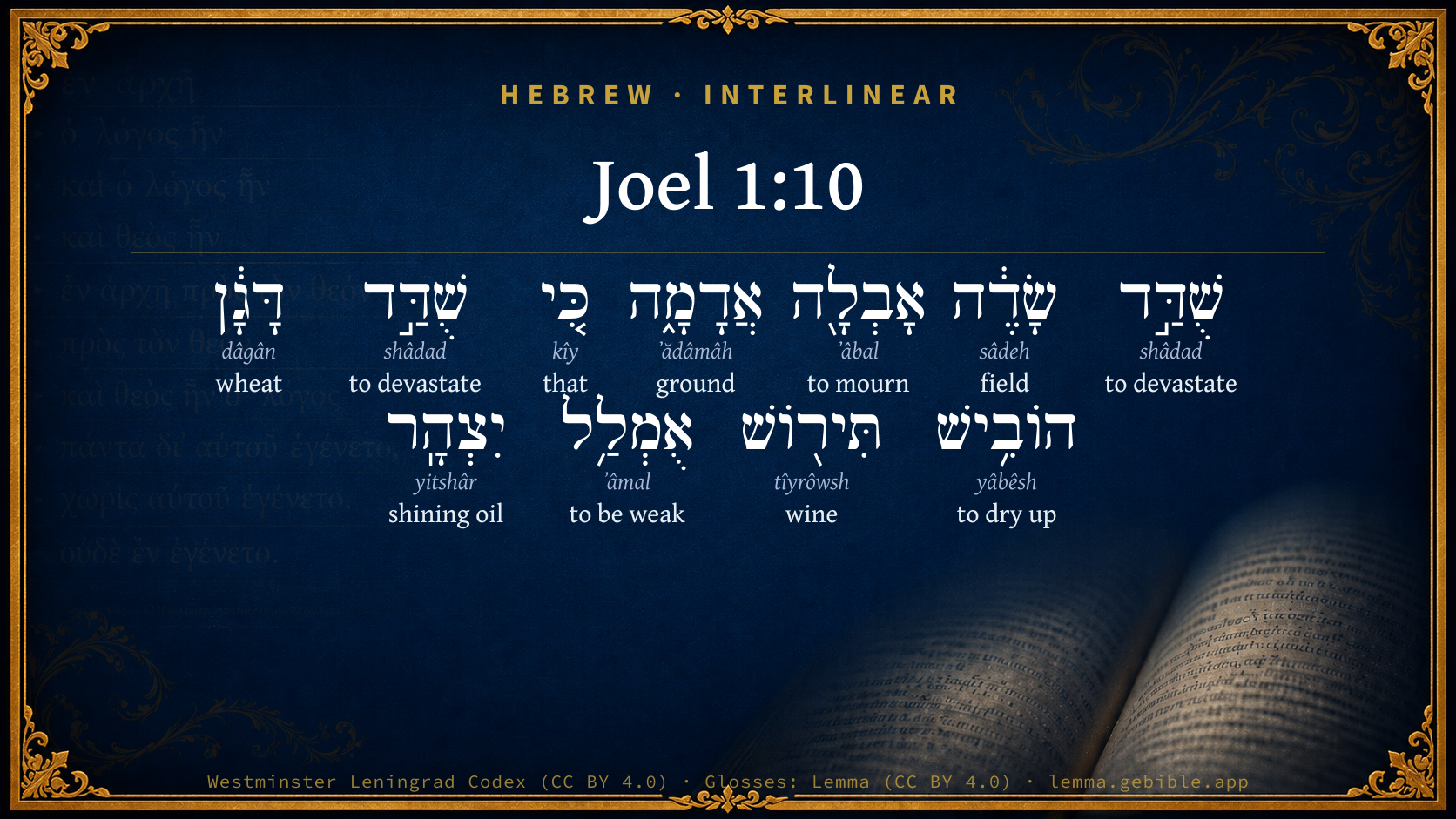
  1. שֻׁדַּ֣ד shâdad H7703 “to devastate” Verb, Pual, Perfect, 3rd Person, Masculine, Singular
  2. שָׂדֶ֔ה sâdeh H7704 “field” Noun, Common, Masculine, Singular, Absolute
  3. אָבְלָ֖ה ʼâbal H56 “to mourn” Verb, Qal, Perfect, 3rd Person, Feminine, Singular
  4. אֲדָמָ֑ה ʼădâmâh H127 “ground” Noun, Common, Feminine, Singular, Absolute
  5. כִּ֚י kîy H3588 “that” Conjunction
  6. שֻׁדַּ֣ד shâdad H7703 “to devastate” Verb, Pual, Perfect, 3rd Person, Masculine, Singular
  7. דָּגָ֔ן dâgân H1715 “wheat” Noun, Common, Masculine, Singular, Absolute
  8. הוֹבִ֥ישׁ yâbêsh H3001 “to dry up” Verb, Hiphil, Perfect, 3rd Person, Masculine, Singular
  9. תִּיר֖וֹשׁ tîyrôwsh H8492 “wine” Noun, Common, Masculine, Singular, Absolute
  10. יִצְהָֽר yitshâr H3323 “shining oil” Noun, Common, Masculine, Singular, Absolute

About this verse

These counts appear in no published source. They are computed here, from the morphology-tagged text and Lemma’s own curated glosses. What Lemma adds →

11
words
10
distinct lemmas
Prophets
section

Notable vocabulary

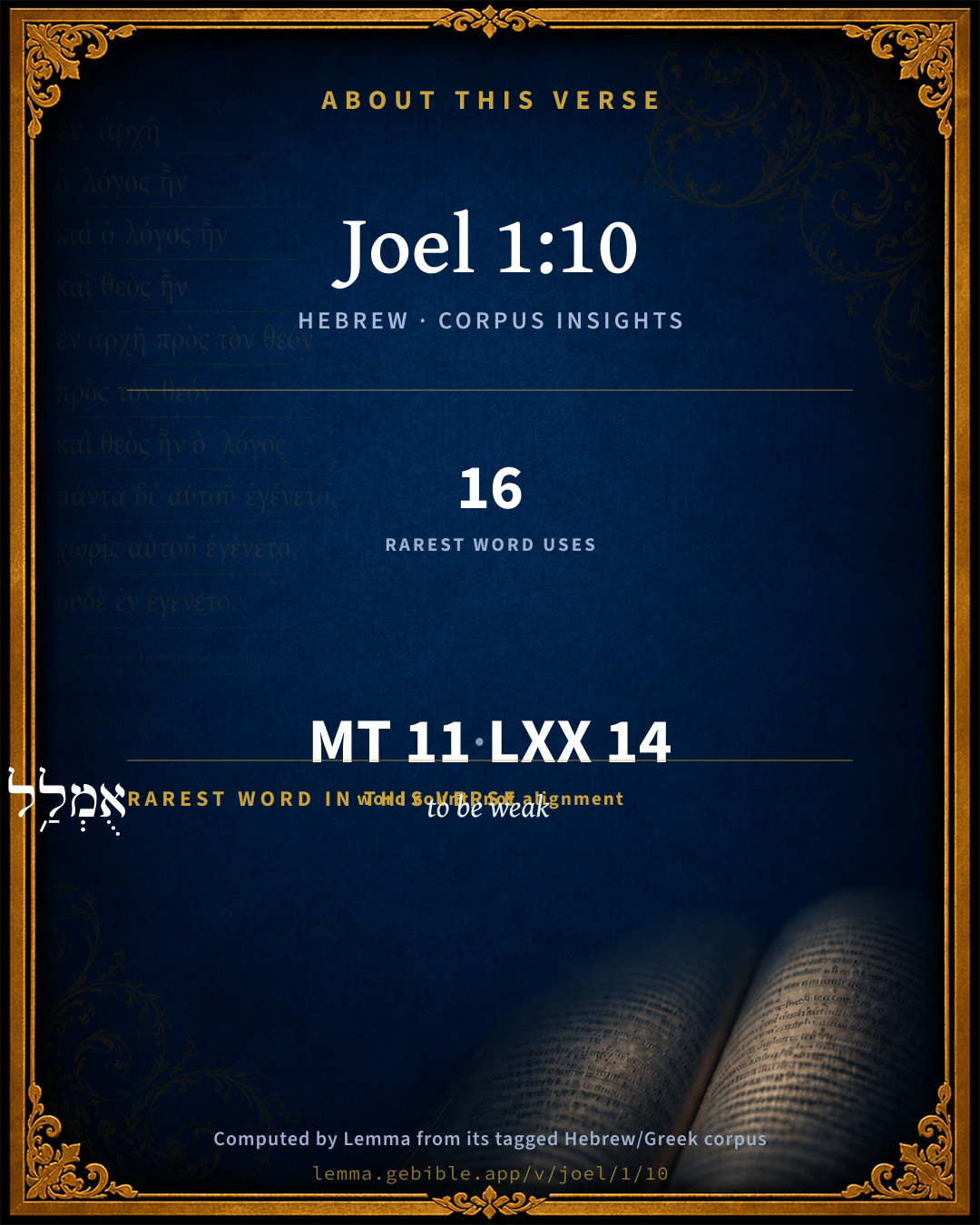
The rarest word here is אֻמְלַ֥ל to be weak H535 — appearing just 16 times in the whole Hebrew Bible.

Shared distinctive vocabulary

אֻמְלַ֥ל to be weak H535 occurs in 14 verses of the Hebrew Bible. Also found in:

Grammatical profile

  • 5 verbs
  • 5 nouns
  • 1 conjunction

Verb forms

  • שֻׁדַּ֣ד Pual · Perfect
  • אָבְלָ֖ה Qal · Perfect
  • שֻׁדַּ֣ד Pual · Perfect
  • הוֹבִ֥ישׁ Hiphil · Perfect
  • אֻמְלַ֥ל Pulal · Perfect

Repetition

A word recurs within this verse — often emphatic in Hebrew:

  • שֻׁדַּ֣ד to devastate H7703 ×2

Hebrew & Septuagint length

In English translation the verse runs 23 words from the Hebrew and 21 from the Septuagint (LXX English) — closely comparable.

A rough comparison of the two English renderings, which tokenize alike — not a word-level alignment.

Word counts can differ between the Hebrew and the Greek without any difference in meaning — e.g. the Hebrew direct-object marker אֵת has no separate Greek word, and Greek often adds the article ὁ.

In the original languages it is 11 Hebrew tokens and 14 Greek tokens — but the two are counted differently (Hebrew bundles its prefixes and suffixes into one token; the Greek is in lemma form), so that isn’t a like-for-like length.

Cross-references

13

Topical passages linked to Joel 1:10 in the Treasury of Scripture Knowledge — connected by theme and wording, ordered by reader-vote popularity; previews shown in the World English Bible.

  • Hosea 4:3 Therefore the land will mourn, And everyone who dwells therein will waste away. All living things in her, Even the animals of the field and the birds of the sky; Yes, the fish of the sea also die.
  • Jeremiah 12:11 They have made it a desolation; it mourns to me, being desolate; the whole land is made desolate, because no man lays it to heart.
  • Hosea 9:2 The threshing floor and the winepress won't feed them, And the new wine will fail her.
  • Joel 1:5 Wake up, you drunkards, and weep! Wail, all you drinkers of wine, because of the sweet wine; For it is cut off from your mouth.
  • Leviticus 26:20 and your strength will be spent in vain; for your land won't yield its increase, neither will the trees of the land yield their fruit.
  • Jeremiah 12:4 How long shall the land mourn, and the herbs of the whole country wither? for the wickedness of those who dwell therein, the animals are consumed, and the birds; because they said, He shall not see our latter end.
  • Jeremiah 14:2–6 Judah mourns, and the gates of it languish, they sit in black on the ground; and the cry of Jerusalem is gone up.
  • Jeremiah 48:33 Gladness and joy is taken away from the fruitful field and from the land of Moab; and I have caused wine to cease from the wine presses: none shall tread with shouting; the shouting shall be no shouting.
  • Joel 1:12 The vine has dried up, and the fig tree withered; the pomegranate tree, the palm tree also, and the apple tree, Even all of the trees of the field are withered; For joy has withered away from the sons of men.
  • Joel 1:17–20 The seeds rot under their clods. The granaries are laid desolate. The barns are broken down, for the grain has withered.
  • Haggai 1:11 I called for a drought on the land, on the mountains, on the grain, on the new wine, on the oil, on that which the ground brings forth, on men, on cattle, and on all the labor of the hands."
  • Isaiah 24:3–4 The earth shall be utterly emptied, and utterly laid waste; for Yahweh has spoken this word.
  • Isaiah 24:11 There is a crying in the streets because of the wine; all joy is darkened, the mirth of the land is gone.

Cross-references courtesy of OpenBible.info (CC BY 4.0).

Hebrew and Greek witnesses Masoretic Hebrew ↔ Greek Septuagint

The same verse in the two great witnesses to the Old Testament, shown verse-for-verse.

These are two independent witnesses, not word-aligned to each other, and the Septuagint is shown in lemma (dictionary) form.

Hebrew Joel 1:10 Masoretic · Westminster Leningrad Codex

שֻׁדַּ֣ד שָׂדֶ֔ה אָבְלָ֖ה אֲדָמָ֑ה כִּ֚י שֻׁדַּ֣ד דָּגָ֔ן הוֹבִ֥ישׁ תִּיר֖וֹשׁ אֻמְלַ֥ל יִצְהָֽר

The field is laid waste. The land mourns, for the grain is destroyed, The new wine has dried up, And the oil languishes.

World English Bible · Public Domain

Greek LXX Joel 1:10 Septuagint · lemma form

ὅτι ταλαιπωρέω ὁ πεδίον πενθέω ὁ γῆ ὅτι ταλαιπωρέω σῖτος ξηραίνω οἶνος ὀλιγόω ἔλαιον

For the plains languish: let the land mourn, for the corn languishes; the wine is dried up, the oil becomes scarce;

LXX2012 (modern English Septuagint) · Public Domain

On this verse, The Cambridge Bible for Schools and Colleges discusses the Septuagint’s reading. Read the note in Commentary ↓

Hebrew: Westminster Leningrad Codex (CC BY 4.0). Greek: Septuagint (public domain); English from LXX2012 (modern English Septuagint) (Public Domain). How the Septuagint differs from the Hebrew →

Targum (Aramaic paraphrase)

1

The Targum is the ancient Jewish Aramaic paraphrase of the Hebrew Scriptures — an interpretive translation, not the Hebrew text itself. Onkelos (literal) and Pseudo-Jonathan (expansive) render the Torah, and Jonathan the Prophets. Coverage is partial: where no permissively-licensed English translation exists for a verse, only the Aramaic is shown. This is verse-level text, not a word-by-word alignment to the Hebrew.

  1. Targum Jonathan Prophets (Joshua–Malachi)
    אִיתְבְּזִיזוּ חַקְלַיָא חֲרוּבַת אַרְעָא אֲרֵי סַף עִבּוּרָא יְבִישׁוּ גוּפְנַיָא נְתַרוּ זֵיתַיָא:

    (no public-domain English translation for this verse)

    Targum Jonathan — Aramaic: “Mikraot Gedolot” (public domain). English: “Sefaria Community Translation” (CC0 1.0 (public-domain dedication)); “London "Chaldee Paraphrase," 1871” (public domain). Text via Sefaria.

Commentary

Notes on Joel 1:10 from classic Christian and Jewish commentators (each source and its license shown beneath its notes). The classic Christian expositions comment on the surrounding passage and are grouped to its opening verse, so a note may address several verses; the Jewish commentaries on the Tanakh (Rashi and others) are per-verse, so they appear only where the commentator wrote on this verse.

Lemma curates 59 commentaries, every one of them public domain or Creative Commons licensed, each selected and text-cleaned for this edition rather than reprinted as found. About our sources →

The Cambridge Bible for Schools and Colleges

gen. ed. J. J. S. Perowne

10. the ground mourneth] the country being personified, as Isa_33:9; Jer_12:4; Jer_12:11; Jer_23:10; cf. on Amo_1:2. Conversely, at harvest time, when the fruits of the earth are abundant, “the vales shout for joy, and sing” (Psa_65:13).

the corn … the new wine (or must) … the fresh oil] The three principal products of the soil of Palestine, often mentioned together as a triad of blessings (Deu_7:13; Deu_11:14; Deu_28:51; Hos_2:8), bestowed by Jehovah upon His people, or, it may be, withheld, in the event of their unfaithfulness. The words, though they may be used with reference to the corn in the ears, and the juice in the grapes and the olives, denote more particularly these products after they have been adapted partially for the food, or use, of man. Corn (dâgân) is thus the grain of wheat after it has been threshed and freed from the husk (“from the threshing-floor,” Num_18:27); new wine, or must (tîrôsh), is the freshly-expressed juice of the grape, sometimes, at any rate, if not always, slightly fermented (Hos_4:11), and described as a sustaining (Gen_27:37), invigorating (Zec_9:17), and exhilarating (Jdg_9:13) beverage; fresh oil (yitzhâr) is similarly the freshly-expressed juice of the olive. On tîrôsh, see more fully the Additional Note at the end of the Book (p. 79). The oil which, when pressed, the fruit of the olive yields, is almost a necessary of life in Palestine: it is used in cooking and for food, where we should employ butter; it is burnt in lamps; it is in habitual use for anointing the person (see on Amo_6:6); it has medicinal virtues (Isa_1:6; Luk_10:34); it was used in ancient times in sacrifice (Lev_2:1; Lev_2:6, &c.), and it was prized as a gift (1Ki_5:11; Hos_12:1; Isa_57:9). Being a valuable commodity, it was subject to tithe (Deu_14:23; Neh_13:5). See further Tristram, N. H. B. p. 373 ff.; Van Lennep, Bible Lands, p. 124 ff.; Whitehouse, Primer of Heb. Antiquities, pp. 104–110.

is dried up] Better, sheweth shame (cf. R.V. marg.), the ‘new wine’ being personified (cf. Isa_24:7, where it is said to ‘mourn’), just as the ‘ground’ is in the first part of the verse. Comp. of Lebanon (though the Heb. word used is a different one), Isa_33:9.

languisheth] The same word, said of trees of which the foliage has been stripped off, or is withering, Joe_1:12; Isa_16:8; Isa_24:7; Nah_1:4.

Additional Note on Chap. Joe_1:10 (tîrôsh)

Tîrôsh occurs thirty-eight times in the O.T. It is mentioned generally as a valued product of the soil, by the side of corn in Gen_27:28; Gen_27:37; Deu_33:28; 2Ki_18:32 (= Isa_36:17); Isa_62:8; Hos_2:9; Hos_7:14; Hos_9:2 (implicitly); Zec_9:17; Psa_4:7; Pro_3:10 (implicitly); and by the side of corn and “fresh oil” (yitzhâr) together in Deu_7:13; Deu_11:14; Deu_28:51; Jer_31:12; Hos_2:8; Hos_2:22; Joe_1:10; Joe_2:19; Joe_2:24; Hag_1:11; 2Ch_32:28; Neh_5:11; cf. Mic_6:15; and as the highly prized product of the vine, “gladdening God (or gods) and men” (i.e. offered to the former in libations and welcome to the latter at feasts) in Jdg_9:13, and bringing a blessing in Isa_65:8; cf. Isa_24:7. It is mentioned further, also with corn and “fresh oil,” as subject to tithe (Deu_12:17; Deu_14:23; Neh_13:5; Neh_13:12), and the payment of firstfruits (Deu_18:4; Num_18:12; 2Ch_31:5; Neh_10:37; cf. Neh_10:39). Lastly, it is mentioned in Hos_4:11, in company with “whoredom and wine,” as “taking away the heart” (i.e. the understanding). From these passages it appears that tîrôsh was a beverage (Isa_62:8), prepared from the fruit of the vine (Isa_65:8; Mic_6:15), and possessed of sustaining (Gen_27:37) and invigorating (Zec_9:17) properties. Hos_4:11 shews further that it was, at least in some cases, fermented; and “gladdening,” in Jdg_9:13, which would naturally, in this connexion, have the force of “exhilarating” (cf. the same word of yayin “wine,” in Psa_104:15), suggests the same inference. Whether, however, tîrôsh denoted always a fermented liquid, is more than we can say. Isa_65:8, “as the tîrôsh is found in the cluster,” might indeed be a poetical expression, not intended to be interpreted literally; but in Joe_2:24, Pro_3:10 it appears to be described as filling the “wine-vat” (see on Joe_2:24) so that (unless it were the custom to leave the grape-juice in this vat for the purpose of fermentation), it would seem to have denoted the unfermented juice of the grape as well. In our ignorance of the precise methods employed by the ancient Hebrews in the manufacture of wine, it is impossible to speak with entire definiteness: but with our present knowledge, it is most just, probably, to the various passages in which tîrôsh occurs, to suppose that it was a comprehensive term, applied both to the freshly-expressed, unfermented juice of the grape (or “must”)[53], and also to a light kind of wine such as we know, from the classical writers, that the ancients were in the habit of making by checking the fermentation of the grape juice before it had run its full course[54].

[53] Mêrîth, which corresponds etymologically in Syriac, is defined by the native lexicographers as “new wine, or must, as it comes forth from the wine-press” (Payne Smith, Thes. Syr. col. 1635).

[54] See the Dict. of Classical Antiquities, s.v. Vinum. Must was sometimes used at once, being drunk fresh after it had been clarified by vinegar. When it was desired to preserve a quantity in a sweet state, it was placed carefully in an air-tight amphora, and deposited in a cool place: it would then keep for a year or more, and was called ἀεὶ γλεῦκος or semper mustum. It was also preserved by being boiled down to two-thirds or less of its original volume, in which case it became a kind of jelly. Must intended for wine was allowed to ferment, by being exposed to the open air, in large earthenware vessels (dolia), for nine days; but fight wines were manufactured by the dolia being closed and fermentation checked after five or seven days.—In warm countries fermentation begins in the grape-juice a few hours after it has been expressed (Anderlind, Z.D.P.V. xi. 1888, p. 168). On modern Syrian wines, see ib. p. 170 ff.

It has sometimes been supposed[55] that tîrôsh denoted the produce of the vine in general, and it has been rendered for example vine-fruit. But this view is certainly untenable. (1) It is spoken of distinctly as something that is ‘drunk’ (Isa_62:8); and surely the analogy of drinking a ‘cup’ (for the contents of a cup) could not be applied to a mass of ‘vine-fruit.’ (2) It is spoken of as filling the yeḳeb, or ‘wine-vat’ (Joe_2:24; Pro_3:10): the yeḳeb, however (see the note on Joe_2:24), was the receiver into which the juice trodden out in the gath ran down: it would contain consequently, not a crushed mass of grapes, or ‘vine-fruit,’ but the expressed juice. (3) Tithe was levied on tîrôsh (Deu_12:17; Deu_14:23); but tithe, as follows from Num_18:27 (cf. Num_18:30), was levied not on the raw produce, but on what came “from the yeḳeb,” or wine-vat, which it is evident can have been only the expressed juice. Tîrôsh was in fact the juice, especially the expressed juice, of the grape, just as dâgân and yitzhâr, with which it is so often conjoined, though they may be used, respectively, with reference to the corn in the ears, and the juice in the olives, denoted more particularly the threshed corn (Num_18:27, “from the threshing-floor”), and oil freshly expressed from the olive-berry.

[55] Especially in the Temperance Bible Commentary.

The clear evidence of these passages cannot be neutralized by the two, which, though they seem at first sight to imply that tîrôsh was a solid, can be readily explained in conformity with the others. The first is Deu_12:17, “Thou mayest not eat within thy gates the tithe of thy corn, or of thy tîrôsh, or of thy fresh oil.” The word eat may, however, be used, as a general term, of a liquid (Deu_12:16; Deu_12:23; Deu_14:26, of ‘wine’ and ‘strong drink’); and this usage is the easier in Deu_12:17, as the object joined immediately to eat is corn, and tîrôsh is only attached to it in the second place. The other passage is Mic_6:15, where tîrôsh is the object of dârakh, “to tread,” and might consequently be supposed to be a solid. In Isa_16:10, however, dârakh has for its object yáyin (“wine”), which no one can pretend to be a solid, the reference being to the expressed juice flowing out from under the treader’s feet; and Mic_6:15 may be understood quite naturally in the same sense[56].

[56] The fullest and most instructive discussion of tîrôsh will be found in A. M. Wilson, The Wines of the Bible (1877), pp. 301–339.

The all but uniform rendering of tîrôsh in the ancient Versions is wine[57]; and either must or new wine is the rendering adopted by all the principal Hebraists of modern times (Gesenius, Ewald, Hitzig, Delitzsch, Keil, Dillmann, &c.), without exception.

[57] In Hos_4:11, LXX, Pesh., Targ., Symm., Vulg. all have “drunkenness.” Otherwise wine is the uniform rendering of LXX, except Isa_65:8 (ῥώξ, “grape-stone”), of Pesh. (except 5 times), of Targ. (except 4 times, two being paraphrases). Aq., in accordance with his peculiar principles of translation, rendered ὀπωρισμός (see Field’s Hexapla, on Hos_2:22; also οἰνία, see ib.), whence Jerome has vindemia, Deu_7:13, Isa_24:7, Neh_10:37; elsewhere always vinum, except Isa_65:8 (granum).

The Cambridge Bible for Schools and Colleges (gen. ed. J. J. S. Perowne; Cambridge University Press, 1878–1918) — public domain. Text from a community e-Sword module.

Trapp's Complete Commentary

John Trapp

Joe 1:10 The field is wasted, the land mourneth; for the corn is wasted: the new wine is dried up, the oil languisheth.

Ver. 10. The field is wasted, the land mourneth] The sacrifices are not only cut off for present, but little hopes left for the future; for the field, that common storehouse, that horreum unde hauriatur, is wasted: Shuddad Sadeh, there is an elegant allusion in the original: as in the following words a personification not inferior to those of the poets, as Luther and Vatablus here note.

The land mourneth] By an ordinary metaphor among the Hebrews, those things are said to mourn that are wasted, desolated, corrupted, and changed for the worse. Lam 2:8, the rampart and the wall are said to lament, and to languish together. When Ephestion died, Alexander not only clipped his horses’ and mules’ hair, but plucked down also the battlements of the walls of the city; because it should appear that the wails and ramparts did mourn for his death (Plutarch): so Isa 24:7, "The new wine mourneth, the vine languisheth, all the merry hearted do sigh." It is fit that if the land mourn and fail of her increase, men should much more mourn and be moved with a sense of their sins, the cause of such calamities. The earth lies under a curse of barrenness, at its best, Gen 3:17, and was never so beautiful and cheerful since the fall of Adam. At this day it lieth bedridden, as it were, waiting for the coming of the Son of God, that it may be delivered from the bondage of corruption, Rom 8:20. But in times of dearth it seemeth to mourn more than ordinary, yea, to blush and bleed.

The new wine is dried up] Or is abashed; as loth to look men in the face, because not answerable to their expectation: see Isa 33:9.

The oil languisheth] Or, is sick. Grain, wine, and oil are the main supports of man’s life: all is gone.

John Trapp, A Commentary or Exposition upon All the Books of the Old and New Testament (1647–1656) — public domain. Text from a community e-Sword module.

Tyndale Open Study Notes

Tyndale Open Resources

1:10 The locusts destroyed the three essential staple crops of ancient Israel: grain . . . grapes and olive oil.

Tyndale Open Study Notes — © Tyndale Open Resources, licensed CC BY-SA 4.0. Text via the HelloAO Bible API.

Geneva Bible (1599)

Geneva Bible translators

All comfort and substance for nourishment is taken away.

Geneva Bible (1599) marginal notes — public domain. Text via Bolls.life.

Jamieson, Fausset & Brown

Robert Jamieson, A. R. Fausset & David Brown

field . . . land--differing in that "field" means the open, unenclosed country; "land," the rich red soil (from a root "to be red") fit for cultivation. Thus, "a man of the field," in Hebrew, is a "hunter"; a "man of the ground" or "land," an "agriculturist" (Gen 25:27). "Field" and "land" are here personified.

new wine--from a Hebrew root implying that it takes possession of the brain, so that a man is not master of himself. So the Arabic term is from a root "to hold captive." It is already fermented, and so intoxicating, unlike the sweet fresh wine, in Joe 1:5, called also "new wine," though a different Hebrew word. It and "the oil" stand for the vine and the olive tree, from which the "wine" and "oil" are obtained (Joe 1:12).

dried up--not "ashamed," as Margin, as is proved by the parallelism to "languisheth," that is, droopeth.

Jamieson, Fausset & Brown — Commentary Critical and Explanatory on the Whole Bible (1871) — public domain (CC PDM 1.0). Text via the HelloAO Bible API.

John Calvin's Commentaries

The Prophet goes on here with the same subject, and uses these many words to give more effect to what he said; for he knew that he addressed the deaf, who, by long habit, had so hardened themselves that God could effect nothing, at least very little, by his word. This is the reason why the Prophet so earnestly presses a subject so evident. Should any one ask what need there was of so many expressions, as it seems to be a needless use of words; I do indeed allow that all that the Prophet wished to say might have been expressed in one sentence, as there is here nothing intricate: but it was not enough that what he said should be understood, except the Jews applied it to themselves, and perceived that they had to do with God; and to make this application they were not disposed. It is not then without reason that the Prophet labors here, and enforces the same thing in many words.

Hence he says, The field is wasted, and the land mourns; for the corn has perished, for dried up has the wine, for destroyed has been the oil. And by these words he intimates that they seeing saw nothing; as though he said, “Let necessity extort mourning from you; ye are indeed starving, all complain of want, all deplore the need of bread and wine; and yet no one of you thinks whence this want is, that it is from the hand of God. Ye feel it in your mouth, ye feel it in your palate, ye feel it in your throat, ye feel it in your stomach; but ye feel it not in your heart.” In short, the Prophet intimates that the Jews were void of right understanding; they indeed deplored their famine, but they were like brute beasts, who, when hungry, show signs of impatience. So the Jews mourned, because their stomach disquieted them; but they knew not that the cause of their want and famine was their sins. It afterwards follows —

John Calvin's Commentaries (1540-1563) — public domain. Text from the Calvin Translation Society English edition (1840s-50s) via the Christian Classics Ethereal Library (ccel.org). Calvin's coverage is partial (roughly two-thirds of the Bible); uncommented books and verses are honest gaps, never fabricated. The 19th-century editor's footnotes and remarks are omitted so the notes are faithfully Calvin's own voice.

Ellicott's Commentary for English Readers

(10) The new wine.—The necessaries and delights of life are all gone: “the wine that maketh glad the heart of man, the oil that makes his face to shine, the bread that strengthened man’s heart” (Psa_104:15).

A Bible Commentary for English Readers, edited by Charles John Ellicott (1878–1897) — public domain. Text from a community e-Sword module.

John Gill's Exposition

The field is wasted,.... By the locust, that eat up all green things, the grass and herbs, the fruit and leaves of trees; and also by the Chaldeans trampling on it with their horses, and the increase of which became fodder for them:

the land mourneth; being destitute, nothing growing upon it, and so looked dismally, and of a horrid aspect; or the inhabitants of it, for want of provision:

for the corn is wasted; by the locusts, and so by the Assyrian or Chaldean army, before it came to perfection:

the new wine is dried up: in the grape, through the drought after mentioned: or, "is ashamed" (r); not answering the expectations of men, who saw it in the cluster, promising much, but failed:

the oil languisheth; or "sickens" (s); the olive trees withered; the olives fell off, as the Targum, and so the oil failed: the corn, wine, and oil, are particularly mentioned, not only as being the chief support of human life, as Kimchi observes, and so the loss of them must be matter of lamentation to the people in general; but because of these the meat and drink offerings were, and therefore the priests in particular had reason to mourn.

(r) "erubuit", Tigurine version, Mercer, Liveleus; "puduit", Drusius, Tarnovius; "pudefit", Cocceius. (s) "infirmatum est", Montanus. So some in Vatablus.

John Gill's Exposition of the Whole Bible (1746–1763) — public domain (CC PDM 1.0). Text via the HelloAO Bible API.

Albert Barnes' Notes on the Bible

The field is wasted, the land mourneth - As, when God pours out His blessings of nature, all nature seems to smile and be glad, and as the Psalmist says, “to shout for joy and sing” Psa 65:13, so when He withholds them, it seems to mourn, and, by its mourning, to reproach the insensibility of man. Oil is the emblem of the abundant graces and gifts of the Holy Spirit, and of the light and devotion of soul given by Him, and spiritual gladness, and overflowing, all-mantling charity.

Albert Barnes' Notes on the Bible (1834–1885) — public domain. Text from a community e-Sword/MySword module.

Haydock's Catholic Bible Commentary

CHAPTER I.

George Leo Haydock (1774–1849), Haydock's Catholic Family Bible and Commentary, 1859 edition — public domain. Excludes Psalms (Douay-Rheims chapter numbering differs from Protestant) and Deuterocanonical books (Catholic canon only).

Matthew Poole's English Annotations

The field is wasted; the soil that was wont to be fat and fruitful, and did shout with fruits, now lieth waste, horrid to look upon, and such as promises no fruit; the famine in their houses, and the ceasing of the sacrifices in the house of God, is like to be perpetuated.

The land mourneth; the inhabitants of the land, by a usual figure, here called the land.

The corn is wasted; the wheat and barley, their bread corn, is eaten up in its greenness by these devouring locusts, whether in the letter by vermin, or in the figure by the Babylonians.

The new wine is dried up; the word may as well be rendered is ashamed, or confounded; it is then a figurative expression, which this prophet useth, Joe 1:12,17, in the last of which it is rendered withered; if you retain, as well you may, our version, it plainly tells us the heats and drought with them were so great, that the vines were withered, and all their hopes of new wine by this means cut off.

The oil; the olive trees, as the vines, fade too, and promise very little oil.

Languisheth; neither able to send sap from the root to maintain its verdure, nor to put forth berries, or to bring them to maturity. Now as these words declare what barrenness was now upon the land, so it is a plain account of the reason why the priests are called to mourn, and why the meat-offering and drink-offering are cut off; these must cease when that ceaseth which made them up corn, wine, and oil.

Matthew Poole's English Annotations on the Holy Bible (1683–1685) — public domain. Text from a community e-Sword/MySword module.

The Pulpit Commentary

The field is wasted, the land mourneth; for the corn is wasted: the new wine is dried up, the oil languisheth. This verse is closely connected with the preceding, for the failure of the meat offerings and drink offerings was owing to the devastation of the country and the destruction of its crops by the locust-plague. The field was laid waste by them, nor was it a field here and there, or a solitary district; it was the whole land without exception or exemption that had cause to grieve, "if aught inanimate e"er grieves." This is expressed by one of those paronomasias of which the Hebrews were so fond, thus, shuddad sadheh, abhelah adhamah, equivalent to "field falls, ground grieves;" or "field fruitless, land laments." The oblation, or meat offering, consisted of flour mingled with oil; the libation, or drink offering, consisted of wine. There were also firstfruits of corn and wine and oil; while all the produce of the land was tithabla. Now, however, the corn was wasted and the oil languished; and therefore the meat offering had partially failed or entirely ceased; the new wine was dried up, and therefore the drink offering must needs have been given up. The mention of corn and wine and oil in particular is owing to their connection with the temple service, for the firstfruits, tithes, oblations, and libations depended largely upon them.

The Pulpit Commentary (1880–1919), ed. H.D.M. Spence-Jones & Joseph S. Exell — public domain. Text from a community e-Sword module.

John Wesley's Explanatory Notes

The corn - The wheat and barley, is eaten up in its greenness. Dried up - The drought was so great, that the vines were withered, and all their hopes of new wine cut off. The oil - The olive-trees. Languisheth - This is a plain account of the reason why the priests were called to mourn, and why the meal-offering and drink- offering were cut off.

John Wesley, Explanatory Notes Upon the Whole Bible (1754–1765) — public domain. Text via the GEBible commentary corpus.

Lesson kit

Teaching starters — assembled from the data on this page, not authored interpretation. Every prompt links to the verse data it draws on. Edit before teaching.

Joel, in the Prophets, opens this verse with 11 words (10 distinct Hebrew lemmas). Its most distinctive word is ʼâmal (“to be weak”). A historical commentator’s framing appears above. Read the whole chapter for the surrounding context.

Discussion questions

  1. How does “to be weak” (ʼâmal) shape what this verse is saying?
  2. 1 Samuel 2:5 shares the word «to be weak» with this verse. How do the two illuminate each other?
  3. “to devastate” occurs 2× in this one verse. What is the effect of the repetition?
  4. The translations on this page render this verse differently — a whole-verse word diff, not a word-by-word alignment. What might account for the different wordings?
  5. The verb «שֻׁדַּ֣ד» is Pual Perfect. How does its form color the action?
  6. Reading how The Cambridge Bible for Schools and Colleges and Trapp's Complete Commentary read this verse, where do the two commentators agree and where do they part?

Things to notice

Reading settings

Reading text

Shown beneath each verse's original-language words.

Old Testament
Old Testament edition

Read the OT as the Masoretic Hebrew (MT) or the Greek Septuagint (LXX).

English shown for the Greek Septuagint (in the Hebrew ↔ Greek comparison).

Comparing translations? Open the Compare panel on any verse page to stack up to four side by side.