Zechariah 13:5

Hebrew (Westminster Leningrad Codex) Zechariah 13:5 appears in the Hebrew Old Testament. The text above is from the Westminster Leningrad Codex. Each word links to its Strong’s number, a concise gloss, and parsing drawn from the Open Scriptures Hebrew Bible morphology. Click any word for its full Brown-Driver-Briggs (BDB) entry.
Download image
Cite this verse

Zechariah 13:5 (World English Bible). Public Domain. Lemma interlinear Bible study tool, https://lemma.gebible.app/v/zechariah/13/5.

Show BibTeX & RIS
BibTeX
RIS
English Translation
but he will say, 'I am no prophet, I am a tiller of the ground; for I have been made a bondservant from my youth.'
World English Bible · Public Domain
Download a study sheet

One document with this verse’s original text, its word-by-word gloss line, the meaning frame, cross-references with their text, attributed commentary, and full source and license credits — printable, and it pastes into notes with its structure intact.

This verse Autodidact and up

Study sheet (.html) Plain text (.txt)

A passage Seminary Student

Up to 50 verses in one chapter. A passage sheet keeps up to 6 commentary sources and 12 cross-references per verse, in the order this page ranks them, and says so on the sheet whenever that leaves anything out. Ask for a single verse and you get the Autodidact verse sheet above.

Everything on this page stays free to read, with no account — the sheet is a download of what is already on screen, not access to it.

Want to remove ads? Support Godless Engineer
Compare translations 3

The same verse in 3 English versions, stacked beneath the original-language interlinear above. Click any original word for its lexicon entry.

Each is an independent rendering of the whole verse — the interlinear is not word-aligned to these translations.

Highlighted words mark where these versions differ — a whole-verse word diff, not a word-by-word alignment.

  • World English Bible Public Domain
    but he will say, 'I am no prophet, I am a tiller of the ground; for I have been made a bondservant from my youth.'
  • King James Version Public Domain
    But he shall say, I am no prophet, I am an husbandman; for man taught me to keep cattle from my youth.
  • unfoldingWord Literal Text CC BY-SA 4.0
    And he will say, ‘I not a prophet. I a man working the ground, for a man acquired me from my youth.’

unfoldingWord Literal Text — © unfoldingWord, licensed CC BY-SA 4.0. Word-aligned USFM3 via Door43 (git.door43.org/unfoldingWord/en_ult).

Versions to compare (up to 4)

3 of 4 selected

Show all 18 translations

Every available English version of this verse, each an independent rendering of the whole verse.

  • World English Bible Public Domain
    but he will say, 'I am no prophet, I am a tiller of the ground; for I have been made a bondservant from my youth.'
  • Berean Standard Bible Public Domain
    He will say, ‘I am not a prophet; I work the land, for I was purchased as a servant in my youth.’
  • Majority Standard Bible Public Domain
    He will say, ‘I am not a prophet; I work the land, for I was purchased as a servant in my youth.’
  • King James Version Public Domain
    But he shall say, I am no prophet, I am an husbandman; for man taught me to keep cattle from my youth.
  • American Standard Version (1901) Public Domain
    but he shall say, I am no prophet, I am a tiller of the ground; for I have been made a bondman from my youth.
  • Revised Version (1885) Public Domain
    but he shall say, I am no prophet, I am a tiller of the ground; for I have been made a bondman from my youth.
  • Geneva Bible (1599) Public Domain
    But he shall say, I am no Prophet: I am an husbandman: for man taught me to be an heardman from my youth vp.
  • Douay-Rheims (1899) Public Domain
    But he shall say: I am no prophet, I am a husbandman: for Adam is my ex- ample from my youth.
  • Young's Literal Translation Public Domain
    And `one' hath said, `I am not a prophet, A man, a tiller of ground I am, For ground `is' my possession from my youth.'
  • Literal Standard Version CC BY-SA 4.0
    And [one] has said, I am not a prophet, || A man—I am a tiller of ground, || For ground [is] my possession from my youth.
  • Unlocked Literal Bible CC BY-SA 4.0
    For each will say, 'I am not a prophet! I am a man who works the soil, for the land became my work while I was still a young man!'
  • unfoldingWord Literal Text CC BY-SA 4.0
    And he will say, ‘I not a prophet. I a man working the ground, for a man acquired me from my youth.’
  • Darby Bible Public Domain
    And he shall say, I am no prophet, I am a tiller of the ground; for man acquired me [as bondman] from my youth.
  • World Messianic Bible Public Domain
    but he will say, ‘I am no prophet, I am a tiller of the ground; for I have been made a bondservant from my youth.’
  • Webster's Bible Public Domain
    But he shall say, I am no prophet, I am a husbandman; for man taught me to keep cattle from my youth.
  • Free Bible Version CC BY-SA 4.0
    They will say, “I'm not a prophet, I'm a farmer. I've worked on the land since I was a child.”
  • Bible in Basic English Public Domain
    But he will say, I am no prophet, but a worker on the land; for I have been an owner of land from the time when I was young.
  • JPS Tanakh (1917) Public Domain
    but he shall say: 'I am no prophet, I am a tiller of the ground; for I have been made a bondman from my youth.'

Literal Standard Version (2020), Covenant Press — licensed CC BY-SA 4.0. Text via the HelloAO Bible API (eBible.org). Unlocked Literal Bible (unfoldingWord) — licensed CC BY-SA 4.0. Text via the HelloAO Bible API (eBible.org). unfoldingWord Literal Text — © unfoldingWord, licensed CC BY-SA 4.0. Word-aligned USFM3 via Door43 (git.door43.org/unfoldingWord/en_ult). Free Bible Version, Dr. Jonathan Gallagher — licensed CC BY-SA 4.0. Text via the HelloAO Bible API (eBible.org).

Word by word

More ways to search: Search by grammar → Find every occurrence → Compare this word →

Practice this passage: Drill this verse → Learn its vocabulary →

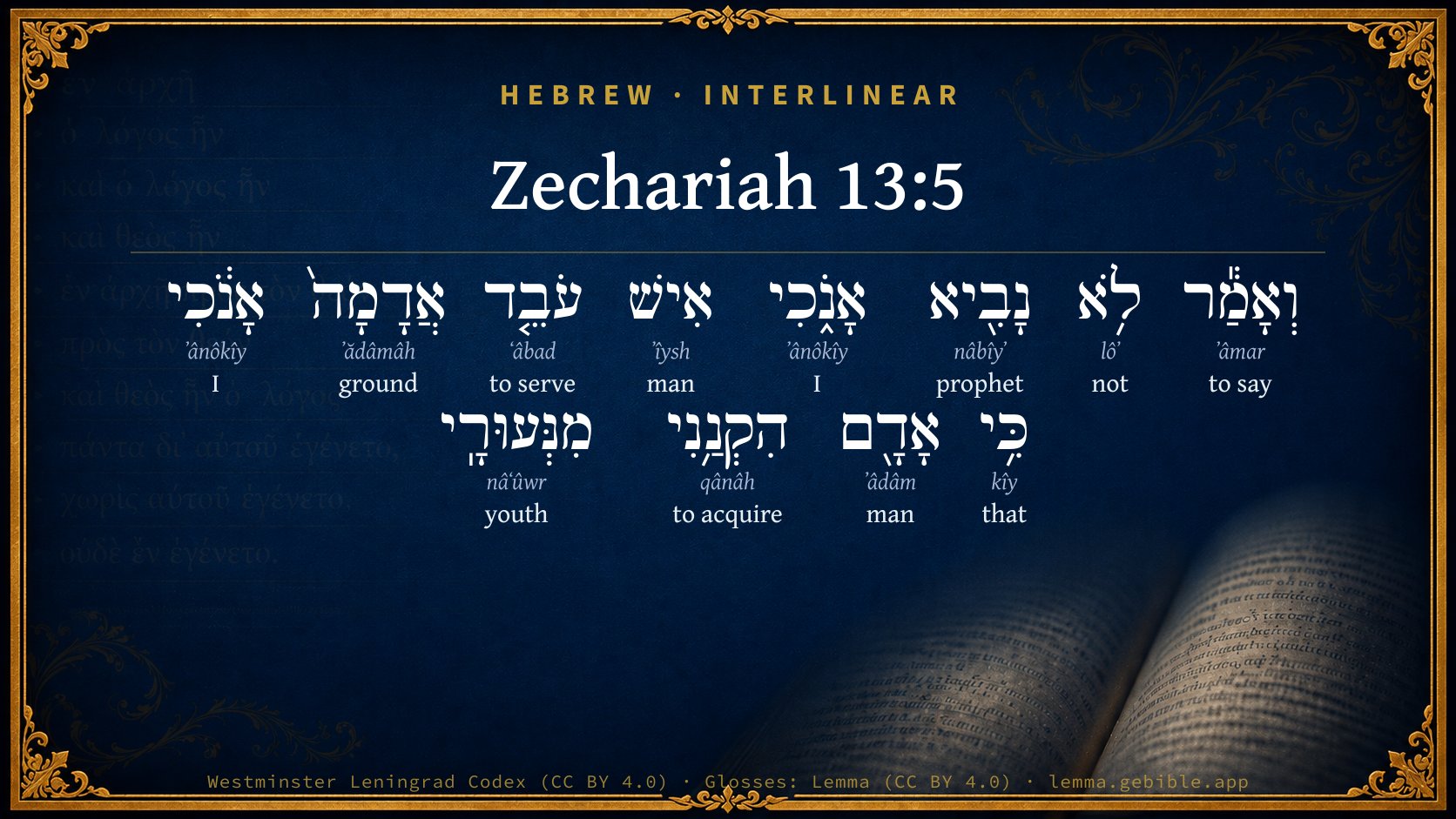
מִנְּעוּרָֽי
nâʻûwr
H5271
“from · youth · my”
Preposition + Noun, Common, Both, Plural, Construct + Suffix, Personal, 1st Person, Common, Singular
Part of Speech
Preposition + Noun
Type
Common
Gender
Both
Number
Plural
State
Construct
Full BDB Definition

Origin: properly, pass. participle from H5288 as denominative

TWOT: 1389d , 1389e

youth, early life
  1. וְאָמַ֕ר ʼâmar H559 “and · to say” Conjunction + Verb, Qal, Sequential Perfect, 3rd Person, Masculine, Singular
  2. לֹ֥א lôʼ H3808 “not” Particle, Negative
  3. נָבִ֖יא nâbîyʼ H5030 “prophet” Noun, Common, Masculine, Singular, Absolute
  4. אָנֹ֑כִי ʼânôkîy H595 “I” Pronoun, Personal, 1st Person, Common, Singular
  5. אִישׁ ʼîysh H376 “man” Noun, Common, Masculine, Singular, Absolute
  6. עֹבֵ֤ד ʻâbad H5647 “serving” Verb, Qal, Participle Active, Masculine, Singular, Absolute
  7. אֲדָמָה֙ ʼădâmâh H127 “ground” Noun, Common, Feminine, Singular, Absolute
  8. אָנֹ֔כִי ʼânôkîy H595 “I” Pronoun, Personal, 1st Person, Common, Singular
  9. כִּ֥י kîy H3588 “that” Conjunction
  10. אָדָ֖ם ʼâdâm H120 “man” Noun, Common, Masculine, Singular, Absolute
  11. הִקְנַ֥נִי qânâh H7069 “to acquire · me” Verb, Hiphil, Perfect, 3rd Person, Masculine, Singular + Suffix, Personal, 1st Person, Common, Singular

About this verse

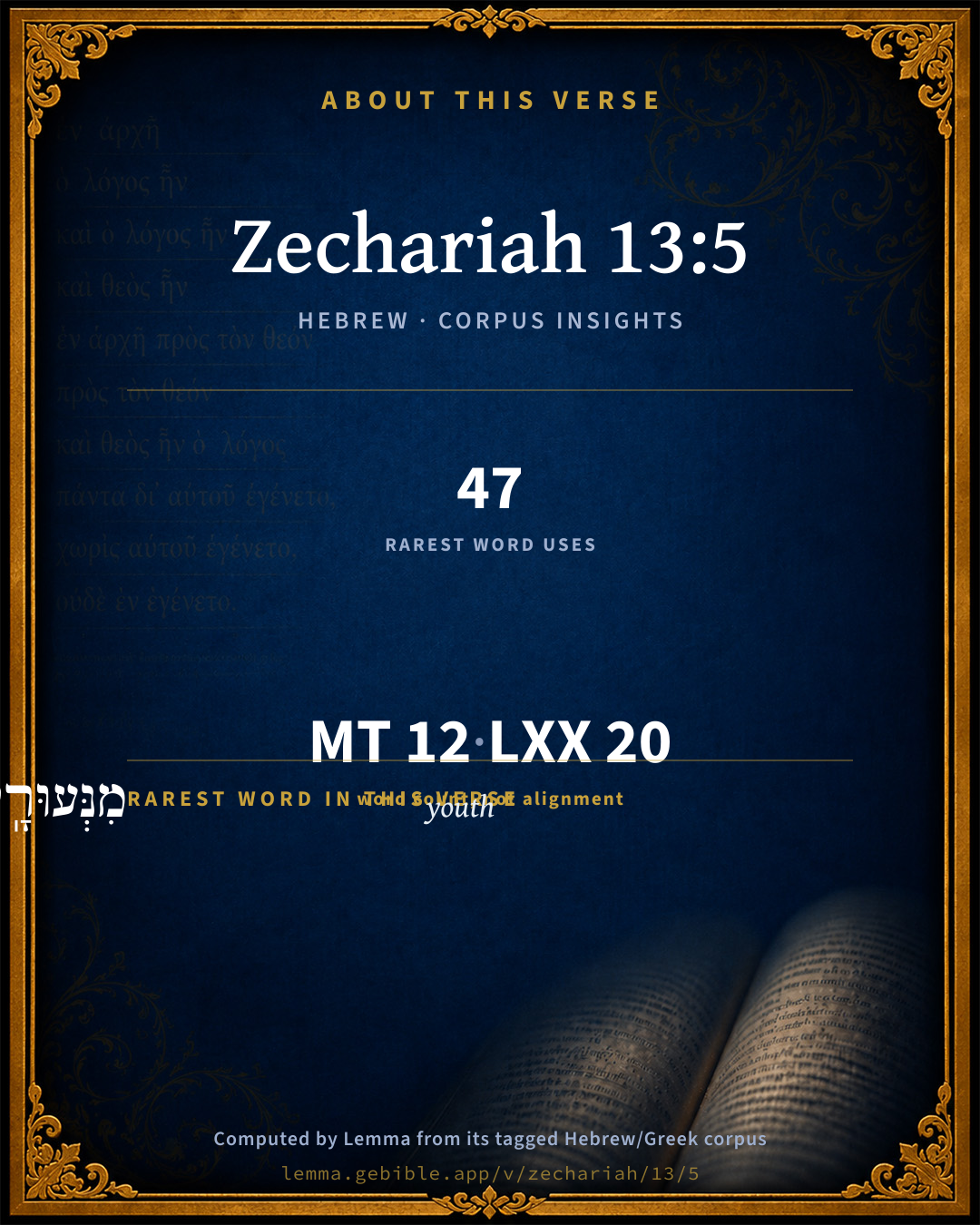
These counts appear in no published source. They are computed here, from the morphology-tagged text and Lemma’s own curated glosses. What Lemma adds →

12
words
11
distinct lemmas
Prophets
section

Shared distinctive vocabulary

מִנְּעוּרָֽי youth H5271 occurs in 46 verses of the Hebrew Bible. Also found in:

Grammatical profile

  • 3 verbs
  • 5 nouns
  • 2 pronouns
  • 1 conjunction
  • 1 particle

Verb forms

  • וְאָמַ֕ר Qal · Sequential Perfect
  • עֹבֵ֤ד Qal · Participle Active
  • הִקְנַ֥נִי Hiphil · Perfect

Repetition

A word recurs within this verse — often emphatic in Hebrew:

  • אָנֹ֑כִי I H595 ×2

Hebrew & Septuagint length

In English translation the verse runs 25 words from the Hebrew and 27 from the Septuagint (LXX English) — closely comparable.

A rough comparison of the two English renderings, which tokenize alike — not a word-level alignment.

Word counts can differ between the Hebrew and the Greek without any difference in meaning — e.g. the Hebrew direct-object marker אֵת has no separate Greek word, and Greek often adds the article ὁ.

In the original languages it is 12 Hebrew tokens and 20 Greek tokens — but the two are counted differently (Hebrew bundles its prefixes and suffixes into one token; the Greek is in lemma form), so that isn’t a like-for-like length.

Cross-references

2

Topical passages linked to Zechariah 13:5 in the Treasury of Scripture Knowledge — connected by theme and wording, ordered by reader-vote popularity; previews shown in the World English Bible.

  • Amos 7:14 Then Amos answered Amaziah, "I was no prophet, neither was I a prophet's son; but I was a herdsman, and a farmer of sycamore trees;
  • Acts 19:17–20 This became known to all, both Jews and Greeks, who lived at Ephesus. Fear fell on them all, and the name of the Lord Jesus was magnified.

Cross-references courtesy of OpenBible.info (CC BY 4.0).

Hebrew and Greek witnesses Masoretic Hebrew ↔ Greek Septuagint

The same verse in the two great witnesses to the Old Testament, shown verse-for-verse.

These are two independent witnesses, not word-aligned to each other, and the Septuagint is shown in lemma (dictionary) form.

Hebrew Zechariah 13:5 Masoretic · Westminster Leningrad Codex

וְאָמַ֕ר לֹ֥א נָבִ֖יא אָנֹ֑כִי אִישׁ עֹבֵ֤ד אֲדָמָה֙ אָנֹ֔כִי כִּ֥י אָדָ֖ם הִקְנַ֥נִי מִנְּעוּרָֽי

but he will say, 'I am no prophet, I am a tiller of the ground; for I have been made a bondservant from my youth.'

World English Bible · Public Domain

Greek LXX Zechariah 13:5 Septuagint · lemma form

καί εἶπον οὐ εἰμί προφήτης ἐγώ διότι ἄνθρωπος ἐργάζομαι ὁ γῆ ἐγώ εἰμί ὅτι ἄνθρωπος γεννάω ἐγώ ἐκ νεότης ἐγώ

And one shall say, I am not a prophet, for I am a tiller of the ground, for a man brought me up thus from my youth.

LXX2012 (modern English Septuagint) · Public Domain

On this verse, Haydock's Catholic Bible Commentary discusses the Septuagint’s reading. Read the note in Commentary ↓

Hebrew: Westminster Leningrad Codex (CC BY 4.0). Greek: Septuagint (public domain); English from LXX2012 (modern English Septuagint) (Public Domain). How the Septuagint differs from the Hebrew →

Targum (Aramaic paraphrase)

1

The Targum is the ancient Jewish Aramaic paraphrase of the Hebrew Scriptures — an interpretive translation, not the Hebrew text itself. Onkelos (literal) and Pseudo-Jonathan (expansive) render the Torah, and Jonathan the Prophets. Coverage is partial: where no permissively-licensed English translation exists for a verse, only the Aramaic is shown. This is verse-level text, not a word-by-word alignment to the Hebrew.

  1. Targum Jonathan Prophets (Joshua–Malachi)
    וְיֵימַר לָא נְבִיָא אֲנָא גְבַר פָּלַח בְּאַרְעָא אֲנָא אֲרֵי אֱנָשָׁא אַקְנִיַנִי מִזְעוּרִי:

    (no public-domain English translation for this verse)

    Targum Jonathan — Aramaic: “Mikraot Gedolot” (public domain). English: “Sefaria Community Translation” (CC0 1.0 (public-domain dedication)); “London "Chaldee Paraphrase," 1871” (public domain). Text via Sefaria.

Commentary

Notes on Zechariah 13:5 from classic Christian and Jewish commentators (each source and its license shown beneath its notes). The classic Christian expositions comment on the surrounding passage and are grouped to its opening verse, so a note may address several verses; the Jewish commentaries on the Tanakh (Rashi and others) are per-verse, so they appear only where the commentator wrote on this verse.

Lemma curates 59 commentaries, every one of them public domain or Creative Commons licensed, each selected and text-cleaned for this edition rather than reprinted as found. About our sources →

Trapp's Complete Commentary

John Trapp

Zec 13:5 But he shall say, I [am] no prophet, I [am] an husbandman; for man taught me to keep cattle from my youth.

Ver. 5. But he shall say, I am no prophet] Oυκ ειμι μοναχος, I am no monk, no clerk, I am not book learned, was the ignorant man’s plea in Chrysostom’s time, and so it is still to this day; though it serves not his turn. But here the like speech is taken up for a better purpose. Hoc etenim principium est resipiscentiae, saith Calvin here. Here begins their repentance, viz. in a free acknowledgment of their ignorance and utter unfitness for the office they had usurped.

I am no prophet] As for self-respects, that my belly might be filled and my back fitted, Si ventri bene, si lateri (Horat.), I sinfully took upon me to be one, but I am a husbandman, and can better hold the plough than handle a text; feed and follow a flock of sheep than feed the flock of God (that have golden fleeces, precious souls), taking the oversight thereof, not for filthy lucre, but of a ready mind. 1Pe 5:2

For man taught me to keep cattle from my youth] q.d. Shepherdy and husbandry I have been ever trained up to, and can better therefore skill of than of preaching, which is certainly Ars artium et scientia scientiarum, the art of arts, the science of sciences, as one said; whereunto Melancthon addeth that it is the misery of miseries. And of the same mind was his colleague, Luther, when he said, A householder’s pains is great, a magistrate’s greater, but a minister’s greatest of all; and afterward added, that if it were lawful to him to leave his calling, he could with more ease and pleasure dig for his living, or do any other hard labour, than undergo a pastoral charge. The mystery thereof is not an idle man’s occupation, an easy trade, as some fondly conceit. The sweat of the brow is nothing to that of the brain; besides dangers on every hand for the work’s sake, and armies of cares, that give neither rest nor respite, but are ready to overwhelm a man, επισυστασις, 2Co 11:28, agmen subinde irruens (Illyr.). This made Luther affirm that a minister labours more in a day many times than a husbandman doth in a month. Let no man, therefore, in taking up the ministry, dream of a delicacy; neither let slow bellies either invade it or hold it (as Popish asses and some impudent Alastores today do) to pick a living out of it. It was an honest complaint of a Popish writer, We, saith he, handle the Scripture, tantum ut nos pascat et vestiat, only that it may feed us and clothe us. And Cardinal Cajetan, not without cause, cries out, that those among them that should have been the salt of the earth had lost their savour; and were good for little else but looking after the rites and revenues of the Church (Com. in Mat 5:1-48). Now for such as these that serve not the Lord Jesus Christ, but their own bellies, that, like body lice, live upon other men’s sweat, or, like rats and mice, do no more but devour victuals and run squeaking up and down, good is the counsel of the apostle, "Let him that stole steal no more: but rather let him labour, working with his hands the thing which is good, that he may have to give to him that needeth," Eph 4:28; let him earn it before he eat it, 2Th 3:10. This is hard to persuade those abbey lubbers, that live at ease in cloisters, feeding on the fat and drinking of the sweet; and those idol shepherds, that feed themselves and not the flock. O Monachi vestri stomachi. Erasmus truly told the Elector of Saxony that Luther, by meddling with the Pope’s triple crown and with the monks’ fat paunches, had procured himself so great ill-will among them. One of them brake out in a sermon into these angry words: If I had Luther here I would tear out his throat with my teeth; and then make no doubt with the same bloody teeth to eat my maker at the Eucharist. How much better were it for such false prophets with "quietness to work and eat their own bread," 2Th 3:14, than to drink the blood of other men with their lives (as David spake in another case, 1Ch 11:19), yea, with their souls, which perish by their insufficiency and gastrimargy! Sed venter non habet aures. But the belly hath no ears. Ease slayeth the foolish. Non minus difficulter a deliciis abstrahimur, quam canis ab uncto corio, among other scandals and lets of the Jews’ conversion this is not the least, that they must quit their goods to the Christian. And the reason is, for that in baptism they renounce the devil and all his works, part whereof (say the Papists among whom they live) are the Jews’ goods; being gotten either of themselves or of their ancestors by usury. Now this is such cold comfort to men of their metal, that they have little mind to turn Christian; and as little doubtless have such as, with these in the text, have got their living by lying; and through covetousness with feigned words made merchandise or prize of men’s precious souls, to return to the hard labour of husbandry or any other lawful but painful employment; yet this was done both in Wycliffe’s days by many friars that fell to him, and embraced his opinions, and in the reformation by Luther, many monks and nuns betook themselves to honest trades, renouncing their Popish vows and orders; yea, Scultetus reporteth that at Augsburg, in Germany, by the powerful preaching of Dr John Speiser, A. D. 1523, some harlots forsook the public stews, and married to honest men, lived chastely, and were great painstakering persons.

John Trapp, A Commentary or Exposition upon All the Books of the Old and New Testament (1647–1656) — public domain. Text from a community e-Sword module.

Whedon's Commentary on the Bible

Daniel D. Whedon

Zec_13:5-6 indicate with what vehemence everyone will deny that he is a prophet

He shall say — The subject is not everyone of Zec_13:4, but the indefinite one, “one shall say”=it shall be said (G.-K., 144d), not necessarily by one who has been a prophet, for in such a case the statement would be an untruth, but by anyone who is suspected of claiming (compare Zec_13:6) to be a prophet.

I am no prophet — Compare Amo_7:14, but here the denial is made for another reason; the speaker disclaims any and all connection with the prophetic office.

Man taught me to keep cattle from my youth — Better, R.V., “I have been made a bondman from my youth.” This answer need not be considered an untruth; and yet it receives additional force if we suppose that the prophet means to teach that in that day a person would rather assume the most despicable position, that of a slave, than be suspected of being a prophet. The reply proves unsatisfactory, and in Zec_13:6 the inquirer is represented as continuing the questioning.

What are these wounds in thine hands? — R.V., “between thine arms.” The suspicion seems to have been aroused in this case by the presence of wounds on the body of the suspect. The last three words have been variously interpreted, as referring to wounds on the palms of the hands, or on the arms, or between the arms, that is, on the breast. The last seems the most probable (compare 2Ki_9:24); but the place of the wound is not essential. The nature of the wounds is not certain; they cannot be connected with Zec_13:3; the questioner, connecting them, apparently, with the custom described in 1Ki_18:28 (compare Deu_14:1; Jer_16:6), seems to consider them marks of devotion, self-inflicted in the pursuit of the prophetic office, perhaps in order to create prophetic ecstasy; but this does not imply that he considered the person addressed a heathen or a false prophet, as distinguished from a true prophet. In reply the suspect insists that the wounds have nothing whatever to do with the prophetic office.

I was wounded in the house of my friends — The last word, literally, lovers, or paramours, is often used of idols (compare Hos_2:7; Hos_2:10), and some give to it that meaning in this passage. If this is correct the reply contains an admission that at one time the speaker had taken part in idolatrous practices; but even then the form of the verb excludes the idea of self-mutilation. The context favors another interpretation, namely, to take lovers or friends literally, but not of the speaker’s parents, for in Zec_13:5 he states that he has been a bondman from his youth, and the word here is used only of fresh wounds, so that the reference cannot be to punishment received in childhood. He means rather that he received the wounds in a “common brawl” in the house of his friends. The willingness with which he makes the admission indicates how anxious he is to remove all suspicion that he is in any way connected with the prophetic office.

Daniel D. Whedon (gen. ed.), Commentary on the Old and New Testaments (1874–1909) — public domain. Text from a community e-Sword module.

Tyndale Open Study Notes

Tyndale Open Resources

13:5 I’m a farmer: This might be a parody of Amos 7:14.

Tyndale Open Study Notes — © Tyndale Open Resources, licensed CC BY-SA 4.0. Text via the HelloAO Bible API.

Geneva Bible (1599)

Geneva Bible translators

They shall confess their former ignorance, and be content to labor for their living.

Geneva Bible (1599) marginal notes — public domain. Text via Bolls.life.

Jamieson, Fausset & Brown

Robert Jamieson, A. R. Fausset & David Brown

The detection of one of the false prophets dramatically represented. He is seized by some zealous vindicator of the law, and in fear cries out, "I am no prophet."

man--that is, one.

taught me to keep cattle--As "keeping cattle" is not the same as to be "an husbandman," translate rather, "Has used (or 'appropriated') me as a servant," namely, in husbandry [MAURER]. However, husbandry and keeping cattle might be regarded as jointly the occupation of the person questioned: then Amo 7:14, "herdman," will accord with English Version. A Hebrew kindred word means "cattle." Both occupations, the respondent replies, are inconsistent with my being a "prophet."

Jamieson, Fausset & Brown — Commentary Critical and Explanatory on the Whole Bible (1871) — public domain (CC PDM 1.0). Text via the HelloAO Bible API.

Adam Clarke's Commentary

Verse 5. But he shall say, I am no prophet] This must be the case of a false prophet or diviner, who had been obliged to give up his infamous practice, and become even a labourer in the land. But having been known to be such, he is questioned by the people to see if he still were addicted in heart to the same practices. He declares he is no prophet, neither true nor false; that he is now a husbandman, and was brought up a herdsman.

Adam Clarke's Commentary on the Bible (1810–1826) — public domain. Text from a community e-Sword/MySword module.

John Calvin's Commentaries

He describes repentance in this verse more fully. When Paul wished to exhort the faithful to newness of life, he said,

“Let him who has stolen, steal no more; but rather work with his own hands, that he may relieve the wants of others.” (Ephesians 4:18.)

Paul notices two parts of repentance, — that thieves are to refrain from acts of dishonesty and wrong, — and that they ought to labor in order to aid others and relieve their wants. So also Zechariah mentions these two particulars, — that false prophets will give up their office, — and that they will then spend their labor in doing what is right and just, supporting themselves in a lawful and innocent manner, and affording aid to their brethren.

Having spoken already of the former part, he repeats the same thing again, I am not a prophet. It is then the first thing in repentance, when they who had been previously the servants of Satan in the work of deception, cease to deal in falsehoods, and thus put an end to their errors. Now follows the progress, — that they who lived before in idleness and in pleasures under the pretext of sanctity, willingly devote themselves to labor, and continue no longer idle and gluttonous as before, but seek to support themselves by just and lawful employment. It would not then have been enough for him to say, I am no prophet, had he not added, I am an husbandman; that is, I am prepared to labor, that I may support myself and aid my brethren.

A half reformation might probably succeed with many at this day. Were many monks sure that a rich mess would continue to them in their cloisters, and were also the milted bishops and abbots made certain that nothing of their gain and profit would be lost to them, they would easily grant a free course to the gospel. But the second part of reformation is very hard, which requires toil and labor: in this case the stomach has no ears, according to the old proverb. And yet we see what the Prophet says, — that those are they who truly and from the heart repent, who not only abstain from impostures, but who are also ready to get their own living, acknowledging that they had before defrauded the poor, and procured their support by rapine and fraud.

The Prophet no doubt speaks of impostors, who were then numerous among the Jews; and there were also women who boasted that they were favored with a prophetic spirit; and the true prophets of God had to contend with these sorceresses or wise women, who had ever intruded themselves during a confused state of things, and undertook the office of teaching. As then there were at that time many idlers who lived on superstition, rightly does the Prophet send them away to cultivate the land. So at this day there are many brotherlings who hide their ignorance under their hood, and even all the papal clergy, under the sacred vestment, as they call it; and were they unmasked, it might easily be found out, that they are the most ignorant asses. Now, as the Lord has abundantly discovered their baseness, were they to acknowledge that they have been impostors, what would remain for them, but willingly to do what they are here taught? that is, to become husband men instead of being prophets.

As to the end of the verse, some retain the word Adam; others render it man; and generally the word Adam means man in Scripture. But they who think that Zechariah speaks of the first man, adduce this reason, — that as this necessity of “eating his bread by the sweat of his face” (Genesis 3:9) was imposed on all mankind after the fall, so also all his posterity were thus taught by Adam their first parent; but this interpretation seems too far-fetched. I therefore take the word indefinitely; as though he had said, “I have not been taught by any master, so as to become capable to undertake the prophetic office; but I am acquainted only with agriculture, and have made such progress, that I can feed sheep and oxen; I am indeed by no means fit to take upon me the office of a teacher.” I take the passage simply in this sense.

With regard to the verb הקנני, ekenni, קנה, kene, means to possess, to acquire; but as the word מקנה, mekene, which signifies a flock of sheep or cattle, is derived from this verb, the most learned interpreters are inclined to give this meaning, “Man has taught me to possess sheep and oxen.” I am however disposed to give this rendering, as I have already stated, “Man has taught me to be a shepherd.”

The import of the whole is, — that when God shall discover the ignorance, which would so prevail in the Church, as that the darkness of errors would extinguish as it were all the light of true religion, then they who repent shall become so humble, as to be by no means ashamed to confess their ignorance and to testify that they had been impostors as long as they had under a false pretense assumed the office of prophets. The Spirit of God then requires here this humility from all who had been for a time immersed in the dregs of falsehood, that when they find that they are not fit to teach, they should say, “I have not been in school, I was wholly ignorant, and yet I wished to be accounted a most learned teacher; at that time the stupidity of the people veiled my disgrace: but now the light of truth has shone upon us, which has constrained me to feel ashamed; and therefore I confess that I am not worthy to be heard in the assembly, and I am prepared to employ my hands in labor and toil, that I may gain my living, rather than to deceive men any longer, as I have hitherto done.”

John Calvin's Commentaries (1540-1563) — public domain. Text from the Calvin Translation Society English edition (1840s-50s) via the Christian Classics Ethereal Library (ccel.org). Calvin's coverage is partial (roughly two-thirds of the Bible); uncommented books and verses are honest gaps, never fabricated. The 19th-century editor's footnotes and remarks are omitted so the notes are faithfully Calvin's own voice.

Ellicott's Commentary for English Readers

(5) Taught . . . cattle.—Better, acquired, or bought me. He pretends to be a purchased slave, kept hard at work, and therefore as having no time for professing inspiration. His meaning is very different from that of Amo_7:14.

A Bible Commentary for English Readers, edited by Charles John Ellicott (1878–1897) — public domain. Text from a community e-Sword module.

The Cambridge Bible for Schools and Colleges

gen. ed. J. J. S. Perowne

5. a husbandman] Lit. one tilling the ground, as Gen_4:2. Comp. Amo_7:14, where however there is no repudiation as here of the prophetical office.

taught me to keep cattle] or possessed me as a serf, or chattel: adscriptus glebœ. I have been made a bondman, R. V.

The Cambridge Bible for Schools and Colleges (gen. ed. J. J. S. Perowne; Cambridge University Press, 1878–1918) — public domain. Text from a community e-Sword module.

John Gill's Exposition

But he shall say, I am no prophet,.... That he is not of the Romish clergy, or of any of their religious orders, having laid aside his habit:

I am an husbandman; he shall put on the habit of a husbandman, and work for his bread; for he will not be able to support himself, as before, with the sale of pardons and indulgences, and by praying souls out of purgatory; for no man hereafter will buy of his merchandise, Rev 18:11 and he will be ashamed of his former calling and traffic, and will not own that he was ever concerned therein; but will affirm that he was never of the Romish clergy, but always a layman, and employed in husbandry:

for man taught me to keep cattle from my youth; he will say he was brought up to husbandry, or in some mechanic business, from his youth, and never was in any convent or monastery, or of any religious order: it may be rendered, "for man made me to work from my youth" (u); and is not to be restrained to keeping cattle, or any particular employment.

(u) "fecerunt me operari", Noldius; "homo operari fecit me", De Dieu, Burkius.

John Gill's Exposition of the Whole Bible (1746–1763) — public domain (CC PDM 1.0). Text via the HelloAO Bible API.

Albert Barnes' Notes on the Bible

And he shall say - Repudiating his former claims, “I am a husbandman:” for a man hath taught me from my youth.” There was no room then for his having been a false prophet, since he had had from his youth one simple unlettered occupation, as Amos said truly of himself; “I was no prophet, neither was I a prophet’s son: but I was an herdsman and a gatherer of sycamore fruit” Amo 7:14. The prophet does not approve the lie, any more than our Lord did the injustice of the “unjust steward.” Our Lord contrasted the wisdom “in their generation” of a bad man for his ends, with the unwisdom of “the children of light,” who took no pains to secure their God. Zechariah pictures vividly, how people would anyhow rid themselves of all suspicion of false prophesying.

Albert Barnes' Notes on the Bible (1834–1885) — public domain. Text from a community e-Sword/MySword module.

Haydock's Catholic Bible Commentary

Husbandman. Worldly occupations were incompatible with the office of prophets, 3 Kings xix 20., and Amos vii. 15., and Matthew iv. 20. The (Calmet) false (Haydock) prophets will become so odious, that people will excuse themselves from taking up the calling. --- Example. I am condemned like him to labour, Genesis iii. 17. Septuagint, "a man begot me." Hebrew, "taught, or bought me, (Calmet) or caused me to work." (De Dieu)

George Leo Haydock (1774–1849), Haydock's Catholic Family Bible and Commentary, 1859 edition — public domain. Excludes Psalms (Douay-Rheims chapter numbering differs from Protestant) and Deuterocanonical books (Catholic canon only).

Matthew Poole's English Annotations

This verse is this reclaimed man’s recantation, or renunciation of his former course, and his solemn promise to take up his own calling, and become a plain honest man, and live upon his labour, to which he was trained up from his youth, and is sorry he ever left it.

Matthew Poole's English Annotations on the Holy Bible (1683–1685) — public domain. Text from a community e-Sword/MySword module.

The Pulpit Commentary

I am a husbandman. The imposter shall confess the truth about himself, and own that he is only "a tiller of the ground (anyrwpov ergazomenov th )," as Gen_4:2. The abnegation in Amo_7:14 is quite different in character. Man taught me to keep cattle; literally, man bought (or, possessed) me; Revised Version, I have been made a bondman. So eager is he now to hide his false pretensions, that he is willing, to be considered a slave, employed from his youth in farm work, and therefore incapable of executing the prophetical office. Vulgate, Quoniam Adam exemplum meum ab adoloscentia mea; i.e. "I have followed the example of Adam in tilling the ground and in earning my bread by the sweat of my brow." St. Cyril and some modern commentators hold that the false prophet says this in sorrow and repentant, not with any idea of deceiving; and that herein is exhibited a signal instance of the grace of God in the Messanic period, when even such sinners are converted from the error of their ways.

The Pulpit Commentary (1880–1919), ed. H.D.M. Spence-Jones & Joseph S. Exell — public domain. Text from a community e-Sword module.

Rashi

Rabbi Shlomo Yitzchaki (Rashi)

for a man entrusted me with his cattle Menahem (Machbereth p. 156, second definition.) interpreted as an expression of “livestock of flocks and livestock of cattle” (Gen. 26:14). He entrusted me from my youth to watch his livestock.

Rashi on the Tanakh — English translations: “The Judaica Press complete Tanach with Rashi, translated by A. J. Rosenberg” (CC BY 4.0); “Pentateuch with Rashi's commentary by M. Rosenbaum and A.M. Silbermann, 1929-1934” (public domain); “The Metsudah Tanach series, Lakewood, N.J” (CC BY 4.0); and “The Book of Joshua, Metsudah Publications, 1997” (CC BY 4.0). Text via Sefaria.

Lesson kit

Teaching starters — assembled from the data on this page, not authored interpretation. Every prompt links to the verse data it draws on. Edit before teaching.

Zechariah, in the Prophets, opens this verse with 12 words (11 distinct Hebrew lemmas). Its most distinctive word is nâʻûwr (“youth”). A historical commentator’s framing appears above. Read the whole chapter for the surrounding context.

Discussion questions

  1. How does “youth” (nâʻûwr) shape what this verse is saying?
  2. Genesis 8:21 shares the word «youth» with this verse. How do the two illuminate each other?
  3. “I” occurs 2× in this one verse. What is the effect of the repetition?
  4. The translations on this page render this verse differently — a whole-verse word diff, not a word-by-word alignment. What might account for the different wordings?
  5. The verb «וְאָמַ֕ר» is Qal Sequential Perfect. How does its form color the action?
  6. Reading how Trapp's Complete Commentary and Whedon's Commentary on the Bible read this verse, where do the two commentators agree and where do they part?

Things to notice

Reading settings

Reading text

Shown beneath each verse's original-language words.

Old Testament
Old Testament edition

Read the OT as the Masoretic Hebrew (MT) or the Greek Septuagint (LXX).

English shown for the Greek Septuagint (in the Hebrew ↔ Greek comparison).

Comparing translations? Open the Compare panel on any verse page to stack up to four side by side.