
Jeremiah 16:4

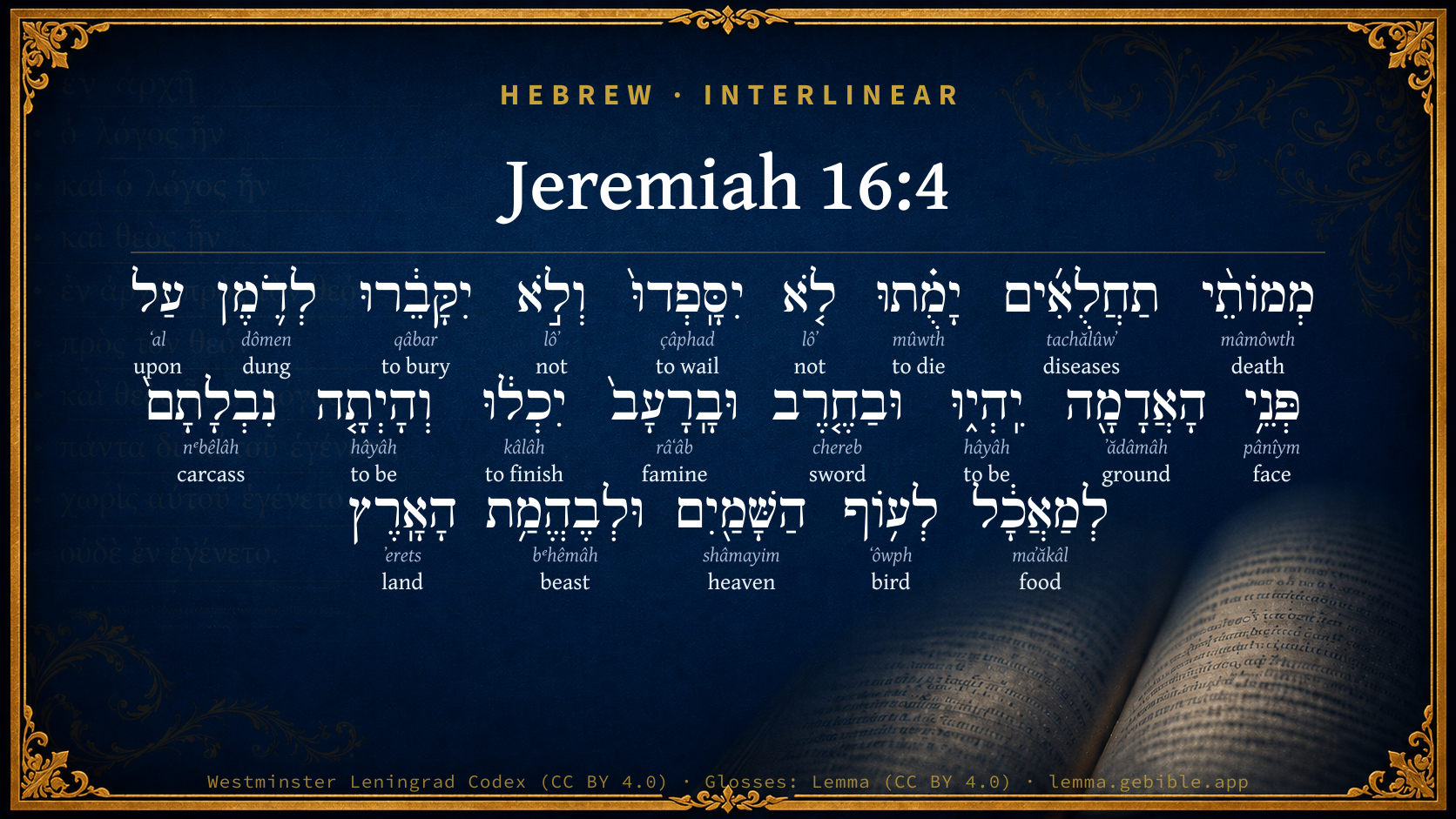
Hebrew (Westminster Leningrad Codex) Jeremiah 16:4 appears in the Hebrew Old Testament. The text above is from the Westminster Leningrad Codex. Each word links to its Strong’s number, a concise gloss, and parsing drawn from the Open Scriptures Hebrew Bible morphology. Click any word for its full Brown-Driver-Briggs (BDB) entry.
Download image
Cite this verse

Jeremiah 16:4 (World English Bible). Public Domain. Lemma interlinear Bible study tool, https://lemma.gebible.app/v/jeremiah/16/4.

Show BibTeX & RIS
BibTeX
RIS
English Translation
They shall die grievous deaths: they shall not be lamented, neither shall they be buried; they shall be as dung on the surface of the ground; and they shall be consumed by the sword, and by famine; and their dead bodies shall be food for the birds of the sky, and for the animals of the earth.
World English Bible · Public Domain
Download a study sheet

One document with this verse’s original text, its word-by-word gloss line, the meaning frame, cross-references with their text, attributed commentary, and full source and license credits — printable, and it pastes into notes with its structure intact.

This verse Autodidact and up

Study sheet (.html) Plain text (.txt)

A passage Seminary Student

Up to 50 verses in one chapter. A passage sheet keeps up to 6 commentary sources and 12 cross-references per verse, in the order this page ranks them, and says so on the sheet whenever that leaves anything out. Ask for a single verse and you get the Autodidact verse sheet above.

Everything on this page stays free to read, with no account — the sheet is a download of what is already on screen, not access to it.

Want to remove ads? Support Godless Engineer
Compare translations 3

The same verse in 3 English versions, stacked beneath the original-language interlinear above. Click any original word for its lexicon entry.

Each is an independent rendering of the whole verse — the interlinear is not word-aligned to these translations.

Highlighted words mark where these versions differ — a whole-verse word diff, not a word-by-word alignment.

  • World English Bible Public Domain
    They shall die grievous deaths: they shall not be lamented, neither shall they be buried; they shall be as dung on the surface of the ground; and they shall be consumed by the sword, and by famine; and their dead bodies shall be food for the birds of the sky, and for the animals of the earth.
  • King James Version Public Domain
    They shall die of grievous deaths; they shall not be lamented; neither shall they be buried; but they shall be as dung upon the face of the earth: and they shall be consumed by the sword, and by famine; and their carcases shall be meat for the fowls of heaven, and for the beasts of the earth.
  • unfoldingWord Literal Text CC BY-SA 4.0
    “They will die deaths of diseases. They shall not be lamented and they shall not be buried; they shall be as dung on the face of the ground and by the sword and by famine they shall be consumed, and their corpses shall be food for the bird of the skies and for the beast of the earth.”

unfoldingWord Literal Text — © unfoldingWord, licensed CC BY-SA 4.0. Word-aligned USFM3 via Door43 (git.door43.org/unfoldingWord/en_ult).

Versions to compare (up to 4)

3 of 4 selected

Show all 18 translations

Every available English version of this verse, each an independent rendering of the whole verse.

  • World English Bible Public Domain
    They shall die grievous deaths: they shall not be lamented, neither shall they be buried; they shall be as dung on the surface of the ground; and they shall be consumed by the sword, and by famine; and their dead bodies shall be food for the birds of the sky, and for the animals of the earth.
  • Berean Standard Bible Public Domain
    “They will die from deadly diseases. They will not be mourned or buried, but will lie like dung on the ground. They will be finished off by sword and famine, and their corpses will become food for the birds of the air and beasts of the earth.”
  • Majority Standard Bible Public Domain
    “They will die from deadly diseases. They will not be mourned or buried, but will lie like dung on the ground. They will be finished off by sword and famine, and their corpses will become food for the birds of the air and beasts of the earth.”
  • King James Version Public Domain
    They shall die of grievous deaths; they shall not be lamented; neither shall they be buried; but they shall be as dung upon the face of the earth: and they shall be consumed by the sword, and by famine; and their carcases shall be meat for the fowls of heaven, and for the beasts of the earth.
  • American Standard Version (1901) Public Domain
    They shall die grievous deaths: they shall not be lamented, neither shall they be buried; they shall be as dung upon the face of the ground; and they shall be consumed by the sword, and by famine; and their dead bodies shall be food for the birds of the heavens, and for the beasts of the earth.
  • Revised Version (1885) Public Domain
    They shall die of grievous deaths; they shalt not be lamented, neither shall they be buried; they shall be as dung upon the face of the ground: and they shall be consumed by the sword, and by famine; and their carcases shall be meat for the fowls of heaven, and for the beasts of the earth.
  • Geneva Bible (1599) Public Domain
    They shall die of deathes and diseases: they shall not be lamented, neither shall they be buried, but they shalbe as dung vpon the earth, and they shalbe consumed by the sword, and by famine, and their carkeises shall be meate for the foules of the heauen, and for the beasts of the earth.
  • Douay-Rheims (1899) Public Domain
    They shall die by the death of grievous illnesses: they shall not be lamented, and they shall not be buried, they shall be as dung upon the face of the earth: and they shall be consumed with the sword, and with famine: and their carcasses shall be meat for the fowls of the air, and for the beasts of the earth.
  • Young's Literal Translation Public Domain
    Of painful deaths they die, They are not lamented, nor are they buried, For dung on the face of the ground they are, And by sword and by famine are consumed, And their carcase hath been for food To the fowl of the heavens, And to the beast of the earth.
  • Literal Standard Version CC BY-SA 4.0
    “They die painful deaths, || They are not lamented, nor are they buried, || For they are dung on the face of the ground, || And are consumed by sword and by famine, || And their carcass has been for food || To the bird of the heavens, || And to the beast of the earth.”
  • Unlocked Literal Bible CC BY-SA 4.0
    'They will die diseased deaths. They will not be mourned or buried. They will be like dung on the ground. For they will come to an end by sword and famine, and their corpses will be food for the birds of the skies and the beasts of the earth.'
  • unfoldingWord Literal Text CC BY-SA 4.0
    “They will die deaths of diseases. They shall not be lamented and they shall not be buried; they shall be as dung on the face of the ground and by the sword and by famine they shall be consumed, and their corpses shall be food for the bird of the skies and for the beast of the earth.”
  • Darby Bible Public Domain
    They shall die of painful deaths; they shall not be lamented, neither shall they be buried; they shall be as dung upon the face of the ground, and they shall be consumed by the sword, and by famine, and their carcases shall be food for the fowl of the heavens and for the beasts of the earth.
  • World Messianic Bible Public Domain
    “They will die grievous deaths. They will not be lamented, neither will they be buried. They will be as dung on the surface of the ground. They will be consumed by the sword and by famine. Their dead bodies will be food for the birds of the sky and for the animals of the earth.”
  • Webster's Bible Public Domain
    They shall die by grievous deaths; they shall not be lamented; neither shall they be buried; but they shall be as dung upon the face of the earth: and they shall be consumed by the sword, and by famine; and their carcasses shall be food for the fowls of heaven, and for the beasts of the earth.
  • Free Bible Version CC BY-SA 4.0
    They will die from fatal diseases. No one will mourn for them. Their bodies won't be buried, but will lie on the ground like manure. They will be destroyed by war and famine, and their bodies will be food for birds of prey and wild animals.
  • Bible in Basic English Public Domain
    Death from evil diseases will overtake them; there will be no weeping for them and their bodies will not be put to rest; they will be like waste on the face of the earth: the sword and need of food will put an end to them; their dead bodies will be meat for the birds of heaven and for the beasts of the earth.
  • JPS Tanakh (1917) Public Domain
    They shall die of grievous deaths; they shall not be lamented, neither shall they be buried, they shall be as dung upon the face of the ground; and they shall be consumed by the sword, and by famine; and their carcasses shall be meat for the fowls of heaven, and for the beasts of the earth.

Literal Standard Version (2020), Covenant Press — licensed CC BY-SA 4.0. Text via the HelloAO Bible API (eBible.org). Unlocked Literal Bible (unfoldingWord) — licensed CC BY-SA 4.0. Text via the HelloAO Bible API (eBible.org). unfoldingWord Literal Text — © unfoldingWord, licensed CC BY-SA 4.0. Word-aligned USFM3 via Door43 (git.door43.org/unfoldingWord/en_ult). Free Bible Version, Dr. Jonathan Gallagher — licensed CC BY-SA 4.0. Text via the HelloAO Bible API (eBible.org).

Word by word

More ways to search: Search by grammar → Find every occurrence → Compare this word →

Practice this passage: Drill this verse → Learn its vocabulary →

מְמוֹתֵ֨י
mâmôwth
H4463
“deaths of”
Noun, Common, Masculine, Plural, Construct
Part of Speech
Noun
Type
Common
Gender
Masculine
Number
Plural
State
Construct
Full BDB Definition

Origin: from H4191

TWOT: 1169b

death
  1. תַחֲלֻאִ֜ים tachălûwʼ H8463 “diseases” Noun, Common, Masculine, Plural, Absolute
  2. יָמֻ֗תוּ mûwth H4191 “to die” Verb, Qal, Imperfect, 3rd Person, Masculine, Plural
  3. לֹ֤א lôʼ H3808 “not” Particle, Negative
  4. יִסָּֽפְדוּ֙ çâphad H5594 “to wail” Verb, Niphal, Imperfect, 3rd Person, Masculine, Plural
  5. וְלֹ֣א lôʼ H3808 “and · not” Conjunction + Particle, Negative
  6. יִקָּבֵ֔רוּ qâbar H6912 “to bury” Verb, Niphal, Imperfect, 3rd Person, Masculine, Plural
  7. לְדֹ֛מֶן dômen H1828 “to/for · dung” Preposition + Noun, Common, Masculine, Singular, Absolute
  8. עַל ʻal H5921 “upon” Preposition
  9. פְּנֵ֥י pânîym H6440 “face(s) of” Noun, Common, Both, Plural, Construct
  10. הָאֲדָמָ֖ה ʼădâmâh H127 “the · ground” Particle, Definite Article + Noun, Common, Feminine, Singular, Absolute
  11. יִֽהְי֑וּ hâyâh H1961 “to be” Verb, Qal, Imperfect, 3rd Person, Masculine, Plural
  12. וּבַחֶ֤רֶב chereb H2719 “and · in/at the · sword” Conjunction + Preposition, Determined + Noun, Common, Feminine, Singular, Absolute
  13. וּבָֽרָעָב֙ râʻâb H7458 “and · in/at the · famine” Conjunction + Preposition, Determined + Noun, Common, Masculine, Singular, Absolute
  14. יִכְל֔וּ kâlâh H3615 “to finish” Verb, Qal, Imperfect, 3rd Person, Masculine, Plural
  15. וְהָיְתָ֤ה hâyâh H1961 “and · to be” Conjunction + Verb, Qal, Sequential Perfect, 3rd Person, Feminine, Singular
  16. נִבְלָתָם֙ nᵉbêlâh H5038 “carcass · their” Noun, Common, Feminine, Singular, Construct + Suffix, Personal, 3rd Person, Masculine, Plural
  17. לְמַאֲכָ֔ל maʼăkâl H3978 “to/for · food” Preposition + Noun, Common, Masculine, Singular, Absolute
  18. לְע֥וֹף ʻôwph H5775 “to/for · bird of” Preposition + Noun, Common, Masculine, Singular, Construct
  19. הַשָּׁמַ֖יִם shâmayim H8064 “the · heaven(s)” Particle, Definite Article + Noun, Common, Masculine, Plural, Absolute
  20. וּלְבֶהֱמַ֥ת bᵉhêmâh H929 “and · to/for · beast of” Conjunction + Preposition + Noun, Common, Feminine, Singular, Construct
  21. הָאָֽרֶץ ʼerets H776 “the · land” Particle, Definite Article + Noun, Common, Both, Singular, Absolute

About this verse

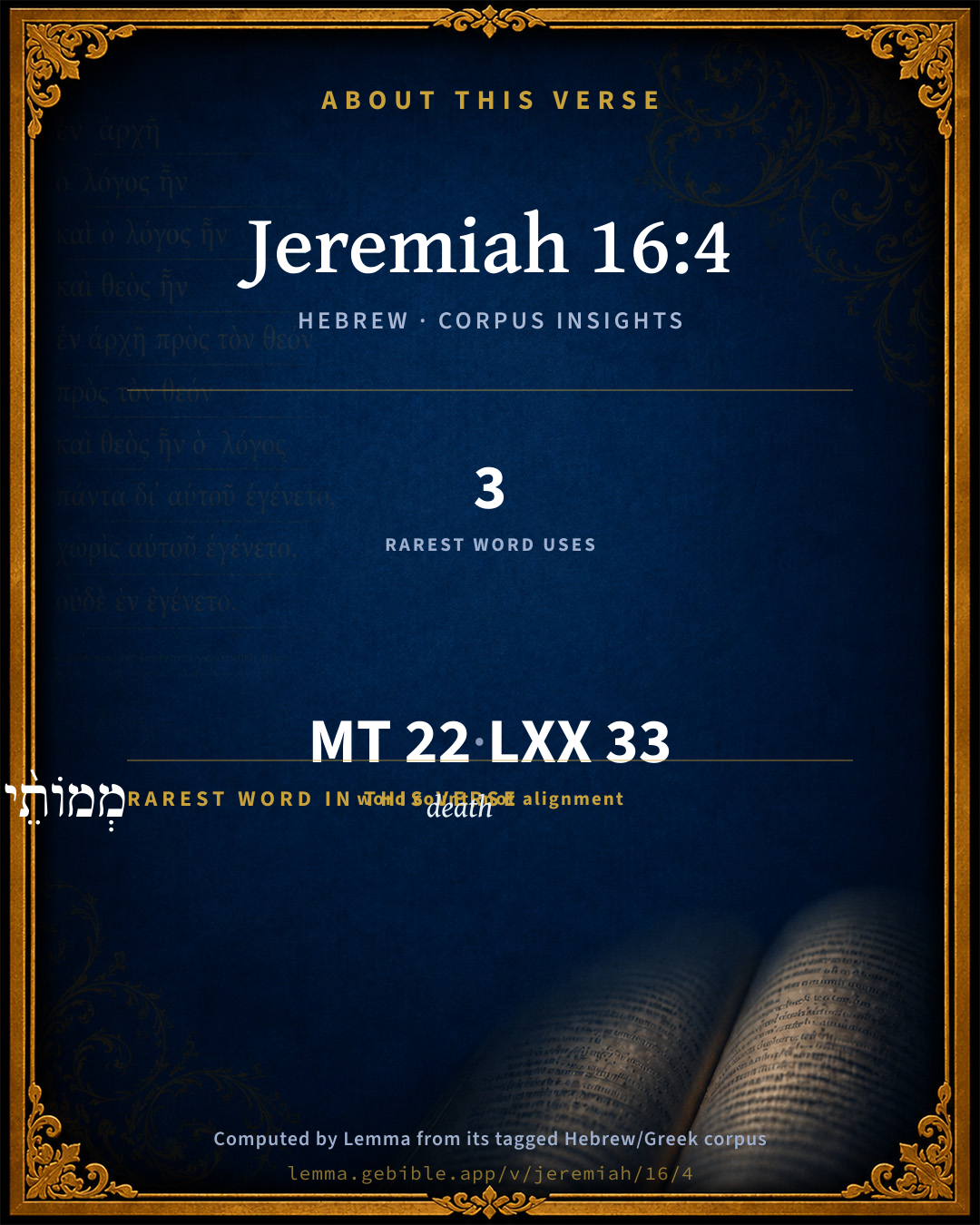
These counts appear in no published source. They are computed here, from the morphology-tagged text and Lemma’s own curated glosses. What Lemma adds →

22
words
20
distinct lemmas
Prophets
section

Notable vocabulary

The rarest word here is מְמוֹתֵ֨י death H4463 — appearing just 3 times in the whole Hebrew Bible.

Shared distinctive vocabulary

מְמוֹתֵ֨י death H4463 occurs in 3 verses of the Hebrew Bible. Also found in:

Grammatical profile

  • 6 verbs
  • 13 nouns
  • 1 preposition
  • 2 particles

Verb forms

  • יָמֻ֗תוּ Qal · Imperfect
  • יִסָּֽפְדוּ֙ Niphal · Imperfect
  • יִקָּבֵ֔רוּ Niphal · Imperfect
  • יִֽהְי֑וּ Qal · Imperfect
  • יִכְל֔וּ Qal · Imperfect
  • וְהָיְתָ֤ה Qal · Sequential Perfect

Repetition

Words recur within this verse — often emphatic in Hebrew:

  • יִֽהְי֑וּ to be H1961 ×2
  • לֹ֤א not H3808 ×2

Hebrew & Septuagint length

In the original languages it is 22 Hebrew tokens and 33 Greek tokens — but the two are counted differently (Hebrew bundles its prefixes and suffixes into one token; the Greek is in lemma form), so that isn’t a like-for-like length.

Cross-references

27

Topical passages linked to Jeremiah 16:4 in the Treasury of Scripture Knowledge — connected by theme and wording, ordered by reader-vote popularity; previews shown in the World English Bible.

  • Jeremiah 25:33 The slain of Yahweh shall be at that day from one end of the earth even to the other end of the earth: they shall not be lamented, neither gathered, nor buried; they shall be dung on the surface of the ground.
  • Psalms 83:10 Who perished at Endor, Who became as dung for the earth.
  • Jeremiah 9:22 Speak, Thus says Yahweh, The dead bodies of men shall fall as dung on the open field, and as the handful after the harvester; and none shall gather [them].
  • Jeremiah 15:2–3 It shall happen, when they tell you, Where shall we go forth? then you shall tell them, Thus says Yahweh: Such as are for death, to death; and such as are for the sword, to the sword; and such as are for the famine, to the famine; and such as are for captivity, to captivity.
  • Jeremiah 22:18–19 Therefore thus says Yahweh concerning Jehoiakim the son of Josiah, king of Judah: they shall not lament for him, [saying], Ah my brother! or, Ah sister! They shall not lament for him, [saying] Ah lord! or, Ah his glory!
  • Jeremiah 34:20 I will even give them into the hand of their enemies, and into the hand of those who seek their life; and their dead bodies shall be for food to the birds of the sky, and to the animals of the earth.
  • Zephaniah 1:17 I will bring distress on men, that they will walk like blind men, because they have sinned against Yahweh, and their blood will be poured out like dust, and their flesh like dung.
  • 2 Kings 9:10 The dogs shall eat Jezebel in the portion of Jezreel, and there shall be none to bury her. He opened the door, and fled.
  • Psalms 79:2–3 They have given the dead bodies of your servants to be food for the birds of the sky, The flesh of your saints to the animals of the earth.
  • Isaiah 18:6 They shall be left together to the ravenous birds of the mountains, and to the animals of the earth; and the ravenous birds shall summer on them, and all the animals of the earth shall winter on them.
  • Jeremiah 7:33 The dead bodies of this people shall be food for the birds of the sky, and for the animals of the earth; and none shall frighten them away.
  • Revelation 19:17–18 I saw an angel standing in the sun. He cried with a loud voice, saying to all the birds that fly in the sky, "Come! Be gathered together to the great supper of God,
  • 1 Kings 14:10–11 therefore, behold, I will bring evil on the house of Jeroboam, and will cut off from Jeroboam every man-child, him who is shut up and him who is left at large in Israel, and will utterly sweep away the house of Jeroboam, as a man sweeps away dung, until it be all gone.
  • 1 Kings 21:23–24 Of Jezebel also spoke Yahweh, saying, The dogs shall eat Jezebel by the rampart of Jezreel.
  • 2 Kings 9:36–37 Therefore they came back, and told him. He said, This is the word of Yahweh, which he spoke by his servant Elijah the Tishbite, saying, In the portion of Jezreel shall the dogs eat the flesh of Jezebel;
  • Psalms 78:64 Their priests fell by the sword, And their widows couldn't weep.
  • Isaiah 5:25 Therefore Yahweh's anger burns against his people, And he has stretched out his hand against them, and has struck them. The mountains tremble, And their dead bodies are as refuse in the midst of the streets. For all this, his anger is not turned away, But his hand is still stretched out.
  • Jeremiah 8:1–3 At that time, says Yahweh, they shall bring out the bones of the kings of Judah, and the bones of his princes, and the bones of the priests, and the bones of the prophets, and the bones of the inhabitants of Jerusalem, out of their graves;
  • Jeremiah 14:15–16 Therefore thus says Yahweh concerning the prophets who prophesy in my name, and I didn't send them, yet they say, Sword and famine shall not be in this land: By sword and famine shall those prophets be consumed.
  • Jeremiah 16:5–7 For thus says Yahweh, Don't enter into the house of mourning, neither go to lament, neither bemoan them; for I have taken away my peace from this people, says Yahweh, even loving kindness and tender mercies.
  • Jeremiah 34:17 Therefore thus says Yahweh: you have not listened to me, to proclaim liberty, every man to his brother, and every man to his neighbor: behold, I proclaim to you a liberty, says Yahweh, to the sword, to the pestilence, and to the famine; and I will make you to be tossed back and forth among all the kingdoms of the earth.
  • Jeremiah 36:30 Therefore thus says Yahweh concerning Jehoiakim king of Judah: He shall have none to sit on the throne of David; and his dead body shall be cast out in the day to the heat, and in the night to the frost.
  • Jeremiah 44:27 Behold, I watch over them for evil, and not for good; and all the men of Judah who are in the land of Egypt shall be consumed by the sword and by the famine, until there be an end of them.
  • Ezekiel 5:12 A third part of you shall die with the pestilence, and with famine shall they be consumed in the midst of you; and a third part shall fall by the sword round about you; and a third part I will scatter to all the winds, and will draw out a sword after them.
  • Ezekiel 39:17–20 You, son of man, thus says the Lord Yahweh: Speak to the birds of every sort, and to every animal of the field, Assemble yourselves, and come; gather yourselves on every side to my sacrifice that I do sacrifice for you, even a great sacrifice on the mountains of Israel, that you may eat flesh and drink blood.
  • Amos 6:9–10 It will happen, if there remain ten men in one house, That they shall die.
  • Jeremiah 44:12 I will take the remnant of Judah, that have set their faces to go into the land of Egypt to sojourn there, and they shall all be consumed; in the land of Egypt shall they fall; they shall be consumed by the sword and by the famine; they shall die, from the least even to the greatest, by the sword and by the famine; and they shall be an object of horror, [and] an astonishment, and a curse, and a reproach.

Cross-references courtesy of OpenBible.info (CC BY 4.0).

Hebrew and Greek witnesses Masoretic Hebrew ↔ Greek Septuagint

The same verse in the two great witnesses to the Old Testament, shown verse-for-verse.

These are two independent witnesses, not word-aligned to each other, and the Septuagint is shown in lemma (dictionary) form.

Hebrew Jeremiah 16:4 Masoretic · Westminster Leningrad Codex

מְמוֹתֵ֨י תַחֲלֻאִ֜ים יָמֻ֗תוּ לֹ֤א יִסָּֽפְדוּ֙ וְלֹ֣א יִקָּבֵ֔רוּ לְדֹ֛מֶן עַל פְּנֵ֥י הָאֲדָמָ֖ה יִֽהְי֑וּ וּבַחֶ֤רֶב וּבָֽרָעָב֙ יִכְל֔וּ וְהָיְתָ֤ה נִבְלָתָם֙ לְמַאֲכָ֔ל לְע֥וֹף הַשָּׁמַ֖יִם וּלְבֶהֱמַ֥ת הָאָֽרֶץ

They shall die grievous deaths: they shall not be lamented, neither shall they be buried; they shall be as dung on the surface of the ground; and they shall be consumed by the sword, and by famine; and their dead bodies shall be food for the birds of the sky, and for the animals of the earth.

World English Bible · Public Domain

Greek LXX Structure differs

In the Septuagint, Jeremiah is about an eighth shorter than the Hebrew and arranges its material differently — the Oracles Against the Nations (Hebrew chapters 46–51) appear in the middle of the Greek book, after 25:13. Because the chapter and verse boundaries do not line up, a verse-for-verse comparison with the Hebrew is not shown.

A verse-for-verse comparison isn’t shown here because the chapters and verses don’t line up. Switch to the LXX edition with the MT / LXX toggle above to read the Greek directly.

Hebrew: Westminster Leningrad Codex (CC BY 4.0). Greek: Septuagint (public domain); English from a public-domain English Septuagint. How the Septuagint differs from the Hebrew →

Targum (Aramaic paraphrase)

1

The Targum is the ancient Jewish Aramaic paraphrase of the Hebrew Scriptures — an interpretive translation, not the Hebrew text itself. Onkelos (literal) and Pseudo-Jonathan (expansive) render the Torah, and Jonathan the Prophets. Coverage is partial: where no permissively-licensed English translation exists for a verse, only the Aramaic is shown. This is verse-level text, not a word-by-word alignment to the Hebrew.

  1. Targum Jonathan Prophets (Joshua–Malachi)
    מְמָת מְמַרְעֵי כְפַן יְמוּתוּן לָא יִסְתַּפֵּדוּן וְלָא יִתְקַבְּרוּן לִזְבַל מְבַדֵר עַל אַפֵּי אַרְעָא יְהוֹן וּבְחַרְבָּא וּבְכַּפְנָא יְסוּפוּן וּתְהֵי נְבַלְתְּהוֹן מְשַׁגְרָא לְמֵיכַל לְעוֹפָא דִשְׁמַיָא וְלִבְעִירָא דְאַרְעָא:

    (no public-domain English translation for this verse)

    Targum Jonathan — Aramaic: “Mikraot Gedolot” (public domain). English: “Sefaria Community Translation” (CC0 1.0 (public-domain dedication)); “London "Chaldee Paraphrase," 1871” (public domain). Text via Sefaria.

Commentary

Notes on Jeremiah 16:4 from classic Christian and Jewish commentators (each source and its license shown beneath its notes). The classic Christian expositions comment on the surrounding passage and are grouped to its opening verse, so a note may address several verses; the Jewish commentaries on the Tanakh (Rashi and others) are per-verse, so they appear only where the commentator wrote on this verse.

Lemma curates 59 commentaries, every one of them public domain or Creative Commons licensed, each selected and text-cleaned for this edition rather than reprinted as found. About our sources →

Trapp's Complete Commentary

John Trapp

Jer 16:4 They shall die of grievous deaths; they shall not be lamented; neither shall they be buried; [but] they shall be as dung upon the face of the earth: and they shall be consumed by the sword, and by famine; and their carcases shall be meat for the fowls of heaven, and for the beasts of the earth.

Ver. 4. They shall die of grievous deaths.] Heb., Death of diseases or grievances, as did Jehoram, {2Ch 21:18} and Philip II of Spain, &c.; they shall die piecemeal, morte valetudinariorum, by death of the sickrooms, which is a misery, especially if the disease be slow, and yet sharp, as some are.

They shall not be lamented nor buried.] Which are two of the usual dues of the dead.

John Trapp, A Commentary or Exposition upon All the Books of the Old and New Testament (1647–1656) — public domain. Text from a community e-Sword module.

Jamieson, Fausset & Brown

Robert Jamieson, A. R. Fausset & David Brown

grievous deaths--rather, "deadly diseases" (Jer 15:2).

not . . . lamented--so many shall be the slain (Jer 22:18).

dung-- (Psa 83:10).

Jamieson, Fausset & Brown — Commentary Critical and Explanatory on the Whole Bible (1871) — public domain (CC PDM 1.0). Text via the HelloAO Bible API.

Adam Clarke's Commentary

Verse 4. They shall die of grievious deaths] All prematurely; see Jer 14:16.

As dung upon the face of the earth] See Jer 8:2.

Be meat for the fowls] See Jer 7:33.

Adam Clarke's Commentary on the Bible (1810–1826) — public domain. Text from a community e-Sword/MySword module.

John Calvin's Commentaries

But the reason why God forbad his Prophet to marry, follows, because they were all consigned to destruction. We hence learn that celibacy is not here commended, as some foolish men have imagined from what is here said; but it is the same as though God had said, “There is no reason for any one to set his mind on begetting an offspring, or to think that this would be to his advantage: whosoever is wise will abstain from raarriage, as he has death before his eyes, and is as it were near to his grave.” The destruction then of the whole people, and the desolation and solitude of the whole land, are the things which God in these words sets forth.

At the same time, they are not threatened with a common kind of death, for he says that they were to die by the deaths of sicknesses He then denounces on them continual languor, which would cause them to pine away with the greatest pain: sudden death would have been more tolerable; and hence David says, while complaining of the prosperity of the ungodly, that there

“were no bands in their death.” (Psalm 73:4)

And the same thing is found in the book of Job, that

“in a moment of time they descend to the grave,”

that is, that they flourish and prosper during life, and then die without any pain. (Job 21:13) Hence Julius Caesar, shortly before he was killed, called this kind a happy death, (εὐθανασίαν,) for he thought it a happy thing to expire suddenly. And this is what is implanted in men by nature. Therefore Jeremiah, in order to amplify God’s vengeance, says that they would die by the deaths of sicknesses; that is, that they would be worn out by daily pains, and pine away until they died.

He adds, They shall not be lamented nor buried We have seen elsewhere, and we shall hereafter see, (Jeremiah 22) that it is a proof of a curse when the dead are not buried, and when no one laments their death: for it is the common duty of humanity for relations and friends who survive, to mourn for the dead and to bury them. But the Prophet seems to mean also something further. I do not indeed exclude this, that God would deprive them of the honor of sepukure and of mourning; but he seems also to intimate, that the destruction of men would be so great that there would be none to perform these offices of humanity. For we lament the dead when leisure is allowed us; but when many are slain in war they are not individually lamented, and then their carcases he confused, and one grave is not sufficient for such a number. The Prophet there means, that so great would be the slaughter in Judea, that none would be buried, that none would be lamented. The verb which he uses means properly to lament, which is more than to weep: and we have said elsewhere, that in those countries there were more ceremonies than with us; for all the orientals were much given to various gesticulations; and hence they were not satisfied with tears, but they added lamentation, as though they were in despair.

But the Prophet speaks according to the customs of the age, without approving of this excess of grief. As they were wont not simply to bewail the dead, but also to shew their grief by lamentation, he says, “Their offices shall now cease, for there will not be graves enough for so many thousands: and then if any one wish to mourn, where would he begin?” We also know that men’s hearts become hardened, when many thus die through pestilence or war. The import of the whole is, that God’s wrath would not be moderate, for he would in a manner empty the land by driving them all away, so that there would be none remaining. God did indeed preserve the elect, though as it were by a miracle; and he afterwards preserved them in exile as in a grave, when they were removed from their own country.

He then adds, That they would be as dung on the face of the land He speaks reproachfully of their carcasses, as though he had said, “They shall be the putridity of the land.” As then they had by their faith contaminated the land during life, God declares that after death they would become foetid like dung. Hence we learn, as I have before said, that it was an evidence of God’s curse, when carcases were left unburied; for as God has created us in his own image, so in death he would have some evidence of the dignity and excellency with which he has favored us beyond brute animals, still to remain. We however know that temporal punishments happen even to the faithful, but they are turned to their good, for the Psalmist complains that the bodies of the godly were cast forth and became food to the birds of heaven. (Psalm 79:2) Though this is true, yet these two things are by no means inconsistent, that it is a sign of God’s wrath when the dead are not buried, and that a temporal punishment does no harm to God’s elect; for all evils, as it is well known, turn out to them for good.

It is added, By the sword and by famine shall they be consumed; that is, some shall perish by the sword, and some by famine, according to what, we have before seen,

“Those for the sword, to the sword; those for the famine, to the famine.” (Jeremiah 15:2)

Then he mentions what we have already referred to, Their carcases shall be for food to the beasts of the earth and to the birds of heaven He here intimates, that it would be a manifest sign of his vengeance, when the Jews pined away in their miseries, when the sword consumed some of them, and famine destroyed others, and not only so, but when another curse after death followed them, for the Lord would inflict judgment on their carcases by not allowing them to be buried. How this is to be understood I have already stated; for God’s judgments as to the reprobate are evident; but when the godly and the righteous fall under similar punishment, God turns to good what seems in itself to be the sign of a curse. Though famine is a sign of a curse, and also the sword, yet we know that many of God’s children perish by famine and by the sword. But in temporal punishments this modification is ever to be remembered, — that God shews himself to be a righteous Judge as to the ungodly and wicked; — and that while he humbles his own people, he is not yet angry with them, but consults their benefit, so that what is in itself adverse to them is turned to their advantage.

John Calvin's Commentaries (1540-1563) — public domain. Text from the Calvin Translation Society English edition (1840s-50s) via the Christian Classics Ethereal Library (ccel.org). Calvin's coverage is partial (roughly two-thirds of the Bible); uncommented books and verses are honest gaps, never fabricated. The 19th-century editor's footnotes and remarks are omitted so the notes are faithfully Calvin's own voice.

Ellicott's Commentary for English Readers

(4) Of grievous deaths.—Literally, deaths from diseases, including, perhaps, famine (as in Jer_14:18), as contrasted with the more immediate work of the sword.

They shall not be lamented.—Among a people who attached such importance to the due observance of funeral obsequies as the Jews did, the neglect of those obsequies was, of course, here, as in Jer_22:18, a symptom of extremest misery. Like features have presented themselves in the pestilences or sieges of other cities and other times, as in the description in Lucretius (vi. 1278) :—

“Nec mos ille sepulturæ remanebat in urbe,

Quo pius hic populus semper consuerat humari.”

“No more the customed rites of sepulture

Were practised in the city, such as wont

Of old to tend the dead with reverent care.”

Compare the account of the plague at Athens in Thucydides (ii. 52).

A Bible Commentary for English Readers, edited by Charles John Ellicott (1878–1897) — public domain. Text from a community e-Sword module.

The Cambridge Bible for Schools and Colleges

gen. ed. J. J. S. Perowne

4. grievous deaths] lit. as mg. deaths of sicknesses.

they shall not be lamented, neither shall they be buried] We may compare the condition of things in the plague at Athens b.c. 430: “Such was the state of dismay and sorrow, that even the nearest relatives neglected the sepulchral duties … the dead and dying lay piled upon one another not merely in the public roads, but even in the temples.… Those bodies which escaped entire neglect were burnt or buried without the customary mourning and with unseemly carelessness.” Grote’s Hist. of Greece, ch. 49. See Thucyd. II. 52.

The Cambridge Bible for Schools and Colleges (gen. ed. J. J. S. Perowne; Cambridge University Press, 1878–1918) — public domain. Text from a community e-Sword module.

John Gill's Exposition

For thus saith the Lord, enter not into the house of mourning,.... On account of his dead relations or neighbours; since they were taken away from the evil to come, and therefore no occasion to mourn for them: moreover, this was to show the certainty of what is before and after said; that, at the time of the general calamity predicted, there would be no lamentation made for the dead. R. Joseph Kimchi says the word here used signifies, in the Arabic (w) language, a lifting of the voice, either for weeping, or for joy (x); and Jarchi, out of the ancient book Siphri, interprets it a "feast"; and it is rendered a "banquet" in Amo 6:7, and so may here design a mourning feast, such as were used at funerals, called by the Greeks and by the Latins "parentalia", as Jerom observes. Neither go to lament nor bemoan them; neither go to the house of mourning, or the mourning feast; to the houses of the deceased, to condole the surviving relations, and to express sorrow for the dead, by shedding tears, and shaking the head, or by any other gesture or ceremony after mentioned,

For I have taken away my peace from this people, saith the Lord; all peace or prosperity is of God, and therefore called his, and which he can take away from a people when he pleases; and having determined to take it away from this people because of their sins, he is said to have done it, it being as certain as if it was done:

even lovingkindness and mercies; all benefits, which flowed from his favour, love, and mercy, as the whole of their prosperity did.

(w) "magna et vehementi voce praeditus", Golius ex Giggeio, col. 979. (x) So the word is used in the Chaldee language: as Schindler observes in Lex. col. 1722.

John Gill's Exposition of the Whole Bible (1746–1763) — public domain (CC PDM 1.0). Text via the HelloAO Bible API.

Haydock's Catholic Bible Commentary

Illnesses, denoting God’s wrath. (St. Jerome) --- Earth. The privation of sepulture was accounted one of the greatest evils.

George Leo Haydock (1774–1849), Haydock's Catholic Family Bible and Commentary, 1859 edition — public domain. Excludes Psalms (Douay-Rheims chapter numbering differs from Protestant) and Deuterocanonical books (Catholic canon only).

Matthew Poole's English Annotations

God in these verses opens the reason why he would not have the prophet marry nor multiply relations. In evil and calamitous times, those who multiply relations do but multiply sorrows and afflictions to themselves; the apostle in evil times tells the Corinthians that married persons should have trouble in the flesh, 1Co 7:28; and Christ pronounceth a woe to those that should be with child, and to those that gave suck, at the time when Jerusalem should be besieged. God tells the prophet he was resolved that the people of this land, both young and old, should die miserable deaths, and die so fast, that there should be none to bury them. They should die by the

sword and the

famine, and be devoured by the

fowls and the

beasts; and therefore it was better for him to abide free from relations, for whose miseries he would be as much concerned as for his own affliction.

Matthew Poole's English Annotations on the Holy Bible (1683–1685) — public domain. Text from a community e-Sword/MySword module.

Whedon's Commentary on the Bible

Daniel D. Whedon

4. Grievous deaths — Literally, deaths of sicknesses; suggesting the manifold forms which death takes in war and famine.

Daniel D. Whedon (gen. ed.), Commentary on the Old and New Testaments (1874–1909) — public domain. Text from a community e-Sword module.

The Pulpit Commentary

Grievous deaths; literally, deaths of sicknesses; i.e. all kinds of painful deaths, including (as Jer_14:18 shows) death by starvation. They shall not be lamented. The absence of sepulchers has already been pointed to several times as a feature of the horror of the times, (Jer_8:2 Jer_14:16; comp. Jer_7:33) but this is a new and affecting touch. Dr. Payne Smith aptly refers to the plagues of Athens and London, in which the gentler elements of human nature were for the time almost extinguished.

The Pulpit Commentary (1880–1919), ed. H.D.M. Spence-Jones & Joseph S. Exell — public domain. Text from a community e-Sword module.

Lesson kit

Teaching starters — assembled from the data on this page, not authored interpretation. Every prompt links to the verse data it draws on. Edit before teaching.

Jeremiah, in the Prophets, opens this verse with 22 words (20 distinct Hebrew lemmas). Its most distinctive word is mâmôwth (“death”). A historical commentator’s framing appears above. Read the whole chapter for the surrounding context.

Discussion questions

  1. What does “death” (mâmôwth) contribute to the verse as a whole?
  2. 2 Kings 11:2 shares the word «death» with this verse. How do the two illuminate each other?
  3. “to be” occurs 2× in this one verse. What is the effect of the repetition?
  4. These translations render this verse differently; the difference is in the English rendering, not the original. What questions does that raise?
  5. The verb «יָמֻ֗תוּ» is Qal Imperfect. How does its form color the action?
  6. Reading how Trapp's Complete Commentary and Jamieson, Fausset & Brown read this verse, where do the two commentators agree and where do they part?

Things to notice

Reading settings

Reading text

Shown beneath each verse's original-language words.

Old Testament
Old Testament edition

Read the OT as the Masoretic Hebrew (MT) or the Greek Septuagint (LXX).

English shown for the Greek Septuagint (in the Hebrew ↔ Greek comparison).

Comparing translations? Open the Compare panel on any verse page to stack up to four side by side.