
Ezekiel 39:28

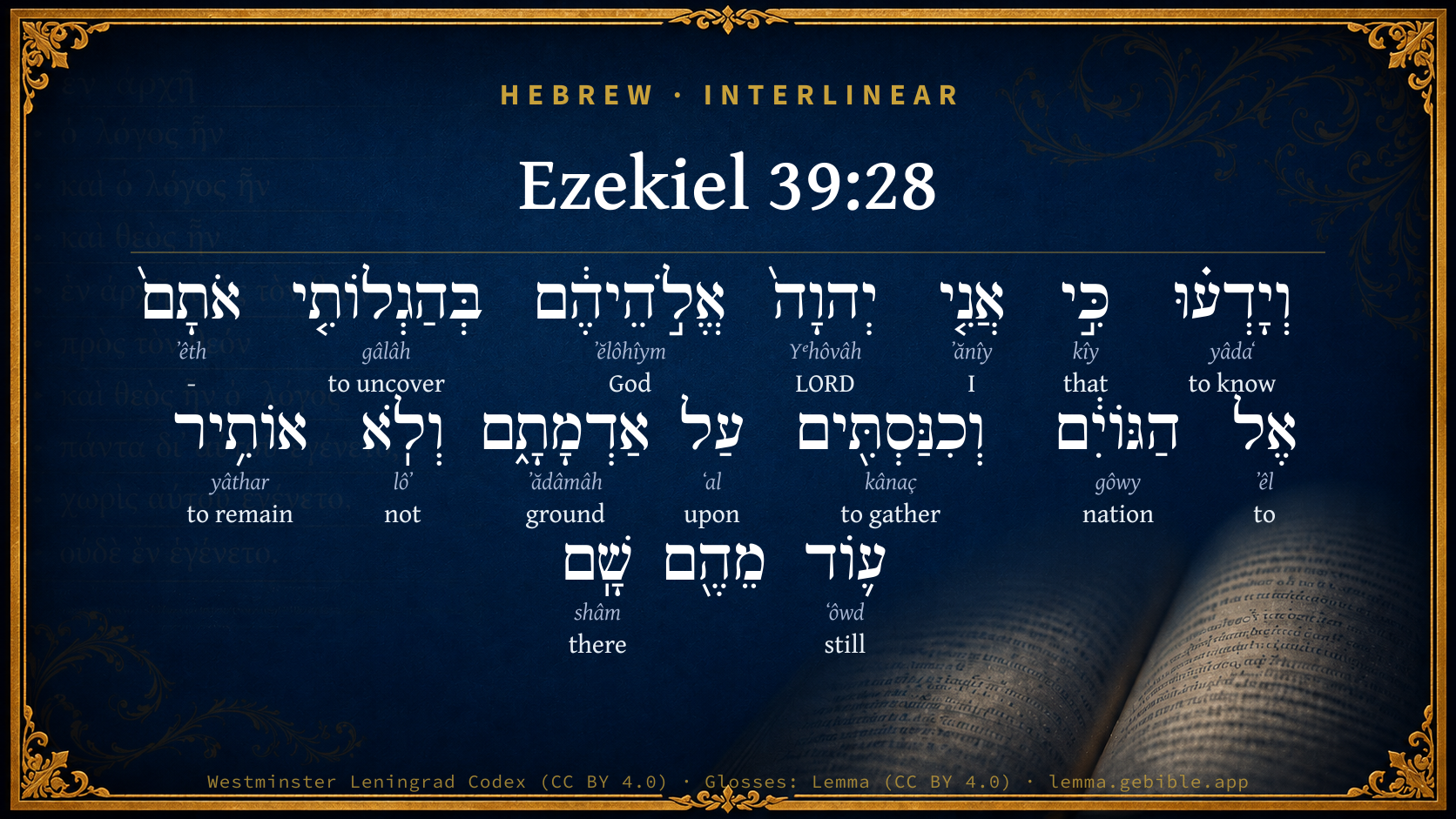
Hebrew (Westminster Leningrad Codex) Ezekiel 39:28 appears in the Hebrew Old Testament. The text above is from the Westminster Leningrad Codex. Each word links to its Strong’s number, a concise gloss, and parsing drawn from the Open Scriptures Hebrew Bible morphology. Click any word for its full Brown-Driver-Briggs (BDB) entry.
Download image
Cite this verse

Ezekiel 39:28 (World English Bible). Public Domain. Lemma interlinear Bible study tool, https://lemma.gebible.app/v/ezekiel/39/28.

Show BibTeX & RIS
BibTeX
RIS
English Translation
They shall know that I am Yahweh their God, in that I caused them to go into captivity among the nations, and have gathered them to their own land; and I will leave none of them any more there;
World English Bible · Public Domain
Download a study sheet

One document with this verse’s original text, its word-by-word gloss line, the meaning frame, cross-references with their text, attributed commentary, and full source and license credits — printable, and it pastes into notes with its structure intact.

This verse Autodidact and up

Study sheet (.html) Plain text (.txt)

A passage Seminary Student

Up to 50 verses in one chapter. A passage sheet keeps up to 6 commentary sources and 12 cross-references per verse, in the order this page ranks them, and says so on the sheet whenever that leaves anything out. Ask for a single verse and you get the Autodidact verse sheet above.

Everything on this page stays free to read, with no account — the sheet is a download of what is already on screen, not access to it.

Want to remove ads? Support Godless Engineer
Compare translations 3

The same verse in 3 English versions, stacked beneath the original-language interlinear above. Click any original word for its lexicon entry.

Each is an independent rendering of the whole verse — the interlinear is not word-aligned to these translations.

Highlighted words mark where these versions differ — a whole-verse word diff, not a word-by-word alignment.

  • World English Bible Public Domain
    They shall know that I am Yahweh their God, in that I caused them to go into captivity among the nations, and have gathered them to their own land; and I will leave none of them any more there;
  • King James Version Public Domain
    Then shall they know that I am the LORD their God, which caused them to be led into captivity among the heathen: but I have gathered them unto their own land, and have left none of them any more there.
  • unfoldingWord Literal Text CC BY-SA 4.0
    Then they will know that I am Yahweh their God, for I sent them into captivity among the nations, but then I will gather them back to their land. I will not leave any of them among the nations.

unfoldingWord Literal Text — © unfoldingWord, licensed CC BY-SA 4.0. Word-aligned USFM3 via Door43 (git.door43.org/unfoldingWord/en_ult).

Versions to compare (up to 4)

3 of 4 selected

Show all 18 translations

Every available English version of this verse, each an independent rendering of the whole verse.

  • World English Bible Public Domain
    They shall know that I am Yahweh their God, in that I caused them to go into captivity among the nations, and have gathered them to their own land; and I will leave none of them any more there;
  • Berean Standard Bible Public Domain
    Then they will know that I am the LORD their God, when I regather them to their own land, not leaving any of them behind after their exile among the nations.
  • Majority Standard Bible Public Domain
    Then they will know that I am the LORD their God, when I regather them to their own land, not leaving any of them behind after their exile among the nations.
  • King James Version Public Domain
    Then shall they know that I am the LORD their God, which caused them to be led into captivity among the heathen: but I have gathered them unto their own land, and have left none of them any more there.
  • American Standard Version (1901) Public Domain
    And they shall know that I am Jehovah their God, in that I caused them to go into captivity among the nations, and have gathered them unto their own land; and I will leave none of them any more there;
  • Revised Version (1885) Public Domain
    And they shall know that I am the LORD their God, in that I caused them to go into captivity among the nations, and have gathered them unto their own land; and I will leave none of them any more there;
  • Geneva Bible (1599) Public Domain
    Then shall they know, that I am the Lord their God, which caused them to be led into captiuitie among the heathen: but I haue gathered them vnto their owne land, and haue left none of them any more there,
  • Douay-Rheims (1899) Public Domain
    And they shall know that I am the Lord their God, because I caused them to be carried away among the nations; and I have gathered them together unto their own land, and have not left any of them there.
  • Young's Literal Translation Public Domain
    And they have known that I `am' Jehovah their God, In My removing them unto the nations, And I have gathered them unto their land, And I leave none of them any more there.
  • Literal Standard Version CC BY-SA 4.0
    And they have known that I [am] their God YHWH, || In My removing them to the nations, || And I have gathered them to their land, || And I leave none of them there anymore.
  • Unlocked Literal Bible CC BY-SA 4.0
    Then they will know that I am Yahweh their God, for I sent them into captivity among the nations, but then I will gather them back to their land. I will not leave any of them among the nations.
  • unfoldingWord Literal Text CC BY-SA 4.0
    Then they will know that I am Yahweh their God, for I sent them into captivity among the nations, but then I will gather them back to their land. I will not leave any of them among the nations.
  • Darby Bible Public Domain
    And they shall know that I [am] Jehovah their God, in that I caused them to be led into captivity among the nations, and have gathered them unto their own land, and have left none of them any more there.
  • World Messianic Bible Public Domain
    They will know that I am the LORD their God, in that I caused them to go into captivity among the nations, and have gathered them to their own land. Then I will leave none of them captive any more.
  • Webster's Bible Public Domain
    Then shall they know that I am the LORD their God, who caused them to be led into captivity among the heathen: but I have gathered them to their own land, and have left none of them there any more.
  • Free Bible Version CC BY-SA 4.0
    Then they will know that I am the Lord their God, when I bring them home to their own country again, not leaving any of them behind.
  • Bible in Basic English Public Domain
    And they will be certain that I am the Lord their God, because I sent them away as prisoners among the nations, and have taken them together back to their land; and I have not let one of them be there any longer.
  • JPS Tanakh (1917) Public Domain
    And they shall know that I am the LORD their God, in that I caused them to go into captivity among the nations, and have gathered them unto their own land; and I will leave none of them any more there;

Literal Standard Version (2020), Covenant Press — licensed CC BY-SA 4.0. Text via the HelloAO Bible API (eBible.org). Unlocked Literal Bible (unfoldingWord) — licensed CC BY-SA 4.0. Text via the HelloAO Bible API (eBible.org). unfoldingWord Literal Text — © unfoldingWord, licensed CC BY-SA 4.0. Word-aligned USFM3 via Door43 (git.door43.org/unfoldingWord/en_ult). Free Bible Version, Dr. Jonathan Gallagher — licensed CC BY-SA 4.0. Text via the HelloAO Bible API (eBible.org).

Word by word

More ways to search: Search by grammar → Find every occurrence → Compare this word →

Practice this passage: Drill this verse → Learn its vocabulary →

וְכִנַּסְתִּ֖ים
kânaç
H3664
“and · to gather · them”
Conjunction + Verb, Piel, Sequential Perfect, 1st Person, Common, Singular + Suffix, Personal, 3rd Person, Masculine, Plural
Part of Speech
Conjunction + Verb
Stem
Piel
Form
Sequential Perfect
Person
1st Person
Gender
Common
Number
Singular
Full BDB Definition

Origin: a primitive root

TWOT: 1000

to gather, collect, wrap - (Qal) to gather - (Piel) to gather - (Hithpael) to gather together, wrap oneself up
  1. וְיָדְע֗וּ yâdaʻ H3045 “and · to know” Conjunction + Verb, Qal, Sequential Perfect, 3rd Person, Common, Plural
  2. כִּ֣י kîy H3588 “that” Conjunction
  3. אֲנִ֤י ʼănîy H589 “I” Pronoun, Personal, 1st Person, Common, Singular
  4. יְהוָה֙ Yᵉhôvâh H3068 “LORD” Noun, Proper
  5. אֱלֹ֣הֵיהֶ֔ם ʼĕlôhîym H430 “God(s) · their” Noun, Common, Masculine, Plural, Construct + Suffix, Personal, 3rd Person, Masculine, Plural
  6. בְּהַגְלוֹתִ֤י gâlâh H1540 “in/at · to uncover · me” Preposition + Verb, Hiphil, Infinitive Construct + Suffix, Personal, 1st Person, Common, Singular
  7. אֹתָם֙ ʼêth H853 “- · them” Particle, Direct Object + Suffix, Personal, 3rd Person, Masculine, Plural
  8. אֶל ʼêl H413 “to” Preposition
  9. הַגּוֹיִ֔ם gôwy H1471 “the · nations” Particle, Definite Article + Noun, Common, Masculine, Plural, Absolute
  10. עַל ʻal H5921 “upon” Preposition
  11. אַדְמָתָ֑ם ʼădâmâh H127 “ground · their” Noun, Common, Feminine, Singular, Construct + Suffix, Personal, 3rd Person, Masculine, Plural
  12. וְלֹֽא lôʼ H3808 “and · not” Conjunction + Particle, Negative
  13. אוֹתִ֥יר yâthar H3498 “to remain” Verb, Hiphil, Imperfect, 1st Person, Common, Singular
  14. ע֛וֹד ʻôwd H5750 “still” Adverb
  15. שָֽׁם shâm H8033 “there” Adverb

About this verse

These counts appear in no published source. They are computed here, from the morphology-tagged text and Lemma’s own curated glosses. What Lemma adds →

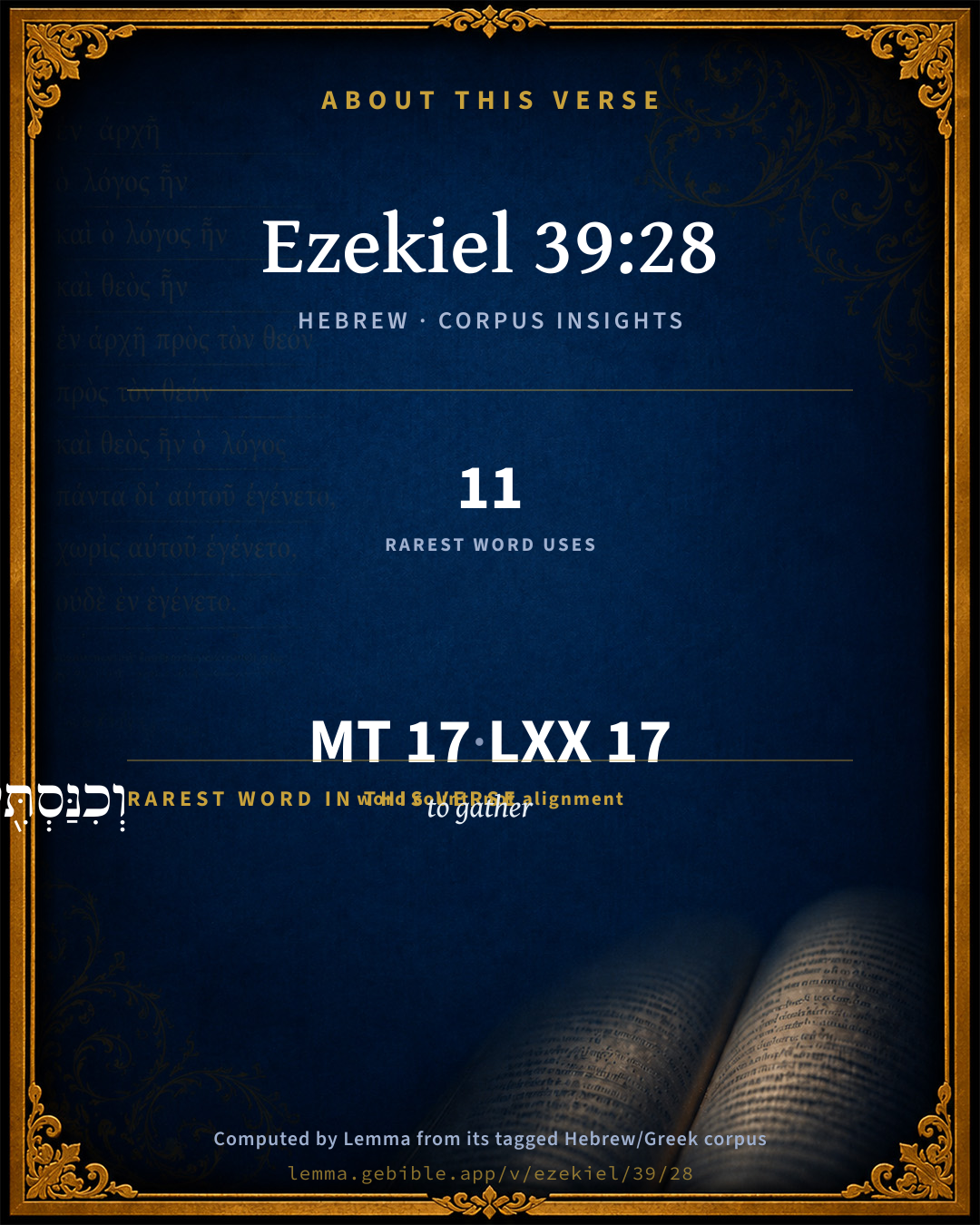
17
words
16
distinct lemmas
Prophets
section

Notable vocabulary

The rarest word here is וְכִנַּסְתִּ֖ים to gather H3664 — appearing just 11 times in the whole Hebrew Bible.

Shared distinctive vocabulary

וְכִנַּסְתִּ֖ים to gather H3664 occurs in 11 verses of the Hebrew Bible. Also found in:

Grammatical profile

  • 4 verbs
  • 4 nouns
  • 1 pronoun
  • 3 prepositions
  • 1 conjunction
  • 2 adverbs
  • 2 particles

Verb forms

  • וְיָדְע֗וּ Qal · Sequential Perfect
  • בְּהַגְלוֹתִ֤י Hiphil · Infinitive Construct
  • וְכִנַּסְתִּ֖ים Piel · Sequential Perfect
  • אוֹתִ֥יר Hiphil · Imperfect

Hebrew & Septuagint length

In English translation the verse runs 39 words from the Hebrew and 21 from the Septuagint (LXX English) — the Septuagint runs noticeably shorter here. See the side-by-side →

A rough comparison of the two English renderings, which tokenize alike — not a word-level alignment.

Word counts can differ between the Hebrew and the Greek without any difference in meaning — e.g. the Hebrew direct-object marker אֵת has no separate Greek word, and Greek often adds the article ὁ.

In the original languages it is 17 Hebrew tokens and 17 Greek tokens — but the two are counted differently (Hebrew bundles its prefixes and suffixes into one token; the Greek is in lemma form), so that isn’t a like-for-like length.

Cross-references

9

Topical passages linked to Ezekiel 39:28 in the Treasury of Scripture Knowledge — connected by theme and wording, ordered by reader-vote popularity; previews shown in the World English Bible.

  • Ezekiel 39:22 So the house of Israel shall know that I am Yahweh their God, from that day and forward.
  • Isaiah 27:12 It shall happen in that day, that Yahweh will beat off [his fruit] from the flood of the River to the brook of Egypt; and you shall be gathered one by one, you children of Israel.
  • Amos 9:9 "For, behold, I will command, and I will sift the house of Israel among all the nations, as grain is sifted in a sieve, yet not the least kernel will fall on the earth.
  • Romans 9:6–8 But it is not as though the word of God has come to nothing. For they are not all Israel, that are of Israel.
  • Deuteronomy 30:3–4 that then Yahweh your God will turn your captivity, and have compassion on you, and will return and gather you from all the peoples, where Yahweh your God has scattered you.
  • Ezekiel 34:30 They shall know that I, Yahweh, their God am with them, and that they, the house of Israel, are my people, says the Lord Yahweh.
  • Romans 11:1–7 I ask then, Did God reject his people? May it never be! For I also am an Israelite, a descendant of Abraham, of the tribe of Benjamin.
  • Nehemiah 1:8–10 Remember, I beg you, the word that you commanded your servant Moses, saying, If you trespass, I will scatter you abroad among the peoples:
  • Hosea 2:20 I will even betroth you to me in faithfulness; And you shall know Yahweh.

Cross-references courtesy of OpenBible.info (CC BY 4.0).

Hebrew and Greek witnesses Masoretic Hebrew ↔ Greek Septuagint

The same verse in the two great witnesses to the Old Testament, shown verse-for-verse.

Here the Septuagint runs noticeably shorter than the Hebrew — LXX2012 (modern English Septuagint) 21 words vs World English Bible 39. A rough length comparison of the two English translations, not a word-level alignment — read both below.

These are two independent witnesses, not word-aligned to each other, and the Septuagint is shown in lemma (dictionary) form.

Hebrew Ezekiel 39:28 Masoretic · Westminster Leningrad Codex

וְיָדְע֗וּ כִּ֣י אֲנִ֤י יְהוָה֙ אֱלֹ֣הֵיהֶ֔ם בְּהַגְלוֹתִ֤י אֹתָם֙ אֶל הַגּוֹיִ֔ם וְכִנַּסְתִּ֖ים עַל אַדְמָתָ֑ם וְלֹֽא אוֹתִ֥יר ע֛וֹד מֵהֶ֖ם שָֽׁם

They shall know that I am Yahweh their God, in that I caused them to go into captivity among the nations, and have gathered them to their own land; and I will leave none of them any more there;

World English Bible · Public Domain

Greek LXX Ezekiel 39:28 Septuagint · lemma form

καί γιγνώσκω ὅτι ἐγώ εἰμί κύριος ὁ θεός αὐτός ἐν ὁ ἐπιφαίνω ἐγώ αὐτός ἐν ὁ ἔθνος

And they shall know that I am the Lord their God, when I have been manifested to them among the nations.

LXX2012 (modern English Septuagint) · Public Domain

On this verse, The Cambridge Bible for Schools and Colleges discusses the Septuagint’s reading. Read the note in Commentary ↓

Hebrew: Westminster Leningrad Codex (CC BY 4.0). Greek: Septuagint (public domain); English from LXX2012 (modern English Septuagint) (Public Domain). How the Septuagint differs from the Hebrew →

Targum (Aramaic paraphrase)

1

The Targum is the ancient Jewish Aramaic paraphrase of the Hebrew Scriptures — an interpretive translation, not the Hebrew text itself. Onkelos (literal) and Pseudo-Jonathan (expansive) render the Torah, and Jonathan the Prophets. Coverage is partial: where no permissively-licensed English translation exists for a verse, only the Aramaic is shown. This is verse-level text, not a word-by-word alignment to the Hebrew.

  1. Targum Jonathan Prophets (Joshua–Malachi)
    וְיֵדְעוּן אֲרֵי אֲנָא יְיָ אֱלָהָהוֹן וְעַל דְחָבוּ קֳדָמַי אַגְלֵיתִי יַתְהוֹן לְבֵינֵי עַמְמַיָא וּכְדוֹ דְתָבוּ כְּנִשְׁתִּינוּן לְאַרְעֲהוֹן וְלָא אַשְׁאַר עוֹד מִנְהוֹן תַּמָן:

    (no public-domain English translation for this verse)

    Targum Jonathan — Aramaic: “Mikraot Gedolot” (public domain). English: “Sefaria Community Translation” (CC0 1.0 (public-domain dedication)); “London "Chaldee Paraphrase," 1871” (public domain). Text via Sefaria.

Commentary

Notes on Ezekiel 39:28 from classic Christian and Jewish commentators (each source and its license shown beneath its notes). The classic Christian expositions comment on the surrounding passage and are grouped to its opening verse, so a note may address several verses; the Jewish commentaries on the Tanakh (Rashi and others) are per-verse, so they appear only where the commentator wrote on this verse.

Lemma curates 59 commentaries, every one of them public domain or Creative Commons licensed, each selected and text-cleaned for this edition rather than reprinted as found. About our sources →

Trapp's Complete Commentary

John Trapp

Eze 39:28 Then shall they know that I [am] the LORD their God, which caused them to be led into captivity among the heathen: but I have gathered them unto their own land, and have left none of them any more there.

Ver. 28. And have left none of them any more there.] Here the Jews triumph and say, When was this promise ever fulfilled? and how, then, can the Messiah be come already? Hereunto it is rightly answered, that this prophecy is to be taken partly literally, and so it was fulfilled at the return of the captives out of Babylon. See Ezr 3:1. Partly spiritually; and so Christ will at the last day raise up every one of his elect, - that Israel indeed, - and gather them to himself; not one of them shall be missing. {a}

{a} Lavat. in loc.

John Trapp, A Commentary or Exposition upon All the Books of the Old and New Testament (1647–1656) — public domain. Text from a community e-Sword module.

Jamieson, Fausset & Brown

Robert Jamieson, A. R. Fausset & David Brown

The Jews, having no dominion, settled country, or fixed property to detain them, may return at any time without difficulty (compare Hos 3:4-5).

Jamieson, Fausset & Brown — Commentary Critical and Explanatory on the Whole Bible (1871) — public domain (CC PDM 1.0). Text via the HelloAO Bible API.

Adam Clarke's Commentary

Verse 28. And have left none of then any more there.] All that chose had liberty to return; but many remained behind. This promise may therefore refer to a greater restoration, when not a Jew shall be left behind. This, the next verse intimates, will be in the Gospel dispensation.

Adam Clarke's Commentary on the Bible (1810–1826) — public domain. Text from a community e-Sword/MySword module.

The Cambridge Bible for Schools and Colleges

gen. ed. J. J. S. Perowne

28. Read: And they shall know … in that I caused them … and will gather … and will leave. The words: and I will gather, &c. to the end are wanting in LXX., which also points the first clause differently.

The Cambridge Bible for Schools and Colleges (gen. ed. J. J. S. Perowne; Cambridge University Press, 1878–1918) — public domain. Text from a community e-Sword module.

John Gill's Exposition

Then shall they know that I am the Lord their God,.... See Gill on Eze 39:22;

which caused them to be led into captivity among the Heathen; for their sins and transgressions: and so the Targum adds,

"because they sinned before me:''

but I have gathered them into their own land; being now penitent for their sins, and believing in the Messiah: and so the Targum,

"and now, because they are converted, I have gathered them, &c.''

and have left none of them any more there; among the Heathen, or in the land of their enemies; everyone shall be returned to the land of Canaan, be they where they will, as when they came out of Egypt: and this is typical of the salvation of God's elect, or mystical Israel; not one of them shall be lost or perish, but all shall be brought to repentance: this again shows, that this prophecy did not respect the return of the Jews from the Babylonish captivity; since then many were left behind.

John Gill's Exposition of the Whole Bible (1746–1763) — public domain (CC PDM 1.0). Text via the HelloAO Bible API.

Haydock's Catholic Bible Commentary

There, except such as refused to return. They have entire liberty. This and what follows was not fully accomplished till the propagation of the gospel. God wished all to embrace it; and though Israel has been partly blind, they will enter the Church after the Gentiles, Romans xii. 26. (Calmet)

George Leo Haydock (1774–1849), Haydock's Catholic Family Bible and Commentary, 1859 edition — public domain. Excludes Psalms (Douay-Rheims chapter numbering differs from Protestant) and Deuterocanonical books (Catholic canon only).

Matthew Poole's English Annotations

Know; on fullest experiences, and clearest evidences, see, acknowledge, and publish to each other.

The Lord; the Mighty One, the just Judge, who determineth righteously between men and men, yea, between them and himself.

Their God; who, in covenant with their fathers, hath remembered it for the good of their children, who did assure them, that if they violated his covenant he would punish, and when they repented he would show mercy.

Which caused; who by his own hand raised up enemies against, and then delivered them into the enemies’ hand, so sent them into a sad and long captivity.

But I have gathered them; but now done more for them than when I brought them out of Babylon? whence the two tribes (yet not all of them, for some staid behind) and a few of the house of Israel returned; now the whole of the twelve tribes shall be gathered.

Unto their own land; that country they so dearly loved, somewhat for their fathers’ sake, whose ancient seat it was, but more for the goodness of it, which flowed with milk and honey. Have left none: this recovery it seems shall be much more universal than the former in Zorobabel’s time: as, coining out of Egypt, not a feeble person left behind; so nor here, if the words be to be literally explained.

There; in the land of captivity, the enemies’ country.

Matthew Poole's English Annotations on the Holy Bible (1683–1685) — public domain. Text from a community e-Sword/MySword module.

The Pulpit Commentary

Vers. 28, 24And the heathen shall know. The special lesson for them should be not so much teaching concerning God"s supremacy over them, or concerning their relation to Israel, as concerning the principles of God"s dealings with Israel. They should learn that if Israel had for a season been abandoned to the sword and driven into exile, it was not because of Jehovah"s inability to protect them, but because of their wickedness which had caused him to hide his face from them an expression which in Ezekiel occurs only here and in ver. 29, though it is found in the Pentateuch (Deu_31:17, Deu_31:18) and in the older prophets (Isa_8:17 Isa_54:8 Isa_57:17 Isa_64:7; Jer_33:5)

The Pulpit Commentary (1880–1919), ed. H.D.M. Spence-Jones & Joseph S. Exell — public domain. Text from a community e-Sword module.

unfoldingWord translationNotes

Door43 World Missions Community

Connecting Statement:

Yahweh continues to give Ezekiel a message about what will happen to Israel.

I sent them into captivity ... I will gather them back to their land

At the time when Ezekiel wrote, Israel was still in captivity in Babylon.

I will no longer hide my face from them

Here "no longer hide my face" is an idiom that means Yahweh will not continue to abandon Israel to exile in Babylon. AT: "I will no longer abandon them" (See: Idiom)

when I pour out my Spirit on the house of Israel

Here to give the Spirit abundantly is spoken of as to "pour out" the Spirit. AT: "when I generously give my Spirit to the house of Israel" (See: Metaphor)

the house of Israel

The word "house" is a metonym for the family that lives in the house, in this case the Israelites, the descendants of Jacob over many years. See how you translated this in Ezekiel 3:1. AT: "the Israelites" or "the Israelite people group" (See: Metonymy)

this is the Lord Yahweh's declaration

Yahweh speaks of himself by name to express the certainty of what he is declaring. See how you translated this in Ezekiel 5:11. AT: "this is what the Lord Yahweh has declared" or "this is what I, the Lord Yahweh, have declared" (See: First, Second, or Third Person)

translationWords

Yahweh

God

send

Holy Spirit

unfoldingWord translationNotes — © Distant Shores Media and the Door43 World Missions Community, licensed CC BY-SA 4.0. Source: git.door43.org/Door43/en_tn.

Rashi

Rabbi Shlomo Yitzchaki (Rashi)

And I shall no longer leave one of them in exile.

Rashi on the Tanakh — English translations: “The Judaica Press complete Tanach with Rashi, translated by A. J. Rosenberg” (CC BY 4.0); “Pentateuch with Rashi's commentary by M. Rosenbaum and A.M. Silbermann, 1929-1934” (public domain); “The Metsudah Tanach series, Lakewood, N.J” (CC BY 4.0); and “The Book of Joshua, Metsudah Publications, 1997” (CC BY 4.0). Text via Sefaria.

Lesson kit

Teaching starters — assembled from the data on this page, not authored interpretation. Every prompt links to the verse data it draws on. Edit before teaching.

Ezekiel, in the Prophets, opens this verse with 17 words (16 distinct Hebrew lemmas). Its most distinctive word is kânaç (“to gather”). The Greek Septuagint runs shorter here. A historical commentator’s framing appears above. Read the whole chapter for the surrounding context.

Discussion questions

  1. How does “to gather” (kânaç) shape what this verse is saying?
  2. How does 1 Chronicles 22:2, which shares the word «to gather», read alongside this verse?
  3. The Septuagint runs shorter here than the Hebrew. What might account for the difference?
  4. These translations render this verse differently; the difference is in the English rendering, not the original. What questions does that raise?
  5. «וְיָדְע֗וּ» is a Qal Sequential Perfect verb. How does that grammatical form shape the action described?
  6. Compare how Trapp's Complete Commentary and Jamieson, Fausset & Brown read this verse. Where do they agree or differ?

Things to notice

Reading settings

Reading text

Shown beneath each verse's original-language words.

Old Testament
Old Testament edition

Read the OT as the Masoretic Hebrew (MT) or the Greek Septuagint (LXX).

English shown for the Greek Septuagint (in the Hebrew ↔ Greek comparison).

Comparing translations? Open the Compare panel on any verse page to stack up to four side by side.