
Ezekiel 11:17

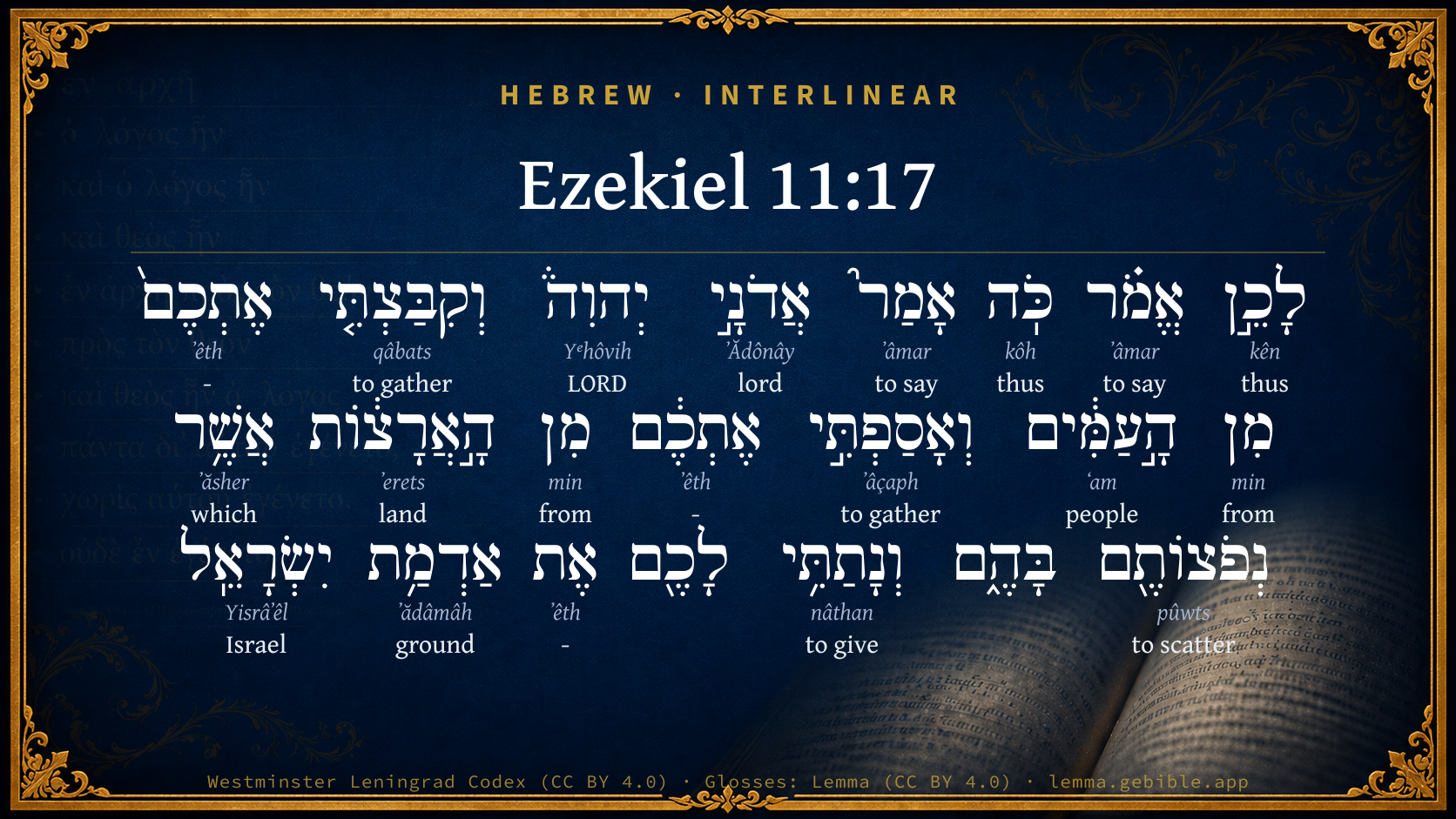
Hebrew (Westminster Leningrad Codex) Ezekiel 11:17 appears in the Hebrew Old Testament. The text above is from the Westminster Leningrad Codex. Each word links to its Strong’s number, a concise gloss, and parsing drawn from the Open Scriptures Hebrew Bible morphology. Click any word for its full Brown-Driver-Briggs (BDB) entry.
Download image
Cite this verse

Ezekiel 11:17 (World English Bible). Public Domain. Lemma interlinear Bible study tool, https://lemma.gebible.app/v/ezekiel/11/17.

Show BibTeX & RIS
BibTeX
RIS
English Translation
Therefore say, Thus says the Lord Yahweh: I will gather you from the peoples, and assemble you out of the countries where you have been scattered, and I will give you the land of Israel.
World English Bible · Public Domain
Download a study sheet

One document with this verse’s original text, its word-by-word gloss line, the meaning frame, cross-references with their text, attributed commentary, and full source and license credits — printable, and it pastes into notes with its structure intact.

This verse Autodidact and up

Study sheet (.html) Plain text (.txt)

A passage Seminary Student

Up to 50 verses in one chapter. A passage sheet keeps up to 6 commentary sources and 12 cross-references per verse, in the order this page ranks them, and says so on the sheet whenever that leaves anything out. Ask for a single verse and you get the Autodidact verse sheet above.

Everything on this page stays free to read, with no account — the sheet is a download of what is already on screen, not access to it.

Want to remove ads? Support Godless Engineer
Compare translations 3

The same verse in 3 English versions, stacked beneath the original-language interlinear above. Click any original word for its lexicon entry.

Each is an independent rendering of the whole verse — the interlinear is not word-aligned to these translations.

Highlighted words mark where these versions differ — a whole-verse word diff, not a word-by-word alignment.

  • World English Bible Public Domain
    Therefore say, Thus says the Lord Yahweh: I will gather you from the peoples, and assemble you out of the countries where you have been scattered, and I will give you the land of Israel.
  • King James Version Public Domain
    Therefore say, Thus saith the Lord GOD; I will even gather you from the people, and assemble you out of the countries where ye have been scattered, and I will give you the land of Israel.
  • unfoldingWord Literal Text CC BY-SA 4.0
    Therefore say, ‘The Lord Yahweh says this: I will gather you from the peoples, and assemble you from the lands where you were scattered, and I will give you the land of Israel.’

unfoldingWord Literal Text — © unfoldingWord, licensed CC BY-SA 4.0. Word-aligned USFM3 via Door43 (git.door43.org/unfoldingWord/en_ult).

Versions to compare (up to 4)

3 of 4 selected

Show all 18 translations

Every available English version of this verse, each an independent rendering of the whole verse.

  • World English Bible Public Domain
    Therefore say, Thus says the Lord Yahweh: I will gather you from the peoples, and assemble you out of the countries where you have been scattered, and I will give you the land of Israel.
  • Berean Standard Bible Public Domain
    Therefore declare that this is what the Lord GOD says: ‘I will gather you from the peoples and assemble you from the countries to which you have been scattered, and I will give back to you the land of Israel.’
  • Majority Standard Bible Public Domain
    Therefore declare that this is what the Lord GOD says: ‘I will gather you from the peoples and assemble you from the countries to which you have been scattered, and I will give back to you the land of Israel.’
  • King James Version Public Domain
    Therefore say, Thus saith the Lord GOD; I will even gather you from the people, and assemble you out of the countries where ye have been scattered, and I will give you the land of Israel.
  • American Standard Version (1901) Public Domain
    Therefore say, Thus saith the Lord Jehovah: I will gather you from the peoples, and assemble you out of the countries where ye have been scattered, and I will give you the land of Israel.
  • Revised Version (1885) Public Domain
    Therefore say, Thus saith the Lord GOD: I will gather you from the peoples, and assemble you out of the countries where ye have been scattered, and I will give you the land of Israel.
  • Geneva Bible (1599) Public Domain
    Therefore say, Thus saith the Lord God, I will gather you againe from the people, and assemble you out of the countreis where ye haue bene scattered, and I will giue you ye land of Israel.
  • Douay-Rheims (1899) Public Domain
    Therefore speak to them: Thus saith the Lord God: I will gather you from among the peoples, and assemble you out of the countries wherein you are scattered, and I will give you the land of Israel.
  • Young's Literal Translation Public Domain
    Therefore say: Thus said the Lord Jehovah: And I have assembled you from the peoples, And I have gathered you from the lands, Into which ye have been scattered, And I have given to you the ground of Israel.
  • Literal Standard Version CC BY-SA 4.0
    Therefore say, Thus said Lord YHWH: And I have assembled you from the peoples, || And I have gathered you from the lands, || Into which you have been scattered, || And I have given the ground of Israel to you.
  • Unlocked Literal Bible CC BY-SA 4.0
    Therefore say, 'The Lord Yahweh says this: I will gather you from the peoples, and assemble you from the lands where you were scattered, and I will give you the land of Israel.'
  • unfoldingWord Literal Text CC BY-SA 4.0
    Therefore say, ‘The Lord Yahweh says this: I will gather you from the peoples, and assemble you from the lands where you were scattered, and I will give you the land of Israel.’
  • Darby Bible Public Domain
    Therefore say, Thus saith the Lord Jehovah: I will even gather you from the peoples, and assemble you out of the countries where ye are scattered, and I will give you the land of Israel.
  • World Messianic Bible Public Domain
    “Therefore say, ‘The Lord GOD says: “I will gather you from the peoples, and assemble you out of the countries where you have been scattered, and I will give you Eretz-Israel.”
  • Webster's Bible Public Domain
    Therefore say, Thus saith the Lord GOD; I will even gather you from the people, and assemble you out of the countries where ye have been scattered, and I will give you the land of Israel.
  • Free Bible Version CC BY-SA 4.0
    Tell them that this is what the Lord God says: I'm going to gather you from the other nations and bring you back from the countries where you've been scattered, and I will return the country of Israel to you.
  • Bible in Basic English Public Domain
    Then say, This is what the Lord has said: I will get you together from the peoples, and make you come out of the countries where you have been sent in flight, and I will give you the land of Israel.
  • JPS Tanakh (1917) Public Domain
    therefore say: Thus saith the Lord GOD: I will even gather you from the peoples, and assemble you out of the countries where ye have been scattered, and I will give you the land of Israel.

Literal Standard Version (2020), Covenant Press — licensed CC BY-SA 4.0. Text via the HelloAO Bible API (eBible.org). Unlocked Literal Bible (unfoldingWord) — licensed CC BY-SA 4.0. Text via the HelloAO Bible API (eBible.org). unfoldingWord Literal Text — © unfoldingWord, licensed CC BY-SA 4.0. Word-aligned USFM3 via Door43 (git.door43.org/unfoldingWord/en_ult). Free Bible Version, Dr. Jonathan Gallagher — licensed CC BY-SA 4.0. Text via the HelloAO Bible API (eBible.org).

Word by word

More ways to search: Search by grammar → Find every occurrence → Compare this word →

Practice this passage: Drill this verse → Learn its vocabulary →

נְפֹצוֹתֶ֖ם
pûwts
H6327
“to scatter”
Verb, Niphal, Perfect, 2nd Person, Masculine, Plural
Part of Speech
Verb
Stem
Niphal
Form
Perfect
Person
2nd Person
Gender
Masculine
Number
Plural
Full BDB Definition

Origin: a primitive root

TWOT: 1745 , 1746 , 1800

to scatter, be dispersed, be scattered - (Qal) to be dispersed, be scattered - (Niphal) - to be scattered - to be spread abroad - (Hiphil) to scatter - Hithpael) scatter - (Qal) to flow, overflow - to break - (Polel) to shatter - (Pilpel) to dash to pieces
  1. לָכֵ֣ן kên H3651 “to/for · thus” Preposition + Adverb
  2. אֱמֹ֗ר ʼâmar H559 “say” Verb, Qal, Imperative, 2nd Person, Masculine, Singular
  3. כֹּֽה kôh H3541 “thus” Adverb
  4. אָמַר֮ ʼâmar H559 “to say” Verb, Qal, Perfect, 3rd Person, Masculine, Singular
  5. אֲדֹנָ֣י ʼĂdônây H136 “Lord · my” Noun, Common, Masculine, Plural, Construct + Suffix, Personal, 1st Person, Common, Singular
  6. יְהוִה֒ Yᵉhôvih H3069 “LORD” Noun, Proper
  7. וְקִבַּצְתִּ֤י qâbats H6908 “and · to gather” Conjunction + Verb, Piel, Sequential Perfect, 1st Person, Common, Singular
  8. אֶתְכֶם֙ ʼêth H853 “- · you” Particle, Direct Object + Suffix, Personal, 2nd Person, Masculine, Plural
  9. מִן min H4480 “from” Preposition
  10. הָ֣עַמִּ֔ים ʻam H5971 “the · peoples” Particle, Definite Article + Noun, Common, Masculine, Plural, Absolute
  11. וְאָסַפְתִּ֣י ʼâçaph H622 “and · to gather” Conjunction + Verb, Qal, Sequential Perfect, 1st Person, Common, Singular
  12. אֶתְכֶ֔ם ʼêth H853 “- · you” Particle, Direct Object + Suffix, Personal, 2nd Person, Masculine, Plural
  13. מִן min H4480 “from” Preposition
  14. הָ֣אֲרָצ֔וֹת ʼerets H776 “the · lands” Particle, Definite Article + Noun, Common, Both, Plural, Absolute
  15. אֲשֶׁ֥ר ʼăsher H834 “which” Particle, Relative
  16. וְנָתַתִּ֥י nâthan H5414 “and · to give” Conjunction + Verb, Qal, Sequential Perfect, 1st Person, Common, Singular
  17. אֶת ʼêth H853 “-” Particle, Direct Object
  18. אַדְמַ֥ת ʼădâmâh H127 “ground of” Noun, Common, Feminine, Singular, Construct
  19. יִשְׂרָאֵֽל Yisrâʼêl H3478 “Israel” Noun, Proper

About this verse

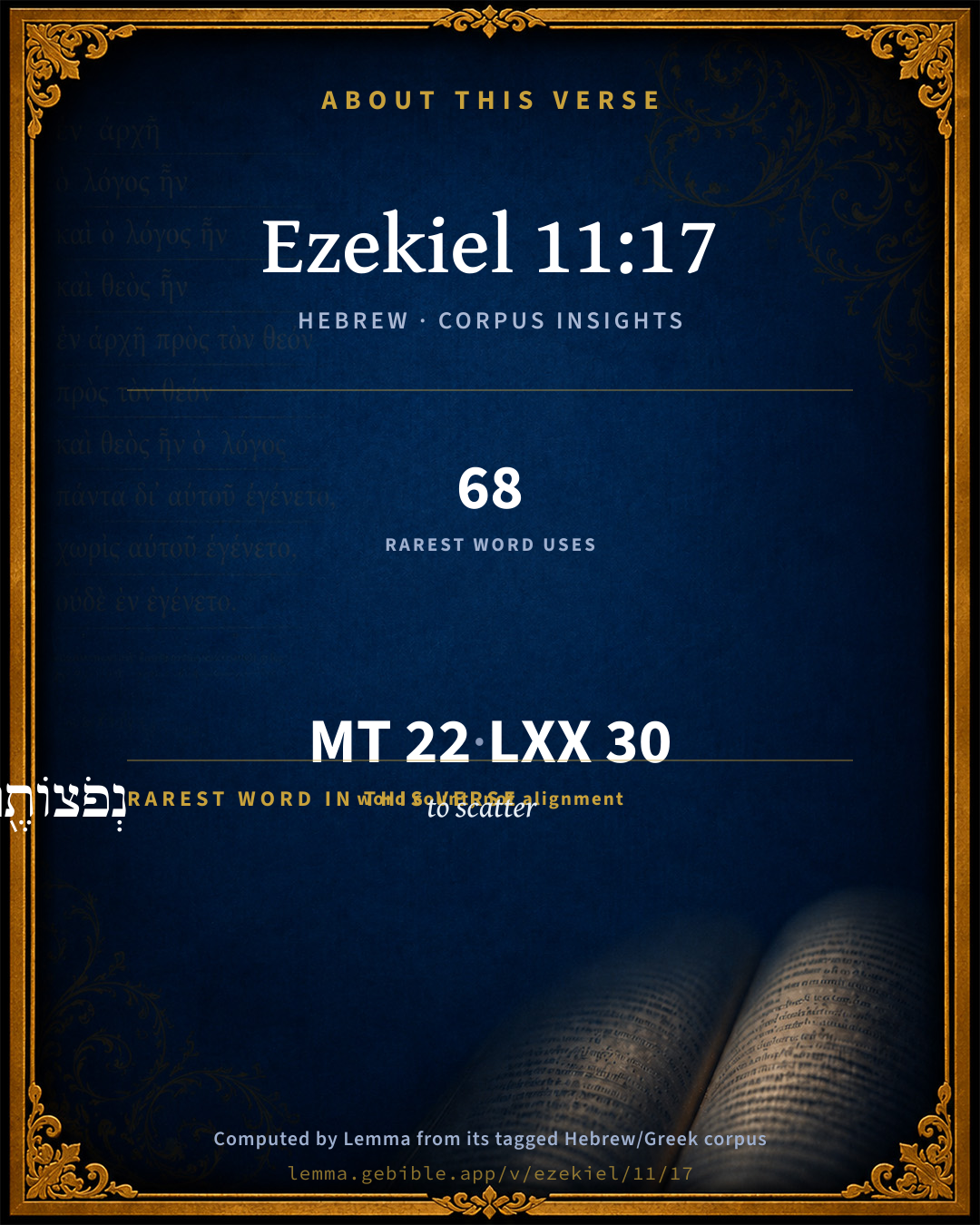
These counts appear in no published source. They are computed here, from the morphology-tagged text and Lemma’s own curated glosses. What Lemma adds →

22
words
16
distinct lemmas
Prophets
section

Grammatical profile

  • 6 verbs
  • 6 nouns
  • 4 prepositions
  • 2 adverbs
  • 4 particles

Verb forms

  • אֱמֹ֗ר Qal · Imperative
  • אָמַר֮ Qal · Perfect
  • וְקִבַּצְתִּ֤י Piel · Sequential Perfect
  • וְאָסַפְתִּ֣י Qal · Sequential Perfect
  • נְפֹצוֹתֶ֖ם Niphal · Perfect
  • וְנָתַתִּ֥י Qal · Sequential Perfect

Repetition

Words recur within this verse — often emphatic in Hebrew:

  • אֱמֹ֗ר to say H559 ×2
  • מִן from H4480 ×2

Hebrew & Septuagint length

In English translation the verse runs 35 words from the Hebrew and 35 from the Septuagint (LXX English) — the same length.

A rough comparison of the two English renderings, which tokenize alike — not a word-level alignment.

Word counts can differ between the Hebrew and the Greek without any difference in meaning — e.g. the Hebrew direct-object marker אֵת has no separate Greek word, and Greek often adds the article ὁ.

In the original languages it is 22 Hebrew tokens and 30 Greek tokens — but the two are counted differently (Hebrew bundles its prefixes and suffixes into one token; the Greek is in lemma form), so that isn’t a like-for-like length.

Cross-references

16

Topical passages linked to Ezekiel 11:17 in the Treasury of Scripture Knowledge — connected by theme and wording, ordered by reader-vote popularity; previews shown in the World English Bible.

  • Ezekiel 28:25 Thus says the Lord Yahweh: When I shall have gathered the house of Israel from the peoples among whom they are scattered, and shall be sanctified in them in the sight of the nations, then shall they dwell in their own land which I gave to my servant Jacob.
  • Jeremiah 3:18 In those days the house of Judah shall walk with the house of Israel, and they shall come together out of the land of the north to the land that I gave for an inheritance to your fathers.
  • Ezekiel 34:13 I will bring them out from the peoples, and gather them from the countries, and will bring them into their own land; and I will feed them on the mountains of Israel, by the watercourses, and in all the inhabited places of the country.
  • Isaiah 11:11–16 It shall happen in that day, that the Lord will set his hand again the second time to recover the remnant of his people, who shall remain, from Assyria, and from Egypt, and from Pathros, and from Cush, and from Elam, and from Shinar, and from Hamath, and from the islands of the sea.
  • Jeremiah 24:5 Thus says Yahweh, the God of Israel: Like these good figs, so will I regard the captives of Judah, whom I have sent out of this place into the land of the Chaldeans, for good.
  • Ezekiel 36:24 For I will take you from among the nations, and gather you out of all the countries, and will bring you into your own land.
  • Jeremiah 3:12 Go, and proclaim these words toward the north, and say, Return, you backsliding Israel, says Yahweh; I will not look in anger on you; for I am merciful, says Yahweh, I will not keep [anger] forever.
  • Jeremiah 32:37–41 Behold, I will gather them out of all the countries, where I have driven them in my anger, and in my wrath, and in great indignation; and I will bring them again to this place, and I will cause them to dwell safely:
  • Ezekiel 20:41 As a sweet savor will I accept you, when I bring you out from the peoples, and gather you out of the countries in which you have been scattered; and I will be sanctified in you in the sight of the nations.
  • Ezekiel 37:21–28 Say to them, Thus says the Lord Yahweh: Behold, I will take the children of Israel from among the nations, where they are gone, and will gather them on every side, and bring them into their own land:
  • Ezekiel 39:27–29 when I have brought them back from the peoples, and gathered them out of their enemies' lands, and am sanctified in them in the sight of many nations.
  • Hosea 1:10–11 Yet the number of the children of Israel will be as the sand of the sea, which can't be measured nor numbered; and it will come to pass that, in the place where it was said to them, 'You are not my people,' they will be called 'sons of the living God.'
  • Amos 9:14–15 I will bring back the captivity of my people Israel, And they will rebuild the ruined cities, and inhabit them; and they will plant vineyards, and drink wine from them. They shall also make gardens, And eat the fruit of them.
  • Jeremiah 30:10–11 Therefore don't you be afraid, O Jacob my servant, says Yahweh; neither be dismayed, Israel: for, behold, I will save you from afar, and your seed from the land of their captivity; and Jacob shall return, and shall be quiet and at ease, and none shall make him afraid.
  • Jeremiah 30:18 Thus says Yahweh: Behold, I will turn again the captivity of Jacob's tents, and have compassion on his dwelling-places; and the city shall be built on its own hill, and the palace shall be inhabited after its own manner.
  • Jeremiah 31:8–10 Behold, I will bring them from the north country, and gather them from the uttermost parts of the earth, [and] with them the blind and the lame, the woman with child and her who travails with child together: a great company shall they return here.

Cross-references courtesy of OpenBible.info (CC BY 4.0).

Hebrew and Greek witnesses Masoretic Hebrew ↔ Greek Septuagint

The same verse in the two great witnesses to the Old Testament, shown verse-for-verse.

These are two independent witnesses, not word-aligned to each other, and the Septuagint is shown in lemma (dictionary) form.

Hebrew Ezekiel 11:17 Masoretic · Westminster Leningrad Codex

לָכֵ֣ן אֱמֹ֗ר כֹּֽה אָמַר֮ אֲדֹנָ֣י יְהוִה֒ וְקִבַּצְתִּ֤י אֶתְכֶם֙ מִן הָ֣עַמִּ֔ים וְאָסַפְתִּ֣י אֶתְכֶ֔ם מִן הָ֣אֲרָצ֔וֹת אֲשֶׁ֥ר נְפֹצוֹתֶ֖ם בָּהֶ֑ם וְנָתַתִּ֥י לָכֶ֖ם אֶת אַדְמַ֥ת יִשְׂרָאֵֽל

Therefore say, Thus says the Lord Yahweh: I will gather you from the peoples, and assemble you out of the countries where you have been scattered, and I will give you the land of Israel.

World English Bible · Public Domain

Greek LXX Ezekiel 11:17 Septuagint · lemma form

διά οὗτος εἶπον ὅδε λέγω κύριος καί εἰςδέχομαι αὐτός ἐκ ὁ ἔθνος καί συνἄγω αὐτός ἐκ ὁ χώρα ὅς διασπείρω αὐτός ἐν αὐτός καί δίδωμι αὐτός ὁ γῆ ὁ ἰσραήλ

Therefore say you, Thus says the Lord; I will also take them from the heathen, and gather them out of the lands wherein I have scattered them, and will give them the land of Israel.

LXX2012 (modern English Septuagint) · Public Domain

Hebrew: Westminster Leningrad Codex (CC BY 4.0). Greek: Septuagint (public domain); English from LXX2012 (modern English Septuagint) (Public Domain). How the Septuagint differs from the Hebrew →

Targum (Aramaic paraphrase)

1

The Targum is the ancient Jewish Aramaic paraphrase of the Hebrew Scriptures — an interpretive translation, not the Hebrew text itself. Onkelos (literal) and Pseudo-Jonathan (expansive) render the Torah, and Jonathan the Prophets. Coverage is partial: where no permissively-licensed English translation exists for a verse, only the Aramaic is shown. This is verse-level text, not a word-by-word alignment to the Hebrew.

  1. Targum Jonathan Prophets (Joshua–Malachi)
    בְּכֵן אֲמַר כִּדְנַן אֲמַר יְיָ אֱלֹהִים וַאֲקָרֵיב יַתְכוֹן מִן בֵּינֵי עַמְמַיָא וְאַכְנֵישׁ יַתְכוֹן מִן מְדִינָתָא דְאִתְבַּדַרְתּוּן בְּהֵן וְאֶתֵּן לְכוֹן יַת אַרְעָא דְיִשְׂרָאֵל:

    (no public-domain English translation for this verse)

    Targum Jonathan — Aramaic: “Mikraot Gedolot” (public domain). English: “Sefaria Community Translation” (CC0 1.0 (public-domain dedication)); “London "Chaldee Paraphrase," 1871” (public domain). Text via Sefaria.

Commentary

Notes on Ezekiel 11:17 from classic Christian and Jewish commentators (each source and its license shown beneath its notes). The classic Christian expositions comment on the surrounding passage and are grouped to its opening verse, so a note may address several verses; the Jewish commentaries on the Tanakh (Rashi and others) are per-verse, so they appear only where the commentator wrote on this verse.

Lemma curates 59 commentaries, every one of them public domain or Creative Commons licensed, each selected and text-cleaned for this edition rather than reprinted as found. About our sources →

Trapp's Complete Commentary

John Trapp

Eze 11:17 Therefore say, Thus saith the Lord GOD; I will even gather you from the people, and assemble you out of the countries where ye have been scattered, and I will give you the land of Israel.

Ver. 17. I will even gather you from the people.] How impossible or improbable soever you may think it, and those of Jerusalem pronounce it. The prophet Isaiah in many chapters of his gospel, which beginneth at Eze 40:1-49, setteth himself to cheer up these poor captives with good hopes of a return, after a little while, paulisper, as some render the word megnat in the foregoing Eze 11:16.

John Trapp, A Commentary or Exposition upon All the Books of the Old and New Testament (1647–1656) — public domain. Text from a community e-Sword module.

Joseph Benson's Commentary

Eze 11:17-20. I will even gather you from the people — This might be, in some degree, fulfilled in those that returned from captivity, but the perfect completion of this promise must be referred to the time of the expected general restoration of the Jewish nation. And they shall come thither — They who assemble upon Cyrus’s proclamation first, and they who afterward assemble upon Darius’s, shall overcome all difficulties, perform their journey, and come safely to their own land. And they shall take away all the detestable things thereof — Shall abolish superstition and idolatry from the temple, the city, and the country, and shall live pure from all the pollutions with which the land had been formerly defiled. But this promise also ultimately respects the future conversion of the Jews, as do those contained in the next two verses. And I will give them one heart — A heart entire for me, the living and true God, and not divided, as their hearts were formerly, among many gods; a heart firmly fixed and resolved for my worship and service, and not wavering; steady and uniform, and not inconstant, and inconsistent with itself. And hence they shall serve me with one consent, Zep 3:9. And I will put a new spirit within them — A disposition of mind agreeable to the new circumstances into which, in the course of my providence, I will bring them. Observe, reader, all that are regenerated have a new spirit: a spirit entirely changed from what it was before: they act from new principles, walk by new rules, and aim at new ends. A new name, a new profession, new opinions, or new modes of worship will not serve without a new spirit. If any man be in Christ he is a new creature: see the margin. And I will take away the stony heart out of their flesh — Out of their corrupt nature. Their hearts shall no longer be dead and dry, hard and unfeeling, but tender and apt to receive good impressions, and deeply sensible of, and affected with, things spiritual and divine. These are the same evangelical promises as we read in the other prophets, particularly Jer 32:39. “The insensibility of men, with regard to religious matters, is often ascribed to the hardness of their hearts. God promises here to give them teachable dispositions, and to take away the veil from their hearts, as St. Paul expresses it, 2Co 3:16; the same temper being indifferently expressed either by blindness or hardness of heart.” — Lowth. That they may walk in my statutes — In their whole conversation; and keep my ordinances — In all acts of religious worship. These two particulars must go together, and not be separated; and those to whom God has given a new heart, and a new spirit, will make conscience of both, and then the following promise shall be fulfilled, They shall be my people, and I will be their God: the ancient covenant, which seemed to have been broken and forgotten, shall be renewed. By their idolatry and other sins, they appeared to have cast God off; and by their being sent into captivity, and divers other punishments, God seemed to have cast them off; but when they are cured of their idolatry and various vices, and delivered from their captivity and other calamities, God and Israel own one another again: God, by his good work in them, makes them his people; and then, by the tokens of his good-will toward them, shows them that he is their God.

Joseph Benson's Commentary on the Old and New Testaments (1811–1818) — public domain. Text from a community e-Sword module.

Tyndale Open Study Notes

Tyndale Open Resources

11:17 The exile in Babylon would last only until God had exercised his judgment. After this, there would be a new exodus of God’s people from the nations where they had been scattered back to the land of Israel. Their land, which was currently being stolen from them by those who remained in Judah, would be restored to them.

Tyndale Open Study Notes — © Tyndale Open Resources, licensed CC BY-SA 4.0. Text via the HelloAO Bible API.

Jamieson, Fausset & Brown

Robert Jamieson, A. R. Fausset & David Brown

(Eze 28:25; Eze 34:13; Eze 36:24).

Jamieson, Fausset & Brown — Commentary Critical and Explanatory on the Whole Bible (1871) — public domain (CC PDM 1.0). Text via the HelloAO Bible API.

John Calvin's Commentaries

Now God expresses the effect of his grace. In the last verse he had said that he would be a sanctuary. I have reminded you that these words ought not to be understood of a visible place in which God was worshipped, but of that hidden influence by which he cherishes his people. But if the exile had been perpetual, that promise might seem vain. Why then did God protect his people in exile, if he wished them to be consumed there? because otherwise his covenant would have been in vain. Therefore lest any one should object that God deceives his faithful ones, when he pronounces that he would be their sanctuary, he now points out its result, viz., that he would restore them to their country. Therefore, says he, I will collect you from the people, and gather you from the nations to which ye have been, driven, and I will give you the land of Israel Since therefore a return to their country was a certain pledge of God’s love, hence he announces that they should at length return On the whole the restitution of the Church is promised, which should confirm God’s covenant. In it had been said to Abraham, I will give this land to thee and to thy seed for ever. (Genesis 13:15; and Genesis 17:8.) God, therefore, to show his covenant still remaining entire and secure, which he had interrupted for a short time, here speaks concerning this restoration. And as to the Prophet so often inculcating the name of God, and relating his orders in God’s name, and directing his discourse to the captives, this tends to confirm his message, because in such a desperate state of things it was difficult to wait patiently for what the Prophet taught, viz., that a time would come when God would collect them again, and recall them home. Hence the faithful were admonished that they must consider God’s power, and put their trust in this prophecy. It follows —

John Calvin's Commentaries (1540-1563) — public domain. Text from the Calvin Translation Society English edition (1840s-50s) via the Christian Classics Ethereal Library (ccel.org). Calvin's coverage is partial (roughly two-thirds of the Bible); uncommented books and verses are honest gaps, never fabricated. The 19th-century editor's footnotes and remarks are omitted so the notes are faithfully Calvin's own voice.

Ellicott's Commentary for English Readers

(17) I will give you the land of Israel.—Again in contrast to the people of Jerusalem, who claimed the land as their own exclusive possession. They shall be cast out; the exiles whom they despised shall be gathered again and possess the land. (Comp. Num_14:3; Num_14:31-32, where when the people refused the Divine command to take possession of the land, and feared that their little ones should be a prey, the doom came that they should all themselves perish in the wilderness, but their little ones should inherit the land.)

A Bible Commentary for English Readers, edited by Charles John Ellicott (1878–1897) — public domain. Text from a community e-Sword module.

The Cambridge Bible for Schools and Colleges

gen. ed. J. J. S. Perowne

17–20. But this time of privation for the exiles shall come to an end. They shall be gathered out of the countries, and the land of Israel given to them; from which they shall remove all its abominations. They shall receive a new heart to walk in the Lord’s commandments; and he shall be their God and they his people.

give you the land of Israel] Those left in the country said: The land is given unto us. They shall be cast out and the land again given to those now in exile. The flower of the nation had been carried away in the captivity of Jehoiachin. Both Jeremiah and Ezekiel regard the exiles as the hope of the nation and speak bitterly against the population remaining at home; comp. the former’s parable of the very naughty figs (ch. 24), and the latter’s scornful questions, ch. Eze_33:24-26. Cp. ch. Eze_28:25, Eze_34:13, Eze_36:24.

The Cambridge Bible for Schools and Colleges (gen. ed. J. J. S. Perowne; Cambridge University Press, 1878–1918) — public domain. Text from a community e-Sword module.

John Gill's Exposition

Therefore thus saith the Lord God, I will even gather you from the people,.... The Babylonians, Medes, and Persians, where they had been carried captive:

and assemble you out of the countries where ye have been scattered; that is, out of Chaldea and Media, out of which they should come in a body, and not singly, or in small numbers, as they did when Cyrus issued out his proclamation:

and I will give you the land of Israel; not only the Jews of the two tribes of Judah and Benjamin, but many of the ten tribes came out of Babylon with Zerubbabel, and settled in the land of Israel; and hither they came also in later times, even those that settled in other countries; at their several festivals, and about such time more especially that the Messiah was expected, and continued there; and this will have a fuller completion at the restoration of the Jews in the latter days.

John Gill's Exposition of the Whole Bible (1746–1763) — public domain (CC PDM 1.0). Text via the HelloAO Bible API.

Matthew Poole's English Annotations

Say; add to the former apology this promise.

The Lord God; the faithful and eternal God, the supreme and sovereign Lord.

I will gather; by my advice and hand they were scattered, and by my hand they shall be gathered.

Assemble you; and to confirm them, it is added in different words, and the promise is repeated, and thus it was punctually performed, Ezr 1:1-4, with Eze 8:15.

I will give you the land of Israel; though your brethren do say you are not to dwell at Jerusalem, nor inherit the land, yet my purpose is otherwise, and I do promise you, that you who followed my counsel, and now are in Babylon, you, or your seed, shall return and inherit Canaan. All this was so worded, that some have thought it no groundless inquiry whether any of those that went with Zedekiah into captivity, or only such as went with Jeconiah, did return out of captivity; and though it is most probable some did, yet of the returners the far greater part were of those that with Jeconiah were gone into captivity.

Matthew Poole's English Annotations on the Holy Bible (1683–1685) — public domain. Text from a community e-Sword/MySword module.

Whedon's Commentary on the Bible

Daniel D. Whedon

17. I will even gather you from the people — The history of the Jewish captives was peculiar. They alone, of all the nations carried to Babylon and then scattered into many countries, preserved their national characteristics intact and went back to their old home a strong, united people. “Nor were it, perhaps, too much to say, having respect to the issues of things, that the dispersion of the Israelites among the nations was fraught with as much blessing for the Church and the world as even their original settlement in Canaan.” — Fairbairn.

I will give you the land of Israel — Not those remaining in Jerusalem, who trusted to the external forms of the temple sacrifices, or to their idols, or to Egypt for help, but those who were carried away from the temple, and developed a purer and more spiritual faith amid the penitential fires of captivity, should ultimately possess the holy land. The Jerusalemites scorned the exiles (Eze_11:15), and would not listen to their counsels or pay any attention to their prophets; but, in fact, these exiles represented the true Israel. They were the remnant which should finally be saved and to whom Jehovah would give the land, from which they would remove all detestable idol images (1Ki_11:5; 1Ki_11:7; 2Ki_23:13), and their abominable accompaniments (Eze_11:18).

Daniel D. Whedon (gen. ed.), Commentary on the Old and New Testaments (1874–1909) — public domain. Text from a community e-Sword module.

The Pulpit Commentary

I will give you the land of Israel. The marginal references in the Authorized Version show how entirely Ezekiel was following in the footsteps of his master Jeremiah, as he had done in those of Isaiah, in their prophecies of restoration. Here also the law of" springing and germinant accomplishments" finds its application. Ezekiel (Eze_47:13-23; Eze_48:1-35) has his ideal of a new geographical Israel, as of a new local temple, a land from which idolatrous shrines and high places have disappeared. St. Paul (Rom_9:11) clings to the thought of a restoration of the literal Israel, even while he strips it of Ezekiel"s geographical limitations.

Restoration and reunion.

I THE DIVINE PRESENCE SECURES FUTURE SALVATION. The promise that God will be with his children in exile "as a Sanctuary" (ver. 16) is immediately followed by the assurance that he will bring them back to their land. It is not for nothing, then, that the poor exiles have the Sanctuary that is better than Solomon"s splendid temple God"s very presence. If God is with us, the future is ours. God is not only a Stay and a Comfort today, he holds the key of tomorrow. Therefore God only needs to be a Sanctuary for "a little while." Our light affliction "endureth but for a moment." The presence of God should make the hardship of the moment doubly endurable, first because of its own immediate help, and. secondly on account of the cheering prospects it opens out. The light of such a future should throw back rays of comfort into the darkest experience.

II THE FUTURE SALVATION IS TO BE A GREAT RFSTORATION. God will bring the exiles home again. This implies two things.

1. Deliverance from evil. The Jews were scattered among heathen peoples whose alien temper and domineering spirit were sources of trouble; e.g. Daniel, and Shadrach, Meshach, and Abednego. Sin plunges us into hurtful conditions. For wholesome discipline God"s true people may be thrown into circumstances of persecution and peril. but this will not be forever. If the Son of God is with the three in the furnace, he will deliver them from it.

2. Restoration to the old home. The exiles are to return to Canaan. Souls exiled from the kingdom of heaven by sin will, when pardoned and renewed (see ver. 19), be restored to the privileges which were the birthright of all for all have been children, and "of such is the kingdom of heaven."Further, those who have been thus far restored may well feel the need of a more perfect recovery to the home of God, since this earth is not heaven, and here the people of God are "pilgrims and strangers" seeking "another country, that is, a heavenly." God"s perfect restoration includes the bringing of his children home to heaven.

III THE GREAT RESTORATION INCLUDES PERFECT REUNION. The nation was scattered; the promise is that it shall be reunited. Sin divides; redemption unites. All evil has a disintegrating influence on national and family life. Its root is selfishness, and selfishness implies severance. But love is the source of the better life, and love is the closest bond of union.

1. National reunion. So with the Jew. A nation will be safe against internal strife when Christian principles are followed.

2. The reunion of mankind. War is a vast and hideous fruit of selfish sinful passions and narrow hardheartedness. Christianity, if triumphant, would kill war by miring the nations in brotherhood, thus bringing "peace on earth.

3. The reunion of individuals. In restoration to God we learn patience, sympathy, and charity in regard to our fellow men.

4. The reunion of families. This begins on earth in pure home love. But it will be completed in the great restoration of families when all can meet in the home beyond the grave.

The Pulpit Commentary (1880–1919), ed. H.D.M. Spence-Jones & Joseph S. Exell — public domain. Text from a community e-Sword module.

Lesson kit

Teaching starters — assembled from the data on this page, not authored interpretation. Every prompt links to the verse data it draws on. Edit before teaching.

Ezekiel, in the Prophets, opens this verse with 22 words (16 distinct Hebrew lemmas). Its most distinctive word is pûwts (“to scatter”). A historical commentator’s framing appears above. Read the whole chapter for the surrounding context.

Discussion questions

  1. How does “to scatter” (pûwts) shape what this verse is saying?
  2. How does Ezekiel 28:25, which shares this passage’s theme, read alongside this verse?
  3. What does the repetition of “to say” (2× in this one verse) do in this verse?
  4. The translations on this page render this verse differently — a whole-verse word diff, not a word-by-word alignment. What might account for the different wordings?
  5. «אֱמֹ֗ר» is a Qal Imperative verb. How does that grammatical form shape the action described?
  6. Compare how Trapp's Complete Commentary and Joseph Benson's Commentary read this verse. Where do they agree or differ?

Things to notice

Reading settings

Reading text

Shown beneath each verse's original-language words.

Old Testament
Old Testament edition

Read the OT as the Masoretic Hebrew (MT) or the Greek Septuagint (LXX).

English shown for the Greek Septuagint (in the Hebrew ↔ Greek comparison).

Comparing translations? Open the Compare panel on any verse page to stack up to four side by side.