
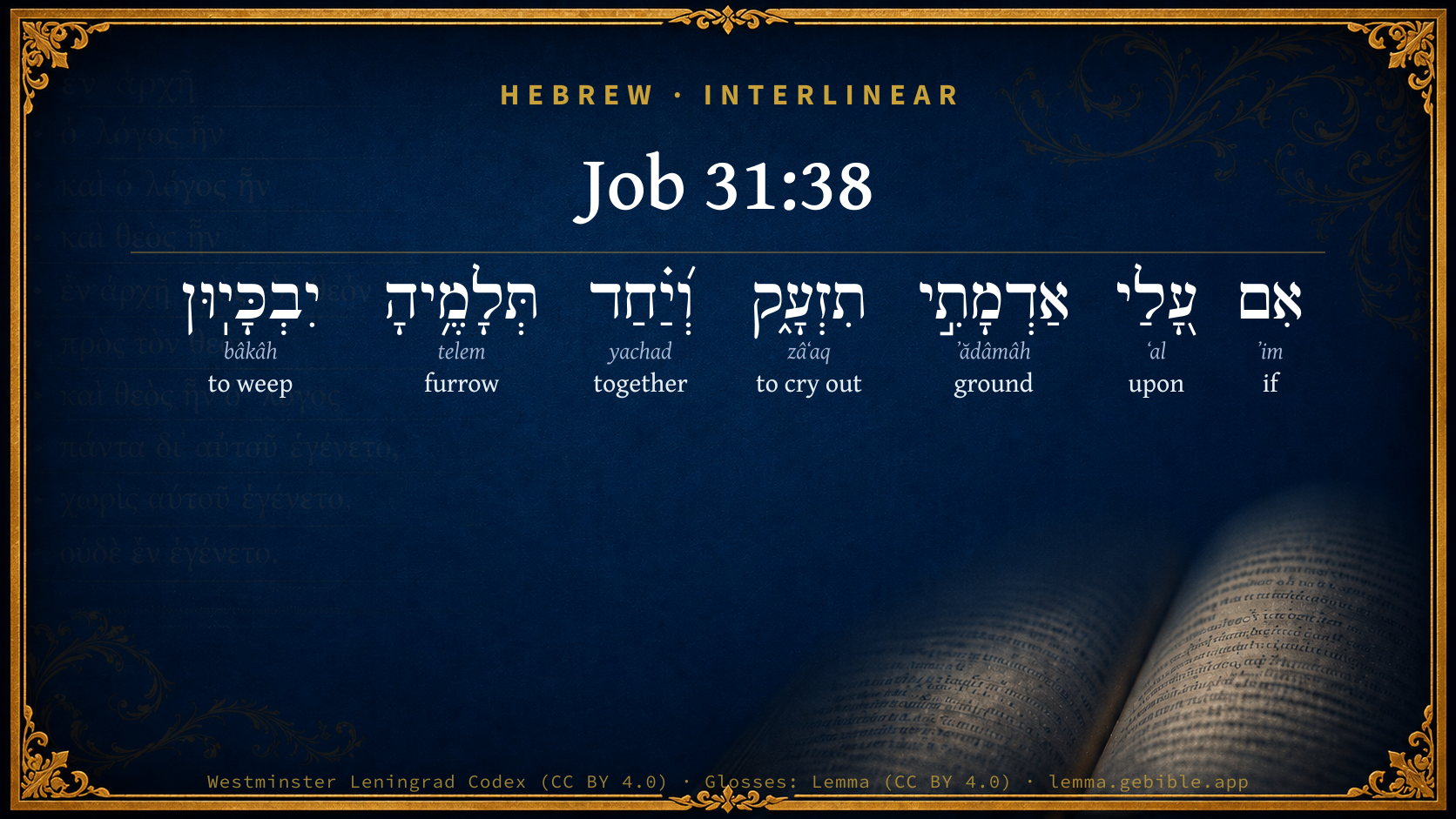
Job 31:38

Hebrew (Westminster Leningrad Codex) Job 31:38 appears in the Hebrew Old Testament. The text above is from the Westminster Leningrad Codex. Each word links to its Strong’s number, a concise gloss, and parsing drawn from the Open Scriptures Hebrew Bible morphology. Click any word for its full Brown-Driver-Briggs (BDB) entry.
Download image
Cite this verse

Job 31:38 (World English Bible). Public Domain. Lemma interlinear Bible study tool, https://lemma.gebible.app/v/job/31/38.

Show BibTeX & RIS
BibTeX
RIS
English Translation
If my land cries out against me, And the furrows of it weep together;
World English Bible · Public Domain
Highlights
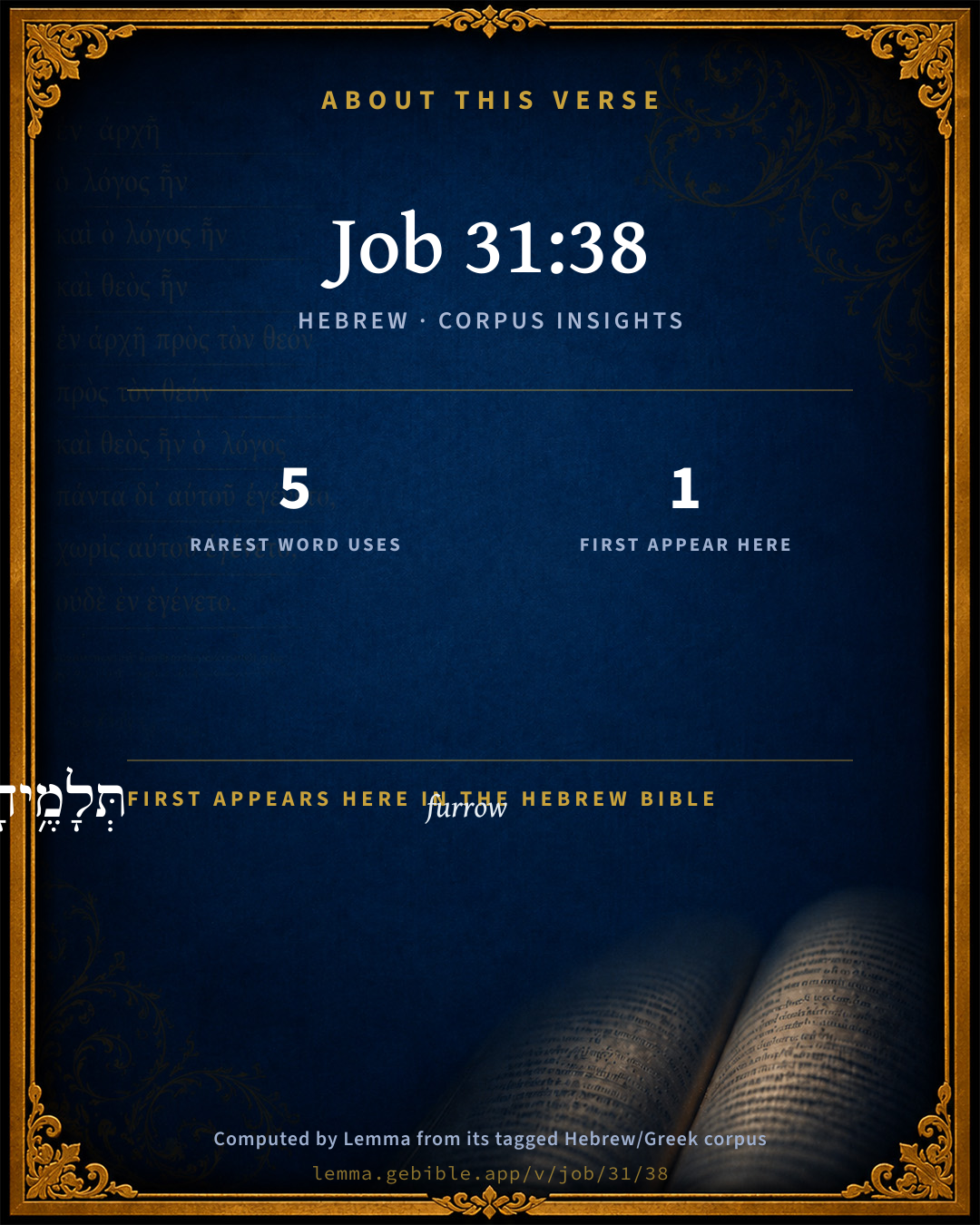
  • 1 first appearance in the Hebrew Bible
Full analysis ↓
Download a study sheet

One document with this verse’s original text, its word-by-word gloss line, the meaning frame, cross-references with their text, attributed commentary, and full source and license credits — printable, and it pastes into notes with its structure intact.

This verse Autodidact and up

Study sheet (.html) Plain text (.txt)

A passage Seminary Student

Up to 50 verses in one chapter. A passage sheet keeps up to 6 commentary sources and 12 cross-references per verse, in the order this page ranks them, and says so on the sheet whenever that leaves anything out. Ask for a single verse and you get the Autodidact verse sheet above.

Everything on this page stays free to read, with no account — the sheet is a download of what is already on screen, not access to it.

Want to remove ads? Support Godless Engineer
Compare translations 3

The same verse in 3 English versions, stacked beneath the original-language interlinear above. Click any original word for its lexicon entry.

Each is an independent rendering of the whole verse — the interlinear is not word-aligned to these translations.

Highlighted words mark where these versions differ — a whole-verse word diff, not a word-by-word alignment.

  • World English Bible Public Domain
    If my land cries out against me, And the furrows of it weep together;
  • King James Version Public Domain
    If my land cry against me, or that the furrows likewise thereof complain;
  • unfoldingWord Literal Text CC BY-SA 4.0
    If my soil cries out against me and its furrows weep together,

unfoldingWord Literal Text — © unfoldingWord, licensed CC BY-SA 4.0. Word-aligned USFM3 via Door43 (git.door43.org/unfoldingWord/en_ult).

Versions to compare (up to 4)

3 of 4 selected

Show all 18 translations

Every available English version of this verse, each an independent rendering of the whole verse.

  • World English Bible Public Domain
    If my land cries out against me, And the furrows of it weep together;
  • Berean Standard Bible Public Domain
    if my land cries out against me and its furrows weep together,
  • Majority Standard Bible Public Domain
    if my land cries out against me and its furrows weep together,
  • King James Version Public Domain
    If my land cry against me, or that the furrows likewise thereof complain;
  • American Standard Version (1901) Public Domain
    If my land crieth out against me, And the furrows thereof weep together;
  • Revised Version (1885) Public Domain
    If my land cry out against me, and the furrows thereof weep together;
  • Geneva Bible (1599) Public Domain
    If my lande cry against me, or the furrowes thereof complayne together,
  • Douay-Rheims (1899) Public Domain
    If my land cry against me, and with it the furrows thereof mourn:
  • Young's Literal Translation Public Domain
    If against me my land doth cry out, And together its furrows weep,
  • Literal Standard Version CC BY-SA 4.0
    If my land cries out against me, || And together its furrows weep,
  • Unlocked Literal Bible CC BY-SA 4.0
    If my land ever cries out against me, and its furrows weep together,
  • unfoldingWord Literal Text CC BY-SA 4.0
    If my soil cries out against me and its furrows weep together,
  • Darby Bible Public Domain
    If my land cry out against me, and its furrows weep together;
  • World Messianic Bible Public Domain
    If my land cries out against me, and its furrows weep together;
  • Webster's Bible Public Domain
    If my land crieth against me, or its furrows likewise complain;
  • Free Bible Version CC BY-SA 4.0
    If my land has cried out against me; if her furrows have wept over me;
  • Bible in Basic English Public Domain
    If my land has made an outcry against me, or the ploughed earth has been in sorrow;
  • JPS Tanakh (1917) Public Domain
    If my land cry out against me, and the furrows thereof weep together;

Literal Standard Version (2020), Covenant Press — licensed CC BY-SA 4.0. Text via the HelloAO Bible API (eBible.org). Unlocked Literal Bible (unfoldingWord) — licensed CC BY-SA 4.0. Text via the HelloAO Bible API (eBible.org). unfoldingWord Literal Text — © unfoldingWord, licensed CC BY-SA 4.0. Word-aligned USFM3 via Door43 (git.door43.org/unfoldingWord/en_ult). Free Bible Version, Dr. Jonathan Gallagher — licensed CC BY-SA 4.0. Text via the HelloAO Bible API (eBible.org).

Word by word

More ways to search: Search by grammar → Find every occurrence → Compare this word →

Practice this passage: Drill this verse → Learn its vocabulary →

About this verse

These counts appear in no published source. They are computed here, from the morphology-tagged text and Lemma’s own curated glosses. What Lemma adds →

7
words
7
distinct lemmas
Wisdom
section

Notable vocabulary

The rarest word here is תְּלָמֶ֥יהָ furrow H8525 — appearing just 5 times in the whole Hebrew Bible.

First appearance in Scripture

This word makes its first canonical appearance in the Hebrew Bible here:

  • תְּלָמֶ֥יהָ furrow H8525

Shared distinctive vocabulary

תְּלָמֶ֥יהָ furrow H8525 occurs in 5 verses of the Hebrew Bible. Also found in:

Grammatical profile

  • 2 verbs
  • 2 nouns
  • 1 preposition
  • 1 conjunction
  • 1 adverb

Verb forms

  • תִזְעָ֑ק Qal · Imperfect
  • יִבְכָּיֽוּן Qal · Imperfect

Hebrew & Septuagint length

In English translation the verse runs 14 words from the Hebrew and 15 from the Septuagint (LXX English) — closely comparable.

A rough comparison of the two English renderings, which tokenize alike — not a word-level alignment.

Word counts can differ between the Hebrew and the Greek without any difference in meaning — e.g. the Hebrew direct-object marker אֵת has no separate Greek word, and Greek often adds the article ὁ.

Cross-references

4

Topical passages linked to Job 31:38 in the Treasury of Scripture Knowledge — connected by theme and wording, ordered by reader-vote popularity; previews shown in the World English Bible.

  • Habakkuk 2:11 For the stone will cry out of the wall, and the beam out of the woodwork will answer it.
  • Job 20:27 The heavens shall reveal his iniquity, The earth shall rise up against him.
  • Psalms 65:13 The pastures are covered with flocks. The valleys also are clothed with grain. They shout for joy! They also sing.
  • James 5:4 Behold, the wages of the laborers who mowed your fields, which you have kept back by fraud, cry out, and the cries of those who reaped have entered into the ears of the Lord of Hosts.

Cross-references courtesy of OpenBible.info (CC BY 4.0).

Hebrew and Greek witnesses Masoretic Hebrew ↔ Greek Septuagint

The same verse in the two great witnesses to the Old Testament, shown verse-for-verse.

These are two independent witnesses, not word-aligned to each other, and the Septuagint is shown in lemma (dictionary) form.

Hebrew Job 31:38 Masoretic · Westminster Leningrad Codex

אִם עָ֭לַי אַדְמָתִ֣י תִזְעָ֑ק וְ֝יַ֗חַד תְּלָמֶ֥יהָ יִבְכָּיֽוּן

If my land cries out against me, And the furrows of it weep together;

World English Bible · Public Domain

Greek LXX Job 31:38 Septuagint · lemma form

εἰ ἐπί ἐγώ ποτέ ὁ γῆ στενάζω εἰ δέ καί ὁ αὖλαξ αὐτός κλαίω ὁμοθυμαδόν

If at any time the land groaned against me, and if its furrows mourned together;

LXX2012 (modern English Septuagint) · Public Domain

On this verse, Keil & Delitzsch discusses the Septuagint’s reading. Read the note in Commentary ↓

Hebrew: Westminster Leningrad Codex (CC BY 4.0). Greek: Septuagint (public domain); English from LXX2012 (modern English Septuagint) (Public Domain). How the Septuagint differs from the Hebrew →

Commentary

Notes on Job 31:38 from classic Christian and Jewish commentators (each source and its license shown beneath its notes). The classic Christian expositions comment on the surrounding passage and are grouped to its opening verse, so a note may address several verses; the Jewish commentaries on the Tanakh (Rashi and others) are per-verse, so they appear only where the commentator wrote on this verse.

Lemma curates 59 commentaries, every one of them public domain or Creative Commons licensed, each selected and text-cleaned for this edition rather than reprinted as found. About our sources →

Jamieson, Fausset & Brown

Robert Jamieson, A. R. Fausset & David Brown

Personification. The complaints of the unjustly ousted proprietors are transferred to the lands themselves (Job 31:20; Gen 4:10; Hab 2:11). If I have unjustly acquired lands (Job 24:2; Isa 5:8).

furrows--The specification of these makes it likely, he implies in this, "If I paid not the laborer for tillage"; as Job 31:39, "If I paid him not for gathering in the fruits." Thus of the four clauses in Job 31:38-39, the first refers to the same subject as the fourth, the second is connected with the third by introverted parallelism. Compare Jam 5:4, which plainly alludes to this passage: compare "Lord of Sabaoth" with Job 31:26 here.

Jamieson, Fausset & Brown — Commentary Critical and Explanatory on the Whole Bible (1871) — public domain (CC PDM 1.0). Text via the HelloAO Bible API.

Trapp's Complete Commentary

John Trapp

Job 31:38 If my land cry against me, or that the furrows likewise thereof complain;

Ver. 38. If my land cry against me] As unjustly gotten; where we have an elegant personification not unlike that of the prophet, Hab 2:11-12, where the stone out of the wall cries out against the oppressor, and the tignum e ligno, the beam out of the timber, answereth it by a woeful antiphony. It hath been noted before, that Goropius will have the English to be called Angli, because they were good anglers, and had skill to lay various baits when they fished for other men’s livings. May it be our care to disprove him, and to show ourselves angels rather (as Gregory the Great derived us), and our land to be Regnum Dei, the kingdom of God, as it was anciently counted and called, by the holiness and righteousness exercised among us (Polydore Virgil). These two make up one perfect pair of compasses, which can take the true latitude of an upright heart (such as Job’s was, witness this whole chapter). The first, like the top of Jacob’s ladder, reacheth up to heaven; the second, like the foot of the ladder, resteth on the earth, or rather walketh about in a perfect circle of all such duties as one man oweth to another. Job was famous for both, whatever his friends surmised or suggested to the contrary. He was righteously religious and religiously righteous; exercising the first table of the law in the second, and caring to keep always a conscience void of offence toward God and toward men, Act 24:16.

Or that the furrows thereof likewise complain] Si plorant porcae. Heb. Weep, sc. As it were, out of a desire after their own right owner, from whom they are detained, as was Naboth’s vineyard.

John Trapp, A Commentary or Exposition upon All the Books of the Old and New Testament (1647–1656) — public domain. Text from a community e-Sword module.

Joseph Benson's Commentary

Job 31:38-40. If my land cry against me — To wit, to God, for revenge,

(as the like phrase signifies, Gen 4:10; Hab 2:11,) because I have gotten it from the right owners by fraud or violence, as my friends accuse me. If I have eaten the fruits thereof without money — Either without paying the price required by the right owner of the land, or by defrauding the workmen of the wages of their labours. Or have caused the owners to lose their life — Killing them, that I might have undisturbed possession of it, as Ahab did Naboth. The words of Job are ended — To wit, in answer to his friends: for he speaks but little afterward, and that is to God.

Joseph Benson's Commentary on the Old and New Testaments (1811–1818) — public domain. Text from a community e-Sword module.

Keil & Delitzsch

C. F. Keil & F. Delitzsch

38 If my field cry out against me,

And all together its furrows weep;

39 If I have devoured its strength without payment,

And caused the soul of its possessor to expire:

40 May thistles spring up instead of wheat,

And darnel instead of barley.

The field which he tills has no reason to cry out on account of violent treatment, nor its furrows to weep over wrong done to them by their lord.

(Note: In a similar figure a Rabbinic proverb says (with reference to Mal 2:13), that the altar of God weeps over him who separates himself from the wife of his youth.)

אדמה, according to its radical signification, is the covering of earth which fits close upon the body of the earth as its skin, and is drawn flat over it, and therefore especially the arable land; תּלם (Arab. telem, not however directly referable to an Arab. root, but as also other words used in agriculture, probably borrowed from the North Semitic, first of all the Aramaic or Nabataic), according to the explanation of the Turkish Kamus, the "ditch-like crack which the iron of the ploughman tears in the field," not the ridge thrown up between every two furrows (vid., on Psa 65:11). He has not unlawfully used (which would be the reason of the crying and weeping) the usufruct of the field (כּח meton., as Gen 4:12, of the produce, proportioned to its capability of production) without having paid its value, by causing the life to expire from the rightful owner, whether slowly or all at once (Jer 15:9). The wish in Job 31:40 is still stronger than in Job 31:8, Job 31:12 : there the loss and rooting out of the produce of the field is desired, here the change of the nature of the land itself; the curse shall and must come upon it, if its present possessor has been guilty of the sin of unmerciful covetousness, which Eliphaz lays to his charge in Job 22:6-9.

According to the view of the Capuchin Bolducius (1637), this last strophe, Job 31:38, stood originally after Job 31:8, according to Kennicott and Eichhorn after Job 31:25, according to Stuhlmann after Job 31:34. The modern expositors retain it in its present position. Hirzel maintains the counter arguments: (1) that none of the texts preserved to us favour the change of position; (2) that it lay in the plan of the poet not to allow the speeches of Job to be rounded off, as would be the case by Job 31:35 being the concluding strophe, but to break off suddenly without a rhetorical conclusion. If now we imagine the speeches of Elihu as removed, God interrupts Job, and he must cease without having come to an end with what he had to say. But these counter arguments are an insufficient defence: for (1) there is a number of admitted misplacements in the Old Testament which exceed the Masora (e.g., Sa1 13:1; Jer 27:1), and also the lxx (e.g., Sa1 17:12, באנשׁים, lxx ἐν ἀνδράσιν, instead of בשׁנים); (2) Job's speech would gain a rhetorical conclusion by Job 31:38, if, as Hirzel in contradiction of himself supposes, Job 31:35 ought to be considered as a parenthesis, and Job 31:40 as a grammatical conclusion to the hypothetical clauses from Job 31:24 onwards. But if this strange view is abandoned, it must be supposed that with Job 31:38 Job intends to begin the assertion of his innocence anew, and is interrupted in this course of thought now begun, by Jehovah. But it is improbable that one has to imagine this in the mind of such a careful poet. Also the first word of Jehovah, "Who is this that darkeneth counsel with words without knowledge?" Job 38:2, is much more appropriate to follow directly on Job 31:37 than Job 31:40; for a new course of thought, which Jehovah's appearing interrupts, begins with Job 31:35; and the rash utterance, Job 31:37, is really a "darkening of the divine decree." For by declaring he will give an account to God, his judge, concerning each of his steps, and approach Him like a prince, Job does not merely express the injustice of the accusations raised by his human opponents, but he casts a reflection of injustice upon the divine decree itself, inasmuch as it appears to him to be a de facto accusation of God.

Nevertheless, whether Elihu's speeches are not be put aside as not forming an original portion of the book, or not, the impression that Job 31:38 follow as stragglers, and that Job 31:35 would form a more appropriate close, and a more appropriate connection for the remonstrance that follows, whether it be Jehovah's or Elihu's, remains. For the assertion in Job 31:38 cannot in itself be considered to be a justifiable boldness; but in Job 31:35 the whole condition of Job's inner nature is once more mirrored forth: his longing after God, by which Satan's prediction is destroyed; and his overstepping the bounds of humility, on account of which his affliction, so far as it is of a tentative character, cannot end before it is also become a refining fire to him. Therefore we cannot refrain from the supposition that it is with Job 31:38 just as with Isa 38:21 The lxx also found these two verses in this position; they belong, however, after Isa 38:6, as is clear in itself, and as is evident from Kg2 20:7 There they are accidentally omitted, and are now added at the close of the narration as a supplement. If the change of position, which is there an oversight, is considered as too hazardous here, Job 31:35 must be put in the special and close relation to the preceding strophe indicated by us in the exposition, and Job 31:38 must be regarded as a final rounding off (not as the beginning of a fresh course of thought); for instead of the previous aposiopeses, this concluding strophe dies away, and with it the whole confession, in a particularly vigorous, imprecative conclusion.

Let us once more take a review of the contents of the three sharply-defined monologues. After Job, in Job 27:1, has closed the controversy with the friends, in the first part to this trilogy, Job 29:1, he wishes himself back in the months of the past, and describes the prosperity, the activity, for the good of his fellow-men, and the respect in which he at that time rejoiced, when God was with him. It is to be observed here, how, among all the good things of the past which he longs to have back, Job gives the pre-eminence to the fellowship and blessing of God as the highest good, the spring and fountain of every other. Five times at the beginning of Job 29:1 in diversified expressions he described the former days as a time when God was with him. Look still further from the beginning of the monologue to its close, to the likewise very expressive כאשׁר אבלים ינחם. The activity which won every heart to Job, and toward which he now looks back so longingly, consisted of works of that charity which weeps with them that weep, and rejoices not in injustice, Job 29:12-17. The righteousness of life with which Job was enamoured, and which manifested itself in him, was therefore charity arising from faith (Liebe aus Glauben). He knew and felt himself to be in fellowship with God; and from the fulness of this state of being apprehended of God, he practised charity. He, however, is blessed who knows himself to be in favour with God, and in return loves his fellow-men, especially the poor and needy, with the love with which he himself is loved of God. Therefore does Job wish himself back in that past, for now God has withdrawn from him; and the prosperity, the power, and the important position which were to him the means for the exercise of his charity, are taken from him.

This contrast of the past and present is described in Job 30:1, which begins with ועתה. Men who have become completely animalized, rough hordes driven into the mountains, with whom he sympathized, but without being able to help them as he had wished, on account of their degeneracy, - these mock at him by their words and acts. Now scorn and persecution for the sake of God is the greatest honour of which a man can be accounted worthy; but, apart from the consideration that this idea could not yet attain its rightful expression in connection with the present, temporal character of the Old Testament, it was not further from any one than from him who in the midst of his sufferings for God's sake regards himself, as Job does now, as rejected of God. That scorn and his painful and loathesome disease are to him a decree of divine wrath; God has, according to his idea, changed to a tyrant; He will not hear his cry for help. Accordingly, Job can say that his welfare as a cloud is passed away. He is conscious of having had pity on those who needed help, and yet he himself finds no pity now, when he implores pity like one who, seated upon a heap of rubbish, involuntarily stretches forth his hand for deliverance. In this gloomy picture of the present there is not even a single gleam of light; for the mysterious darkness of his affliction has not been in the slightest degree lighted up for Job by the treatment the friends have adopted. Also he is as little able as the friends to think of suffering and sin as unconnected, for which very reason his affliction appears to him as the effect of divine wrath; and the sting of his affliction is, that he cannot consider this wrath just. From the demand made by his faith, which here and there breaks through his conflict, that God cannot allow him to die the death of a sinner without testifying to his innocence, Job nowhere attains the conscious conclusion that the motive of his affliction is love, and not wrath.

In the third part of the speech (Job 31:1), which begins with the words, "I had made a covenant," etc., without everywhere going into the detail of the visible conjunction of the thought, Job asserts his earnest struggle after sanctification, by delivering himself up to just divine punishment in case his conduct had been the opposite. The poet allows us to gain a clear insight into that state of his hero's heart, and also of his house, which was well-pleasing to God. Not merely outward adultery, even the adulterous look; not merely the unjust acquisition of property and goods, but even the confidence of the heart in such things; not merely the share in an open adoration of idols, but even the side-glance of the heart after them, is accounted by him as condemnatory. He has not merely guarded himself from using sinful curses against his enemies, but he has also not rejoiced when misfortune overtook them. As to his servants, even when he has had a dispute with any of them, he has not forgotten that master and servant, without distinction of birth, are creatures of one God. Towards orphans, from early youth onwards, he has practised such tender love as if he were their father; towards widows, as if he were their son. With the hungry he has shared his bread, with the naked his clothes; his subordinates had no reason to complain of niggardly sustenance; his house always stood open hospitably to the stranger; and, as the two final strophes affirm: he has not hedged in any secret sin, anxious only not to appear as a sinner openly, and has not drawn forth wailings and tears from the ground which he cultivated by avarice and oppressive injustice. Who does not here recognise a righteousness of life and endeavour, the final aim of which is purity of heart, and which, in its relation to man, flows forth in that love which is the fulfilling of the law? The righteousness of which Job (Job 29:14) says, he has put it on like a garment, and it has put him on, is essentially the same as that which the New Testament Preacher on the mount enjoins. As the work of an Israelitish poet, Job 31:1 is a most important evidence in favour of the assertion, that a life well-pleasing to God is not, even in the Old Testament, absolutely limited to the Israelitish nation, and that it enjoins a love which includes man as man within itself, and knows of no distinction.

If, now, Job can lay down the triumphant testimony of such a genuine righteousness of life concerning himself, in opposition to men's misconstruction, the contrast of his past and present becomes for the first time mysterious; but we are also standing upon the extreme boundary where the knot that has been tied must be untied. The injustice done to Job in the accusations which the friends bring against him must be laid bare by the appearance of accusation on the part of God, which his affliction casts upon him, being destroyed. With the highest confidence in a triumphant issue, even before the trial of his cause, Job longs, in the concluding words, Job 31:35, for the judicial decision of God. As a prince he will go before the Judge, and bind his indictment like a costly diadem upon his brow. For he is certain that he has not merited his affliction, that neither human nor divine accusation can do anything against him, and that he will remain conqueror - as over men, so over God Himself.

Thus has the poet, in this threefold monologue of Job, prepared the way for the catastrophe, the unravelment of the knot of the drama. But will God enter into a controversy respecting His cause with Job? This is contrary to the honour of God; and that Job desires it, is contrary to the lowliness which becomes him towards God. On this very account God will not at once acknowledge Job as His servant: Job will require first of all to be freed from the sinful presumption concerning God with which he has handled the problem of his sufferings. But he has proved himself to be a servant of God, in spite of the folly into which he has fallen; the design of Satan to tear him away from God is completely frustrated. Thus, therefore, after he has purified himself from his sin into which, both in word and thought, he has allowed himself to be drawn by the conflict of temptation, Job must be proved to be the servant of God in opposition to the friends.

But before God Himself appears in order to bring about the unravelment, there follow still four speeches, Job 32-37, of a speaker, for whose appearance the former part of the drama has in no way prepared us. It is also remarkable that they are marked off from the book of Job, as far as we have hitherto read, by the formula תּמּוּ דּברי איּוב, are ended the words of Job. Carey is of the opinion that these three words may possibly be Job's own closing dixi. According to Hahn, the poet means to imply by them that Job has now said all that he intended to say, so that it would now have been the friends' turn to speak. These views involve a perplexity like that of those who think that Psa 72:20 must be regarded as a constituent part of the Psalm. As in that position the words, "The prayers of David the son of Jesse are finished," are as a memorial-stone between the original collection and its later extensions, so this תמו דברי איוב, which is transferred by the lxx (καὶ ἐπαύσατο Ἰὼβ ῥήμασιν) to the historical introduction of the Elihu section, seems to be an important hint in reference to the origin of the book of Job in its present form. Since Job has come to an end with his speeches, and is silent at the four speeches of a new speaker, although they strongly enough provoke him to reply; according to the idea of the poet, Elihu's appearance is to be regarded as belonging to the catastrophe itself. And since a hasty glance at the speeches of Jehovah shows that they do not say anything concerning the motive and object of Job's affliction, these speeches of Elihu, in so far as they seem to be an integral part of the whole, as they cast light upon this dark point, will therefore prove in the midst of the action of the drama, what we know already from the prologue, that Job's affliction has not the wrath of God as its motive power, nor the punishment of Job as ungodly for its object. If the four speeches really furnish this, it is still not absolutely decisive in favour of their forming originally a part of the book. For it would be even possible that a second poet might have added a part, in harmony with its idea, to the work of the first. What we expect, moreover, is the mark of the same high poetic genius which we have hitherto regarded with amazement. But since we are now passing on the the exposition of these speeches, it must be with the assumption that they have a like origin with the whole, and that they also really belong to this whole with which they are embodied, in the place where they now stand. We shall only be able to form a conclusive judgment concerning the character of their form, the solution of their problem, and the manner of their composition, after the exposition is completed, by then taking a comprehensive and critical review of the impressions produced, and our observations.

Keil & Delitzsch — Biblical Commentary on the Old Testament (1861–1891) — public domain (CC PDM 1.0). Text via the HelloAO Bible API. (Old Testament only.)

Tyndale Open Study Notes

Tyndale Open Resources

31:38 The land was the chief witness to crimes committed upon it (20:27; see Gen 4:10; cp. Jas 5:4).

Tyndale Open Study Notes — © Tyndale Open Resources, licensed CC BY-SA 4.0. Text via the HelloAO Bible API.

Geneva Bible (1599)

Geneva Bible translators

As though I had withheld their wages that labored in it.

Geneva Bible (1599) marginal notes — public domain. Text via Bolls.life.

Adam Clarke's Commentary

Verse 38. If my land cry] The most careless reader may see that the introduction of this and the two following verses here, disturbs the connection, and that they are most evidently out of their place. Job seems here to refer to that law, Le 25:1-7, by which the Israelites were obliged to give the land rest every seventh year, that the soil might not be too much exhausted by perpetual cultivation, especially in a country which afforded so few advantages to improve the arable ground by manure. He, conscious that he had acted according to this law, states that his land could not cry out against him, nor its furrows complain. He had not broken the law, nor exhausted the soil.

Adam Clarke's Commentary on the Bible (1810–1826) — public domain. Text from a community e-Sword/MySword module.

Ellicott's Commentary for English Readers

(38) Or that the furrows likewise thereof complain.—Rather, Or if the furrows thereof weep together—a strong impersonation to express the consequence of oppression and wrong-doing. It is to be observed that throughout this defence Job has far more than traversed the indictment of his friends. He has shown that he has not only not broken the moral law, as they insinuated, but, much more, has shown himself exemplary in all the relations of life, so that, according to the narrator of the history, he was not only one that feared God and eschewed evil (Job_1:1), but also was perfect, i.e., of sincere and consistent conduct and upright.

A Bible Commentary for English Readers, edited by Charles John Ellicott (1878–1897) — public domain. Text from a community e-Sword module.

The Cambridge Bible for Schools and Colleges

gen. ed. J. J. S. Perowne

38. The literal meaning of the figurative expressions in this verse is given in Job_31:39. The land, unjustly seized, is supposed to cry out to heaven against the cruelty and wrong done its true owner from whom it had been robbed (“without money,” Job_31:39). The land and its rightful owner have a common cause, it feels and weeps over the injury he has suffered.

38–40. Job resumes his protestations, imprecating a curse upon his lands if he have acquired them unjustly, and wishing that they may bring forth weeds instead of grain.

38. If my land cry out against me,

And the furrows thereof weep together;

39. If I have eaten the fruits thereof without money,

And caused the soul of its owners to expire:

40. Let thistles, &c.

The Cambridge Bible for Schools and Colleges (gen. ed. J. J. S. Perowne; Cambridge University Press, 1878–1918) — public domain. Text from a community e-Sword module.

John Gill's Exposition

Let thistles grow instead of wheat, and cockle instead of barley,.... This is an imprecation of Job's, in which he wishes that if what he had said was not true, or if he was guilty of the crimes he denied, that when and where he sowed wheat, thorns or thistles might come up instead of it, or tares, as some Jewish writers (d) interpret it; and that when and where he should sow barley, cockle, or darnel, or any "stinking" or "harmful" weed (e), as the word signifies, might spring up in room of it; respect seems to be had to the original curse upon the earth, and by the judgment of God is sometimes the case, that a fruitful land is turned into barrenness for the wickedness of them that dwell in it, Gen 3:18;

the words of Job are ended; which is either said by himself, at the close of his speech; thus far says Job, and no farther, having said enough in his own defence, and for the confutation of his antagonists, and so closes in a way of triumph: or else this was added by Moses, supposed to have written this book; or by some other hand, as Ezra, upon the revision of it, and other books of the Old Testament, when put in order by him: and these were the last words of Job to his friends, and in vindication of himself; for though there is somewhat more said afterwards by him, and but little, yet to God, and by way of humiliation, acknowledging his sin, and repentance for it with shame and abhorrence; see Job 40:3. Jarchi, and so the Midrash, understand this concluding clause as all imprecation of Job's; that if he had done otherwise than he had declared, he wishes that these might be his last words, and he become dumb, and never open his mouth more; but, as Bar Tzemach observes, the simple sense is, that his words were now completed and finished, just as the prayers of David, the son of Jesse, are said to be, Psa 72:20.

(d) Bar Tzemach, et alii. (e) "herba foetens", Montanus, Bolducius; "spina foetida", Drusius; "vitium frugum", Junius & Tremellius, Piscator; "labrusca", Cocceius, Schultens.

Next: Job Chapter 32

John Gill's Exposition of the Whole Bible (1746–1763) — public domain (CC PDM 1.0). Text via the HelloAO Bible API.

Albert Barnes' Notes on the Bible

If my land cry against me - This is a new specification of an offence, and an imprecation of an appropriate punishment if he had been guilty of it. Many have supposed that these closing verses have been transferred from their appropriate place by an error of transcribers, and that they should have been inserted between Job 31:23-24 - or in some previous part of the chapter. It is certain that Job 31:35-37 would make an appropriate and impressive close of the chapter, being a solemn appeal to God in reference to all the specifications, or to the general tenor of his life; but there is no authority from the MSS. to make any change in the present arrangement. All the ancient versions insert the verses in the place which they now occupy, and in this all versions agree, except, according to Kennicott, the Teutonic version, where they are inserted after Job 31:25. All the MSS. also concur in the present arrangement.

Schultens supposes that there is manifest pertinency and propriety in the present arrangement. The former specification, says he, related mainly to his private life, this to his more public conduct; and the design is to vindicate himself from the charge of injustice and crime in both respects, closing appropriately with the latter. Rosenmuller remarks that in a composition composed in an age and country so remote as this, we are not to look for or demand the observance of the same regularity which is required by the modern canons of criticism. At all events, there is no authority for changing the present arrangement of the text. The meaning of the phrase “if my land cry out against me” is, that in the cultivation of his land he had not been guilty of injustice. He had not employed those to till it who had been compelled to do it, nor had he imposed on them unreasonable burdens, nor had he defrauded them of their wages. The land had not had occasion to cry out against him to God, because fraud or injustice had been done to any in its cultivation; compare Gen 4:10; Hab. ii. 11.

Or that the furrows likewise thereof complain - Margin, weep. The Hebrew is, “If the furrows weep together,” or “in like manner weep.” This is a beautiful image. The very furrows in the field are personified as weeping on account of injustice which would be done them, and of the burdens which would be laid on them, if they were compelled to contribute to oppression and fraud.

Albert Barnes' Notes on the Bible (1834–1885) — public domain. Text from a community e-Sword/MySword module.

Haydock's Catholic Bible Commentary

Mourn, as if I possessed the land unjustly, or had committed some crime.

George Leo Haydock (1774–1849), Haydock's Catholic Family Bible and Commentary, 1859 edition — public domain. Excludes Psalms (Douay-Rheims chapter numbering differs from Protestant) and Deuterocanonical books (Catholic canon only).

Matthew Poole's English Annotations

To wit, to God for revenge, as the like phrase is used, Gen 4:10; Hab 2:11, because I have gotten it from the right owners by fraud or violence, as my friends charge me, and as is implied in the next verse.

Matthew Poole's English Annotations on the Holy Bible (1683–1685) — public domain. Text from a community e-Sword/MySword module.

Whedon's Commentary on the Bible

Daniel D. Whedon

38-39. Some, without good ground, have thought that these verses are misplaced, and that they should have appeared before in the list of affirmations; according to Eichhorn, after Job_31:25; and Stuhlmann, after Job_31:34. Such criticism, forgetful that nature loves irregularities of landscape, would reduce all to the same dead level. The perfection of this defence is secured by this last solemn asseveration. Seemingly an after-consideration, it looks boldly in the face the most serious of all the charges, the unnamed something which the friends have darkly hinted, — for instance, Bildad, in chap. 8; Zophar in chaps. 11 and 20; and Eliphaz in chap. 22. Comp. Job_13:23.

38. Complain — Weep. The rabbinical proverb embodies a similar figure, “The altar of God weeps over him who separates himself from the wife of his youth.” Comp. Hab_2:11.

Daniel D. Whedon (gen. ed.), Commentary on the Old and New Testaments (1874–1909) — public domain. Text from a community e-Sword module.

The Pulpit Commentary

Vers. 38-40. It is generally supposed that these verses, with the exception of the last clause of ver. 40, are misplaced. As a termination, they form an anti-climax, and greatly weaken the peroration. Their proper place would seem to be between vers. 32 and 33.

If my land cry against me; i.e. if my land disclaim my ownership, as having been acquired by wrong or robbery. If the furrows likewise thereof complain; or, weep, as having been torn from their rightful proprietors, and seized by a stranger. The apodosis is in ver. 40.

The Pulpit Commentary (1880–1919), ed. H.D.M. Spence-Jones & Joseph S. Exell — public domain. Text from a community e-Sword module.

John Wesley's Explanatory Notes

Cry - Because I have gotten it by fraud or violence.

John Wesley, Explanatory Notes Upon the Whole Bible (1754–1765) — public domain. Text via the GEBible commentary corpus.

unfoldingWord translationNotes

Door43 World Missions Community

General Information:

This concludes Job's description of situations in which he would deserve God's punishment, but he knows they are not true. (See: Hypothetical Situations)

If my land ever cries out against me, and its furrows weep together

Job speaks of being guilty as if his land were a person who cries out against Job because of the wrong Job has done to the land. AT: "If I have done wrong concerning my land" or "If I have stolen my land from someone" (See: Personification)

to lose their lives

This represents dying. AT: "to die" (See: Metonymy)

weeds instead of barley

The words "let" and "grow" are understood from the previous phrase. AT: "let weeds grow instead of barley" (See: Ellipsis)

translationWords

harvest

life

thorn

wheat

barley

word

unfoldingWord translationNotes — © Distant Shores Media and the Door43 World Missions Community, licensed CC BY-SA 4.0. Source: git.door43.org/Door43/en_tn.

Rashi

Rabbi Shlomo Yitzchaki (Rashi)

If my soil complains about me concerning the gleanings, the forgotten sheaves, and the end [of the field], as well as tithes, [claiming] that I did not extract tithes properly.

and its furrows weep together that I plowed with an ox and with a donkey together.

Rashi on the Tanakh — English translations: “The Judaica Press complete Tanach with Rashi, translated by A. J. Rosenberg” (CC BY 4.0); “Pentateuch with Rashi's commentary by M. Rosenbaum and A.M. Silbermann, 1929-1934” (public domain); “The Metsudah Tanach series, Lakewood, N.J” (CC BY 4.0); and “The Book of Joshua, Metsudah Publications, 1997” (CC BY 4.0). Text via Sefaria.

Lesson kit

Teaching starters — assembled from the data on this page, not authored interpretation. Every prompt links to the verse data it draws on. Edit before teaching.

Job, in the Wisdom, opens this verse with 7 words (7 distinct Hebrew lemmas). Its most distinctive word is telem (“furrow”). A historical commentator’s framing appears above. Read the whole chapter for the surrounding context.

Discussion questions

  1. What does “furrow” (telem) contribute to the verse as a whole?
  2. The word “furrow” first appears here in Scripture. What is being introduced at this debut?
  3. Job 39:10 shares the word «furrow» with this verse. How do the two illuminate each other?
  4. These translations render this verse differently. What is at stake in choosing one wording over another?
  5. The verb «תִזְעָ֑ק» is Qal Imperfect. How does its form color the action?
  6. Reading how Jamieson, Fausset & Brown and Trapp's Complete Commentary read this verse, where do the two commentators agree and where do they part?

Things to notice

Reading settings

Reading text

Shown beneath each verse's original-language words.

Old Testament
Old Testament edition

Read the OT as the Masoretic Hebrew (MT) or the Greek Septuagint (LXX).

English shown for the Greek Septuagint (in the Hebrew ↔ Greek comparison).

Comparing translations? Open the Compare panel on any verse page to stack up to four side by side.