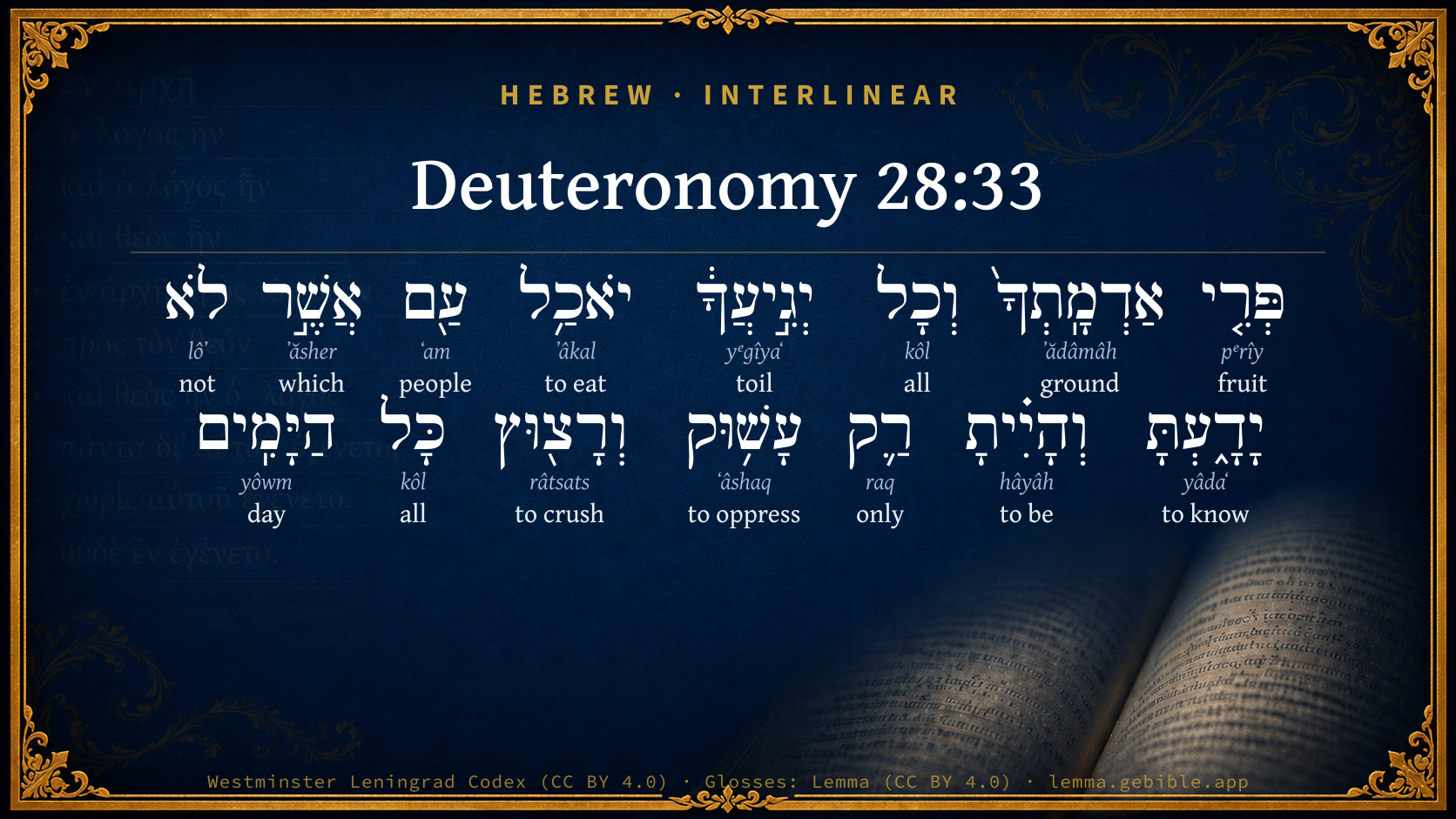
Deuteronomy 28:33

Hebrew (Westminster Leningrad Codex) Deuteronomy 28:33 appears in the Hebrew Old Testament. The text above is from the Westminster Leningrad Codex. Each word links to its Strong’s number, a concise gloss, and parsing drawn from the Open Scriptures Hebrew Bible morphology. Click any word for its full Brown-Driver-Briggs (BDB) entry.
Download image
Cite this verse

Deuteronomy 28:33 (World English Bible). Public Domain. Lemma interlinear Bible study tool, https://lemma.gebible.app/v/deuteronomy/28/33.

Show BibTeX & RIS
BibTeX
RIS
English Translation
The fruit of your ground, and all your labors, shall a nation which you don't know eat up; and you shall be only oppressed and crushed always;
World English Bible · Public Domain
Download a study sheet

One document with this verse’s original text, its word-by-word gloss line, the meaning frame, cross-references with their text, attributed commentary, and full source and license credits — printable, and it pastes into notes with its structure intact.

This verse Autodidact and up

Study sheet (.html) Plain text (.txt)

A passage Seminary Student

Up to 50 verses in one chapter. A passage sheet keeps up to 6 commentary sources and 12 cross-references per verse, in the order this page ranks them, and says so on the sheet whenever that leaves anything out. Ask for a single verse and you get the Autodidact verse sheet above.

Everything on this page stays free to read, with no account — the sheet is a download of what is already on screen, not access to it.

Want to remove ads? Support Godless Engineer
Compare translations 3

The same verse in 3 English versions, stacked beneath the original-language interlinear above. Click any original word for its lexicon entry.

Each is an independent rendering of the whole verse — the interlinear is not word-aligned to these translations.

Highlighted words mark where these versions differ — a whole-verse word diff, not a word-by-word alignment.

  • World English Bible Public Domain
    The fruit of your ground, and all your labors, shall a nation which you don't know eat up; and you shall be only oppressed and crushed always;
  • King James Version Public Domain
    The fruit of thy land, and all thy labors, shall a nation which thou knowest not eat up; and thou shalt be only oppressed and crushed alway:
  • unfoldingWord Literal Text CC BY-SA 4.0
    A nation that you do not know will eat the fruit of your land and all your labor, and you will be only oppressed and crushed all the days.

unfoldingWord Literal Text — © unfoldingWord, licensed CC BY-SA 4.0. Word-aligned USFM3 via Door43 (git.door43.org/unfoldingWord/en_ult).

Versions to compare (up to 4)

3 of 4 selected

Show all 18 translations

Every available English version of this verse, each an independent rendering of the whole verse.

  • World English Bible Public Domain
    The fruit of your ground, and all your labors, shall a nation which you don't know eat up; and you shall be only oppressed and crushed always;
  • Berean Standard Bible Public Domain
    A people you do not know will eat the produce of your land and of all your toil. All your days you will be oppressed and crushed.
  • Majority Standard Bible Public Domain
    A people you do not know will eat the produce of your land and of all your toil. All your days you will be oppressed and crushed.
  • King James Version Public Domain
    The fruit of thy land, and all thy labors, shall a nation which thou knowest not eat up; and thou shalt be only oppressed and crushed alway:
  • American Standard Version (1901) Public Domain
    The fruit of thy ground, and all thy labors, shall a nation which thou knowest not eat up; and thou shalt be only oppressed and crushed alway;
  • Revised Version (1885) Public Domain
    The fruit of thy ground, and all thy labours, shall a nation which thou knowest not eat up; and thou shalt be only oppressed and crushed alway:
  • Geneva Bible (1599) Public Domain
    The fruite of thy land and all thy labours shall a people, which thou knowest not, eate, and thou shalt neuer but suffer wrong, and violence alway:
  • Douay-Rheims (1899) Public Domain
    May a people which thou knowest not, eat the fruits of thy land, and all thy labours: and mayst thou always suffer oppression, and be crushed at all times.
  • Young's Literal Translation Public Domain
    The fruit of thy ground, and all thy labour, eat up doth a people whom thou hast not known; and thou hast been only oppressed and bruised all the days;
  • Literal Standard Version CC BY-SA 4.0
    A people whom you have not known eat the fruit of your ground and all your labor; and you have been only oppressed and bruised [for] all the days;
  • Unlocked Literal Bible CC BY-SA 4.0
    The harvest of your land and of all your labors—a nation that you do not know will eat it up; you will always be oppressed and crushed,
  • unfoldingWord Literal Text CC BY-SA 4.0
    A nation that you do not know will eat the fruit of your land and all your labor, and you will be only oppressed and crushed all the days.
  • Darby Bible Public Domain
    The fruit of thy ground and all thy labour, shall a people that thou knowest not eat up; and thou shalt be only oppressed and crushed continually.
  • World Messianic Bible Public Domain
    A nation which you don’t know will eat the fruit of your ground and all of your work. You will only be oppressed and crushed always,
  • Webster's Bible Public Domain
    The fruit of thy land, and all thy labors, shall be eaten by a nation which thou knowest not: and thou shalt be only oppressed and crushed always:
  • Free Bible Version CC BY-SA 4.0
    A foreign nation you've never heard of will eat all the crops you worked so hard to grow. You will be continually persecuted and downtrodden.
  • Bible in Basic English Public Domain
    The fruit of your land and all the work of your hands will be food for a nation which is strange to you and to your fathers; you will only be crushed down and kept under for ever:
  • JPS Tanakh (1917) Public Domain
    The fruit of thy land, and all thy labours, shall a nation which thou knowest not eat up; and thou shalt be only oppressed and crushed away:

Literal Standard Version (2020), Covenant Press — licensed CC BY-SA 4.0. Text via the HelloAO Bible API (eBible.org). Unlocked Literal Bible (unfoldingWord) — licensed CC BY-SA 4.0. Text via the HelloAO Bible API (eBible.org). unfoldingWord Literal Text — © unfoldingWord, licensed CC BY-SA 4.0. Word-aligned USFM3 via Door43 (git.door43.org/unfoldingWord/en_ult). Free Bible Version, Dr. Jonathan Gallagher — licensed CC BY-SA 4.0. Text via the HelloAO Bible API (eBible.org).

Word by word

More ways to search: Search by grammar → Find every occurrence → Compare this word →

Practice this passage: Drill this verse → Learn its vocabulary →

יְגִ֣יעֲךָ֔
yᵉgîyaʻ
H3018
“toil · your”
Noun, Common, Masculine, Singular, Construct + Suffix, Personal, 2nd Person, Masculine, Singular
Part of Speech
Noun
Type
Common
Gender
Masculine
Number
Singular
State
Construct
Full BDB Definition

Origin: from H3021

TWOT: 842e

toil, work - product, produce, acquired property (as a result of work)
  1. פְּרִ֤י pᵉrîy H6529 “fruit of” Noun, Common, Masculine, Singular, Construct
  2. אַדְמָֽתְךָ֙ ʼădâmâh H127 “ground · your” Noun, Common, Feminine, Singular, Construct + Suffix, Personal, 2nd Person, Masculine, Singular
  3. וְכָל kôl H3605 “and · all of” Conjunction + Noun, Common, Masculine, Singular, Construct
  4. יֹאכַ֥ל ʼâkal H398 “to eat” Verb, Qal, Imperfect, 3rd Person, Masculine, Singular
  5. עַ֖ם ʻam H5971 “people” Noun, Common, Masculine, Singular, Absolute
  6. אֲשֶׁ֣ר ʼăsher H834 “which” Particle, Relative
  7. לֹא lôʼ H3808 “not” Particle, Negative
  8. יָדָ֑עְתָּ yâdaʻ H3045 “to know” Verb, Qal, Perfect, 2nd Person, Masculine, Singular
  9. וְהָיִ֗יתָ hâyâh H1961 “and · to be” Conjunction + Verb, Qal, Sequential Perfect, 2nd Person, Masculine, Singular
  10. רַ֛ק raq H7535 “only” Particle, Accusative
  11. עָשׁ֥וּק ʻâshaq H6231 “oppressed” Verb, Qal, Participle Passive, Masculine, Singular, Absolute
  12. וְרָצ֖וּץ râtsats H7533 “and · crushed” Conjunction + Verb, Qal, Participle Passive, Masculine, Singular, Absolute
  13. כָּל kôl H3605 “all of” Noun, Common, Masculine, Singular, Construct
  14. הַיָּמִֽים yôwm H3117 “the · days” Particle, Definite Article + Noun, Common, Masculine, Plural, Absolute

About this verse

These counts appear in no published source. They are computed here, from the morphology-tagged text and Lemma’s own curated glosses. What Lemma adds →

15
words
14
distinct lemmas
Pentateuch
section

Notable vocabulary

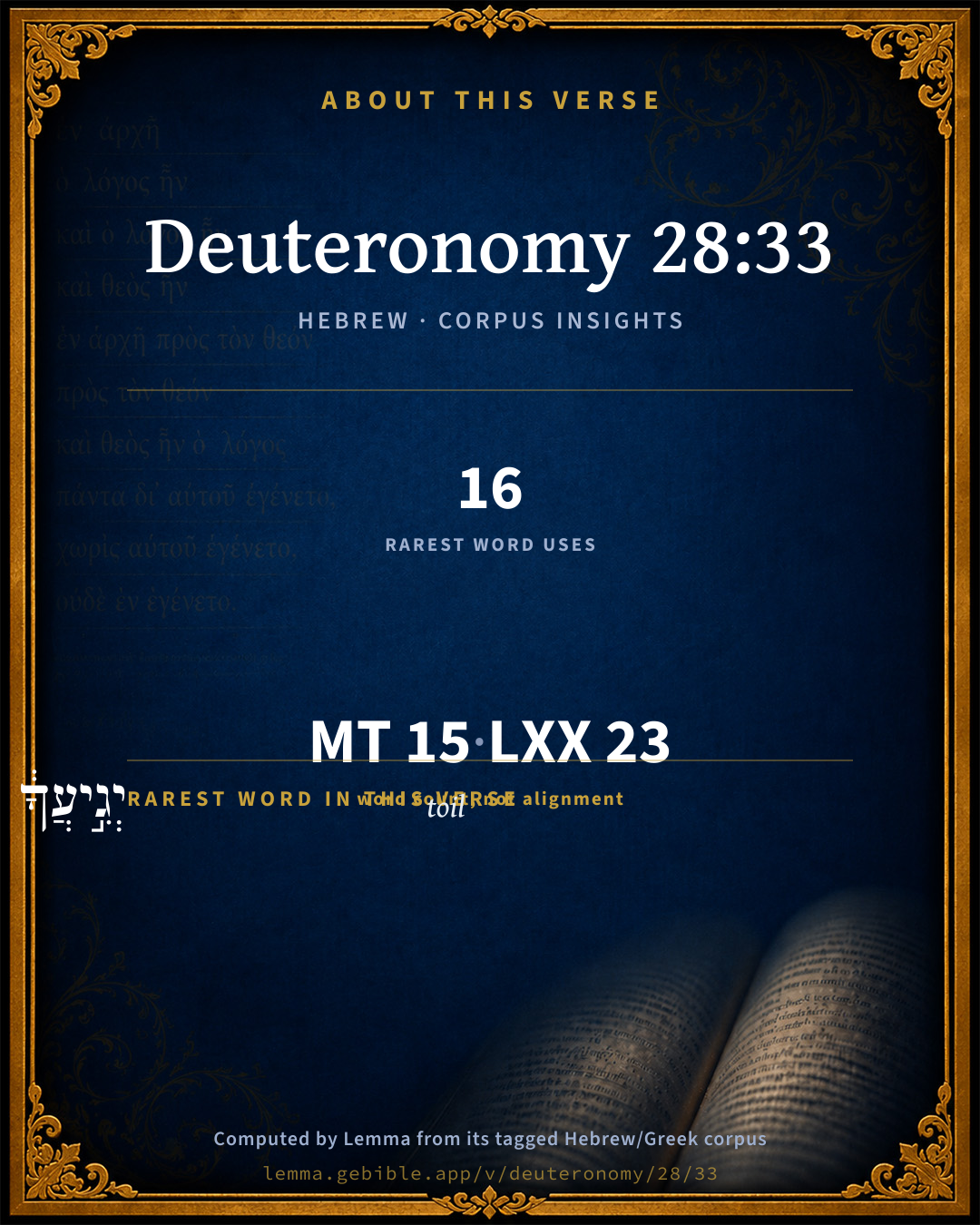
The rarest word here is יְגִ֣יעֲךָ֔ toil H3018 — appearing just 16 times in the whole Hebrew Bible.

Shared distinctive vocabulary

יְגִ֣יעֲךָ֔ toil H3018 occurs in 16 verses of the Hebrew Bible. Also found in:

Grammatical profile

  • 5 verbs
  • 7 nouns
  • 3 particles

Verb forms

  • יֹאכַ֥ל Qal · Imperfect
  • יָדָ֑עְתָּ Qal · Perfect
  • וְהָיִ֗יתָ Qal · Sequential Perfect
  • עָשׁ֥וּק Qal · Participle Passive
  • וְרָצ֖וּץ Qal · Participle Passive

Repetition

A word recurs within this verse — often emphatic in Hebrew:

  • וְכָל all H3605 ×2

Hebrew & Septuagint length

In English translation the verse runs 27 words from the Hebrew and 25 from the Septuagint (LXX English) — closely comparable.

A rough comparison of the two English renderings, which tokenize alike — not a word-level alignment.

Word counts can differ between the Hebrew and the Greek without any difference in meaning — e.g. the Hebrew direct-object marker אֵת has no separate Greek word, and Greek often adds the article ὁ.

In the original languages it is 15 Hebrew tokens and 23 Greek tokens — but the two are counted differently (Hebrew bundles its prefixes and suffixes into one token; the Greek is in lemma form), so that isn’t a like-for-like length.

Cross-references

9

Topical passages linked to Deuteronomy 28:33 in the Treasury of Scripture Knowledge — connected by theme and wording, ordered by reader-vote popularity; previews shown in the World English Bible.

  • Jeremiah 5:17 They shall eat up your harvest, and your bread, [which] your sons and your daughters should eat; they shall eat up your flocks and your herds; they shall eat up your vines and your fig trees; they shall beat down your fortified cities, in which you trust, with the sword.
  • Leviticus 26:16 I also will do this to you: I will appoint terror over you, even consumption and fever, that shall consume the eyes, and make the soul to pine away; and you will sow your seed in vain, for your enemies will eat it.
  • Deuteronomy 28:29–30 and you shall grope at noonday, as the blind gropes in darkness, and you shall not prosper in your ways: and you shall be only oppressed and robbed always, and there shall be none to save you.
  • Deuteronomy 28:51 and shall eat the fruit of your cattle, and the fruit of your ground, until you are destroyed; that also shall not leave you grain, new wine, or oil, the increase of your cattle, or the young of your flock, until they have caused you to perish.
  • Nehemiah 9:36–37 Behold, we are servants this day, and as for the land that you gave to our fathers to eat the fruit of it and the good of it, behold, we are servants in it.
  • Isaiah 1:7 Your country is desolate. Your cities are burned with fire. Strangers devour your land in your presence, And it is desolate, As overthrown by strangers.
  • Jeremiah 4:17 As keepers of a field are they against her round about, because she has been rebellious against me, says Yahweh.
  • Jeremiah 5:15 Behold, I will bring a nation on you from far, house of Israel, says Yahweh: it is a mighty nation, it is an ancient nation, a nation whose language you don't know, neither understand what they say.
  • Jeremiah 8:16 The snorting of his horses is heard from Dan: at the sound of the neighing of his strong ones the whole land trembles; for they are come, and have devoured the land and all that is in it; the city and those who dwell therein.

Cross-references courtesy of OpenBible.info (CC BY 4.0).

Hebrew and Greek witnesses Masoretic Hebrew ↔ Greek Septuagint

The same verse in the two great witnesses to the Old Testament, shown verse-for-verse.

These are two independent witnesses, not word-aligned to each other, and the Septuagint is shown in lemma (dictionary) form.

Hebrew Deuteronomy 28:33 Masoretic · Westminster Leningrad Codex

פְּרִ֤י אַדְמָֽתְךָ֙ וְכָל יְגִ֣יעֲךָ֔ יֹאכַ֥ל עַ֖ם אֲשֶׁ֣ר לֹא יָדָ֑עְתָּ וְהָיִ֗יתָ רַ֛ק עָשׁ֥וּק וְרָצ֖וּץ כָּל הַיָּמִֽים

The fruit of your ground, and all your labors, shall a nation which you don't know eat up; and you shall be only oppressed and crushed always;

World English Bible · Public Domain

Greek LXX Deuteronomy 28:33 Septuagint · lemma form

ὁ ἐκφόριον ὁ γῆ σύ καί πᾶς ὁ πόνος σύ ἐσθίω ἔθνος ὅς οὐ ἐπίσταμαι καί εἰμί ἀδικέω καί θραύω πᾶς ὁ ἡμέρα

A nation which you know not shall eat the produce of your land, and all your labors; and you shall be injured and crushed always.

LXX2012 (modern English Septuagint) · Public Domain

Hebrew: Westminster Leningrad Codex (CC BY 4.0). Greek: Septuagint (public domain); English from LXX2012 (modern English Septuagint) (Public Domain). How the Septuagint differs from the Hebrew →

Targum (Aramaic paraphrase)

2

The Targum is the ancient Jewish Aramaic paraphrase of the Hebrew Scriptures — an interpretive translation, not the Hebrew text itself. Onkelos (literal) and Pseudo-Jonathan (expansive) render the Torah, and Jonathan the Prophets. Coverage is partial: where no permissively-licensed English translation exists for a verse, only the Aramaic is shown. This is verse-level text, not a word-by-word alignment to the Hebrew.

  1. Targum Onkelos Torah (Genesis–Deuteronomy)
    אִבָּא דְאַרְעָךְ וְכָל לֵאוּתָךְ יֵכוּל עַמָא דִי לָא יְדַעַתְּ וּתְהֵי בְּרַם עָשִׁיק וּרְעִיעַ כָּל יוֹמַיָא

    (no public-domain English translation for this verse)

    Targum Onkelos — Aramaic: “Onkelos Genesis” (public domain); “Onkelos Exodus” (public domain); “Onkelos Leviticus” (public domain); “Onkelos Numbers” (public domain); “Onkelos Deuteronomy” (public domain). English: “Sefaria Community Translation” (CC0 1.0 (public-domain dedication)); “J.W. Etheridge. The Targums of Onkelos and Jonathan Ben Uzziel on the Pentateuch. London: Longmans, Green, 1862” (public domain). Text via Sefaria.

  2. Targum Pseudo-Jonathan Torah (Genesis–Deuteronomy)
    פֵּירֵי אַרְעֲכוֹן וְכָל לֵיעוּתְכוֹן יְגַמֵר עַמָא דְלָא חַכִּימְתּוּן וְתֶהֱווֹן בְּרַם טְלִימִין וּדְרִיסִין כָּל יוֹמַיָא

    The fruitage of your ground, and of all your labour, will a people whom thou hast not known devour, and thou shalt be oppressed and trodden down all the days.

    Targum Pseudo-Jonathan — Aramaic: “Targum Jonathan on Genesis” (public domain); “Targum Jonathan on Exodus” (public domain); “Targum Jonathan on Leviticus” (public domain); “Targum Jonathan on Numbers” (public domain); “Targum Jonathan on Deuteronomy” (public domain). English: “The Targum of Jonathan ben Uzziel, trans. J. W. Etheridge, London, 1862” (public domain). Text via Sefaria.

Commentary

Notes on Deuteronomy 28:33 from classic Christian and Jewish commentators (each source and its license shown beneath its notes). The classic Christian expositions comment on the surrounding passage and are grouped to its opening verse, so a note may address several verses; the Jewish commentaries on the Tanakh (Rashi and others) are per-verse, so they appear only where the commentator wrote on this verse.

Lemma curates 59 commentaries, every one of them public domain or Creative Commons licensed, each selected and text-cleaned for this edition rather than reprinted as found. About our sources →

Trapp's Complete Commentary

John Trapp

Deu 28:33 The fruit of thy land, and all thy labours, shall a nation which thou knowest not eat up; and thou shalt be only oppressed and crushed alway:

Ver. 33. The fruit of thy land, &c.] So Eze 25:4. They shall eat thy fruit, and they shall drink thy milk. See Jer 5:17; Jer 1:7.

John Trapp, A Commentary or Exposition upon All the Books of the Old and New Testament (1647–1656) — public domain. Text from a community e-Sword module.

Joseph Benson's Commentary

Deu 28:33. Which thou knowest not — Who shall come from a far country, whom thou didst not at all expect or fear, and therefore will be the more dreadful when they come. This was remarkably fulfilled when Shalmaneser, king of Assyria, came and dispossessed the ten tribes, and when Nebuchadnezzar carried the other two tribes away, and placed other people in their room. Thou shalt be oppressed and crushed always — They were not to be quite rooted out and destroyed, as the Amalekites and Canaanites were, of whom no footsteps now remain; but to be scattered through other nations, and there oppressed, crushed, and enslaved.

Joseph Benson's Commentary on the Old and New Testaments (1811–1818) — public domain. Text from a community e-Sword module.

Ellicott's Commentary for English Readers

(33) A nation which thou knowest not.—Comp. Jer_5:15-17, “A nation whose language thou knowest not . . . shall eat up thy harvest and thy bread” &c.

A Bible Commentary for English Readers, edited by Charles John Ellicott (1878–1897) — public domain. Text from a community e-Sword module.

The Cambridge Bible for Schools and Colleges

gen. ed. J. J. S. Perowne

33. thou knowest not] So of the land of the invading nation, Jer_14:18; Jer_15:14; Jer_17:4; Jer_22:28.

The Cambridge Bible for Schools and Colleges (gen. ed. J. J. S. Perowne; Cambridge University Press, 1878–1918) — public domain. Text from a community e-Sword module.

John Gill's Exposition

And the Lord shall bring thee, and thy king which thou shall set over thee,.... This was fulfilled both in Jehoiachin and in Zedekiah, kings of Judah, who were carried captive to Babylon, by Nebuchadnezzar, Kg2 24:15,

unto a nation which neither thou nor thy fathers have known; the land of Babylon, which was at a distance from them, and is represented in Scripture as afar off, Jer 5:15; and which the Jews, not being a trading people, or dealing in merchandise in foreign parts, were unacquainted with:

and there shall thou serve other gods, wood and stone; which they were obliged to do in Babylon, of which it seems best to understand it; for though it may be interpreted of their compliance with the image worship of the Papists in their present condition, as the former clause may be of their rulers and governors, included in the name of king, carried captive by the Romans; who were a nation as little, if not less known than the Babylonians: but the former sense seems to suit best here, as this does with Deu 28:64; where the language is somewhat different, and very appropriate. The Targum of Jonathan is,"shall pay tribute to those that worship idols of wood and stone.''

John Gill's Exposition of the Whole Bible (1746–1763) — public domain (CC PDM 1.0). Text via the HelloAO Bible API.

Haydock's Catholic Bible Commentary

A people. The Gentiles, whom the Jews so much despised, and whom the Scripture styles not a nation, have supplanted the Israelites, and entered into the inheritance, which they had lost by their prevarications, Romans x. 19. (Haydock)

George Leo Haydock (1774–1849), Haydock's Catholic Family Bible and Commentary, 1859 edition — public domain. Excludes Psalms (Douay-Rheims chapter numbering differs from Protestant) and Deuterocanonical books (Catholic canon only).

Matthew Poole's English Annotations

Which thou knowest not; which shall come from a far country, which thou didst not at all expect or fear and therefore will be the more dreadful when they come; a nation whose language thou understandest not, and therefore canst not plead with them for mercy, nor expect any favour from them.

Oppressed and crushed alway; not sometimes conquered, and sometimes conquering, as the course of war commonly is, but in all times, and in all thy actions and attempts, foiled and worsted.

Matthew Poole's English Annotations on the Holy Bible (1683–1685) — public domain. Text from a community e-Sword/MySword module.

John Wesley's Explanatory Notes

Which thou knowest not - Which shall come from a far country, which thou didst not at all expect or fear, and therefore will be the more dreadful when they come; a nation whose language thou understandest not, and therefore canst not plead with them for mercy, nor expect any favour from them.

John Wesley, Explanatory Notes Upon the Whole Bible (1754–1765) — public domain. Text via the GEBible commentary corpus.

unfoldingWord translationNotes

Door43 World Missions Community

General Information:

Moses speaks to the Israelites as if they were one man, so the words "you" and "your" here are singular. (See: Forms of You)

a nation

Here the metonym "a nation" means the people from a nation. AT: "people from a nation" (See: Metonymy)

you will always be oppressed and crushed

The words "oppressed" and "crushed" mean basically the same thing. This can be stated in active form. AT: "they will always oppress and crush you" or "they will oppress you continually" (See: Doublet and Active or Passive)

you will become insane by what you have to see happen

"what you see will make you go crazy"

from which you cannot be cured

This can be stated in active form. AT: "that no one will be able to cure" (See: Active or Passive)

translationWords

harvest

labor

nation

oppress

cure

unfoldingWord translationNotes — © Distant Shores Media and the Door43 World Missions Community, licensed CC BY-SA 4.0. Source: git.door43.org/Door43/en_tn.

Lesson kit

Teaching starters — assembled from the data on this page, not authored interpretation. Every prompt links to the verse data it draws on. Edit before teaching.

Deuteronomy, in the Pentateuch, opens this verse with 15 words (14 distinct Hebrew lemmas). Its most distinctive word is yᵉgîyaʻ (“toil”). A historical commentator’s framing appears above. Read the whole chapter for the surrounding context.

Discussion questions

  1. The word yᵉgîyaʻ carries the sense “toil.” How does it shape the verse?
  2. How does Genesis 31:42, which shares the word «toil», read alongside this verse?
  3. What does the repetition of “all” (2× in this one verse) do in this verse?
  4. These translations render this verse differently. What is at stake in choosing one wording over another?
  5. «יֹאכַ֥ל» is a Qal Imperfect verb. How does that grammatical form shape the action described?
  6. Compare how Trapp's Complete Commentary and Joseph Benson's Commentary read this verse. Where do they agree or differ?

Things to notice

Reading settings

Reading text

Shown beneath each verse's original-language words.

Old Testament
Old Testament edition

Read the OT as the Masoretic Hebrew (MT) or the Greek Septuagint (LXX).

English shown for the Greek Septuagint (in the Hebrew ↔ Greek comparison).

Comparing translations? Open the Compare panel on any verse page to stack up to four side by side.