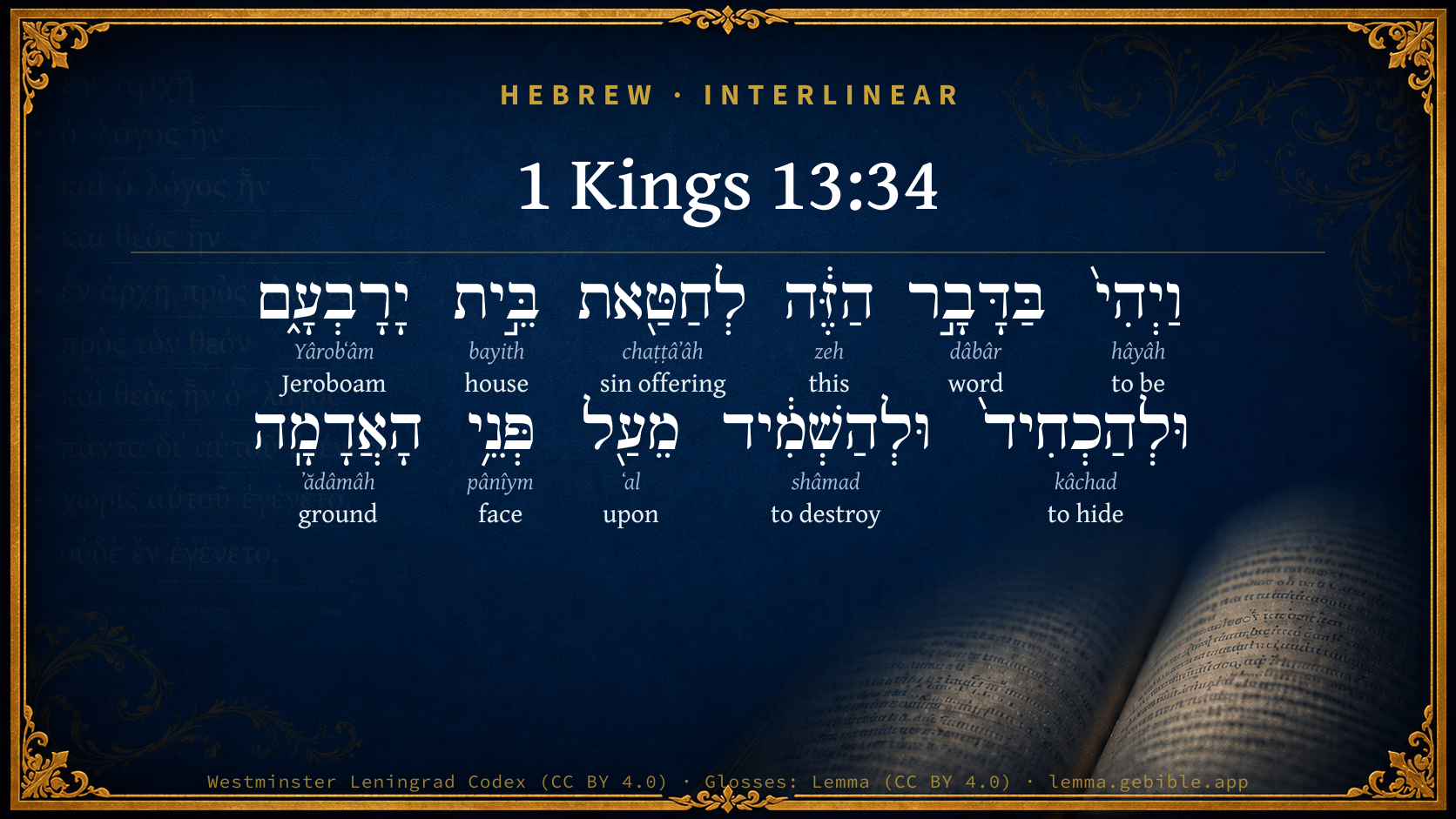
1 Kings 13:34

Hebrew (Westminster Leningrad Codex) 1 Kings 13:34 appears in the Hebrew Old Testament. The text above is from the Westminster Leningrad Codex. Each word links to its Strong’s number, a concise gloss, and parsing drawn from the Open Scriptures Hebrew Bible morphology. Click any word for its full Brown-Driver-Briggs (BDB) entry.
Download image
Cite this verse

1 Kings 13:34 (World English Bible). Public Domain. Lemma interlinear Bible study tool, https://lemma.gebible.app/v/1-kings/13/34.

Show BibTeX & RIS
BibTeX
RIS
English Translation
This thing became sin to the house of Jeroboam, even to cut it off, and to destroy it from off the surface of the earth.
World English Bible · Public Domain
Download a study sheet

One document with this verse’s original text, its word-by-word gloss line, the meaning frame, cross-references with their text, attributed commentary, and full source and license credits — printable, and it pastes into notes with its structure intact.

This verse Autodidact and up

Study sheet (.html) Plain text (.txt)

A passage Seminary Student

Up to 50 verses in one chapter. A passage sheet keeps up to 6 commentary sources and 12 cross-references per verse, in the order this page ranks them, and says so on the sheet whenever that leaves anything out. Ask for a single verse and you get the Autodidact verse sheet above.

Everything on this page stays free to read, with no account — the sheet is a download of what is already on screen, not access to it.

Want to remove ads? Support Godless Engineer
Compare translations 3

The same verse in 3 English versions, stacked beneath the original-language interlinear above. Click any original word for its lexicon entry.

Each is an independent rendering of the whole verse — the interlinear is not word-aligned to these translations.

Highlighted words mark where these versions differ — a whole-verse word diff, not a word-by-word alignment.

  • World English Bible Public Domain
    This thing became sin to the house of Jeroboam, even to cut it off, and to destroy it from off the surface of the earth.
  • King James Version Public Domain
    And this thing became sin unto the house of Jeroboam, even to cut it off, and to destroy it from off the face of the earth.
  • unfoldingWord Literal Text CC BY-SA 4.0
    And it became in this thing a sin of the house of Jeroboam, both to annihilate and to destroy from upon the face of the ground.

unfoldingWord Literal Text — © unfoldingWord, licensed CC BY-SA 4.0. Word-aligned USFM3 via Door43 (git.door43.org/unfoldingWord/en_ult).

Versions to compare (up to 4)

3 of 4 selected

Show all 18 translations

Every available English version of this verse, each an independent rendering of the whole verse.

  • World English Bible Public Domain
    This thing became sin to the house of Jeroboam, even to cut it off, and to destroy it from off the surface of the earth.
  • Berean Standard Bible Public Domain
    And this was the sin of the house of Jeroboam that led to its extermination and destruction from the face of the earth.
  • Majority Standard Bible Public Domain
    And this was the sin of the house of Jeroboam that led to its extermination and destruction from the face of the earth.
  • King James Version Public Domain
    And this thing became sin unto the house of Jeroboam, even to cut it off, and to destroy it from off the face of the earth.
  • American Standard Version (1901) Public Domain
    And this thing became sin unto the house of Jeroboam, even to cut it off, and to destroy it from off the face of the earth.
  • Revised Version (1885) Public Domain
    And this thing became sin unto the house of Jeroboam, even to cut it off, and to destroy it from off the face of the earth.
  • Geneva Bible (1599) Public Domain
    And this thing turned to sinne vnto the house of Ieroboam, euen to roote it out, and destroy it from the face of the earth.
  • Douay-Rheims (1899) Public Domain
    And for this cause did the house of Jeroboam sin, and was cut off and destroyed from the face of the earth.
  • Young's Literal Translation Public Domain
    And in this thing is the sin of the house of Jeroboam, even to cut `it' off, and to destroy `it' from off the face of the ground.
  • Literal Standard Version CC BY-SA 4.0
    And in this thing is the sin of the house of Jeroboam, even to cut [it] off, and to destroy [it] from off the face of the ground.
  • Unlocked Literal Bible CC BY-SA 4.0
    This matter became sin to the family of Jeroboam and caused his family to be destroyed and to be exterminated from the face of the earth.
  • unfoldingWord Literal Text CC BY-SA 4.0
    And it became in this thing a sin of the house of Jeroboam, both to annihilate and to destroy from upon the face of the ground.
  • Darby Bible Public Domain
    And by this thing there was sin on the house of Jeroboam, even to cut it off and to destroy it from off the face of the earth.
  • World Messianic Bible Public Domain
    This thing became sin to the house of Jeroboam, even to cut it off and to destroy it from off the surface of the earth.
  • Webster's Bible Public Domain
    And this thing became sin to the house of Jeroboam, even to cut it off, and to destroy it from the face of the earth.
  • Free Bible Version CC BY-SA 4.0
    It was because of this sin that the house of Jeroboam was wiped out, completely destroyed from the face of the earth.
  • Bible in Basic English Public Domain
    And this became a sin in the family of Jeroboam, causing it to be cut off and sent to destruction from the face of the earth.
  • JPS Tanakh (1917) Public Domain
    And by this thing there was sin unto the house of Jeroboam, even to cut it off, and to destroy it from off the face of the earth.

Literal Standard Version (2020), Covenant Press — licensed CC BY-SA 4.0. Text via the HelloAO Bible API (eBible.org). Unlocked Literal Bible (unfoldingWord) — licensed CC BY-SA 4.0. Text via the HelloAO Bible API (eBible.org). unfoldingWord Literal Text — © unfoldingWord, licensed CC BY-SA 4.0. Word-aligned USFM3 via Door43 (git.door43.org/unfoldingWord/en_ult). Free Bible Version, Dr. Jonathan Gallagher — licensed CC BY-SA 4.0. Text via the HelloAO Bible API (eBible.org).

Word by word

More ways to search: Search by grammar → Find every occurrence → Compare this word →

Practice this passage: Drill this verse → Learn its vocabulary →

וּלְהַכְחִיד֙
kâchad
H3582
“and · to hide”
Conjunction + Preposition + Verb, Hiphil, Infinitive Construct
Part of Speech
Conjunction + Preposition + Verb
Stem
Hiphil
Form
Infinitive Construct
Full BDB Definition

Origin: a primitive root

TWOT: 972

to hide, conceal, cut off, cut down, make desolate, kick - (Niphal) - to be hidden - to be effaced, be destroyed, be cut off - (Piel) to cover, hide - (Hiphil) - to hide - to efface, annihilate
  1. וַיְהִי֙ hâyâh H1961 “and · to be” Conjunction + Verb, Qal, Sequential Imperfect, 3rd Person, Masculine, Singular
  2. בַּדָּבָ֣ר dâbâr H1697 “in/at the · word” Preposition, Determined + Noun, Common, Masculine, Singular, Absolute
  3. הַזֶּ֔ה zeh H2088 “the · this” Particle, Definite Article + Pronoun, Demonstrative, Masculine, Singular
  4. לְחַטַּ֖את chaṭṭâʼâh H2403 “to/for · sin offering of” Preposition + Noun, Common, Feminine, Singular, Construct
  5. בֵּ֣ית bayith H1004 “house of” Noun, Common, Masculine, Singular, Construct
  6. יָרָבְעָ֑ם Yârobʻâm H3379 “Jeroboam” Noun, Proper
  7. וּלְהַשְׁמִ֔יד shâmad H8045 “and · to destroy” Conjunction + Preposition + Verb, Hiphil, Infinitive Construct
  8. מֵעַ֖ל ʻal H5921 “from · upon” Preposition + Preposition
  9. פְּנֵ֥י pânîym H6440 “face(s) of” Noun, Common, Both, Plural, Construct
  10. הָאֲדָמָֽה ʼădâmâh H127 “the · ground” Particle, Definite Article + Noun, Common, Feminine, Singular, Absolute

About this verse

These counts appear in no published source. They are computed here, from the morphology-tagged text and Lemma’s own curated glosses. What Lemma adds →

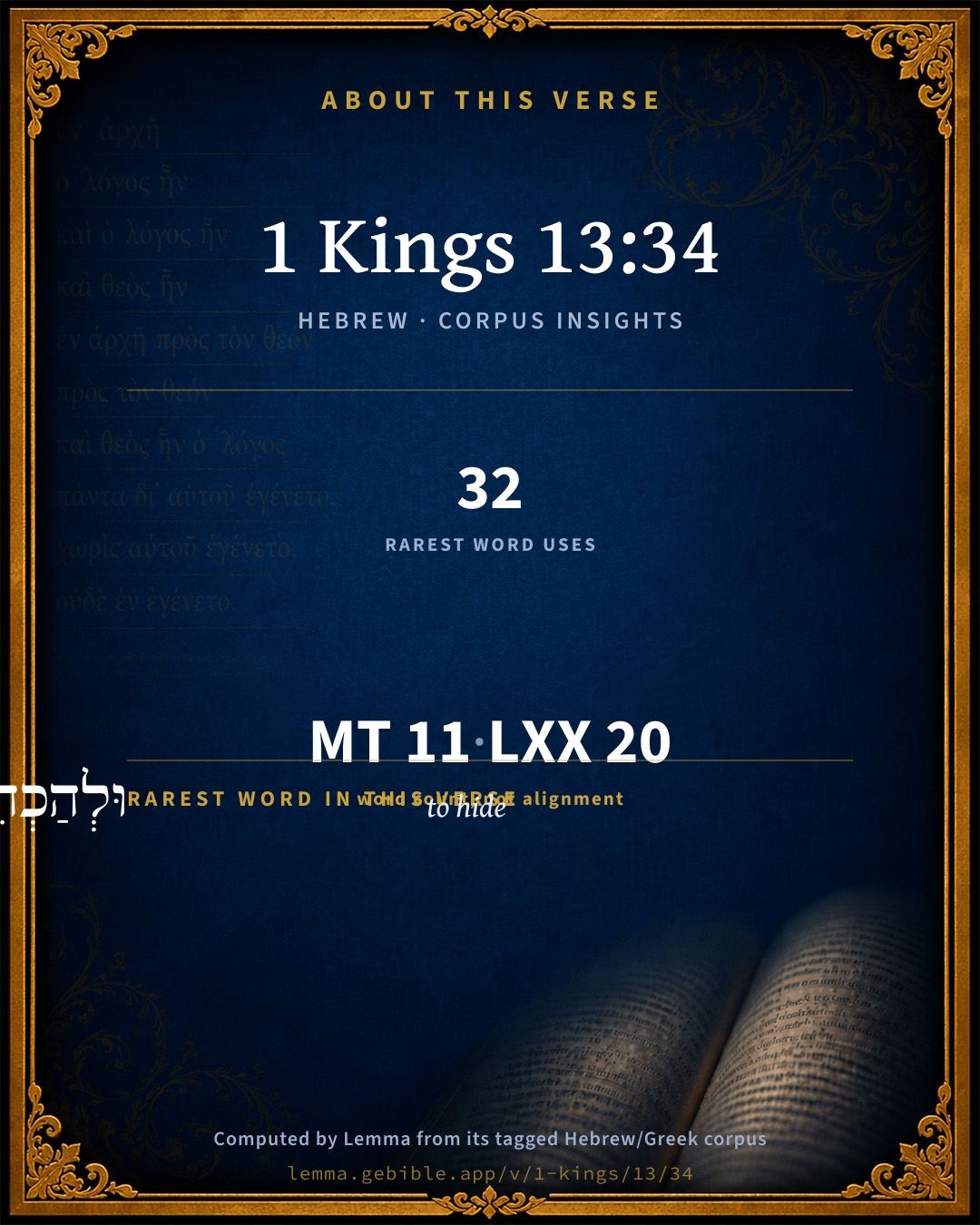
11
words
11
distinct lemmas
Historical
section

Shared distinctive vocabulary

וּלְהַכְחִיד֙ to hide H3582 occurs in 30 verses of the Hebrew Bible. Also found in:

Grammatical profile

  • 3 verbs
  • 6 nouns
  • 1 pronoun
  • 1 preposition

Verb forms

  • וַיְהִי֙ Qal · Sequential Imperfect
  • וּלְהַכְחִיד֙ Hiphil · Infinitive Construct
  • וּלְהַשְׁמִ֔יד Hiphil · Infinitive Construct

Hebrew & Septuagint length

In English translation the verse runs 25 words from the Hebrew and 23 from the Septuagint (LXX English) — closely comparable.

A rough comparison of the two English renderings, which tokenize alike — not a word-level alignment.

Word counts can differ between the Hebrew and the Greek without any difference in meaning — e.g. the Hebrew direct-object marker אֵת has no separate Greek word, and Greek often adds the article ὁ.

In the original languages it is 11 Hebrew tokens and 20 Greek tokens — but the two are counted differently (Hebrew bundles its prefixes and suffixes into one token; the Greek is in lemma form), so that isn’t a like-for-like length.

Cross-references

7

Topical passages linked to 1 Kings 13:34 in the Treasury of Scripture Knowledge — connected by theme and wording, ordered by reader-vote popularity; previews shown in the World English Bible.

  • 1 Kings 12:30 This thing became a sin; for the people went [to worship] before the one, even to Dan.
  • 1 Kings 14:10 therefore, behold, I will bring evil on the house of Jeroboam, and will cut off from Jeroboam every man-child, him who is shut up and him who is left at large in Israel, and will utterly sweep away the house of Jeroboam, as a man sweeps away dung, until it be all gone.
  • 1 Kings 15:29–30 It happened that, as soon as he was king, he struck all the house of Jeroboam: he didn't leave to Jeroboam any who breathed, until he had destroyed him; according to the saying of Yahweh, which he spoke by his servant Ahijah the Shilonite;
  • 2 Kings 17:21 For he tore Israel from the house of David; and they made Jeroboam the son of Nebat king: and Jeroboam drove Israel from following Yahweh, and made them sin a great sin.
  • 1 Kings 12:26 Jeroboam said in his heart, Now will the kingdom return to the house of David:
  • 2 Kings 10:31 But Jehu took no heed to walk in the law of Yahweh, the God of Israel, with all his heart: he didn't depart from the sins of Jeroboam, with which he made Israel to sin.
  • Proverbs 13:6 Righteousness guards the way of integrity, But wickedness overthrows the sinner.

Cross-references courtesy of OpenBible.info (CC BY 4.0).

Hebrew and Greek witnesses Masoretic Hebrew ↔ Greek Septuagint

The same verse in the two great witnesses to the Old Testament, shown verse-for-verse.

These are two independent witnesses, not word-aligned to each other, and the Septuagint is shown in lemma (dictionary) form.

Hebrew 1 Kings 13:34 Masoretic · Westminster Leningrad Codex

וַיְהִי֙ בַּדָּבָ֣ר הַזֶּ֔ה לְחַטַּ֖את בֵּ֣ית יָרָבְעָ֑ם וּלְהַכְחִיד֙ וּלְהַשְׁמִ֔יד מֵעַ֖ל פְּנֵ֥י הָאֲדָמָֽה

This thing became sin to the house of Jeroboam, even to cut it off, and to destroy it from off the surface of the earth.

World English Bible · Public Domain

Greek LXX 1 Kings 13:34 Septuagint · lemma form

καί γίγνομαι ὁ ῥῆμα οὗτος εἰς ἁμαρτία ὁ οἶκος ιεροβοαμ καί εἰς ὄλεθρος καί εἰς ἀφανισμός ἀπό πρόσωπον ὁ γῆ

And this thing became sin to the house of Jeroboam, even to its destruction and its removal from the face of the earth.

LXX2012 (modern English Septuagint) · Public Domain

Hebrew: Westminster Leningrad Codex (CC BY 4.0). Greek: Septuagint (public domain); English from LXX2012 (modern English Septuagint) (Public Domain). How the Septuagint differs from the Hebrew →

Targum (Aramaic paraphrase)

1

The Targum is the ancient Jewish Aramaic paraphrase of the Hebrew Scriptures — an interpretive translation, not the Hebrew text itself. Onkelos (literal) and Pseudo-Jonathan (expansive) render the Torah, and Jonathan the Prophets. Coverage is partial: where no permissively-licensed English translation exists for a verse, only the Aramaic is shown. This is verse-level text, not a word-by-word alignment to the Hebrew.

  1. Targum Jonathan Prophets (Joshua–Malachi)
    וַהֲוָה פִתְגָמָא הָדֵין לְחוֹבֵי בֵית יָרָבְעָם וּלְגַמָרָא וּלְשֵׁיצָאָה מֵעַל אַפֵּי אַרְעָא:

    (no public-domain English translation for this verse)

    Targum Jonathan — Aramaic: “Mikraot Gedolot” (public domain). English: “Sefaria Community Translation” (CC0 1.0 (public-domain dedication)); “London "Chaldee Paraphrase," 1871” (public domain). Text via Sefaria.

Commentary

Notes on 1 Kings 13:34 from classic Christian and Jewish commentators (each source and its license shown beneath its notes). The classic Christian expositions comment on the surrounding passage and are grouped to its opening verse, so a note may address several verses; the Jewish commentaries on the Tanakh (Rashi and others) are per-verse, so they appear only where the commentator wrote on this verse.

Lemma curates 59 commentaries, every one of them public domain or Creative Commons licensed, each selected and text-cleaned for this edition rather than reprinted as found. About our sources →

Trapp's Complete Commentary

John Trapp

1Ki 13:34 And this thing became sin unto the house of Jeroboam, even to cut [it] off, and to destroy [it] from off the face of the earth.

Ver. 34. And this thing became sin.] This his obstinacy and pertinacy in his abominable idolatries, became his utter ruin. Fugite ergo, reges, eiusmodi exitum, fugiendo huiusmodi flagitium, saith Ambrose, {a} "Be wise now, therefore, O ye kings," and overturn not your houses by "lifting up your horns on high" against God.

{a} De Naboth Jezrael, chap. xi.

John Trapp, A Commentary or Exposition upon All the Books of the Old and New Testament (1647–1656) — public domain. Text from a community e-Sword module.

Joseph Benson's Commentary

1Ki 13:34. This thing became sin to the house of Jeroboam — An occasion of sin, and a mean of hardening all his posterity in their idolatry; or, rather, it became a punishment, as the word sin often signifies. This his obstinate continuance in his idolatry, after such warnings, brought dreadful punishments upon his family, and these not of an ordinary kind; but such as effected its utter extirpation. We may reflect here with Ostervald, on the astonishing blindness and ingratitude of Jeroboam. “Instead of relying on the promises which God had made him, to preserve the kingdom in his family, if he continued faithful, fearing lest his subjects should forsake him, if they went to worship at Jerusalem; out of a false policy he set up an idolatrous worship in his kingdom, which occasioned the ruin of his family, and at last the ruin of the kingdom of the ten tribes. Thus men, instead of trusting to God, in the faithful discharge of their duty, for security, have recourse to ill methods, whereby they draw upon themselves, at length, those very misfortunes they mean to avoid.” Indeed, all those betray themselves effectually, who endeavour to support themselves or families by any sin.

Joseph Benson's Commentary on the Old and New Testaments (1811–1818) — public domain. Text from a community e-Sword module.

Adam Clarke's Commentary

Verse 34. And this thing became sin] These abominations were too glaring, and too insulting to the Divine Majesty, to be permitted to last; therefore his house was cut off, and destroyed from the face of the earth.

A HOLY priesthood, a righteous ministry, is a blessing to any state, because it has a most powerful effect on the morals of the community; inducing order, sobriety, and habits of industry, among the people: on the contrary, the profligacy of the clergy, and false principles of religion, are the most likely to unsettle a kingdom, and to bring about destructive revolutions in the state. This is the principle on which all national establishments of religion were originally formed. The state thought proper to secure a permanency of religion, that religion might secure the safety of the state; because it was supposed from the general aversion of men from good, that, if left to themselves, they would have no religion at all. Where the religion of the country is pure, founded solely on the oracles of God, it deserves the utmost sanction of the state, as well as the attention of every individual. A Christian state has surely authority to enact, The Christian religion is and shall be the religion of this land; and, prejudice apart, should not the laws provide for the permanence of this system? Is the form of Christianity likely to be preserved in times of general profligacy, if the laws do not secure its permanence? What would our nation have been if we had not had a version of the sacred writings established by the authority of the laws: and a form of sound words for general devotion established by the same authority? Whatever the reader may do the writer thanks God for the religious establishment of his country. For abuses in church or state, he is the last to contend.

Adam Clarke's Commentary on the Bible (1810–1826) — public domain. Text from a community e-Sword/MySword module.

Ellicott's Commentary for English Readers

(34) And this thing.—The comment of the author of the book, evidently based on the prophetic denunciation of Ahijah in 1Ki_14:9-11, and its subsequent fulfilment. (See 1Ki_15:25-30.)

A Bible Commentary for English Readers, edited by Charles John Ellicott (1878–1897) — public domain. Text from a community e-Sword module.

The Cambridge Bible for Schools and Colleges

gen. ed. J. J. S. Perowne

34. The Hebrew text here also is not clear. Literally it is ‘in this thing there came to be &c.’ But the A.V. and all other versions translate as though the Hebrew were the same as in the beginning of 1Ki_12:30. Probably the variation is only a slip of the scribe.

to cut it off and to destroy it] God’s judgement wrought the destruction, but yet it was the sin which called it forth. Hence the sin may be called the destroying power. Nadab the son of Jeroboam reigned only two years (1Ki_15:25), and then met a violent death at the hand of Baasha.

The Cambridge Bible for Schools and Colleges (gen. ed. J. J. S. Perowne; Cambridge University Press, 1878–1918) — public domain. Text from a community e-Sword module.

Albert Barnes' Notes on the Bible

This persistence in wrong, after the warning given him, brought a judgment, not only on Jeroboam himself, but on his family. Jeroboam’s departure from the path of right forfeited the crown 1Ki 11:38; and in that forfeiture was involved naturally the destruction of his family, for in the East, as already observed, when one dynasty supplants another, the ordinary practice is for the new king to destroy all the males belonging to the house of his predecessor. See 1Ki 15:29.

Albert Barnes' Notes on the Bible (1834–1885) — public domain. Text from a community e-Sword/MySword module.

Haydock's Catholic Bible Commentary

Earth. Hebrew, "to destroy it from the face of the earth." The Vulgate insinuates that it had taken place before the author wrote. In the third year of Asa, 22 years after this revolt, Bansa slew the whole family, chap. xv. 29.

George Leo Haydock (1774–1849), Haydock's Catholic Family Bible and Commentary, 1859 edition — public domain. Excludes Psalms (Douay-Rheims chapter numbering differs from Protestant) and Deuterocanonical books (Catholic canon only).

Matthew Poole's English Annotations

This thing became sin; either an occasion of sin, and means of hardening all his posterity in their idolatry; or, a punishment, for so the word sin is oft used. This his obstinate continuance in his idolatry after such warnings was the utter ruin of all his family.

Matthew Poole's English Annotations on the Holy Bible (1683–1685) — public domain. Text from a community e-Sword/MySword module.

Whedon's Commentary on the Bible

Daniel D. Whedon

34. This thing became sin — בדבר, in this text, is probably an error of some early transcriber, and should be הדבר, as in 1Ki_12:30. This sacrilegious impiety became the standing and crying sin of Jeroboam’s family, and led to its utter destruction.

Daniel D. Whedon (gen. ed.), Commentary on the Old and New Testaments (1874–1909) — public domain. Text from a community e-Sword module.

The Pulpit Commentary

And this thing Heb. "in this thing:" rbDB (Cf. 1Ch_7:23 1Ch_9:33) became sin unto the house of Jeroboam, even to cut it off, and to destroy it from off the face of the earth. (1Ki_15:29) The forfeiture of the crown would bring in its train, almost as amatter of course, the destruction of his family. (1Ki_14:10-14) And we are taught here that both events are to be regarded, under the dispensation of temporal rewards and punishments, as the recompenses of his impiety; of that daring schismatic policy which, in all its branches, betrayed a complete disregard of the terms of the covenant, and which was persevered in contemptuous defiance of the repeated warnings of God.

The Pulpit Commentary (1880–1919), ed. H.D.M. Spence-Jones & Joseph S. Exell — public domain. Text from a community e-Sword module.

John Wesley's Explanatory Notes

Sin - Either, an occasion of sin, and means of hardening all his posterity in their idolatry: or, a punishment, for so the word sin is often used. This his obstinate continuance in his idolatry, after such warnings, was the utter ruin of all his family. They betray themselves effectually, who endeavour to support themselves by any sin.

John Wesley, Explanatory Notes Upon the Whole Bible (1754–1765) — public domain. Text via the GEBible commentary corpus.

Lesson kit

Teaching starters — assembled from the data on this page, not authored interpretation. Every prompt links to the verse data it draws on. Edit before teaching.

1 Kings, in the Historical, opens this verse with 11 words (11 distinct Hebrew lemmas). Its most distinctive word is kâchad (“to hide”). A historical commentator’s framing appears above. Read the whole chapter for the surrounding context.

Discussion questions

  1. How does “to hide” (kâchad) shape what this verse is saying?
  2. Genesis 47:18 shares the word «to hide» with this verse. How do the two illuminate each other?
  3. These translations render this verse differently. What is at stake in choosing one wording over another?
  4. The verb «וַיְהִי֙» is Qal Sequential Imperfect. How does its form color the action?
  5. Reading how Trapp's Complete Commentary and Joseph Benson's Commentary read this verse, where do the two commentators agree and where do they part?

Things to notice

Reading settings

Reading text

Shown beneath each verse's original-language words.

Old Testament
Old Testament edition

Read the OT as the Masoretic Hebrew (MT) or the Greek Septuagint (LXX).

English shown for the Greek Septuagint (in the Hebrew ↔ Greek comparison).

Comparing translations? Open the Compare panel on any verse page to stack up to four side by side.