Ezekiel 21:2

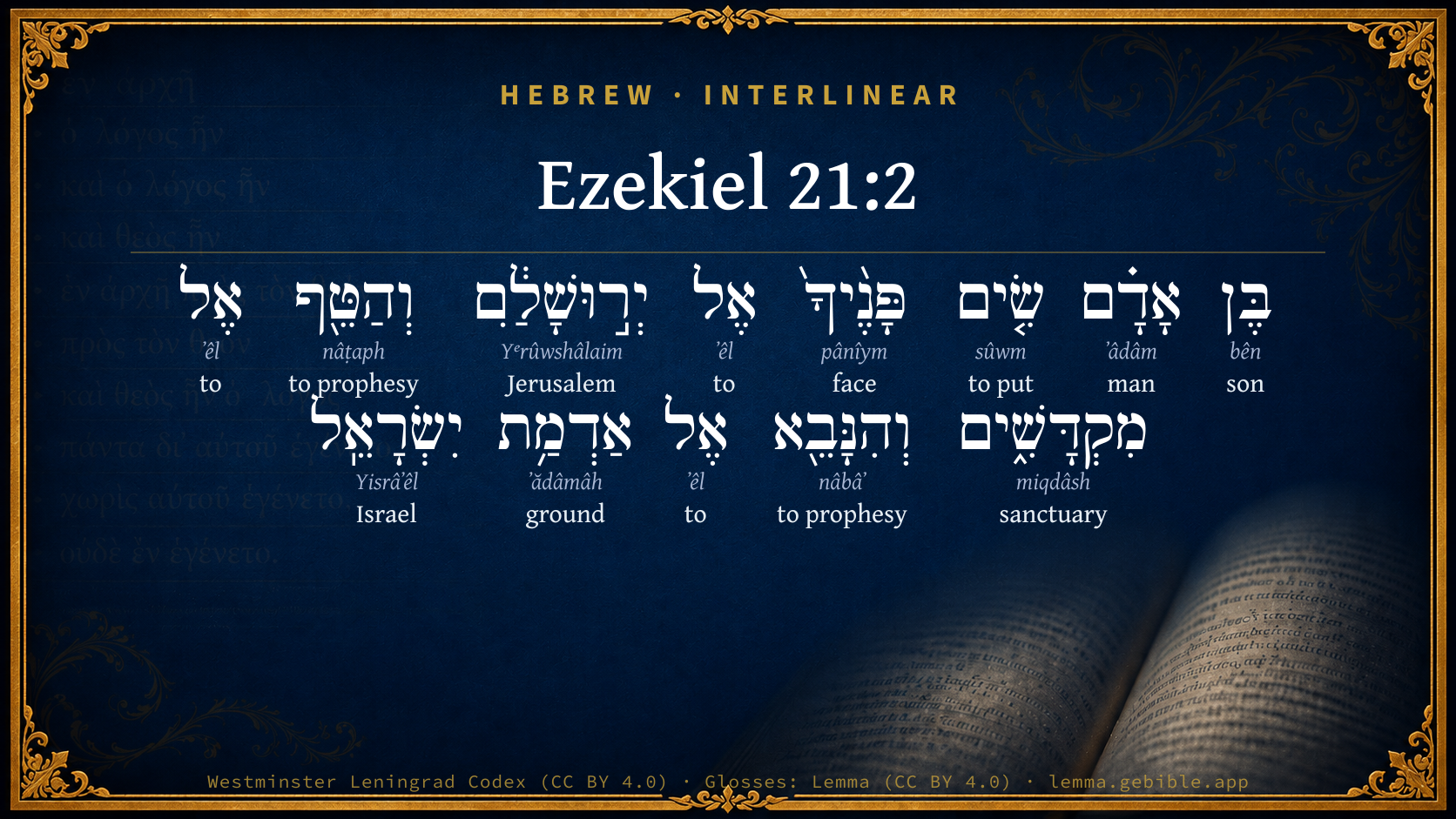
Hebrew (Westminster Leningrad Codex) Ezekiel 21:2 appears in the Hebrew Old Testament. The text above is from the Westminster Leningrad Codex. Each word links to its Strong’s number, a concise gloss, and parsing drawn from the Open Scriptures Hebrew Bible morphology. Click any word for its full Brown-Driver-Briggs (BDB) entry.
Download image
Cite this verse

Ezekiel 21:2 (World English Bible). Public Domain. Lemma interlinear Bible study tool, https://lemma.gebible.app/v/ezekiel/21/2.

Show BibTeX & RIS
BibTeX
RIS
English Translation
Son of man, set your face toward Jerusalem, and drop [your word] toward the sanctuaries, and prophesy against the land of Israel;
World English Bible · Public Domain
Download a study sheet

One document with this verse’s original text, its word-by-word gloss line, the meaning frame, cross-references with their text, attributed commentary, and full source and license credits — printable, and it pastes into notes with its structure intact.

This verse Autodidact and up

Study sheet (.html) Plain text (.txt)

A passage Seminary Student

Up to 50 verses in one chapter. A passage sheet keeps up to 6 commentary sources and 12 cross-references per verse, in the order this page ranks them, and says so on the sheet whenever that leaves anything out. Ask for a single verse and you get the Autodidact verse sheet above.

Everything on this page stays free to read, with no account — the sheet is a download of what is already on screen, not access to it.

Want to remove ads? Support Godless Engineer
Compare translations 3

The same verse in 3 English versions, stacked beneath the original-language interlinear above. Click any original word for its lexicon entry.

Each is an independent rendering of the whole verse — the interlinear is not word-aligned to these translations.

Highlighted words mark where these versions differ — a whole-verse word diff, not a word-by-word alignment.

  • World English Bible Public Domain
    Son of man, set your face toward Jerusalem, and drop [your word] toward the sanctuaries, and prophesy against the land of Israel;
  • King James Version Public Domain
    Son of man, set thy face toward Jerusalem, and drop thy word toward the holy places, and prophesy against the land of Israel,
  • unfoldingWord Literal Text CC BY-SA 4.0
    “Son of man, set your face toward Jerusalem, and speak against the sanctuaries; prophesy against the land of Israel.

unfoldingWord Literal Text — © unfoldingWord, licensed CC BY-SA 4.0. Word-aligned USFM3 via Door43 (git.door43.org/unfoldingWord/en_ult).

Versions to compare (up to 4)

3 of 4 selected

Show all 18 translations

Every available English version of this verse, each an independent rendering of the whole verse.

  • World English Bible Public Domain
    Son of man, set your face toward Jerusalem, and drop [your word] toward the sanctuaries, and prophesy against the land of Israel;
  • Berean Standard Bible Public Domain
    “Son of man, set your face against Jerusalem and preach against the sanctuaries. Prophesy against the land of Israel
  • Majority Standard Bible Public Domain
    “Son of man, set your face against Jerusalem and preach against the sanctuaries. Prophesy against the land of Israel
  • King James Version Public Domain
    Son of man, set thy face toward Jerusalem, and drop thy word toward the holy places, and prophesy against the land of Israel,
  • American Standard Version (1901) Public Domain
    Son of man, set thy face toward Jerusalem, and drop `thy word' toward the sanctuaries, and prophesy against the land of Israel;
  • Revised Version (1885) Public Domain
    Son of man, set thy face toward Jerusalem, and drop thy word toward the sanctuaries, and prophesy against the land of Israel;
  • Geneva Bible (1599) Public Domain
    Sonne of man, set thy face toward Ierusalem, and drop thy word toward the holy places, and prophecie against the land of Israel.
  • Douay-Rheims (1899) Public Domain
    Son of man, set thy face toward Jerusalem, and let thy speech flow towards the holy places, and prophesy against the land of Israel:
  • Young's Literal Translation Public Domain
    `Son of man, set thy face unto Jerusalem, and prophesy unto the holy places, and prophesy unto the ground of Israel;
  • Literal Standard Version CC BY-SA 4.0
    “Son of man, set your face toward Jerusalem, and prophesy to the holy places, and prophesy to the ground of Israel;
  • Unlocked Literal Bible CC BY-SA 4.0
    “Son of man, set your face toward Jerusalem, and speak against the sanctuaries; prophesy against the land of Israel.
  • unfoldingWord Literal Text CC BY-SA 4.0
    “Son of man, set your face toward Jerusalem, and speak against the sanctuaries; prophesy against the land of Israel.
  • Darby Bible Public Domain
    Son of man, set thy face against Jerusalem, and drop [words] against the holy places, and prophesy against the land of Israel,
  • World Messianic Bible Public Domain
    “Son of man, set your face toward Jerusalem, and proclaim toward the sanctuaries, and prophesy against Eretz-Israel.
  • Webster's Bible Public Domain
    Son of man, set thy face towards Jerusalem, and drop thy word towards the holy places, and prophesy against the land of Israel,
  • Free Bible Version CC BY-SA 4.0
    “Son of man, face towards Jerusalem and condemn their places of worship. Prophesy against the people living in Israel
  • Bible in Basic English Public Domain
    Son of man, let your face be turned to Jerusalem, let your words be dropped in the direction of her holy place, and be a prophet against the land of Israel;
  • JPS Tanakh (1917) Public Domain
    (21-7) 'Son of man, set thy face toward Jerusalem, and preach toward the sanctuaries, and prophesy against the land of Israel;

Literal Standard Version (2020), Covenant Press — licensed CC BY-SA 4.0. Text via the HelloAO Bible API (eBible.org). Unlocked Literal Bible (unfoldingWord) — licensed CC BY-SA 4.0. Text via the HelloAO Bible API (eBible.org). unfoldingWord Literal Text — © unfoldingWord, licensed CC BY-SA 4.0. Word-aligned USFM3 via Door43 (git.door43.org/unfoldingWord/en_ult). Free Bible Version, Dr. Jonathan Gallagher — licensed CC BY-SA 4.0. Text via the HelloAO Bible API (eBible.org).

Word by word

More ways to search: Search by grammar → Find every occurrence → Compare this word →

Practice this passage: Drill this verse → Learn its vocabulary →

וְהַטֵּ֖ף
nâṭaph
H5197
“and · prophesy”
Conjunction + Verb, Hiphil, Imperative, 2nd Person, Masculine, Singular
Part of Speech
Conjunction + Verb
Stem
Hiphil
Form
Imperative
Person
2nd Person
Gender
Masculine
Number
Singular
Full BDB Definition

Origin: a primitive root

TWOT: 1355

to drop, drip, distil, prophesy, preach, discourse - (Qal) to drop, drip - (Hiphil) - to drip - to drop (prophecy)
  1. בֶּן bên H1121 “son of” Noun, Common, Masculine, Singular, Construct
  2. אָדָ֗ם ʼâdâm H120 “man” Noun, Common, Masculine, Singular, Absolute
  3. שִׂ֤ים sûwm H7760 “put” Verb, Qal, Imperative, 2nd Person, Masculine, Singular
  4. פָּנֶ֨יךָ֙ pânîym H6440 “face(s) · your” Noun, Common, Both, Plural, Construct + Suffix, Personal, 2nd Person, Masculine, Singular
  5. אֶל ʼêl H413 “to” Preposition
  6. יְר֣וּשָׁלִַ֔ם Yᵉrûwshâlaim H3389 “Jerusalem” Noun, Proper
  7. אֶל ʼêl H413 “to” Preposition
  8. מִקְדָּשִׁ֑ים miqdâsh H4720 “sanctuaries” Noun, Common, Masculine, Plural, Absolute
  9. וְהִנָּבֵ֖א nâbâʼ H5012 “and · prophesy” Conjunction + Verb, Niphal, Imperative, 2nd Person, Masculine, Singular
  10. אֶל ʼêl H413 “to” Preposition
  11. אַדְמַ֥ת ʼădâmâh H127 “ground of” Noun, Common, Feminine, Singular, Construct
  12. יִשְׂרָאֵֽל Yisrâʼêl H3478 “Israel” Noun, Proper

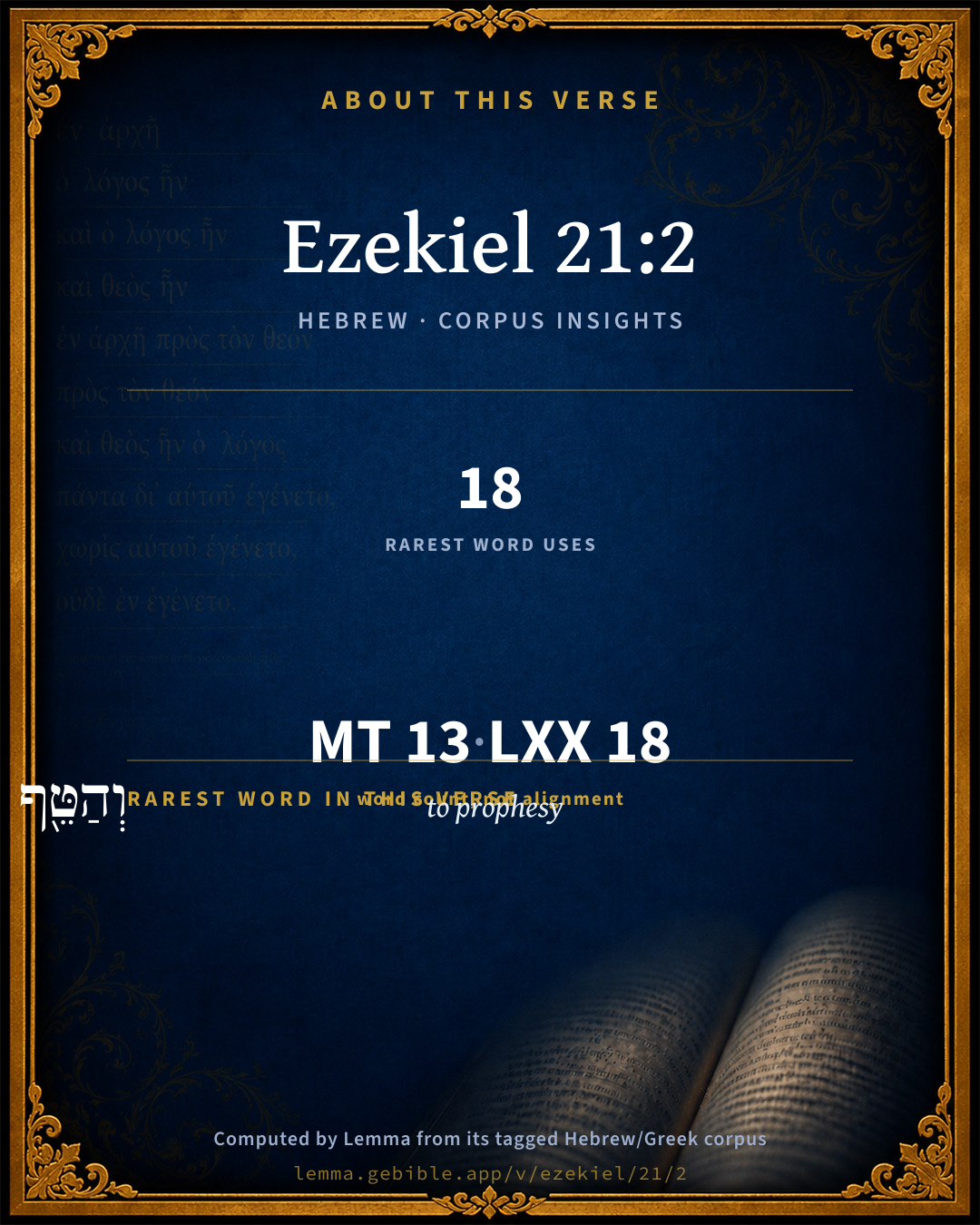
About this verse

These counts appear in no published source. They are computed here, from the morphology-tagged text and Lemma’s own curated glosses. What Lemma adds →

13
words
11
distinct lemmas
Prophets
section

Notable vocabulary

The rarest word here is וְהַטֵּ֖ף to prophesy H5197 — appearing just 18 times in the whole Hebrew Bible.

Shared distinctive vocabulary

וְהַטֵּ֖ף to prophesy H5197 occurs in 14 verses of the Hebrew Bible. Also found in:

Grammatical profile

  • 3 verbs
  • 7 nouns
  • 3 prepositions

Verb forms

  • שִׂ֤ים Qal · Imperative
  • וְהַטֵּ֖ף Hiphil · Imperative
  • וְהִנָּבֵ֖א Niphal · Imperative

Repetition

A word recurs within this verse — often emphatic in Hebrew:

  • אֶל to H413 ×3

Hebrew & Septuagint length

In English translation the verse runs 22 words from the Hebrew and 26 from the Septuagint (LXX English) — closely comparable.

A rough comparison of the two English renderings, which tokenize alike — not a word-level alignment.

Word counts can differ between the Hebrew and the Greek without any difference in meaning — e.g. the Hebrew direct-object marker אֵת has no separate Greek word, and Greek often adds the article ὁ.

In the original languages it is 13 Hebrew tokens and 18 Greek tokens — but the two are counted differently (Hebrew bundles its prefixes and suffixes into one token; the Greek is in lemma form), so that isn’t a like-for-like length.

Cross-references

16

Topical passages linked to Ezekiel 21:2 in the Treasury of Scripture Knowledge — connected by theme and wording, ordered by reader-vote popularity; previews shown in the World English Bible.

  • Ezekiel 20:46 Son of man, set your face toward the south, and drop [your word] toward the south, and prophesy against the forest of the field in the South;
  • Ezekiel 4:7 You shall set your face toward the siege of Jerusalem, with your arm uncovered; and you shall prophesy against it.
  • Ezekiel 25:2 Son of man, set your face toward the children of Ammon, and prophesy against them:
  • Ezekiel 28:21 Son of man, set your face toward Sidon, and prophesy against it,
  • Deuteronomy 32:2 My doctrine shall drop as the rain; My speech shall condense as the dew, As the small rain on the tender grass, As the showers on the herb.
  • Jeremiah 26:11–12 Then spoke the priests and the prophets to the princes and to all the people, saying, This man is worthy of death; for he has prophesied against this city, as you have heard with your ears.
  • Ezekiel 4:3 Take for yourself an iron pan, and set it for a wall of iron between you and the city: and set your face toward it, and it shall be besieged, and you shall lay siege against it. This shall be a sign to the house of Israel.
  • Ezekiel 6:2 Son of man, set your face toward the mountains of Israel, and prophesy to them,
  • Ezekiel 29:2 Son of man, set your face against Pharaoh king of Egypt, and prophesy against him, and against all Egypt;
  • Ezekiel 36:1 You, son of man, prophesy to the mountains of Israel, and say, You mountains of Israel, hear the word of Yahweh.
  • Ezekiel 38:2 Son of man, set your face toward Gog, of the land of Magog, the prince of Rosh, Meshech, and Tubal, and prophesy against him,
  • Amos 7:16 Now therefore listen to the word of Yahweh: 'You say, Don't prophesy against Israel, and don't preach against the house of Isaac.'
  • Micah 2:6 "Don't you prophesy!" They prophesy. "Don't prophesy about these things. Disgrace won't overtake us."
  • Micah 2:11 If a man walking in a spirit of falsehood lies: 'I will prophesy to you of wine and of strong drink;' He would be the prophet of this people.
  • Acts 6:13–14 and set up false witnesses who said, "This man never stops speaking blasphemous words against this holy place and the law.
  • Ephesians 6:19 on my behalf, that utterance may be given to me in opening my mouth, to make known with boldness the mystery of the Gospel,

Cross-references courtesy of OpenBible.info (CC BY 4.0).

Hebrew and Greek witnesses Masoretic Hebrew ↔ Greek Septuagint

The same verse in the two great witnesses to the Old Testament, shown verse-for-verse.

These are two independent witnesses, not word-aligned to each other, and the Septuagint is shown in lemma (dictionary) form.

Hebrew Ezekiel 21:2 Masoretic · Westminster Leningrad Codex

בֶּן אָדָ֗ם שִׂ֤ים פָּנֶ֨יךָ֙ אֶל יְר֣וּשָׁלִַ֔ם וְהַטֵּ֖ף אֶל מִקְדָּשִׁ֑ים וְהִנָּבֵ֖א אֶל אַדְמַ֥ת יִשְׂרָאֵֽל

Son of man, set your face toward Jerusalem, and drop [your word] toward the sanctuaries, and prophesy against the land of Israel;

World English Bible · Public Domain

Greek LXX Ezekiel 21:2 Septuagint · lemma form

υἱός ἄνθρωπος στηρίζω ὁ πρόσωπον σύ ἐπί θαιμαν καί ἐπιβλέπω ἐπί δαρωμ καί προφητεύω ἐπί δρυμός ἡγέομαι ναγεβ

Therefore prophesy, son of man, set your face steadfastly toward Jerusalem, and look toward their holy places, and you shall prophesy against the land of Israel,

LXX2012 (modern English Septuagint) · Public Domain

Hebrew: Westminster Leningrad Codex (CC BY 4.0). Greek: Septuagint (public domain); English from LXX2012 (modern English Septuagint) (Public Domain). How the Septuagint differs from the Hebrew →

Targum (Aramaic paraphrase)

1

The Targum is the ancient Jewish Aramaic paraphrase of the Hebrew Scriptures — an interpretive translation, not the Hebrew text itself. Onkelos (literal) and Pseudo-Jonathan (expansive) render the Torah, and Jonathan the Prophets. Coverage is partial: where no permissively-licensed English translation exists for a verse, only the Aramaic is shown. This is verse-level text, not a word-by-word alignment to the Hebrew.

  1. Targum Jonathan Prophets (Joshua–Malachi)
    בַּר אָדָם קַבֵּיל נְבוּאָה לְאוֹרַח דָרוֹמָא וְאַלֵיף עַל דָרוֹמָא וְאִתְנְבֵּי עַל חוּרְשָׁא דַחֲקַל דָרוֹמָא:

    (no public-domain English translation for this verse)

    Targum Jonathan — Aramaic: “Mikraot Gedolot” (public domain). English: “Sefaria Community Translation” (CC0 1.0 (public-domain dedication)); “London "Chaldee Paraphrase," 1871” (public domain). Text via Sefaria.

Commentary

Notes on Ezekiel 21:2 from classic Christian and Jewish commentators (each source and its license shown beneath its notes). The classic Christian expositions comment on the surrounding passage and are grouped to its opening verse, so a note may address several verses; the Jewish commentaries on the Tanakh (Rashi and others) are per-verse, so they appear only where the commentator wrote on this verse.

Lemma curates 59 commentaries, every one of them public domain or Creative Commons licensed, each selected and text-cleaned for this edition rather than reprinted as found. About our sources →

Trapp's Complete Commentary

John Trapp

Eze 21:2 Son of man, set thy face toward Jerusalem, and drop [thy word] toward the holy places, and prophesy against the land of Israel,

Ver. 2. Set thy face.] See on Eze 20:46.

And drop thy word.] See Deu 32:2 Amo 7:16. As drops of rain follow one upon another, so do words. Speak thick, speak home, though they forbid thee to drop such vinegar or nitre on their galled conscience. {Mic 2:6; Mic 2:11}

Toward the holy places,] i.e., Against the temple, which they so cried up, {Jer 7:4} like so many oyster wives, ad ravim usque.

John Trapp, A Commentary or Exposition upon All the Books of the Old and New Testament (1647–1656) — public domain. Text from a community e-Sword module.

The Biblical Illustrator

Joseph S. Exell

Eze_21:2-3

Behold, I am against thee.

A prophecy of judgment

I. The prophets compellation, or title--Son of man. There are but two persons in Scripture which have eminently this name--the one is our Saviour, the other Ezekiel. For our Saviour, it was not without very good reason--namely, as hereby to discover the truth of His humanity to us--that amongst those many miracles which were wrought by Him, from whence He did appear to be God, He might have somewhat also fastened upon Him declaring Him likewise to be man. Besides, as suitable to His present state of humiliation and future passion, that He might be looked upon according to that view wherein He tendered Himself to the world, and that those which were about Him might be prepared for what should happen unto Him, He thought it fitting thus to be called; in the meantime, likewise, encouraging them, upon these terms, to close with Him, as who having taken their nature upon Him, was not now ashamed to call them brethren. As for Ezekiel, why this name should be put upon him, this is a thing further considerable--especially why upon him rather than upon any other of the prophets, Daniel only excepted, who but once is distinguished by this compellation (Dan_8:17). It is the general sense of divines, that it was for this reason especially, namely, to humble him in the midst of those many divine visions and revelations which he was partaker of, that though in regard of his work and employment he was a companion of angels, yet, for his condition, he was numbered amongst men. And so, in that respect, had a double disparagement upon him, which served to abase him--both of mortality and sinfulness. But we may add also another reason here in this place for the giving of it; and that was, not only to breed in him an humble spirit, but likewise a pitiful and compassionate. The message which he was now sent about, it was a matter of judgment and terror; it was a threatening, and foretelling of Gods wrath and indignation against His people. Now, this did require some bowels and tenderness in him, that he should do it; and therefore Son of man was a very fit and proper compellation, that so, being a man himself, he might the more commiserate his brethren.

II. The prophets injunction, or command, which is laid upon him: and that is, how to carry himself in the denunciations of Gods judgments against His people. This is laid forth in three clauses--First, to set his face toward Jerusalem. Secondly, to drop his word towards the holy places. Thirdly, to prophesy against the land of Israel. Where ye have a full enumeration of all kind of places, and conditions, and persons, as the objects of Divine wrath, which is threatened against them. First, the city, expressed in Jerusalem. Secondly, the Church, signified in the holy places. Thirdly, the country, or whole community, implied in the land of Israel. Here is Gods judgments extended to all sorts and ranks of men--to the civil State, to the ecclesiastical, and to the popular. We will begin with the civil. The Lords voice crieth to the city (Mic_6:9).

1. The place threatened is Jerusalem, the mother-city in the land of the princes and governors of the nation. This is that which God begins withal in the denunciation of His judgments against His people here in this place. This carries in it Gods anger against great ones--the nobles and princes and judges and magistrates of the land; those which were of any eminency amongst them, whether for birth, or place, or power, or wealth; these sinning against the Lord were not without their correction--nay, God thinks fitting to take aim at them first of all: Set thy face against Jerusalem. Now, there is a very good account which may be given of this dispensation.

(1) Because such places as these are, do abound with greater mercies, and so opportunities of doing good; therefore they, rebelling against the Lord, and provoking Him, do become more obnoxious.

(2) Because the sins of these are more exemplary and scandalous, The more eminent any are in place, the more notorious are their miscarriages--everyone looks upon them as so many patterns to all the rest.

(3) They are populous places, and they are such places wherein the flower and glory of the whole land is gathered together. The strength and riches and state of any nation are in their chief cities. Now, therefore, when God has a mind to stain the pride of all glory, He does especially aim at these.

2. The prophets gesture which he is required to use to it--and that is, to set his face towards it. Set thy face towards Jerusalem. The setting of the face, in Scripture, does carry a different notion in it.

(1) It is a note of attention. God would have him to set his face upon it, by way of serious consideration; to take notice of the manifold abominations which were in it. And thus now is it the concernment of ministers in like manner to do--not to shoot their arrows at random, rashly and unadvisedly, they care not how; but as being thoroughly appreciative of the guilt of the persons themselves they deal withal.

(2) It is a note of compassion and commiseration. So we also find it sometimes in Scripture. As our Saviour (Luk_19:41).

(3) It is a note of displeasure and indignation. So it is used sometimes (Jer_21:10; Eze_25:2; Eze_28:21; Eze_29:2).

The second is in reference to the Church, or State Ecclesiastical. And drop thy word towards the holy places.

1. The place is the Church and house of God. Here is Gods vengeance threatened against that, as to the destruction of it. This is worse than the former; by how much spirituals are better than temporals, and any prejudice to our souls worse than to our outward estates.

(1) Here is a threatening of the place, the temple itself, which was afterwards verified and made good in the destruction and rendition of that: Not one stone left upon another. God threatens to take away that visible token of His presence from amongst them, which was one step of this punishment.

(2) Here is a threatening of the persons, the priests and ministers--there is an heavy judgment belonging to them; forasmuch as they had corrupted themselves, and others with them.

(3) In reference to the performances--the ordinances and ministerial dispensations. God drops upon the sanctuary when He threatens to suspend these, as oftentimes He does when He sends a famine of His word (Amo_8:11) Especially when His ordinances are neglected, when there is no heed or regard unto them: in such cases as these does God remove them, and otherwise bestow them; neither is there anything here which shall stand in the way of His judgments.

2. The carriage and proceeding towards it, and that is expressed here by dropping.

(1) A leisurable proceeding--one thing after another, in a succession. The judgments of God, they are not to be denounced all at once; that were enough to astonish men, and wholly overwhelm them. No, but by steps and degrees. They must first be acquainted with lesser judgments, and then afterwards with greater.

(2) A gentle proceeding--not boisterously, with over-much rigour; but mildly, and with the spirit of meekness.

(3) A constant proceeding. Dropping--it has frequency in it. So should it be with us here: Precept upon precept, and line upon line (Isa_28:10).

The third, and last, in reference to the community and whole nation in general. In these words: And prophesy against the land of Israel.

1. The place threatened--the land of Israel. These words do carry two things in them, which might seem, at the first hearing, to plead for exemption from punishment.

(1) Israel, Gods own peculiar people.

(2) The land of Israel, that is, a great number of them. Yet it will not do, or serve the turn neither. Though it be Israel, Gods own people; though it be the land of Israel, all states and degrees amongst them; yet sinners, they must not shun judgment.

2. The carriage towards it, and that is prophesying. Prophesy against the land of Israel. This was a very ill message, and very unwelcome, which Ezekiel was sent with; but yet he must carry it, for all that. He must prophesy against them--that is, declare Gods punishments upon them for their sins and provocations of Him. (T. Herren, D. D.)

The Biblical Illustrator, edited by Joseph S. Exell (c. 1880s–1900s) — public domain. Text from a community e-Sword module.

Geneva Bible (1599)

Geneva Bible translators

Speak sensibly, that all may understand.

Geneva Bible (1599) marginal notes — public domain. Text via Bolls.life.

Adam Clarke's Commentary

Verse 2. Set thy face toward Jerusalem] This is a continuation of the preceding prophecy; and in this chapter the prophet sets before them, in the plainest language, what the foregoing metaphors meant, so that they could not complain of his parables.

Adam Clarke's Commentary on the Bible (1810–1826) — public domain. Text from a community e-Sword/MySword module.

Ellicott's Commentary for English Readers

(2) Set thy face . . . drop thy word . . . prophesy.—These expressions, with the “say to the land” of Eze_21:3, connect this with 20:46, 47; but there they were followed by figurative terms, while here we have plainly “Jerusalem,” “the holy places,” and “the land of Israel.”

A Bible Commentary for English Readers, edited by Charles John Ellicott (1878–1897) — public domain. Text from a community e-Sword module.

The Cambridge Bible for Schools and Colleges

gen. ed. J. J. S. Perowne

2. the holy places] Or, sanctuaries. These are not the rural sanctuaries or high places, but the holy buildings in Jerusalem (Eze_7:24; Lam_2:6).

The Cambridge Bible for Schools and Colleges (gen. ed. J. J. S. Perowne; Cambridge University Press, 1878–1918) — public domain. Text from a community e-Sword module.

John Gill's Exposition

And say to the land of Israel,.... The inhabitants of it, signified by the "forest of the south field", Eze 20:47,

thus saith the Lord, behold, I am against thee; and sad it is to have the Lord against a people, a nation, a city, or a family, or a particular person; for there is no contending with him, or standing before him; there is always a reason for it, it is for sin when God is against a people, even his own professing people:

and will draw forth my sword out of his sheath; bring the Chaldean army out of Babylon; which interprets what is meant by the "fire" he would kindle in the land of Israel, Eze 20:47, namely, the sword of the enemy, which he would bring upon it; or war, with all its desolating train of judgments:

and will cut off from thee the righteous and the wicked; meant by the green and dry tree, Eze 20:47, who, though they shall not perish everlastingly together, yet may fall together in temporal calamities; the one may be chastised, and the other condemned; or the one be carried captive for their good, as Ezekiel and Daniel, &c. and others be cut off by sword and famine; and such as were captives, never the better for their captivity. The Targum is,

"I will remove out of thee thy righteous ones, that I may destroy thy wicked ones.''

Some think that only such who were righteous in appearance, or in their own sight, are here meant. R. Saadiah Gaon, as Kimchi quotes him, interprets them of such as were righteous to Baal, and served him continually, in distinction from such as were wicked to him, and did not serve him continually; and both were wicked before the Lord, and therefore justly cut off.

John Gill's Exposition of the Whole Bible (1746–1763) — public domain (CC PDM 1.0). Text via the HelloAO Bible API.

Matthew Poole's English Annotations

Set thy face; put thyself in a posture may bespeak thy going to prophesy.

Toward Jerusalem, or against Jerusalem, called, Eze 20:46, forest of the south field. Drop thy word; of the phrase see Eze 20:46; as rain from heaven, so distil my word.

The holy places; either the temple, and all the parts of it, which were three, the porch, the holy, and holy of holies; or their synagogues, in which they met to worship and read the law, which were burnt up by this fire, Psa 74:8.

Against the land of Israel; not only against Jerusalem, but the whole land of Israel, from the south thereof to the north; as Eze 20:47.

Matthew Poole's English Annotations on the Holy Bible (1683–1685) — public domain. Text from a community e-Sword/MySword module.

Whedon's Commentary on the Bible

Daniel D. Whedon

2. Drop thy word — See Deu_32:2; Isa_55:11. This word of the prophet did not drop as the dew, but fell like the blow of a sword. (Compare also Amo_7:16; Heb_4:12.)

The holy places — Peshito, their holy place. Reference is made to the temple building in Jerusalem (Eze_7:24; Lam_2:6).

Daniel D. Whedon (gen. ed.), Commentary on the Old and New Testaments (1874–1909) — public domain. Text from a community e-Sword module.

John Wesley's Explanatory Notes

The holy places - The temple and all parts of it.

John Wesley, Explanatory Notes Upon the Whole Bible (1754–1765) — public domain. Text via the GEBible commentary corpus.

Rashi

Rabbi Shlomo Yitzchaki (Rashi)

southward The land of Israel is south of Babylon.

to the forest of the field in the south To My Temple, which is destined to be like a forest and like a field, to be plowed in order to be overrun by foxes.

Rashi on the Tanakh — English translations: “The Judaica Press complete Tanach with Rashi, translated by A. J. Rosenberg” (CC BY 4.0); “Pentateuch with Rashi's commentary by M. Rosenbaum and A.M. Silbermann, 1929-1934” (public domain); “The Metsudah Tanach series, Lakewood, N.J” (CC BY 4.0); and “The Book of Joshua, Metsudah Publications, 1997” (CC BY 4.0). Text via Sefaria.

Lesson kit

Teaching starters — assembled from the data on this page, not authored interpretation. Every prompt links to the verse data it draws on. Edit before teaching.

Ezekiel, in the Prophets, opens this verse with 13 words (11 distinct Hebrew lemmas). Its most distinctive word is nâṭaph (“to prophesy”). A historical commentator’s framing appears above. Read the whole chapter for the surrounding context.

Discussion questions

  1. What does “to prophesy” (nâṭaph) contribute to the verse as a whole?
  2. Judges 5:4 shares the word «to prophesy» with this verse. How do the two illuminate each other?
  3. “to” occurs 3× in this one verse. What is the effect of the repetition?
  4. These translations render this verse differently. What is at stake in choosing one wording over another?
  5. The verb «שִׂ֤ים» is Qal Imperative. How does its form color the action?
  6. Reading how Trapp's Complete Commentary and The Biblical Illustrator read this verse, where do the two commentators agree and where do they part?

Things to notice

Reading settings

Reading text

Shown beneath each verse's original-language words.

Old Testament
Old Testament edition

Read the OT as the Masoretic Hebrew (MT) or the Greek Septuagint (LXX).

English shown for the Greek Septuagint (in the Hebrew ↔ Greek comparison).

Comparing translations? Open the Compare panel on any verse page to stack up to four side by side.