
Isaiah 6:11

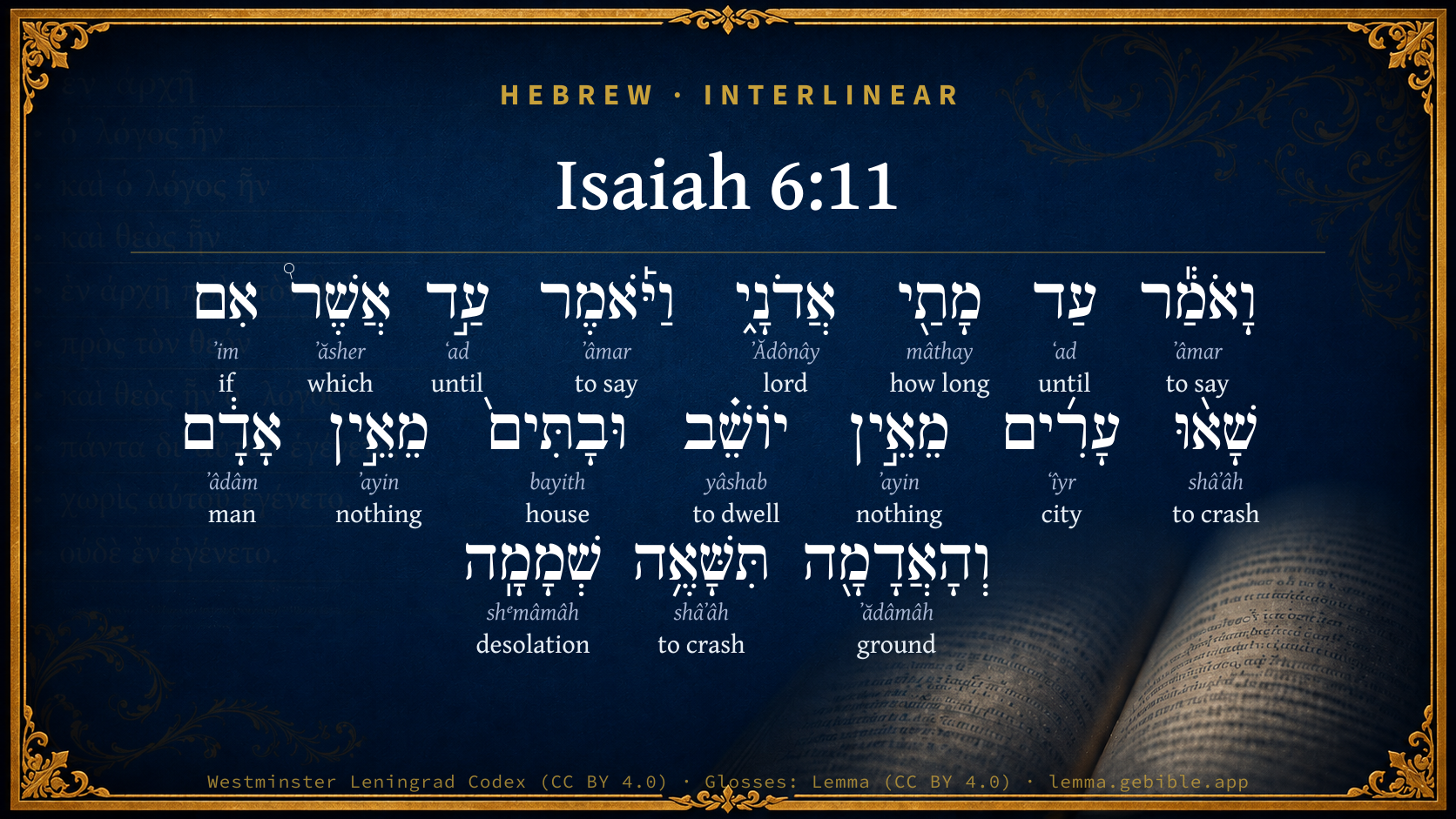
Hebrew (Westminster Leningrad Codex) Isaiah 6:11 appears in the Hebrew Old Testament. The text above is from the Westminster Leningrad Codex. Each word links to its Strong’s number, a concise gloss, and parsing drawn from the Open Scriptures Hebrew Bible morphology. Click any word for its full Brown-Driver-Briggs (BDB) entry.
Download image
Cite this verse

Isaiah 6:11 (World English Bible). Public Domain. Lemma interlinear Bible study tool, https://lemma.gebible.app/v/isaiah/6/11.

Show BibTeX & RIS
BibTeX
RIS
English Translation
Then I said, "Lord, how long?" He answered, "Until cities are waste without inhabitant, And houses without man, And the land becomes utterly waste,
World English Bible · Public Domain
Download a study sheet

One document with this verse’s original text, its word-by-word gloss line, the meaning frame, cross-references with their text, attributed commentary, and full source and license credits — printable, and it pastes into notes with its structure intact.

This verse Autodidact and up

Study sheet (.html) Plain text (.txt)

A passage Seminary Student

Up to 50 verses in one chapter. A passage sheet keeps up to 6 commentary sources and 12 cross-references per verse, in the order this page ranks them, and says so on the sheet whenever that leaves anything out. Ask for a single verse and you get the Autodidact verse sheet above.

Everything on this page stays free to read, with no account — the sheet is a download of what is already on screen, not access to it.

Want to remove ads? Support Godless Engineer
Compare translations 3

The same verse in 3 English versions, stacked beneath the original-language interlinear above. Click any original word for its lexicon entry.

Each is an independent rendering of the whole verse — the interlinear is not word-aligned to these translations.

Highlighted words mark where these versions differ — a whole-verse word diff, not a word-by-word alignment.

  • World English Bible Public Domain
    Then I said, "Lord, how long?" He answered, "Until cities are waste without inhabitant, And houses without man, And the land becomes utterly waste,
  • King James Version Public Domain
    Then said I, Lord, how long? And he answered, Until the cities be wasted without inhabitant, and the houses without man, and the land be utterly desolate,
  • unfoldingWord Literal Text CC BY-SA 4.0
    And I said, “Until when, Lord?” And he said, “Until that if cities are desolate, without a dweller, and houses without a man, and the land is desolated, a wasteland,

unfoldingWord Literal Text — © unfoldingWord, licensed CC BY-SA 4.0. Word-aligned USFM3 via Door43 (git.door43.org/unfoldingWord/en_ult).

Versions to compare (up to 4)

3 of 4 selected

Show all 18 translations

Every available English version of this verse, each an independent rendering of the whole verse.

  • World English Bible Public Domain
    Then I said, "Lord, how long?" He answered, "Until cities are waste without inhabitant, And houses without man, And the land becomes utterly waste,
  • Berean Standard Bible Public Domain
    Then I asked: “How long, O Lord?” And He replied: “Until the cities lie ruined and without inhabitant, until the houses are left unoccupied and the land is desolate and ravaged,
  • Majority Standard Bible Public Domain
    Then I asked: “How long, O Lord?” And He replied: “Until the cities lie ruined and without inhabitant, until the houses are left unoccupied and the land is desolate and ravaged,
  • King James Version Public Domain
    Then said I, Lord, how long? And he answered, Until the cities be wasted without inhabitant, and the houses without man, and the land be utterly desolate,
  • American Standard Version (1901) Public Domain
    Then said I, Lord, how long? And he answered, Until cities be waste without inhabitant, and houses without man, and the land become utterly waste,
  • Revised Version (1885) Public Domain
    Then said I, Lord, how long? And he answered, Until cities be waste without inhabitant, and houses without man, and the land become utterly waste,
  • Geneva Bible (1599) Public Domain
    Then sayd I, Lord, howe long? And he answered, Vntill the cities be wasted without inhabitant, and the houses without man, and the land be vtterly desolate,
  • Douay-Rheims (1899) Public Domain
    And I said: How long, O Lord? And he said: Until the cities be wasted without inhabitant, and the houses without man, and the land shall be left desolate.
  • Young's Literal Translation Public Domain
    And I say, `Till when, O Lord?' And He saith, `Surely till cities have been wasted without inhabitant, And houses without man, And the ground be wasted -- a desolation,
  • Literal Standard Version CC BY-SA 4.0
    And I say, “Until when, O Lord?” And He says, “Surely until cities have been ruined without inhabitant, || And houses without man, || And the ground is ruined—a desolation,
  • Unlocked Literal Bible CC BY-SA 4.0
    Then I said, “Lord, how long?” He answered, “Until cities crash into ruins and are without inhabitants, and the houses are without people, and the land falls into a desolate waste,
  • unfoldingWord Literal Text CC BY-SA 4.0
    And I said, “Until when, Lord?” And he said, “Until that if cities are desolate, without a dweller, and houses without a man, and the land is desolated, a wasteland,
  • Darby Bible Public Domain
    And I said, Lord, how long? And he said, Until the cities be wasted, without inhabitant, and the houses without man, and the land become an utter desolation,
  • World Messianic Bible Public Domain
    Then I said, “Lord, how long?” He answered, “Until cities are waste without inhabitant, houses without man, the land becomes utterly waste,
  • Webster's Bible Public Domain
    Then said I, Lord, how long? And he answered, Until the cities shall be wasted without inhabitant, and the houses without man, and the land be utterly desolate;
  • Free Bible Version CC BY-SA 4.0
    Then I asked, “How long will this last, Lord?” He replied, “Until towns are ruined and empty, houses are abandoned, and the land is devastated and destroyed;
  • Bible in Basic English Public Domain
    Then I said, Lord, how long? And he said in answer, Till the towns are waste and unpeopled, and the houses have no men, and the land becomes completely waste,
  • JPS Tanakh (1917) Public Domain
    Then said I: 'Lord, how long?' And He answered: 'Until cities be waste without inhabitant, and houses without man, and the land become utterly waste,

Literal Standard Version (2020), Covenant Press — licensed CC BY-SA 4.0. Text via the HelloAO Bible API (eBible.org). Unlocked Literal Bible (unfoldingWord) — licensed CC BY-SA 4.0. Text via the HelloAO Bible API (eBible.org). unfoldingWord Literal Text — © unfoldingWord, licensed CC BY-SA 4.0. Word-aligned USFM3 via Door43 (git.door43.org/unfoldingWord/en_ult). Free Bible Version, Dr. Jonathan Gallagher — licensed CC BY-SA 4.0. Text via the HelloAO Bible API (eBible.org).

Word by word

More ways to search: Search by grammar → Find every occurrence → Compare this word →

Practice this passage: Drill this verse → Learn its vocabulary →

שָׁא֨וּ
shâʼâh
H7582
“to crash”
Verb, Qal, Perfect, 3rd Person, Common, Plural
Part of Speech
Verb
Stem
Qal
Form
Perfect
Person
3rd Person
Gender
Common
Number
Plural
Full BDB Definition

Origin: a primitive root

TWOT: 2301

crash, make a din or crash, crash into ruins, be in ruins, be desolated - (Qal) to crash into ruins - (Niphal) - to be ruined - to crash - to be left (a desolation) - (Hiphil) - to cause to crash - to cause to be desolated
  1. וָאֹמַ֕ר ʼâmar H559 “and · to say” Conjunction + Verb, Qal, Sequential Imperfect, 1st Person, Common, Singular
  2. עַד ʻad H5704 “until” Preposition
  3. מָתַ֖י mâthay H4970 “how long” Particle, Interrogative
  4. אֲדֹנָ֑י ʼĂdônây H136 “Lord · my” Noun, Common, Masculine, Plural, Construct + Suffix, Personal, 1st Person, Common, Singular
  5. וַיֹּ֡אמֶר ʼâmar H559 “and · to say” Conjunction + Verb, Qal, Sequential Imperfect, 3rd Person, Masculine, Singular
  6. עַ֣ד ʻad H5704 “until” Preposition
  7. אֲשֶׁר֩ ʼăsher H834 “which” Particle, Relative
  8. אִם ʼim H518 “if” Conjunction
  9. עָרִ֜ים ʻîyr H5892 “cities” Noun, Common, Feminine, Plural, Absolute
  10. מֵאֵ֣ין ʼayin H369 “from · nothing” Preposition + Particle, Negative
  11. יוֹשֵׁ֗ב yâshab H3427 “dwelling” Verb, Qal, Participle Active, Masculine, Singular, Absolute
  12. וּבָתִּים֙ bayith H1004 “and · houses” Conjunction + Noun, Common, Masculine, Plural, Absolute
  13. מֵאֵ֣ין ʼayin H369 “from · nothing” Preposition + Particle, Negative
  14. אָדָ֔ם ʼâdâm H120 “man” Noun, Common, Masculine, Singular, Absolute
  15. וְהָאֲדָמָ֖ה ʼădâmâh H127 “and · the · ground” Conjunction + Particle, Definite Article + Noun, Common, Feminine, Singular, Absolute
  16. תִּשָּׁאֶ֥ה shâʼâh H7582 “to crash” Verb, Niphal, Imperfect, 3rd Person, Feminine, Singular
  17. שְׁמָמָֽה shᵉmâmâh H8077 “desolation” Noun, Common, Feminine, Singular, Absolute

About this verse

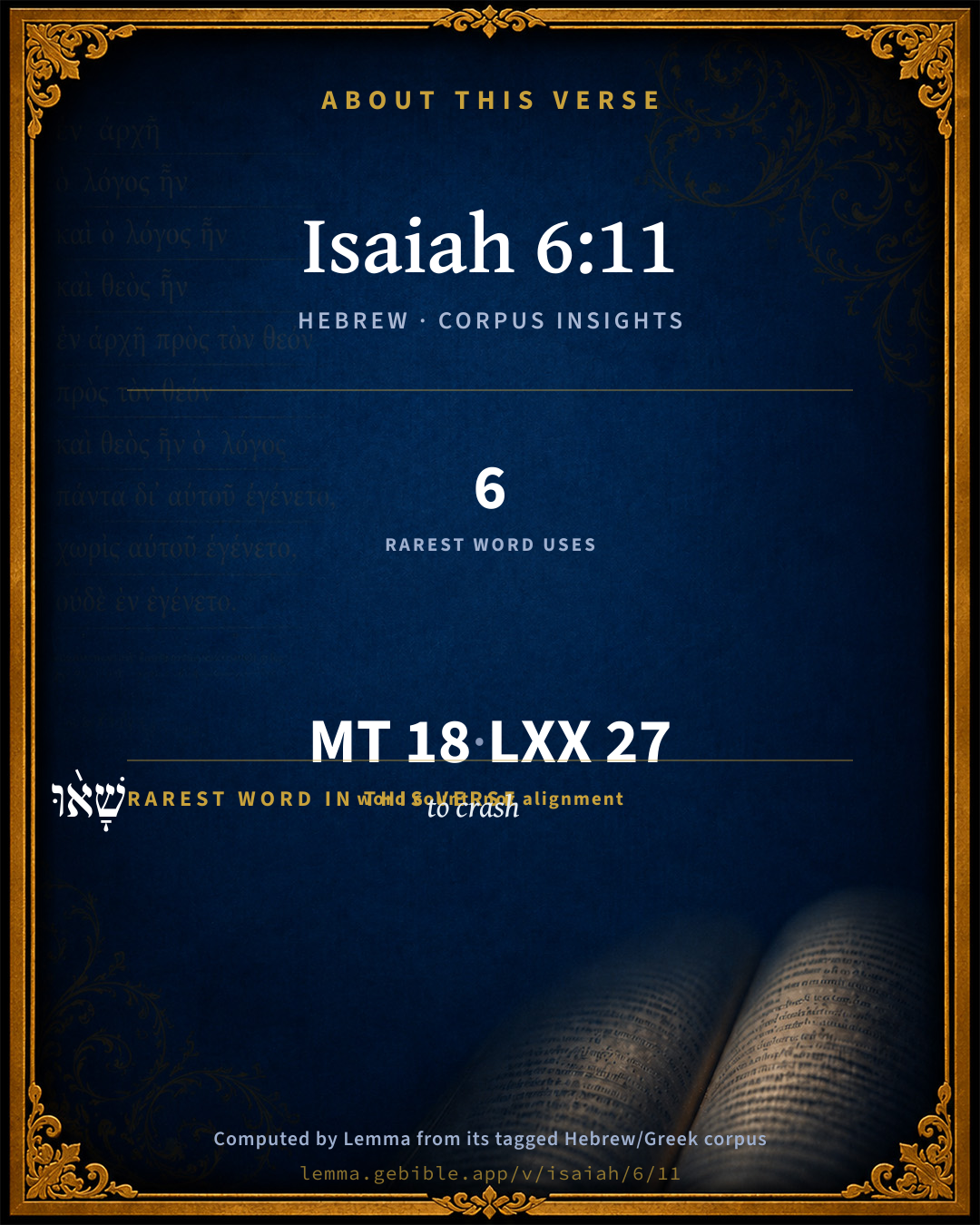
These counts appear in no published source. They are computed here, from the morphology-tagged text and Lemma’s own curated glosses. What Lemma adds →

18
words
14
distinct lemmas
Prophets
section

Notable vocabulary

The rarest word here is שָׁא֨וּ to crash H7582 — appearing just 6 times in the whole Hebrew Bible.

Shared distinctive vocabulary

שָׁא֨וּ to crash H7582 occurs in 5 verses of the Hebrew Bible. Also found in:

Grammatical profile

  • 5 verbs
  • 6 nouns
  • 2 prepositions
  • 1 conjunction
  • 4 particles

Verb forms

  • וָאֹמַ֕ר Qal · Sequential Imperfect
  • וַיֹּ֡אמֶר Qal · Sequential Imperfect
  • שָׁא֨וּ Qal · Perfect
  • יוֹשֵׁ֗ב Qal · Participle Active
  • תִּשָּׁאֶ֥ה Niphal · Imperfect

Repetition

Words recur within this verse — often emphatic in Hebrew:

  • וָאֹמַ֕ר to say H559 ×2
  • עַד until H5704 ×2
  • שָׁא֨וּ to crash H7582 ×2
  • מֵאֵ֣ין nothing H369 ×2

Hebrew & Septuagint length

In English translation the verse runs 24 words from the Hebrew and 38 from the Septuagint (LXX English) — the Septuagint runs noticeably longer here. See the side-by-side →

A rough comparison of the two English renderings, which tokenize alike — not a word-level alignment.

Word counts can differ between the Hebrew and the Greek without any difference in meaning — e.g. the Hebrew direct-object marker אֵת has no separate Greek word, and Greek often adds the article ὁ.

In the original languages it is 18 Hebrew tokens and 27 Greek tokens — but the two are counted differently (Hebrew bundles its prefixes and suffixes into one token; the Greek is in lemma form), so that isn’t a like-for-like length.

Cross-references

8

Topical passages linked to Isaiah 6:11 in the Treasury of Scripture Knowledge — connected by theme and wording, ordered by reader-vote popularity; previews shown in the World English Bible.

  • Leviticus 26:31 I will lay your cities waste, and will bring your sanctuaries to desolation, and I will not take delight in the sweet fragrence of your offerings.
  • Psalms 90:13 Relent, Yahweh! How long? Have compassion on your servants!
  • Psalms 94:3 Yahweh, how long will the wicked, How long will the wicked triumph?
  • Isaiah 1:7 Your country is desolate. Your cities are burned with fire. Strangers devour your land in your presence, And it is desolate, As overthrown by strangers.
  • Isaiah 3:26 Her gates shall lament and mourn; And she shall be desolate and sit on the ground.
  • Isaiah 24:1–12 Behold, Yahweh makes the earth empty, and makes it waste, and turns it upside down, and scatters abroad the inhabitants of it.
  • Psalms 79:5 How long, Yahweh? Will you be angry forever? Will your jealousy burn like fire?
  • Psalms 74:10 How long, God, shall the adversary reproach? Shall the enemy blaspheme your name forever?

Cross-references courtesy of OpenBible.info (CC BY 4.0).

Hebrew and Greek witnesses Masoretic Hebrew ↔ Greek Septuagint

The same verse in the two great witnesses to the Old Testament, shown verse-for-verse.

Here the Septuagint runs noticeably longer than the Hebrew — LXX2012 (modern English Septuagint) 38 words vs World English Bible 24. A rough length comparison of the two English translations, not a word-level alignment — read both below.

These are two independent witnesses, not word-aligned to each other, and the Septuagint is shown in lemma (dictionary) form.

Hebrew Isaiah 6:11 Masoretic · Westminster Leningrad Codex

וָאֹמַ֕ר עַד מָתַ֖י אֲדֹנָ֑י וַיֹּ֡אמֶר עַ֣ד אֲשֶׁר֩ אִם שָׁא֨וּ עָרִ֜ים מֵאֵ֣ין יוֹשֵׁ֗ב וּבָתִּים֙ מֵאֵ֣ין אָדָ֔ם וְהָאֲדָמָ֖ה תִּשָּׁאֶ֥ה שְׁמָמָֽה

Then I said, "Lord, how long?" He answered, "Until cities are waste without inhabitant, And houses without man, And the land becomes utterly waste,

World English Bible · Public Domain

Greek LXX Isaiah 6:11 Septuagint · lemma form

καί εἶπον ἕως πότε κύριος καί εἶπον ἕως ἄν ἐρημόω πόλις παρά ὁ μή καταοἰκέω καί οἶκος παρά ὁ μή εἰμί ἄνθρωπος καί ὁ γῆ καταλείπω ἔρημος

And I said, How long, O Lord? And he said, Until cities be deserted by reason of their not being inhabited, and the houses by reason of there being no men, and the land shall be left desolate.

LXX2012 (modern English Septuagint) · Public Domain

On this verse, Adam Clarke's Commentary discusses the Septuagint’s reading. Read the note in Commentary ↓

Hebrew: Westminster Leningrad Codex (CC BY 4.0). Greek: Septuagint (public domain); English from LXX2012 (modern English Septuagint) (Public Domain). How the Septuagint differs from the Hebrew →

Targum (Aramaic paraphrase)

1

The Targum is the ancient Jewish Aramaic paraphrase of the Hebrew Scriptures — an interpretive translation, not the Hebrew text itself. Onkelos (literal) and Pseudo-Jonathan (expansive) render the Torah, and Jonathan the Prophets. Coverage is partial: where no permissively-licensed English translation exists for a verse, only the Aramaic is shown. This is verse-level text, not a word-by-word alignment to the Hebrew.

  1. Targum Jonathan Prophets (Joshua–Malachi)
    וַאֲמָרִית עַד אֵימָתַי יְיָ וַאֲמַר עַד דְיִצְדוּן קִרְוַיָא מִבְּלִי יָתֵיב וּבָתַּיָא מִבְּלִי אֱנָשָׁא וְאַרְעָא תֶּחֱרוּב וְתִצְדֵי:

    Then said I, Lord, how long? And He answered, Until the cities be wasted without an inhabitant, and the houses without man, and the land be laid desolate and wasted.

    Targum Jonathan — Aramaic: “Mikraot Gedolot” (public domain). English: “Sefaria Community Translation” (CC0 1.0 (public-domain dedication)); “London "Chaldee Paraphrase," 1871” (public domain). Text via Sefaria.

Commentary

Notes on Isaiah 6:11 from classic Christian and Jewish commentators (each source and its license shown beneath its notes). The classic Christian expositions comment on the surrounding passage and are grouped to its opening verse, so a note may address several verses; the Jewish commentaries on the Tanakh (Rashi and others) are per-verse, so they appear only where the commentator wrote on this verse.

Lemma curates 59 commentaries, every one of them public domain or Creative Commons licensed, each selected and text-cleaned for this edition rather than reprinted as found. About our sources →

Trapp's Complete Commentary

John Trapp

Isa 6:11 Then said I, Lord, how long? And he answered, Until the cities be wasted without inhabitant, and the houses without man, and the land be utterly desolate,

Ver. 11. Then said I, Lord, how long?] sc., Shall this sad stroke upon the souls of this poor people last? Is there no hope of an end? Hast thou utterly cast off Israel? See here the good affection of godly ministers towards even obdurate and obstinate sinners; how deeply and dearly they oft pity them and pray for them, as did also Moses, Samuel, Paul.

Until the cities be wasted, &c.] Till these uncounselable and incorrigible refractories be utterly rooted out by the Babylonians first: and then by the Romans.

John Trapp, A Commentary or Exposition upon All the Books of the Old and New Testament (1647–1656) — public domain. Text from a community e-Sword module.

The Biblical Illustrator

Joseph S. Exell

Isa_6:11

Then said I, Lord, how long?

--

The state of the Church

I. NOTICE A FEW THINGS AFFECTING THE STATE OF THE CHURCH AND OF THE WORLD WHICH ARE CALCULATED TO EXCITE THE ASTONISHMENT AND GRIEF OF THE CHRISTIAN.

1. The little progress which Christianity has made after a lapse of eighteen hundred years.

2. The prevalence of irreligion in those parts of the world which are professedly Christian.

3. The low state of religion in the Church itself.

4. The obstacles which the Church presents to the increase of vital piety.

II. HOW LONG THIS STATE OF THINGS IS TO CONTINUE, or when we may reasonably expect another, and a better.

1. There is a connection established between the spirit or the state of mind generally prevailing in the Church and its prosperity, or the extension of religion in the world. As soon as the Church is thoroughly alive and truly devoted to God, the time of her enlargement is at hand.

2. The second point respects the inquiry, what is that state of mind which must generally prevail in the Church in order to the extension of religion in the world?

(1) It is absolutely necessary that the Church should realise her position and feel her responsibility.

(2) It is absolutely necessary also that the Church should feel sympathy with her Lord in His intense solicitude, or in the accomplishment of the great purpose of His mediation.

(3) Until this state of mind prevail in the Church our efforts will not be of such a character as God can greatly bless.

III. HOW MAY THE CHURCH BE BROUGHT INTO THAT STATE OF MIND WHICH APPEARS TO BE ABSOLUTELY NECESSARY IN ORDER TO HER EXTENDED USEFULNESS AND TO THE DIFFUSION OF THE GOSPEL THROUGHOUT THE WORLD! Every man should begin with himself, and everyone who is awake should endeavour to awaken his brother. (J. J.Davies.)

Isaiahs attitude towards his message

The prophet cannot venture to intercede for the people, nor does he dare to give vent to his sorrow over the need of this stern message save by the words, How long, Lord? How long shall I have this painful and fruitless duty to perform! (P. Thomson, M. A.)

The Biblical Illustrator, edited by Joseph S. Exell (c. 1880s–1900s) — public domain. Text from a community e-Sword module.

Joseph Benson's Commentary

Isa 6:11-12. Then said I, Lord, how long? — An abrupt speech, arising from the prophet’s great passion and astonishment: how long shall this dreadful judgment last? Until the cities be wasted, &c. — Until this land be totally destroyed, first by the Babylonians, and afterward by the Romans. And the Lord have removed men far away — Hath caused this people to be carried away captive into far countries. And there be a great forsaking — Till houses and lands be generally forsaken of their owners. The reader wilt observe, “There is a remarkable gradation in denouncing these judgments; not only Jerusalem and the cities should be wasted without inhabitant, but even the single houses should be without man; and not only the houses of the cities, but even the country should be utterly desolate; and not only the people should be removed out of the land, but the Lord should remove them far away; and they should not be removed for a short period, but there should be a great, or rather, a long forsaking in the midst of the land. And hath not the world seen all these particulars exactly fulfilled? Have not the Jews laboured under a spiritual blindness and infatuation, in hearing, but not understanding, in seeing, but not perceiving the Messiah, after the accomplishment of so many prophecies, after the performance of so many miracles? And, in consequence of their refusal to convert and be healed, have not their cities been wasted without inhabitants, and their houses without man? Have they not been removed far away into the most distant parts of the earth? and hath not their removal, or banishment, been now of above 1700 years duration? And do they not still continue deaf and blind, obstinate and unbelieving? The Jews, at the time of the delivery of this prophecy, gloried in being the peculiar church and people of God; and would any Jew, of himself, have thought or have said, that his nation would, in process of time, become an infidel and reprobate nation; infidel and reprobate for many ages, oppressed by man, and forsaken of God? It was above 750 years before Christ that Isaiah predicted these things; and how could he have predicted them, unless he had been illuminated by the divine vision; or could they have succeeded accordingly, unless the Spirit of prophecy had been the Spirit of God?” See Bishop Newton on the Prophecies, vol. 1. p. 233.

Joseph Benson's Commentary on the Old and New Testaments (1811–1818) — public domain. Text from a community e-Sword module.

The Preacher's Complete Homiletical Commentary

Joseph S. Exell (gen. ed.)

A STRANGE AND SAD ERRAND

Isa_6:9-10. And He said, Go, and tell this people, &c.

A sad and mysterious errand, the statement of which might well have quenched the enthusiasm inspired by his vision of the Divine glory. When he exclaimed, “Here am I, send me!” how little did he anticipate for what purpose he would be sent! It must have astounded and saddened him, and it is full of astonishment and mystery for us. How could God have sent His servant on an errand such as this?

Much of the mystery will be relieved, though not altogether removed, if we recognise—what I believe to be the fact—that here we have a statement, not of the messages Isaiah was to deliver (for they were many, and were revealed to him at various times), but of what would be the result of them all. Those to whom he was sent, and whom he desired to bless, would not be made better, but worse, by his ministry.

This is in accordance with a well-known and terrible fact, viz., that the proclamation of truth often leads men to cleave more desperately to error [757] Why, then, does God send His servants to proclaim it?

[757] To a man living in the belief of what is erroneous or the practice of what is wrong you proclaim the truth, and what happens? (1) Either he amends his creed or his conduct; or (2) he disregards what you say, and goes on as before; or (3) he rejects what you say, and cleaves to his error more passionately than he would have done otherwise. The latter is a very frequent result. For example, slavery once prevailed throughout our colonies and the United States of America. Holy men held slaves; they had no suspicion of the wrongfulness of slavery. When its wrongfulness was proclaimed, many abandoned it; but others held to it,—some not caring whether it was wrong or right, looking only to the fact that it was profitable; but others reasoned themselves into a persuasion that it is right, that it is Scriptural, and maintained the system with a tenacity and passion they never felt before its wickedness was declared. In thousands of cases that was the result of the anti-slavery movement. God foresaw it, yet He raised up faithful men to proclaim the doctrines of human brotherhood and freedom, and sent them forth on their perilous errand, saying to them in effect, “Go, and tell this people, Hear ye indeed, but understand not; and see ye indeed, but perceive not. Make the heart of this people fat, and make their ears heavy, and shut their eyes, lest they see with their eyes, and hear with their ears, and understand with their heart, and convert, and be healed.” He sent them forth, notwithstanding that He foresaw that one inevitable effect of their mission would be the confirmation of thousands in error, the hardening of thousands in iniquity. In like manner He raised up Isaiah and other prophets to denounce the sensuality of the Jews, to pronounce their political schemes—their alliances now with Egypt and now with Assyria—to be huge mistakes, and to exhort them to a life of holiness and of simple trust in God; He foresaw that the result of their efforts would not be the reformation of the nation, and yet He sent them forth!

Not because He desires the depravity and destruction of men. Such a desire would be utterly inconsistent with His character and with His express declarations (Eze_18:23; Eze_18:32, &c.). We need not imagine, then, that we have here a confirmation of those schemes of arbitrary election and reprobation which some theologians have attributed to Him.

But

1. Because it is necessary for the preservation of His character as a God of righteousness and mercy that He should do what OUGHT to result in the salvation of men. Had He not sent His prophets forth on their sad mission, we should have been confronted by a greater difficulty: God permitting His chosen people to go on to ruin without one word of warning spoken, without one effort put forth to arrest them. But one of the supreme moral necessities of the universe is this, that His character as a God desiring the redemption of sinners should be maintained unimpaired; and therefore He sends forth His messengers to proclaim the truth, although He foresees that to many they will be the “savour of death unto death,”—as the frosty air of winter which cuts off the aged and feeble,—and not “the savour of life unto life,”—not as that same frosty air which “braces” and invigorates those who are already vigorous. As this quotation reminds you, this is the effect of the Gospel itself. Ought God, therefore, never to have sent its preachers forth?

2. That stubborn sinners may be left without excuse in the day of their doom. God will not merely take vengeance on the violators of His laws of righteousness; He will make it manifest that while in Him there is an awful severity, there is no vindictiveness; and He will so act that, even when that severity is most manifested, not only the onlookers, but even those who experience it shall be constrained to confess, “Just and true are Thy ways, Thou King of saints!” He will not leave it possible for them to say, “Hadst Thou warned us, we should not have sinned.” They shall be speechless (Mat_22:12; Jer_44:2-5).

3. That the righteous may be saved. Did He not send His prophets forth to instruct and warn, even the men in whose hearts are the germs of righteousness and holiness of life would follow the multitude to do evil: they hear, and turn, and live: and this is ample justification of the prophet’s mission. Those who perish would have perished without it; but without it those who are saved would have perished also. And in this respect Isaiah’s ministry was not in vain: while to the vast majority of the nation it was “the savour of death unto death,” it was to a few—“the holy seed” of whom also this chapter speaks to us—“the savour of life unto life.” They learned to trust, not in Assyria nor in Egypt, but in the Holy One of Israel, and therefore were “kept in perfect peace” amid all the convulsions and catastrophes of their time.

This passage seemed at the outset full of mystery; our tendency was to shun it as one that would not bear investigation, as one about which the least that could be said the better, as one which we could have wished had never been written. What do we see now? That here we have an illustration of the Psalmist’s saying, “Clouds and darkness are round about Him”—so to our purblind vision it seems, the brightness being so bright that it dazzles and blinds us; “but righteousness and judgment are the habitation of His throne.” What should we learn from this?

1. Never to fear to investigate anything in God’s Word. There is nothing here which its friends need wish to hide out of sight; it is all worthy of Him from whom it came (Psa_19:9).

2. Never to distrust God because of anything in either His Word or His Providence. Things that might cause distrust we shall meet with; some of them we shall never explain here, where we can know only “in part;” yet let us keep fast hold of the glorious and gladdening truth, that “in Him is no darkness at all.” God is light; God is love.

THE REJECTION OF DIVINE TRUTH

Isa_6:9-10. And He said, Go, and tell this people, &c.

The divine message—a message of melting pathos and of startling warning, of beseeching entreaty and of terrible threatening—must be delivered to men. “Go, and tell this people” is a command that shatters excuses and imposes an imperative obligation. God’s speakers have no option—speak they must (Jon_3:2). The effects of God’s communications correspond to the willingness or the wilfulness of men.

I. Divine truth elicits human disposition. In the spring season, the sun sits in judgment upon the trees of gardens and forests. Then the trees that have life have it more abundantly. Their latent powers and possibilities are developed and exhibited. The same sun-force smites the decaying trees and shrivels those having only goodliness without life. Is not the Sun of Righteousness “a discerner of the thoughts and intents of the heart”? When on earth, He who is “the Truth” evoked the hidden feelings, purposes, and qualities of men; and His manifold message repeats the process to the end of time (Joh_9:39). The ministry of Isaiah was a revealing ministry: the character of men and the character of the nation by it were made manifest.

II. Divine truth repelled because of dislike. “Lest they see, hear, understand, be converted and healed.” A diseased eye winces under the scorching sunlight, as a disordered soul will flinch under the fierce light that streams upon it from above. The disquieted conscience repels the entrance of the truth, because of the revolutions in thought, disposition, purpose, character, and activity which its admission would necessitate. None are so blind, deaf, insensible as those who do not want to see, hear, or feel (Joh_3:19-20). Men dislike the purpose of God’s good but severe discipline: they want not to “be converted and healed,” and they recoil from the painful process [760]

[760] “There is light enough for those whose sincere desire is to see; and darkness enough for those of a contrary disposition. There is brightness enough to illuminate the elect; and enough of obscurity to humble them. There is obscurity enough to blind the reprobate; and brightness enough to condemn them and to leave them without excuse.”—Blaise Pascal.

III. Divine truth cannot be rejected without injury. Divine truth and grace will not be void of result, though the result may be most injurious (Rom_2:4-5). Consequences of lasting duration are involved in our action of opening or shutting the doors of the soul [763] Not to receive the “grace upon grace” of God is to put the spirit into an attitude of opposition: this attitude can easily become a confirmed habit; and the habit, in righteous retribution, may be ratified (Rev_22:11). Antagonism to God’s revelation injures the soul’s highest life; its power of vision is dimmed or veiled; the understanding loses its alertness and fails to comprehend; the affections become gross and carnal. Inexorable is the spiritual law and appalling the spiritual doom (Eph_4:18). Isaiah unfolded God’s design of salvation; but the design was intercepted and frustrated by human perversity. Men “rejected the counsel of God against themselves,” and persistent resistance rendered them “past feeling.” “Take heed how ye hear.” “Hear, and your soul shall live” [766]Matthew Braithwaite.

[763] “The smallest particle of light falling on the sensitive plate produces a chemical change that can never be undone again; and the light of Christ’s love, once brought to the knowledge and presented for the acceptance of a soul, stamps on it an ineffaceable sign of its having been there. Once heard, it is hence forward a perpetual element in the whole condition, character, and destiny of the hearer. Every man that ever rejects Christ, does these things thereby—wounds his own conscience, hardens his own heart, and makes himself a worse man, just because he has had a glimpse of holiness, and has willingly, and almost consciously, “loved darkness rather than light.” Unbelief is its own judgment, its own condemnation: unbelief, as sin, is punished like other sins, by the perpetuation of deeper and darker forms of itself. Every time that you stifle a conviction, fight down a conviction, or din away a conviction, you have harmed your soul, made yourself a worse man, lowered the tone of your conscience, enfeebled your will, made your heart harder against love; you have drawn another horny scale over the eye that will prevent you seeing the light that is yonder. You have, as much as in you is, approximated to the other pole of the universe (if I may say that), to the dark and deadly antagonist of mercy, and goodness, and truth, and grace.”—Alexander Maclaren.

[766] “The great iniquity is, or then is the Gospel hid in a sinful sense, when men have it among them, or may have it, and will not hear it; or do hear it, and never understand it,—that is, never apply or set themselves to understand it; or receive no conviction from it; or receive no suitable impression on their hearts from it. Thus, all the while, is the Gospel hid to them by their own iniquity, that they do voluntarily make resisting efforts against it, as everything of sin must have somewhat of voluntarium in it. It supposeth that otherwise a brute agent might be as capable of sin as a rational one, and that cannot be. But here lies the iniquity, that men might understand and they will not; and there is a natural faculty that should turn them, even in their very hearts; but there is a sinful disinclination, and they will not turn. For it is the will that is not turned: “Ye will not come unto me that ye might have life.” And so, when the Gospel is hid, it is hid, not because men cannot see, but because they will not. They do (as it were) pretend the veil; stretch forth the veil before their eyes or bind it close over their own eyes, hoodwink themselves that they will not see. Being thus sinfully hidden, it comes also to be penalty hidden by a nemesis, hidden by a just vindicta. Ye will not understand, then ye shall not understand; ye will harden your hearts against light, against grace, against the design of the Gospel, and they shall be hardened. Since ye will have it so, so let it be.”—John Howe.

D. P. Q., 2938, 3391.

THE DURATION OF THE PROPHET’S MISSION

Isa_6:11-13. Then said I, Lord, how long? &c.

For an exposition of this passage see note [769]

[769] He inquired how long this service of hardening and this state of hardness were to continue,—a question forced from him by his sympathy with the nation to which he himself belonged (cf. Exo_32:9-14), and one which was warranted by the certainty that God, who is ever true to His promises, could not cast off Israel as a people for ever. The answer follows in Isa_6:11 b–13: “Until towns are wasted without inhabitant, and houses are without man, and the ground shall be laid waste, a wilderness, and Jehovah shall put men far away, and there shall be many forsaken places within the land. And is there still a tenth therein, this also again is given up to destruction, like the terebinth and the oak, of which, when they are felled, only a root-stump remains: such a root-stump is the holy seed.” The hardening judgment would come to an end only when the land of Israel had been made utterly desolate. Up to the words “given up to destruction,” the announcement is a threatening one; but from this point to “remains” a consolatory prospect begins to dawn; and in the last three words this brighter prospect, like a distant streak of light, bounds the horizon of the gloomy prophecy. It shall happen as with the terebinth and the oak. These trees were selected as illustrations, not only because they were so near akin to evergreens, and produced a similar impression, or because there were so many associations connected with them in the olden times of Israel’s history; but also because they formed such fitting symbols of Israel, on account of their peculiar facility for springing up again from the root (like the beech and nut, for example), even when they had been completely felled.… The root-stump was the remnant that had survived the judgment, and this remnant would become a seed, out of which a new Israel would spring up after the old had been destroyed. Thus in a few words is the way sketched out which God would henceforth take with His people. The passage contains an outline of the history of Israel to the end of time. Israel as a nation was indestructible, by virtue of the promise of God; but the mass of the people were doomed to destruction through the judicial sentence of God, and only a remnant, which would be converted, would perpetuate the nationality of Israel, and inherit the glorious future. This law of a blessing sunk in the depths of the curse actually inflicted still prevails in the history of the Jews. The way of salvation is open to all. Individuals find it, and give us a presentiment of what might be and is to be; but the great mass are hopelessly lost, and only when they have been swept away will a holy seed, saved by the covenant-keeping God, grow up into a new and holy Israel, which, according to chap. Isa_27:6, will fill the earth with its fruits, or, as the Apostle expresses it in Rom_11:12, become “the riches of the Gentiles.”—Delitzsch.

Let us look steadily at the facts before us, and then, perchance, we may discern the lessons associated with them. Isaiah desires to know how long his strange and sad mission is to continue; and the answer is, until its utter failure to save his fellow-countrymen from their sins and their impending doom has been demonstrated, until nothing but the mere life-germ of the nation is left. Here really are three facts, full of instruction for us to-day. I. Isaiah’s mission and the calamities he desired to avert by it were to work together. There was thus a twofold appeal to the men of that generation; and at its close God might have repeated the challenge, “What could I have done more?” (chap. Isa_5:4). Both by offers of mercy and manifestations of righteous anger He sought to deliver them from the doom towards which they madly hastened. Thus God deals with the world to-day: His preachers of righteousness and His judgments because of unrighteousness work side by side; this fact is a conclusive proof that God is not willing that the sinner should die. This is true of nations, and it is true of individuals. II. Isaiah was to prosecute his mission to the end, notwithstanding the proofs that his efforts to deliver his fellow-countrymen were vain. This is always the duty of God’s messengers: they are to deliver their message, and reiterate it, whether men accept or reject it. Whether it is popular or unpopular is a thing of which they are not even to think! the one thing they have to consider and remember is, that it is true. III. In the midst of all the calamities of his time, Isaiah was sustained by the assurance that the nation he loved should not utterly perish. Nothing could hurt “the holy seed” that constituted its true life. The Church of to-day is full of imperfections; the forces of unbelief are marshalling themselves against her; it may be that she will again be tried by fierce persecutions: but the Lord’s true prophet can survey all these possible calamities with calmness; he knows that “the holy seed” which constitutes her true life cannot be injured by them.

Here, then, is instruction and encouragement for the Lord’s prophet to-day. He is to preach the preaching which God has bidden him, regardless of everything but the fact that God had sent it forth. He is not to modify his message, to make it more palatable to his hearers. He must not cease to deliver it, although he sees that his hearers are hardening themselves against it, and so are bringing upon themselves a heavier doom. Comfort he will need, but he must find it in the fact that there is a “holy seed” to whom his ministry will be a blessing, and in whose salvation, if he be faithful to the end, he shall share.

In this passage there are also some supplementary lessons of general interest.

1. We have here an illustration of the persistence and success of the divine purposes. God selected the descendants of Abraham as the instruments through whom He would bless the world (Exo_19:5-6). Their history has been one long struggle against this purpose; but it has not been a frustration of it: their very waywardness and wickedness have afforded occasions for the manifestation of His character, and the consequent revelations both of His goodness and of His severity have been blessings to the world. In spite even of their rejection of His Son they are still His people, and He will at length make them a holy people (Rom_11:25-29).

2. God does not hesitate to use any means that will help to conform His chosen ones to His own ideal. It is a solemn thing to be chosen of God: that choice may involve possibilities from which flesh and blood shrinks [772] The way to avoid those possibilities is to find out what God’s purpose concerning us is, and endeavour to conform ourselves thereto: then we shall find His choice of us a well-spring of constant blessing.

3. God does not despise the merest germs of goodness. Insignificant, comparatively, as was “the holy seed” in Israel, He watched over it with ceaseless care. Comfort there is here for those who lament that there is in them so little of which God can approve. That little He will not despise (1Ki_14:13; Isa_42:3); He sees what possibilities of excellence there are in His chosen ones [775] and those little germs of excellence He will nourish until they have developed into that which will satisfy even Himself.

[772] Homiletic Encyclopædia of Illustrations, 86–90, 99–115.

[775] As the eye of the cunning lapidary detects in the rugged pebble, just digged from the mine, the polished diadem that shall sparkle in the diadem of a king; or as the sculptor in the rough block of marble, newly hewn from the quarry, beholds the statue of perfect grace and beauty which is latent there, and waiting but the touch of his hand,—so He who sees all, and the end from the beginning, sees oftentimes greater wonders than these. He sees the saint in the sinner, the saint that shall be in the sinner that is; the wheat in the tare; the shepherd feeding the sheep in the wolf tearing the sheep; Paul in the preacher of the faith in Saul the persecutor of the faith; Israel a prince with God in Jacob the trickster and the supplanter; Matthew the Apostle in Levi the publican; a woman that should love much in a woman sinning much; and in some vine of the earth bringing forth wild grapes and grapes of gall a tree which shall yet bring forth good fruit, and wine to make glad the heart; so that when some, like those over-zealous servants in the parable, would have Him pluck it up, and to cast it without more ado into the wine-press of the wrath of Almighty God, He exclaims rather, “Destroy it not, for a blessing is in it,” and is well content to await the end.—Trench.

See also Homiletic Encyclopædia, &c., 2454 and 3056.

The Preacher's Complete Homiletical Commentary (gen. ed. Joseph S. Exell; Funk & Wagnalls, c. 1892) — public domain (pre-1929). A full-Bible homiletical/sermon-outline anthology covering 65 of 66 books (2 John is absent from the source module). Text from a community e-Sword module.

Keil & Delitzsch

C. F. Keil & F. Delitzsch

Isaiah heard with sighing, and yet with obedience, in what the mission to which he had so cheerfully offered himself was to consist. Isa 6:11. "Then said I, Lord, how long?" He inquired how long this service of hardening and this state of hardness were to continue - a question forced from him by his sympathy with the nation to which he himself belonged (cf., Exo 32:9-14), and one which was warranted by the certainty that God, who is ever true to His promises, could not cast off Israel as a people for ever. The answer follows in Isa 6:11-13 : "Until towns are wasted without inhabitant, and houses are without man, and the ground shall be laid waste, a wilderness, and Jehovah shall put men far away, and there shall be many forsaken places within the land. And is there still a tenth therein, this also again is given up to destruction, like the terebinth and like the oak, of which, when they are felled, only a root-stump remains: such a root-stump is a holy seed." The answer is intentionally commenced, not with עד־כּי, but with אם אשׁר עד (the expression only occurs again in Gen 28:15 and Num 32:17), which, even without dropping the conditional force of אם, signified that the hardening judgment would only come to an end when the condition had been fulfilled, that towns, houses, and the soil of the land of Israel and its environs had been made desolate, in fact, utterly and universally desolate, as the three definitions (without inhabitant, without man, wilderness) affirm. The expression richak (put far away) is a general and enigmatical description of exile or captivity (cf., Joe. 4:6, Jer 27:10); the literal term gâlâh has been already used in Isa 5:13. Instead of a national term being used, we find here simply the general expression "men" (eth-hâēâdâm; the consequence of depopulation, viz., the entire absence of men, being expressed in connection with the depopulation itself. The participial noun hâ azubâh (the forsaken) is a collective term for places once full of life, that had afterwards died out and fallen into ruins (Isa 17:2, Isa 17:9). This judgment would be followed by a second, which would expose the still remaining tenth of the nation to a sifting. והיה שׁב, to become again (Ges. 142, 3); לבער היה, not as in Isa 5:5, but as in Isa 4:4, after Num 24:22 : the feminine does not refer to the land of Israel (Luzzatto), but to the tenth. Up to the words "given up to destruction," the announcement is a threatening one; but from this point to "remains" a consolatory prospect begins to dawn; and in the last three words this brighter prospect, like a distant streak of light, bounds the horizon of the gloomy prophecy. It shall happen as with the terebinth and oak. These trees were selected as illustrations, not only because they were so near akin to evergreens, and produced a similar impression, or because there were so many associations connected with them in the olden times of Israel's history; but also because they formed such fitting symbols of Israel, on account of their peculiar facility for springing up again from the root (like the beech and nut, for example), even when they had been completely felled. As the forms yabbesheth (dryness), dalleketh (fever), ‛avvereth (blindness), shachepheth (consumption), are used to denote certain qualities or states, and those for the most part faulty ones (Concord. p. 1350); so shalleceth here does not refer to the act itself of felling or casting away, but rather to the condition of a tree that has been hewn or thrown down; though not to the condition of the trunk as it lies prostrate upon the ground, but to that of the root, which is still left in the earth. Of this tree, that had been deprived of its trunk and crown, there was still a mazzebeth kindred form of mazzebâh), i.e., a root-stump (truncus) fast in the ground. The tree was not yet entirely destroyed; the root-stump could shoot out and put forth branches again. And this would take place: the root-stump of the oak or terebinth, which was a symbol of Israel, was "a holy seed." The root-stump was the remnant that had survived the judgment, and this remnant would become a seed, out of which a new Israel would spring up after the old had been destroyed. Thus in a few weighty words is the way sketched out, which God would henceforth take with His people. The passage contains an outline of the history of Israel to the end of time. Israel as a nation was indestructible, by virtue of the promise of God; but the mass of the people were doomed to destruction through the judicial sentence of God, and only a remnant, which would be converted, would perpetuate the nationality of Israel, and inherit the glorious future. This law of a blessing sunk in the depths of the curse actually inflicted, still prevails in the history of the Jews. The way of salvation is open to all. Individuals find it, and give us a presentiment of what might be and is to be; but the great mass are hopelessly lost, and only when they have been swept away will a holy seed, saved by the covenant-keeping God, grow up into a new and holy Israel, which, according to Isa 27:6, will fill the earth with its fruits, or, as the apostle expresses it in Rom 11:12, become "the riches of the Gentiles."

Now, if the impression which we have received from Isa 6:1-13 is not a false one - namely, that the prophet is here relating his first call to the prophetic office, and not, as Seb. Schmidt observes, his call to one particular duty (ad unum specialem actum officii) - this impression may be easily verified, inasmuch as the addresses in chapters 1-5 will be sure to contain the elements which are here handed to the prophet by revelation, and the result of these addresses will correspond to the sentence judicially pronounced here. And the conclusion to which we have come will stand this test. For the prophet, in the very first address, after pointing out to the nation as a whole the gracious pathway of justification and sanctification, takes the turn indicated in Isa 6:11-13, in full consciousness that all is in vain. And the theme of the second address is, that it will be only after the overthrow of the false glory of Israel that the true glory promised can possibly be realized, and that after the destruction of the great body of the people only a small remnant will live to see this realization. The parable with which the third begins, rests upon the supposition that the measure of the nation's iniquity is full; and the threatening of judgment introduced by this parable agrees substantially, and in part verbally, with the divine answer received by the prophet to his question "How long?" On every side, therefore, the opinion is confirmed, that in Isa 6:1-13 he describes his own consecration to the prophetic office. The addresses in chapters 2-4 and 5, which belong to the time of Uzziah and Jotham, do not fall earlier than the year of Uzziah's death, from which point the whole of Jotham's sixteen years' reign lay open before them. Now, as Micah commenced his ministry in Jotham's reign, though his book was written in the form of a complete and chronologically indivisible summary, by the working up of the prophecies which he delivered under Jotham, Ahaz, and Hezekiah, and was then read or published in the time of Hezekiah, as we may infer from Jer 26:18, it is quite possible that Isaiah may have taken from Micah's own lips (though not from Micah's book) the words of promise in Isa 2:1-4, which he certainly borrowed from some quarter. The notion that this word of promise originated with a third prophet (who must have been Joel, if he were one of the prophets known to us), is rendered very improbable by the many marks of Micah's prophetic peculiarities, and by its natural position in the context in which it there occurs (vid., Caspari, Micha, pp. 444-5).

Again, the situation of Isa 6:1-13 is not inexplicable. As Hvernick has observed, the prophet evidently intended to vindicate in Isa 6:1-13 the style and method of his previous prophecies, on the ground of the divine commission that he had received. but this only serves to explain the reason why Isaiah has not placed Isa 6:1-13 at the commencement of the collection, and not why he inserts it in this particular place. He has done this, no doubt, for the purpose of bringing close together the prophecy and its fulfilment; for whilst on the one hand the judgment of hardening suspended over the Jewish nation is brought distinctly out in the person of king Ahaz, on the other hand we find ourselves in the midst of the Syro-Ephraimitish war, which formed the introduction to the judgments of extermination predicted in Isa 6:11-13. It is only the position of chapter 1 which still remains in obscurity. If Isa 1:7-9 is to be understood in a historically literally sense, then chapter 1 must have been composed after the dangers of the Syro-Ephraimitish war had been averted from Jerusalem, though the land of Judah was still bleeding with the open wounds which this war, designed as it was to destroy it altogether, had inflicted upon it. Chapter 1 would therefore be of more recent origin than chapters 2-5, and still more recent than the connected chapters 7-12. It is only the comparatively more general and indefinite character of chapter 1 which seems at variance with this. But this difficulty is removed at once, if we assume that chapter 1, though not indeed the first of the prophet's addresses, was yet in one sense the first - namely, the first that was committed to writing, though not the first that he delivered, and that it was primarily intended to form the preface to the addresses and historical accounts in chapters 2-12, the contents of which were regulated by it. For chapters 2-5 and 7-12 form two prophetic cycles, chapter 1 being the portal which leads into them, and Isa 6:1-13 the band which connects them together. The prophetic cycle in chapters 2-5 may be called the Book of hardening, as it is by Caspari, and chapters 7-12 the Book of Immanuel, as Chr. Aug. Crusius suggests, because in all the stages through which the proclamation in chapters 7-12 passes, the coming Immanuel is the banner of consolation, which it lifts up even in the midst of the judgments already breaking upon the people, in accordance with the doom pronounced upon them in Isa 6:1-13.

Keil & Delitzsch — Biblical Commentary on the Old Testament (1861–1891) — public domain (CC PDM 1.0). Text via the HelloAO Bible API. (Old Testament only.)

Tyndale Open Study Notes

Tyndale Open Resources

6:11 how long . . . until . . . the whole country is a wasteland: During the prophet’s ministry (740 to 685 BC), the nation was plagued by wars, famines, and other forms of devastation.

Tyndale Open Study Notes — © Tyndale Open Resources, licensed CC BY-SA 4.0. Text via the HelloAO Bible API.

Geneva Bible (1599)

Geneva Bible translators

As he was moved with the zeal of God’s glory, so was he touched with a charitable affection toward the people.

Geneva Bible (1599) marginal notes — public domain. Text via Bolls.life.

Jamieson, Fausset & Brown

Robert Jamieson, A. R. Fausset & David Brown

how long--will this wretched condition of the nation being hardened to its destruction continue?

until-- (Isa 5:9) --fulfilled primarily at the Babylonish captivity, and more fully at the dispersion under the Roman Titus.

Jamieson, Fausset & Brown — Commentary Critical and Explanatory on the Whole Bible (1871) — public domain (CC PDM 1.0). Text via the HelloAO Bible API.

Adam Clarke's Commentary

Verse 11. Be utterly desolate - "Be left"] For תשאה tishaeh, the Septuagint and Vulgate read תשאר tishshaer.

Adam Clarke's Commentary on the Bible (1810–1826) — public domain. Text from a community e-Sword/MySword module.

Ellicott's Commentary for English Readers

(11) Lord, how long?—The prophet asks the question which is ever on the lips of those who are brought face to face with the problems of the world, with the great mystery of evil, sin permitted to work out fresh evil as its punishment, and yet remaining evil. How long shall all this last? So a later prophet, towards the close of the seventy years of exile, cried once again, “How long?” (Dan_8:13). So the cry, “How long, O Lord, dost thou not judge?” came from the souls beneath the altar (Rev_6:10).

Until the cities be wasted without inhabitant.—The words answer the immediate question of the prophet within its horizon. They suggest an answer to all analogous questions. Stroke after stroke must come, judgment after judgment, till the sin has been adequately punished; but the darkness of the prospect, terrible as it is, does not exclude the glimmer of an eternal hope for the far-off future.

A Bible Commentary for English Readers, edited by Charles John Ellicott (1878–1897) — public domain. Text from a community e-Sword module.

The Cambridge Bible for Schools and Colleges

gen. ed. J. J. S. Perowne

11. Lord, how long?] The prophet feels that in the divine counsels there must be a limit to this process of judicial hardening, that it must reach a crisis with a day of hope beyond it. But the answer is “Not till the existing Israel has been annihilated.”

Until the cities … without man] (Omit the.) Cf. ch. Isa_5:9.

and the land be utterly desolate] lit. “be wasted to desolation.” LXX., changing a letter, reads “and the land be left a desolation.”

11–13. The hardening of the people in unbelief is to be accompanied by a series of external judgments, culminating in the utter ruin of the nation.

The Cambridge Bible for Schools and Colleges (gen. ed. J. J. S. Perowne; Cambridge University Press, 1878–1918) — public domain. Text from a community e-Sword module.

John Gill's Exposition

Then said I, Lord, how long?.... That is, how long will this blindness, hardness, stupidity, and impenitence, remain with this people, or they be under such a sore judgment of God upon them:

and he answered, until the cities be wasted without inhabitant, and the houses without man, and the land be utterly desolate; until there is not an inhabitant in the cities of Judea, nor in Jerusalem, the metropolis of the land, nor a single man in any house in them; which denotes the utter desolation of the land and city; and can refer to no other than to the desolation thereof by the Romans; and till that time the blindness which happened to them continued; the things which belonged to their peace were hid from their eyes till their city was destroyed, and not one stone left upon another, Luk 19:42 till that time, and even to this day, the veil of blindness, ignorance, and and penitence, is on their hearts, and will remain until they are converted to the Lord, in the latter day; see Rom 11:25, Co2 3:14.

John Gill's Exposition of the Whole Bible (1746–1763) — public domain (CC PDM 1.0). Text via the HelloAO Bible API.

Albert Barnes' Notes on the Bible

How long - The prophet did not dare to pray that this effect should not follow. He asked merely therefore “how long” this state of things must continue; how long this message was to be delivered, and how long it should be attended with these painful effects.

Until the cities ... - They will remain perverse and obstinate until the land is completely destroyed by divine judgments. Still the truth is to be proclaimed, though it is known it will have no effect in reforming the nation. This refers, doubtless, to the destruction that was accomplished by the Babylonians.

The houses without man - This is strong language, denoting the certain and widespread desolation that should come upon the nation.

Albert Barnes' Notes on the Bible (1834–1885) — public domain. Text from a community e-Sword/MySword module.

Haydock's Catholic Bible Commentary

Desolate. By means of Nabuchodonosor, (St. Chrysostom) and the Romans, (Eusebius, &c.) or even till the end of the world, their obstinacy will continue.

George Leo Haydock (1774–1849), Haydock's Catholic Family Bible and Commentary, 1859 edition — public domain. Excludes Psalms (Douay-Rheims chapter numbering differs from Protestant) and Deuterocanonical books (Catholic canon only).

Matthew Poole's English Annotations

Lord, how long? an abrupt speech, arising from the prophet’s great passion and astonishment. How long shall this dreadful judgment last?

Until the land be utterly desolate; until this land be totally destroyed, first by the Babylonians, and afterward by the Romans.

Matthew Poole's English Annotations on the Holy Bible (1683–1685) — public domain. Text from a community e-Sword/MySword module.

Whedon's Commentary on the Bible

Daniel D. Whedon

11. How long a period will this hardness last, and how extended a time must the message predict?

Until — The direful answer covers the whole period until Nebuchadnezzar carries the people to Babylon. Cities will be reduced to solitudes; houses will stand tenantless and dilapidated; land or soil will be untilled and run wild.

Daniel D. Whedon (gen. ed.), Commentary on the Old and New Testaments (1874–1909) — public domain. Text from a community e-Sword module.

The Pulpit Commentary

Then said I, Lord, how long? Either, "How long am I to continue this preaching?" or, "How long is this blindness and callousness of the people to continue?" Isaiah assumes that he has not heard as yet God"s final purpose; that there is some merciful intention kept in reserve, which is to take effect after the close of the period of judgment. The cities... the houses; rather, cities... houses. An entire desolation of the whole land, and extermination of its inhabitants, is not prophesied, and never took place. Nebuchadnezzar "left of the poor of the land to be vinedressers and husbandmen". (2Ki_25:12 Jer_39:10) Even when the great mass of these persons went into Egypt and perished there, (Jer_44:11-27) a certain number escaped and returned to Palestine. (Jer_44:14, Jer_44:28) The land; rather, the ground, the soil.

Vers. 11-13. The loving-kindness of God shown in his judgments.

"I know, O Lord, that thy judgments are right, and flat thou in faithfulness hast afflicted me," says the psalmist. (Psa_119:75) No doubt, at last God must simply punish the obdurate and impenitent; but for the most part he sends his judgment upon men in mercy, either to turn them from their sins, or to refine and improve their characters.

I EVEN WHEN GOD SIMPLY PUNISHES, IT IS IN LOVINGKINDNESS TO MANKIND AT LARGE. When a nation, like Israel, as distinct from Judah, has persisted in evil-doing for centuries, in spite of warnings, teaching, remonstrance, knowledge of the truth, its case is hopeless is no remedy". (2Ch_36:16) The blow that then falls upon the nation is penal and final the requital of its ill desert. But if the blow is dealt to the nation itself in mere justice, it is also struck for the benefit of all neighboring nations, in mercy. It warns them from their evil ways; it says to them, in a voice which they can scarcely fail to hear, "Take heed, lest ye too perish.

II MOST OF GOD"S JUDGMENTS ARE CHASTISEMENTS, SENT TO TURN MEN FROM THEIR SINS. "We have had fathers of our flesh who corrected us" (Heb_12:9) when we had done wrong, and strove thereby to deter us from evil. So God acts with his children. So he chastened Judah, bringing calamity after calamity upon her, until at last there was a "remnant" which truly turned to him, and became the germ of the Christian Church. So be has chastened many a nation besides. So, too, he chastens individuals, sending on them sickness, and poverty, and loss of friends, and other misfortunes, to check them in a career of sin, and cause them to pause, and reflect, and tremble at his mighty hand, and humble themselves under it, and change their course of life. In this way he chastened David by the loss of Bathsheba"s first child, and by the revolt of Absalom and Adonijah; Hezekiah by war and sickness; Solomon by "adversaries" at home and abroad. Of this kind again are the natural punishments which he has attached to sins, the natural tendency of which is to deter men from them.

III ONE CLASS OF HIS JUDGMENTS ARE TRIALS, SENT TO PROVE MEN, AND THEREBY TO PURIFY THEM AND RAISE THEM TO GREATER SAINTLINESS. "Every branch in me that beareth fruit, he purgeth it, that it may bring forth more fruit"; (Joh_15:2) "The trying of your faith worketh patience". (Jam_1:3) Christ himself, we are told, was in his human nature "made perfect through suffering." The discipline of affliction is needed for forming in us many of the highest Christian graces, as patience, resignation, forgivingness, mildness, long-suffering. The sons of God are taught to expect a chastening which shall be "for their profit, that they may be partakers of his holiness". (Heb_12:10)

The Pulpit Commentary (1880–1919), ed. H.D.M. Spence-Jones & Joseph S. Exell — public domain. Text from a community e-Sword module.

John Wesley's Explanatory Notes

Lord - An abrupt speech, arising from the prophet's great passion and astonishment: how long shall this dreadful judgment last? Until - Until this land be totally destroyed, first by the Babylonians, and afterward by the Romans.

John Wesley, Explanatory Notes Upon the Whole Bible (1754–1765) — public domain. Text via the GEBible commentary corpus.

J. A. Alexander on Isaiah

Joseph Addison Alexander

“And I said, How long, Lord? And he said, Until that cities are desolate for want of an inhabitant, and houses for want of men, and the land shall be desolated, a waste, or utterly desolate.” The spiritual death of the people should be followed by external desolation. The common explanation is no doubt the true one, that the Prophet asks how long the blindness of the people shall continue, and is told until it ruins them and drives them from their country. As the foregoing description is repeatedly applied in the New Testament to the Jews who were contemporary with our Savior, the threatening must be equally extensive, and equivalent to saying that the land should be completely wasted, not at one time but repeatedly.

Joseph Addison Alexander, The Prophecies of Isaiah (1846–1847; New York: Scribner, 1870–1878) — public domain. Text from a community e-Sword module.

unfoldingWord translationNotes

Door43 World Missions Community

Until cities crash into ruins and are without inhabitants, and the houses are without people

"Until all the cities and houses are ruined and no one lives there"

the land falls into a desolate waste

Here "falls into" is an idiom that means to become something worse. AT: "the land becomes a desolate waste" (See: Idiom)

until Yahweh has sent the people far away, and the solitude of the land is great

Here Yahweh speaks about himself in the third person. AT: "until I, Yahweh, have sent all the people far away from their land, so that no one is left" (See: First, Second, or Third Person)

translationWords

lord

ruin

house

people group

desolate

waste

Yahweh

send

unfoldingWord translationNotes — © Distant Shores Media and the Door43 World Missions Community, licensed CC BY-SA 4.0. Source: git.door43.org/Door43/en_tn.

Rashi

Rabbi Shlomo Yitzchaki (Rashi)

Until when will they make their heart heavy and not listen?

And He said I know that they will not repent until retribution comes upon them and they go into exile, and the cities will be desolate without inhabitants.

lies waste and desolate an expression of solitude, without an inhabitant.

Rashi on the Tanakh — English translations: “The Judaica Press complete Tanach with Rashi, translated by A. J. Rosenberg” (CC BY 4.0); “Pentateuch with Rashi's commentary by M. Rosenbaum and A.M. Silbermann, 1929-1934” (public domain); “The Metsudah Tanach series, Lakewood, N.J” (CC BY 4.0); and “The Book of Joshua, Metsudah Publications, 1997” (CC BY 4.0). Text via Sefaria.

Ibn Ezra

Rabbi Abraham ibn Ezra

How long. The prophet wants to know how long this misfortune shall last, that the people shall not understand nor repent. The answer is, Till the land be desolate.

Ibn Ezra on the Tanakh — English translations: “Sefaria Community Translation” (CC0 1.0 (public-domain dedication)); “Yalkut, Sifsei Chachomim Chumash, Metsudah Publications, 2009” (CC BY 4.0); and “Commentary of Ibn Ezra on Isaiah - trans. by M. Friedlander, 1873” (public domain). Text via Sefaria.

Lesson kit

Teaching starters — assembled from the data on this page, not authored interpretation. Every prompt links to the verse data it draws on. Edit before teaching.

Isaiah, in the Prophets, opens this verse with 18 words (14 distinct Hebrew lemmas). Its most distinctive word is shâʼâh (“to crash”). The Greek Septuagint runs longer here. A historical commentator’s framing appears above. Read the whole chapter for the surrounding context.

Discussion questions

  1. How does “to crash” (shâʼâh) shape what this verse is saying?
  2. How does 2 Kings 19:25, which shares the word «to crash», read alongside this verse?
  3. What does the repetition of “to say” (2× in this one verse) do in this verse?
  4. The Septuagint runs longer here than the Hebrew. What might account for the difference?
  5. The translations on this page render this verse differently — a whole-verse word diff, not a word-by-word alignment. What might account for the different wordings?
  6. «וָאֹמַ֕ר» is a Qal Sequential Imperfect verb. How does that grammatical form shape the action described?
  7. Compare how Trapp's Complete Commentary and The Biblical Illustrator read this verse. Where do they agree or differ?

Things to notice

Reading settings

Reading text

Shown beneath each verse's original-language words.

Old Testament
Old Testament edition

Read the OT as the Masoretic Hebrew (MT) or the Greek Septuagint (LXX).

English shown for the Greek Septuagint (in the Hebrew ↔ Greek comparison).

Comparing translations? Open the Compare panel on any verse page to stack up to four side by side.