
Deuteronomy 14:2

Hebrew (Westminster Leningrad Codex) Deuteronomy 14:2 appears in the Hebrew Old Testament. The text above is from the Westminster Leningrad Codex. Each word links to its Strong’s number, a concise gloss, and parsing drawn from the Open Scriptures Hebrew Bible morphology. Click any word for its full Brown-Driver-Briggs (BDB) entry.
Download image
Cite this verse

Deuteronomy 14:2 (World English Bible). Public Domain. Lemma interlinear Bible study tool, https://lemma.gebible.app/v/deuteronomy/14/2.

Show BibTeX & RIS
BibTeX
RIS
English Translation
For you are a holy people to Yahweh your God, and Yahweh has chosen you to be a people for his own possession, above all peoples who are on the face of the earth.
World English Bible · Public Domain
Download a study sheet

One document with this verse’s original text, its word-by-word gloss line, the meaning frame, cross-references with their text, attributed commentary, and full source and license credits — printable, and it pastes into notes with its structure intact.

This verse Autodidact and up

Study sheet (.html) Plain text (.txt)

A passage Seminary Student

Up to 50 verses in one chapter. A passage sheet keeps up to 6 commentary sources and 12 cross-references per verse, in the order this page ranks them, and says so on the sheet whenever that leaves anything out. Ask for a single verse and you get the Autodidact verse sheet above.

Everything on this page stays free to read, with no account — the sheet is a download of what is already on screen, not access to it.

Want to remove ads? Support Godless Engineer
Compare translations 3

The same verse in 3 English versions, stacked beneath the original-language interlinear above. Click any original word for its lexicon entry.

Each is an independent rendering of the whole verse — the interlinear is not word-aligned to these translations.

Highlighted words mark where these versions differ — a whole-verse word diff, not a word-by-word alignment.

  • World English Bible Public Domain
    For you are a holy people to Yahweh your God, and Yahweh has chosen you to be a people for his own possession, above all peoples who are on the face of the earth.
  • King James Version Public Domain
    For thou art an holy people unto the LORD thy God, and the LORD hath chosen thee to be a peculiar people unto himself, above all the nations that are upon the earth.
  • unfoldingWord Literal Text CC BY-SA 4.0
    for you a nation set apart for Yahweh your God, and Yahweh has chosen you to be a people for his possession, over all the peoples that are on the face of the earth.

unfoldingWord Literal Text — © unfoldingWord, licensed CC BY-SA 4.0. Word-aligned USFM3 via Door43 (git.door43.org/unfoldingWord/en_ult).

Versions to compare (up to 4)

3 of 4 selected

Show all 18 translations

Every available English version of this verse, each an independent rendering of the whole verse.

  • World English Bible Public Domain
    For you are a holy people to Yahweh your God, and Yahweh has chosen you to be a people for his own possession, above all peoples who are on the face of the earth.
  • Berean Standard Bible Public Domain
    for you are a people holy to the LORD your God. The LORD has chosen you to be a people for His prized possession out of all the peoples on the face of the earth.
  • Majority Standard Bible Public Domain
    for you are a people holy to the LORD your God. The LORD has chosen you to be a people for His prized possession out of all the peoples on the face of the earth.
  • King James Version Public Domain
    For thou art an holy people unto the LORD thy God, and the LORD hath chosen thee to be a peculiar people unto himself, above all the nations that are upon the earth.
  • American Standard Version (1901) Public Domain
    For thou art a holy people unto Jehovah thy God, and Jehovah hath chosen thee to be a people for his own possession, above all peoples that are upon the face of the earth.
  • Revised Version (1885) Public Domain
    For thou art an holy people unto the LORD thy God, and the LORD hath chosen thee to be a peculiar people unto himself, above all peoples that are upon the face of the earth.
  • Geneva Bible (1599) Public Domain
    For thou art an holy people vnto ye Lord thy God, and the Lord hath chosen thee to be a precious people vnto himselfe, aboue all the people that are vpon the earth.
  • Douay-Rheims (1899) Public Domain
    Because thou art a holy people to the Lord thy God: and he chose thee to be his peculiar people of all nations that are upon the earth.
  • Young's Literal Translation Public Domain
    for a holy people `art' thou to Jehovah thy God, and on thee hath Jehovah fixed to be to Him for a people, a peculiar treasure, out of all the peoples who `are' on the face of the ground.
  • Literal Standard Version CC BY-SA 4.0
    for you [are] a holy people to your God YHWH, and YHWH has fixed on you to be to Him for a people, a peculiar treasure, out of all the peoples who [are] on the face of the ground.
  • Unlocked Literal Bible CC BY-SA 4.0
    For you are a nation that is set apart to Yahweh your God, and Yahweh has chosen you to be a people for his own possession, more than all peoples that are on the surface of the earth.
  • unfoldingWord Literal Text CC BY-SA 4.0
    for you a nation set apart for Yahweh your God, and Yahweh has chosen you to be a people for his possession, over all the peoples that are on the face of the earth.
  • Darby Bible Public Domain
    For thou art a holy people unto Jehovah thy God, and thee hath Jehovah chosen for a people of possession unto himself, out of all the peoples that are upon the face of the earth.
  • World Messianic Bible Public Domain
    For you are a holy people to the LORD your God, and the LORD has chosen you to be a people for his own possession, above all peoples who are on the face of the earth.
  • Webster's Bible Public Domain
    For thou art a holy people to the LORD thy God, and the LORD hath chosen thee to be a peculiar people to himself, above all the nations that are upon the earth.
  • Free Bible Version CC BY-SA 4.0
    because you are a holy people who belong to the Lord your God. The Lord chose you as his special people out of all the nations on earth.
  • Bible in Basic English Public Domain
    For you are a holy people to the Lord your God, and the Lord has taken you to be his special people out of all the nations on the face of the earth.
  • JPS Tanakh (1917) Public Domain
    For thou art a holy people unto the LORD thy God, and the LORD hath chosen thee to be His own treasure out of all peoples that are upon the face of the earth.

Literal Standard Version (2020), Covenant Press — licensed CC BY-SA 4.0. Text via the HelloAO Bible API (eBible.org). Unlocked Literal Bible (unfoldingWord) — licensed CC BY-SA 4.0. Text via the HelloAO Bible API (eBible.org). unfoldingWord Literal Text — © unfoldingWord, licensed CC BY-SA 4.0. Word-aligned USFM3 via Door43 (git.door43.org/unfoldingWord/en_ult). Free Bible Version, Dr. Jonathan Gallagher — licensed CC BY-SA 4.0. Text via the HelloAO Bible API (eBible.org).

Word by word

More ways to search: Search by grammar → Find every occurrence → Compare this word →

Practice this passage: Drill this verse → Learn its vocabulary →

סְגֻלָּ֔ה
çᵉgullâh
H5459
“treasure”
Noun, Common, Feminine, Singular, Absolute
Part of Speech
Noun
Type
Common
Gender
Feminine
Number
Singular
State
Absolute
Full BDB Definition

Origin: from an unused root meaning to shut up

TWOT: 1460a

possession, property - valued property, peculiar treasure - treasure
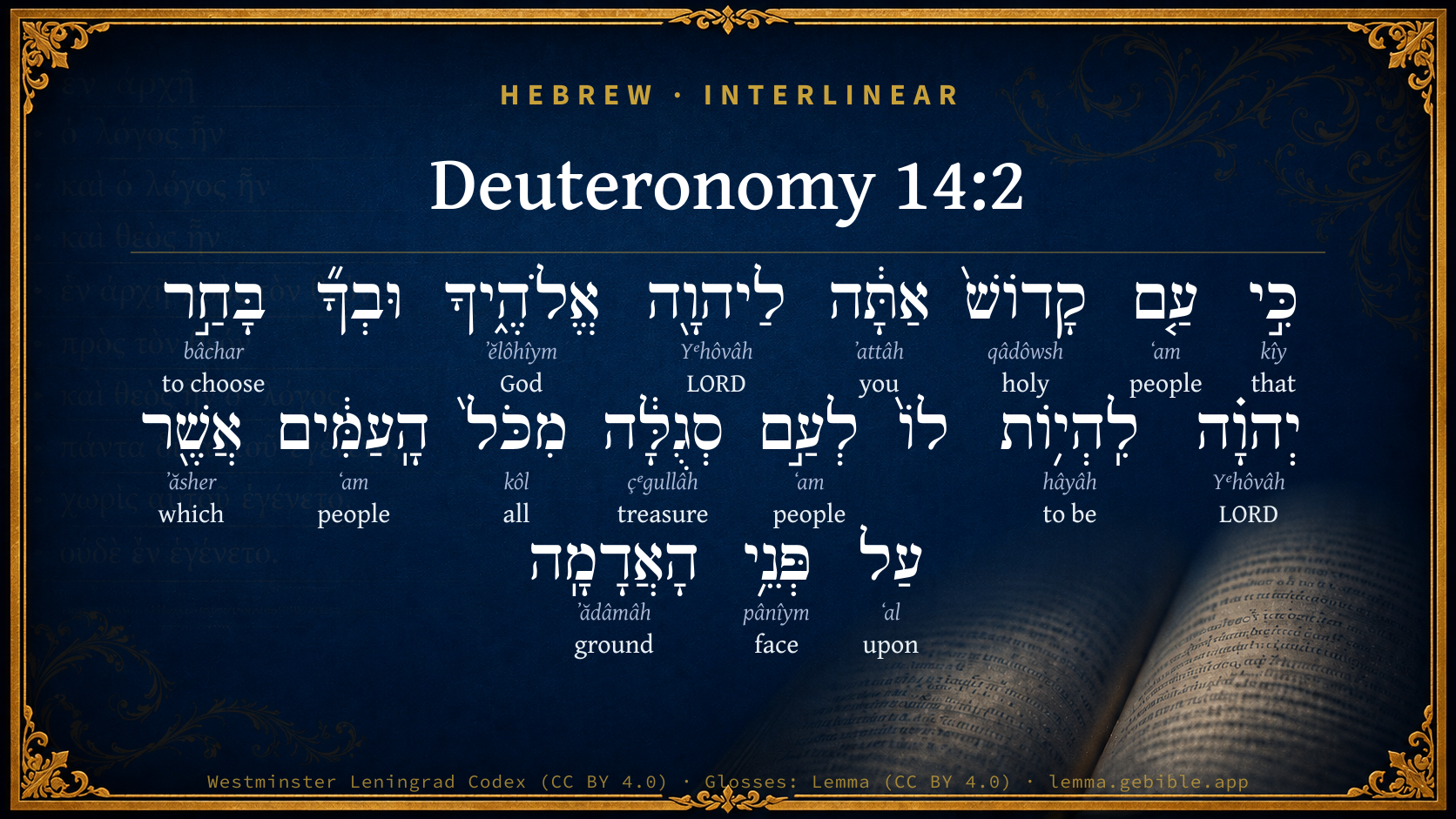
  1. כִּ֣י kîy H3588 “that” Conjunction
  2. עַ֤ם ʻam H5971 “people” Noun, Common, Masculine, Singular, Absolute
  3. קָדוֹשׁ֙ qâdôwsh H6918 “holy” Adjective, Adjective, Masculine, Singular, Absolute
  4. אַתָּ֔ה ʼattâh H859 “you” Pronoun, Personal, 2nd Person, Masculine, Singular
  5. לַיהוָ֖ה Yᵉhôvâh H3068 “to/for · LORD” Preposition + Noun, Proper
  6. אֱלֹהֶ֑יךָ ʼĕlôhîym H430 “God(s) · your” Noun, Common, Masculine, Plural, Construct + Suffix, Personal, 2nd Person, Masculine, Singular
  7. בָּחַ֣ר bâchar H977 “to choose” Verb, Qal, Perfect, 3rd Person, Masculine, Singular
  8. יְהוָ֗ה Yᵉhôvâh H3068 “LORD” Noun, Proper
  9. לִֽהְי֥וֹת hâyâh H1961 “to be” Preposition + Verb, Qal, Infinitive Construct
  10. לְעַ֣ם ʻam H5971 “to/for · people of” Preposition + Noun, Common, Masculine, Singular, Construct
  11. מִכֹּל֙ kôl H3605 “from · all of” Preposition + Noun, Common, Masculine, Singular, Construct
  12. הָֽעַמִּ֔ים ʻam H5971 “the · peoples” Particle, Definite Article + Noun, Common, Masculine, Plural, Absolute
  13. אֲשֶׁ֖ר ʼăsher H834 “which” Particle, Relative
  14. עַל ʻal H5921 “upon” Preposition
  15. פְּנֵ֥י pânîym H6440 “face(s) of” Noun, Common, Both, Plural, Construct
  16. הָאֲדָמָֽה ʼădâmâh H127 “the · ground” Particle, Definite Article + Noun, Common, Feminine, Singular, Absolute

About this verse

These counts appear in no published source. They are computed here, from the morphology-tagged text and Lemma’s own curated glosses. What Lemma adds →

19
words
14
distinct lemmas
Pentateuch
section

Notable vocabulary

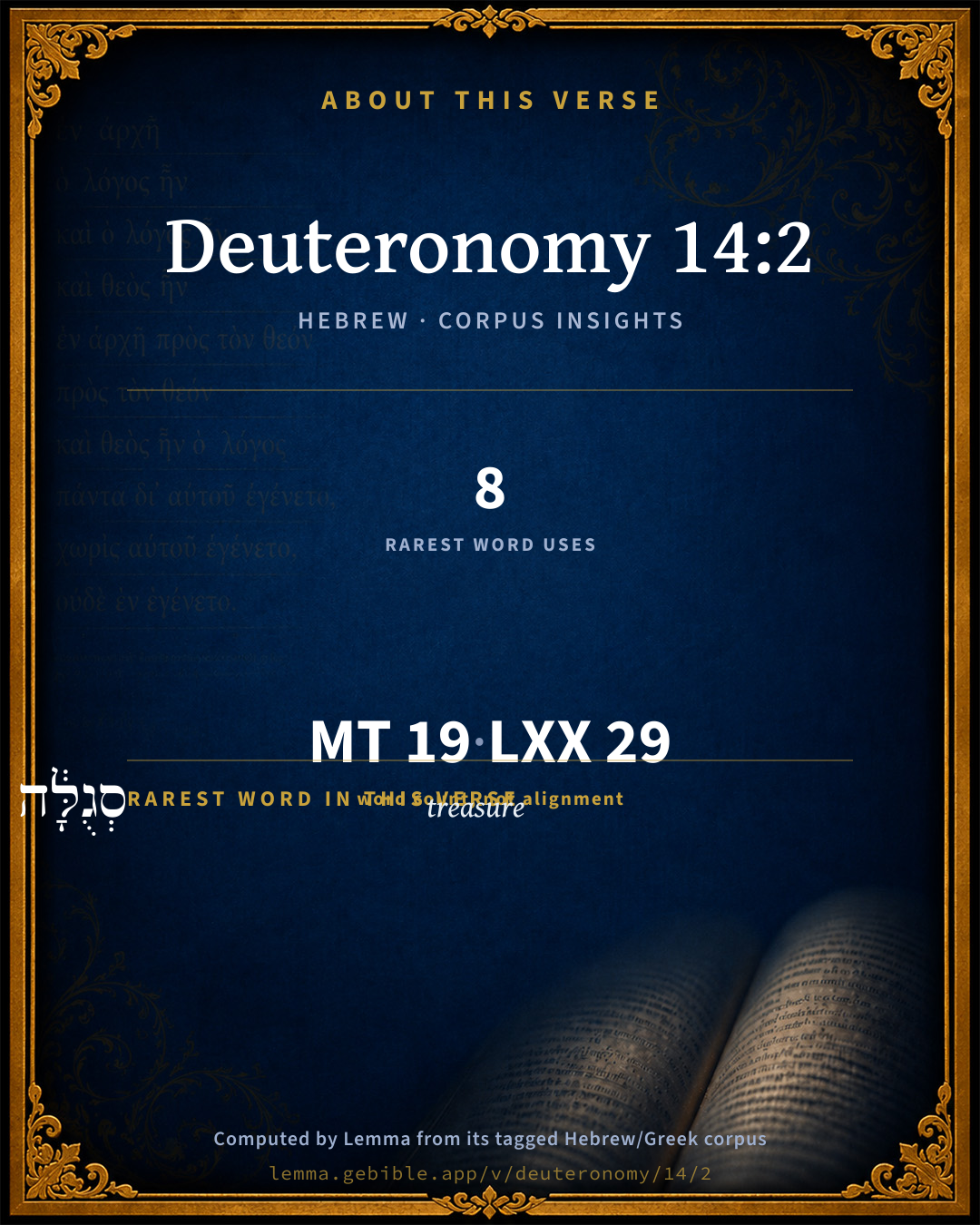
The rarest word here is סְגֻלָּ֔ה treasure H5459 — appearing just 8 times in the whole Hebrew Bible.

Shared distinctive vocabulary

סְגֻלָּ֔ה treasure H5459 occurs in 8 verses of the Hebrew Bible. Also found in:

Grammatical profile

  • 2 verbs
  • 10 nouns
  • 1 adjective
  • 1 pronoun
  • 3 prepositions
  • 1 conjunction
  • 1 particle

Verb forms

  • בָּחַ֣ר Qal · Perfect
  • לִֽהְי֥וֹת Qal · Infinitive Construct

Repetition

Words recur within this verse — often emphatic in Hebrew:

  • עַ֤ם people H5971 ×3
  • לַיהוָ֖ה LORD H3068 ×2

Hebrew & Septuagint length

In English translation the verse runs 34 words from the Hebrew and 36 from the Septuagint (LXX English) — closely comparable.

A rough comparison of the two English renderings, which tokenize alike — not a word-level alignment.

Word counts can differ between the Hebrew and the Greek without any difference in meaning — e.g. the Hebrew direct-object marker אֵת has no separate Greek word, and Greek often adds the article ὁ.

In the original languages it is 19 Hebrew tokens and 29 Greek tokens — but the two are counted differently (Hebrew bundles its prefixes and suffixes into one token; the Greek is in lemma form), so that isn’t a like-for-like length.

Cross-references

12

Topical passages linked to Deuteronomy 14:2 in the Treasury of Scripture Knowledge — connected by theme and wording, ordered by reader-vote popularity; previews shown in the World English Bible.

  • Deuteronomy 7:6 For you are a holy people to Yahweh your God: Yahweh your God has chosen you to be a people for his own possession, above all peoples who are on the face of the earth.
  • Leviticus 20:26 You shall be holy to me: for I, Yahweh, am holy, and have set you apart from the peoples, that you should be mine.
  • Exodus 19:5–6 Now therefore, if you will indeed obey my voice, and keep my covenant, then you shall be my own possession from among all peoples; for all the earth is mine;
  • Deuteronomy 26:18–19 and Yahweh has declared you this day to be a people for his own possession, as he has promised you, and that you should keep all his commandments;
  • 1 Peter 2:9 But you are a chosen race, a royal priesthood, a holy nation, a people for God's own possession, that you may show forth the excellencies of him who called you out of darkness into his marvelous light:
  • Leviticus 19:2 "Speak to all the congregation of the children of Israel, and tell them, 'You shall be holy; for I Yahweh your God am holy.
  • Titus 2:14 who gave himself for us, that he might redeem us from all iniquity, and purify for himself a people for his own possession, zealous for good works.
  • Leviticus 11:45 For I am Yahweh who brought you up out of the land of Egypt, to be your God. You shall therefore be holy, for I am holy.
  • Deuteronomy 28:9 Yahweh will establish you for a holy people to himself, as he has sworn to you; if you shall keep the commandments of Yahweh your God, and walk in his ways.
  • Isaiah 62:12 They shall call them The holy people, The redeemed of Yahweh: and you shall be called Sought out, A city not forsaken.
  • Deuteronomy 14:21 You shall not eat of anything that dies of itself: you may give it to the foreigner living among you who is within your gates, that he may eat it; or you may sell it to a foreigner: for you are a holy people to Yahweh your God. You shall not boil a kid in its mother's milk.
  • Daniel 8:24 His power shall be mighty, but not by his own power; and he shall destroy wonderfully, and shall prosper and do [his pleasure]; and he shall destroy the mighty ones and the holy people.

Cross-references courtesy of OpenBible.info (CC BY 4.0).

Hebrew and Greek witnesses Masoretic Hebrew ↔ Greek Septuagint

The same verse in the two great witnesses to the Old Testament, shown verse-for-verse.

These are two independent witnesses, not word-aligned to each other, and the Septuagint is shown in lemma (dictionary) form.

Hebrew Deuteronomy 14:2 Masoretic · Westminster Leningrad Codex

כִּ֣י עַ֤ם קָדוֹשׁ֙ אַתָּ֔ה לַיהוָ֖ה אֱלֹהֶ֑יךָ וּבְךָ֞ בָּחַ֣ר יְהוָ֗ה לִֽהְי֥וֹת לוֹ֙ לְעַ֣ם סְגֻלָּ֔ה מִכֹּל֙ הָֽעַמִּ֔ים אֲשֶׁ֖ר עַל פְּנֵ֥י הָאֲדָמָֽה

For you are a holy people to Yahweh your God, and Yahweh has chosen you to be a people for his own possession, above all peoples who are on the face of the earth.

World English Bible · Public Domain

Greek LXX Deuteronomy 14:2 Septuagint · lemma form

ὅτι λαός ἅγιος εἰμί κύριος ὁ θεός σύ καί σύ ἐκλέγω κύριος ὁ θεός σύ γίγνομαι σύ αὐτός λαός περιούσιος ἀπό πᾶς ὁ ἔθνος ὁ ἐπί πρόσωπον ὁ γῆ

For you are a holy people to the Lord your God, and the Lord your God has chosen you to be a peculiar people to himself of all the nations on the face of the earth.

LXX2012 (modern English Septuagint) · Public Domain

Hebrew: Westminster Leningrad Codex (CC BY 4.0). Greek: Septuagint (public domain); English from LXX2012 (modern English Septuagint) (Public Domain). How the Septuagint differs from the Hebrew →

Targum (Aramaic paraphrase)

2

The Targum is the ancient Jewish Aramaic paraphrase of the Hebrew Scriptures — an interpretive translation, not the Hebrew text itself. Onkelos (literal) and Pseudo-Jonathan (expansive) render the Torah, and Jonathan the Prophets. Coverage is partial: where no permissively-licensed English translation exists for a verse, only the Aramaic is shown. This is verse-level text, not a word-by-word alignment to the Hebrew.

  1. Targum Onkelos Torah (Genesis–Deuteronomy)
    אֲרֵי עַם קַדִישׁ אַתְּ קֳדָם יְיָ אֱלָהָךְ וּבָךְ אִתִּרְעֵי יְיָ לְמֶהֱוֵי לֵהּ לְעַם חַבִּיב מִכָּל עַמְמַיָא דִי עַל אַפֵּי אַרְעָא

    (no public-domain English translation for this verse)

    Targum Onkelos — Aramaic: “Onkelos Genesis” (public domain); “Onkelos Exodus” (public domain); “Onkelos Leviticus” (public domain); “Onkelos Numbers” (public domain); “Onkelos Deuteronomy” (public domain). English: “Sefaria Community Translation” (CC0 1.0 (public-domain dedication)); “J.W. Etheridge. The Targums of Onkelos and Jonathan Ben Uzziel on the Pentateuch. London: Longmans, Green, 1862” (public domain). Text via Sefaria.

  2. Targum Pseudo-Jonathan Torah (Genesis–Deuteronomy)
    אֲרוּם עַם קַדִּישׁ אַתּוּן קֳדָם יְיָ אֱלָהָכוֹן וּבְכוֹן אִיתְרְעֵי יְיָ אֱלָהָכוֹן לְמֶהֱוֵי לֵיהּ לְעָם חָבִיב מִכָּל עַמְמַיָא דְּעַל אַפֵּי אַרְעָא

    For you are to be a holy people before the Lord your God: the Lord your God hath chosen you to be a people more beloved than all the peoples who are upon the face of the earth.

    Targum Pseudo-Jonathan — Aramaic: “Targum Jonathan on Genesis” (public domain); “Targum Jonathan on Exodus” (public domain); “Targum Jonathan on Leviticus” (public domain); “Targum Jonathan on Numbers” (public domain); “Targum Jonathan on Deuteronomy” (public domain). English: “The Targum of Jonathan ben Uzziel, trans. J. W. Etheridge, London, 1862” (public domain). Text via Sefaria.

Commentary

Notes on Deuteronomy 14:2 from classic Christian and Jewish commentators (each source and its license shown beneath its notes). The classic Christian expositions comment on the surrounding passage and are grouped to its opening verse, so a note may address several verses; the Jewish commentaries on the Tanakh (Rashi and others) are per-verse, so they appear only where the commentator wrote on this verse.

Lemma curates 59 commentaries, every one of them public domain or Creative Commons licensed, each selected and text-cleaned for this edition rather than reprinted as found. About our sources →

Trapp's Complete Commentary

John Trapp

Deu 14:2 For thou [art] an holy people unto the LORD thy God, and the LORD hath chosen thee to be a peculiar people unto himself, above all the nations that [are] upon the earth.

Ver. 2. For thou art.] {See Trapp on "Deu 7:6"}

And the Lord hath chosen thee.] Hence all thy holiness. The maids were first purified, before Ahasuerus chose one; but here it is otherwise. {Eph 5:25-26}

John Trapp, A Commentary or Exposition upon All the Books of the Old and New Testament (1647–1656) — public domain. Text from a community e-Sword module.

Joseph Benson's Commentary

Deu 14:2. Thou art a holy people — Since you have the honour to be separated to God as a peculiar people, by laws different from those of all other nations, it behooves you to act suitably to the dignity of your privileges, and to beware of defiling yourselves with any such heathenish rites or practices as are either impious or absurd. Any abominable thing — Unclean, and forbidden by me, which therefore should be abominable to you: see on Leviticus 11.

Joseph Benson's Commentary on the Old and New Testaments (1811–1818) — public domain. Text from a community e-Sword module.

Tyndale Open Study Notes

Tyndale Open Resources

14:2 The fundamental Hebrew meaning of holy focuses on separation of a person or thing for a particular function or use. A derivative meaning is “pure” or “morally and spiritually upright.”

Tyndale Open Study Notes — © Tyndale Open Resources, licensed CC BY-SA 4.0. Text via the HelloAO Bible API.

Geneva Bible (1599)

Geneva Bible translators

Therefore thou oughtest not to follow the superstition of the Gentiles.

Geneva Bible (1599) marginal notes — public domain. Text via Bolls.life.

Ellicott's Commentary for English Readers

(2) For thou art an holy people.—This verse is repeated from Deu_7:6, word for word, except the “and,” which is added here. In the former passage, the principle is made the ground for destroying all monuments of idolatry in the land of Israel. Here it is made the basis of outward personal dignity and purity. This recalls the arrangement of the Book of Leviticus somewhat forcibly. The laws of ceremonial holiness stand first in that book, before the law of yearly atonement. Then follow the laws of moral holiness. But the principle and ground of all these laws is the same: “Ye shall be holy, for I am holy, and ye are Mine.”

Nations.—Rather, peoples. The commonwealth of Israel and its institutions are contrasted with other states and their institutions.

A Bible Commentary for English Readers, edited by Charles John Ellicott (1878–1897) — public domain. Text from a community e-Sword module.

The Cambridge Bible for Schools and Colleges

gen. ed. J. J. S. Perowne

2. For thou art an holy people, etc.] Almost exactly as Deu_7:6 (q.v.). Note also the Sg. address in contrast to the Pl. of the context. This v. is, therefore, probably an addition by the hand which inserted these later laws in the code of D.

The Cambridge Bible for Schools and Colleges (gen. ed. J. J. S. Perowne; Cambridge University Press, 1878–1918) — public domain. Text from a community e-Sword module.

John Gill's Exposition

For thou art an holy people unto the Lord thy God,.... Set apart by him from all other people, and devoted to his worship and service, and many of them were sanctified and made holy in a special and spiritual sense; and therefore should not conform to the customs of Gentiles, whether in their extravagant mourning for the dead, or in their religious services; see Deu 7:6,

and the Lord hath chosen thee to be a peculiar people, above all the nations that are upon the earth; to be his peculiar treasure, to be his peculiar servants and worshippers, to enjoy peculiar blessings and privileges, and behave in a peculiar manner different from all other people; and have no connection with them, especially in things sacred; and, in order to keep them a distinct peculiar people from all others, a peculiar diet was appointed them, that so being prohibited to eat such things as others did, they might be kept out of their company and conversation, and so from being drawn into their idolatrous practices; the rules concerning which follow; see Deu 7:6.

John Gill's Exposition of the Whole Bible (1746–1763) — public domain (CC PDM 1.0). Text via the HelloAO Bible API.

The Pulpit Commentary

cf. Deu_7:6. The reason assigned here is an emphatic expansion of the statement in ver. 1.

The Pulpit Commentary (1880–1919), ed. H.D.M. Spence-Jones & Joseph S. Exell — public domain. Text from a community e-Sword module.

Rashi

Rabbi Shlomo Yitzchaki (Rashi)

כי עם קדוש אתה FOR THOU ART AN HOLY PEOPLE — You are holy — your actual holiness comes to you from your fathers, but, in addition, ובך בחר ה׳ THE LORD HAS CHOSEN YOU [so that you are for two reasons bound to keep away from these pagan customs] (cf. Sifrei Devarim 97:1).

Rashi on the Tanakh — English translations: “The Judaica Press complete Tanach with Rashi, translated by A. J. Rosenberg” (CC BY 4.0); “Pentateuch with Rashi's commentary by M. Rosenbaum and A.M. Silbermann, 1929-1934” (public domain); “The Metsudah Tanach series, Lakewood, N.J” (CC BY 4.0); and “The Book of Joshua, Metsudah Publications, 1997” (CC BY 4.0). Text via Sefaria.

Lesson kit

Teaching starters — assembled from the data on this page, not authored interpretation. Every prompt links to the verse data it draws on. Edit before teaching.

Deuteronomy, in the Pentateuch, opens this verse with 19 words (14 distinct Hebrew lemmas). Its most distinctive word is çᵉgullâh (“treasure”). A historical commentator’s framing appears above. Read the whole chapter for the surrounding context.

Discussion questions

  1. What does “treasure” (çᵉgullâh) contribute to the verse as a whole?
  2. Exodus 19:5 shares the word «treasure» with this verse. How do the two illuminate each other?
  3. “people” occurs 3× in this one verse. What is the effect of the repetition?
  4. These translations render this verse differently. What is at stake in choosing one wording over another?
  5. The verb «בָּחַ֣ר» is Qal Perfect. How does its form color the action?
  6. Reading how Trapp's Complete Commentary and Joseph Benson's Commentary read this verse, where do the two commentators agree and where do they part?

Things to notice

Reading settings

Reading text

Shown beneath each verse's original-language words.

Old Testament
Old Testament edition

Read the OT as the Masoretic Hebrew (MT) or the Greek Septuagint (LXX).

English shown for the Greek Septuagint (in the Hebrew ↔ Greek comparison).

Comparing translations? Open the Compare panel on any verse page to stack up to four side by side.