Isaiah 1:7

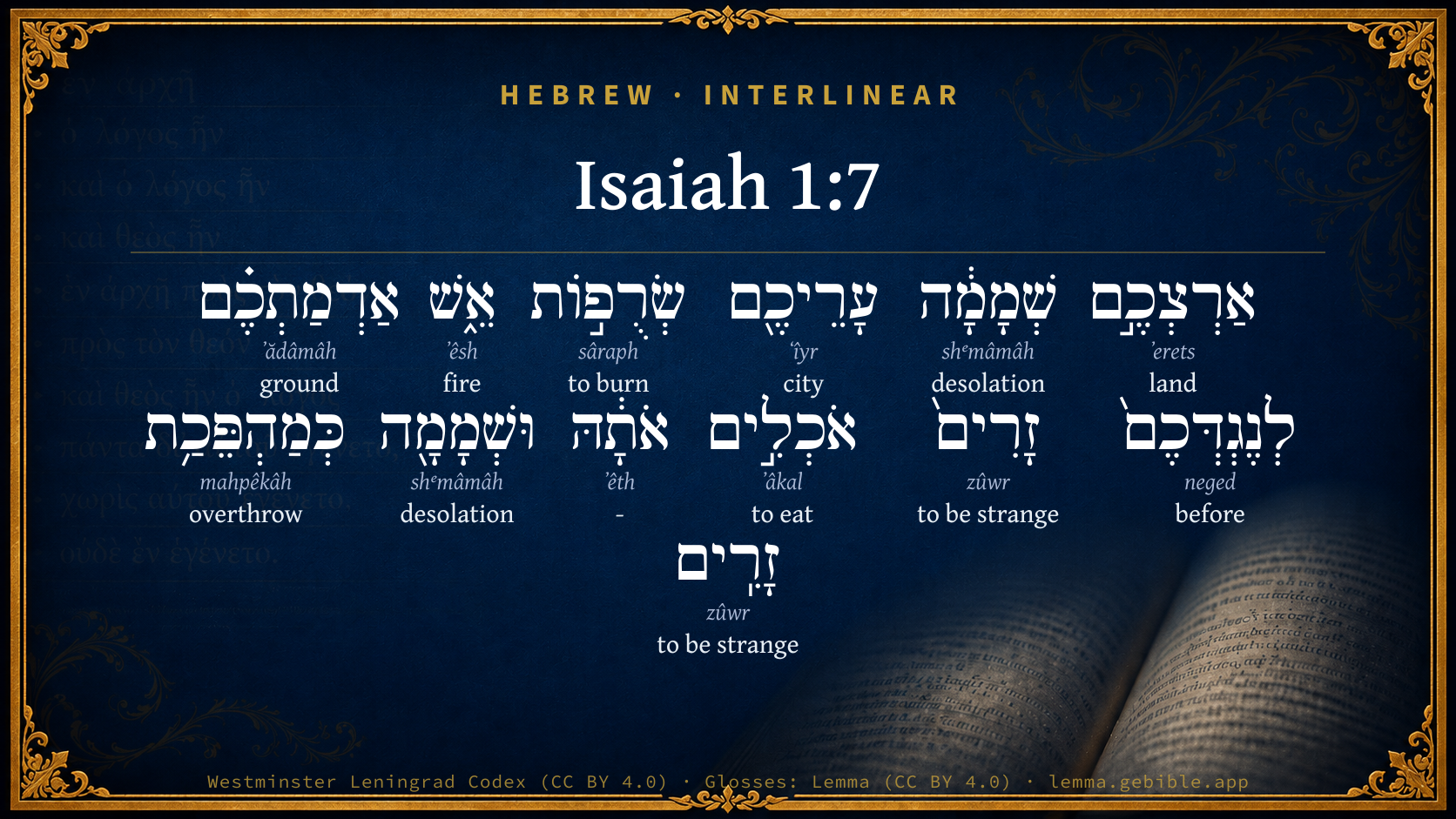
Hebrew (Westminster Leningrad Codex) Isaiah 1:7 appears in the Hebrew Old Testament. The text above is from the Westminster Leningrad Codex. Each word links to its Strong’s number, a concise gloss, and parsing drawn from the Open Scriptures Hebrew Bible morphology. Click any word for its full Brown-Driver-Briggs (BDB) entry.
Download image
Cite this verse

Isaiah 1:7 (World English Bible). Public Domain. Lemma interlinear Bible study tool, https://lemma.gebible.app/v/isaiah/1/7.

Show BibTeX & RIS
BibTeX
RIS
English Translation
Your country is desolate. Your cities are burned with fire. Strangers devour your land in your presence, And it is desolate, As overthrown by strangers.
World English Bible · Public Domain
Download a study sheet

One document with this verse’s original text, its word-by-word gloss line, the meaning frame, cross-references with their text, attributed commentary, and full source and license credits — printable, and it pastes into notes with its structure intact.

This verse Autodidact and up

Study sheet (.html) Plain text (.txt)

A passage Seminary Student

Up to 50 verses in one chapter. A passage sheet keeps up to 6 commentary sources and 12 cross-references per verse, in the order this page ranks them, and says so on the sheet whenever that leaves anything out. Ask for a single verse and you get the Autodidact verse sheet above.

Everything on this page stays free to read, with no account — the sheet is a download of what is already on screen, not access to it.

Want to remove ads? Support Godless Engineer
Compare translations 3

The same verse in 3 English versions, stacked beneath the original-language interlinear above. Click any original word for its lexicon entry.

Each is an independent rendering of the whole verse — the interlinear is not word-aligned to these translations.

Highlighted words mark where these versions differ — a whole-verse word diff, not a word-by-word alignment.

  • World English Bible Public Domain
    Your country is desolate. Your cities are burned with fire. Strangers devour your land in your presence, And it is desolate, As overthrown by strangers.
  • King James Version Public Domain
    Your country is desolate, your cities are burned with fire: your land, strangers devour it in your presence, and it is desolate, as overthrown by strangers.
  • unfoldingWord Literal Text CC BY-SA 4.0
    Your land a desolation, your cities have been burned with fire. Your ground, strangers are devouring it before you, indeed, a desolation like the overthrow of strangers.

unfoldingWord Literal Text — © unfoldingWord, licensed CC BY-SA 4.0. Word-aligned USFM3 via Door43 (git.door43.org/unfoldingWord/en_ult).

Versions to compare (up to 4)

3 of 4 selected

Show all 18 translations

Every available English version of this verse, each an independent rendering of the whole verse.

  • World English Bible Public Domain
    Your country is desolate. Your cities are burned with fire. Strangers devour your land in your presence, And it is desolate, As overthrown by strangers.
  • Berean Standard Bible Public Domain
    Your land is desolate; your cities are burned with fire. Foreigners devour your fields before you—a desolation demolished by strangers.
  • Majority Standard Bible Public Domain
    Your land is desolate; your cities are burned with fire. Foreigners devour your fields before you—a desolation demolished by strangers.
  • King James Version Public Domain
    Your country is desolate, your cities are burned with fire: your land, strangers devour it in your presence, and it is desolate, as overthrown by strangers.
  • American Standard Version (1901) Public Domain
    Your country is desolate; your cities are burned with fire; your land, strangers devour it in your presence, and it is desolate, as overthrown by strangers.
  • Revised Version (1885) Public Domain
    Your country is desolate; your cities are burned with fire; your land, strangers devour it in your presence, and it is desolate, as overthrown by strangers.
  • Geneva Bible (1599) Public Domain
    Your land is waste: your cities are burnt with fire: strangers deuoure your lande in your presence, and it is desolate like the ouerthrowe of strangers.
  • Douay-Rheims (1899) Public Domain
    Your land is desolate, your cities are burnt with fire: your country strangers devour before your face, and it shall be desolate as when wasted by enemies.
  • Young's Literal Translation Public Domain
    Your land `is' a desolation, your cities burnt with fire, Your ground, before you strangers are consuming it, And a desolation as overthrown by strangers!
  • Literal Standard Version CC BY-SA 4.0
    Your land [is] a desolation, your cities burned with fire, || Your ground—strangers are consuming it before you, || And a desolation as overthrown by strangers!
  • Unlocked Literal Bible CC BY-SA 4.0
    Your country is ruined; your cities are burned; your fields—in your presence, strangers are destroying them— abandoned devastation, overthrown by strangers.
  • unfoldingWord Literal Text CC BY-SA 4.0
    Your land a desolation, your cities have been burned with fire. Your ground, strangers are devouring it before you, indeed, a desolation like the overthrow of strangers.
  • Darby Bible Public Domain
    Your country is desolate; your cities are burned with fire; your land, strangers eat it up in your presence, and it is desolate, as overthrown by strangers.
  • World Messianic Bible Public Domain
    Your country is desolate. Your cities are burned with fire. Strangers devour your land in your presence and it is desolate, as overthrown by strangers.
  • Webster's Bible Public Domain
    Your country is desolate, your cities are burned with fire: your land, strangers devour it in your presence, and it is desolate, as overthrown by strangers.
  • Free Bible Version CC BY-SA 4.0
    Your country has been devastated, your towns burned down, your fields stripped bare by foreigners right in front of you, as they turn it all into a wasteland.
  • Bible in Basic English Public Domain
    Your country has become waste; your towns are burned with fire; as for your land, it is overturned before your eyes, made waste and overcome by men from strange lands.
  • JPS Tanakh (1917) Public Domain
    Your country is desolate; your cities are burned with fire; your land, strangers devour it in your presence, and it is desolate, as overthrown by floods.

Literal Standard Version (2020), Covenant Press — licensed CC BY-SA 4.0. Text via the HelloAO Bible API (eBible.org). Unlocked Literal Bible (unfoldingWord) — licensed CC BY-SA 4.0. Text via the HelloAO Bible API (eBible.org). unfoldingWord Literal Text — © unfoldingWord, licensed CC BY-SA 4.0. Word-aligned USFM3 via Door43 (git.door43.org/unfoldingWord/en_ult). Free Bible Version, Dr. Jonathan Gallagher — licensed CC BY-SA 4.0. Text via the HelloAO Bible API (eBible.org).

Word by word

More ways to search: Search by grammar → Find every occurrence → Compare this word →

Practice this passage: Drill this verse → Learn its vocabulary →

כְּמַהְפֵּכַ֥ת
mahpêkâh
H4114
“like/as · overthrow of”
Preposition + Noun, Common, Feminine, Singular, Construct
Part of Speech
Preposition + Noun
Type
Common
Gender
Feminine
Number
Singular
State
Construct
Full BDB Definition

Origin: from H2015

TWOT: 512d

overthrow, destruction - always of Sodom and Gomorrah
  1. אַרְצְכֶ֣ם ʼerets H776 “land · your” Noun, Common, Both, Singular, Construct + Suffix, Personal, 2nd Person, Masculine, Plural
  2. שְׁמָמָ֔ה shᵉmâmâh H8077 “desolation” Noun, Common, Feminine, Singular, Absolute
  3. עָרֵיכֶ֖ם ʻîyr H5892 “cities · your” Noun, Common, Feminine, Plural, Construct + Suffix, Personal, 2nd Person, Masculine, Plural
  4. שְׂרֻפ֣וֹת sâraph H8313 “burnt” Verb, Qal, Participle Passive, Feminine, Plural, Absolute
  5. אֵ֑שׁ ʼêsh H784 “fire” Noun, Common, Both, Singular, Absolute
  6. אַדְמַתְכֶ֗ם ʼădâmâh H127 “ground · your” Noun, Common, Feminine, Singular, Construct + Suffix, Personal, 2nd Person, Masculine, Plural
  7. לְנֶגְדְּכֶם֙ neged H5048 “to/for · before · you” Preposition + Preposition + Suffix, Personal, 2nd Person, Masculine, Plural
  8. זָרִים֙ zûwr H2114 “strange” Adjective, Adjective, Masculine, Plural, Absolute
  9. אֹכְלִ֣ים ʼâkal H398 “eating” Verb, Qal, Participle Active, Masculine, Plural, Absolute
  10. אֹתָ֔הּ ʼêth H853 “- · her” Particle, Direct Object + Suffix, Personal, 3rd Person, Feminine, Singular
  11. וּשְׁמָמָ֖ה shᵉmâmâh H8077 “and · desolation” Conjunction + Noun, Common, Feminine, Singular, Absolute
  12. זָרִֽים zûwr H2114 “strange” Adjective, Adjective, Masculine, Plural, Absolute

About this verse

These counts appear in no published source. They are computed here, from the morphology-tagged text and Lemma’s own curated glosses. What Lemma adds →

13
words
11
distinct lemmas
Prophets
section

Notable vocabulary

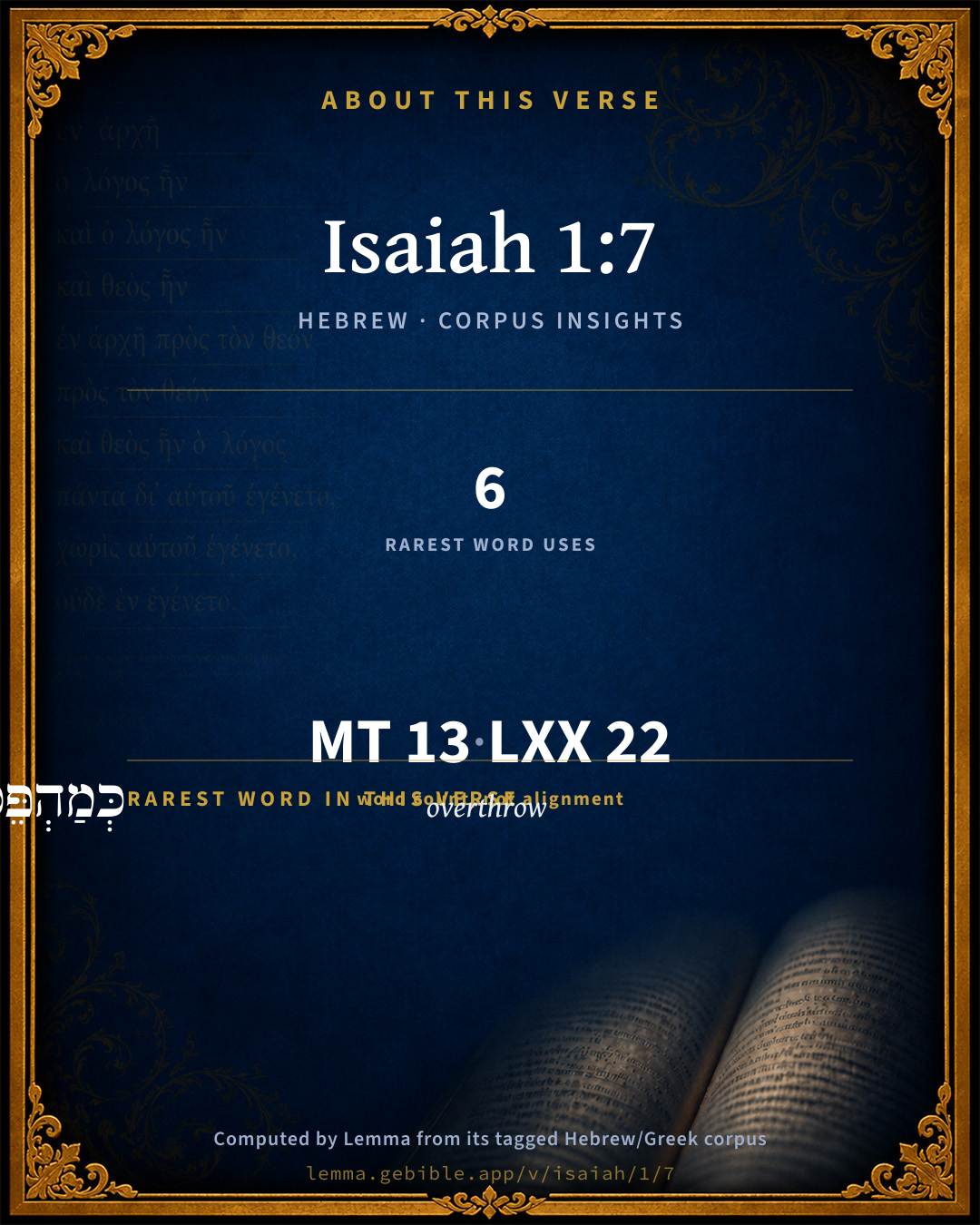
The rarest word here is כְּמַהְפֵּכַ֥ת overthrow H4114 — appearing just 6 times in the whole Hebrew Bible.

Shared distinctive vocabulary

כְּמַהְפֵּכַ֥ת overthrow H4114 occurs in 6 verses of the Hebrew Bible. Also found in:

Grammatical profile

  • 2 verbs
  • 7 nouns
  • 2 adjectives
  • 1 preposition
  • 1 particle

Verb forms

  • שְׂרֻפ֣וֹת Qal · Participle Passive
  • אֹכְלִ֣ים Qal · Participle Active

Repetition

Words recur within this verse — often emphatic in Hebrew:

  • שְׁמָמָ֔ה desolation H8077 ×2
  • זָרִים֙ to be strange H2114 ×2

Hebrew & Septuagint length

In English translation the verse runs 25 words from the Hebrew and 26 from the Septuagint (LXX English) — closely comparable.

A rough comparison of the two English renderings, which tokenize alike — not a word-level alignment.

Word counts can differ between the Hebrew and the Greek without any difference in meaning — e.g. the Hebrew direct-object marker אֵת has no separate Greek word, and Greek often adds the article ὁ.

In the original languages it is 13 Hebrew tokens and 22 Greek tokens — but the two are counted differently (Hebrew bundles its prefixes and suffixes into one token; the Greek is in lemma form), so that isn’t a like-for-like length.

Cross-references

21

Topical passages linked to Isaiah 1:7 in the Treasury of Scripture Knowledge — connected by theme and wording, ordered by reader-vote popularity; previews shown in the World English Bible.

  • Deuteronomy 28:33 The fruit of your ground, and all your labors, shall a nation which you don't know eat up; and you shall be only oppressed and crushed always;
  • Deuteronomy 28:43 The foreigner who is in the midst of you shall mount up above you higher and higher; and you shall come down lower and lower.
  • Lamentations 5:2 Our inheritance is turned to strangers, Our houses to aliens.
  • Ezekiel 30:12 I will make the rivers dry, and will sell the land into the hand of evil men; and I will make the land desolate, and all that is therein, by the hand of strangers: I, Yahweh, have spoken it.
  • Hosea 7:9 Strangers have devoured his strength, And he doesn't realize it. Indeed, gray hairs are here and there on him, And he doesn't realize it.
  • Deuteronomy 28:48–52 therefore shall you serve your enemies whom Yahweh shall send against you, in hunger, and in thirst, and in nakedness, and in want of all things: and he shall put a yoke of iron on your neck, until he have destroyed you.
  • 2 Chronicles 28:5 Therefore Yahweh his God delivered him into the hand of the king of Syria; and they struck him, and carried away of his a great multitude of captives, and brought them to Damascus. He was also delivered into the hand of the king of Israel, who struck him with a great slaughter.
  • 2 Chronicles 28:16–21 At that time did king Ahaz send to the kings of Assyria to help him.
  • Leviticus 26:34 Then the land will enjoy its sabbaths as long as it lies desolate and you are in your enemies' land. Even then the land will rest and enjoy its sabbaths.
  • Psalms 107:34 And a fruitful land into a salt waste, For the wickedness of those who dwell in it.
  • Psalms 107:39 Again, they are diminished and bowed down Through oppression, trouble, and sorrow.
  • Isaiah 5:9 In my ears, Yahweh of Hosts says: "Surely many houses will be desolate, Even great and beautiful, unoccupied.
  • Isaiah 5:17 Then the lambs will graze as in their pasture, And strangers will eat the ruins of the rich.
  • Isaiah 6:11 Then I said, "Lord, how long?" He answered, "Until cities are waste without inhabitant, And houses without man, And the land becomes utterly waste,
  • Isaiah 9:5 For all the armor of the armed man in the tumult, and the garments rolled in blood, shall be for burning, for fuel of fire.
  • Isaiah 24:10–12 The waste city is broken down; every house is shut up, that no man may come in.
  • Isaiah 34:9 The streams of [Edom] shall be turned into pitch, and the dust of it into sulfur, and the land of it shall become burning pitch.
  • Jeremiah 2:15 The young lions have roared on him, and yelled; and they have made his land waste: his cities are burned up, without inhabitant.
  • Jeremiah 6:8 Be instructed, Jerusalem, lest my soul be alienated from you; lest I make you a desolation, a land not inhabited.
  • Hosea 8:7 For they sow the wind, And they will reap the whirlwind. He has no standing grain. The stalk will yield no head. If it does yield, strangers will swallow it up.
  • Isaiah 5:5–6 Now I will tell you what I will do to my vineyard. I will take away its hedge, and it will be eaten up. I will break down its wall of it, and it will be trampled down.

Cross-references courtesy of OpenBible.info (CC BY 4.0).

Hebrew and Greek witnesses Masoretic Hebrew ↔ Greek Septuagint

The same verse in the two great witnesses to the Old Testament, shown verse-for-verse.

These are two independent witnesses, not word-aligned to each other, and the Septuagint is shown in lemma (dictionary) form.

Hebrew Isaiah 1:7 Masoretic · Westminster Leningrad Codex

אַרְצְכֶ֣ם שְׁמָמָ֔ה עָרֵיכֶ֖ם שְׂרֻפ֣וֹת אֵ֑שׁ אַדְמַתְכֶ֗ם לְנֶגְדְּכֶם֙ זָרִים֙ אֹכְלִ֣ים אֹתָ֔הּ וּשְׁמָמָ֖ה כְּמַהְפֵּכַ֥ת זָרִֽים

Your country is desolate. Your cities are burned with fire. Strangers devour your land in your presence, And it is desolate, As overthrown by strangers.

World English Bible · Public Domain

Greek LXX Isaiah 1:7 Septuagint · lemma form

ὁ γῆ σύ ἔρημος ὁ πόλις σύ πυρίκαυστος ὁ χώρα σύ ἐνώπιον σύ ἀλλότριος καταἐσθίω αὐτός καί ἐρημόω καταστρέφω ὑπό λαός ἀλλότριος

Your land is desolate, your cities burned with fire: your land, strangers devour it in your presence, and it is made desolate, overthrown by strange nations.

LXX2012 (modern English Septuagint) · Public Domain

Hebrew: Westminster Leningrad Codex (CC BY 4.0). Greek: Septuagint (public domain); English from LXX2012 (modern English Septuagint) (Public Domain). How the Septuagint differs from the Hebrew →

Targum (Aramaic paraphrase)

1

The Targum is the ancient Jewish Aramaic paraphrase of the Hebrew Scriptures — an interpretive translation, not the Hebrew text itself. Onkelos (literal) and Pseudo-Jonathan (expansive) render the Torah, and Jonathan the Prophets. Coverage is partial: where no permissively-licensed English translation exists for a verse, only the Aramaic is shown. This is verse-level text, not a word-by-word alignment to the Hebrew.

  1. Targum Jonathan Prophets (Joshua–Malachi)
    אַרְעֲכוֹן צַדְיָא קִרְוֵיכוֹן יְקִידַת נוּר אַרְעֲכוֹן לְקִבְלֵיכוֹן עַמְמַיָא מַחְסְנִין יָתָהּ וּבְחוֹבֵיהוֹן צְדִיאַת מִנְכוֹן אִתְחַלָפַת וַהֲוָה לְנוּכְרָאִין:

    Your land is desolate, your cities each burnt with fire; in your presence the nations possess it. On account of their sins it is laid desolate: from you it is transferred, and it belongs to aliens.

    Targum Jonathan — Aramaic: “Mikraot Gedolot” (public domain). English: “Sefaria Community Translation” (CC0 1.0 (public-domain dedication)); “London "Chaldee Paraphrase," 1871” (public domain). Text via Sefaria.

Commentary

Notes on Isaiah 1:7 from classic Christian and Jewish commentators (each source and its license shown beneath its notes). The classic Christian expositions comment on the surrounding passage and are grouped to its opening verse, so a note may address several verses; the Jewish commentaries on the Tanakh (Rashi and others) are per-verse, so they appear only where the commentator wrote on this verse.

Lemma curates 59 commentaries, every one of them public domain or Creative Commons licensed, each selected and text-cleaned for this edition rather than reprinted as found. About our sources →

Trapp's Complete Commentary

John Trapp

Isa 1:7 Your country [is] desolate, your cities [are] burned with fire: your land, strangers devour it in your presence, and [it is] desolate, as overthrown by strangers.

Ver. 7. Your country is desolate.] Here the prophet speaketh plainly, what before, parabolically. Thus many times the Scripture explaineth itself. {Job 7:3-9}

Your cities are burnt.] So that there is sometimes but an hour’s time, inter civitatem magnam et nullam, saith Seneca, between a fair city and a heap.

Your land, strangers devour it.] That is, enemies; in which sense also a harlot is called "a strange woman," seemingly a friend, but really an enemy: {a} she will destroy his peace who is overcome by her.

In your presence.] To your greater grief. Witness the experience hereof in our late stripping and desolating times, whereof we have here a kind of theological picture.

{a} Zar, "alienum" significat et "hostem."

John Trapp, A Commentary or Exposition upon All the Books of the Old and New Testament (1647–1656) — public domain. Text from a community e-Sword module.

Joseph Benson's Commentary

Isa 1:7-8. Your country is desolate — “The description of the ruined and desolate state of the country, in these verses,” says Bishop Lowth, “does not suit with any part of the prosperous times of Uzziah and Jotham. It very well agrees with the time of Ahaz, when Judea was ravaged by the joint invasion of the Israelites and Syrians, and by the incursions of the Philistines and Edomites. The date of this prophecy is therefore generally fixed to the time of Ahaz.” Strangers devour it in your presence — Which your eyes see to torment you, when there is no power in your hands to deliver you. As overthrown, &c. — כמהפכת, as the overthrow; of strangers — That is, such as strangers bring upon a land which is not likely to continue in their hands, and therefore they spare no persons; and spoil and destroy all things, which is not usually done in wars between persons of the same or of a neighbouring nation. And the daughter of Zion is left — Is left solitary, all the neighbouring villages and country round about it being laid waste. As a cottage — Or, as a shed in a vineyard, as Bishop Lowth translates it, namely, “a little temporary hut, covered with boughs, straw, turf, or the like materials, for a shelter from the heat by day, and the cold and dews by night, for the watchman that kept the garden, or vineyard, during the short season while the fruit was ripening; see Job 27:18; and presently removed when it had served that purpose.” — See Harmer, Observ. 1:454.

Joseph Benson's Commentary on the Old and New Testaments (1811–1818) — public domain. Text from a community e-Sword module.

Keil & Delitzsch

C. F. Keil & F. Delitzsch

This is described more particularly in Isa 1:7, which commences with the most general view, and returns to it again at the close."Your land ... a desert; your cities ... burned with fire; your field ... foreigners consuming it before your eyes, and a desert like overthrowing by strangers." Caspari has pointed out, in his Introduction to the Book of Isaiah, how nearly every word corresponds to the curses threatened in Lev 26 and Deut 28 (29); Mic 6:13-16 and Jer 5:15. stand in the very same relation to these sections of the Pentateuch. From the time of Isaiah downwards, the state of Israel was a perfect realization of the curses of the law. The prophet intentionally employs the words of the law to describe his own times; he designates the enemy, who devastated the land, reduced its towers to ashes, and took possession of its crops, by the simple term zarim, foreigners or barbarians (a word which would have the very same meaning if it were really the reduplication of the Aramaean bar; compare the Syriac barōye, a foreigner), without mentioning their particular nationality. He abstracts himself from the definite historical present, in order that he may point out all the more emphatically how thoroughly it bears the character of the fore-ordained curse. The most emphatic indication of this was to be found in the fact, which the clause at the close of Isa 1:7 palindromically affirms, that a desolation had been brought about "like the overthrow of foreigners." The repetition of a catchword like zarim (foreigners) at the close of the v. in this emphatic manner, is a figure of speech, called epanaphora, peculiar to the two halves of our collection. The question arises, however, whether zarim is to be regarded as the genitive of the subject, as Caspari, Knobel, and others suppose, "such an overthrow as is commonly produced by barbarians" (cf., Sa2 10:3, where the verb occurs), or as the genitive of the object, "such an overthrow as comes upon barbarians." As mahpechâh (overthrow) is used in other places in which it occurs to denote the destruction of Sodom, Gomorrah, etc., according to the primary passage, Deu 29:22, and Isaiah had evidently also this catastrophe in his mind, as Isa 1:8 clearly shows; we decide in favour of the conclusion that zârim is the genitive of the object (cf., Amo 4:11). The force of the comparison is also more obvious, if we understand the words in this sense. The desolation which had fallen upon the land of the people of God resembled that thorough desolation (subversio) with which God visited the nations outside the covenant, who, like the people of the Pentapolis, were swept from off the earth without leaving a trace behind. But although there was similarity, there was not sameness, as Isa 1:8, Isa 1:9 distinctly affirm. Jerusalem itself was still preserved; but in how pitiable a condition! There can be no doubt that bath-Zion ("daughter of Zion," Eng. ver.) in Isa 1:8 signifies Jerusalem. The genitive in this case is a genitive of apposition: "daughter Zion," not "daughter of Zion" (cf., Isa 37:22 : see Ges. 116, 5). Zion itself is represented as a daughter, i.e., as a woman. The expression applied primarily to the community dwelling around the fortress of Zion, to which the individual inhabitants stood in the same relation as children to a mother, inasmuch as the community sees its members for the time being come into existence and grow: they are born within her, and, as it were, born and brought up by her. It was then applied secondarily to the city itself, with or without the inhabitants (cf., Jer 46:19; Jer 48:18; Zac 2:11). In this instance the latter are included, as Isa 1:9 clearly shows. This is precisely the point in the first two comparisons.

Keil & Delitzsch — Biblical Commentary on the Old Testament (1861–1891) — public domain (CC PDM 1.0). Text via the HelloAO Bible API. (Old Testament only.)

Tyndale Open Study Notes

Tyndale Open Resources

1:7 country . . . towns: By 701 BC, the Assyrians had destroyed the infrastructure, taken cities, and ravaged the fields (see 64:10). This fulfilled Isaiah’s prophetic word (6:11-13). Those who survived this Assyrian onslaught would know by experience to heed later warnings of exile to Babylon (39:6-7). God does what he says he will do, so the warning of God’s judgment on all the nations is certain.

Tyndale Open Study Notes — © Tyndale Open Resources, licensed CC BY-SA 4.0. Text via the HelloAO Bible API.

Geneva Bible (1599)

Geneva Bible translators

Meaning, of them that dwell far off, which because they look for no advantage of that which remaineth destroy all before them.

Geneva Bible (1599) marginal notes — public domain. Text via Bolls.life.

Jamieson, Fausset & Brown

Robert Jamieson, A. R. Fausset & David Brown

Judah had not in Uzziah's reign recovered from the ravages of the Syrians in Joash's reign (Ch2 24:24), and of Israel in Amaziah's reign (Ch2 25:13, Ch2 25:23, &c.). Compare Isaiah's contemporary (Amo 4:6-11), where, as here (Isa 1:9-10), Israel is compared to "Sodom and Gomorrah," because of the judgments on it by "fire."

in your presence--before your eyes: without your being able to prevent them.

desolate, &c.--literally, "there is desolation, such as one might look for from foreign" invaders.

Jamieson, Fausset & Brown — Commentary Critical and Explanatory on the Whole Bible (1871) — public domain (CC PDM 1.0). Text via the HelloAO Bible API.

Adam Clarke's Commentary

Verse 7. - 9. Your country is desolate] The description of the ruined and desolate state of the country in these verses does not suit with any part of the prosperous times of Uzziah and Jotham. It very well agrees with the time of Ahaz, when Judea was ravaged by the joint invasion of the Israelites and Syrians, and by the incursions of the Philistines and Edomites. The date of this prophecy is therefore generally fixed to the time of Ahaz. But on the other hand it may be considered whether those instances of idolatry which are urged in Isa 1:29 - the worshipping in groves and gardens - having been at all times too commonly practised, can be supposed to be the only ones which the prophet would insist upon in the time of Ahaz; who spread the grossest idolatry through the whole country, and introduced it even into the temple; and, to complete his abominations, made his son pass through the fire to Molech. It is said, Isa 1:2; Isa 15:37, that in Jotham's time "the Lord began to send against Judah, Rezin - and Pekah." If we may suppose any invasion from that quarter to have been actually made at the latter end of Jotham's reign, I should choose to refer this prophecy to that time.

AND your cities are burned. - Nineteen of Dr. Kennicott's MSS. and twenty-two of De Rossi's, some of my own, with the Syriac and Arabic, add the conjunction which makes the hemistich more complete.

Ver. 7. זרים zarim at the end of the verse. This reading, though confirmed by all the ancient versions, gives us no good sense; for "your land is devoured by strangers; and is desolate, as if overthrown by strangers," is a mere tautology, or, what is as bad, an identical comparison. Aben Ezra thought that the word in its present form might be taken for the same with זרם zerem, an inundation: Schultens is of the same opinion; (see Taylor's Concord.;) and Schindler in his Lexicon explains it in the same manner: and so, says Kimchi, some explain it. Abendana endeavours to reconcile it to grammatical analogy in the following manner: " זרים zarim is the same with זרם zerem; that is, as overthrown by an inundation of waters: and these two words have the same analogy as קדם kedem and קדים kadim. Or it may be a concrete of the same form with שכיר shechir; and the meaning will be: as overthrown by rain pouring down violently, and causing a flood." On Sal. ben Melech, in loc. But I rather suppose the true reading to be זרם zerem, and have translated it accordingly: the word זרים zerim, in the line above, seems to have caught the transcriber's eye, and to have led him into this mistake. But this conjecture of the learned prelate is not confirmed by any MS. yet discovered.

Adam Clarke's Commentary on the Bible (1810–1826) — public domain. Text from a community e-Sword/MySword module.

Ellicott's Commentary for English Readers

(7) Your country is desolate . . .—It is natural to take the words as describing the actual state of things when the prophet wrote. There had been such invasions in the days of Ahaz, in which Israel and Syria (Isa_7:1), Edom and the Philistines, had been conspicuous (2Ch_28:17-18); and the reign of Hezekiah already had witnessed that of Sargon (Isa_20:1).

The Hebrew has no copulative verb, but joins subject and predicate together with the emphasis of abruptness: Your land—a desolation, and so on. The repetition of the word “strangers” is characteristic of Isaiah’s style.

As overthrown by strangers.—Conjectural readings give (1) “as the overthrow of Sodom;” (2) “as the overthrow of (i.e., wrought by) a rain-storm.” The word rendered “overthrown” is elsewhere applied only to the destruction of the cities of the plain (Deu_29:23; Amo_4:11; Jer_49:18). So taken, the clause prepares the way for the fuller comparison of Isa_1:9-10.

A Bible Commentary for English Readers, edited by Charles John Ellicott (1878–1897) — public domain. Text from a community e-Sword module.

The Cambridge Bible for Schools and Colleges

gen. ed. J. J. S. Perowne

7. The situation here described (which was undoubtedly present at the time of utterance) is that of a land ravaged by foreign troops (land is “cultivated land”). It has been contended that the word strangers (foreigners) must refer to the Assyrians, and could not be used of the allied Syrians and Ephraimites. But there seems no good reason why an army mainly composed of Syrians should not be designated as “foreigners.”

and it is desolate … strangers] Lit., “and a desolation like an overthrow of strangers.” If the text is sound it must mean “is such an overthrow as might be expected at the hands of strangers” (the so-called Kaph veritatis). This is a weak sense; and hence Ewald’s plausible emendation, “like the overthrow of Sodom,” has been accepted by most subsequent writers. The word for “overthrow” never occurs elsewhere except in connexion with Sodom (ch. Isa_13:19; Deu_29:23; Jer_49:18; Jer_50:40; Amo_4:11).

The Cambridge Bible for Schools and Colleges (gen. ed. J. J. S. Perowne; Cambridge University Press, 1878–1918) — public domain. Text from a community e-Sword module.

John Gill's Exposition

Your country is desolate,.... Or "shall be"; this is either a declaration in proper terms of what is before figuratively expressed, or rather a prophecy of what would be their case on account of transgressions; and which had its accomplishment partly in the Babylonish captivity, and fully in the destruction of Jerusalem by the Romans; when not only their city and temple, called their house, Mat 23:38, were left unto them desolate, but the whole land; and they were carried captive, and scattered among the nations, where they have been ever since:

your cities are, or shall be,

burned with fire; as, Jerusalem has been, and other cities in Judea, Mat 22:7.

your land, strangers devour it in your presence; before their eyes, and it would not be in their power to prevent it; meaning either the Babylonians or the Romans, or both, and especially the latter, who were strangers and aliens from the commonwealth of Israel:

and it is desolate, as overthrown by strangers; who ravage, plunder, and destroy all they meet with, and spare nothing, not intending to settle there, as those who are near do, when they conquer a neighbouring nation. Some think this prophecy was delivered in the times of Ahaz, and refers to the desolation in his time, Ch2 28:17 but rather, as Joel and Amos prophesied before Isaiah, he may refer to those desolating judgments, they speak of, by the locusts, caterpillars, and fire, Joe 1:4 but to consider the words as a prediction of what should be in after times seems best; and so the Arabic version reads the words, "your land shall be desolate, your cities shall be burnt with fire, and your country strangers shall devour before you"; or shall be as overthrown by strangers, being overflown with a flood or storm of rain; so Abendana (d).

(d) As if it was which signifies a flood, or overflowing of water, Hab. iii. 10. to which sense Aben Ezra inclines; so Schultens in Job xxiv. 8.

John Gill's Exposition of the Whole Bible (1746–1763) — public domain (CC PDM 1.0). Text via the HelloAO Bible API.

Albert Barnes' Notes on the Bible

Your country is desolate - This is the literal statement of what he had just affirmed by a figure. In this there was much art. The figure Isa 1:6 was striking. The resemblance between a man severely beaten, and entirely livid and sore, and a land perfectly desolate, was so impressive as to arrest the attention. This had been threatened as one of the curses which should attend disobedience; Lev 26:33 :

And I will scatter you among the heathen,

And will draw out a sword after you:

And your land shall be desolate,

And your cities waste.

Compare Isa 1:31; Deu 28:49-52. It is not certain, or agreed among expositors, to what time the prophet refers in this passage. Some have supposed that he refers to the time of Ahaz, and to the calamities which came upon the nation during his reign; 2Ch 28:5-8. But the probability is, that this refers to the time of Uzziah; see the Analysis of the chapter. The reign of Uzziah was indeed prosperous; 2 Chr. 26. But it is to be remembered that the land had been ravaged just before, under the reigns of Joash and Amaziah, by the kings of Syria and Israel; 2Ki 14:8-14; 2 Chr. 24; 25; and it is by no means probable that it had recovered in the time of Uzziah. It was lying under the effect of the former desolation, and not improbably the enemies of the Jews were even then hovering around it, and possibly still in the very midst of it. The kingdom was going to decay, and the reign of Uzziah gave it only a temporary prosperity.

Is desolate - Hebrew: “Is desolation.” שׁממה shemâmâh. This is a Hebrew mode of emphatic expression, denoting that the desolation was so universal that the land might be said to be entirely in ruins.

Your land - That is, the fruit, or productions of the land. Foreigners consume all that it produces.

Strangers - זרים zâryı̂m, from זור zûr, to be alienated, or estranged, Isa 1:4. It is applied to foreigners, that is, those who were not Israelites, Exo 30:33; and is often used to denote an enemy, a foe, a barbarian; Psa 109:11 :

Let the extortioner catch all that he hath,

And let the strangers plunder his labor.

Eze 11:9; Eze 28:10; Eze 30:12; Hos 7:9; Hos 8:7. The word refers here particularly to the Syrians.

Devour it - Consume its provisions.

In your presence - This is a circumstance that greatly heightens the calamity, that they were compelled to look on and witness the desolation, without being able to prevent it.

As overthrown by strangers - זרים כמהפכה kemahpêkâh zâryı̂m - from הפך hâphak, to turn, to overturn, to destroy as a city; Gen 19:21-25; Deu 29:22. It refers to the changes which an invading foe produces in a nation, where everything is subverted; where cities are destroyed, walls are thrown down, and fields and vineyards laid waste. The land was as if an invading army had passed through it, and completely overturned everything. Lowth proposes to read this, ‘as if destroyed by an inundation;’ but without authority. The desolation caused by the ravages of foreigners, at a time when the nations were barbarous, was the highest possible image of distress, and the prophet dwells on it, though with some appearance of repetition.

Albert Barnes' Notes on the Bible (1834–1885) — public domain. Text from a community e-Sword/MySword module.

Matthew Poole's English Annotations

All this and what follows was verified in the days of king Ahaz, 2Ch 28, in whose time, and upon which occasion, this prophecy seems to have been delivered, as more exactly agreeing with that time than with any other. If any object, that this being the first of his prophecies, must rather belong to the days of Uzziah, they must take notice, and it is agreed by interpreters, and it is undeniably true, that the prophecies of Isaiah, as also of the other prophets, are not set down in the same order in which they were delivered, but oftentimes the latter are put before the former.

In your presence; which your eyes shall see to torment you, when there is no power in your hands to deliver you.

As overthrown by strangers, Heb, as the overthrow of strangers, i.e. which strangers bring upon a land which is not theirs, nor likely to continue in their hands, and therefore they spare no persons that come in their way, and they spoil and destroy all things, which is not usually done in wars between persons of the same or of a neighbour nation.

Matthew Poole's English Annotations on the Holy Bible (1683–1685) — public domain. Text from a community e-Sword/MySword module.

Whedon's Commentary on the Bible

Daniel D. Whedon

7. The figurative language is now dropped, and words direct and literal are used. Country… desolate… cities… burned with fire, etc. — Notice how nearly every word corresponds to the curses threatened in Leviticus xxvi and Deuteronomy 28. From the time of Isaiah downward the state of Israel was a realization of the curses of the law.

Strangers — This word occurs twice in this verse: possibly the fact hints at the oppression the people were to experience from foreign conquerors, as a just return for their propensity to stray after strange gods rather than to adhere to their covenant God and Protector. See Deu_28:48; Deu_28:50-51.

Daniel D. Whedon (gen. ed.), Commentary on the Old and New Testaments (1874–1909) — public domain. Text from a community e-Sword module.

The Pulpit Commentary

Your country is desolate. Metaphor is now dropped, and the prophet describes in strong but simple language the judgments of God, which have already followed the sins of the nation. First of all, their land is "a desolation." It has been recently ravaged by an enemy; the towns have been burnt, the crops devoured. There is nothing to determine who the enemy had been. Knobel supposes the Edomites and Philistines, who invaded Judaea in the time of Ahaz, (2Ch_28:17, 2Ch_28:18) to be intended; Rosenm suggests the Israelites under Amaziah; (2Ch_25:21-24) while Mr. Cheyne supposes the devastation to have been wrought by the Assyrians under Sargon. If we could be assured that the prophecies of Isaiah are arranged in chronological order, we should either have to accept Rosenm view, or to suppose some invasion of Judaea to have taken place in the later years of Uzziah of which no mention is made by the authors of Kings and Chronicles; but it is impossible to be certain on what principle Isaiah"s prophecies are arranged. The mention of "strangers" is in favor of the enemy having been actual foreigners, and therefore not the Israelites. Your cities are burned with fire. The common fate of cities taken in war. In the Assyrian sculptures we often see the torch applied to them. Your land. Mr. Cheyne translates, "your tillage." Adamah means "soil" or "ground" generally; but here no doubt denotes the ground which bore crops. Strangers devour it; i.e. "foreigners" others than the sons of the soil not necessarily persons of a different race, but still probably such persons. In your presence; before your eyes, as you look on an aggravation of the affliction. It is desolate, as overthrown by strangers; literally, it is a desolation, like an overthrow by strangers. The near approach to repetition displeases moderns, who conjecture

(1) that zarim, strangers, has another meaning, and should be here translated by "inundation" or "deluge" (Aben Ezra, Michaelis, Lowth); or

(2) that it is a wrong reading, and should Be altered into sodim, a word not very different (Ewald, Cheyne). But "the return to words whose sounds are yet lingering in the ear" is characteristic of ancient writing, and a favorite practice of Isaiah"s (Kay). The translation of the Authorized Version may therefore stand.

The Pulpit Commentary (1880–1919), ed. H.D.M. Spence-Jones & Joseph S. Exell — public domain. Text from a community e-Sword module.

John Wesley's Explanatory Notes

In your presence - Which your eye shall see to torment you, when there is no power in your hands to deliver you. As - Hebrew. as the overthrow of strangers, that is, which strangers bring upon a land which is not likely to continue in their hands, and therefore they spare no persons, and spoil and destroy all things, which is not usually done in wars between persons of the same, or of a neighbouring nation.

John Wesley, Explanatory Notes Upon the Whole Bible (1754–1765) — public domain. Text via the GEBible commentary corpus.

J. A. Alexander on Isaiah

Joseph Addison Alexander

Thus far the sufferings of the people have been represented by strong figures, giving no intimation of their actual form, or of the outward causes which produced them. But now the Prophet brings distinctly into view foreign invasion as the instrument of vengeance, and describes the country as already desolated by it. The absence of verbs in the first clause gives great rapidity and life to the description. “Your land” (including town and country, which are afterwards distinctly mentioned) a waste! Your towns (including cities and villages of every size) “burnt with fire! Your ground” (including its produce), (i.e., as to your ground), before you (in your presence, but beyond your reach) “strangers (are) devouring it, and a waste” (it is a waste) “like the overthrow of strangers”, (i.e., as foreign foes) are wont to waste a country, in which they have no interest, and for which they have no pity.

Joseph Addison Alexander, The Prophecies of Isaiah (1846–1847; New York: Scribner, 1870–1878) — public domain. Text from a community e-Sword module.

unfoldingWord translationNotes

Door43 World Missions Community

General Information:

Isaiah speaks to the people of Judah in the form of a poem. (See: Parallelism)

Your country is ruined

This can be stated in active form. AT: "They have ruined your country" or "Your enemies have ruined your country" (See: Active or Passive)

your cities are burned

This can be stated in active form. AT: "they have burned your cities" (See: Active or Passive)

your fields—in your presence, strangers are destroying them

"people who are not from your own country steal the crops from your fields while you watch"

abandoned devastation

"empty and devastated." This abstract noun phrase can be expressed as verb phrases. AT: "they have destroyed the land and no one lives there" (See: Abstract Nouns)

overthrown by strangers

This can be stated in active form. AT: "strangers have overthrown your country" or "a foreign army has completely conquered it" (See: Active or Passive)

The daughter of Zion is left

This can be stated in active form. AT: "I have left the daughter of Zion" (See: Active or Passive)

The daughter of Zion

The "daughter" of a city means the people of the city. AT: "The people of Zion" or "The people who live in Zion" (See: Idiom)

is left like a hut in a vineyard, like a shed in a garden of cucumbers

Possible meanings are 1) "has become as small as a hut in a vineyard or a shed in a garden of cucumbers" or 2) "is left the way a farmer leaves a hut in a vineyard or a shed in a garden of cucumbers when he is finished with them" (See: Simile and Assumed Knowledge and Implicit Information)

like ... cucumbers, like a besieged city

Another possible meaning is "like ... cucumbers. She is a besieged city"

translationWords

Zion

vineyard

unfoldingWord translationNotes — © Distant Shores Media and the Door43 World Missions Community, licensed CC BY-SA 4.0. Source: git.door43.org/Door43/en_tn.

Rashi

Rabbi Shlomo Yitzchaki (Rashi)

in your presence, strangers devour it Before your eyes, your enemies will devour it.

and desolate of you as a heritage turned over to strangers, which is desolate of its owners. Jonathan renders in this manner.

Rashi on the Tanakh — English translations: “The Judaica Press complete Tanach with Rashi, translated by A. J. Rosenberg” (CC BY 4.0); “Pentateuch with Rashi's commentary by M. Rosenbaum and A.M. Silbermann, 1929-1934” (public domain); “The Metsudah Tanach series, Lakewood, N.J” (CC BY 4.0); and “The Book of Joshua, Metsudah Publications, 1997” (CC BY 4.0). Text via Sefaria.

Ibn Ezra

Rabbi Abraham ibn Ezra

Your country, etc. What has been said hitherto in figurative expressions is now repeated in plain language. All their land has been smitten, a part of it is desolate, without inhabitants, a part destroyed by fire, another part robbed of its produce by strangers.

אכלים אתה Devour it. Devour its produce; comp. בעצבון תאכלנה In sorrow shalt thou eat of it. (Gen. 3:17.)

ושממה And desolate. Supply ארצכם ‘ your country ’—and your country is desolate. זרים can be derived from זרם ‘ tempest ’ (32:2); the final מ would then be not a sign of the plural, but one of the radical letters; if so, if this derivation be correct, the two words זרים of this verse are two different grammatical forms.

Ibn Ezra on the Tanakh — English translations: “Sefaria Community Translation” (CC0 1.0 (public-domain dedication)); “Yalkut, Sifsei Chachomim Chumash, Metsudah Publications, 2009” (CC BY 4.0); and “Commentary of Ibn Ezra on Isaiah - trans. by M. Friedlander, 1873” (public domain). Text via Sefaria.

Lesson kit

Teaching starters — assembled from the data on this page, not authored interpretation. Every prompt links to the verse data it draws on. Edit before teaching.

Isaiah, in the Prophets, opens this verse with 13 words (11 distinct Hebrew lemmas). Its most distinctive word is mahpêkâh (“overthrow”). A historical commentator’s framing appears above. Read the whole chapter for the surrounding context.

Discussion questions

  1. The word mahpêkâh carries the sense “overthrow.” How does it shape the verse?
  2. How does Deuteronomy 29:23, which shares the word «overthrow», read alongside this verse?
  3. What does the repetition of “desolation” (2× in this one verse) do in this verse?
  4. The translations on this page render this verse differently — a whole-verse word diff, not a word-by-word alignment. What might account for the different wordings?
  5. «שְׂרֻפ֣וֹת» is a Qal Participle Passive verb. How does that grammatical form shape the action described?
  6. Compare how Trapp's Complete Commentary and Joseph Benson's Commentary read this verse. Where do they agree or differ?

Things to notice

Reading settings

Reading text

Shown beneath each verse's original-language words.

Old Testament
Old Testament edition

Read the OT as the Masoretic Hebrew (MT) or the Greek Septuagint (LXX).

English shown for the Greek Septuagint (in the Hebrew ↔ Greek comparison).

Comparing translations? Open the Compare panel on any verse page to stack up to four side by side.