Jeremiah 24:10

Hebrew (Westminster Leningrad Codex) Jeremiah 24:10 appears in the Hebrew Old Testament. The text above is from the Westminster Leningrad Codex. Each word links to its Strong’s number, a concise gloss, and parsing drawn from the Open Scriptures Hebrew Bible morphology. Click any word for its full Brown-Driver-Briggs (BDB) entry.
Download image
Cite this verse

Jeremiah 24:10 (World English Bible). Public Domain. Lemma interlinear Bible study tool, https://lemma.gebible.app/v/jeremiah/24/10.

Show BibTeX & RIS
BibTeX
RIS
English Translation
I will send the sword, the famine, and the pestilence, among them, until they be consumed from off the land that I gave to them and to their fathers.
World English Bible · Public Domain
Download a study sheet

One document with this verse’s original text, its word-by-word gloss line, the meaning frame, cross-references with their text, attributed commentary, and full source and license credits — printable, and it pastes into notes with its structure intact.

This verse Autodidact and up

Study sheet (.html) Plain text (.txt)

A passage Seminary Student

Up to 50 verses in one chapter. A passage sheet keeps up to 6 commentary sources and 12 cross-references per verse, in the order this page ranks them, and says so on the sheet whenever that leaves anything out. Ask for a single verse and you get the Autodidact verse sheet above.

Everything on this page stays free to read, with no account — the sheet is a download of what is already on screen, not access to it.

Want to remove ads? Support Godless Engineer
Compare translations 3

The same verse in 3 English versions, stacked beneath the original-language interlinear above. Click any original word for its lexicon entry.

Each is an independent rendering of the whole verse — the interlinear is not word-aligned to these translations.

Highlighted words mark where these versions differ — a whole-verse word diff, not a word-by-word alignment.

  • World English Bible Public Domain
    I will send the sword, the famine, and the pestilence, among them, until they be consumed from off the land that I gave to them and to their fathers.
  • King James Version Public Domain
    And I will send the sword, the famine, and the pestilence, among them, till they be consumed from off the land that I gave unto them and to their fathers.
  • unfoldingWord Literal Text CC BY-SA 4.0
    And I will send among them the sword, the famine, and the plague, until they are consumed from upon the land that I gave to them and to their fathers.”

unfoldingWord Literal Text — © unfoldingWord, licensed CC BY-SA 4.0. Word-aligned USFM3 via Door43 (git.door43.org/unfoldingWord/en_ult).

Versions to compare (up to 4)

3 of 4 selected

Show all 18 translations

Every available English version of this verse, each an independent rendering of the whole verse.

  • World English Bible Public Domain
    I will send the sword, the famine, and the pestilence, among them, until they be consumed from off the land that I gave to them and to their fathers.
  • Berean Standard Bible Public Domain
    And I will send against them sword and famine and plague, until they have perished from the land that I gave to them and their fathers.’”
  • Majority Standard Bible Public Domain
    And I will send against them sword and famine and plague, until they have perished from the land that I gave to them and their fathers.’”
  • King James Version Public Domain
    And I will send the sword, the famine, and the pestilence, among them, till they be consumed from off the land that I gave unto them and to their fathers.
  • American Standard Version (1901) Public Domain
    And I will send the sword, the famine, and the pestilence, among them, till they be consumed from off the land that I gave unto them and to their fathers.
  • Revised Version (1885) Public Domain
    And I will send the sword, the famine, and the pestilence, among them, till they be consumed from off the land that I gave unto them and to their fathers.
  • Geneva Bible (1599) Public Domain
    And I will sende the sworde, the famine, and the pestilence among them, till they bee consumed out of the land, that I gaue vnto them and to their fathers.
  • Douay-Rheims (1899) Public Domain
    And I will send among them the sword, and the famine, and the pestilence: till they be consumed out of the land which I gave to them, and their fathers.
  • Young's Literal Translation Public Domain
    And I have sent against them the sword, The famine and the pestilence, Till their consumption from off the ground, That I gave to them and to their fathers!
  • Literal Standard Version CC BY-SA 4.0
    And I have sent the sword against them, || The famine and the pestilence, || Until their consumption from off the ground, || That I gave to them and to their fathers!”
  • Unlocked Literal Bible CC BY-SA 4.0
    I will send out sword, famine, and plague against them, until they are destroyed from the land that I gave them and their ancestors.”
  • unfoldingWord Literal Text CC BY-SA 4.0
    And I will send among them the sword, the famine, and the plague, until they are consumed from upon the land that I gave to them and to their fathers.”
  • Darby Bible Public Domain
    and I will send among them the sword, the famine, and the pestilence, until they be consumed from off the land that I gave unto them and to their fathers.
  • World Messianic Bible Public Domain
    I will send the sword, the famine, and the pestilence among them, until they are consumed from off the land that I gave to them and to their fathers.’”
  • Webster's Bible Public Domain
    And I will send the sword, the famine, and the pestilence, among them, till they are consumed from off the land that I gave to them and to their fathers.
  • Free Bible Version CC BY-SA 4.0
    I'm going to attack them with war and famine and plague, until they're completely wiped out from the country that I gave to them and their forefathers.
  • Bible in Basic English Public Domain
    And I will send the sword, and need of food, and disease, among them till they are all cut off from the land which I gave to them and to their fathers.
  • JPS Tanakh (1917) Public Domain
    And I will send the sword, the famine, and the pestilence, among them, till they be consumed from off the land that I gave unto them and to their fathers.'

Literal Standard Version (2020), Covenant Press — licensed CC BY-SA 4.0. Text via the HelloAO Bible API (eBible.org). Unlocked Literal Bible (unfoldingWord) — licensed CC BY-SA 4.0. Text via the HelloAO Bible API (eBible.org). unfoldingWord Literal Text — © unfoldingWord, licensed CC BY-SA 4.0. Word-aligned USFM3 via Door43 (git.door43.org/unfoldingWord/en_ult). Free Bible Version, Dr. Jonathan Gallagher — licensed CC BY-SA 4.0. Text via the HelloAO Bible API (eBible.org).

Word by word

More ways to search: Search by grammar → Find every occurrence → Compare this word →

Practice this passage: Drill this verse → Learn its vocabulary →

הַדָּ֑בֶר
deber
H1698
“the · pestilence”
Particle, Definite Article + Noun, Common, Masculine, Singular, Absolute
Part of Speech
Particle + Noun
Type
Common
Gender
Masculine
Number
Singular
State
Absolute
Full BDB Definition

Origin: from H1696 (in the sense of destroying)

TWOT: 399b

pestilence, plague - murrain, cattle disease, cattle-plague
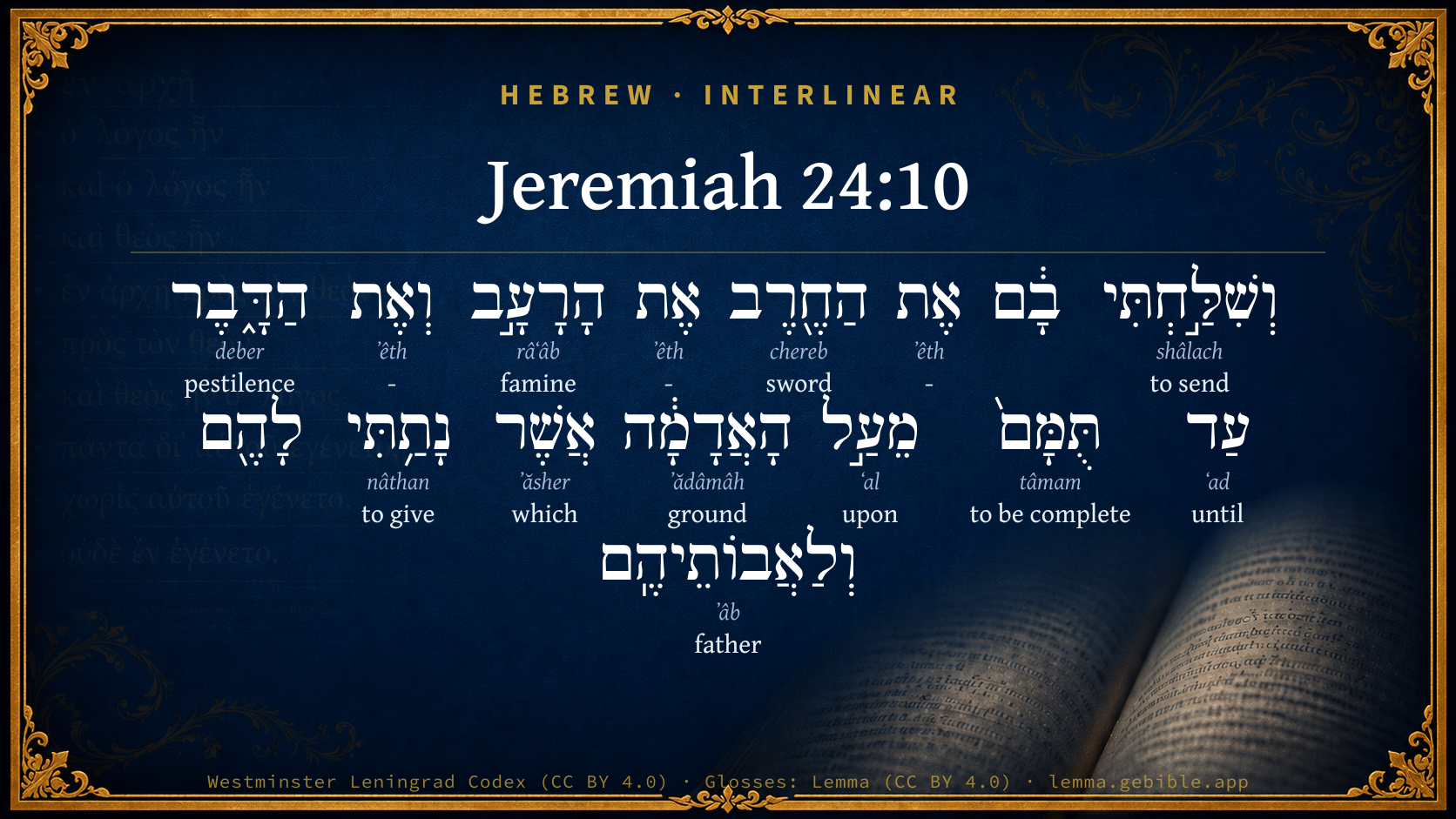
  1. וְשִׁלַּ֣חְתִּי shâlach H7971 “and · to send” Conjunction + Verb, Piel, Sequential Perfect, 1st Person, Common, Singular
  2. אֶת ʼêth H853 “-” Particle, Direct Object
  3. הַחֶ֖רֶב chereb H2719 “the · sword” Particle, Definite Article + Noun, Common, Feminine, Singular, Absolute
  4. אֶת ʼêth H853 “-” Particle, Direct Object
  5. הָרָעָ֣ב râʻâb H7458 “the · famine” Particle, Definite Article + Noun, Common, Masculine, Singular, Absolute
  6. וְאֶת ʼêth H853 “and · -” Conjunction + Particle, Direct Object
  7. עַד ʻad H5704 “until” Preposition
  8. תֻּמָּם֙ tâmam H8552 “to be complete · them” Verb, Qal, Infinitive Construct + Suffix, Personal, 3rd Person, Masculine, Plural
  9. מֵעַ֣ל ʻal H5921 “from · upon” Preposition + Preposition
  10. הָאֲדָמָ֔ה ʼădâmâh H127 “the · ground” Particle, Definite Article + Noun, Common, Feminine, Singular, Absolute
  11. אֲשֶׁר ʼăsher H834 “which” Particle, Relative
  12. נָתַ֥תִּי nâthan H5414 “to give” Verb, Qal, Perfect, 1st Person, Common, Singular
  13. וְלַאֲבוֹתֵיהֶֽם ʼâb H1 “and · to/for · fathers · their” Conjunction + Preposition + Noun, Common, Masculine, Plural, Construct + Suffix, Personal, 3rd Person, Masculine, Plural

About this verse

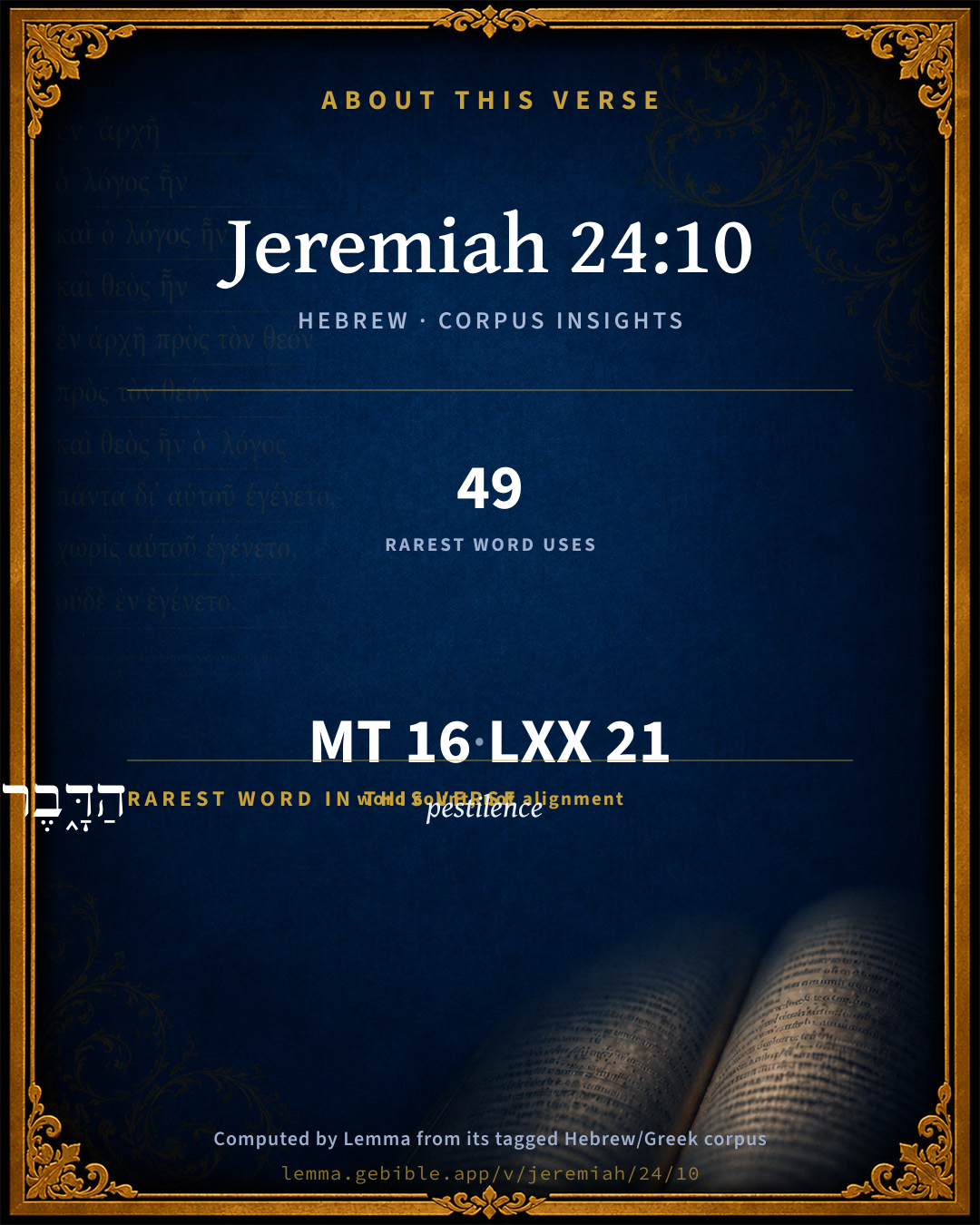
These counts appear in no published source. They are computed here, from the morphology-tagged text and Lemma’s own curated glosses. What Lemma adds →

16
words
12
distinct lemmas
Prophets
section

Shared distinctive vocabulary

הַדָּ֑בֶר pestilence H1698 occurs in 48 verses of the Hebrew Bible. Also found in:

Grammatical profile

  • 3 verbs
  • 5 nouns
  • 4 prepositions
  • 4 particles

Verb forms

  • וְשִׁלַּ֣חְתִּי Piel · Sequential Perfect
  • תֻּמָּם֙ Qal · Infinitive Construct
  • נָתַ֥תִּי Qal · Perfect

Hebrew & Septuagint length

In the original languages it is 16 Hebrew tokens and 21 Greek tokens — but the two are counted differently (Hebrew bundles its prefixes and suffixes into one token; the Greek is in lemma form), so that isn’t a like-for-like length.

Cross-references

14

Topical passages linked to Jeremiah 24:10 in the Treasury of Scripture Knowledge — connected by theme and wording, ordered by reader-vote popularity; previews shown in the World English Bible.

  • Isaiah 51:19 These two things have happened to you. Who will bemoan you? Desolation and destruction, and the famine and the sword; how shall I comfort you?
  • Jeremiah 19:7 I will make void the counsel of Judah and Jerusalem in this place; and I will cause them to fall by the sword before their enemies, and by the hand of those who seek their life: and their dead bodies will I give to be food for the birds of the sky, and for the animals of the earth.
  • Ezekiel 5:12–17 A third part of you shall die with the pestilence, and with famine shall they be consumed in the midst of you; and a third part shall fall by the sword round about you; and a third part I will scatter to all the winds, and will draw out a sword after them.
  • Jeremiah 5:12 They have denied Yahweh, and said, It is not he; neither shall evil come on us; neither shall we see sword nor famine:
  • Jeremiah 9:16 I will scatter them also among the nations, whom neither they nor their fathers have known; and I will send the sword after them, until I have consumed them.
  • Jeremiah 14:15–16 Therefore thus says Yahweh concerning the prophets who prophesy in my name, and I didn't send them, yet they say, Sword and famine shall not be in this land: By sword and famine shall those prophets be consumed.
  • Jeremiah 15:2 It shall happen, when they tell you, Where shall we go forth? then you shall tell them, Thus says Yahweh: Such as are for death, to death; and such as are for the sword, to the sword; and such as are for the famine, to the famine; and such as are for captivity, to captivity.
  • Jeremiah 16:4 They shall die grievous deaths: they shall not be lamented, neither shall they be buried; they shall be as dung on the surface of the ground; and they shall be consumed by the sword, and by famine; and their dead bodies shall be food for the birds of the sky, and for the animals of the earth.
  • Jeremiah 27:8 It shall happen, that the nation and the kingdom which will not serve the same Nebuchadnezzar king of Babylon, and that will not put their neck under the yoke of the king of Babylon, that nation will I punish, says Yahweh, with the sword, and with the famine, and with the pestilence, until I have consumed them by his hand.
  • Jeremiah 34:17 Therefore thus says Yahweh: you have not listened to me, to proclaim liberty, every man to his brother, and every man to his neighbor: behold, I proclaim to you a liberty, says Yahweh, to the sword, to the pestilence, and to the famine; and I will make you to be tossed back and forth among all the kingdoms of the earth.
  • Ezekiel 6:12–14 He who is far off shall die of the pestilence; and he who is near shall fall by the sword; and he who remains and is besieged shall die by the famine: thus will I accomplish my wrath on them.
  • Ezekiel 7:15 The sword is outside, and the pestilence and the famine within: he who is in the field shall die with the sword: and he who is in the city, famine and pestilence shall devour him.
  • Ezekiel 14:12–21 The word of Yahweh came to me, saying,
  • Ezekiel 33:27 Thus shall you tell them, Thus says the Lord Yahweh: As I live, surely those who are in the waste places shall fall by the sword; and him who is in the open field will I give to the animals to be devoured; and those who are in the strongholds and in the caves shall die of the pestilence.

Cross-references courtesy of OpenBible.info (CC BY 4.0).

Hebrew and Greek witnesses Masoretic Hebrew ↔ Greek Septuagint

The same verse in the two great witnesses to the Old Testament, shown verse-for-verse.

These are two independent witnesses, not word-aligned to each other, and the Septuagint is shown in lemma (dictionary) form.

Hebrew Jeremiah 24:10 Masoretic · Westminster Leningrad Codex

וְשִׁלַּ֣חְתִּי בָ֔ם אֶת הַחֶ֖רֶב אֶת הָרָעָ֣ב וְאֶת הַדָּ֑בֶר עַד תֻּמָּם֙ מֵעַ֣ל הָאֲדָמָ֔ה אֲשֶׁר נָתַ֥תִּי לָהֶ֖ם וְלַאֲבוֹתֵיהֶֽם

I will send the sword, the famine, and the pestilence, among them, until they be consumed from off the land that I gave to them and to their fathers.

World English Bible · Public Domain

Greek LXX Structure differs

In the Septuagint, Jeremiah is about an eighth shorter than the Hebrew and arranges its material differently — the Oracles Against the Nations (Hebrew chapters 46–51) appear in the middle of the Greek book, after 25:13. Because the chapter and verse boundaries do not line up, a verse-for-verse comparison with the Hebrew is not shown.

A verse-for-verse comparison isn’t shown here because the chapters and verses don’t line up. Switch to the LXX edition with the MT / LXX toggle above to read the Greek directly.

Hebrew: Westminster Leningrad Codex (CC BY 4.0). Greek: Septuagint (public domain); English from a public-domain English Septuagint. How the Septuagint differs from the Hebrew →

Targum (Aramaic paraphrase)

1

The Targum is the ancient Jewish Aramaic paraphrase of the Hebrew Scriptures — an interpretive translation, not the Hebrew text itself. Onkelos (literal) and Pseudo-Jonathan (expansive) render the Torah, and Jonathan the Prophets. Coverage is partial: where no permissively-licensed English translation exists for a verse, only the Aramaic is shown. This is verse-level text, not a word-by-word alignment to the Hebrew.

  1. Targum Jonathan Prophets (Joshua–Malachi)
    וֶאֱגָרֵי בְהוֹן יַת דְקַטְלִין בְּחַרְבָּא בְּכַפְנָא וּבְמוֹתָא עַד דִיסוּפוּן מֵעַל אַרְעָא דִיהָבֵית לְהוֹן וְלַאֲבָהַתְהוֹן:

    (no public-domain English translation for this verse)

    Targum Jonathan — Aramaic: “Mikraot Gedolot” (public domain). English: “Sefaria Community Translation” (CC0 1.0 (public-domain dedication)); “London "Chaldee Paraphrase," 1871” (public domain). Text via Sefaria.

Commentary

Notes on Jeremiah 24:10 from classic Christian and Jewish commentators (each source and its license shown beneath its notes). The classic Christian expositions comment on the surrounding passage and are grouped to its opening verse, so a note may address several verses; the Jewish commentaries on the Tanakh (Rashi and others) are per-verse, so they appear only where the commentator wrote on this verse.

Lemma curates 59 commentaries, every one of them public domain or Creative Commons licensed, each selected and text-cleaned for this edition rather than reprinted as found. About our sources →

Trapp's Complete Commentary

John Trapp

Jer 24:10 And I will send the sword, the famine, and the pestilence, among them, till they be consumed from off the land that I gave unto them and to their fathers.

Ver. 10. And I will send the sword.] So Jer 14:15; Jer 34:17.

John Trapp, A Commentary or Exposition upon All the Books of the Old and New Testament (1647–1656) — public domain. Text from a community e-Sword module.

Adam Clarke's Commentary

Verse 10. I will send the sword] Many of them fell by sword and famine in the war with the Chaldeans, and many more by such means afterwards. The first received their captivity as a correction, and turned to God; the latter still hardened their hearts more and more, and probably very many of them never returned: perhaps they are now amalgamated with heathen nations. Lord, how long?

Adam Clarke's Commentary on the Bible (1810–1826) — public domain. Text from a community e-Sword/MySword module.

John Calvin's Commentaries

He confirms the former verse, — that God would then with extreme rigor punish them, by allowing the city and the inhabitants who remained, to be given up to the will of their enemies. And Jeremiah still speaks as from the mouth of Moses, that his prophecy might be more weighty, and that he might frighten those men who were so refractory. There are here three kinds of punishments which we often meet with, under which are included all other punishments. But as God for the most part punishes the sins of men by pestilence, or by famine, or by war, he connects these three together when his purpose is to include all kinds of punishment.

He adds, Until they be consumed from the face of the land; he says not “until they be consumed in the land,” but from the face of it, מעל, mol, from upon it: for the Jews were not consumed in their own country; but he consumed them by degrees elsewhere, so that they gradually pined away: they were driven into exile, and that was their final destruction. What this clause means I have explained in another place.

The Prophet adds, which I gave to them and to their fathers. His object here was to shake off from the Jews that foolish confidence with which they were inebriated: for as they had heard of the land in which they dwelt, that it was the rest of God, and as they knew that it had been given to them by an hereditary right, according to what had been promised to their fathers, they thought that it could never be taken away from them. They therefore became torpid in their sins, as though God was bound to them. The Prophet ridicules this folly by saying, that the promise and favor of God would not prevent him from depriving them of the land and of its possession, and from rejecting them as though they were aliens, notwithstanding the fact, that he had formerly adopted them as his children.

We now see the meaning of both parts of this vision. For the Prophet wished to alleviate the sorrow of the exiles when he said, that their state at length would be better; and so he promised that God would be reconciled to them after having for a time chastised them. Thus it is no small comfort to us when we regard the end; for as the Apostle says to the Hebrews, when we feel the scourges of God, sorrow is a hinderance to a patient suffering, as chastisement is for the present grievous, bitter, and difficult to be endured. (Hebrews 12:11.) It is therefore necessary, if we would patiently submit to God, to have regard to the issue: for until the sinner begins to taste of God’s grace and mercy, he will fret and murmur, or he will be stupid and hardened; and certainly he will receive no comfort. Afterwards the Prophet shews, on the other hand, that though God may spare us for a time, there is yet no reason for us to indulge ourselves, for he will at length make up for the delay by the heaviness of his punishment: the more indulgently he deals with us, the more grievous and dreadful will be his vengeance, when he sees that we have abused his forbearance. Now follows —

John Calvin's Commentaries (1540-1563) — public domain. Text from the Calvin Translation Society English edition (1840s-50s) via the Christian Classics Ethereal Library (ccel.org). Calvin's coverage is partial (roughly two-thirds of the Bible); uncommented books and verses are honest gaps, never fabricated. The 19th-century editor's footnotes and remarks are omitted so the notes are faithfully Calvin's own voice.

Ellicott's Commentary for English Readers

(10) The sword, the famine, and the pestilence.—The three forms of suffering are grouped together, as in Jer_14:12 and Eze_14:21. The two latter followed almost inevitably in the wake of the first.

A Bible Commentary for English Readers, edited by Charles John Ellicott (1878–1897) — public domain. Text from a community e-Sword module.

The Cambridge Bible for Schools and Colleges

gen. ed. J. J. S. Perowne

10. The fresh captivity shall be preceded by the same horrors as before (see on Jer_15:2). Those who are represented by the evil figs were thus, still dwelling in the land, to be wasted by famine, pestilence, and sword, while the nation should thenceforward have representatives living in disgrace and exile throughout “the kingdoms.”

The Cambridge Bible for Schools and Colleges (gen. ed. J. J. S. Perowne; Cambridge University Press, 1878–1918) — public domain. Text from a community e-Sword module.

Matthew Poole's English Annotations

Many of them shall not live to be carried into captivity, but shall die miserably in their own land, if not by the enemies’ sword, yet by the famine and the pestilence, which two things ordinarily attend long sieges. By one of these three sore judgments of God they shall be consumed out of the land, and shall not hold it by the title of God’s gift of it

to their fathers. No gifts of God, except those of special grace, are perpetuities; but either given quamdiu bene se gesserint, so long as men behave themselves well in the use of them; or durante bene placito, during God’s good will and pleasure.

Matthew Poole's English Annotations on the Holy Bible (1683–1685) — public domain. Text from a community e-Sword/MySword module.

The Pulpit Commentary

Sword, famine, and pestilence.

I TROUBLE BEGETS TROUBLE. War devastating the fields, checking industry, robbing stores, etc., leads to famine; famine and war create horrible causes of pestilence. Trouble does not tend to relieve itself, but the reverse. The poor become poorer, the wretched more miserable. Hence the need of a salvation outside ourselves.

II TROUBLE IS CUMULATIVE. The full force is not often felt at first. One by one the blows fell upon Job. Thus each is felt most acutely. Though we can bear present calamities unaided, we still need a refuge for the future.

III TROUBLE IS VARIOUS IN FORM sword, famine, pestilence. If we are not touched by one kind of trouble, we may fall under another. Of what avail is it to escape the sword, only to perish of the pangs of hunger or to fall a victim to the ravages of pestilence? Future punishment will probably be various in kind, yet so adapted to all varieties of character and condition that none of the impenitent will be able to escape.

IV TROUBLE MUST BE CONQUERED BY REDEMPTION, NOT EVADED BY FLIGHT, We may flee from some trouble, but cannot from all. When this is judicial it is searching and penetrating, so that none can elude it. It is vain to rest in the assurance that we have been able to devise means for resisting many troubles. The army of them is so vast that no victory over scattered detachments can affect our ultimate condition. This fact should not induce despair, but urge us to turn to the full deliverance of Christ"s redemption. (Rom_8:1)

The Pulpit Commentary (1880–1919), ed. H.D.M. Spence-Jones & Joseph S. Exell — public domain. Text from a community e-Sword module.

Lesson kit

Teaching starters — assembled from the data on this page, not authored interpretation. Every prompt links to the verse data it draws on. Edit before teaching.

Jeremiah, in the Prophets, opens this verse with 16 words (12 distinct Hebrew lemmas). Its most distinctive word is deber (“pestilence”). A historical commentator’s framing appears above. Read the whole chapter for the surrounding context.

Discussion questions

  1. What does “pestilence” (deber) contribute to the verse as a whole?
  2. Exodus 5:3 shares the word «pestilence» with this verse. How do the two illuminate each other?
  3. These translations render this verse differently; the difference is in the English rendering, not the original. What questions does that raise?
  4. The verb «וְשִׁלַּ֣חְתִּי» is Piel Sequential Perfect. How does its form color the action?
  5. Reading how Trapp's Complete Commentary and Adam Clarke's Commentary read this verse, where do the two commentators agree and where do they part?

Things to notice

Reading settings

Reading text

Shown beneath each verse's original-language words.

Old Testament
Old Testament edition

Read the OT as the Masoretic Hebrew (MT) or the Greek Septuagint (LXX).

English shown for the Greek Septuagint (in the Hebrew ↔ Greek comparison).

Comparing translations? Open the Compare panel on any verse page to stack up to four side by side.