
Deuteronomy 6:15

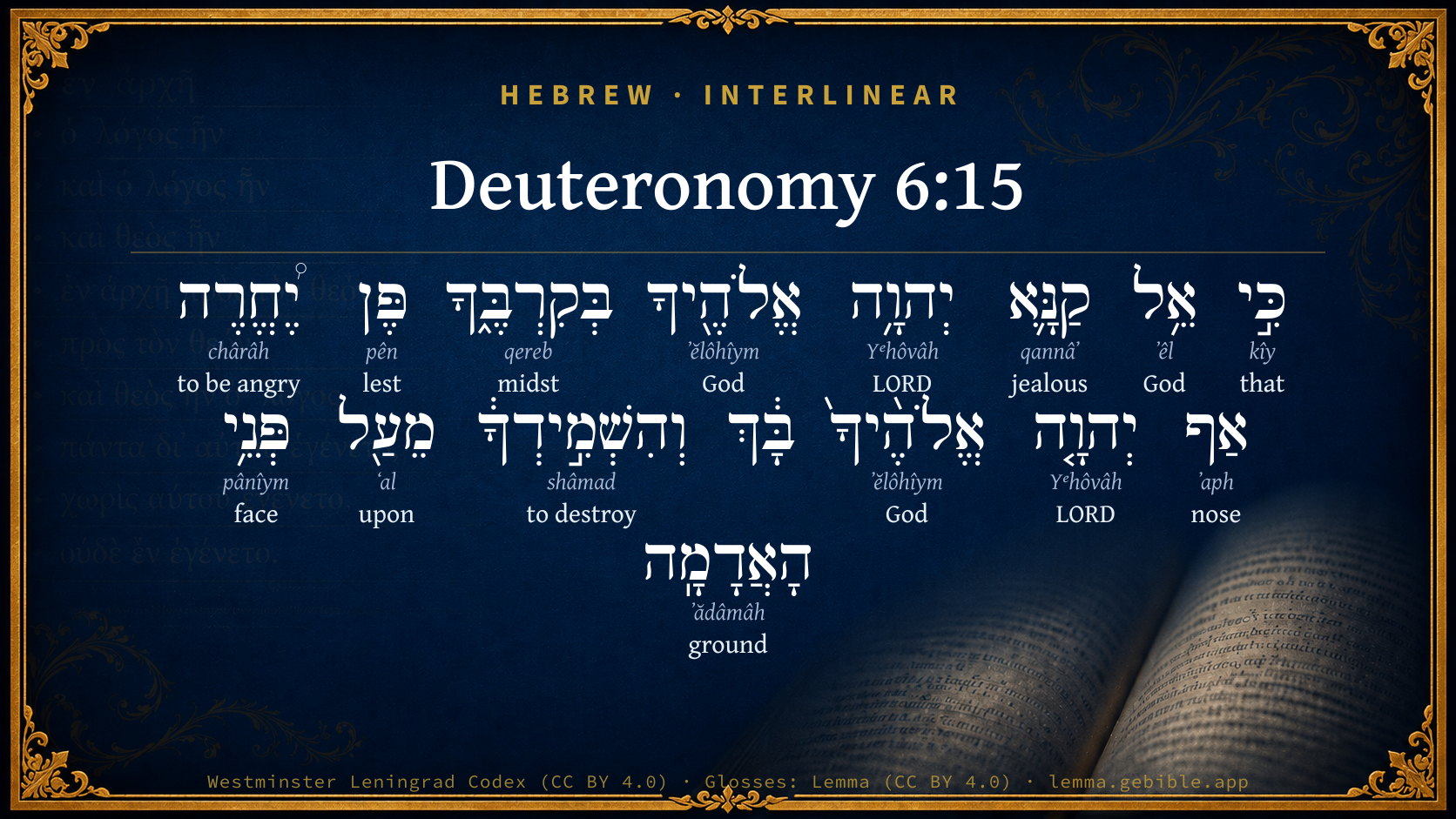
Hebrew (Westminster Leningrad Codex) Deuteronomy 6:15 appears in the Hebrew Old Testament. The text above is from the Westminster Leningrad Codex. Each word links to its Strong’s number, a concise gloss, and parsing drawn from the Open Scriptures Hebrew Bible morphology. Click any word for its full Brown-Driver-Briggs (BDB) entry.
Download image
Cite this verse

Deuteronomy 6:15 (World English Bible). Public Domain. Lemma interlinear Bible study tool, https://lemma.gebible.app/v/deuteronomy/6/15.

Show BibTeX & RIS
BibTeX
RIS
English Translation
for Yahweh your God in the midst of you is a jealous God; lest the anger of Yahweh your God be kindled against you, and he destroy you from off the face of the earth.
World English Bible · Public Domain
Download a study sheet

One document with this verse’s original text, its word-by-word gloss line, the meaning frame, cross-references with their text, attributed commentary, and full source and license credits — printable, and it pastes into notes with its structure intact.

This verse Autodidact and up

Study sheet (.html) Plain text (.txt)

A passage Seminary Student

Up to 50 verses in one chapter. A passage sheet keeps up to 6 commentary sources and 12 cross-references per verse, in the order this page ranks them, and says so on the sheet whenever that leaves anything out. Ask for a single verse and you get the Autodidact verse sheet above.

Everything on this page stays free to read, with no account — the sheet is a download of what is already on screen, not access to it.

Want to remove ads? Support Godless Engineer
Compare translations 3

The same verse in 3 English versions, stacked beneath the original-language interlinear above. Click any original word for its lexicon entry.

Each is an independent rendering of the whole verse — the interlinear is not word-aligned to these translations.

Highlighted words mark where these versions differ — a whole-verse word diff, not a word-by-word alignment.

  • World English Bible Public Domain
    for Yahweh your God in the midst of you is a jealous God; lest the anger of Yahweh your God be kindled against you, and he destroy you from off the face of the earth.
  • King James Version Public Domain
    (For the LORD thy God is a jealous God among you) lest the anger of the LORD thy God be kindled against thee, and destroy thee from off the face of the earth.
  • unfoldingWord Literal Text CC BY-SA 4.0
    for Yahweh your God in your midst a jealous God, lest the nose of Yahweh your God burn against you, and he destroy you from the face of the earth.

unfoldingWord Literal Text — © unfoldingWord, licensed CC BY-SA 4.0. Word-aligned USFM3 via Door43 (git.door43.org/unfoldingWord/en_ult).

Versions to compare (up to 4)

3 of 4 selected

Show all 18 translations

Every available English version of this verse, each an independent rendering of the whole verse.

  • World English Bible Public Domain
    for Yahweh your God in the midst of you is a jealous God; lest the anger of Yahweh your God be kindled against you, and he destroy you from off the face of the earth.
  • Berean Standard Bible Public Domain
    For the LORD your God, who is among you, is a jealous God. Otherwise the anger of the LORD your God will be kindled against you, and He will wipe you off the face of the earth.
  • Majority Standard Bible Public Domain
    For the LORD your God, who is among you, is a jealous God. Otherwise the anger of the LORD your God will be kindled against you, and He will wipe you off the face of the earth.
  • King James Version Public Domain
    (For the LORD thy God is a jealous God among you) lest the anger of the LORD thy God be kindled against thee, and destroy thee from off the face of the earth.
  • American Standard Version (1901) Public Domain
    for Jehovah thy God in the midst of thee is a jealous God; lest the anger of Jehovah thy God be kindled against thee, and he destroy thee from off the face of the earth.
  • Revised Version (1885) Public Domain
    for the LORD thy God in the midst of thee is a jealous God; lest the anger of the LORD thy God be kindled against thee, and he destroy thee from off the face of the earth.
  • Geneva Bible (1599) Public Domain
    (For the Lord thy God is a ielous God among you:) least the wrath of the Lord thy God be kindled against thee, and destroy thee from the face of the earth.
  • Douay-Rheims (1899) Public Domain
    Because the Lord thy God is a jealous God in the midst of thee: lest at any time the wrath of the Lord thy God be kindled against thee, and take thee away from the face of the earth.
  • Young's Literal Translation Public Domain
    for a zealous God `is' Jehovah thy God in thy midst -- lest the anger of Jehovah thy God burn against thee, and He hath destroyed thee from off the face of the ground.
  • Literal Standard Version CC BY-SA 4.0
    for your God YHWH [is] a zealous God in your midst—lest the anger of your God YHWH burns against you, and He has destroyed you from off the face of the ground.
  • Unlocked Literal Bible CC BY-SA 4.0
    for Yahweh your God in the midst of you is a jealous God—if you do, the anger of Yahweh your God will be kindled against you and he will destroy you from the surface of the earth.
  • unfoldingWord Literal Text CC BY-SA 4.0
    for Yahweh your God in your midst a jealous God, lest the nose of Yahweh your God burn against you, and he destroy you from the face of the earth.
  • Darby Bible Public Domain
    for Jehovah thy God is a jealous ùGod in thy midst; lest the anger of Jehovah thy God be kindled against thee, and he destroy thee from the face of the earth.
  • World Messianic Bible Public Domain
    for the LORD your God among you is a jealous God, lest the anger of the LORD your God be kindled against you, and he destroy you from off the face of the earth.
  • Webster's Bible Public Domain
    (For the LORD thy God is a jealous God among you) lest the anger of the LORD thy God should be kindled against thee, and destroy thee from off the face of the earth.
  • Free Bible Version CC BY-SA 4.0
    because the Lord your God, who lives among you, is an exclusive God, and the Lord your God will become angry with you, and he will wipe you out.
  • Bible in Basic English Public Domain
    For the Lord your God who is with you is a God who will not let his honour be given to another; or the wrath of the Lord will be burning against you, causing your destruction from the face of the earth.
  • JPS Tanakh (1917) Public Domain
    for a jealous God, even the LORD thy God, is in the midst of thee; lest the anger of the LORD thy God be kindled against thee, and He destroy thee from off the face of the earth.

Literal Standard Version (2020), Covenant Press — licensed CC BY-SA 4.0. Text via the HelloAO Bible API (eBible.org). Unlocked Literal Bible (unfoldingWord) — licensed CC BY-SA 4.0. Text via the HelloAO Bible API (eBible.org). unfoldingWord Literal Text — © unfoldingWord, licensed CC BY-SA 4.0. Word-aligned USFM3 via Door43 (git.door43.org/unfoldingWord/en_ult). Free Bible Version, Dr. Jonathan Gallagher — licensed CC BY-SA 4.0. Text via the HelloAO Bible API (eBible.org).

Word by word

More ways to search: Search by grammar → Find every occurrence → Compare this word →

Practice this passage: Drill this verse → Learn its vocabulary →

קַנָּ֛א
qannâʼ
H7067
“jealous”
Adjective, Adjective, Masculine, Singular, Absolute
Part of Speech
Adjective
Type
Adjective
Gender
Masculine
Number
Singular
State
Absolute
Full BDB Definition

Origin: from H7065

TWOT: 2038b

jealous (only of God)
  1. כִּ֣י kîy H3588 “that” Conjunction
  2. אֵ֥ל ʼêl H410 “God” Noun, Common, Masculine, Singular, Absolute
  3. יְהוָ֥ה Yᵉhôvâh H3068 “LORD” Noun, Proper
  4. אֱלֹהֶ֖יךָ ʼĕlôhîym H430 “God(s) · your” Noun, Common, Masculine, Plural, Construct + Suffix, Personal, 2nd Person, Masculine, Singular
  5. בְּקִרְבֶּ֑ךָ qereb H7130 “in/at · midst · your” Preposition + Noun, Common, Masculine, Singular, Construct + Suffix, Personal, 2nd Person, Masculine, Singular
  6. פֶּן pên H6435 “lest” Conjunction
  7. יֶ֠חֱרֶה chârâh H2734 “to be angry” Verb, Qal, Imperfect, 3rd Person, Masculine, Singular
  8. אַף ʼaph H639 “nose” Particle, Accusative
  9. יְהוָ֤ה Yᵉhôvâh H3068 “LORD” Noun, Proper
  10. אֱלֹהֶ֨יךָ֙ ʼĕlôhîym H430 “God(s) · your” Noun, Common, Masculine, Plural, Construct + Suffix, Personal, 2nd Person, Masculine, Singular
  11. וְהִשְׁמִ֣ידְךָ֔ shâmad H8045 “and · to destroy · you” Conjunction + Verb, Hiphil, Sequential Perfect, 3rd Person, Masculine, Singular + Suffix, Personal, 2nd Person, Masculine, Singular
  12. מֵעַ֖ל ʻal H5921 “from · upon” Preposition + Preposition
  13. פְּנֵ֥י pânîym H6440 “face(s) of” Noun, Common, Both, Plural, Construct
  14. הָאֲדָמָֽה ʼădâmâh H127 “the · ground” Particle, Definite Article + Noun, Common, Feminine, Singular, Absolute

About this verse

These counts appear in no published source. They are computed here, from the morphology-tagged text and Lemma’s own curated glosses. What Lemma adds →

16
words
13
distinct lemmas
Pentateuch
section

Notable vocabulary

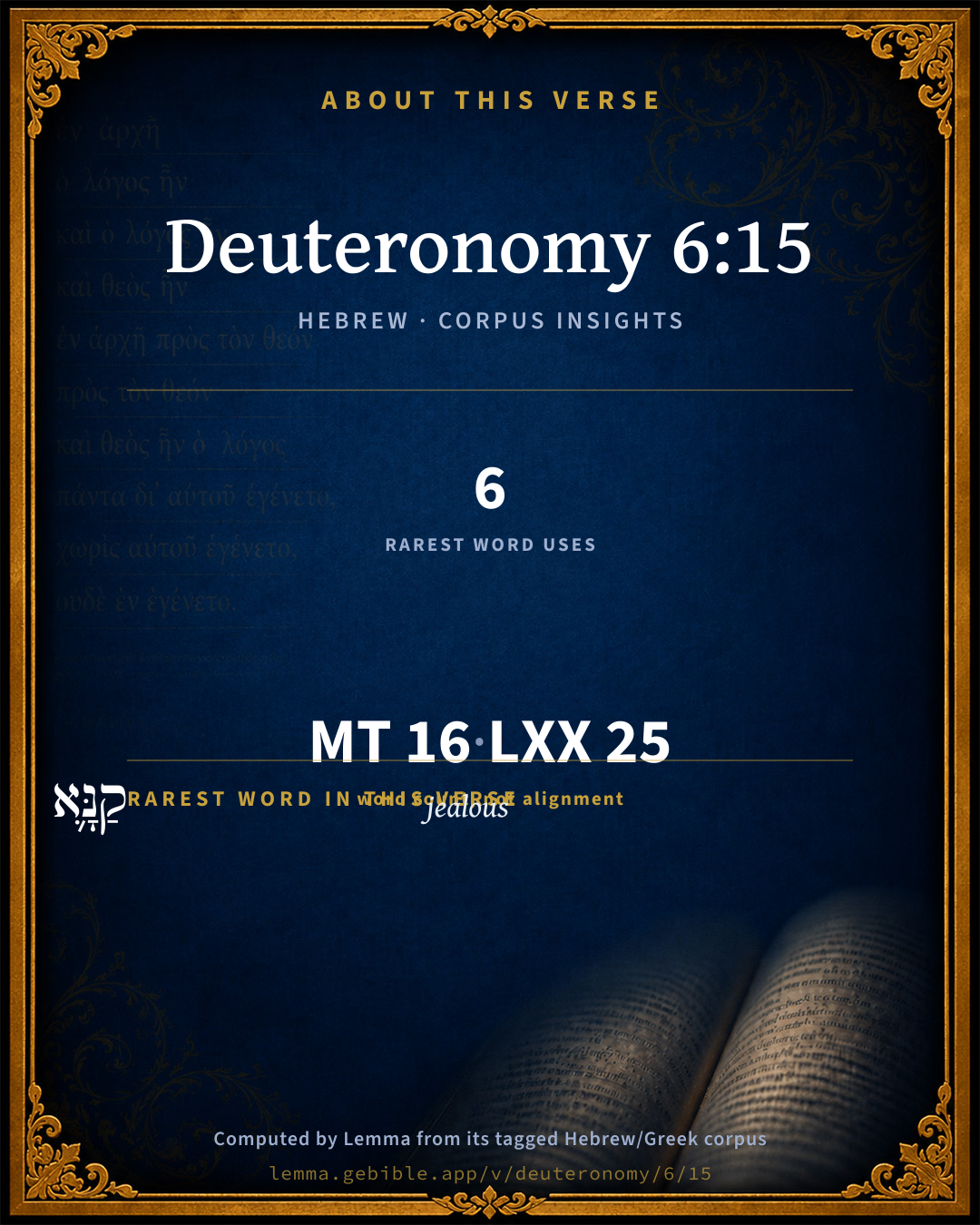
The rarest word here is קַנָּ֛א jealous H7067 — appearing just 6 times in the whole Hebrew Bible.

Shared distinctive vocabulary

קַנָּ֛א jealous H7067 occurs in 5 verses of the Hebrew Bible. Also found in:

Grammatical profile

  • 2 verbs
  • 8 nouns
  • 1 adjective
  • 2 prepositions
  • 2 conjunctions
  • 1 particle

Verb forms

  • יֶ֠חֱרֶה Qal · Imperfect
  • וְהִשְׁמִ֣ידְךָ֔ Hiphil · Sequential Perfect

Repetition

Words recur within this verse — often emphatic in Hebrew:

  • יְהוָ֥ה LORD H3068 ×2
  • אֱלֹהֶ֖יךָ God H430 ×2

Hebrew & Septuagint length

In English translation the verse runs 35 words from the Hebrew and 34 from the Septuagint (LXX English) — closely comparable.

A rough comparison of the two English renderings, which tokenize alike — not a word-level alignment.

Word counts can differ between the Hebrew and the Greek without any difference in meaning — e.g. the Hebrew direct-object marker אֵת has no separate Greek word, and Greek often adds the article ὁ.

In the original languages it is 16 Hebrew tokens and 25 Greek tokens — but the two are counted differently (Hebrew bundles its prefixes and suffixes into one token; the Greek is in lemma form), so that isn’t a like-for-like length.

Cross-references

15

Topical passages linked to Deuteronomy 6:15 in the Treasury of Scripture Knowledge — connected by theme and wording, ordered by reader-vote popularity; previews shown in the World English Bible.

  • Deuteronomy 4:24 For Yahweh your God is a devouring fire, a jealous God.
  • Exodus 20:5 you shall not bow yourself down to them, nor serve them, for I, Yahweh your God, am a jealous God, visiting the iniquity of the fathers on the children, on the third and on the fourth generation of those who hate me,
  • Deuteronomy 7:4 For he will turn away your son from following me, that they may serve other gods: so will the anger of Yahweh be kindled against you, and he will destroy you quickly.
  • Deuteronomy 11:17 and the anger of Yahweh be kindled against you, and he shut up the sky, so that there shall be no rain, and the land shall not yield its fruit; and you perish quickly from off the good land which Yahweh gives you.
  • Genesis 7:4 In seven days, I will cause it to rain on the earth for forty days and forty nights. Every living thing that I have made, I will destroy from the surface of the ground."
  • Exodus 32:12 Why should the Egyptians speak, saying, 'He brought them forth for evil, to kill them in the mountains, and to consume them from the surface of the earth?' Turn from your fierce wrath, and repent of this evil against your people.
  • Numbers 32:10–15 Yahweh's anger was kindled in that day, and he swore, saying,
  • Deuteronomy 5:9 you shall not bow down yourself to them, nor serve them; for I, Yahweh, your God, am a jealous God, visiting the iniquity of the fathers on the children, and on the third and on the fourth generation of those who hate me;
  • 1 Kings 13:34 This thing became sin to the house of Jeroboam, even to cut it off, and to destroy it from off the surface of the earth.
  • 2 Chronicles 36:16 but they mocked the messengers of God, and despised his words, and scoffed at his prophets, until the wrath of Yahweh arose against his people, until there was no remedy.
  • Psalms 90:7 For we are consumed in your anger. We are troubled in your wrath.
  • Psalms 90:11 Who knows the power of your anger, Your wrath according to the fear that is due to you?
  • Amos 3:2 "You only have I chosen of all the families of the earth. Therefore I will punish you for all of your sins."
  • Amos 9:8 Behold, the eyes of the Lord Yahweh are on the sinful kingdom, and I will destroy it from off the surface of the earth; except that I will not utterly destroy the house of Jacob," says Yahweh.
  • 1 Corinthians 10:22 Or do we provoke the Lord to jealousy? Are we stronger than he?

Cross-references courtesy of OpenBible.info (CC BY 4.0).

Hebrew and Greek witnesses Masoretic Hebrew ↔ Greek Septuagint

The same verse in the two great witnesses to the Old Testament, shown verse-for-verse.

These are two independent witnesses, not word-aligned to each other, and the Septuagint is shown in lemma (dictionary) form.

Hebrew Deuteronomy 6:15 Masoretic · Westminster Leningrad Codex

כִּ֣י אֵ֥ל קַנָּ֛א יְהוָ֥ה אֱלֹהֶ֖יךָ בְּקִרְבֶּ֑ךָ פֶּן יֶ֠חֱרֶה אַף יְהוָ֤ה אֱלֹהֶ֨יךָ֙ בָּ֔ךְ וְהִשְׁמִ֣ידְךָ֔ מֵעַ֖ל פְּנֵ֥י הָאֲדָמָֽה

for Yahweh your God in the midst of you is a jealous God; lest the anger of Yahweh your God be kindled against you, and he destroy you from off the face of the earth.

World English Bible · Public Domain

Greek LXX Deuteronomy 6:15 Septuagint · lemma form

ὅτι θεός ζηλωτής κύριος ὁ θεός σύ ἐν σύ μή ὀργίζω θυμόω κύριος ὁ θεός σύ ἐν σύ καί ἐκὀλεθρεύω σύ ἀπό πρόσωπον ὁ γῆ

for the Lord your God in the midst of you is a jealous God, lest the Lord your God be very angry with you, and destroy you from off the face of the earth.

LXX2012 (modern English Septuagint) · Public Domain

Hebrew: Westminster Leningrad Codex (CC BY 4.0). Greek: Septuagint (public domain); English from LXX2012 (modern English Septuagint) (Public Domain). How the Septuagint differs from the Hebrew →

Targum (Aramaic paraphrase)

2

The Targum is the ancient Jewish Aramaic paraphrase of the Hebrew Scriptures — an interpretive translation, not the Hebrew text itself. Onkelos (literal) and Pseudo-Jonathan (expansive) render the Torah, and Jonathan the Prophets. Coverage is partial: where no permissively-licensed English translation exists for a verse, only the Aramaic is shown. This is verse-level text, not a word-by-word alignment to the Hebrew.

  1. Targum Onkelos Torah (Genesis–Deuteronomy)
    אֲרֵי אֵל קַנָא יְיָ אֱלָהָךְ שְׁכִנְתֵּהּ בֵּינָךְ דִילְמָא יִתְקֵף רָגְזָא דַיְיָ אֱלָהָךְ בָּךְ וִישֵׁצָךְ מֵעַל אַפֵּי אַרְעָא

    (no public-domain English translation for this verse)

    Targum Onkelos — Aramaic: “Onkelos Genesis” (public domain); “Onkelos Exodus” (public domain); “Onkelos Leviticus” (public domain); “Onkelos Numbers” (public domain); “Onkelos Deuteronomy” (public domain). English: “Sefaria Community Translation” (CC0 1.0 (public-domain dedication)); “J.W. Etheridge. The Targums of Onkelos and Jonathan Ben Uzziel on the Pentateuch. London: Longmans, Green, 1862” (public domain). Text via Sefaria.

  2. Targum Pseudo-Jonathan Torah (Genesis–Deuteronomy)
    אֲרוּם אֱלָהָא קַנְאָן וּפוּרְעָן יְיָ אֱלָהָכוֹן שְׁכִינְתֵּיהּ שַׁרְיָא בֵּינֵיכוֹן דִּלְמָא יִתְקוֹף רוּגְזָא דַיְיָ אֱלָהָכוֹן בְּכוֹן וִישֵׁיצִינוּךְ בְּסַרְהוֹבַיָא מֵעִילַוֵי אַפֵּי אַרְעָא

    for the Lord our God is a jealous God, and an Avenger, whose Shekinah dwelleth in the midst of you; lest the anger of the Lord your God be kindled against you, and He quickly destroy you from the face of the earth.

    Targum Pseudo-Jonathan — Aramaic: “Targum Jonathan on Genesis” (public domain); “Targum Jonathan on Exodus” (public domain); “Targum Jonathan on Leviticus” (public domain); “Targum Jonathan on Numbers” (public domain); “Targum Jonathan on Deuteronomy” (public domain). English: “The Targum of Jonathan ben Uzziel, trans. J. W. Etheridge, London, 1862” (public domain). Text via Sefaria.

Commentary

Notes on Deuteronomy 6:15 from classic Christian and Jewish commentators (each source and its license shown beneath its notes). The classic Christian expositions comment on the surrounding passage and are grouped to its opening verse, so a note may address several verses; the Jewish commentaries on the Tanakh (Rashi and others) are per-verse, so they appear only where the commentator wrote on this verse.

Lemma curates 59 commentaries, every one of them public domain or Creative Commons licensed, each selected and text-cleaned for this edition rather than reprinted as found. About our sources →

Trapp's Complete Commentary

John Trapp

Deu 6:15 (For the LORD thy God [is] a jealous God among you) lest the anger of the LORD thy God be kindled against thee, and destroy thee from off the face of the earth.

Ver. 15. A jealous God amongst you.] Let the gods of the heathens be good fellows, our God will endure no co-rivals. He is both a jealous God, and is ever amongst us, so that our faults, our furtas, cannot be hid from his eyes. Now he that dares sin, though he know God looks on, is more impudent in sinning than was Absalom, when he spread a tent upon the top of the house, and went in to his father’s concubines in the sight of all Israel and of the sun.

John Trapp, A Commentary or Exposition upon All the Books of the Old and New Testament (1647–1656) — public domain. Text from a community e-Sword module.

Joseph Benson's Commentary

Deu 6:15-17. Is a jealous God among you — Hebrew, In the midst of you; to see and observe all your ways, and your turnings aside to other gods. Ye shall not tempt — Not provoke him, as the following instance explains. Sinners, especially presumptuous sinners, are said to tempt God; that is, to make a trial of God, whether he be so wise as to see their sins, so just, and true, and powerful, as to take vengeance on them, concerning which they are very apt to doubt, because of the present impunity and prosperity of many such persons. Ye shall diligently keep — Negligence will ruin us; but we cannot be saved without diligence.

Joseph Benson's Commentary on the Old and New Testaments (1811–1818) — public domain. Text from a community e-Sword module.

Adam Clarke's Commentary

Verse 15. A jealous God] Jehovah has betrothed you to himself as a bride is to her husband. Do not be unfaithful, else that love wherewith he has now distinguished you shall assume the form of jealousy, and so divorce and consume you.

Adam Clarke's Commentary on the Bible (1810–1826) — public domain. Text from a community e-Sword/MySword module.

Ellicott's Commentary for English Readers

(15) From off the face of the earth.—Literally, of the ground. Absolute extermination is threatened by the fire of His jealousy.

A Bible Commentary for English Readers, edited by Charles John Ellicott (1878–1897) — public domain. Text from a community e-Sword module.

The Cambridge Bible for Schools and Colleges

gen. ed. J. J. S. Perowne

15. in the midst of thee] So Deu_7:21; Deu_23:14 (contr. Deu_1:42). Hosea has the same thought, Hos_11:9, and Jeremiah, Jer_14:9.

a jealous God] As in Deu_4:24, Deu_5:9; see note on Exo_20:5.

lest the anger, etc.] Cp. Deu_7:4, Deu_11:17.

The Cambridge Bible for Schools and Colleges (gen. ed. J. J. S. Perowne; Cambridge University Press, 1878–1918) — public domain. Text from a community e-Sword module.

John Gill's Exposition

For the Lord thy God is a jealous God among you,.... He was near to them, in the midst of them, his tabernacle being placed between their camps; and was a God jealous of his honour and glory in matters of worship, and would resent any affront given him in that way:

lest the anger of the Lord thy God be kindled against thee; there being nothing more apt to stir up his wrath than idolatry:

and destroy thee from off the face of the earth; suffer them to be carried captive out of their own land, and to be scattered among the nations of the world, and be utterly destroyed.

John Gill's Exposition of the Whole Bible (1746–1763) — public domain (CC PDM 1.0). Text via the HelloAO Bible API.

Matthew Poole's English Annotations

Among you, Heb. in the midst of you, to see and observe all your ways and your turnings aside to other gods.

Matthew Poole's English Annotations on the Holy Bible (1683–1685) — public domain. Text from a community e-Sword/MySword module.

John Wesley's Explanatory Notes

Among you - Hebrew. In the midst of you, to see and observe all your ways and your turnings aside to other Gods.

John Wesley, Explanatory Notes Upon the Whole Bible (1754–1765) — public domain. Text via the GEBible commentary corpus.

Lesson kit

Teaching starters — assembled from the data on this page, not authored interpretation. Every prompt links to the verse data it draws on. Edit before teaching.

Deuteronomy, in the Pentateuch, opens this verse with 16 words (13 distinct Hebrew lemmas). Its most distinctive word is qannâʼ (“jealous”). A historical commentator’s framing appears above. Read the whole chapter for the surrounding context.

Discussion questions

  1. The word qannâʼ carries the sense “jealous.” How does it shape the verse?
  2. How does Exodus 20:5, which shares the word «jealous», read alongside this verse?
  3. What does the repetition of “LORD” (2× in this one verse) do in this verse?
  4. These translations render this verse differently. What is at stake in choosing one wording over another?
  5. «יֶ֠חֱרֶה» is a Qal Imperfect verb. How does that grammatical form shape the action described?
  6. Compare how Trapp's Complete Commentary and Joseph Benson's Commentary read this verse. Where do they agree or differ?

Things to notice

Reading settings

Reading text

Shown beneath each verse's original-language words.

Old Testament
Old Testament edition

Read the OT as the Masoretic Hebrew (MT) or the Greek Septuagint (LXX).

English shown for the Greek Septuagint (in the Hebrew ↔ Greek comparison).

Comparing translations? Open the Compare panel on any verse page to stack up to four side by side.